AN INTRODUCTION TO ASQ3 Ages Stages Questionnaires Third


- Slides: 93
AN INTRODUCTION TO ASQ-3™ Ages & Stages Questionnaires®, Third Edition (ASQ-3™) ASQ-3™ and ASQ: SE-2™ Training Materials by J Squires, J Farrell, J Clifford, S Yockelson, E Twombly, and L Potter Copyright © 2016 Brookes Publishing Co. All rights reserved. www. agesandstages. com 1
Training Objectives • Define and discuss benefits of developmental screening • Describe features of ASQ-3 • Score ASQ-3 • Describe ASQ-3 cutoff scores ASQ-3™ and ASQ: SE-2™ Training Materials by J Squires, J Farrell, J Clifford, S Yockelson, E Twombly, and L Potter Copyright © 2016 Brookes Publishing Co. All rights reserved. www. agesandstages. com 2
Training Objectives • Interpret ASQ-3 information in relation to other referral considerations • Understand importance of sensitive communication of screening results • Discuss the process for referring children to appropriate agencies • Discuss appropriate follow-up activities ASQ-3™ and ASQ: SE-2™ Training Materials by J Squires, J Farrell, J Clifford, S Yockelson, E Twombly, and L Potter Copyright © 2016 Brookes Publishing Co. All rights reserved. www. agesandstages. com 3
What is ASQ-3? • Parent- or caregiver-completed screening tools that encourage parent/caregiver involvement • Series of questionnaires for children ages 1 month to 5 ½ years (ASQ-3) • Tool used to accurately identify children at risk for developmental delay ASQ-3™ and ASQ: SE-2™ Training Materials by J Squires, J Farrell, J Clifford, S Yockelson, E Twombly, and L Potter Copyright © 2016 Brookes Publishing Co. All rights reserved. www. agesandstages. com 4
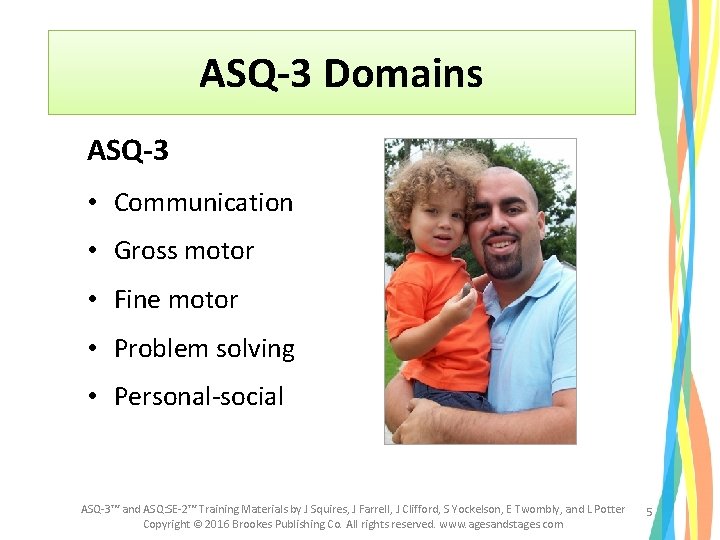
ASQ-3 Domains ASQ-3 • Communication • Gross motor • Fine motor • Problem solving • Personal-social ASQ-3™ and ASQ: SE-2™ Training Materials by J Squires, J Farrell, J Clifford, S Yockelson, E Twombly, and L Potter Copyright © 2016 Brookes Publishing Co. All rights reserved. www. agesandstages. com 5
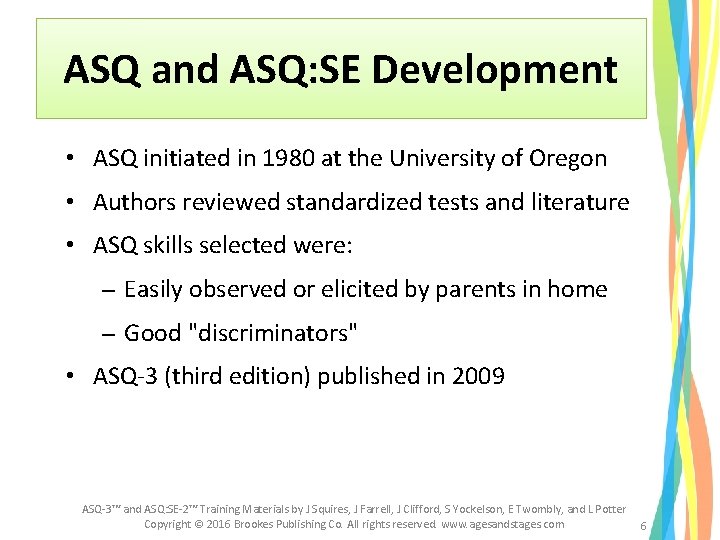
ASQ and ASQ: SE Development • ASQ initiated in 1980 at the University of Oregon • Authors reviewed standardized tests and literature • ASQ skills selected were: – Easily observed or elicited by parents in home – Good "discriminators" • ASQ-3 (third edition) published in 2009 ASQ-3™ and ASQ: SE-2™ Training Materials by J Squires, J Farrell, J Clifford, S Yockelson, E Twombly, and L Potter Copyright © 2016 Brookes Publishing Co. All rights reserved. www. agesandstages. com 6
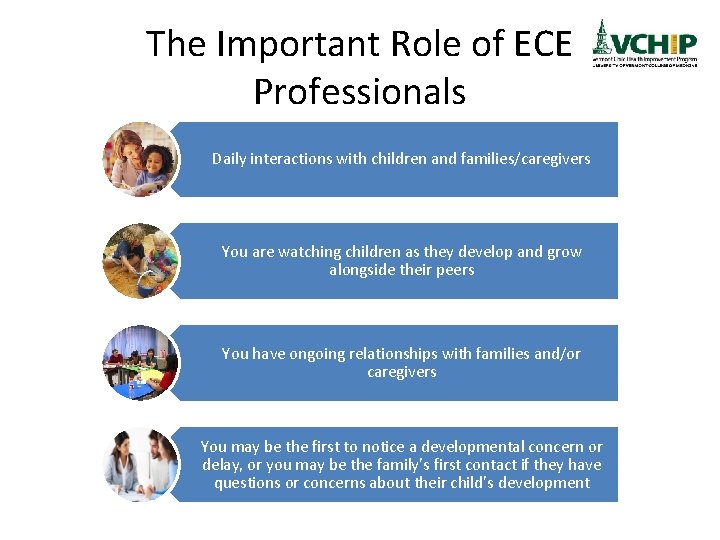
The Important Role of ECE Professionals Daily interactions with children and families/caregivers You are watching children as they develop and grow alongside their peers You have ongoing relationships with families and/or caregivers You may be the first to notice a developmental concern or delay, or you may be the family’s first contact if they have questions or concerns about their child’s development
Why Parent Report? ASQ-3™ and ASQ: SE-2™ Training Materials by J Squires, J Farrell, J Clifford, S Yockelson, E Twombly, and L Potter 8 Copyright © 2016 Brookes Publishing Co. All rights reserved. www. agesandstages. com
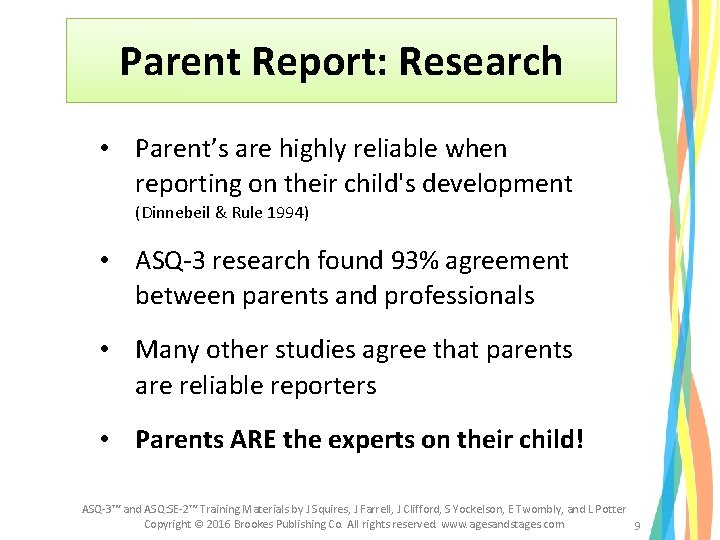
Parent Report: Research • Parent’s are highly reliable when reporting on their child's development (Dinnebeil & Rule 1994) • ASQ-3 research found 93% agreement between parents and professionals • Many other studies agree that parents are reliable reporters • Parents ARE the experts on their child! ASQ-3™ and ASQ: SE-2™ Training Materials by J Squires, J Farrell, J Clifford, S Yockelson, E Twombly, and L Potter Copyright © 2016 Brookes Publishing Co. All rights reserved. www. agesandstages. com 9
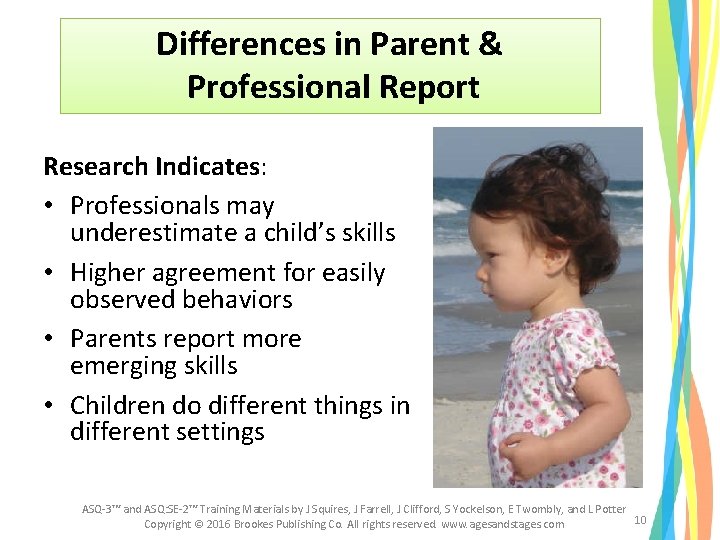
Differences in Parent & Professional Report Research Indicates: • Professionals may underestimate a child’s skills • Higher agreement for easily observed behaviors • Parents report more emerging skills • Children do different things in different settings ASQ-3™ and ASQ: SE-2™ Training Materials by J Squires, J Farrell, J Clifford, S Yockelson, E Twombly, and L Potter 10 Copyright © 2016 Brookes Publishing Co. All rights reserved. www. agesandstages. com
Parental Characteristics that may Affect Accuracy • • • Low literacy Cultural and language differences Impaired mental functioning Mental health issues Involvement with child protective agencies Parents with these characteristics will need different levels of support. ASQ-3™ and ASQ: SE-2™ Training Materials by J Squires, J Farrell, J Clifford, S Yockelson, E Twombly, and L Potter Copyright © 2016 Brookes Publishing Co. All rights reserved. www. agesandstages. com 11
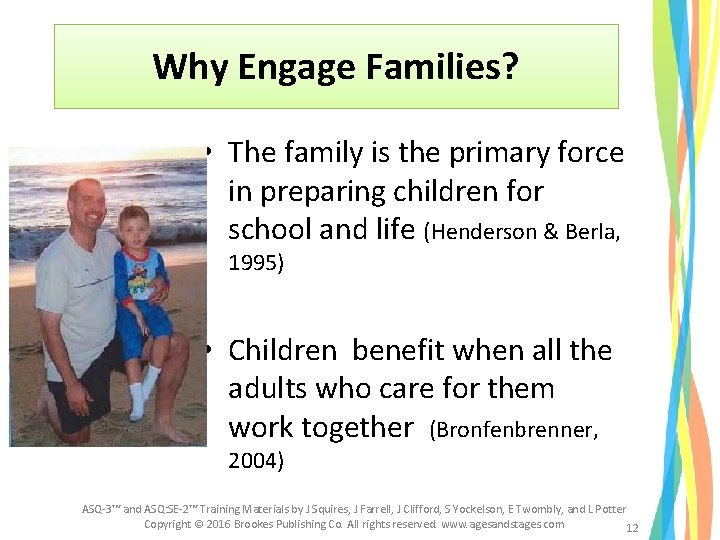
Why Engage Families? • The family is the primary force in preparing children for school and life (Henderson & Berla, 1995) • Children benefit when all the adults who care for them work together (Bronfenbrenner, 2004) ASQ-3™ and ASQ: SE-2™ Training Materials by J Squires, J Farrell, J Clifford, S Yockelson, E Twombly, and L Potter Copyright © 2016 Brookes Publishing Co. All rights reserved. www. agesandstages. com 12
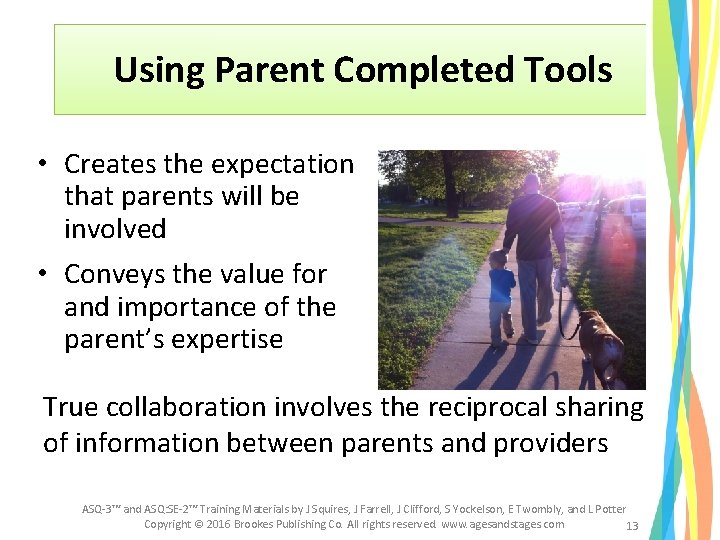
Using Parent Completed Tools • Creates the expectation that parents will be involved • Conveys the value for and importance of the parent’s expertise True collaboration involves the reciprocal sharing of information between parents and providers ASQ-3™ and ASQ: SE-2™ Training Materials by J Squires, J Farrell, J Clifford, S Yockelson, E Twombly, and L Potter Copyright © 2016 Brookes Publishing Co. All rights reserved. www. agesandstages. com 13
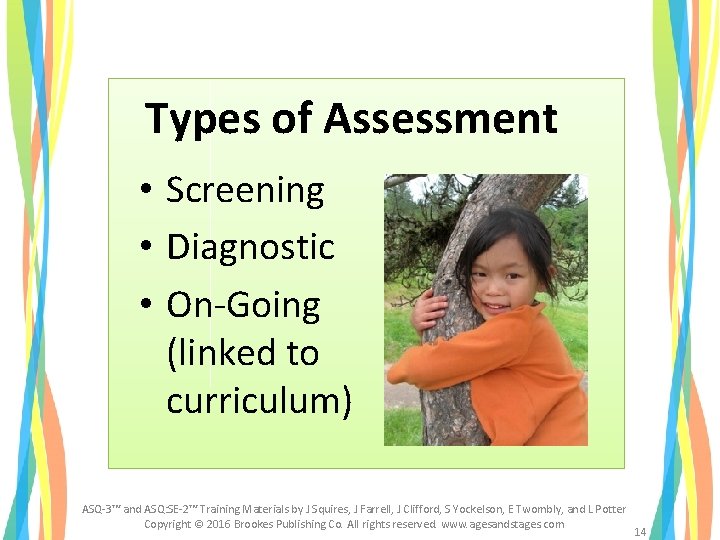
Types of Assessment • Screening • Diagnostic • On-Going (linked to curriculum) ASQ-3™ and ASQ: SE-2™ Training Materials by J Squires, J Farrell, J Clifford, S Yockelson, E Twombly, and L Potter Copyright © 2016 Brookes Publishing Co. All rights reserved. www. agesandstages. com 14
What is Screening? Administration of a brief, accurate (valid) tool that: • Identifies children developing on-schedule • May identify children who would benefit from practice/support in specific areas (e. g. , ASQ-3 & ASQ: SE-2) • Identifies children at risk for developmental delays (DD) who should be referred for further evaluation Answers: "Does child need an in-depth assessment? " ASQ-3™ and ASQ: SE-2™ Training Materials by J Squires, J Farrell, J Clifford, S Yockelson, E Twombly, and L Potter Copyright © 2016 Brookes Publishing Co. All rights reserved. www. agesandstages. com 15
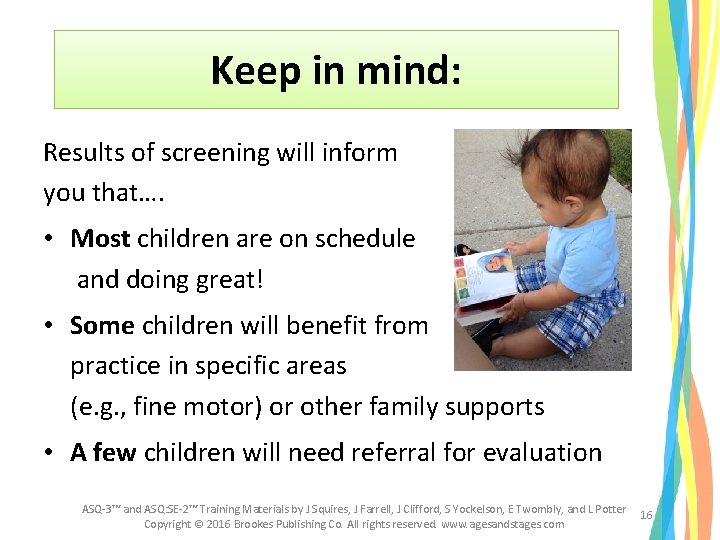
Keep in mind: Results of screening will inform you that…. • Most children are on schedule and doing great! • Some children will benefit from practice in specific areas (e. g. , fine motor) or other family supports • A few children will need referral for evaluation ASQ-3™ and ASQ: SE-2™ Training Materials by J Squires, J Farrell, J Clifford, S Yockelson, E Twombly, and L Potter Copyright © 2016 Brookes Publishing Co. All rights reserved. www. agesandstages. com 16
Diagnostic Assessment (Professional Evaluation) • A complex process that may identify specific developmental disabilities • Administered by evaluation specialist(s) • Determines if there is a delay and the extent of the delay Answers: "Is the child eligible for services? " ASQ-3™ and ASQ: SE-2™ Training Materials by J Squires, J Farrell, J Clifford, S Yockelson, E Twombly, and L Potter Copyright © 2016 Brookes Publishing Co. All rights reserved. www. agesandstages. com 17
On-Going Assessment (Programmatic, Curriculum-based, Criterion-based) • An in-depth assessment that: • Provides a complete child profile • Identifies targeted goals and objectives • Helps with program planning • Can be used for child or program evaluation ASQ-3™ and ASQ: SE-2™ Training Materials by J Squires, J Farrell, J Clifford, S Yockelson, E Twombly, and L Potter Copyright © 2016 Brookes Publishing Co. All rights reserved. www. agesandstages. com 18
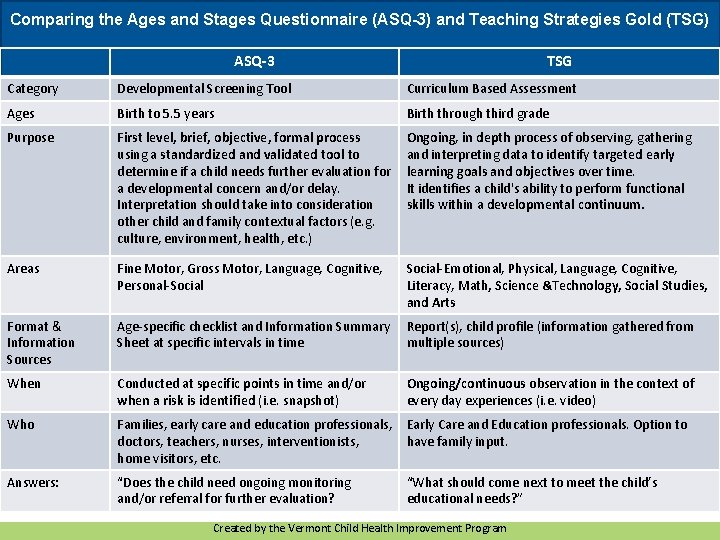
Comparing the Ages and Stages Questionnaire (ASQ-3) and Teaching Strategies Gold (TSG) ASQ-3 TSG Category Developmental Screening Tool Curriculum Based Assessment Ages Birth to 5. 5 years Birth through third grade Purpose First level, brief, objective, formal process using a standardized and validated tool to determine if a child needs further evaluation for a developmental concern and/or delay. Interpretation should take into consideration other child and family contextual factors (e. g. culture, environment, health, etc. ) Ongoing, in depth process of observing, gathering and interpreting data to identify targeted early learning goals and objectives over time. It identifies a child's ability to perform functional skills within a developmental continuum. Areas Fine Motor, Gross Motor, Language, Cognitive, Personal-Social-Emotional, Physical, Language, Cognitive, Literacy, Math, Science &Technology, Social Studies, and Arts Format & Information Sources Age-specific checklist and Information Summary Sheet at specific intervals in time Report(s), child profile (information gathered from multiple sources) When Conducted at specific points in time and/or when a risk is identified (i. e. snapshot) Ongoing/continuous observation in the context of every day experiences (i. e. video) Who Families, early care and education professionals, doctors, teachers, nurses, interventionists, home visitors, etc. Early Care and Education professionals. Option to have family input. Answers: “Does the child need ongoing monitoring and/or referral for further evaluation? “What should come next to meet the child’s educational needs? ” Created by the Vermont Child Health Improvement Program
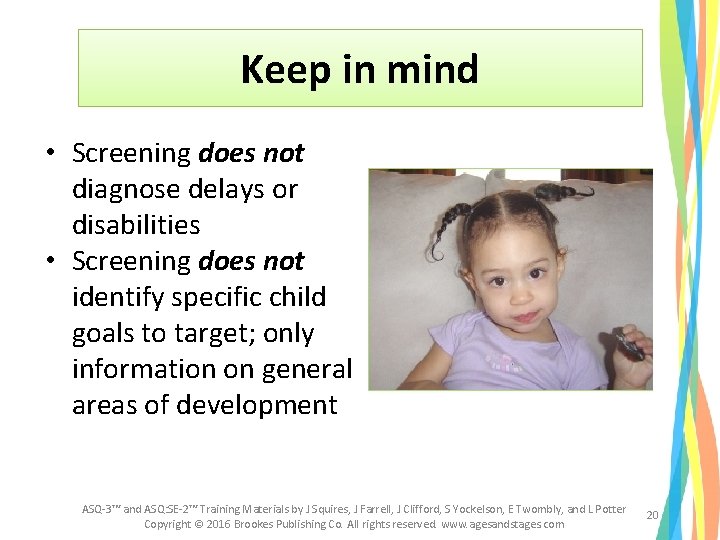
Keep in mind • Screening does not diagnose delays or disabilities • Screening does not identify specific child goals to target; only information on general areas of development ASQ-3™ and ASQ: SE-2™ Training Materials by J Squires, J Farrell, J Clifford, S Yockelson, E Twombly, and L Potter Copyright © 2016 Brookes Publishing Co. All rights reserved. www. agesandstages. com 20
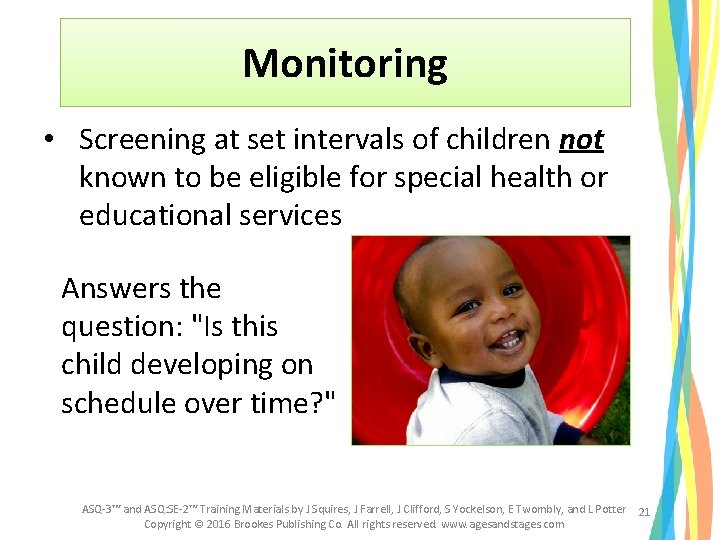
Monitoring • Screening at set intervals of children not known to be eligible for special health or educational services Answers the question: "Is this child developing on schedule over time? " ASQ-3™ and ASQ: SE-2™ Training Materials by J Squires, J Farrell, J Clifford, S Yockelson, E Twombly, and L Potter Copyright © 2016 Brookes Publishing Co. All rights reserved. www. agesandstages. com 21
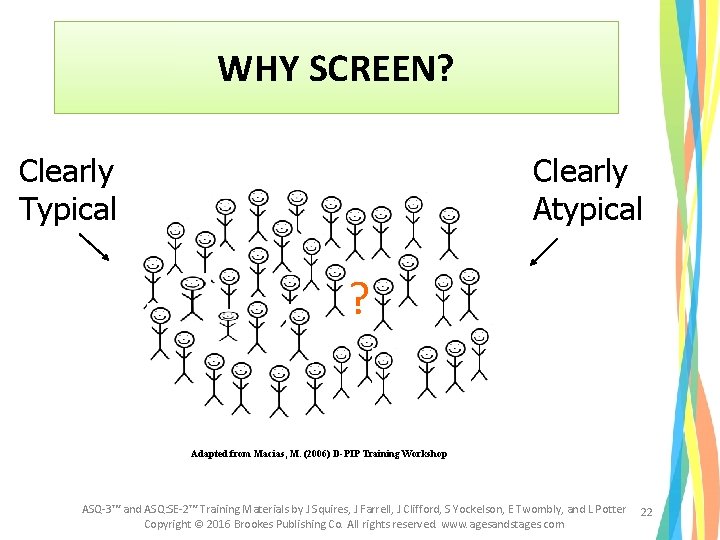
WHY SCREEN? Clearly Typical Clearly Atypical ? Adapted from Macias, M. (2006) D-PIP Training Workshop ASQ-3™ and ASQ: SE-2™ Training Materials by J Squires, J Farrell, J Clifford, S Yockelson, E Twombly, and L Potter Copyright © 2016 Brookes Publishing Co. All rights reserved. www. agesandstages. com 22
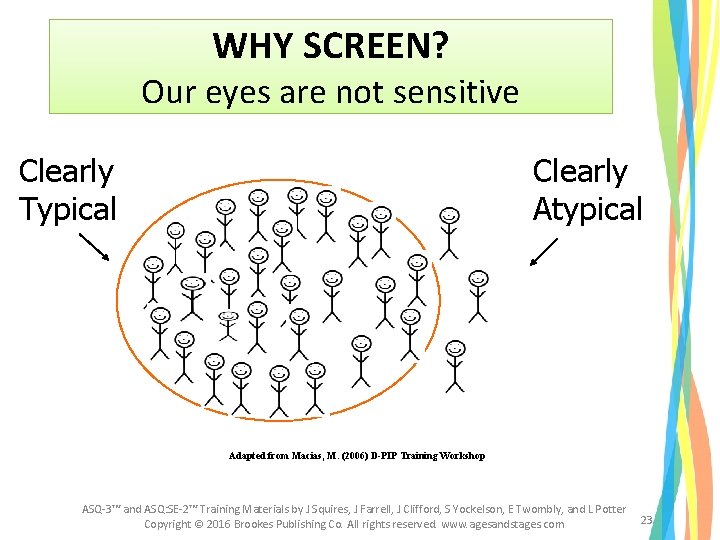
WHY SCREEN? Our eyes are not sensitive Clearly Typical Clearly Atypical Adapted from Macias, M. (2006) D-PIP Training Workshop ASQ-3™ and ASQ: SE-2™ Training Materials by J Squires, J Farrell, J Clifford, S Yockelson, E Twombly, and L Potter Copyright © 2016 Brookes Publishing Co. All rights reserved. www. agesandstages. com 23
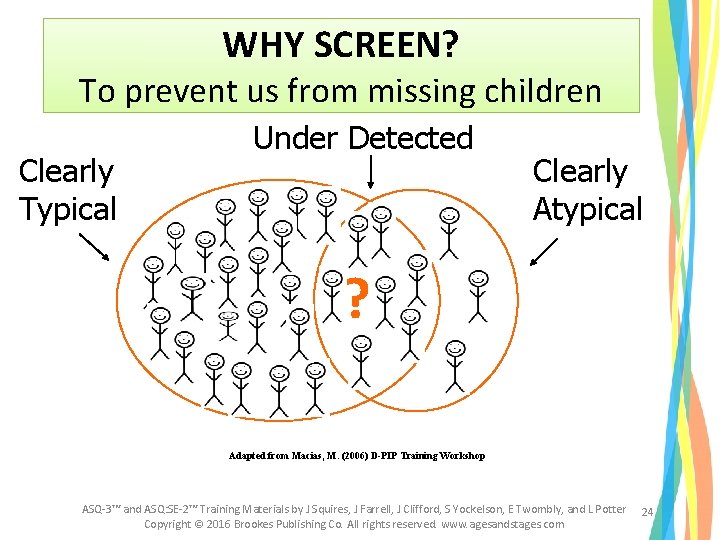
WHY SCREEN? To prevent us from missing children Clearly Typical Under Detected Clearly Atypical ? Adapted from Macias, M. (2006) D-PIP Training Workshop ASQ-3™ and ASQ: SE-2™ Training Materials by J Squires, J Farrell, J Clifford, S Yockelson, E Twombly, and L Potter Copyright © 2016 Brookes Publishing Co. All rights reserved. www. agesandstages. com 24
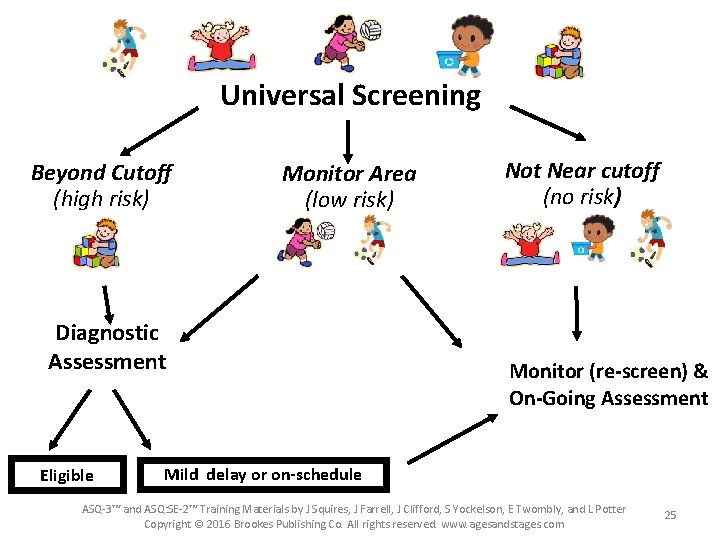
Universal Screening Beyond Cutoff (high risk) Monitor Area (low risk) Diagnostic Assessment Eligible Not Near cutoff (no risk) Monitor (re-screen) & On-Going Assessment Mild delay or on-schedule ASQ-3™ and ASQ: SE-2™ Training Materials by J Squires, J Farrell, J Clifford, S Yockelson, E Twombly, and L Potter Copyright © 2016 Brookes Publishing Co. All rights reserved. www. agesandstages. com 25
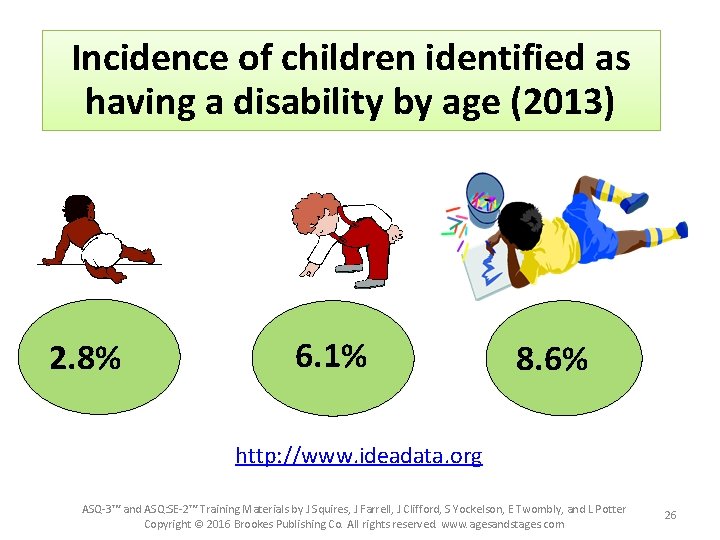
Incidence of children identified as having a disability by age (2013) 2. 8% 6. 1% 8. 6% http: //www. ideadata. org ASQ-3™ and ASQ: SE-2™ Training Materials by J Squires, J Farrell, J Clifford, S Yockelson, E Twombly, and L Potter Copyright © 2016 Brookes Publishing Co. All rights reserved. www. agesandstages. com 26
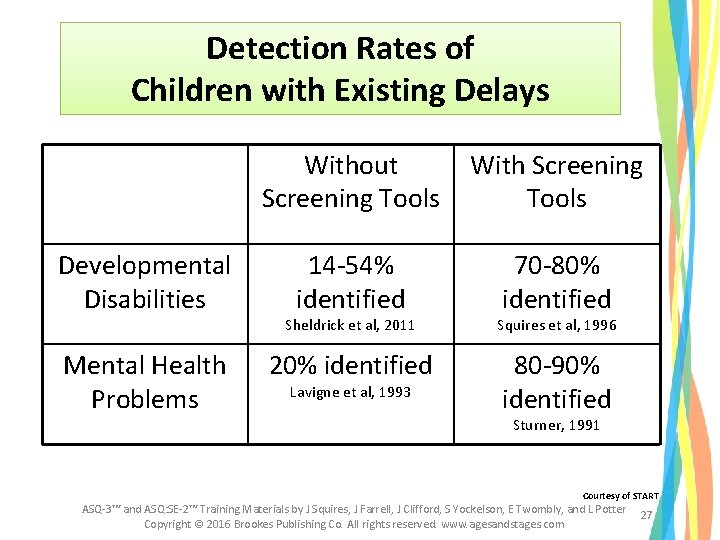
Detection Rates of Children with Existing Delays Developmental Disabilities Mental Health Problems Without Screening Tools With Screening Tools 14 -54% identified 70 -80% identified Sheldrick et al, 2011 Squires et al, 1996 20% identified 80 -90% identified Lavigne et al, 1993 Sturner, 1991 Courtesy of START ASQ-3™ and ASQ: SE-2™ Training Materials by J Squires, J Farrell, J Clifford, S Yockelson, E Twombly, and L Potter Copyright © 2016 Brookes Publishing Co. All rights reserved. www. agesandstages. com 27
Features of the ASQ-3™ and ASQ: SE-2™ Training Materials by J Squires, J Farrell, J Clifford, S Yockelson, E Twombly, and L Potter 28 Copyright © 2016 Brookes Publishing Co. All rights reserved. www. agesandstages. com
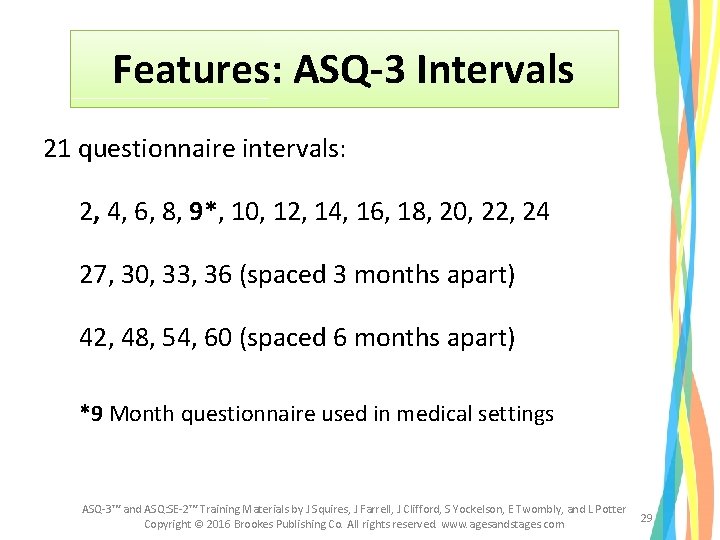
Features: ASQ-3 Intervals 21 questionnaire intervals: 2, 4, 6, 8, 9*, 10, 12, 14, 16, 18, 20, 22, 24 27, 30, 33, 36 (spaced 3 months apart) 42, 48, 54, 60 (spaced 6 months apart) *9 Month questionnaire used in medical settings ASQ-3™ and ASQ: SE-2™ Training Materials by J Squires, J Farrell, J Clifford, S Yockelson, E Twombly, and L Potter Copyright © 2016 Brookes Publishing Co. All rights reserved. www. agesandstages. com 29
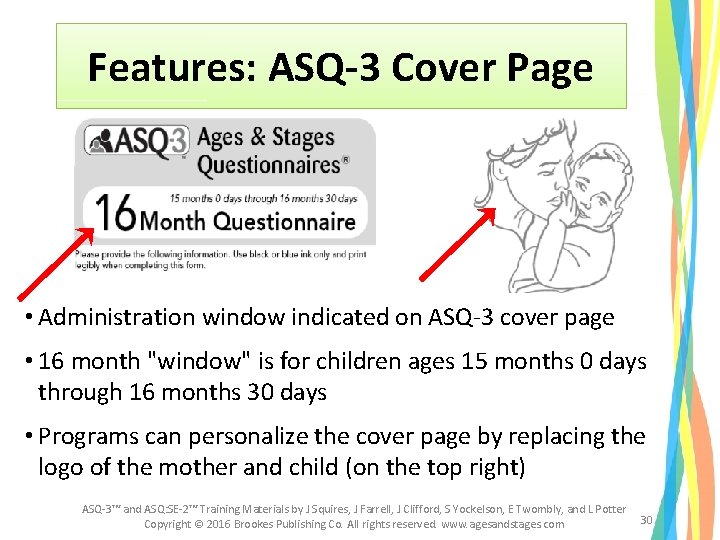
Features: ASQ-3 Cover Page • Administration window indicated on ASQ-3 cover page • 16 month "window" is for children ages 15 months 0 days through 16 months 30 days • Programs can personalize the cover page by replacing the logo of the mother and child (on the top right) ASQ-3™ and ASQ: SE-2™ Training Materials by J Squires, J Farrell, J Clifford, S Yockelson, E Twombly, and L Potter Copyright © 2016 Brookes Publishing Co. All rights reserved. www. agesandstages. com 30
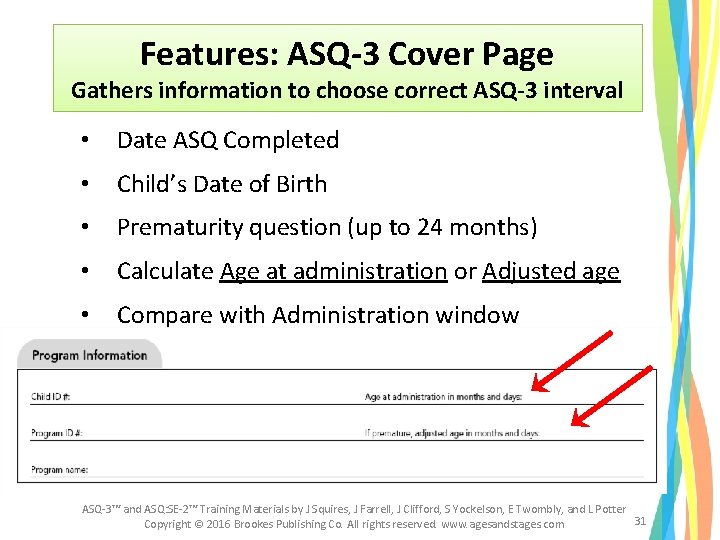
Features: ASQ-3 Cover Page Gathers information to choose correct ASQ-3 interval • Date ASQ Completed • Child’s Date of Birth • Prematurity question (up to 24 months) • Calculate Age at administration or Adjusted age • Compare with Administration window ASQ-3™ and ASQ: SE-2™ Training Materials by J Squires, J Farrell, J Clifford, S Yockelson, E Twombly, and L Potter 31 Copyright © 2016 Brookes Publishing Co. All rights reserved. www. agesandstages. com
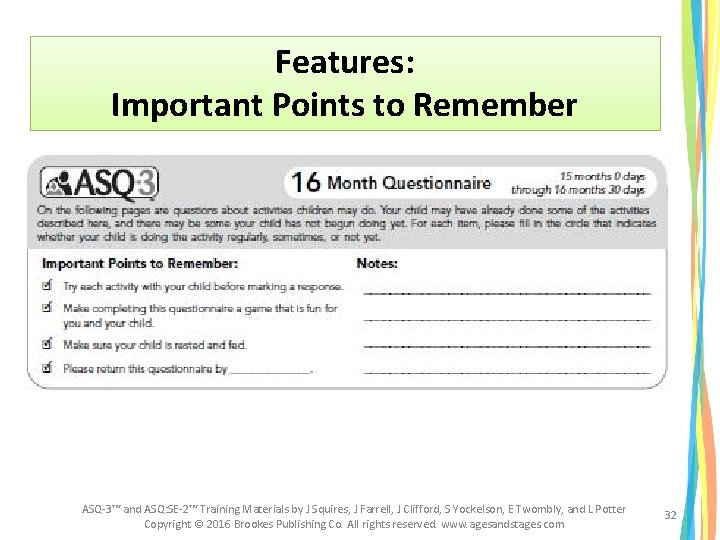
Features: Important Points to Remember ASQ-3™ and ASQ: SE-2™ Training Materials by J Squires, J Farrell, J Clifford, S Yockelson, E Twombly, and L Potter Copyright © 2016 Brookes Publishing Co. All rights reserved. www. agesandstages. com 32
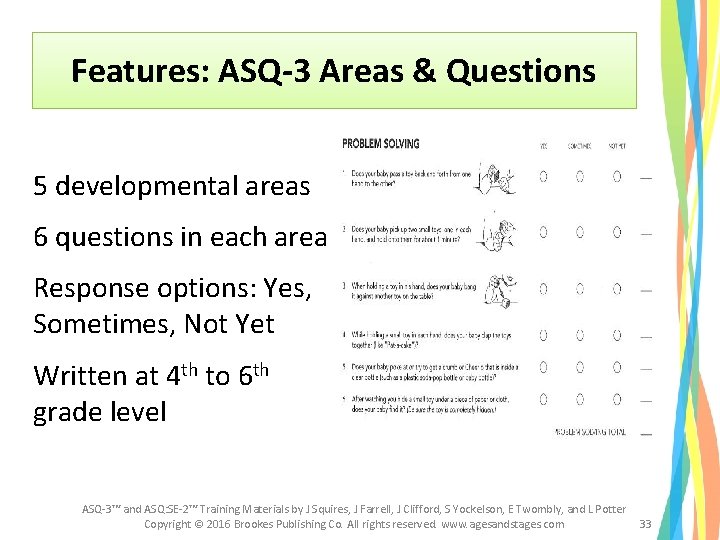
Features: ASQ-3 Areas & Questions 5 developmental areas 6 questions in each area Response options: Yes, Sometimes, Not Yet Written at 4 th to 6 th grade level ASQ-3™ and ASQ: SE-2™ Training Materials by J Squires, J Farrell, J Clifford, S Yockelson, E Twombly, and L Potter Copyright © 2016 Brookes Publishing Co. All rights reserved. www. agesandstages. com 33
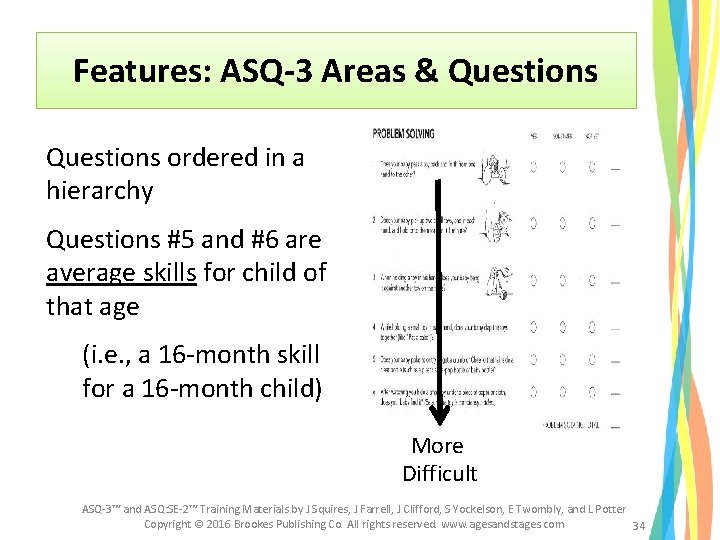
Features: ASQ-3 Areas & Questions ordered in a hierarchy Questions #5 and #6 are average skills for child of that age (i. e. , a 16 -month skill for a 16 -month child) More Difficult ASQ-3™ and ASQ: SE-2™ Training Materials by J Squires, J Farrell, J Clifford, S Yockelson, E Twombly, and L Potter Copyright © 2016 Brookes Publishing Co. All rights reserved. www. agesandstages. com 34
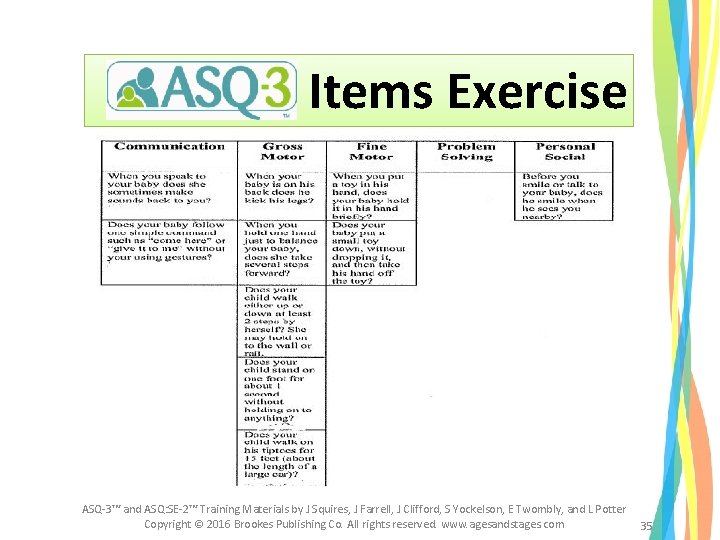
Items Exercise ASQ-3™ and ASQ: SE-2™ Training Materials by J Squires, J Farrell, J Clifford, S Yockelson, E Twombly, and L Potter Copyright © 2016 Brookes Publishing Co. All rights reserved. www. agesandstages. com 35
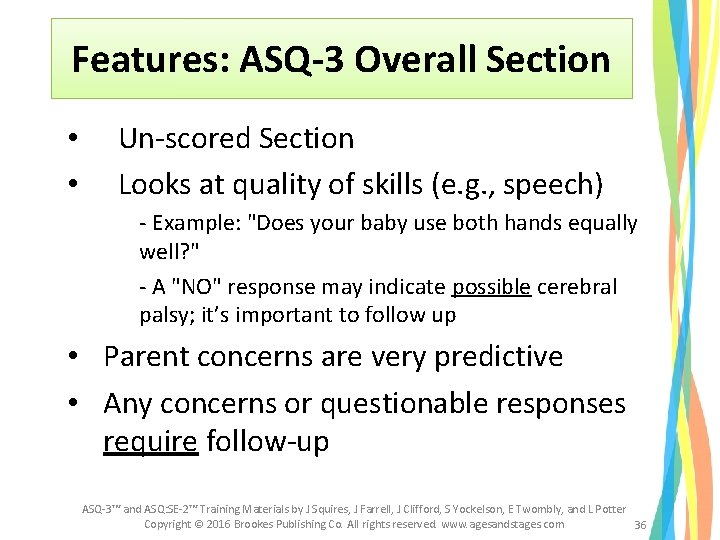
Features: ASQ-3 Overall Section • • Un-scored Section Looks at quality of skills (e. g. , speech) - Example: "Does your baby use both hands equally well? " - A "NO" response may indicate possible cerebral palsy; it’s important to follow up • Parent concerns are very predictive • Any concerns or questionable responses require follow-up ASQ-3™ and ASQ: SE-2™ Training Materials by J Squires, J Farrell, J Clifford, S Yockelson, E Twombly, and L Potter Copyright © 2016 Brookes Publishing Co. All rights reserved. www. agesandstages. com 36
Features: ASQ-3 Summary Sheet • Each interval has unique summary sheets • Summary sheets have 5 sections: - Child/family information - Bar graph with cutoffs - Overall section - Follow-up action taken (new to ASQ-3) - Optional section: Individual item responses ASQ-3™ and ASQ: SE-2™ Training Materials by J Squires, J Farrell, J Clifford, S Yockelson, E Twombly, and L Potter Copyright © 2016 Brookes Publishing Co. All rights reserved. www. agesandstages. com 37
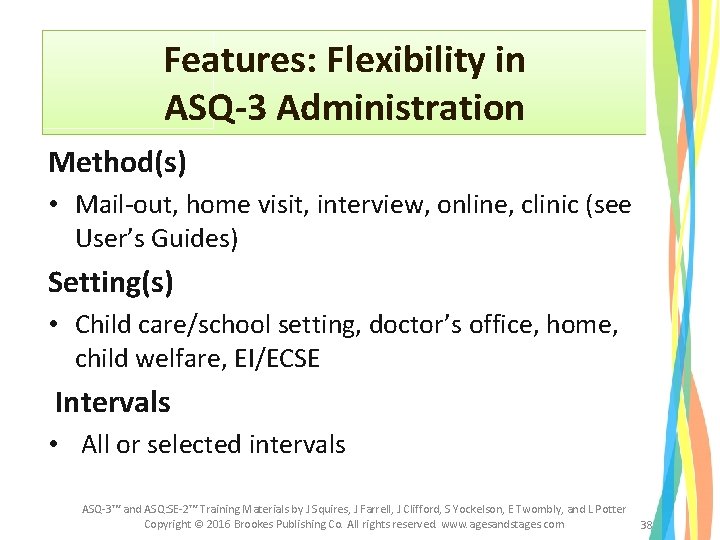
Features: Flexibility in ASQ-3 Administration Method(s) • Mail-out, home visit, interview, online, clinic (see User’s Guides) Setting(s) • Child care/school setting, doctor’s office, home, child welfare, EI/ECSE Intervals • All or selected intervals ASQ-3™ and ASQ: SE-2™ Training Materials by J Squires, J Farrell, J Clifford, S Yockelson, E Twombly, and L Potter Copyright © 2016 Brookes Publishing Co. All rights reserved. www. agesandstages. com 38
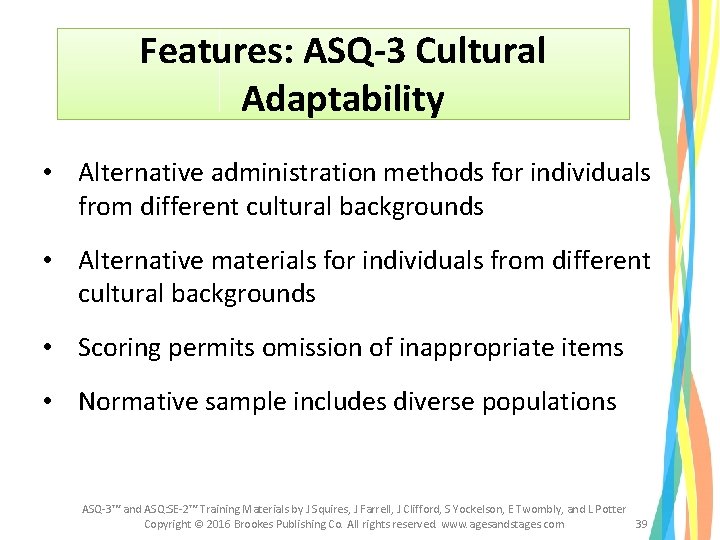
Features: ASQ-3 Cultural Adaptability • Alternative administration methods for individuals from different cultural backgrounds • Alternative materials for individuals from different cultural backgrounds • Scoring permits omission of inappropriate items • Normative sample includes diverse populations ASQ-3™ and ASQ: SE-2™ Training Materials by J Squires, J Farrell, J Clifford, S Yockelson, E Twombly, and L Potter 39 Copyright © 2016 Brookes Publishing Co. All rights reserved. www. agesandstages. com
Scoring Exercise ASQ-3™ and ASQ: SE-2™ Training Materials by J Squires, J Farrell, J Clifford, S Yockelson, E Twombly, and L Potter 40 Copyright © 2016 Brookes Publishing Co. All rights reserved. www. agesandstages. com
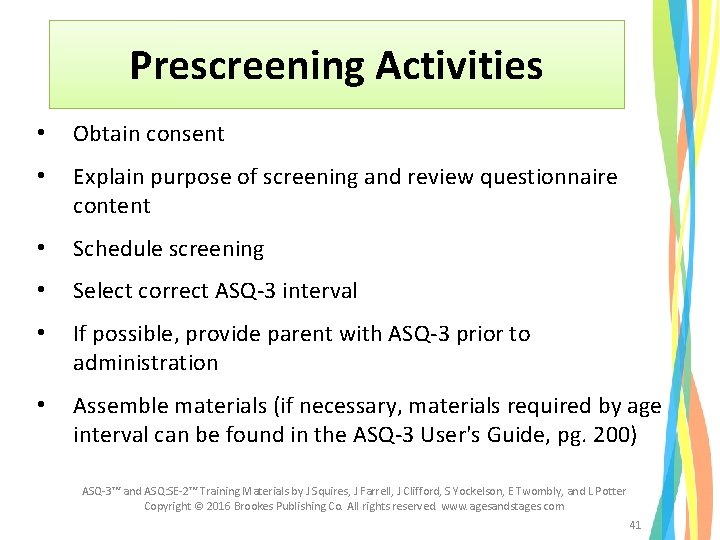
Prescreening Activities • Obtain consent • Explain purpose of screening and review questionnaire content • Schedule screening • Select correct ASQ-3 interval • If possible, provide parent with ASQ-3 prior to administration • Assemble materials (if necessary, materials required by age interval can be found in the ASQ-3 User's Guide, pg. 200) ASQ-3™ and ASQ: SE-2™ Training Materials by J Squires, J Farrell, J Clifford, S Yockelson, E Twombly, and L Potter Copyright © 2016 Brookes Publishing Co. All rights reserved. www. agesandstages. com 41
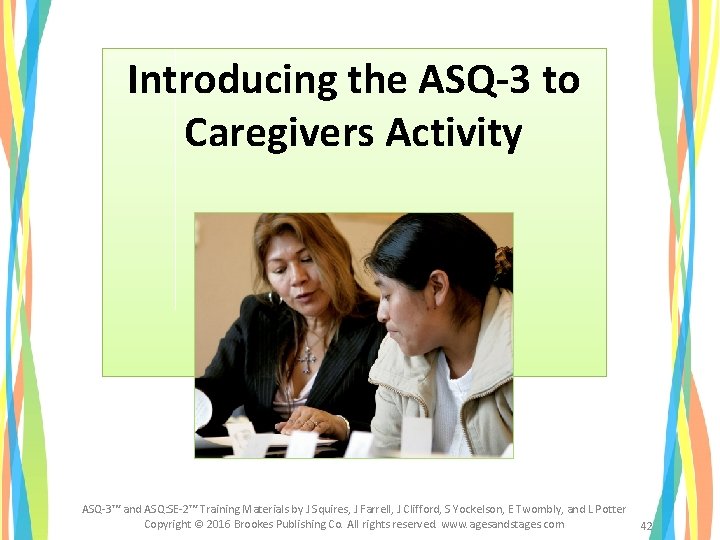
Introducing the ASQ-3 to Caregivers Activity ASQ-3™ and ASQ: SE-2™ Training Materials by J Squires, J Farrell, J Clifford, S Yockelson, E Twombly, and L Potter Copyright © 2016 Brookes Publishing Co. All rights reserved. www. agesandstages. com 42
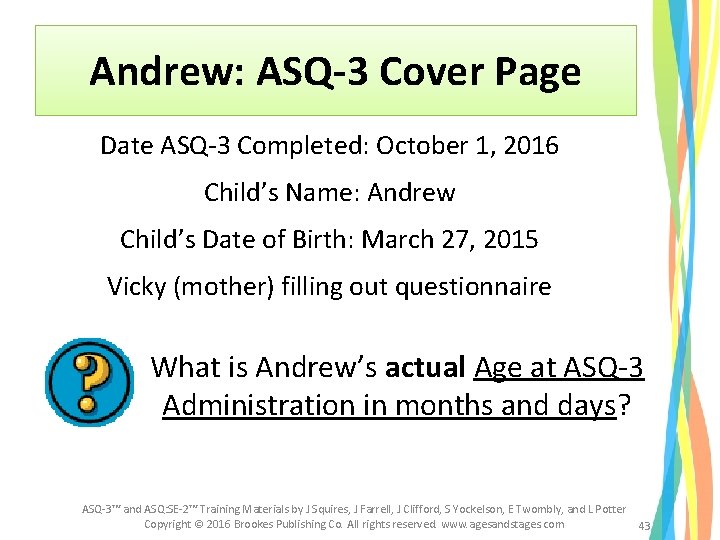
Andrew: ASQ-3 Cover Page Date ASQ-3 Completed: October 1, 2016 Child’s Name: Andrew Child’s Date of Birth: March 27, 2015 Vicky (mother) filling out questionnaire What is Andrew’s actual Age at ASQ-3 Administration in months and days? ASQ-3™ and ASQ: SE-2™ Training Materials by J Squires, J Farrell, J Clifford, S Yockelson, E Twombly, and L Potter Copyright © 2016 Brookes Publishing Co. All rights reserved. www. agesandstages. com 43
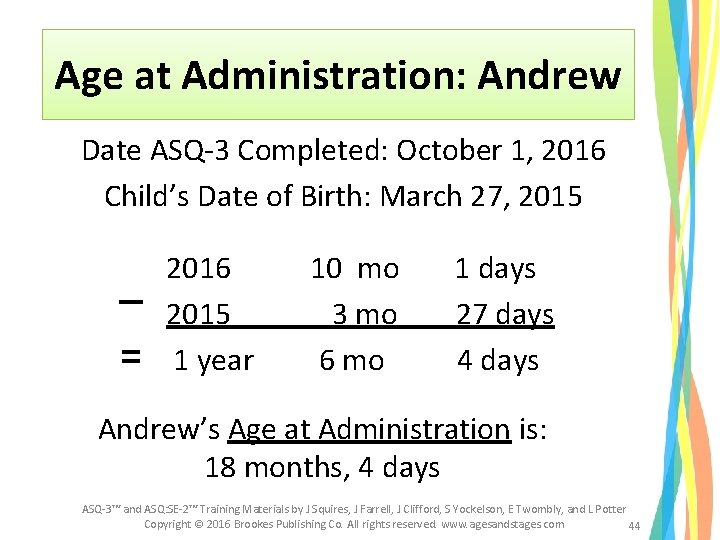
Age at Administration: Andrew Date ASQ-3 Completed: October 1, 2016 Child’s Date of Birth: March 27, 2015 = 2016 2015 1 year 10 mo 3 mo 6 mo 1 days 27 days 4 days Andrew’s Age at Administration is: 18 months, 4 days ASQ-3™ and ASQ: SE-2™ Training Materials by J Squires, J Farrell, J Clifford, S Yockelson, E Twombly, and L Potter Copyright © 2016 Brookes Publishing Co. All rights reserved. www. agesandstages. com 44
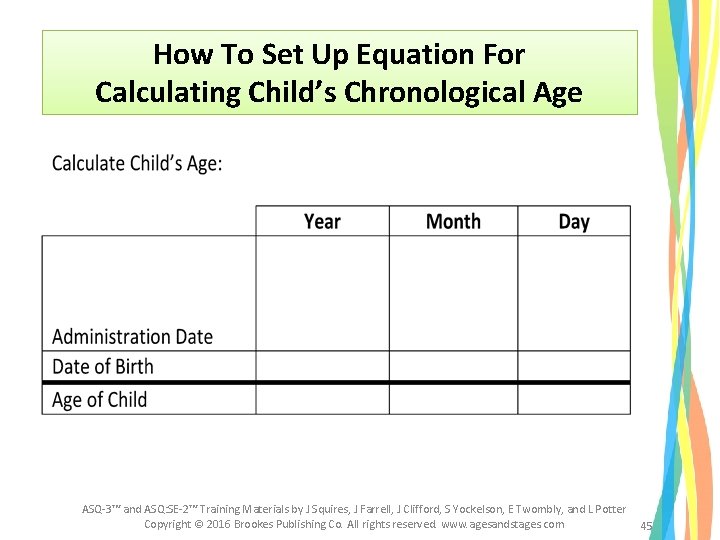
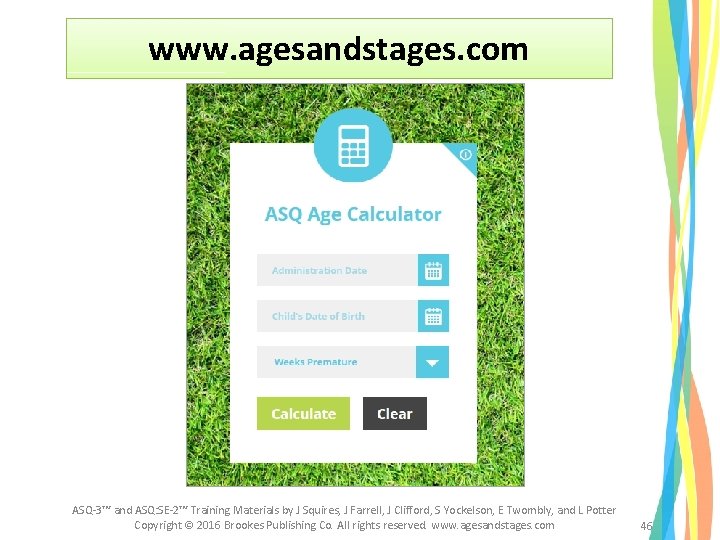
How To Set Up Equation For Calculating Child’s Chronological Age ASQ-3™ and ASQ: SE-2™ Training Materials by J Squires, J Farrell, J Clifford, S Yockelson, E Twombly, and L Potter Copyright © 2016 Brookes Publishing Co. All rights reserved. www. agesandstages. com 45
www. agesandstages. com ASQ-3™ and ASQ: SE-2™ Training Materials by J Squires, J Farrell, J Clifford, S Yockelson, E Twombly, and L Potter Copyright © 2016 Brookes Publishing Co. All rights reserved. www. agesandstages. com 46
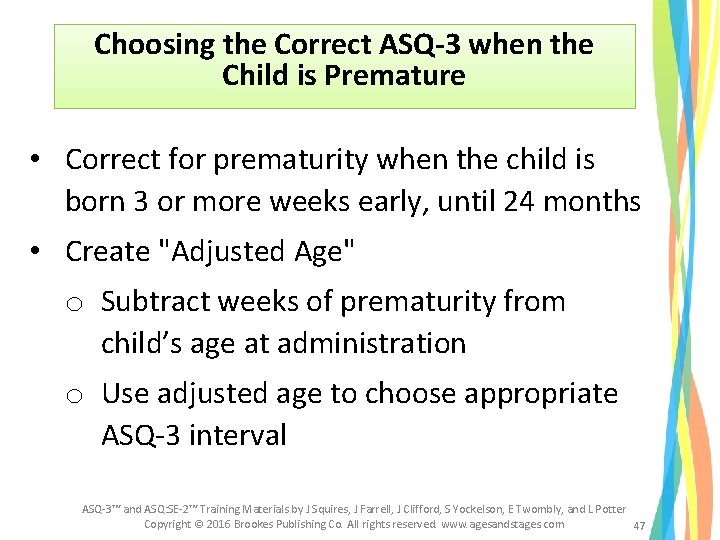
Choosing the Correct ASQ-3 when the Child is Premature • Correct for prematurity when the child is born 3 or more weeks early, until 24 months • Create "Adjusted Age" o Subtract weeks of prematurity from child’s age at administration o Use adjusted age to choose appropriate ASQ-3 interval ASQ-3™ and ASQ: SE-2™ Training Materials by J Squires, J Farrell, J Clifford, S Yockelson, E Twombly, and L Potter Copyright © 2016 Brookes Publishing Co. All rights reserved. www. agesandstages. com 47
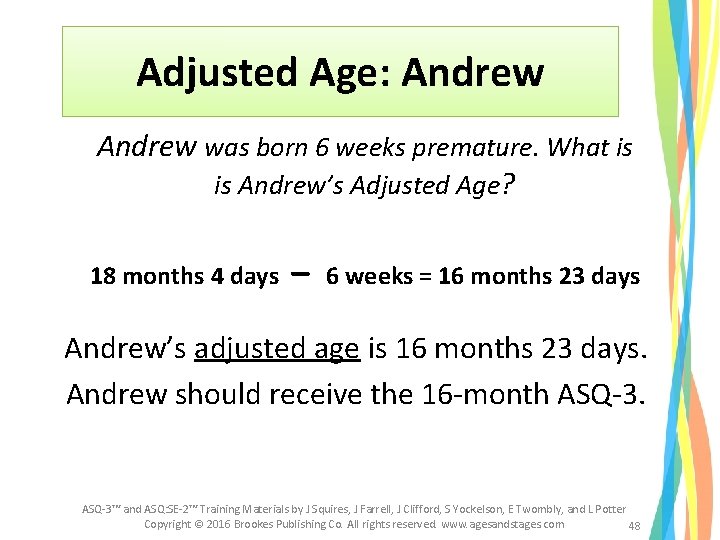
Adjusted Age: Andrew was born 6 weeks premature. What is is Andrew’s Adjusted Age? 18 months 4 days – 6 weeks = 16 months 23 days Andrew’s adjusted age is 16 months 23 days. Andrew should receive the 16 -month ASQ-3™ and ASQ: SE-2™ Training Materials by J Squires, J Farrell, J Clifford, S Yockelson, E Twombly, and L Potter Copyright © 2016 Brookes Publishing Co. All rights reserved. www. agesandstages. com 48
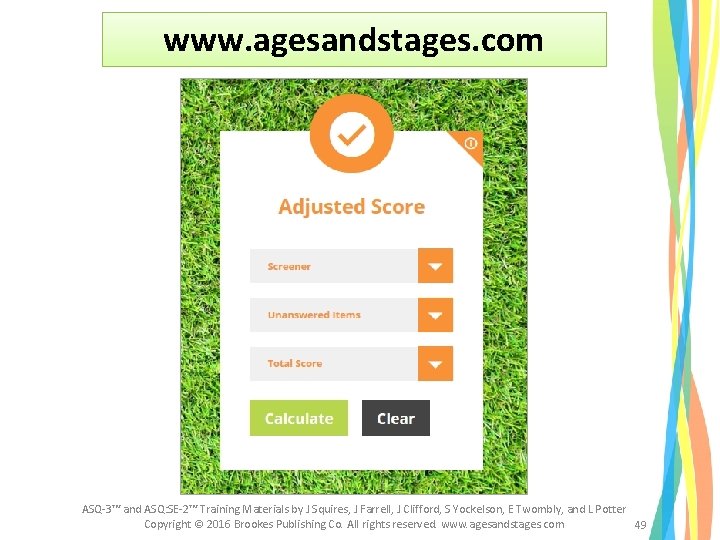
www. agesandstages. com ASQ-3™ and ASQ: SE-2™ Training Materials by J Squires, J Farrell, J Clifford, S Yockelson, E Twombly, and L Potter Copyright © 2016 Brookes Publishing Co. All rights reserved. www. agesandstages. com 49
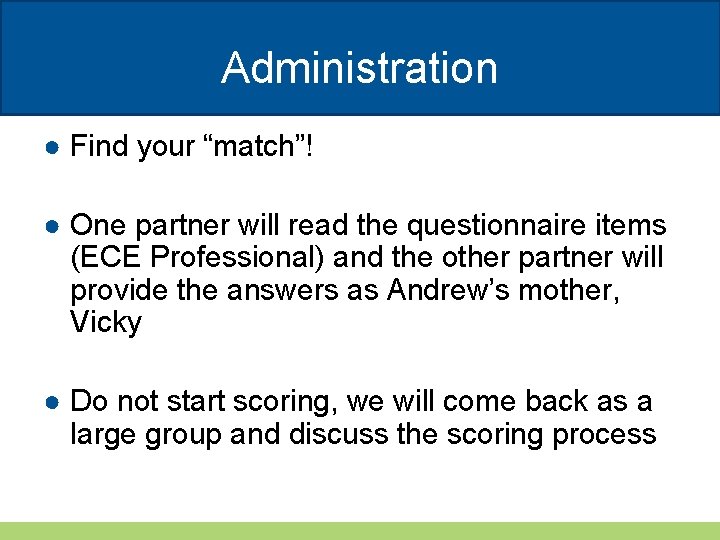
Administration ● Find your “match”! ● One partner will read the questionnaire items (ECE Professional) and the other partner will provide the answers as Andrew’s mother, Vicky ● Do not start scoring, we will come back as a large group and discuss the scoring process
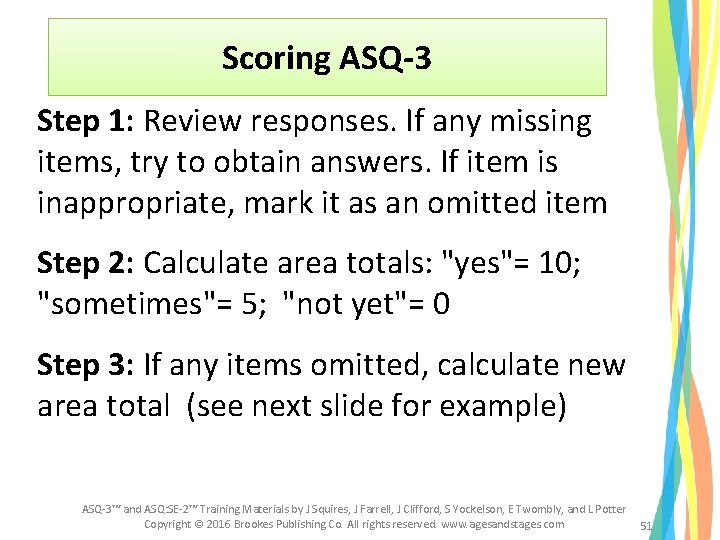
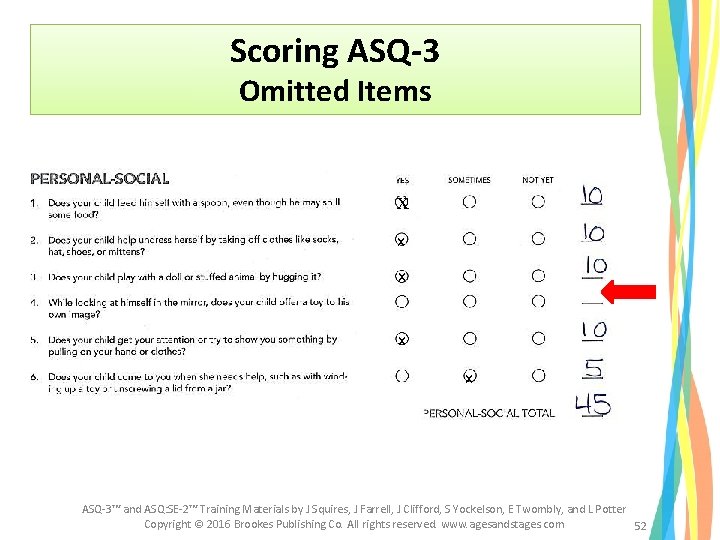
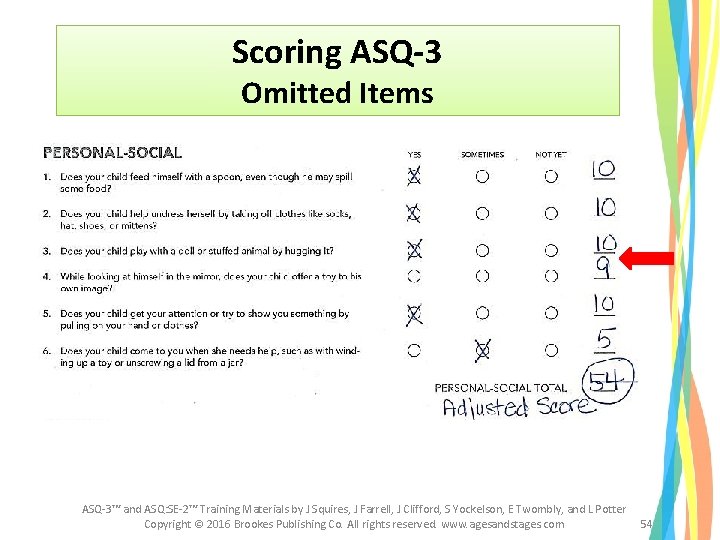
Scoring ASQ-3 Step 1: Review responses. If any missing items, try to obtain answers. If item is inappropriate, mark it as an omitted item Step 2: Calculate area totals: "yes"= 10; "sometimes"= 5; "not yet"= 0 Step 3: If any items omitted, calculate new area total (see next slide for example) ASQ-3™ and ASQ: SE-2™ Training Materials by J Squires, J Farrell, J Clifford, S Yockelson, E Twombly, and L Potter Copyright © 2016 Brookes Publishing Co. All rights reserved. www. agesandstages. com 51
Scoring ASQ-3 Omitted Items x x x ASQ-3™ and ASQ: SE-2™ Training Materials by J Squires, J Farrell, J Clifford, S Yockelson, E Twombly, and L Potter Copyright © 2016 Brookes Publishing Co. All rights reserved. www. agesandstages. com 52
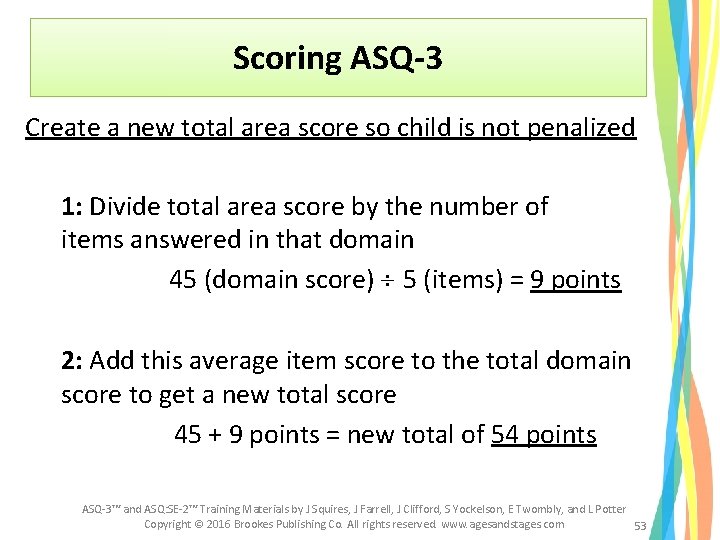
Scoring ASQ-3 Create a new total area score so child is not penalized 1: Divide total area score by the number of items answered in that domain 45 (domain score) 5 (items) = 9 points 2: Add this average item score to the total domain score to get a new total score 45 + 9 points = new total of 54 points ASQ-3™ and ASQ: SE-2™ Training Materials by J Squires, J Farrell, J Clifford, S Yockelson, E Twombly, and L Potter Copyright © 2016 Brookes Publishing Co. All rights reserved. www. agesandstages. com 53
Scoring ASQ-3 Omitted Items ASQ-3™ and ASQ: SE-2™ Training Materials by J Squires, J Farrell, J Clifford, S Yockelson, E Twombly, and L Potter Copyright © 2016 Brookes Publishing Co. All rights reserved. www. agesandstages. com 54
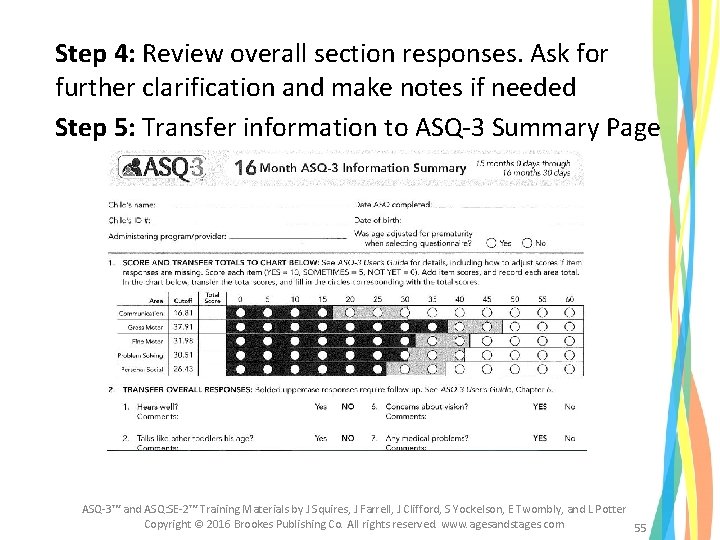
Step 4: Review overall section responses. Ask for further clarification and make notes if needed Step 5: Transfer information to ASQ-3 Summary Page ASQ-3™ and ASQ: SE-2™ Training Materials by J Squires, J Farrell, J Clifford, S Yockelson, E Twombly, and L Potter Copyright © 2016 Brookes Publishing Co. All rights reserved. www. agesandstages. com 55
ASQ-3 Information Summary Sheet (Sections 1 & 2) ASQ-3™ and ASQ: SE-2™ Training Materials by J Squires, J Farrell, J Clifford, S Yockelson, E Twombly, and L Potter Copyright © 2016 Brookes Publishing Co. All rights reserved. www. agesandstages. com 56
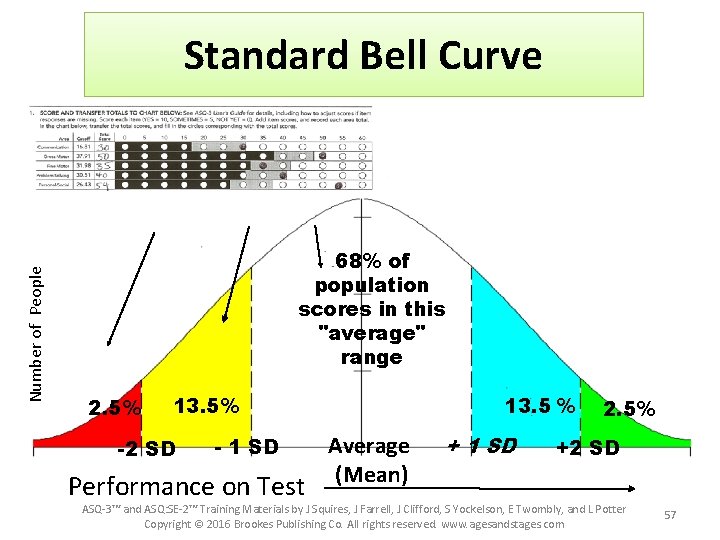
Number of People Standard Bell Curve 68% of population scores in this "average" range 2. 5% 13. 5% -2 SD - 1 SD Performance on Test 13. 5 % Average (Mean) + 1 SD 2. 5% +2 SD ASQ-3™ and ASQ: SE-2™ Training Materials by J Squires, J Farrell, J Clifford, S Yockelson, E Twombly, and L Potter Copyright © 2016 Brookes Publishing Co. All rights reserved. www. agesandstages. com 57
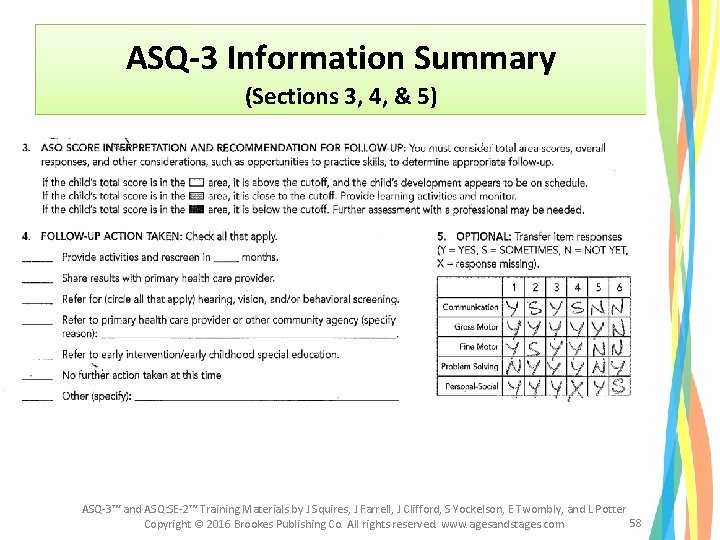
ASQ-3 Information Summary (Sections 3, 4, & 5) ASQ-3™ and ASQ: SE-2™ Training Materials by J Squires, J Farrell, J Clifford, S Yockelson, E Twombly, and L Potter 58 Copyright © 2016 Brookes Publishing Co. All rights reserved. www. agesandstages. com
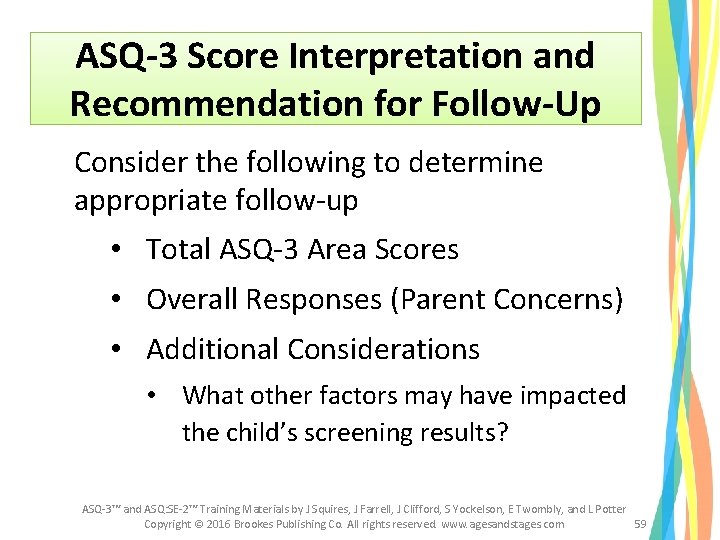
ASQ-3 Score Interpretation and Recommendation for Follow-Up Consider the following to determine appropriate follow-up • Total ASQ-3 Area Scores • Overall Responses (Parent Concerns) • Additional Considerations • What other factors may have impacted the child’s screening results? ASQ-3™ and ASQ: SE-2™ Training Materials by J Squires, J Farrell, J Clifford, S Yockelson, E Twombly, and L Potter Copyright © 2016 Brookes Publishing Co. All rights reserved. www. agesandstages. com 59
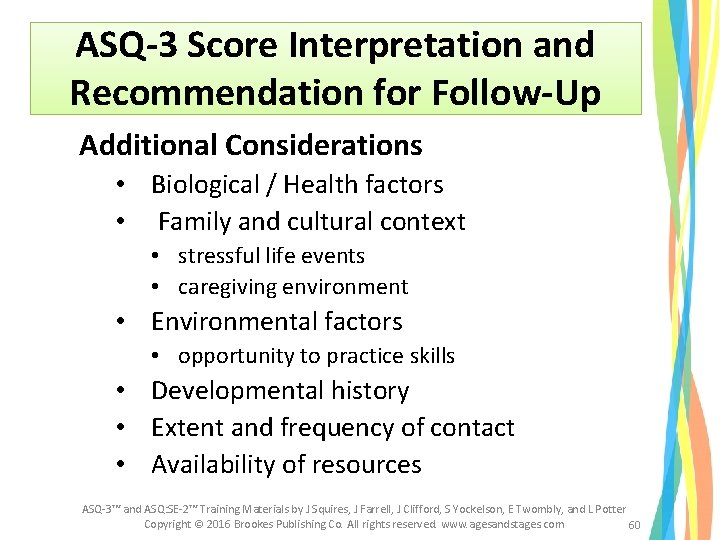
ASQ-3 Score Interpretation and Recommendation for Follow-Up Additional Considerations • Biological / Health factors • Family and cultural context • stressful life events • caregiving environment • Environmental factors • opportunity to practice skills • Developmental history • Extent and frequency of contact • Availability of resources ASQ-3™ and ASQ: SE-2™ Training Materials by J Squires, J Farrell, J Clifford, S Yockelson, E Twombly, and L Potter Copyright © 2016 Brookes Publishing Co. All rights reserved. www. agesandstages. com 60
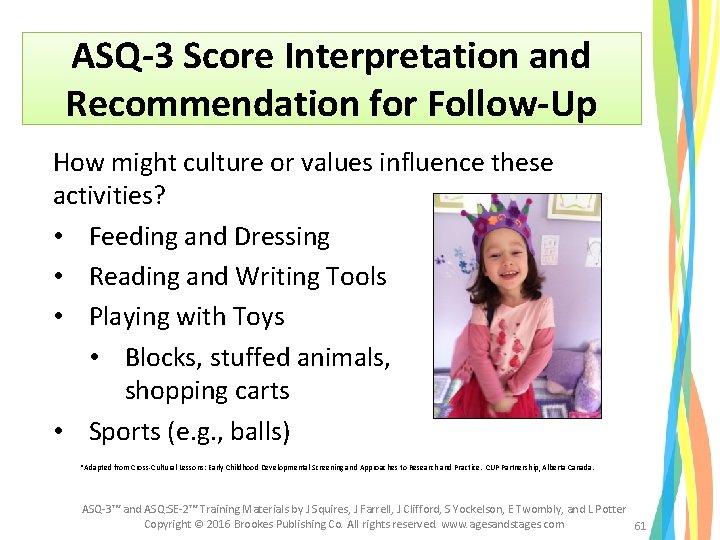
ASQ-3 Score Interpretation and Recommendation for Follow-Up How might culture or values influence these activities? • Feeding and Dressing • Reading and Writing Tools • Playing with Toys • Blocks, stuffed animals, shopping carts • Sports (e. g. , balls) *Adapted from Cross-Cultural Lessons: Early Childhood Developmental Screening and Approaches to Research and Practice. CUP Partnership, Alberta Canada. ASQ-3™ and ASQ: SE-2™ Training Materials by J Squires, J Farrell, J Clifford, S Yockelson, E Twombly, and L Potter Copyright © 2016 Brookes Publishing Co. All rights reserved. www. agesandstages. com 61
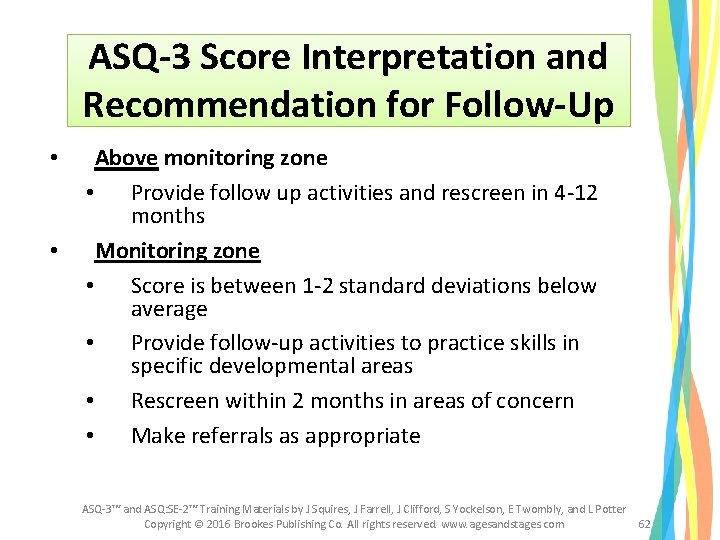
ASQ-3 Score Interpretation and Recommendation for Follow-Up • • Above monitoring zone • Provide follow up activities and rescreen in 4 -12 months Monitoring zone • Score is between 1 -2 standard deviations below average • Provide follow-up activities to practice skills in specific developmental areas • Rescreen within 2 months in areas of concern • Make referrals as appropriate ASQ-3™ and ASQ: SE-2™ Training Materials by J Squires, J Farrell, J Clifford, S Yockelson, E Twombly, and L Potter Copyright © 2016 Brookes Publishing Co. All rights reserved. www. agesandstages. com 62
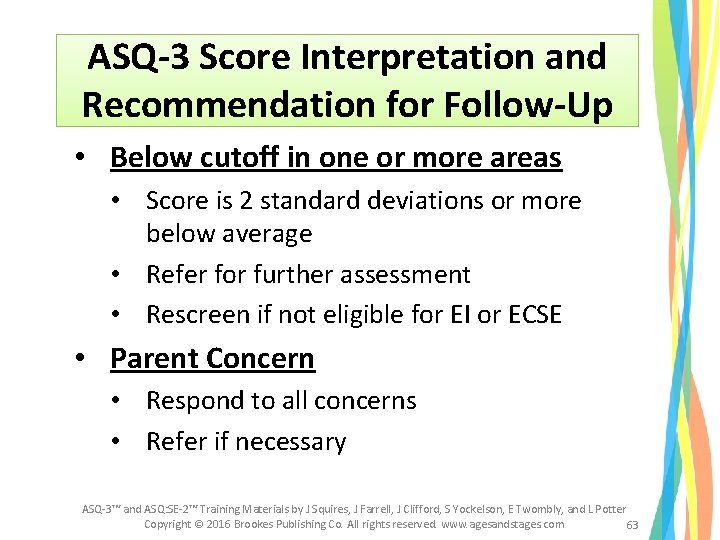
ASQ-3 Score Interpretation and Recommendation for Follow-Up • Below cutoff in one or more areas • Score is 2 standard deviations or more below average • Refer for further assessment • Rescreen if not eligible for EI or ECSE • Parent Concern • Respond to all concerns • Refer if necessary ASQ-3™ and ASQ: SE-2™ Training Materials by J Squires, J Farrell, J Clifford, S Yockelson, E Twombly, and L Potter Copyright © 2016 Brookes Publishing Co. All rights reserved. www. agesandstages. com 63
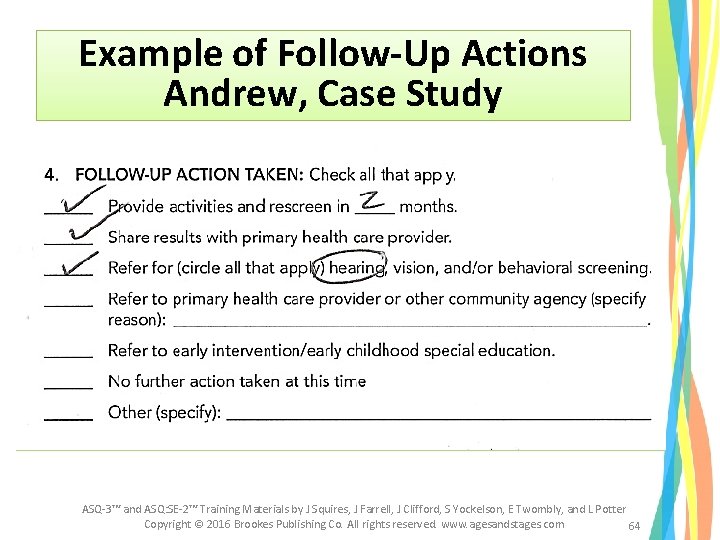
Example of Follow-Up Actions Andrew, Case Study ASQ-3™ and ASQ: SE-2™ Training Materials by J Squires, J Farrell, J Clifford, S Yockelson, E Twombly, and L Potter Copyright © 2016 Brookes Publishing Co. All rights reserved. www. agesandstages. com 64
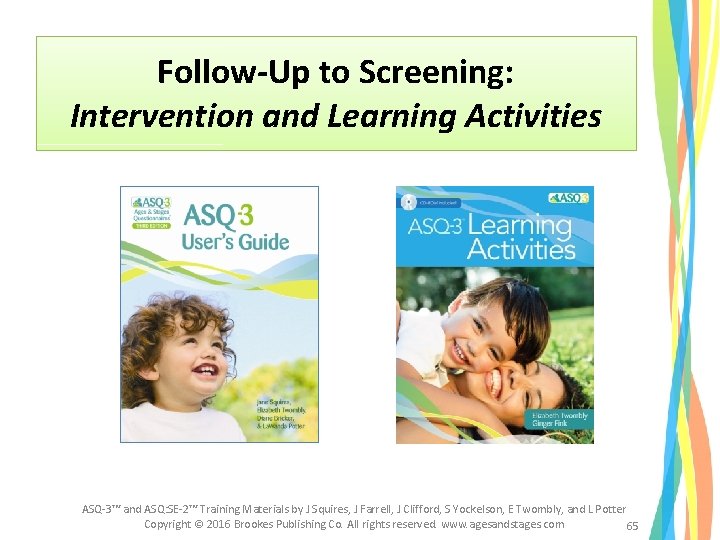
Follow-Up to Screening: Intervention and Learning Activities ASQ-3™ and ASQ: SE-2™ Training Materials by J Squires, J Farrell, J Clifford, S Yockelson, E Twombly, and L Potter Copyright © 2016 Brookes Publishing Co. All rights reserved. www. agesandstages. com 65
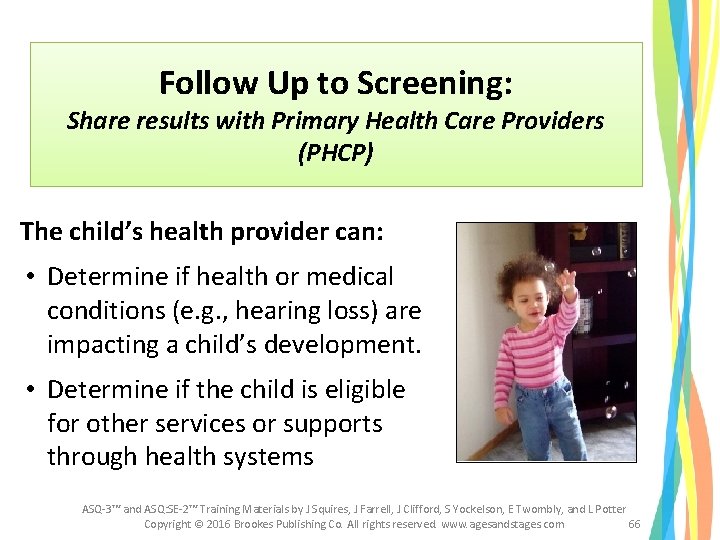
Follow Up to Screening: Share results with Primary Health Care Providers (PHCP) The child’s health provider can: • Determine if health or medical conditions (e. g. , hearing loss) are impacting a child’s development. • Determine if the child is eligible for other services or supports through health systems ASQ-3™ and ASQ: SE-2™ Training Materials by J Squires, J Farrell, J Clifford, S Yockelson, E Twombly, and L Potter Copyright © 2016 Brookes Publishing Co. All rights reserved. www. agesandstages. com 66
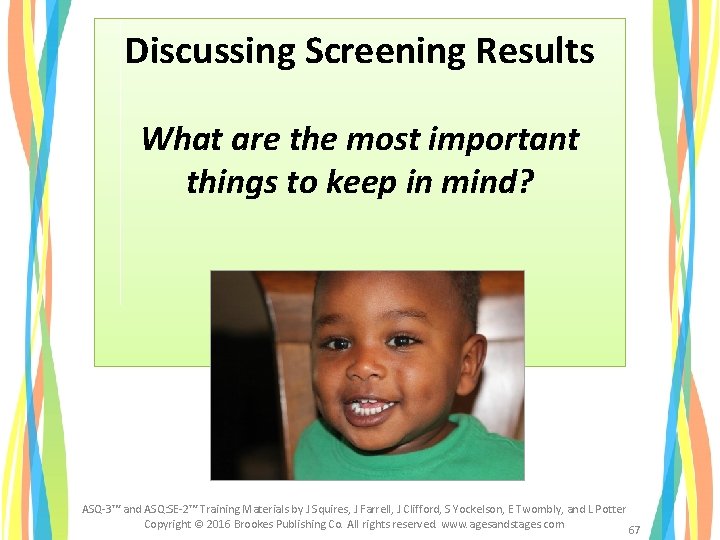
Discussing Screening Results What are the most important things to keep in mind? ASQ-3™ and ASQ: SE-2™ Training Materials by J Squires, J Farrell, J Clifford, S Yockelson, E Twombly, and L Potter Copyright © 2016 Brookes Publishing Co. All rights reserved. www. agesandstages. com 67
Discussing Results with all families…. • • • Begin the meeting by celebrating the child Review the purpose of screening Start with Strengths (Yes’s) Show you value confidentiality Review “Not Yet” items and Concerns Consider cultural or language issues ASQ-3™ and ASQ: SE-2™ Training Materials by J Squires, J Farrell, J Clifford, S Yockelson, E Twombly, and L Potter Copyright © 2016 Brookes Publishing Co. All rights reserved. www. agesandstages. com 68
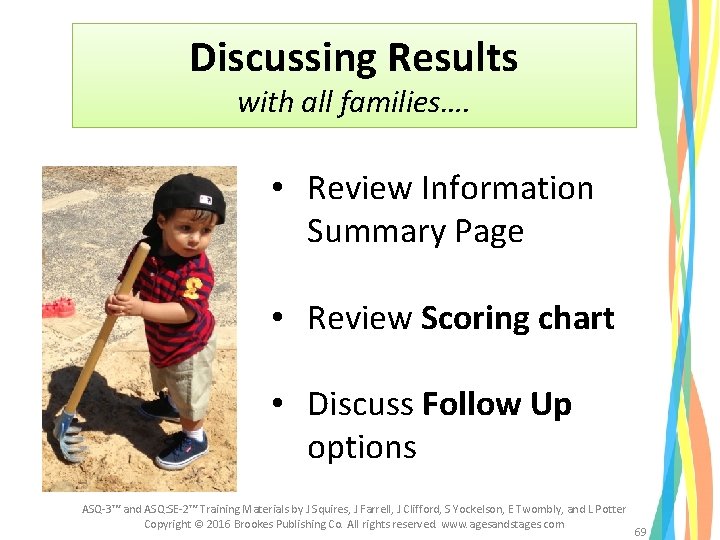
Discussing Results with all families…. • Review Information Summary Page • Review Scoring chart • Discuss Follow Up options ASQ-3™ and ASQ: SE-2™ Training Materials by J Squires, J Farrell, J Clifford, S Yockelson, E Twombly, and L Potter Copyright © 2016 Brookes Publishing Co. All rights reserved. www. agesandstages. com 69
Discussing Results with all families…. Together, decide follow-up: • Share fun learning activities for home/school • Share results with child’s health care provider • Share community resources (Early Intervention, parenting supports) ASQ-3™ and ASQ: SE-2™ Training Materials by J Squires, J Farrell, J Clifford, S Yockelson, E Twombly, and L Potter Copyright © 2016 Brookes Publishing Co. All rights reserved. www. agesandstages. com 70
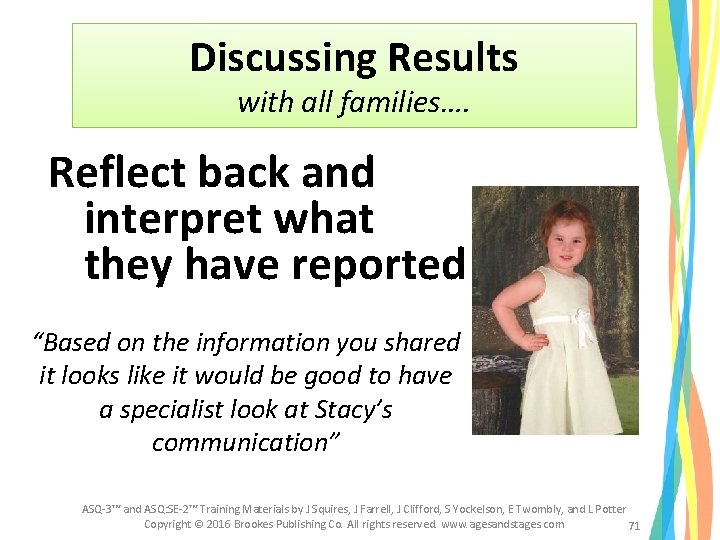
Discussing Results with all families…. Reflect back and interpret what they have reported “Based on the information you shared it looks like it would be good to have a specialist look at Stacy’s communication” ASQ-3™ and ASQ: SE-2™ Training Materials by J Squires, J Farrell, J Clifford, S Yockelson, E Twombly, and L Potter Copyright © 2016 Brookes Publishing Co. All rights reserved. www. agesandstages. com 71
Discussing Results When concerns arise. Having the difficult conversation • Listen and discuss parent concerns • Restate factors to consider (e. g. , health) • If you share concerns, be specific • Think about where parent is in the process • Know your community resources ASQ-3™ and ASQ: SE-2™ Training Materials by J Squires, J Farrell, J Clifford, S Yockelson, E Twombly, and L Potter Copyright © 2016 Brookes Publishing Co. All rights reserved. www. agesandstages. com 72
Discussing Results When concerns arise… • Parents may be relieved and ready or. . • Maybe upset, disagree, or not be ready to accept results. • Listen. Read subtle cues. Reflect back. • Support, guide, and inform parents about resources. • You do not need to convince parents to refer. • Support parent in referrals when they are ready. • Re-screening is a good option and gives them time. ASQ-3™ and ASQ: SE-2™ Training Materials by J Squires, J Farrell, J Clifford, S Yockelson, E Twombly, and L Potter Copyright © 2016 Brookes Publishing Co. All rights reserved. www. agesandstages. com 73
Activity: Discussing ASQ-3 Results with Families Directions: 1. Break into groups of 2 or 3 2. Review steps for discussing ASQ-3 results with caregivers and FAQ’s 3. Choose a role (Provider, Caregiver, Observer) 4. Read background on your role. 5. Begin Role Play and review results using the ASQ-3 Information Summary Sheet. ASQ-3™ and ASQ: SE-2™ Training Materials by J Squires, J Farrell, J Clifford, S Yockelson, E Twombly, and L Potter Copyright © 2016 Brookes Publishing Co. All rights reserved. www. agesandstages. com 74
Activity: Discussing Results – Large Group Debriefing ASQ-3™ and ASQ: SE-2™ Training Materials by J Squires, J Farrell, J Clifford, S Yockelson, E Twombly, and L Potter Copyright © 2016 Brookes Publishing Co. All rights reserved. www. agesandstages. com 75
The Individuals With Disabilities in Education Act (IDEA) Part C: Early Intervention (EI) infants/toddlers Part B: Early Childhood Special Ed (ECSE) preschoolers ASQ-3™ and ASQ: SE-2™ Training Materials by J Squires, J Farrell, J Clifford, S Yockelson, E Twombly, and L Potter Copyright © 2016 Brookes Publishing Co. All rights reserved. www. agesandstages. com 76
Follow Up to Screening: Referring a Child to EI/ECSE • Call, Email, Fax referral information to Part C or Part B provider • Best if parent makes the referral (don’t refer without parent consent) • Timelines for EI/ECSE to respond • EI: 45 Calendar days • ECSE: 60 School day ASQ-3™ and ASQ: SE-2™ Training Materials by J Squires, J Farrell, J Clifford, S Yockelson, E Twombly, and L Potter 77 Copyright © 2016 Brookes Publishing Co. All rights reserved. www. agesandstages. com
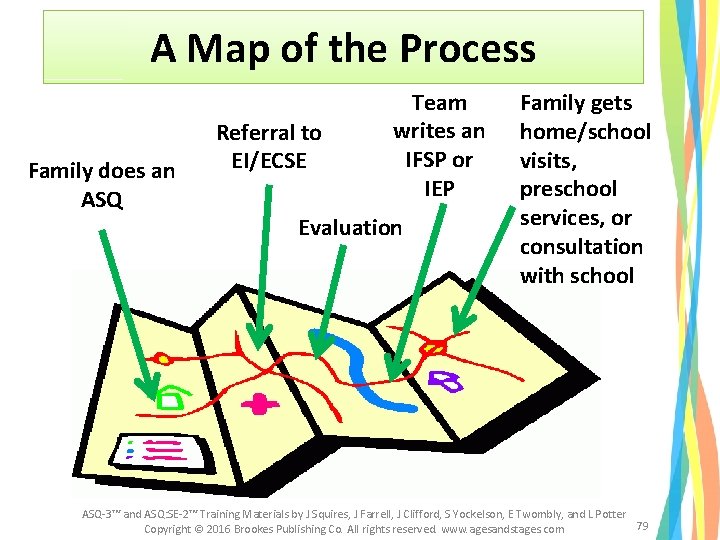
If a Child is Determined Eligible Services are… • Based on child’s goals in an educational plan (IFSP or IEP) • Determined by team, including parents • Reviewed at least every 6 or 12 months • Includes services such as home visits, speech, PT, OT, behavioral therapy, preschool programs or consultation ASQ-3™ and ASQ: SE-2™ Training Materials by J Squires, J Farrell, J Clifford, S Yockelson, E Twombly, and L Potter Copyright © 2016 Brookes Publishing Co. All rights reserved. www. agesandstages. com 78
A Map of the Process Family does an ASQ Referral to EI/ECSE Team writes an IFSP or IEP Evaluation Family gets home/school visits, preschool services, or consultation with school ASQ-3™ and ASQ: SE-2™ Training Materials by J Squires, J Farrell, J Clifford, S Yockelson, E Twombly, and L Potter 79 Copyright © 2016 Brookes Publishing Co. All rights reserved. www. agesandstages. com
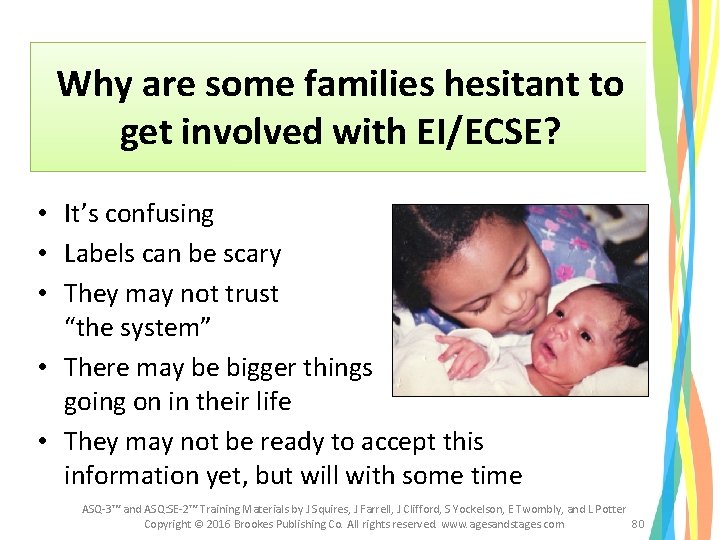
Why are some families hesitant to get involved with EI/ECSE? • It’s confusing • Labels can be scary • They may not trust “the system” • There may be bigger things going on in their life • They may not be ready to accept this information yet, but will with some time ASQ-3™ and ASQ: SE-2™ Training Materials by J Squires, J Farrell, J Clifford, S Yockelson, E Twombly, and L Potter Copyright © 2016 Brookes Publishing Co. All rights reserved. www. agesandstages. com 80
Research and Technical Adequacy of the ASQ-3™ and ASQ: SE-2™ Training Materials by J Squires, J Farrell, J Clifford, S Yockelson, E Twombly, and L Potter Copyright © 2016 Brookes Publishing Co. All rights reserved. www. agesandstages. com 81
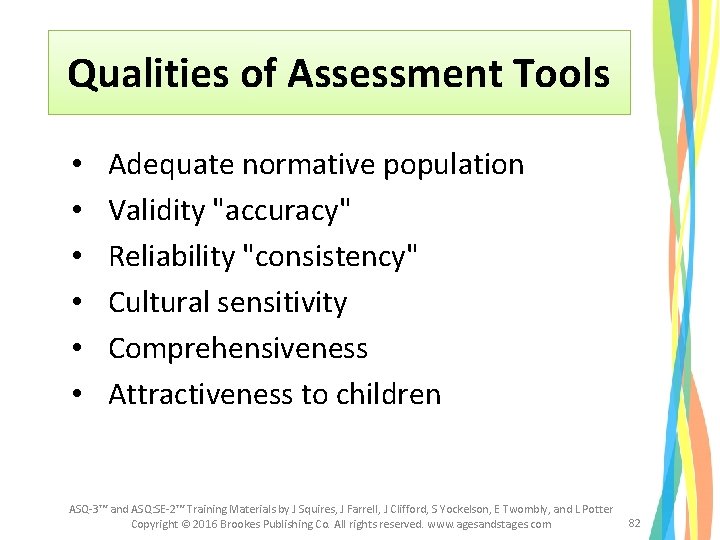
Qualities of Assessment Tools • • • Adequate normative population Validity "accuracy" Reliability "consistency" Cultural sensitivity Comprehensiveness Attractiveness to children ASQ-3™ and ASQ: SE-2™ Training Materials by J Squires, J Farrell, J Clifford, S Yockelson, E Twombly, and L Potter Copyright © 2016 Brookes Publishing Co. All rights reserved. www. agesandstages. com 82
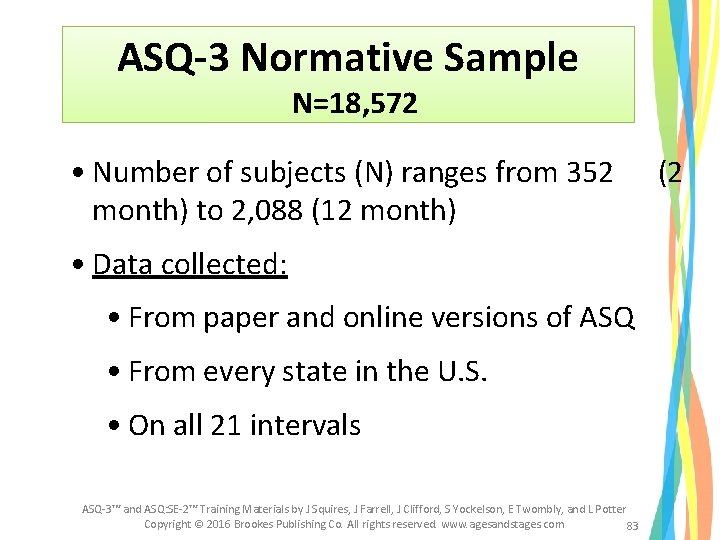
ASQ-3 Normative Sample N=18, 572 • Number of subjects (N) ranges from 352 month) to 2, 088 (12 month) • Data collected: • From paper and online versions of ASQ • From every state in the U. S. • On all 21 intervals ASQ-3™ and ASQ: SE-2™ Training Materials by J Squires, J Farrell, J Clifford, S Yockelson, E Twombly, and L Potter Copyright © 2016 Brookes Publishing Co. All rights reserved. www. agesandstages. com 83 (2
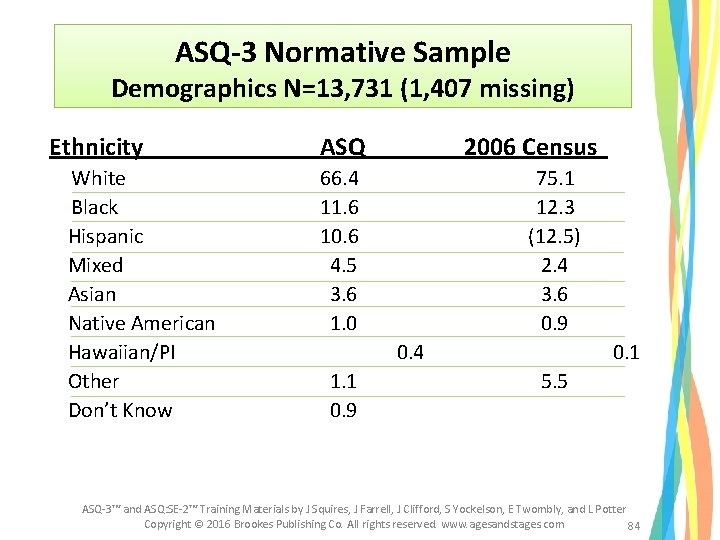
ASQ-3 Normative Sample Demographics N=13, 731 (1, 407 missing) Ethnicity White Black Hispanic Mixed Asian Native American Hawaiian/PI Other Don’t Know ASQ 2006 Census 66. 4 11. 6 10. 6 4. 5 3. 6 1. 0 75. 1 12. 3 (12. 5) 2. 4 3. 6 0. 9 0. 4 1. 1 0. 9 0. 1 5. 5 ASQ-3™ and ASQ: SE-2™ Training Materials by J Squires, J Farrell, J Clifford, S Yockelson, E Twombly, and L Potter Copyright © 2016 Brookes Publishing Co. All rights reserved. www. agesandstages. com 84
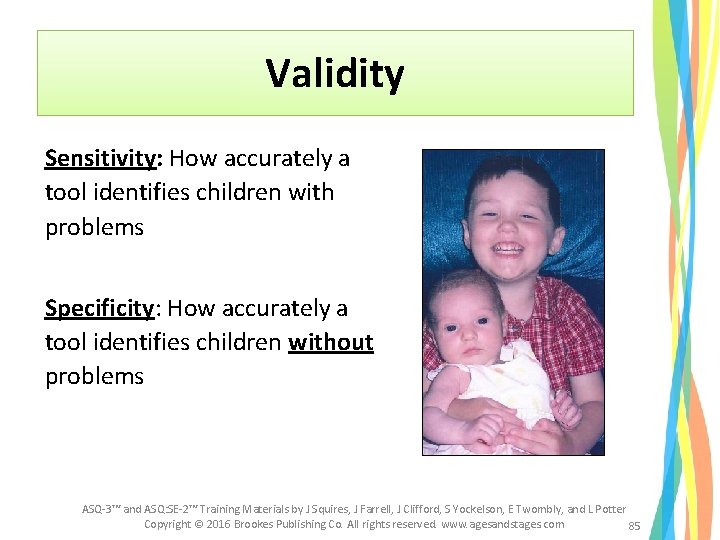
Validity Sensitivity: How accurately a tool identifies children with problems Specificity: How accurately a tool identifies children without problems ASQ-3™ and ASQ: SE-2™ Training Materials by J Squires, J Farrell, J Clifford, S Yockelson, E Twombly, and L Potter Copyright © 2016 Brookes Publishing Co. All rights reserved. www. agesandstages. com 85
ASQ-3 Concurrent Validity • ASQ-3 results compared to: • BDI-2 results • Child’s Eligibility Status ASQ-3™ and ASQ: SE-2™ Training Materials by J Squires, J Farrell, J Clifford, S Yockelson, E Twombly, and L Potter Copyright © 2016 Brookes Publishing Co. All rights reserved. www. agesandstages. com 86
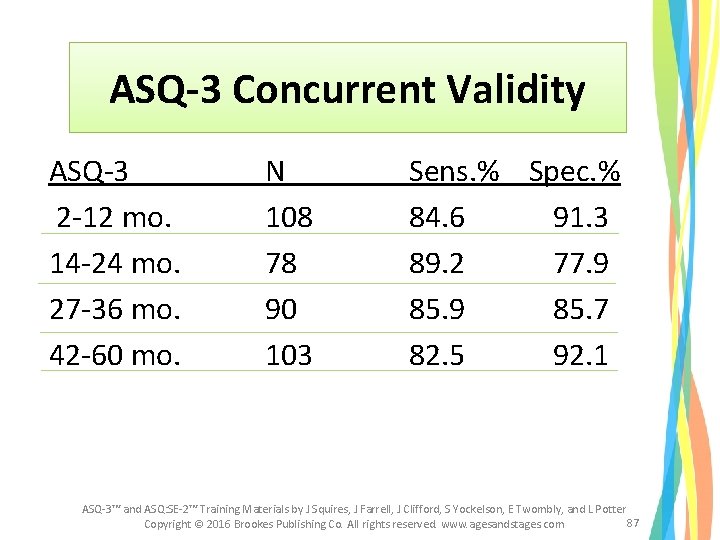
ASQ-3 Concurrent Validity ASQ-3 2 -12 mo. 14 -24 mo. 27 -36 mo. 42 -60 mo. N 108 78 90 103 Sens. % Spec. % 84. 6 91. 3 89. 2 77. 9 85. 7 82. 5 92. 1 ASQ-3™ and ASQ: SE-2™ Training Materials by J Squires, J Farrell, J Clifford, S Yockelson, E Twombly, and L Potter 87 Copyright © 2016 Brookes Publishing Co. All rights reserved. www. agesandstages. com
ASQ-3 Concurrent Validity • Overall (2 -60 months) – Sensitivity: 86. 1 % – Specificity: 85. 6 % – Percent agreement: 85. 8 % – Under-identified: 6. 0 % – Over-identified: 8. 1 % ASQ-3™ and ASQ: SE-2™ Training Materials by J Squires, J Farrell, J Clifford, S Yockelson, E Twombly, and L Potter Copyright © 2016 Brookes Publishing Co. All rights reserved. www. agesandstages. com 88
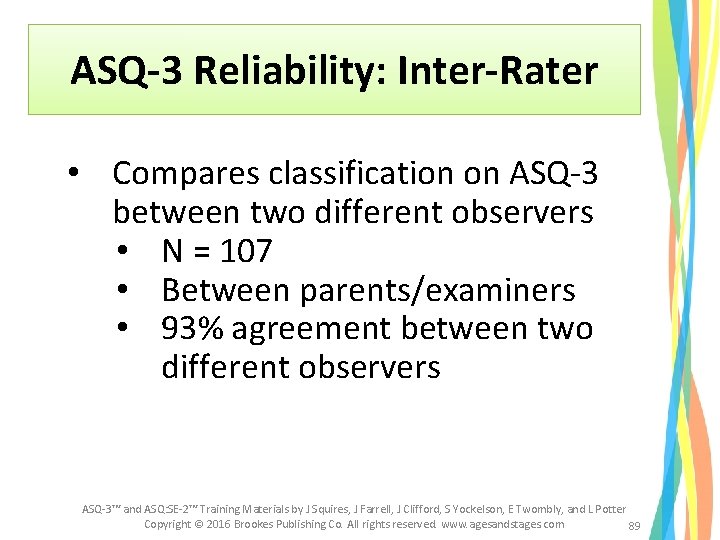
ASQ-3 Reliability: Inter-Rater • Compares classification on ASQ-3 between two different observers • N = 107 • Between parents/examiners • 93% agreement between two different observers ASQ-3™ and ASQ: SE-2™ Training Materials by J Squires, J Farrell, J Clifford, S Yockelson, E Twombly, and L Potter Copyright © 2016 Brookes Publishing Co. All rights reserved. www. agesandstages. com 89
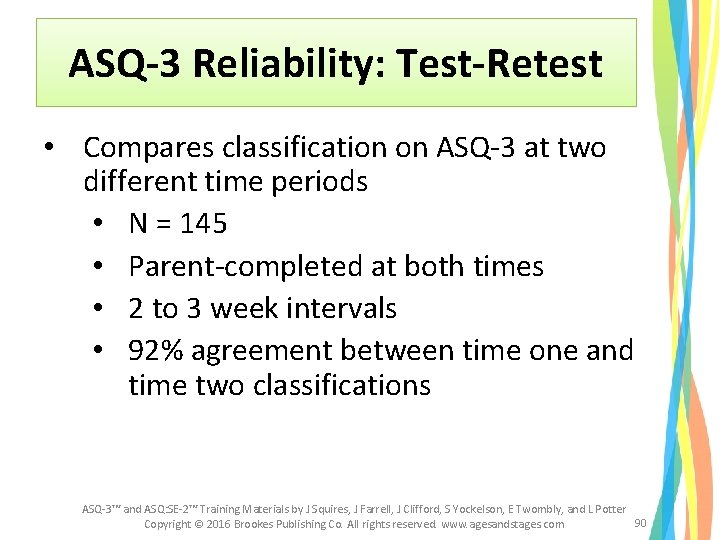
ASQ-3 Reliability: Test-Retest • Compares classification on ASQ-3 at two different time periods • N = 145 • Parent-completed at both times • 2 to 3 week intervals • 92% agreement between time one and time two classifications ASQ-3™ and ASQ: SE-2™ Training Materials by J Squires, J Farrell, J Clifford, S Yockelson, E Twombly, and L Potter 90 Copyright © 2016 Brookes Publishing Co. All rights reserved. www. agesandstages. com
ASQ Research Topics Current and Future Directions ASQ-3™ and ASQ: SE-2™ Training Materials by J Squires, J Farrell, J Clifford, S Yockelson, E Twombly, and L Potter Copyright © 2016 Brookes Publishing Co. All rights reserved. www. agesandstages. com 91
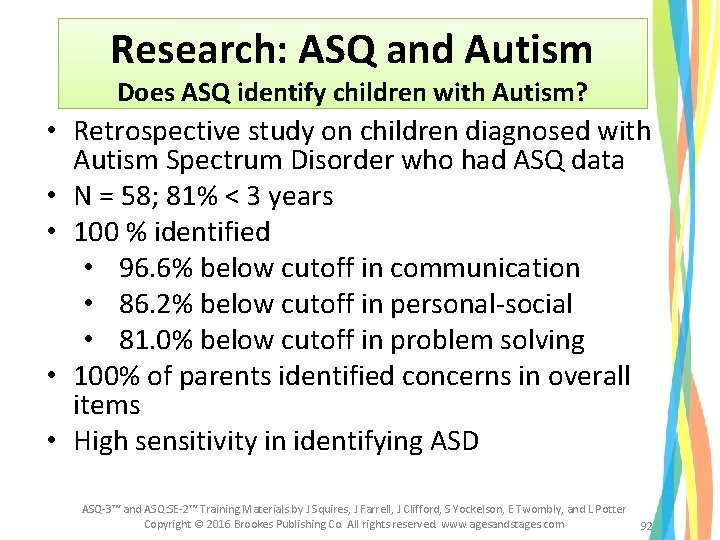
Research: ASQ and Autism Does ASQ identify children with Autism? • Retrospective study on children diagnosed with Autism Spectrum Disorder who had ASQ data • N = 58; 81% < 3 years • 100 % identified • 96. 6% below cutoff in communication • 86. 2% below cutoff in personal-social • 81. 0% below cutoff in problem solving • 100% of parents identified concerns in overall items • High sensitivity in identifying ASD ASQ-3™ and ASQ: SE-2™ Training Materials by J Squires, J Farrell, J Clifford, S Yockelson, E Twombly, and L Potter Copyright © 2016 Brookes Publishing Co. All rights reserved. www. agesandstages. com 92
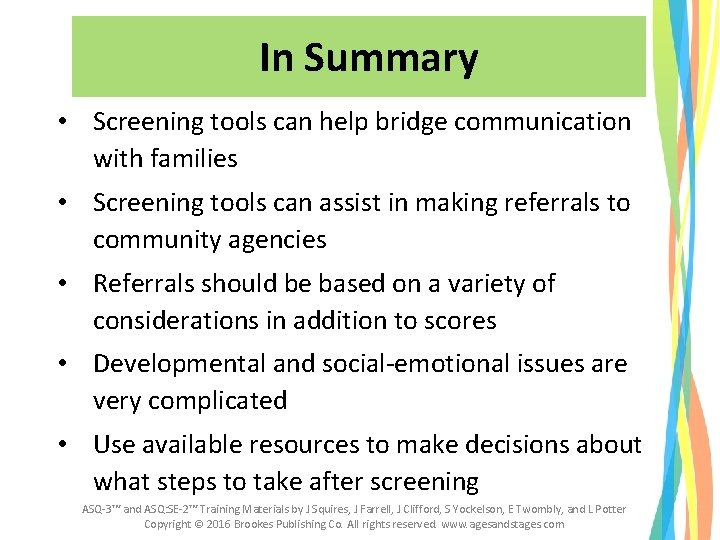
In Summary • Screening tools can help bridge communication with families • Screening tools can assist in making referrals to community agencies • Referrals should be based on a variety of considerations in addition to scores • Developmental and social-emotional issues are very complicated • Use available resources to make decisions about what steps to take after screening ASQ-3™ and ASQ: SE-2™ Training Materials by J Squires, J Farrell, J Clifford, S Yockelson, E Twombly, and L Potter Copyright © 2016 Brookes Publishing Co. All rights reserved. www. agesandstages. com 93