Educational Considerations for Students with Usher Syndrome Part






- Slides: 32
Educational Considerations for Students with Usher Syndrome – Part 1 October 11, 2017 Presented by: Carly Fredericks Family Engagement Coordinator-New Jersey/Founder of Ava’s Voice/NFADB Patti Mc. Gowan Family Engagement Coordinator-Pennsylvania/NFADB Nancy O’Donnell Director, USH Trust Registry-Usher Syndrome Coalition Facilitated by: Megan Cote NCDB Initiative Lead for Early Identification/ Referral & Family Engagement info@nationaldb. org The contents of this presentation were developed under a grant from the U. S. Department of Education #H 326 T 130013. However, those contents do not necessarily represent the policy of the Teaching Research Institute, nor the US Department of Education, and you should not assume endorsement by the Federal Government. Project Officer, Jo Ann Mc. Cann.
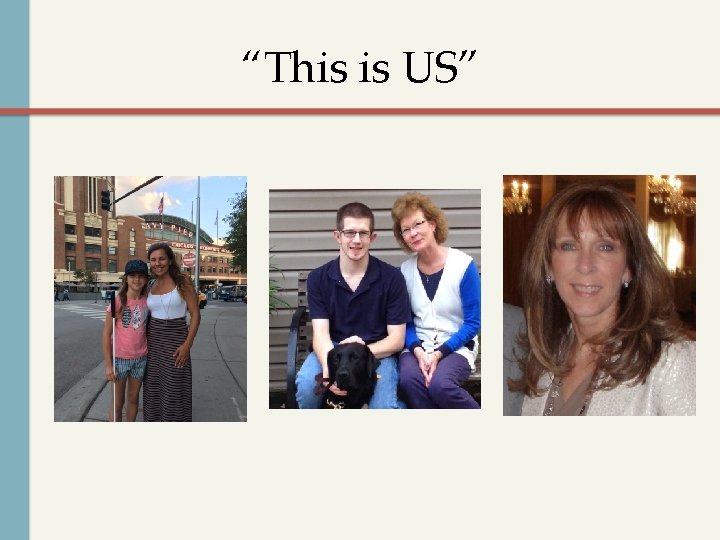
“This is US”
Part I Content • Overview of Usher syndrome • Your child with Usher syndrome • First steps in creating the educational program
Part II Content • The Individualized Education Plan • Accommodations and Modifications • Detailed example of Specially Designed Instruction • The educational team • Transition • Adult services
Webinar Outcomes Participants will: 1. increase their knowledge about the impact that combined vision and hearing loss (due to Usher syndrome) has on their child’s learning 2. understand some of the educational considerations that may be needed now and in the future
History of USH 1914 - Charles Usher, Scottish ophthalmologist studied 69 individuals with RP, 19 of whom also had hearing loss. What have we learned in 103 years?
What is Usher syndrome • Congenital bilateral sensorineural hearing loss (SNL) • Retinitis pigmentosa (RP) – night blindness and a loss of peripheral vision. This may become evident at different ages, depending on type of Usher • Vestibular/balance issues
Usher Syndrome FAQs • Most common genetic cause of combined vision and hearing loss • Recessive - both parents must carry the Usher gene • Affects males and females • 3 main types and 16 subtypes http: //hereditaryhearingloss. org/main. aspx? c=. HHH&n=86573
Usher type 1 • Profound hearing loss (deaf) • Early onset RP (first decade of life) • Vestibular (balance) problems affecting early milestones of crawling, walking, balance and coordination • 1 B, 1 C, 1 D, 1 E, 1 F, 1 G, 1 H, 1 J, 1 K
Usher type 2 • Moderate to severe hearing loss (hard of hearing) • RP evident in teen years • No balance problems • 2 A, 2 C, 2 D
Usher type 3 • Sighted and hearing at birth; progressive hearing and vision loss. • Progressive balance loss in 50% of those with USH 3 • Rare - more common in Finland Ashkenazi Jews • 3 A and 3 B
Atypical Usher • Doesn’t fit any of the first three categories OR • symptoms do not fully express OR • symptoms are absent
Population estimates • USA USH population estimated to be between 20 -50, 000. • # kids, ages birth to 21, could be between 7560 and 13, 125.
What do we know - NCDB’s 2016 child count showed just under 300 kids with Usher syndrome, birth to 21 out of nearly 10, 000 children identified as deafblind. .
What do we know - USC As of October, 2017, the Usher Syndrome Coalition registry had 278 kids with Usher syndrome registered in the USA, birth to 21
Where is everyone? ? • Not yet identified with Usher • Identified but still functioning visually with CI or H/A • Don’t want to “say anything” yet.
Those 5 words. . . Your child has Usher syndrome. . .
Grieving and Believing • • The initial shock of the diagnosis The unknown is the worst Unraveling the unknown Embracing the journey
Fill your toolbox “Knowledge is POWER”
What’s first? Making connections. . . Educate yourself! Set a Goal for yourself! Network with other families Meet adults with Usher syndrome Connect to your State Deaf-Blind Project and the National Center on Deaf-Blindness (NCDB) • Usher Syndrome Coalition- USH Trust registry • Parent Groups (NFADB, PTI, ) local, state, national • HKNC- get your child on the registry • • •
One size does NOT fit all! • • • Learn Consider Make educated decisions Follow your child’s lead ADVOCATE
Exploring Modes of Communication • • Total Communication Auditory/Oral spoken Language American Sign Language Tactile Sign Language Follow your child’s lead. . .
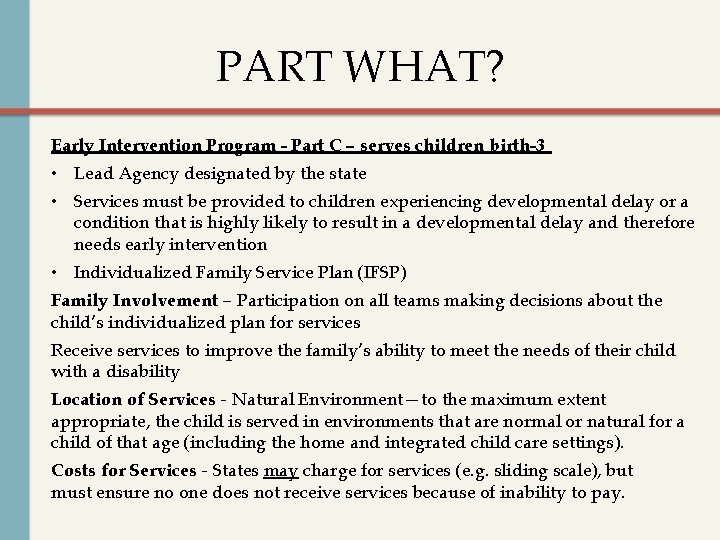
PART WHAT? Early Intervention Program - Part C – serves children birth-3 • Lead Agency designated by the state • Services must be provided to children experiencing developmental delay or a condition that is highly likely to result in a developmental delay and therefore needs early intervention • Individualized Family Service Plan (IFSP) Family Involvement – Participation on all teams making decisions about the child’s individualized plan for services Receive services to improve the family’s ability to meet the needs of their child with a disability Location of Services - Natural Environment—to the maximum extent appropriate, the child is served in environments that are normal or natural for a child of that age (including the home and integrated child care settings). Costs for Services - States may charge for services (e. g. sliding scale), but must ensure no one does not receive services because of inability to pay.
PART WHAT? (cont. ) Special Education Program – Part B – children ages 3 -21 • Lead Agency is the State Department of Education • Special education must be provided to children who fit 1 or more of the following categories of disability: Mental retardation, a hearing impairment (including deafness), a speech or language impairment, a visual impairment (including blindness), a serious emotional disturbance (referred to in this part as emotional disturbance), an orthopedic impairment, Autism, Traumatic brain injury, other health impairment, a specific learning disability, Deaf-blindness, or multiple disabilities • Individualized Education Plans (IEP) Family Involvement - Participation on all teams making decisions about the child’s individualized plan for services Location of Services - Least Restrictive Environment—to the maximum extent appropriate, the child receives services and participates in the general curriculum, non-academic, and extra-curricular activities alongside peers without disabilities. Costs for Services - All services must be provided for free.
Early Intervention (birth-3 yrs) Early intervention refers to educational services for young children (birth to age 3) who have disabilities. Part C Early intervention focuses on helping eligible babies and toddlers learn the basic and brand-new skills that typically develop during the first three years of life, such as: ● physical (reaching, rolling, crawling, and walking); ● cognitive (thinking, learning, solving problems); ● communication (talking, listening, understanding); ● social/emotional (playing, feeling secure and happy); and ● self-help (eating, dressing).
Preschool (age 3 -5 yrs) Services for preschool children (ages 3 through 5) are provided free of charge through the public school system. These services are available through the same law—the Individuals with Disabilities Education Act —
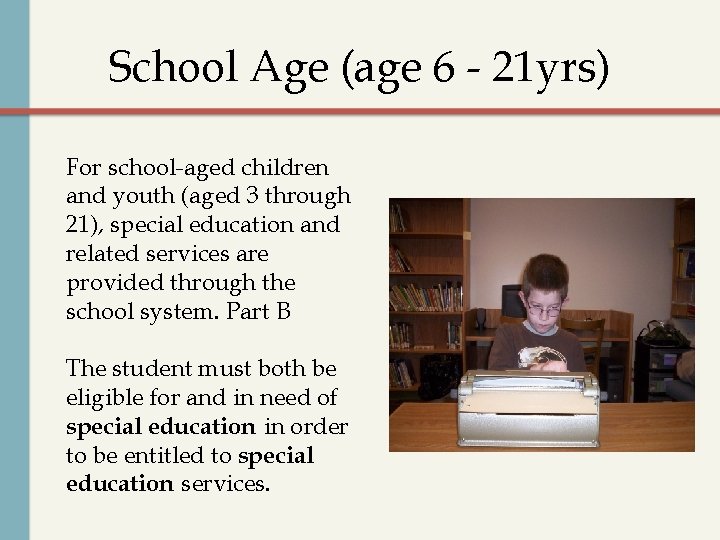
School Age (age 6 - 21 yrs) For school-aged children and youth (aged 3 through 21), special education and related services are provided through the school system. Part B The student must both be eligible for and in need of special education in order to be entitled to special education services.
Who’s on my team? • • • • Parent, Student Family member, guardian Special Ed Director, LEA/Case Manager General Education Teachers Special Education Teachers Teacher of Visual Impairment (TVI) Teacher of the Deaf (TOD) Educational Interpreter Intervener, Para-professional Audiologist AT Consultant Deaf-Blind Consultant Speech Pathologist OT, PT
Classification Federal Definition: Deaf-blindness means concomitant hearing and visual impairments, the combination of which causes such severe communication and other developmental and educational needs that they cannot be accommodated in special education programs solely for children with deafness or children with blindness. 34 CFR 300. 8 (c) (2)
Assessments The evaluation must use a variety of assessment tools and strategies to gather relevant functional, developmental, and academic information about the child, including information provided by the parent. When conducting an initial evaluation, it’s important to examine all areas of a child’s functioning to determine not only if the child is a child with a disability, but also determine the child’s educational needs. This full and individual evaluation includes evaluating the child’s: • Health, • Vision and hearing • Social and emotional status • General inteliligence • Academic performances • Communicative status and • Motor abilities
Develop IEP • Based on the results of the Assessment, the team develops educational goals for the school year. • The IEP tells his story and designs a path for him to achieve his educational outcomes. This includes adaptations, accommodations or modifications for him/her to access the general ed curriculum.
Contacts Megan Cote megan. cote@hknc. org Carly Fredericks frederc 5@tcnj. edu Patti Mc. Gowan pmcgowan@pattan. net Nancy O'Donnell nancy. odonnell 0813@gmail. com