
Chapter 9 Preanalytical Considerations OBJECTIVES Define the key

Chapter 9 Preanalytical Considerations
OBJECTIVES • Define the key terms and abbreviations listed at the beginning of this chapter. • List and describe physiologic variables that influence basal state and name the laboratory tests affected by each one. • List problem areas to avoid in site selection and describe causes for concern and procedures to follow when encountering each • Identify and describe various vascular access devices.
OBJECTIVES Cont. • List blood collection complications and procedural errors that affect the patient or the quality of the specimen. • Identify and describe the procedural errors that lead to failure to draw blood and explain how to handle them.

54. Basal state refer to what? • Resting metabolic state – early morning

Physiologic Variables that Influence Specimen Composition • Basal state – Condition of body when patient is still at rest and fasting approx. 12 hrs. – Reference ranges • Normal values for lab tests • Established on basal state ranges – Outpatients are not at basal state

55. How does age, altitude, dehydration play a part in results of the blood? • Age - RBC and WBC are higher in newborns than adults • Altitude – RBC carry O 2 – HGB, HCT higher in elevation • Dehydration – low body fluid – vomiting, vomiting diarrhea, caused by hemoconcentration – blood can’t leave bloodstream become concentrated in the smaller plasma volume
56. How does eating prior to blood draw affect test results? • • Glucose – higher Lipemic- milky serum or plasma Triglycerides - higher Hormones - certain hormones higher
57. How can drug therapy affect test? • Chemo – Lowers the WBC and PLT • Drugs toxic to liver/ multiple drugs – elevate certain liver tests • Opiates and morphine – increase liver & pancreas enzymes

58. What does jaundice indicate? • Icteric – abnormal deep yellow color, increase bilirubin level
60. List the vascular access devices and sites • Art-line – placed in a artery • Arteriovenous (AV) shunt, shunt fistula or graft – permanent, surgical fusion of an artery and vein, usually for dialysis • Heparin lock (saline) catheter or cannula used to give medicine or take blood out. Lower arm • Intravenous (IV) within a vein • Central Vascular Access Devices (CVADs) – Tubing inserted in main artery or vein • Peripherally Inserted Central Catheter – (PICC-line) inserted in the peripheral venous system then threaded into the central venous system ( vein leading to the heart)
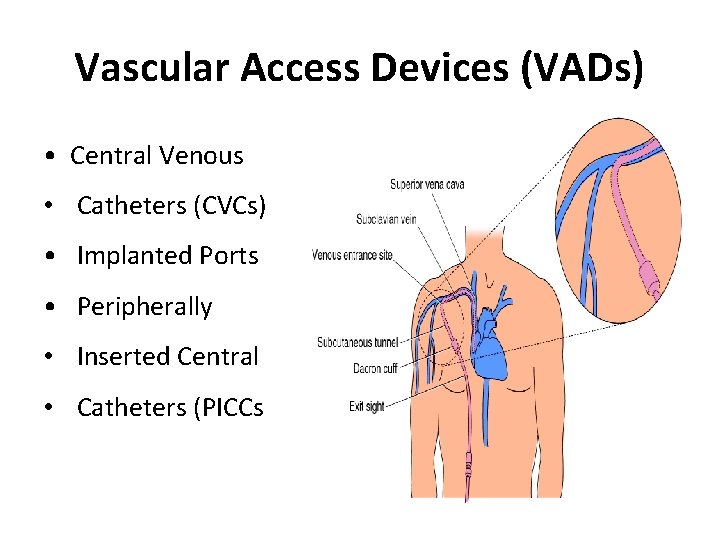
Vascular Access Devices (VADs) • Central Venous • Catheters (CVCs) • Implanted Ports • Peripherally • Inserted Central • Catheters (PICCs

Vascular Access Areas & Devices to Avoid in Site Selection • IV Sites • Previously Active IV Sites • Arterial Lines • AV Shunts or Fistulas • Heparin or Saline Locks • Vascular Access Devices

IV Sites • Preference is not to draw from arm with intravenous line • If drawing from IV arm – Must be drawn below – May result in dilution – For procedure see Box 9 -1, p. 309
61. What is syncope and how do you deal with it? • Loss of consciousness • Fainting - Halt the venipuncture - Have patient place head between knees - Get ice pack or cold towel on forehead or back of neck - Call for assistance - Place patient in reclining position

62. What are petechiae? • Tiny red or purple spots on the skin, when a tourniquet is tied (too tight). Blood is forced through the capillaries and comes to the surface of the skin
63. How do you deal with a patient having a seizures/convulsions • • • Stop drawing Call for assistance Hold pressure to the site Do not put anything into the mouth Keep airways open

64. What do you do with a hematoma formation? • • Stop drawing Apply pressure – 5 minutes Ice Document in incident log!
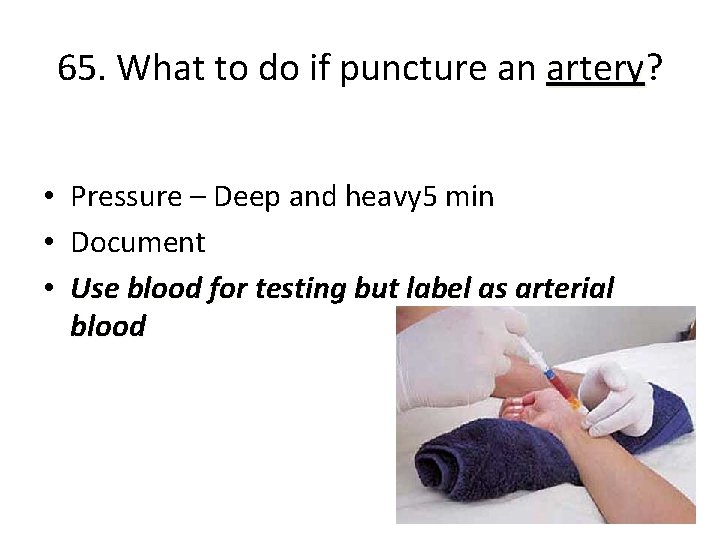
65. What to do if puncture an artery? artery • Pressure – Deep and heavy 5 min • Document • Use blood for testing but label as arterial blood
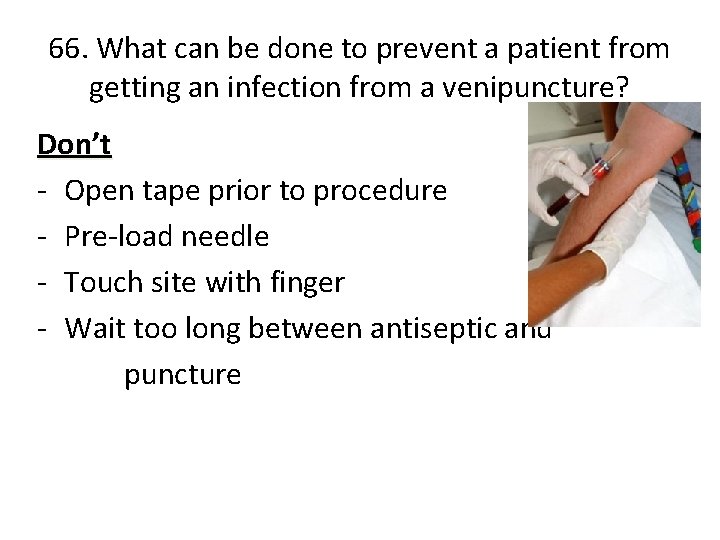
66. What can be done to prevent a patient from getting an infection from a venipuncture? Don’t - Open tape prior to procedure - Pre-load needle - Touch site with finger - Wait too long between antiseptic and puncture
67. Nerve injury occurs, when? • • • Poor site Improper vein selection Inserted needle too deep or quickly Patient moved Excessive or lateral redirection Blind probing Stop venipuncture and document! document - Shock sensation, burning, pain radiating up/down

69. How can a phlebotomist prevent vein damage? • • • Don’t draw continuously from same site Blind probing Improper technique when redirecting needle

70. Name 4 Specimen Quality Concerns and preventions • Hemoconcentration – tourniquet causes localized “venous stasis” – stagnation of normal blood flow (venostasis trapping blood) • Hemolysis – Breaking of RBC – darkens the serum or plasma, elevates test (small bore needle, high pressure transfer) • Partially Filled Tubes – Tubes should be full, anticoagulant partial filled tubes don’t contain proper blood to additive ratio • Specimen contamination – - Alcohol residue, fingerprint oil, from urine wet diapers - Glove powder (starch) on slides - Sweat – dripping into capillary tubes - Improper usage of antiseptic - omit B/C bottle tops, retouching - Using wrong antiseptic – ex: alcohol for ETOH levels
68. Explain “reflux”, also how it relates to anticoagulants? • Backflow - Adverse reaction of the additives • - Prevention Patient arm in a downward position Insert tubes upward
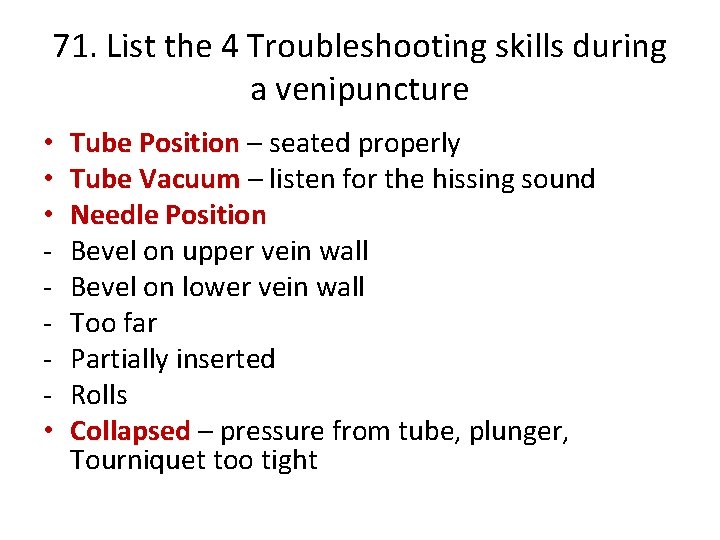
71. List the 4 Troubleshooting skills during a venipuncture • • Tube Position – seated properly Tube Vacuum – listen for the hissing sound Needle Position Bevel on upper vein wall Bevel on lower vein wall Too far Partially inserted Rolls Collapsed – pressure from tube, plunger, Tourniquet too tight
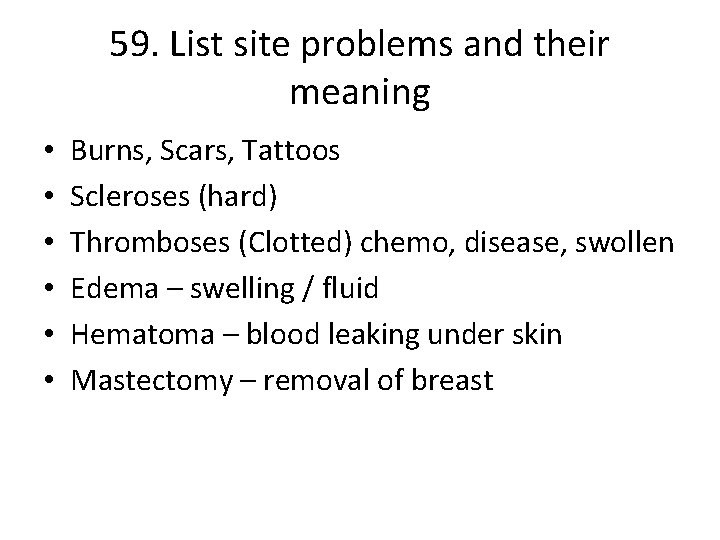
59. List site problems and their meaning • • • Burns, Scars, Tattoos Scleroses (hard) Thromboses (Clotted) chemo, disease, swollen Edema – swelling / fluid Hematoma – blood leaking under skin Mastectomy – removal of breast

Proper & Improper Needle Positioning
Problem #1: Misidentifying a Patient or Sample Solution: Treating a patient according to another patient's results can be catastrophic, especially when a transfusion is involved. One study showed that 11 percent of transfusion-related deaths were caused when the phlebotomist misidentified the patient or mislabeled the tube. reports Dennis J. Ernst, MT(ASCP), director, Center for Phlebotomy Education Inc. , Corydon, IN. In 2005, the chair of the College of American Pathologists' Quality Practices Committee estimated that 160, 000 adverse patient events occur annually in the United States due to patient identification and specimen labeling errors.
Problem #2: Decentralized Phlebotomy Solution: Studies have repeatedly shown that a laboratory-based specimen-collection staff commits fewer patient identification and labeling errors and has lower blood culture contamination rates and fewer rejected specimens. Studies have also shown emergency room specimens are 10 times more likely to be mislabeled than those drawn elsewhere and 20 times more likely to be hemolyzed than those drawn by laboratory personnel, Ernst reports.
Problem #3: Poor Phlebotomy Technique Solution: Poor phlebotomy technique is particularly relevant in institutions with decentralized phlebotomy that do not possess properly trained phlebotomists, but rely on nurses to do the blood collections.
Problem #4: Improper Specimen Mixing Solution: In the process of converting from glass to plastic tubes, improper specimen mixing has emerged as an area for concern. In the past, blood collection tubes were made of glass and contained liquid additives that did not require a lot of mixing. Because of safety concerns, most institutions have switched to plastic blood collection tubes, which require between five to eight inversions, depending on the tube type. The consequence of improper mixing is either partial clotting (in plasma tubes) or incomplete clotting (in serum tubes). Both can lead to fibrin formation, which can cause significant problems during specimen testing.
Paying the Price In light of tough economic times, a laboratory may be tempted to eliminate dedicated phlebotomy staff or switch to cheaper, lower quality products to meet cost containment requirements. "The cost of poor specimen quality, however, can far outweigh savings achieved by the elimination of dedicated phlebotomy staff or relying on less expensive but lower quality products, " Dr. Stankovic says. Unanticipated expenses result from specimen re-draws, laboratory testing errors, unnecessary treatment delays, prolonged patient stays in the emergency room and subjecting patients to unnecessary procedures due to erroneous testing results.

- Slides: 32