AF 1 Trusts 1682019 Audley Financial Training 1
- Slides: 120
AF 1 Trusts 16/8/2019 Audley Financial Training 1
What we will cover • Basics of a trust • The main types of trusts • Taxation of trusts • Investment Bonds in Trusts • Overseas Trusts • The use of trusts in financial planning 16/8/2019 Audley Financial Training 2
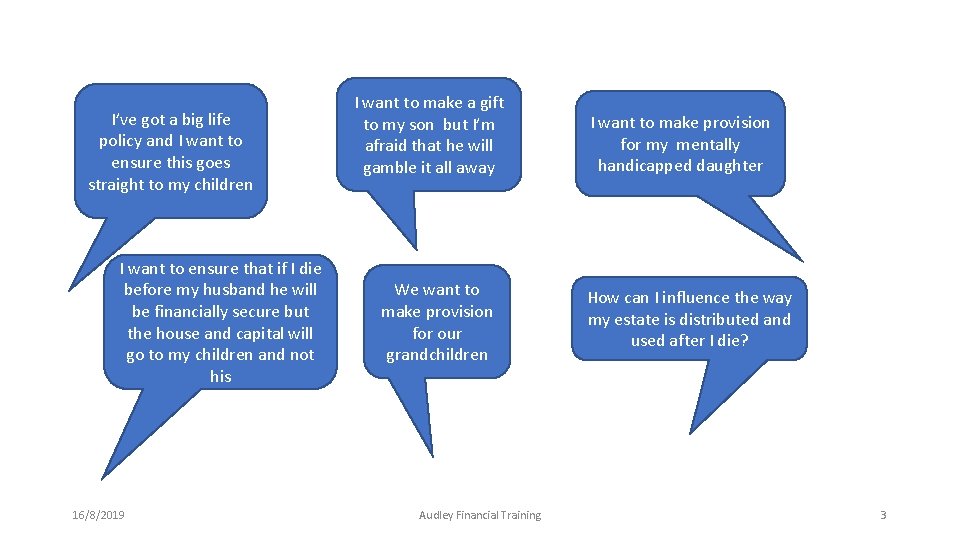
I’ve got a big life policy and I want to ensure this goes straight to my children I want to ensure that if I die before my husband he will be financially secure but the house and capital will go to my children and not his 16/8/2019 I want to make a gift to my son but I’m afraid that he will gamble it all away We want to make provision for our grandchildren Audley Financial Training I want to make provision for my mentally handicapped daughter How can I influence the way my estate is distributed and used after I die? 3
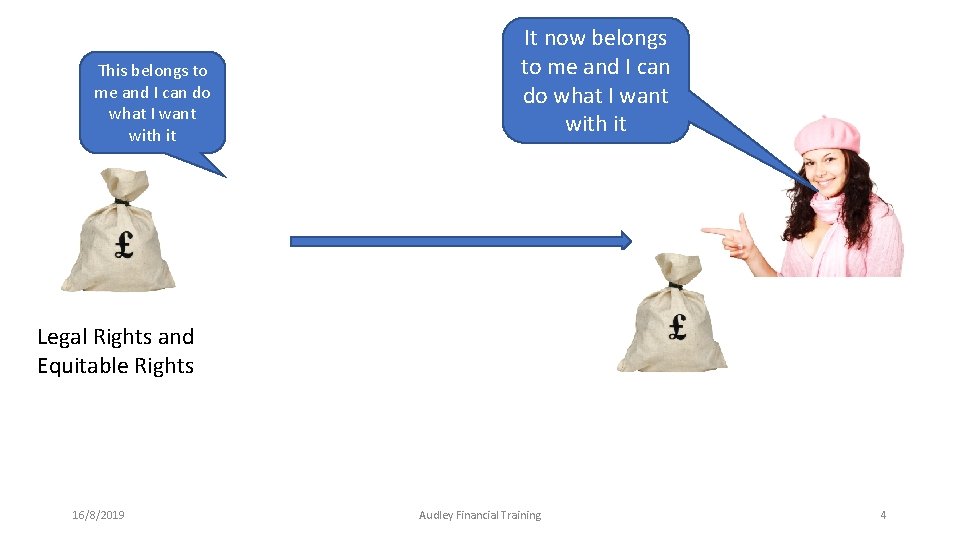
This belongs to me and I can do what I want with it It now belongs to me and I can do what I want with it Legal Rights and Equitable Rights 16/8/2019 Audley Financial Training 4
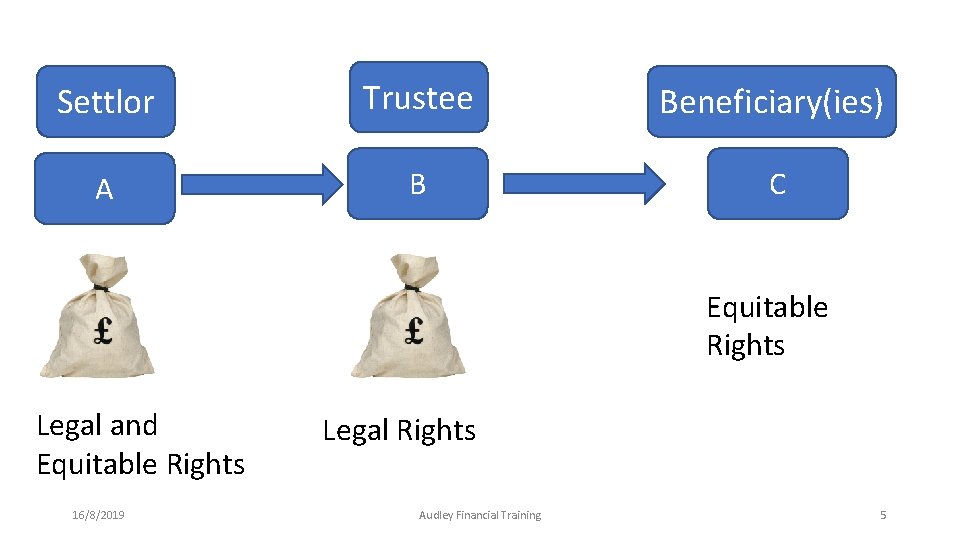
Settlor Trustee Beneficiary(ies) A B C Equitable Rights Legal and Equitable Rights 16/8/2019 Legal Rights Audley Financial Training 5
The three parties to a trust • The settlor • Decides what type of trust • Gifts the property to the trust • Appoints trustees • Trustees • The legal owners of the property • Administer the trust property in accordance with the trust deed • The beneficiary(ies) • Those who can benefit from the trust 16/8/2019 Audley Financial Training 6
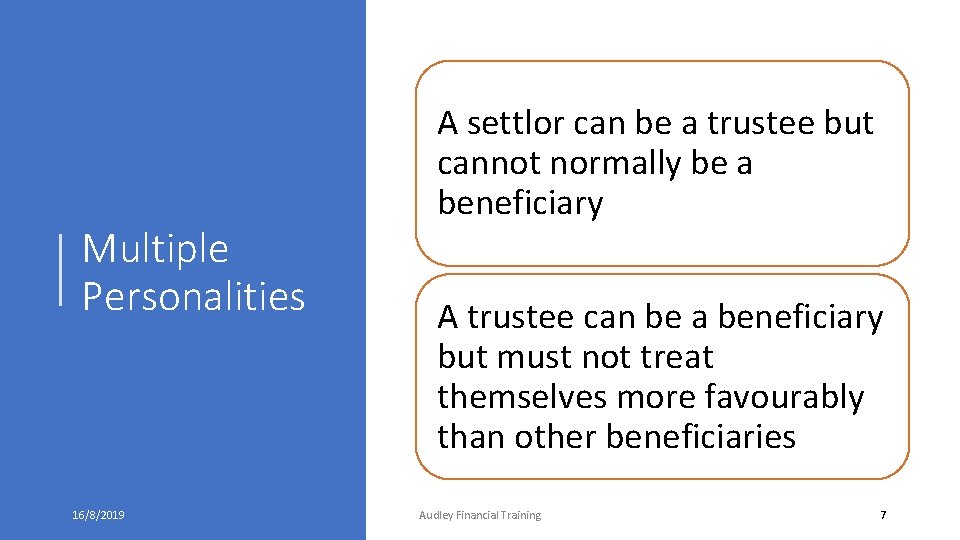
Multiple Personalities 16/8/2019 A settlor can be a trustee but cannot normally be a beneficiary A trustee can be a beneficiary but must not treat themselves more favourably than other beneficiaries Audley Financial Training 7
Beneficiary’s rights • Income rights. The right to receive income from the trust • “Enjoyment” rights. The right to enjoy some benefit such as living in a house rent free. • Right to be “maintained” • Right to capital from the trust. • This may be an absolute right • It could be conditional, e. g on reaching a set age • It could be at the discretion of the trustees 16/8/2019 Audley Financial Training 8
How to set up a trust • The main two ways are: • By a deed • A written declaration, signed and witnessed that sets up the trust. Usually comes into effect immediately. • Through a will • The will states that on the death of the individual, property is passed into a trust. • The trust comes into effect on their death • Other methods are available! 16/8/2019 Audley Financial Training 9
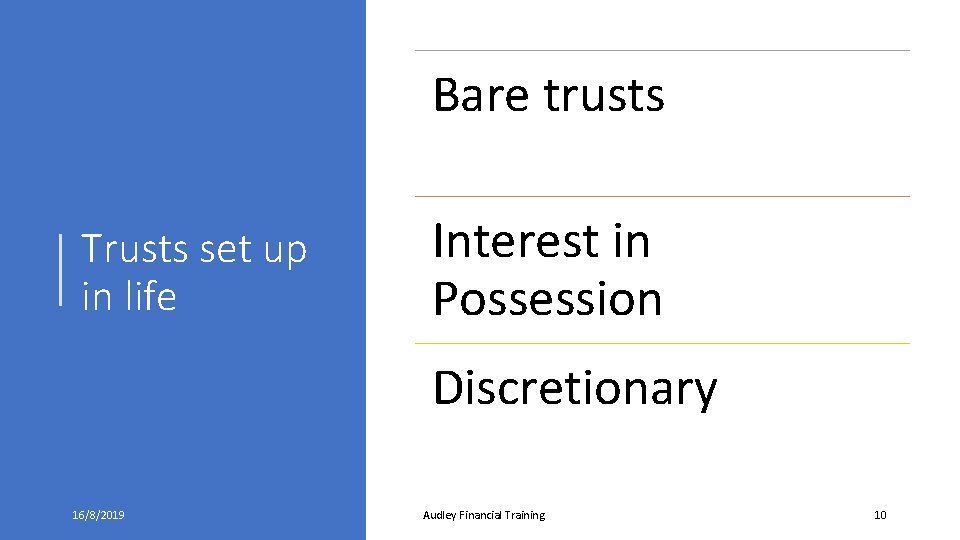
Bare trusts Trusts set up in life Interest in Possession Discretionary 16/8/2019 Audley Financial Training 10
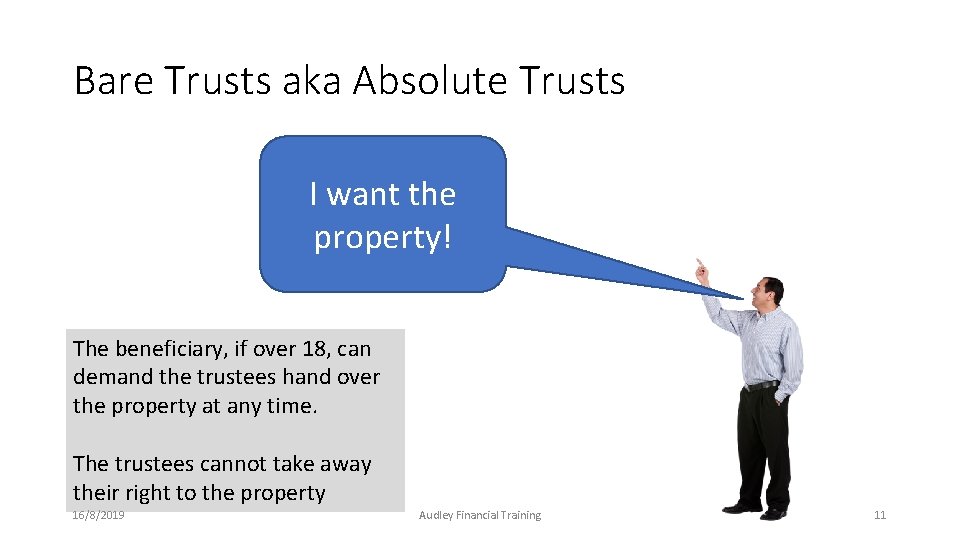
Bare Trusts aka Absolute Trusts I want the property! The beneficiary, if over 18, can demand the trustees hand over the property at any time. The trustees cannot take away their right to the property 16/8/2019 Audley Financial Training 11
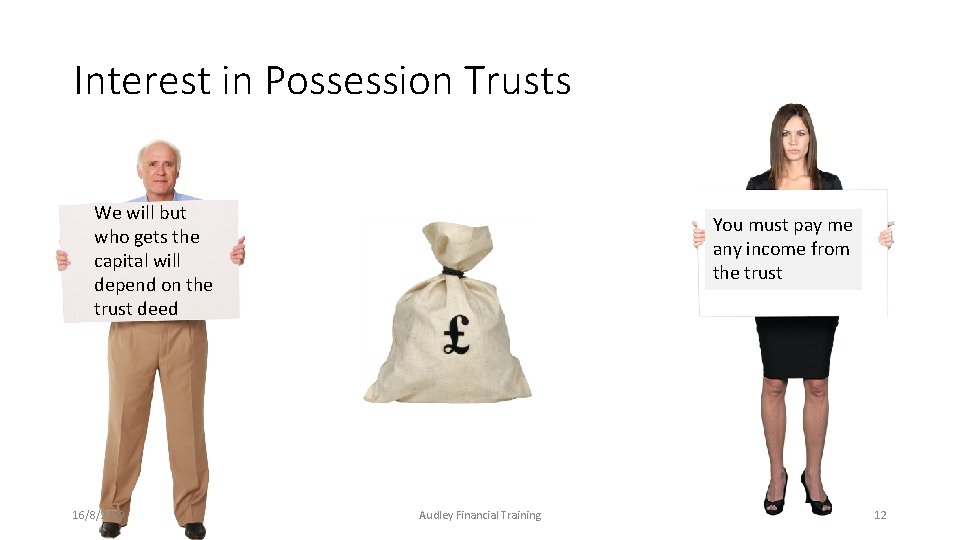
Interest in Possession Trusts We will but who gets the capital will depend on the trust deed 16/8/2019 You must pay me any income from the trust Audley Financial Training 12
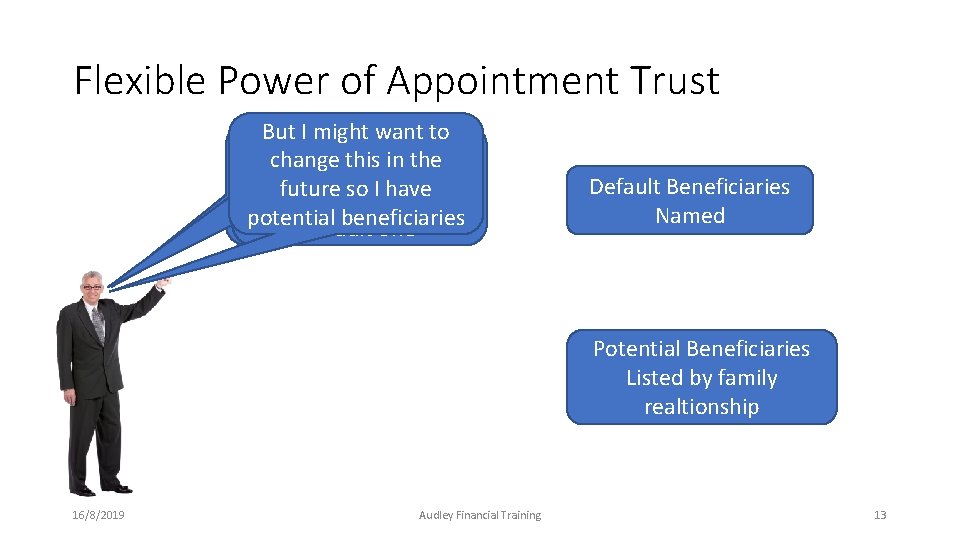
Flexible Power of Appointment Trust But want to I can. I might take someone The trust this has default change in thelist from the potential beneficiaries are future so Iwho have and add them to the are named potential beneficiaries default one Default Beneficiaries Named Potential Beneficiaries Listed by family realtionship 16/8/2019 Audley Financial Training 13
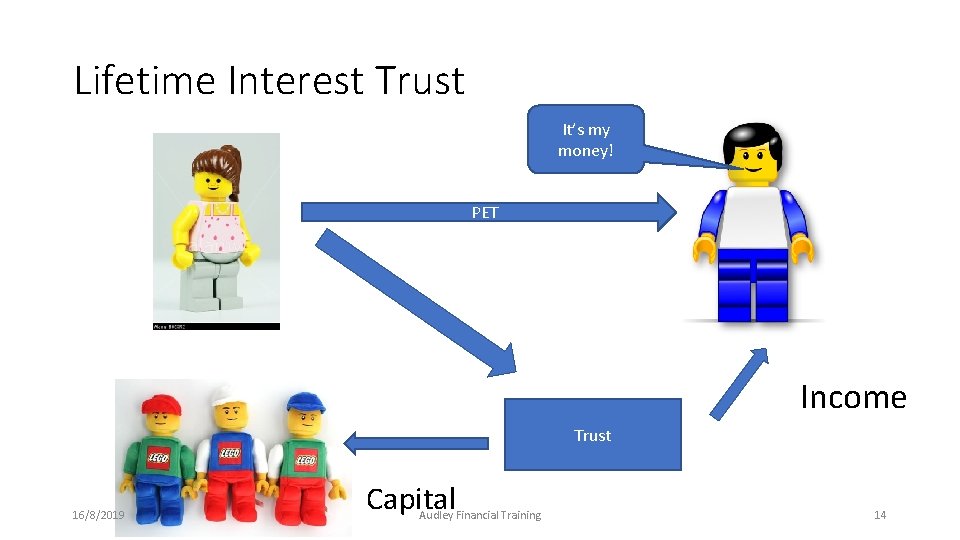
Lifetime Interest Trust It’s my money! PET Income Trust 16/8/2019 Capital Audley Financial Training 14
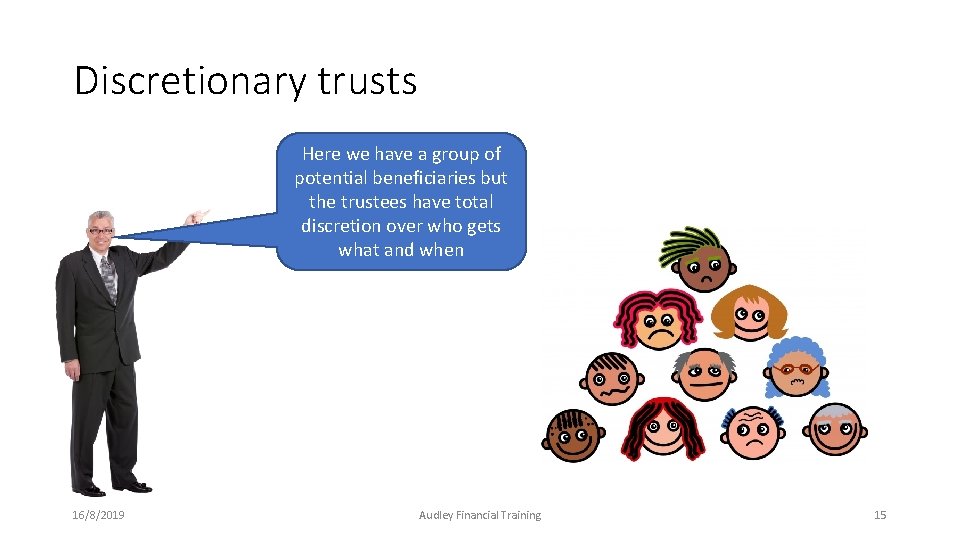
Discretionary trusts Here we have a group of potential beneficiaries but the trustees have total discretion over who gets what and when 16/8/2019 Audley Financial Training 15
It’s all about the beneficiaries’ rights • Bare/Absolute Trust. • Beneficiaries can claim the assets whenever they want • Interest in Possession Trust • Named beneficiaries have a right to income or other benefit. Right to capital will depend on trust deed. • Discretionary Trust • No beneficiary has a right to income or capital 16/8/2019 Audley Financial Training 16
Trusts set up in a will • Rather than give an outright legacy it may be preferable to pass the gift into a trust. • The trust comes into effect on the death of the donor • The executors are normally the trustees • The main reasons to set one up are control and IHT mitigation • You can set up an bare/absolute trust or a Discretionary Trust • There are three trusts that can only be set up through a will. • Immediate Post Death Interest (IPDI) Trust • Trust for Bereaved Minors • 18 -25 trust 16/8/2019 Audley Financial Training 17
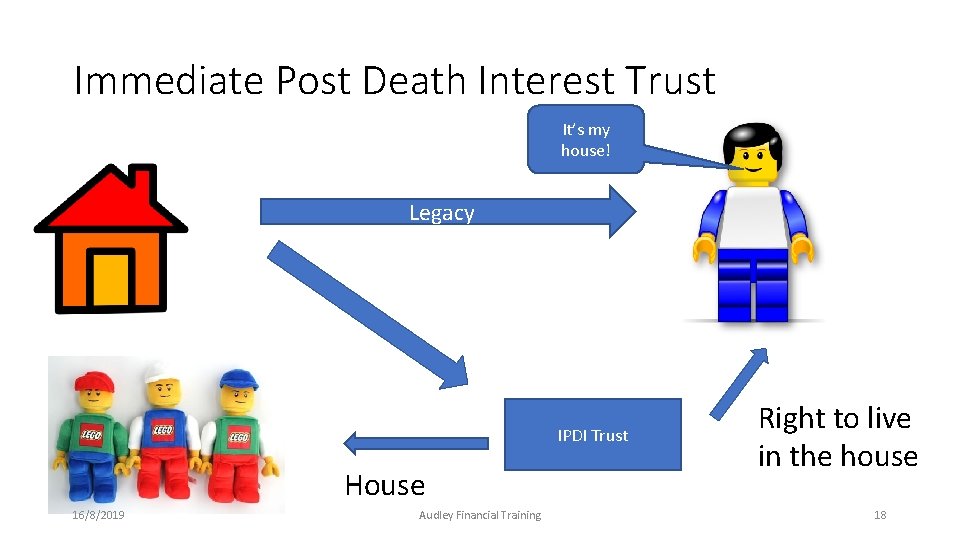
Immediate Post Death Interest Trust It’s my house! Legacy IPDI Trust House 16/8/2019 Audley Financial Training Right to live in the house 18
Bereaved Minor Trust/18 -25 trust • Can only be set up by a parent or step-parent of a minor child. • It cannot be used by a grandparent or any other relative • It must give the child an absolute right to the property on reaching 18 • And that can be a potential problem • An alternative is the 18 -25 trust where the trustees can pass the property over at any time between their 18 th and 25 th birthday 16/8/2019 Audley Financial Training 19
Discretionary Will Trusts • The deceased cannot be a trustee but can have some influence on the trustees. • This is done by writing a letter of intent • This is not binding on the trustees but will normally be followed 16/8/2019 Audley Financial Training 20
Married Women’s Property Act trust • A life policy must be taken out by a man or woman on their own life • The policy must be for the benefit of a spouse or civil partner or children of the assured • The Act does not have to be mentioned and the words used do not have to expressly declare a trust • Usually set up by a “tick box” on the proposal form 16/8/2019 Audley Financial Training 21
MWPA Benefeciaries • Unnamed spouse • spouse at the date of death • Named spouse • a subsequent divorce will not destroy the interest • a court may vary the terms of the trust during a divorce • Children excludes stepchildren and grandchildren • but includes illegitimate and adopted children • Child beneficiaries may be named or unnamed • can be restricted to children of an existing marriage • their interest can be contingent on attaining some age 16/8/2019 Audley Financial Training 22
Charitable Trusts • Set up under the Charities Act 2006 • 13 possible objectives • Lifetime gifts are exempt • Legacies are exempt and could reduce IHT rate to 36% • Trust income and gains free of income and Capital gains tax 16/8/2019 Audley Financial Training 23
Trusts legal issues 16/8/2019 Audley Financial Training 24
The three certainties of a trust • Certainty of words • Certainty of subject • Certainty of object 16/8/2019 Audley Financial Training 25
Trustees • • Choosing trustees How they are appointed How they can be changed Their duties Their powers including their investment powers Their powers to delegate Trust registration Service 16/8/2019 Audley Financial Training 26
Choosing Trustees • • • Anyone over 18 and sane can be a trustee How many? Professional or lay? What will trustees be expected to do? What age will they be when they will be required to make crucial decisions? 16/8/2019 Audley Financial Training 27
Appointment of trustees • Usually appointed by settlor in trust deed • Further trustees may be added by trustees or an appointer depending on trust deed. • Trustees can be replaced if • • • 16/8/2019 They are minors They die They are unfit or become incapable of acting They become disqualified They are out of the UK for more than 12 months They wish to be discharged Audley Financial Training 28
Death of trustee • If the last surviving trustee dies their powers will be taken over by their executors • Who can appoint another trustee • No trust will ever fail because of a lack of trustee • The court will appoint a trustee in those circumstances 16/8/2019 Audley Financial Training 29
Powers of trustees • What they can legally do • Buy & sell investments and give receipt for property passed to them • Insure property • Settle debts or renegotiate their liabilities • Maintain minors by advancing money for their maintenance, education or benefit • Advance capital to a beneficiary before the deed states they will become absolutely entitled to it 16/8/2019 Audley Financial Training 30
Duties of trustees: what they must do • To act in the best interest of the beneficiaries • To exercise care in the management of the trust • To invest any cash, unless it is to be paid out • To invest in accordance with the trust deed, or general trust law (Trustee Act 2000) • To hold the title documents to any trust property • To take into account the tax position of the trust and its beneficiaries • To keep proper accounts and produce them to the beneficiaries if required 16/8/2019 Audley Financial Training 31
Investment powers of trustees Investment Powers of trustees • A default power to invest in the same way as outright owners – can be restricted by the trust deed • Must consider the suitability of the investments – and the need for diversification • Keep investments under review and vary them if appropriate • Must obtain and consider proper advice when making and reviewing investments – unless considered unnecessary or inappropriate 16/8/2019 Audley Financial Training 32
Trustees powers to delegate Delegation of Powers • Under Trustee Act 2000 can appoint • agents • nominees • Custodians • But cannot delegate • • 16/8/2019 Distribution of trust assets How fees are dealt with Appointment of new trustees Delegation of trustees’ powers Audley Financial Training 33
Breach of Trust Action against trustees • If trustees do something outside their powers, or fail to do something the trust requires them to do • A beneficiary can take legal action against trustees and if they are guilty of a breach – they can be liable to compensate the beneficiaries for loss caused by the breach – a court can relieve them of liability if they have acted honestly and reasonably • Provided the trustees exercise their duty of care they will not be liable for loss 16/8/2019 Audley Financial Training 34
Perpetuities and Accumulations • A charitable trust can continue indefinitely • All other trusts have a limited life • Current law is that all new trusts have a maximum life of 125 years • A trust can accumulate income for its whole lifetime • A charitable trust can only accumulate income for a maximum of 21 years 16/8/2019 Audley Financial Training 35
Saunders v Vautier • Allows beneficiaries to demand trustees wind up the trust and distribute assets • Provided all beneficiaries can be identified • All are over 18 and sane • And they all agree 16/8/2019 Audley Financial Training 36
Trust Registration • Most UK trusts must now be registered with HMRC • All UK express trusts, that is deliberately created by a settlor • All non-UK trusts which receive UK income or have UK assets on which the trustees have incurred a UK tax liability in a given tax year. • Tax includes income tax, CGT, IHT, Stamp Duty Land Tax, Stamp duty Reserve Tax or Stamp Duty 16/8/2019 Audley Financial Training 37
Trusts that don’t need to register • Bare Trusts • Trusts with no UK tax liability or the liability is less than £ 100 on bank/BS interest (equates to £ 500 gross interest) • Trusts with non income producing assets, e. g, Insurance Bonds • Until there is a chargeable event and the settlor is dead or non-UK resident. • OR a new gift occurs that results in the trustees paying a CLT • A periodic or exit charge occurs 16/8/2019 Audley Financial Training 38
How and what to register • One trustee is nominated as the “principal acting trustee” • Information required: • Trust: Name, date it was established, where the trust is registered • Trustees, settlors and protector: Name, DOB, NINO and telephone number. • Individual beneficiaries: Name, DOB, NINO • Unspecified beneficiaries; Description used in the trust • Details of the assets in the trust 16/8/2019 Audley Financial Training 39
When to register • For a new trust: October 5 in the following tax year • For an existing trust where there is a tax liability, by 31 January in the following tax year • Failure to register by the deadline will incur a penalty. 16/8/2019 Audley Financial Training 40
Trust taxation: 16/8/2019 Audley Financial Training 41
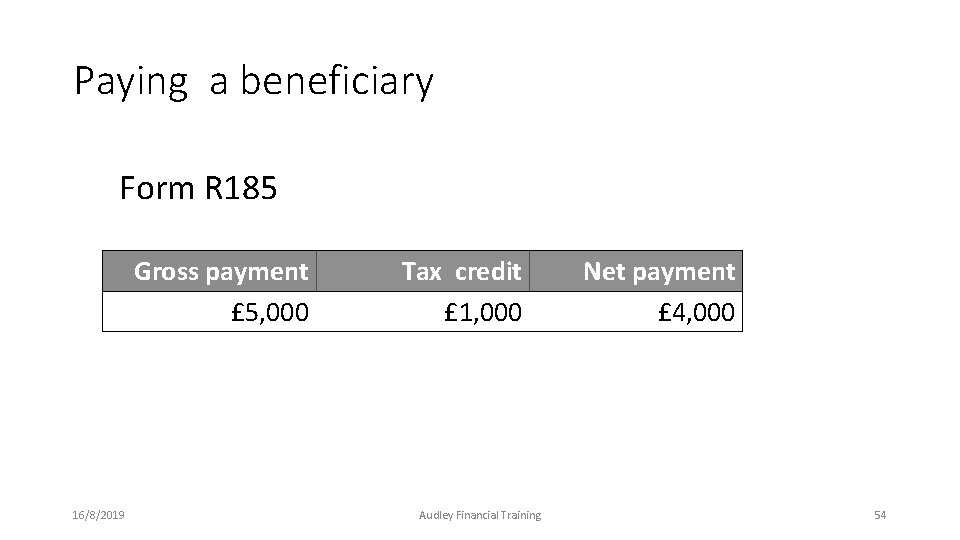
Trust taxation - Overview • In a Bare trust all liability falls directly on the beneficiary • All other trusts, the liability falls on the trustees who are responsible for declaring and paying tax • Trustees must register for self-assessment. • Tax is payable in two payments on account, 31 January in the year of assessment and 31 July in the following year. • With balancing payment on the following 31 January. • If trustees pay money to a beneficiary they must prepare a R 185 statement showing the gross and net amount and tax paid by trustees 16/8/2019 Audley Financial Training 42
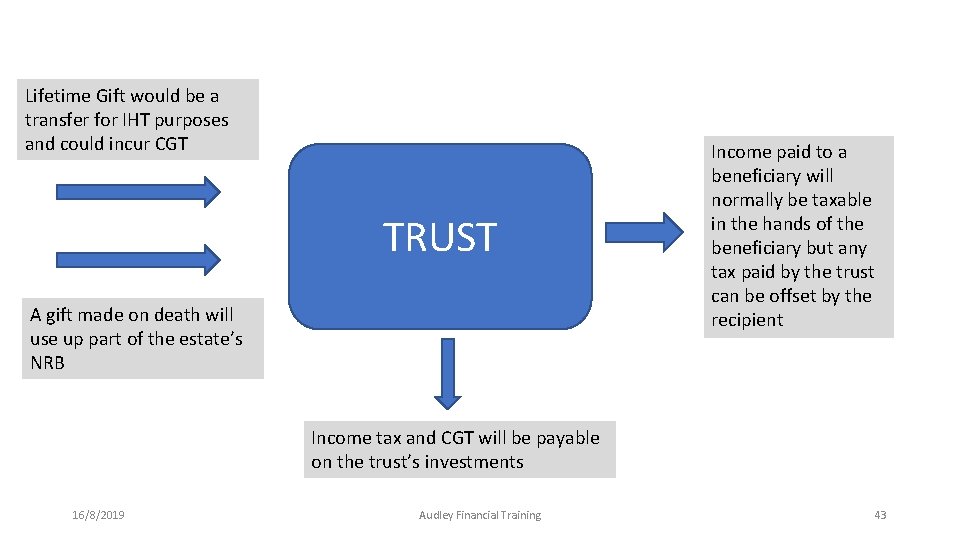
Lifetime Gift would be a transfer for IHT purposes and could incur CGT TRUST A gift made on death will use up part of the estate’s NRB Income paid to a beneficiary will normally be taxable in the hands of the beneficiary but any tax paid by the trust can be offset by the recipient Income tax and CGT will be payable on the trust’s investments 16/8/2019 Audley Financial Training 43
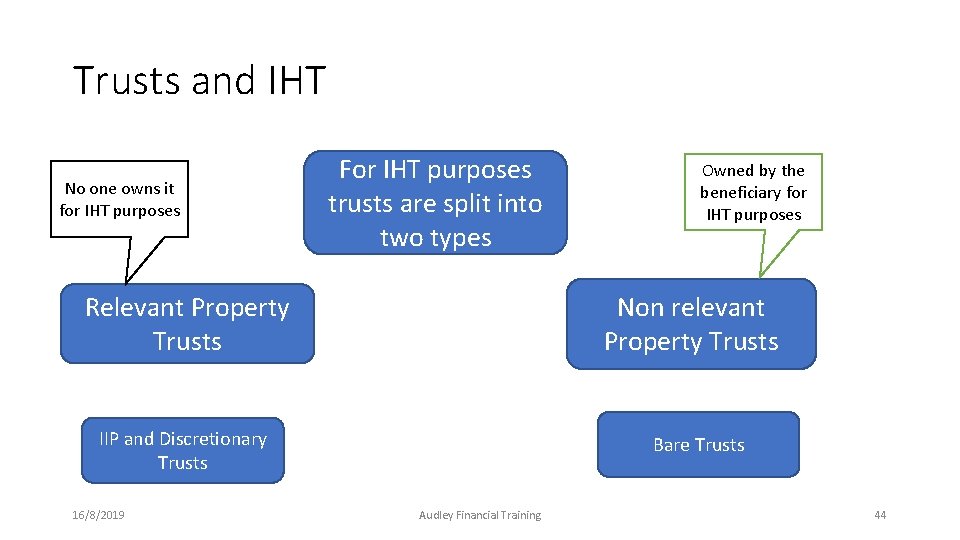
Trusts and IHT No one owns it for IHT purposes For IHT purposes trusts are split into two types Non relevant Property Trusts Relevant Property Trusts IIP and Discretionary Trusts 16/8/2019 Owned by the beneficiary for IHT purposes Bare Trusts Audley Financial Training 44
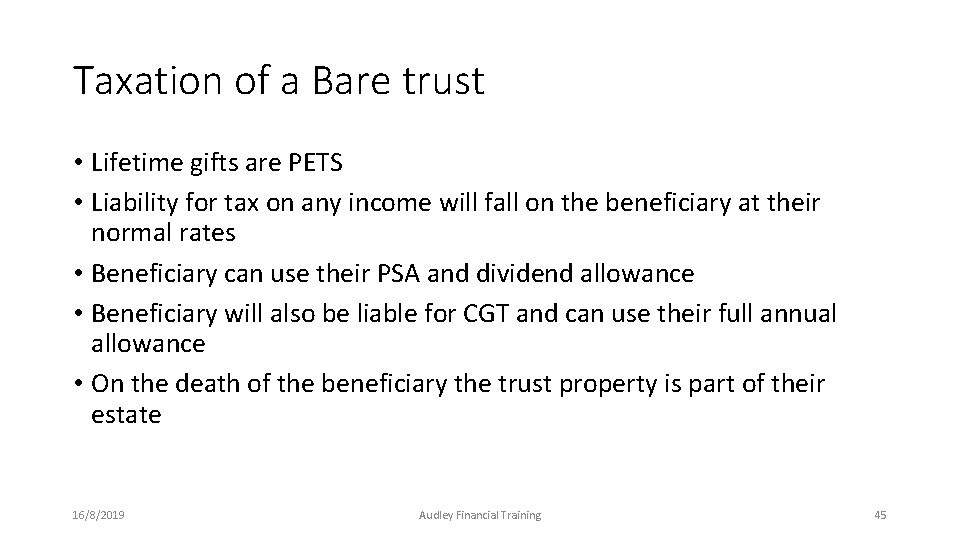
Taxation of a Bare trust • Lifetime gifts are PETS • Liability for tax on any income will fall on the beneficiary at their normal rates • Beneficiary can use their PSA and dividend allowance • Beneficiary will also be liable for CGT and can use their full annual allowance • On the death of the beneficiary the trust property is part of their estate 16/8/2019 Audley Financial Training 45
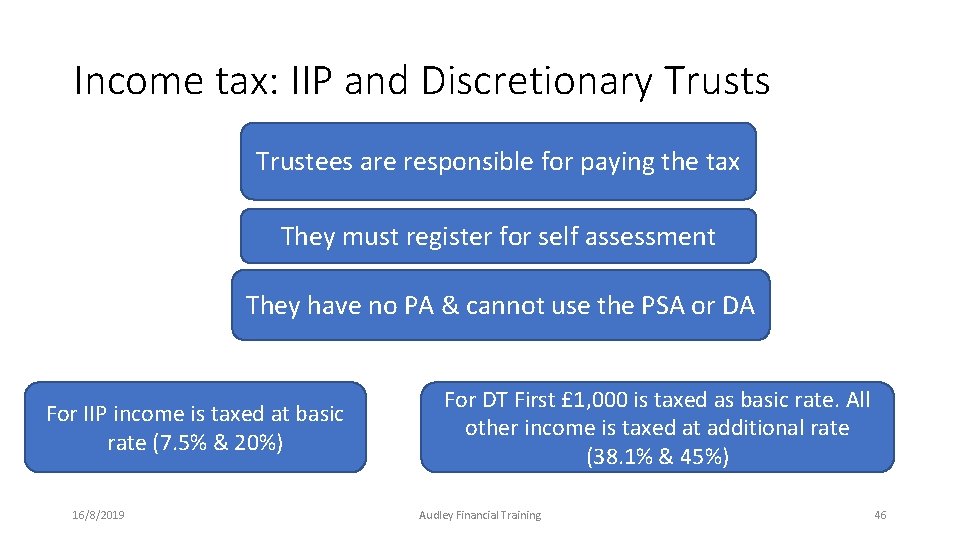
Income tax: IIP and Discretionary Trusts Trustees are responsible for paying the tax They must register for self assessment They have no PA & cannot use the PSA or DA For IIP income is taxed at basic rate (7. 5% & 20%) 16/8/2019 For DT First £ 1, 000 is taxed as basic rate. All other income is taxed at additional rate (38. 1% & 45%) Audley Financial Training 46
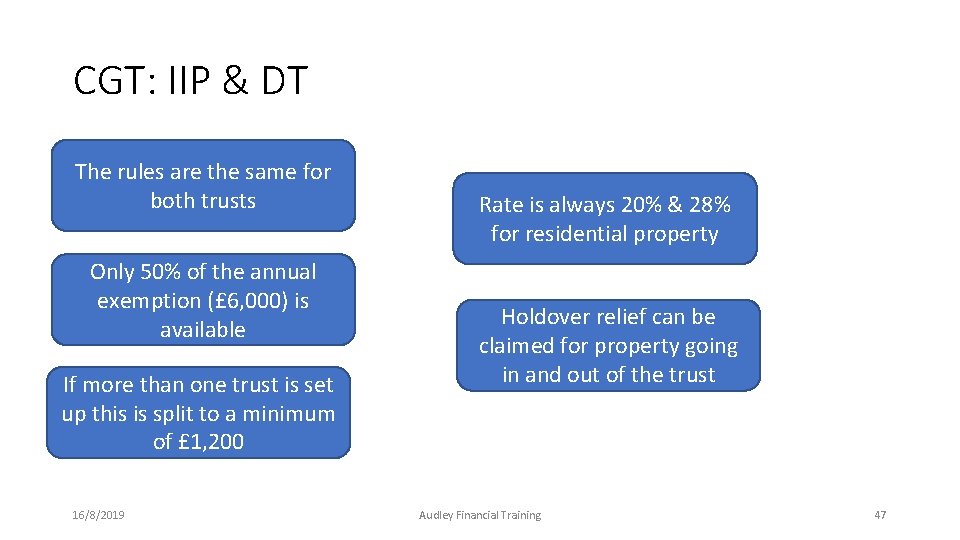
CGT: IIP & DT The rules are the same for both trusts Only 50% of the annual exemption (£ 6, 000) is available If more than one trust is set up this is split to a minimum of £ 1, 200 16/8/2019 Rate is always 20% & 28% for residential property Holdover relief can be claimed for property going in and out of the trust Audley Financial Training 47
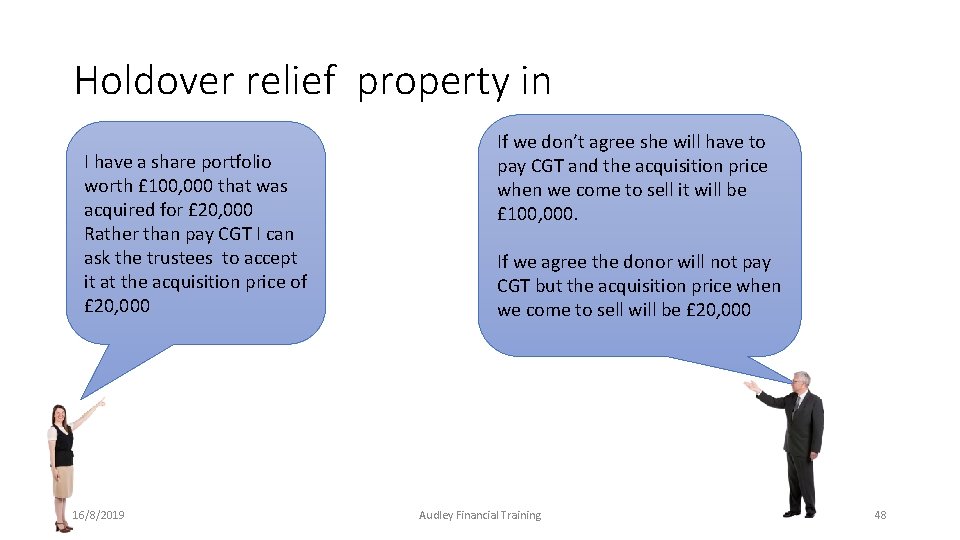
Holdover relief property in I have a share portfolio worth £ 100, 000 that was acquired for £ 20, 000 Rather than pay CGT I can ask the trustees to accept it at the acquisition price of £ 20, 000 16/8/2019 If we don’t agree she will have to pay CGT and the acquisition price when we come to sell it will be £ 100, 000. If we agree the donor will not pay CGT but the acquisition price when we come to sell will be £ 20, 000 Audley Financial Training 48
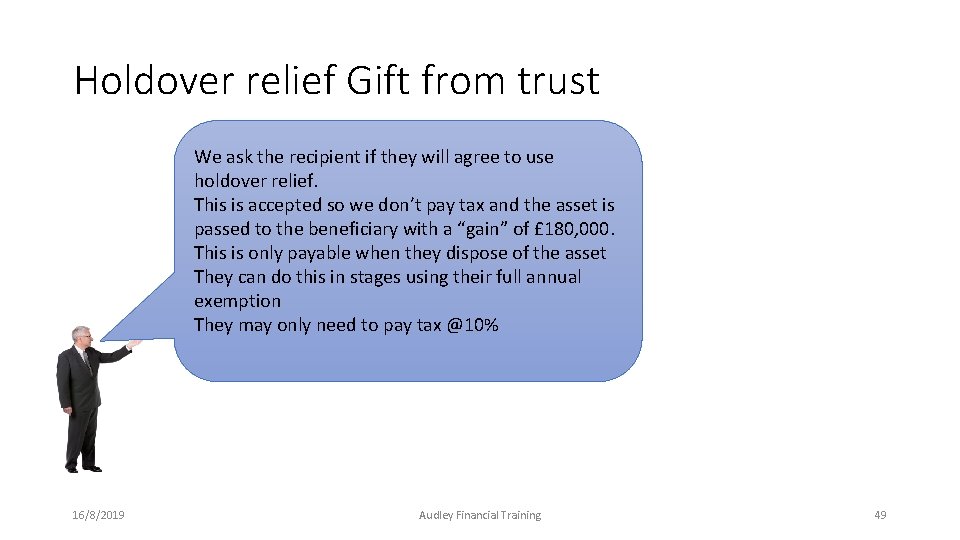
Holdover relief Gift from trust We ask the to recipient if they relief will agree toacquisition use agreed use holdover so the holdover relief. price is £ 20, 000 This is accepted so we don’t pay tax and the asset is passed the beneficiary with a “gain” of £ 180, 000. 15 yearstolater it is worth £ 200, 000 and we plan to This only when they dispose of the asset give is this to payable a beneficiary. They can do this in stages using their full annual exemption The gain would be £ 180, 000 and after annual They may only need topay paytax taxat@10% exemption we would 20% 16/8/2019 Audley Financial Training 49
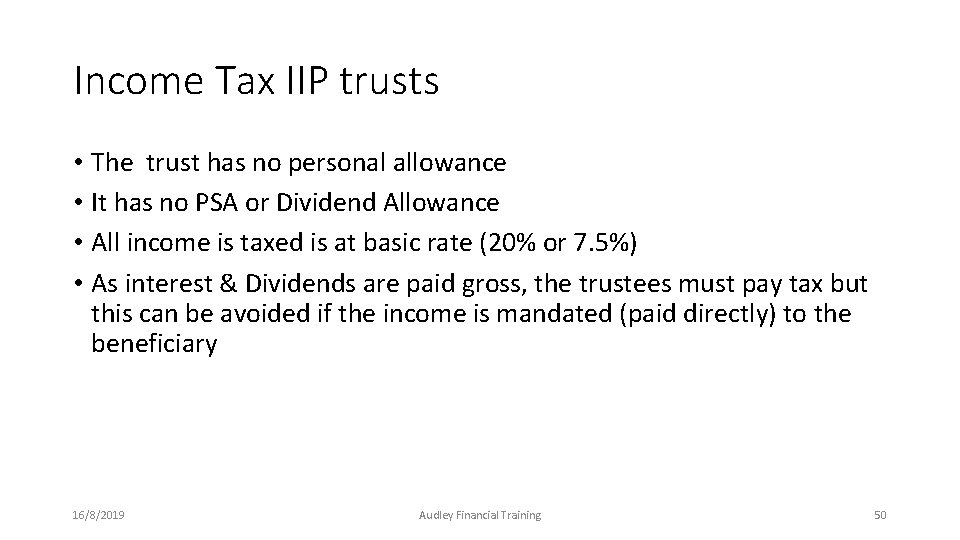
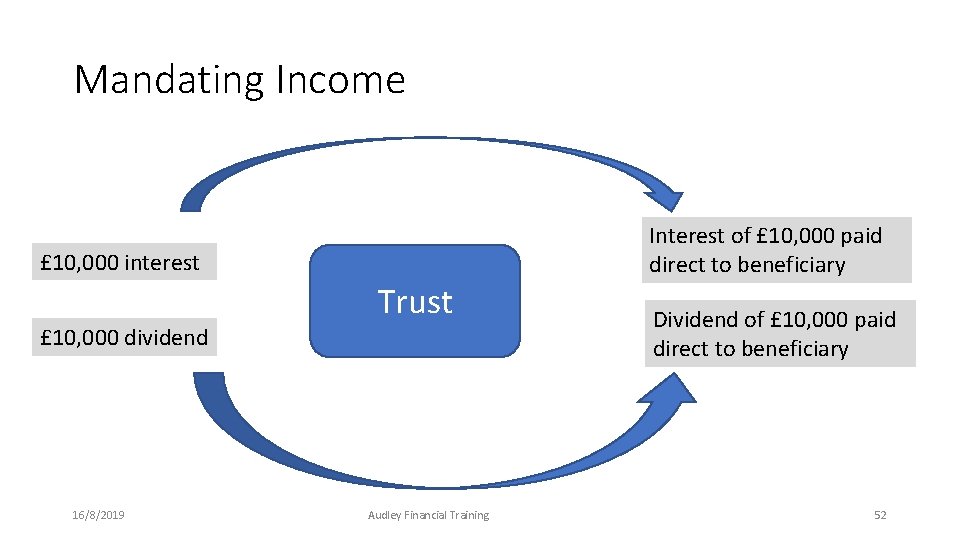
Income Tax IIP trusts • The trust has no personal allowance • It has no PSA or Dividend Allowance • All income is taxed is at basic rate (20% or 7. 5%) • As interest & Dividends are paid gross, the trustees must pay tax but this can be avoided if the income is mandated (paid directly) to the beneficiary 16/8/2019 Audley Financial Training 50
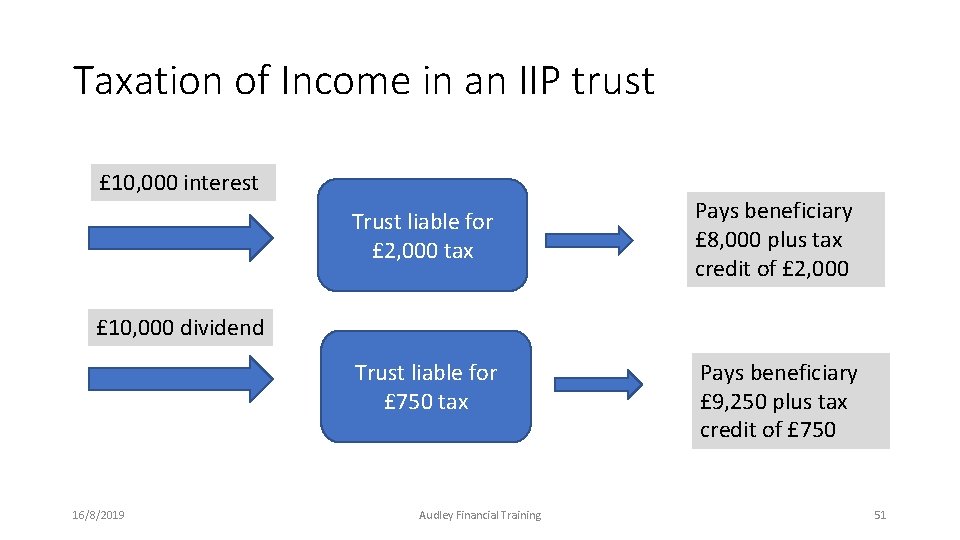
Taxation of Income in an IIP trust £ 10, 000 interest Trust liable for £ 2, 000 tax Pays beneficiary £ 8, 000 plus tax credit of £ 2, 000 Trust liable for £ 750 tax Pays beneficiary £ 9, 250 plus tax credit of £ 750 £ 10, 000 dividend 16/8/2019 Audley Financial Training 51
Mandating Income Interest of £ 10, 000 paid direct to beneficiary £ 10, 000 interest £ 10, 000 dividend 16/8/2019 Trust Audley Financial Training Dividend of £ 10, 000 paid direct to beneficiary 52
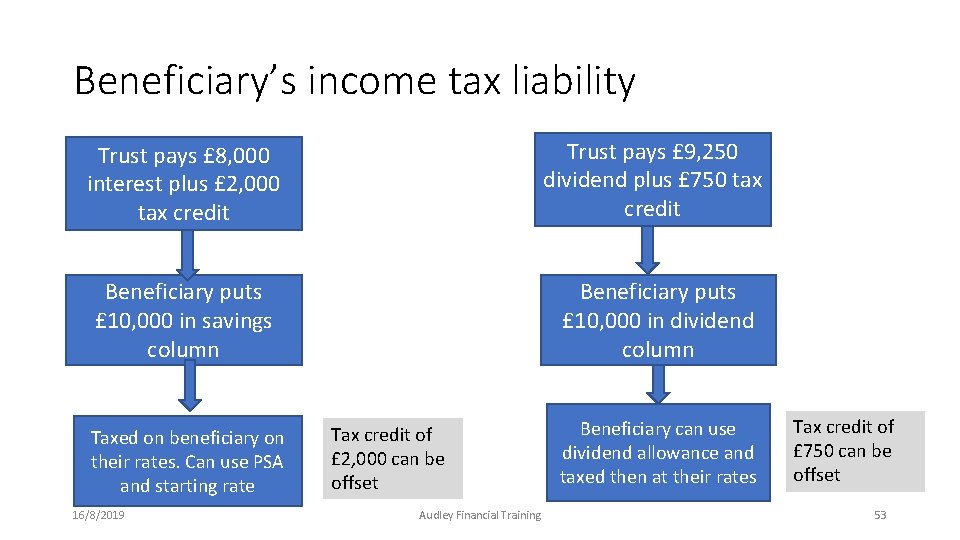
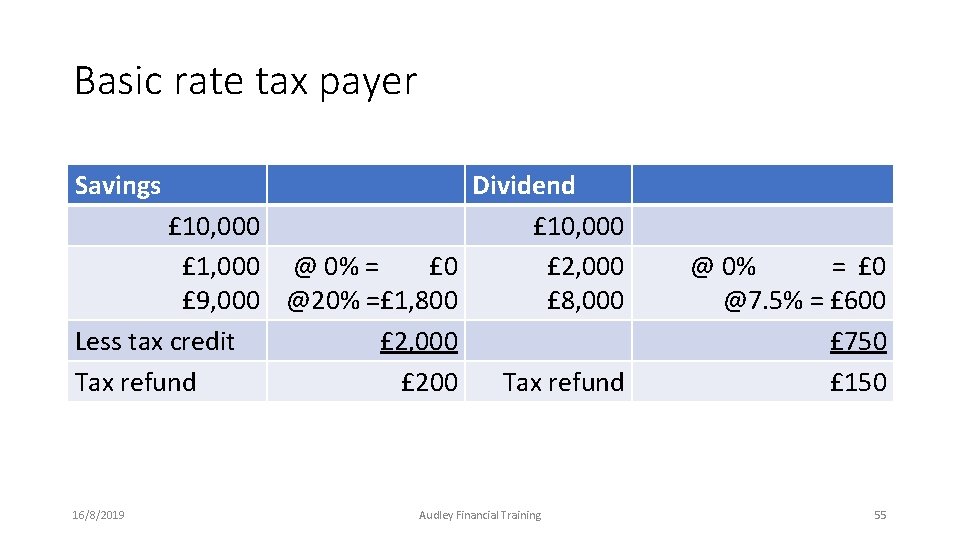
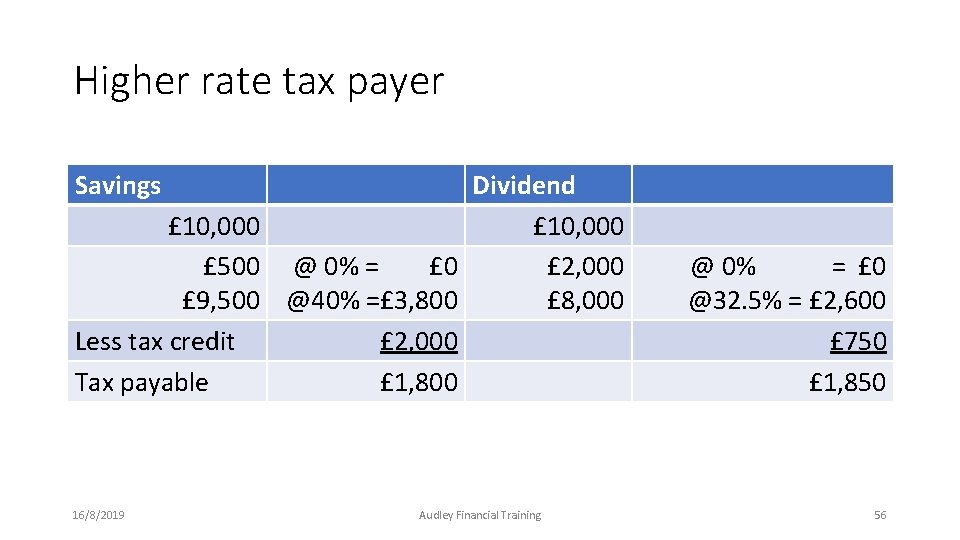
Beneficiary’s income tax liability Trust pays £ 8, 000 interest plus £ 2, 000 tax credit Trust pays £ 9, 250 dividend plus £ 750 tax credit Beneficiary puts £ 10, 000 in savings column Beneficiary puts £ 10, 000 in dividend column Taxed on beneficiary on their rates. Can use PSA and starting rate 16/8/2019 Tax credit of £ 2, 000 can be offset Audley Financial Training Beneficiary can use dividend allowance and taxed then at their rates Tax credit of £ 750 can be offset 53
Paying a beneficiary Form R 185 Gross payment £ 5, 000 16/8/2019 Tax credit £ 1, 000 Audley Financial Training Net payment £ 4, 000 54
Basic rate tax payer Savings Dividend £ 10, 000 £ 1, 000 @ 0% = £ 0 £ 2, 000 £ 9, 000 @20% =£ 1, 800 £ 8, 000 Less tax credit £ 2, 000 Tax refund £ 200 Tax refund 16/8/2019 Audley Financial Training @ 0% = £ 0 @7. 5% = £ 600 £ 750 £ 150 55
Higher rate tax payer Savings Dividend £ 10, 000 £ 500 @ 0% = £ 0 £ 2, 000 £ 9, 500 @40% =£ 3, 800 £ 8, 000 Less tax credit £ 2, 000 Tax payable £ 1, 800 16/8/2019 Audley Financial Training @ 0% = £ 0 @32. 5% = £ 2, 600 £ 750 £ 1, 850 56
Income tax on a discretionary/accumulation trust • As with IIP, the trust is a legal entity • Trustees are liable for the tax • But the rates of tax are different • The tax treatment of the beneficiary’s income is also different 16/8/2019 Audley Financial Training 57
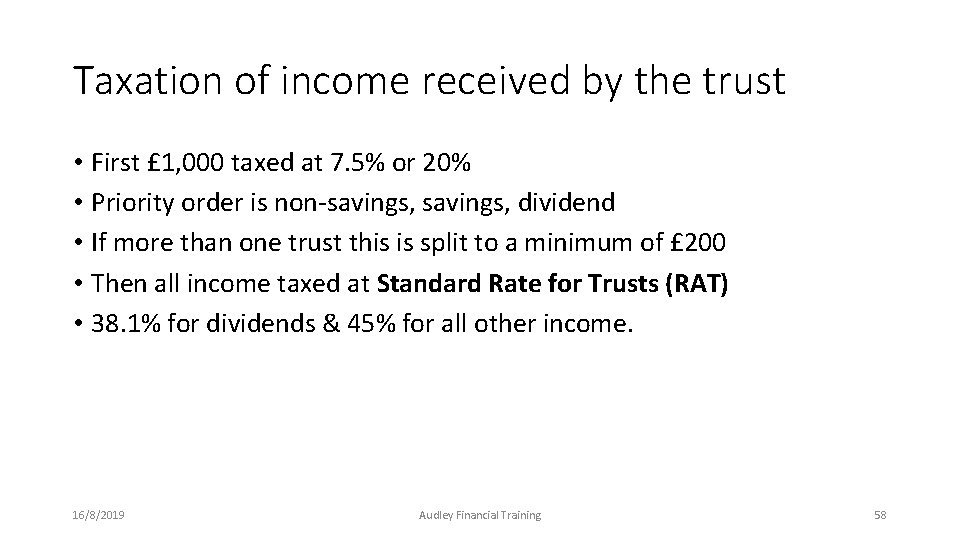
Taxation of income received by the trust • First £ 1, 000 taxed at 7. 5% or 20% • Priority order is non-savings, dividend • If more than one trust this is split to a minimum of £ 200 • Then all income taxed at Standard Rate for Trusts (RAT) • 38. 1% for dividends & 45% for all other income. 16/8/2019 Audley Financial Training 58
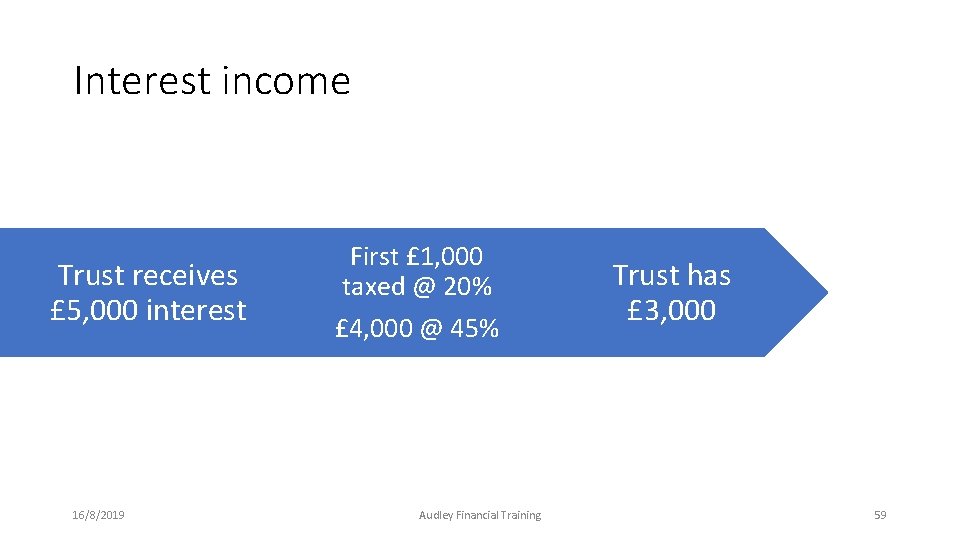
Interest income Trust receives £ 5, 000 interest 16/8/2019 First £ 1, 000 taxed @ 20% £ 4, 000 @ 45% Audley Financial Training Trust has £ 3, 000 59
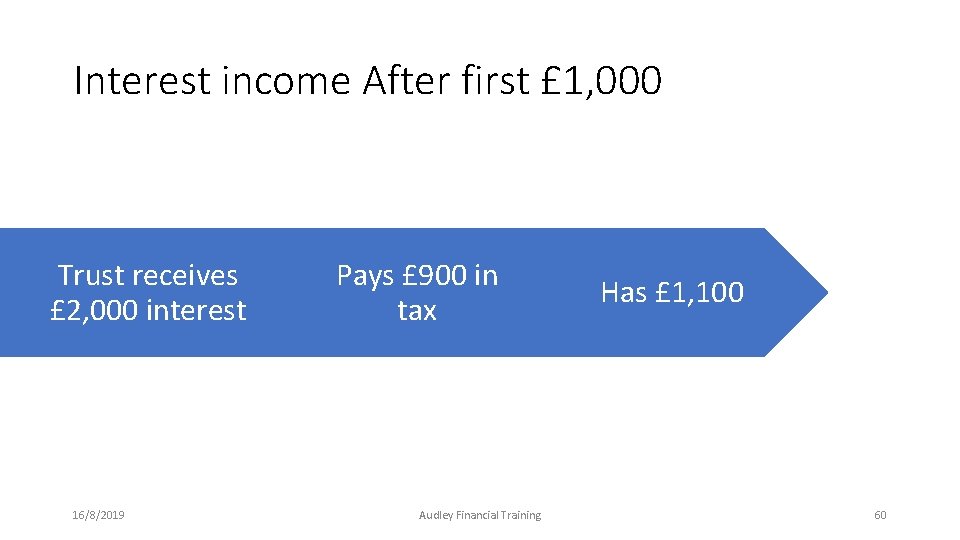
Interest income After first £ 1, 000 Trust receives £ 2, 000 interest 16/8/2019 Pays £ 900 in tax Audley Financial Training Has £ 1, 100 60
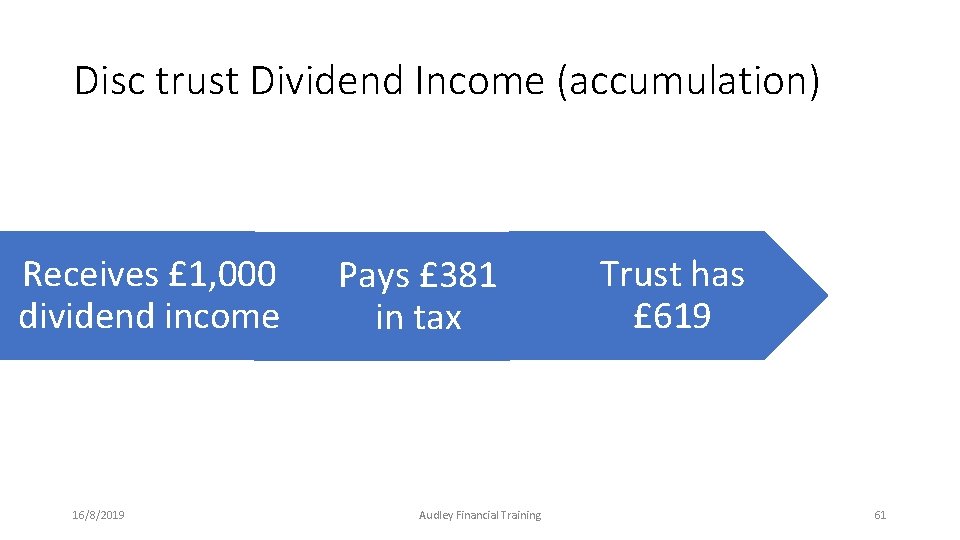
Disc trust Dividend Income (accumulation) Receives £ 1, 000 dividend income 16/8/2019 Pays £ 381 in tax Audley Financial Training Trust has £ 619 61
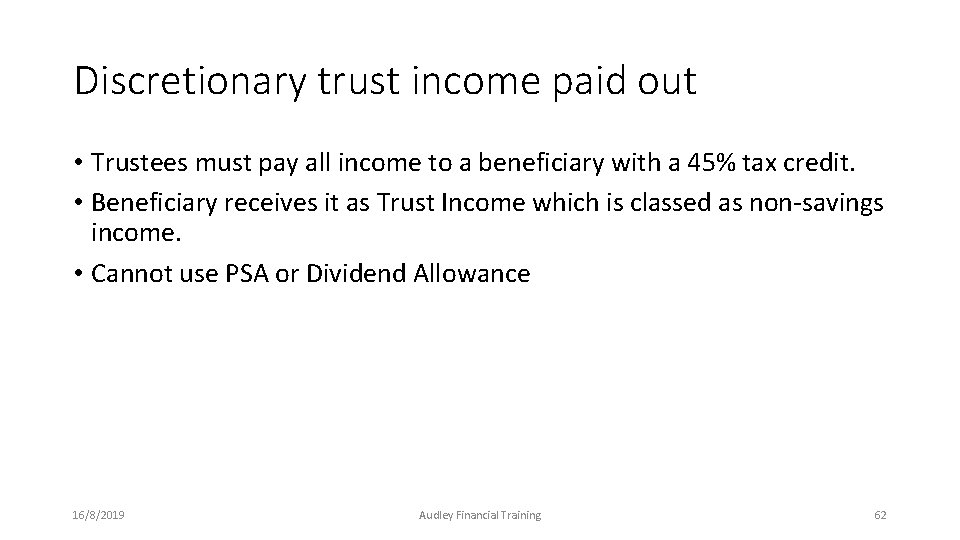
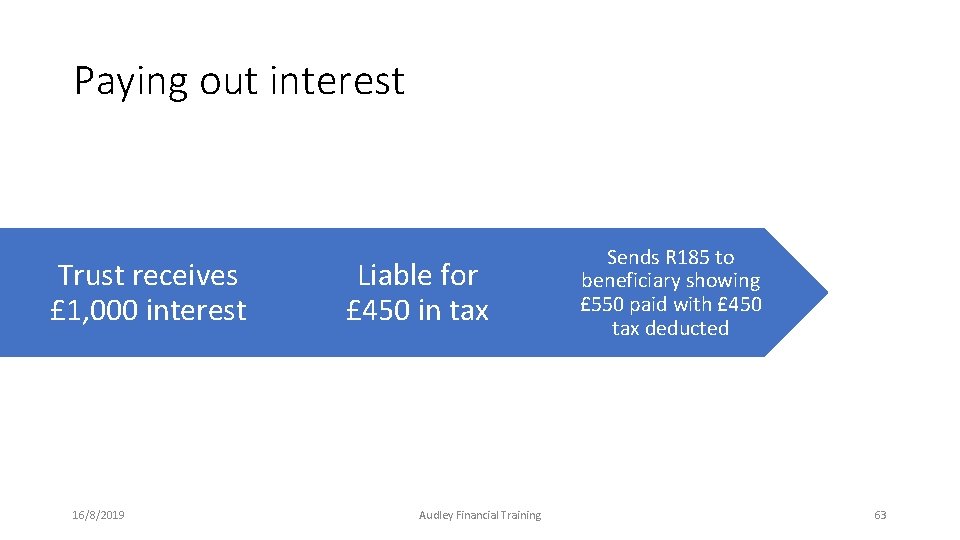
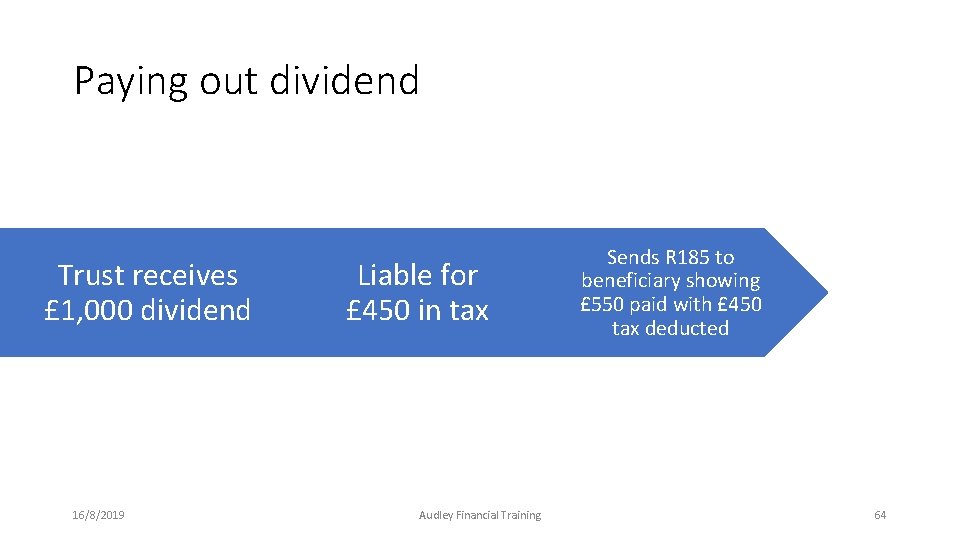
Discretionary trust income paid out • Trustees must pay all income to a beneficiary with a 45% tax credit. • Beneficiary receives it as Trust Income which is classed as non-savings income. • Cannot use PSA or Dividend Allowance 16/8/2019 Audley Financial Training 62
Paying out interest Trust receives £ 1, 000 interest 16/8/2019 Liable for £ 450 in tax Audley Financial Training Sends R 185 to beneficiary showing £ 550 paid with £ 450 tax deducted 63
Paying out dividend Trust receives £ 1, 000 dividend 16/8/2019 Liable for £ 450 in tax Audley Financial Training Sends R 185 to beneficiary showing £ 550 paid with £ 450 tax deducted 64
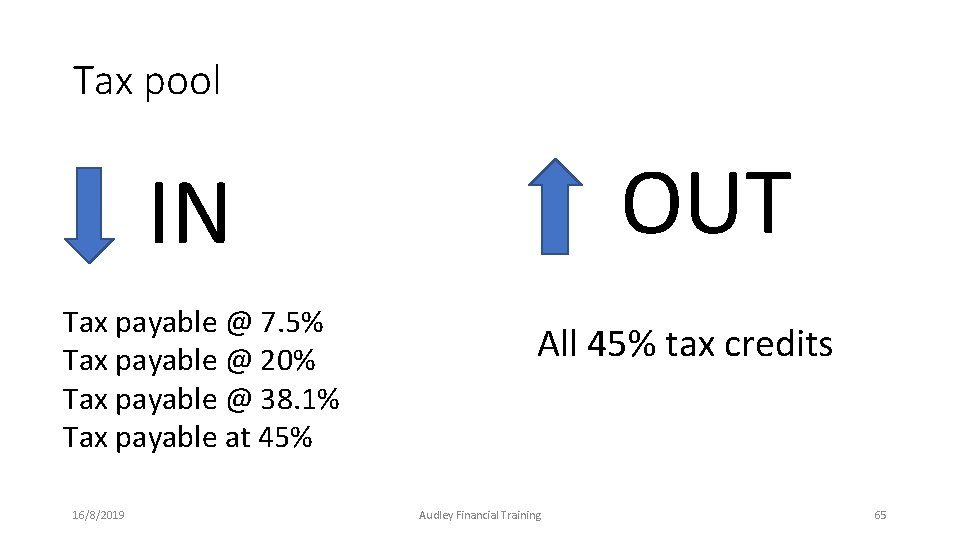
Tax pool OUT IN Tax payable @ 7. 5% Tax payable @ 20% Tax payable @ 38. 1% Tax payable at 45% 16/8/2019 All 45% tax credits Audley Financial Training 65
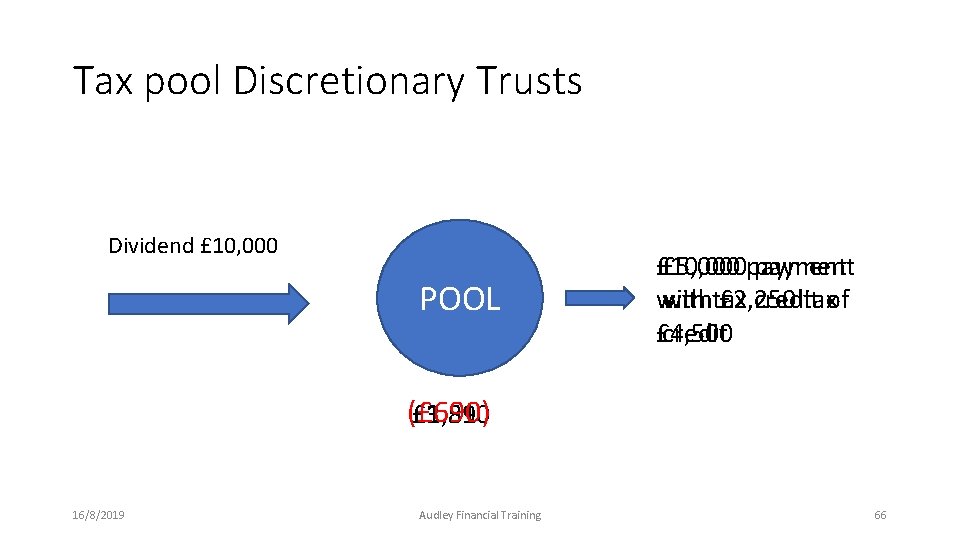
Tax pool Discretionary Trusts Dividend £ 10, 000 POOL £ 10, 000 £ 5, 000 payment withtax £ 2, 250 credit taxof £ 4, 500 credit (£ 690) £ 1, 590 £ 3, 810 16/8/2019 Audley Financial Training 66
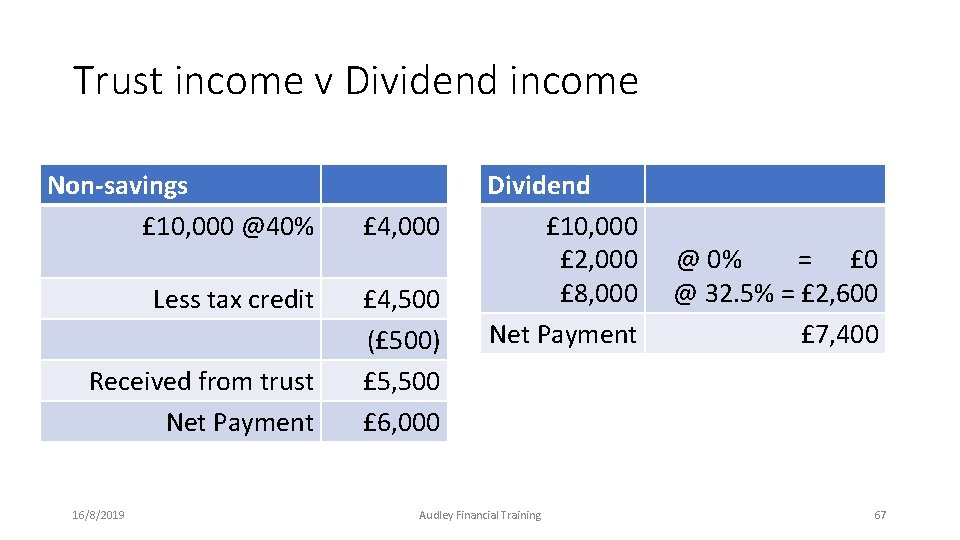
Trust income v Dividend income Non-savings £ 10, 000 @40% Less tax credit Received from trust Net Payment 16/8/2019 £ 4, 000 £ 4, 500 (£ 500) £ 5, 500 £ 6, 000 Dividend £ 10, 000 £ 2, 000 £ 8, 000 Net Payment Audley Financial Training @ 0% = £ 0 @ 32. 5% = £ 2, 600 £ 7, 400 67
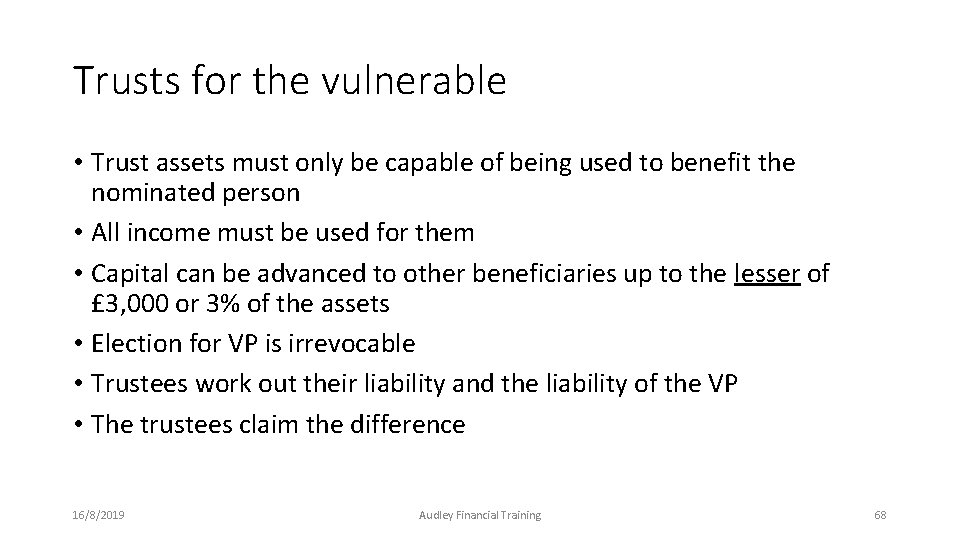
Trusts for the vulnerable • Trust assets must only be capable of being used to benefit the nominated person • All income must be used for them • Capital can be advanced to other beneficiaries up to the lesser of £ 3, 000 or 3% of the assets • Election for VP is irrevocable • Trustees work out their liability and the liability of the VP • The trustees claim the difference 16/8/2019 Audley Financial Training 68
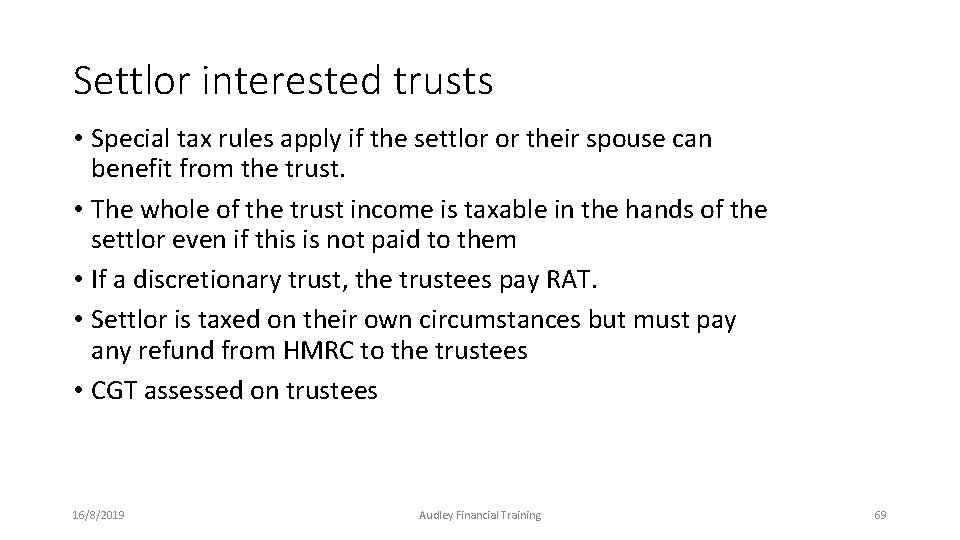
Settlor interested trusts • Special tax rules apply if the settlor or their spouse can benefit from the trust. • The whole of the trust income is taxable in the hands of the settlor even if this is not paid to them • If a discretionary trust, the trustees pay RAT. • Settlor is taxed on their own circumstances but must pay any refund from HMRC to the trustees • CGT assessed on trustees 16/8/2019 Audley Financial Training 69
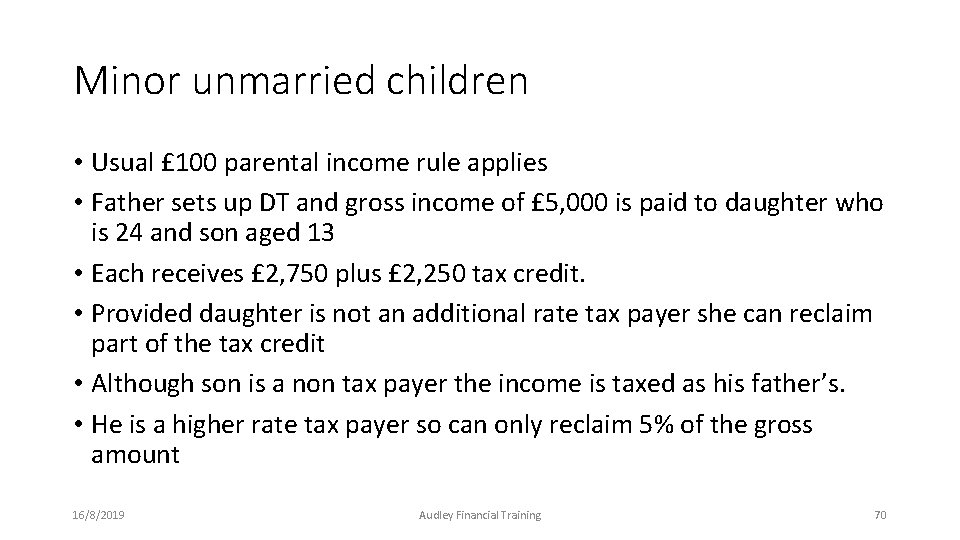
Minor unmarried children • Usual £ 100 parental income rule applies • Father sets up DT and gross income of £ 5, 000 is paid to daughter who is 24 and son aged 13 • Each receives £ 2, 750 plus £ 2, 250 tax credit. • Provided daughter is not an additional rate tax payer she can reclaim part of the tax credit • Although son is a non tax payer the income is taxed as his father’s. • He is a higher rate tax payer so can only reclaim 5% of the gross amount 16/8/2019 Audley Financial Training 70
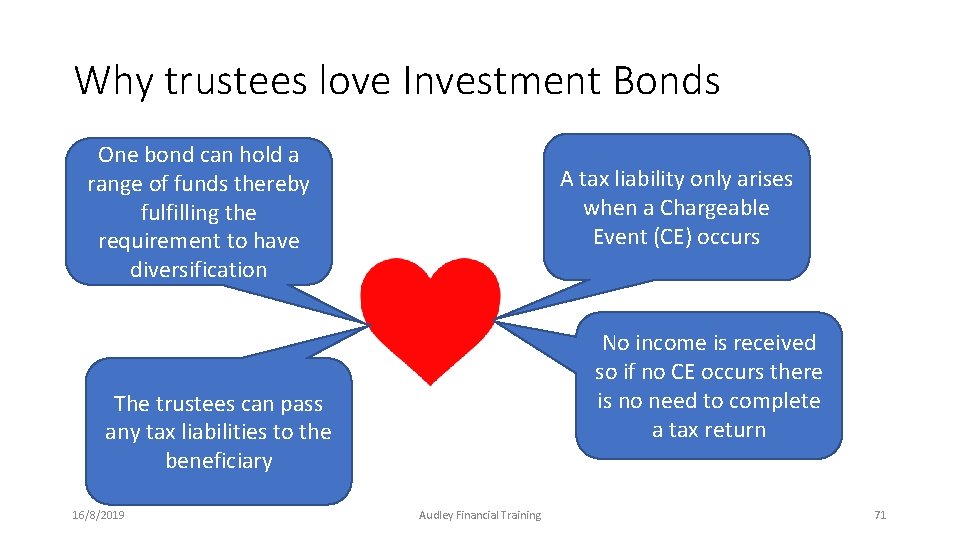
Why trustees love Investment Bonds One bond can hold a range of funds thereby fulfilling the requirement to have diversification A tax liability only arises when a Chargeable Event (CE) occurs No income is received so if no CE occurs there is no need to complete a tax return The trustees can pass any tax liabilities to the beneficiary 16/8/2019 Audley Financial Training 71
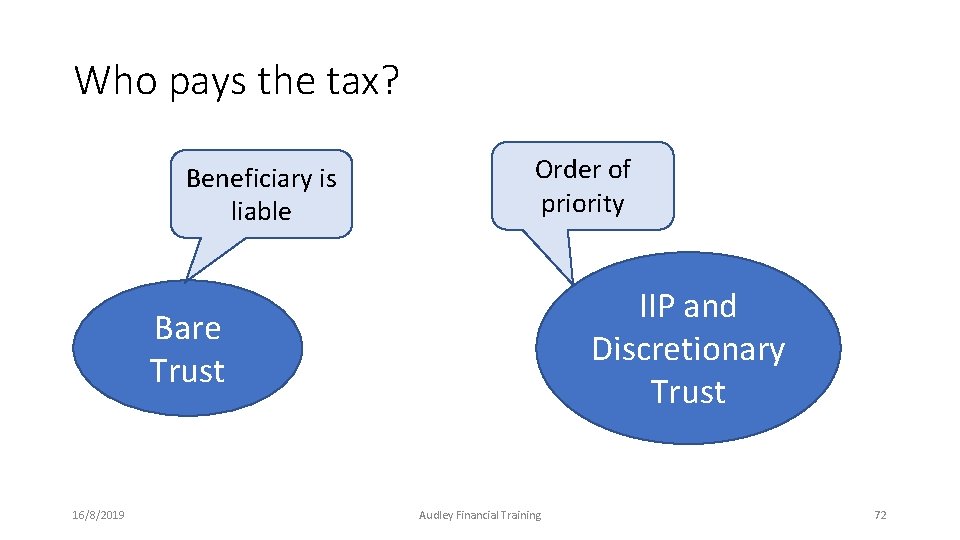
Who pays the tax? Beneficiary is liable Order of priority IIP and Discretionary Trust Bare Trust 16/8/2019 Audley Financial Training 72
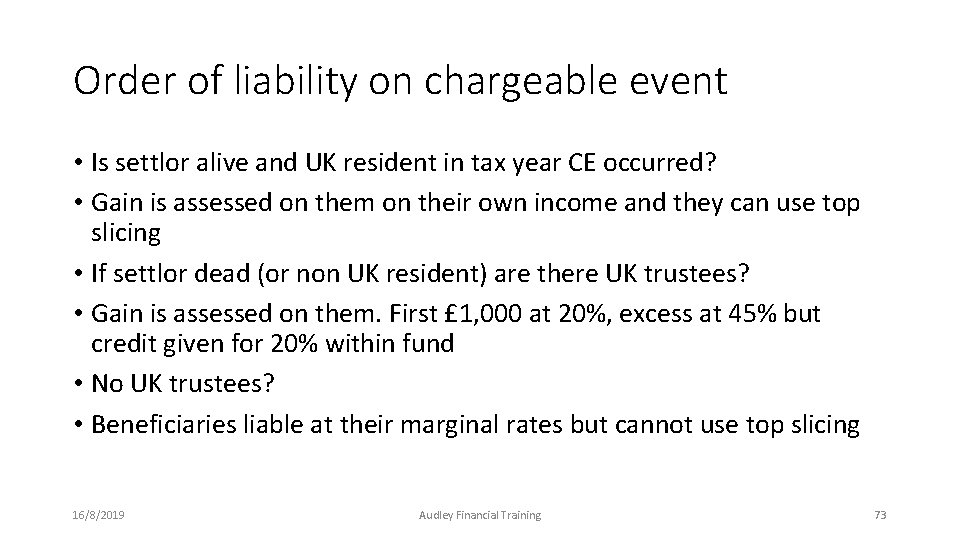
Order of liability on chargeable event • Is settlor alive and UK resident in tax year CE occurred? • Gain is assessed on them on their own income and they can use top slicing • If settlor dead (or non UK resident) are there UK trustees? • Gain is assessed on them. First £ 1, 000 at 20%, excess at 45% but credit given for 20% within fund • No UK trustees? • Beneficiaries liable at their marginal rates but cannot use top slicing 16/8/2019 Audley Financial Training 73
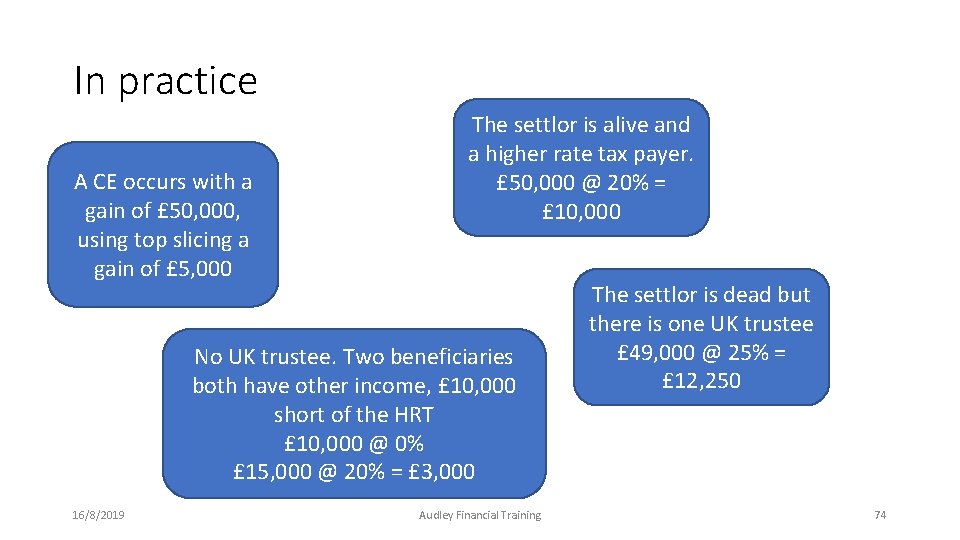
In practice A CE occurs with a gain of £ 50, 000, using top slicing a gain of £ 5, 000 The settlor is alive and a higher rate tax payer. £ 50, 000 @ 20% = £ 10, 000 No UK trustee. Two beneficiaries both have other income, £ 10, 000 short of the HRT £ 10, 000 @ 0% £ 15, 000 @ 20% = £ 3, 000 16/8/2019 Audley Financial Training The settlor is dead but there is one UK trustee £ 49, 000 @ 25% = £ 12, 250 74
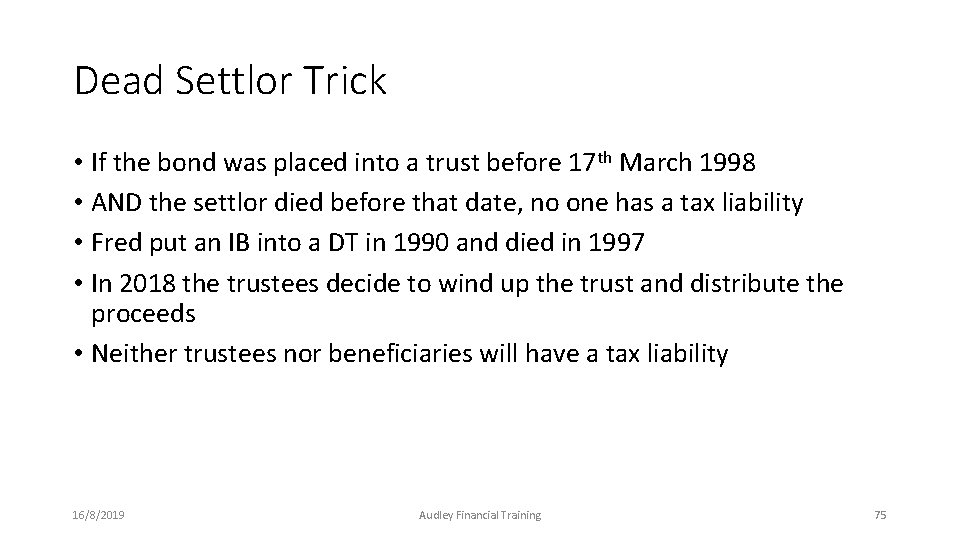
Dead Settlor Trick • If the bond was placed into a trust before 17 th March 1998 • AND the settlor died before that date, no one has a tax liability • Fred put an IB into a DT in 1990 and died in 1997 • In 2018 the trustees decide to wind up the trust and distribute the proceeds • Neither trustees nor beneficiaries will have a tax liability 16/8/2019 Audley Financial Training 75
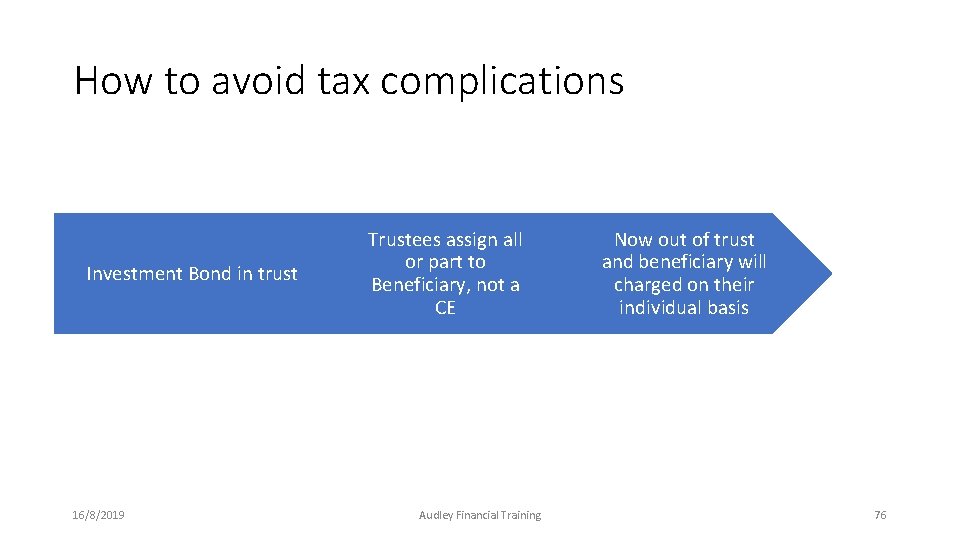
How to avoid tax complications Investment Bond in trust 16/8/2019 Trustees assign all or part to Beneficiary, not a CE Audley Financial Training Now out of trust and beneficiary will charged on their individual basis 76
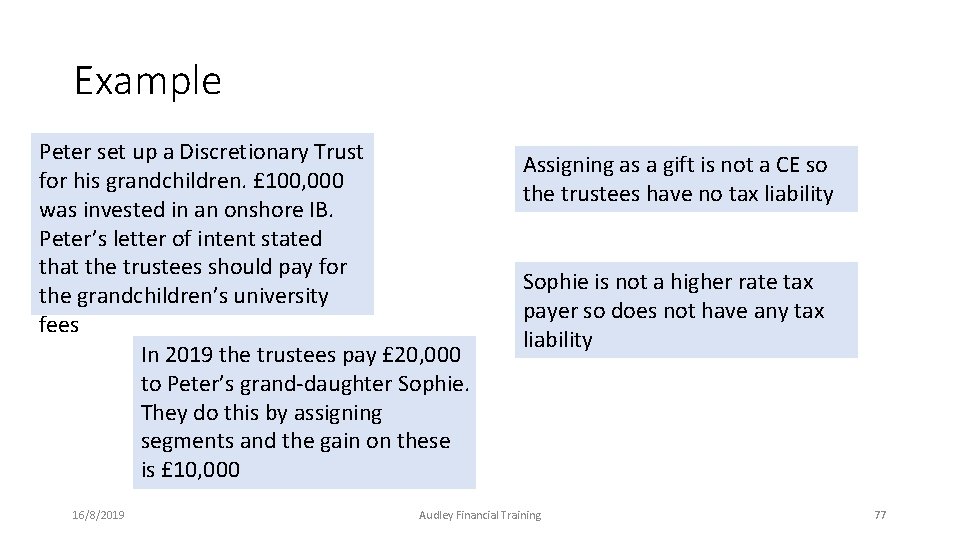
Example Peter set up a Discretionary Trust for his grandchildren. £ 100, 000 was invested in an onshore IB. Peter’s letter of intent stated that the trustees should pay for the grandchildren’s university fees In 2019 the trustees pay £ 20, 000 to Peter’s grand-daughter Sophie. They do this by assigning segments and the gain on these is £ 10, 000 16/8/2019 Assigning as a gift is not a CE so the trustees have no tax liability Sophie is not a higher rate tax payer so does not have any tax liability Audley Financial Training 77
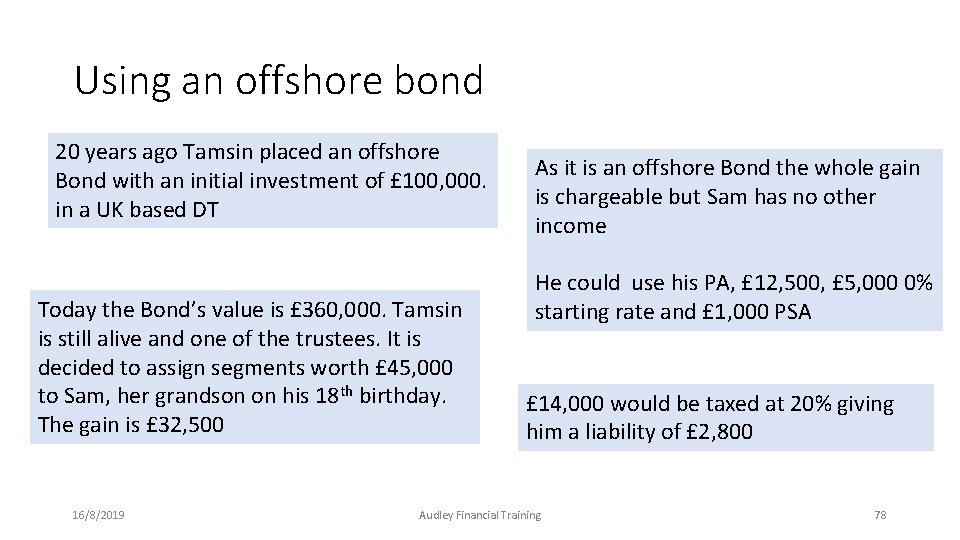
Using an offshore bond 20 years ago Tamsin placed an offshore Bond with an initial investment of £ 100, 000. in a UK based DT Today the Bond’s value is £ 360, 000. Tamsin is still alive and one of the trustees. It is decided to assign segments worth £ 45, 000 to Sam, her grandson on his 18 th birthday. The gain is £ 32, 500 16/8/2019 As it is an offshore Bond the whole gain is chargeable but Sam has no other income He could use his PA, £ 12, 500, £ 5, 000 0% starting rate and £ 1, 000 PSA £ 14, 000 would be taxed at 20% giving him a liability of £ 2, 800 Audley Financial Training 78
What are TME? • Income expenses incurred by trustees in running the trust. • Accountancy and legal fees. Fees for financial advice. • Not costs of insurance, mortgage interest for real property • Cannot be incurred by bare trusts 16/8/2019 Audley Financial Training 79
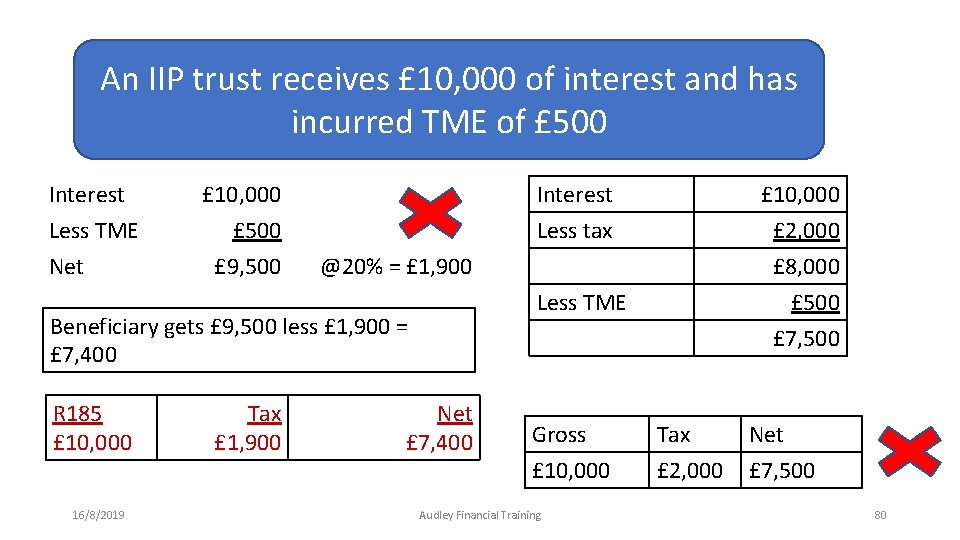
An IIP trust receives £ 10, 000 of interest and has incurred TME of £ 500 Interest Less TME Net £ 10, 000 £ 500 £ 9, 500 Interest Less tax @20% = £ 1, 900 Less TME Beneficiary gets £ 9, 500 less £ 1, 900 = £ 7, 400 R 185 £ 10, 000 16/8/2019 Tax £ 1, 900 £ 10, 000 £ 2, 000 £ 8, 000 £ 500 £ 7, 500 Net £ 7, 400 Gross £ 10, 000 Audley Financial Training Tax £ 2, 000 Net £ 7, 500 80
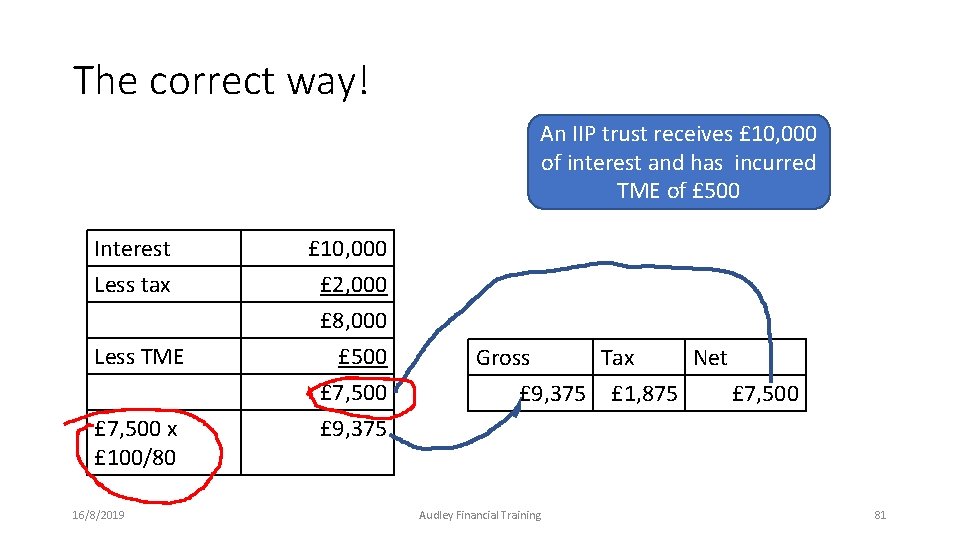
The correct way! An IIP trust receives £ 10, 000 of interest and has incurred TME of £ 500 Interest Less tax Less TME £ 7, 500 x £ 100/80 16/8/2019 £ 10, 000 £ 2, 000 £ 8, 000 £ 500 £ 7, 500 £ 9, 375 Gross Tax Net £ 9, 375 £ 1, 875 £ 7, 500 Audley Financial Training 81
Trust Management Expenses IIP: trusts • For IIP trusts they reduce income payable to beneficiary. • They do not reduce the tax payable by trustees • The expenses should be grossed up • If the trust has more than one type of income TME are offset first against dividend, then savings and last non-savings 16/8/2019 Audley Financial Training 82
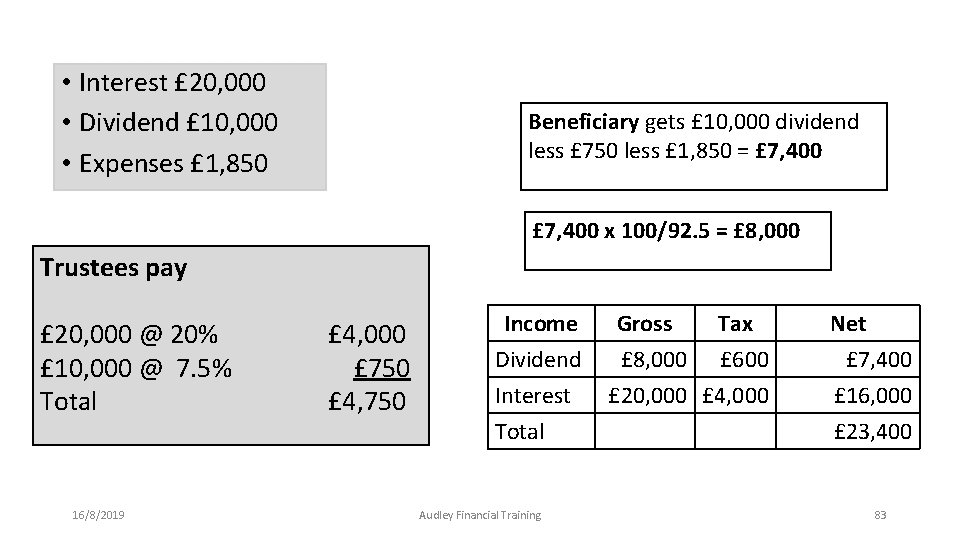
• Interest £ 20, 000 • Dividend £ 10, 000 • Expenses £ 1, 850 Beneficiary gets £ 10, 000 dividend less £ 750 less £ 1, 850 = £ 7, 400 x 100/92. 5 = £ 8, 000 Trustees pay £ 20, 000 @ 20% £ 10, 000 @ 7. 5% Total 16/8/2019 £ 4, 000 £ 750 £ 4, 750 Income Dividend Interest Total Audley Financial Training Gross Tax £ 8, 000 £ 600 £ 20, 000 £ 4, 000 Net £ 7, 400 £ 16, 000 £ 23, 400 83
TME & Discretionary Trusts • No one has a right to income from a discretionary trust, • Instead they reduce the amount payable at RAT • Again offset first against dividend, then savings and last non-savings 16/8/2019 Audley Financial Training 84
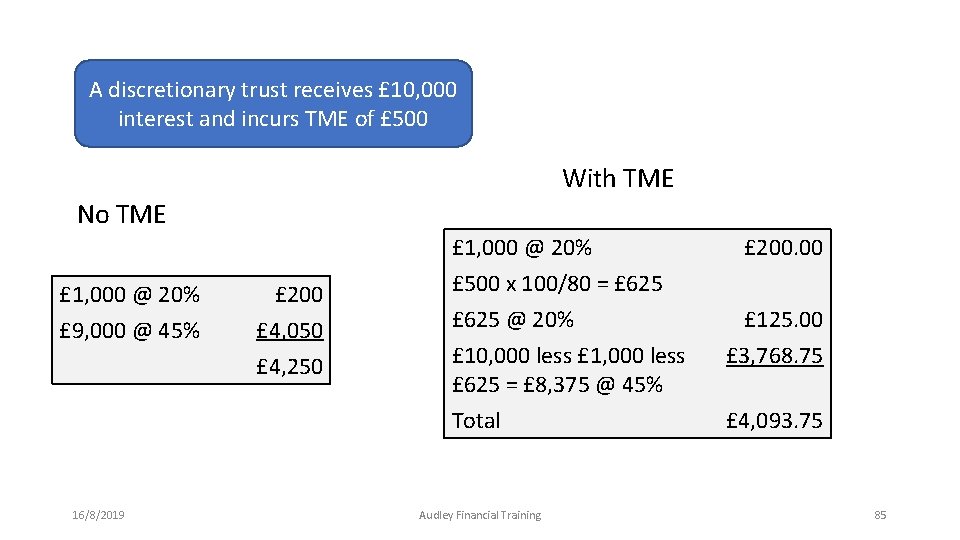
A discretionary trust receives £ 10, 000 interest and incurs TME of £ 500 With TME No TME £ 1, 000 @ 20% £ 9, 000 @ 45% £ 200 £ 4, 050 £ 4, 250 £ 1, 000 @ 20% £ 500 x 100/80 = £ 625 @ 20% £ 10, 000 less £ 1, 000 less £ 625 = £ 8, 375 @ 45% Total 16/8/2019 Audley Financial Training £ 200. 00 £ 125. 00 £ 3, 768. 75 £ 4, 093. 75 85
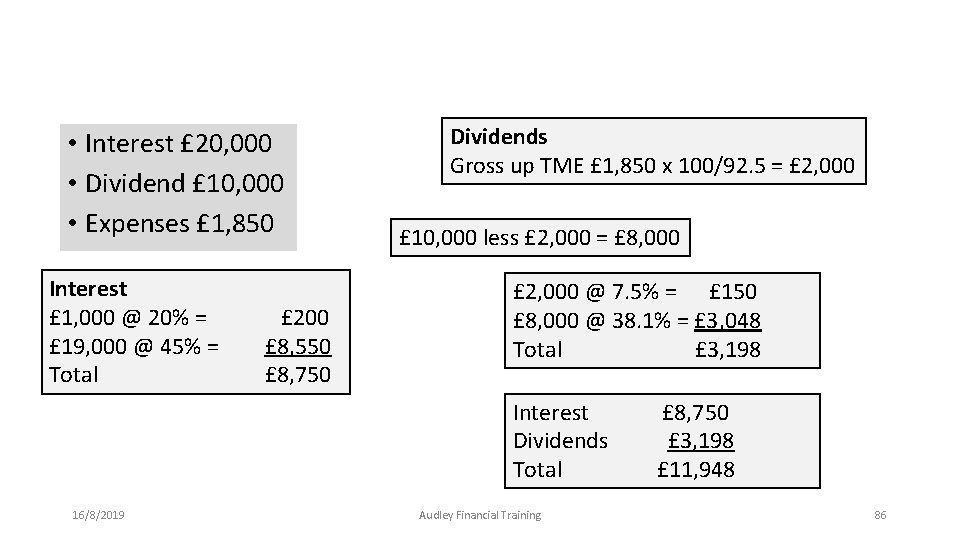
• Interest £ 20, 000 • Dividend £ 10, 000 • Expenses £ 1, 850 Interest £ 1, 000 @ 20% = £ 19, 000 @ 45% = Total £ 200 £ 8, 550 £ 8, 750 Dividends Gross up TME £ 1, 850 x 100/92. 5 = £ 2, 000 £ 10, 000 less £ 2, 000 = £ 8, 000 £ 2, 000 @ 7. 5% = £ 150 £ 8, 000 @ 38. 1% = £ 3, 048 Total £ 3, 198 Interest Dividends Total 16/8/2019 Audley Financial Training £ 8, 750 £ 3, 198 £ 11, 948 86
Trusts and IHT 16/8/2019 Audley Financial Training 87
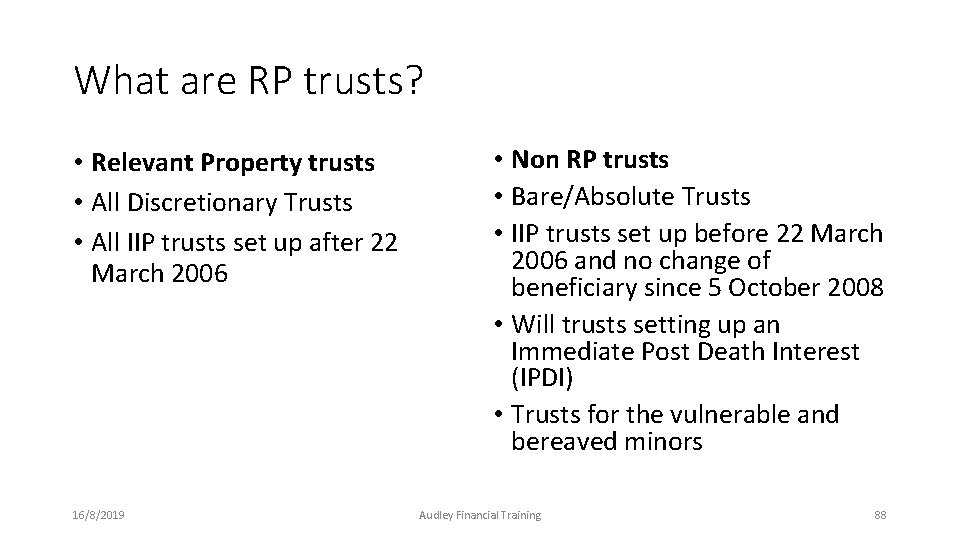
What are RP trusts? • Relevant Property trusts • All Discretionary Trusts • All IIP trusts set up after 22 March 2006 16/8/2019 • Non RP trusts • Bare/Absolute Trusts • IIP trusts set up before 22 March 2006 and no change of beneficiary since 5 October 2008 • Will trusts setting up an Immediate Post Death Interest (IPDI) • Trusts for the vulnerable and bereaved minors Audley Financial Training 88
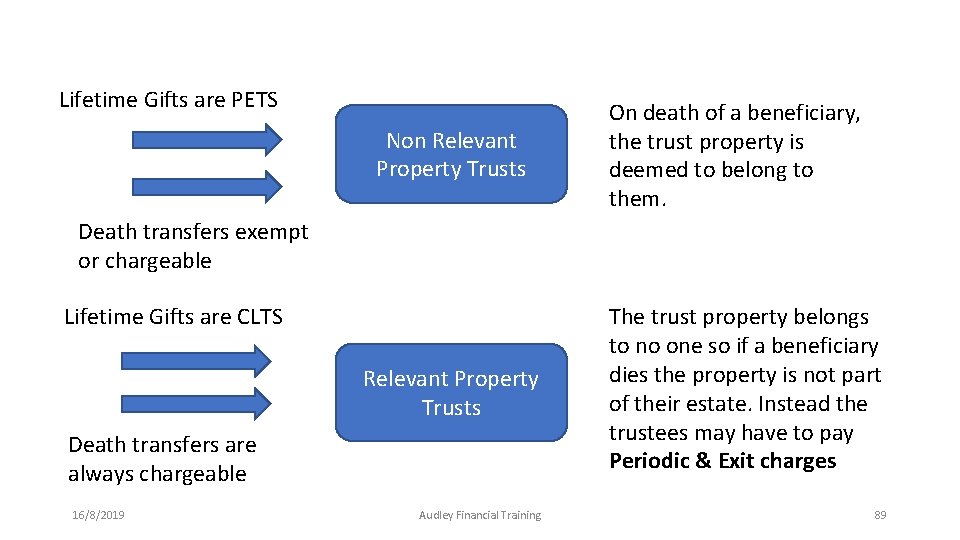
Lifetime Gifts are PETS Non Relevant Property Trusts On death of a beneficiary, the trust property is deemed to belong to them. Death transfers exempt or chargeable Lifetime Gifts are CLTS Relevant Property Trusts Death transfers are always chargeable 16/8/2019 Audley Financial Training The trust property belongs to no one so if a beneficiary dies the property is not part of their estate. Instead the trustees may have to pay Periodic & Exit charges 89
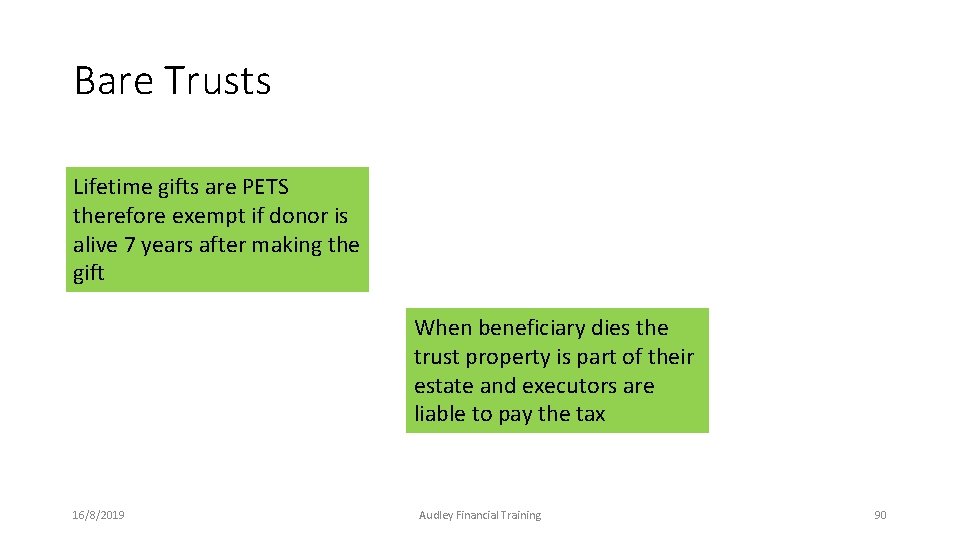
Bare Trusts Lifetime gifts are PETS therefore exempt if donor is alive 7 years after making the gift When beneficiary dies the trust property is part of their estate and executors are liable to pay the tax 16/8/2019 Audley Financial Training 90
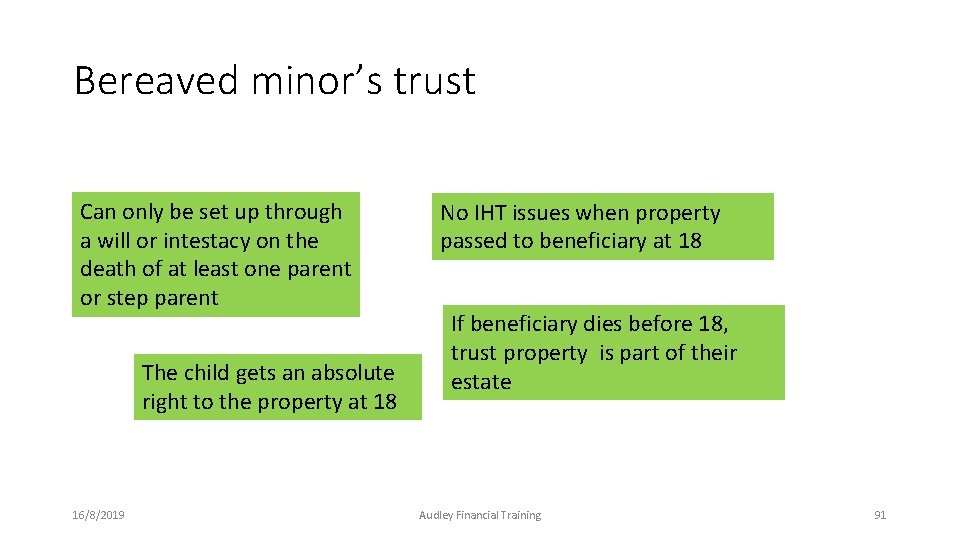
Bereaved minor’s trust Can only be set up through a will or intestacy on the death of at least one parent or step parent The child gets an absolute right to the property at 18 16/8/2019 No IHT issues when property passed to beneficiary at 18 If beneficiary dies before 18, trust property is part of their estate Audley Financial Training 91
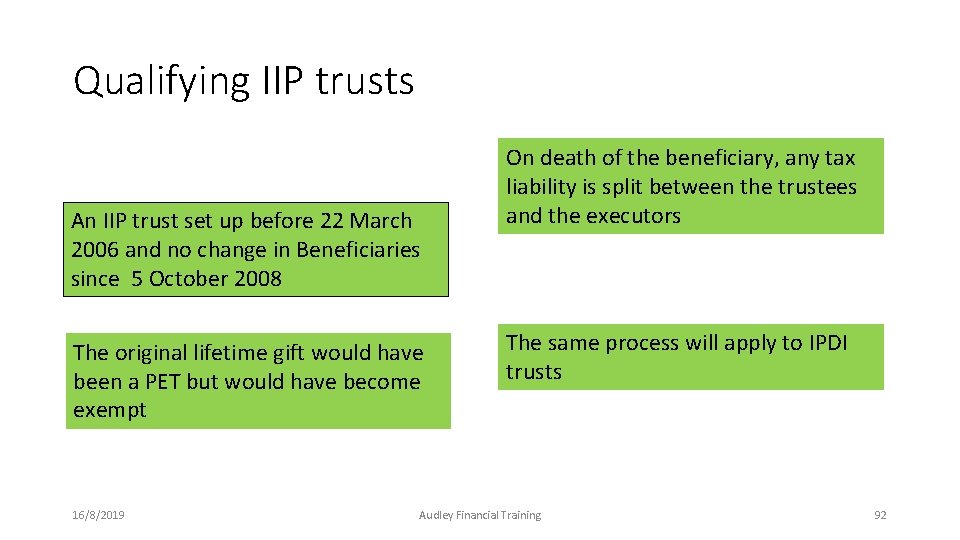
Qualifying IIP trusts An IIP trust set up before 22 March 2006 and no change in Beneficiaries since 5 October 2008 The original lifetime gift would have been a PET but would have become exempt 16/8/2019 On death of the beneficiary, any tax liability is split between the trustees and the executors The same process will apply to IPDI trusts Audley Financial Training 92
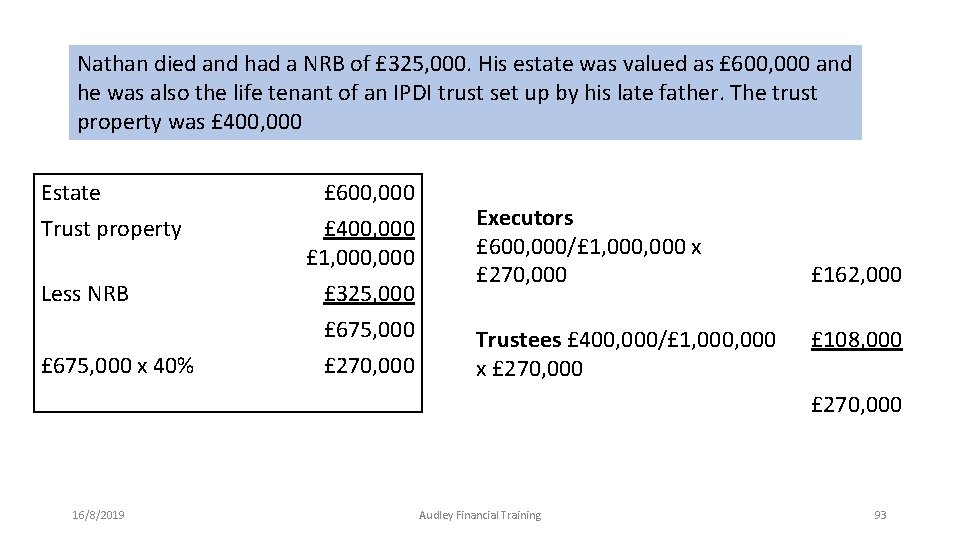
Nathan died and had a NRB of £ 325, 000. His estate was valued as £ 600, 000 and he was also the life tenant of an IPDI trust set up by his late father. The trust property was £ 400, 000 Estate Trust property Less NRB £ 675, 000 x 40% £ 600, 000 £ 400, 000 £ 1, 000 £ 325, 000 £ 675, 000 £ 270, 000 Executors £ 600, 000/£ 1, 000 x £ 270, 000 Trustees £ 400, 000/£ 1, 000 x £ 270, 000 £ 162, 000 £ 108, 000 £ 270, 000 16/8/2019 Audley Financial Training 93
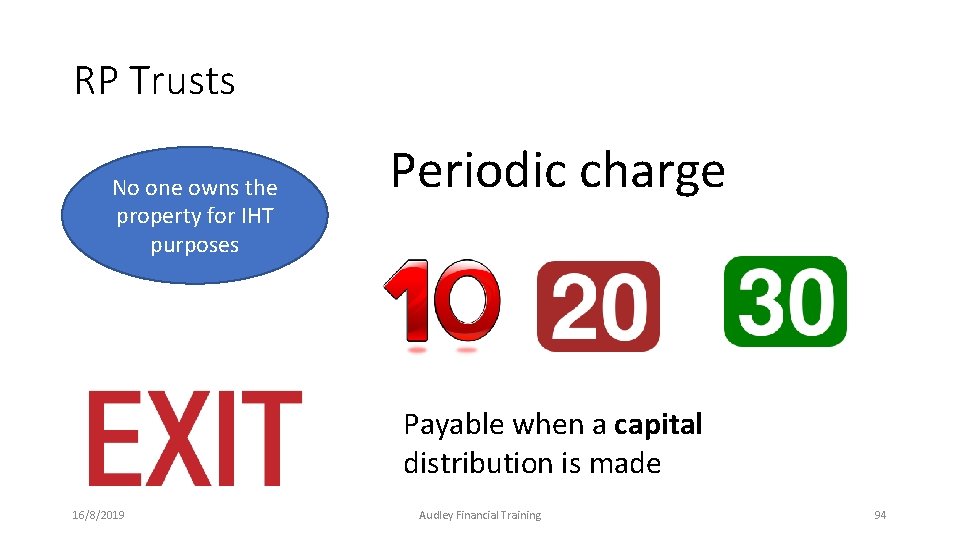
RP Trusts No one owns the property for IHT purposes Periodic charge Payable when a capital distribution is made 16/8/2019 Audley Financial Training 94
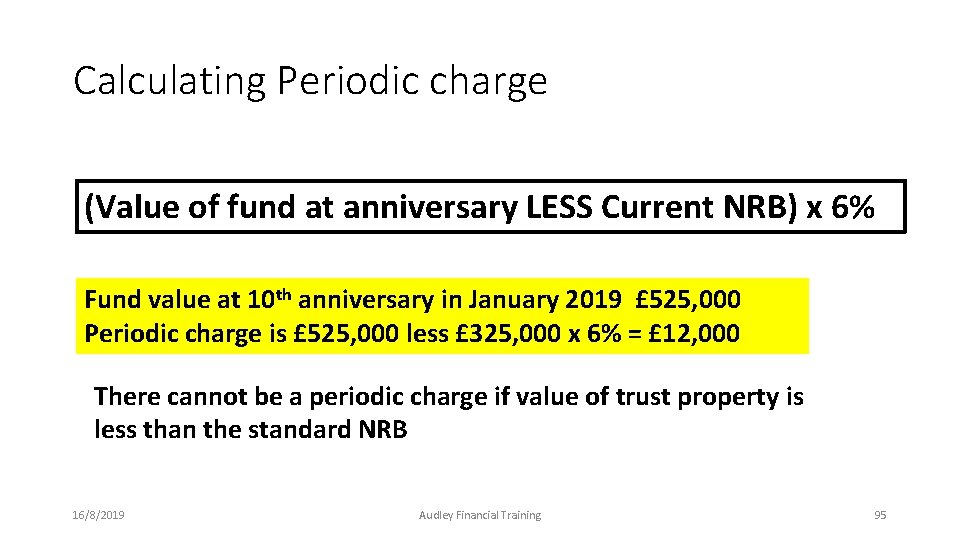
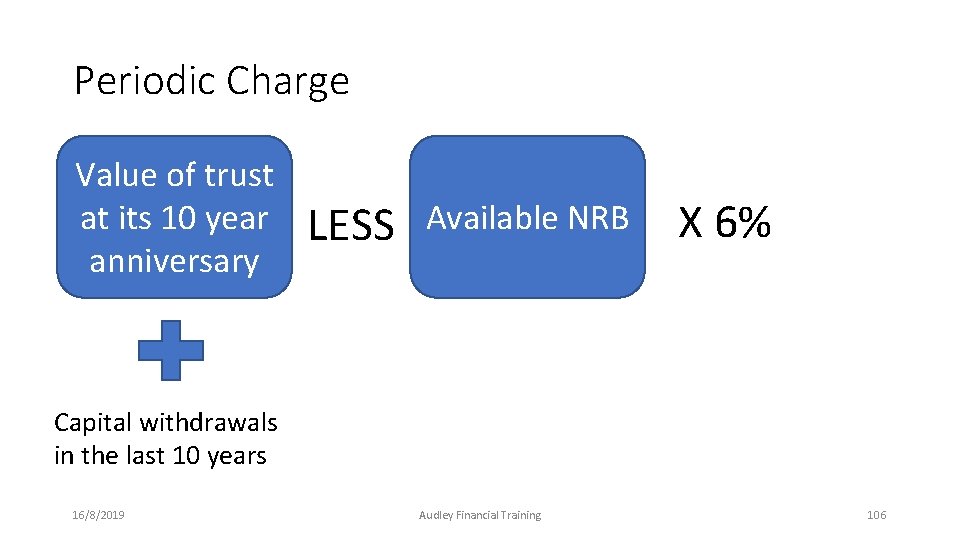
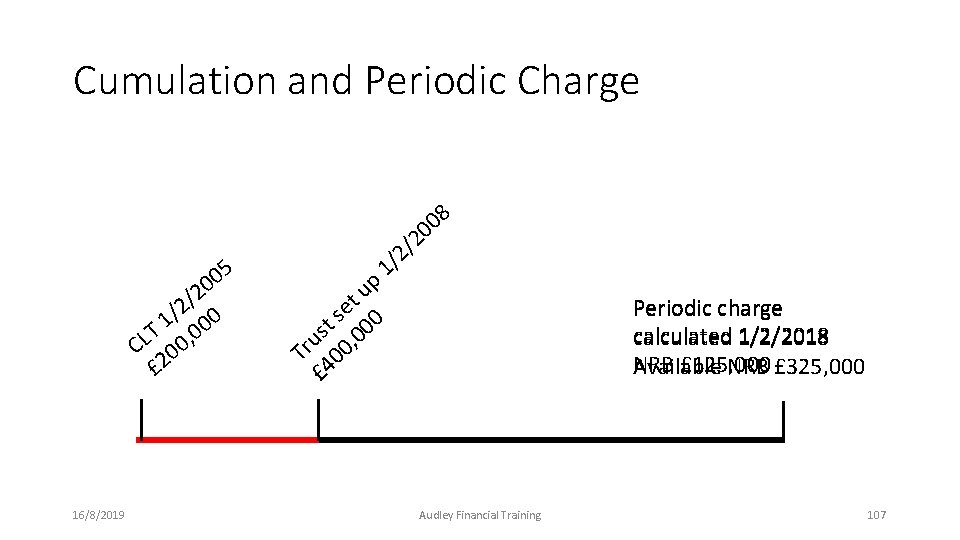
Calculating Periodic charge (Value of fund at anniversary LESS Current NRB) x 6% Fund value at 10 th anniversary in January 2019 £ 525, 000 Periodic charge is £ 525, 000 less £ 325, 000 x 6% = £ 12, 000 There cannot be a periodic charge if value of trust property is less than the standard NRB 16/8/2019 Audley Financial Training 95
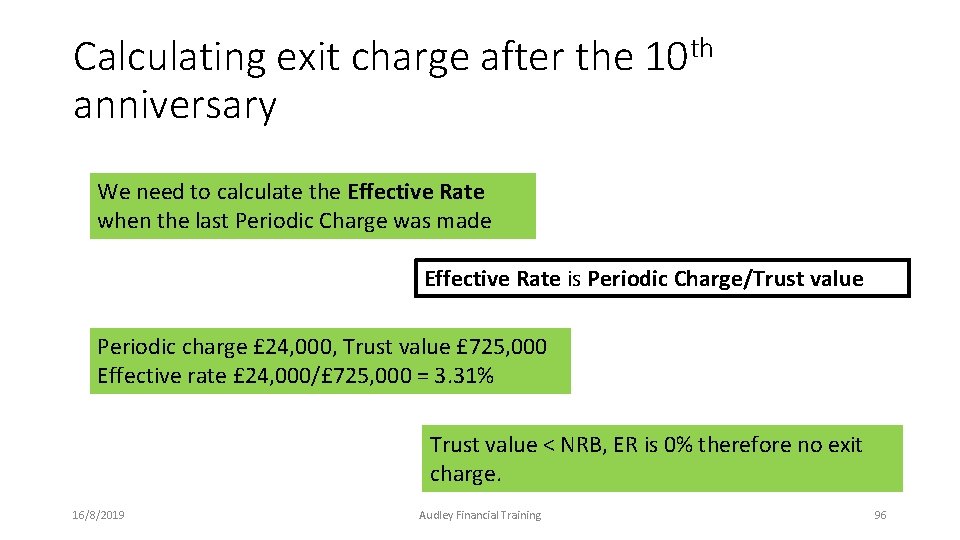
Calculating exit charge after the 10 th anniversary We need to calculate the Effective Rate when the last Periodic Charge was made Effective Rate is Periodic Charge/Trust value Periodic charge £ 24, 000, Trust value £ 725, 000 Effective rate £ 24, 000/£ 725, 000 = 3. 31% Trust value < NRB, ER is 0% therefore no exit charge. 16/8/2019 Audley Financial Training 96
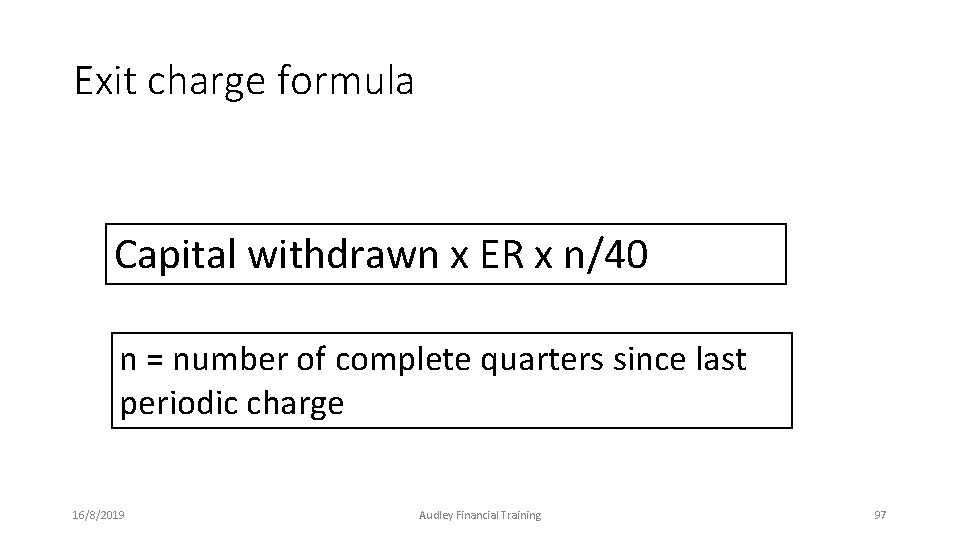
Exit charge formula Capital withdrawn x ER x n/40 n = number of complete quarters since last periodic charge 16/8/2019 Audley Financial Training 97
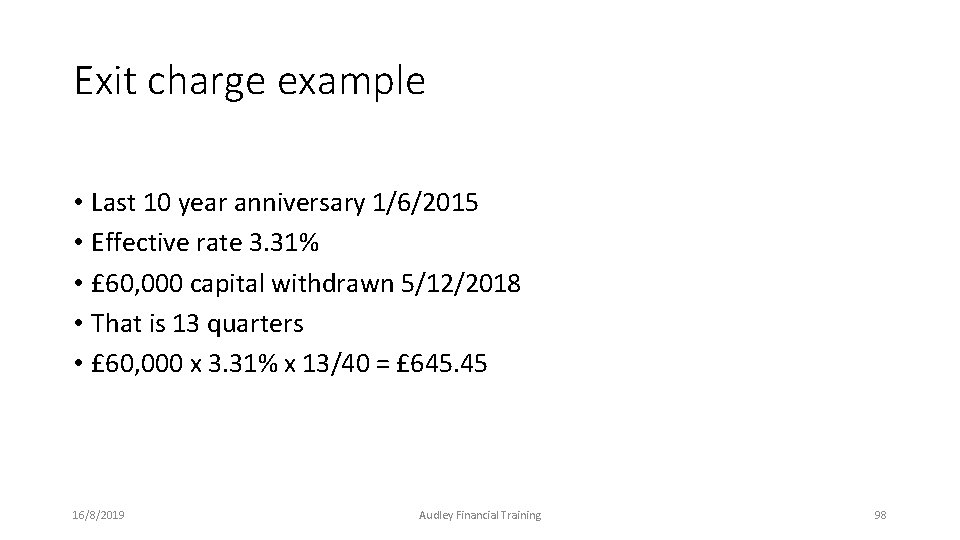
Exit charge example • Last 10 year anniversary 1/6/2015 • Effective rate 3. 31% • £ 60, 000 capital withdrawn 5/12/2018 • That is 13 quarters • £ 60, 000 x 3. 31% x 13/40 = £ 645. 45 16/8/2019 Audley Financial Training 98
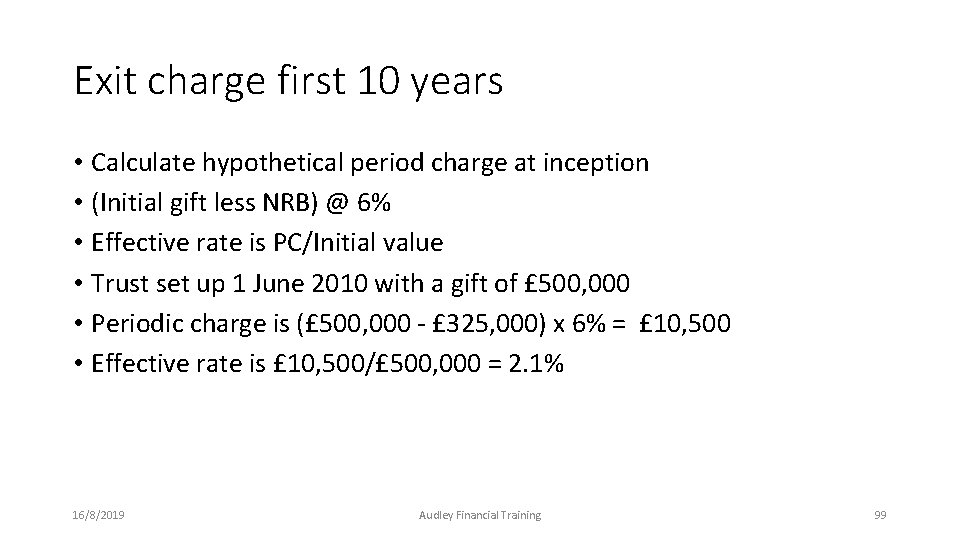
Exit charge first 10 years • Calculate hypothetical period charge at inception • (Initial gift less NRB) @ 6% • Effective rate is PC/Initial value • Trust set up 1 June 2010 with a gift of £ 500, 000 • Periodic charge is (£ 500, 000 - £ 325, 000) x 6% = £ 10, 500 • Effective rate is £ 10, 500/£ 500, 000 = 2. 1% 16/8/2019 Audley Financial Training 99
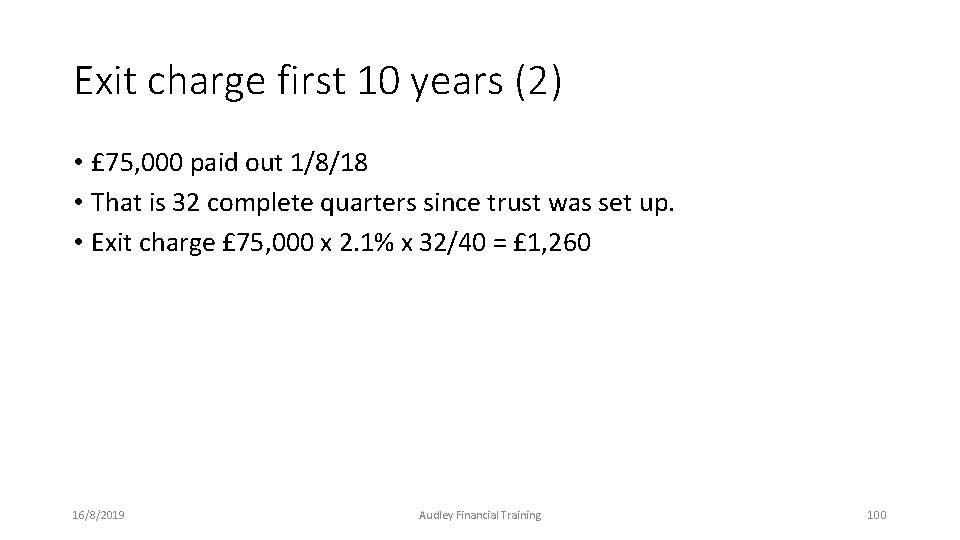
Exit charge first 10 years (2) • £ 75, 000 paid out 1/8/18 • That is 32 complete quarters since trust was set up. • Exit charge £ 75, 000 x 2. 1% x 32/40 = £ 1, 260 16/8/2019 Audley Financial Training 100
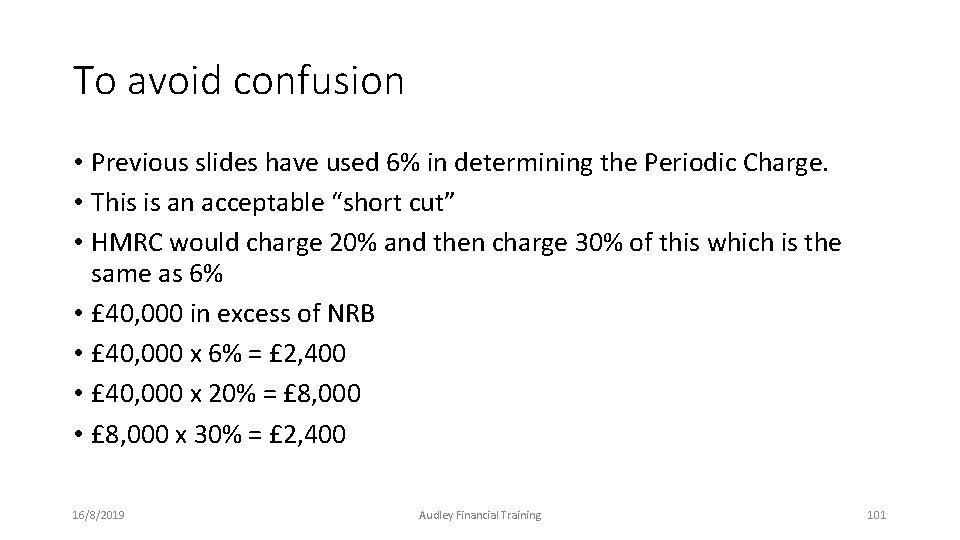
To avoid confusion • Previous slides have used 6% in determining the Periodic Charge. • This is an acceptable “short cut” • HMRC would charge 20% and then charge 30% of this which is the same as 6% • £ 40, 000 in excess of NRB • £ 40, 000 x 6% = £ 2, 400 • £ 40, 000 x 20% = £ 8, 000 • £ 8, 000 x 30% = £ 2, 400 16/8/2019 Audley Financial Training 101
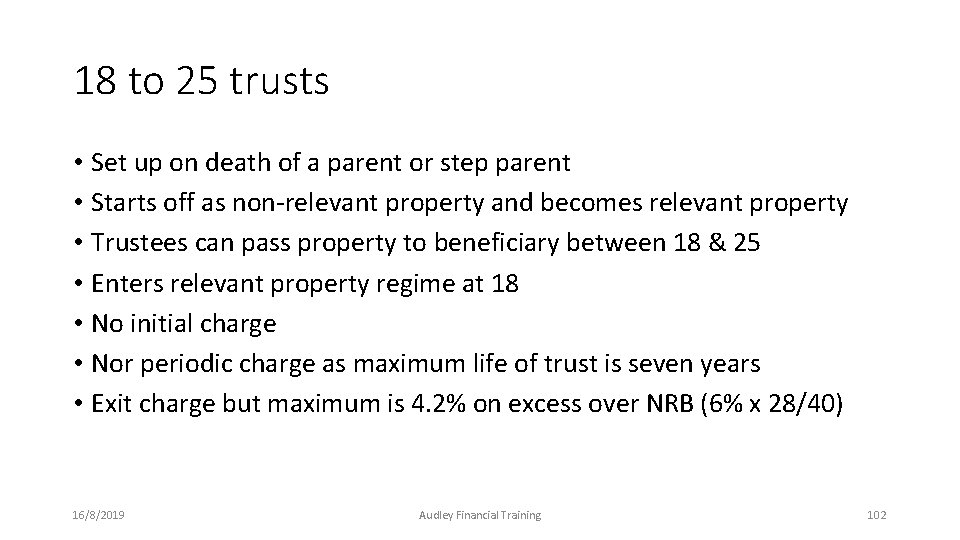
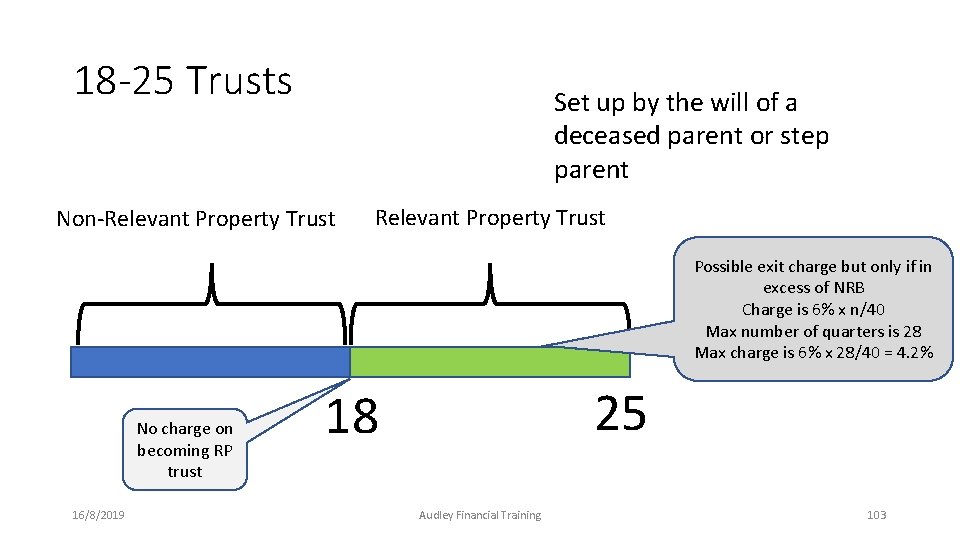
18 to 25 trusts • Set up on death of a parent or step parent • Starts off as non-relevant property and becomes relevant property • Trustees can pass property to beneficiary between 18 & 25 • Enters relevant property regime at 18 • No initial charge • Nor periodic charge as maximum life of trust is seven years • Exit charge but maximum is 4. 2% on excess over NRB (6% x 28/40) 16/8/2019 Audley Financial Training 102
18 -25 Trusts Set up by the will of a deceased parent or step parent Non-Relevant Property Trust Possible exit charge but only if in excess of NRB Charge is 6% x n/40 Max number of quarters is 28 Max charge is 6% x 28/40 = 4. 2% No charge on becoming RP trust 16/8/2019 25 18 Audley Financial Training 103
IHT – Lifetime gifts to RP trusts • Gifts are CLT • Usual 7 year cumulation rule on initial gifts will apply • Gifts made jointly, e. g. husband wife are deemed to set up two separate trusts and each can use their NRB 16/8/2019 Audley Financial Training 104
Cumulation • Bob makes a gift of £ 300 K on 1 st March 2013 into a discretionary trust (assume AE used up) • No tax as below NRB • He makes a further gift of £ 300 K of 1 November 2018. • Below NRB but we must add in earlier gift to give a total of £ 600 K • £ 275 K above NRB so this is chargeable at 20% or 25% if Bob pays the tax • On 1 March 2020 the first gift will drop out and Bob will have some NRB left 16/8/2019 Audley Financial Training 105
Periodic Charge Value of trust at its 10 year anniversary LESS Available NRB X 6% Capital withdrawals in the last 10 years 16/8/2019 Audley Financial Training 106
Cumulation and Periodic Charge 8 0 0 05 20 / 2 0 / 1 0 T 0 CL 00, £ 2 16/8/2019 p u et 0 s st , 00 u Tr 00 £ 4 2 / 2 1/ Periodic charge calculated 1/2/2018 NRB £ 125, 000 Available NRB £ 325, 000 Audley Financial Training 107
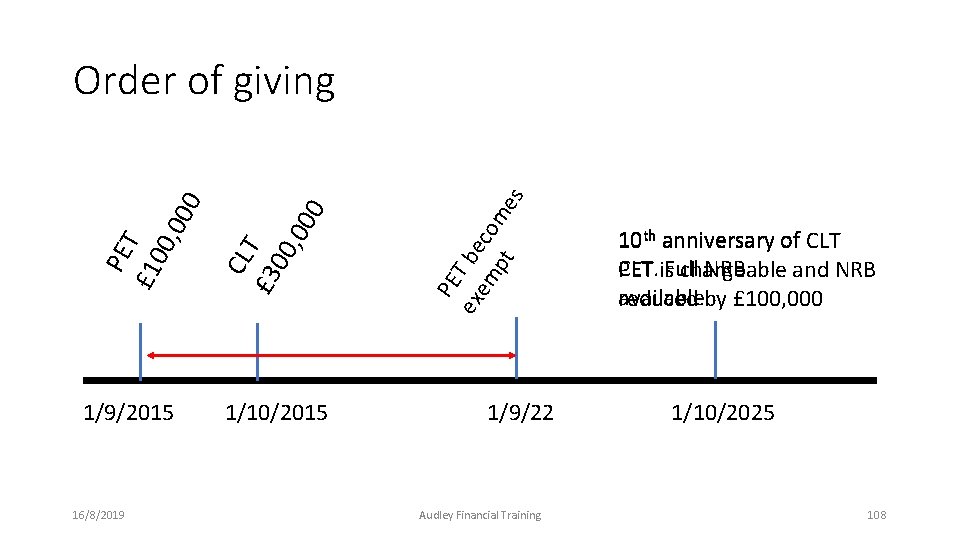
1/9/2015 16/8/2019 1/10/2015 PE ex T be em co pt me s 0 CL £ 3 T 00 , 00 PE T £ 1 00 , 00 0 Order of giving 1/9/22 Audley Financial Training 10 th anniversary of CLT. NRB PET is. Full chargeable and NRB availableby £ 100, 000 reduced 1/10/2025 108
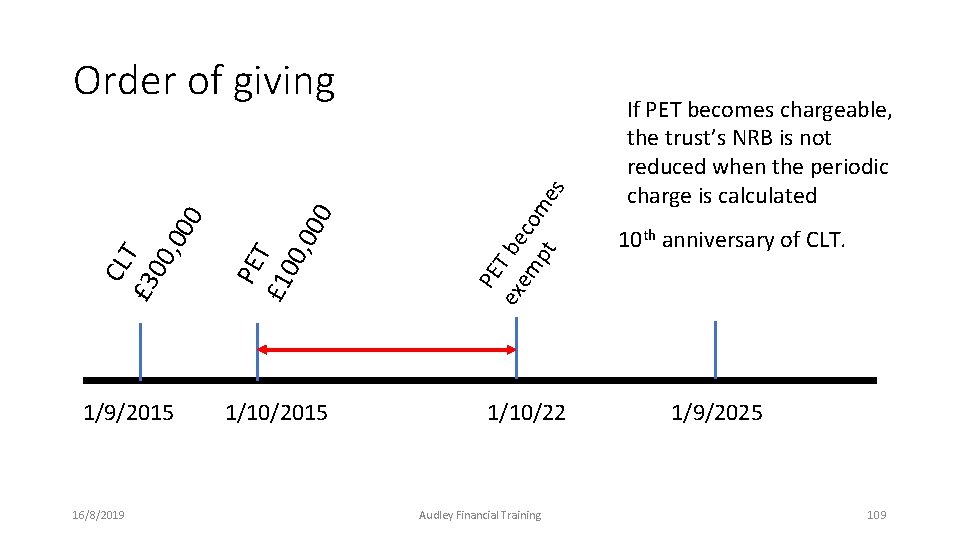
16/8/2019 1/10/2015 1/10/22 0 PE ex T be em co pt me s 1/9/2015 PE T £ 1 00 , 00 CL £ 3 T 00 , 00 0 Order of giving Audley Financial Training If PET becomes chargeable, the trust’s NRB is not reduced when the periodic charge is calculated 10 th anniversary of CLT. 1/9/2025 109
Order of gifts rule • Helen is planning to make a PET to her daughter and set up an RP trust • Which should she make first? • If she makes the PET first and dies within 7 years it becomes chargeable and deducted from the NRB when calculating the periodic charge. • If she makes the trust gift first and then the PET, and dies within 7 years of making the PET, the full NRB will be available in calculating the periodic charge. 16/8/2019 Audley Financial Training 110
Rysaffe principle • For periodic charge purposes each trust has its own NRB provided they are set up on separate days. • This does not reduce the initial CLT charge • But setting up a number of trusts rather than just one can result in a lower Periodic Charge. 16/8/2019 Audley Financial Training 111
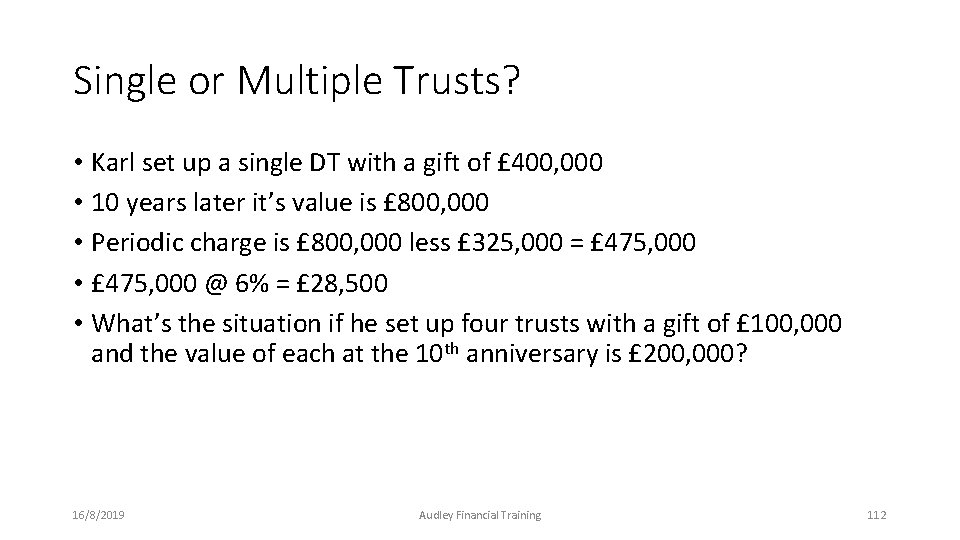
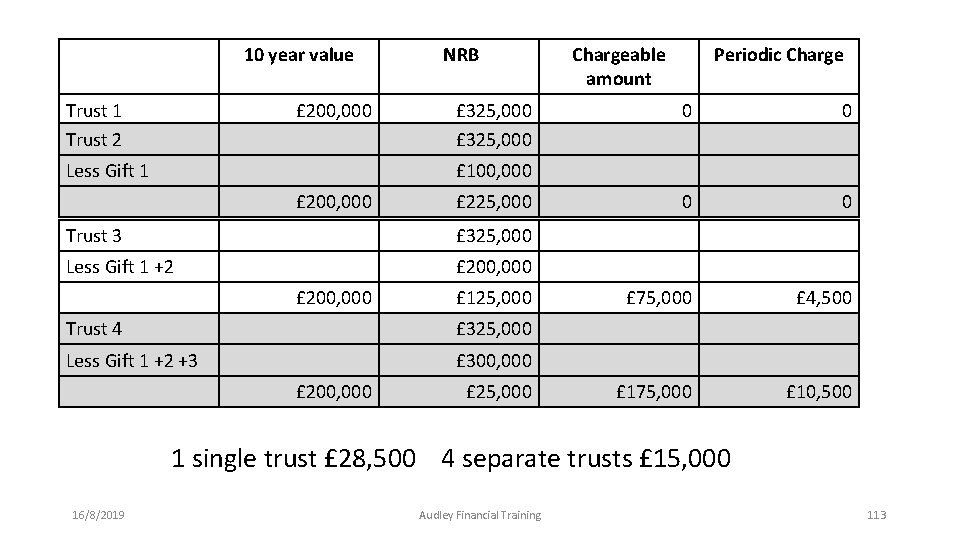
Single or Multiple Trusts? • Karl set up a single DT with a gift of £ 400, 000 • 10 years later it’s value is £ 800, 000 • Periodic charge is £ 800, 000 less £ 325, 000 = £ 475, 000 • £ 475, 000 @ 6% = £ 28, 500 • What’s the situation if he set up four trusts with a gift of £ 100, 000 and the value of each at the 10 th anniversary is £ 200, 000? 16/8/2019 Audley Financial Training 112
10 year value Trust 1 Trust 2 £ 200, 000 Less Gift 1 NRB £ 325, 000 Chargeable amount Periodic Charge 0 0 £ 75, 000 £ 4, 500 £ 175, 000 £ 10, 500 £ 100, 000 £ 225, 000 Trust 3 £ 325, 000 Less Gift 1 +2 £ 200, 000 £ 125, 000 Trust 4 £ 325, 000 Less Gift 1 +2 +3 £ 300, 000 £ 25, 000 1 single trust £ 28, 500 4 separate trusts £ 15, 000 16/8/2019 Audley Financial Training 113
Life protection policies under trust • If set up before 22/3/06 • Premiums will still be considered PETS • Premiums can be varied if pre 22/3/06 conditions allow this • If set up after 22/3/06 will be CLTs but usually exempt either using annual exemption or gifts out of normal expenditure • Value of policy nil until claim so unlikely to be exit or periodic charge 16/8/2019 Audley Financial Training 114
Trust planning • What is the client trying to achieve? • Would a trust meet these objectives? • What type of trust should be used? • What investment wrappers should be used? 16/8/2019 Audley Financial Training 115
Loan Trust • Settlor lends property to the trust, usually cash • Not a gift so not a PET or CLT • Loan repaid to settlor usually by 5% withdrawals from an Insurance Bond • Growth of the bond, after repaying loan outside the estate • If it appears in an IHT calculation you must add the outstanding loan to the estate. 16/8/2019 Audley Financial Training 116
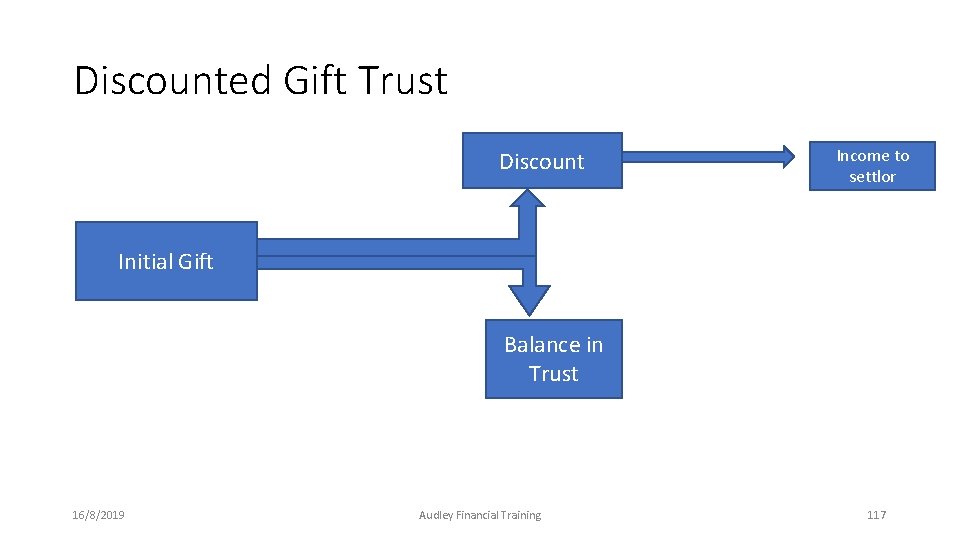
Discounted Gift Trust Discount Income to settlor Initial Gift Balance in Trust 16/8/2019 Audley Financial Training 117
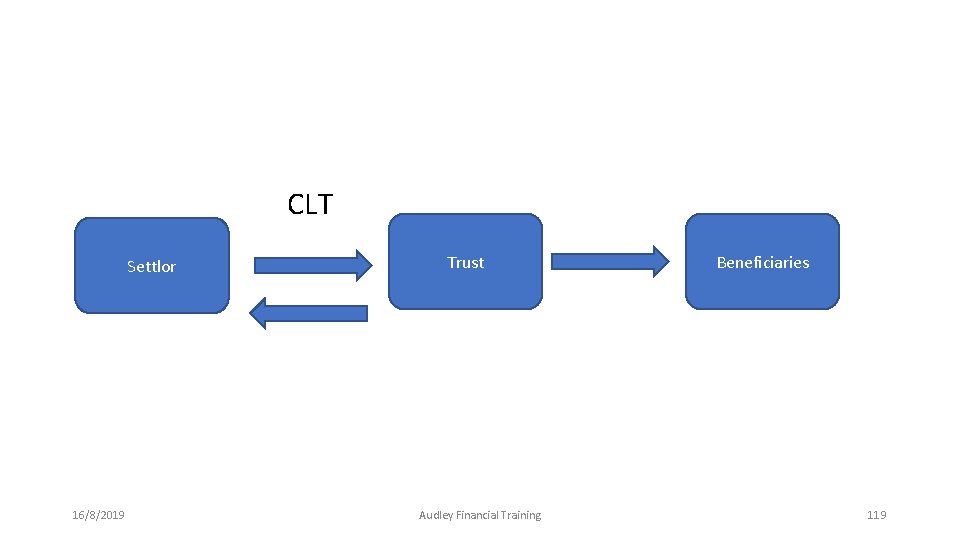
Flexible Reversionary Trust • This enables the settlor to make a gift that is effective for IHT purposes • And have the possibility of benefiting from the trust • But will not fall foul of the Gifts with Reservation rules • Nor will it be subject to POAT 16/8/2019 Audley Financial Training 118
CLT Settlor 16/8/2019 Trust Audley Financial Training Beneficiaries 119
How? • Trustees invest gift into a series of single premium endowments • Each with a different maturity date, usually 1 to 10 years • At maturity date the trustees can decide whether to claim the proceeds or to extend the maturity date • As the extension is exercised by trustees, they are not treated as new gifts by the settlor • If the policy is not extended the proceeds are paid to the settlor • Alternatively they can surrender policies at any time to pay to beneficiaries or assign policies to them 16/8/2019 Audley Financial Training 120