
Special Needs Trusts Planning and Resources Megan Brand
Special Needs Trusts, Planning and Resources Megan Brand Executive Director Colorado Fund for People with Disabilities 303. 476. 6315 mbrand@cpfdtrust. org 1
Presenter’s bio: Megan Brand is the Executive Director of CFPD-Colorado Fund for People with Disabilities. Megan began her service at CFPD in 2003 and has been the Executive Director since 2010. Megan has a bachelor’s degree in social work from the College of St. Benedict over 20 years of experience in working with people with disabilities, their families, service providers, attorneys, trustees, financial planners, guardians and other professionals. She leads a staff of 27 in administering the largest and longest-standing locally managed pooled trust in Colorado, as well as providing myriad of other services that offer protection, personalized attention, access to our network of organizations and services, and financial and benefit’s guidance. In addition to leading the staff, Megan is a former board member of the Colorado Guardianship Association and currently serves on the board for the National Planned Lifetime Assistance Network and Community Living Alternatives and is a frequent presenter in the community, both locally and nationally, on Special Needs Trusts and related topics. 2
Who needs a Special Needs Trust (SNT)? Persons on benefits receiving funds exceeding $2, 000 ◦ Inheritance, back-payments of Social Security, gifts �Settlements �Personal Injury �Worker’s Compensation �Note need for Medicare Set-Aside Trust as applicable �Medical Malpractice �Divorce �Liquidation of personal assets ◦ Sale of home ◦ Excess resources �Employment wages Persons unable to personally handle sums of money or may be vulnerable to exploitation Persons who may receive benefits in the future 3
Special Needs Trusts: Disability Trusts and Special Needs Planning Special Needs Trust (SNT) (also called Supplemental Needs Trusts, Disability Trusts, d(4)(a) and d(4)(c) Trusts). Types of Special Needs Trusts: ◦ First Party Individual Trusts �Subject to Medicaid approval �Can be created by Court, parents or guardian of beneficiary and self created �Payback provisions on death or termination of trust �Income taxable to beneficiary ◦ Third Party Individual Trusts �Settlor/Creator = third party (inter vivos or testamentary) �No payback provisions �More flexibility ◦ Pooled Special Needs Trusts (1 st and 3 rd Party) �Managed by a non-profit organization �Master trust document �Can be created by Court, parents or guardian of beneficiary and self created �More Portability from state to state 4
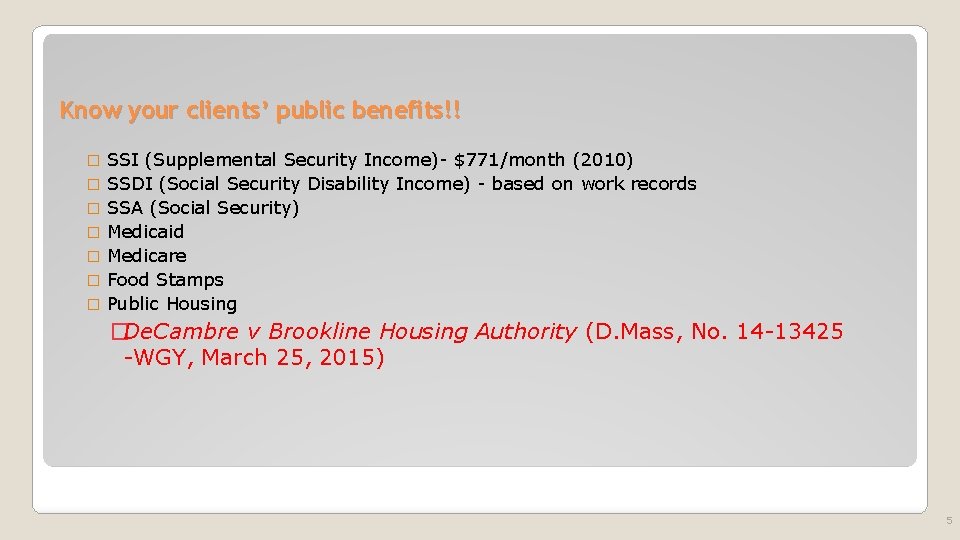
Know your clients’ public benefits!! � � � � SSI (Supplemental Security Income)- $771/month (2010) SSDI (Social Security Disability Income) - based on work records SSA (Social Security) Medicaid Medicare Food Stamps Public Housing �De. Cambre v Brookline Housing Authority (D. Mass, No. 14 -13425 -WGY, March 25, 2015) 5
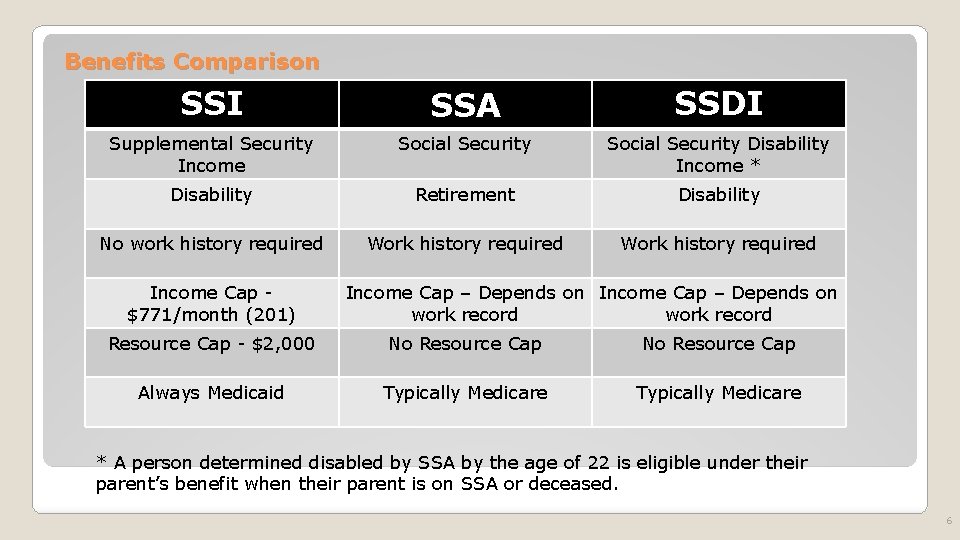
Benefits Comparison SSI SSA SSDI Supplemental Security Income Social Security Disability Income * Disability Retirement Disability No work history required Work history required Income Cap $771/month (201) Income Cap – Depends on work record Resource Cap - $2, 000 No Resource Cap Always Medicaid Typically Medicare * A person determined disabled by SSA by the age of 22 is eligible under their parent’s benefit when their parent is on SSA or deceased. 6
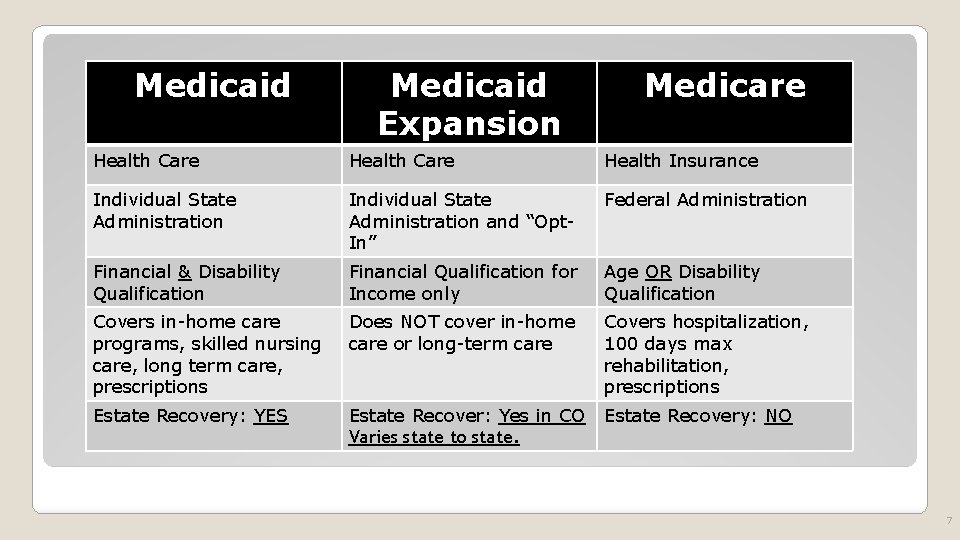
Medicaid Expansion Medicare Health Care Health Insurance Individual State Administration and “Opt. In” Federal Administration Financial & Disability Qualification Financial Qualification for Income only Age OR Disability Qualification Covers in-home care programs, skilled nursing care, long term care, prescriptions Does NOT cover in-home care or long-term care Covers hospitalization, 100 days max rehabilitation, prescriptions Estate Recovery: YES Estate Recover: Yes in CO Varies state to state. Estate Recovery: NO 7
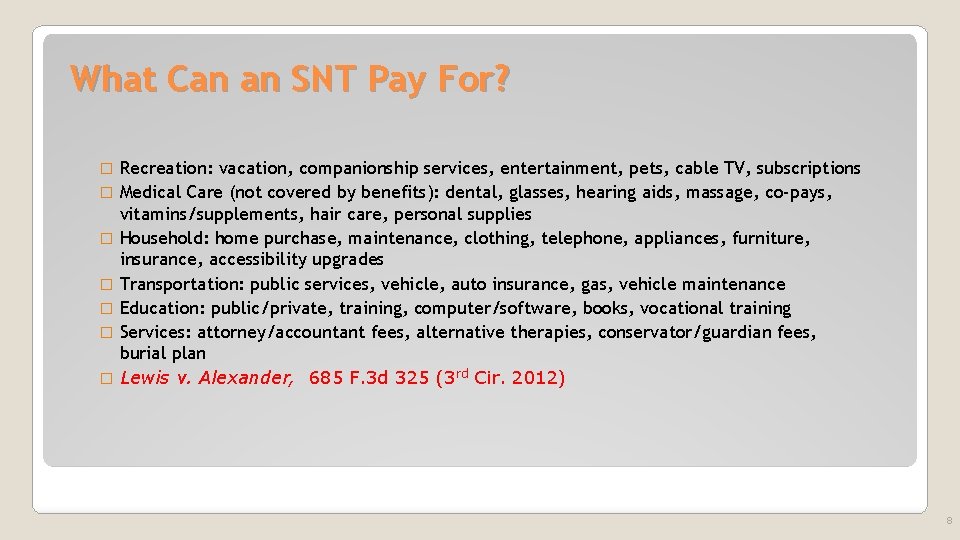
What Can an SNT Pay For? � � � � Recreation: vacation, companionship services, entertainment, pets, cable TV, subscriptions Medical Care (not covered by benefits): dental, glasses, hearing aids, massage, co-pays, vitamins/supplements, hair care, personal supplies Household: home purchase, maintenance, clothing, telephone, appliances, furniture, insurance, accessibility upgrades Transportation: public services, vehicle, auto insurance, gas, vehicle maintenance Education: public/private, training, computer/software, books, vocational training Services: attorney/accountant fees, alternative therapies, conservator/guardian fees, burial plan Lewis v. Alexander, 685 F. 3 d 325 (3 rd Cir. 2012) 8
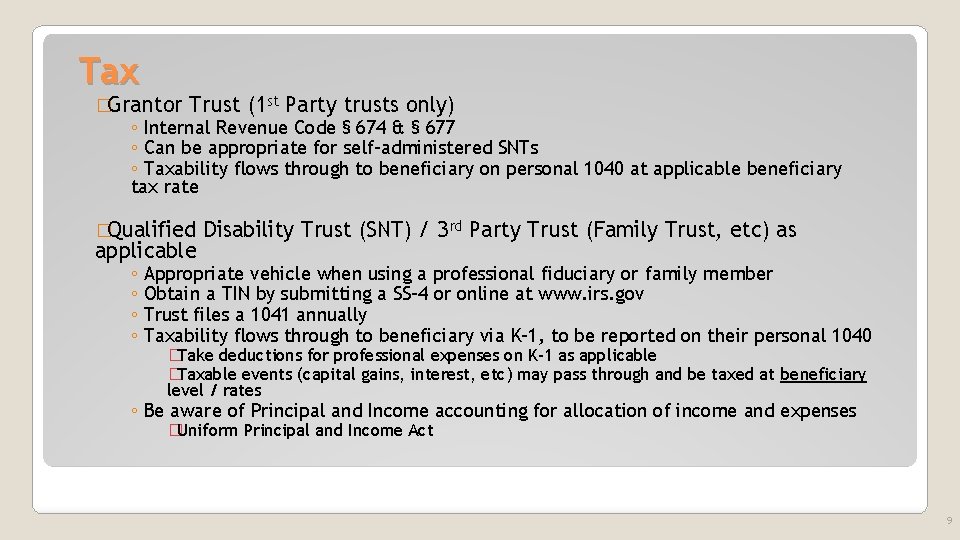
Tax �Grantor Trust (1 st Party trusts only) ◦ Internal Revenue Code § 674 & § 677 ◦ Can be appropriate for self-administered SNTs ◦ Taxability flows through to beneficiary on personal 1040 at applicable beneficiary tax rate �Qualified applicable Disability Trust (SNT) / 3 rd Party Trust (Family Trust, etc) as ◦ Appropriate vehicle when using a professional fiduciary or family member ◦ Obtain a TIN by submitting a SS-4 or online at www. irs. gov ◦ Trust files a 1041 annually ◦ Taxability flows through to beneficiary via K-1, to be reported on their personal 1040 �Take deductions for professional expenses on K-1 as applicable �Taxable events (capital gains, interest, etc) may pass through and be taxed at beneficiary level / rates ◦ Be aware of Principal and Income accounting for allocation of income and expenses �Uniform Principal and Income Act 9
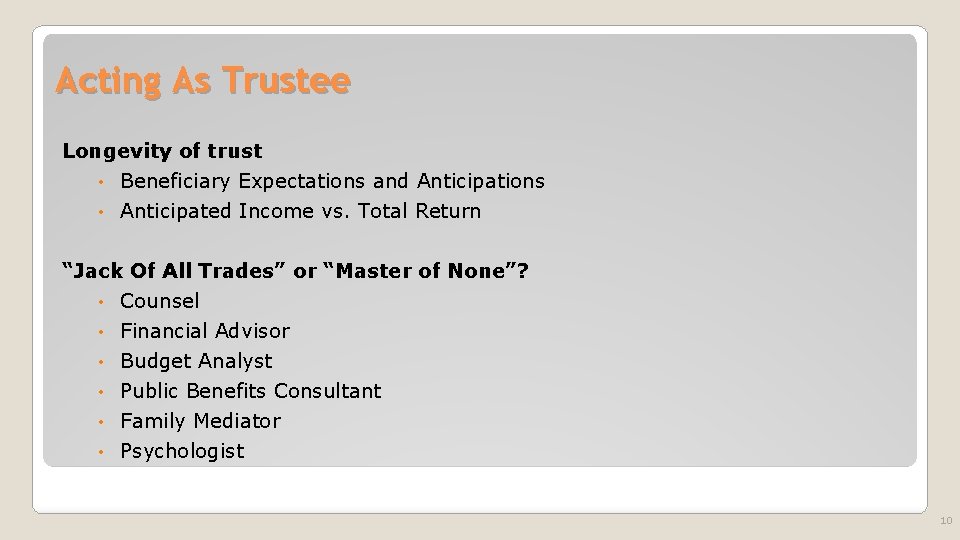
Acting As Trustee Longevity of trust Beneficiary Expectations and Anticipations • Anticipated Income vs. Total Return • “Jack Of All Trades” or “Master of None”? • Counsel • Financial Advisor • Budget Analyst • Public Benefits Consultant • Family Mediator • Psychologist 10
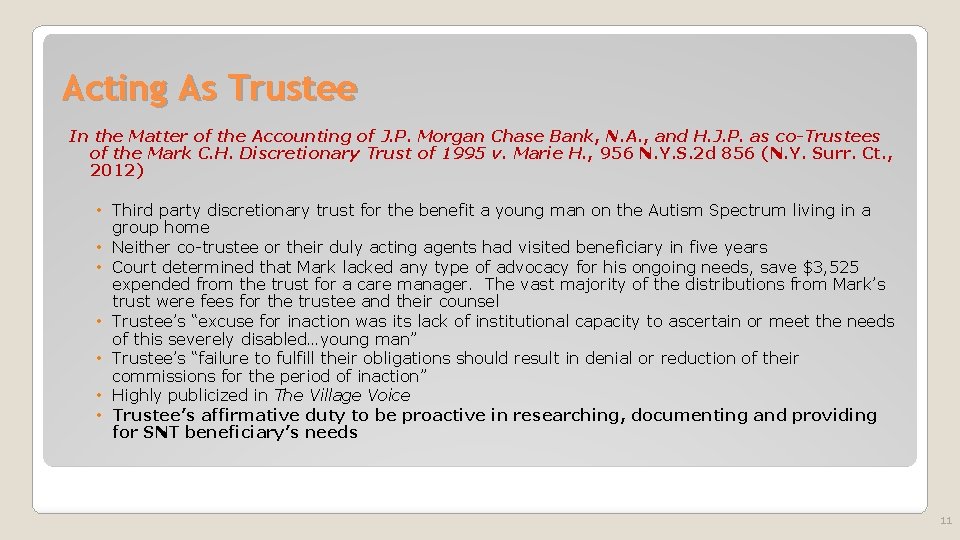
Acting As Trustee In the Matter of the Accounting of J. P. Morgan Chase Bank, N. A. , and H. J. P. as co-Trustees of the Mark C. H. Discretionary Trust of 1995 v. Marie H. , 956 N. Y. S. 2 d 856 (N. Y. Surr. Ct. , 2012) • Third party discretionary trust for the benefit a young man on the Autism Spectrum living in a group home • Neither co-trustee or their duly acting agents had visited beneficiary in five years • Court determined that Mark lacked any type of advocacy for his ongoing needs, save $3, 525 expended from the trust for a care manager. The vast majority of the distributions from Mark’s trust were fees for the trustee and their counsel • Trustee’s “excuse for inaction was its lack of institutional capacity to ascertain or meet the needs of this severely disabled…young man” • Trustee’s “failure to fulfill their obligations should result in denial or reduction of their commissions for the period of inaction” • Highly publicized in The Village Voice • Trustee’s affirmative duty to be proactive in researching, documenting and providing for SNT beneficiary’s needs 11
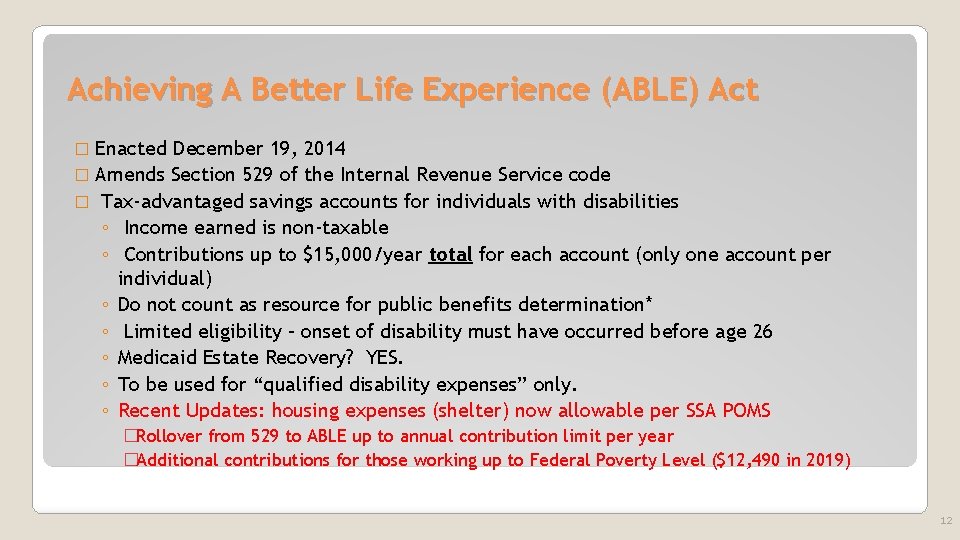
Achieving A Better Life Experience (ABLE) Act � Enacted December 19, 2014 � Amends Section 529 of the Internal Revenue Service code � Tax-advantaged savings accounts for individuals with disabilities ◦ Income earned is non-taxable ◦ Contributions up to $15, 000/year total for each account (only one account per individual) ◦ Do not count as resource for public benefits determination* ◦ Limited eligibility – onset of disability must have occurred before age 26 ◦ Medicaid Estate Recovery? YES. ◦ To be used for “qualified disability expenses” only. ◦ Recent Updates: housing expenses (shelter) now allowable per SSA POMS �Rollover from 529 to ABLE up to annual contribution limit per year �Additional contributions for those working up to Federal Poverty Level ($12, 490 in 2019) 12
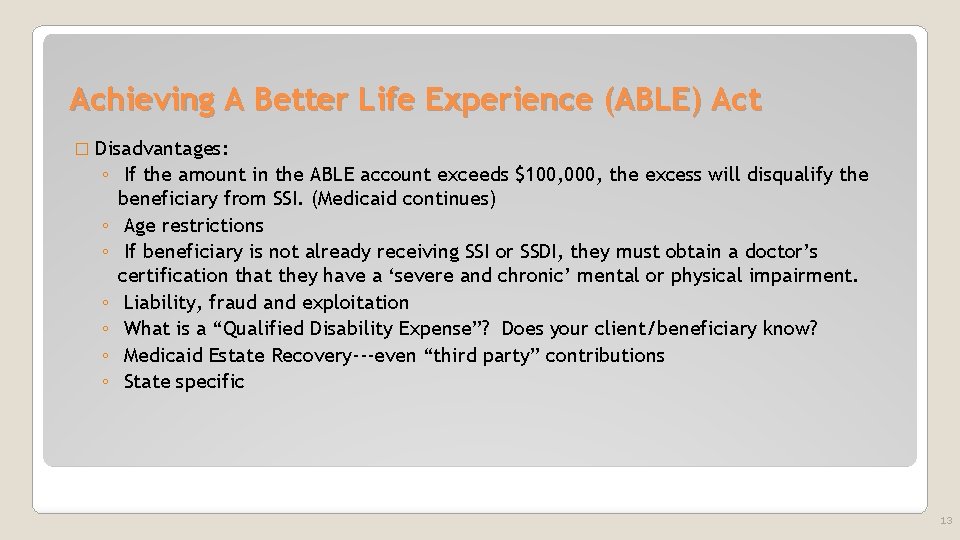
Achieving A Better Life Experience (ABLE) Act � Disadvantages: ◦ If the amount in the ABLE account exceeds $100, 000, the excess will disqualify the beneficiary from SSI. (Medicaid continues) ◦ Age restrictions ◦ If beneficiary is not already receiving SSI or SSDI, they must obtain a doctor’s certification that they have a ‘severe and chronic’ mental or physical impairment. ◦ Liability, fraud and exploitation ◦ What is a “Qualified Disability Expense”? Does your client/beneficiary know? ◦ Medicaid Estate Recovery---even “third party” contributions ◦ State specific 13
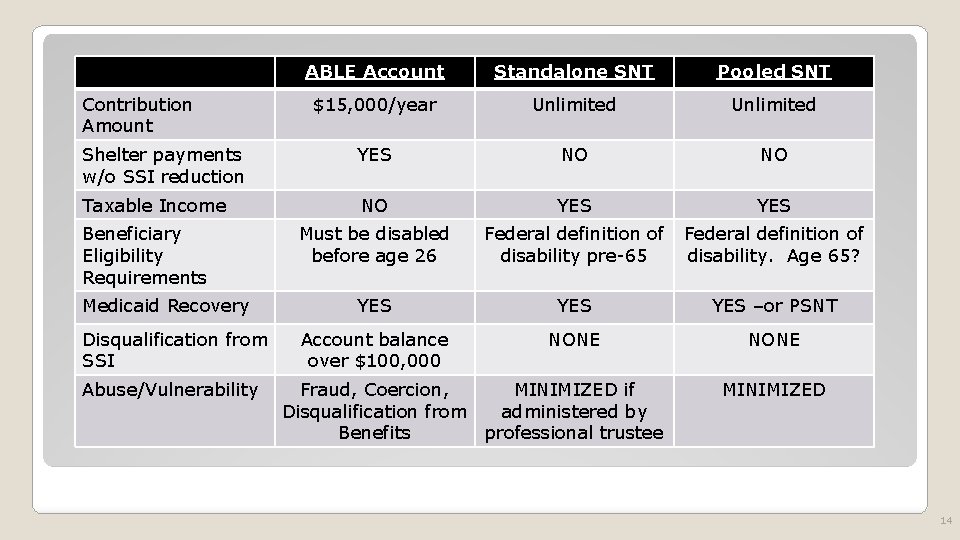
ABLE Account Standalone SNT Pooled SNT $15, 000/year Unlimited Shelter payments w/o SSI reduction YES NO NO Taxable Income NO YES Must be disabled before age 26 Federal definition of disability pre-65 Federal definition of disability. Age 65? YES YES –or PSNT Account balance over $100, 000 NONE Contribution Amount Beneficiary Eligibility Requirements Medicaid Recovery Disqualification from SSI Abuse/Vulnerability Fraud, Coercion, MINIMIZED if Disqualification from administered by Benefits professional trustee MINIMIZED 14
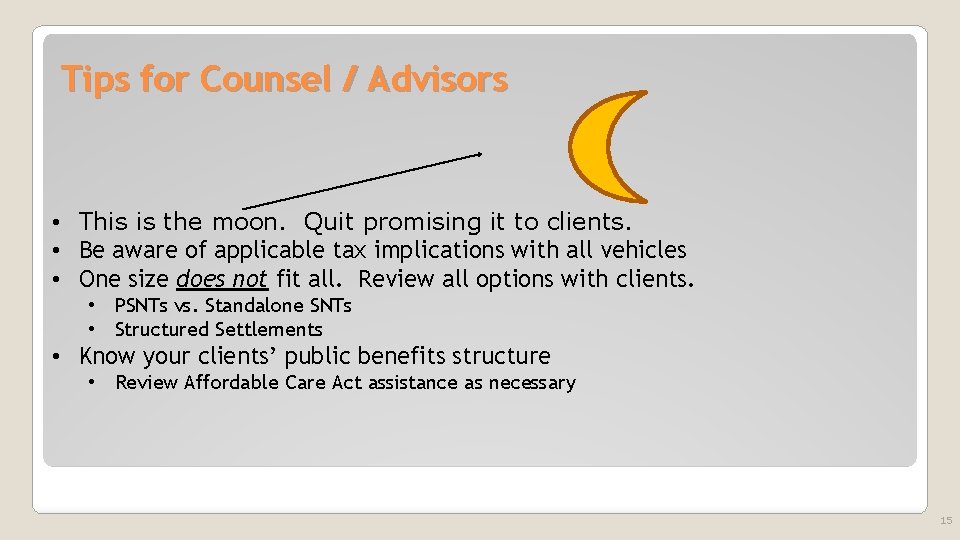
Tips for Counsel / Advisors • This is the moon. Quit promising it to clients. • Be aware of applicable tax implications with all vehicles • One size does not fit all. Review all options with clients. • PSNTs vs. Standalone SNTs • Structured Settlements • Know your clients’ public benefits structure • Review Affordable Care Act assistance as necessary 15
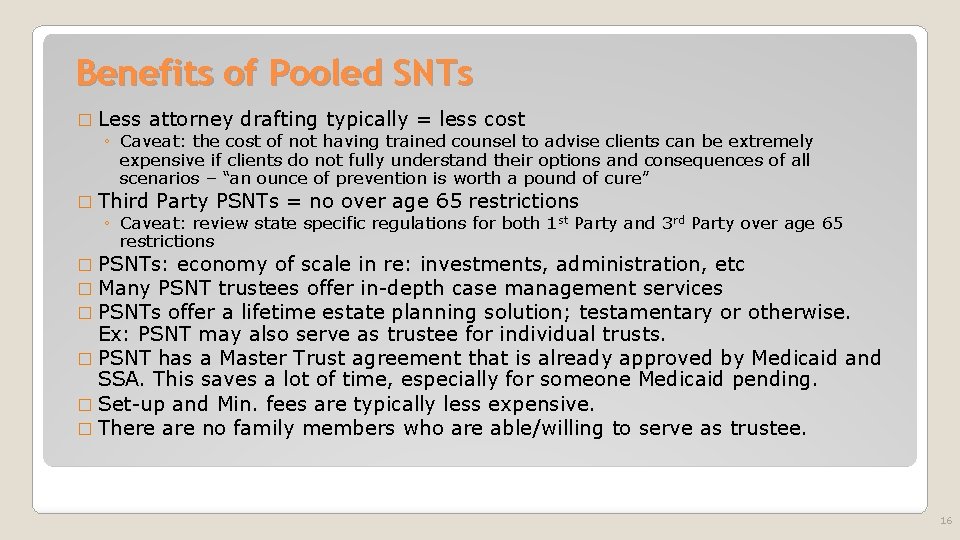
Benefits of Pooled SNTs � Less attorney drafting typically = less cost ◦ Caveat: the cost of not having trained counsel to advise clients can be extremely expensive if clients do not fully understand their options and consequences of all scenarios – “an ounce of prevention is worth a pound of cure” � Third Party PSNTs = no over age 65 restrictions ◦ Caveat: review state specific regulations for both 1 st Party and 3 rd Party over age 65 restrictions � PSNTs: economy of scale in re: investments, administration, etc � Many PSNT trustees offer in-depth case management services � PSNTs offer a lifetime estate planning solution; testamentary or otherwise. Ex: PSNT may also serve as trustee for individual trusts. � PSNT has a Master Trust agreement that is already approved by Medicaid and SSA. This saves a lot of time, especially for someone Medicaid pending. � Set-up and Min. fees are typically less expensive. � There are no family members who are able/willing to serve as trustee. 16
Case Manager, Trust Advisors/Protectors and Co-Trustees � Case Manager ◦ Knowledgeable person hired to assist trustee with services, purchases, with a knowledge of community resources and public benefits. �Increase the Trust’s familiarity with the beneficiary and their needs �Identify necessary and appropriate expenditures under the trust �Monitor for misuse of funds of exploitation of Beneficiary � Trust advisors can be family members, attorneys, accountants or other trusted professionals ◦ Fees vary, but if there is a family member trustee, trust advisor fees may be more economical ◦ Rights NOT duties � Co-Trustee ◦ Consider a family member acting as co-trustee with a professional trustee. 17
The Importance of Choosing the Right Fiduciary Ideal Trustee: ◦ In-depth public benefit knowledge ◦ Ability to stay abreast of all benefit and fiduciary law changes ◦ Unbiased decision making capability with beneficiary’s best interests in mind in regards to discretionary distributions (i. e. beware of remainder persons) ◦ Advocate of the beneficiary ◦ Invests according to fiduciary standards (Prudent Investor Act) ◦ Up to date knowledge and adherence to statutory fiduciary requirements ◦ Expertise in tax law ◦ Immaculate bookkeeping abilities ◦ Carries Errors and Omissions Insurance/Liability Insurance or is bonded ◦ Can properly identify second rate service providers and/or beneficiary abuse or financial vulnerability ◦ Can appear in or petition the Court as needed ◦ Immortality 18
Relationship Building Common Ground • Engage your beneficiary from the very first meeting and find common connections • What do you do both professionally and in your spare time? • What are your passions? • Discuss immediate beneficiary needs and record for future reference • House? Vehicle? • Monthly budget • Trust longevity projection Common “Enemies” • Public benefits agencies - “red tape” • State statutes and common law • Federal vs. state vs. county regulations • Uniform Prudent Investor Act • TIP: Know the “how” and the “why” 19
A Happy/Engaged Beneficiary Is More Likely To: 1) Refer your services to a friend or family member 2) Report back positively to the attorney who referred you 3) Work through issues collaboratively 4) Properly utilize their trust to supplement public benefits A Disgruntled/Unengaged Beneficiary Is More Likely To: 1) Speak poorly about you in the community (false or otherwise) 2) Contact their attorney at every discretionary distribution denial, thus driving up cost of administration 3) Lead with litigation 4) “Game the system” TIP: Always be prepared to resign in favor of competent successor 20
Trust Administration and Hot-Topics � � People age 65 and older and the 1 st party pooled trust Medicaid Trust Approvals and timeframe ◦ Court filings ◦ Determination of Disability ◦ Funding of trust and prior approval ◦ Annuities Increased scrutiny of trust accountings by Medicaid-especially 1 st party trusts ◦ Supplemental caregiving ◦ Minor trust beneficiary expenditures ◦ Travel Trust close out provisions – 1 st Party Trusts ◦ due to move out of state or death ◦ Misalignment with SSI and CO Medicaid requirements 21
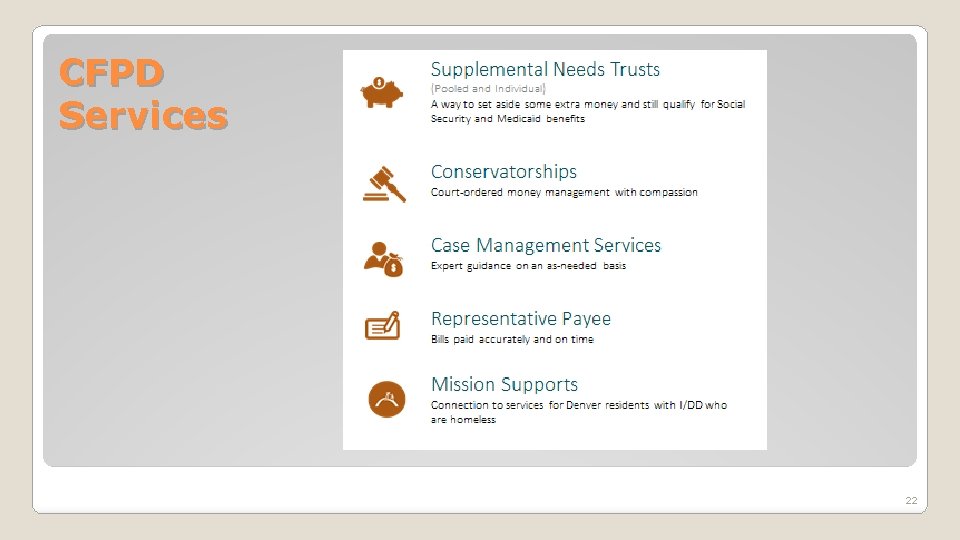
CFPD Services 22
Megan Brand Executive Director Colorado Fund for People with Disabilities 1355 S Colorado Blvd, Ste 920 Denver, CO 80222 303 -476 -6315 mbrand@cfpdtrust. org www. cfpdtrust. org 23
- Slides: 23