Lecture Notes FINANCIAL ENGINEERING Money Time Relationships And
- Slides: 9
Lecture Notes FINANCIAL ENGINEERING Money Time Relationships And Equivalence
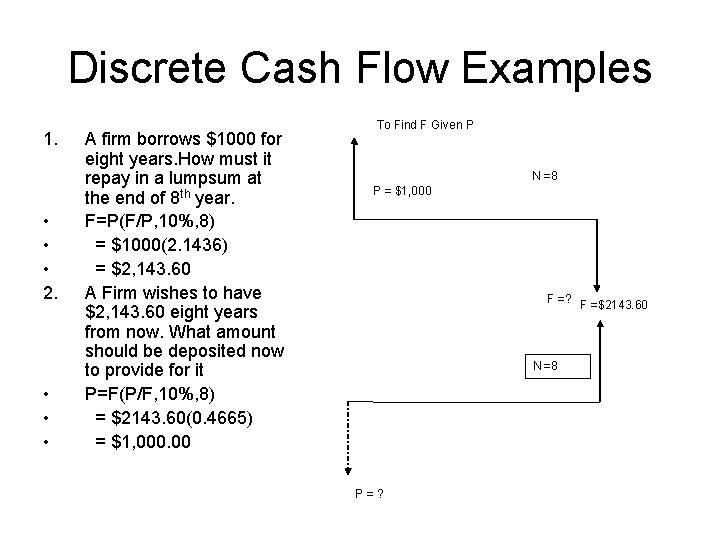
Discrete Cash Flow Examples 1. • • • 2. • • • A firm borrows $1000 for eight years. How must it repay in a lumpsum at the end of 8 th year. F=P(F/P, 10%, 8) = $1000(2. 1436) = $2, 143. 60 A Firm wishes to have $2, 143. 60 eight years from now. What amount should be deposited now to provide for it P=F(P/F, 10%, 8) = $2143. 60(0. 4665) = $1, 000. 00 To Find F Given P N =8 P = $1, 000 F =? F =$2143. 60 N =8 P=?
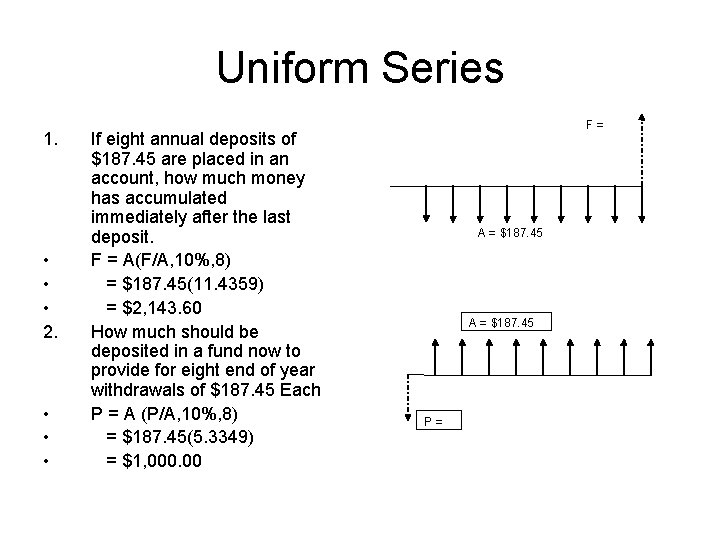
Uniform Series 1. • • • 2. • • • If eight annual deposits of $187. 45 are placed in an account, how much money has accumulated immediately after the last deposit. F = A(F/A, 10%, 8) = $187. 45(11. 4359) = $2, 143. 60 How much should be deposited in a fund now to provide for eight end of year withdrawals of $187. 45 Each P = A (P/A, 10%, 8) = $187. 45(5. 3349) = $1, 000. 00 F= A = $187. 45 P=
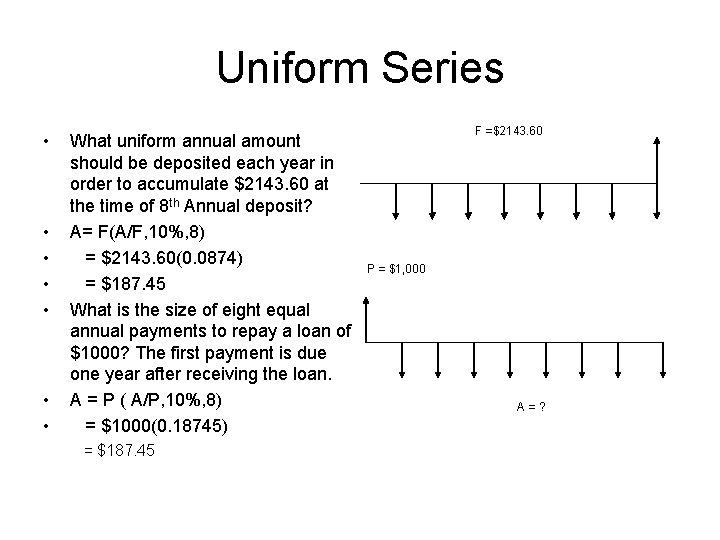
Uniform Series • • What uniform annual amount should be deposited each year in order to accumulate $2143. 60 at the time of 8 th Annual deposit? A= F(A/F, 10%, 8) = $2143. 60(0. 0874) = $187. 45 What is the size of eight equal annual payments to repay a loan of $1000? The first payment is due one year after receiving the loan. A = P ( A/P, 10%, 8) = $1000(0. 18745) = $187. 45 F =$2143. 60 P = $1, 000 A=?
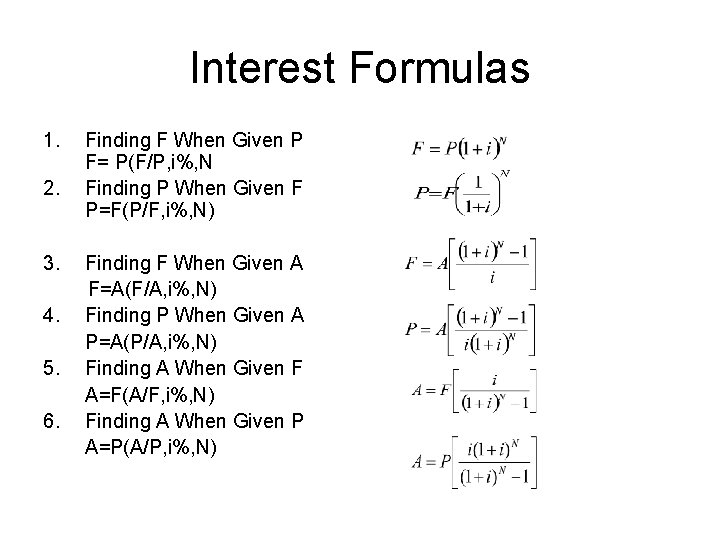
Interest Formulas 1. 2. 3. 4. 5. 6. Finding F When Given P F= P(F/P, i%, N Finding P When Given F P=F(P/F, i%, N) Finding F When Given A F=A(F/A, i%, N) Finding P When Given A P=A(P/A, i%, N) Finding A When Given F A=F(A/F, i%, N) Finding A When Given P A=P(A/P, i%, N)
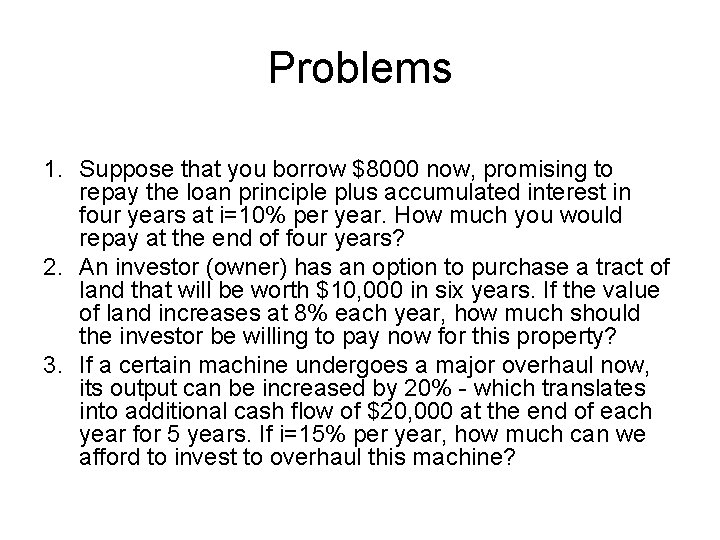
Problems 1. Suppose that you borrow $8000 now, promising to repay the loan principle plus accumulated interest in four years at i=10% per year. How much you would repay at the end of four years? 2. An investor (owner) has an option to purchase a tract of land that will be worth $10, 000 in six years. If the value of land increases at 8% each year, how much should the investor be willing to pay now for this property? 3. If a certain machine undergoes a major overhaul now, its output can be increased by 20% - which translates into additional cash flow of $20, 000 at the end of each year for 5 years. If i=15% per year, how much can we afford to invest to overhaul this machine?
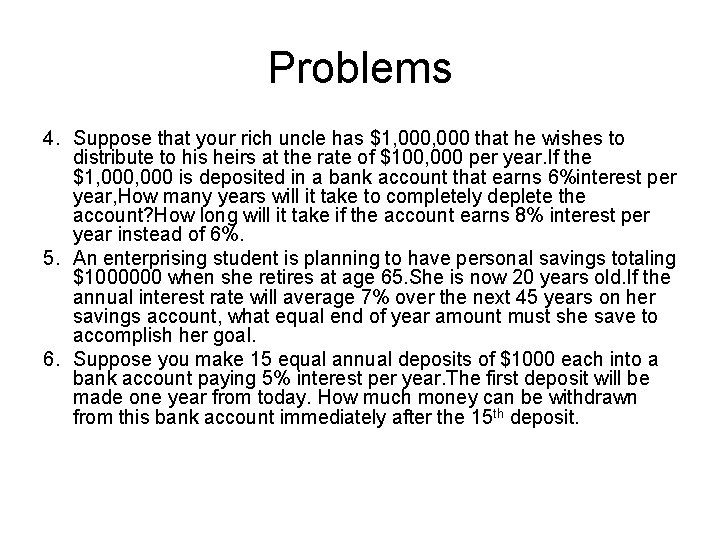
Problems 4. Suppose that your rich uncle has $1, 000 that he wishes to distribute to his heirs at the rate of $100, 000 per year. If the $1, 000 is deposited in a bank account that earns 6%interest per year, How many years will it take to completely deplete the account? How long will it take if the account earns 8% interest per year instead of 6%. 5. An enterprising student is planning to have personal savings totaling $1000000 when she retires at age 65. She is now 20 years old. If the annual interest rate will average 7% over the next 45 years on her savings account, what equal end of year amount must she save to accomplish her goal. 6. Suppose you make 15 equal annual deposits of $1000 each into a bank account paying 5% interest per year. The first deposit will be made one year from today. How much money can be withdrawn from this bank account immediately after the 15 th deposit.
Nominal and Effective Interest Rates • The Interest period or time between successive compounding is less than one year. • For example, if the interest is 6% per interest period and the interest period is six months, it is customary to speak of this rate as 12% compounded semiannually. Here the annual rate of interest is known as the nominal rate 12%. • The nominal interest rate is represented by r. • The actual annual rate on the principle is not 12% but something greater, because compounding occurs twice during the year. • The relationship between effective interest i and nominal interest rate, r is • i= (1+r/M)M -1
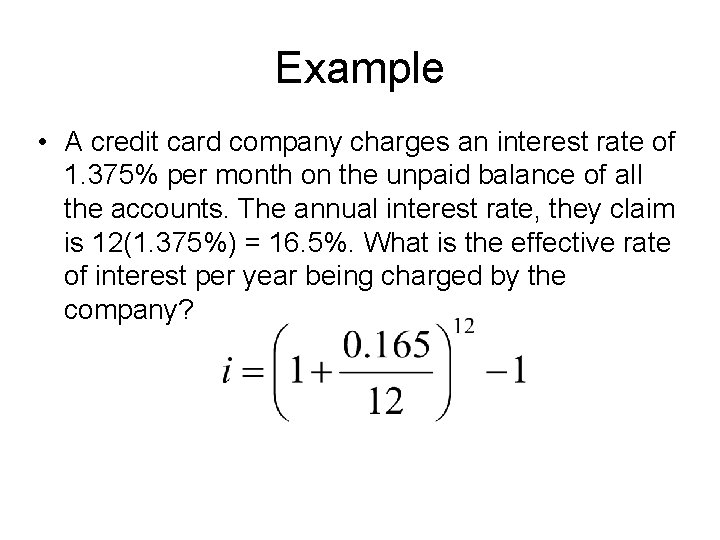
Example • A credit card company charges an interest rate of 1. 375% per month on the unpaid balance of all the accounts. The annual interest rate, they claim is 12(1. 375%) = 16. 5%. What is the effective rate of interest per year being charged by the company?