
Chapter 53 Decedents Estates and Trusts Twomey Business
Chapter 53 Decedents’ Estates and Trusts Twomey, Business Law and the Regulatory Environment (14 th Ed. ) (c) 2000 West Legal Studies Chapter 53
Will Terminology [53 -1] TESTATOR/TESTATRIX: Maker of the will LEGATEE: Person to whom personal property is left DEVISEE: Person to whom real property is left WILL: Document used to transfer property at death CODICIL: Addition to will HOLOGRAPHIC WILL: Handwritten will LIVING WILL: Document that covers wishes regarding life-sustaining medical treatment (c) 2000 West Legal Studies Chapter 53 2
Estate Terminology [53 -2] EXECUTOR/EXECUTRIX: Person named in a will to administer an estate ADMINISTRATOR/ADMINISTRATIX: Person administering an intestate PERSONAL REPRESENTATIVE: Name for party administering any estate under the UPC PROBATE: Act of a court in declaring a will valid WILL CONTEST: Challenge to validity of a will (c) 2000 West Legal Studies Chapter 53 3
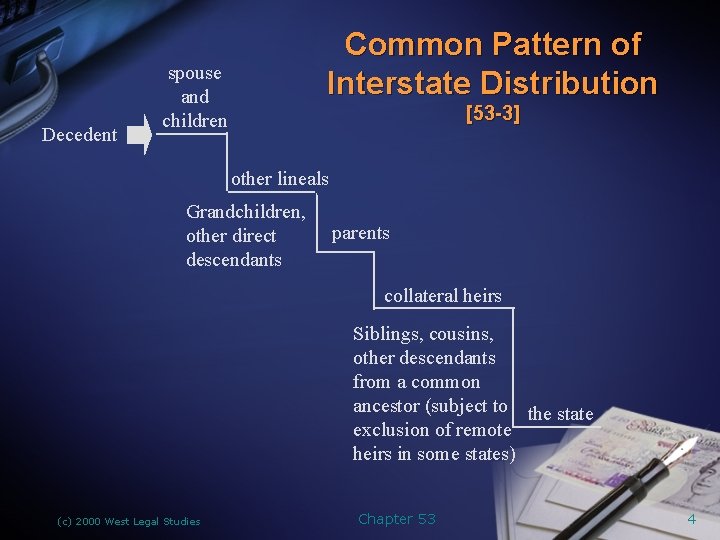
Decedent Common Pattern of Interstate Distribution spouse and children [53 -3] other lineals Grandchildren, other direct descendants parents collateral heirs Siblings, cousins, other descendants from a common ancestor (subject to the state exclusion of remote heirs in some states) (c) 2000 West Legal Studies Chapter 53 4
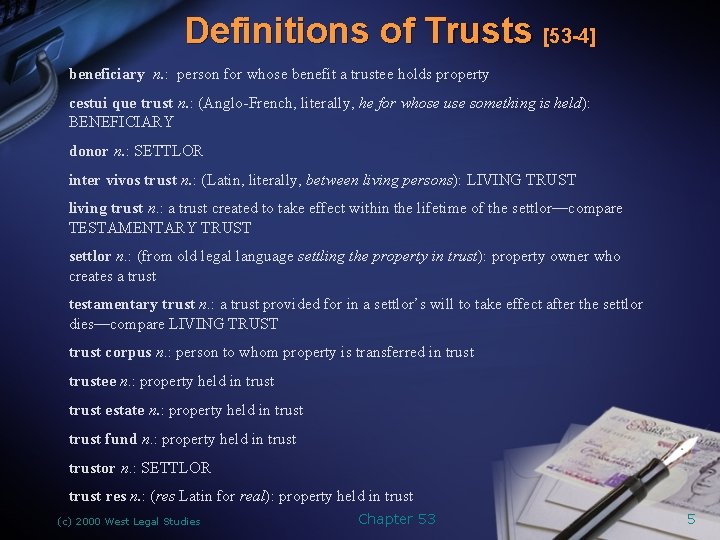
Definitions of Trusts [53 -4] beneficiary n. : person for whose benefit a trustee holds property cestui que trust n. : (Anglo-French, literally, he for whose use something is held): BENEFICIARY donor n. : SETTLOR inter vivos trust n. : (Latin, literally, between living persons): LIVING TRUST living trust n. : a trust created to take effect within the lifetime of the settlor—compare TESTAMENTARY TRUST settlor n. : (from old legal language settling the property in trust): property owner who creates a trust testamentary trust n. : a trust provided for in a settlor’s will to take effect after the settlor dies—compare LIVING TRUST trust corpus n. : person to whom property is transferred in trustee n. : property held in trust estate n. : property held in trust fund n. : property held in trustor n. : SETTLOR trust res n. : (res Latin for real): property held in trust (c) 2000 West Legal Studies Chapter 53 5
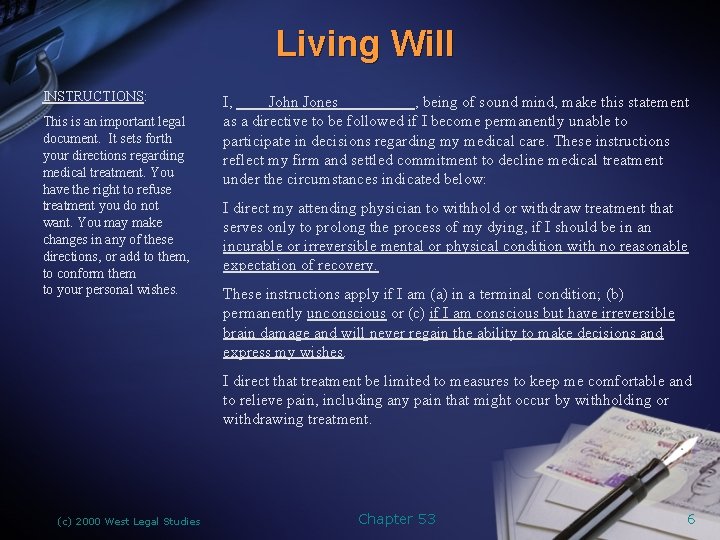
Living Will INSTRUCTIONS: This is an important legal document. It sets forth your directions regarding medical treatment. You have the right to refuse treatment you do not want. You may make changes in any of these directions, or add to them, to conform them to your personal wishes. I, John Jones , being of sound mind, make this statement as a directive to be followed if I become permanently unable to participate in decisions regarding my medical care. These instructions reflect my firm and settled commitment to decline medical treatment under the circumstances indicated below: I direct my attending physician to withhold or withdraw treatment that serves only to prolong the process of my dying, if I should be in an incurable or irreversible mental or physical condition with no reasonable expectation of recovery. These instructions apply if I am (a) in a terminal condition; (b) permanently unconscious or (c) if I am conscious but have irreversible brain damage and will never regain the ability to make decisions and express my wishes. I direct that treatment be limited to measures to keep me comfortable and to relieve pain, including any pain that might occur by withholding or withdrawing treatment. (c) 2000 West Legal Studies Chapter 53 6
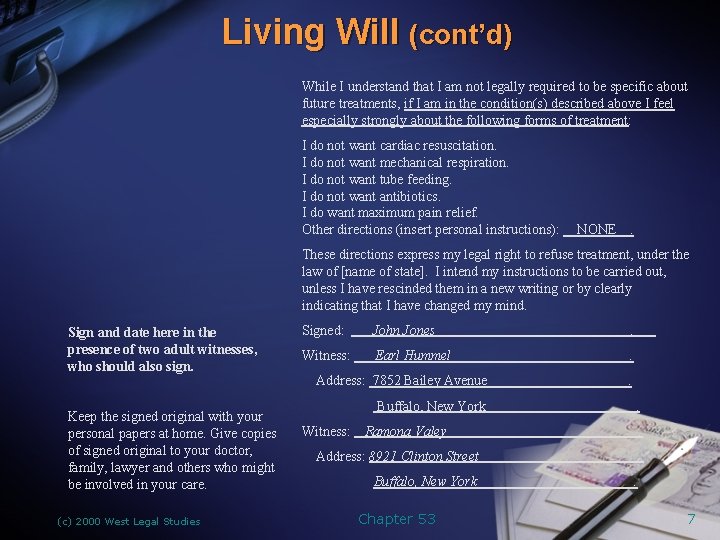
Living Will (cont’d) While I understand that I am not legally required to be specific about future treatments, if I am in the condition(s) described above I feel especially strongly about the following forms of treatment: I do not want cardiac resuscitation. I do not want mechanical respiration. I do not want tube feeding. I do not want antibiotics. I do want maximum pain relief. Other directions (insert personal instructions): NONE . These directions express my legal right to refuse treatment, under the law of [name of state]. I intend my instructions to be carried out, unless I have rescinded them in a new writing or by clearly indicating that I have changed my mind. Sign and date here in the presence of two adult witnesses, who should also sign. Keep the signed original with your personal papers at home. Give copies of signed original to your doctor, family, lawyer and others who might be involved in your care. (c) 2000 West Legal Studies Signed: John Jones . Witness: Earl Hummel . Address: 7852 Bailey Avenue Buffalo, New York Witness: . . Ramona Valey . Address: 8921 Clinton Street Buffalo, New York Chapter 53 . . 7
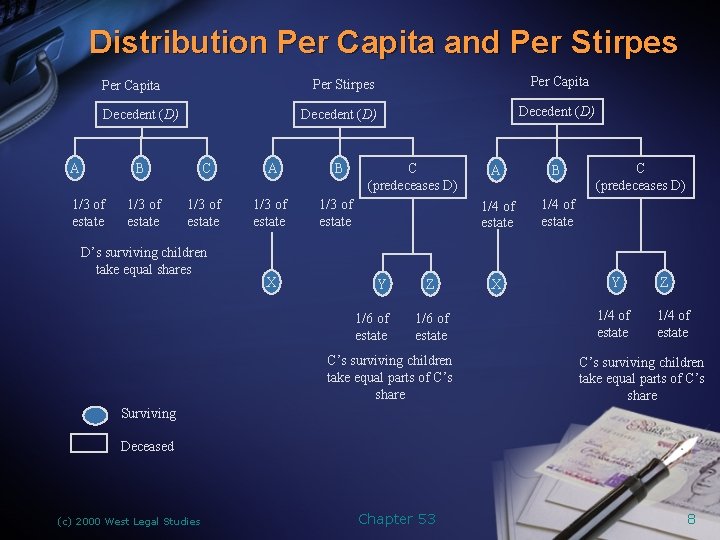
Distribution Per Capita and Per Stirpes Decedent (D) A 1/3 of estate Per Capita Per Stirpes Per Capita Decedent (D) B C A B 1/3 of estate D’s surviving children take equal shares X C (predeceases D) Y 1/6 of estate Z 1/6 of estate C’s surviving children take equal parts of C’s share A B 1/4 of estate X C (predeceases D) Y 1/4 of estate Z 1/4 of estate C’s surviving children take equal parts of C’s share Surviving Deceased (c) 2000 West Legal Studies Chapter 53 8
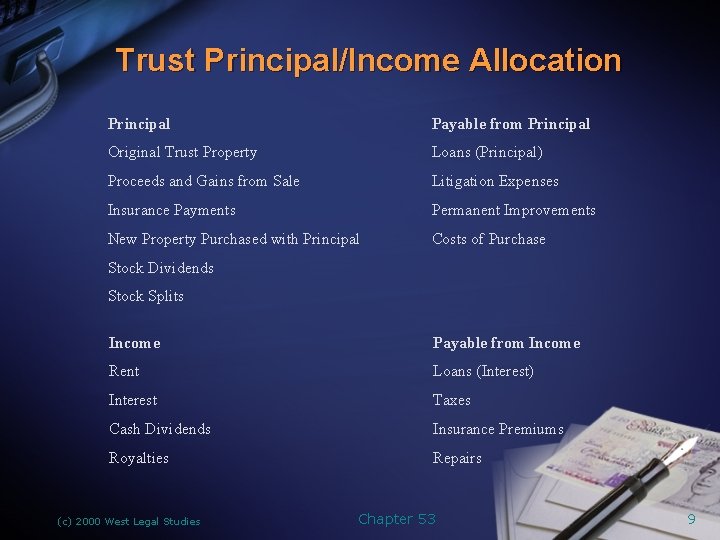
Trust Principal/Income Allocation Principal Payable from Principal Original Trust Property Loans (Principal) Proceeds and Gains from Sale Litigation Expenses Insurance Payments Permanent Improvements New Property Purchased with Principal Costs of Purchase Stock Dividends Stock Splits Income Payable from Income Rent Loans (Interest) Interest Taxes Cash Dividends Insurance Premiums Royalties Repairs (c) 2000 West Legal Studies Chapter 53 9
Chapter 53 Summary A will is a writing that provides for a disposition of property to take effect upon death. A man who makes a will is called a testator; a woman, a testatrix. The person to whom property is left by will is a beneficiary. A legacy is a gift of personal property by will; a gift of real property by will is a devise. (c) 2000 West Legal Studies Chapter 53 10
Chapter 53 Summary [2] A testator must have testamentary capacity to make a will and must manifest some intention that the will is to be effective only upon death. The will must be signed by the testator and be witnessed. A will may be modified by a codicil or revoked either by the act of the testator or by operation of law. (c) 2000 West Legal Studies Chapter 53 11
Chapter 53 Summary [3] Probate is the process by which a proper court official accepts a will. Probate may be refused or set aside on grounds that the will is not the free expression of the testator. A holographic will is an unwitnessed will written entirely in the handwriting of the testator. A self-proved will may be admitted to probate without the testimony of subscribing witnesses. A living will allows a person to make wishes known regarding life -sustaining medical treatment. (c) 2000 West Legal Studies Chapter 53 12
Chapter 53 Summary [4] If there is a valid will, the last phase of administration of the estate is the distribution of property after the payment of all debts and taxes. General legacies are bequests of money, whereas specific legacies or specific devises are gifts of identified personal or real property. Legacies abate in the following order: residuary, general, and specific. (c) 2000 West Legal Studies Chapter 53 13
Chapter 53 Summary [5] If a beneficiary named in the will has died before the testator and no alternate provision has been made for such beneficiary, antilapse statutes provide that the gift will not lapse. In that event, the children or heirs of the beneficiary may take the legacy in the place of the deceased beneficiary. (c) 2000 West Legal Studies Chapter 53 14
Chapter 53 Summary [6] If the decedent does not dispose of all property by will or does not have a will, the property will be distributed according to state intestacy statutes. A surviving spouse may generally elect to take the statutory allocation instead of that provided in the will. (c) 2000 West Legal Studies Chapter 53 15
Chapter 53 Summary [7] The estate of the testator will be administered by the person appointed in the will (the executor) or, if there is no will, by a person appointed by the court (an administrator). Creditors who have claims against the estate are required to give notice of their claims to the personal representative; otherwise, the claims will be barred. (c) 2000 West Legal Studies Chapter 53 16
Chapter 53 Summary [8] A trust is a legal device by which property is held by one person for the benefit of another. The settlor creates the trust, and the person for whose benefit the trustee holds the property is the beneficiary. Property held in trust is called the trust corpus, trust fund, trust estate, or trust res. (c) 2000 West Legal Studies Chapter 53 17
Chapter 53 Summary [9] A trust is usually created by a writing called a trust agreement or deed of trust. No particular form or language is required. A trust is not created unless an active duty is placed on the trustee to manage the property in some manner. A trustee’s acceptance of duties is presumed. (c) 2000 West Legal Studies Chapter 53 18
Chapter 53 Summary [10] Legal title to trust property is given to the trustee, but equitable title is held by the beneficiary. A beneficiary may transfer an interest in the trust except in the case of a spendthrift trust. (c) 2000 West Legal Studies Chapter 53 19
Chapter 53 Summary [11] The trustee can exercise only those powers that are given by law or the trust instrument. The trustee must administer the trust and carry out the trust in a proper manner. A trustee may be sued for breach of the terms of the trust agreement. A trust comes to an end when its terms so provide or when it becomes impossible to attain the object of the trust. (c) 2000 West Legal Studies Chapter 53 20
- Slides: 20