
Fraud Examination 4 E Chapter 11 Financial Statement


- Slides: 24
Fraud Examination, 4 E Chapter 11: Financial Statement Fraud Albrecht, Zimbelman
Learning Objectives q Discuss the role that financial statements play in capital markets. q Understand the nature of financial statement fraud. q Become familiar with financial statement fraud statistics. q See how financial statement frauds occur and are concealed. q Outline the framework for detecting financial statement fraud. Albrecht, Zimbelman © 2011 Cengage Learning. All Rights Reserved. May not be copied, scanned, or duplicated, in whole or in part, except for use as permitted in a license
Learning Objectives q Identify financial statement fraud exposures. q Explain how information regarding a company’s management and directors, nature of organization, operating characteristics, relationship with others, and financial results can help assess the likelihood of financial statement fraud. Albrecht, Zimbelman © 2011 Cengage Learning. All Rights Reserved. May not be copied, scanned, or duplicated, in whole or in part, except for use as permitted in a license
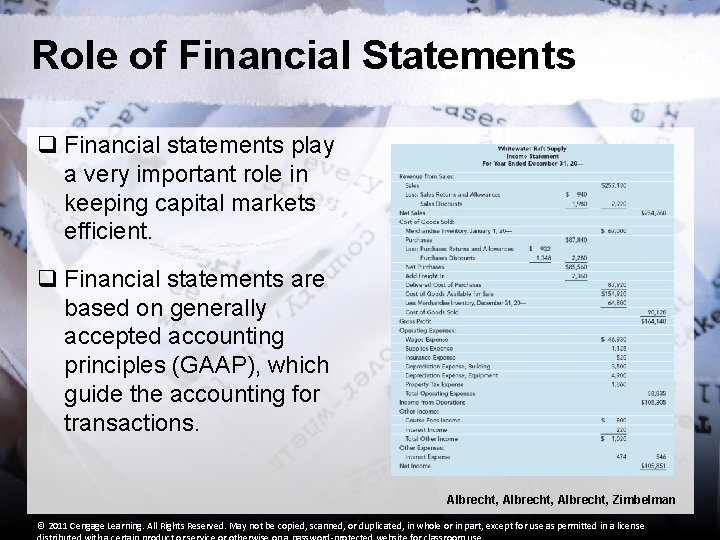
Role of Financial Statements q Financial statements play a very important role in keeping capital markets efficient. q Financial statements are based on generally accepted accounting principles (GAAP), which guide the accounting for transactions. Albrecht, Zimbelman © 2011 Cengage Learning. All Rights Reserved. May not be copied, scanned, or duplicated, in whole or in part, except for use as permitted in a license
Financial Statement Fraud q Financial statements are sometimes prepared in ways that intentionally misstate the financial position and performance of an organization. q Misstatement of financial statements can result from manipulating, falsifying, or altering accounting records. q Misleading financial statements cause serious problems in the market and the economy. Albrecht, Zimbelman © 2011 Cengage Learning. All Rights Reserved. May not be copied, scanned, or duplicated, in whole or in part, except for use as permitted in a license
Financial Statement Fraud q Misleading financial statements cause serious problems: § large losses by investors § lack of trust in the market and accounting systems § litigation and embarrassment for individuals and organizations associated with financial statement fraud Albrecht, Zimbelman © 2011 Cengage Learning. All Rights Reserved. May not be copied, scanned, or duplicated, in whole or in part, except for use as permitted in a license
Examples of Financial Statement Fraud q Misstated financial statements and “cooking the books. ” § Examples: § Qwest § Enron § Global Crossing § World. Com § Xerox Albrecht, Zimbelman © 2011 Cengage Learning. All Rights Reserved. May not be copied, scanned, or duplicated, in whole or in part, except for use as permitted in a license
Examples of Financial Statement Fraud q Inappropriate executive loans and corporate looting. § Examples: § John Rigas (Adelphia) § Dennis Kozlowski (Tyco) § Bernie Ebbers (World. Com) Albrecht, Zimbelman © 2011 Cengage Learning. All Rights Reserved. May not be copied, scanned, or duplicated, in whole or in part, except for use as permitted in a license
Examples of Financial Statement Fraud q Insider trading scandals § Example: § Martha Stewart and Sam Waksal, both used insider information to profit from trading Im. Clone stock Albrecht, Zimbelman © 2011 Cengage Learning. All Rights Reserved. May not be copied, scanned, or duplicated, in whole or in part, except for use as permitted in a license
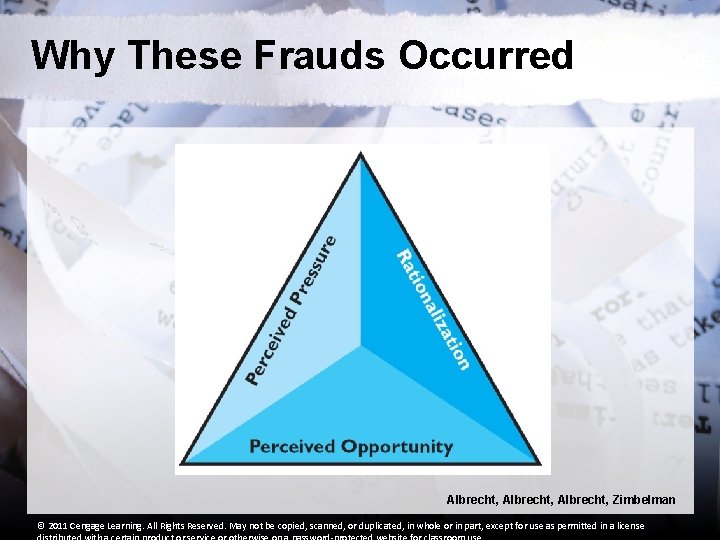
Why These Frauds Occurred Albrecht, Zimbelman © 2011 Cengage Learning. All Rights Reserved. May not be copied, scanned, or duplicated, in whole or in part, except for use as permitted in a license
Elements of the Perfect Fraud Storm q A Booming Economy q Decay of Moral Values q Misplaced Incentives q High Analysts’ Expectations q High Debt Levels q Focus on Accounting Rules Rather Than Principles q Lack of Auditor Independence q Greed q Educator Failures Albrecht, Zimbelman © 2011 Cengage Learning. All Rights Reserved. May not be copied, scanned, or duplicated, in whole or in part, except for use as permitted in a license
Nature of Financial Statement Fraud q Involves intentional deceit q Involves attempted concealment q Rarely seen q Many false red flags q Conviction is very difficult Because of the difficulty of detecting and proving fraud , investigators must exercise extreme care when performing fraud examinations, quantifying fraud, or performing other types of fraud-related engagements. Albrecht, Zimbelman © 2011 Cengage Learning. All Rights Reserved. May not be copied, scanned, or duplicated, in whole or in part, except for use as permitted in a license
Fraud Statistics (Between 1987 – 1997) q The average fraud last about two years q Improper revenue recognition, overstatement of assets, and understatement of expenses were the most common frauds q Cumulative average magnitude of fraud was $25 million ($4. 1 million median) q CEO perpetrated the fraud in 72 percent of the cases Albrecht, Zimbelman © 2011 Cengage Learning. All Rights Reserved. May not be copied, scanned, or duplicated, in whole or in part, except for use as permitted in a license
Fraud Statistics (Between 1987 – 1997) q Fraudulent companies’ size: Average assets were $532 million ($16 million median) and $232 million average revenues ($13 million median) q Severe consequences were usually associated with companies having fraudulent financial statements q Most of these firms had no audit committee, or one that met only once per year Albrecht, Zimbelman © 2011 Cengage Learning. All Rights Reserved. May not be copied, scanned, or duplicated, in whole or in part, except for use as permitted in a license
Fraud Statistics (Between 1987 – 1997) q Boards of directors were dominated by insiders and “grey” directors q Some companies were experiencing net losses or were close to break-even positions q 25% of the companies changed auditors during the fraud period Albrecht, Zimbelman © 2011 Cengage Learning. All Rights Reserved. May not be copied, scanned, or duplicated, in whole or in part, except for use as permitted in a license
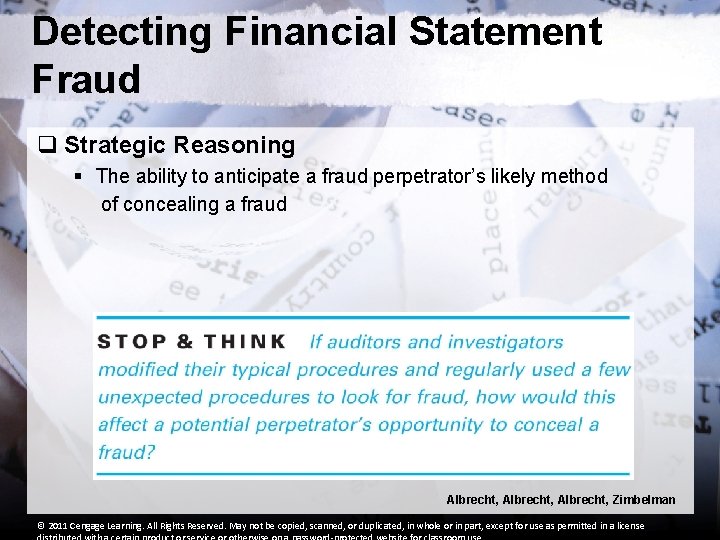
Detecting Financial Statement Fraud q Strategic Reasoning § The ability to anticipate a fraud perpetrator’s likely method of concealing a fraud Albrecht, Zimbelman © 2011 Cengage Learning. All Rights Reserved. May not be copied, scanned, or duplicated, in whole or in part, except for use as permitted in a license
Detecting Financial Statement Fraud Strategic Reasoning Questions to ask: § What types of fraud schemes is management likely to use to commit financial statement fraud? § What typical tests are used to detect these schemes? § How could management conceal the scheme of interest from the typical test? § How could the typical test be modified so as to detect the concealed scheme? Albrecht, Zimbelman © 2011 Cengage Learning. All Rights Reserved. May not be copied, scanned, or duplicated, in whole or in part, except for use as permitted in a license
Detecting Financial Statement Fraud q Financial Statement Analysis § Focus on the changes in reported assets, liabilities, § revenues, and expenses from period to period or by § comparing company performance to industry norms. Not just general financial statement analysis – think outside the box…… Albrecht, Zimbelman © 2011 Cengage Learning. All Rights Reserved. May not be copied, scanned, or duplicated, in whole or in part, except for use as permitted in a license
Detecting Financial Statement Fraud q Nonfinancial Performance Measures § Look for a discrepancy between the company’s financial and nonfinancial performance q Example: § Former Health. South CEO Richard Scrushy’s § The company’s revenues and assets were increasing while the number of Health. South facilities decreased Albrecht, Zimbelman © 2011 Cengage Learning. All Rights Reserved. May not be copied, scanned, or duplicated, in whole or in part, except for use as permitted in a license
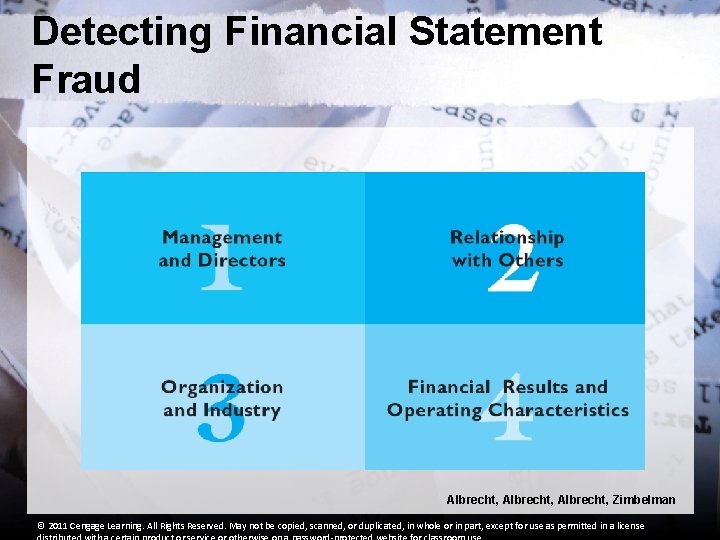
Detecting Financial Statement Fraud Albrecht, Zimbelman © 2011 Cengage Learning. All Rights Reserved. May not be copied, scanned, or duplicated, in whole or in part, except for use as permitted in a license
Management and Directors q Investigate three aspects of management: § Managements’ backgrounds § Managements’ motivations § Managements’ influence in making decisions for the organization Albrecht, Zimbelman © 2011 Cengage Learning. All Rights Reserved. May not be copied, scanned, or duplicated, in whole or in part, except for use as permitted in a license
Relationship with Others q Relationships should be examined to determine if they present management fraud opportunities or exposures. q Carefully consider relationships with: § related organizations and individuals § external auditors § lawyers § Investors § regulators § bondholders Albrecht, Zimbelman © 2011 Cengage Learning. All Rights Reserved. May not be copied, scanned, or duplicated, in whole or in part, except for use as permitted in a license
Organization and Industry q Some industries are more risky than others. q Attributes of fraud-prone organizations: § unduly complex organizational structure § without an internal audit department § board of directors with no or few outsiders on the board or audit committee § one person or a small group of individuals controls related entities § has offshore affiliates with no apparent business purpose Albrecht, Zimbelman © 2011 Cengage Learning. All Rights Reserved. May not be copied, scanned, or duplicated, in whole or in part, except for use as permitted in a license
Financial Results and Operations q Critical questions that must be asked: § Are unrealistic changes or increases present in financial statement account balances? § Are account balances are not realistic given the nature, age, and size of the company? § Do actual physical assets do not exist in the amounts and values indicated on the financial statements? § Have there been significant changes in the nature of the organization’s revenues or expenses? Albrecht, Zimbelman © 2011 Cengage Learning. All Rights Reserved. May not be copied, scanned, or duplicated, in whole or in part, except for use as permitted in a license