2 1 TROLLEYLORRYDOLLY WORKING Working of Push Trolley



- Slides: 82
2 1 TROLLEY/LORRY/DOLLY WORKING. Working of Push Trolley, Lorry & motor Trolley, Rail dolly, Competency Certificate.
Rules for working trollies, motor trollies and lorries The Rules for working trollies, motor trollies and lorries are contained in Para 15. 18 to Para 15. 28 of Chapter XV-B of General Rules for Indian Railways (1976), supplemented by the Subsidiary Rules issued by individual railways. The instructions contained in this chapter are in amplification of these rules and will not supersede the general and subsidiary rules of Railways.
Officials permitted to use these vehicles Trolleys/Lorries-- officers & JEs/SSEs of Engineering department. Mates, head trolley man as may be authorized. Motor Trollies--all officers of Engg. Dept. , motor trolley drivers & such JEs/SSEs as may be authorized.
General rules Official in-charge at all times responsible for its safe working. When more than one person holding competency certificate travels in a trolley, the official-in-charge of the trolley is responsible for its safe working. Every precaution & protection taken against accident.
General rules While entering tunnel or cutting, proceeding over long bridges or curve , make sure that no train is likely to be met. While approaching a level crossing the official -in-charge, should look out for road traffic and ensure safe passage of his vehicle over the level crossing.
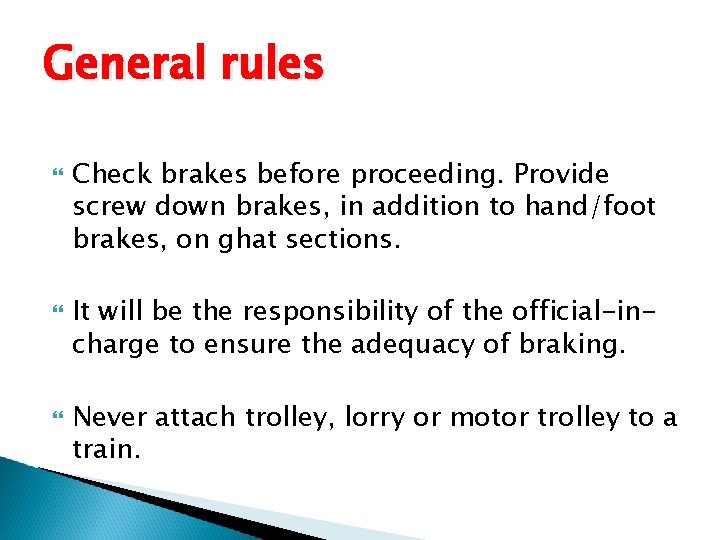
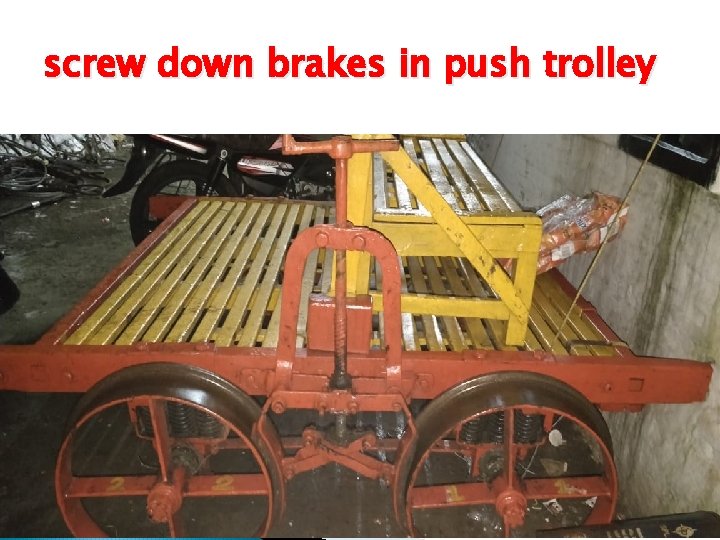
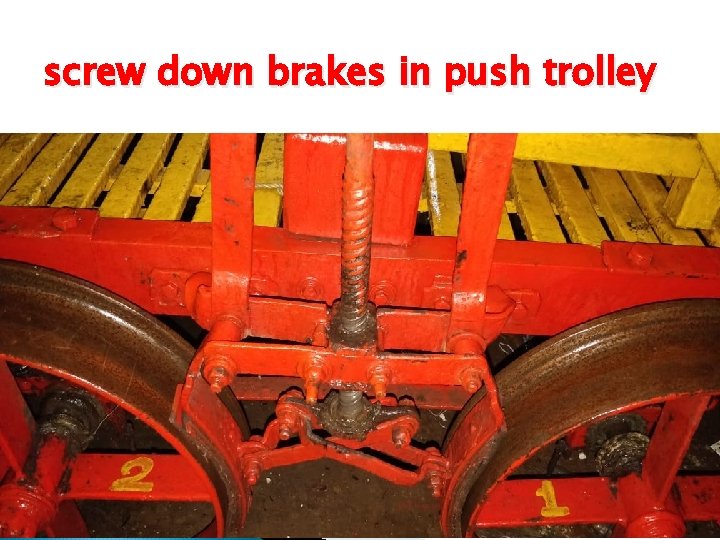
General rules Check brakes before proceeding. Provide screw down brakes, in addition to hand/foot brakes, on ghat sections. It will be the responsibility of the official-incharge to ensure the adequacy of braking. Never attach trolley, lorry or motor trolley to a train.
screw down brakes in push trolley
screw down brakes in push trolley
General rules Do not load in a train without the consent of guard in-charge of the train, who will direct where it is to be placed. In the case of an accident/emergency, Trollies / Motor Trollies may be carried by Mail / Express trains on which there are restrictions normally for loading of Trolley/Motor Trolley.
General rules Ø When loading a motor trolley with petrol in the tank, it shall be ensured that v The flow of petrol in the carburetor has been cut off v Any pressure has been released from the tanks v The tank is in sound condition and closed by a well fitted cap v The engine has been run by the official- incharge until the carburetor has become exhausted and the engine stops automatically.
General rules A trolley, motor trolley or lorry, when not in use shall be placed clear of the line, and wheels thereof secured with a chain and padlock. Whenever possible, motor trollies, should be placed in a shed, the key of which, shall be in the possession of the official-in-charge.
General rules When a trolley/motor trolley is placed on a platform to be loaded into a train, it should be under the charge of a Trolleymen and placed where it will not be in the way of passengers or working staff.
General rules Numbering of Trollies/Motor Trollies/ Lorries Each Trolley/Motor Trolley and Lorry shall be marked with its number, code, initials of the department, the designation and headquarters of the official-in-charge.
General rules Working on Track Circuited Sections and Sections Provided with Axle counters Each Railway shall issue subsidiary rules for the working of Trollies/Motor Trollies/Lorries in sections where axle counters or track circuits form part of the Block instruments or where automatic signaling has been provided.
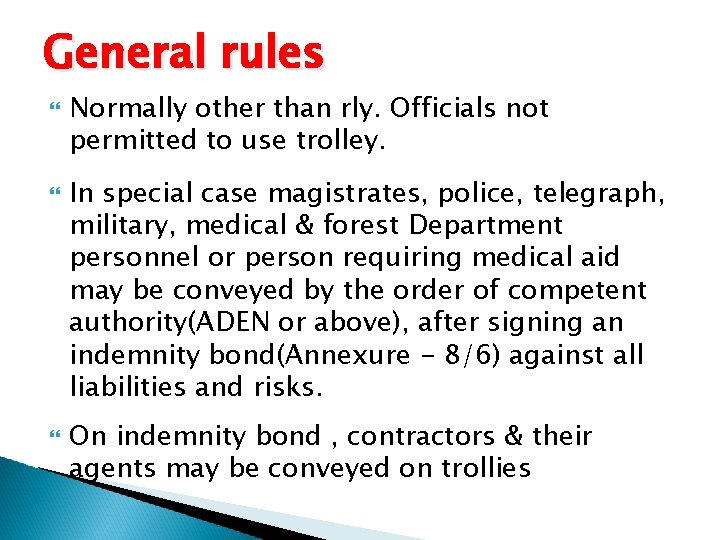
General rules Normally other than rly. Officials not permitted to use trolley. In special case magistrates, police, telegraph, military, medical & forest Department personnel or person requiring medical aid may be conveyed by the order of competent authority(ADEN or above), after signing an indemnity bond(Annexure - 8/6) against all liabilities and risks. On indemnity bond , contractors & their agents may be conveyed on trollies
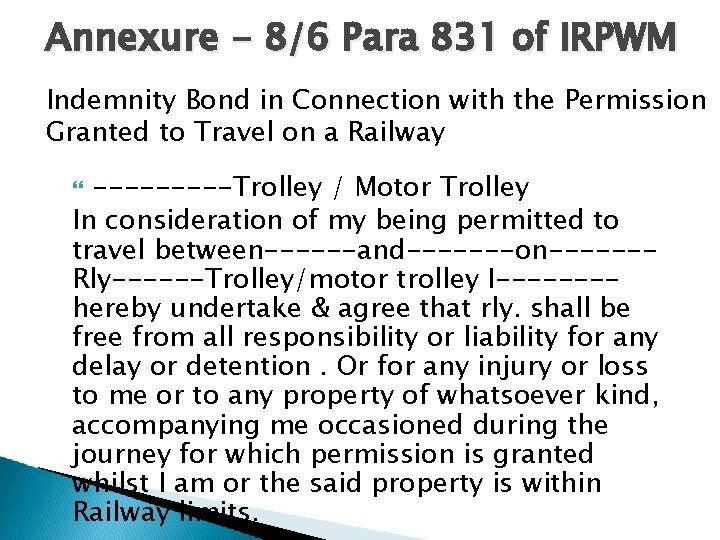
Annexure - 8/6 Para 831 of IRPWM Indemnity Bond in Connection with the Permission Granted to Travel on a Railway -----Trolley / Motor Trolley In consideration of my being permitted to travel between------and-------on------Rly------Trolley/motor trolley I-------hereby undertake & agree that rly. shall be free from all responsibility or liability for any delay or detention. Or for any injury or loss to me or to any property of whatsoever kind, accompanying me occasioned during the journey for which permission is granted whilst I am or the said property is within Railway limits.
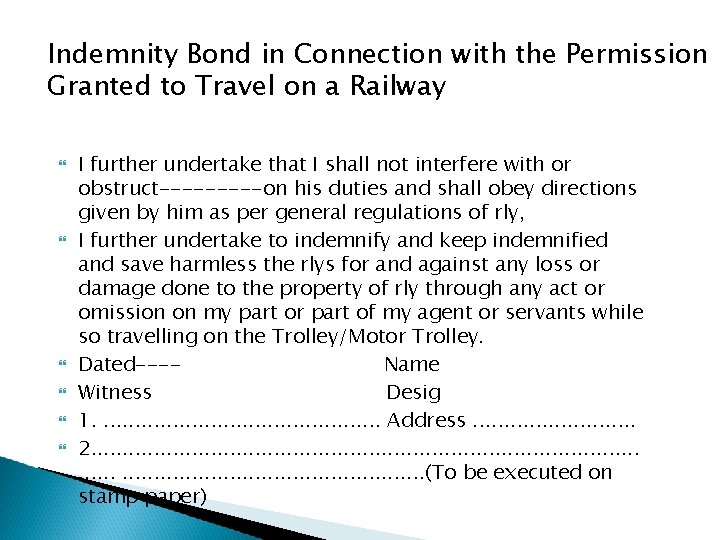
Indemnity Bond in Connection with the Permission Granted to Travel on a Railway I further undertake that I shall not interfere with or obstruct-----on his duties and shall obey directions given by him as per general regulations of rly, I further undertake to indemnify and keep indemnified and save harmless the rlys for and against any loss or damage done to the property of rly through any act or omission on my part or part of my agent or servants while so travelling on the Trolley/Motor Trolley. Dated---Name Witness Desig 1. . . Address. . . 2. . . . . . . . . (To be executed on stamp paper)
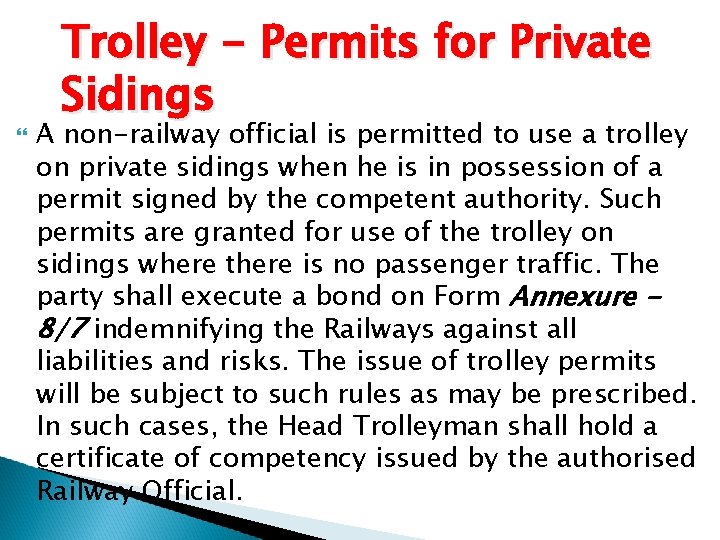
Trolley - Permits for Private Sidings A non-railway official is permitted to use a trolley on private sidings when he is in possession of a permit signed by the competent authority. Such permits are granted for use of the trolley on sidings where there is no passenger traffic. The party shall execute a bond on Form Annexure 8/7 indemnifying the Railways against all liabilities and risks. The issue of trolley permits will be subject to such rules as may be prescribed. In such cases, the Head Trolleyman shall hold a certificate of competency issued by the authorised Railway Official.
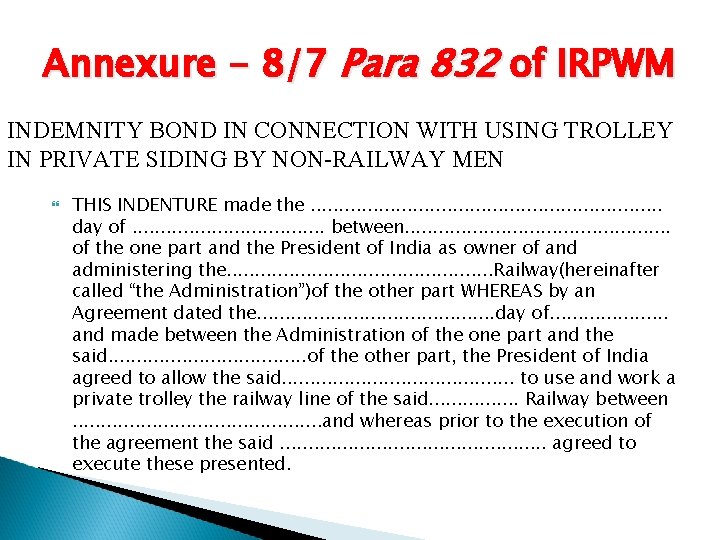
Annexure - 8/7 Para 832 of IRPWM INDEMNITY BOND IN CONNECTION WITH USING TROLLEY IN PRIVATE SIDING BY NON-RAILWAY MEN THIS INDENTURE made the. . . . day of. . . . between. . . of the one part and the President of India as owner of and administering the. . . Railway(hereinafter called “the Administration”)of the other part WHEREAS by an Agreement dated the. . . . . day of. . . . . and made between the Administration of the one part and the said. . . . . of the other part, the President of India agreed to allow the said. . . . . to use and work a private trolley the railway line of the said. . . . Railway between. . . and whereas prior to the execution of the agreement the said. . . agreed to execute these presented.
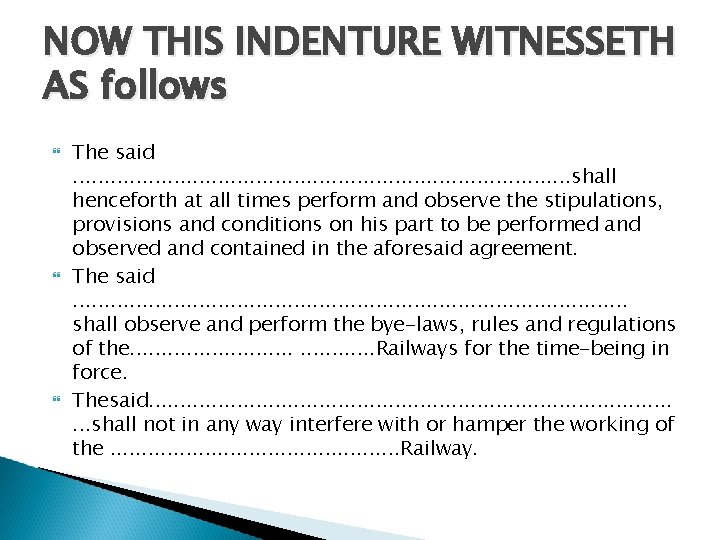
NOW THIS INDENTURE WITNESSETH AS follows The said. . . . . shall henceforth at all times perform and observe the stipulations, provisions and conditions on his part to be performed and observed and contained in the aforesaid agreement. The said. . . . . . shall observe and perform the bye-laws, rules and regulations of the. . . . . Railways for the time-being in force. Thesaid. . . . . . shall not in any way interfere with or hamper the working of the. . . Railway.
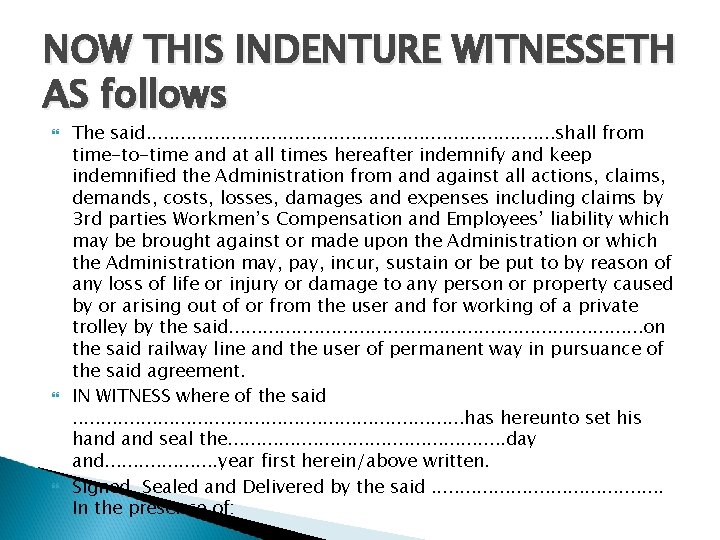
NOW THIS INDENTURE WITNESSETH AS follows The said. . . . . shall from time-to-time and at all times hereafter indemnify and keep indemnified the Administration from and against all actions, claims, demands, costs, losses, damages and expenses including claims by 3 rd parties Workmen’s Compensation and Employees’ liability which may be brought against or made upon the Administration or which the Administration may, pay, incur, sustain or be put to by reason of any loss of life or injury or damage to any person or property caused by or arising out of or from the user and for working of a private trolley by the said. . . . . on the said railway line and the user of permanent way in pursuance of the said agreement. IN WITNESS where of the said. . . . . has hereunto set his hand seal the. . . day and. . . . . year first herein/above written. Signed, Sealed and Delivered by the said. . . . . In the presence of:
Military Officers Using Trollies in Ordnance Depots Railway shall not accept any liability whatsoever for damage or compensation arising out of accidents caused in the working of trollies used by Military Officers on duty in Ordnance Factories in respect of claims of Officers themselves or third persons.
Signals for Trolley / Motor Trolley / Lorry– Day Signal– Every trolley, Motor trolley or Lorry when on the line shall show a red flag by day, fixed to a staff which will be placed on a socket and conspicuously visible in both directions.
Signals for Trolley / Motor Trolley / Lorry– Night Signal– On a double line the night signal shall be red light in the direction from which trains are expected and white in the other direction and on a single line, red in both directions. Where on double line, single line working is introduced, the night signal should be as per a single line. When working within the station limits, the light displayed at night shall be red in both directions.
Signals for Trolley / Motor Trolley / Lorry– Signals within long tunnels– v On sections where there are long and dark tunnels, the night signals prescribed must be displayed during the day in addition to the red flag, in the case of Trollies, Motor trollies and Lorries. In the case of thick foggy or tempestuous weather impairing visibility, light signals must be displayed in addition to the red flag.
Signals for Trolley / Motor Trolley / Lorry– Removal of Trolley/Motor trolley/Lorry– As soon as a Trolley/Motor trolley/Lorry is removed from the track and placed clear of it, the red flag or light signal shall be removed, but care should be taken to see that this signal is not taken off before the lines have been cleared of all the obstructions.
Working of trollies Always be manned by four men. Always be pushed & not pulled While doing trolly inspection minimum 4 trollymen must be available always In addition , when a location like cuttings , sharp curves, tunnels etc. comes, where visibility becomes poor , additional gangmen should be available to push trolly & trollymen utilised for protection.
Working of trollies The max number of persons including trollymen which can be carried on trolly must not exceed 10 On a plain section , where visibility is clear for 600 M or more, after ascertaining train position , trolly can be placed on line , displaying 2 red hand signals attached to trolly frame. Further additional protection if required, shall be arranged.
Trolley working without block protection Without block protection day time and section with normal visibility : Before placing trolley on line, ascertain train position.
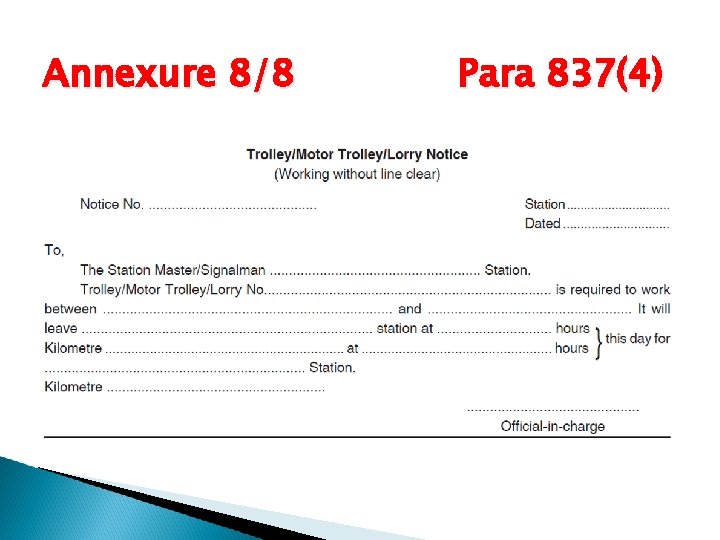
Trolley working without block protection If visibility is poor, & official unable to work under block protection, adopt following procedure. Official in charge of trolley on a prescribed format hands over trolley programme to SS, who returns a copy stating trains running on section.
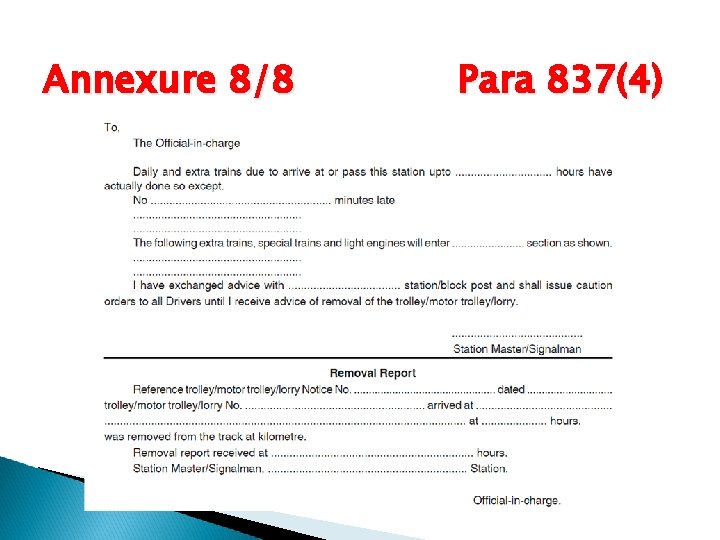
Trolley working without block protection SS puts a placard “ trolley on line” on his block instrument until advice of the removal of the trolley is received to remind him issue of caution order. Station Master/ Signalman at both ends of the block section shall issue caution orders to Drivers of all trains entering the block section till a message of trolley out of section is received
Trolley working without block protection On the double line, caution order should be issued for both up and down trains. Issue of caution order does not relieve official in charge of trolley for protection. On arrival, official would convey in writing the removal of trolley, so that, caution order is discontinued.
Trolley working without block protection For some work, if official removes trolley at the station not provided with telegraph or telephone instruments or in the block section, & does not intend to place again on line, he should convey in writing to SS, so that, caution is discontinued. SSs at both ends, make entry in train register. entering time of trolley & clearing time
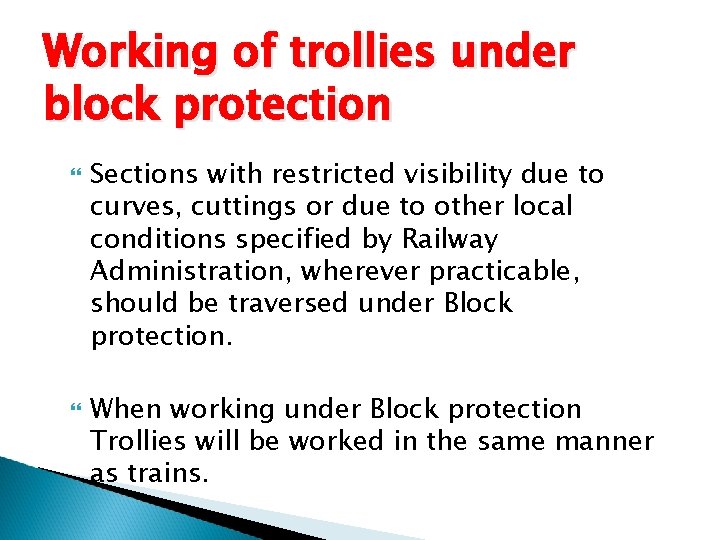
Working of trollies under block protection May be worked under block protection, without interference to train service. Should be worked under block protection in night. During daytime in foggy weather and during dust storm, when the visibility is poor, a Trolley should be worked under Block protection.
Working of trollies under block protection Sections with restricted visibility due to curves, cuttings or due to other local conditions specified by Railway Administration, wherever practicable, should be traversed under Block protection. When working under Block protection Trollies will be worked in the same manner as trains.
Annexure 8/8 Para 837(4)
Annexure 8/8 Para 837(4)
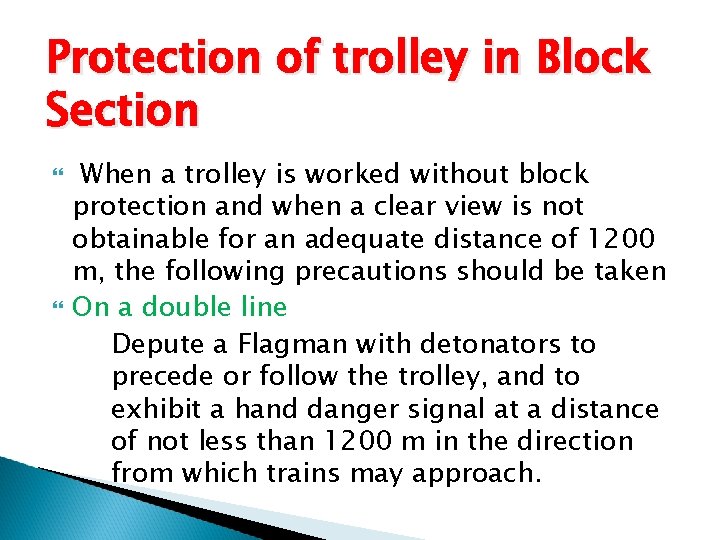
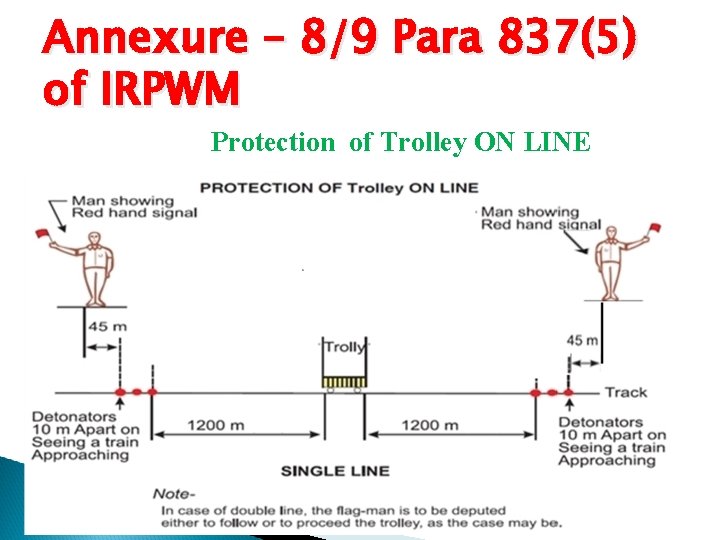
Protection of trolley in Block Section When a trolley is worked without block protection and when a clear view is not obtainable for an adequate distance of 1200 m, the following precautions should be taken On a double line Depute a Flagman with detonators to precede or follow the trolley, and to exhibit a hand danger signal at a distance of not less than 1200 m in the direction from which trains may approach.
Protection of trolley in Block Section On single line Depute a Flagman with detonators to precede and another to follow the trolley and to exhibit hand danger signals at a distance of not less than 1200 m. Where necessary, intermediate Flagman should be posted to relay signals.
Protection of trolley in Block Section The flagman should only be withdrawn when a clear view of at least 1200 m can be obtained in the direction from which trains may approach.
Protection of trolley in Block Section When a train is sighted, the Flagman should wave the red flag vigorously to warn the official-in-charge of the trolley of the approach of the train, Place three detonators 10 m apart on the line to protect the trolley. The detonators should be removed only on receipts of hand signals from the official- in-charge by waving of a green flag to withdraw the danger signal indicating that the trolley has been removed.
Protection of trolley in Block Section When conditions are such that the Flagman cannot be seen by the official- in-charge of trolley, the latter must arrange before entering the section to take with him sufficient men with hand signals who will be placed in suitable positions between the trolley and the Flagman so that the signals from the Flagman can be repeated to the person- in-charge of the trolley and viceversa.
Protection of trolley in Block Section On sighting an approaching train or the Flagman’s signal, the trolley must be removed clear of the line and kept in such a manner that it cannot roll towards the line.
Protection of trolley in Block Section Trollies travelling together– When two or more trollies are running together in the same direction in the same line, care should be taken to ensure that they are kept at least 100 m apart to safeguard the trolley in rear from colliding with the front one, in case the front trolley has to be stopped suddenly for any reason.
Annexure – 8/9 Para 837(5) of IRPWM Protection of Trolley ON LINE
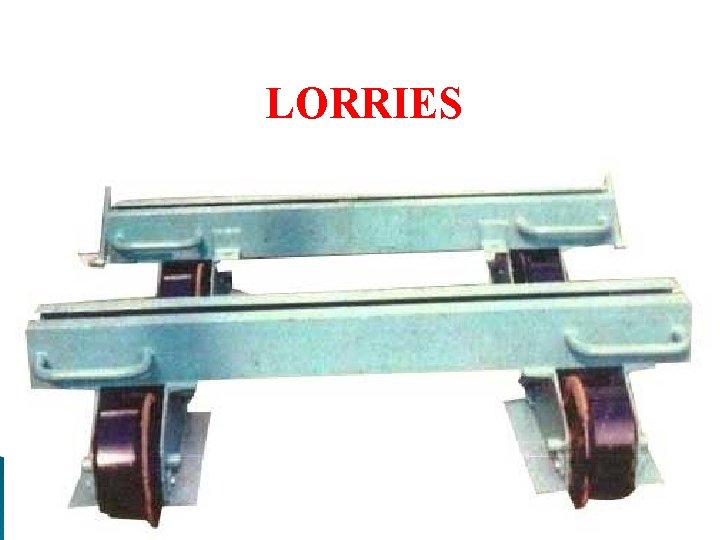
WORKING OF LORRIES Lorries should be worked ONLY UNDER BLOCK PROTECTION. Lorries in all cases should be pushed and never pulled. Riding of persons on the same is prohibited. Lorry must be accompanied on foot by not less than 04 men in addition to the number of men required for expeditiously loading and unloading materials being conveyed on the lorry.
WORKING OF LORRIES Before obtaining line clear, the official-incharge of a lorry should advise the Station Master/Block Hut- in-charge, whether it is his intention to return to that station, to run to the other end of block section, or to remove the lorry in mid-section.
WORKING OF LORRIES The official-in-charge, after getting the authority to proceed in the form of line clear ticket/token, double line certificate or shunting key, as the case may be, should work his lorry. He should, after completion of his work, hand over the authority to proceed to the concerned Station Master/Block Hut-incharge and remove his lorry.
WORKING OF LORRIES In case the lorry is off loaded in the midsection, the authority to proceed should be returned by a special messenger to the nearest station after ensuring that the lorry is kept clear off the line. On the double line the official-in- charge should run the lorry on the proper road. The lorry should be taken along the line in the direction in which the trains will run; except when returning to the original starting station/Block Hut.
WORKING OF LORRIES Working in Station limits When a lorry is required to work within Station limits, the permission of the Station Master shall be obtained in writing before working the lorry and the lorry should be worked as per the approved special instructions.
WORKING OF LORRIES Protection in Station limits When a lorry works in a station yard the Flagman must exhibit danger signals at such a distance on both sides as will ensure safety. When the lorry is required to remain stationary for more than 15 minutes, it must be protected by banner flags placed at an adequate distance supplemented by three detonators on both sides.
WORKING OF LORRIES When a lorry has to work on a section with a steep down gradient (gradients steeper than 1/100), the same should not only be controlled by hand brakes, but by a rope tied in the rear and held in tension by men following a lorry.
WORKING OF MOPED LORRIES These are light motor trollies, which can be lifted off the track normally by three men. They should be manned by at least three men including the Driver. These may be worked as per the rules pertaining to a Motor Trolley, for which the Railway Administration may issue special instructions, as necessary.
LORRIES
WORKING OF MOTOR TROLLIES A motor trolley shall only be run in accordance with special instructions. A motor trolley may be worked under block protection or without block protection, as may be prescribed by the Railway Administration.
WORKING OF MOTOR TROLLIES Working under block protection A motor trolley should be run only under block protection (i) During night (ii) During day time, when the visibility is poor due to fog or dust storm. Sections of restricted visibility should invariably be traversed under block protection. A list of “sections of restricted visibility” may be specified for the guidance of all concerned, either in the subsidiary rules or in the working time table.
WORKING OF MOTOR TROLLIES When a motor trolley that is worked under block protection breaks down in the block section, the official-in-charge should remove it clear of the line and send a written advice to the nearest Station Master/Block Hut -in-charge returning the line clear ticket or token or in the case of a motor trolley when the token has been clamped for a preceding train the key of the padlock.
WORKING OF MOTOR TROLLIES He should not replace the motor trolley on the line without the written permission of either Station Master/Block Hut-in-charge at the end of the block section concerned. On arrival at the other end, the official- in-charge will deliver the authority to the Station Master after the trolley has arrived complete.
WORKING OF MOTOR TROLLIES Following a Train/Motor Trolley Motor trolley may follow a fully vacuum/air brake train or a Light engine or another motor trolley in the same block section during day light hours and in clear weather under special instructions issued by the Railway Administration.
WORKING OF MOTOR TROLLIES Working without block protection (i) It should be manned by at least four men. (ii) In case a motor trolley is worked without block protection, the procedure for working of trollies without Block protection shall be followed for working of the motor trollies. (iii) When a motor trolley is worked without block protection, as per special instructions, the procedure for protection of trollies in block section should be followed for the protection of trolley in block section.
Equipments on trolley/lorry/motor trolley Two HS lamps/Tri colour LED Flashing hand signal lamp Two each red & green HS flags 10 nos. detonators A chain & pad lock Working time table with all correction slips Motor horn & search light(for M. trolley only) Two banners & additional detonators(lorry only) Such other articles as may be prescribed by the Railway Administration in this behalf Official should have a watch.
Equipments on trolley/lorry/motor trolley Apart from above , following items are also essential , Trolley box having important manuals , registers , circulars Equipment box having versine , wear measuring gadgets , callipers, scale, gauge cum level, spanner, hammer , etc which will be reqd for inspection.
Rail Dolley
Working of Rail Dolleys – Rail dolley is a device with two or more wheels, which in balanced condition, can be moved manually on one rail of track and can carry one rail/sleeper in suspended condition. When necessary, the suspended material can be dropped and rail dolley cleared off the track.
Working of Rail Dolleys Manning of Rail Dolley– Every rail dolley shall be manned by not less than 2 able bodied persons. The person- in-charge for the working of rail dolleys shall be a railway servant not lower in rank than a Keyman. The official in-charge should have passed in medical category A-3 and Must hold a valid certificate of competency for working rail dolleys.
Working of Rail Dolleys Certificate of competency shall be issued by SSE (P. Way) of the section who must satisfy himself that the person to whom competency certificate is being issued is fully aware of the rules for the working of rail dolleys and is also well acquainted with the concerned section.
Working of Rail Dolleys– (a) The railway servant in-charge of rail dolleys must inspect the section in advance particularly in reference to heaping of ballast, girder bridges and any other special features which make it difficult to drop the material and remove the rail dolley in the event of an approaching train. He shall get the ballast heaps cleared and work the dolley(s) only when the visibility is clear for at least 1200 metre and the rails/sleepers can be dropped off safely without affecting the safety of trains and workers both.
Working of Rail Dolleys– (a) The railway servant in-charge of rail dolleys must inspect the section in advance particularly in reference to heaping of ballast, girder bridges and any other special features which make it difficult to drop the material and remove the rail dolley in the event of an approaching train. He shall get the ballast heaps cleared and work the dolley(s) only when the visibility is clear for at least 1200 m and the rails/sleepers can be dropped off safely without affecting the safety of trains and workers both.
Working of Rail Dolleys Working of Rail Dolleys– (b) Rail dolley shall not be worked on sections having gradients steeper than 1 in 200. (c) Not more than 6 rail dolleys should be worked in a group in any one block section.
Working of Rail Dolleys– (d) Normally, not longer than 3 rail welded panels should be carried by rail dolleys. The rail dolleys must not be worked after sunset and before sunrise and in bad weather when the visibility is poor. Rail dolleys should not be worked in deep cuttings, steep grades, sharp curves and heavily built up areas where the visibility is not clear for 1200 m. In such locations, the rail dolleys should be worked under block protection.
Working of Rail Dolleys Working of Rail Dolleys– (e) In case, a rail dolley is to carry rails longer than 3 rail panel or it is required to move over x-overs in yard crossing more than one line in deep cuttings and curves then it should work under block protection. (f) No traffic block or caution order is normally necessary for working of rail dolleys except as indicated in Para (c) & (d) above.
Working of Rail Dolleys Working of Rail Dolleys– (g) Every rail dolley/group of rail dolley when on line shall exhibit a red flag. (h) The rail dolley shall be protected by a flagman at a distance of 1200 m from the rail dolley, on a double line in the direction from which trains may approach, and by two flagmen one on either direction on single line. The flagmen shall also carry three detonators for use in any emergency.
Working of Rail Dolleys Working of Rail Dolleys– (i) Where necessary intermediate Flagman should be posted to relay signals. (j) The official-in-charge of the rail dolley shall keep a look out for approaching trains and will get the rail dolley(s) and materials cleared off the track as soon as an approaching train is sighted.
Working of Rail Dolleys– (k) When a train is sighted, the Flagman should wave the red flag vigorously to warn the official-in-charge of the dolley of the train and at the same time place three detonators 10 m apart on the line to protect the rail dolley(s). The detonators should be removed only on receipt of hand signals from the official-in-charge by waving of a green signal to withdraw the danger signals from indicating that rail dolleys have been removed.
Working of Rail Dolleys Working of Rail Dolleys– (l) While approaching level crossings, the official in-charge shall look out for road vehicles and ensure safe passage of rail dolleys. (m) The official in-charge shall be fully responsible for the safe working of rail dolleys.
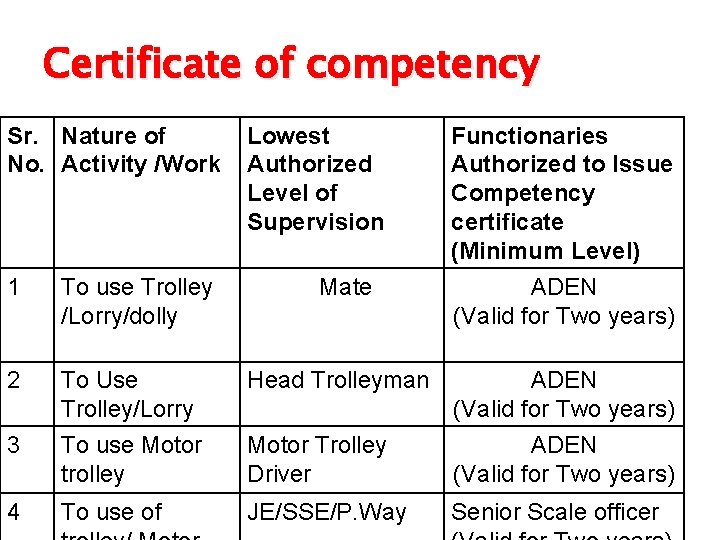
Certificate of competency No trolley, motor trolley or lorry shall be placed on the line except by a qualified person appointed by special instructions. Such qualified person shall accompany the trolley, motor trolley or lorry. Such person responsible for protection & its being used as per rules.
Certificate of competency Such person should possess a certificate of competency. Person should be literate, have knowledge of Hindi & local language, have passed prescribed medical test & have thorough knowledge of working rules of trollies, motor trollies and lorries, as the case may be.
Certificate of competency The certificate of competency will be issued for a specified period, by an authorized officer, and renewed periodically.
Certificate of competency Competency certificate is issued by CE, CTE, CBE, CSO, CSTE / C, DRM, JA grade officer of engineering and S & T department. This certificate is issued after examining the person in safety rules for running of trolleys , motor trolleys and lorries. Validity of this certificate is TWO years.
Certificate of competency Sr. Nature of No. Activity /Work Lowest Authorized Level of Supervision Mate Functionaries Authorized to Issue Competency certificate (Minimum Level) 1 To use Trolley /Lorry/dolly ADEN (Valid for Two years) 2 To Use Trolley/Lorry Head Trolleyman ADEN (Valid for Two years) 3 To use Motor trolley Motor Trolley Driver ADEN (Valid for Two years) 4 To use of JE/SSE/P. Way Senior Scale officer
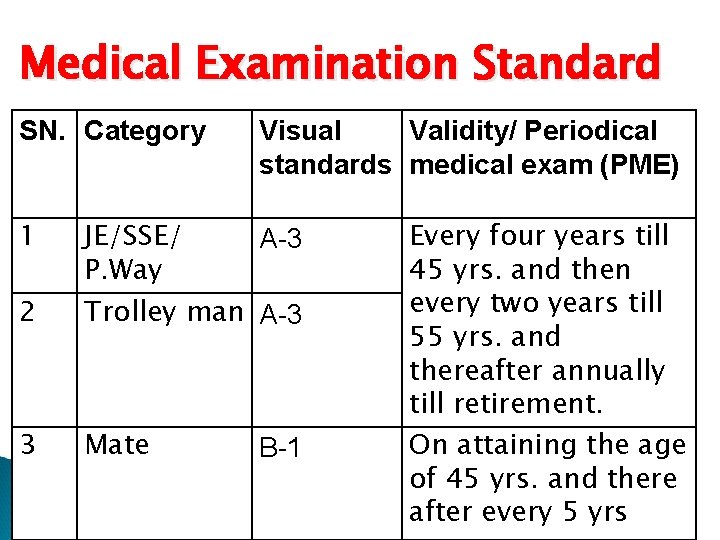
Medical Examination Standard SN. Category 1 Visual Validity/ Periodical standards medical exam (PME) 2 JE/SSE/ A-3 P. Way Trolley man A-3 3 Mate B-1 Every four years till 45 yrs. and then every two years till 55 yrs. and thereafter annually till retirement. On attaining the age of 45 yrs. and there after every 5 yrs
THANKS