Physical Science Unit 1 Test Review Game Question


- Slides: 71
Physical Science Unit 1 Test Review Game
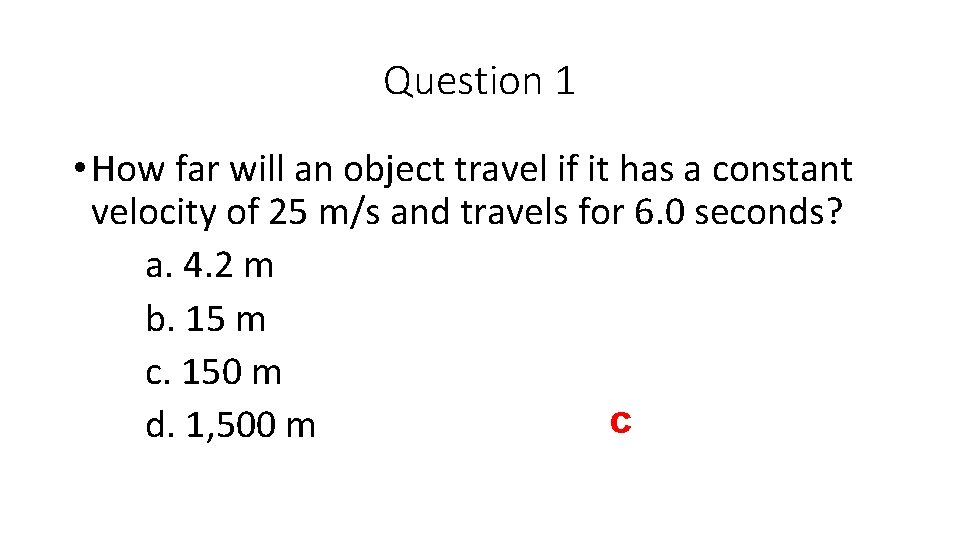
Question 1 • How far will an object travel if it has a constant velocity of 25 m/s and travels for 6. 0 seconds? a. 4. 2 m b. 15 m c. 150 m c d. 1, 500 m
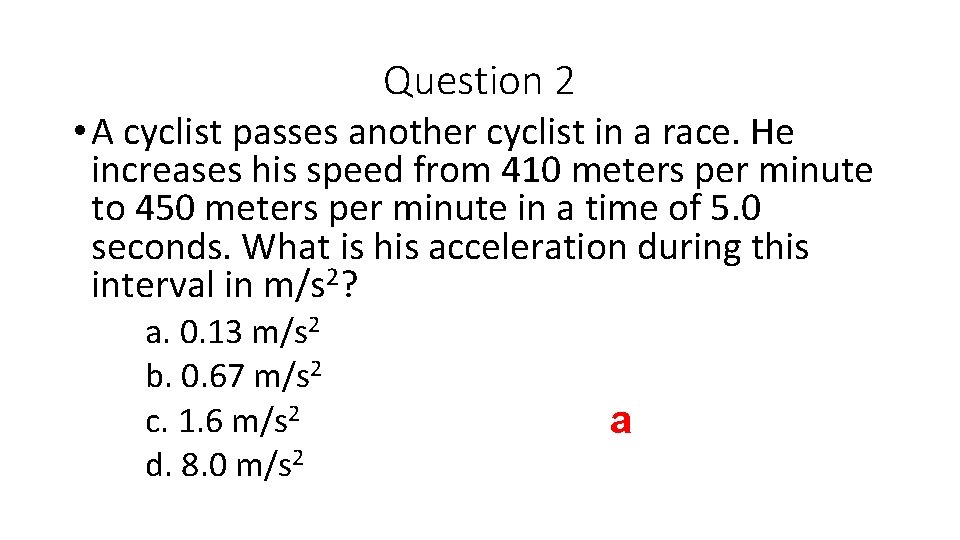
Question 2 • A cyclist passes another cyclist in a race. He increases his speed from 410 meters per minute to 450 meters per minute in a time of 5. 0 seconds. What is his acceleration during this interval in m/s 2? a. 0. 13 m/s 2 b. 0. 67 m/s 2 c. 1. 6 m/s 2 d. 8. 0 m/s 2 a
Question 3 • A child pushes a wagon that is at rest. It accelerates for 10 seconds at a rate of 2 meters per second. What is the velocity of the wagon after the 10 seconds? a. 5 m/s b. 8. 0 m/s c. 12. 0 m/s d. 20. 0 m/s d
Question 4 • When an object is free falling it has a constant _____. a. velocity b. acceleration c. distance b d. speed
Question 5 • A pitching machine is pointed upward. A ball is launched vertically out of the machine until it reaches a maximum height of 45 meters. It then falls back to the ground. What is the acceleration of the ball as it falls back to the ground? a. 0. 0 m/s 2 b. 4. 0 m/s 2 c. 9. 8 m/s 2 c d. 45. 0 m/s 2
Question 6 • What does the slope on a velocity-time graph indicate? a. speed b. distance c. displacement d d. acceleration
Question 7 • Which of the following is a displacement? a. 5 meters per second b. 10 feet c. 0. 7 grams per centimeter cubed d. 3 blocks east d
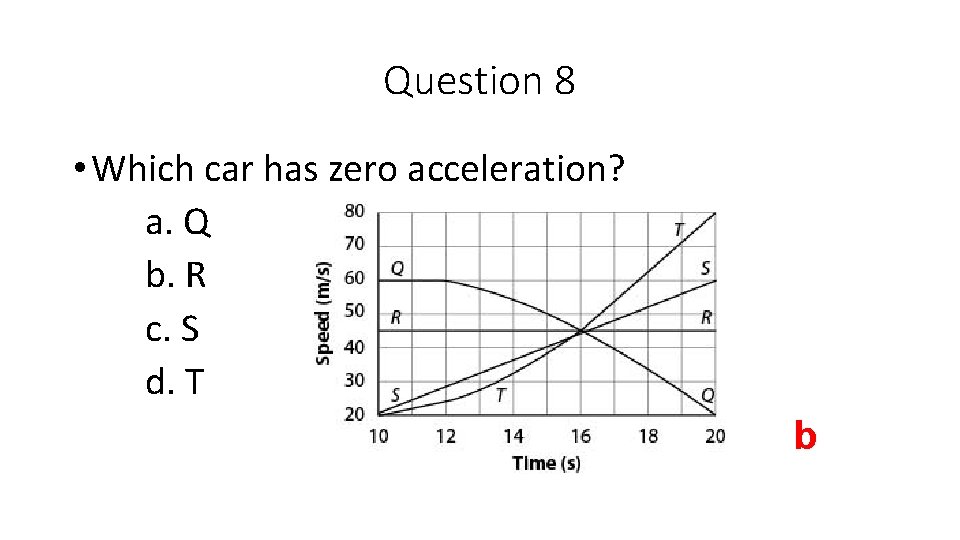
Question 8 • Which car has zero acceleration? a. Q b. R c. S d. T b
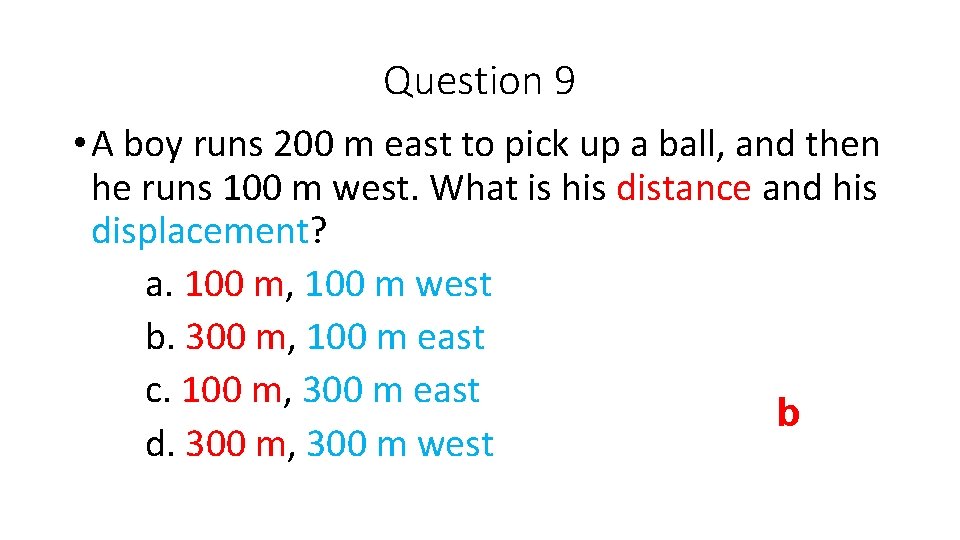
Question 9 • A boy runs 200 m east to pick up a ball, and then he runs 100 m west. What is his distance and his displacement? a. 100 m, 100 m west b. 300 m, 100 m east c. 100 m, 300 m east b d. 300 m, 300 m west
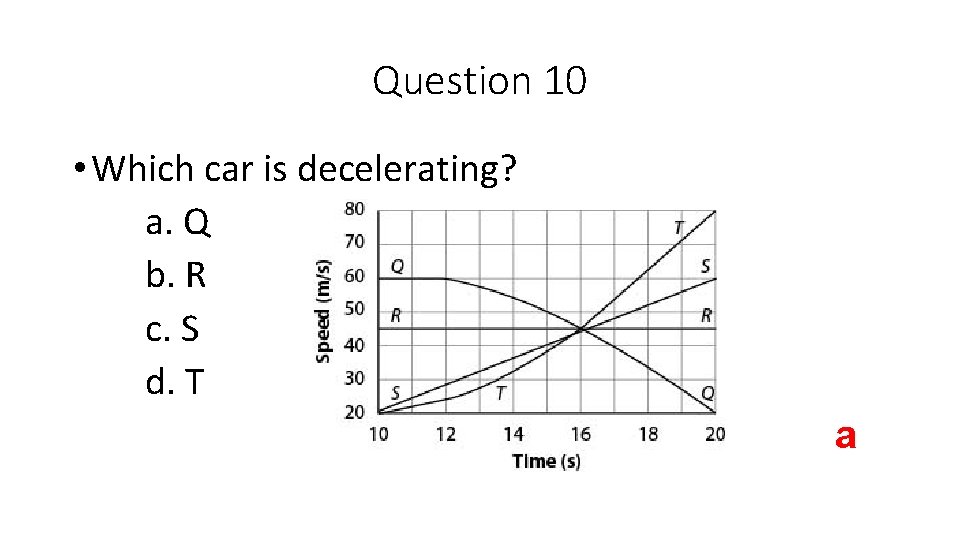
Question 10 • Which car is decelerating? a. Q b. R c. S d. T a
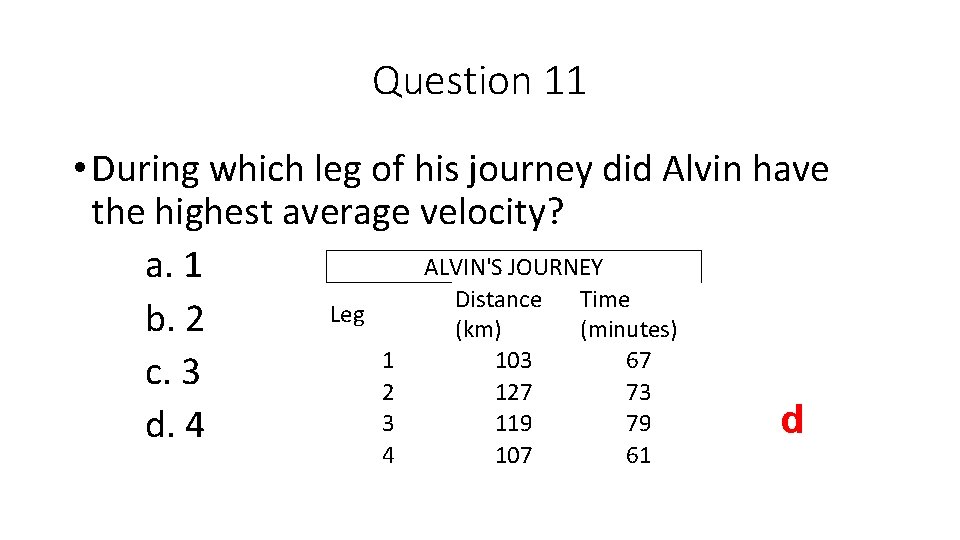
Question 11 • During which leg of his journey did Alvin have the highest average velocity? ALVIN'S JOURNEY a. 1 Distance Time Leg b. 2 (km) (minutes) 1 103 67 c. 3 2 127 73 3 119 79 d d. 4 4 107 61
Question 12 • What are 3 ways to change acceleration? a. change speed b. change direction c. change speed and direction d. all of the above d
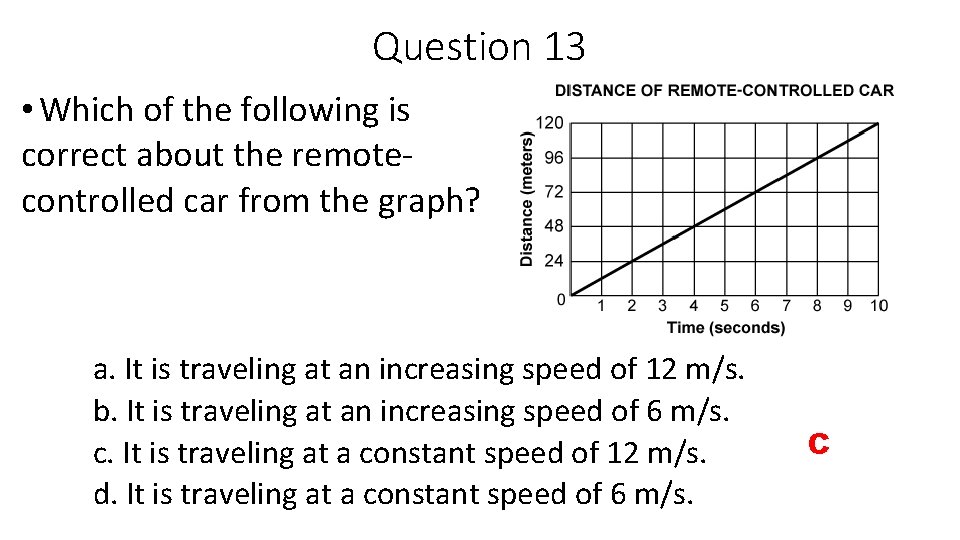
Question 13 • Which of the following is correct about the remotecontrolled car from the graph? a. It is traveling at an increasing speed of 12 m/s. b. It is traveling at an increasing speed of 6 m/s. c. It is traveling at a constant speed of 12 m/s. d. It is traveling at a constant speed of 6 m/s. c
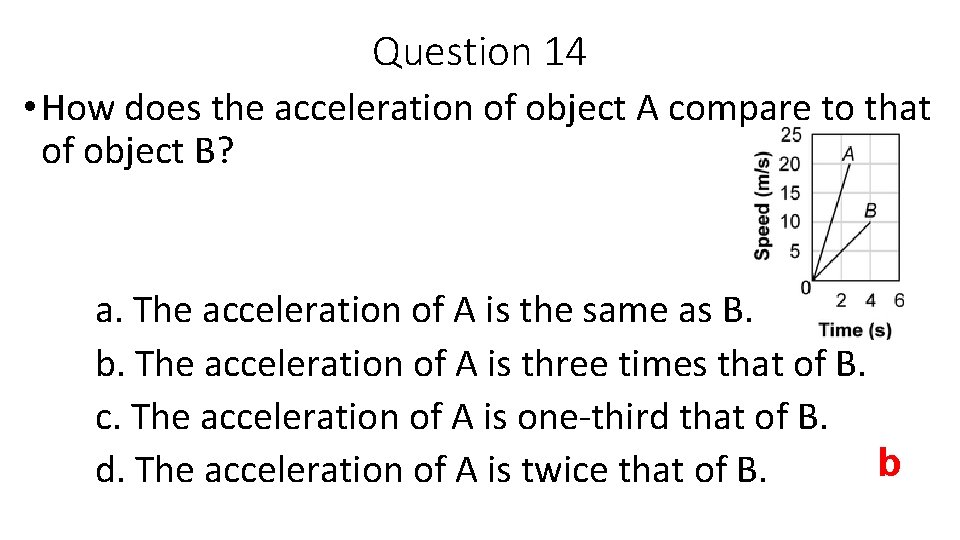
Question 14 • How does the acceleration of object A compare to that of object B? a. The acceleration of A is the same as B. b. The acceleration of A is three times that of B. c. The acceleration of A is one-third that of B. b d. The acceleration of A is twice that of B.
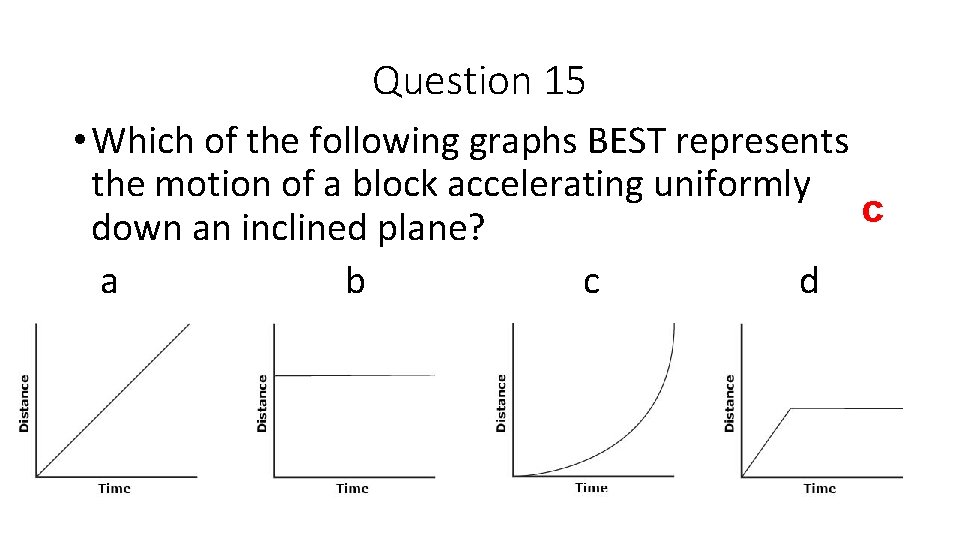
Question 15 • Which of the following graphs BEST represents the motion of a block accelerating uniformly c down an inclined plane? a b c d
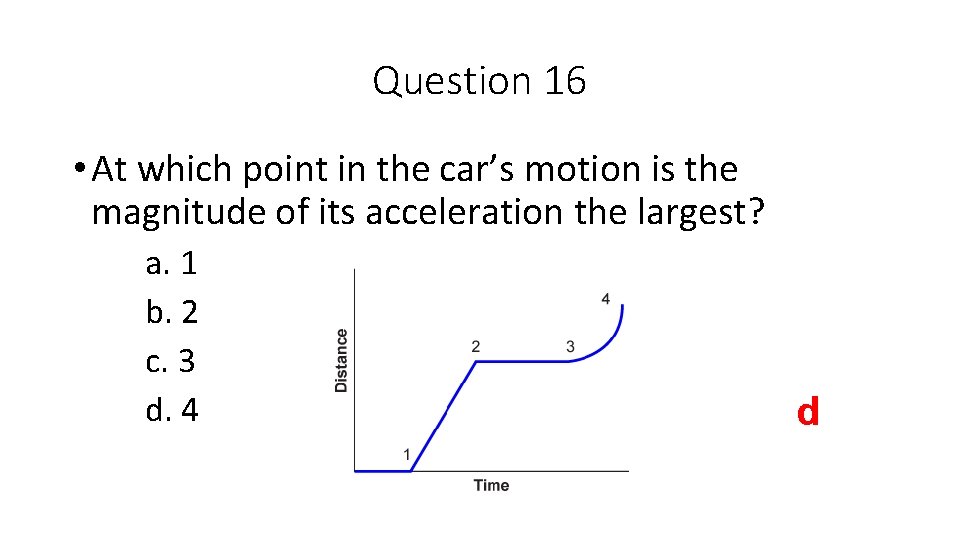
Question 16 • At which point in the car’s motion is the magnitude of its acceleration the largest? a. 1 b. 2 c. 3 d. 4 d
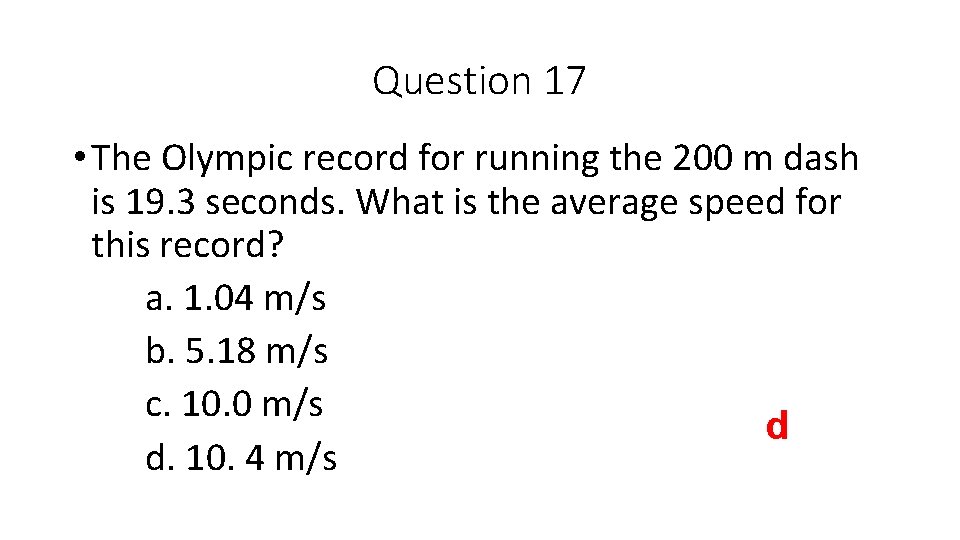
Question 17 • The Olympic record for running the 200 m dash is 19. 3 seconds. What is the average speed for this record? a. 1. 04 m/s b. 5. 18 m/s c. 10. 0 m/s d d. 10. 4 m/s
Question 18 • How much time is required for an object moving 4. 5 m/s to travel 65 m? a. 13 s b. 14 s c. 15 s d. 16 s b
Question 19 • During a trail race, a runner is moving at a velocity of 5 meters per second north. He comes to a hill and begins to slow down uniformly for 5 seconds until he is running at 1 meter per second north. What is the acceleration of the runner during these 5 seconds? a. 0. 8 m/s 2 south b. 0. 8 m/s 2 north c. 0. 2 m/s 2 north a d. 0. 2 m/s 2 south
Question 20 • A river flows at 2. 50 m/s to the north, while a boat travels from south to north with a constant velocity of 12. 5 m/s relative to the water. What is the velocity of the boat relative to an observer at rest on the shore? a. 5. 00 m/s south b. 10. 0 m/s north c. 12. 5 m/s south d. 15. 0 m/s north d
Question 21 • If a train is traveling west at a rate of 30 kilometers per hour, how could a passenger on the train be moving west at a rate of 28 kilometers per hour? a. The passenger is walking east on the train at a rate of 28 km/hr. b. The passenger is walking east on the train at a rate of 2 km/hr. c. The passenger is walking west on the train at a rate of 28 km/hr. d. The passenger is walking west on the train at a rate of 2 km/hr. b
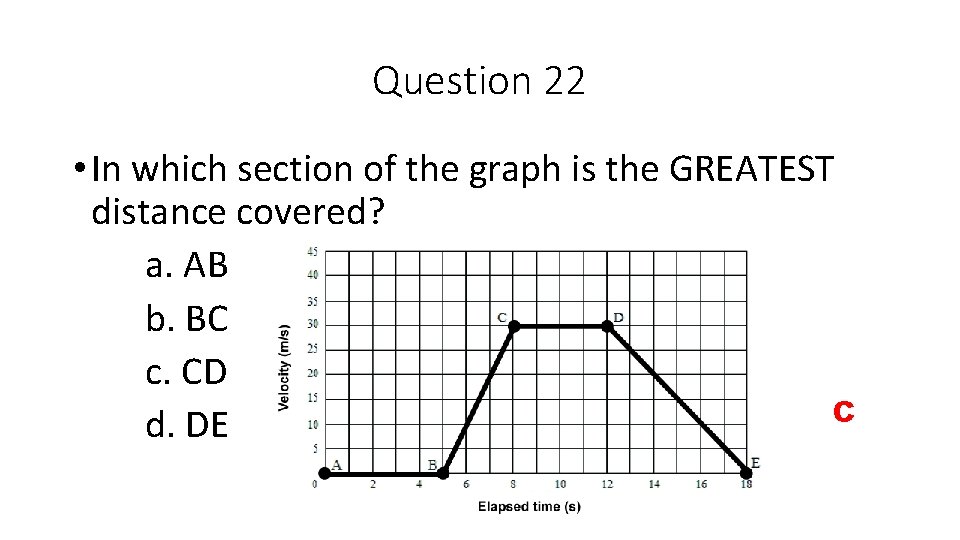
Question 22 • In which section of the graph is the GREATEST distance covered? a. AB b. BC c. CD c d. DE
Question 23 • A group of bike riders went on a 4 -hour trip. During the first 3 hours, they traveled a total of 50. 0 kilometers, but during the last hour, they traveled only 10. 0 kilometers. What was the group's average speed for the entire trip? a. 15 km/hr b. 13. 3 km/hr c. 26. 6 km/hr a d. 30. 0 km/hr
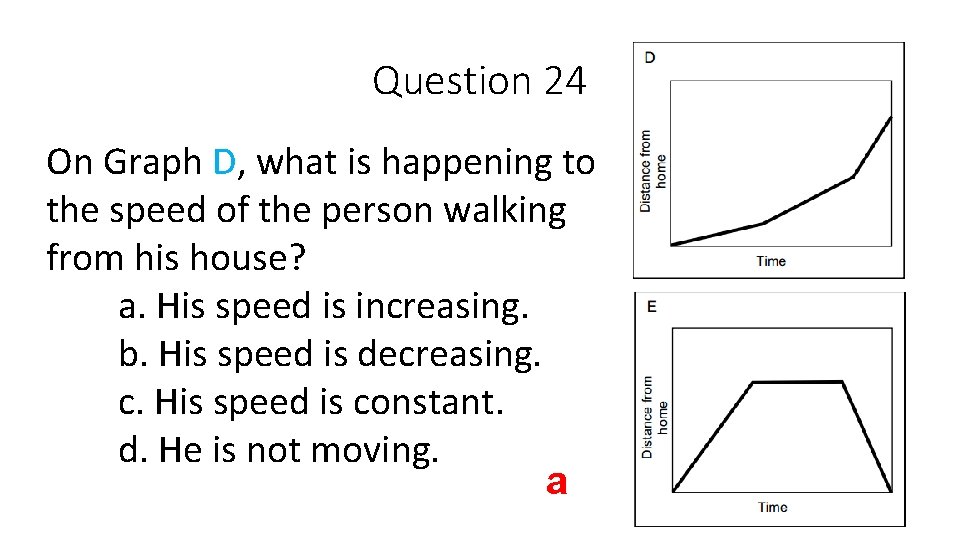
Question 24 On Graph D, what is happening to the speed of the person walking from his house? a. His speed is increasing. b. His speed is decreasing. c. His speed is constant. d. He is not moving. a
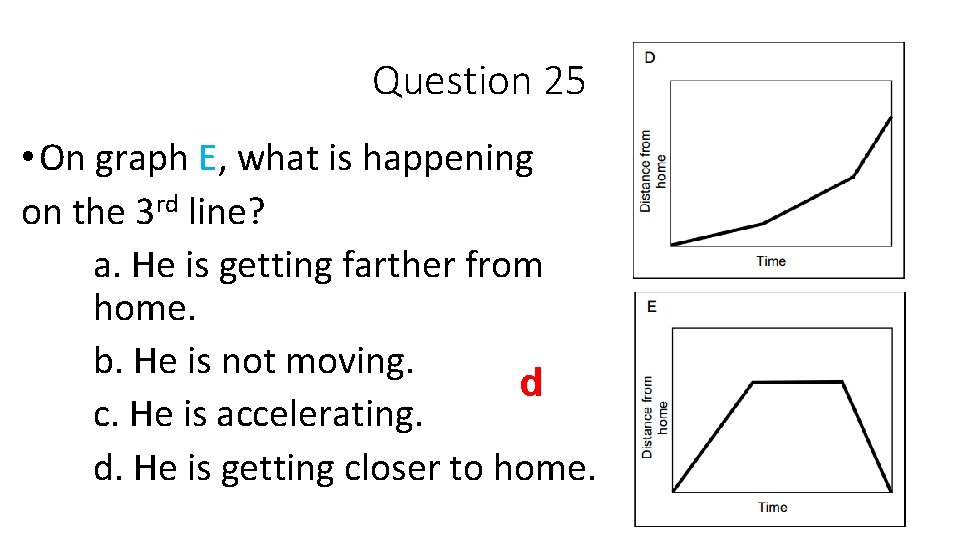
Question 25 • On graph E, what is happening on the 3 rd line? a. He is getting farther from home. b. He is not moving. d c. He is accelerating. d. He is getting closer to home.
Question 1 • A student observes an 8. 0 -kilogram shopping cart accelerate uniformly across a parking lot. It reaches a speed of 4. 0 meters per second in 0. 5 seconds. What is the magnitude of the force that causes the shopping cart to accelerate? a. 8. 0 N b. 32. 0 N c. 16. 0 N d. 64. 0 N d
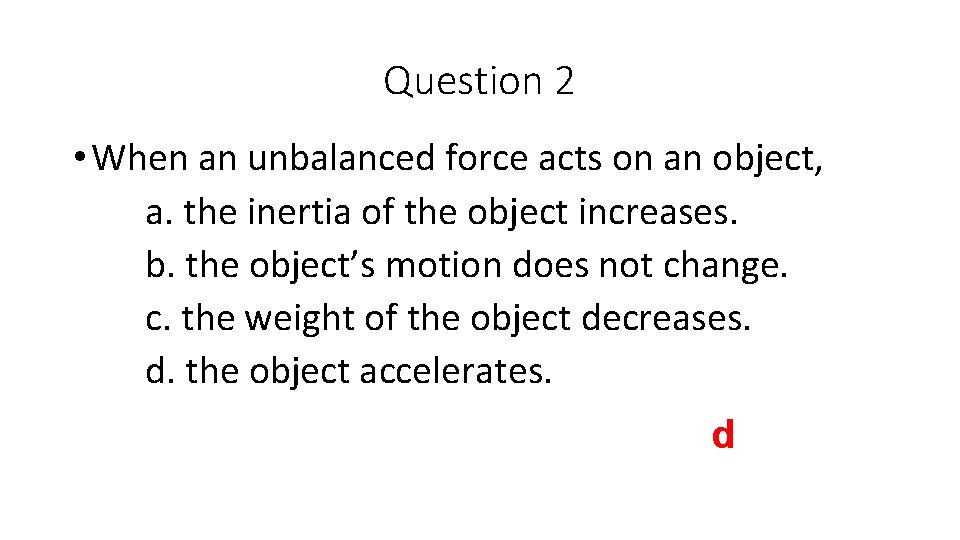
Question 2 • When an unbalanced force acts on an object, a. the inertia of the object increases. b. the object’s motion does not change. c. the weight of the object decreases. d. the object accelerates. d
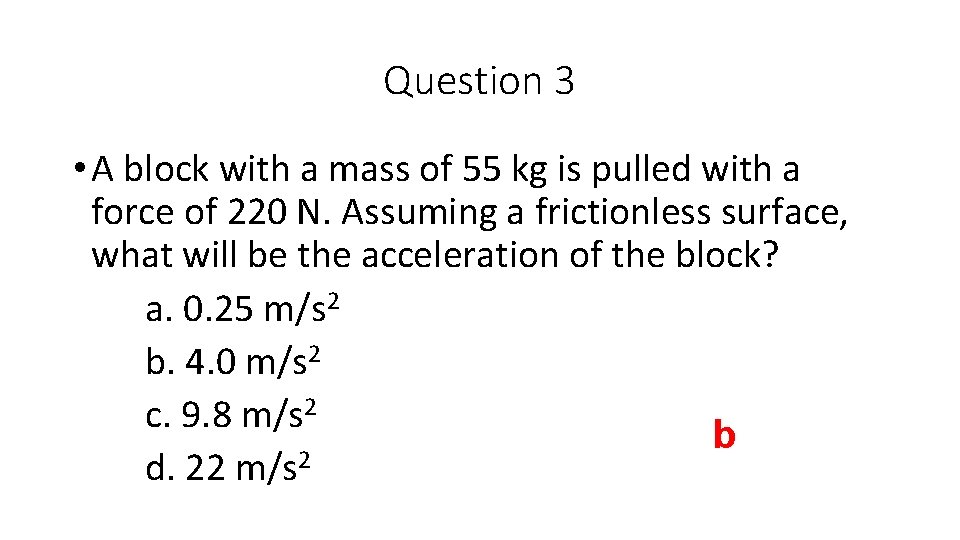
Question 3 • A block with a mass of 55 kg is pulled with a force of 220 N. Assuming a frictionless surface, what will be the acceleration of the block? a. 0. 25 m/s 2 b. 4. 0 m/s 2 c. 9. 8 m/s 2 b d. 22 m/s 2
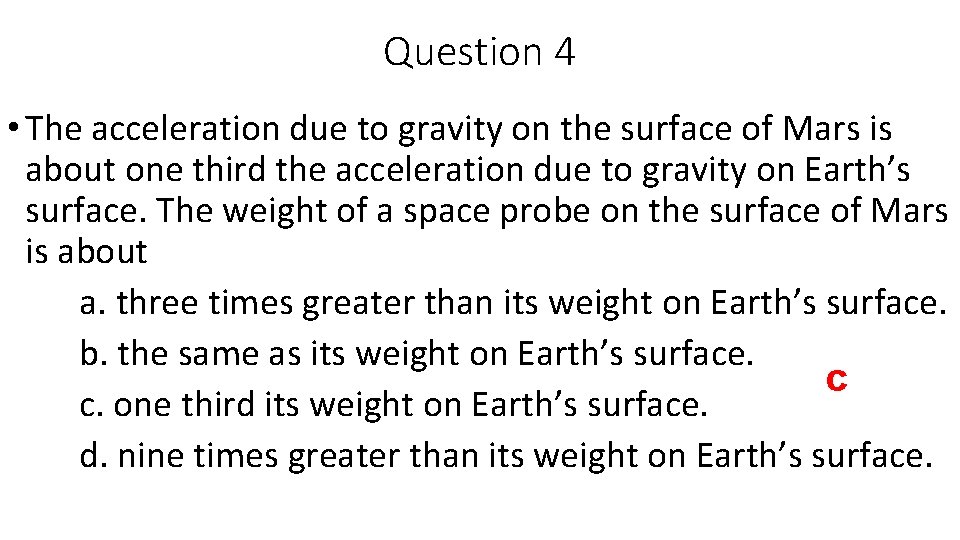
Question 4 • The acceleration due to gravity on the surface of Mars is about one third the acceleration due to gravity on Earth’s surface. The weight of a space probe on the surface of Mars is about a. three times greater than its weight on Earth’s surface. b. the same as its weight on Earth’s surface. c c. one third its weight on Earth’s surface. d. nine times greater than its weight on Earth’s surface.
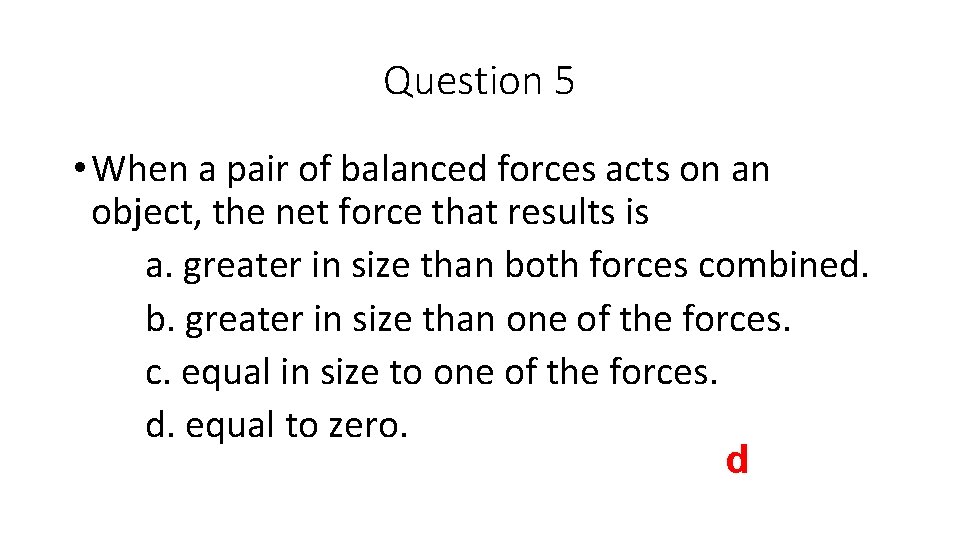
Question 5 • When a pair of balanced forces acts on an object, the net force that results is a. greater in size than both forces combined. b. greater in size than one of the forces. c. equal in size to one of the forces. d. equal to zero. d
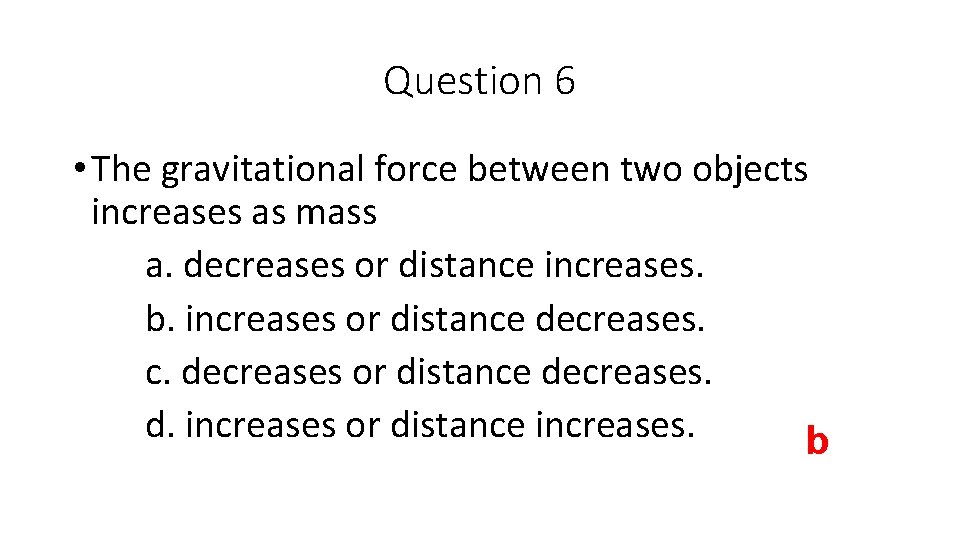
Question 6 • The gravitational force between two objects increases as mass a. decreases or distance increases. b. increases or distance decreases. c. decreases or distance decreases. d. increases or distance increases. b
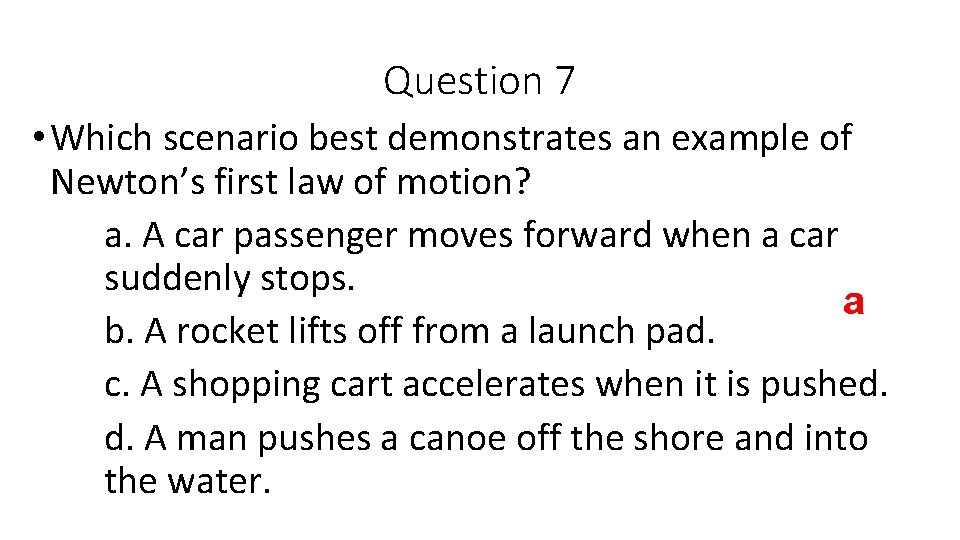
Question 7 • Which scenario best demonstrates an example of Newton’s first law of motion? a. A car passenger moves forward when a car suddenly stops. a b. A rocket lifts off from a launch pad. c. A shopping cart accelerates when it is pushed. d. A man pushes a canoe off the shore and into the water.
Question 8 • The forces acting on a falling leaf are a. gravity and air resistance. b. gravity and static friction. c. air resistance and fluid friction. d. weight and rolling friction. a
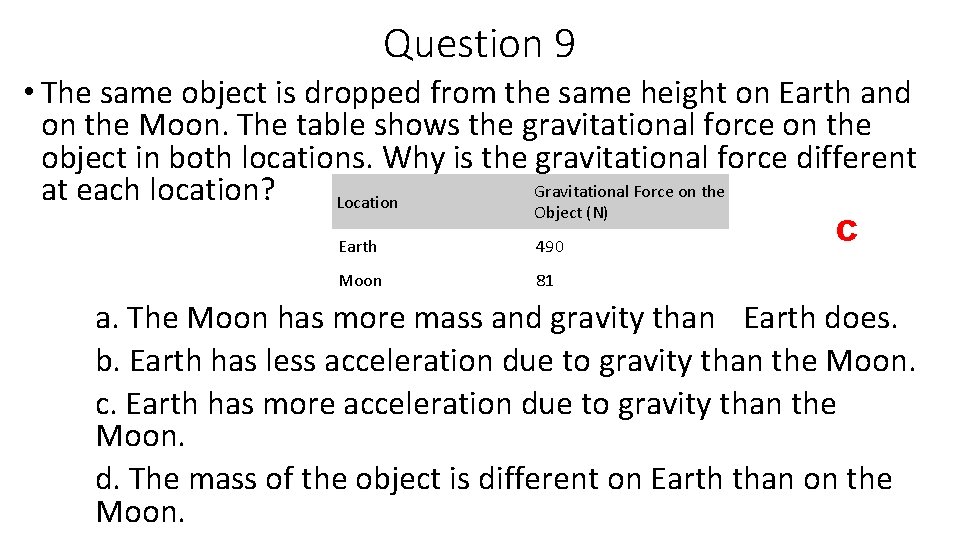
Question 9 • The same object is dropped from the same height on Earth and on the Moon. The table shows the gravitational force on the object in both locations. Why is the gravitational force different Gravitational Force on the at each location? Location Object (N) Earth 490 Moon 81 c a. The Moon has more mass and gravity than Earth does. b. Earth has less acceleration due to gravity than the Moon. c. Earth has more acceleration due to gravity than the Moon. d. The mass of the object is different on Earth than on the Moon.
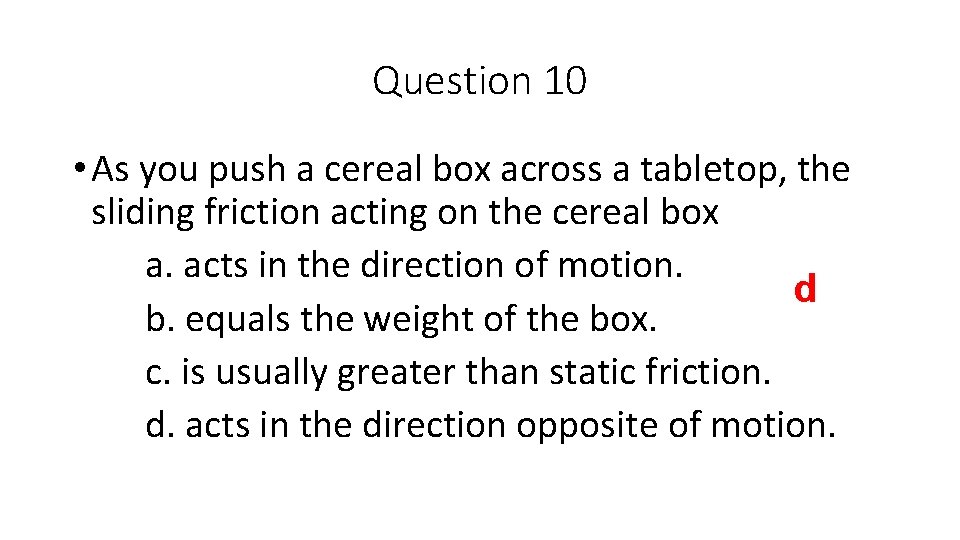
Question 10 • As you push a cereal box across a tabletop, the sliding friction acting on the cereal box a. acts in the direction of motion. d b. equals the weight of the box. c. is usually greater than static friction. d. acts in the direction opposite of motion.
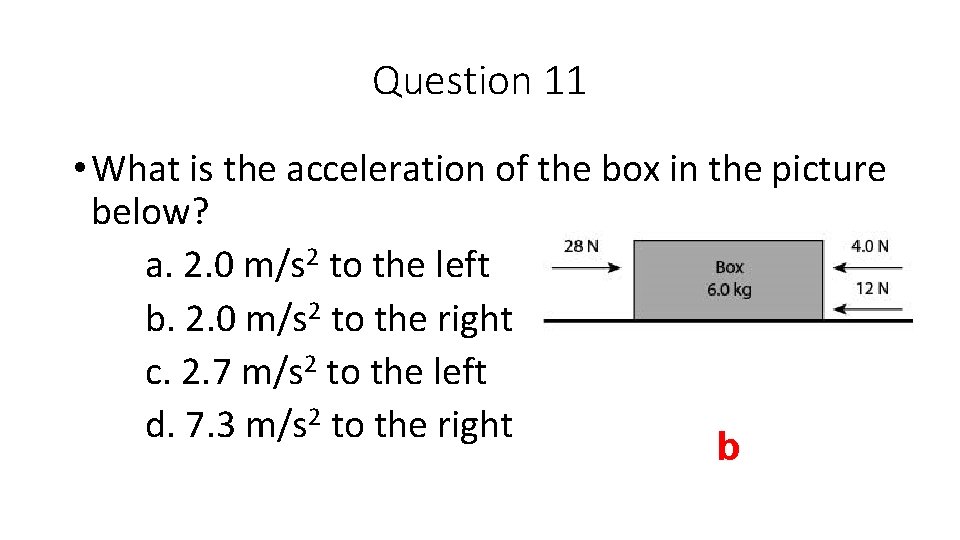
Question 11 • What is the acceleration of the box in the picture below? a. 2. 0 m/s 2 to the left b. 2. 0 m/s 2 to the right c. 2. 7 m/s 2 to the left d. 7. 3 m/s 2 to the right b
Question 12 • An orange might roll off your cafeteria tray when you stop suddenly because of a a. the orange’s inertia. b. the friction forces acting on the orange. c. the centripetal force acting on the orange. d. the balanced forces acting on the orange.
Question 13 • A man pushes against a brick wall with a force of 100 Newtons. Which statement best describes the force exerted on the man by the wall? a. The wall pushes back with a force of 100 N. b. The wall pushes back with more force than 100 N. c. The wall pushes back with less force than 100 N. d. The wall does not push back with any force. a
Question 14 • An object is moving at a constant speed. An additional force is applied to the object in the same direction as the object’s c motion. What will be the effects of this additional force? a. The forces will become balanced and the object will come to a stop. b. The forces will become balanced and the speed of the object will decrease. c. The forces will become unbalanced and the speed of the object will increase. d. The forces will become unbalanced and the object will travel in the opposite direction.
Question 15 • Ray is sitting on the couch. Gravity exerts a downward force on him. Based on Newton’s law of action-reaction, the other force acting on Ray is the a. downward force of the floor. b. downward force of air pressure. c. upward force of momentum. d. upward force of the couch. d
Question 16 • Newton’s third law of motion describes a. net force. b. balanced forces. c. centripetal forces. d. action and reaction forces. d
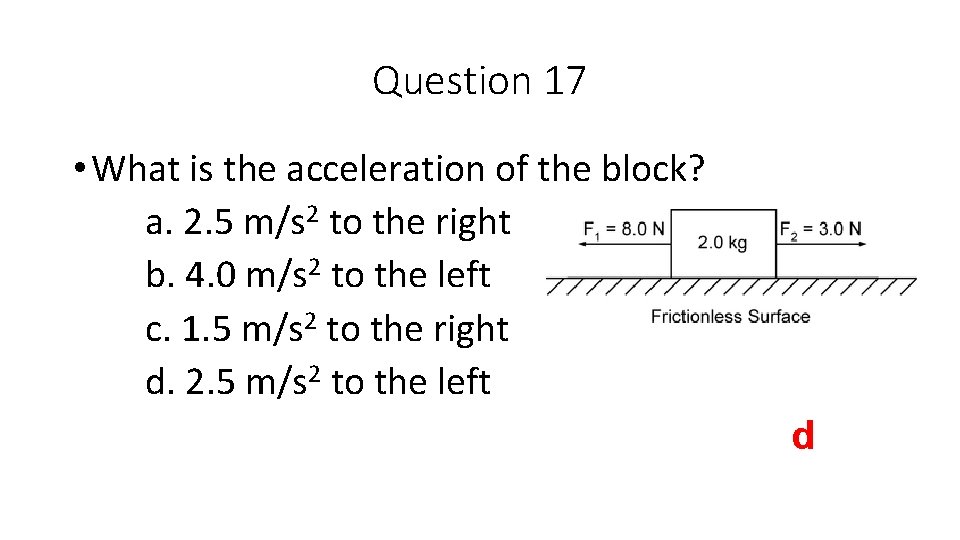
Question 17 • What is the acceleration of the block? a. 2. 5 m/s 2 to the right b. 4. 0 m/s 2 to the left c. 1. 5 m/s 2 to the right d. 2. 5 m/s 2 to the left d
Question 18 • Which of the following objects has the greatest inertia? • a. A 5. 0 kg mass moving at 10. 0 m/s. • b. A 20. 0 kg mass moving at 1. 0 m/s. • c. A 10. 0 kg mass moving at 1. 0 m/s. • d. A 15 kg mass moving at 10. 0 m/s. b
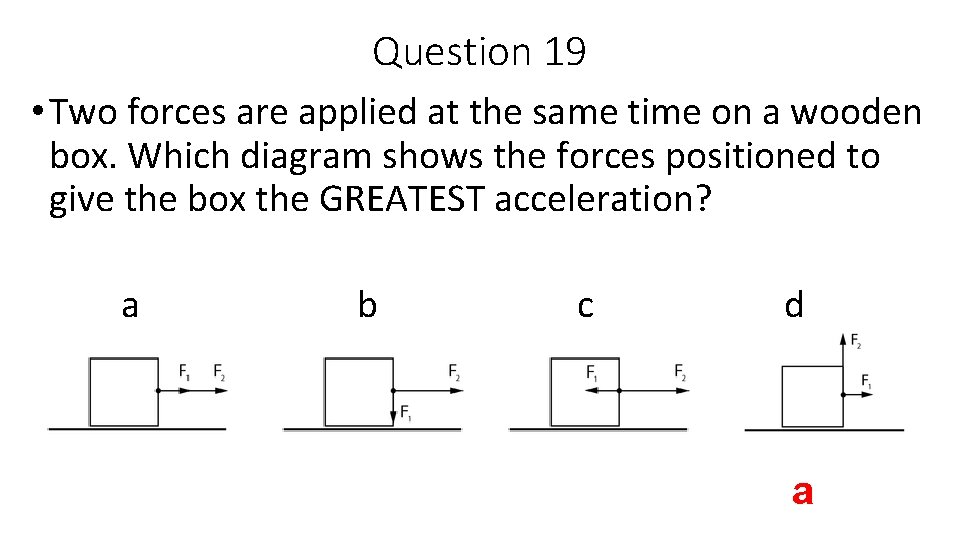
Question 19 • Two forces are applied at the same time on a wooden box. Which diagram shows the forces positioned to give the box the GREATEST acceleration? a b c d a
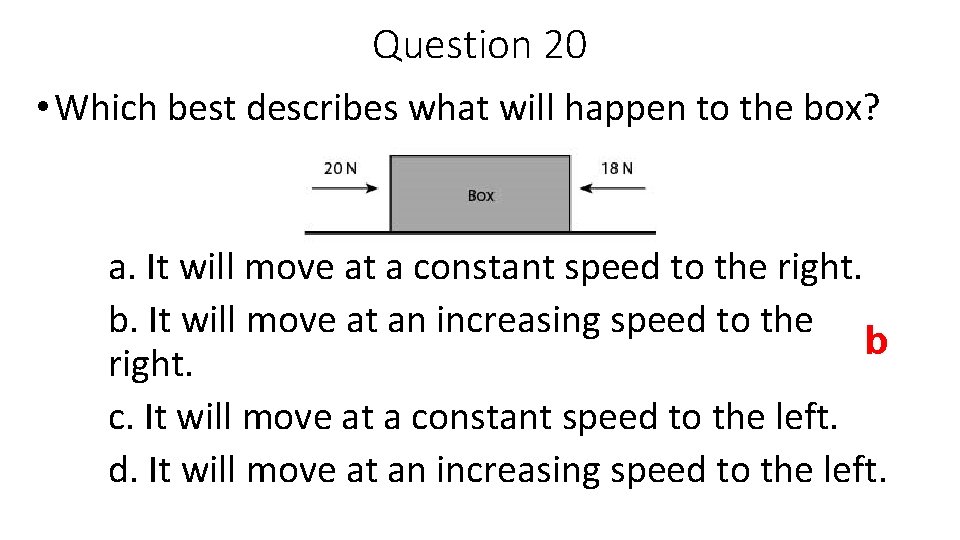
Question 20 • Which best describes what will happen to the box? a. It will move at a constant speed to the right. b. It will move at an increasing speed to the b right. c. It will move at a constant speed to the left. d. It will move at an increasing speed to the left.
Question 21 • The mass of a newborn baby is 3. 8 kilograms. What is the baby’s weight? (The acceleration due to gravity at Earth’s surface is 9. 8 m/s 2. ) a. 0. 387 N b. 372 N c. 37. 2 N c d. 3. 87 N
Question 22 • Which force accounts for the difference between mass and weight? a. gravitational force b. frictional force c. magnetic force d. air resistance force a
Question 23 • A small engine causes a 0. 4 -kg model airplane to accelerate at a rate of 12 m/s 2. What is the net force on the model airplane? a. 30 N b. 3. 0 N c. 4. 8 N c d. 48 N
Question 24 • If Malik weighs 100 N on Earth, and Alexander weighs 100 N on the Moon, how do their masses compare to one another? b a. Malik’s mass is greater than Alexander’s. b. Alexander’s mass is greater than Malik’s. c. Malik and Alexander have the same mass. d. Alexander’s and Malik’s masses cannot be compared.
Question 25 • What does the law of inertia state? a. Planets move in circles around the Sun. d b. Planets move in ellipses around the Sun. c. When an object exerts a force onto another object, it will cause the second object to exert an equal force in the opposite direction. d. Objects remain at rest or move in straight continuous paths at a constant velocity unless a net force acts on them.
Question 1 • In which of the following is no work done? a. climbing stairs b. pushing a shopping cart c. lifting a book d. All of the above involve work. d
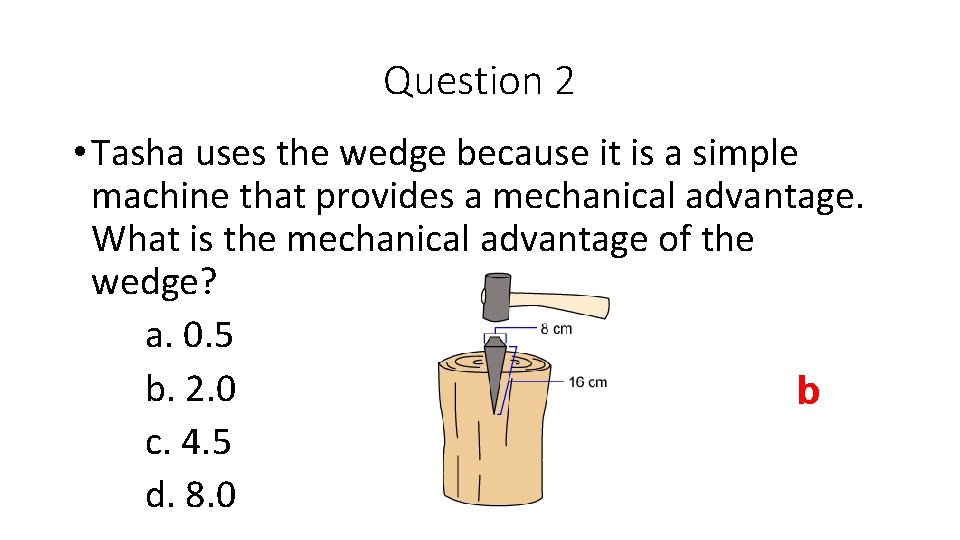
Question 2 • Tasha uses the wedge because it is a simple machine that provides a mechanical advantage. What is the mechanical advantage of the wedge? a. 0. 5 b. 2. 0 b c. 4. 5 d. 8. 0
Question 3 • Kartianna is pushing a lawn mower using a force of 300 N. If she pushes the mower a distance of 800 m, how much work has she done? a. 500 J b. 800 J c. 1100 J d d. 2400 J
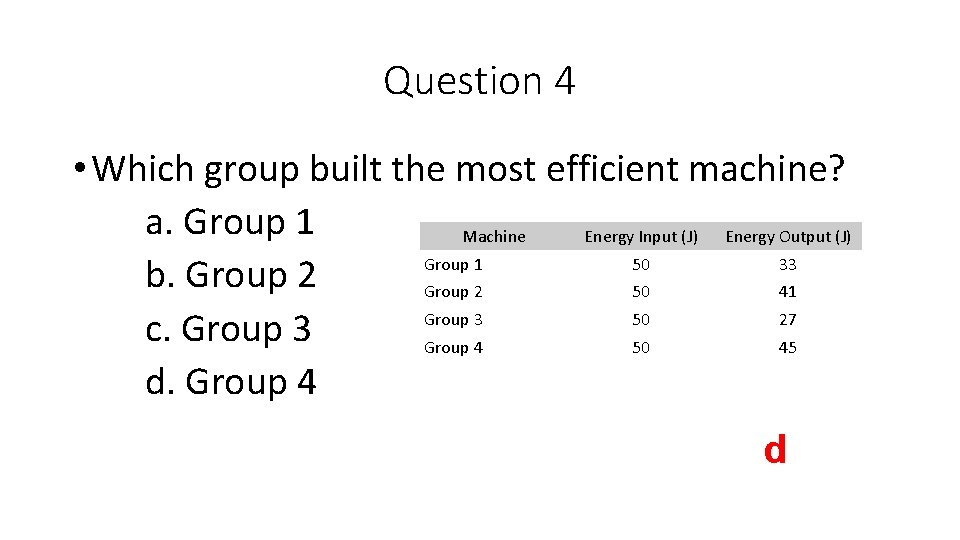
Question 4 • Which group built the most efficient machine? a. Group 1 Machine Energy Input (J) Energy Output (J) Group 1 50 33 b. Group 2 50 41 Group 3 50 27 c. Group 3 Group 4 50 45 d. Group 4 d
Question 5 • If you perform 40 joules of work lifting a 10 N box from the floor to a shelf, how high is the shelf? a. 0. 3 m b. 4. 0 m c. 20 m d. 400 m b
Question 6 • A machine is a device that can multiply a. force. b. work. c. power. d. all of the above a
Question 7 • How can a machine make work easier for you? a. by decreasing the amount of work you do b. by changing the direction of your force c. by increasing the work done by the machine d. none of the above b
Question 8 • Darla pushed a cart with 50 newtons of force 100 meters away from her house. How much work, measured in joules, did she do to move the cart? a. 2 J b. 50 J c. 150 J d. 5000 J d
Question 9 • How can you make the work output of a machine greater than the work input? a. by decreasing friction b. by increasing the input force c. by increasing the output distance d. none of the above d
Question 10 • The actual mechanical advantage of a machine a. is less than the ideal mechanical advantage of the machine. b. decreases as the input distance increases. c. increases with greater friction. d. cannot be less than 1. a
Question 11 • A 120 m long ski lift carries skiers from a station at the foot of a slope to a second station 40 m above. What is the IMA of the lift? a. 0. 3 b. 40 c. 3 d. 160 c
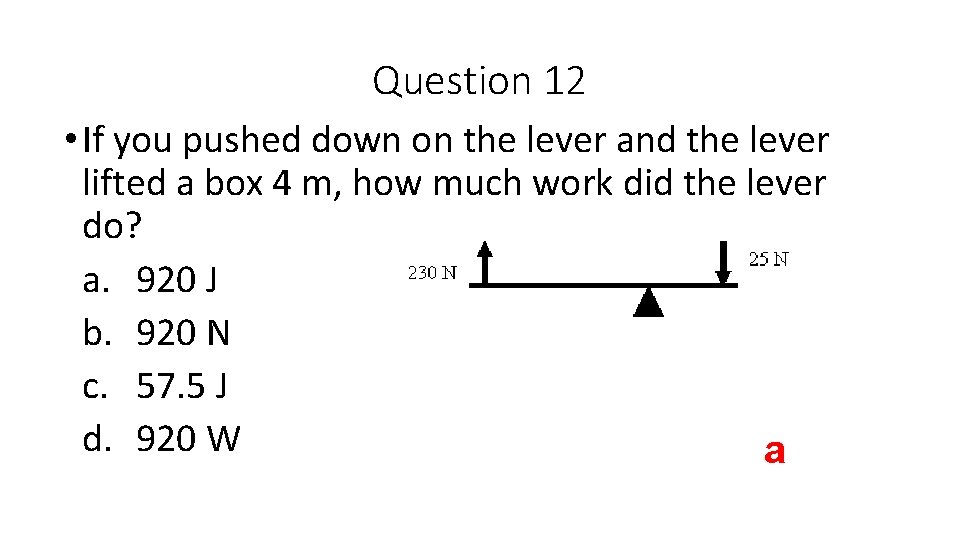
Question 12 • If you pushed down on the lever and the lever lifted a box 4 m, how much work did the lever do? a. 920 J b. 920 N c. 57. 5 J d. 920 W a
Question 13 • An ax is an example of a(an) a. inclined plane. b. wedge. c. lever. d. wheel and axle. b
Question 14 • An inclined plane reduces the effort force by a. increasing the work. b. reducing the effort distance. c. increasing the distance through which the force is applied. d. reducing the work. c
Question 15 • Luisa used a claw hammer to remove nails from a piece of wood she wants to paint. What is the effort distance for a claw hammer if the resistance distance is 6. 0 cm and the mechanical advantage is 6. 0? a. 24 b. 27 c. 30 d d. 36
Question 16 • If you grease a ramp to make a box slide more easily, what happens to the ramp’s ideal mechanical advantage? a. it decreases b. it is multiplied by 100 c. it stays the same d. it increases c
Question 17 • An example of a compound machine is a a. crowbar. b. ramp. c. seesaw. d. bike. d
Question 18 • A brick mason builds a simple machine to lift bricks from the ground up to the second story of a building. The machine requires an input force of 35 N to lift 75 kg (735 N) of bricks. What is the mechanical advantage (MA) of the simple machine? a. 21 b. 2. 143 c. 35 a d. 0. 048
Question 19 • A lever has a mechanical advantage of 2. What does the lever multiply? a. It multiplies the output work by 2. b. It multiplies the output force by 2. c. It multiplies the output energy by 2. d. It multiplies the output distance by 2. b
Question 20 • A construction crew must use a lever to lift a boulder. The mechanical advantage of the lever is 6 and the lever applies a force of 1600 N to the rock. What is the force that the construction crew must apply to the lever? a. 134 N b. 267 N c. 380 N d. 534 N b