
IV PUSH MATH By Mary Jacobs Spring 2019

IV PUSH MATH By: Mary Jacobs Spring 2019 Based on Dr. Casey Scudmore’s Video Presentation Retrieved from: https: //www. youtube. com/watch? v=m. OUu 916 I 2 z. M&t=9 s

IV push safety Remember that medications have a recommended push time for a reason. Many medications if pushed too quickly can create a toxicity and extreme reaction in the client. You can always push a little slower if the math doesn’t give even increments. For example 1. 25 ml/15 sec can be further slowed to 1. 2 ml/15 sec or even 1 ml/15 sec depending on medication and client. Never let go of the syringe while pushing medications. Also, always thoroughly clean your port. The alcohol caps are great, but only effective if they’ve been on for at least 3 minutes. Client safety above nurse convenience. Verify your math. You can always push a little slower. Make sure fluids are compatible with the medication.
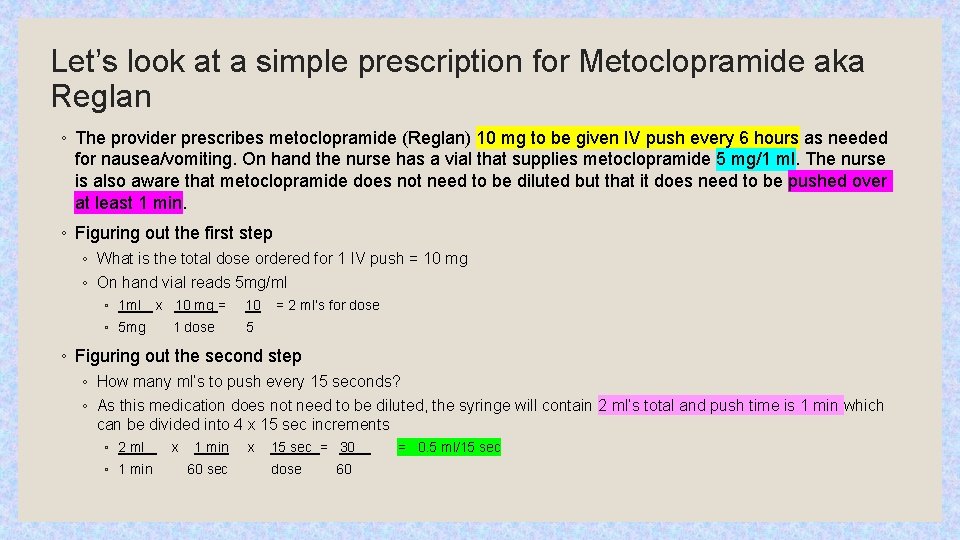
Let’s look at a simple prescription for Metoclopramide aka Reglan ◦ The provider prescribes metoclopramide (Reglan) 10 mg to be given IV push every 6 hours as needed for nausea/vomiting. On hand the nurse has a vial that supplies metoclopramide 5 mg/1 ml. The nurse is also aware that metoclopramide does not need to be diluted but that it does need to be pushed over at least 1 min. ◦ Figuring out the first step ◦ What is the total dose ordered for 1 IV push = 10 mg ◦ On hand vial reads 5 mg/ml ◦ 1 ml x 10 mg = 10 ◦ 5 mg 1 dose 5 = 2 ml’s for dose ◦ Figuring out the second step ◦ How many ml’s to push every 15 seconds? ◦ As this medication does not need to be diluted, the syringe will contain 2 ml’s total and push time is 1 min which can be divided into 4 x 15 sec increments ◦ 2 ml ◦ 1 min x 1 min 60 sec x 15 sec = 30 dose 60 = 0. 5 ml/15 sec
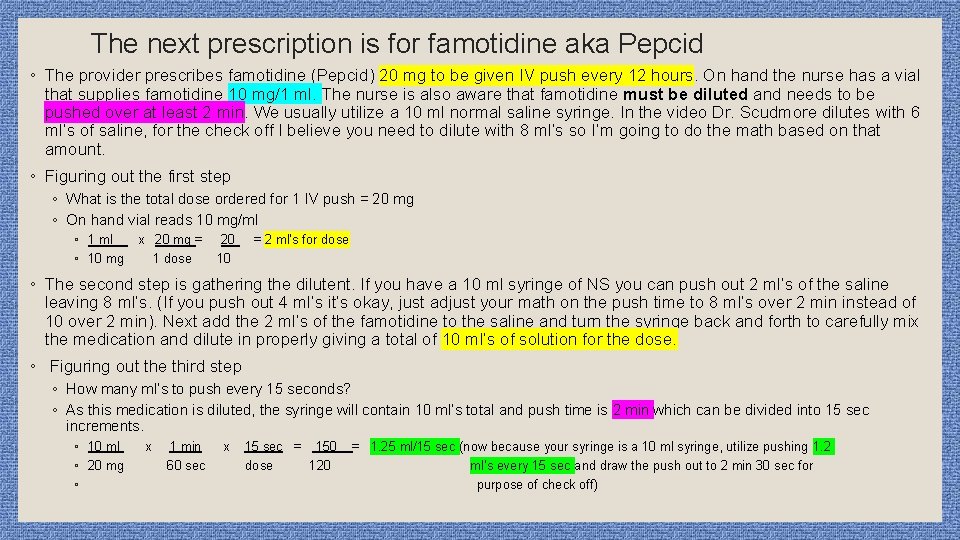
The next prescription is for famotidine aka Pepcid ◦ The provider prescribes famotidine (Pepcid) 20 mg to be given IV push every 12 hours. On hand the nurse has a vial that supplies famotidine 10 mg/1 ml. The nurse is also aware that famotidine must be diluted and needs to be pushed over at least 2 min. We usually utilize a 10 ml normal saline syringe. In the video Dr. Scudmore dilutes with 6 ml’s of saline, for the check off I believe you need to dilute with 8 ml’s so I’m going to do the math based on that amount. ◦ Figuring out the first step ◦ What is the total dose ordered for 1 IV push = 20 mg ◦ On hand vial reads 10 mg/ml ◦ 10 mg x 20 mg = 1 dose 20 10 = 2 ml’s for dose ◦ The second step is gathering the dilutent. If you have a 10 ml syringe of NS you can push out 2 ml’s of the saline leaving 8 ml’s. (If you push out 4 ml’s it’s okay, just adjust your math on the push time to 8 ml’s over 2 min instead of 10 over 2 min). Next add the 2 ml’s of the famotidine to the saline and turn the syringe back and forth to carefully mix the medication and dilute in properly giving a total of 10 ml’s of solution for the dose. ◦ Figuring out the third step ◦ How many ml’s to push every 15 seconds? ◦ As this medication is diluted, the syringe will contain 10 ml’s total and push time is 2 min which can be divided into 15 sec increments. ◦ 10 ml ◦ 20 mg ◦ x 1 min 60 sec x 15 sec = 150 dose 120 = 1. 25 ml/15 sec (now because your syringe is a 10 ml syringe, utilize pushing 1. 2 ml’s every 15 sec and draw the push out to 2 min 30 sec for purpose of check off)
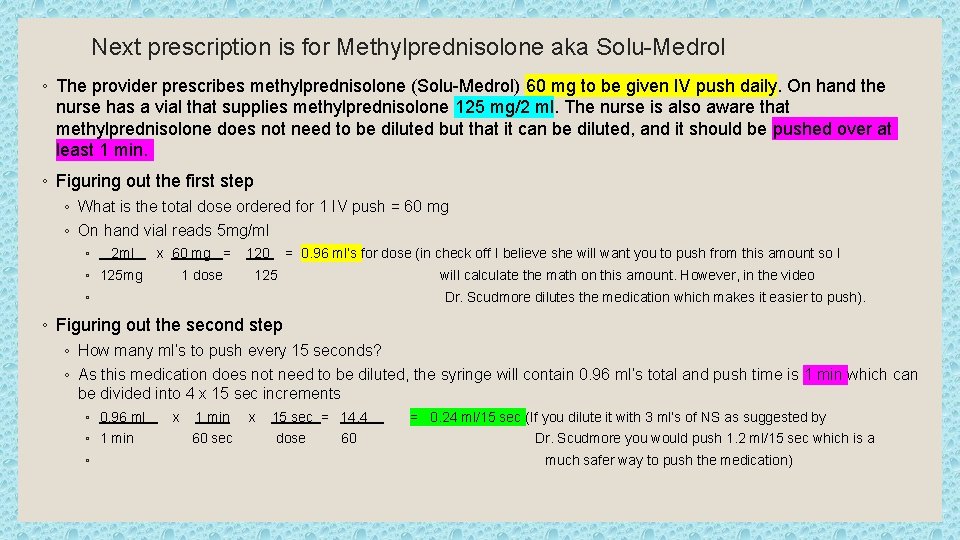
Next prescription is for Methylprednisolone aka Solu-Medrol ◦ The provider prescribes methylprednisolone (Solu-Medrol) 60 mg to be given IV push daily. On hand the nurse has a vial that supplies methylprednisolone 125 mg/2 ml. The nurse is also aware that methylprednisolone does not need to be diluted but that it can be diluted, and it should be pushed over at least 1 min. ◦ Figuring out the first step ◦ What is the total dose ordered for 1 IV push = 60 mg ◦ On hand vial reads 5 mg/ml ◦ 2 ml x 60 mg = ◦ 125 mg 1 dose 120 = 0. 96 ml’s for dose (in check off I believe she will want you to push from this amount so I 125 will calculate the math on this amount. However, in the video ◦ Dr. Scudmore dilutes the medication which makes it easier to push). ◦ Figuring out the second step ◦ How many ml’s to push every 15 seconds? ◦ As this medication does not need to be diluted, the syringe will contain 0. 96 ml’s total and push time is 1 min which can be divided into 4 x 15 sec increments ◦ 0. 96 ml ◦ 1 min ◦ x 1 min 60 sec x 15 sec = 14. 4 dose 60 = 0. 24 ml/15 sec (If you dilute it with 3 ml’s of NS as suggested by Dr. Scudmore you would push 1. 2 ml/15 sec which is a much safer way to push the medication)

Next prescription is for Pantoprazole aka Protonix ◦ The provider prescribes pantoprazole (Protonix) 40 mg to be given IV push daily. On hand the nurse has a vial that supplies metoclopramide 40 mg powder to be reconstituted with 10 ml of NS. The nurse is also aware that it needs to be pushed over 2 minimum. ◦ Figuring out the first step ◦ What is the total dose ordered for 1 IV push = 40 mg ◦ On hand vial reads 40 mg of powder to be reconstituted with 10 ml’s of saline providing us with a 40 mg/10 syringe to be pushed over 2 minutes. No math for first step. Just be certain to mix until the powder is completely dissolved. ◦ Figuring out the second step ◦ How many ml’s to push every 15 seconds? ◦ As this medication does not need to be diluted, the syringe will contain 10 ml’s total and push time is 2 min which can be divided into 4 x 15 sec increments ◦ 10 ml ◦ 2 min ◦ x 1 min 60 sec x 15 sec = 150 dose 120 = 1. 25 ml/15 sec (because of syringe size you will not be able to get 1. 25 so you will give 1. 2 ml/15 sec and total time over 2 min 30 sec)
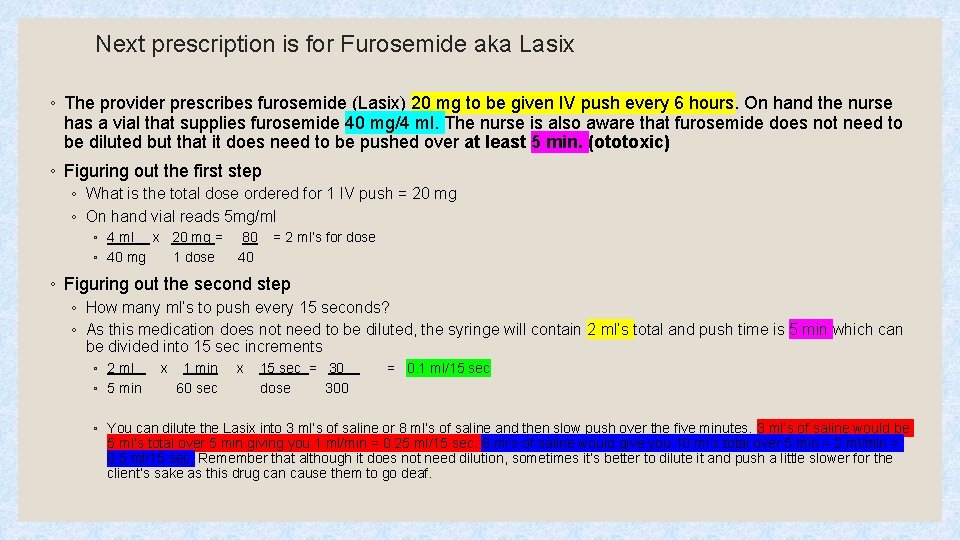
Next prescription is for Furosemide aka Lasix ◦ The provider prescribes furosemide (Lasix) 20 mg to be given IV push every 6 hours. On hand the nurse has a vial that supplies furosemide 40 mg/4 ml. The nurse is also aware that furosemide does not need to be diluted but that it does need to be pushed over at least 5 min. (ototoxic) ◦ Figuring out the first step ◦ What is the total dose ordered for 1 IV push = 20 mg ◦ On hand vial reads 5 mg/ml ◦ 4 ml x 20 mg = ◦ 40 mg 1 dose 80 40 = 2 ml’s for dose ◦ Figuring out the second step ◦ How many ml’s to push every 15 seconds? ◦ As this medication does not need to be diluted, the syringe will contain 2 ml’s total and push time is 5 min which can be divided into 15 sec increments ◦ 2 ml ◦ 5 min x 1 min 60 sec x 15 sec = 30 dose 300 = 0. 1 ml/15 sec ◦ You can dilute the Lasix into 3 ml’s of saline or 8 ml’s of saline and then slow push over the five minutes. 3 ml’s of saline would be 5 ml’s total over 5 min giving you 1 ml/min = 0. 25 ml/15 sec. 8 ml’s of saline would give you 10 ml’s total over 5 min = 2 ml/min = 0. 5 ml/15 sec. Remember that although it does not need dilution, sometimes it’s better to dilute it and push a little slower for the client’s sake as this drug can cause them to go deaf.
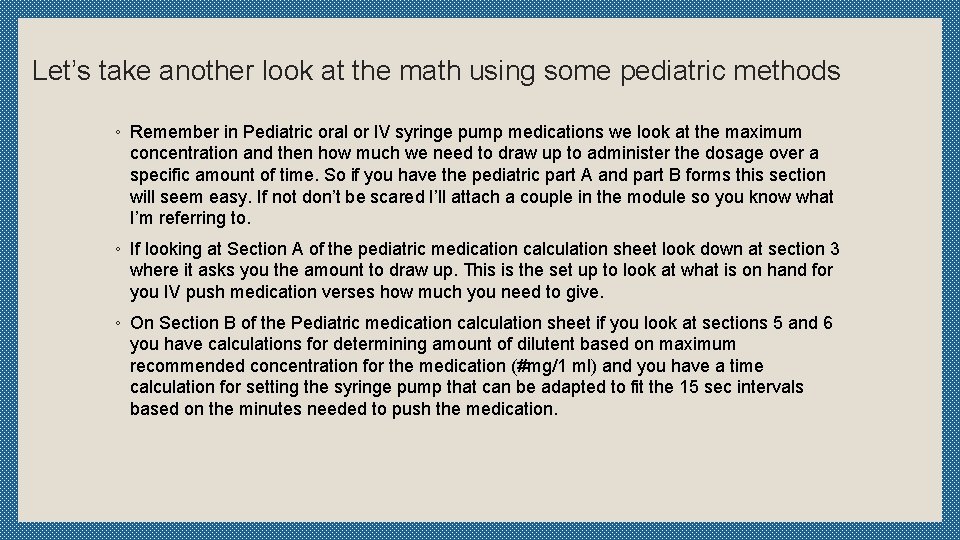
Let’s take another look at the math using some pediatric methods ◦ Remember in Pediatric oral or IV syringe pump medications we look at the maximum concentration and then how much we need to draw up to administer the dosage over a specific amount of time. So if you have the pediatric part A and part B forms this section will seem easy. If not don’t be scared I’ll attach a couple in the module so you know what I’m referring to. ◦ If looking at Section A of the pediatric medication calculation sheet look down at section 3 where it asks you the amount to draw up. This is the set up to look at what is on hand for you IV push medication verses how much you need to give. ◦ On Section B of the Pediatric medication calculation sheet if you look at sections 5 and 6 you have calculations for determining amount of dilutent based on maximum recommended concentration for the medication (#mg/1 ml) and you have a time calculation for setting the syringe pump that can be adapted to fit the 15 sec intervals based on the minutes needed to push the medication.
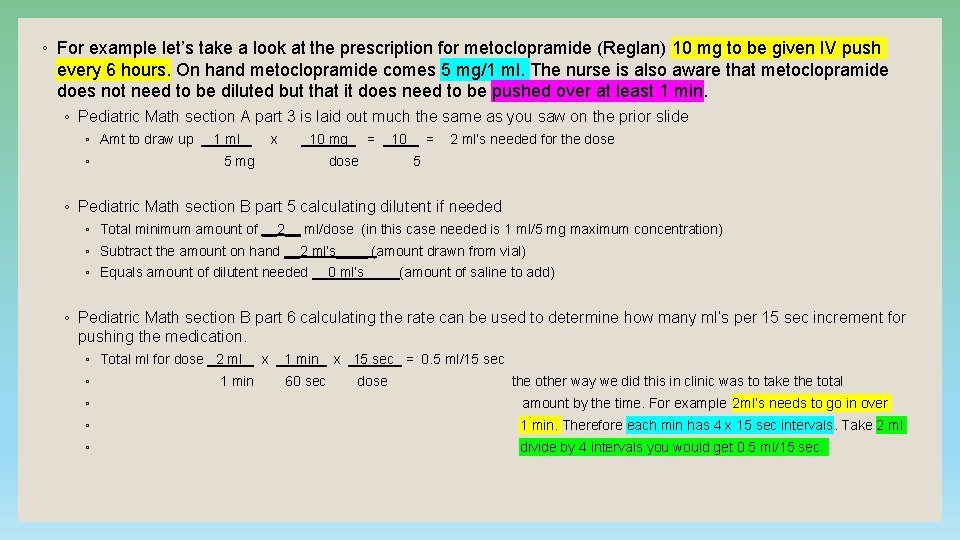
◦ For example let’s take a look at the prescription for metoclopramide (Reglan) 10 mg to be given IV push every 6 hours. On hand metoclopramide comes 5 mg/1 ml. The nurse is also aware that metoclopramide does not need to be diluted but that it does need to be pushed over at least 1 min. ◦ Pediatric Math section A part 3 is laid out much the same as you saw on the prior slide ◦ Amt to draw up ◦ 1 ml x 10 mg 5 mg = dose 10 = 2 ml’s needed for the dose 5 ◦ Pediatric Math section B part 5 calculating dilutent if needed ◦ Total minimum amount of __2__ ml/dose (in this case needed is 1 ml/5 mg maximum concentration) ◦ Subtract the amount on hand __2 ml’s____ (amount drawn from vial) ◦ Equals amount of dilutent needed __0 ml’s____ (amount of saline to add) ◦ Pediatric Math section B part 6 calculating the rate can be used to determine how many ml’s per 15 sec increment for pushing the medication. ◦ Total ml for dose 2 ml ◦ 1 min x 1 min 60 sec x 15 sec = 0. 5 ml/15 sec dose the other way we did this in clinic was to take the total ◦ amount by the time. For example 2 ml’s needs to go in over ◦ 1 min. Therefore each min has 4 x 15 sec intervals. Take 2 ml ◦ divide by 4 intervals you would get 0. 5 ml/15 sec.
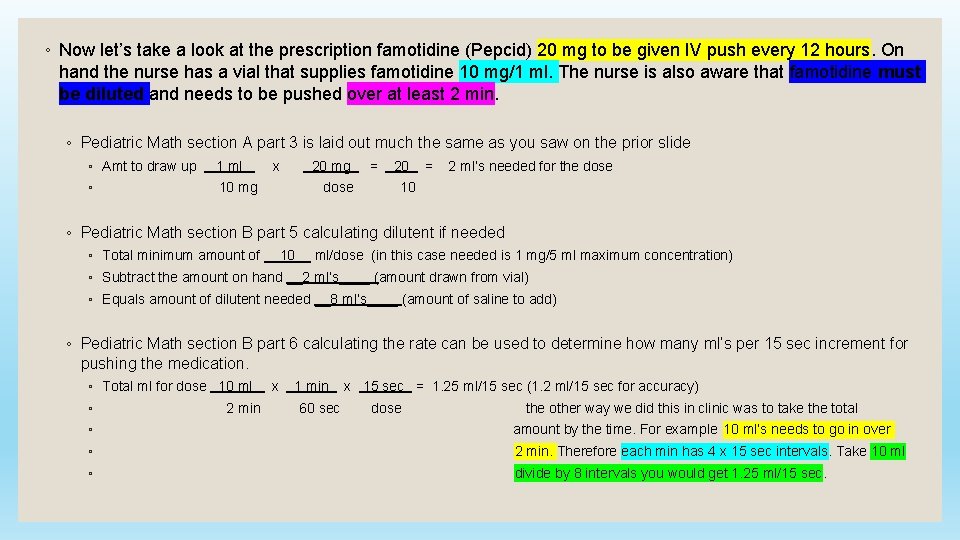
◦ Now let’s take a look at the prescription famotidine (Pepcid) 20 mg to be given IV push every 12 hours. On hand the nurse has a vial that supplies famotidine 10 mg/1 ml. The nurse is also aware that famotidine must be diluted and needs to be pushed over at least 2 min. ◦ Pediatric Math section A part 3 is laid out much the same as you saw on the prior slide ◦ Amt to draw up 1 ml ◦ 10 mg x 20 mg dose = 20 = 2 ml’s needed for the dose 10 ◦ Pediatric Math section B part 5 calculating dilutent if needed ◦ Total minimum amount of __10__ ml/dose (in this case needed is 1 mg/5 ml maximum concentration) ◦ Subtract the amount on hand __2 ml’s____ (amount drawn from vial) ◦ Equals amount of dilutent needed __8 ml’s____ (amount of saline to add) ◦ Pediatric Math section B part 6 calculating the rate can be used to determine how many ml’s per 15 sec increment for pushing the medication. ◦ Total ml for dose 10 ml ◦ 2 min x 1 min 60 sec x 15 sec = 1. 25 ml/15 sec (1. 2 ml/15 sec for accuracy) dose the other way we did this in clinic was to take the total ◦ amount by the time. For example 10 ml’s needs to go in over ◦ 2 min. Therefore each min has 4 x 15 sec intervals. Take 10 ml ◦ divide by 8 intervals you would get 1. 25 ml/15 sec.
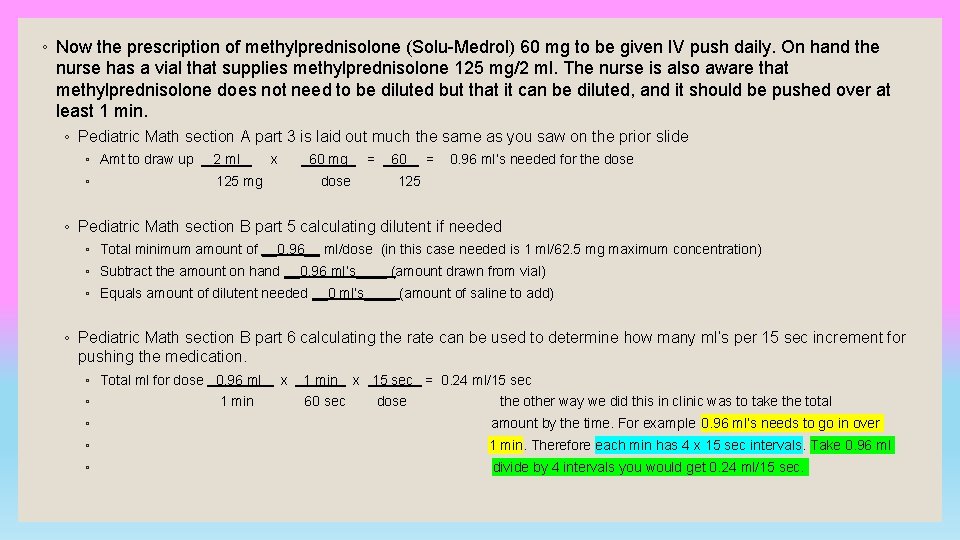
◦ Now the prescription of methylprednisolone (Solu-Medrol) 60 mg to be given IV push daily. On hand the nurse has a vial that supplies methylprednisolone 125 mg/2 ml. The nurse is also aware that methylprednisolone does not need to be diluted but that it can be diluted, and it should be pushed over at least 1 min. ◦ Pediatric Math section A part 3 is laid out much the same as you saw on the prior slide ◦ Amt to draw up 2 ml ◦ 125 mg x 60 mg dose = 60 = 0. 96 ml’s needed for the dose 125 ◦ Pediatric Math section B part 5 calculating dilutent if needed ◦ Total minimum amount of __0. 96__ ml/dose (in this case needed is 1 ml/62. 5 mg maximum concentration) ◦ Subtract the amount on hand __0. 96 ml’s____ (amount drawn from vial) ◦ Equals amount of dilutent needed __0 ml’s____ (amount of saline to add) ◦ Pediatric Math section B part 6 calculating the rate can be used to determine how many ml’s per 15 sec increment for pushing the medication. ◦ Total ml for dose 0. 96 ml ◦ 1 min x 1 min 60 sec x 15 sec = 0. 24 ml/15 sec dose the other way we did this in clinic was to take the total ◦ amount by the time. For example 0. 96 ml’s needs to go in over ◦ 1 min. Therefore each min has 4 x 15 sec intervals. Take 0. 96 ml ◦ divide by 4 intervals you would get 0. 24 ml/15 sec.
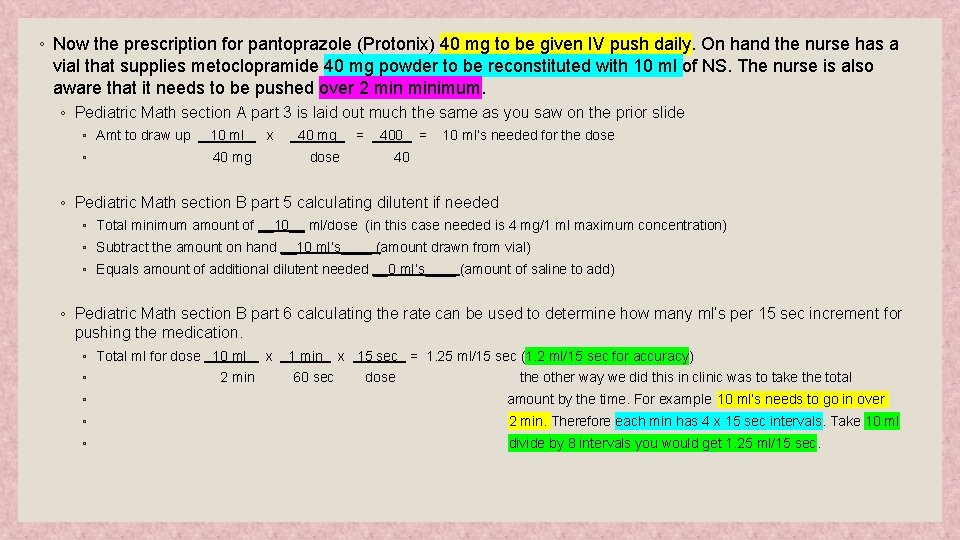
◦ Now the prescription for pantoprazole (Protonix) 40 mg to be given IV push daily. On hand the nurse has a vial that supplies metoclopramide 40 mg powder to be reconstituted with 10 ml of NS. The nurse is also aware that it needs to be pushed over 2 minimum. ◦ Pediatric Math section A part 3 is laid out much the same as you saw on the prior slide ◦ Amt to draw up 10 ml ◦ 40 mg x 40 mg = dose 400 = 10 ml’s needed for the dose 40 ◦ Pediatric Math section B part 5 calculating dilutent if needed ◦ Total minimum amount of __10__ ml/dose (in this case needed is 4 mg/1 ml maximum concentration) ◦ Subtract the amount on hand __10 ml’s____ (amount drawn from vial) ◦ Equals amount of additional dilutent needed __0 ml’s____ (amount of saline to add) ◦ Pediatric Math section B part 6 calculating the rate can be used to determine how many ml’s per 15 sec increment for pushing the medication. ◦ Total ml for dose 10 ml ◦ 2 min x 1 min 60 sec x 15 sec = 1. 25 ml/15 sec (1. 2 ml/15 sec for accuracy) dose the other way we did this in clinic was to take the total ◦ amount by the time. For example 10 ml’s needs to go in over ◦ 2 min. Therefore each min has 4 x 15 sec intervals. Take 10 ml ◦ divide by 8 intervals you would get 1. 25 ml/15 sec.
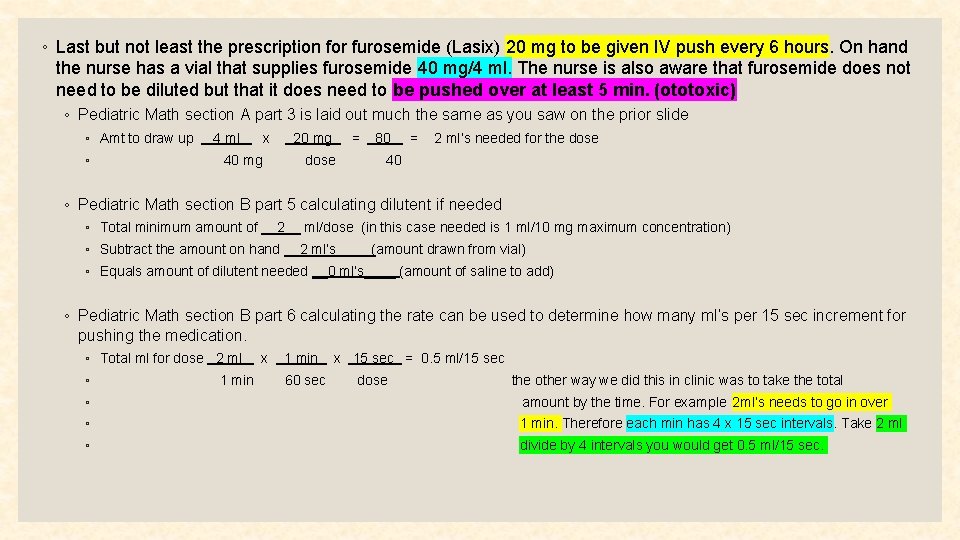
◦ Last but not least the prescription for furosemide (Lasix) 20 mg to be given IV push every 6 hours. On hand the nurse has a vial that supplies furosemide 40 mg/4 ml. The nurse is also aware that furosemide does not need to be diluted but that it does need to be pushed over at least 5 min. (ototoxic) ◦ Pediatric Math section A part 3 is laid out much the same as you saw on the prior slide ◦ Amt to draw up ◦ 4 ml x 40 mg 20 mg = dose 80 = 2 ml’s needed for the dose 40 ◦ Pediatric Math section B part 5 calculating dilutent if needed ◦ Total minimum amount of __2__ ml/dose (in this case needed is 1 ml/10 mg maximum concentration) ◦ Subtract the amount on hand __2 ml’s____ (amount drawn from vial) ◦ Equals amount of dilutent needed __0 ml’s____ (amount of saline to add) ◦ Pediatric Math section B part 6 calculating the rate can be used to determine how many ml’s per 15 sec increment for pushing the medication. ◦ Total ml for dose 2 ml ◦ 1 min x 1 min 60 sec x 15 sec = 0. 5 ml/15 sec dose the other way we did this in clinic was to take the total ◦ amount by the time. For example 2 ml’s needs to go in over ◦ 1 min. Therefore each min has 4 x 15 sec intervals. Take 2 ml ◦ divide by 4 intervals you would get 0. 5 ml/15 sec.
Additional Practice and Resources ◦ I uploaded the list of different IV push medications from Dr. Scudmore’s website to the module as well so that you can utilize it and plug the numbers into the formulas for additional practice. Remember for extra help see Dr. Scudmore’s You Tube videos on IV push medications. ◦ https: //www. youtube. com/channel/UCBn. Vy. KD 4_H 1_DEm. Aj 3 m. YBEg/videos ◦ https: //www. youtube. com/watch? v=N-t 2 m 16 NPl 8 ◦ https: //www. youtube. com/watch? v=m. OUu 916 I 2 z. M ◦ https: //www. youtube. com/watch? v=PLx. U 5 WNjl. XY ◦ https: //www. youtube. com/watch? v=b 6 NP_POTAr 4 ◦ https: //www. youtube. com/watch? v=muql. Cr. Sxp. Es
- Slides: 14