Welcome to the Canadian Red Cross First Aid





- Slides: 89
Welcome to the Canadian Red Cross First Aid & CPR Course Copyright © 2006 The Canadian Red Cross Society
What is the ACT Foundation? ACT… • Fundraises for mannequins and AED for schools. • Brings CPR to all schools. • Is partnered nationally with health partners who support ACT’s Canada-wide goal for CPR in schools: § Astra. Zeneca Canada § Pfizer Canada § Sanofi Visit ACT! www. actfoundation. ca 2 Copyright © 2006 The Canadian Red Cross Society First Aid & CPR
Day 1 Preparing to Respond EMS Check, Call, Care 3 Copyright © 2006 The Canadian Red Cross Society First Aid & CPR
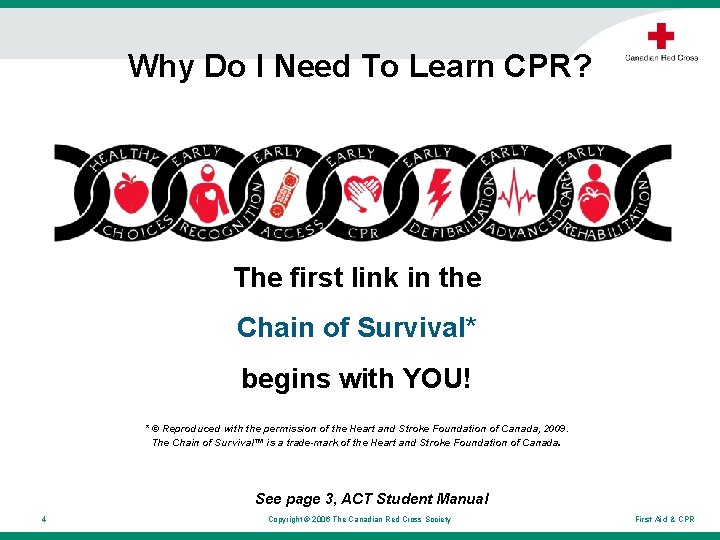
Why Do I Need To Learn CPR? The first link in the Chain of Survival* begins with YOU! * © Reproduced with the permission of the Heart and Stroke Foundation of Canada, 2009. The Chain of Survival™ is a trade-mark of the Heart and Stroke Foundation of Canada. See page 3, ACT Student Manual 4 Copyright © 2006 The Canadian Red Cross Society First Aid & CPR
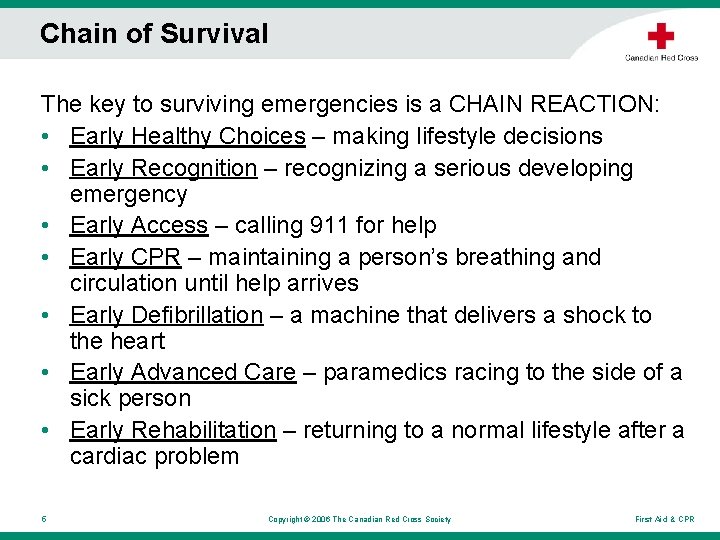
Chain of Survival The key to surviving emergencies is a CHAIN REACTION: • Early Healthy Choices – making lifestyle decisions • Early Recognition – recognizing a serious developing emergency • Early Access – calling 911 for help • Early CPR – maintaining a person’s breathing and circulation until help arrives • Early Defibrillation – a machine that delivers a shock to the heart • Early Advanced Care – paramedics racing to the side of a sick person • Early Rehabilitation – returning to a normal lifestyle after a cardiac problem 5 Copyright © 2006 The Canadian Red Cross Society First Aid & CPR
The 4 R’s of CPR • RISK – factors in your life that predispose you to developing heart problems or a stroke • RECOGNIZE – how to recognize a serious developing emergency • REACT – what to do when you see a developing emergency • RESUSCITATE – how to do CPR and how to help someone who is choking 6 Copyright © 2006 The Canadian Red Cross Society First Aid & CPR
Laws that Protect First Aiders Ontario • The Good Samaritan Act, 2001 • a legal principle that prevents a rescuer who has voluntarily helped a victim in distress from being successfully sued for 'wrongdoing. ' • Its purpose is to keep people from being so reluctant to help a stranger in need for fear of legal repercussions if they made some mistake in treatment. ***It is KEY to get the person’s consent before you help, or parent/guardian consent for an injured child. For an UNCONSCIOUS person, consent is IMPLIED. 7 Copyright © 2006 The Canadian Red Cross Society First Aid & CPR
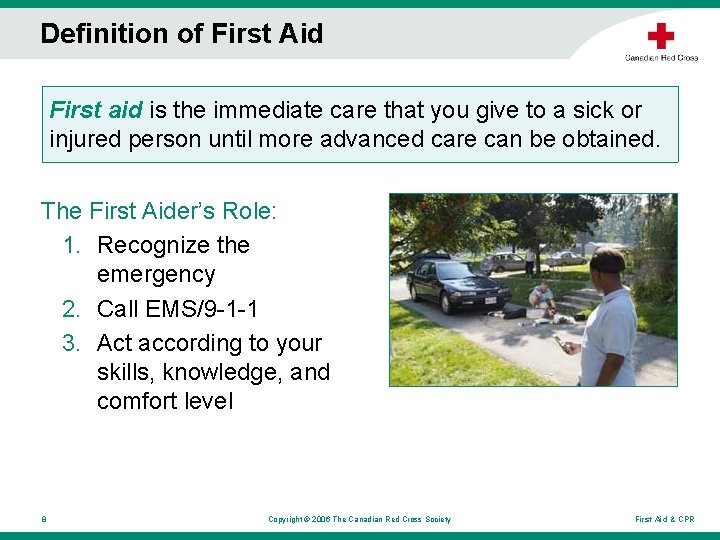
Definition of First Aid First aid is the immediate care that you give to a sick or injured person until more advanced care can be obtained. The First Aider’s Role: 1. Recognize the emergency 2. Call EMS/9 -1 -1 3. Act according to your skills, knowledge, and comfort level 8 Copyright © 2006 The Canadian Red Cross Society First Aid & CPR
Common Concerns About Providing First Aid • • • 9 Other people at the scene The ill or injured person Unpleasant injuries or illnesses Catching a disease Doing something wrong Copyright © 2006 The Canadian Red Cross Society First Aid & CPR
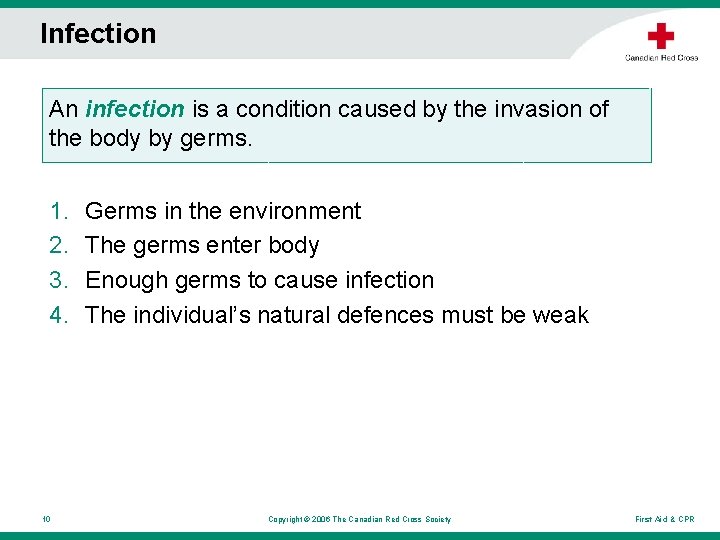
Infection An infection is a condition caused by the invasion of the body by germs. 1. 2. 3. 4. 10 Germs in the environment The germs enter body Enough germs to cause infection The individual’s natural defences must be weak Copyright © 2006 The Canadian Red Cross Society First Aid & CPR
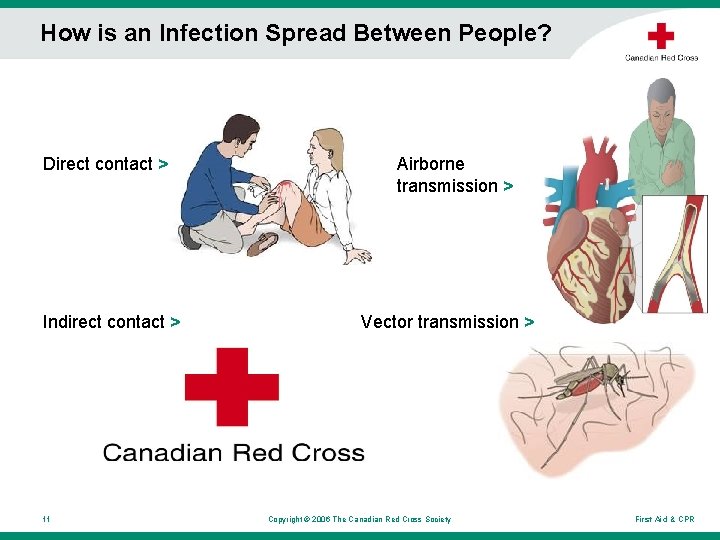
How is an Infection Spread Between People? Direct contact > Indirect contact > 11 Airborne transmission > Vector transmission > Copyright © 2006 The Canadian Red Cross Society First Aid & CPR
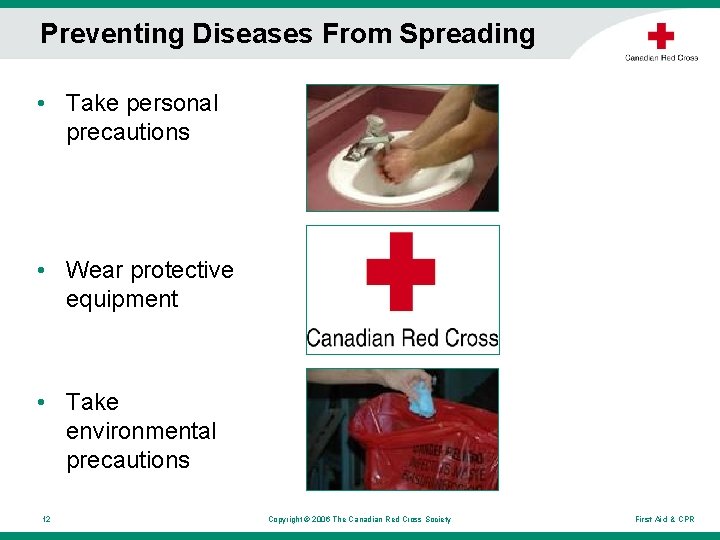
Preventing Diseases From Spreading • Take personal precautions • Wear protective equipment • Take environmental precautions 12 Copyright © 2006 The Canadian Red Cross Society First Aid & CPR
Preparing to Respond – Summary Questions 1. 2. 3. 4. 5. 13 List three examples of a medical emergency. How can a disease be transmitted in first aid? How can disease transmission be prevented in first aid? Can you be sued for doing first aid? Name three elements of a home safety plan. Copyright © 2006 The Canadian Red Cross Society First Aid & CPR
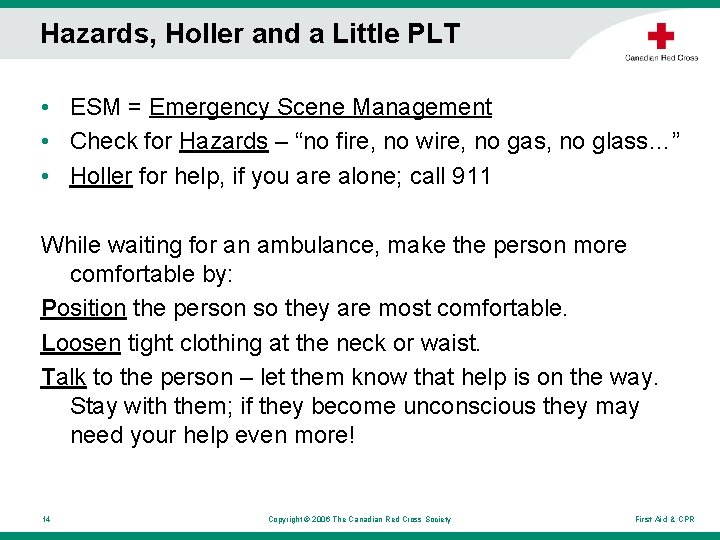
Hazards, Holler and a Little PLT • ESM = Emergency Scene Management • Check for Hazards – “no fire, no wire, no gas, no glass…” • Holler for help, if you are alone; call 911 While waiting for an ambulance, make the person more comfortable by: Position the person so they are most comfortable. Loosen tight clothing at the neck or waist. Talk to the person – let them know that help is on the way. Stay with them; if they become unconscious they may need your help even more! 14 Copyright © 2006 The Canadian Red Cross Society First Aid & CPR
Check, Call, Care – Be Systematic 4 Check 4 Call 4 Care 15 Copyright © 2006 The Canadian Red Cross Society First Aid & CPR
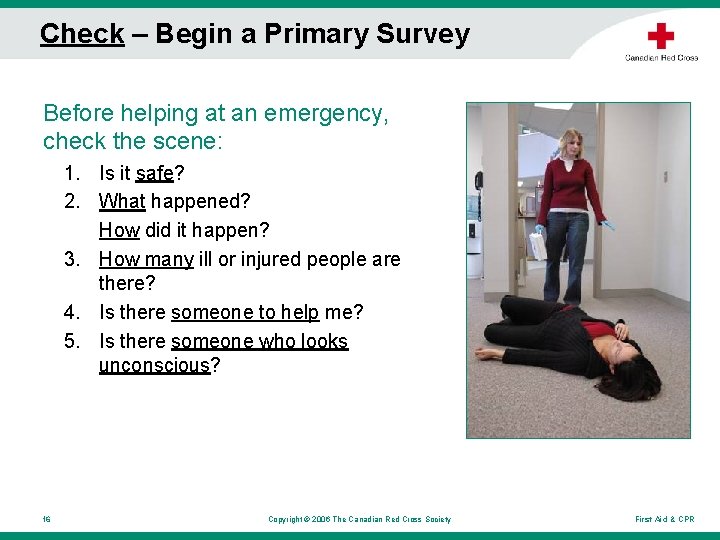
Check – Begin a Primary Survey Before helping at an emergency, check the scene: 1. Is it safe? 2. What happened? How did it happen? 3. How many ill or injured people are there? 4. Is there someone to help me? 5. Is there someone who looks unconscious? 16 Copyright © 2006 The Canadian Red Cross Society First Aid & CPR
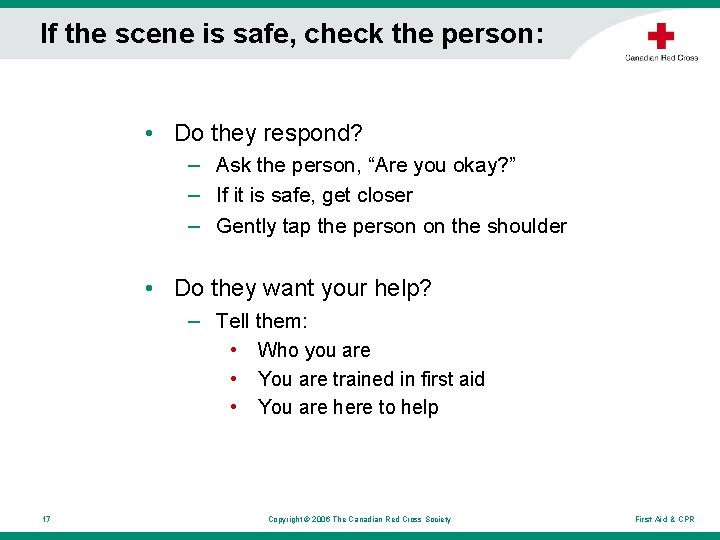
If the scene is safe, check the person: • Do they respond? – Ask the person, “Are you okay? ” – If it is safe, get closer – Gently tap the person on the shoulder • Do they want your help? – Tell them: • Who you are • You are trained in first aid • You are here to help 17 Copyright © 2006 The Canadian Red Cross Society First Aid & CPR
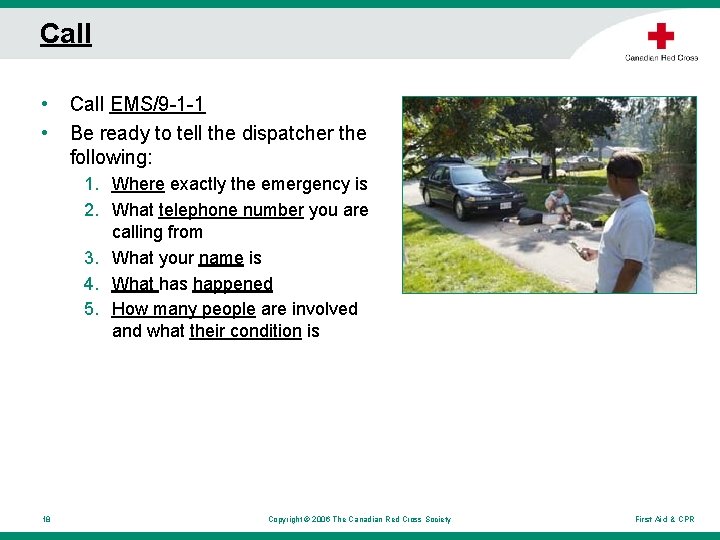
Call • • Call EMS/9 -1 -1 Be ready to tell the dispatcher the following: 1. Where exactly the emergency is 2. What telephone number you are calling from 3. What your name is 4. What has happened 5. How many people are involved and what their condition is 18 Copyright © 2006 The Canadian Red Cross Society First Aid & CPR
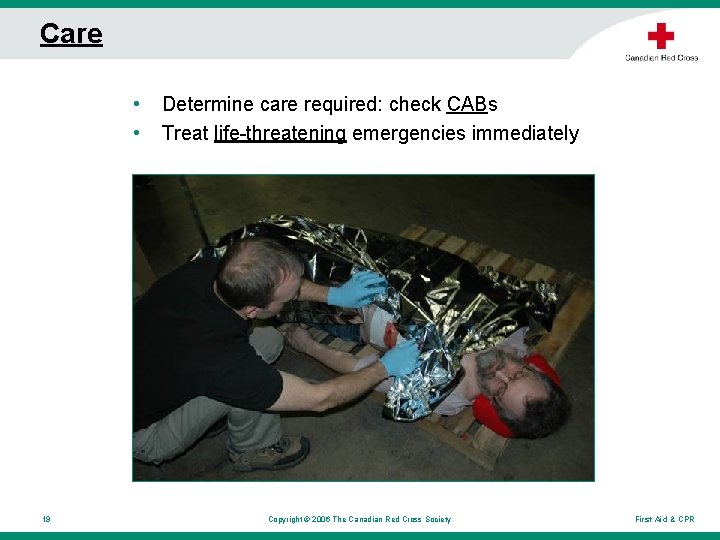
Care • • 19 Determine care required: check CABs Treat life-threatening emergencies immediately Copyright © 2006 The Canadian Red Cross Society First Aid & CPR
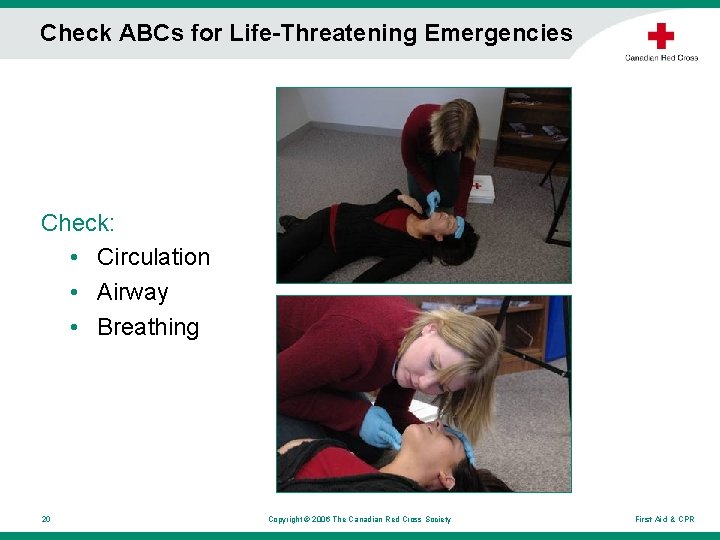
Check ABCs for Life-Threatening Emergencies Check: • Circulation • Airway • Breathing 20 Copyright © 2006 The Canadian Red Cross Society First Aid & CPR
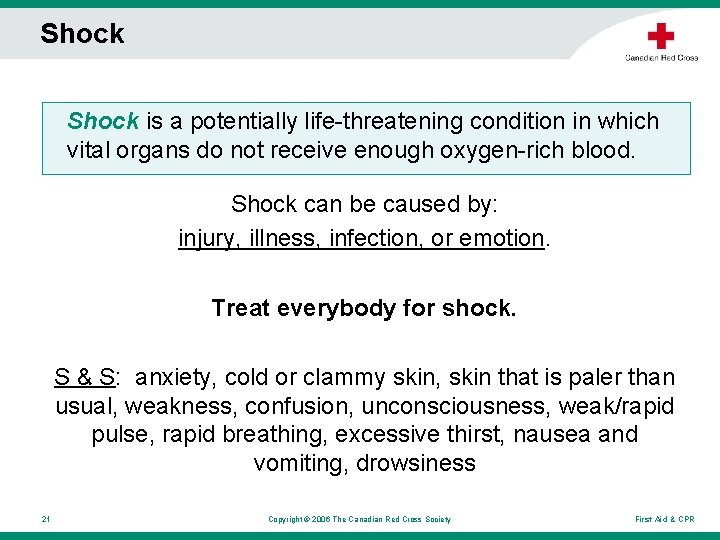
Shock is a potentially life-threatening condition in which vital organs do not receive enough oxygen-rich blood. Shock can be caused by: injury, illness, infection, or emotion. Treat everybody for shock. S & S: anxiety, cold or clammy skin, skin that is paler than usual, weakness, confusion, unconsciousness, weak/rapid pulse, rapid breathing, excessive thirst, nausea and vomiting, drowsiness 21 Copyright © 2006 The Canadian Red Cross Society First Aid & CPR
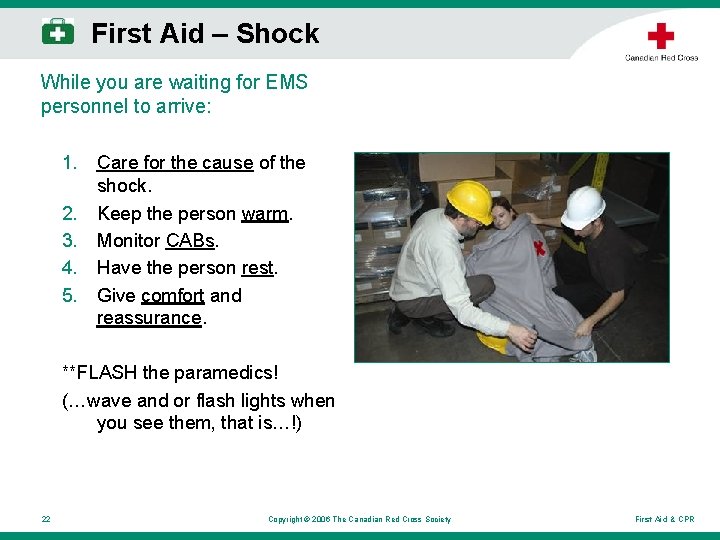
First Aid – Shock While you are waiting for EMS personnel to arrive: 1. Care for the cause of the shock. 2. Keep the person warm. 3. Monitor CABs. 4. Have the person rest. 5. Give comfort and reassurance. **FLASH the paramedics! (…wave and or flash lights when you see them, that is…!) 22 Copyright © 2006 The Canadian Red Cross Society First Aid & CPR
Secondary Survey: Are there any other injuries? Only do a secondary survey if the CABs are present. Do the three-steps of a secondary survey: 1. Ask SAMPLE questions 2. Check vital signs 3. Do a head-to-toe check Always complete the secondary survey before treating any non-life-threatening injuries. 23 Copyright © 2006 The Canadian Red Cross Society First Aid & CPR
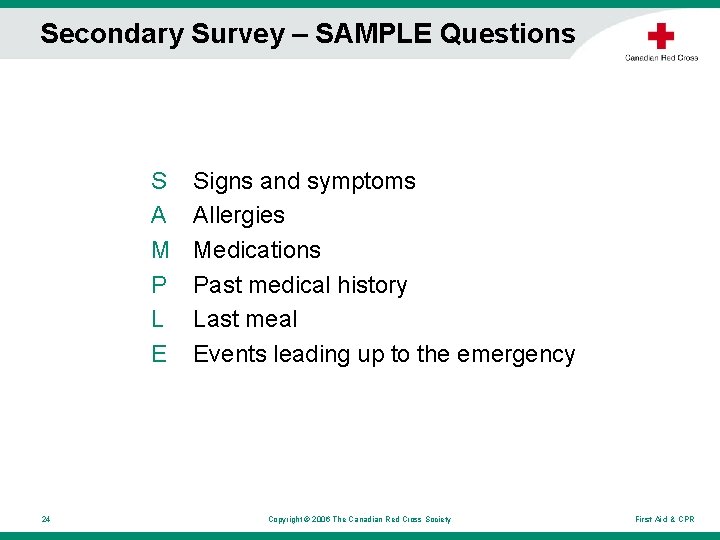
Secondary Survey – SAMPLE Questions S A M P L E 24 Signs and symptoms Allergies Medications Past medical history Last meal Events leading up to the emergency Copyright © 2006 The Canadian Red Cross Society First Aid & CPR
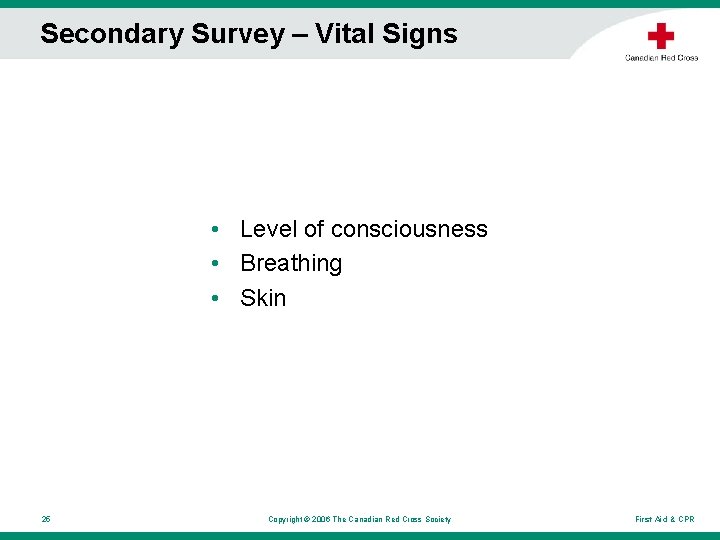
Secondary Survey – Vital Signs • Level of consciousness • Breathing • Skin 25 Copyright © 2006 The Canadian Red Cross Society First Aid & CPR
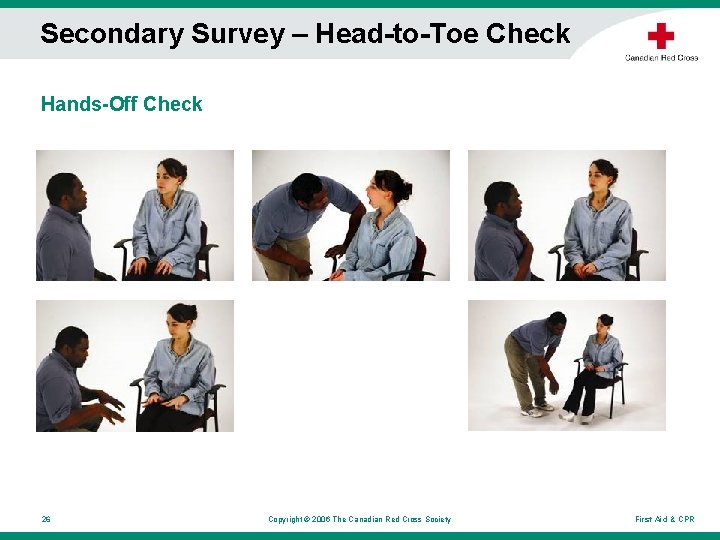
Secondary Survey – Head-to-Toe Check Hands-Off Check 26 Copyright © 2006 The Canadian Red Cross Society First Aid & CPR
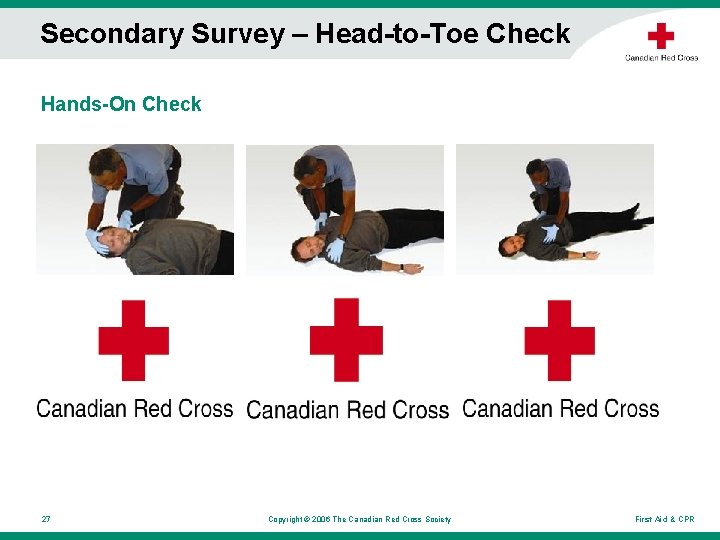
Secondary Survey – Head-to-Toe Check Hands-On Check 27 Copyright © 2006 The Canadian Red Cross Society First Aid & CPR
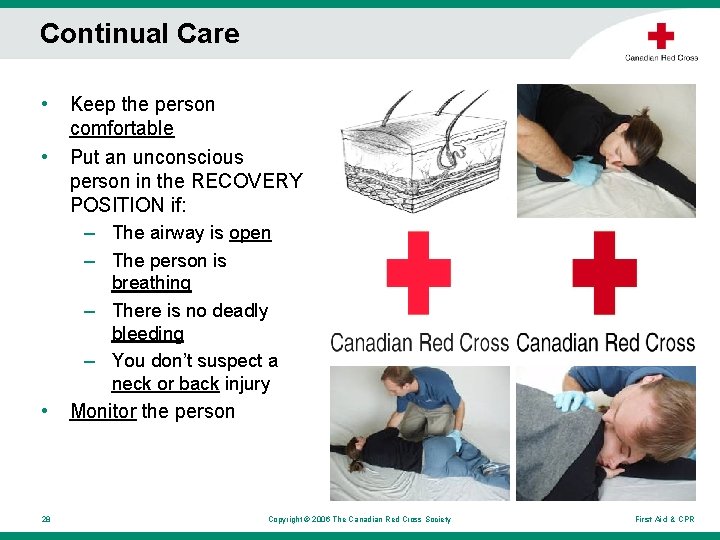
Continual Care • • Keep the person comfortable Put an unconscious person in the RECOVERY POSITION if: – The airway is open – The person is breathing – There is no deadly bleeding – You don’t suspect a neck or back injury • 28 Monitor the person Copyright © 2006 The Canadian Red Cross Society First Aid & CPR
Summary Check • • Check the scene Check the person Call • Call EMS/9 -1 -1 Care • Deal with life-threatening conditions (CABs) Secondary Survey • Perform a secondary survey and treat any non-life-threatening injuries Continual Care • 29 Keep the person comfortable and monitor vital signs Copyright © 2006 The Canadian Red Cross Society First Aid & CPR
Check, Call, Care – Summary Questions 1. 2. 3. 4. 5. 6. 7. What should you do during the check? What actions must you take in call? What actions must you take in care? What can you do to prevent shock? What do you do during the secondary survey? What does the acronym SAMPLE stand for? What should you look for in a head-to-toe check? ***PRACTICE THE RECOVERY POSITION! 30 Copyright © 2006 The Canadian Red Cross Society First Aid & CPR
Cool Idea! • ICE your phone! • ICE stands for In Case of Emergency. Putting ICE before your designated next of kin in your list of contact numbers lets emergency personnel know who to contact in case of emergency! 31 Copyright © 2006 The Canadian Red Cross Society First Aid & CPR
Day 2 Choking & Airway Emergencies 32 Copyright © 2006 The Canadian Red Cross Society First Aid & CPR
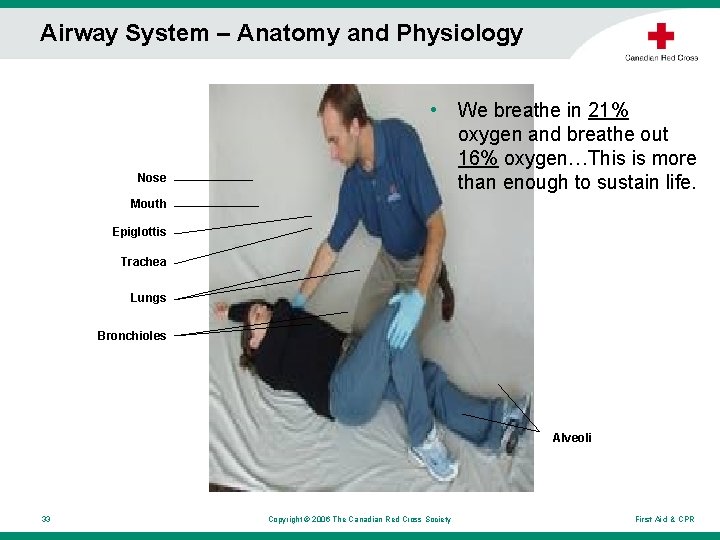
Airway System – Anatomy and Physiology • Nose We breathe in 21% oxygen and breathe out 16% oxygen…This is more than enough to sustain life. Mouth Epiglottis Trachea Lungs Bronchioles Alveoli 33 Copyright © 2006 The Canadian Red Cross Society First Aid & CPR
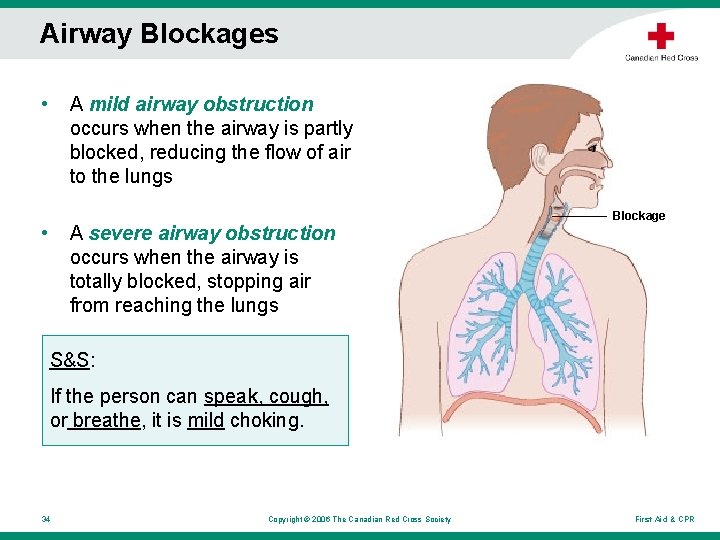
Airway Blockages • A mild airway obstruction occurs when the airway is partly blocked, reducing the flow of air to the lungs • A severe airway obstruction occurs when the airway is totally blocked, stopping air from reaching the lungs Blockage S&S: If the person can speak, cough, or breathe, it is mild choking. 34 Copyright © 2006 The Canadian Red Cross Society First Aid & CPR
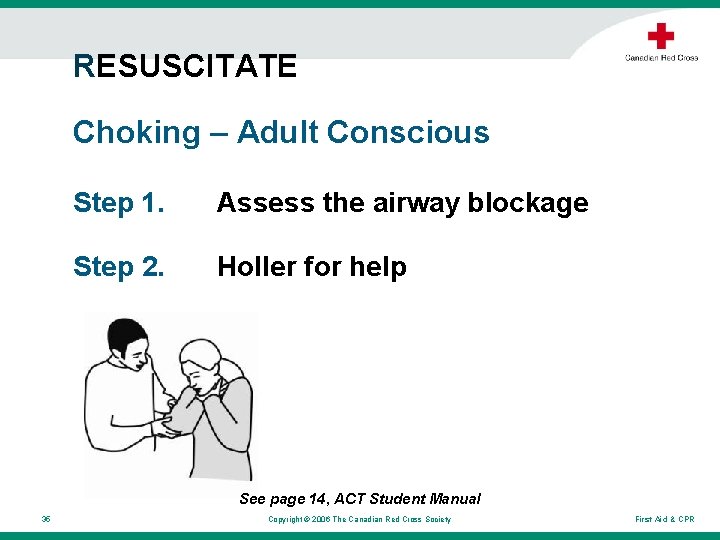
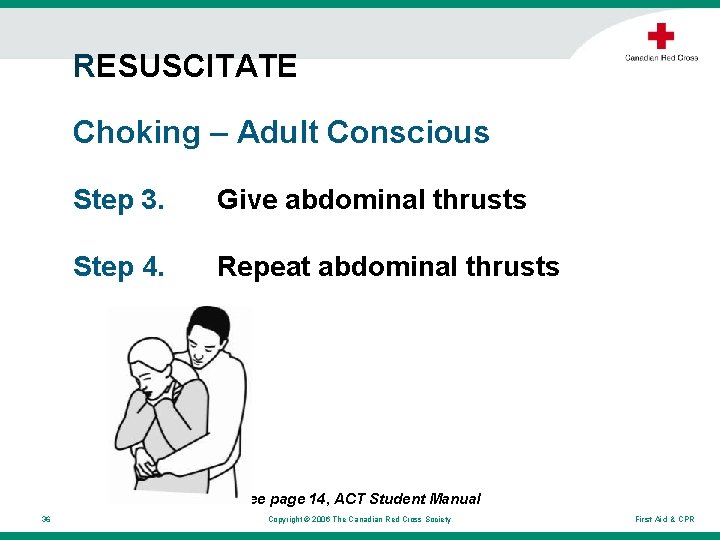
RESUSCITATE Choking – Adult Conscious Step 1. Assess the airway blockage Step 2. Holler for help See page 14, ACT Student Manual 35 Copyright © 2006 The Canadian Red Cross Society First Aid & CPR
RESUSCITATE Choking – Adult Conscious Step 3. Give abdominal thrusts Step 4. Repeat abdominal thrusts See page 14, ACT Student Manual 36 Copyright © 2006 The Canadian Red Cross Society First Aid & CPR
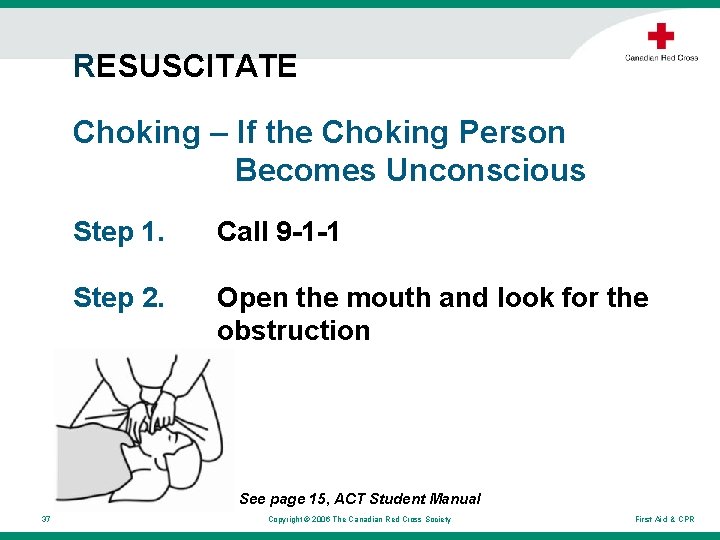
RESUSCITATE Choking – If the Choking Person Becomes Unconscious Step 1. Call 9 -1 -1 Step 2. Open the mouth and look for the obstruction See page 15, ACT Student Manual 37 Copyright © 2006 The Canadian Red Cross Society First Aid & CPR
RESUSCITATE Choking – If the Choking Person Becomes Unconscious Step 3. Open the airway Step 4. Try to give a breath See page 15, ACT Student Manual 38 Copyright © 2006 The Canadian Red Cross Society First Aid & CPR
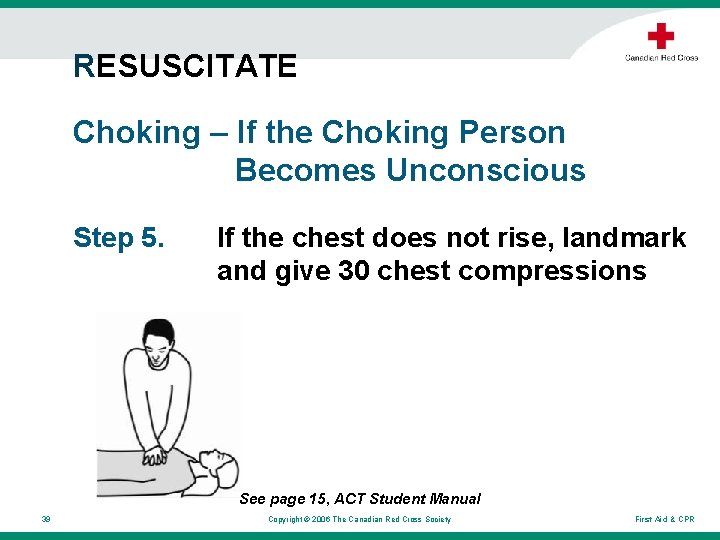
RESUSCITATE Choking – If the Choking Person Becomes Unconscious Step 5. If the chest does not rise, landmark and give 30 chest compressions See page 15, ACT Student Manual 39 Copyright © 2006 The Canadian Red Cross Society First Aid & CPR
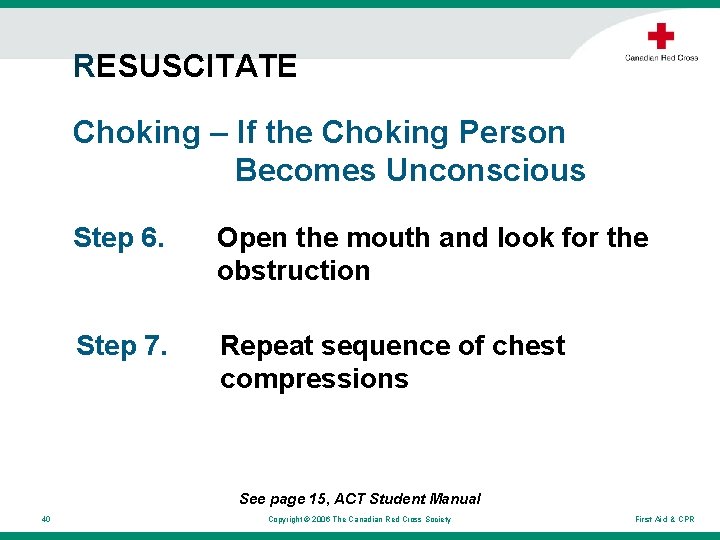
RESUSCITATE Choking – If the Choking Person Becomes Unconscious Step 6. Open the mouth and look for the obstruction Step 7. Repeat sequence of chest compressions See page 15, ACT Student Manual 40 Copyright © 2006 The Canadian Red Cross Society First Aid & CPR
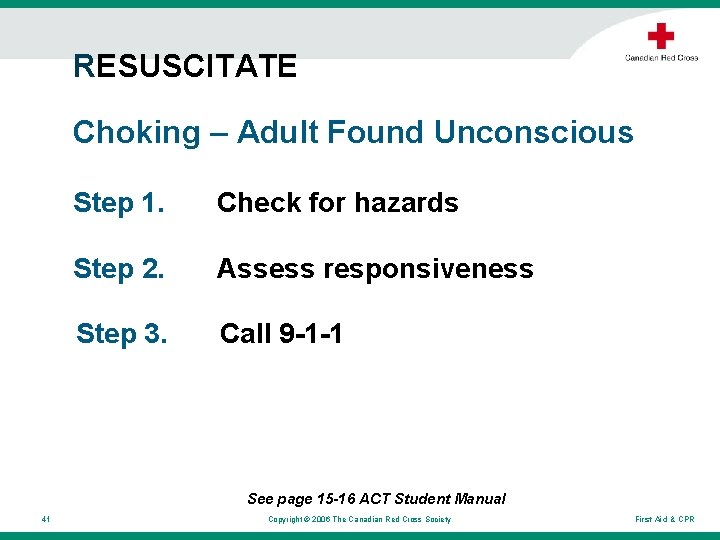
RESUSCITATE Choking – Adult Found Unconscious Step 1. Check for hazards Step 2. Assess responsiveness Step 3. Call 9 -1 -1 See page 15 -16 ACT Student Manual 41 Copyright © 2006 The Canadian Red Cross Society First Aid & CPR
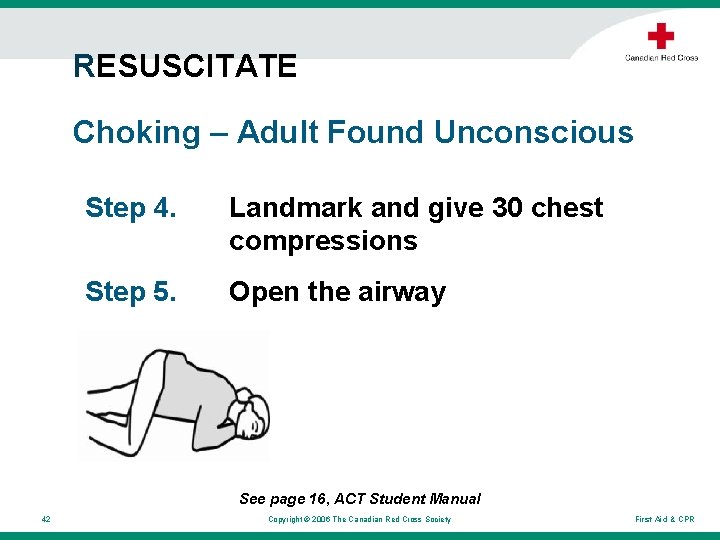
RESUSCITATE Choking – Adult Found Unconscious Step 4. Landmark and give 30 chest compressions Step 5. Open the airway See page 16, ACT Student Manual 42 Copyright © 2006 The Canadian Red Cross Society First Aid & CPR
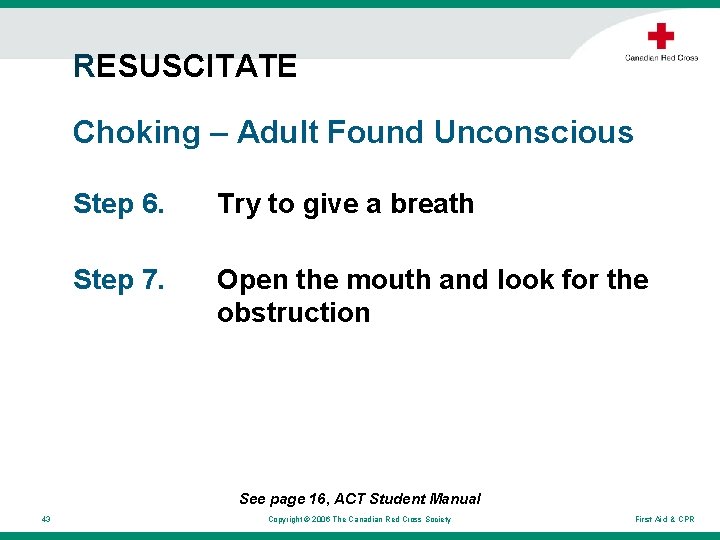
RESUSCITATE Choking – Adult Found Unconscious Step 6. Try to give a breath Step 7. Open the mouth and look for the obstruction See page 16, ACT Student Manual 43 Copyright © 2006 The Canadian Red Cross Society First Aid & CPR
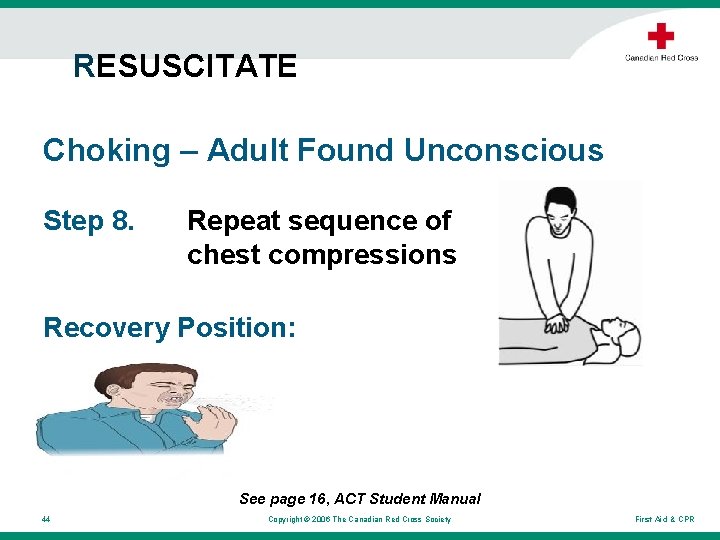
RESUSCITATE Choking – Adult Found Unconscious Step 8. Repeat sequence of chest compressions Recovery Position: See page 16, ACT Student Manual 44 Copyright © 2006 The Canadian Red Cross Society First Aid & CPR
ACT Manual Using the ACT Manual: 1. 2. 3. 4. 5. Describe 2 types of choking. (p. 14) Describe signs and symptoms of mild choking. (p. 14) Describe signs and symptoms of severe choking (p. 14) Know the universal sign for choking. (p. 14) Refer to pp. 14 -16 for the first aid for conscious severe choking adult and for unconscious severe choking adult. Demo and/or DVD#3 & DVD#6 45 Copyright © 2006 The Canadian Red Cross Society First Aid & CPR
Airway Emergencies – Summary Questions 1. 2. 3. 4. 46 How would you recognize that someone is choking? What are the first aid steps for mild choking? What are the first aid steps for conscious severe choking? What are the first aid steps for someone who is choking and becomes unconscious? . . . you will need to be able to show this skill! Copyright © 2006 The Canadian Red Cross Society First Aid & CPR
DVD’s & Practice: • DVD 3 – Conscious Choking Adult • DVD 6 – Unconscious Choking Adult • Practice Time! Pair up and practice conscious and unconscious choking first aid! 47 Copyright © 2006 The Canadian Red Cross Society First Aid & CPR
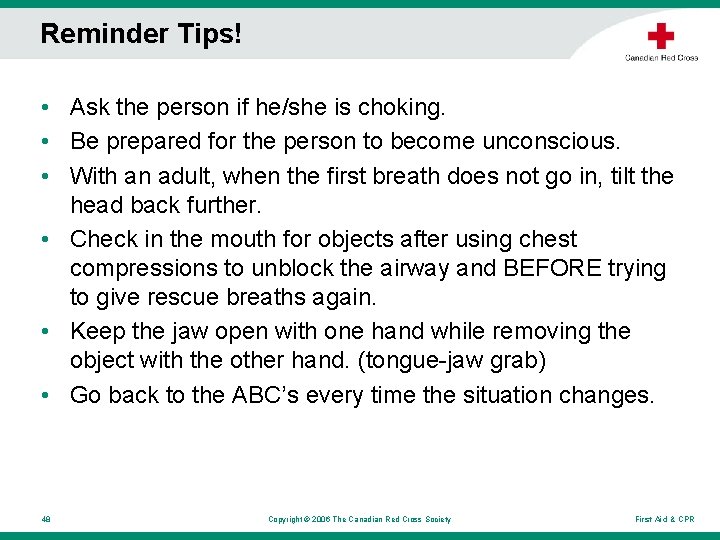
Reminder Tips! • Ask the person if he/she is choking. • Be prepared for the person to become unconscious. • With an adult, when the first breath does not go in, tilt the head back further. • Check in the mouth for objects after using chest compressions to unblock the airway and BEFORE trying to give rescue breaths again. • Keep the jaw open with one hand while removing the object with the other hand. (tongue-jaw grab) • Go back to the ABC’s every time the situation changes. 48 Copyright © 2006 The Canadian Red Cross Society First Aid & CPR
Day 3 Circulation Emergencies 49 Copyright © 2006 The Canadian Red Cross Society First Aid & CPR
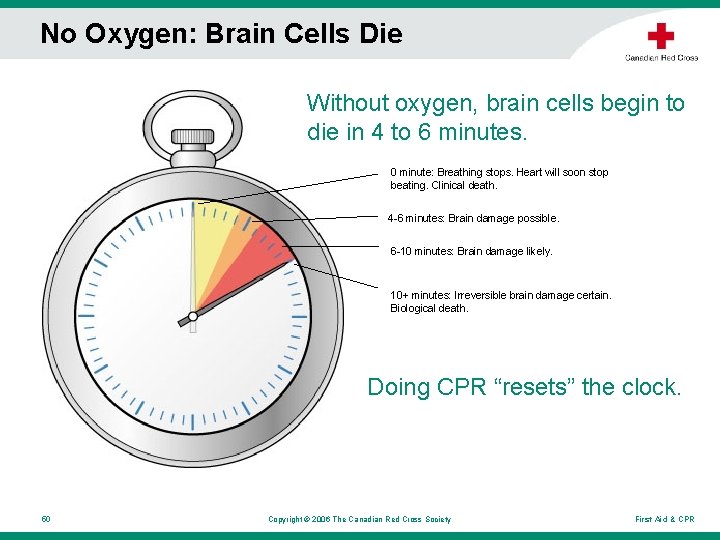
No Oxygen: Brain Cells Die Without oxygen, brain cells begin to die in 4 to 6 minutes. 0 minute: Breathing stops. Heart will soon stop beating. Clinical death. 4 -6 minutes: Brain damage possible. 6 -10 minutes: Brain damage likely. 10+ minutes: Irreversible brain damage certain. Biological death. Doing CPR “resets” the clock. 50 Copyright © 2006 The Canadian Red Cross Society First Aid & CPR
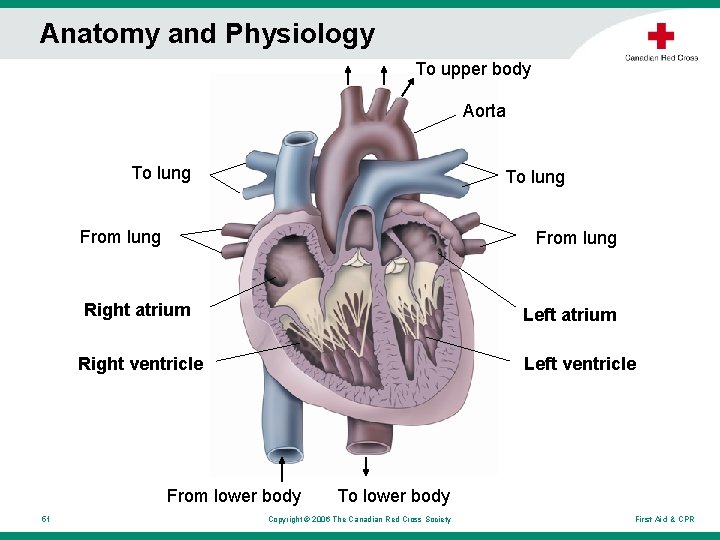
Anatomy and Physiology To upper body Aorta To lung From lung Right atrium Left atrium Right ventricle Left ventricle From lower body 51 To lower body Copyright © 2006 The Canadian Red Cross Society First Aid & CPR
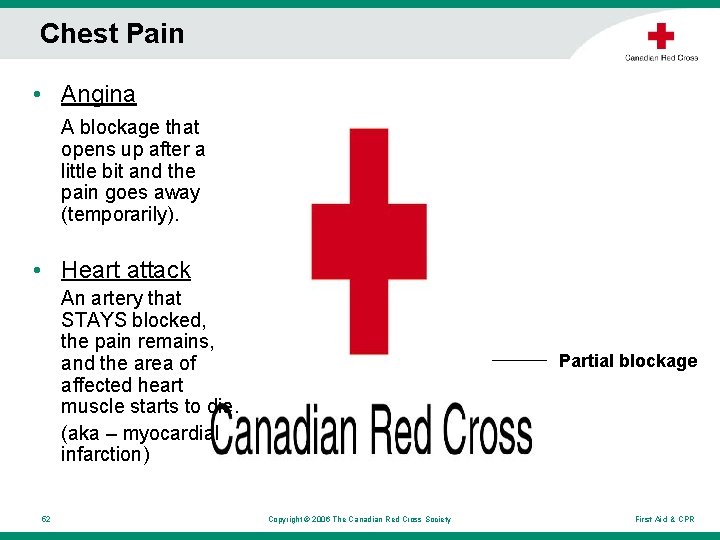
Chest Pain • Angina A blockage that opens up after a little bit and the pain goes away (temporarily). • Heart attack An artery that STAYS blocked, the pain remains, and the area of affected heart muscle starts to die. (aka – myocardial infarction) 52 Partial blockage Copyright © 2006 The Canadian Red Cross Society First Aid & CPR
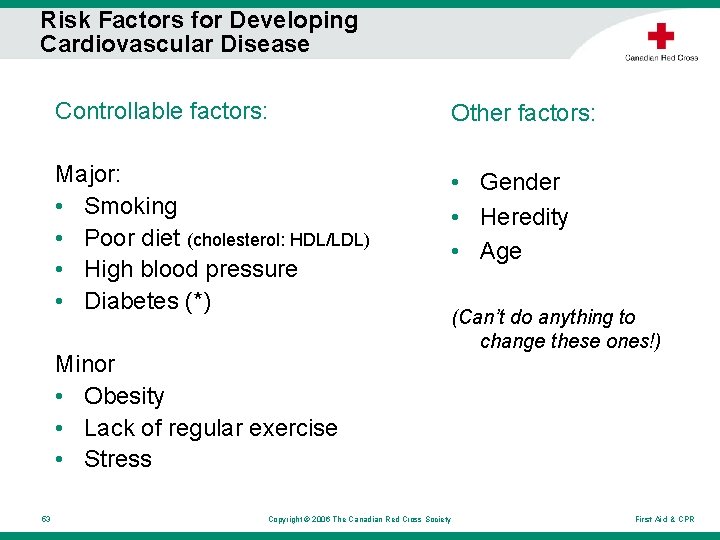
Risk Factors for Developing Cardiovascular Disease Controllable factors: Other factors: Major: • Smoking • Poor diet (cholesterol: HDL/LDL) • High blood pressure • Diabetes (*) • Gender • Heredity • Age Minor • Obesity • Lack of regular exercise • Stress 53 Copyright © 2006 The Canadian Red Cross Society (Can’t do anything to change these ones!) First Aid & CPR
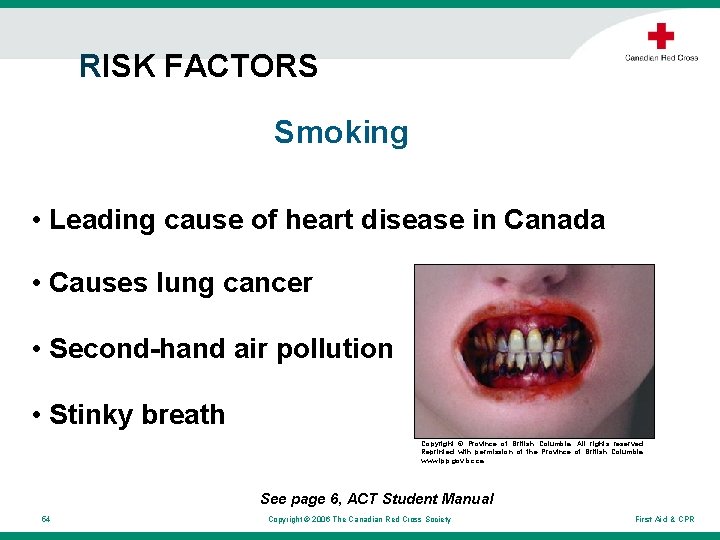
RISK FACTORS Smoking • Leading cause of heart disease in Canada • Causes lung cancer • Second-hand air pollution • Stinky breath Copyright © Province of British Columbia. All rights reserved. Reprinted with permission of the Province of British Columbia. www. ipp. gov. bc. ca See page 6, ACT Student Manual 54 Copyright © 2006 The Canadian Red Cross Society First Aid & CPR
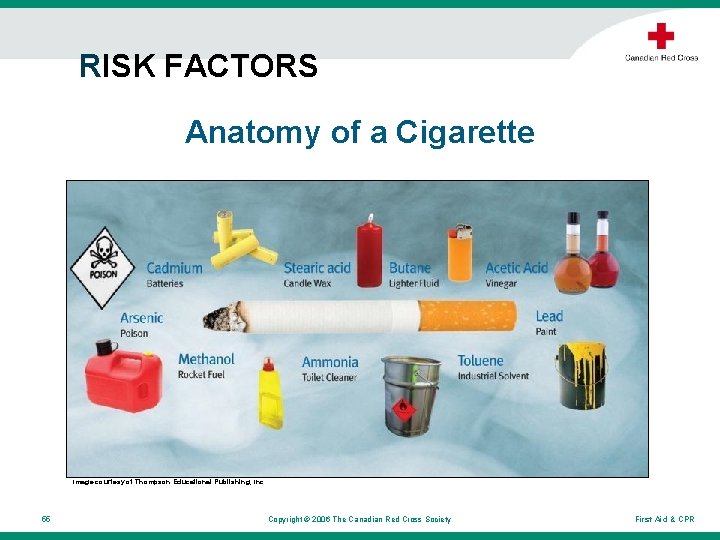
RISK FACTORS Anatomy of a Cigarette Image courtesy of Thompson Educational Publishing, Inc. 55 Copyright © 2006 The Canadian Red Cross Society First Aid & CPR
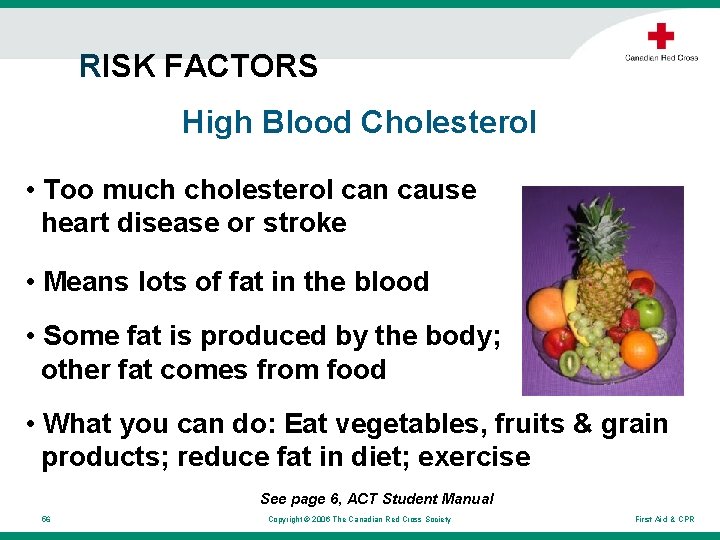
RISK FACTORS High Blood Cholesterol • Too much cholesterol can cause heart disease or stroke • Means lots of fat in the blood • Some fat is produced by the body; other fat comes from food • What you can do: Eat vegetables, fruits & grain products; reduce fat in diet; exercise See page 6, ACT Student Manual 56 Copyright © 2006 The Canadian Red Cross Society First Aid & CPR
RISK FACTORS High Blood Pressure • Can damage your heart and blood vessels • Increases chances of a heart attack or stroke • Heart has to work harder • Some causes: hereditary, diet, stress • Get it checked regularly Blood pressure cuff See page 6, ACT Student Manual 57 Copyright © 2006 The Canadian Red Cross Society First Aid & CPR
RISK FACTORS Diabetes • Affects the level of sugar and fat in your blood • Eat properly, follow doctor’s instructions See page 6, ACT Student Manual 58 Copyright © 2006 The Canadian Red Cross Society First Aid & CPR
RISK FACTORS Obesity and Lack of Exercise • Obesity: Heart has to pump harder all the time to move blood around • Exercise: Your heart is a muscle - it works better if you keep fit & active See page 6 -7, ACT Student Manual 59 Copyright © 2006 The Canadian Red Cross Society First Aid & CPR
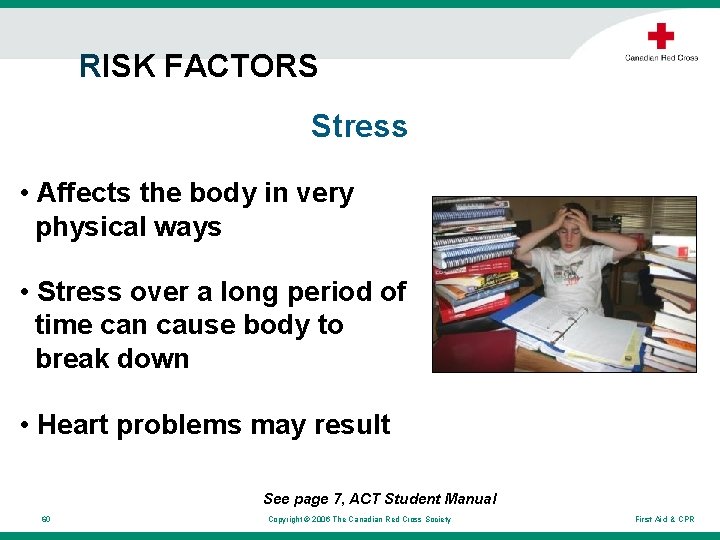
RISK FACTORS Stress • Affects the body in very physical ways • Stress over a long period of time can cause body to break down • Heart problems may result See page 7, ACT Student Manual 60 Copyright © 2006 The Canadian Red Cross Society First Aid & CPR
Signs and Symptoms of Heart Attack and Angina • • Squeezing chest pain Problems breathing Abdominal or back pain (most commonly in women) Cold, sweaty skin Skin that is bluish or paler than normal Nausea and vomiting Denial Signs and symptoms vary from person to person. 61 Copyright © 2006 The Canadian Red Cross Society First Aid & CPR
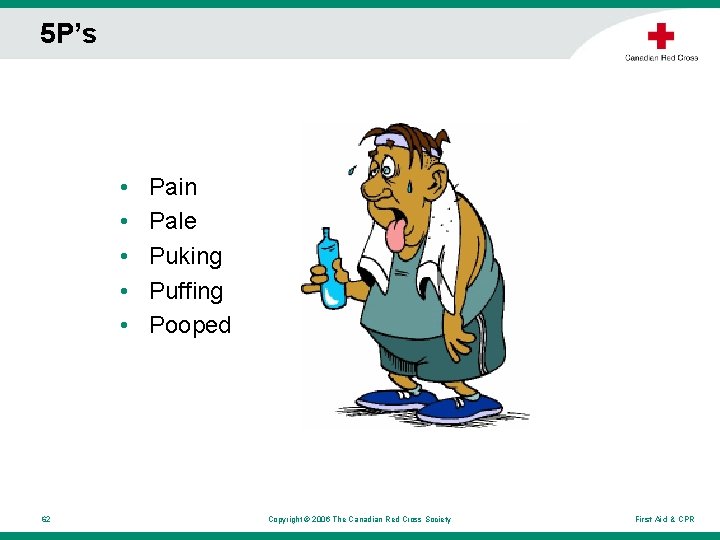
5 P’s • • • 62 Pain Pale Puking Puffing Pooped Copyright © 2006 The Canadian Red Cross Society First Aid & CPR
First Aid – Heart Attack and Angina 1. Have the person rest. 2. Ask if they have taken any erectile dysfunction drugs. If they have, do not allow them to take nitroglycerin. 3. Help the person take their nitroglycerin and ASA. • Take one dose every 5 minutes (3 doses maximum). • If they don’t carry nitroglycerin, or if the first dose doesn’t make the pain go away, suggest they chew two 80 mg ASA tablets or one 325 mg ASA tablet. 63 Copyright © 2006 The Canadian Red Cross Society First Aid & CPR
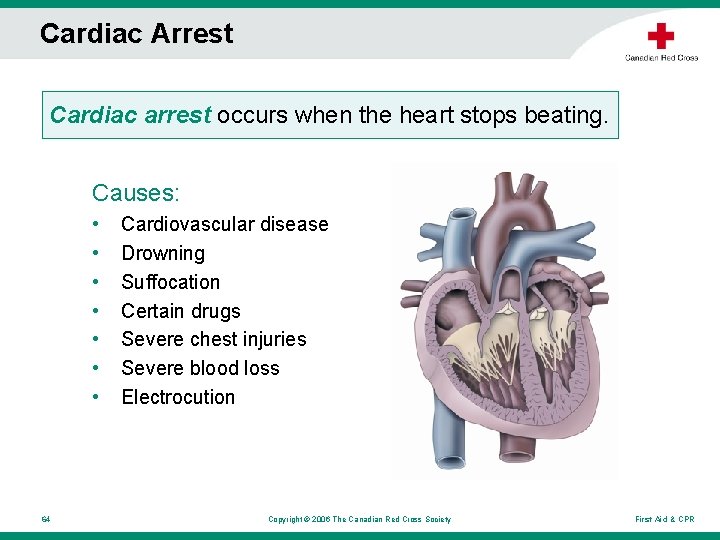
Cardiac Arrest Cardiac arrest occurs when the heart stops beating. Causes: • • 64 Cardiovascular disease Drowning Suffocation Certain drugs Severe chest injuries Severe blood loss Electrocution Copyright © 2006 The Canadian Red Cross Society First Aid & CPR
Cardiopulmonary Resuscitation (CPR) and Automated External Defibrillation (AED) • Clinical death occurs when the heart stops. It is reversible. • CPR keeps oxygen-rich blood circulating throughout the body. • AED can deliver a shock to re-establish an effective rhythm. Quick defibrillation greatly increases chances of survival. 65 Copyright © 2006 The Canadian Red Cross Society First Aid & CPR
RESUSCITATE As simple as CAB-D! Compressions Airway Breathing Defibrillation See page 10, ACT Student Manual 66 Copyright © 2006 The Canadian Red Cross Society First Aid & CPR
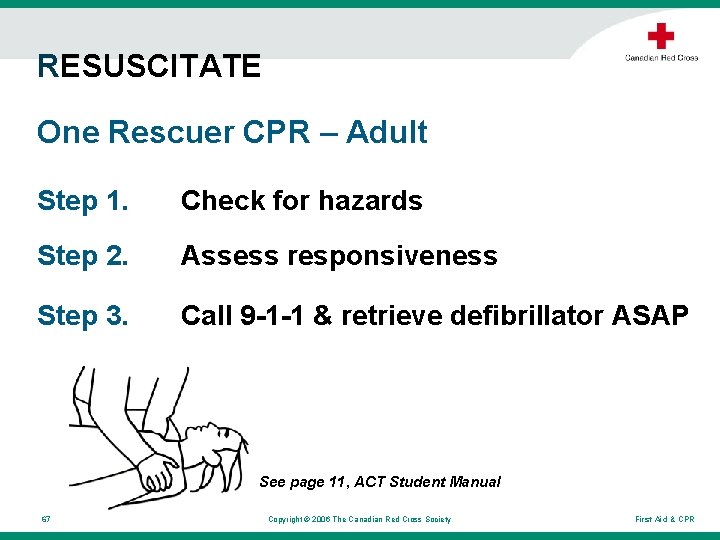
RESUSCITATE One Rescuer CPR – Adult Step 1. Check for hazards Step 2. Assess responsiveness Step 3. Call 9 -1 -1 & retrieve defibrillator ASAP See page 11, ACT Student Manual 67 Copyright © 2006 The Canadian Red Cross Society First Aid & CPR
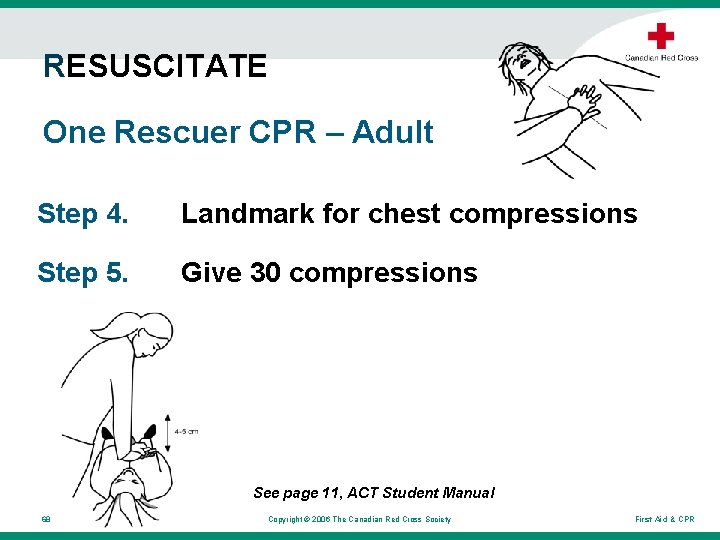
RESUSCITATE One Rescuer CPR – Adult Step 4. Landmark for chest compressions Step 5. Give 30 compressions See page 11, ACT Student Manual 68 Copyright © 2006 The Canadian Red Cross Society First Aid & CPR
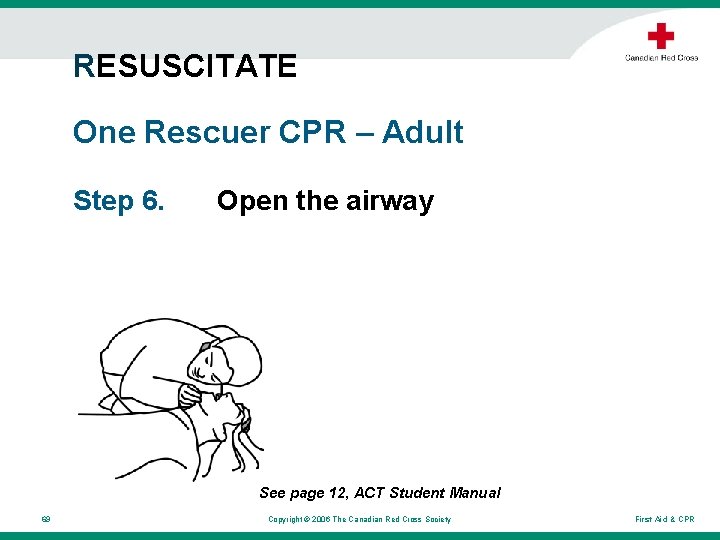
RESUSCITATE One Rescuer CPR – Adult Step 6. Open the airway See page 12, ACT Student Manual 69 Copyright © 2006 The Canadian Red Cross Society First Aid & CPR
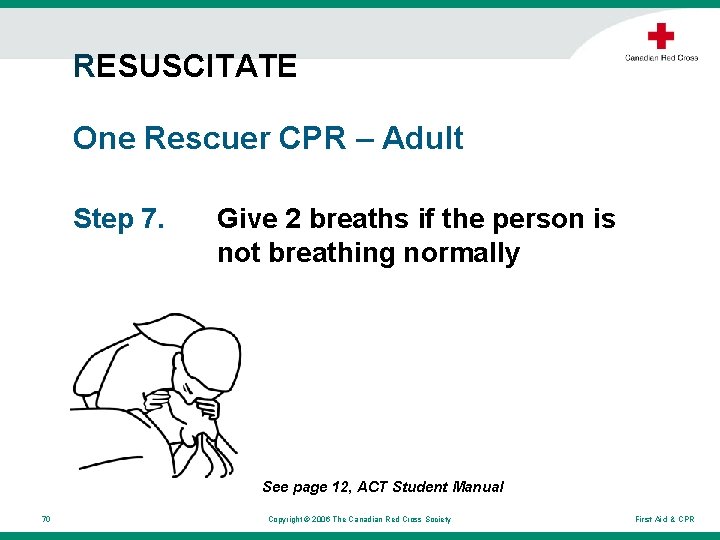
RESUSCITATE One Rescuer CPR – Adult Step 7. Give 2 breaths if the person is not breathing normally See page 12, ACT Student Manual 70 Copyright © 2006 The Canadian Red Cross Society First Aid & CPR
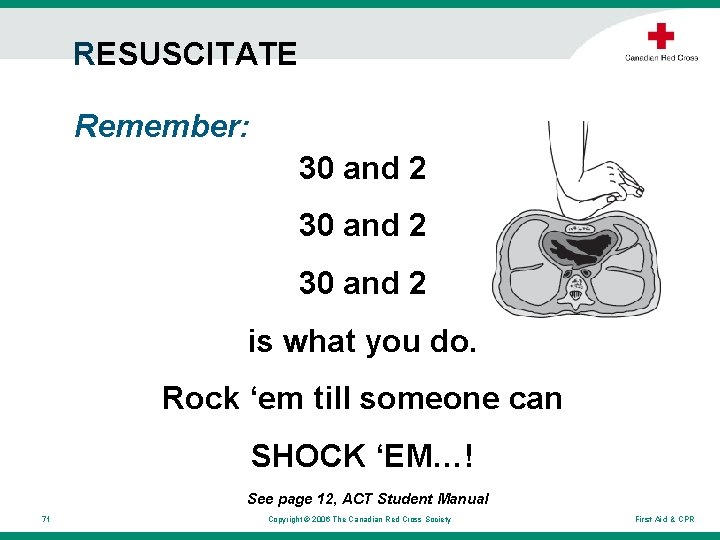
RESUSCITATE Remember: 30 and 2 is what you do. Rock ‘em till someone can SHOCK ‘EM…! See page 12, ACT Student Manual 71 Copyright © 2006 The Canadian Red Cross Society First Aid & CPR
DVD • DVD #9 -CPR technique 72 Copyright © 2006 The Canadian Red Cross Society First Aid & CPR
Early AED • Survival rate decreases 7% to 10% with each minute there is a delay • Defibrillation combined with CPR, is the key treatment in more than 80% of all sudden cardiac arrest victims For unwitnessed arrest: • 2 minutes of CPR can increase chances of the AED detecting a shockable rhythm …more on AEDs later! 73 Copyright © 2006 The Canadian Red Cross Society First Aid & CPR
Stroke A stroke happens when the blood flow to the brain gets interrupted Causes: • A clot in an artery to the brain • An artery that ruptures in the brain • A tumour 74 Copyright © 2006 The Canadian Red Cross Society First Aid & CPR
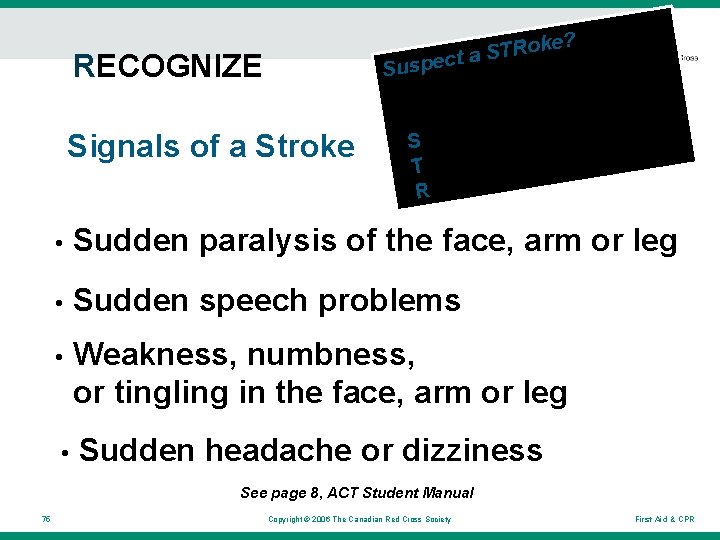
RECOGNIZE Signals of a Stroke e? k o R T ta. S c e p s u S ing: k s a y r T u… Can yo ce? n ? e e t l i n e m • S ple s m i s a • Talk in th arms? bo e s i a R • • Sudden paralysis of the face, arm or leg • Sudden speech problems • Weakness, numbness, or tingling in the face, arm or leg • Sudden headache or dizziness See page 8, ACT Student Manual 75 Copyright © 2006 The Canadian Red Cross Society First Aid & CPR
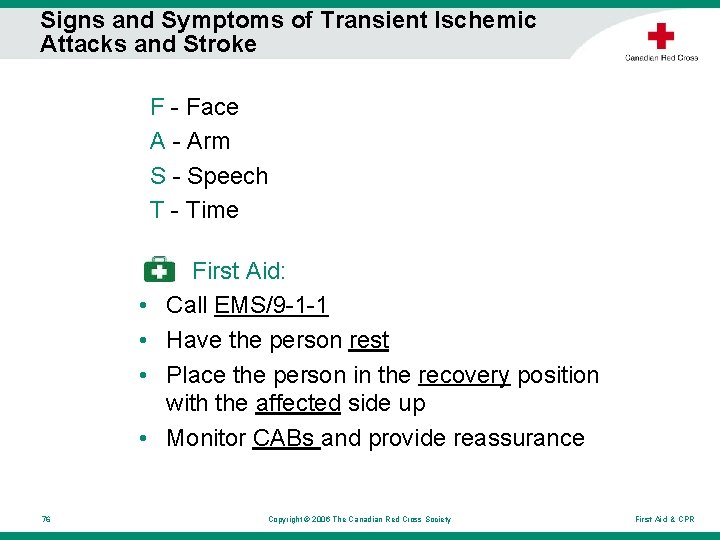
Signs and Symptoms of Transient Ischemic Attacks and Stroke F - Face A - Arm S - Speech T - Time • • 76 First Aid: Call EMS/9 -1 -1 Have the person rest Place the person in the recovery position with the affected side up Monitor CABs and provide reassurance Copyright © 2006 The Canadian Red Cross Society First Aid & CPR
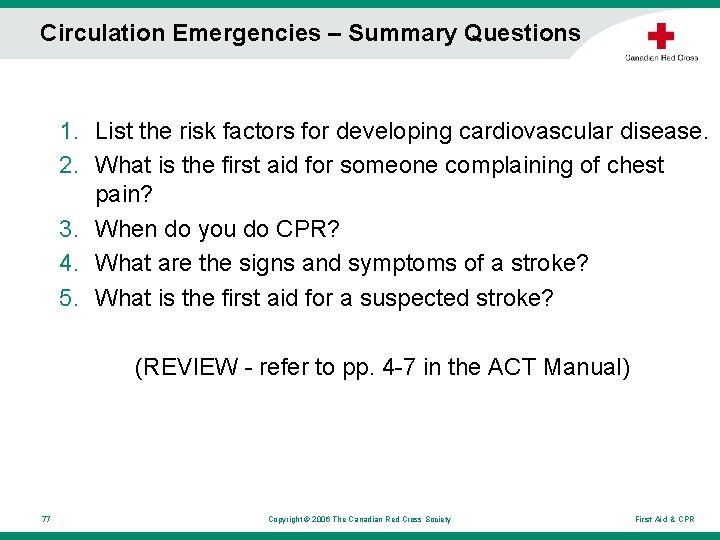
Circulation Emergencies – Summary Questions 1. List the risk factors for developing cardiovascular disease. 2. What is the first aid for someone complaining of chest pain? 3. When do you do CPR? 4. What are the signs and symptoms of a stroke? 5. What is the first aid for a suspected stroke? (REVIEW - refer to pp. 4 -7 in the ACT Manual) 77 Copyright © 2006 The Canadian Red Cross Society First Aid & CPR
Day 4 Cardiac Arrest & Automated External Defibrillator (AED)…or (PAD) 78 Copyright © 2006 The Canadian Red Cross Society First Aid & CPR
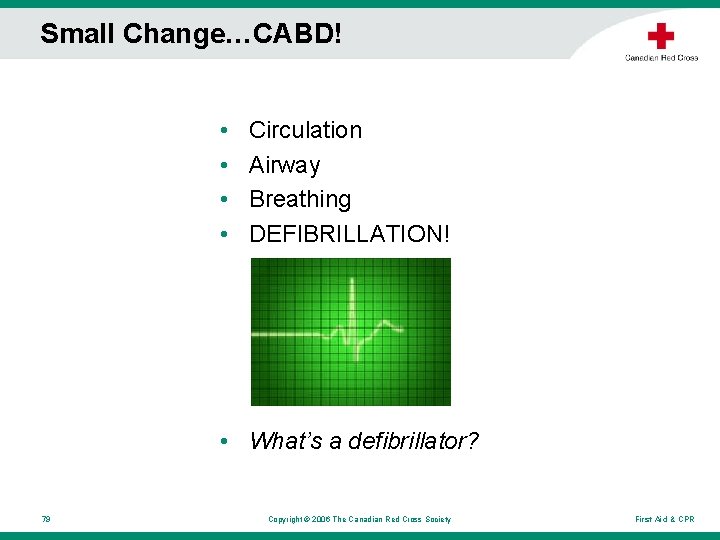
Small Change…CABD! • • Circulation Airway Breathing DEFIBRILLATION! • What’s a defibrillator? 79 Copyright © 2006 The Canadian Red Cross Society First Aid & CPR
Chase Mc. Eachern Act • • 80 In addition to Ontario’s Good Samaritan Act, there is also now liability protection for people using public automated external defibrillators (AEDs). The Chase Mc. Eachern Act came into force on July 3, 2007 and is named after 11 year old Barrie resident Chase Mc. Eachern. After being diagnosed with an irregular heartbeat, and hearing that two professional hockey players also have irregular heart beats like his, Chase decided to start a campaign to make defibrillators mandatory in hockey arenas and schools everywhere. In February 2006, Chase passed out in gym class and was rushed to the hospital. Efforts to resuscitate him failed. The Mc. Eachern family created a tribute fund in honour of their son. A donor made a $100, 000 gift to the fund with the condition it be used to put defibrillators in arenas in Grey and Bruce counties. The Chase Mc. Eachern Act protects individuals and health care professionals from liability for damages that may occur in relation to their use of an AED to save someone’s life at the immediate scene of an emergency. It also protects the owners and occupiers of the buildings where AEDs are installed from liability that may occur in relation to the use of the AED provided that the owner or occupier of the building made the AED available for use in good faith. Copyright © 2006 The Canadian Red Cross Society First Aid & CPR
Using an AED When using an AED: • Turn on the machine • Follow the diagrams to place the pads • Use the age appropriate pads • Follow the voice prompts! No one touch the person. When shocking, state, “I’m clear, you’re clear, everybody’s clear. ” 81 Copyright © 2006 The Canadian Red Cross Society First Aid & CPR
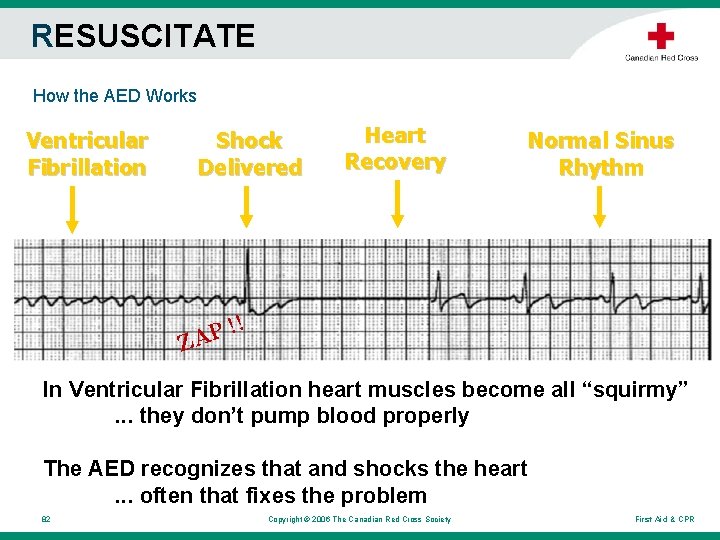
RESUSCITATE How the AED Works Ventricular Fibrillation Shock Delivered Heart Recovery Normal Sinus Rhythm !! P ZA In Ventricular Fibrillation heart muscles become all “squirmy”. . . they don’t pump blood properly The AED recognizes that and shocks the heart. . . often that fixes the problem 82 Copyright © 2006 The Canadian Red Cross Society First Aid & CPR
RESUSCITATE When should I use an AED? If a person is … • Unresponsive • Not breathing • Appears to be 8+ years or 55+ lbs (25+ kg) 83 Copyright © 2006 The Canadian Red Cross Society First Aid & CPR
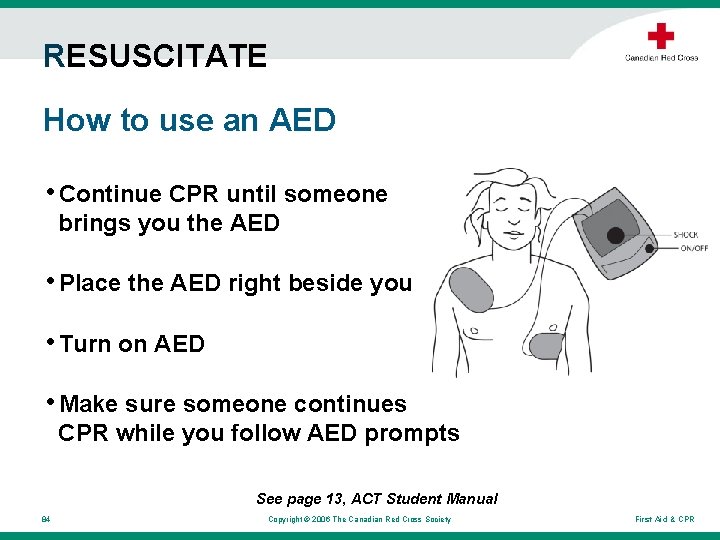
RESUSCITATE How to use an AED • Continue CPR until someone brings you the AED • Place the AED right beside you • Turn on AED • Make sure someone continues CPR while you follow AED prompts See page 13, ACT Student Manual 84 Copyright © 2006 The Canadian Red Cross Society First Aid & CPR
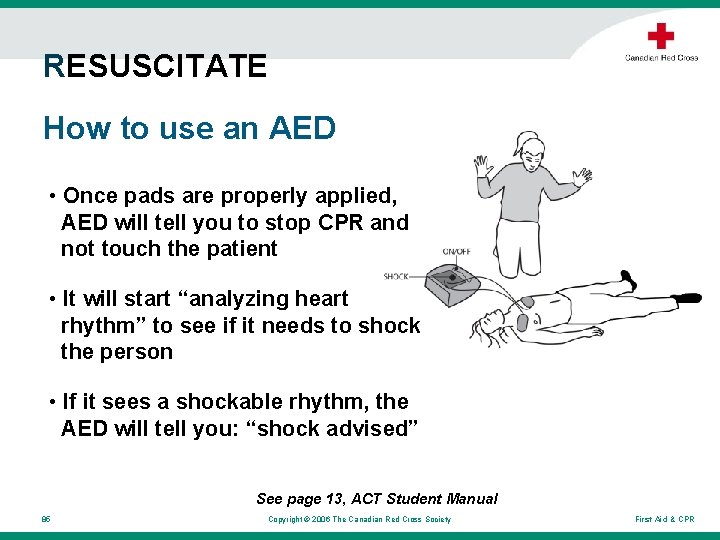
RESUSCITATE How to use an AED • Once pads are properly applied, AED will tell you to stop CPR and not touch the patient • It will start “analyzing heart rhythm” to see if it needs to shock the person • If it sees a shockable rhythm, the AED will tell you: “shock advised” See page 13, ACT Student Manual 85 Copyright © 2006 The Canadian Red Cross Society First Aid & CPR
A Properly Prepared AED Should ALSO Have: • Razor • Scissors • Cloth 86 Copyright © 2006 The Canadian Red Cross Society First Aid & CPR
DVD • DVD #9 – Review Check, Call, Care, CPR & AED • Demonstrate AED 87 Copyright © 2006 The Canadian Red Cross Society First Aid & CPR
Practice Time! • Work in groups of 3 to practice with the AED. • Be able to: -describe special considerations with the AED, particularly safety considerations! -describe adjuncts used with the AED (pocket mask, scissors, towel, razor) 88 Copyright © 2006 The Canadian Red Cross Society First Aid & CPR
Day 5 Practical & Written Testing 89 Copyright © 2006 The Canadian Red Cross Society First Aid & CPR