HLTAID 003 Provide First Aid IVET Institute HLTAID


- Slides: 83
HLTAID 003 Provide First Aid IVET Institute HLTAID 003 This is not a controlled document when printed website Version 2. 0 1/3/2017 1
What is First Aid? “The immediate care given to a person with a sudden injury or sudden illness until more advanced care can be provided or recovery occurs” “ You are the most important person” IVET Institute HLTAID 003 This is not a controlled document when printed website Version 2. 0 1/3/2017 2
Professional Relationships “A first aider has a legal obligation and legal protection to act in good judgment, using the skills a competent first aider would use. ” “Good Samaritan Act” “A Good Samaritan is a person who, in good faith and without expectation of payment or other reward, comes to the assistance of a person who is apparently injured or at risk of being injured” When does a first aider have to help someone? When they have a relationship with the person. This can come in the form of Duty of Care or a personal relationship. IVET Institute HLTAID 003 This is not a controlled document when printed website Version 2. 0 1/3/2017 3
Legal Considerations for the First Aider. Duty of Care Once a First aider starts treatment, he/she must continue. Consent Conscious patient: consent always needs to be given. Unconscious Consent is implied IVET Institute HLTAID 003 This is not a controlled document when printed website Version 2. 0 1/3/2017 4
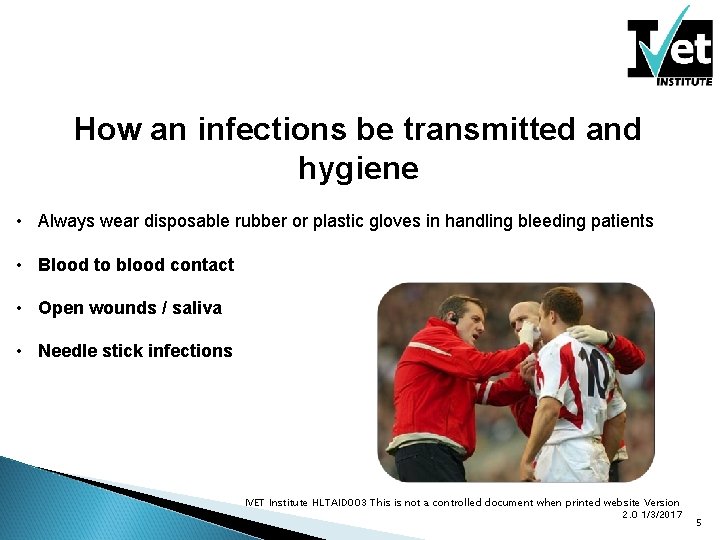
How an infections be transmitted and hygiene • Always wear disposable rubber or plastic gloves in handling bleeding patients • Blood to blood contact • Open wounds / saliva • Needle stick infections IVET Institute HLTAID 003 This is not a controlled document when printed website Version 2. 0 1/3/2017 5
Contacting Emergency Services Who do we contact? At school you should notify a teacher of any incidents that have occurred. For emergency situations you are to call 000 from a land line or mobile phone, if you do not have service on your mobile you can call 112 and this will connect you to an emergency services operator. IVET Institute HLTAID 003 This is not a controlled document when printed website Version 2. 0 1/3/2017 6
What should I say? 1. 2. 3. 4. 5. 6. 7. You will need to provide the following information to the operator when you call for an ambulance: The exact location of the emergency Telephone number to call back What is the problem (exactly what happened) How many people are hurt? How old is the patient? Is the patient conscious? Is the patient breathing? IVET Institute HLTAID 003 This is not a controlled document when printed website Version 2. 0 1/3/2017 7
D. R. S. A. B. C. D. What is it? It is the basis of all emergency first aid. DRSABCD is the acronym to follow when you are treating a person whether they are conscious or not. IVET Institute HLTAID 003 This is not a controlled document when printed website Version 2. 0 1/3/2017 8
Basic Life Support Flow Chart Danger Ensure Safety Response Talk/Touch/Command Send for help 000 / 112 Airway Clear/Open Breathing Yes / No Compressions 30: 2 – 1/3 Chest depth 100 per minute Defibrillate ASAP – Follow Prompts IVET Institute HLTAID 003 This is not a controlled document when printed website Version 2. 0 1/3/2017 9
D= Dangers to yourself, bystanders and the patient. You are no help to the patient if you are hurt, injured or killed while performing first aid. You need to check the surroundings around you to look for any dangers. Eg Car accident: Other cars on the road. Work place: Chemical spill, electrical wires. Street: Needles, glass. IVET Institute HLTAID 003 This is not a controlled document when printed website Version 2. 0 1/3/2017 10
Practical In pairs practice checking for danger around a casualty, what are you looking for? IVET Institute HLTAID 003 This is not a controlled document when printed website Version 2. 0 1/3/2017 11
R= Response You need to assess if the person is conscious or unconscious. Walk up to the person with caution. Ask: COWS: Can you hear me? Open your eyes? What is your name? Squeeze my hands? Remember that when we get them to squeeze our hands we need to both hands at the same time as they may have had a stroke. If the patient responds: Monitor them, ask them questions and notify their next of kin or ambulance depending on condition. If their is no response the patient is unconscious, we move to our next stage. IVET Institute HLTAID 003 This is not a controlled document when printed website Version 2. 0 1/3/2017 12
Practical In your pairs practice getting a response out of your patient. IVET Institute HLTAID 003 This is not a controlled document when printed website Version 2. 0 1/3/2017 13
S = Send for Help We need to send for help You ask a bystander to call for an ambulance, or you can call an ambulance through your mobile phone, either on loud speaker or hold it up to your mouth while performing the following steps. Contact numbers? IVET Institute HLTAID 003 This is not a controlled document when printed website Version 2. 0 1/3/2017 14
A = Airway You need to check that there isn’t anything blocking the airways and remove any foreign material in the mouth. In order for you to remove and foreign material you need to move your patient into the recovery position. Remove objects from airway and check breathing. IVET Institute HLTAID 003 This is not a controlled document when printed website Version 2. 0 1/3/2017 15
Practical Practice getting your victim into the recovery position, and checking their airways! IVET Institute HLTAID 003 This is not a controlled document when printed website Version 2. 0 1/3/2017 16
B = Breathing Is the casualty breathing? How do we tell? Kneel down and put your face near the casualties mouth. Look down to see if the chest is rising and falling. You can also feel the warmth of the air coming out of the casualties mouth. If the casualty is breathing roll them over to the recovery position and continue to monitor their breathing. No sign of breathing? Begin compressions! Head tilt is important so that the air goes into the lungs not the stomach. Pistol grip. IVET Institute HLTAID 003 This is not a controlled document when printed website Version 2. 0 1/3/2017 17
C = Compression 30 compressions to 2 breaths. How do I find the correct place where to start the compressions? Find the bottom of the ribs, working your way to the middle to find the xiphoid process. You have found the sternum, place one hand on the bottom half of the sternum. The heel of the hand at the bottom is where the pressure will come from. With your free hand place this on top and interlock fingers, keeping fingers off casualty. You need to push down a 1/3 of the chest cavity. IVET Institute HLTAID 003 This is not a controlled document when printed website Version 2. 0 1/3/2017 18
C = Compression cont. Is there anything different when performing CPR on a child to an adult? Child: 30: 2. Still need to compress 1/3, depending on size of child can be 2 or 1 hands. Head tilt still necessary. Infant: 30: 2. Still need to compress 1/3, 2 fingers only, no head tilt as the head needs to be in the neutral position. Pregnant women tilt to the left hand side, by placing a towel/jumper under her right hand buttock. IVET Institute HLTAID 003 This is not a controlled document when printed website Version 2. 0 1/3/2017 19
Practical In your pairs start at the beginning of the process with your CPR manikin. IVET Institute HLTAID 003 This is not a controlled document when printed website Version 2. 0 1/3/2017 20
D = Defibrillation What is it? This machine provides an electric current that will restart the hearts regular beat. Where can these be found? A lot of public places and shopping centres now have AED’s for the use of qualified people. All you need to do is follow the directions that the machine gives you. IVET Institute HLTAID 003 This is not a controlled document when printed website Version 2. 0 1/3/2017 21
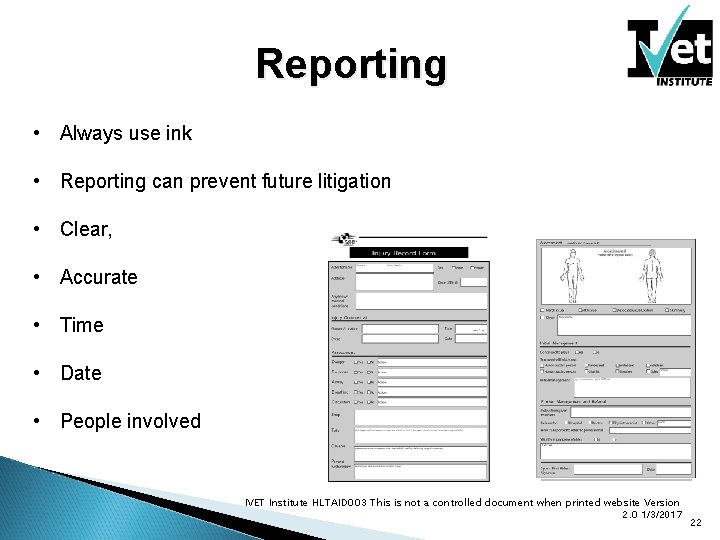
Reporting • Always use ink • Reporting can prevent future litigation • Clear, • Accurate • Time • Date • People involved IVET Institute HLTAID 003 This is not a controlled document when printed website Version 2. 0 1/3/2017 22
Heart attack and Angina Heart attack: Occurs when a coronary artery is blocked and blood flow to the heart is stopped. Who is at risk of having a heart attack? Signs and symptoms: Rapid or weak pulse, sweating, rapid breathing, collapse, chest pain or discomfort, pain can radiate to left arm, neck or jaw, and shoulders. Time is critical. IVET Institute HLTAID 003 This is not a controlled document when printed website Version 2. 0 1/3/2017 23
Heart attack and Angina cont. Angina: Literally means pain in the chest. Restricted blood flow to the heart. Occurs when the heart needs to work harder than normal, eg stress or exercise. Casualty should rest, and pain should subside within minutes. If pain has not subsided in 10 -15 minutes ambulance should be called and victim treated as a heart attack patient. Signs and symptoms: Sweating, breathless, pale cool skin, chest pain or discomfort can radiate to jaw, shoulders and neck. IVET Institute HLTAID 003 This is not a controlled document when printed website Version 2. 0 1/3/2017 24
Choking What to do with a partial blocked airway? How do you tell? Signs and symptoms are: Coughing, wheezing, difficulty and noisy breathing, cyanosis (Blue skin colour). What to do? Encourage person to continue to cough. Give them REASSURANCE. If cough is effective do not give back blows IVET Institute HLTAID 003 This is not a controlled document when printed website Version 2. 0 1/3/2017 25
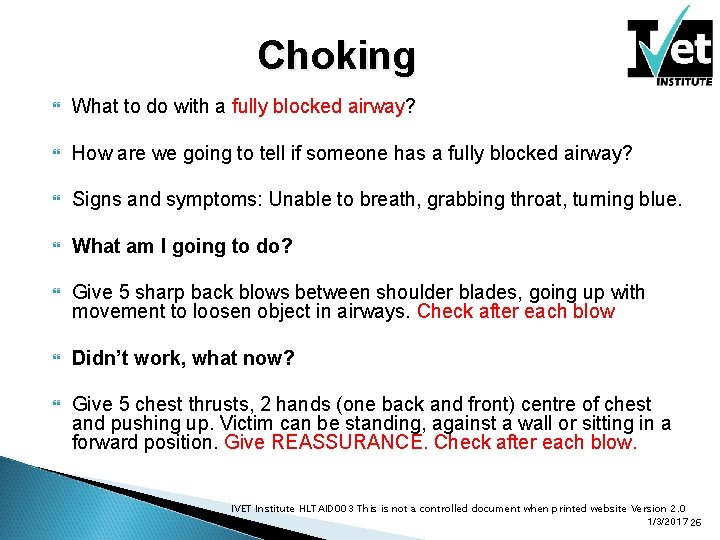
Choking What to do with a fully blocked airway? How are we going to tell if someone has a fully blocked airway? Signs and symptoms: Unable to breath, grabbing throat, turning blue. What am I going to do? Give 5 sharp back blows between shoulder blades, going up with movement to loosen object in airways. Check after each blow Didn’t work, what now? Give 5 chest thrusts, 2 hands (one back and front) centre of chest and pushing up. Victim can be standing, against a wall or sitting in a forward position. Give REASSURANCE. Check after each blow. IVET Institute HLTAID 003 This is not a controlled document when printed website Version 2. 0 1/3/2017 26
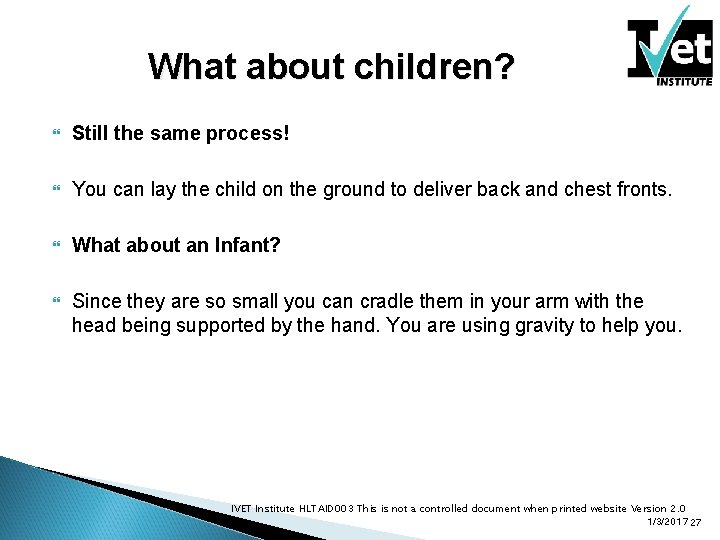
What about children? Still the same process! You can lay the child on the ground to deliver back and chest fronts. What about an Infant? Since they are so small you can cradle them in your arm with the head being supported by the hand. You are using gravity to help you. IVET Institute HLTAID 003 This is not a controlled document when printed website Version 2. 0 1/3/2017 27
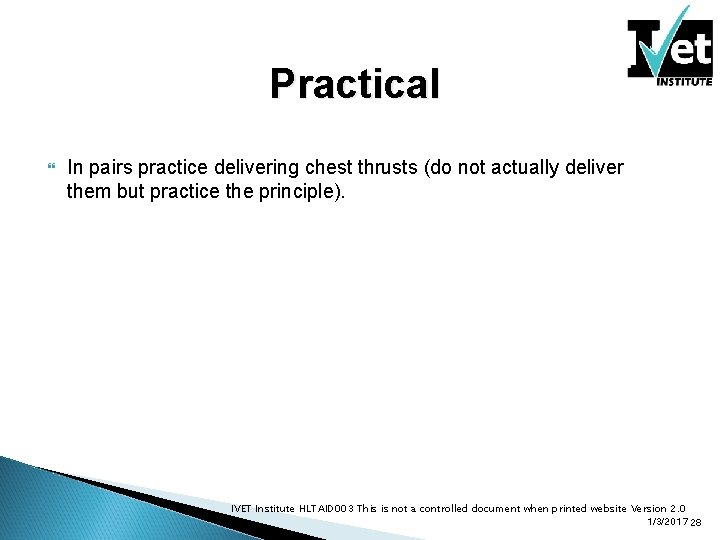
Practical In pairs practice delivering chest thrusts (do not actually deliver them but practice the principle). IVET Institute HLTAID 003 This is not a controlled document when printed website Version 2. 0 1/3/2017 28
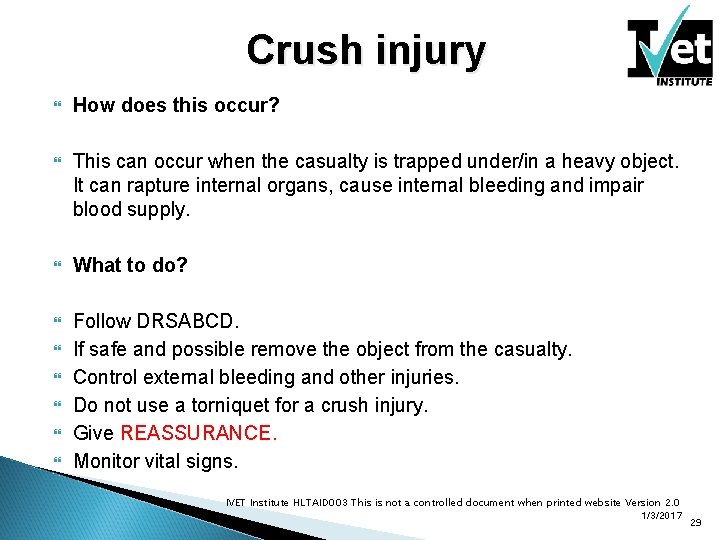
Crush injury How does this occur? This can occur when the casualty is trapped under/in a heavy object. It can rapture internal organs, cause internal bleeding and impair blood supply. What to do? Follow DRSABCD. If safe and possible remove the object from the casualty. Control external bleeding and other injuries. Do not use a torniquet for a crush injury. Give REASSURANCE. Monitor vital signs. IVET Institute HLTAID 003 This is not a controlled document when printed website Version 2. 0 1/3/2017 29
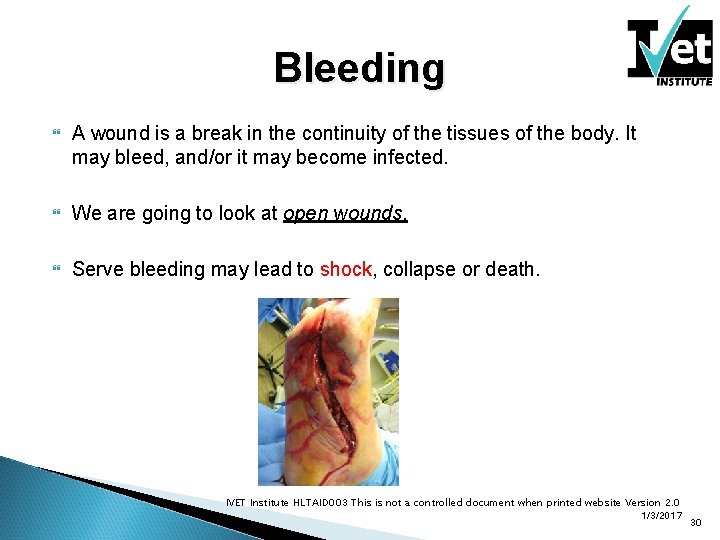
Bleeding A wound is a break in the continuity of the tissues of the body. It may bleed, and/or it may become infected. We are going to look at open wounds. Serve bleeding may lead to shock, collapse or death. IVET Institute HLTAID 003 This is not a controlled document when printed website Version 2. 0 1/3/2017 30
Shock What is it? Shock is a life threatening condition which can occur in any first aid situation. It is caused by a reduction of the amount of blood flowing through the body’s vital organs. If the amount of blood flow drops too far, the organs cannot get enough oxygen, and toxic waste products build up which can lead to irreversible damage or death of body cells. You should manage every casualty as if shock were present. The signs and symptoms will develop progressively. IVET Institute HLTAID 003 This is not a controlled document when printed website Version 2. 0 1/3/2017 31
Shock cont. . Initial signs and symptoms are: Pale face, fingernails and lips Cold and clammy skin Faintness or dizziness, Nausea, Anxiety Servere shock: Restlessness, Thirst Weak rapid pulse and rapid breathing. Drowsiness, confusion or unconsciousness Bluish colour to extremities, eg lips, hands. IVET Institute HLTAID 003 This is not a controlled document when printed website Version 2. 0 1/3/2017 32
What do I do? Follow DRSABCD control any bleeding. Reassure the casualty. Raise the casualty’s legs above the level of the heart Loosen any tight clothing Maintain body warmth, blanket or space blanket If the casualty is conscious, and does not have abdominal trauma and is unlikely to require an operation give small amounts of water. Monitor the casualty in regular intervals Place casualty in recovery position if difficulty breathing or vomiting. IVET Institute HLTAID 003 This is not a controlled document when printed website Version 2. 0 1/3/2017 33
Practical Practice with your partner for treatment of shock. Monitoring all signs. IVET Institute HLTAID 003 This is not a controlled document when printed website Version 2. 0 1/3/2017 34
What can I make out of a Triangular Bandage? You can make the following bandages: Narrow bandage Broad Bandage A Pad You can also make slings which we will cover later on. IVET Institute HLTAID 003 This is not a controlled document when printed website Version 2. 0 1/3/2017 35
Practical Practice with your partner making these bandages. IVET Institute HLTAID 003 This is not a controlled document when printed website Version 2. 0 1/3/2017 36
Abrasions What to do? The most important thing to do is to control the bleeding. How? Direct pressure. Above heart. Clean the wound. You will need to clean the wound so there are no foreign objects in the wound. You can use tweezers or a scraper to remove the objects. You can also use a running tap or treated water to clean the wound. Once the wound is clean and stopped bleeding you will need to apply a sterile or clean dressing to the wound. Advise the casualty to have a tetanus shot or seek further medical care. IVET Institute HLTAID 003 This is not a controlled document when printed website Version 2. 0 1/3/2017 37
Foreign object embedded in the body How do we treat this? Apply pressure to the surrounding area/s but do not apply pressure to the foreign object eg nail, knife, arrow, wood etc. You will need to use a triangular bandage wadded around the object to apply pressure to the area and then bandage to hold in place You need to make sure the bandages does not place any pressure on the object. IVET Institute HLTAID 003 This is not a controlled document when printed website Version 2. 0 1/3/2017 38
Amputation 1. 2. 3. 4. 5. You will need to apply direct pressure to wound and raising the limb to limit blood flow. For the amputated part: DO NOT wash or soak the amputated part in water or any other liquid. Wrap the part in gauze or material and place in a waterproof container such as a plastic bag. Place the sealed container in cold water which has had ice added to it. Do not let the amputated part come into contact with ice. Send to hospital with the casualty. IVET Institute HLTAID 003 This is not a controlled document when printed website Version 2. 0 1/3/2017 39
Internal bleeding Who can suffer from this? Direct contact with an object or person. How can I tell if a person has internal bleeding? Pain Tenderness Rigidity of abdominal muscles Coughing up red, frothy material Swelling IVET Institute HLTAID 003 This is not a controlled document when printed website Version 2. 0 1/3/2017 40
Management of internal bleeding Lie the casualty down Raise the legs or bend the knees If coughing up blood the most comfortable position will normally be half sitting Loosen tight clothing Call 000 Give nothing by mouth. Calm the casualty. REASURANCE IVET Institute HLTAID 003 This is not a controlled document when printed website Version 2. 0 1/3/2017 41
Nose Bleeds Can be caused by a direct blow to the face or from environmental conditions. What to do? Rest and reassure the casualty. Sit them down with their elbows resting on their knees and leaning forward. Place sterile gauze or tissues under their nostrils and pinch their nostrils. Place an ice pack on the back of the neck and/or on their forehead to reduce their body temperature. Instruct to breath through their mouth. If the nose bleed has not stopped after 15 -20 minutes start the process again. After the 2 nd treatment if the nose is still bleeding you will need to seek further medical assistance. IVET Institute HLTAID 003 This is not a controlled document when printed website Version 2. 0 1/3/2017 42
Practical In groups please complete each of the following and use the correct bandages for each: 1. Cut on your palm 2. Nose bleed 3. Lower arm injury 4. Object in the upper leg IVET Institute HLTAID 003 This is not a controlled document when printed website Version 2. 0 1/3/2017 43
Fractures and dislocations 1. 2. 3. There are 3 types of fractures: Closed: Fracture does not penetrate skin. Open: Fracture is exposed through wound or skin. Complicated: Vital organ, major nerve or blood vessel is damaged by a broken bone. What do we do? The first thing to do is to observe and gain information. Touch area to assess where pain is and compare to opposite limb for differences. Immobilise area to reduce swelling and pain. IVET Institute HLTAID 003 This is not a controlled document when printed website Version 2. 0 1/3/2017 44
How? We need to be able to manage the injury so the patient is not in to much pain. Be careful as they may go into shock. Our main aim is to immobilise the injured part, to prevent further damage, minimise bleeding and reduce pain. How? • We are going to immobilise the area by using a sling. • Three types of slings: Elevation sling: Fractured/broken collar bone Arm sling: Fractured broken lower arm Collar and cuff sling: Fractured upper arm. IVET Institute HLTAID 003 This is not a controlled document when printed website Version 2. 0 1/3/2017 45
Fractures and dislocations Cont. When we are securing a fracture or break we need to immobilise the area. We do not apply pressure directly on the area but immobilise 3 fingers above and below. We do this by our broad and narrow bandages made from our triangular bandages. We need to be able to support the arm when it is immobilised, we can use a newspaper, book or piece of wood. Making sure that the splint is comfortable for the casualty (hard or uncomfortable splints need to have a covering of some sort). IVET Institute HLTAID 003 This is not a controlled document when printed website Version 2. 0 1/3/2017 46
Practical Practice making: Broad and narrow bandages with your partner. Securing a fractured lower arm and making a sling. Broken collar bone along with sling Fractured upper arm along with sling. IVET Institute HLTAID 003 This is not a controlled document when printed website Version 2. 0 1/3/2017 47
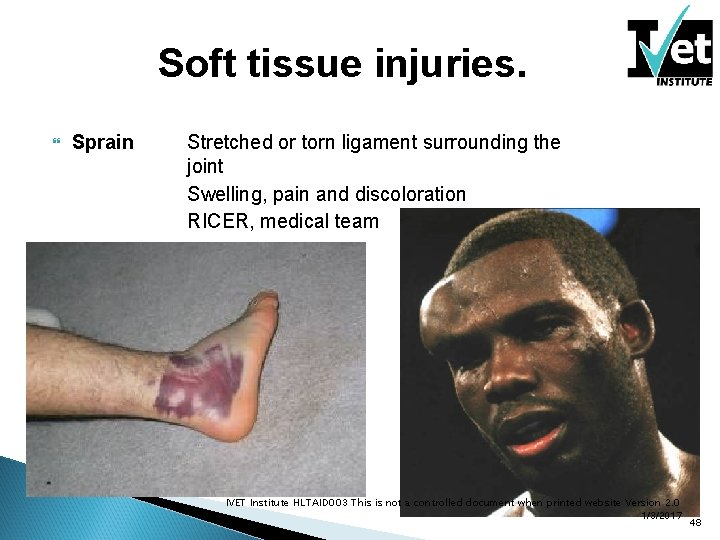
Soft tissue injuries. Sprain Stretched or torn ligament surrounding the joint Swelling, pain and discoloration RICER, medical team IVET Institute HLTAID 003 This is not a controlled document when printed website Version 2. 0 1/3/2017 48
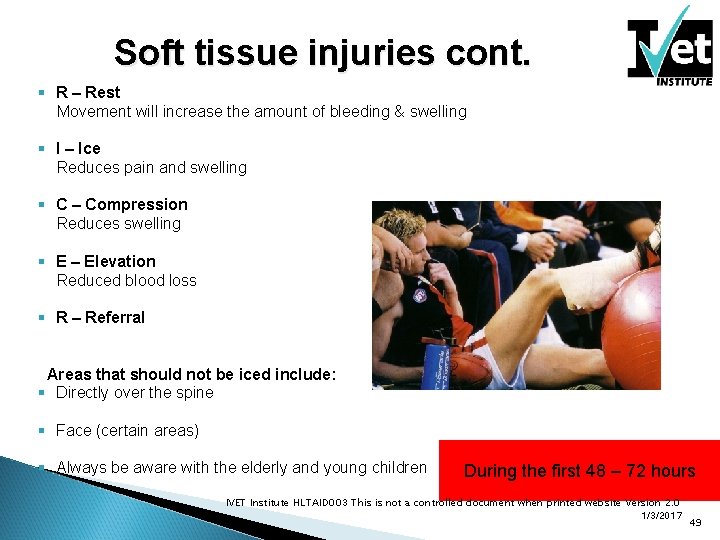
Soft tissue injuries cont. § R – Rest Movement will increase the amount of bleeding & swelling § I – Ice Reduces pain and swelling § C – Compression Reduces swelling § E – Elevation Reduced blood loss § R – Referral Areas that should not be iced include: § Directly over the spine § Face (certain areas) § Always be aware with the elderly and young children During the first 48 – 72 hours IVET Institute HLTAID 003 This is not a controlled document when printed website Version 2. 0 1/3/2017 49
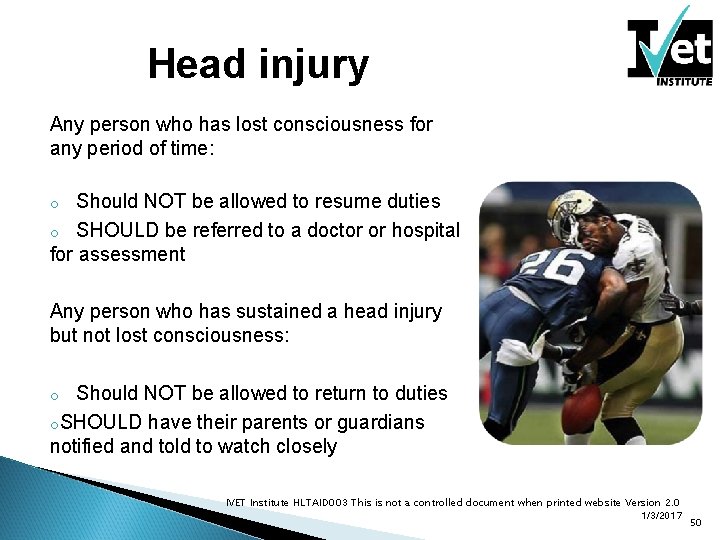
Head injury Any person who has lost consciousness for any period of time: Should NOT be allowed to resume duties o SHOULD be referred to a doctor or hospital for assessment o Any person who has sustained a head injury but not lost consciousness: Should NOT be allowed to return to duties o. SHOULD have their parents or guardians notified and told to watch closely o IVET Institute HLTAID 003 This is not a controlled document when printed website Version 2. 0 1/3/2017 50
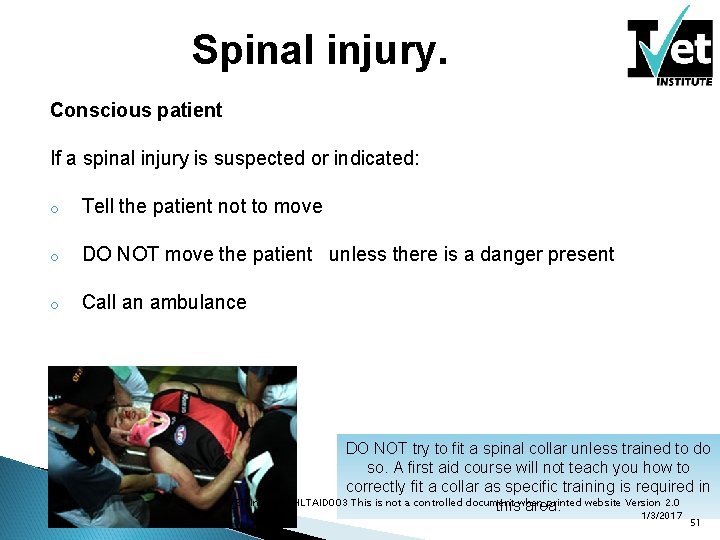
Spinal injury. Conscious patient If a spinal injury is suspected or indicated: o Tell the patient not to move o DO NOT move the patient unless there is a danger present o Call an ambulance DO NOT try to fit a spinal collar unless trained to do so. A first aid course will not teach you how to correctly fit a collar as specific training is required in IVET Institute HLTAID 003 This is not a controlled document printed website Version 2. 0 thiswhen area. 1/3/2017 51
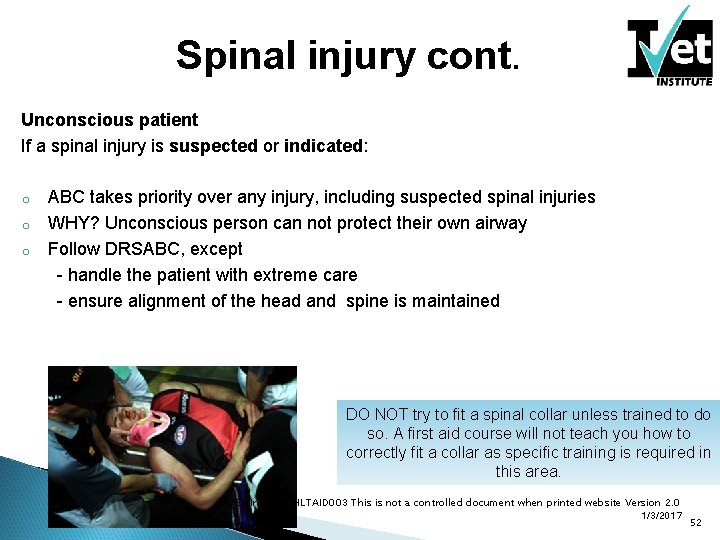
Spinal injury cont. Unconscious patient If a spinal injury is suspected or indicated: ABC takes priority over any injury, including suspected spinal injuries o WHY? Unconscious person can not protect their own airway o Follow DRSABC, except - handle the patient with extreme care - ensure alignment of the head and spine is maintained o DO NOT try to fit a spinal collar unless trained to do so. A first aid course will not teach you how to correctly fit a collar as specific training is required in this area. IVET Institute HLTAID 003 This is not a controlled document when printed website Version 2. 0 1/3/2017 52
Stroke What is it? A stroke is when the blood supply to the brain is disrupted, resulting in damaging brain tissue. Caused by a block or ruptured artery. The signs and symptoms vary depending on which side of the brain is affected. First aid: Conduct the FAST test, if they fail one call 000 ASAP. Sit casualty in a position of comfort and give reassurance. If they become unconscious put in recovery position. Maintain body temperature. IVET Institute HLTAID 003 This is not a controlled document when printed website Version 2. 0 1/3/2017 53
Practical Conduct a FAST test with your partner. IVET Institute HLTAID 003 This is not a controlled document when printed website Version 2. 0 1/3/2017 54
Seizure/ Epilepsy What is it? It is caused by an abnormal electrical activity in the brain. It can occur for a number of reasons: Epilepsy, head injury, stroke, meningitis, fever, hypoglycaemia, poisoning, alcohol and drug withdrawal. What to do? Firstly remove any dangers from the person, or if object can not be moved padded for protection. Do not restrain the person. Do not put anything in their mouth. After seizure roll into recovery position and monitor vital signs. IVET Institute HLTAID 003 This is not a controlled document when printed website Version 2. 0 1/3/2017 55
Seizure/Epilepsy cont. If they have a seizure management plan follow this. If it is their first seizure call an ambulance. If they are pregnant or have diabetes call 000. If this is their first seizure call 000. If in doubt call 000 and they will be able to tell you what to do. IVET Institute HLTAID 003 This is not a controlled document when printed website Version 2. 0 1/3/2017 56
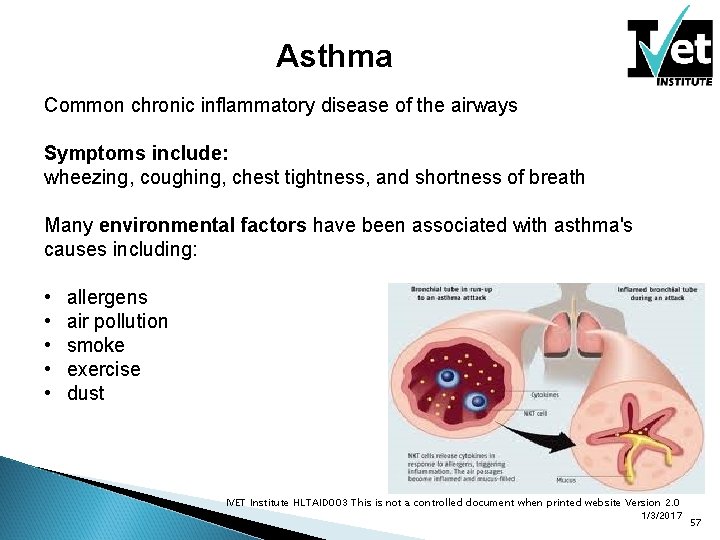
Asthma Common chronic inflammatory disease of the airways Symptoms include: wheezing, coughing, chest tightness, and shortness of breath Many environmental factors have been associated with asthma's causes including: • • • allergens air pollution smoke exercise dust IVET Institute HLTAID 003 This is not a controlled document when printed website Version 2. 0 1/3/2017 57
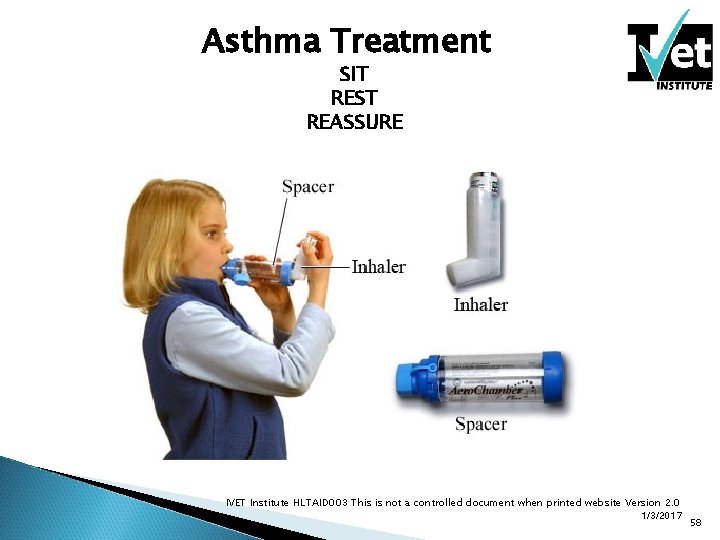
Asthma Treatment SIT REST REASSURE IVET Institute HLTAID 003 This is not a controlled document when printed website Version 2. 0 1/3/2017 58
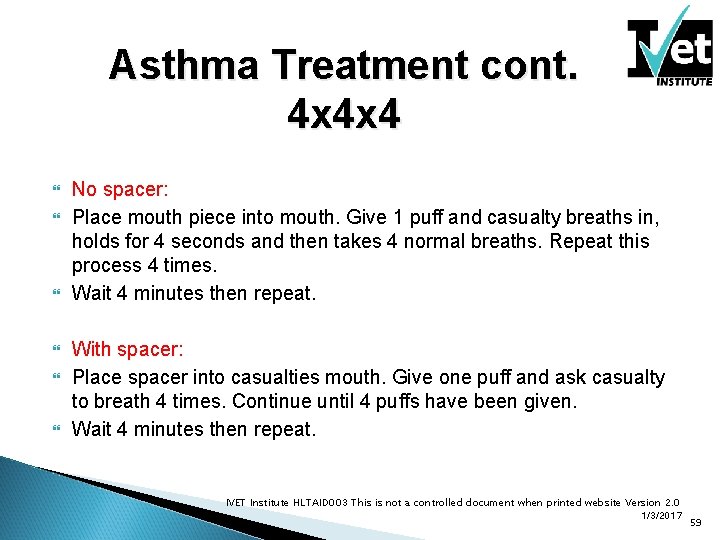
Asthma Treatment cont. 4 x 4 x 4 No spacer: Place mouth piece into mouth. Give 1 puff and casualty breaths in, holds for 4 seconds and then takes 4 normal breaths. Repeat this process 4 times. Wait 4 minutes then repeat. With spacer: Place spacer into casualties mouth. Give one puff and ask casualty to breath 4 times. Continue until 4 puffs have been given. Wait 4 minutes then repeat. IVET Institute HLTAID 003 This is not a controlled document when printed website Version 2. 0 1/3/2017 59
Practical Treat your partner for an asthma attack with both a spacer and without a spacer. IVET Institute HLTAID 003 This is not a controlled document when printed website Version 2. 0 1/3/2017 60
Eye injury There are different eye injuries and we are going to be looking at all 4 Burns: If the casualty has received a burn to the eye and is wearing contact lens DO NOT take off if the eye is badly damaged. The lens may have acted as a protective film, get the patient to remove own lens. What to do? Irrigate eye with cool running water or saline for 20 -30 minutes working from the inside out. Irrigate under eye lids, gently patch eye and ask victim to limit eye movement. Seek urgent medical assistance. IVET Institute HLTAID 003 This is not a controlled document when printed website Version 2. 0 1/3/2017 61
Eye injury cont. Foreign body Gently irrigate eye to remove object. If the particle does not come out and is on white part of eye ball you can remove with a moistened gauze wrapped up. Do not try to remove object if in coloured section. If unsuccessful pad eye with no pressure an seek medical assistance. IVET Institute HLTAID 003 This is not a controlled document when printed website Version 2. 0 1/3/2017 62
Penetrating injury What is this? A object that is stuck in the eye e. g. A nail. What to do? Lay the casualty flat and reassure!! DO NOT TAKE OUT Call 000 straight away. Place padding around the object but do not apply pressure to the wound. This can be done with gauze or a triangular bandage. Place a paper/plastic cup over the eye to limit movement of eye. Ask victim to stare at something on ceiling or in the distance to limit movement of good eye. If the victim becomes panicked you can remove shield around eye. IVET Institute HLTAID 003 This is not a controlled document when printed website Version 2. 0 1/3/2017 63
Practical Practice treating your partner for a penetrating eye injury. IVET Institute HLTAID 003 This is not a controlled document when printed website Version 2. 0 1/3/2017 64
Direct blow This is normally caused by a sporting accident or a fight. A direct blow can cause the patient to have a detached retina and also damage the eye socket and cheek bone. What to do? Rest and reassurance. Place padding over eye and ask to limit eye movement. Seek urgent medical attention. IVET Institute HLTAID 003 This is not a controlled document when printed website Version 2. 0 1/3/2017 65
Bites and stings We will look at land animals first: If victim is bitten by a red back spider or another spider you are to apply an ice pack and compress the area to limit blood flow. Seek medical attention ASAP. If victim is bitten by Bees, Wasps or Ants apply ice packs to the areas to reduce swelling and compress areas. If the victim is allergic to the animals you will need to use PIT. IVET Institute HLTAID 003 This is not a controlled document when printed website Version 2. 0 1/3/2017 66
Land Animals If bitten by a snake or Sydney funnel web spider you will need to use the PIT method. What to do if this happens? DRSABCD Rest and reassure the victim Do not wash the bite mark. Do not do a Bear Grylls and suck the venom out. If possible identify the animal as this is important to pass onto the medical practitioners. IVET Institute HLTAID 003 This is not a controlled document when printed website Version 2. 0 1/3/2017 67
Pressure Immobilisation Technique Rest and reassure the victim. Do not remove the victims clothes as this causes unnecessary movement. 1. Apply pressure over the bite area as firmly as a sprain. If only one bandage start from bottom and work up-Fingers/toes. Mark with X over bite site. 2. With second bandage start from the top of the first bandage overlapping slightly with first bandage and work way up limb as far as possible. 3. Splint bitten limb on either side of bite mark, including joints. Do not elevate limb, do not remove bandage or splint. IVET Institute HLTAID 003 This is not a controlled document when printed website Version 2. 0 1/3/2017 68
Practical Practice with your partner to treat a snake bite on their calf. IVET Institute HLTAID 003 This is not a controlled document when printed website Version 2. 0 1/3/2017 69
Aquatic creatures Sea snakes, blue ringed octopus and cone shells: Use the PIT method For box jelly fish, Irukandji Jelly fish: Use vinegar or salt water to flush the wound for 30 seconds. Call 000 straight away. The casualty will lose consciousness quickly and will go into cardiac arrest. Commence CPR immediately. Blue bottles and fish stings: Immerse or flood area with hot water, if no pain relief continue with Ice to numb area, pain will subside in 3 minutes. IVET Institute HLTAID 003 This is not a controlled document when printed website Version 2. 0 1/3/2017 70
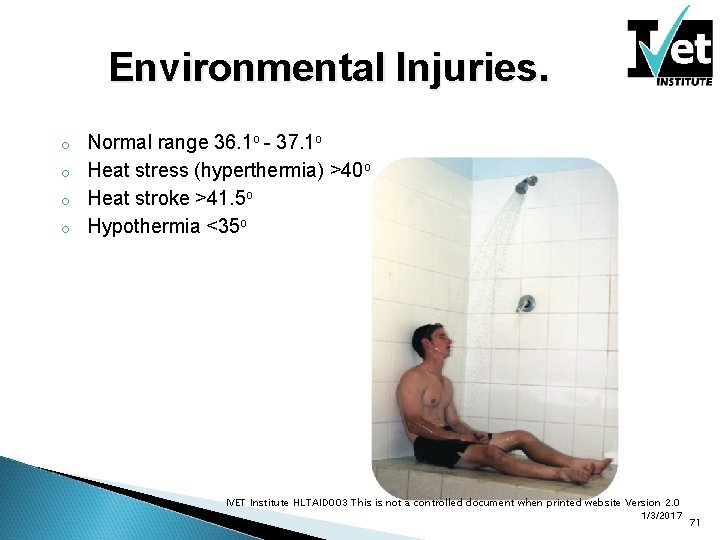
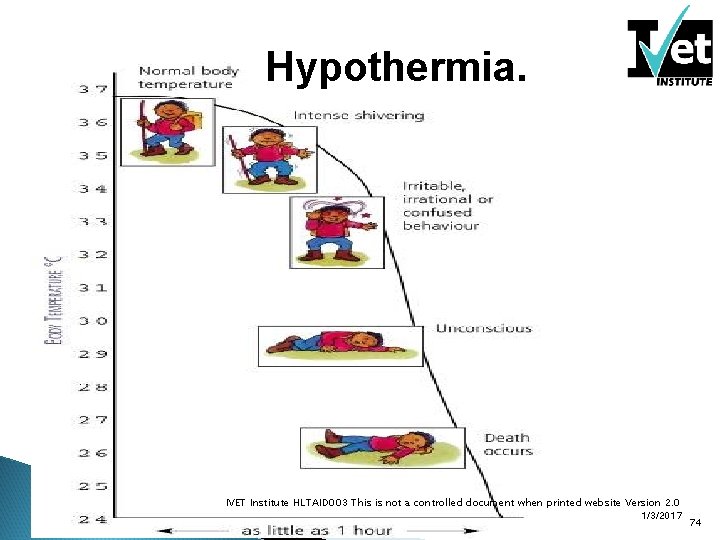
Environmental Injuries. Normal range 36. 1 o - 37. 1 o o Heat stress (hyperthermia) >40 o o Heat stroke >41. 5 o o Hypothermia <35 o o IVET Institute HLTAID 003 This is not a controlled document when printed website Version 2. 0 1/3/2017 71
Dehydration / Heat stroke First signs are the body becomes dehydrated o Dizzy o Lack of feeling in limbs o Severe physical and mental reactions of the body o IVET Institute HLTAID 003 This is not a controlled document when printed website Version 2. 0 1/3/2017 72
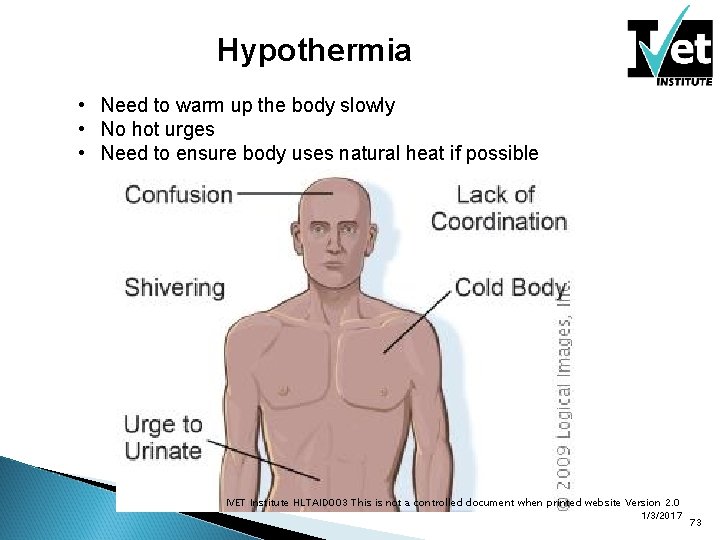
Hypothermia • Need to warm up the body slowly • No hot urges • Need to ensure body uses natural heat if possible IVET Institute HLTAID 003 This is not a controlled document when printed website Version 2. 0 1/3/2017 73
Hypothermia. IVET Institute HLTAID 003 This is not a controlled document when printed website Version 2. 0 1/3/2017 74
Anaphylaxis. Is a life threatening allergic reaction. What to? There are many different triggers including nuts, insect stings, shellfish, latex products and certain drugs. The airways rapidly close and breathing becomes difficult. IVET Institute HLTAID 003 This is not a controlled document when printed website Version 2. 0 1/3/2017 75
Anaphylaxis Signs and Symptoms Swelling of Face General Red Rash Hives of Back Hives of Trunk IVET Institute HLTAID 003 This is not a controlled document when printed website Version 2. 0 1/3/2017 76
When to use the auto-injector? Mild to moderate signs & symptoms: Swelling of lips, face and eyes. Hives or rash Rapid Pulse Nausea You will administer the auto-injector that the individual has when: Difficulty breathing Collapse or unconscious Swelling of throat, tongue. IVET Institute HLTAID 003 This is not a controlled document when printed website Version 2. 0 1/3/2017 77
What to do? Call 000 Assist the casualty administer epipen, record the time it was given. Monitor casualties breathing, put victim in a comfortable position. The auto-injector will last for about 5 minutes. After this you can administer another auto-injector if available. If there are none available commence CPR until the ambulance arrives. IVET Institute HLTAID 003 This is not a controlled document when printed website Version 2. 0 1/3/2017 78
Practical In partners treat your casualty that is having an anaphylactic reaction. IVET Institute HLTAID 003 This is not a controlled document when printed website Version 2. 0 1/3/2017 79
Burns Can be caused by: heat, cold , friction, chemical, electrical or radiation. Do not apply ice directly to burns, do not break any blisters. Do not use fluffy dressings to cover burns. First aid: DRSABCD. Cool affected area with water, usually 20 minutes. Cover burnt area with a loose, non stick dressing(sterile non adherent dressing, cling wrap, sheet, pillow case. Elevate limb if possible. Watch for shock. If burn is bigger than a 20 c piece seek medical attention. IVET Institute HLTAID 003 This is not a controlled document when printed website Version 2. 0 1/3/2017 80
Common Drugs Can I give out analgesics? Analgesics are pain relief eg panadol. Panadol is only to be given out by a nurse not a first aid officier. IVET Institute HLTAID 003 This is not a controlled document when printed website Version 2. 0 1/3/2017 81
Poisons Who do you call? Poison information line 131126. What to do? Establish what they have taken. Do not induce vomiting, if they do vomit send to hospital with patient. Do not give anything by mouth! IVET Institute HLTAID 003 This is not a controlled document when printed website Version 2. 0 1/3/2017 82
Needle stick injury What should you do? Wash the area well with soapy water. If in the eyes flush for 5 minutes. If on the arm cover with bandage and mark site of wound and seek immediate medical attention. IVET Institute HLTAID 003 This is not a controlled document when printed website Version 2. 0 1/3/2017 83