STUDY OF ROAD ACCIDENTS IN INDIA INTRODUCTION Road


- Slides: 51
STUDY OF ROAD ACCIDENTS IN INDIA
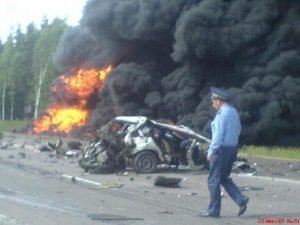
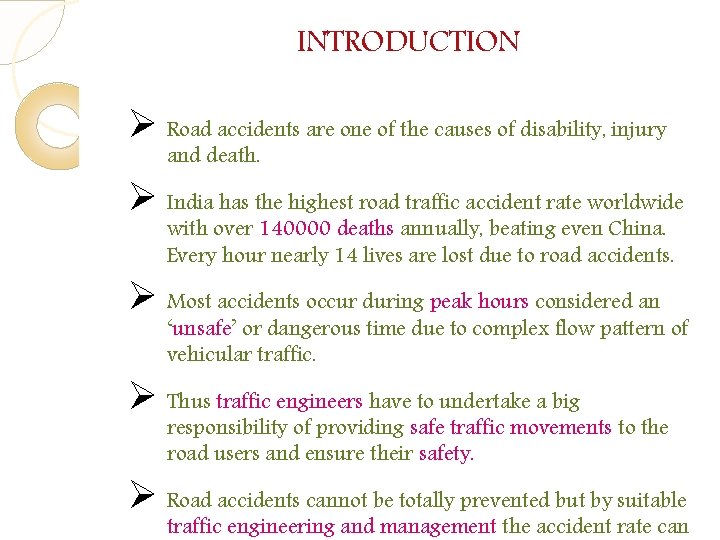
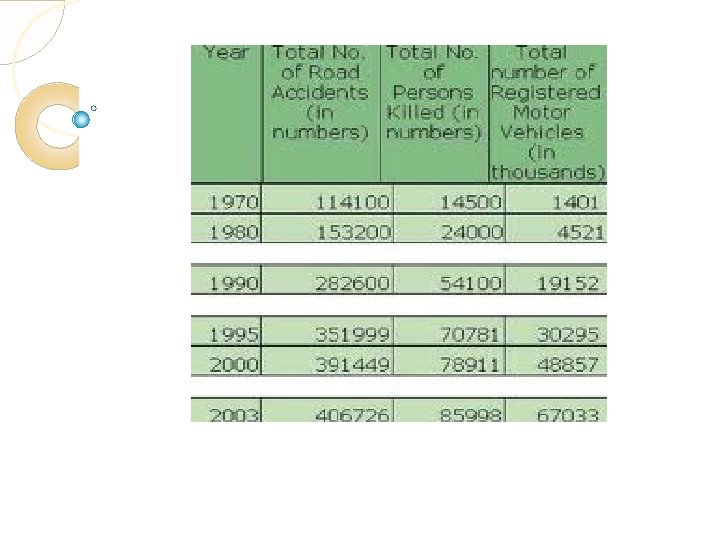
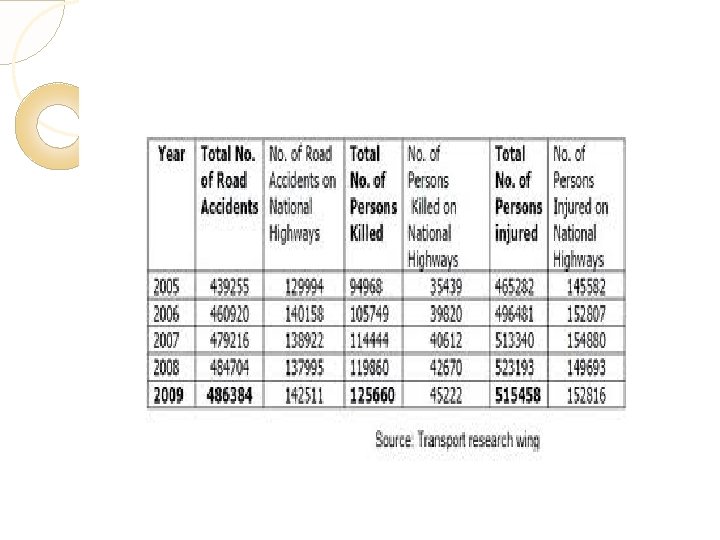
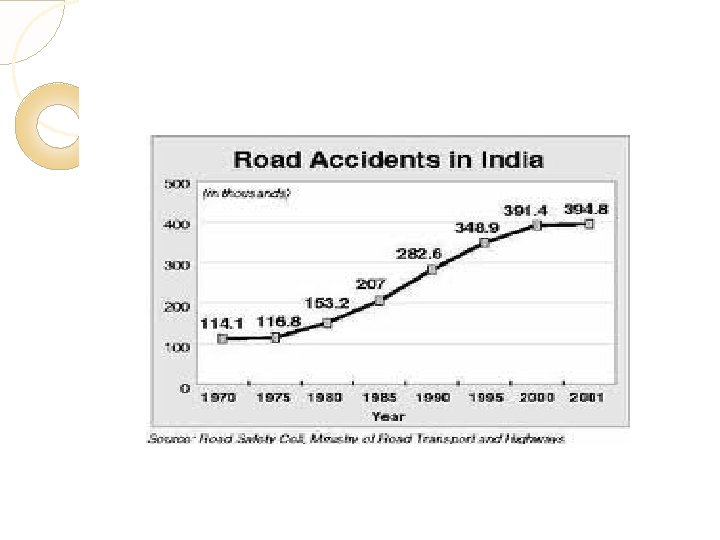
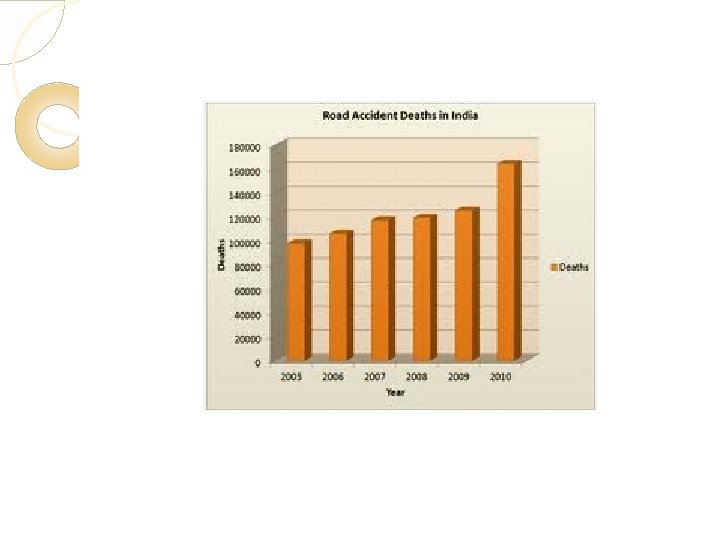
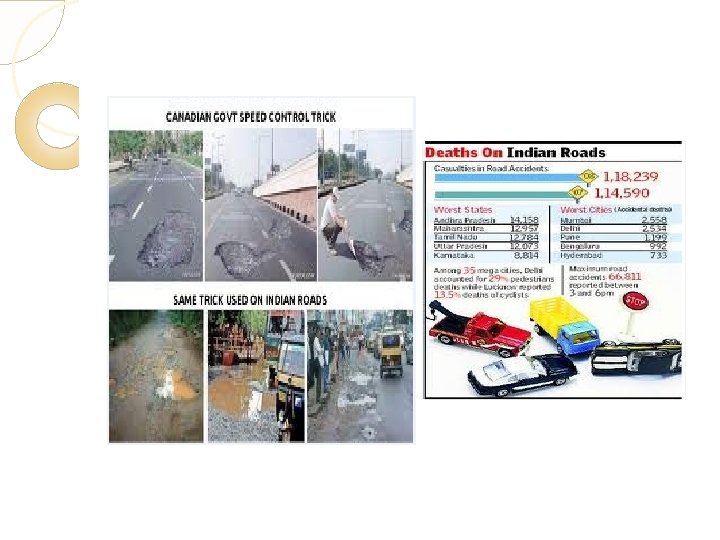
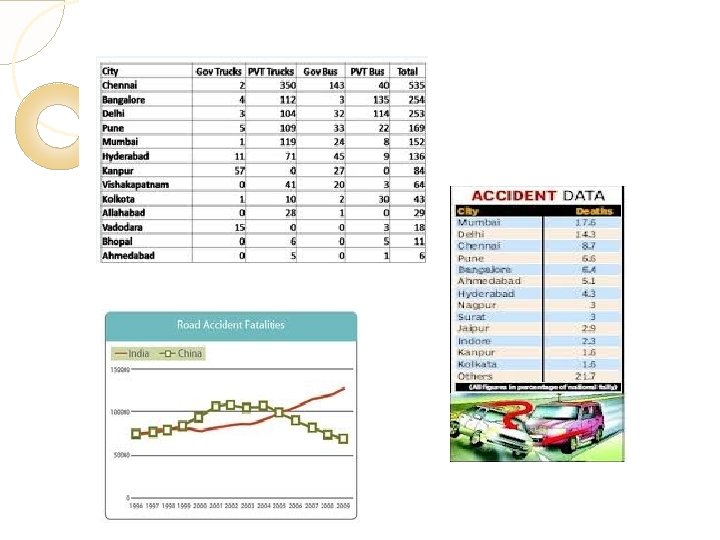
INTRODUCTION Ø Road accidents are one of the causes of disability, injury and death. Ø India has the highest road traffic accident rate worldwide with over 140000 deaths annually, beating even China. Every hour nearly 14 lives are lost due to road accidents. Ø Most accidents occur during peak hours considered an ‘unsafe’ or dangerous time due to complex flow pattern of vehicular traffic. Ø Thus traffic engineers have to undertake a big responsibility of providing safe traffic movements to the road users and ensure their safety. Ø Road accidents cannot be totally prevented but by suitable traffic engineering and management the accident rate can
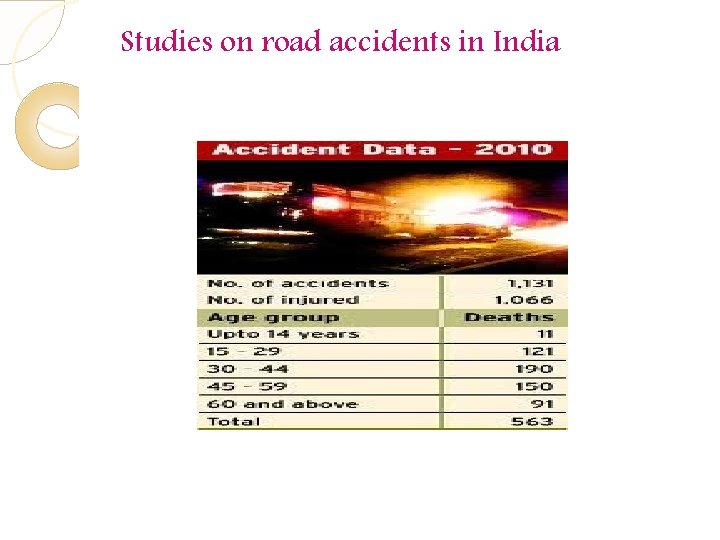
Studies on road accidents in India
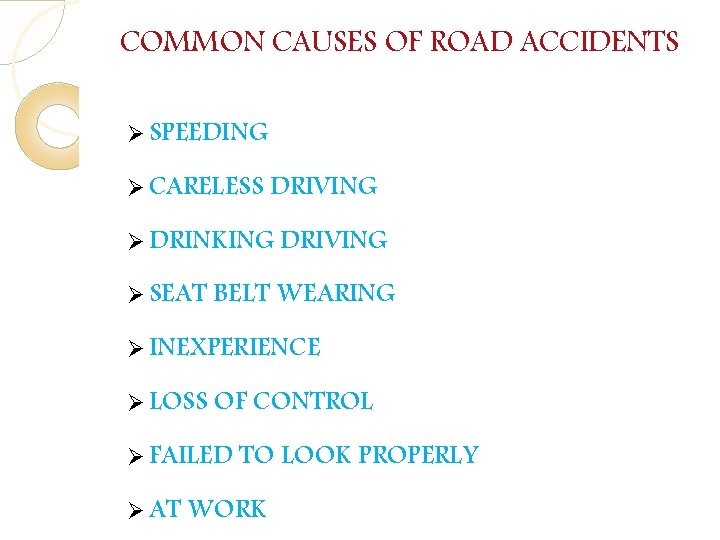
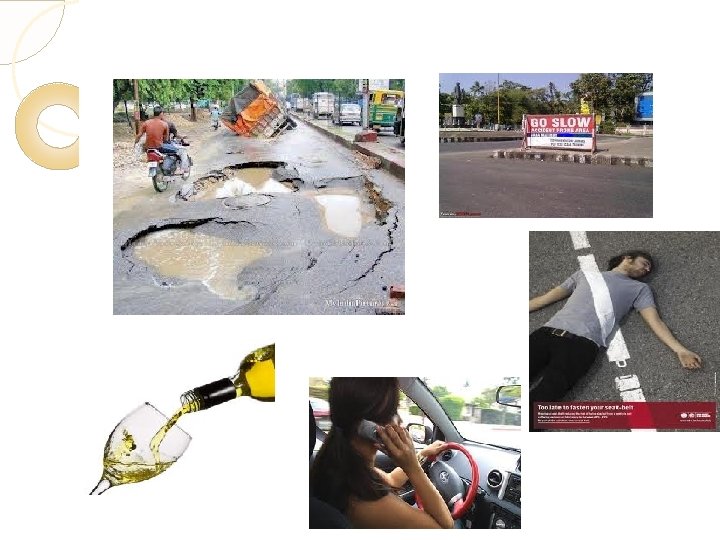
COMMON CAUSES OF ROAD ACCIDENTS Ø SPEEDING Ø CARELESS DRIVING Ø DRINKING DRIVING Ø SEAT BELT WEARING Ø INEXPERIENCE Ø LOSS OF CONTROL Ø FAILED TO LOOK PROPERLY Ø AT WORK
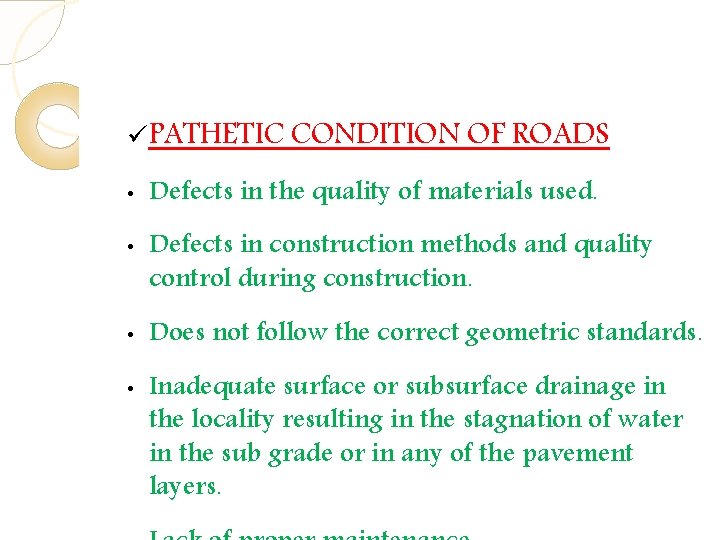
ü PATHETIC CONDITION OF ROADS • • Defects in the quality of materials used. Defects in construction methods and quality control during construction. Does not follow the correct geometric standards. Inadequate surface or subsurface drainage in the locality resulting in the stagnation of water in the sub grade or in any of the pavement layers.
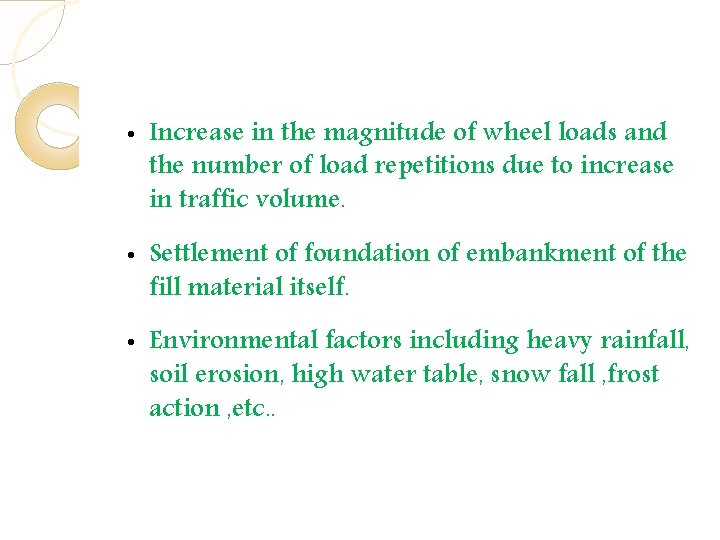
• Increase in the magnitude of wheel loads and the number of load repetitions due to increase in traffic volume. • Settlement of foundation of embankment of the fill material itself. • Environmental factors including heavy rainfall, soil erosion, high water table, snow fall , frost action , etc. .
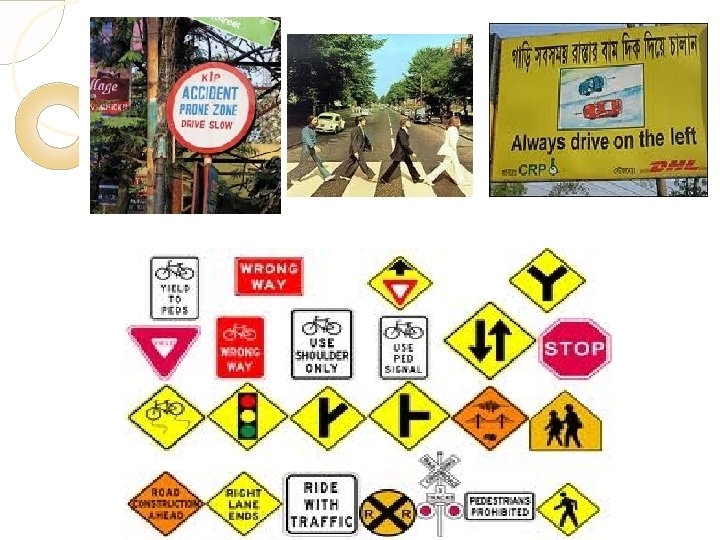
STEPS TO BE TAKEN FOR PREVENTING ROAD ACCIDENTS…. § Strict enforcement of speed limits. § One way traffic should be implemented. § Roads should be widened wherever required. § Curvatures should be minimized. § Footpaths and medians should be made mandatory for all important roads. § Zebra crossing should be provided. § Provide signals, road markings, sign posts. . § Construction of humps in important places,
PAVEMENT SAFETY FACTORS v SURFACE TEXTURE v PAVEMENT ROUGHNESS AND SURFACE DISTRESS v PAVEMENT SHOULDER DESIGN v RUMBLE STRIPS v PASSING LANES v TIME OF DAY AND WEATHER CONDITON v INCORPORATING ROAD SAFETY IMPROVEMENTS
SURFACE TEXTURE Ø Road surfaces must ensure an adequate level of friction at the tyre pavement interfaces to provide safe operation of vehicles. Ø Pavement surface properties • • Micro texture – tyre pavement contact, skid resistance Macro texture –drainage ability
PAVEMENT ROUGHNESS AND SURFACE DISTRESS § “potholes, bumps or ruts”. § Driving on roads in good condition, higher accident may occur due to high speed, lower skid resistance and some other safety factors. § Single and multiple vehicle accident rates. § To decrease single vehicle road accidents by
�Multiple road accidents on rougher roads contain two factors Ø Lateral variation in vehicle path Ø Road defects
PAVEMENT SHOULDER DESIGN Shoulder performs variety of functions o Lateral support o Provides area o Provide easy driving o Safety zone for parking o Improve sight distance Shoulder reduces accident rates for various lane
ü Median shoulder width increases, accidents increases… ü Main functions of traffic engineering studies is to improve safety by • Minimizing shoulder drop-off • Increase driver comfort • Reduce property damage
RUMBLE STRIPS �Effective low cost method of providing guidance for drivers. �Mainly helpful at the time of winter storms, which reduces the visibility of pavement marking. �Installed wherever the shoulder width is 2 m or more. �On shoulders adjacent to climbing lanes, rumble strips may be installed on 1. 5 m shoulder also.
PASSING LANES �Road system must have a wide paved lanes. �It helps in reducing problems during overtaking and to avoid queues of vehicles on the road. �It also provide adequate gap in the opposing traffic nor absence of solid barrier lines.
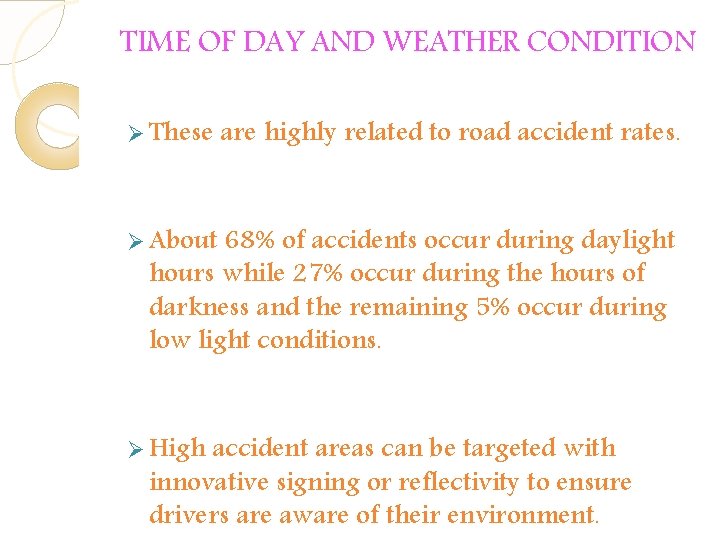
TIME OF DAY AND WEATHER CONDITION Ø These are highly related to road accident rates. Ø About 68% of accidents occur during daylight hours while 27% occur during the hours of darkness and the remaining 5% occur during low light conditions. Ø High accident areas can be targeted with innovative signing or reflectivity to ensure drivers are aware of their environment.
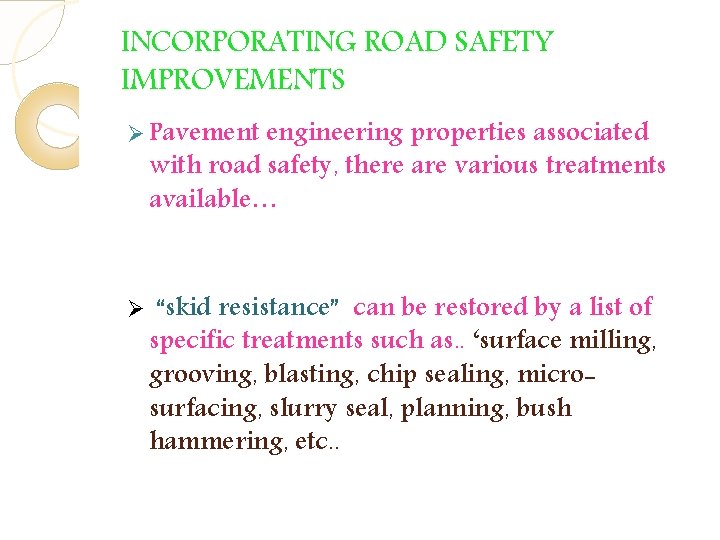
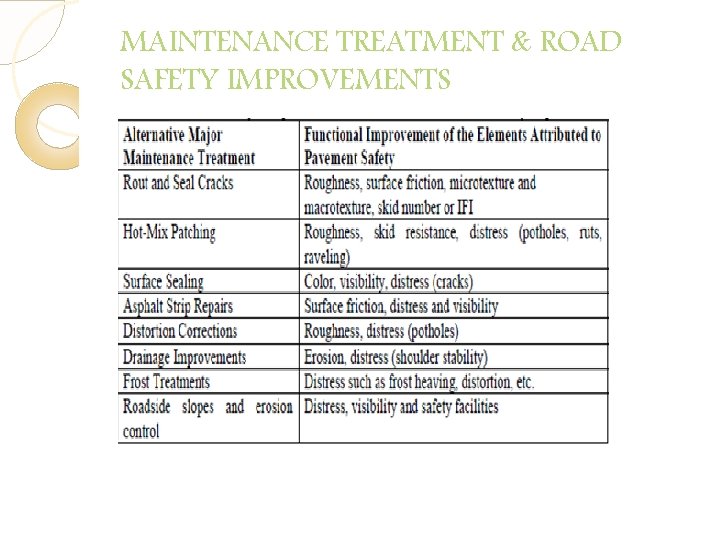
INCORPORATING ROAD SAFETY IMPROVEMENTS Ø Pavement engineering properties associated with road safety, there are various treatments available… Ø “skid resistance” can be restored by a list of specific treatments such as. . ‘surface milling, grooving, blasting, chip sealing, microsurfacing, slurry seal, planning, bush hammering, etc. .
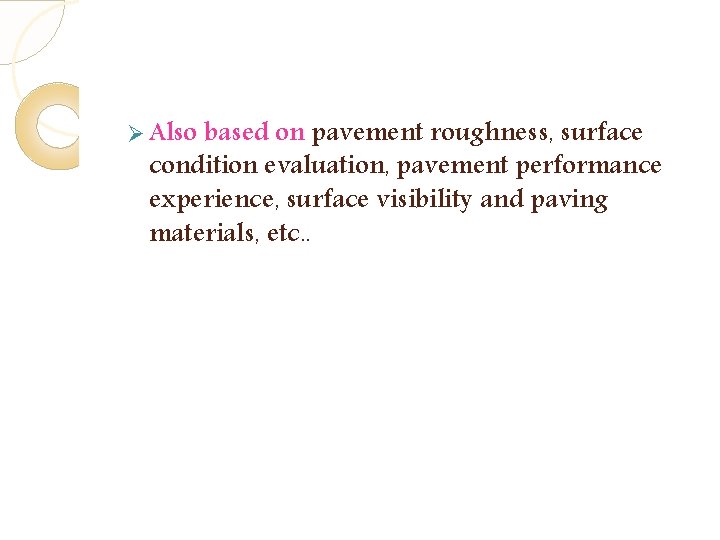
Ø Also based on pavement roughness, surface condition evaluation, pavement performance experience, surface visibility and paving materials, etc. .
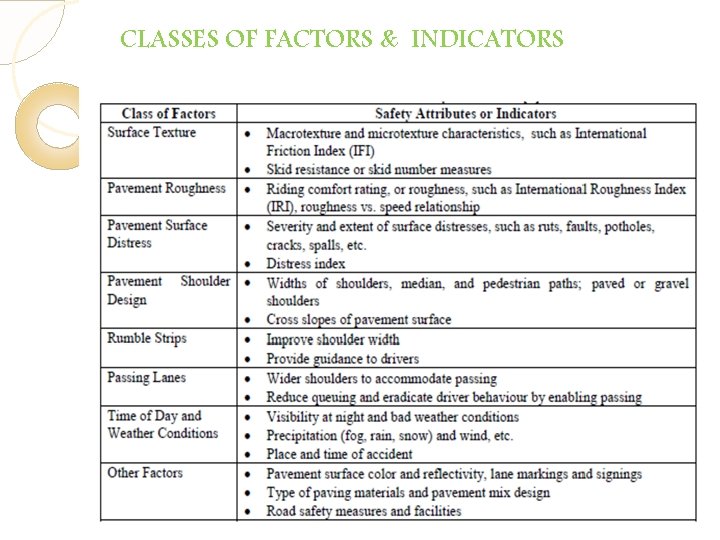
CLASSES OF FACTORS & INDICATORS
MAINTENANCE TREATMENT & ROAD SAFETY IMPROVEMENTS
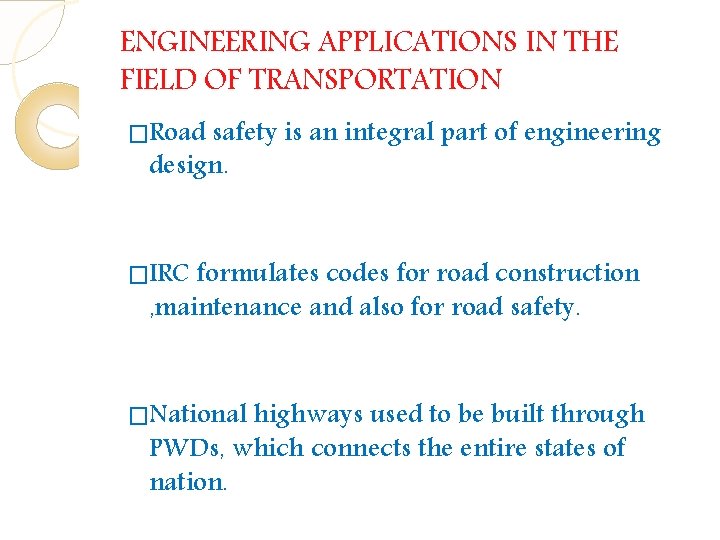
ENGINEERING APPLICATIONS IN THE FIELD OF TRANSPORTATION �Road safety is an integral part of engineering design. �IRC formulates codes for road construction , maintenance and also for road safety. �National highways used to be built through PWDs, which connects the entire states of nation.
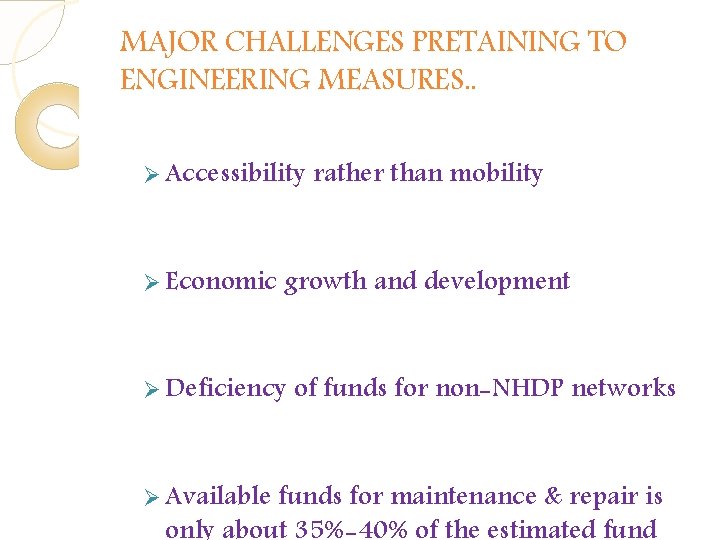
MAJOR CHALLENGES PRETAINING TO ENGINEERING MEASURES. . Ø Accessibility rather than mobility Ø Economic growth and development Ø Deficiency of funds for non-NHDP networks Ø Available funds for maintenance & repair is only about 35%-40% of the estimated fund
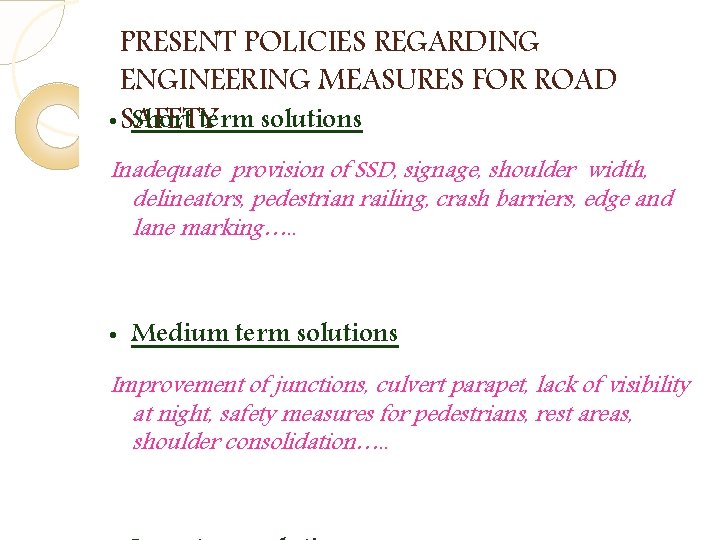
PRESENT POLICIES REGARDING ENGINEERING MEASURES FOR ROAD • SAFETY Short term solutions Inadequate provision of SSD, signage, shoulder width, delineators, pedestrian railing, crash barriers, edge and lane marking…. . • Medium term solutions Improvement of junctions, culvert parapet, lack of visibility at night, safety measures for pedestrians, rest areas, shoulder consolidation…. .
GEOMETRIC DESIGN CONSIDERATIONS OF ROADS TO PREVENT ACCIDENTS Basic objectives of geometric design are Ø Optimize efficiency Ø Safety Ø Minimizing cost Ø Minimizing environmental damages Ø Livability Geometric design can be broken into 3 parts Ø Alignment Ø Profile
�ALIGNMENT- route of the road, defined as a series of horizontal tangents and curves �PROFILE – vertical aspect of the road, including crest, sag curves and the straight grade lines connecting them. �CROSS SECTION – position, no of vehicles, bicycle lanes and side walks , along with their cross slope or banking, drainage features,
DESIGN STANDARDS Ø Design guidelines taken into account by § Speed § Vehicle type § Road grade (slope) § View obstructions § Stopping distance Ø AASHTO published primary US guidance on “A Policy on Geometric Design of Highway and Streets” and other standards includes
PROFILE �Consist of road slopes(grades) connected by parabolic vertical curves �Sag curves –tangent slopes at the end of the curve that is higher than the beginning of the curve �Crest vertical curves –tangent slope at the end of the curve lower than the beginning of the curve �Drainage – poor in sag curves and flat roads
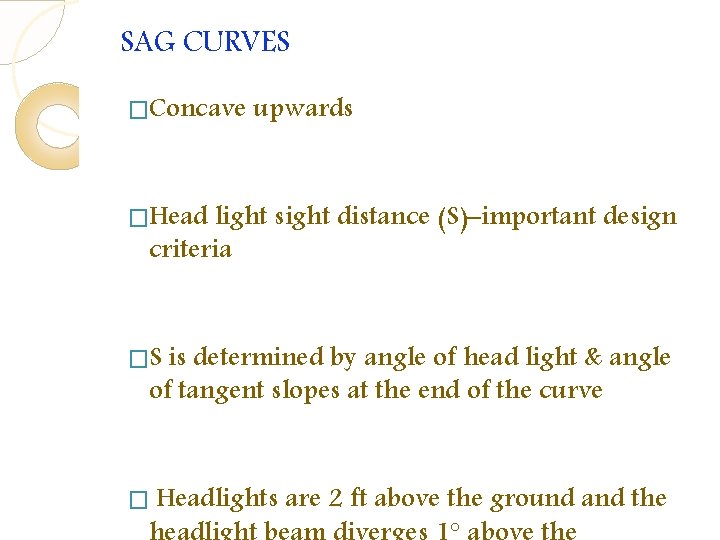
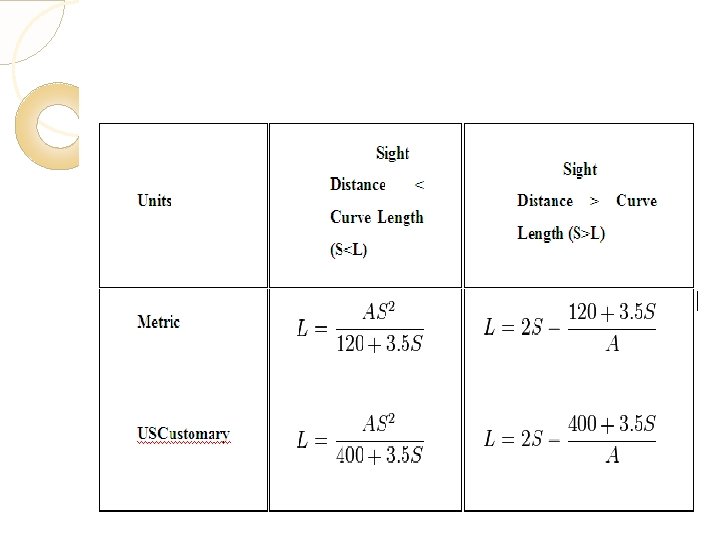
SAG CURVES �Concave upwards �Head light sight distance (S)–important design criteria �S is determined by angle of head light & angle of tangent slopes at the end of the curve � Headlights are 2 ft above the ground and the
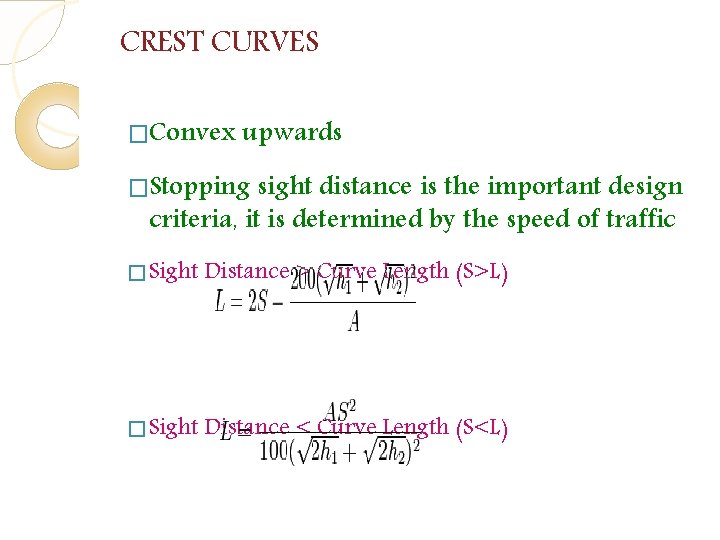
CREST CURVES �Convex upwards �Stopping sight distance is the important design criteria, it is determined by the speed of traffic � Sight Distance > Curve Length (S>L) � Sight Distance < Curve Length (S<L)
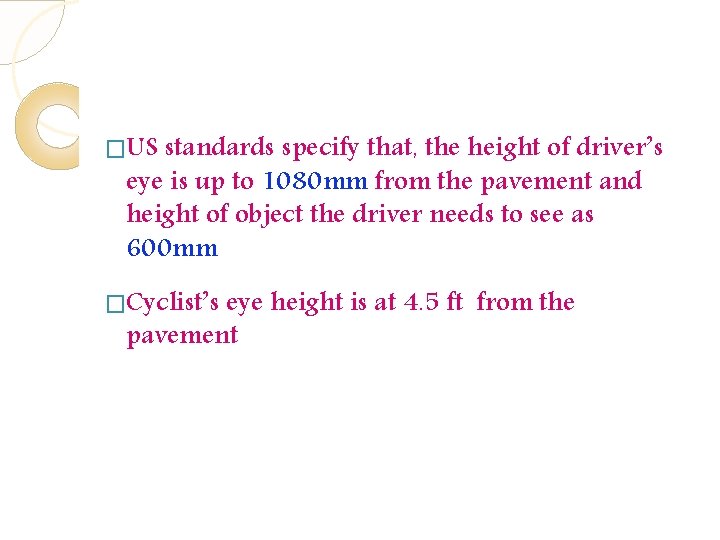
�US standards specify that, the height of driver’s eye is up to 1080 mm from the pavement and height of object the driver needs to see as 600 mm �Cyclist’s eye height is at 4. 5 ft pavement from the
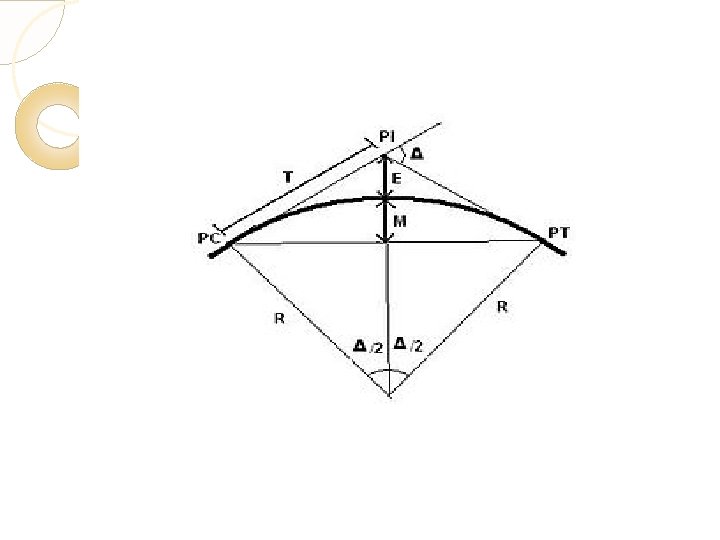
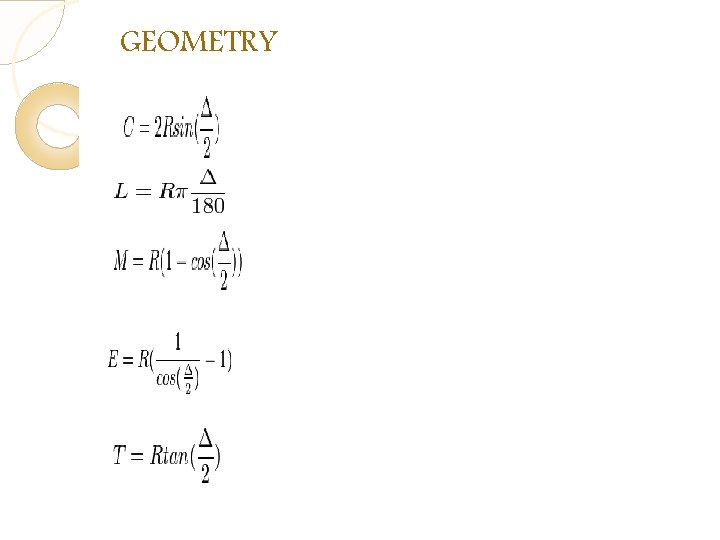
GEOMETRY
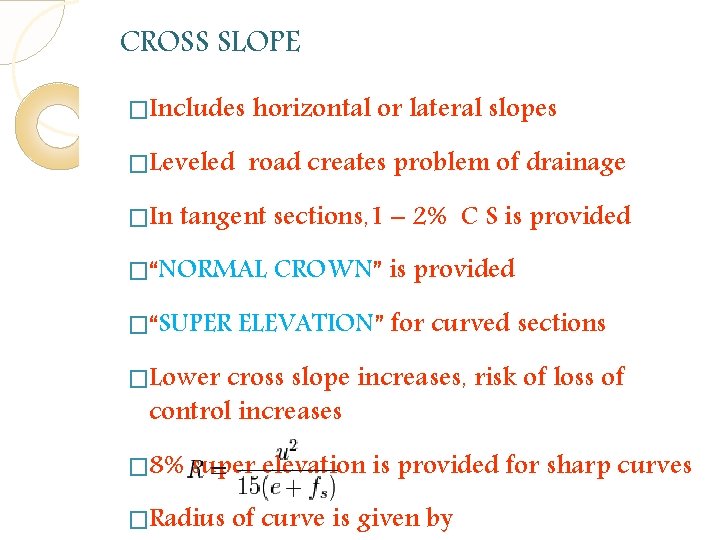
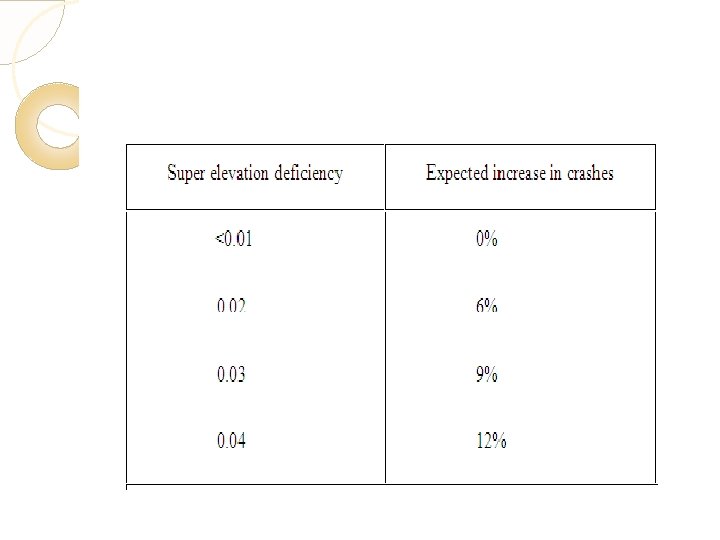
CROSS SLOPE �Includes horizontal or lateral slopes �Leveled road creates problem of drainage �In tangent sections, 1 – 2% C S is provided �“NORMAL CROWN” is provided �“SUPER ELEVATION” for curved sections �Lower cross slope increases, risk of loss of control increases � 8% super elevation is provided for sharp curves �Radius of curve is given by
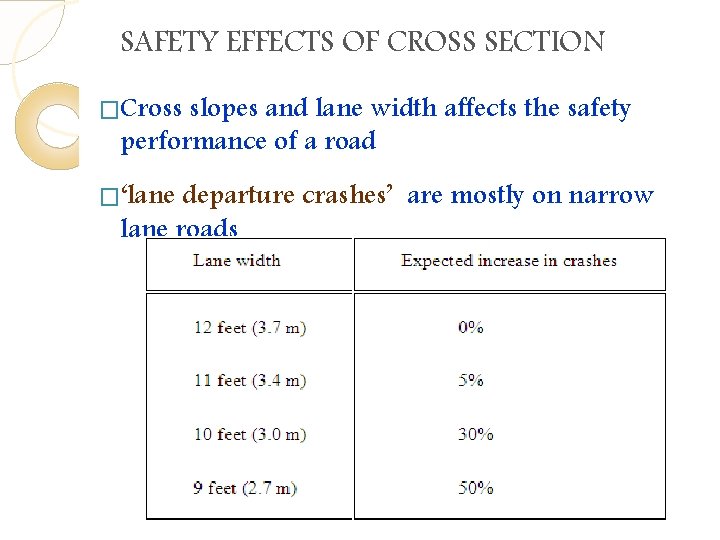
SAFETY EFFECTS OF CROSS SECTION �Cross slopes and lane width affects the safety performance of a road �‘lane departure crashes’ lane roads are mostly on narrow
SIGHT DISTANCE �Length of road way ahead visible to the driver �It is the distance travelled during two phases Ø Perception reaction time Ø Maneuver time (Brake reaction time) • Depending upon the situations, 3 types of sight distance are used Ø Stopping sight distance Ø Decision sight distance
�Stopping sight distance- distance travelled during PRT & MT and affected by road conditions, mass of the vehicle, inclination of the road and some other factors �Decision sight distance- used when drivers must make decisions more complex than stop or don’t stop, roads are designed for DSD , using 6 to 10 sec for PRT & 4 to 5 sec for MT �Intersection sight distance – distance needed to
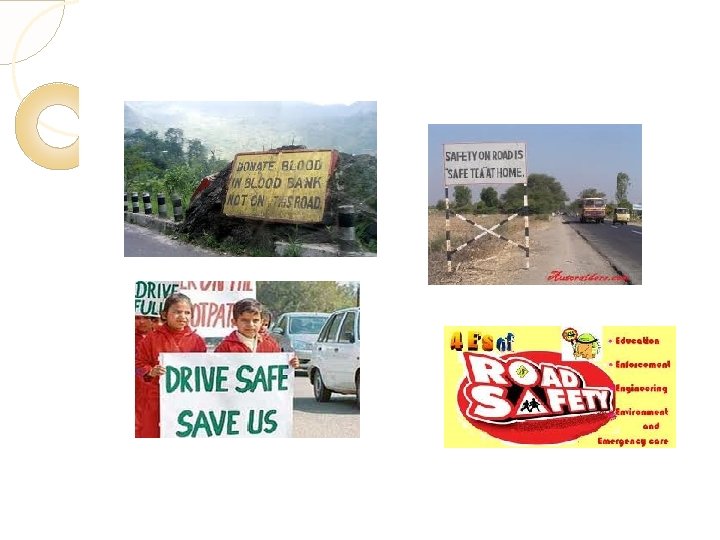
CONCLUSION �Safety means first aid to the uninjured �Health of the nation is more important than the wealth of the nation �Road safety is a major public health concern �Strict implementation of road safety measures reduces the“ ROAD ACCIDENTS”
REFERENCES Journal Articles: �DR. (Mrs. ) Nishi Mittal & DR. S. M. Sarin, “ characteristics of road accidents in India”, Indian Highways, October 2001 �A. Anne Rosaline, B. Sathya Narayanan & S. Shanmuga Sundara Boopathy, “comparison of accident rate using accident ranking”, Indian
Thank you