
CPR First Aid Foundation Standard 10 Technical Skills

- Slides: 23
CPR/ First Aid • *Foundation Standard 10: Technical Skills • Apply technical skills required for all career specialties and demonstrate skills and knowledge as appropriate – 10. 12 Obtain training or certification in cardiopulmonary resuscitation (CPR), automated external defibrillator (AED), foreign body airway obstruction (FBAO) and first aid. 2
CDC Statistics on Causes of Death 2015 • Leading Cause of Death- Heart disease: 614, 348 • Accidents 4 th leading cause of death in the U. S. 136, 053 • Stroke (cerebrovascular diseases) 5 th leading cause of death- 133, 103 10. 12 Obtain training or certification in cardiopulmonary resuscitation (CPR), automated external defibrillator (AED), foreign body airway obstruction (FBAO) and first aid
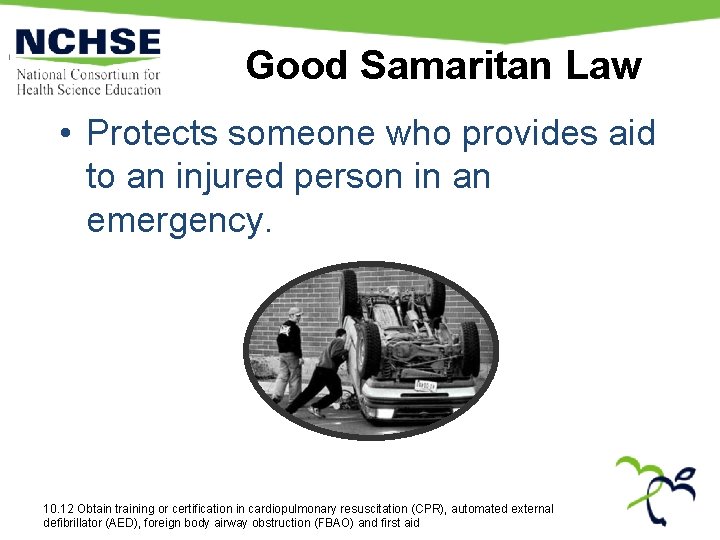
Good Samaritan Law • Protects someone who provides aid to an injured person in an emergency. 10. 12 Obtain training or certification in cardiopulmonary resuscitation (CPR), automated external defibrillator (AED), foreign body airway obstruction (FBAO) and first aid
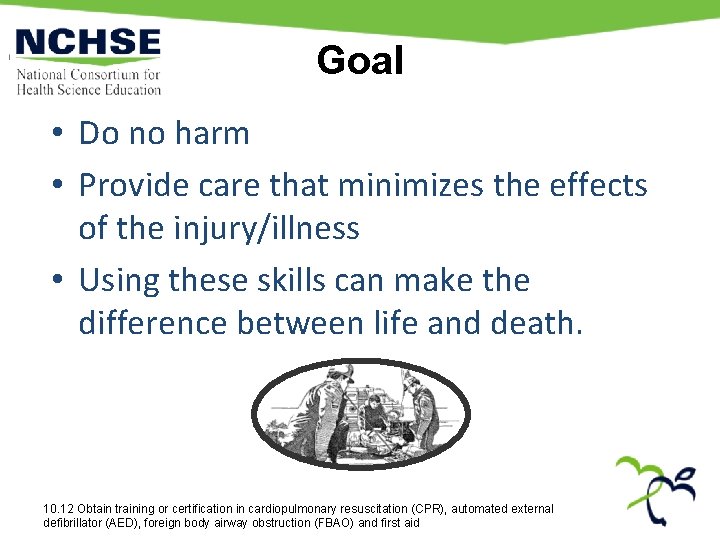
Goal • Do no harm • Provide care that minimizes the effects of the injury/illness • Using these skills can make the difference between life and death. 10. 12 Obtain training or certification in cardiopulmonary resuscitation (CPR), automated external defibrillator (AED), foreign body airway obstruction (FBAO) and first aid
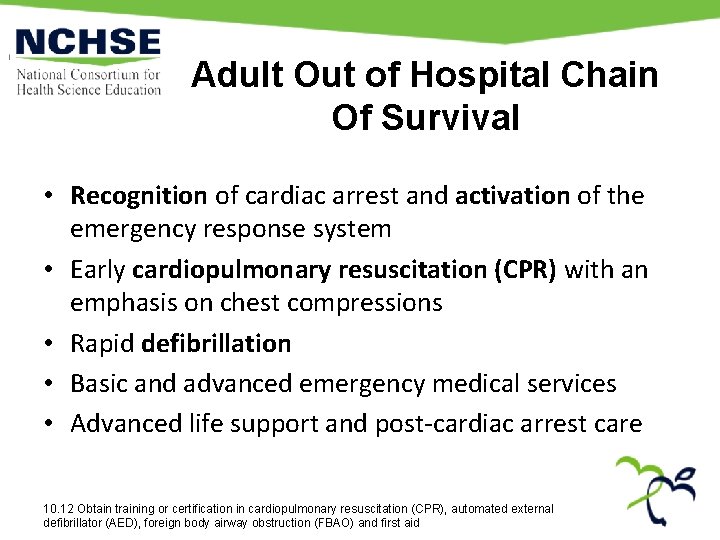
Adult Out of Hospital Chain Of Survival • Recognition of cardiac arrest and activation of the emergency response system • Early cardiopulmonary resuscitation (CPR) with an emphasis on chest compressions • Rapid defibrillation • Basic and advanced emergency medical services • Advanced life support and post-cardiac arrest care 10. 12 Obtain training or certification in cardiopulmonary resuscitation (CPR), automated external defibrillator (AED), foreign body airway obstruction (FBAO) and first aid
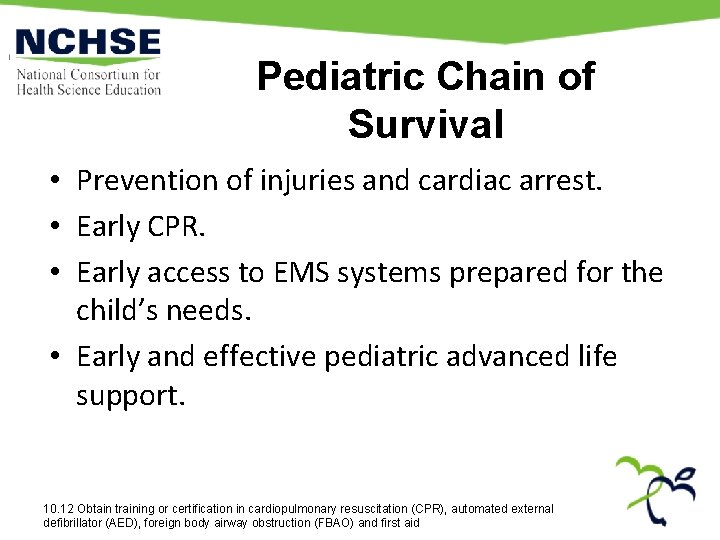
Pediatric Chain of Survival • Prevention of injuries and cardiac arrest. • Early CPR. • Early access to EMS systems prepared for the child’s needs. • Early and effective pediatric advanced life support. 10. 12 Obtain training or certification in cardiopulmonary resuscitation (CPR), automated external defibrillator (AED), foreign body airway obstruction (FBAO) and first aid
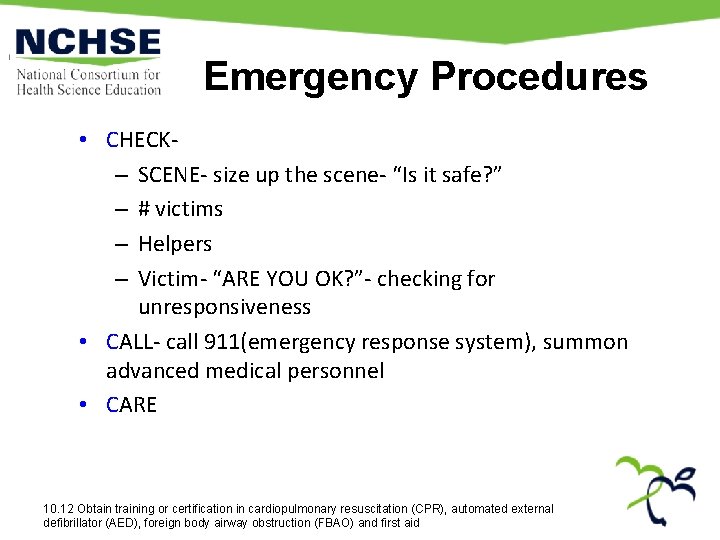
Emergency Procedures • CHECK– SCENE- size up the scene- “Is it safe? ” – # victims – Helpers – Victim- “ARE YOU OK? ”- checking for unresponsiveness • CALL- call 911(emergency response system), summon advanced medical personnel • CARE 10. 12 Obtain training or certification in cardiopulmonary resuscitation (CPR), automated external defibrillator (AED), foreign body airway obstruction (FBAO) and first aid
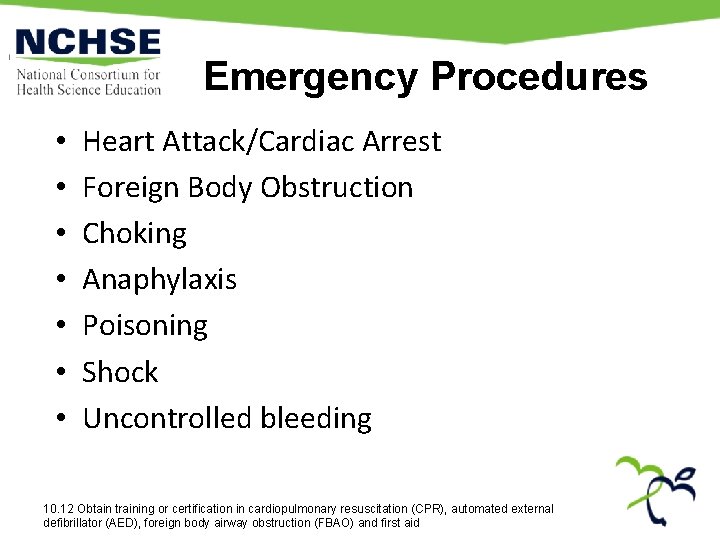
Emergency Procedures • • Heart Attack/Cardiac Arrest Foreign Body Obstruction Choking Anaphylaxis Poisoning Shock Uncontrolled bleeding 10. 12 Obtain training or certification in cardiopulmonary resuscitation (CPR), automated external defibrillator (AED), foreign body airway obstruction (FBAO) and first aid
Coronary Heart Disease Angina Pectoris • Chest Pain- retrosternal “Feels like someone is setting on my chest” – – – Shortness of breath Sweating Nauseous Radiating pain Pain goes away when resting Myocardial Infarction • Chest Pain- retrosternal “Feels like someone is setting on my chest” – – Shortness of breath Sweating Nauseous Radiating pain Treatment Call 911 (Emergency Response System) Keep them calm! NCHSE 1. 21 Describe common diseases and disorders of each body system (such as: heart disease) a. Etiology b. Pathology c. Diagnosis d. Treatment e. Prevention;
Myocardial Infarction • “DEATH OF A PORTION OF THE HEART MUSCLE”, HEART ATTACK, • SYMPTOMS – CHEST PAIN-RETROSTERNAL PAIN MAY RADIATE SHOULDER, NECK , ARMS, BACK, & JAW – NAUSEA, “ACID INGESTION” – SHORTNESS OF BREATH – DOESN’T GO AWAY – “I’M NOT HAVING A HEART ATTACK” NCHSE 1. 21 Describe common diseases and disorders of each body system (such as: heart disease) a. Etiology b. Pathology c. Diagnosis d. Treatment e. Prevention;
Unresponsive Care – A- Airway • Head tilt, chin lift – B- Check for breathing • Look, listen, and feel – C- Check for circulation • Carotid artery • No longer than 10 seconds 10. 12 Obtain training or certification in cardiopulmonary resuscitation (CPR), automated external defibrillator (AED), foreign body airway obstruction (FBAO) and first aid
Cardiac Arrest • No pulse • Heart stops = DEAD • CPR- Cardiopulmonary Resuscitation (revive heart and lungs) – Breath - O 2 into the blood – Compressions- “ squash” the heart against the backbone to circulate the blood 10. 12 Obtain training or certification in cardiopulmonary resuscitation (CPR), automated external defibrillator (AED), foreign body airway obstruction (FBAO) and first aid
CPR • C – COMPRESSIONS – 30 compressions – Compressions- 2” deep – Rate- at least 100 compressions per minute – 30: 2 • A – Airway- head tilt, chin lift • B – Breaths- 2 breaths- just enough to make the chest rise • 5 cycles of 30: 2, check pulse 10. 12 Obtain training or certification in cardiopulmonary resuscitation (CPR), automated external defibrillator (AED), foreign body airway obstruction (FBAO) and first aid
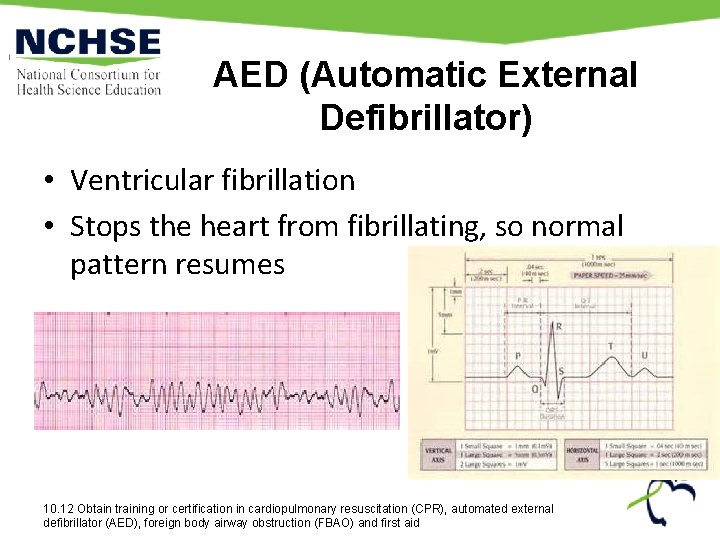
AED (Automatic External Defibrillator) • Ventricular fibrillation • Stops the heart from fibrillating, so normal pattern resumes 10. 12 Obtain training or certification in cardiopulmonary resuscitation (CPR), automated external defibrillator (AED), foreign body airway obstruction (FBAO) and first aid
Defibrillation • Preliminaries – Avoid wet areas – Take off clothing with metal – Place on bare skin – Remove patches • Sequence – Power on – Attach pads – Plug pads into AED – Stand clear – Analyzing – Electrical activity shock – No electrical activity continue CPR 10. 12 Obtain training or certification in cardiopulmonary resuscitation (CPR), automated external defibrillator (AED), foreign body airway obstruction (FBAO) and first aid
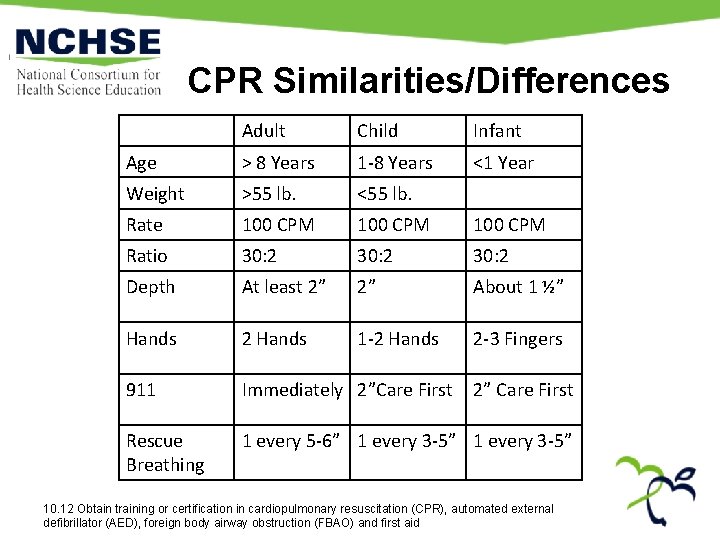
CPR Similarities/Differences Adult Child Infant Age > 8 Years 1 -8 Years <1 Year Weight >55 lb. <55 lb. Rate 100 CPM Ratio 30: 2 Depth At least 2” 2” About 1 ½” Hands 2 Hands 1 -2 Hands 2 -3 Fingers 911 Immediately 2”Care First Rescue Breathing 1 every 5 -6” 1 every 3 -5” 2” Care First 10. 12 Obtain training or certification in cardiopulmonary resuscitation (CPR), automated external defibrillator (AED), foreign body airway obstruction (FBAO) and first aid
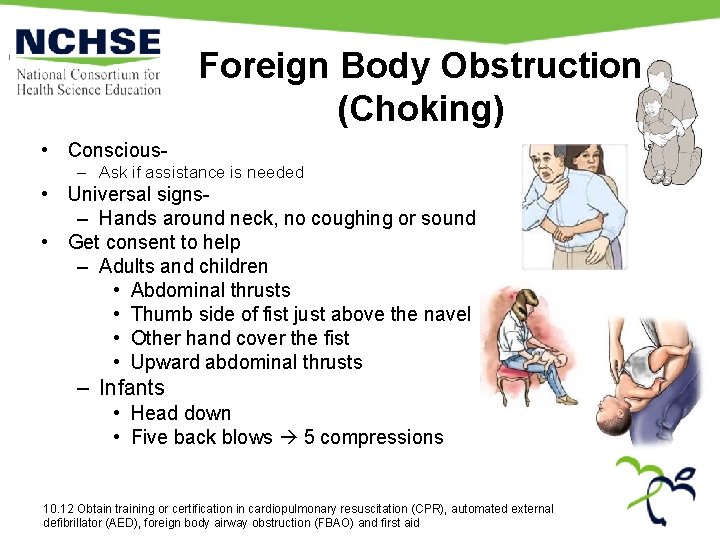
Foreign Body Obstruction (Choking) • Conscious– Ask if assistance is needed • Universal signs– Hands around neck, no coughing or sound • Get consent to help – Adults and children • Abdominal thrusts • Thumb side of fist just above the navel • Other hand cover the fist • Upward abdominal thrusts – Infants • Head down • Five back blows 5 compressions 10. 12 Obtain training or certification in cardiopulmonary resuscitation (CPR), automated external defibrillator (AED), foreign body airway obstruction (FBAO) and first aid
Respiratory Arrest • Unconscious ( 1 person) – Steps of CPR – 2 Breaths Air doesn’t go in – Re-tilt Air doesn’t go in – 30 chest comprehensions – Look, sweep if something visible, – Breath – Repeat until air goes in 10. 12 Obtain training or certification in cardiopulmonary resuscitation (CPR), automated external defibrillator (AED), foreign body airway obstruction (FBAO) and first aid
Emergency Procedures • Anaphylaxis – Keep victim calm – Call 911 – Epi-pen if available • Poisoning – Look for symptoms • Burns or redness around the mouth and lips, Breath that smells like chemicals, Vomiting Difficulty breathing, Drowsiness, Altered mental status – Call 1 - (800) 222 -1222 (Poison Control Center), take container to phone – Give syrup of ipecac or activated charcoal if advised 10. 12 Obtain training or certification in cardiopulmonary resuscitation (CPR), automated external defibrillator (AED), foreign body airway obstruction (FBAO) and first aid
Emergency Procedures • Shock – Lay the person down – Elevate the person's feet unless injury is suspected – Keep person warm and comfortable • Uncontrolled bleeding – Elevate if possible – Cover with gauze – Apply pressure – Apply additional gauze, if necessary – Wrap with bandage and tie over wound 10. 12 Obtain training or certification in cardiopulmonary resuscitation (CPR), automated external defibrillator (AED), foreign body airway obstruction (FBAO) and first aid
Emergency Procedures • Seizures – Do nothing, remove all objects to keep scene safe – Assess victim after seizure stops • Burns – Remove the heat, cool the burn, cover the burn • Strokes – Face – Arms – Speech – Time 10. 12 Obtain training or certification in cardiopulmonary resuscitation (CPR), automated external defibrillator (AED), foreign body airway obstruction (FBAO) and first aid
Emergency Procedures • Strains, sprains – Rest – Ice – Compression – Elevate 10. 12 Obtain training or certification in cardiopulmonary resuscitation (CPR), automated external defibrillator (AED), foreign body airway obstruction (FBAO) and first aid