Vitamins Early on in nutritional research we recognized
- Slides: 75
Vitamins Early on in nutritional research we recognized that there were some substances in foods that were vital for life. Since the 1900 s the study of vitamin’s roles in human physiology has continued at a dramatic pace. “Lecture 9: Vitamins Power. Point" by Dr. Michael Kobre, Achieving the Dream OER Degree Initiative, Tompkins Cortland Community College is licensed under CC BY 4. 0
The Vitamins support nutritional health. Keep in mind that vitamin supplements do not offer as many benefits that come from vitamin-rich foods. Vitamins are essential for normal physiological functioning and homeostasis. Vitamins have many roles in the body. For example: Vitamin C not only prevents the deficiency disease scurvy, but also seems to protect us against certain types of cancer.
The Vitamins A vitamin A deficiency can cause blindness; a lack of the B vitamin niacin cause dementia; and a lack of vitamin D can retard bone growth. The consequences of vitamin deficiencies are so debilitating and the effects of restoring the needed vitamins so dramatic, that people often spend billions of dollars every year in belief that vitamins will cure a host of ailments in the human body.
The Vitamins Some research suggests that vitamin E seems to help protect against some forms of CAD. The B vitamin folate is important in the prevention birth defects. As you will see, the vitamins’ roles in supporting optimal health extend far beyond preventing deficiency diseases. In fact, some of the credit given to low-fat diets in preventing disease actually belongs to the vitamins that diets rich in vegetables, fruits and whole grains bring into the body.
The Vitamins Vitamin differ from carbohydrates, fats, and proteins in the following ways: Structure: vitamins are individual units, they are not linked together. Function: Vitamins do not yield useable energy when broken down but they assist the enzymes that release energy from CHO, fats, and Protein. Food contents: The amounts of vitamins people ingest daily from foods is much smaller in mass, usually vitamins are measured in micrograms or milligrams instead of grams.
Bioavailability The availability of vitamins in foods depends on two factors: the quantity provided by a food source and the amount absorbed and used by the body. Researchers analyze foods to determine their vitamin contents and then they are published the in data tables of food composition.
Bioavailability Determining the bioavailability of a vitamin is a more complex task because it depends on many different factors including Efficiency of digestion/absorption and time of transit through the GI tract. Previous nutritional intake and current nutrition status. What foods consumed at the same time. Food preparation, raw, cooked, or processed. Source of the nutrient, if it is synthetic, fortified, or naturally occurring.
Precursors Some of the vitamins are available from foods in inactive forms known as precursors, or provitamins. Once inside the body, the precursor is changed chemically to an active form of the vitamin that becomes functional.
Organic Nature Being organic (carbon containing), vitamins can be destroyed an then are unable to perform their functions in the body. Vitamins must be handled with care during storage and in cooking to preserve their function.
Organic Nature One example, oxygen destroys vitamin C, so losses occur when foods are cut or open exposing them to the air.
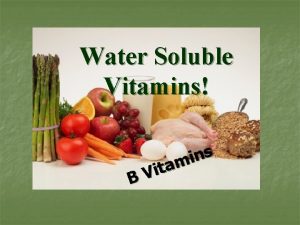
Solubility As you may recall, carbohydrates and proteins are hydrophilic (water-loving), and lipids are hydrophobic. The vitamins are similar, the hydrophilic watersoluble one are the B vitamins and vitamin C. The hydrophobic, fat-soluble vitamins are A, D, E and K. they are handled, transported, and stored differently in the body.
Solubility As each vitamin was researched, it was given a name and sometimes a letter and number designation as well. Many of the water-soluble vitamins have multiple names, which can lead to some confusion. Solubility in the food sources of the different vitamins, affects their absorption, transport, storage, and excretion by our body.
Solubility Water soluble-vitamins are found in the watery compartments of foods. Fat-soluble vitamins usually occur together in the fats and oils of foods. On being absorbed, the water-soluble vitamins move directly into the blood. As with fats, the fat-soluble vitamins must first enter the lymph, then the blood stream using special transport carriers.
Solubility Once in the blood stream, many of the watersoluble vitamins will continue to circulate around with the blood. Fat-soluble vitamins require protein carriers for transport in the body. Our kidneys monitor the blood that flows through them and can detect and remove small excesses of water-soluble vitamins flushing excesses out in our urine.
Solubility Large excesses of water-soluble vitamins can overwhelm the body creating negative effects. Fat-soluble vitamins are stored in adipose cells with body fat site instead of being excreted. Fat soluble vitamins are more likely to reach toxic levels when consumed in excess when compared to water soluble vitamins.
Solubility Because the body stores fat-soluble vitamins, they can be eaten in excess amounts on occasion and still meet the body’s needs over time. Water- soluble vitamins are retained for varying periods in the body. A single day’s omission from the diet will not bring on a deficiency, but water soluble vitamin must be consumed more regularly than the fat-soluble vitamins.
Toxicity Knowledge about some of the roles of vitamins has prompted many people to begin taking excess supplements, assuming that more is better. Just as an inadequate intake can cause harm, so can an excessive intakes of vitamins. Some of the water-soluble vitamins have toxic effects when taken in large doses.
Toxicity Of the nutrients discussed in this course, niacin, vitamin B 6, folate, choline, and vitamin C have upper intake levels set. Data is still lacking to establish upper intake levels for the remaining B vitamins, but this does not mean that excessively high intakes would be without toxic risk.
The B Vitamins Thiamin: is the vitamin part of the coenzyme thiamin pyrophosphate which assists in energy metabolism. This coenzyme participates in the conversion of pyruvate to acetyl Co. A. Along with roles in metabolism, thiamin attaches to a special site on the membranes of nerve cells and in their responding tissues. Muscles, depend heavily on thiamin for normal function.
Thiamin B 1 Dietary recommendations are based on thiamin’s role in enzyme activity. Generally, if a person eats enough food to meet their energy needs and obtains energy from nutritious foods, thiamin intake will be adequate.
Thiamin Deficiency People who fail to eat enough food to meet energy needs risk nutrient deficiencies, including thiamin deficiency. Thiamin deficiency has been often reported among malnourished and homeless people. People who derive most of their energy from empty-kcal foods and alcohol will risk a thiamin deficiency.
Thiamin Deficiency An estimated 4 out of 5 alcoholics are thiamin deficient. Wernicke-Korsakoff syndrome: symptoms include disorientation, loss of short term memory, jerk eye movements, and staggering gait.
Thiamin Deficiency Beriberi: Is a long term thiamin deficiency condition that has two presentations, “wet” or “dry” types. Wasting with edema or just muscle wasting. Also damage to the nervous system, muscles, including cardiac tissue. This condition was first seen in East Asia when the custom of “polishing” rice became widespread. Rice provided ~80% of the energy intake of the people of that area, and rice bran and germ were their principle source of thiamin. Polishing rice takes away the parts of the rice that contain thiamin.
Thiamin Food Sources Many different foods contribute some thiamin to the diet but few are good sources. Consuming several servings of a variety of different nutrient dense foods can help us to meet our thiamin needs. Pork is high in thiamin. When we consume grain products, we should choose whole gain or enriched products.
RDA for Thiamin (B 1) Men should consume: 1. 2 mg/day Women: 1. 1 mg/day Deficiencies can cause: enlarged heart, cardiac failure, weakness, apathy, poor short-term memory, confusion, anorexia and weight loss. Toxicity symptoms: none are currently reported.
Riboflavin also has roles as a coenzyme in many reactions, most noteworthy, the release of energy from nutrients in all of the body’s cells. The coenzyme forms of riboflavin are flavin mononucleotide and flavin adenine dinucleotide. Both of these molecules play critical roles in cell metabolism.
Riboflavin As with thiamin’s RDA, riboflavin’s RDA is based primarily on its function in enzyme activity. Most of us in the United States generally meet or exceed riboflavin recommendations. Men should consume: 1. 3 mg/day Women: 1. 1 mg/day
Riboflavin B 2 Deficiency No single disease is associated with riboflavin deficiency. Deficiencies of the vitamin cause inflammation of the membranes of the mouth, skin, eyes and GI tract.
Riboflavin Food Sources The greatest sources of riboflavin come from milk and other dairy products. Liver, clams, feta cheese, eggs, and dark green leaf vegetables, such as spinach and broccoli are good sources too.
Niacin B 3 Niacin has many names including: Nicotic acid, nicotinamide, niacinamide. The precursor to niacin is the amino acid tryptophan. Niacin is unique when compared to the other B vitamins in that the body can synthesize it from the amino acid tryptophan. To make 1 mg of niacin requires 60 mg of dietary tryptophan to be available for the conversion.
Niacin Recommendations Recommended intakes are shown in niacin equivalents. For example, a food containing 1 mg of niacin and 120 mg of tryptophan provides 3 mg of niacin or 3 niacin equivalents. RDA Men: 16 mg NE/day RDA Women: 14 mg NE/day
Niacin Deficiency Causes Pellagra: A niacin-deficiency disease produces the four symptoms of diarrhea, dermatitis, and dementia, leading to death if untreated. In the 1900 s, pellagra caused widespread deficiencies and some 87, 000 deaths in the southern United States, where many people consumed a diet of low-protein that was based on corn.
Niacin Deficiency This low protein corn-based diet supplied not enough niacin or tryptophan. At least 70% of the niacin in corn is bound to fiber and small peptides, making it unavailable for human digestion or absorption. Corn is also contains the amino acid leucine, which interferes with the tryptophan-to-niacin conversion in the body.
Niacin Deficiency Pellagra was first thought to be caused by infectious agents until we found that the problem was deficient niacin. The fact that a disease such as pellagra could be caused by something lacking in the diet and not by a germ was a unique discovery at the time.
Niacin Toxicity Naturally occurring niacin from foods causes no harm, but large doses consumed from supplements can produce a variety of adverse effects, most notably a condition called niacin flush. Niacin flush occurs when niacin in the form of nicotinic acid is taken in doses as low as three to four times the RDA. It dilates the capillaries and causes a tingling sensation that can be painful.
Niacin Toxicity Large doses of nicotinic acid (~3000 mg/day) have been used to lower blood cholesterol. Any therapy should be closely monitored because of the toxic side effect like liver damage had can occur. Some folks with the following conditions may be particularly susceptible to the toxic effects of niacin. People with liver disease, diabetes, ulcers, gout, heart conditions, and migraine headaches.
Niacin Food Sources Eggs, milk, meat, poultry, fish, whole grain and enriched breads and cereals, nuts, and all proteincontaining foods are good sources of niacin.
Biotin plays an important role as a coenzyme that carries activated carbon dioxide. This role is critical in cellular metabolism for energy production in the body.
Biotin is needed in very small amounts in the body. Because of the small amounts needed, an Adequate intake level has been determined. AI: Adults- 30 micrograms/day. Biotin deficiencies rarely occur. A protein in egg whites binds biotin and can prevent its absorption if eaten in very large amounts.
Biotin Food Sources Biotin is widespread in foods so eating a variety of foods prevents against deficiencies. Biotin is also synthesized by GI tract bacteria, but how much of it is absorbed and used by the body is still under active research.
Pantothenic Acid Is involved in many different processes in the construction of lipids, neurotransmitters, steroid hormones, and hemoglobin in our body. It also functions as a part of coenzyme A in metabolic activities.
Pantothenic Acid Recommendations An AI for pantothenic acid has been researched. The amount reflects how much we need to replace our daily loses. AI for Adults: 5 mg/day
Pantothenic Acid Deficiency is fairly rare. Symptoms of deficiency include a general failure of most of the body’s organ systems and include fatigue, GI distress, and neurological disorders. A condition called Burning feet syndrome that was reported in prisoners of war in Asia during World War II may have been caused by pantothenic acid deficiencies.
Pantothenic Acid Food Sources Pantothenic acid is found in many foods. Typical dietary intakes seem to good levels of pantothenic acid. Diets containing beef, poultry, whole grains, potatoes, tomatoes, and broccoli are good sources. Losses of pantothenic acid during food production can be substantial because it can be destroyed by packaging and some refining processes.
Vitamin B 6 Is found in three different forms. Pyridoxal, pyridoxine, and pyridoxamine. All three forms can be converted to an enzyme that functions in amino acid metabolism. Vitamin B 6 can help function in the transfer amino groups when our liver is synthesizing nonessential amino acids.
Vitamin B 6 Recommendations Because vitamin B 6 coenzymes play many roles in amino acid metabolism, previous RDA were based on levels of protein intakes but since as been changed. RDA for Adults: 1. 3 mg/day Upper RDA level: 100 mg/day
Vitamin B 6 Deficiency Without adequate B 6, synthesis of important neurotransmitters diminishes, and abnormal compounds produced during tryptophan metabolism can form and may accumulate in the central nervous system, mainly in the brain. Symptoms of B 6 deficiency include depression and confusion. More advanced symptoms include abnormal brain wave patterns and convulsions leading to death.
Vitamin B 6 Toxicity The first report of vitamin B 6 toxicity appeared in 1983. Up until that time, researchers believed that, like some other water-soluble vitamins, B 6 could not reach toxic concentrations in the body. The report at the time showed neurological damage in people who had been taking more than 2 grams of B 6 daily with was twenty times the current upper limit for 60 plus consecutive days.
Vitamin B 6 Toxicity It has been reported that some women use B 6 supplements in an attempt to treat premenstrual syndrome (PMS). Research has shown that B 6 seems to be more detrimental than good in treating PMS.
Vitamin B 6 Food Sources Meats, fish, poultry, potatoes, legumes, noncitrus fruits, fortified cereals, liver, and soy products are all good sources of B 6. It should be noted that high levels of heat can damage B 6 causing it to be non-functional.
Folate Also named folacin or folic acid. It’s chemical name is pteroylglutamic acid. Its primary coenzyme form serves as part of an enzyme compound that functions in metabolism. Folate’s action helps convert B 12 to one of its coenzyme forms and helps to synthesize the DNA required for all developing cells.
Folate Recommendations The bioavailability of folate ranges from 50% in foods to 100% for supplement forms consumed with an empty stomach. These difference in bioavailability were considered in establishing the RDA for folate. RDA for adults: 400 micrograms/day Upper level: 1000 micrograms/day
Folate and Neural Tube Birth Defects Many studies have confirmed the importance of folate in reducing the risks of neural tube birth defects. A fetus brain and spinal cord develops from the neural tube. Defects in its normal formation during the first eight weeks of pregnancy may result in various central nervous system disorders and death of the developing fetus.
Folate and Heart Disease The Food and Drug Adminstration’s decision to fortify grain products with folate was based by research indicating the important roles folate has in defending against heart disease. One of folate’s function in the body is to breakdown homocysteine. Without folate homocysteine can accumulate, which may enhance blood clot formation and arterial wall deterioration.
Folate and Cancer Folate may also play some roles in preventing cancer. Research is starting to demonstrate that folate may have an effective role in protecting people who are at higher risk to develop certain cancers.
Folate Deficiency Folate deficienies can hamper cell division and protein synthesis-processes. Both are essential to growing repairing and replacing tissues. Folate deficiency symptoms include: megaloblastic anemia, smooth red tongue (cells wear off faster than they are replaced), mental confusion, weakness, fatigue, irritability, and headaches.
Folate Food Sources Fortified grains, leafy green vegetables, legumes, seeds, liver. Folate is destroyed by heat and oxygen.
Vitamin B 12 and folate are very closely related. Both depends on the other to be present for activation in the body. In the stomach, hydrochloric acid and the digestive enzyme pepsin help release B 12 from the proteins that is bonded to in foods. After release, B 12 then must bind with intrinsic factor, molecule that is made in the stomach. After the intrinsic factor attaches to B 12, the complex passes into the small intestine and is absorbed into the bloodstream.
Vitamin B 12 Recommendations The RDA for B 12 in adults is only 2. 4 micrograms of B 12 a day. This tiny amount contains billions of molecules of B 12, enough to provide coenzymes for the many the enzymes involved in metabolism in cells.
Vitamin B 12 Deficiency Most B 12 deficiencies are caused by inadequate absorption and not deficient intake. Inadequate absorption usually happens for one of two reasons. Either a lack of Hydrochloric acid or a lack of intrinsic factor. Without stomach acid B 12 cannot be released from proteins, and without intrinsic factor B 12 cannot be properly packaged for absorption in the small intestine.
Vitamin B 12 Deficiency Many people over the age of 60 develop a condition called atrophic gastritis, this is a common condition that reduces the stomach’s ability to produce hydrochloric acid and also intrinsic factor. This condition is called pernicious anemia. Some people may also inherit a defective gene for synthesizing intrinsic factor, in this case and in case were the stomach has been damaged, people need to receive B 12 injections or use a B 12 nasal inhaler.
Vitamin B 12 Deficiency Because the body recycles B 12, it usually takes quite some time before a person becomes deficient. People who have a prolonged decreased of intake of B 12 make take up to 3 years before they develop deficiencies and become symptomatic.
Vitamin B 12 Deficiency B 12 is required to convert folate into it’s active form. Because of this, one obvious vitamin B 12 deficiency symptom is the anemia of folate deficiency. This type of anemia is characterized by large, immature red blood cells, which reflect slow DNA synthesis and an inability of cells to divide and mature normally.
Vitamin B 12 Deficiency The first cells to be effected with a B 12 or folate deficiency are rapidly growing Red blood cells. Both B 12 or folate will clear up the anemia, but if folate is given when B 12 is needed, the result will cause severe neurological symptoms. Giving folate when B 12 is needed can hide B 12 anemia symptoms but detrimental neurological conditions will still arise.
Vitamin B 12 Deficiency Neurological symptoms of a B 12 deficiency include an advancing paralysis that begins at the extremities and works medially up to the spine. Early diagnosis and treatment is needed to prevent permanent nerve damage and paralysis. If sufficient folate is in the diet, when B 12 is lacking, neurological symptoms can develop without evidence of anemia.
B 12 Sources Animal products, fortified cereals. Unlike most other water-soluble vitamins, the microwave destroys B 12 because B 12 is so small and easily damaged. No toxicity levels have been reported with B 12.
Non-B Vitamins Choline is required by the body for the synthesis of the neurotransmitter acetylcholine and the phospholipid lecithin. AI men: 550 mg/day AI women: 425 mg/day Upper level: 3500 mg/day Deficiency symptoms: liver damage Toxicity: body odor, sweating, reduced growth rates, low blood pressure, liver damage.
Non-B Vitamins Inositol and Carnitine: no recommendation have been established. Research continues to explore the possibility that these water soluble vitamins may be essential for health. Vitamin companies often include these to make their supplements look more complete.
Vitamin C (Ascorbic Acid) Many yeas ago, those folks who joined the crew of a seagoing ship had only half a chance of returning from a voyage in good health because they might develop the disease scurvy. One of the first nutrition experiments ever performed on humans took place in the mid 1700’s to fins a cure for the disease scurvy.
Vitamin C James Lind, was a British physician who devised the experiment. He took twelve volunteer sailors that developed scurvy into six different pairs. Each pair was given a different supplemental concoction: One pair, cinder, vinegar, the second, sulfuric acid, third, seawater, the forth pair, oranges and lemons, or a strong laxative mixed with spices. Those that received the citrus quickly recovered from scurvy. Unfortunately, it wasn’t until fifty years after his findings that the British navy started requiring all vessels to provide every sailor with lime juice daily. Thus, the nickname “limey”.
Vitamin C Lind’s discovery, something in limes and other foods had anti-scurvy properties an the molecule was dubbed the “anti-scorbutic” factor. Two hundred years later, the molecule was isolated and shown to be a six carbon compound similar to glucose. It was named ascorbic acid.
Vitamin C Roles Vitamin C has many roles in the body. It serves as a cofactor helping an enzyme perform its function and it acts as an antioxidant participating many other funtions. As an antioxidant vitamin C gives up it’s electrons easily, which allows it to function as a sacrificial antioxidant. In the body, antioxidants help to protect against free radical molecules that can cause damage in cells.
Vitamin C Roles Vitamin C is like a shield for water soluble substances. In the cells and the body fluids Vitamin C protects tissues from oxidative stress and may also play and important role in preventing diseases. In the intestines, vitamin C helps enhance iron absorption by protecting iron from becoming oxidized.
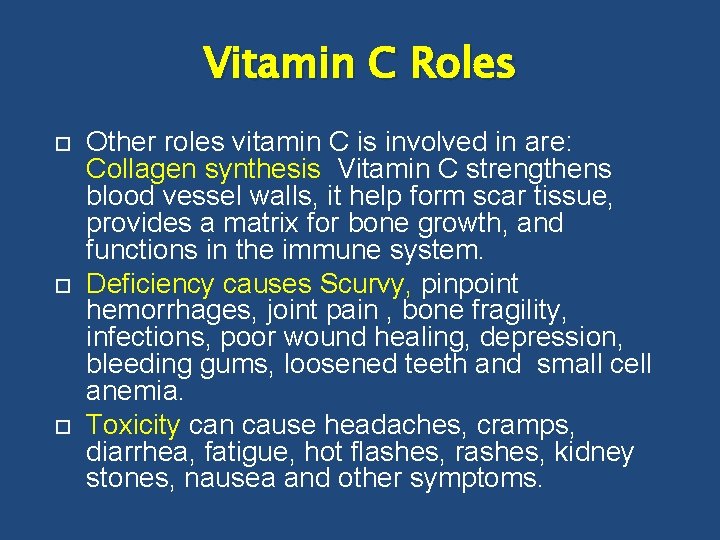
Vitamin C Roles Other roles vitamin C is involved in are: Collagen synthesis Vitamin C strengthens blood vessel walls, it help form scar tissue, provides a matrix for bone growth, and functions in the immune system. Deficiency causes Scurvy, pinpoint hemorrhages, joint pain , bone fragility, infections, poor wound healing, depression, bleeding gums, loosened teeth and small cell anemia. Toxicity can cause headaches, cramps, diarrhea, fatigue, hot flashes, rashes, kidney stones, nausea and other symptoms.
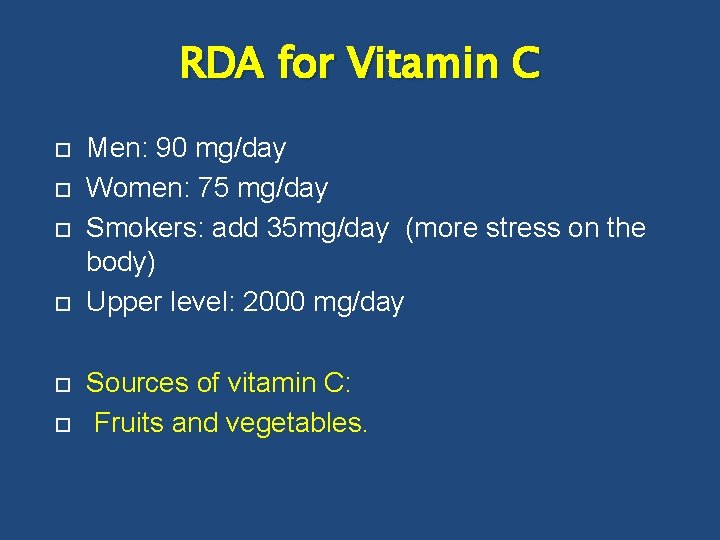
RDA for Vitamin C Men: 90 mg/day Women: 75 mg/day Smokers: add 35 mg/day (more stress on the body) Upper level: 2000 mg/day Sources of vitamin C: Fruits and vegetables.