
Nutrients What are they and why do I


- Slides: 25
Nutrients What are they, and why do I need to know about them?
Nutrients are chemicals found in foods that your body needs to function properly. When you eat, your body digests, or breaks down the food into a liquid. As food is digested, nutrients are absorbed into your blood. Your blood carries the nutrients to wherever they are needed in your body! Nutrients work together like members of a team. When one or more is missing, it’s hard to get their work accomplished!
When you’re well nourished, you… Feel Great! Grow Properly! Perform Your Best!
What do nutrients do for you? *Provide Energy *Build and Repair Cells *Regulate Body Processes (Such as Breathing, Digestion, Fighting Infection, and much more!)
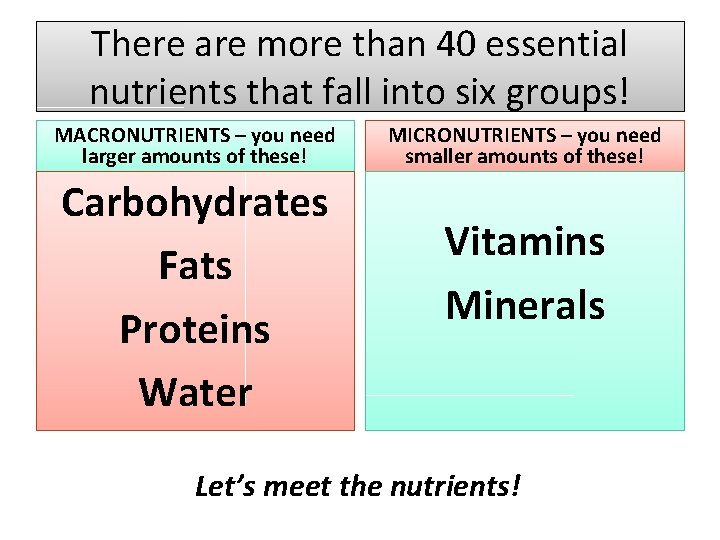
There are more than 40 essential nutrients that fall into six groups! MACRONUTRIENTS – you need larger amounts of these! Carbohydrates Fats Proteins Water MICRONUTRIENTS – you need smaller amounts of these! Vitamins Minerals Let’s meet the nutrients!
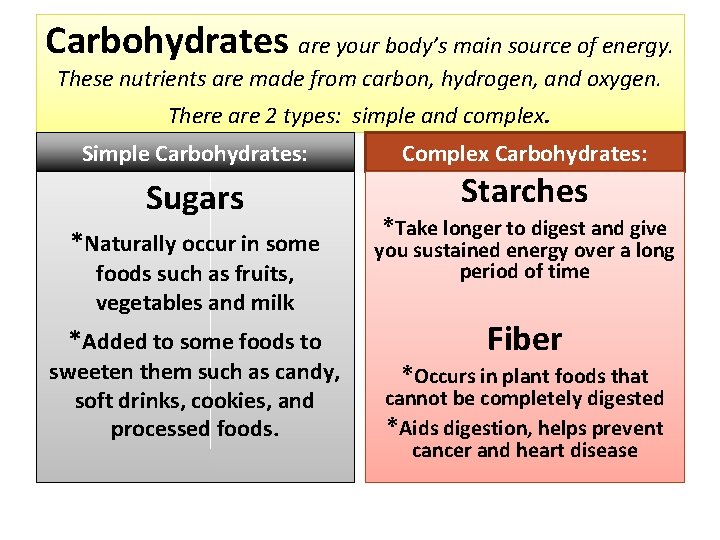
Carbohydrates are your body’s main source of energy. These nutrients are made from carbon, hydrogen, and oxygen. There are 2 types: simple and complex. Simple Carbohydrates: Sugars *Naturally occur in some foods such as fruits, vegetables and milk *Added to some foods to sweeten them such as candy, soft drinks, cookies, and processed foods. Complex Carbohydrates: Starches *Take longer to digest and give you sustained energy over a long period of time Fiber *Occurs in plant foods that cannot be completely digested *Aids digestion, helps prevent cancer and heart disease
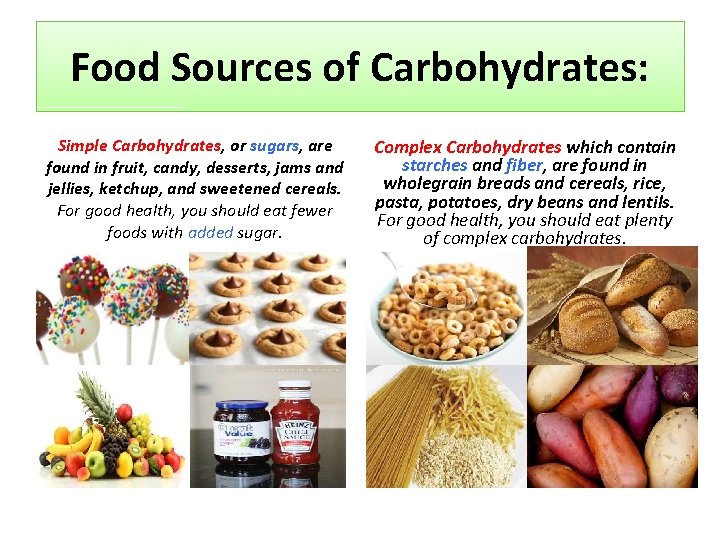
Food Sources of Carbohydrates: Simple Carbohydrates, or sugars, are found in fruit, candy, desserts, jams and jellies, ketchup, and sweetened cereals. For good health, you should eat fewer foods with added sugar. Complex Carbohydrates which contain starches and fiber, are found in wholegrain breads and cereals, rice, pasta, potatoes, dry beans and lentils. For good health, you should eat plenty of complex carbohydrates.
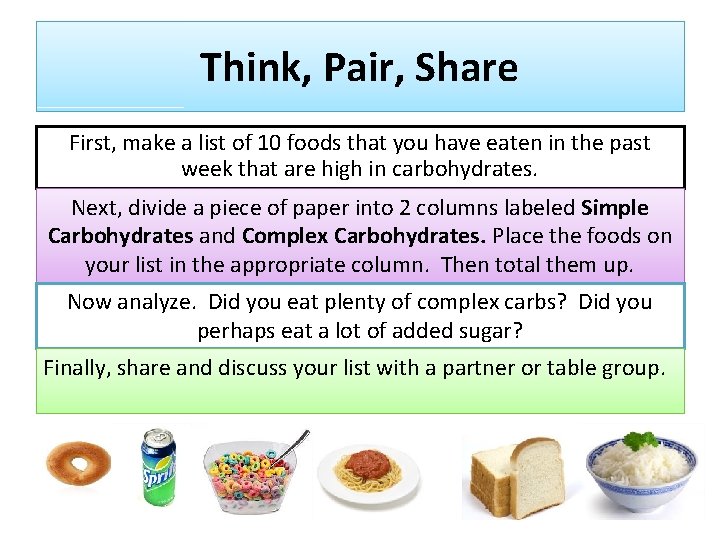
Think, Pair, Share First, make a list of 10 foods that you have eaten in the past week that are high in carbohydrates. Next, divide a piece of paper into 2 columns labeled Simple Carbohydrates and Complex Carbohydrates. Place the foods on your list in the appropriate column. Then total them up. Now analyze. Did you eat plenty of complex carbs? Did you perhaps eat a lot of added sugar? Finally, share and discuss your list with a partner or table group.
Fats are a mixture of saturated or unsaturated fatty acids that occur naturally in food. Benefits of Fats: *Provide Energy *Transport Vitamins *Help You Feel Full *Healthy skin 3 Types of Fats: *Saturated – solid at room temperature *Unsaturated – liquid at room temperature *Trans Fats – processed, or hydrogenated oils
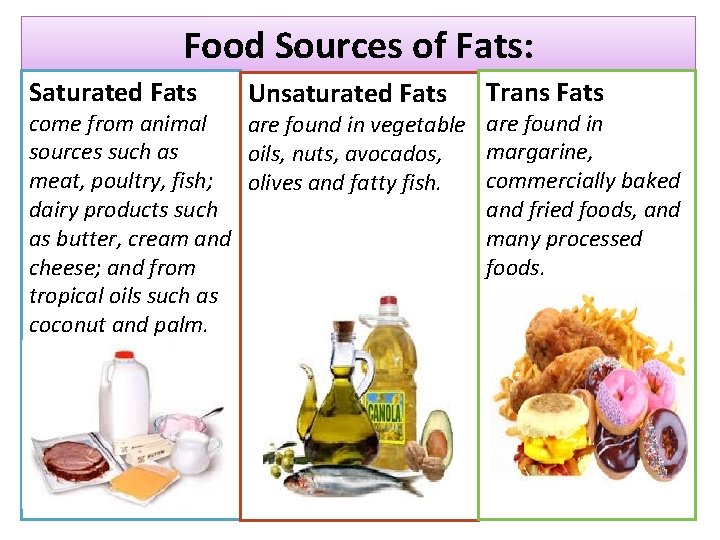
Food Sources of Fats: Saturated Fats Unsaturated Fats come from animal are found in vegetable sources such as oils, nuts, avocados, meat, poultry, fish; olives and fatty fish. dairy products such as butter, cream and cheese; and from tropical oils such as coconut and palm oil. Trans Fats are found in margarine, commercially baked and fried foods, and many processed foods.
Cholesterol is a fat-like substance found in the body naturally, and it helps your body to function. We can also get cholesterol from the fat we eat from animal products such as meats, dairy products and egg yolks. High levels of cholesterol in the blood is associated with heart disease. For good health, eat: *Plenty of unsaturated fats (nuts, avocados, olive oils, etc. ) *Small amounts of saturated fats (meats, butter, cheese, etc. ) *Very little to no trans fats (packaged cookies, chips, fast food, etc. )
Proteins are substances the body uses to build and repair cells. They are made up of tiny building blocks called amino acids. Many amino acids are already in your body naturally, but 9 of them are essential to get from food. Complete Proteins contain all 9 of the essential amino acids. Food from animal sources such as meat, poultry, fish, eggs, and dairy products are complete proteins. Soy beans are the only plant source of complete proteins. Incomplete Proteins are lacking one or more of the essential amino acids. Plant sources such as nuts, beans, lentils and seeds are incomplete proteins, so a wide variety should be eaten, especially if one does not eat animal products.
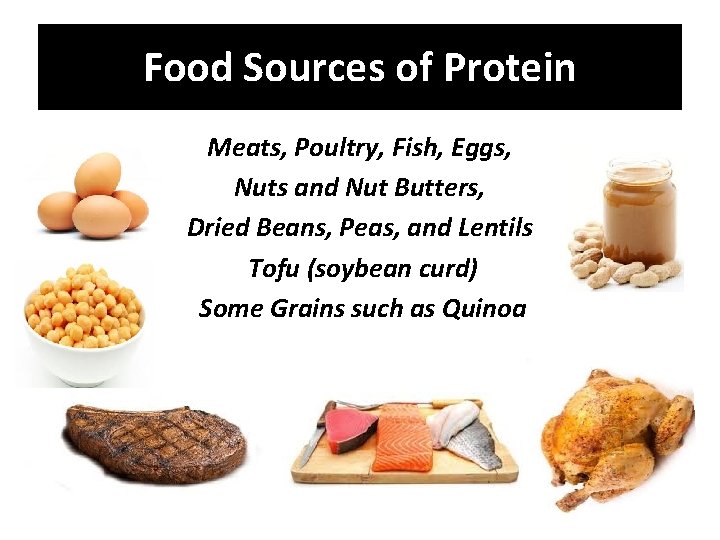
Food Sources of Protein Meats, Poultry, Fish, Eggs, Nuts and Nut Butters, Dried Beans, Peas, and Lentils Tofu (soybean curd) Some Grains such as Quinoa
Benefits of Protein: *Provides Energy *Builds and Repairs Cells *Growth and Strong Muscles *Fights Disease
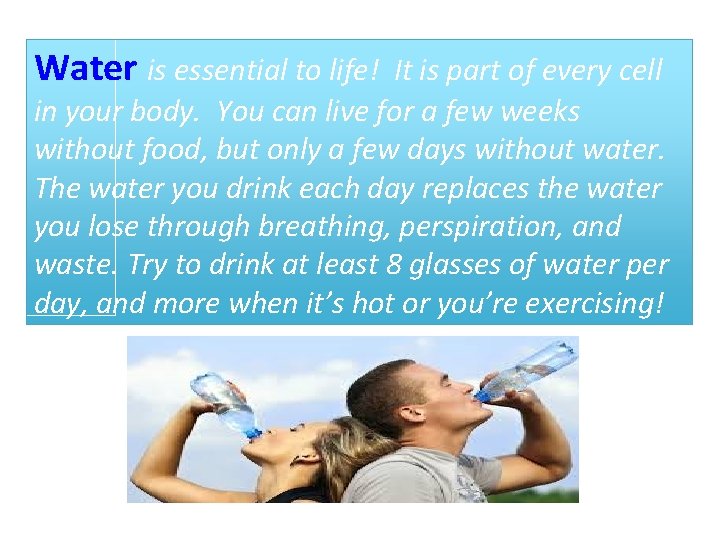
Water is essential to life! It is part of every cell in your body. You can live for a few weeks without food, but only a few days without water. The water you drink each day replaces the water you lose through breathing, perspiration, and waste. Try to drink at least 8 glasses of water per day, and more when it’s hot or you’re exercising!
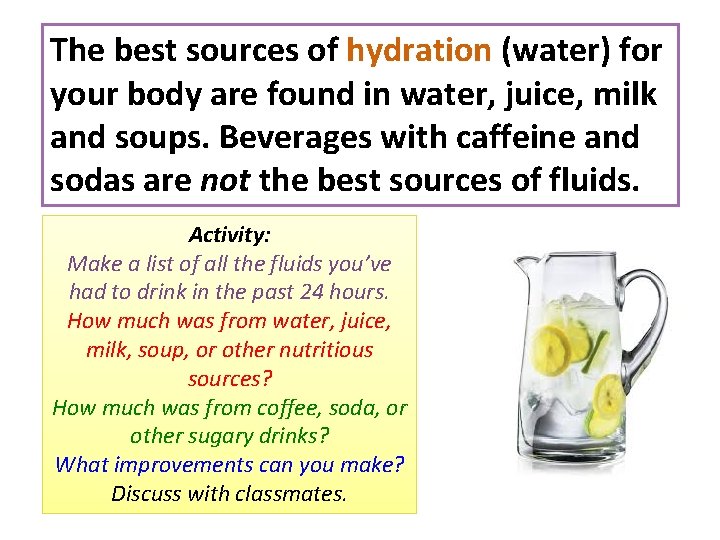
The best sources of hydration (water) for your body are found in water, juice, milk and soups. Beverages with caffeine and sodas are not the best sources of fluids. Activity: Make a list of all the fluids you’ve had to drink in the past 24 hours. How much was from water, juice, milk, soup, or other nutritious sources? How much was from coffee, soda, or other sugary drinks? What improvements can you make? Discuss with classmates.
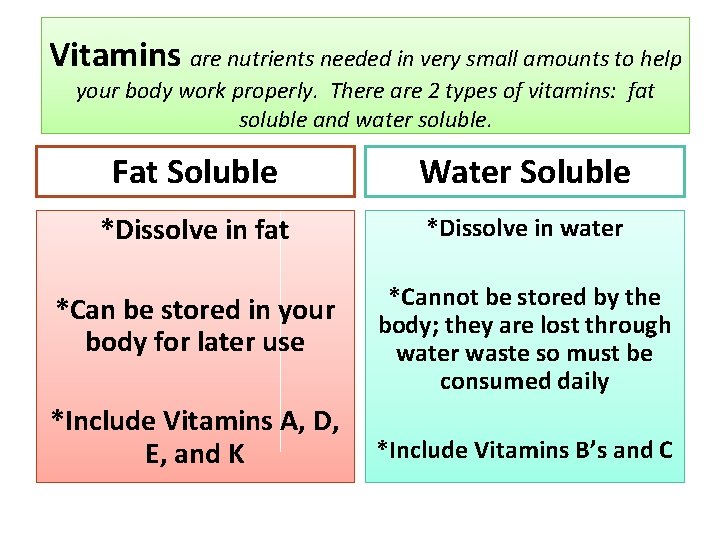
Vitamins are nutrients needed in very small amounts to help your body work properly. There are 2 types of vitamins: fat soluble and water soluble. Fat Soluble Water Soluble *Dissolve in fat *Dissolve in water *Can be stored in your body for later use *Cannot be stored by the body; they are lost through water waste so must be consumed daily *Include Vitamins A, D, E, and K *Include Vitamins B’s and C
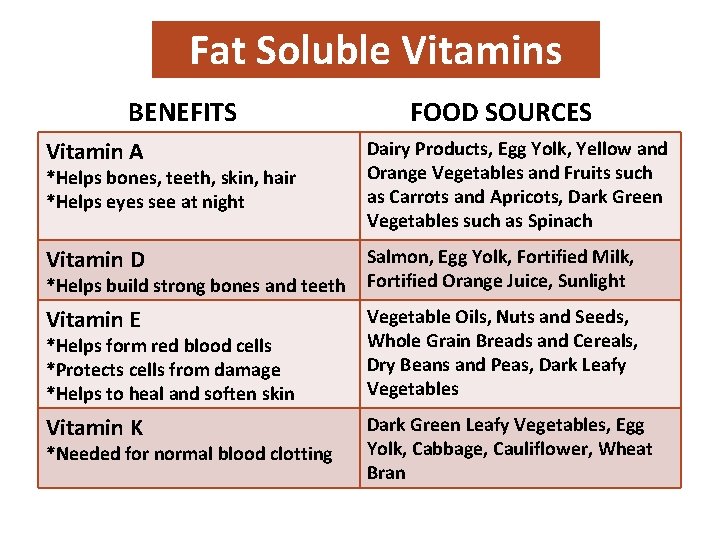
Fat Soluble Vitamins BENEFITS FOOD SOURCES Vitamin A *Helps bones, teeth, skin, hair *Helps eyes see at night Dairy Products, Egg Yolk, Yellow and Orange Vegetables and Fruits such as Carrots and Apricots, Dark Green Vegetables such as Spinach Vitamin D Salmon, Egg Yolk, Fortified Milk, Fortified Orange Juice, Sunlight Vitamin E Vegetable Oils, Nuts and Seeds, Whole Grain Breads and Cereals, Dry Beans and Peas, Dark Leafy Vegetables Vitamin K Dark Green Leafy Vegetables, Egg Yolk, Cabbage, Cauliflower, Wheat Bran *Helps build strong bones and teeth *Helps form red blood cells *Protects cells from damage *Helps to heal and soften skin *Needed for normal blood clotting
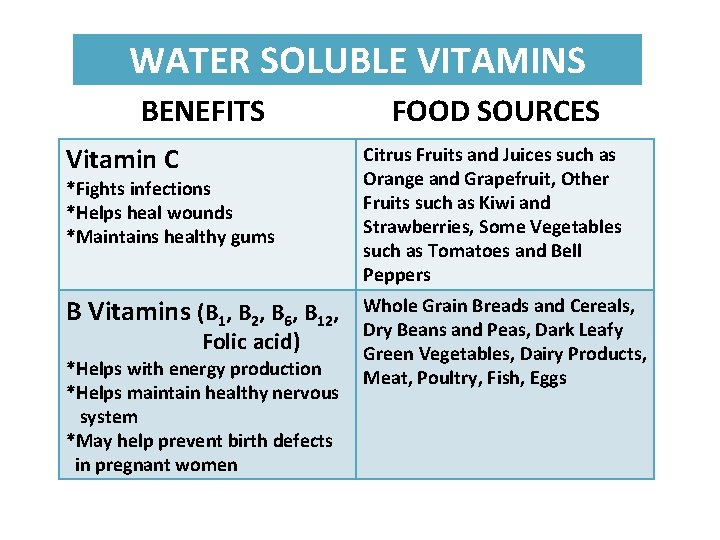
WATER SOLUBLE VITAMINS BENEFITS FOOD SOURCES Vitamin C Citrus Fruits and Juices such as Orange and Grapefruit, Other Fruits such as Kiwi and Strawberries, Some Vegetables such as Tomatoes and Bell Peppers B Vitamins (B 1, B 2, B 6, B 12, Whole Grain Breads and Cereals, Dry Beans and Peas, Dark Leafy Green Vegetables, Dairy Products, Meat, Poultry, Fish, Eggs *Fights infections *Helps heal wounds *Maintains healthy gums Folic acid) *Helps with energy production *Helps maintain healthy nervous system *May help prevent birth defects in pregnant women
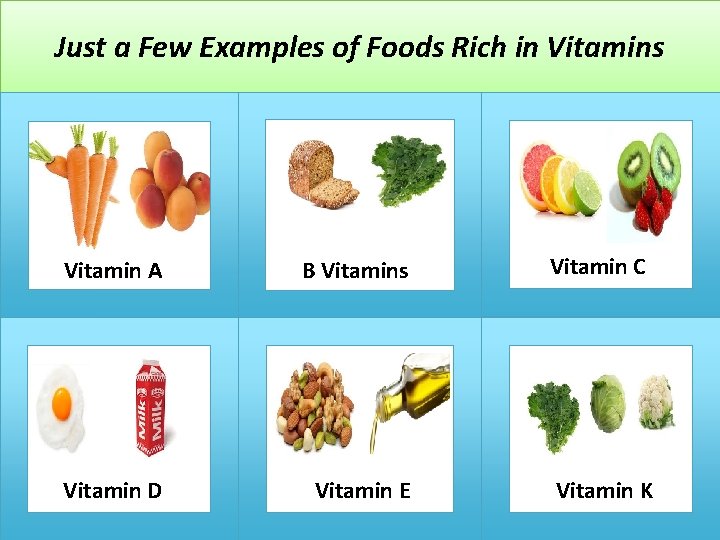
Just a Few Examples of Foods Rich in Vitamins Vitamin A B Vitamins Vitamin C Vitamin D Vitamin E Vitamin K
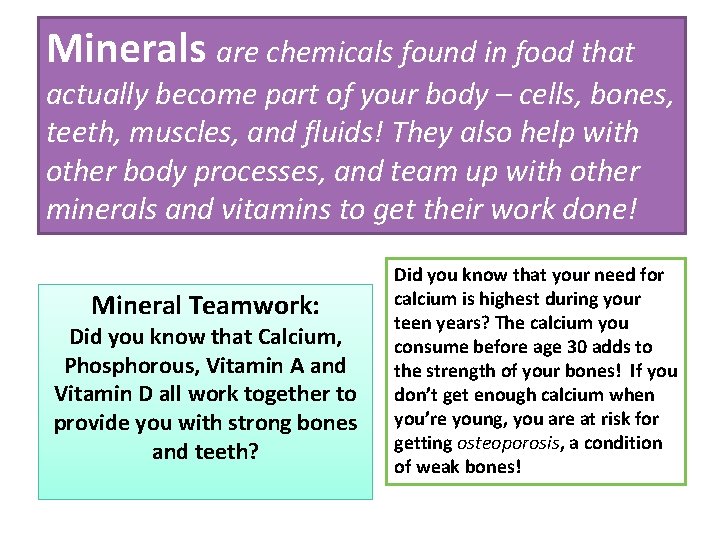
Minerals are chemicals found in food that actually become part of your body – cells, bones, teeth, muscles, and fluids! They also help with other body processes, and team up with other minerals and vitamins to get their work done! Mineral Teamwork: Did you know that Calcium, Phosphorous, Vitamin A and Vitamin D all work together to provide you with strong bones and teeth? Did you know that your need for calcium is highest during your teen years? The calcium you consume before age 30 adds to the strength of your bones! If you don’t get enough calcium when you’re young, you are at risk for getting osteoporosis, a condition of weak bones!
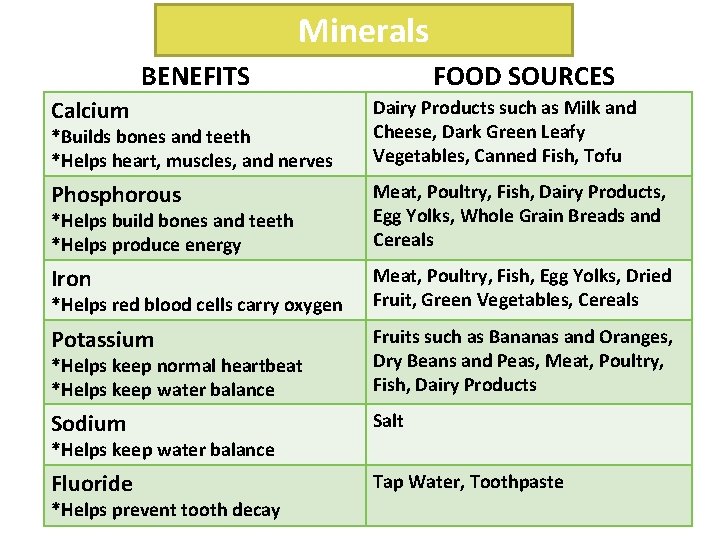
Minerals BENEFITS FOOD SOURCES Calcium Dairy Products such as Milk and Cheese, Dark Green Leafy Vegetables, Canned Fish, Tofu Phosphorous Meat, Poultry, Fish, Dairy Products, Egg Yolks, Whole Grain Breads and Cereals Iron Meat, Poultry, Fish, Egg Yolks, Dried Fruit, Green Vegetables, Cereals Potassium *Helps keep normal heartbeat *Helps keep water balance Fruits such as Bananas and Oranges, Dry Beans and Peas, Meat, Poultry, Fish, Dairy Products Sodium Salt Fluoride Tap Water, Toothpaste *Builds bones and teeth *Helps heart, muscles, and nerves *Helps build bones and teeth *Helps produce energy *Helps red blood cells carry oxygen *Helps keep water balance *Helps prevent tooth decay
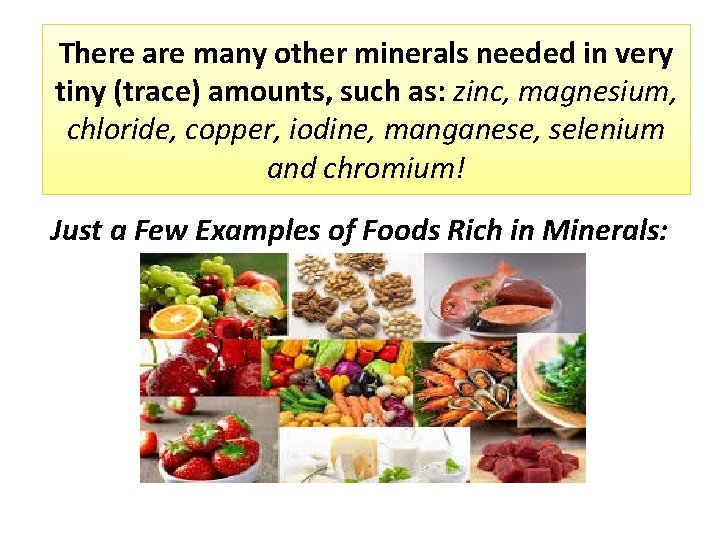
There are many other minerals needed in very tiny (trace) amounts, such as: zinc, magnesium, chloride, copper, iodine, manganese, selenium and chromium! Just a Few Examples of Foods Rich in Minerals:
Final Thoughts…. *There are 6 essential nutrients that humans need to consume daily for good health. *Eating a wide variety of foods is the best way to ensure you get all the nutrients you need. *Carbohydrates, Protein, and Fats are the 3 nutrients that provide us with energy. *Water, Vitamins, and Minerals do not provide energy, but they are needed to grow and function.
Questions for Discussion 1. Does eating fat make you fat? 2. Why does a teenager need to consume dairy products? What are some examples of dairy products? What happens if a person is allergic to dairy products or another food group? 3. What are some food recommendations you would make for a person who is healing from wounds caused in an automobile accident? 4. Malnutrition, the serious lack of adequate nutrition, is common in some parts of the world where poverty and famine are problems. What are some possible solutions to this problem?