Nutritional epidemiology CHS 269 Lecture NO 1 1
- Slides: 20
Nutritional epidemiology (CHS 269) Lecture NO (1) 1 CHS 269_Lecture (1)
Epidemiology • Epidemiology is defined as follows: It is the study of the frequency, distribution and determinants of health related phenomena in human populations. 2 CHS 269_Lecture (1)
NUTRITION • Science of food, nutrients and other substances therein, • the processes by which the organism ingests food, digests, absorbs nutrients, transports, utilizes and excretes waste or undigested substances – And their action, interaction and balance in relation to health and disease 3 CHS 269_Lecture (1)
Nutritional epidemiology The study of the nutritional determinants of disease in human populations. 4 CHS 269_Lecture (1)
Nutrition in Epidemiology • In the field of Epidemiology , nutrition can be defined as: – The way in which the human body reacts with diet – The extent to which the diet influences levels of health 5 CHS 269_Lecture (1)
NUTRITIONAL EPIDEMIOLOGY • Many questions about diet and disease remain unresolved. • Nutritional epidemiology will enable us to understand the relationship between diet and health as well as diet and disease • Our understanding of biologic mechanisms remains incomplete to predict confidently the ultimate consequences of eating a particular food or nutrient. 6 CHS 269_Lecture (1)
Nutritional epidemiology has contributed to understanding the etiology of many diseases. – Low intake of fruits and vegetables has been shown to be related to increased risk of cardiovascular disease. – Replacing saturated and trans fats with unsaturated fats can play an important role in the prevention of coronary heart disease and type 2 diabetes. – Many diseases—as cataracts, neural-tube defects, and macular degeneration—that were not thought to be nutritionally related have been found to have important dietary determinants. 7 CHS 269_Lecture (1)
– In the early 1990 s, epidemiological studies established that women could substantially reduce their risk of bearing a child with a neural tube birth defect by increasing their intake of the B vitamin folic acid. – Medical organizations in many nations have recommended increased intakes of folic acid for women of childbearing potential – Government agencies in several countries are planning to fortify staple foods with folic acid. 8 CHS 269_Lecture (1)
• Nonetheless, much more needs to be learned regarding other diet and disease relations, • Furthermore, new products are constantly being introduced into the food supply requiring continued epidemiologic attention. 9 CHS 269_Lecture (1)
Goals of nutritional epidemiology • Monitoring food consumption, nutrient intake and nutritional status of a population. • Generating new hypotheses about diet and disease, to: – produce evidence that supports or refutes existing hypotheses – assess the strength of diet-disease associations. • Contributing to prevention of disease and improvement of public health. 10 CHS 269_Lecture (1)
Advantages of Nutritional Epidemiology • Its direct relevance to human health. – Epidemiologists study real life. – They do not need to extrapolate from animal models or in vitro systems. – The results of their work can be translated into specific recommendations for changes in nutrient intakes or food consumption patterns. 11 CHS 269_Lecture (1)
• Findings from nutritional epidemiology can have direct implications for food processing and technology – Epidemiological studies showed that there is an associating between high intakes of trans fatty acids (found in margarine and other processed vegetable fats) with increased risks of coronary heart disease – This will probably prompt margarine manufacturers to seek out ways to reformulate their products to reduce their trans fatty acid content. 12 CHS 269_Lecture (1)
Disadvantages of Nutritional Epidemiology 1. The potential for many kinds of bias. – Bias is defined as systematic error, resulting in over- or underestimation of the strength of association between exposure and outcome. 13 CHS 269_Lecture (1)
Disadvantages of Nutritional Epidemiology 2. Difficulty in determining whether observed associations are causal. • If the association between a factor and a disease is not causal, efforts to modify exposure to that factor will not reduce disease risk. • For example, • even though drinking of alcohol is associated with lung cancer risk, efforts to discourage alcohol consumption would not be likely to reduce the lung cancer death rate, • because the relationship is not causal. • Instead, it reflects the association of both alcohol intake and lung cancer with a third factor which is cigarette smoking. 14 CHS 269_Lecture (1)
Disadvantages of Nutritional Epidemiology 3. The apparent simplicity and “real life” relevance of epidemiological findings. • This is especially true when preliminary or unconfirmed findings come to the attention of the news media and the general public. • For example, • reports of an association between margarine intake and cardiovascular disease have prompted some consumers to switch back to butter, • most experts believe that this action would not be beneficial to cardiovascular health. 15 CHS 269_Lecture (1)
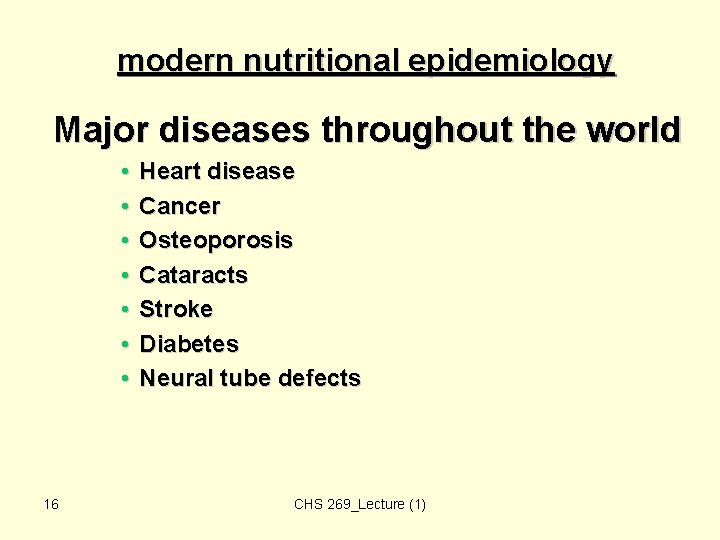
modern nutritional epidemiology Major diseases throughout the world • • 16 Heart disease Cancer Osteoporosis Cataracts Stroke Diabetes Neural tube defects CHS 269_Lecture (1)
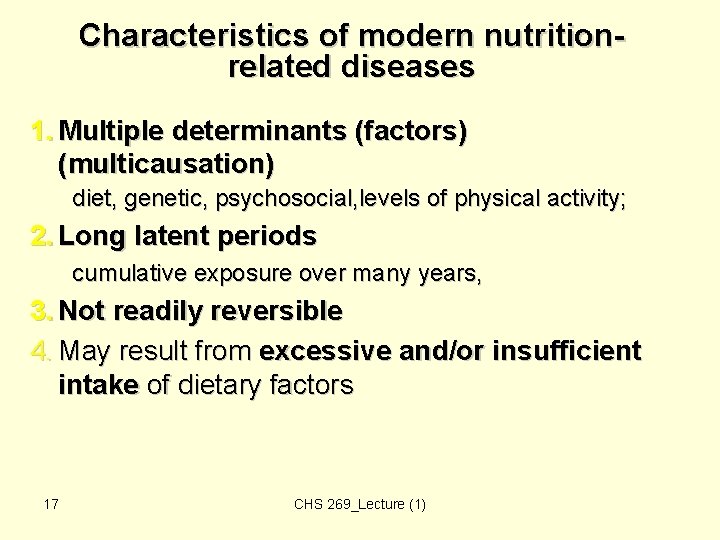
Characteristics of modern nutritionrelated diseases 1. Multiple determinants (factors) (multicausation) diet, genetic, psychosocial, levels of physical activity; 2. Long latent periods cumulative exposure over many years, 3. Not readily reversible 4. May result from excessive and/or insufficient intake of dietary factors 17 CHS 269_Lecture (1)
Difficulties facing nutritional epidemiology Extremely complex nature of diet. • To understand this complexity, it is helpful to compare diet with another exposure such as cigarette smoking. 18 CHS 269_Lecture (1)
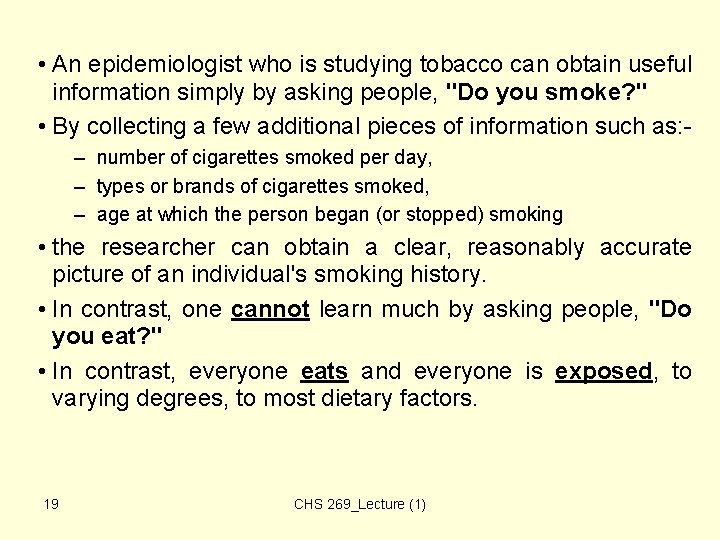
• An epidemiologist who is studying tobacco can obtain useful information simply by asking people, "Do you smoke? " • By collecting a few additional pieces of information such as: – number of cigarettes smoked per day, – types or brands of cigarettes smoked, – age at which the person began (or stopped) smoking • the researcher can obtain a clear, reasonably accurate picture of an individual's smoking history. • In contrast, one cannot learn much by asking people, "Do you eat? " • In contrast, everyone eats and everyone is exposed, to varying degrees, to most dietary factors. 19 CHS 269_Lecture (1)
• Eating patterns often evolve slowly over periods of years and people may not remember when their habits changed. • The foods that people eat consist of complex mixtures of compounds, with substantial differences even among seemingly similar products. • People who eat more of one type of food must eat less of other types of foods, thus creating a complex set of intercorrelations among dietary components. • Eating habits may be correlated with other factors that influence disease risk, such as ethnic background, socioeconomic status and tobacco use. • Even the method of preparation of foods may be important. – For example, – boiled coffee may raise blood cholesterol levels; – filtered coffee does not raise blood cholesterol because filtering removes the components that may have cholesterol-raising effects. 20 CHS 269_Lecture (1)