
Chapter 6 Cruising Cruise Industry Development Key Players


- Slides: 22
Chapter 6 Cruising Ø Cruise Industry Development Ø Key Players Ø The Market Ø Types of Cruises Ø Organization of the Ship Ø Employment Ø Destinations Ø Trends Walker: Exploring the Hospitality Industry. © 2008 Pearson Education, Upper Saddle River, NJ 07458. All Rights Reserved.
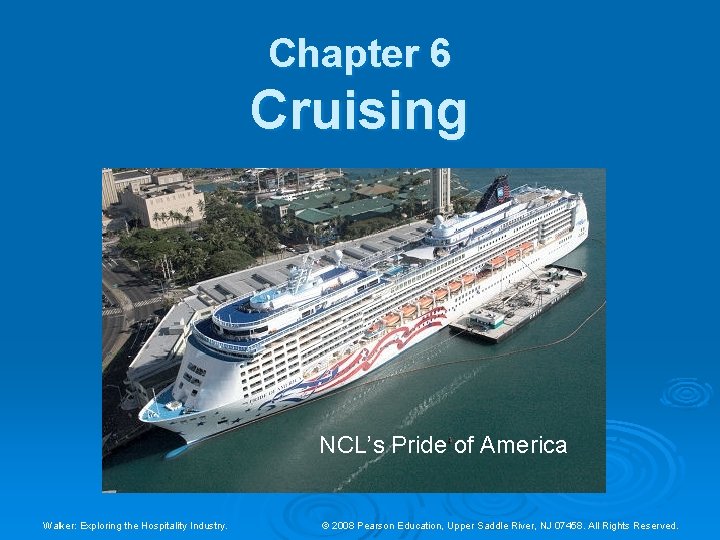
Chapter 6 Cruising NCL’s Pride of America Walker: Exploring the Hospitality Industry. © 2008 Pearson Education, Upper Saddle River, NJ 07458. All Rights Reserved.
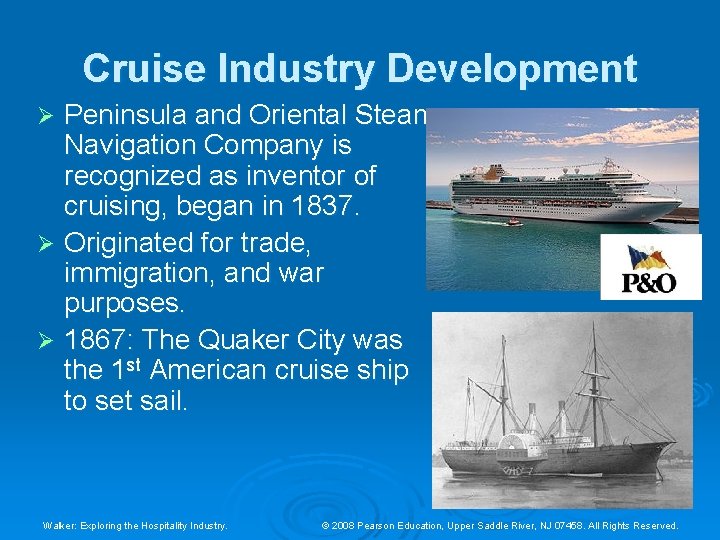
Cruise Industry Development Peninsula and Oriental Steam Navigation Company is recognized as inventor of cruising, began in 1837. Ø Originated for trade, immigration, and war purposes. Ø 1867: The Quaker City was the 1 st American cruise ship to set sail. Ø Walker: Exploring the Hospitality Industry. © 2008 Pearson Education, Upper Saddle River, NJ 07458. All Rights Reserved.
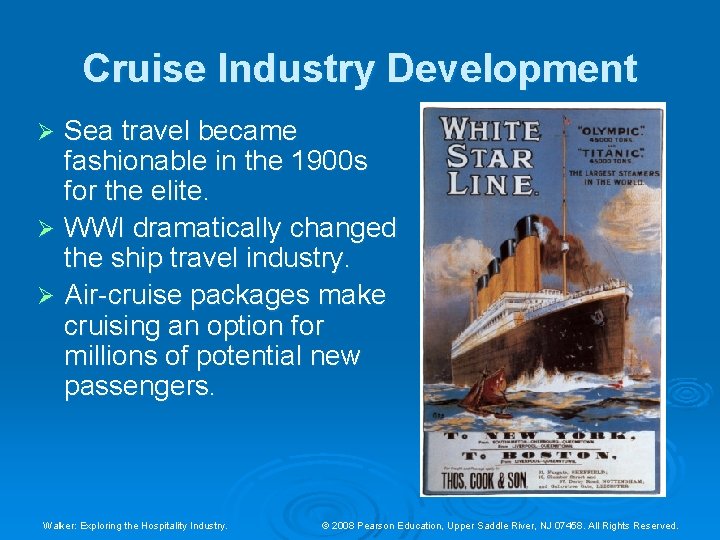
Cruise Industry Development Sea travel became fashionable in the 1900 s for the elite. Ø WWI dramatically changed the ship travel industry. Ø Air-cruise packages make cruising an option for millions of potential new passengers. Ø Walker: Exploring the Hospitality Industry. © 2008 Pearson Education, Upper Saddle River, NJ 07458. All Rights Reserved.
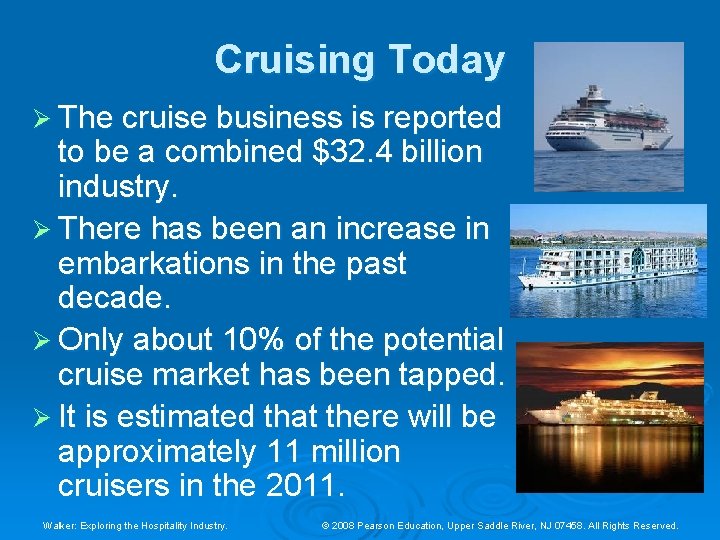
Cruising Today Ø The cruise business is reported to be a combined $32. 4 billion industry. Ø There has been an increase in embarkations in the past decade. Ø Only about 10% of the potential cruise market has been tapped. Ø It is estimated that there will be approximately 11 million cruisers in the 2011. Walker: Exploring the Hospitality Industry. © 2008 Pearson Education, Upper Saddle River, NJ 07458. All Rights Reserved.
Key Players l l l The largest cruise line. Most financially successful. Its largest income, other than the fare itself, is from beverage service. Nets about 20% of the market share. Includes: Carnival Cruise Lines, Holland America Line, Princess Cruises, Seabourn Cruise Line, Windstar Cruises, AIDA Costa Cruises, Cunard Line, P&O Cruises. Walker: Exploring the Hospitality Industry. © 2008 Pearson Education, Upper Saddle River, NJ 07458. All Rights Reserved.
Key Players l l 2 nd largest. Includes 4 brands: • Royal Caribbean International and Celebrity Cruises, Pullmantur, and Azamara Cruises l l Targets ages 35 and older, high incomes, and welcomes families. 3 million passengers per year. Walker: Exploring the Hospitality Industry. © 2008 Pearson Education, Upper Saddle River, NJ 07458. All Rights Reserved.
Key Players l l l 3 rd largest. Now operates Norwegian Cruise Line and Cruise Ferries. Currently employing a “freestyle cruising” concept, in which everyone is allowed to dress as they wish, and eat when and where they like. Walker: Exploring the Hospitality Industry. © 2008 Pearson Education, Upper Saddle River, NJ 07458. All Rights Reserved.
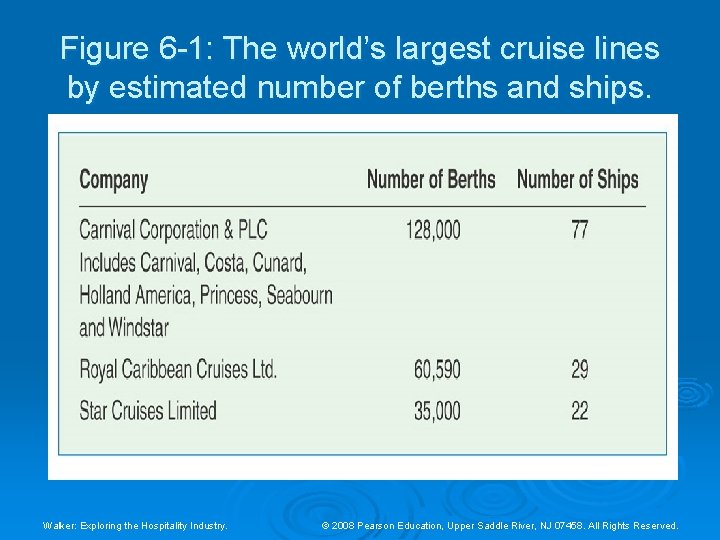
Figure 6 -1: The world’s largest cruise lines by estimated number of berths and ships. Walker: Exploring the Hospitality Industry. © 2008 Pearson Education, Upper Saddle River, NJ 07458. All Rights Reserved.
The Cruise Market Ø Includes a wide variety of demographics. Ø Typical traveler: l l 50+ years old. Married. No children in household. Income of $79 K. Ø cruise for less than 7 days. Ø Brand loyalty is common- Frequent Guest Programs. Walker: Exploring the Hospitality Industry. © 2008 Pearson Education, Upper Saddle River, NJ 07458. All Rights Reserved.
Types of Cruise Markets Mass market: Consists of people with incomes in the $30, 000 to $60, 000 range. Average cost person is $100 to $300 per day. Ø Middle market: Consists of people with incomes in the $60, 000 to $80, 000 range. Average cost person is $250 to $500 per day. Ø Luxury market: Consists of people with incomes higher than $80, 000. Average cost person of more than $500 per day. Ø Walker: Exploring the Hospitality Industry. © 2008 Pearson Education, Upper Saddle River, NJ 07458. All Rights Reserved.
Types of Cruises Regional: Sail in the Caribbean, the Mediterranean, the Baltic Sea, and other small seas. Ø Coastal: Offered in Northern Europe, the United States, and Mexico. Significantly smaller than the average floating resort, they sail closer to land, seeking out areas not accessible to larger ships. Ø River: Often have the feel of a small hotel, with features like public rooms, a large dining room, three to four decks, air-conditioning, an observation lounge, a bar, heated pool, sauna, gym, massage therapists, and salons. Ø Walker: Exploring the Hospitality Industry. © 2008 Pearson Education, Upper Saddle River, NJ 07458. All Rights Reserved.
Types of Cruises Barges: Even smaller than river ships. Cruise Europe’s inland waterways and canals from April to November, when the weather permits. Ø Steam boating: A concept unique to the United States. Cruises along river locations and America’s Heartland. Ø Expeditions and natural cruises: Cruises exotic and exciting places where passengers play an active part in every aspect of the trip. Ø Walker: Exploring the Hospitality Industry. © 2008 Pearson Education, Upper Saddle River, NJ 07458. All Rights Reserved.
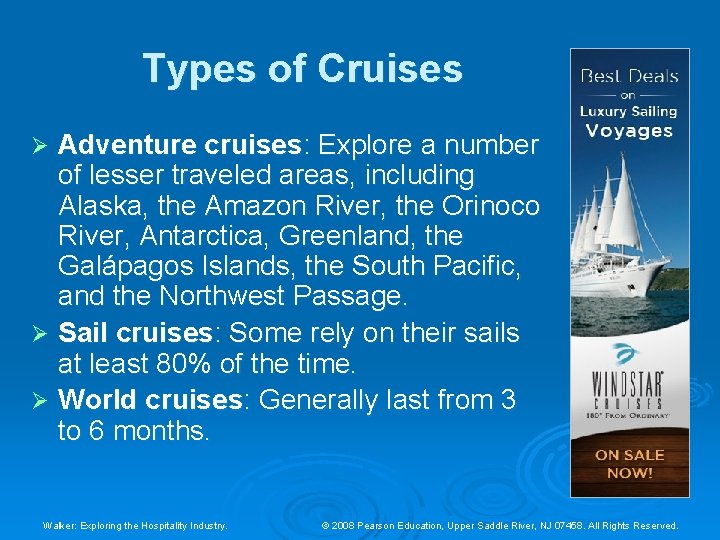
Types of Cruises Adventure cruises: Explore a number of lesser traveled areas, including Alaska, the Amazon River, the Orinoco River, Antarctica, Greenland, the Galápagos Islands, the South Pacific, and the Northwest Passage. Ø Sail cruises: Some rely on their sails at least 80% of the time. Ø World cruises: Generally last from 3 to 6 months. Ø Walker: Exploring the Hospitality Industry. © 2008 Pearson Education, Upper Saddle River, NJ 07458. All Rights Reserved.
Types of Cruises Crossings: Sailing across the Northern Atlantic Ocean either to or from the Americas, although it can take place across any major ocean. Ø Specialty and theme cruises: Culture-rich, offthe-beaten-path itineraries built around passengers’ special interests and hobbies, and high on enrichment and adventure. Ø Deluxe cruising: Larger ships with resort-like design, numerous activities, and amenities such as “virtual golf, ” pizzerias, and caviar bars. Ø Walker: Exploring the Hospitality Industry. © 2008 Pearson Education, Upper Saddle River, NJ 07458. All Rights Reserved.
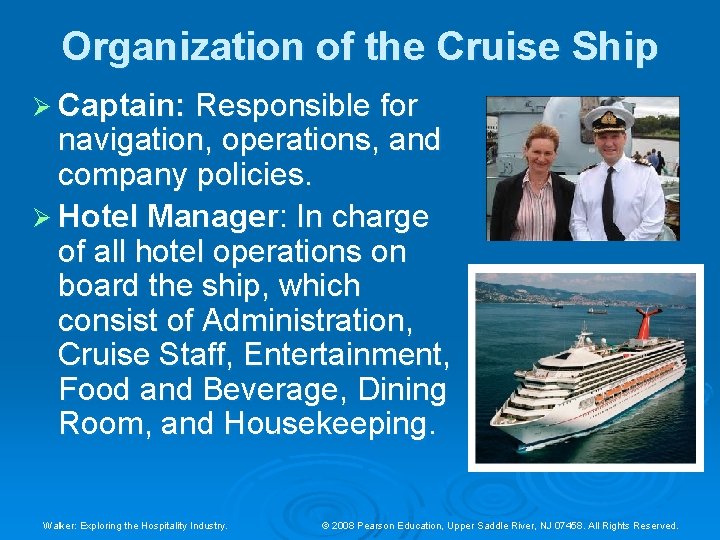
Organization of the Cruise Ship Ø Captain: Responsible for navigation, operations, and company policies. Ø Hotel Manager: In charge of all hotel operations on board the ship, which consist of Administration, Cruise Staff, Entertainment, Food and Beverage, Dining Room, and Housekeeping. Walker: Exploring the Hospitality Industry. © 2008 Pearson Education, Upper Saddle River, NJ 07458. All Rights Reserved.
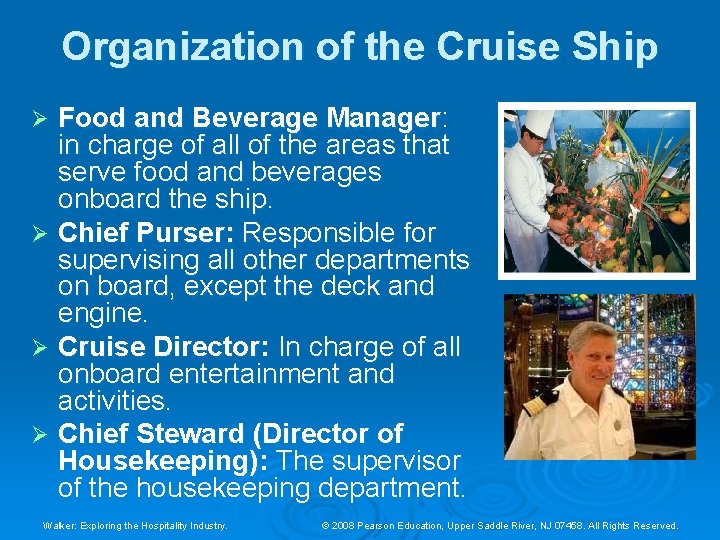
Organization of the Cruise Ship Food and Beverage Manager: in charge of all of the areas that serve food and beverages onboard the ship. Ø Chief Purser: Responsible for supervising all other departments on board, except the deck and engine. Ø Cruise Director: In charge of all onboard entertainment and activities. Ø Chief Steward (Director of Housekeeping): The supervisor of the housekeeping department. Ø Walker: Exploring the Hospitality Industry. © 2008 Pearson Education, Upper Saddle River, NJ 07458. All Rights Reserved.
Employment opportunities for Americans are mainly in sales, marketing, and other U. S. shorebased activities, such as reservations and supplies. Ø Onboard, Americans sometimes occupy certain positions such as cruise director and purser. Ø Few Americans work onboard cruise ships because the ships are at sea for months at a time with just a few hours in port. Ø Most ships also have foreign crews because they can avoid American labor laws (like overtime). Ø Walker: Exploring the Hospitality Industry. © 2008 Pearson Education, Upper Saddle River, NJ 07458. All Rights Reserved.
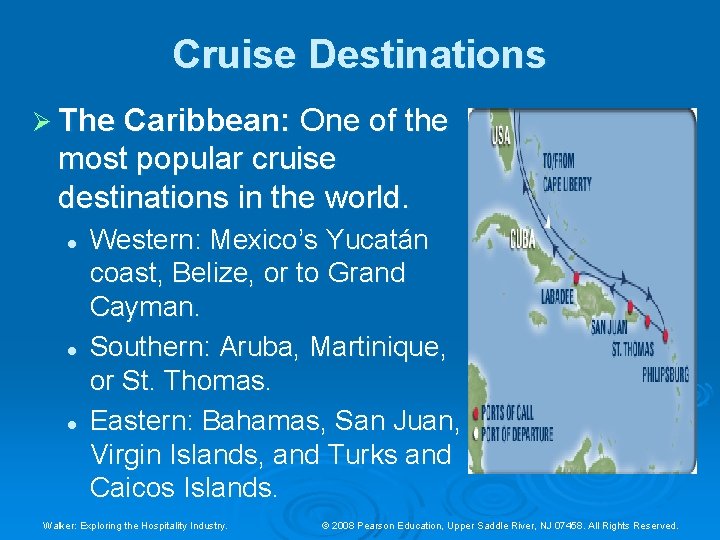
Cruise Destinations Ø The Caribbean: One of the most popular cruise destinations in the world. l l l Western: Mexico’s Yucatán coast, Belize, or to Grand Cayman. Southern: Aruba, Martinique, or St. Thomas. Eastern: Bahamas, San Juan, Virgin Islands, and Turks and Caicos Islands. Walker: Exploring the Hospitality Industry. © 2008 Pearson Education, Upper Saddle River, NJ 07458. All Rights Reserved.
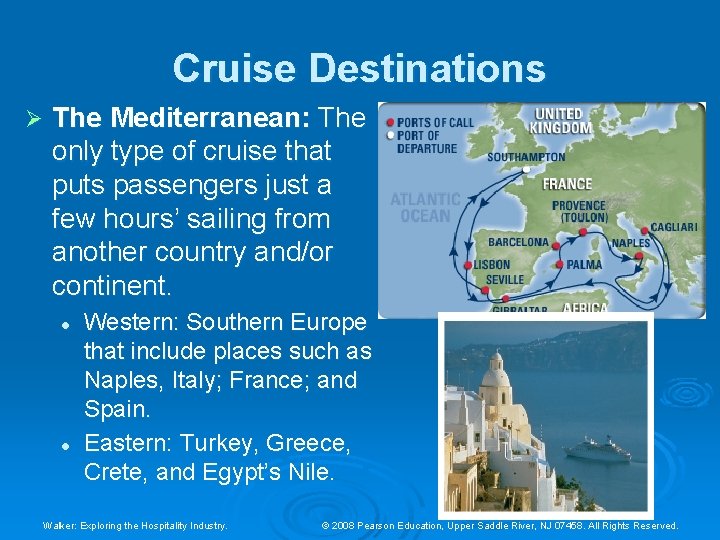
Cruise Destinations Ø The Mediterranean: The only type of cruise that puts passengers just a few hours’ sailing from another country and/or continent. l l Western: Southern Europe that include places such as Naples, Italy; France; and Spain. Eastern: Turkey, Greece, Crete, and Egypt’s Nile. Walker: Exploring the Hospitality Industry. © 2008 Pearson Education, Upper Saddle River, NJ 07458. All Rights Reserved.
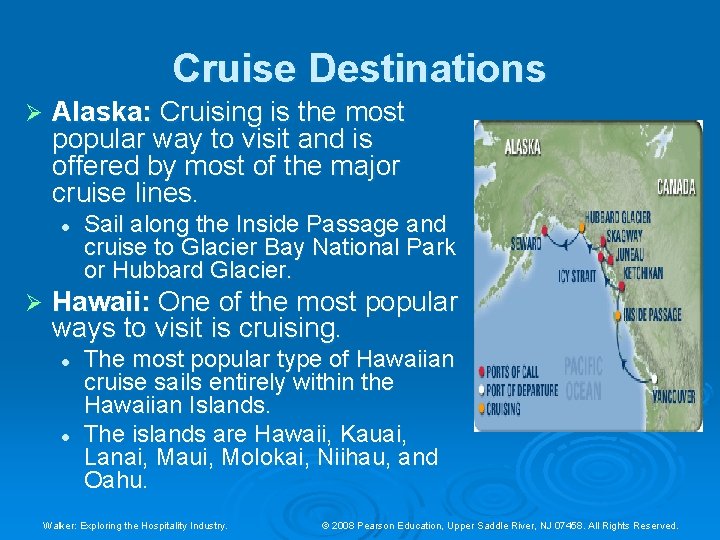
Cruise Destinations Ø Alaska: Cruising is the most popular way to visit and is offered by most of the major cruise lines. l Ø Sail along the Inside Passage and cruise to Glacier Bay National Park or Hubbard Glacier. Hawaii: One of the most popular ways to visit is cruising. l l The most popular type of Hawaiian cruise sails entirely within the Hawaiian Islands. The islands are Hawaii, Kauai, Lanai, Maui, Molokai, Niihau, and Oahu. Walker: Exploring the Hospitality Industry. © 2008 Pearson Education, Upper Saddle River, NJ 07458. All Rights Reserved.
Trends Rapid expansion in number of ships. Ø Create new accommodations and entertainment to distinguish themselves from other brands. Ø Increase in North American ports. Ø Increase in number of embarkations, destinations, and itineraries offered through North American ports. Ø Increased number of refurbished ships. Ø Expansion of passengers within the market. Ø Continual development of different types of cruises offered. Ø Sizeable growth in number of job opportunities. Ø Walker: Exploring the Hospitality Industry. © 2008 Pearson Education, Upper Saddle River, NJ 07458. All Rights Reserved.