Use of Drum Circles for Stress Relief and
- Slides: 37
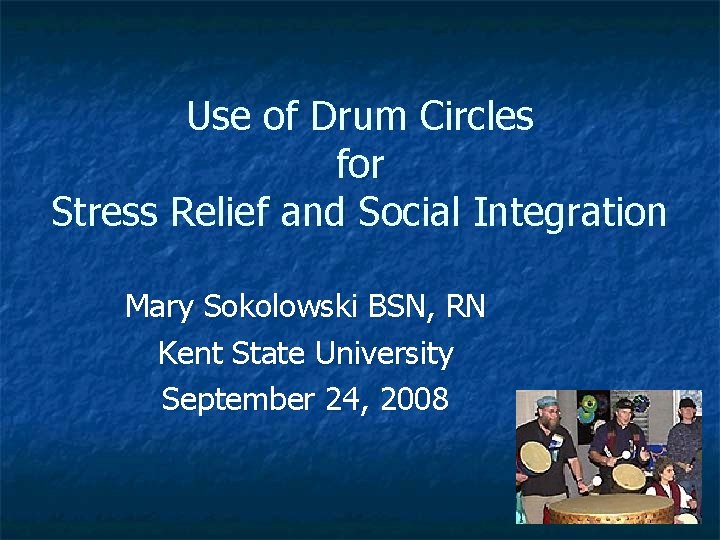
Use of Drum Circles for Stress Relief and Social Integration Mary Sokolowski BSN, RN Kent State University September 24, 2008
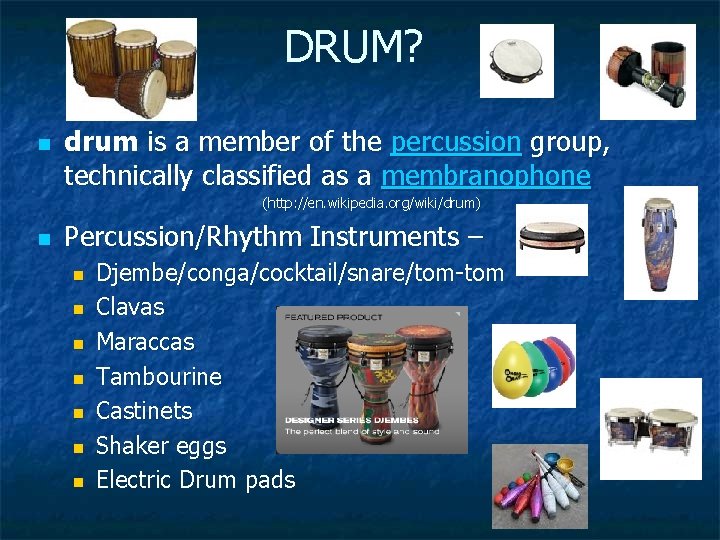
DRUM? n drum is a member of the percussion group, technically classified as a membranophone (http: //en. wikipedia. org/wiki/drum) n Percussion/Rhythm Instruments – n n n n Djembe/conga/cocktail/snare/tom-tom Clavas Maraccas Tambourine Castinets Shaker eggs Electric Drum pads
CIRCLE n simple shapes of Euclidean geometry consisting of those points …which are at a constant distance, …from a fixed point, called the center (http: //en. wikipedia. org/wiki/Circle) so. . .
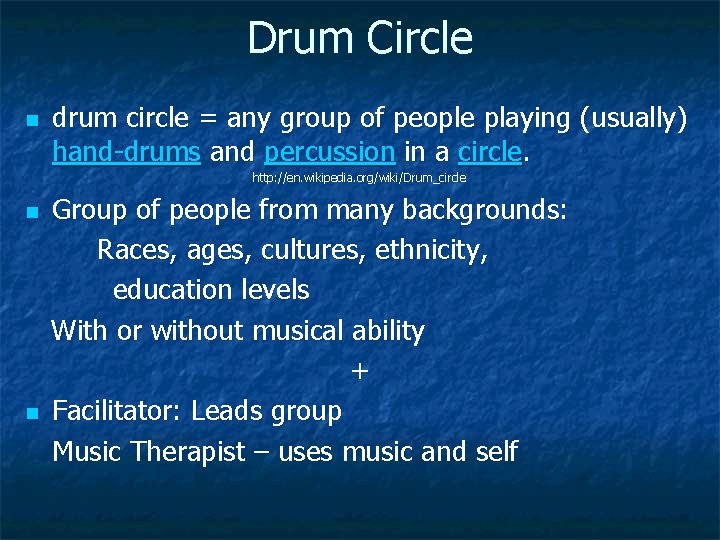
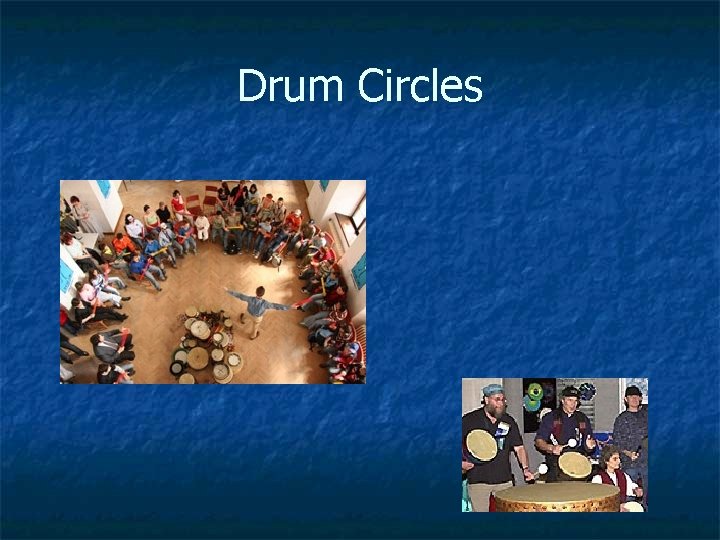
Drum Circle n drum circle = any group of people playing (usually) hand-drums and percussion in a circle. http: //en. wikipedia. org/wiki/Drum_circle n n Group of people from many backgrounds: Races, ages, cultures, ethnicity, education levels With or without musical ability + Facilitator: Leads group Music Therapist – uses music and self
Drum Circles
History: Drum Circles n n n First rhythm – heartbeat Drum circles – various cultures/worldwide Ancient times – rituals Healing - reduce pain, suffering Communication (Sacks, 2006) n Now: Websites for Sex: 185 million sites Websites for Music: 131 million sites (Kemper & Danhauer, 2005)
Principles n n n Sound – objects vibrate Human Body – Vibrates/Absorbs Entrainment: Strong rhythm (vibration) causes other rhythms to fall in sync Noise vs. Music Psychophysiologic response – pitch, rhythm n n Limbic system/Neurohormonal system Altered states of consiousness (Dossey & Keegan, 2009) n Collaborative creativity Camaraderie, non-threatening environment
Benefits n Psychologic: Distraction Decreased Anxiety Comfort/Relaxation n Social: Cohesiveness Interpersonal support n Spiritual: Altered Consciousness Self Awareness Improved Mood Emotional Release Reconnection Higher Power (Secular) (Winkelman, 2003)
Benefits: n Physiologic: ∆ Neuronal activity – lateral temporal/cortical areas ∆ RR, HR variability ↓ Salivary cortisol ↑ Opiate receptor expression ↑ Interleukin 6, salivary Ig. A (Kemper & Danhauer, 2005)
Effects: n n n Music Tempo, Pitch, Rhythm People Listener Characteristics Circumstances Live vs Recorded Active vs Passive Recreation/Work/Therapy (Kemper & Danhauer, 2005)
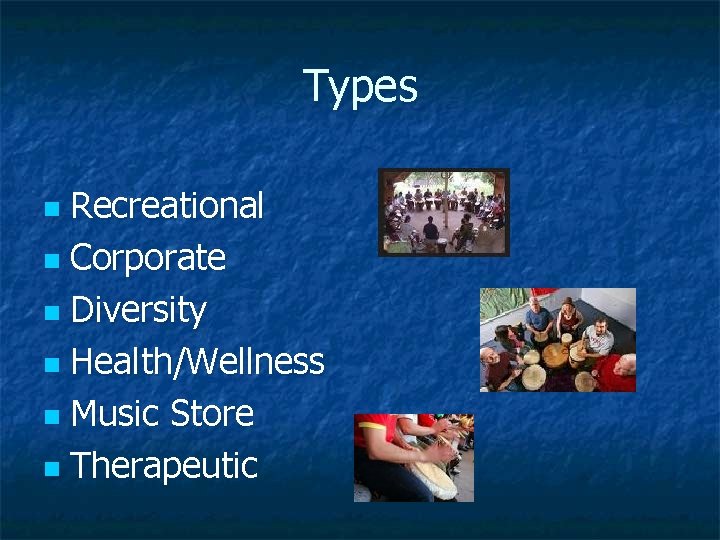
Types Recreational n Corporate n Diversity n Health/Wellness n Music Store n Therapeutic n
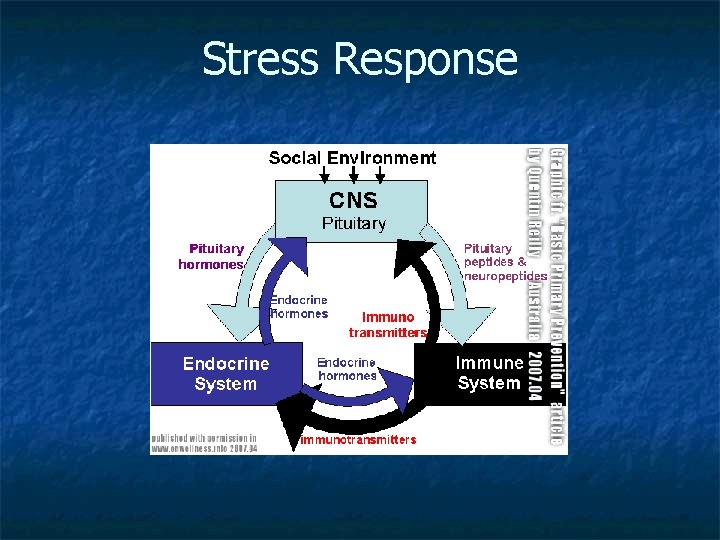
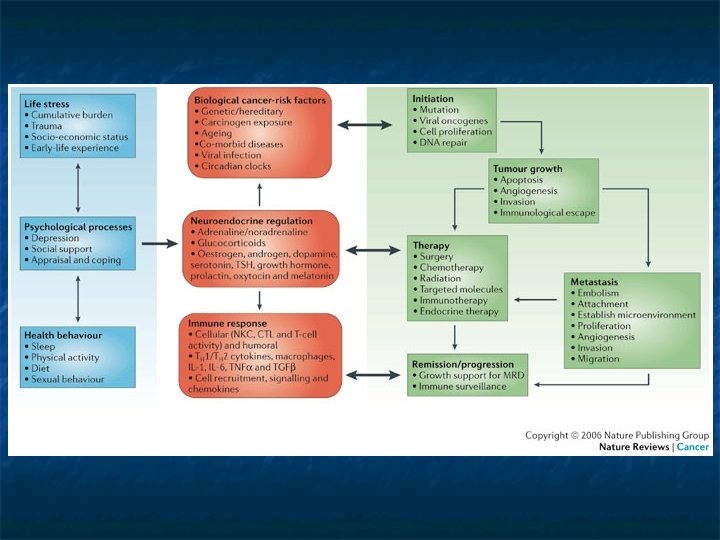
Stress Response n Jung Psyche’s attempt to self-regulate Problem somaticized (Mc. Clary & Rebecca, 2007) n n n Selye General Adaptation Response (GAR) Reactive Response Psychoneuroimmunlogy (Mc. Cance & Huether, 2006)
Stress Response
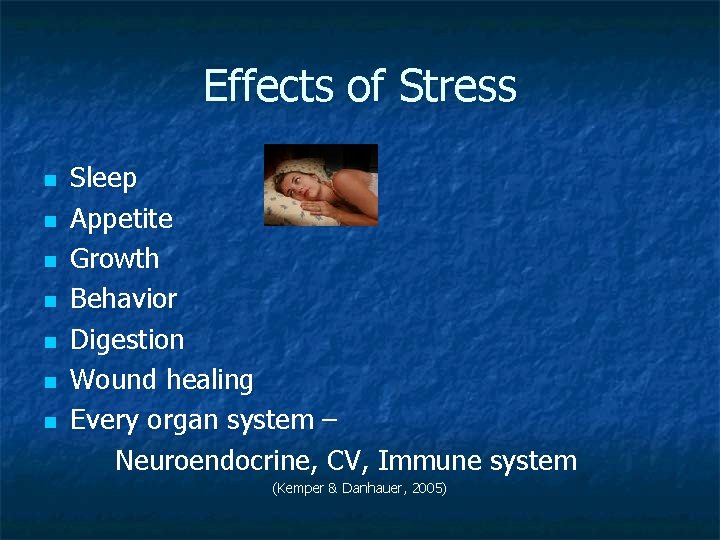
Effects of Stress n n n n Sleep Appetite Growth Behavior Digestion Wound healing Every organ system – Neuroendocrine, CV, Immune system (Kemper & Danhauer, 2005)
Concept: n Social Integration Definition: Perceived/Received sense of support from others Includes: Social support functions Network structure (Hutchison, 1999)
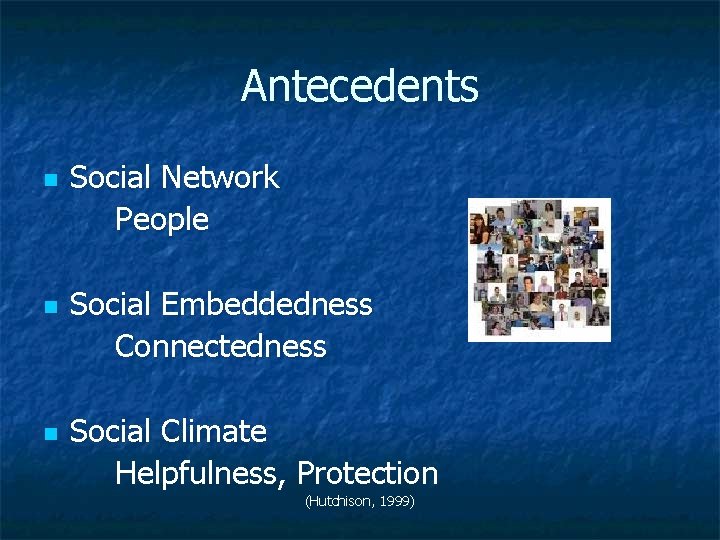
Antecedents n n n Social Network People Social Embeddedness Connectedness Social Climate Helpfulness, Protection (Hutchison, 1999)
Consequences: Feeling of being: Loved Esteemed Respected Sense of belonging to group (Hutchison, 1999)
Nursing Diagnosis n Social Isolation: Definition: Aloneness experienced by the individual and perceived as imposed by others and as a negative or threatened state Characteristics: Expressed feelings of aloneness, rejection, feeling different from others; inadequate sense of purpose; inability to meet expectations of others (Wilkinson & Wilkinson, 2005)
Related Factors n R/T: Populations Chemical Dependency Addictive Behavior Psychologic Impairment Alzheimer’s Disease Treatment-imposed Isolation Trauma Stressful Occupations Corporate culture, LTC worker, Students (Wilkinson & Wilkinson, 2005)
Research Normal Subjects: 111 subjects: 6 groups 2 control – listening, reading 4 group drum – basic, impact, shamanic, composite Measure: Blood tests + Anxiety/Depression Scales Results: ↑ DHEA: Cortisol level, ↑NK cell activity, n ↑lymphocytes; No ∆ Depression/Anxiety Scales Conclusion: Neuroendocrine and neuroimmune hormones ↑ in direct opposition to normal stress response (Bittman, Berk, Felten, Westengard, Simonton, & Pappas, 2001)
Research n Alzheimer’s Disease – ↓ Motivation, ↓ initiative for social interaction; decline in psychomotor, cognitive, communicative, social, emotional Purpose: Test value of musical instrument to elicit responses in a group musical session Method: 2 groups; 24 sessions (1/week) 1 early/moderate, 1 later Alzheimer’s Participant observation Results: Musical perception still present; able to learn new material; enhances social interaction; AD responds to structure of movement, rhythm; Best – djembe in lap (Cevasco & Grant, 2006)
Research n Stress Induction/Amelioration: 32 healthy volunteers Method: Blood tests pre/post protocol All – puzzle for stress induction; 1 group – continued, 1 group rested, 1 group engaged in RMM protocol Results: Subjects with RMM protocol - 19/45 peripheral blood gene analysis markers demonstrated reversal compared with 6/45 in control and 0/45 in ongoing stressor groups Antiviral, immunologic effects (Bittman, Berk, Shannon, Sharaf, Westengard, & Guegler, 2005)
Research n Stroke Patients 40 patients - motor impairment after stroke – paresis of UE Method: Restricted unimpaired arm and exposed to repetitive movements with piano, electric drum Result: improvement in movements – fine motor (piano) and gross motor (drum); functional reorganization noted on PET scan ? Influence from motivational factors after stroke (group) (Schneider, Schonle, Altenmuller, & Munte, 2007)
Research n Drug Addiction Addicts are self-centered, disconnected, isolated in subculture 4 separate studies in 2001 Method: Observation, Interview (counselor), Pilot program, Online discussion Results: Unity, purpose, connectedness, deep relaxation, emotional release, altered state of consciousness, “rush of energy”, “eraser” to remove effects of trauma. Entrains brain to feel pleaurable effects without drugs. Reintegration of self (Winkelman, 2003)
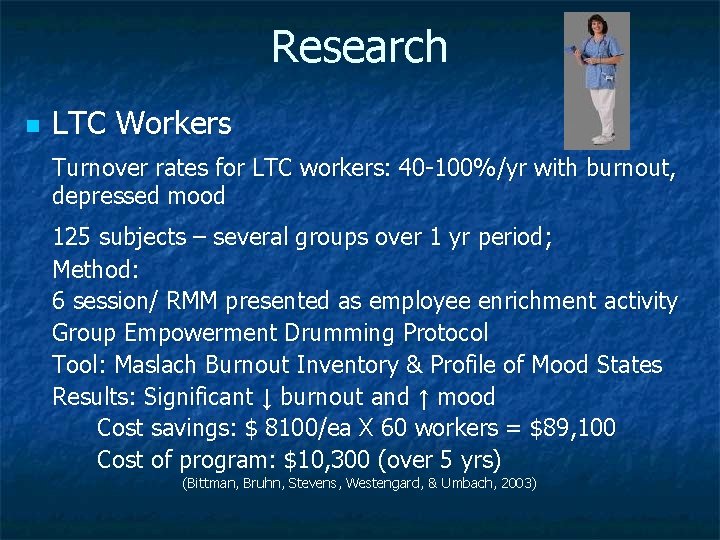
Research n LTC Workers Turnover rates for LTC workers: 40 -100%/yr with burnout, depressed mood 125 subjects – several groups over 1 yr period; Method: 6 session/ RMM presented as employee enrichment activity Group Empowerment Drumming Protocol Tool: Maslach Burnout Inventory & Profile of Mood States Results: Significant ↓ burnout and ↑ mood Cost savings: $ 8100/ea X 60 workers = $89, 100 Cost of program: $10, 300 (over 5 yrs) (Bittman, Bruhn, Stevens, Westengard, & Umbach, 2003)
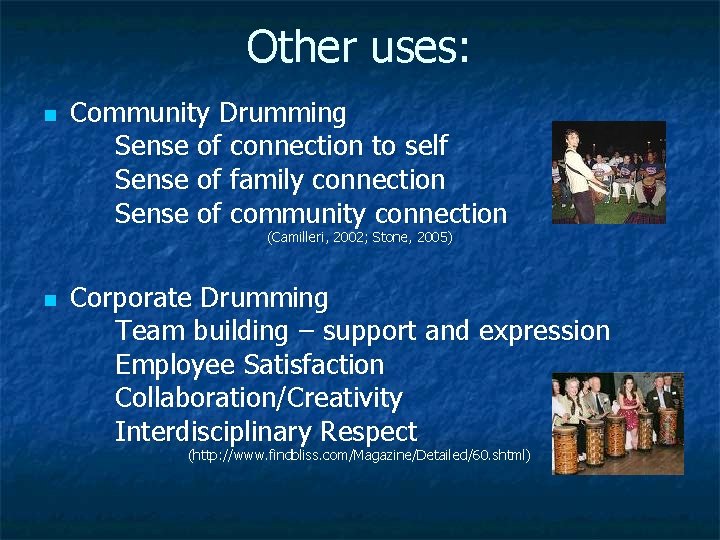
Other uses: n Community Drumming Sense of connection to self Sense of family connection Sense of community connection (Camilleri, 2002; Stone, 2005) n Corporate Drumming Team building – support and expression Employee Satisfaction Collaboration/Creativity Interdisciplinary Respect (http: //www. findbliss. com/Magazine/Detailed/60. shtml)
Adverse Effects n n None reported in literature One article mentioned ? precipitation of seizures with music of ↑ tempo (Stouffer, Shirk, & Polomano, 2007) n Caution in culture of substance abuse
Intervention n Music Therapy: using music to help achieve a specific change in behavior, feeling, or physiology Define the specific change in behavior or physiology that is desired n Inform the individual of purpose of music experience n Facilitate the individual’s active participation n (Dochterman, Bulechek, Butcher, & University of Iowa, 2008)
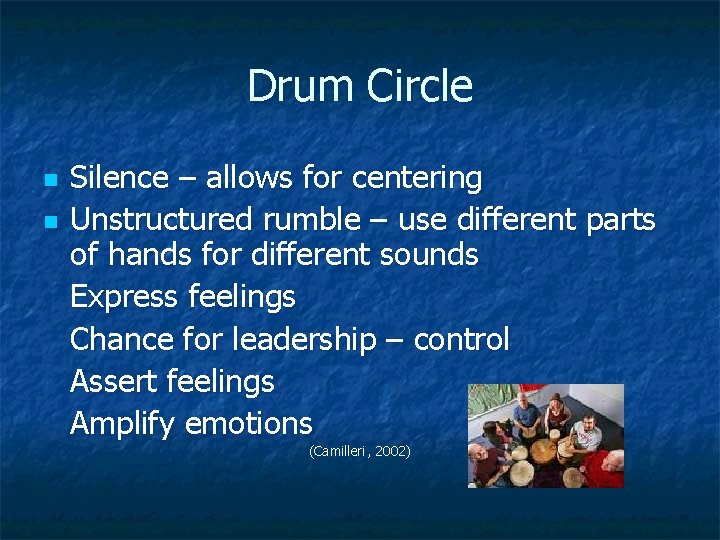
Drum Circle n n Silence – allows for centering Unstructured rumble – use different parts of hands for different sounds Express feelings Chance for leadership – control Assert feelings Amplify emotions (Camilleri, 2002)
Drum Circle n Introduce self with drum – Group mirrors the sound n Self expression n Voice to emotion n Immediate gratification and feedback n (Camilleri, 2002)
Drum Circle n Listening/Imitating Games n Mirror Games n n 1 starts, group copies back – pride of ownership Echo Games – n 1 starts, sound around group in wave – chance for idea to be heard; no right/wrong (Camilleri, 2002)
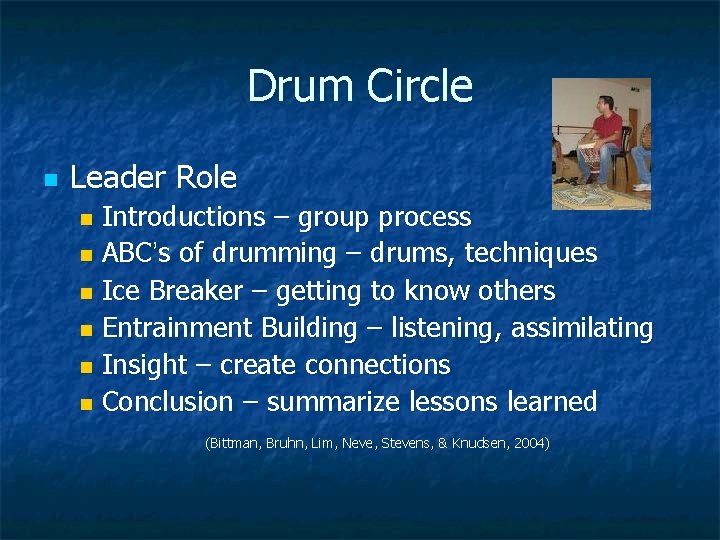
Drum Circle n Leader Role Introductions – group process n ABC’s of drumming – drums, techniques n Ice Breaker – getting to know others n Entrainment Building – listening, assimilating n Insight – create connections n Conclusion – summarize lessons learned n (Bittman, Bruhn, Lim, Neve, Stevens, & Knudsen, 2004)
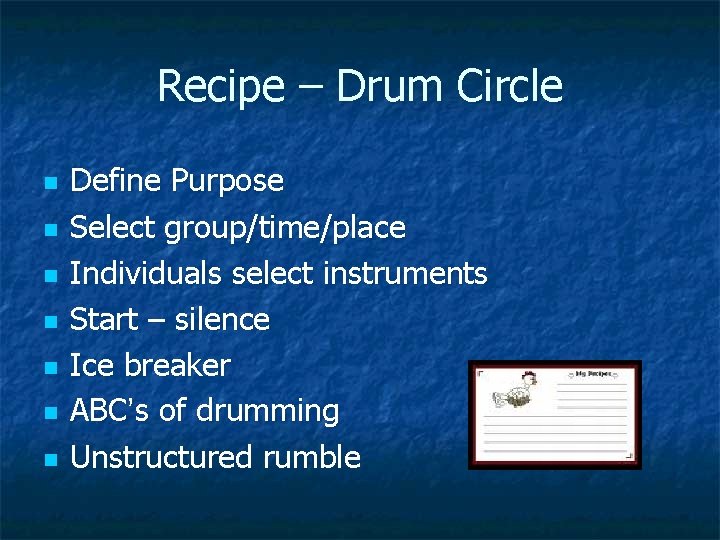
Recipe – Drum Circle n n n n Define Purpose Select group/time/place Individuals select instruments Start – silence Ice breaker ABC’s of drumming Unstructured rumble
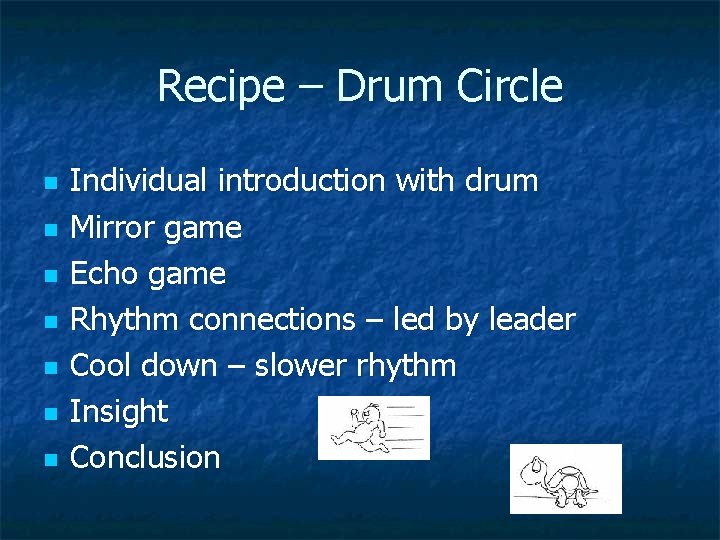
Recipe – Drum Circle n n n n Individual introduction with drum Mirror game Echo game Rhythm connections – led by leader Cool down – slower rhythm Insight Conclusion
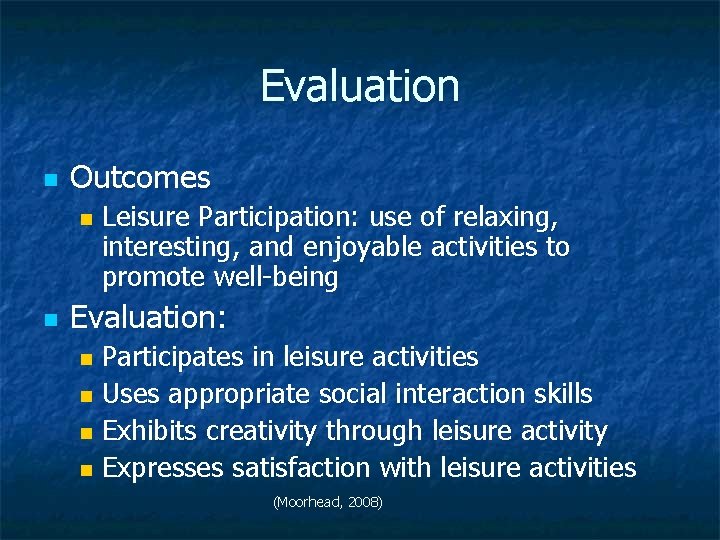
Evaluation n Outcomes n n Leisure Participation: use of relaxing, interesting, and enjoyable activities to promote well-being Evaluation: Participates in leisure activities n Uses appropriate social interaction skills n Exhibits creativity through leisure activity n Expresses satisfaction with leisure activities n (Moorhead, 2008)
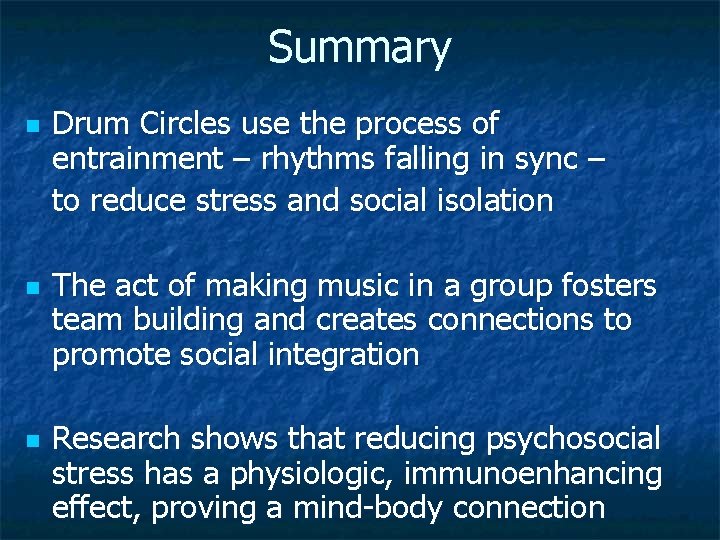
Summary n n n Drum Circles use the process of entrainment – rhythms falling in sync – to reduce stress and social isolation The act of making music in a group fosters team building and creates connections to promote social integration Research shows that reducing psychosocial stress has a physiologic, immunoenhancing effect, proving a mind-body connection