TEPSTips and Pitfalls TEP Seminar Southampton 24 th




- Slides: 44
TEPS-Tips and Pitfalls TEP Seminar, Southampton 24 th September 2015 George Lillie, Director of Clinical Services, St Luke’s Hospice Dr Mick Mercer, Consultant Anaesthesia and Critical Care, South Devon Healthcare
History • The first description of external cardiac massage was in 1960 (1). • 1974 - the American Medical Association proposed that decisions not to resuscitate should be entered into the medical notes and communicated to all attending clinical staff (2). • 1976 two North American centres were the first to describe their process to decide that a patient should be the object of a Do-Not. Resuscitate (DNR) order (3, 4). • 1984 -88 various authors commented on the variability in the way in which DNR orders were interpreted and the differences in care that this might mean for the patient. This led to the concept of more specific individualised patient plans that detailed which treatments were and were not appropriate (5, 6, 7).
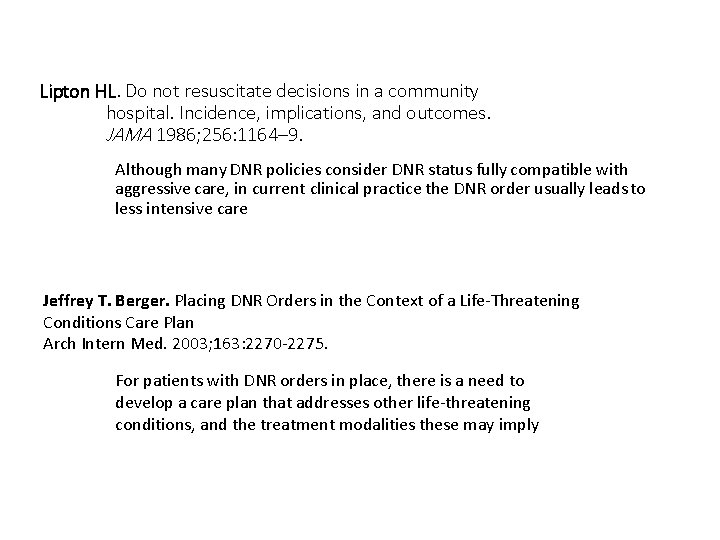
Lipton HL. Do not resuscitate decisions in a community hospital. Incidence, implications, and outcomes. JAMA 1986; 256: 1164– 9. Although many DNR policies consider DNR status fully compatible with aggressive care, in current clinical practice the DNR order usually leads to less intensive care Jeffrey T. Berger. Placing DNR Orders in the Context of a Life-Threatening Conditions Care Plan Arch Intern Med. 2003; 163: 2270 -2275. For patients with DNR orders in place, there is a need to develop a care plan that addresses other life-threatening conditions, and the treatment modalities these may imply
DNR orders • Do not include plans for dealing with unstable conditions that may precede arrest. • Patients thoughts governing their DNR order may not necessarily support non-treatment of other life threatening states.
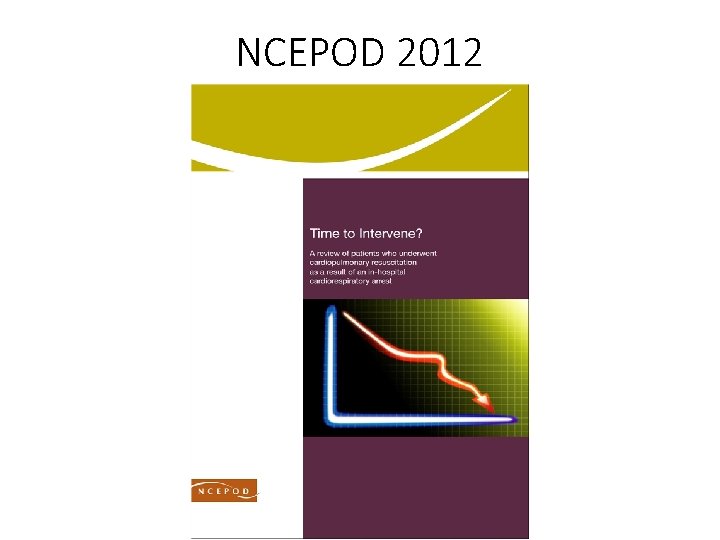
NCEPOD 2012
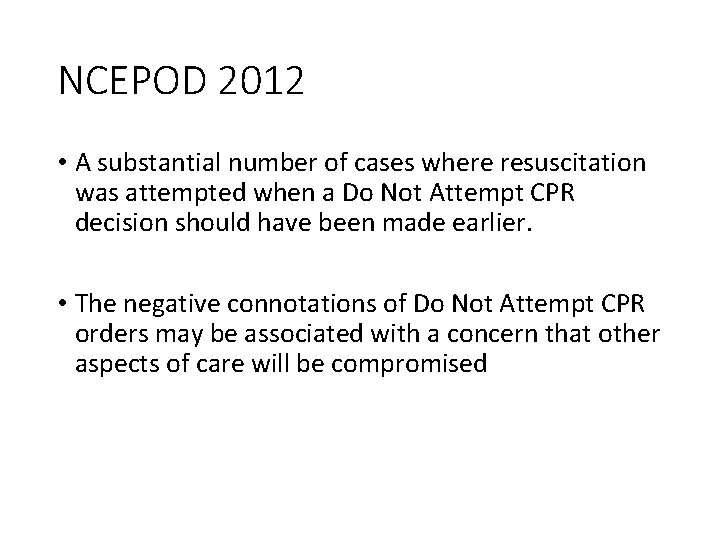
NCEPOD 2012 • A substantial number of cases where resuscitation was attempted when a Do Not Attempt CPR decision should have been made earlier. • The negative connotations of Do Not Attempt CPR orders may be associated with a concern that other aspects of care will be compromised
Do Not Attempt Cardiopulmonary Resuscitation Orders (DNACPR) • We recommend that the Government review the use of DNACPR orders in acute care settings, including whether resuscitation decisions should be considered in the context of overall treatment plans. This Committee believes there is a case for standardising the recording mechanisms for the NHS in England.
What’s been happening in Devon? • 2006 TEP in Acute Trust (South Devon) • 2012 TEP across Devon – all sectors
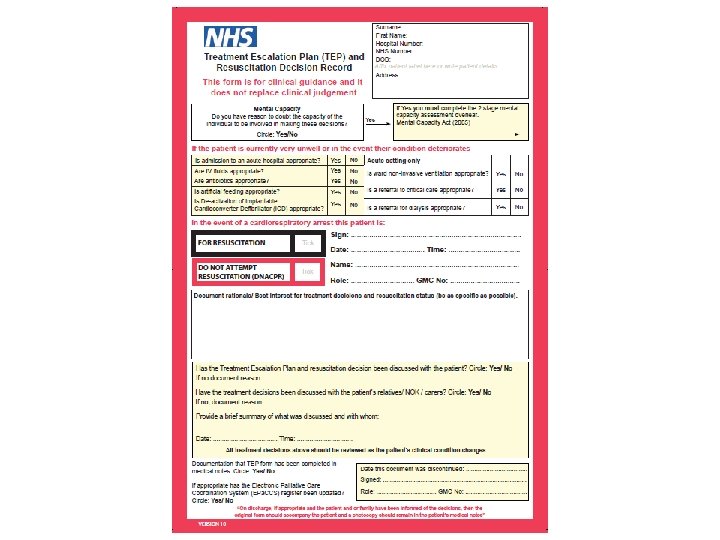
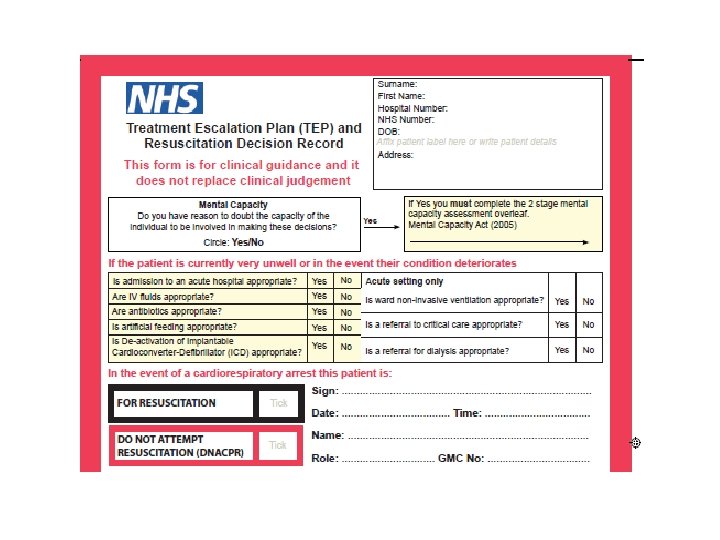
The NHS Devon TEP • An overall plan • Adoption of one form across ALL OF DEVON’S health community ensures continuity of care approach
Aims ►All appropriate patients are included in TEP process ►TEP process completed with engagement of patient/family ►Information held in the TEP is easily available to all attending clinical staff
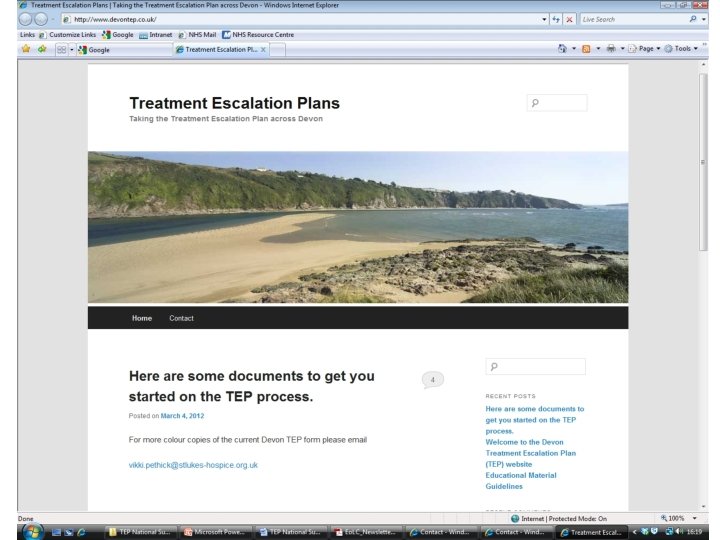
TEP resources ►See www. devontep. co. uk • • educational movies downloadable teaching material Guidelines and information Patient information • Comments regarding TEP can be sent to tep-sw@nhs. net
Devon TEP Evaluation • Obolensky L, Mercer M. Replacing Do-Not. Resuscitate Forms with Treatment Escalation Plans. Abstract at Intensive Care Society Meeting London, December 17/18 2007. • Obolensky L, Clark T, Matthew G, Mercer M. Patients’ Positive Experiences of Treatment Escalation Plans – a replacement for the Do-Not. Resuscitate process. Journal of Medical Ethics 2010; 36: 518 -520.
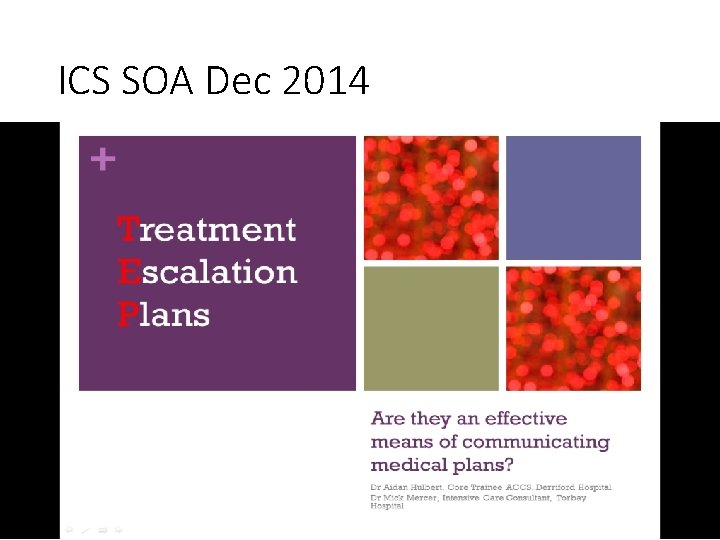
ICS SOA Dec 2014
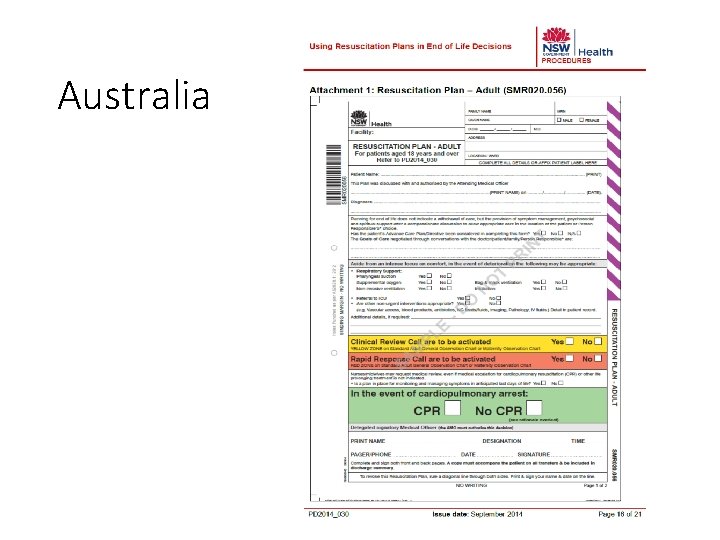
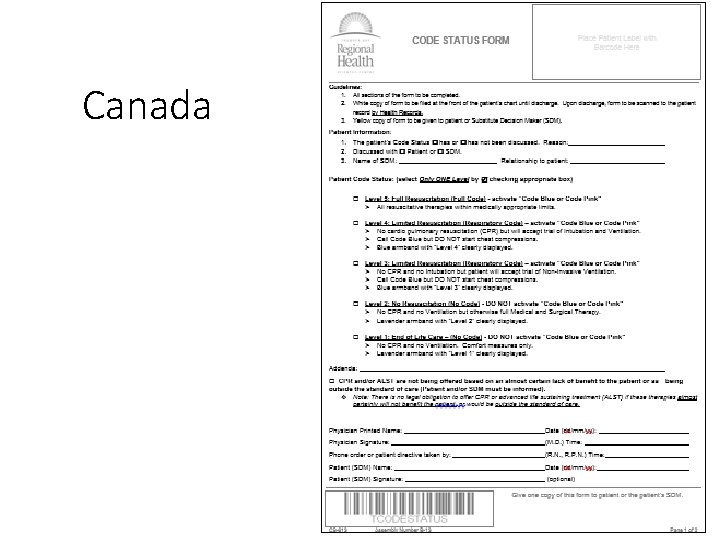
Global Examples USA http: //www. ohsu. edu/polst/
Australia
Canada
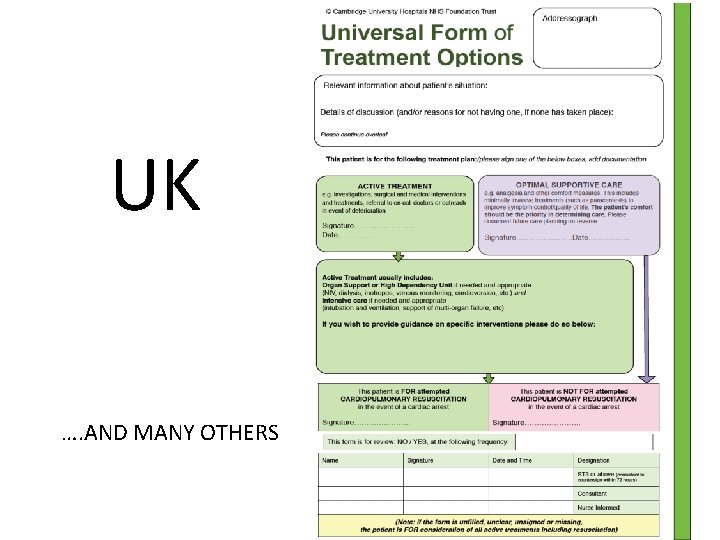
UK …. AND MANY OTHERS
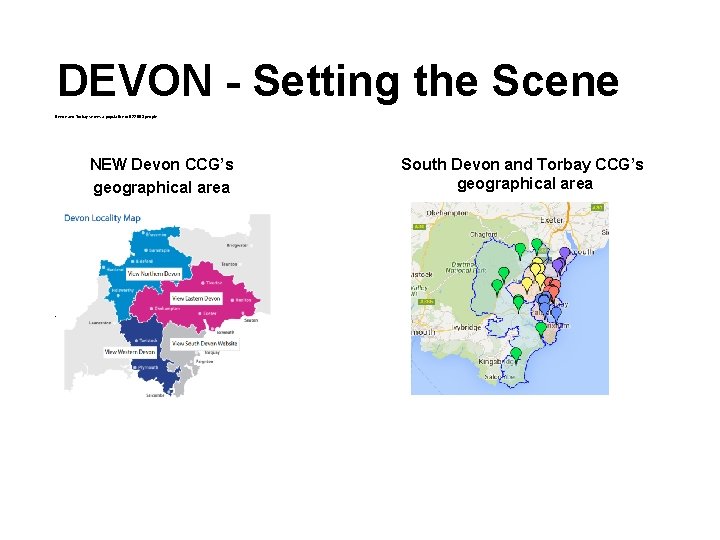
DEVON - Setting the Scene Devon and Torbay serves a population of 922, 693 people NEW Devon CCG’s geographical area • Has 4 acute providers, 4 hospices and community providers South Devon and Torbay CCG’s geographical area
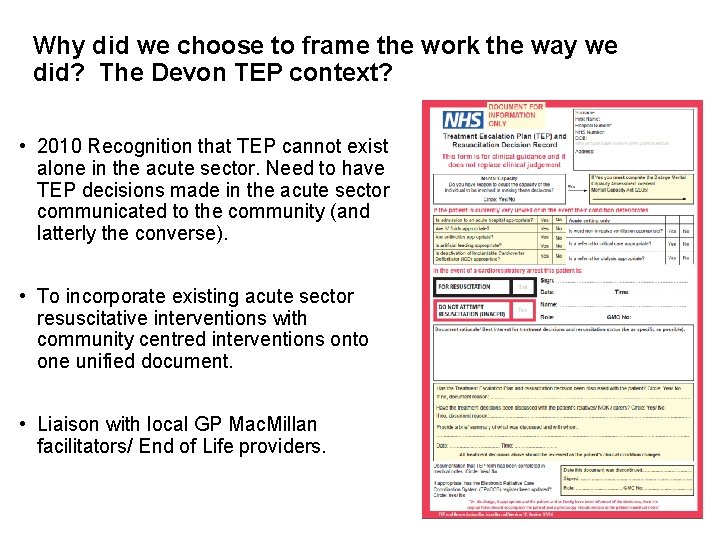
What was the rationale behind the Devon TEP- why did we do it? • 2006, Acute Sector (Torbay Hospital) needed to have a process for consideration of appropriateness of admission of patient to ICU from the general ward – not just appropriateness of CPR. Hence need for other “resuscitative” treatment modalities on TEP form. • Growing Issue with complaints around resuscitation decision making, particularly in the community setting. • A plethora of RDR (Resuscitation Decision Record) forms used throughout the health community, that had to be changed when moved from one setting to another. • Part of Strategy to promote joined up End of Life Care across Devon.
Why did we choose to frame the work the way we did? The Devon TEP context? • 2010 Recognition that TEP cannot exist alone in the acute sector. Need to have TEP decisions made in the acute sector communicated to the community (and latterly the converse). • To incorporate existing acute sector resuscitative interventions with community centred interventions onto one unified document. • Liaison with local GP Mac. Millan facilitators/ End of Life providers.
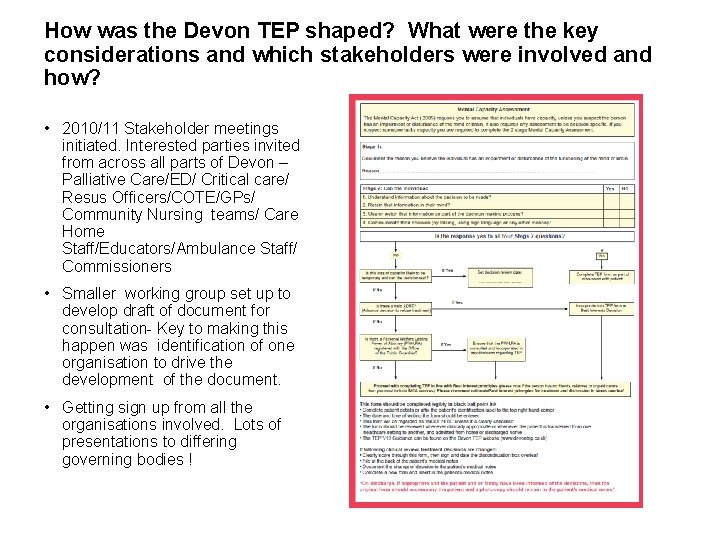
How was the Devon TEP shaped? What were the key considerations and which stakeholders were involved and how? • 2010/11 Stakeholder meetings initiated. Interested parties invited from across all parts of Devon – Palliative Care/ED/ Critical care/ Resus Officers/COTE/GPs/ Community Nursing teams/ Care Home Staff/Educators/Ambulance Staff/ Commissioners • Smaller working group set up to develop draft of document for consultation- Key to making this happen was identification of one organisation to drive the development of the document. • Getting sign up from all the organisations involved. Lots of presentations to differing governing bodies !
What had to be negotiated to get the Devon TEP into practice? Learning from implementation? • • • All on one sheet of paper Which resuscitative interventions to incorporate Flexible approach to design Who would be responsible for there production Ownership by all organisations involved One original version only to travel with patient (mainly applies to End of Life Patients) Recognition that TEP is a signpost to guide care – not a replacement for clinical judgement Agreement of key messages to aid implementation Financial support from commissioners Implementation date
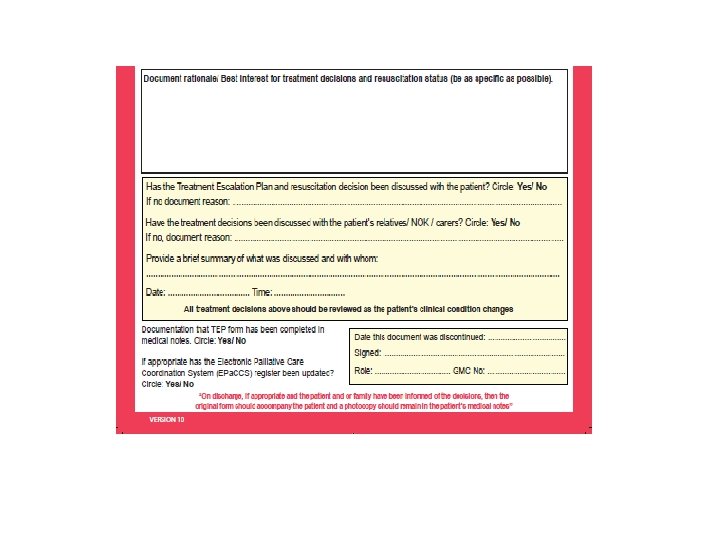
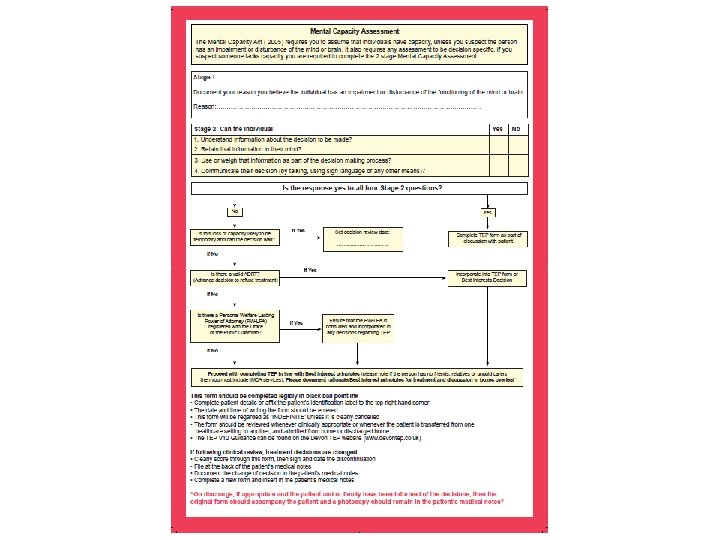
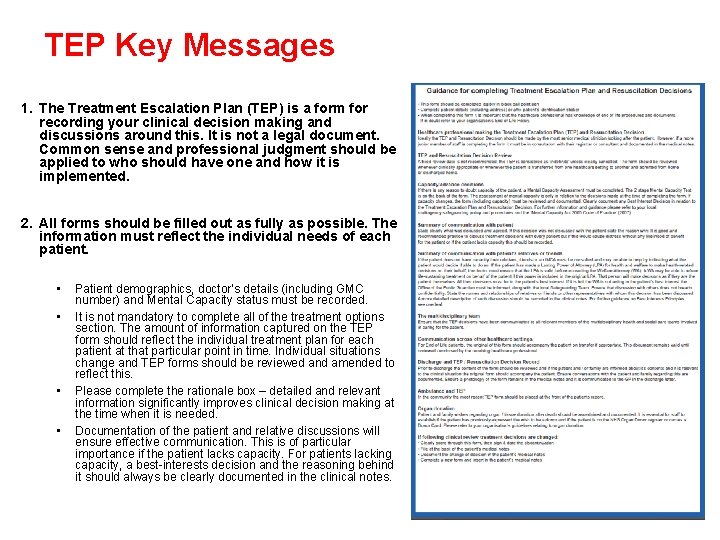
TEP Key Messages 1. The Treatment Escalation Plan (TEP) is a form for recording your clinical decision making and discussions around this. It is not a legal document. Common sense and professional judgment should be applied to who should have one and how it is implemented. 2. All forms should be filled out as fully as possible. The information must reflect the individual needs of each patient. • • Patient demographics, doctor’s details (including GMC number) and Mental Capacity status must be recorded. It is not mandatory to complete all of the treatment options section. The amount of information captured on the TEP form should reflect the individual treatment plan for each patient at that particular point in time. Individual situations change and TEP forms should be reviewed and amended to reflect this. Please complete the rationale box – detailed and relevant information significantly improves clinical decision making at the time when it is needed. Documentation of the patient and relative discussions will ensure effective communication. This is of particular importance if the patient lacks capacity. For patients lacking capacity, a best-interests decision and the reasoning behind it should always be clearly documented in the clinical notes.
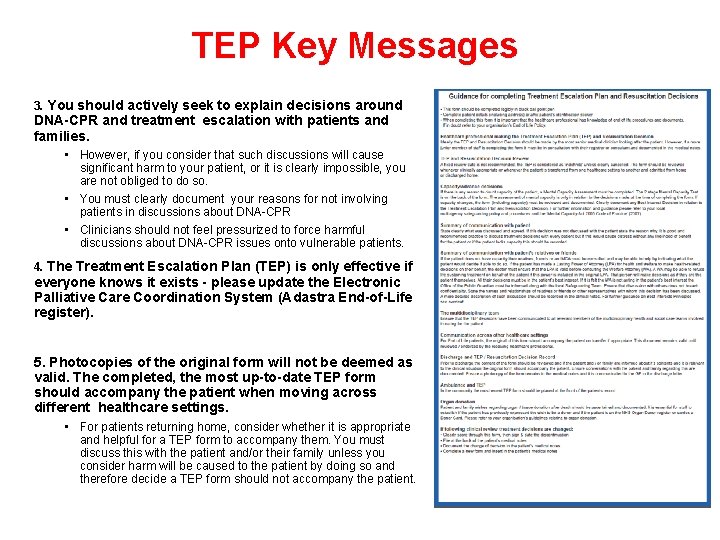
TEP Key Messages 3. You should actively seek to explain decisions around DNA-CPR and treatment escalation with patients and families. • However, if you consider that such discussions will cause significant harm to your patient, or it is clearly impossible, you are not obliged to do so. • You must clearly document your reasons for not involving patients in discussions about DNA-CPR • Clinicians should not feel pressurized to force harmful discussions about DNA-CPR issues onto vulnerable patients. 4. The Treatment Escalation Plan (TEP) is only effective if everyone knows it exists - please update the Electronic Palliative Care Coordination System (Adastra End-of-Life register). 5. Photocopies of the original form will not be deemed as valid. The completed, the most up-to-date TEP form should accompany the patient when moving across different healthcare settings. • For patients returning home, consider whether it is appropriate and helpful for a TEP form to accompany them. You must discuss this with the patient and/or their family unless you consider harm will be caused to the patient by doing so and therefore decide a TEP form should not accompany the patient.
How far has implementation in Devon progressed? • All Key Health providers are using TEP forms as there method of recording RDR decisions • Recently undertook Devon wide survey with 87 responses from professionals across both areas.
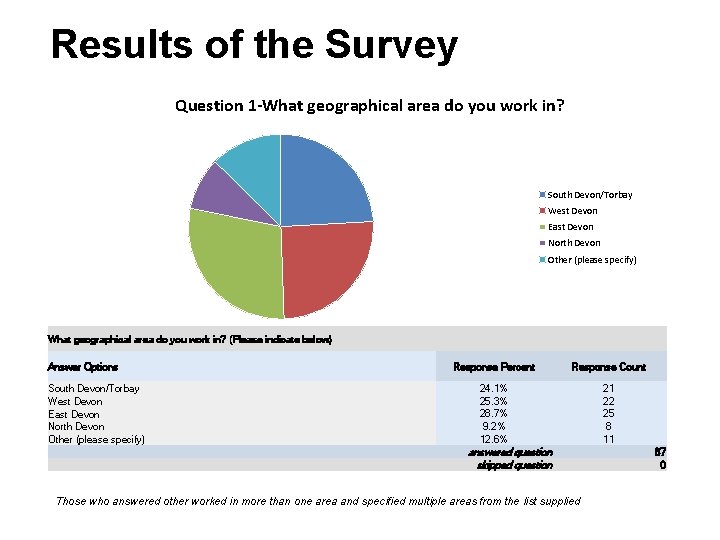
Results of the Survey Question 1 -What geographical area do you work in? South Devon/Torbay West Devon East Devon North Devon Other (please specify) What geographical area do you work in? (Please indicate below) Answer Options South Devon/Torbay West Devon East Devon North Devon Other (please specify) Response Percent Response Count 24. 1% 25. 3% 28. 7% 9. 2% 12. 6% 21 22 25 8 11 answered question skipped question Those who answered other worked in more than one area and specified multiple areas from the list supplied 87 0
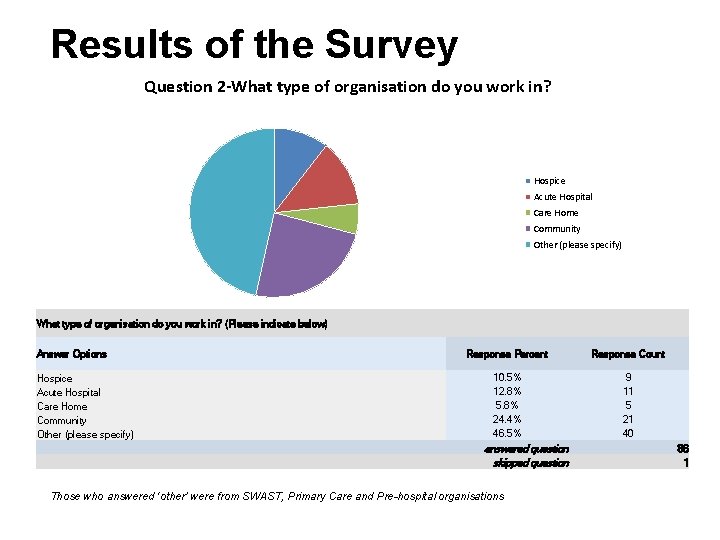
Results of the Survey Question 2 -What type of organisation do you work in? Hospice Acute Hospital Care Home Community Other (please specify) What type of organisation do you work in? (Please indicate below) Answer Options Hospice Acute Hospital Care Home Community Other (please specify) Response Percent Response Count 10. 5% 12. 8% 5. 8% 24. 4% 46. 5% 9 11 5 21 40 answered question skipped question Those who answered ‘other’ were from SWAST, Primary Care and Pre-hospital organisations 86 1
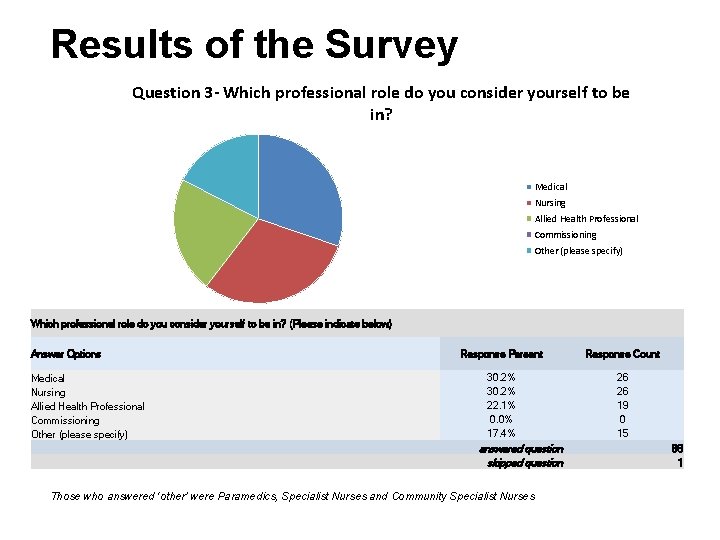
Results of the Survey Question 3 - Which professional role do you consider yourself to be in? Medical Nursing Allied Health Professional Commissioning Other (please specify) Which professional role do you consider yourself to be in? (Please indicate below) Answer Options Medical Nursing Allied Health Professional Commissioning Other (please specify) Response Percent Response Count 30. 2% 22. 1% 0. 0% 17. 4% 26 26 19 0 15 answered question skipped question Those who answered ‘other’ were Paramedics, Specialist Nurses and Community Specialist Nurses 86 1
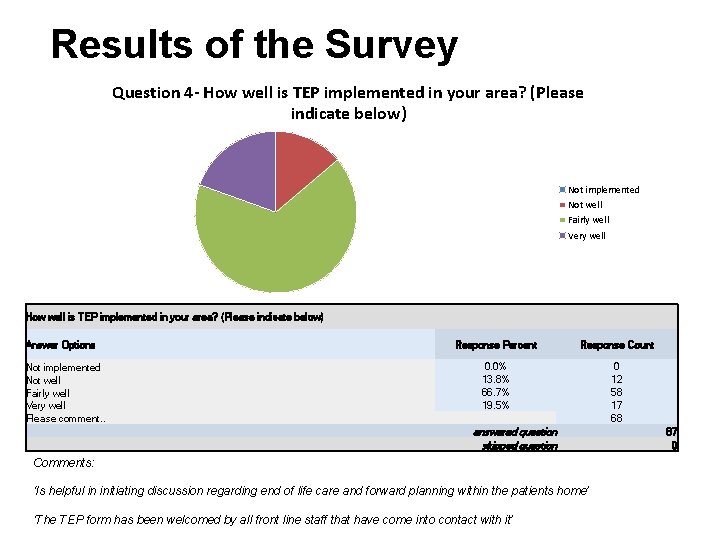
Results of the Survey Question 4 - How well is TEP implemented in your area? (Please indicate below) Not implemented Not well Fairly well Very well How well is TEP implemented in your area? (Please indicate below) Answer Options Not implemented Not well Fairly well Very well Please comment. . Response Percent Response Count 0. 0% 13. 8% 66. 7% 19. 5% 0 12 58 17 68 answered question skipped question Comments: ‘Is helpful in initiating discussion regarding end of life care and forward planning within the patients home’ ‘The TEP form has been welcomed by all front line staff that have come into contact with it’ 87 0
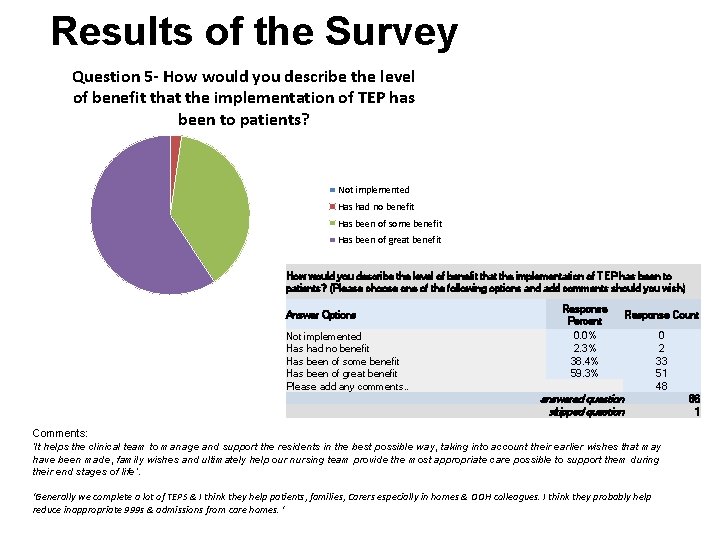
Results of the Survey Question 5 - How would you describe the level of benefit that the implementation of TEP has been to patients? Not implemented Has had no benefit Has been of some benefit Has been of great benefit How would you describe the level of benefit that the implementation of TEP has been to patients? (Please choose one of the following options and add comments should you wish) Answer Options Not implemented Has had no benefit Has been of some benefit Has been of great benefit Please add any comments. . Response Percent Response Count 0. 0% 2. 3% 38. 4% 59. 3% 0 2 33 51 48 answered question skipped question Comments: ‘It helps the clinical team to manage and support the residents in the best possible way, taking into account their earlier wishes that may have been made, family wishes and ultimately help our nursing team provide the most appropriate care possible to support them during their end stages of life’. ‘Generally we complete a lot of TEPS & I think they help patients, families, Carers especially in homes & OOH colleagues. I think they probably help reduce inappropriate 999 s & admissions from care homes. ‘ 86 1
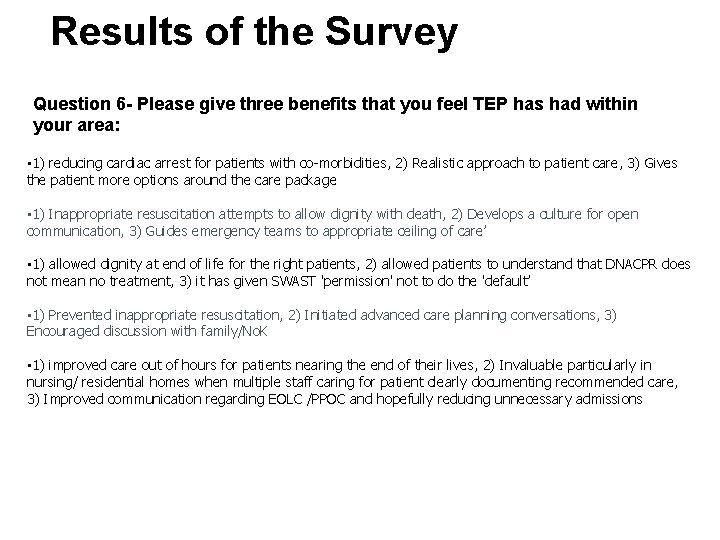
Results of the Survey Question 6 - Please give three benefits that you feel TEP has had within your area: • 1) reducing cardiac arrest for patients with co-morbidities, 2) Realistic approach to patient care, 3) Gives the patient more options around the care package • 1) Inappropriate resuscitation attempts to allow dignity with death, 2) Develops a culture for open communication, 3) Guides emergency teams to appropriate ceiling of care’ • 1) allowed dignity at end of life for the right patients, 2) allowed patients to understand that DNACPR does not mean no treatment, 3) it has given SWAST 'permission' not to do the 'default’ • 1) Prevented inappropriate resuscitation, 2) Initiated advanced care planning conversations, 3) Encouraged discussion with family/No. K • 1) improved care out of hours for patients nearing the end of their lives, 2) Invaluable particularly in nursing/ residential homes when multiple staff caring for patient clearly documenting recommended care, 3) Improved communication regarding EOLC /PPOC and hopefully reducing unnecessary admissions
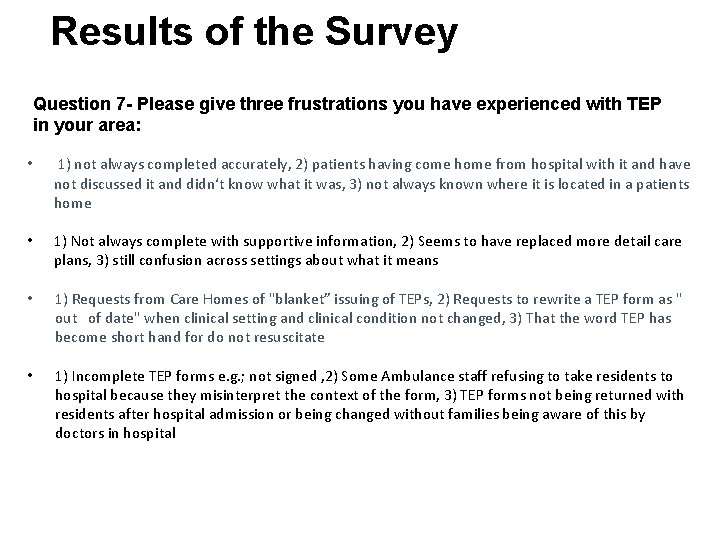
Results of the Survey Question 7 - Please give three frustrations you have experienced with TEP in your area: • 1) not always completed accurately, 2) patients having come home from hospital with it and have not discussed it and didn‘t know what it was, 3) not always known where it is located in a patients home • 1) Not always complete with supportive information, 2) Seems to have replaced more detail care plans, 3) still confusion across settings about what it means • 1) Requests from Care Homes of "blanket” issuing of TEPs, 2) Requests to rewrite a TEP form as " out of date" when clinical setting and clinical condition not changed, 3) That the word TEP has become short hand for do not resuscitate • 1) Incomplete TEP forms e. g. ; not signed , 2) Some Ambulance staff refusing to take residents to hospital because they misinterpret the context of the form, 3) TEP forms not being returned with residents after hospital admission or being changed without families being aware of this by doctors in hospital
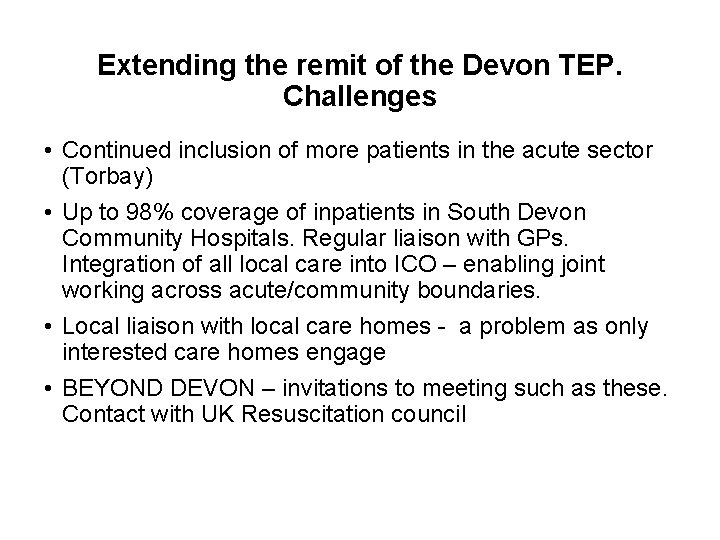
Extending the remit of the Devon TEP. Challenges • Continued inclusion of more patients in the acute sector (Torbay) • Up to 98% coverage of inpatients in South Devon Community Hospitals. Regular liaison with GPs. Integration of all local care into ICO – enabling joint working across acute/community boundaries. • Local liaison with local care homes - a problem as only interested care homes engage • BEYOND DEVON – invitations to meeting such as these. Contact with UK Resuscitation council
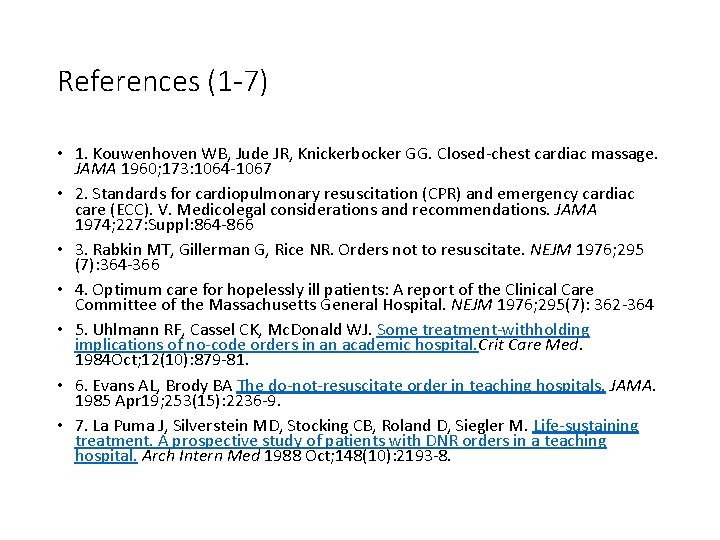
References (1 -7) • 1. Kouwenhoven WB, Jude JR, Knickerbocker GG. Closed-chest cardiac massage. JAMA 1960; 173: 1064 -1067 • 2. Standards for cardiopulmonary resuscitation (CPR) and emergency cardiac care (ECC). V. Medicolegal considerations and recommendations. JAMA 1974; 227: Suppl: 864 -866 • 3. Rabkin MT, Gillerman G, Rice NR. Orders not to resuscitate. NEJM 1976; 295 (7): 364 -366 • 4. Optimum care for hopelessly ill patients: A report of the Clinical Care Committee of the Massachusetts General Hospital. NEJM 1976; 295(7): 362 -364 • 5. Uhlmann RF, Cassel CK, Mc. Donald WJ. Some treatment-withholding implications of no-code orders in an academic hospital. Crit Care Med. 1984 Oct; 12(10): 879 -81. • 6. Evans AL, Brody BA The do-not-resuscitate order in teaching hospitals. JAMA. 1985 Apr 19; 253(15): 2236 -9. • 7. La Puma J, Silverstein MD, Stocking CB, Roland D, Siegler M. Life-sustaining treatment. A prospective study of patients with DNR orders in a teaching hospital. Arch Intern Med 1988 Oct; 148(10): 2193 -8.