Radionuclide production for medical Application at the ARRONAX
- Slides: 21
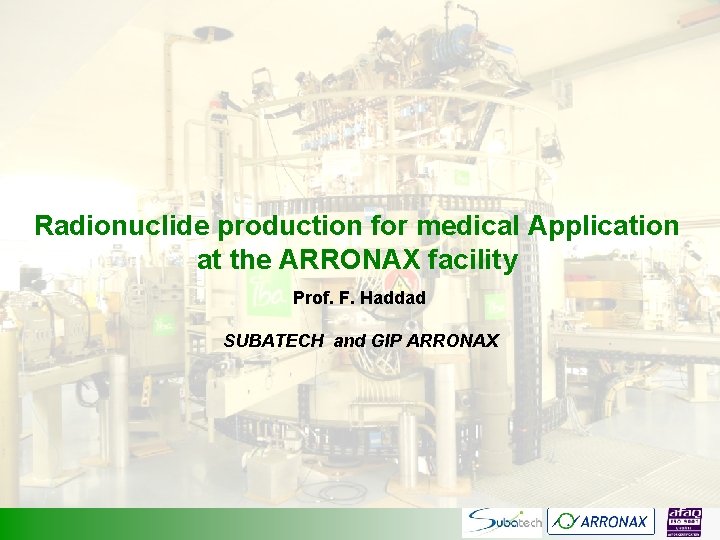
Radionuclide production for medical Application at the ARRONAX facility Prof. F. Haddad SUBATECH and GIP ARRONAX
Innovative radionuclide production To be of interest, it must : Ø Have an interest for end-users Ø Be produced in enough quantity Ø Be of good quality Ø Have a high reliability
Motivations There is a demand for radionuclides Ø with different Half-lives: to match with vector distribution time in targeted therapy or imaging Ø with different decay radiations: imaging / therapy short range High LET vs long range Low LET
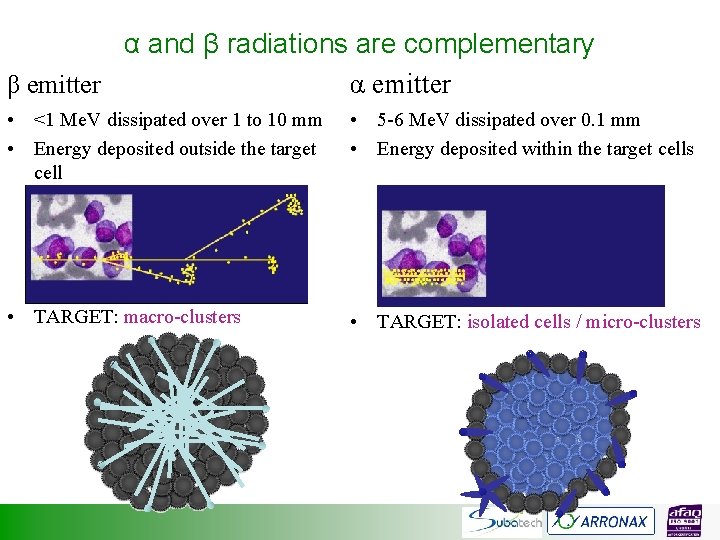
α and β radiations are complementary α emitter β emitter • <1 Me. V dissipated over 1 to 10 mm • Energy deposited outside the target cell • 5 -6 Me. V dissipated over 0. 1 mm • Energy deposited within the target cells • TARGET: macro-clusters • TARGET: isolated cells / micro-clusters
Motivations There is a demand for radionuclides Ø with different Half-lives: to match with vector distribution time in targeted therapy or imaging Ø with different decay radiations: imaging / therapy short range High LET vs long range Low LET Ø with different Chemical properties Ø produced via generator (ease the availability) Ø To be used for the Theragnostic approach Radionuclide with radiations for both imaging and therapy (117 m. Sn) Radionuclides of the same element (64 Cu/67 Cu, 124 I/131 I, … ) Radionuclides with comparable properties (99 m. Tc / 188 Re)
Innovative radionuclide production To be of interest, it must : Ø Have an interest for end-users - OK Ø Be produced in enough quantity High intensity accelerator Ø Be of good quality Radiochemistry & select the right nuclear reaction Ø Have a high reliability
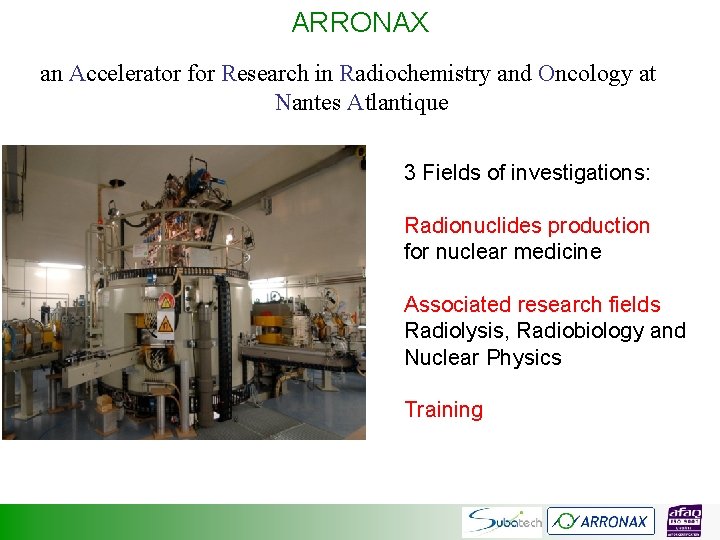
ARRONAX an Accelerator for Research in Radiochemistry and Oncology at Nantes Atlantique 3 Fields of investigations: Radionuclides production for nuclear medicine Associated research fields Radiolysis, Radiobiology and Nuclear Physics Training
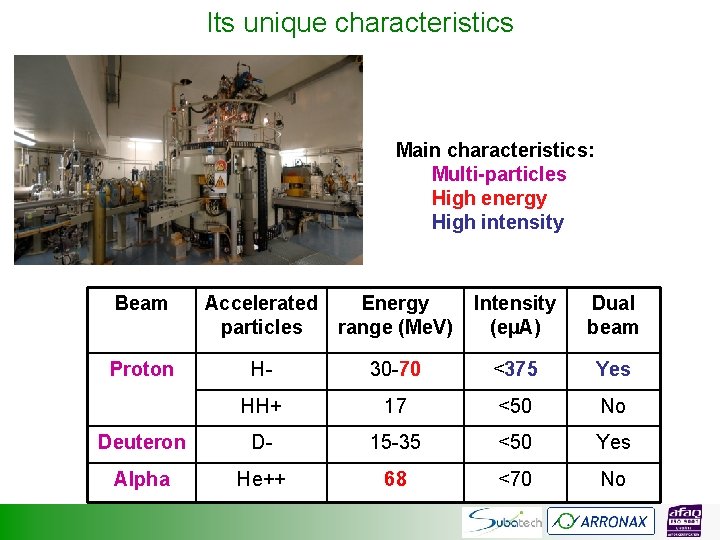
Its unique characteristics Main characteristics: Multi-particles High energy High intensity Beam Accelerated particles Energy range (Me. V) Intensity (eµA) Dual beam Proton H- 30 -70 <375 Yes HH+ 17 <50 No Deuteron D- 15 -35 <50 Yes Alpha He++ 68 <70 No
Innovative radionuclide production To be of interest, it must : Ø Have an interest for end-users - OK Ø Be produced in enough quantity - OK High intensity accelerator Ø Be of good quality - OK Radiochemistry & select the right nuclear reaction Ø Have a high reliability
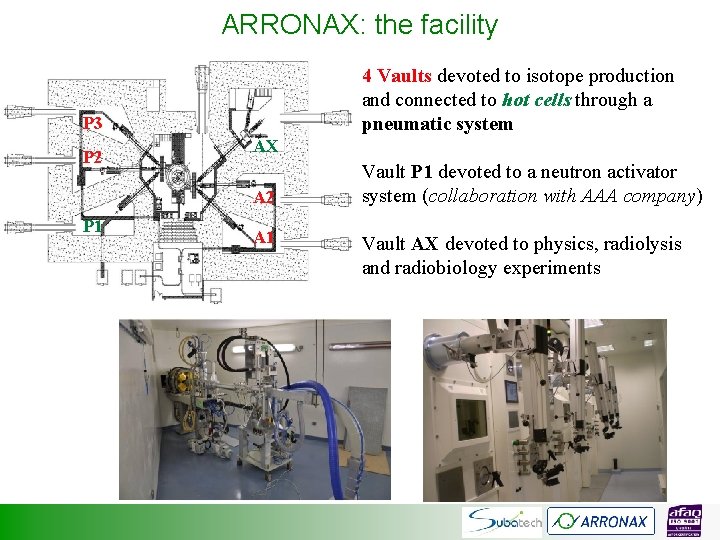
ARRONAX: the facility 4 Vaults devoted to isotope production and connected to hot cells through a pneumatic system P 3 P 2 AX A 2 P 1 A 1 Vault P 1 devoted to a neutron activator system (collaboration with AAA company) Vault AX devoted to physics, radiolysis and radiobiology experiments
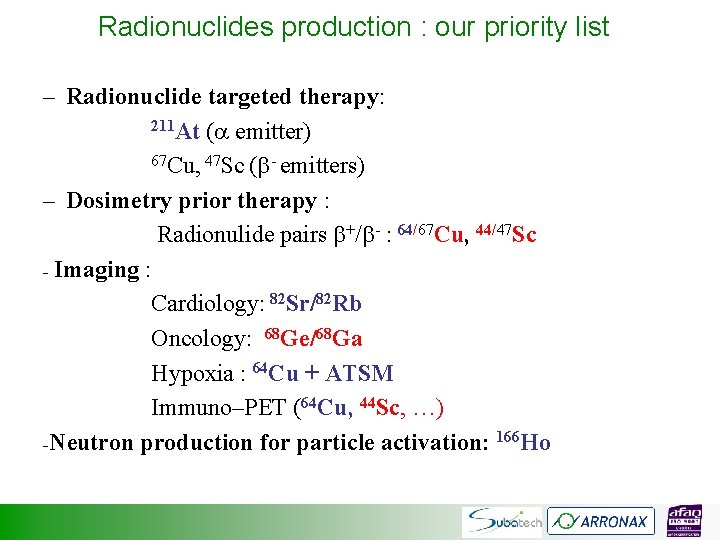
Radionuclides production : our priority list – Radionuclide targeted therapy: 211 At ( emitter) 67 Cu, 47 Sc ( - emitters) – Dosimetry prior therapy : Radionulide pairs +/ - : 64/67 Cu, 44/47 Sc - Imaging : Cardiology: 82 Sr/82 Rb Oncology: 68 Ge/68 Ga Hypoxia : 64 Cu + ATSM Immuno–PET (64 Cu, 44 Sc, …) -Neutron production for particle activation: 166 Ho
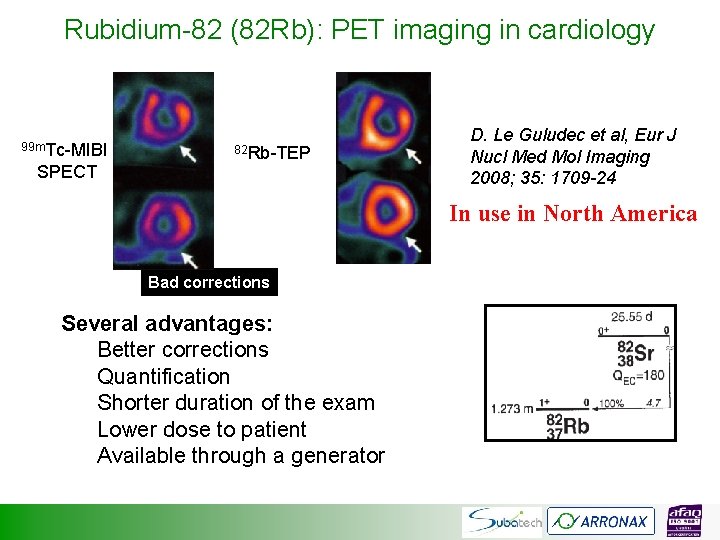
Rubidium-82 (82 Rb): PET imaging in cardiology Perfusion default 99 m. Tc-MIBI SPECT 82 Rb-TEP D. Le Guludec et al, Eur J Nucl Med Mol Imaging 2008; 35: 1709 -24 In use in North America Bad corrections Several advantages: Better corrections Quantification Shorter duration of the exam Lower dose to patient Available through a generator
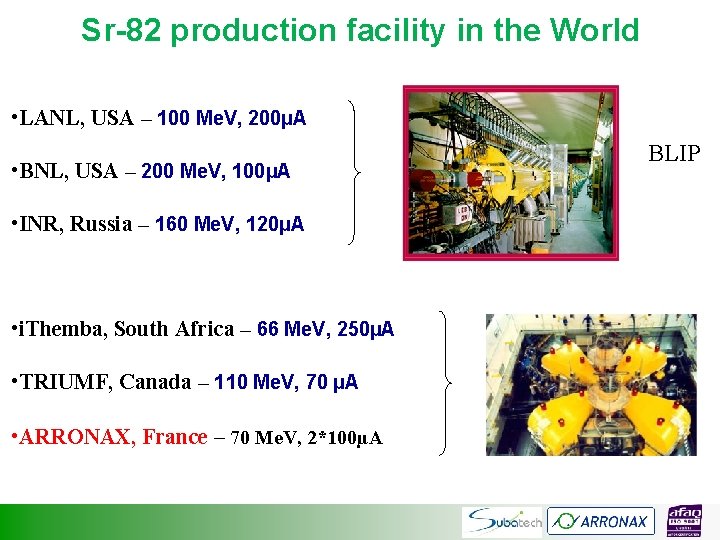
Sr-82 production facility in the World • LANL, USA – 100 Me. V, 200µA • BNL, USA – 200 Me. V, 100µA • INR, Russia – 160 Me. V, 120µA • i. Themba, South Africa – 66 Me. V, 250µA • TRIUMF, Canada – 110 Me. V, 70 µA • ARRONAX, France – 70 Me. V, 2*100µA BLIP
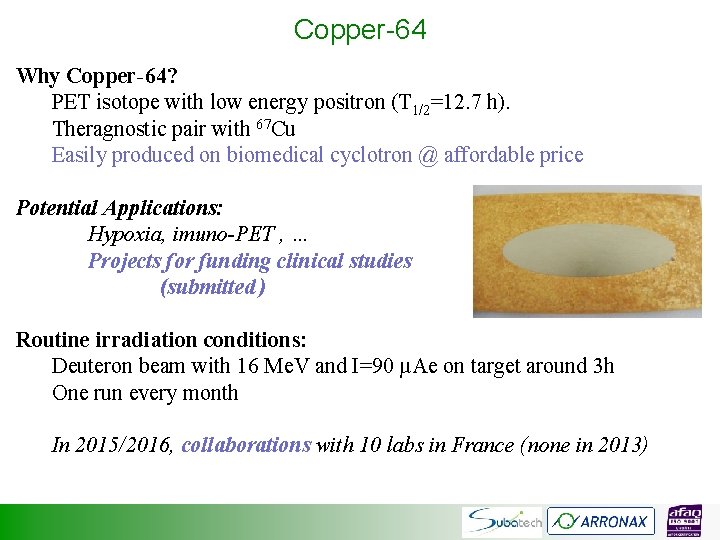
Copper-64 Why Copper-64? PET isotope with low energy positron (T 1/2=12. 7 h). Theragnostic pair with 67 Cu Easily produced on biomedical cyclotron @ affordable price Potential Applications: Hypoxia, imuno-PET , … Projects for funding clinical studies (submitted ) Routine irradiation conditions: Deuteron beam with 16 Me. V and I=90 µAe on target around 3 h One run every month In 2015/2016, collaborations with 10 labs in France (none in 2013)
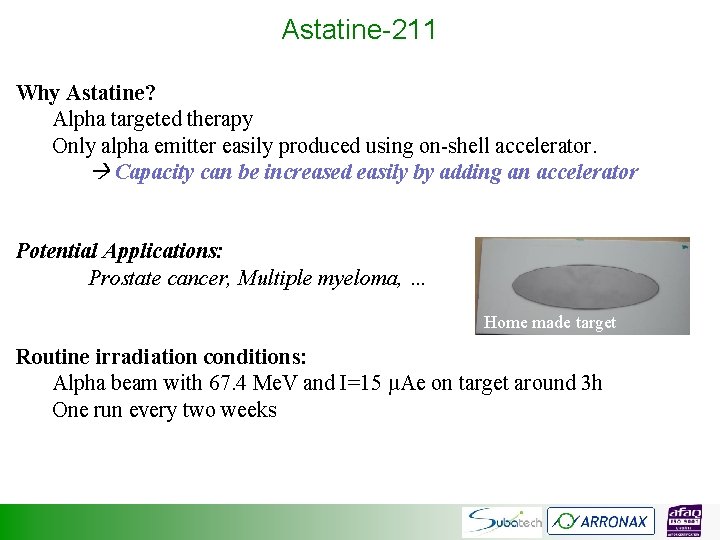
Astatine-211 Why Astatine? Alpha targeted therapy Only alpha emitter easily produced using on-shell accelerator. Capacity can be increased easily by adding an accelerator Potential Applications: Prostate cancer, Multiple myeloma, … Home made target Routine irradiation conditions: Alpha beam with 67. 4 Me. V and I=15 µAe on target around 3 h One run every two weeks
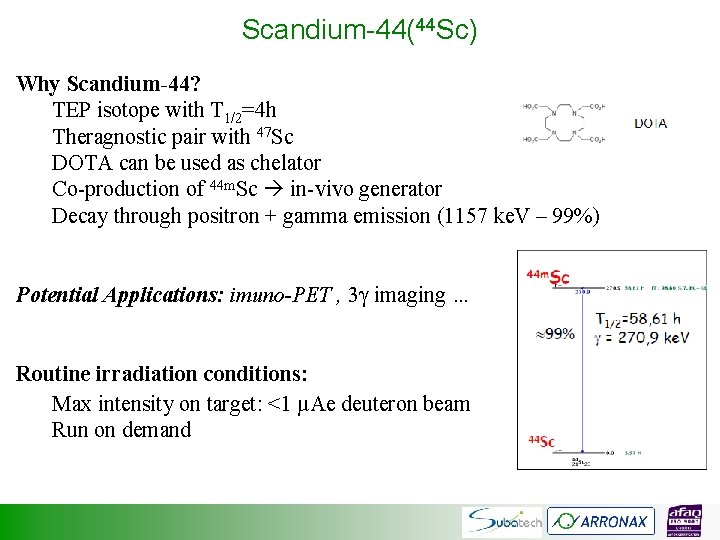
Scandium-44(44 Sc) Why Scandium-44? TEP isotope with T 1/2=4 h Theragnostic pair with 47 Sc DOTA can be used as chelator Co-production of 44 m. Sc in-vivo generator Decay through positron + gamma emission (1157 ke. V – 99%) Potential Applications: imuno-PET , 3γ imaging … Routine irradiation conditions: Max intensity on target: <1 µAe deuteron beam Run on demand
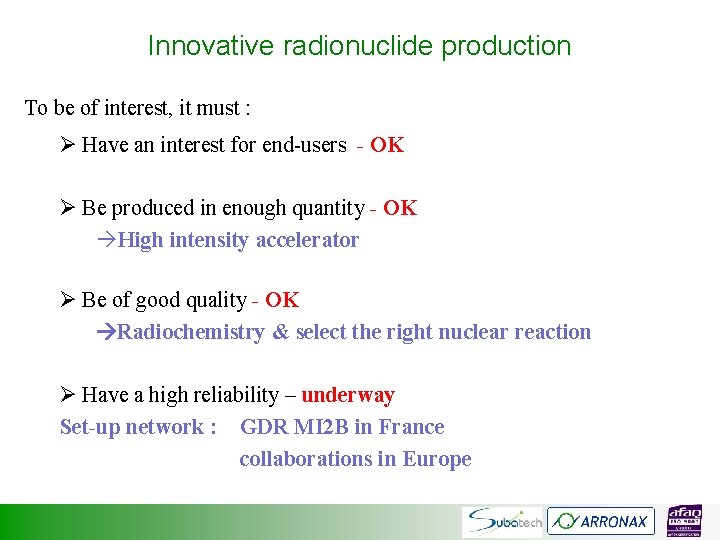
Innovative radionuclide production To be of interest, it must : Ø Have an interest for end-users - OK Ø Be produced in enough quantity - OK High intensity accelerator Ø Be of good quality - OK Radiochemistry & select the right nuclear reaction Ø Have a high reliability – underway Set-up network : GDR MI 2 B in France collaborations in Europe
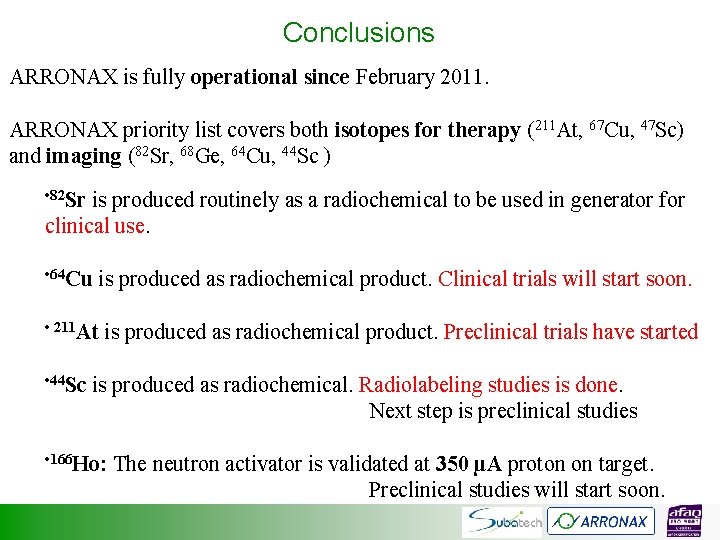
Conclusions ARRONAX is fully operational since February 2011. ARRONAX priority list covers both isotopes for therapy (211 At, 67 Cu, 47 Sc) and imaging (82 Sr, 68 Ge, 64 Cu, 44 Sc ) • 82 Sr is produced routinely as a radiochemical to be used in generator for clinical use. • 64 Cu is produced as radiochemical product. Clinical trials will start soon. • 211 At • 44 Sc is produced as radiochemical product. Preclinical trials have started is produced as radiochemical. Radiolabeling studies is done. Next step is preclinical studies • 166 Ho: The neutron activator is validated at 350 µA proton on target. Preclinical studies will start soon.
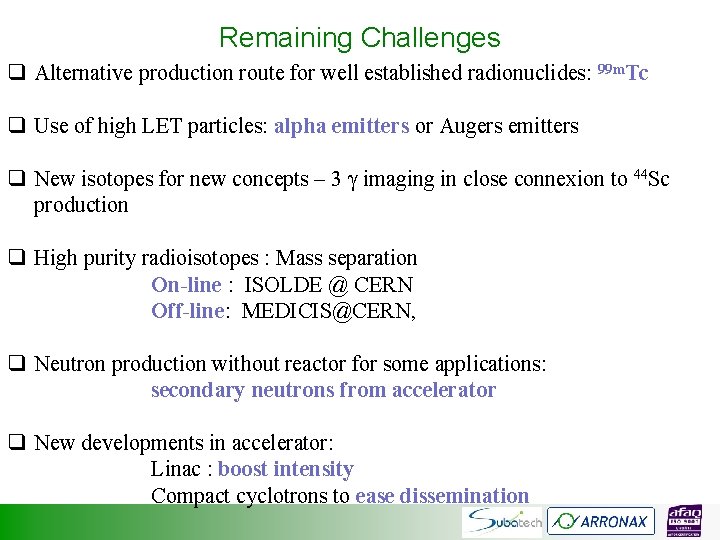
Remaining Challenges q Alternative production route for well established radionuclides: 99 m. Tc q Use of high LET particles: alpha emitters or Augers emitters q New isotopes for new concepts – 3 γ imaging in close connexion to 44 Sc production q High purity radioisotopes : Mass separation On-line : ISOLDE @ CERN Off-line: MEDICIS@CERN, q Neutron production without reactor for some applications: secondary neutrons from accelerator q New developments in accelerator: Linac : boost intensity Compact cyclotrons to ease dissemination
Credit C. Alliot 2, 3, N. Audouin 2, J. Barbet 2, 3, O. Batrak 1, A. C. Bonraisin 2, Y. Bortoli 1, C. Bourdeau 2, M. Bourgeois 2, 3, G. Bouvet 1, J. M. Buhour 1, A. Cadiou 1, C. Coban, J. B. Etienne, S. Fresneau 1, S. Girault 2, M. Guillamet 1, F. Gomez 2, X. Goiziou 2, F. Haddad 1, 2, A. Herbert, S. Huclier-Markai 1, C. Huet 2, J. Laizé 2, L. Lamouric 2, E. Macé 2, 3, G. Mechin 2, N. Michel 1, 2, T. Milleto 1, M. Mokili 1, 2, M. Pageau 2, S. Pauper, L. Perrigaud 2, F. Poirier 1, 2 , D. Poyac 2, C. Roustan 2, H. Trichet 2, A. Vidal, N. Varmenot 2. SUBATECH (CNRS/IN 2 P 3 - Ecole des mines - Université de Nantes) 2 GIP ARRONAX 3 Inserm U 892, Nantes, France 1
Thank you for your attention The ARRONAX project is supported by: the Regional Council of Pays de la Loire the Université de Nantes the French government (CNRS, INSERM) the European Union. This work has been, in part, supported by a grant from the French National Agency for Research called "Investissements d'Avenir", Equipex Arronax-Plus no. ANR-11 -EQPX-0004 and Labex IRON no. ANR-11 -LABX-18 -01