Swaps Chapter 6 1 SWAPS Swaps are a

- Slides: 134
Swaps Chapter 6 1
SWAPS Swaps are a form of derivative instruments. Out of the variety of assets underlying swaps we will cover: INTEREST RATES SWAPS, CURRENCY SWAPS, COMMODITY SWAPS, EQUITY SWAPS and BASIS SWAPS. 2
SWAPS A SWAP is a contract between two parties for an exchange of cash flows during some time period. The cash flows are determined based on the UNDERLYING ASSET 3
1. 2. 3. 4. 5. It follows that a swap involves Two parties An underlying asset Cash flows A payment schedule An agreement as to how to resolve problems 4
1. Two parties: The two parties in a swap are labeled as party and counterparty. They may arrange the swap directly or indirectly. In the latter case, there are two swaps, each between one of the parties and the swap dealer. 5
2. The Underlying asset is the basis for the determination of the cash flows. It is almost never exchanged by the parties. Examples: USD 100, 000, GBP 50, 000, 50, 000 barrels of crude oil An equity index 6
2. The Underlying asset is called the NOTIONAL AMOUNT Or The PRINCIPAL Because it only serves to determine the cash flows. Neither party needs to own it and it almost never changes hands. 7
3. The cash flows may be of two types: a fixed or a floating cash flow. Fixed interest rate vs. Floating interest rate Fixed price Vs. Market price 8
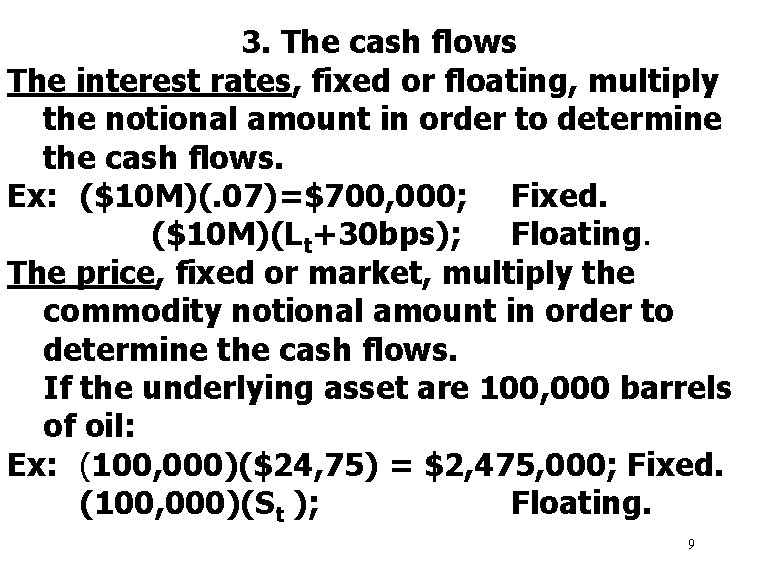
3. The cash flows The interest rates, fixed or floating, multiply the notional amount in order to determine the cash flows. Ex: ($10 M)(. 07)=$700, 000; Fixed. ($10 M)(Lt+30 bps); Floating. The price, fixed or market, multiply the commodity notional amount in order to determine the cash flows. If the underlying asset are 100, 000 barrels of oil: Ex: (100, 000)($24, 75) = $2, 475, 000; Fixed. (100, 000)(St ); Floating. 9
4. The payments are always net. The contract determines the cash flows timing as annual, semiannual or monthly, etc. Every payment is the net of the two cash flows 10
5. How to resolve problems: Swaps are Over The Counter (OTC) agreements. Therefore, the two parties always face credit risk operational risk, etc. Moreover, liquidity issues such as getting out of the agreement, default possiblilities, selling one side of the contract, etc. , are frequently encountered problems. 11
Typical Uses of an Interest Rate Swap • Converting an liability from investment from – fixed rate to floating rate – floating rate to fixed rate 12
Why SWAPS? The goals of entering a swap are: 1. Cost saving. 2. Changing the nature of cash flow each party receives or pays from fixed to floating and vice versa. 13
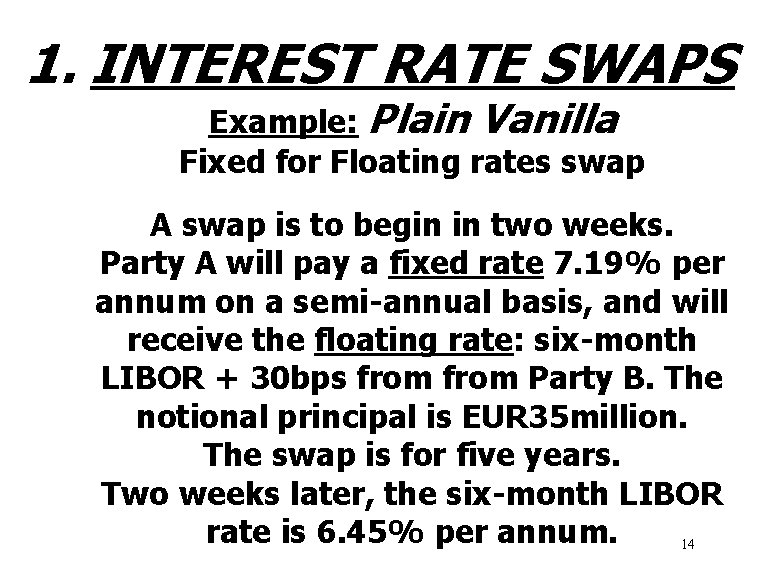
1. INTEREST RATE SWAPS Example: Plain Vanilla Fixed for Floating rates swap A swap is to begin in two weeks. Party A will pay a fixed rate 7. 19% per annum on a semi-annual basis, and will receive the floating rate: six-month LIBOR + 30 bps from Party B. The notional principal is EUR 35 million. The swap is for five years. Two weeks later, the six-month LIBOR rate is 6. 45% per annum. 14
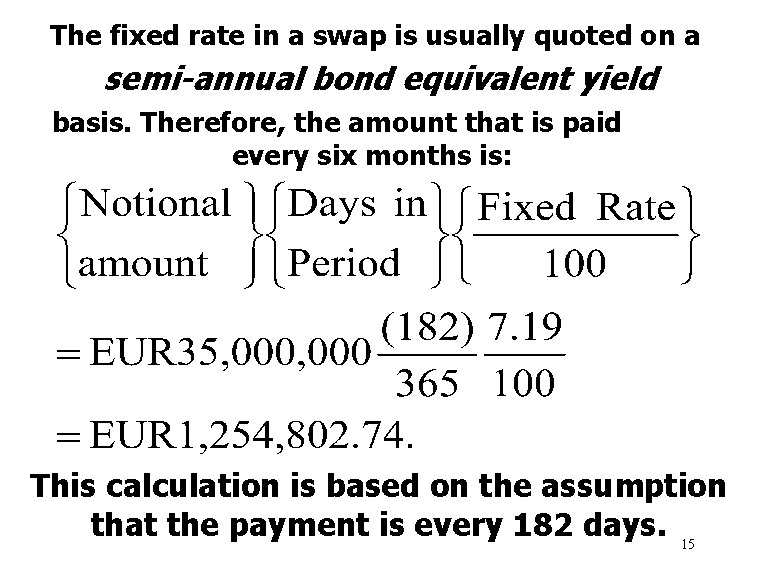
The fixed rate in a swap is usually quoted on a semi-annual bond equivalent yield basis. Therefore, the amount that is paid every six months is: This calculation is based on the assumption that the payment is every 182 days. 15
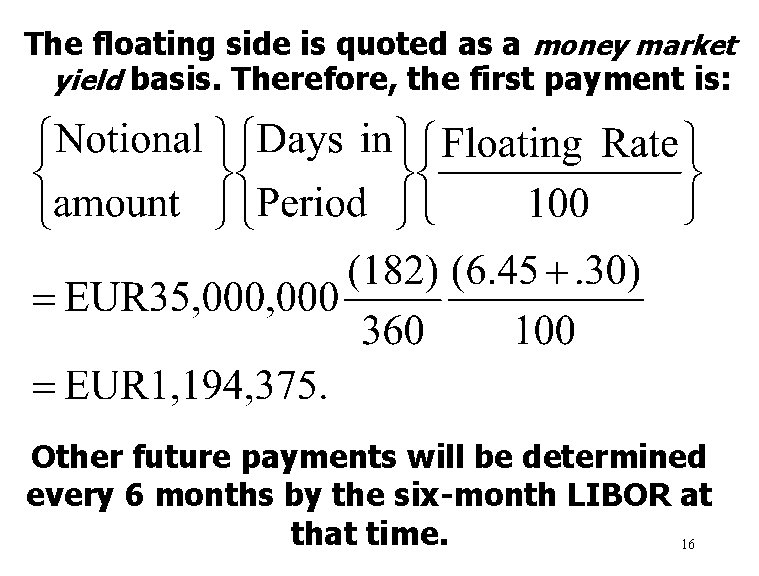
The floating side is quoted as a money market yield basis. Therefore, the first payment is: Other future payments will be determined every 6 months by the six-month LIBOR at that time. 16
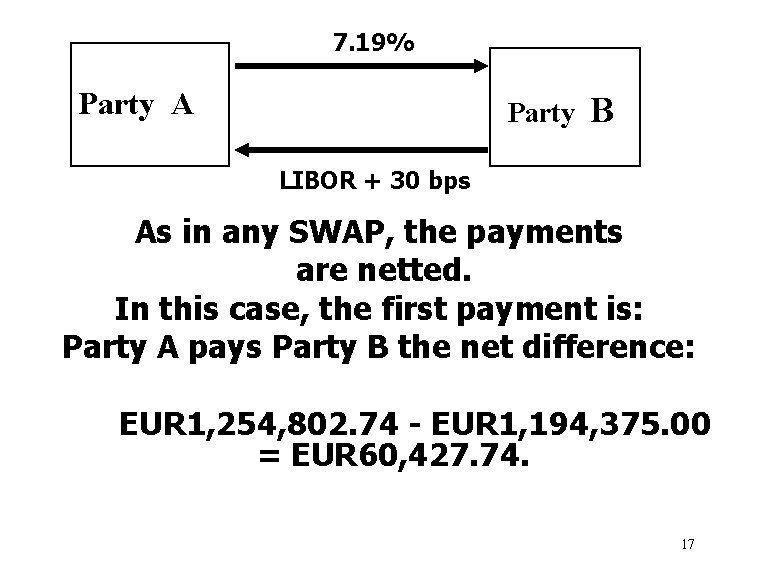
7. 19% Party A Party B LIBOR + 30 bps As in any SWAP, the payments are netted. In this case, the first payment is: Party A pays Party B the net difference: EUR 1, 254, 802. 74 - EUR 1, 194, 375. 00 = EUR 60, 427. 74. 17
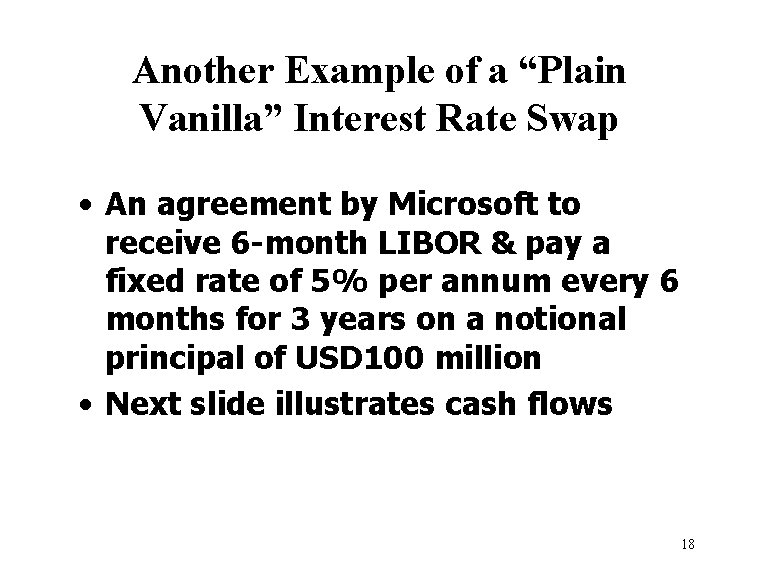
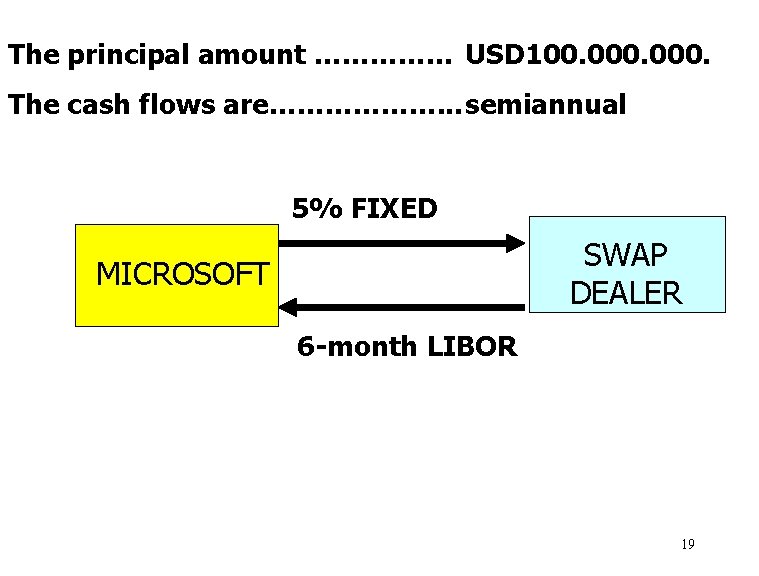
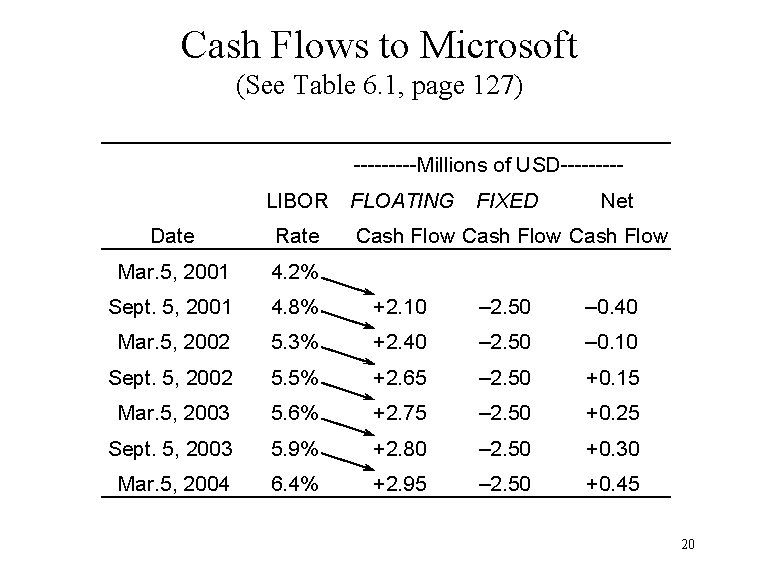
Another Example of a “Plain Vanilla” Interest Rate Swap • An agreement by Microsoft to receive 6 -month LIBOR & pay a fixed rate of 5% per annum every 6 months for 3 years on a notional principal of USD 100 million • Next slide illustrates cash flows 18
The principal amount …………… USD 100. 000. The cash flows are………………. . . semiannual 5% FIXED SWAP DEALER MICROSOFT 6 -month LIBOR 19
Cash Flows to Microsoft (See Table 6. 1, page 127) -----Millions of USD----LIBOR FLOATING FIXED Net Date Rate Cash Flow Mar. 5, 2001 4. 2% Sept. 5, 2001 4. 8% +2. 10 – 2. 50 – 0. 40 Mar. 5, 2002 5. 3% +2. 40 – 2. 50 – 0. 10 Sept. 5, 2002 5. 5% +2. 65 – 2. 50 +0. 15 Mar. 5, 2003 5. 6% +2. 75 – 2. 50 +0. 25 Sept. 5, 2003 5. 9% +2. 80 – 2. 50 +0. 30 Mar. 5, 2004 6. 4% +2. 95 – 2. 50 +0. 45 20
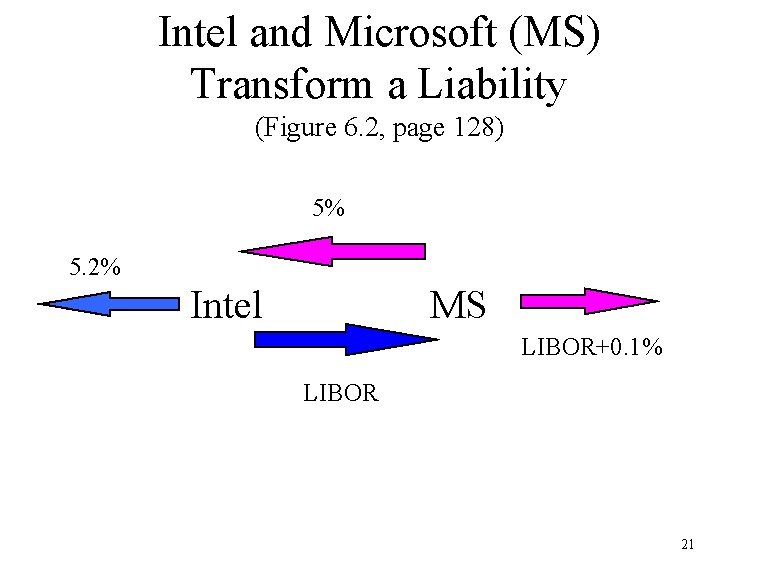
Intel and Microsoft (MS) Transform a Liability (Figure 6. 2, page 128) 5% 5. 2% MS Intel LIBOR+0. 1% LIBOR 21
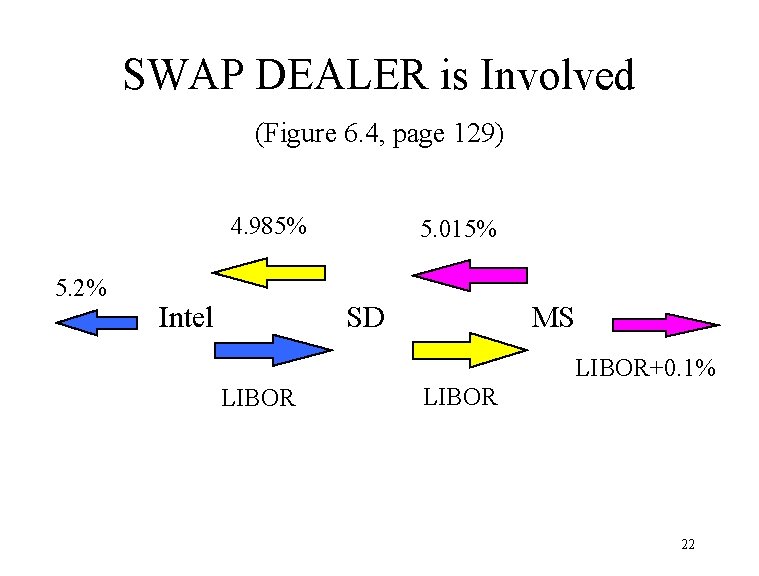
SWAP DEALER is Involved (Figure 6. 4, page 129) 4. 985% 5. 2% Intel 5. 015% SD MS LIBOR+0. 1% LIBOR 22
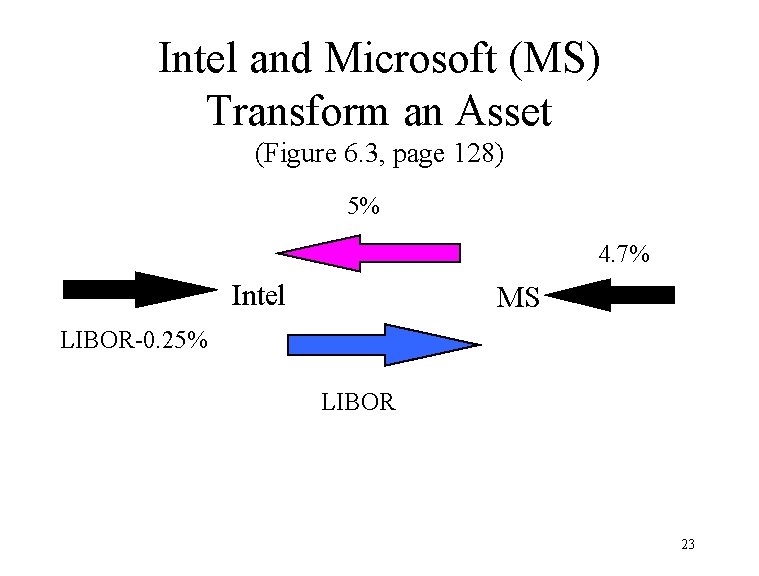
Intel and Microsoft (MS) Transform an Asset (Figure 6. 3, page 128) 5% 4. 7% Intel MS LIBOR-0. 25% LIBOR 23
SWAP DEALER is Involved (See Figure 6. 5, page 129) 4. 985% 5. 015% 4. 7% SD Intel MS LIBOR-0. 25% LIBOR 24
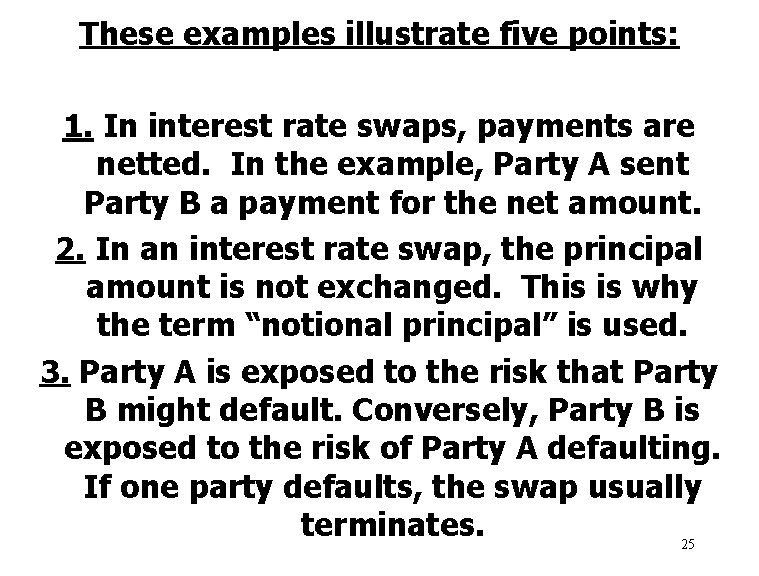
These examples illustrate five points: 1. In interest rate swaps, payments are netted. In the example, Party A sent Party B a payment for the net amount. 2. In an interest rate swap, the principal amount is not exchanged. This is why the term “notional principal” is used. 3. Party A is exposed to the risk that Party B might default. Conversely, Party B is exposed to the risk of Party A defaulting. If one party defaults, the swap usually terminates. 25
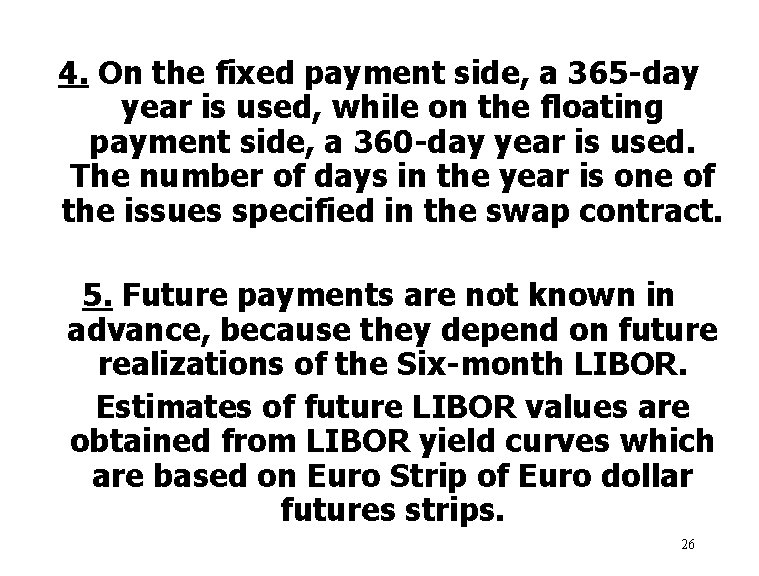
4. On the fixed payment side, a 365 -day year is used, while on the floating payment side, a 360 -day year is used. The number of days in the year is one of the issues specified in the swap contract. 5. Future payments are not known in advance, because they depend on future realizations of the Six-month LIBOR. Estimates of future LIBOR values are obtained from LIBOR yield curves which are based on Euro Strip of Euro dollar futures strips. 26
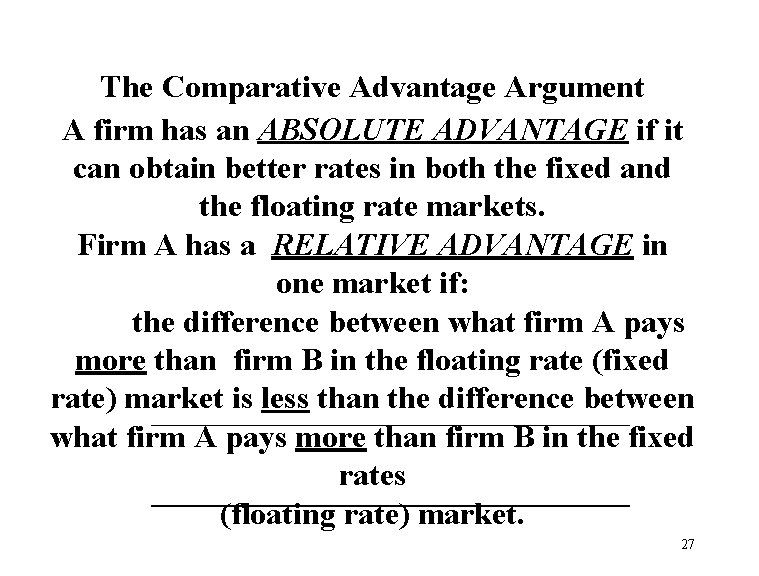
The Comparative Advantage Argument A firm has an ABSOLUTE ADVANTAGE if it can obtain better rates in both the fixed and the floating rate markets. Firm A has a RELATIVE ADVANTAGE in one market if: the difference between what firm A pays more than firm B in the floating rate (fixed rate) market is less than the difference between what firm A pays more than firm B in the fixed rates (floating rate) market. 27
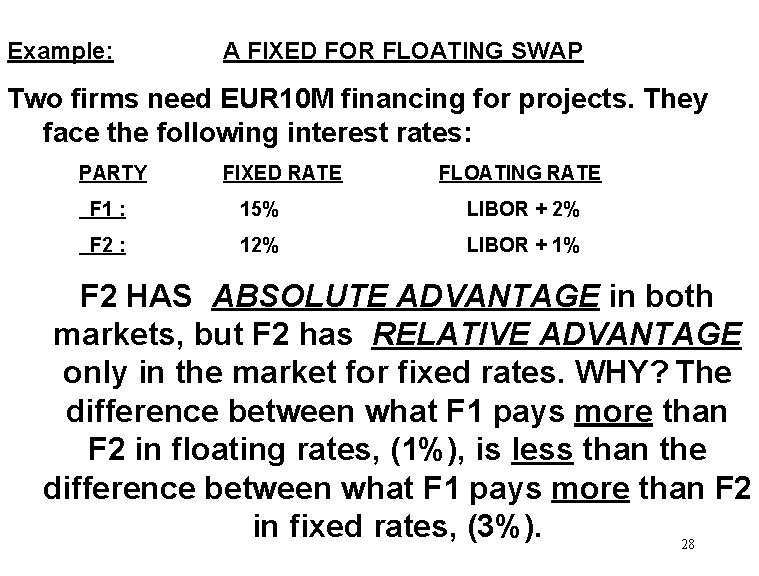
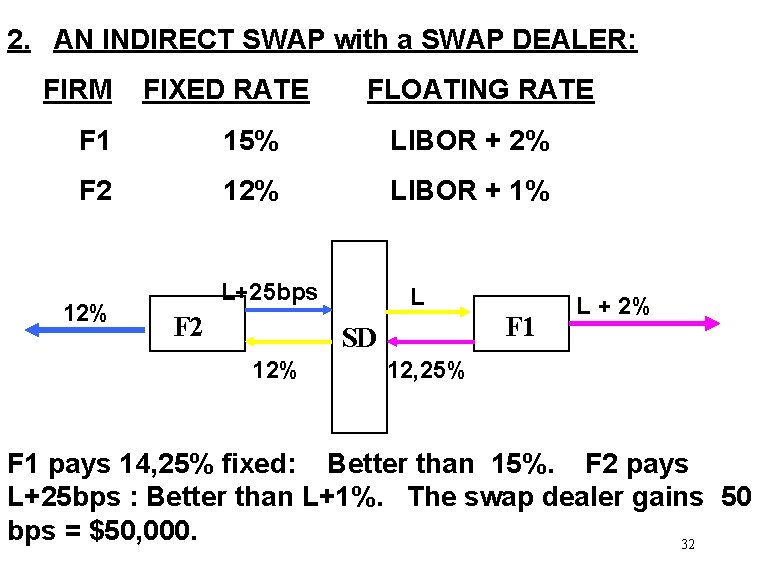
Example: A FIXED FOR FLOATING SWAP Two firms need EUR 10 M financing for projects. They face the following interest rates: PARTY FIXED RATE FLOATING RATE F 1 : 15% LIBOR + 2% F 2 : 12% LIBOR + 1% F 2 HAS ABSOLUTE ADVANTAGE in both markets, but F 2 has RELATIVE ADVANTAGE only in the market for fixed rates. WHY? The difference between what F 1 pays more than F 2 in floating rates, (1%), is less than the difference between what F 1 pays more than F 2 in fixed rates, (3%). 28
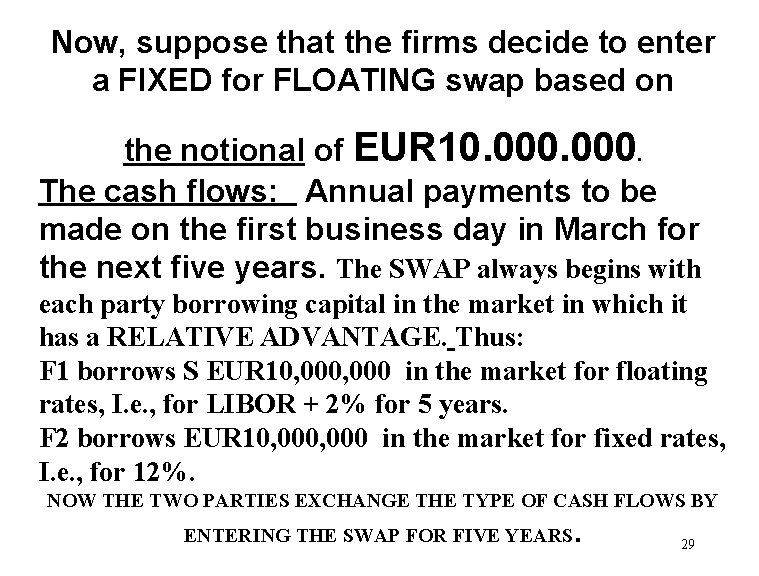
Now, suppose that the firms decide to enter a FIXED for FLOATING swap based on the notional of EUR 10. 000. The cash flows: Annual payments to be made on the first business day in March for the next five years. The SWAP always begins with each party borrowing capital in the market in which it has a RELATIVE ADVANTAGE. Thus: F 1 borrows S EUR 10, 000 in the market for floating rates, I. e. , for LIBOR + 2% for 5 years. F 2 borrows EUR 10, 000 in the market for fixed rates, I. e. , for 12%. NOW THE TWO PARTIES EXCHANGE THE TYPE OF CASH FLOWS BY ENTERING THE SWAP FOR FIVE YEARS . 29
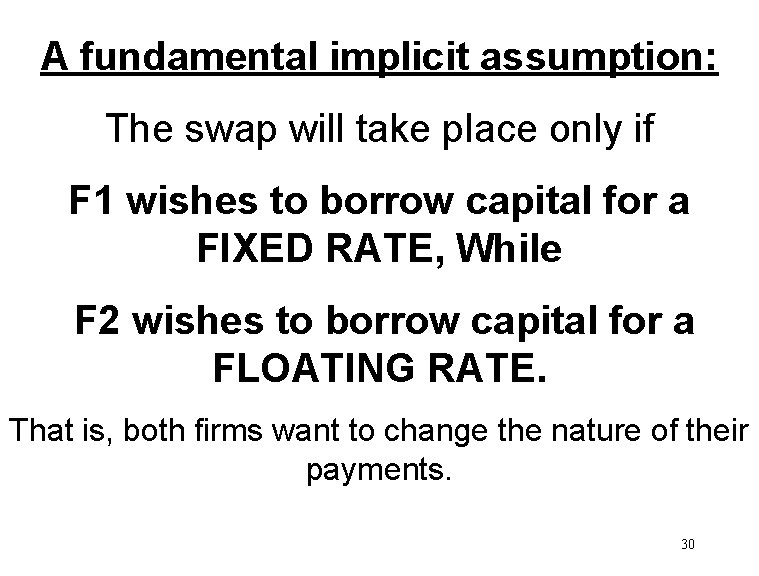
A fundamental implicit assumption: The swap will take place only if F 1 wishes to borrow capital for a FIXED RATE, While F 2 wishes to borrow capital for a FLOATING RATE. That is, both firms want to change the nature of their payments. 30
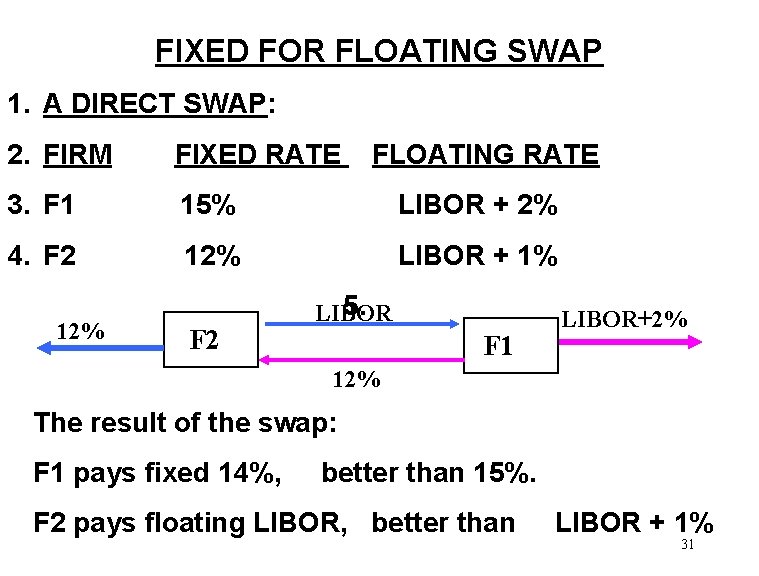
FIXED FOR FLOATING SWAP 1. A DIRECT SWAP: 2. FIRM FIXED RATE 3. F 1 15% LIBOR + 2% 4. F 2 12% LIBOR + 1% 12% F 2 FLOATING RATE 5. LIBOR F 1 LIBOR+2% 12% The result of the swap: F 1 pays fixed 14%, better than 15%. F 2 pays floating LIBOR, better than LIBOR + 1% 31
2. AN INDIRECT SWAP with a SWAP DEALER: FIRM FIXED RATE FLOATING RATE F 1 15% LIBOR + 2% F 2 12% LIBOR + 1% 12% L+25 bps F 2 L F 1 SD 12% L + 2% 12, 25% F 1 pays 14, 25% fixed: Better than 15%. F 2 pays L+25 bps : Better than L+1%. The swap dealer gains 50 bps = $50, 000. 32
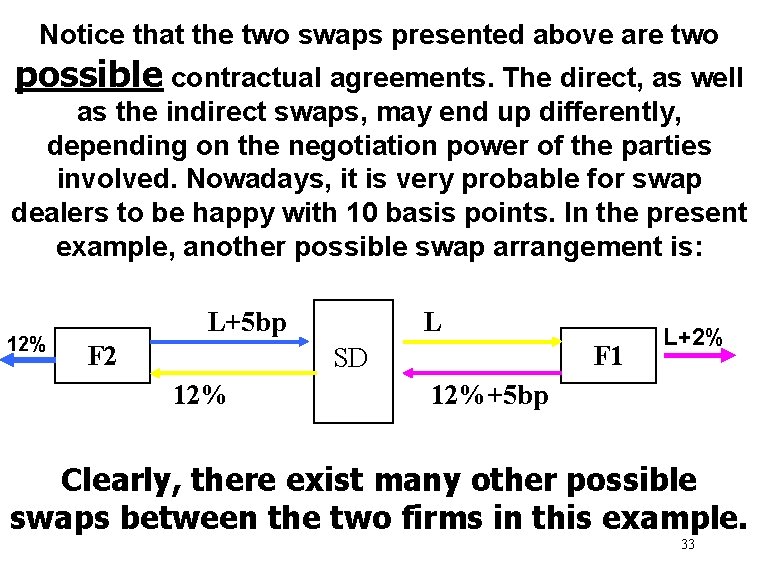
Notice that the two swaps presented above are two possible contractual agreements. The direct, as well as the indirect swaps, may end up differently, depending on the negotiation power of the parties involved. Nowadays, it is very probable for swap dealers to be happy with 10 basis points. In the present example, another possible swap arrangement is: 12% L+5 bp F 2 L F 1 SD 12% L+2% 12%+5 bp Clearly, there exist many other possible swaps between the two firms in this example. 33
Warehousing In practice, a swap dealer intermediating (making a market in) swaps may not be able to find an immediate off-setting swap. Most dealers will warehouse the swap and use interest rate derivatives to hedge their risk exposure until they can find an off-setting swap. In practice, it is not always possible to find a second swap with the same maturity and notional principal as the first swap, implying that the institution making a market in swaps has a residual exposure. The relatively narrow bid/ask spread in the interest rate swap market implies that to make a profit, effective interest rate risk management is essential. 34
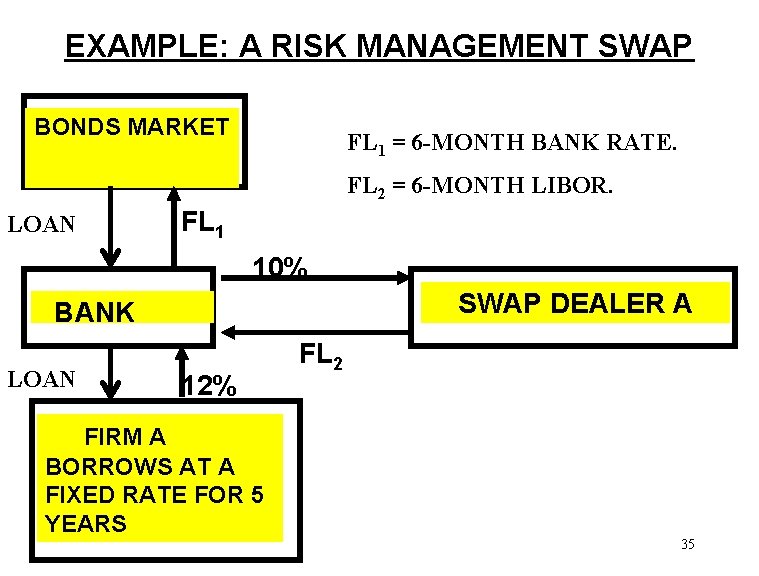
EXAMPLE: A RISK MANAGEMENT SWAP BONDS MARKET FL 1 = 6 -MONTH BANK RATE. FL 2 = 6 -MONTH LIBOR. LOAN FL 1 10% SWAP DEALER A BANK LOAN 12% FIRM A BORROWS AT A FIXED RATE FOR 5 YEARS FL 2 35
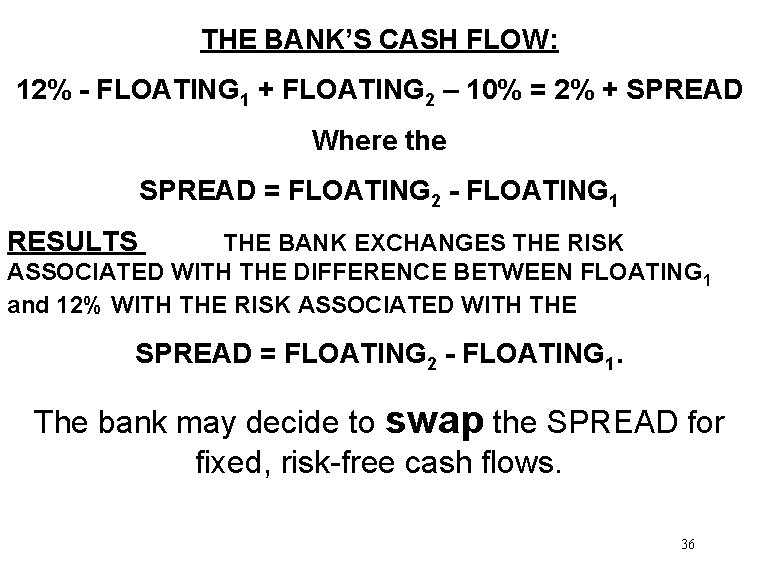
THE BANK’S CASH FLOW: 12% - FLOATING 1 + FLOATING 2 – 10% = 2% + SPREAD Where the SPREAD = FLOATING 2 - FLOATING 1 RESULTS THE BANK EXCHANGES THE RISK ASSOCIATED WITH THE DIFFERENCE BETWEEN FLOATING 1 and 12% WITH THE RISK ASSOCIATED WITH THE SPREAD = FLOATING 2 - FLOATING 1. The bank may decide to swap the SPREAD for fixed, risk-free cash flows. 36
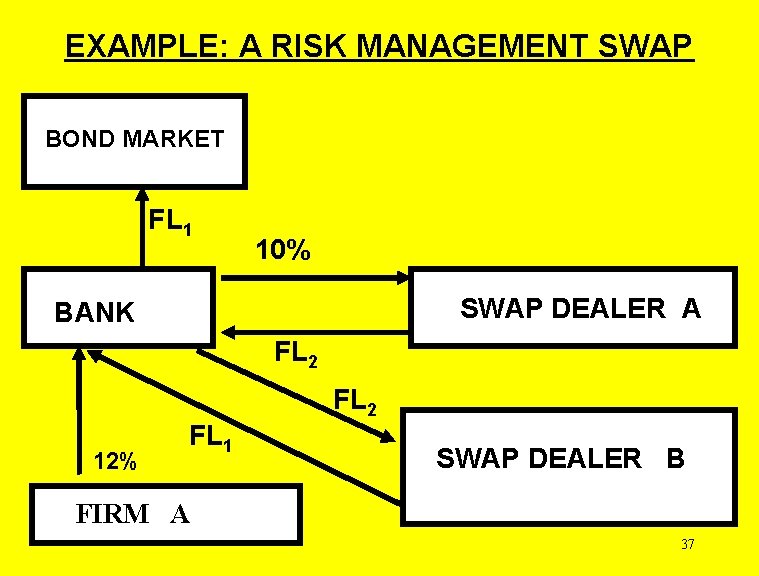
EXAMPLE: A RISK MANAGEMENT SWAP BOND MARKET FL 1 10% SWAP DEALER A BANK FL 2 12% FL 1 SWAP DEALER B FIRM A 37
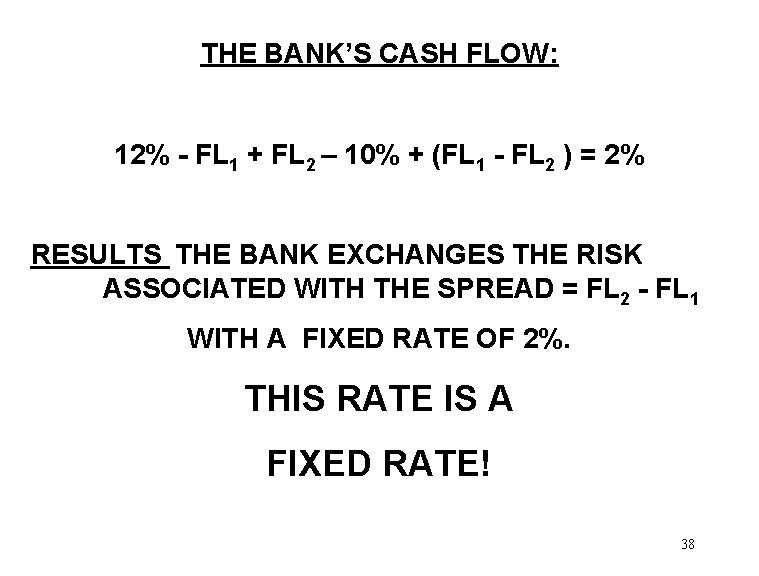
THE BANK’S CASH FLOW: 12% - FL 1 + FL 2 – 10% + (FL 1 - FL 2 ) = 2% RESULTS THE BANK EXCHANGES THE RISK ASSOCIATED WITH THE SPREAD = FL 2 - FL 1 WITH A FIXED RATE OF 2%. THIS RATE IS A FIXED RATE! 38
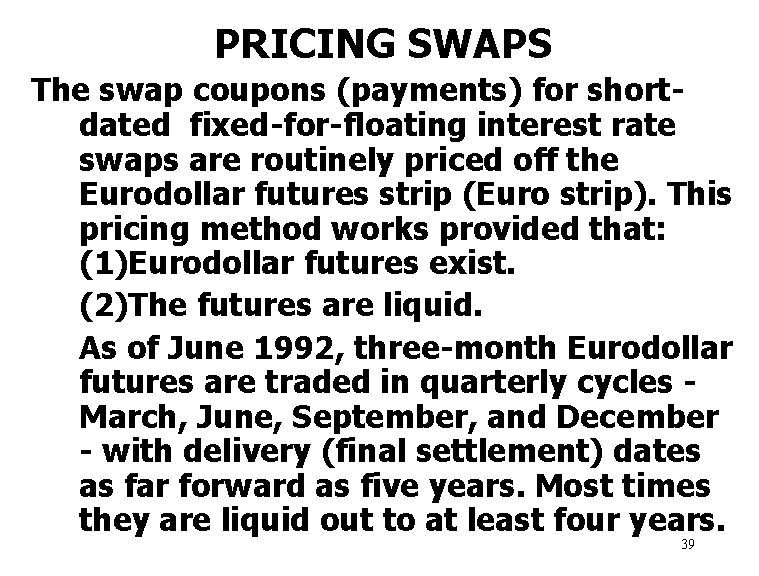
PRICING SWAPS The swap coupons (payments) for shortdated fixed-for-floating interest rate swaps are routinely priced off the Eurodollar futures strip (Euro strip). This pricing method works provided that: (1)Eurodollar futures exist. (2)The futures are liquid. As of June 1992, three-month Eurodollar futures are traded in quarterly cycles - March, June, September, and December - with delivery (final settlement) dates as far forward as five years. Most times they are liquid out to at least four years. 39
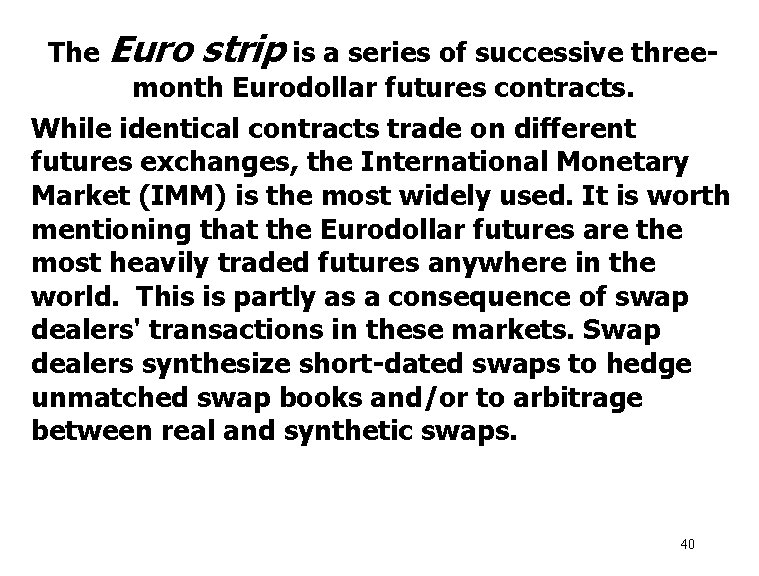
The Euro strip is a series of successive threemonth Eurodollar futures contracts. While identical contracts trade on different futures exchanges, the International Monetary Market (IMM) is the most widely used. It is worth mentioning that the Eurodollar futures are the most heavily traded futures anywhere in the world. This is partly as a consequence of swap dealers' transactions in these markets. Swap dealers synthesize short-dated swaps to hedge unmatched swap books and/or to arbitrage between real and synthetic swaps. 40
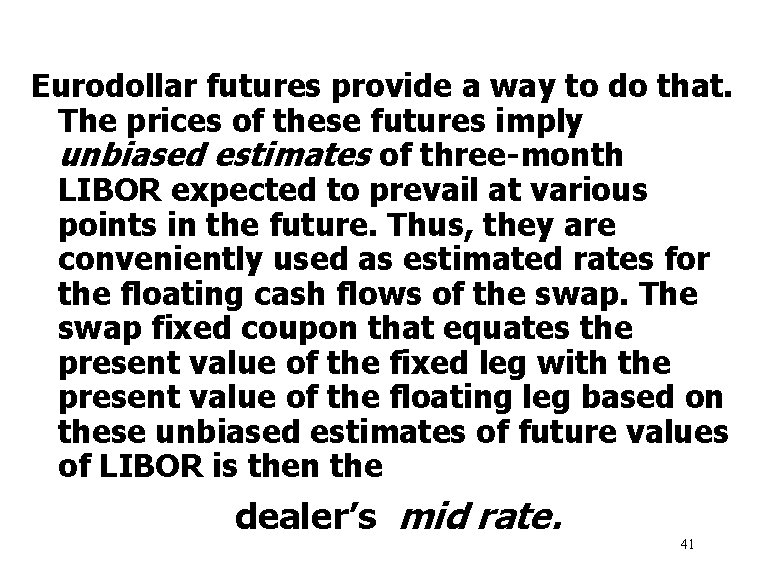
Eurodollar futures provide a way to do that. The prices of these futures imply unbiased estimates of three-month LIBOR expected to prevail at various points in the future. Thus, they are conveniently used as estimated rates for the floating cash flows of the swap. The swap fixed coupon that equates the present value of the fixed leg with the present value of the floating leg based on these unbiased estimates of future values of LIBOR is then the dealer’s mid rate. 41
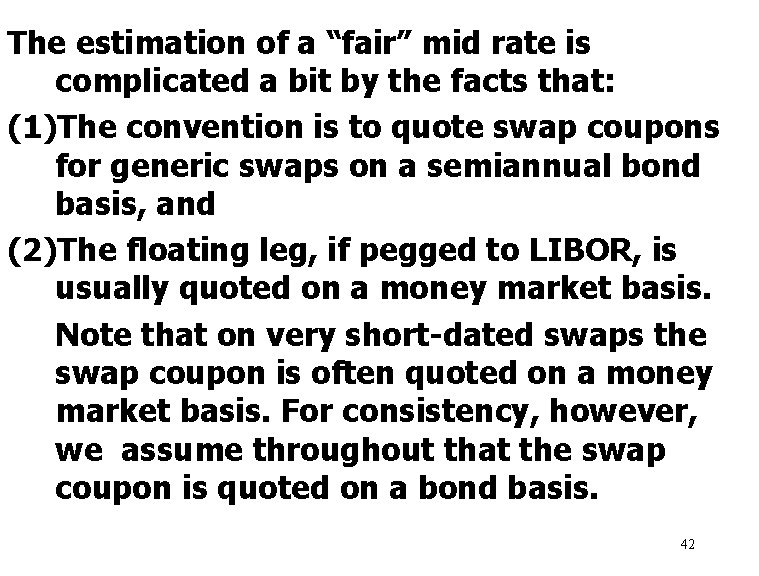
The estimation of a “fair” mid rate is complicated a bit by the facts that: (1)The convention is to quote swap coupons for generic swaps on a semiannual bond basis, and (2)The floating leg, if pegged to LIBOR, is usually quoted on a money market basis. Note that on very short-dated swaps the swap coupon is often quoted on a money market basis. For consistency, however, we assume throughout that the swap coupon is quoted on a bond basis. 42
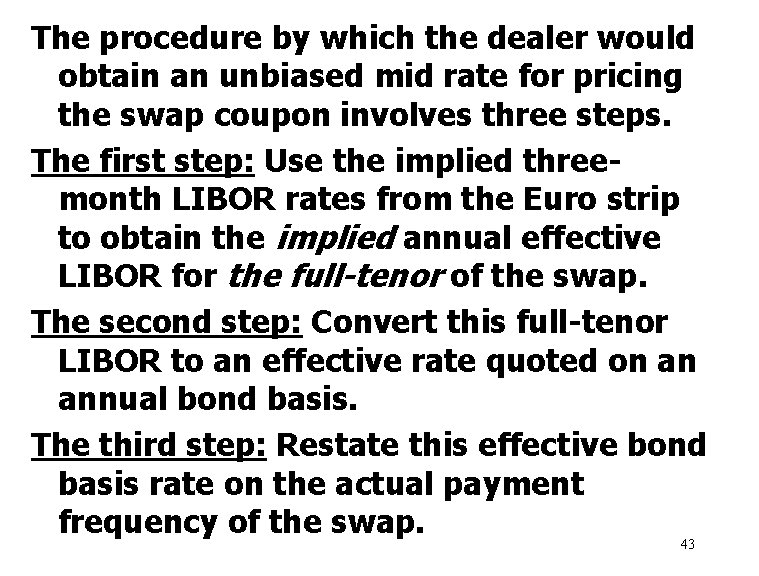
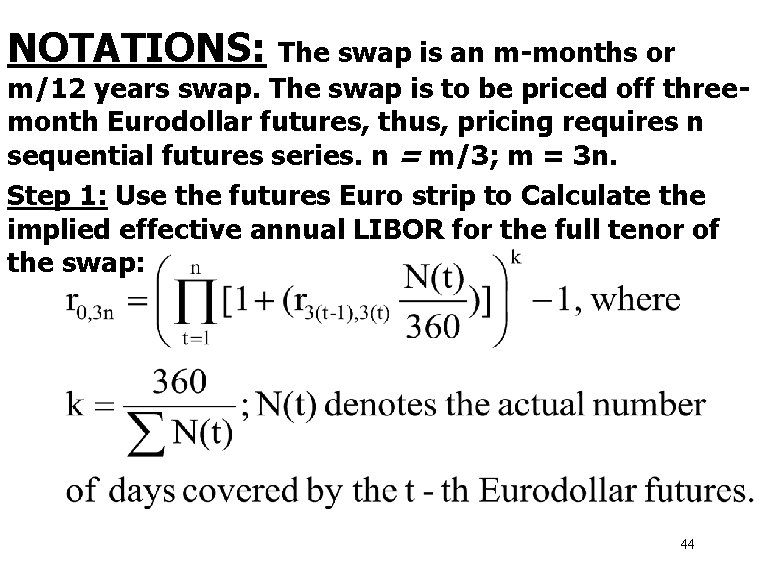
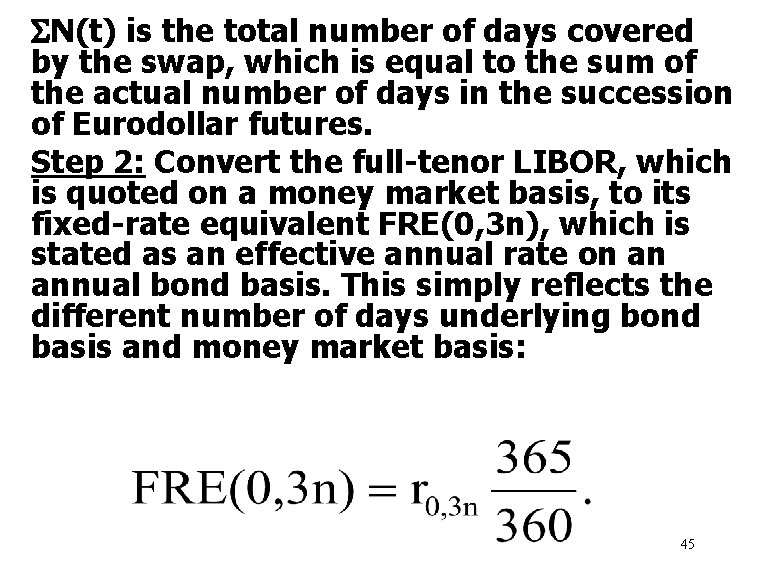
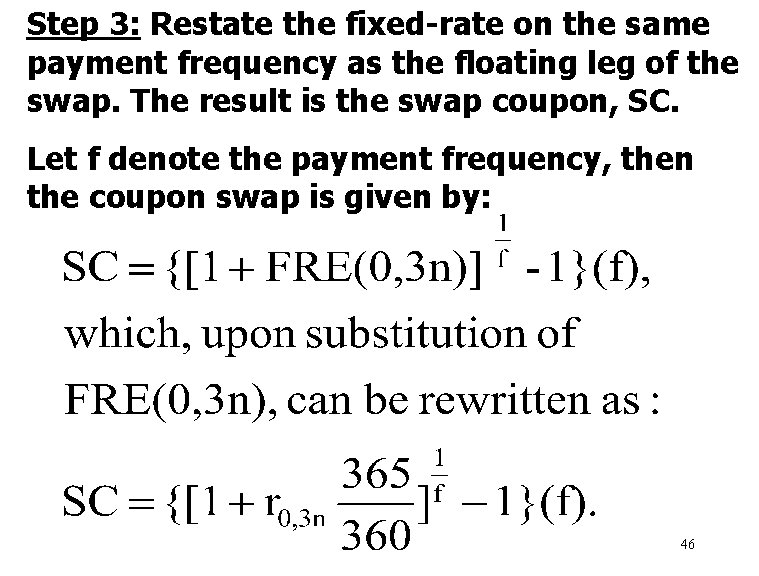
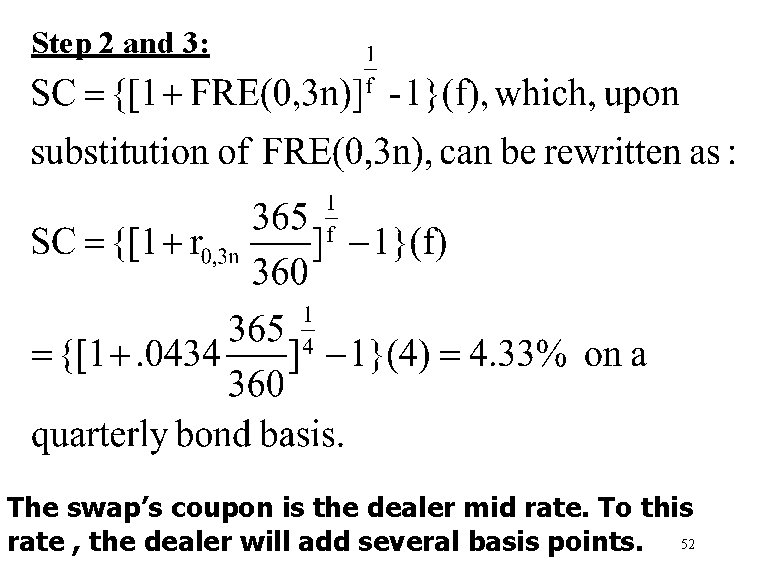
The procedure by which the dealer would obtain an unbiased mid rate for pricing the swap coupon involves three steps. The first step: Use the implied threemonth LIBOR rates from the Euro strip to obtain the implied annual effective LIBOR for the full-tenor of the swap. The second step: Convert this full-tenor LIBOR to an effective rate quoted on an annual bond basis. The third step: Restate this effective bond basis rate on the actual payment frequency of the swap. 43
NOTATIONS: The swap is an m-months or m/12 years swap. The swap is to be priced off threemonth Eurodollar futures, thus, pricing requires n sequential futures series. n = m/3; m = 3 n. Step 1: Use the futures Euro strip to Calculate the implied effective annual LIBOR for the full tenor of the swap: 44
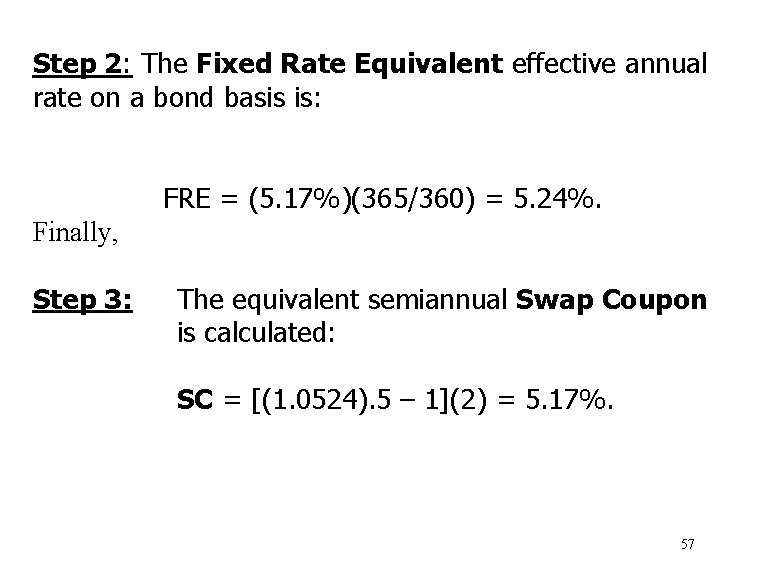
N(t) is the total number of days covered by the swap, which is equal to the sum of the actual number of days in the succession of Eurodollar futures. Step 2: Convert the full-tenor LIBOR, which is quoted on a money market basis, to its fixed-rate equivalent FRE(0, 3 n), which is stated as an effective annual rate on an annual bond basis. This simply reflects the different number of days underlying bond basis and money market basis: 45
Step 3: Restate the fixed-rate on the same payment frequency as the floating leg of the swap. The result is the swap coupon, SC. Let f denote the payment frequency, then the coupon swap is given by: 46
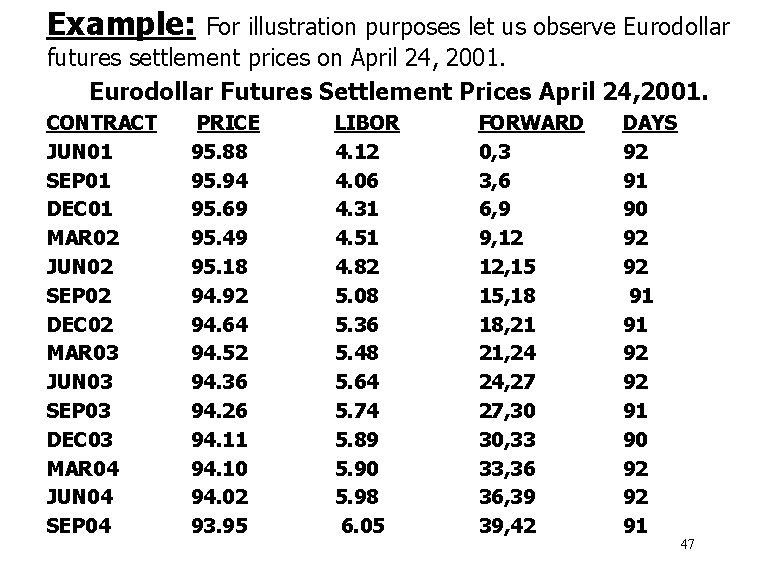
Example: For illustration purposes let us observe Eurodollar futures settlement prices on April 24, 2001. Eurodollar Futures Settlement Prices April 24, 2001. CONTRACT JUN 01 SEP 01 DEC 01 MAR 02 JUN 02 SEP 02 DEC 02 MAR 03 JUN 03 SEP 03 DEC 03 MAR 04 JUN 04 SEP 04 PRICE 95. 88 95. 94 95. 69 95. 49 95. 18 94. 92 94. 64 94. 52 94. 36 94. 26 94. 11 94. 10 94. 02 93. 95 LIBOR 4. 12 4. 06 4. 31 4. 51 4. 82 5. 08 5. 36 5. 48 5. 64 5. 74 5. 89 5. 90 5. 98 6. 05 FORWARD 0, 3 3, 6 6, 9 9, 12 12, 15 15, 18 18, 21 21, 24 24, 27 27, 30 30, 33 33, 36 36, 39 39, 42 DAYS 92 91 90 92 92 91 91 92 92 91 90 92 92 91 47
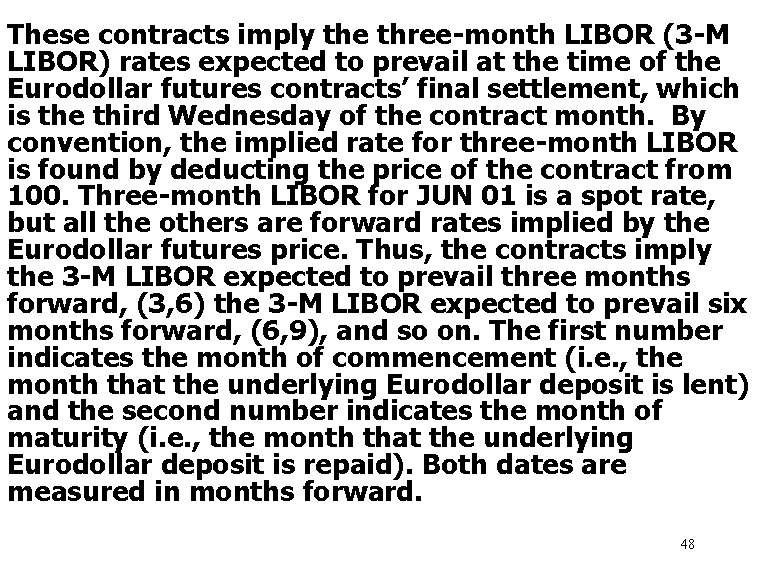
These contracts imply the three-month LIBOR (3 -M LIBOR) rates expected to prevail at the time of the Eurodollar futures contracts’ final settlement, which is the third Wednesday of the contract month. By convention, the implied rate for three-month LIBOR is found by deducting the price of the contract from 100. Three-month LIBOR for JUN 01 is a spot rate, but all the others are forward rates implied by the Eurodollar futures price. Thus, the contracts imply the 3 -M LIBOR expected to prevail three months forward, (3, 6) the 3 -M LIBOR expected to prevail six months forward, (6, 9), and so on. The first number indicates the month of commencement (i. e. , the month that the underlying Eurodollar deposit is lent) and the second number indicates the month of maturity (i. e. , the month that the underlying Eurodollar deposit is repaid). Both dates are measured in months forward. 48
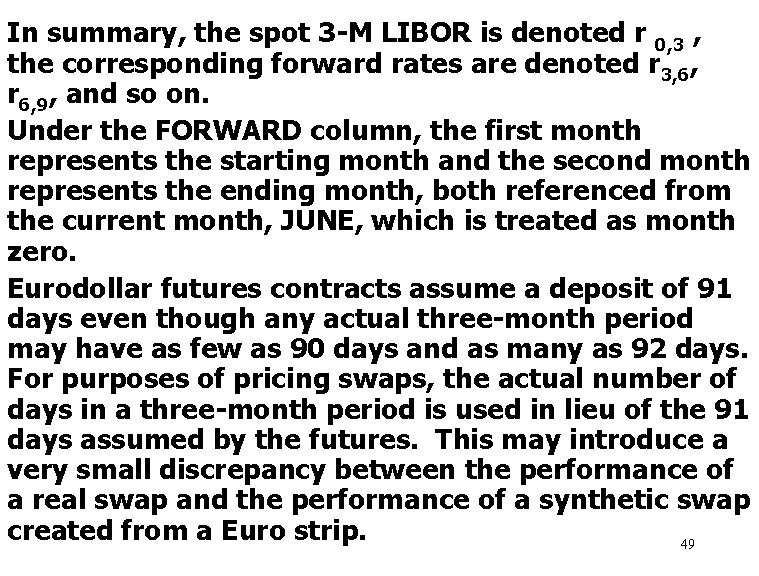
In summary, the spot 3 -M LIBOR is denoted r 0, 3 , the corresponding forward rates are denoted r 3, 6, r 6, 9, and so on. Under the FORWARD column, the first month represents the starting month and the second month represents the ending month, both referenced from the current month, JUNE, which is treated as month zero. Eurodollar futures contracts assume a deposit of 91 days even though any actual three-month period may have as few as 90 days and as many as 92 days. For purposes of pricing swaps, the actual number of days in a three-month period is used in lieu of the 91 days assumed by the futures. This may introduce a very small discrepancy between the performance of a real swap and the performance of a synthetic swap created from a Euro strip. 49
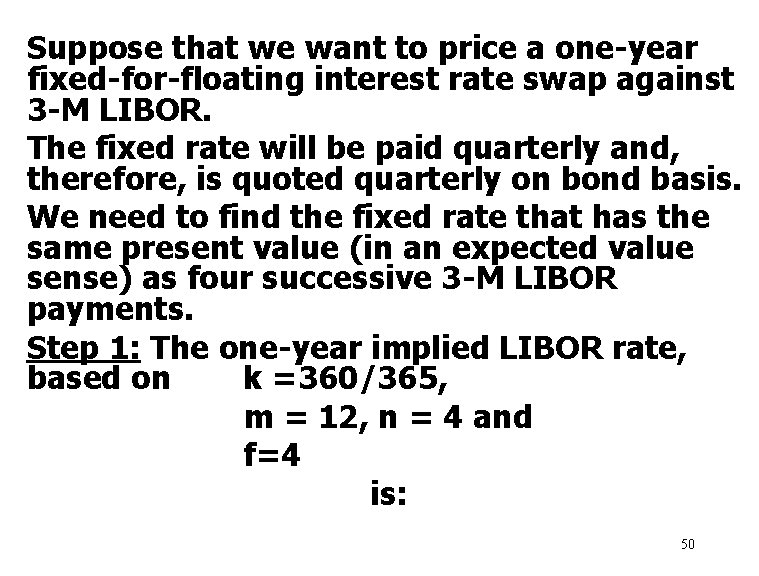
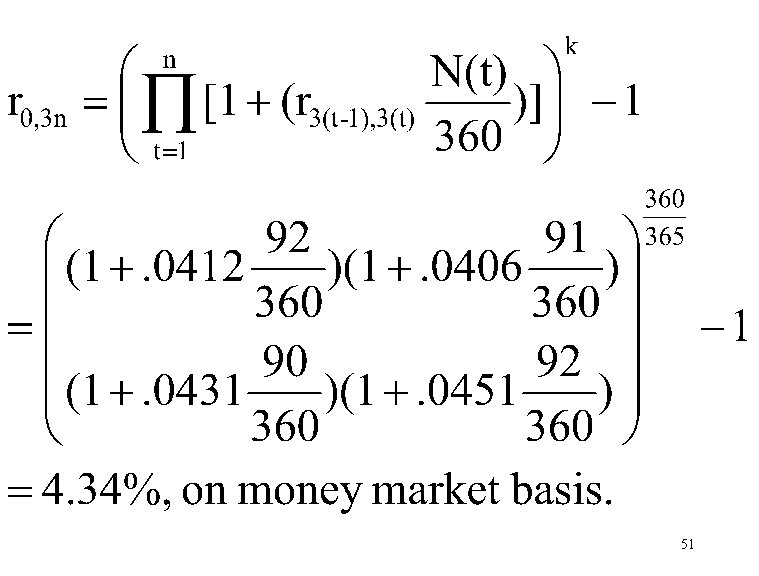
Suppose that we want to price a one-year fixed-for-floating interest rate swap against 3 -M LIBOR. The fixed rate will be paid quarterly and, therefore, is quoted quarterly on bond basis. We need to find the fixed rate that has the same present value (in an expected value sense) as four successive 3 -M LIBOR payments. Step 1: The one-year implied LIBOR rate, based on k =360/365, m = 12, n = 4 and f=4 is: 50
51
Step 2 and 3: The swap’s coupon is the dealer mid rate. To this rate , the dealer will add several basis points. 52
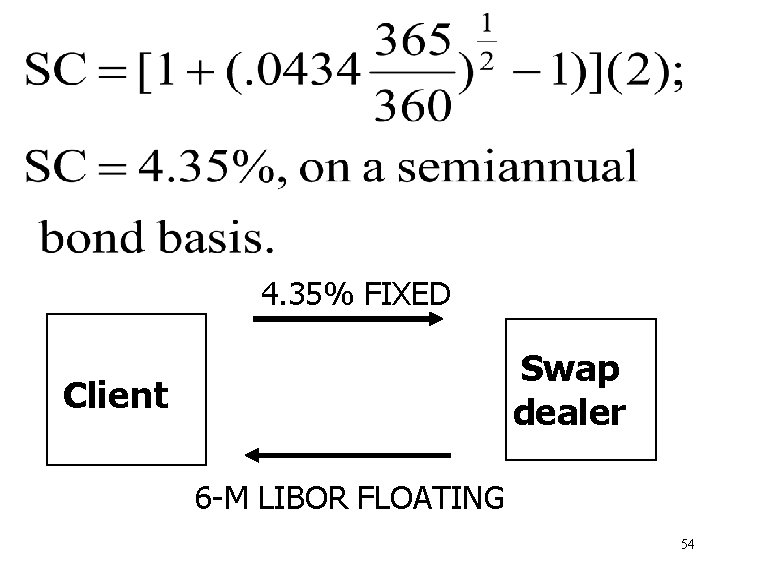
Next, suppose that the swap is for semiannual payments against 6 -month LIBOR. The first two steps are the same as in the previous example. Step 3 is different because f = 2, instead of 4. 53
4. 35% FIXED Swap dealer Client 6 -M LIBOR FLOATING 54
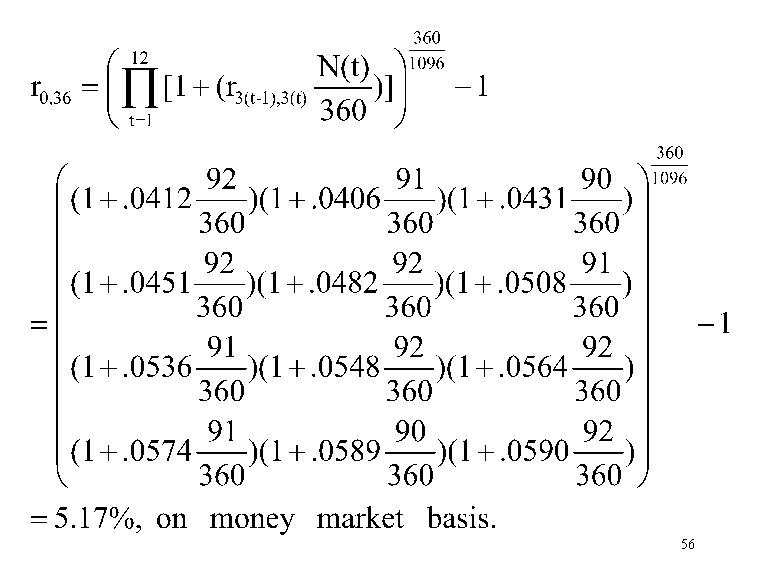
The procedure above allows a dealer to quote swaps having tenors out to the limit of the liquidity of Eurodollar futures on any payment frequency desired and to fully hedge those swaps in the Euro Strip. The latter is accomplished by purchasing the components of the Euro Strip to hedge a dealer-paysfixed-rate swap or, selling the components of the Euro Strip to hedge a dealer-pays-floating-rate swap. Example: Suppose that a dealer wants to price a three -year swap with a semiannual coupon when the floating leg is six-month LIBOR. Three years: m=36 months requiring 12 separate Eurodollar futures; n = 12. Further, f = 2 and the actual number of days covered by the swap is N(t) = 1096. Step 1: The implied LIBOR rate for the entire period of the swap: 55
56
Step 2: The Fixed Rate Equivalent effective annual rate on a bond basis is: FRE = (5. 17%)(365/360) = 5. 24%. Finally, Step 3: The equivalent semiannual Swap Coupon is calculated: SC = [(1. 0524). 5 – 1](2) = 5. 17%. 57
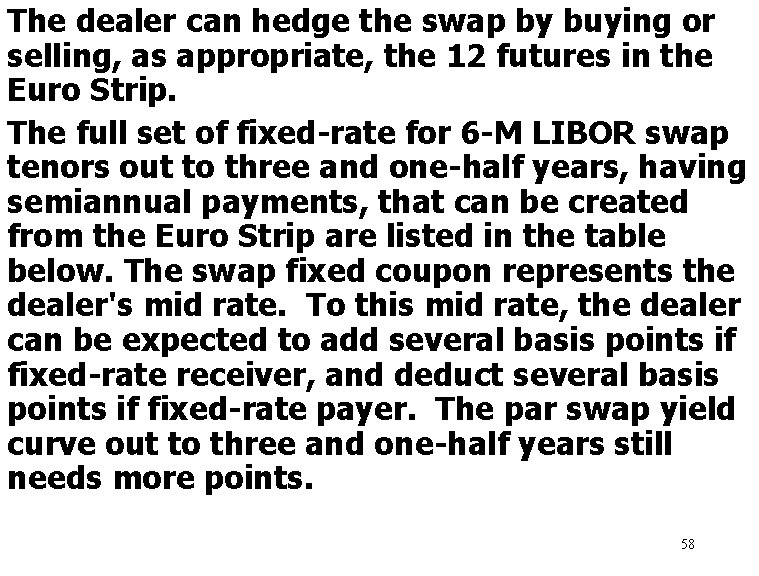
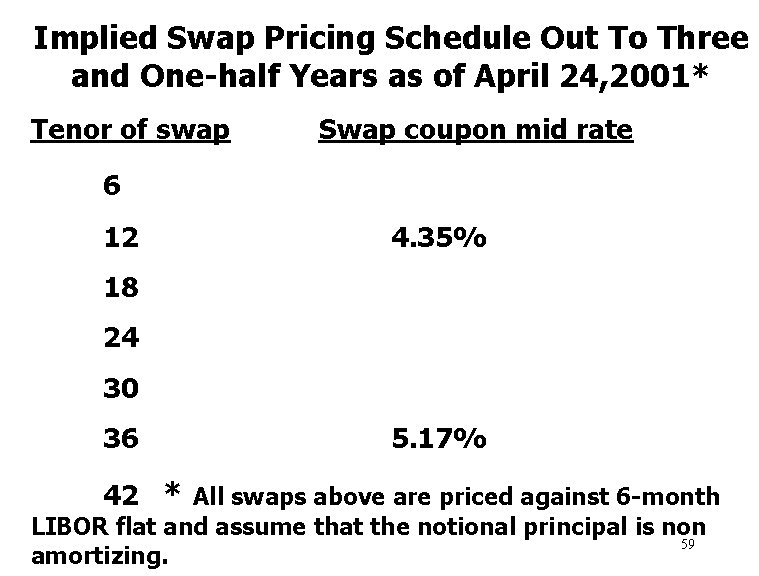
The dealer can hedge the swap by buying or selling, as appropriate, the 12 futures in the Euro Strip. The full set of fixed-rate for 6 -M LIBOR swap tenors out to three and one-half years, having semiannual payments, that can be created from the Euro Strip are listed in the table below. The swap fixed coupon represents the dealer's mid rate. To this mid rate, the dealer can be expected to add several basis points if fixed-rate receiver, and deduct several basis points if fixed-rate payer. The par swap yield curve out to three and one-half years still needs more points. 58
Implied Swap Pricing Schedule Out To Three and One-half Years as of April 24, 2001* Tenor of swap Swap coupon mid rate 6 12 4. 35% 18 24 30 36 5. 17% 42 * All swaps above are priced against 6 -month LIBOR flat and assume that the notional principal is non 59 amortizing.
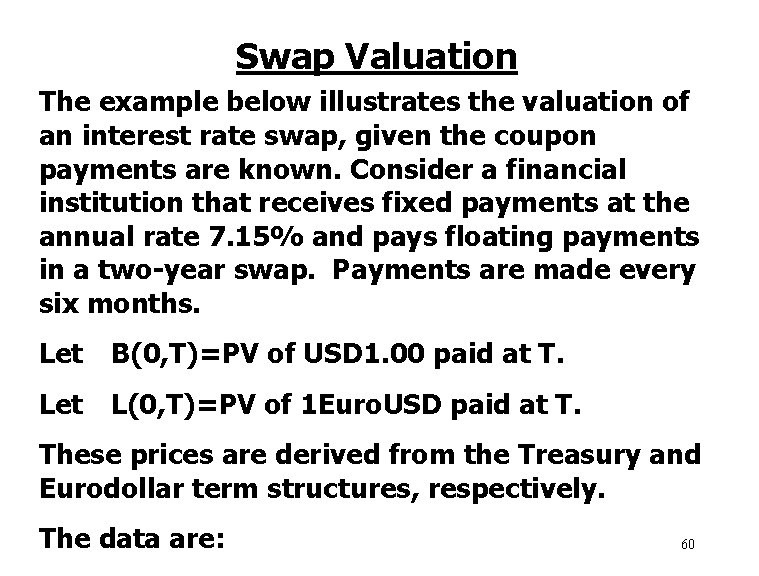
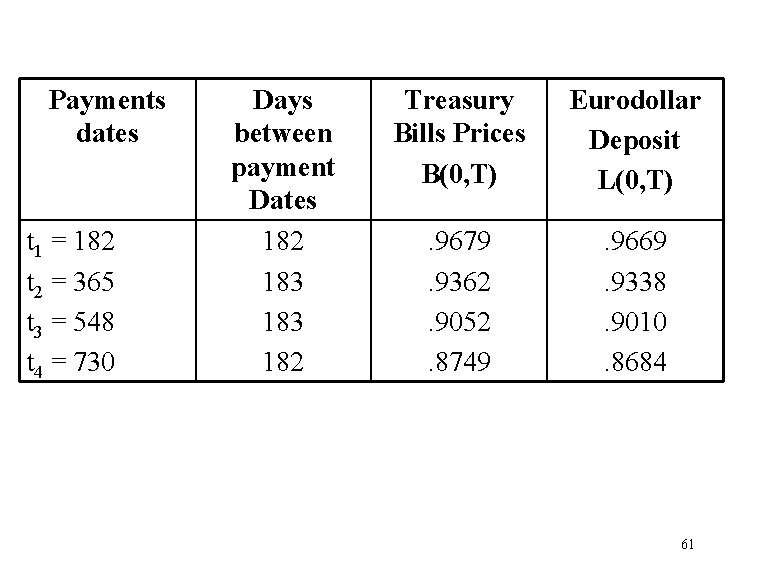
Swap Valuation The example below illustrates the valuation of an interest rate swap, given the coupon payments are known. Consider a financial institution that receives fixed payments at the annual rate 7. 15% and pays floating payments in a two-year swap. Payments are made every six months. Let B(0, T)=PV of USD 1. 00 paid at T. Let L(0, T)=PV of 1 Euro. USD paid at T. These prices are derived from the Treasury and Eurodollar term structures, respectively. The data are: 60
Payments dates t 1 = 182 t 2 = 365 t 3 = 548 t 4 = 730 Days between payment Dates 182 183 182 Treasury Bills Prices B(0, T) Eurodollar Deposit L(0, T) . 9679. 9362. 9052. 8749 . 9669. 9338. 9010. 8684 61
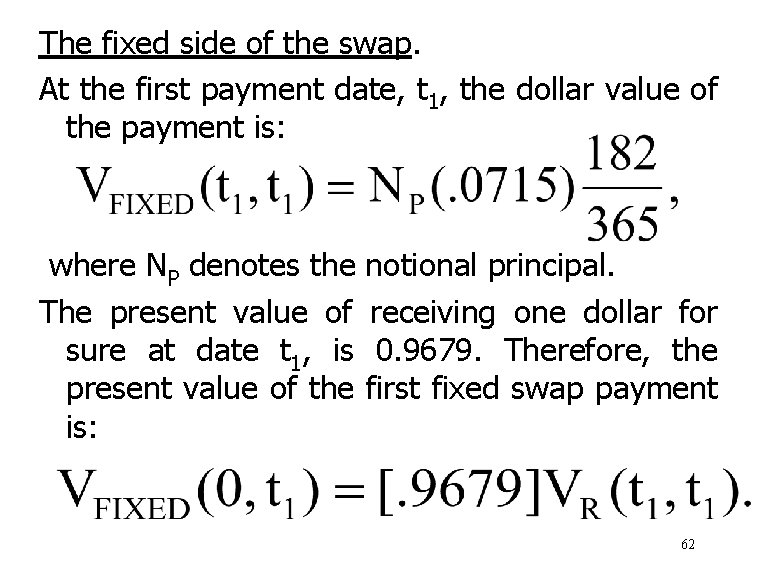
The fixed side of the swap. At the first payment date, t 1, the dollar value of the payment is: where NP denotes the notional principal. The present value of receiving one dollar for sure at date t 1, is 0. 9679. Therefore, the present value of the first fixed swap payment is: 62
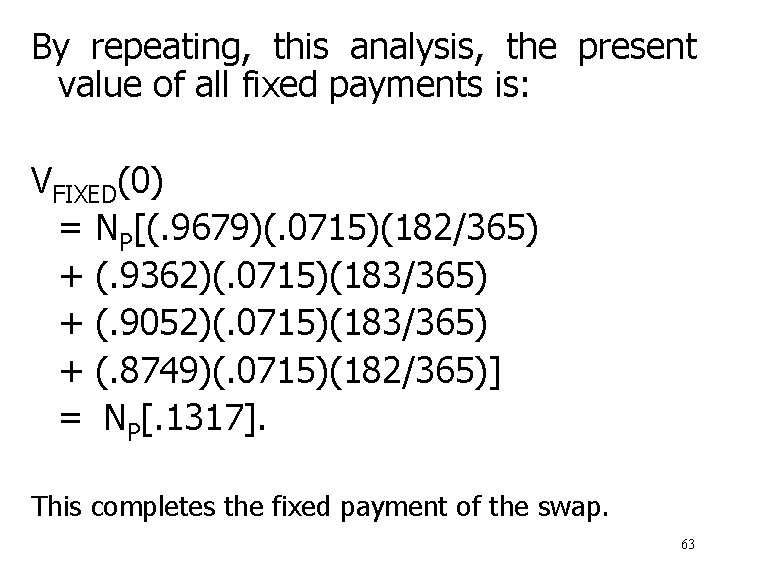
By repeating, this analysis, the present value of all fixed payments is: VFIXED(0) = NP[(. 9679)(. 0715)(182/365) + (. 9362)(. 0715)(183/365) + (. 9052)(. 0715)(183/365) + (. 8749)(. 0715)(182/365)] = NP[. 1317]. This completes the fixed payment of the swap. 63
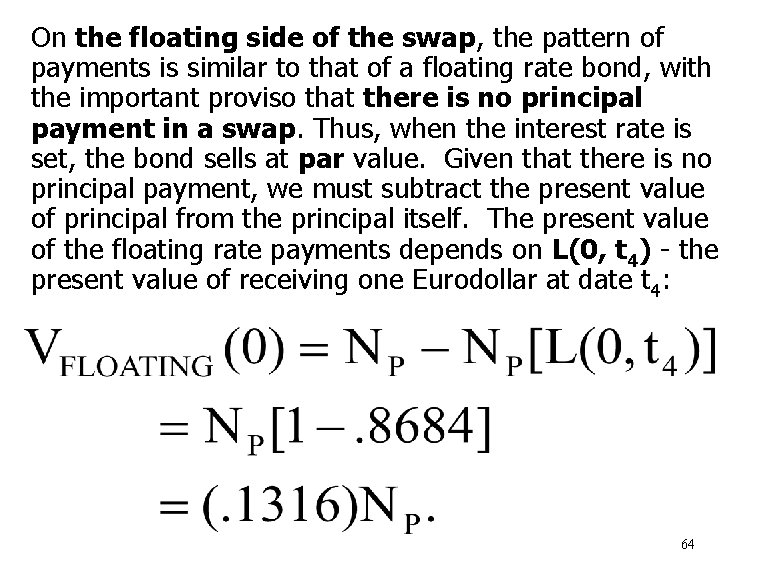
On the floating side of the swap, the pattern of payments is similar to that of a floating rate bond, with the important proviso that there is no principal payment in a swap. Thus, when the interest rate is set, the bond sells at par value. Given that there is no principal payment, we must subtract the present value of principal from the principal itself. The present value of the floating rate payments depends on L(0, t 4) - the present value of receiving one Eurodollar at date t 4: 64
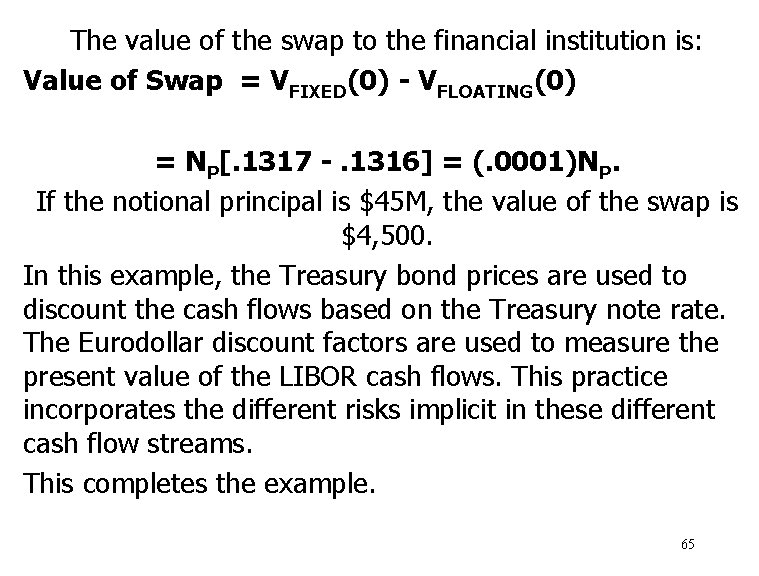
The value of the swap to the financial institution is: Value of Swap = VFIXED(0) - VFLOATING(0) = NP[. 1317 -. 1316] = (. 0001)NP. If the notional principal is $45 M, the value of the swap is $4, 500. In this example, the Treasury bond prices are used to discount the cash flows based on the Treasury note rate. The Eurodollar discount factors are used to measure the present value of the LIBOR cash flows. This practice incorporates the different risks implicit in these different cash flow streams. This completes the example. 65
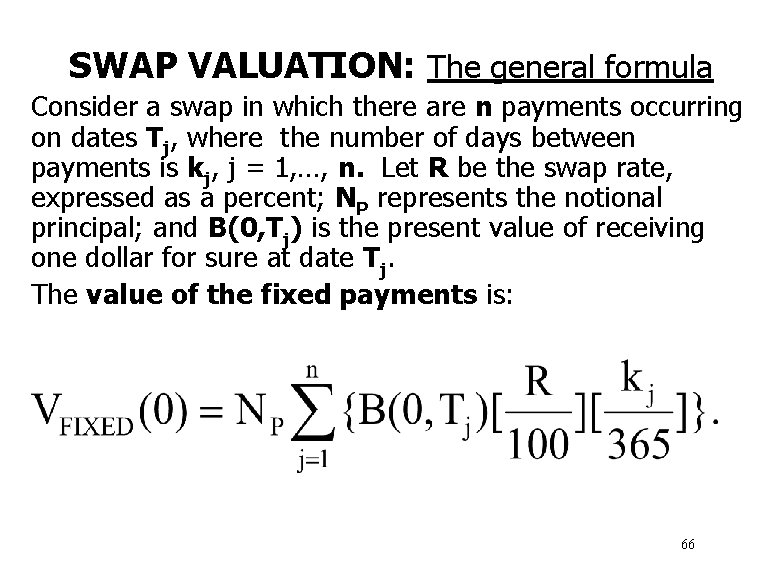
SWAP VALUATION: The general formula Consider a swap in which there are n payments occurring on dates Tj, where the number of days between payments is kj, j = 1, …, n. Let R be the swap rate, expressed as a percent; NP represents the notional principal; and B(0, Tj) is the present value of receiving one dollar for sure at date Tj. The value of the fixed payments is: 66
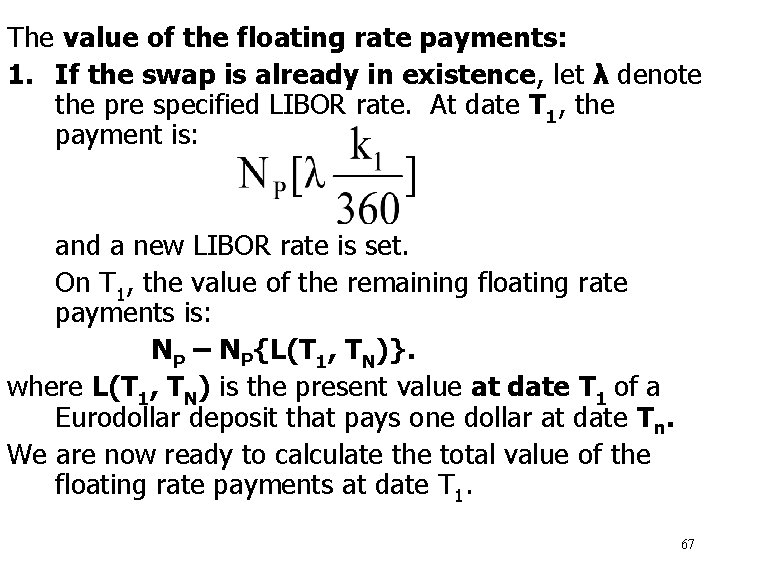
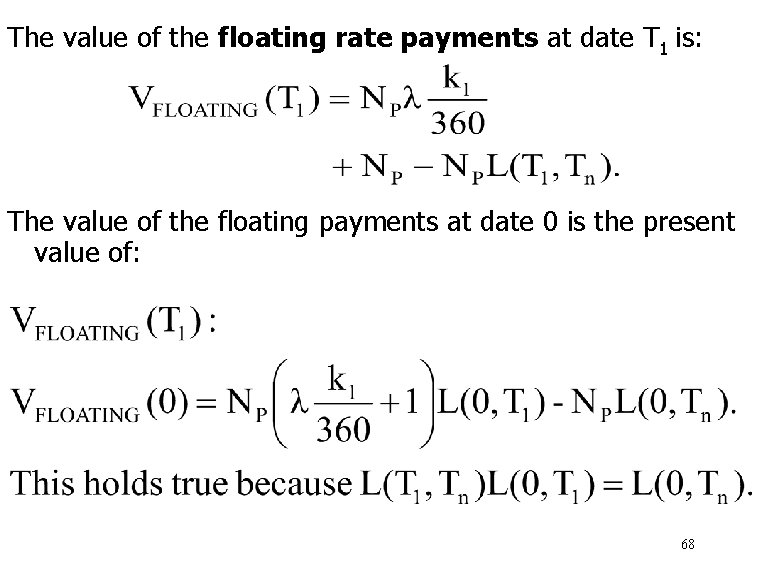
The value of the floating rate payments: 1. If the swap is already in existence, let λ denote the pre specified LIBOR rate. At date T 1, the payment is: and a new LIBOR rate is set. On T 1, the value of the remaining floating rate payments is: NP – NP{L(T 1, TN)}. where L(T 1, TN) is the present value at date T 1 of a Eurodollar deposit that pays one dollar at date Tn. We are now ready to calculate the total value of the floating rate payments at date T 1. 67
The value of the floating rate payments at date T 1 is: The value of the floating payments at date 0 is the present value of: 68
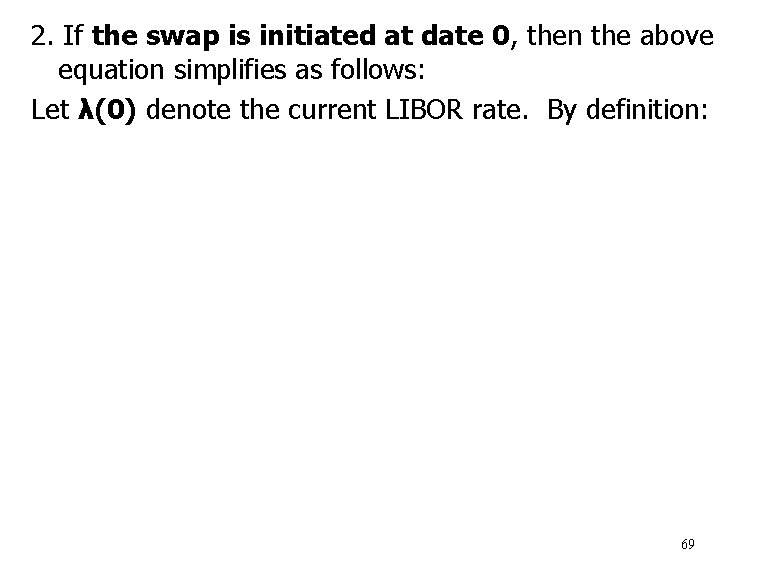
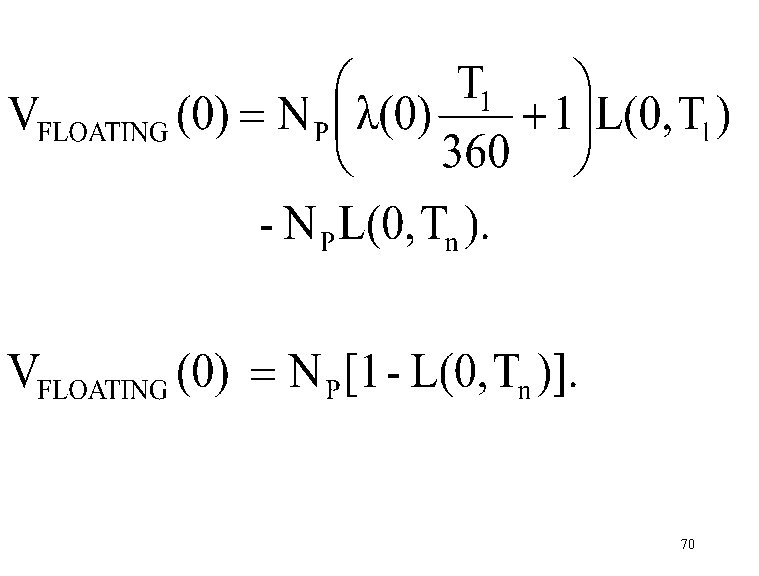
2. If the swap is initiated at date 0, then the above equation simplifies as follows: Let λ(0) denote the current LIBOR rate. By definition: 69
70
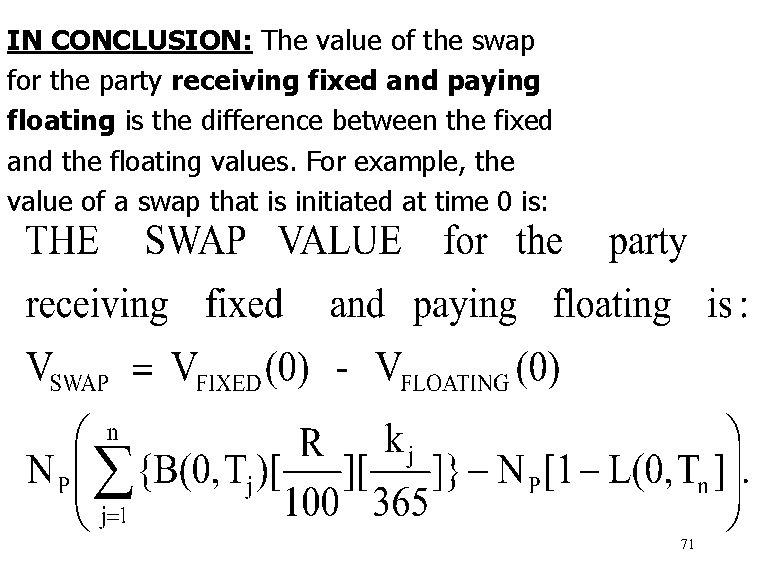
IN CONCLUSION: The value of the swap for the party receiving fixed and paying floating is the difference between the fixed and the floating values. For example, the value of a swap that is initiated at time 0 is: 71
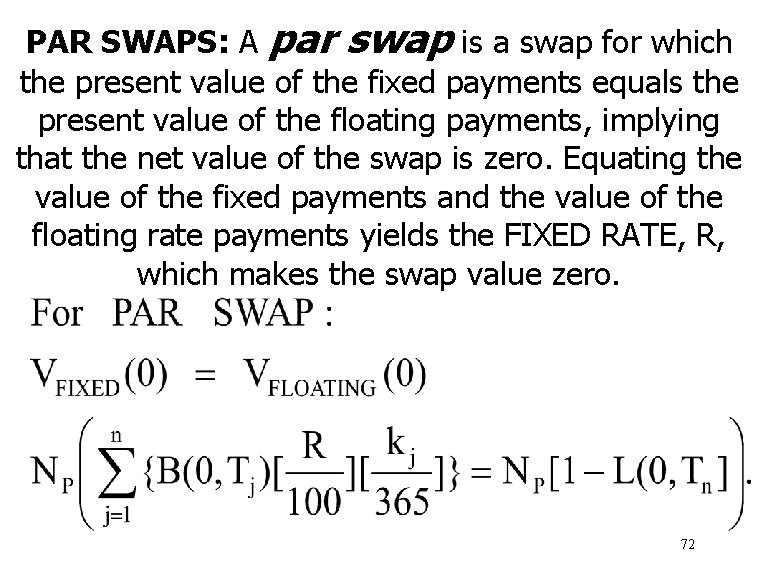
PAR SWAPS: A par swap is a swap for which the present value of the fixed payments equals the present value of the floating payments, implying that the net value of the swap is zero. Equating the value of the fixed payments and the value of the floating rate payments yields the FIXED RATE, R, which makes the swap value zero. 72
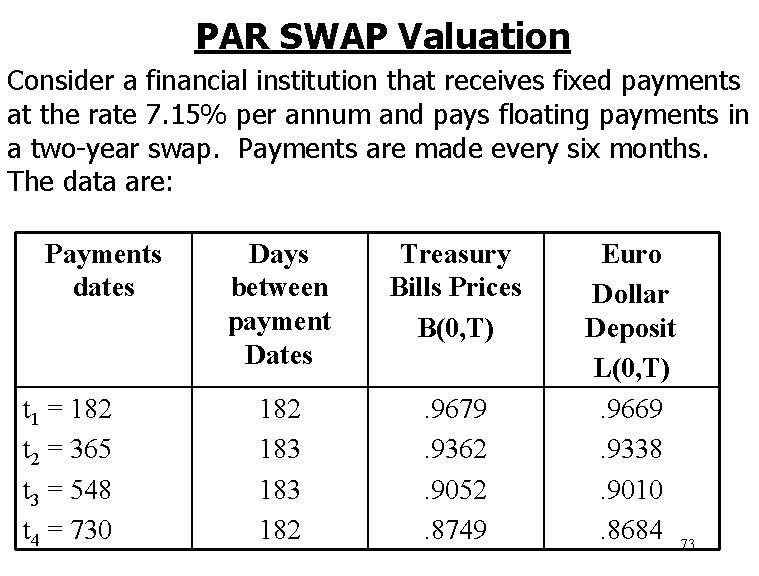
PAR SWAP Valuation Consider a financial institution that receives fixed payments at the rate 7. 15% per annum and pays floating payments in a two-year swap. Payments are made every six months. The data are: Payments dates t 1 = 182 t 2 = 365 t 3 = 548 t 4 = 730 Days between payment Dates Treasury Bills Prices B(0, T) 182 183 182 . 9679. 9362. 9052. 8749 Euro Dollar Deposit L(0, T). 9669. 9338. 9010. 8684 73
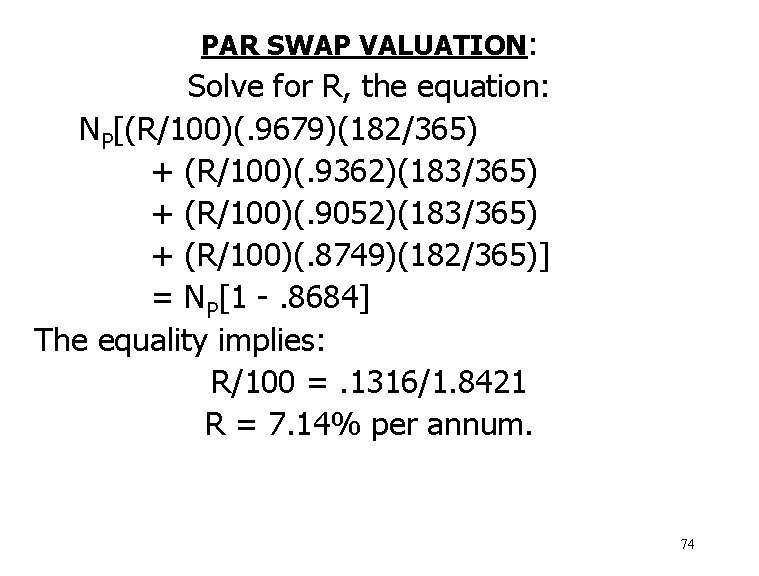
PAR SWAP VALUATION: Solve for R, the equation: NP[(R/100)(. 9679)(182/365) + (R/100)(. 9362)(183/365) + (R/100)(. 9052)(183/365) + (R/100)(. 8749)(182/365)] = NP[1 -. 8684] The equality implies: R/100 =. 1316/1. 8421 R = 7. 14% per annum. 74
2. CURRENCY SWAPS Nowadays markets are global. Firms cannot operate with disregard to international markets trends and prices. Capital can be transfered from one country to another rapidly and efficiently. Therefore, firms may take advantage of international markets even if their business is local. For example, a firm in Denver CO. may find it cheaper to borrow money in Europe, exchange it to USD and repay it later, exchanging USD into EUR. Currency swaps are basically, interest rate swaps 75 accross international borders.
Case Study of a currency swap: IBM and The World Bank(1982) A famous example of an early currency Swap took place between IBM an the World Bank in August 1981, with Salomon Brothers as the intermediary. The complete details of the swap have never been published in full. The following description follows a paper published by D. R. Bock in Swap Finance, Euromoney Publications. 76
In the mid 1970 s, IBM had issued bonds in German marks, DEM, and Swiss francs, CHF. The bonds maturity date was March 30, 1986. The issued amount of the CHF bond was CHF 200 million, with a coupon rate of 6. 1785% per annum. The issued amount of the DEM bond was DEM 300 million with a coupon rate of 10% per annum. During 1981 the USD appreciated sharply against both currencies. The DEM, for example, fell in value from USD. 5181/DEM in March 1980 to USD. 3968/DEM in August 1981. Thus, coupon payments of DEM 100 had fallen in USD cost from USD 51. 81 to USD 39. 68. The situation with the Swiss francs was the Same. Thus, IBM enjoyed a sudden, unexpected capital gain from the reduced USD value of its foreign debt liabilities. 77
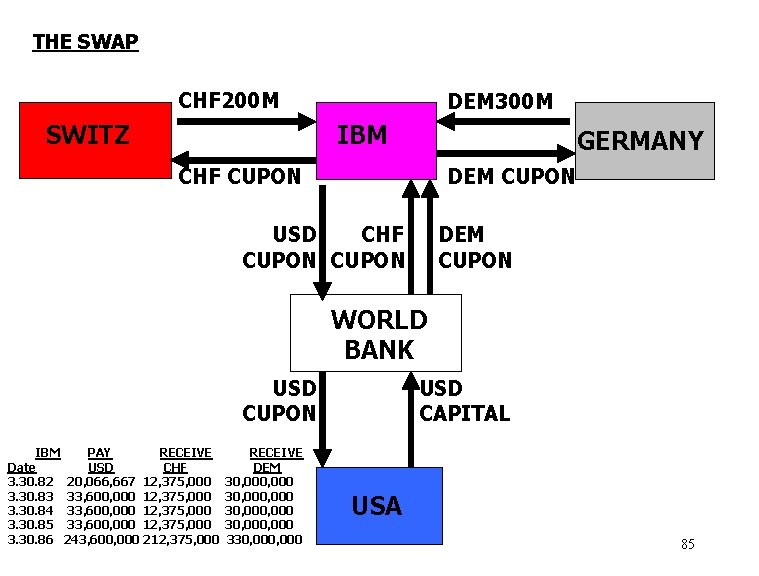
In the beginning of 1981, The World Bank wanted to borrow capital in German marks and Swiss francs against USD. Around that time, the World Bank had issued comparatively little USD paper and could raise funds at an attractive rate in the U. S. market. Both parties could benefit from USD for DEM and CHF swap. The World Bank would issue a USD bond and swap the $ proceeds with IBM for cash flows in CHF and DEM. The bond was issued by the World Bank on August 11, 1981, settling on August 25, 1981 became the settlement date for the swap. The first annual payment under the swap Was determined to be on March 30, 1982 – the next coupon date on IBM's bonds. I. e. , 215 days, rather than 360 from the swap starting date. 78
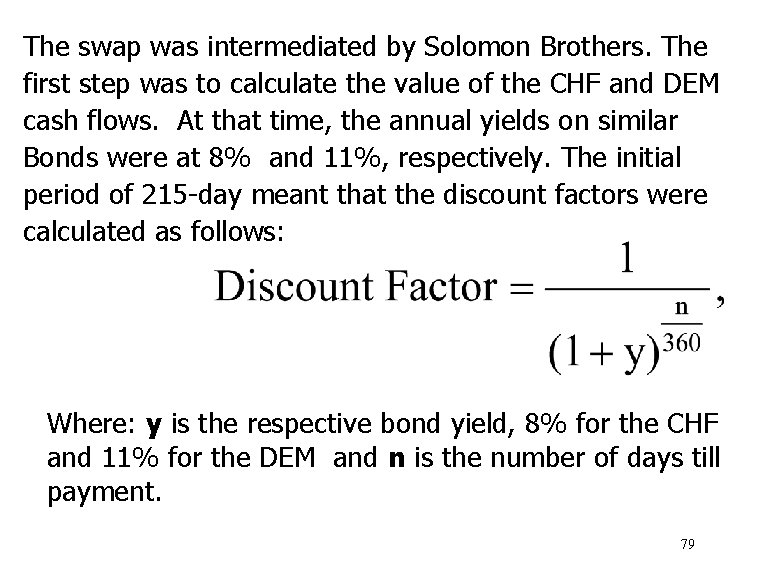
The swap was intermediated by Solomon Brothers. The first step was to calculate the value of the CHF and DEM cash flows. At that time, the annual yields on similar Bonds were at 8% and 11%, respectively. The initial period of 215 -day meant that the discount factors were calculated as follows: Where: y is the respective bond yield, 8% for the CHF and 11% for the DEM and n is the number of days till payment. 79
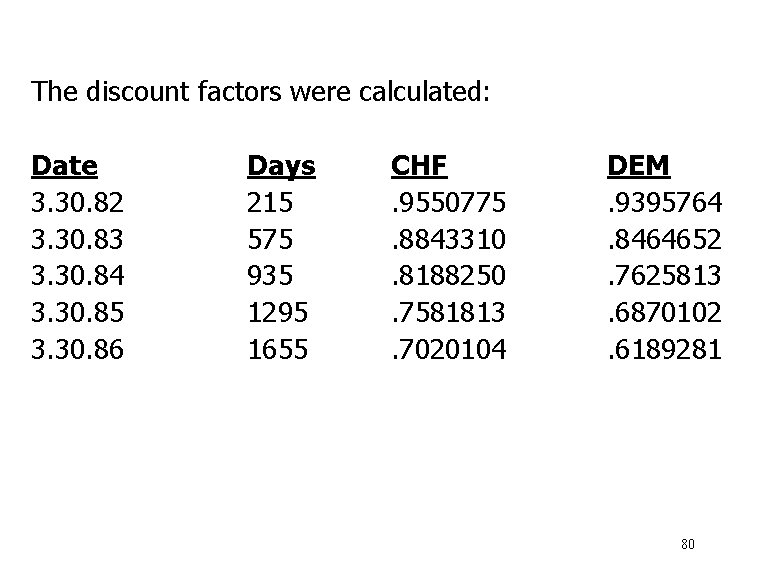
The discount factors were calculated: Date 3. 30. 82 3. 30. 83 3. 30. 84 3. 30. 85 3. 30. 86 Days 215 575 935 1295 1655 CHF . 9550775 . 8843310. 8188250 . 7581813 . 7020104 DEM. 9395764. 8464652. 7625813. 6870102. 6189281 80
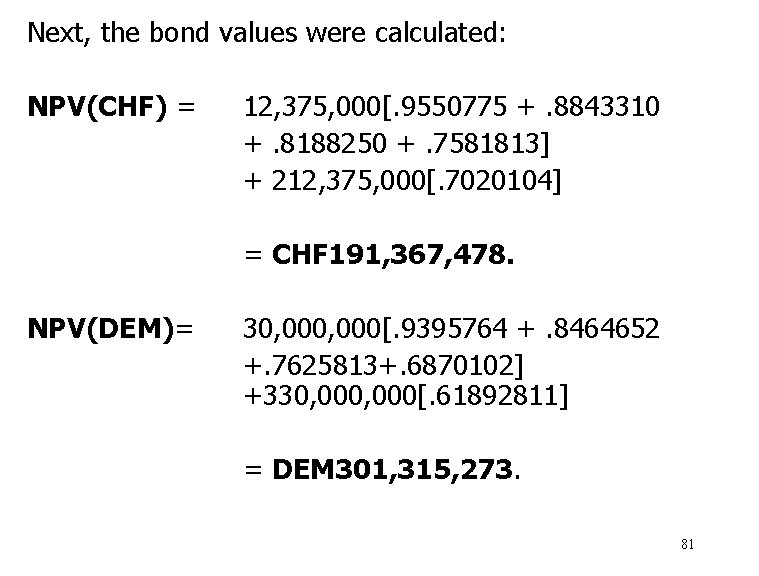
Next, the bond values were calculated: NPV(CHF) = 12, 375, 000[. 9550775 +. 8843310 +. 8188250 +. 7581813] + 212, 375, 000[. 7020104] = CHF 191, 367, 478. NPV(DEM)= 30, 000[. 9395764 +. 8464652 +. 7625813+. 6870102] +330, 000[. 61892811] = DEM 301, 315, 273. 81
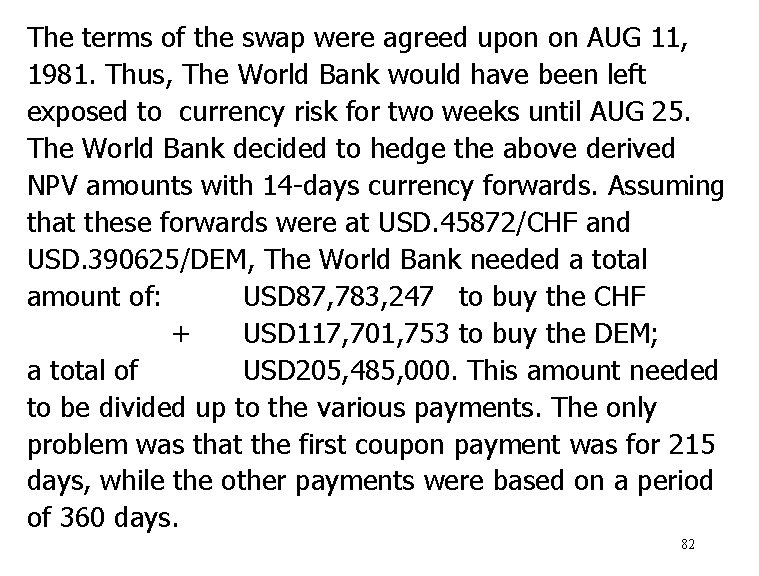
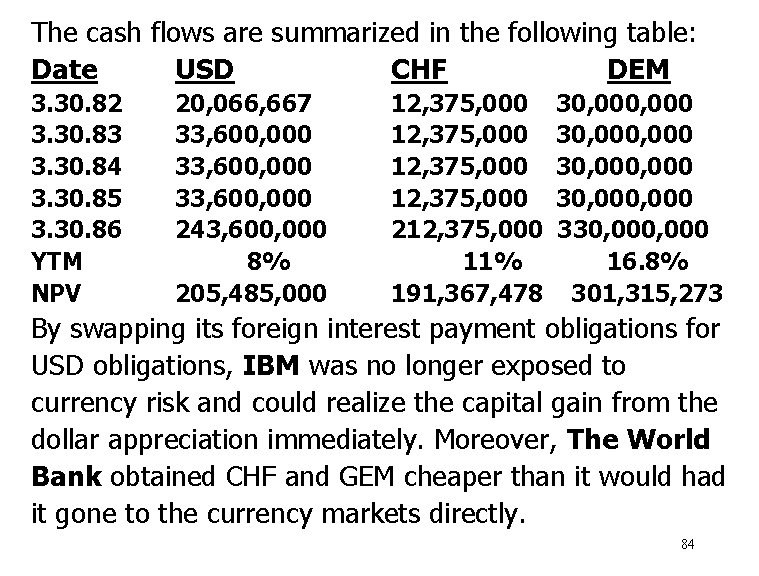
The terms of the swap were agreed upon on AUG 11, 1981. Thus, The World Bank would have been left exposed to currency risk for two weeks until AUG 25. The World Bank decided to hedge the above derived NPV amounts with 14 -days currency forwards. Assuming that these forwards were at USD. 45872/CHF and USD. 390625/DEM, The World Bank needed a total amount of: USD 87, 783, 247 to buy the CHF + USD 117, 701, 753 to buy the DEM; a total of USD 205, 485, 000. This amount needed to be divided up to the various payments. The only problem was that the first coupon payment was for 215 days, while the other payments were based on a period of 360 days. 82
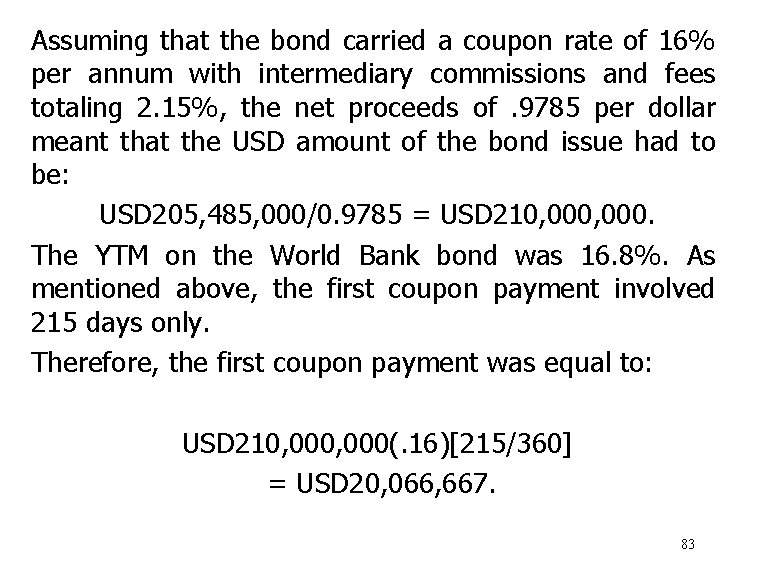
Assuming that the bond carried a coupon rate of 16% per annum with intermediary commissions and fees totaling 2. 15%, the net proceeds of . 9785 per dollar meant that the USD amount of the bond issue had to be: USD 205, 485, 000/0. 9785 = USD 210, 000. The YTM on the World Bank bond was 16. 8%. As mentioned above, the first coupon payment involved 215 days only. Therefore, the first coupon payment was equal to: USD 210, 000(. 16)[215/360] = USD 20, 066, 667. 83
The cash flows are summarized in the following table: Date USD CHF DEM 3. 30. 82 3. 30. 83 3. 30. 84 3. 30. 85 3. 30. 86 YTM NPV 20, 066, 667 33, 600, 000 243, 600, 000 8% 205, 485, 000 12, 375, 000 30, 000, 000 212, 375, 000 330, 000 11% 16. 8% 191, 367, 478 301, 315, 273 By swapping its foreign interest payment obligations for USD obligations, IBM was no longer exposed to currency risk and could realize the capital gain from the dollar appreciation immediately. Moreover, The World Bank obtained CHF and GEM cheaper than it would had it gone to the currency markets directly. 84
THE SWAP CHF 200 M SWITZ DEM 300 M IBM GERMANY CHF CUPON DEM CUPON USD CHF CUPON DEM CUPON WORLD BANK USD CUPON IBM PAY RECEIVE Date USD CHF DEM 3. 30. 82 20, 066, 667 12, 375, 000 30, 000 3. 30. 83 33, 600, 000 12, 375, 000 30, 000 3. 30. 84 33, 600, 000 12, 375, 000 30, 000 3. 30. 85 33, 600, 000 12, 375, 000 30, 000 3. 30. 86 243, 600, 000 212, 375, 000 330, 000 USD CAPITAL USA 85
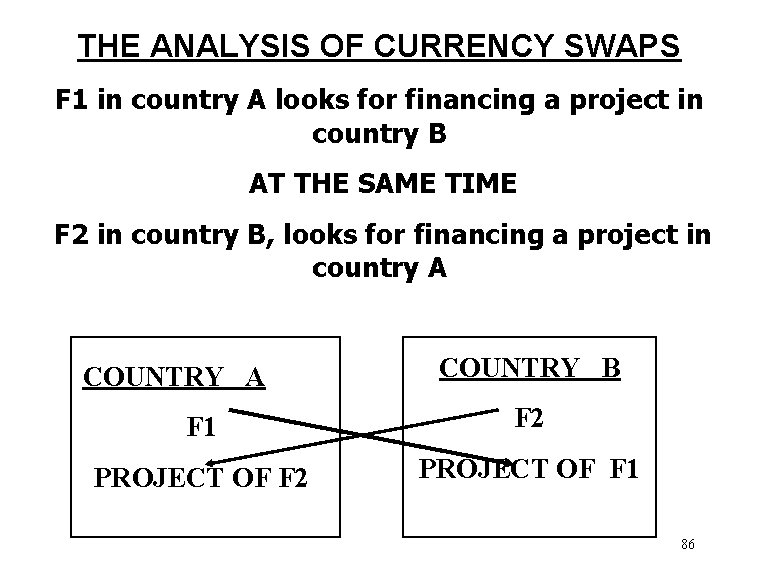
THE ANALYSIS OF CURRENCY SWAPS F 1 in country A looks for financing a project in country B AT THE SAME TIME F 2 in country B, looks for financing a project in country A COUNTRY B F 1 F 2 PROJECT OF F 1 86
CURRENCY SWAP IN TERMS OF THE BORROWING RAES, EACH FIRM HAS COMPARATIVE ADVANTAGE ONLY IN ONE COUNTRY, EVEN THOUGH IT MAY HAVE ABSOLUTE ADVANTAGE IN BOTH COUNTRIES. THUS, EACH FIRM WILL BORROW IN THE COUNTRY IN WHICH IT HAS COMPARATIVE ADVANTAGE AND THEN, THEY EXCHANGE THE PAYMENTS THROUGH A SWAP. 87
CURRENCY SWAP FIXED FOR FIXED CLP = Chilean Peso BR = Brazilian Real Firm CH 1, is a Chilean firm who needs capital for a project in Brazil, while, A Brazilian firm, BR 2, needs capital for a project in Chile. The market for fixed interest rates in these countries makes a swap beneficial for both firms as follows: 88
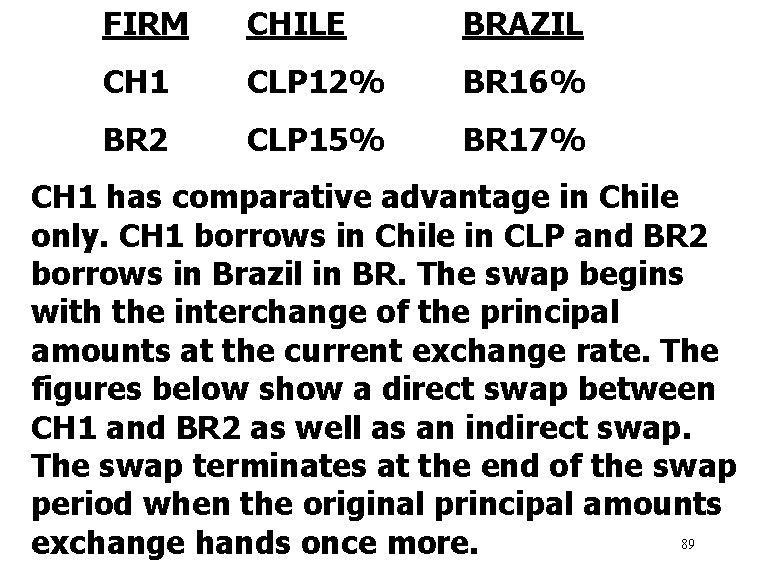
FIRM CHILE BRAZIL CH 1 CLP 12% BR 16% BR 2 CLP 15% BR 17% CH 1 has comparative advantage in Chile only. CH 1 borrows in Chile in CLP and BR 2 borrows in Brazil in BR. The swap begins with the interchange of the principal amounts at the current exchange rate. The figures below show a direct swap between CH 1 and BR 2 as well as an indirect swap. The swap terminates at the end of the swap period when the original principal amounts 89 exchange hands once more.
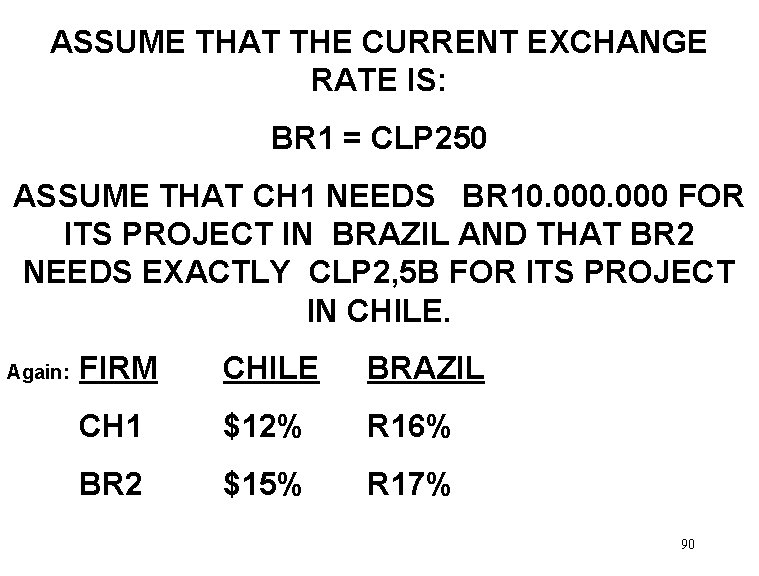
ASSUME THAT THE CURRENT EXCHANGE RATE IS: BR 1 = CLP 250 ASSUME THAT CH 1 NEEDS BR 10. 000 FOR ITS PROJECT IN BRAZIL AND THAT BR 2 NEEDS EXACTLY CLP 2, 5 B FOR ITS PROJECT IN CHILE. Again: FIRM CHILE BRAZIL CH 1 $12% R 16% BR 2 $15% R 17% 90
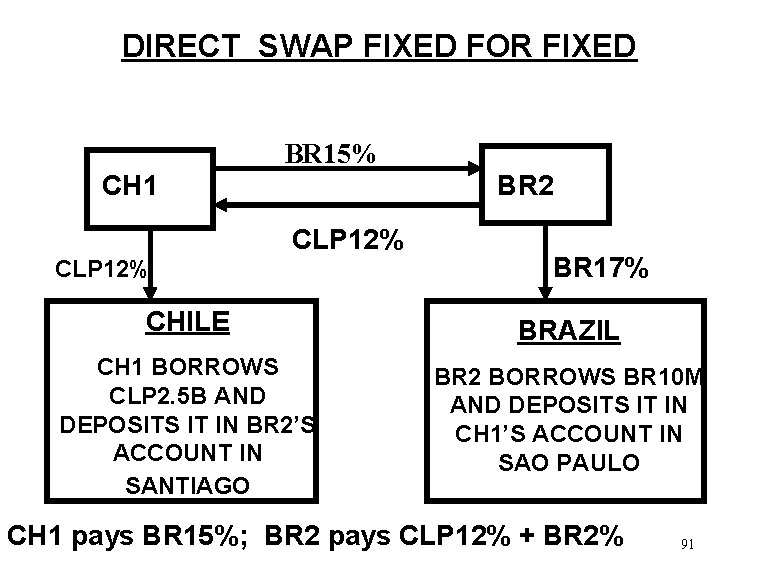
DIRECT SWAP FIXED FOR FIXED BR 15% CH 1 BR 2 CLP 12% BR 17% CHILE BRAZIL CH 1 BORROWS CLP 2. 5 B AND DEPOSITS IT IN BR 2’S ACCOUNT IN SANTIAGO BR 2 BORROWS BR 10 M AND DEPOSITS IT IN CH 1’S ACCOUNT IN SAO PAULO CH 1 pays BR 15%; BR 2 pays CLP 12% + BR 2% 91
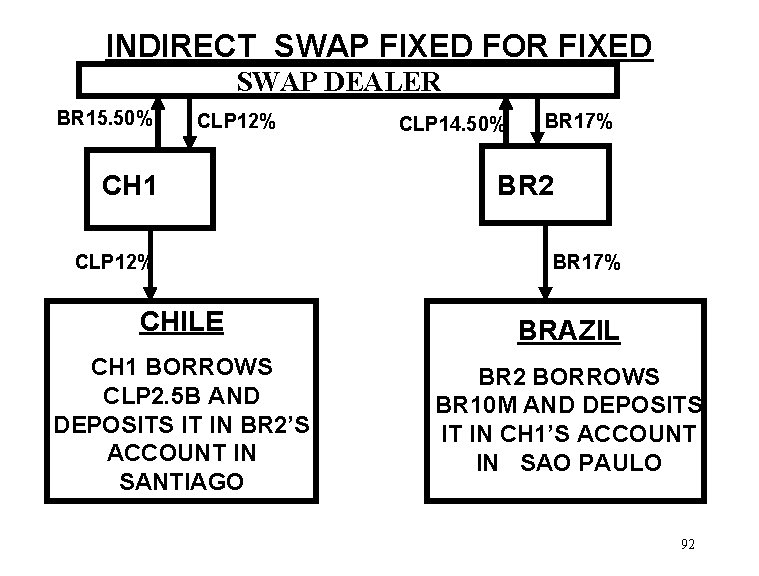
INDIRECT SWAP FIXED FOR FIXED SWAP DEALER BR 15. 50% CLP 12% CH 1 CLP 12% CLP 14. 50% BR 17% BR 2 BR 17% CHILE BRAZIL CH 1 BORROWS CLP 2. 5 B AND DEPOSITS IT IN BR 2’S ACCOUNT IN SANTIAGO BR 2 BORROWS BR 10 M AND DEPOSITS IT IN CH 1’S ACCOUNT IN SAO PAULO 92
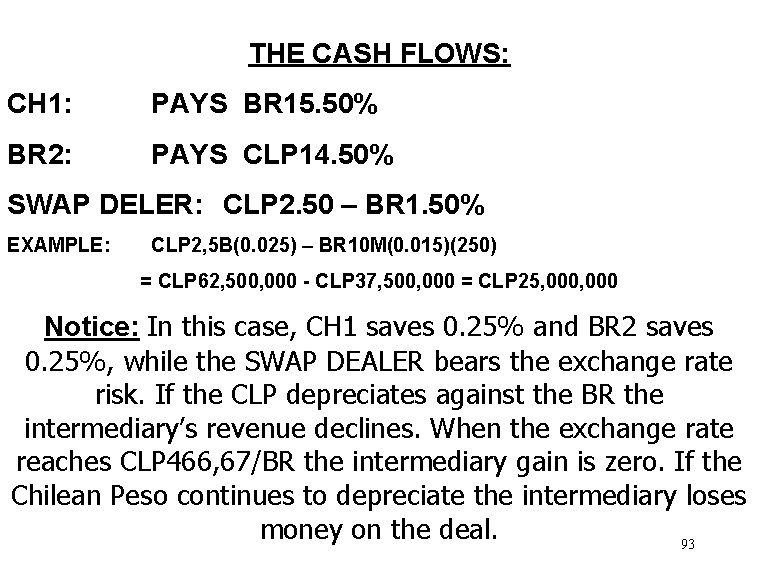
THE CASH FLOWS: CH 1: PAYS BR 15. 50% BR 2: PAYS CLP 14. 50% SWAP DELER: CLP 2. 50 – BR 1. 50% EXAMPLE: CLP 2, 5 B(0. 025) – BR 10 M(0. 015)(250) = CLP 62, 500, 000 - CLP 37, 500, 000 = CLP 25, 000 Notice: In this case, CH 1 saves 0. 25% and BR 2 saves 0. 25%, while the SWAP DEALER bears the exchange rate risk. If the CLP depreciates against the BR the intermediary’s revenue declines. When the exchange rate reaches CLP 466, 67/BR the intermediary gain is zero. If the Chilean Peso continues to depreciate the intermediary loses money on the deal. 93
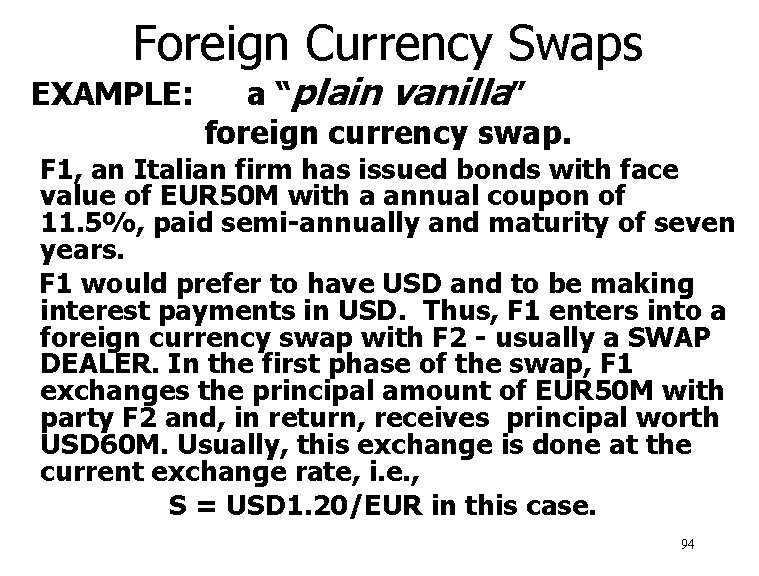
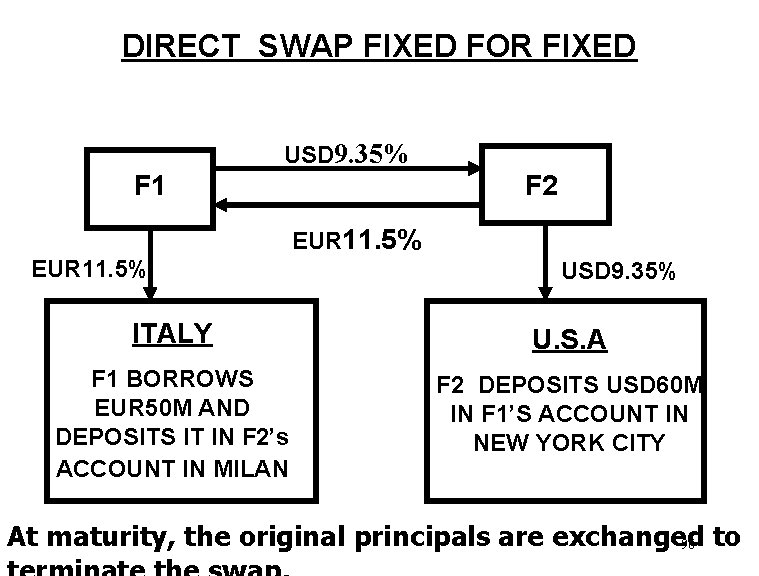
Foreign Currency Swaps EXAMPLE: a “plain vanilla” foreign currency swap. F 1, an Italian firm has issued bonds with face value of EUR 50 M with a annual coupon of 11. 5%, paid semi-annually and maturity of seven years. F 1 would prefer to have USD and to be making interest payments in USD. Thus, F 1 enters into a foreign currency swap with F 2 - usually a SWAP DEALER. In the first phase of the swap, F 1 exchanges the principal amount of EUR 50 M with party F 2 and, in return, receives principal worth USD 60 M. Usually, this exchange is done at the current exchange rate, i. e. , S = USD 1. 20/EUR in this case. 94
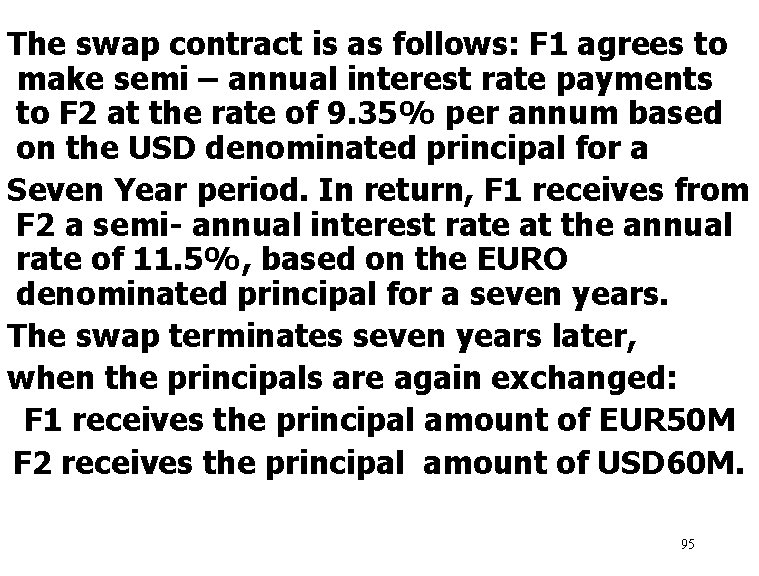
The swap contract is as follows: F 1 agrees to make semi – annual interest rate payments to F 2 at the rate of 9. 35% per annum based on the USD denominated principal for a Seven Year period. In return, F 1 receives from F 2 a semi- annual interest rate at the annual rate of 11. 5%, based on the EURO denominated principal for a seven years. The swap terminates seven years later, when the principals are again exchanged: F 1 receives the principal amount of EUR 50 M F 2 receives the principal amount of USD 60 M. 95
DIRECT SWAP FIXED FOR FIXED USD 9. 35% F 1 F 2 EUR 11. 5% USD 9. 35% ITALY U. S. A F 1 BORROWS EUR 50 M AND DEPOSITS IT IN F 2’s ACCOUNT IN MILAN F 2 DEPOSITS USD 60 M IN F 1’S ACCOUNT IN NEW YORK CITY At maturity, the original principals are exchanged to 96
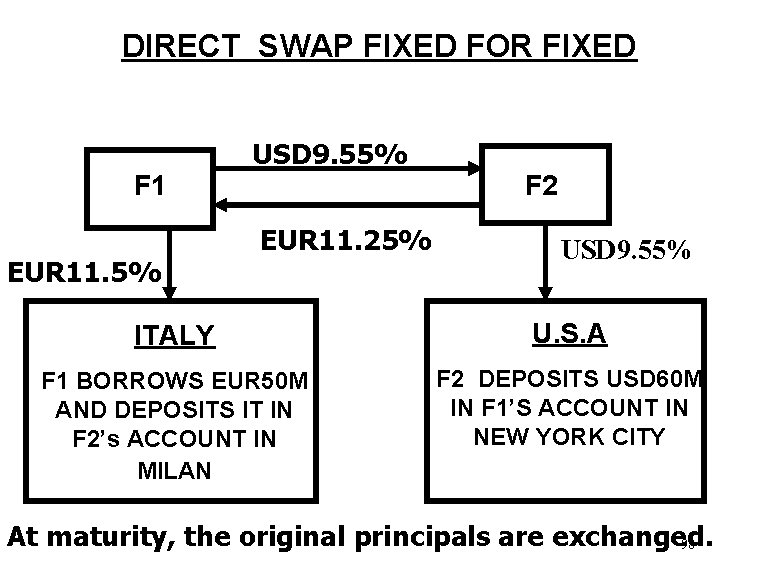
By entering into the foreign currency swap, F 1 has successfully transferred its EUR liability into a USD liability. In this case, F 2 payments to F 1 were based on the same rate of party’s F 1 payments in Italy EUR 11. 5%. Thus, F 1 was able to exactly offset the EUR interest rate payments. This is not necessarily always the case. It is quite possible that the interest rate payments F 1 receives from SWAP DEALER F 2 only partially offset the EUR expense. In the same example, the situation may change to: 97
DIRECT SWAP FIXED FOR FIXED USD 9. 55% F 1 EUR 11. 5% F 2 EUR 11. 25% USD 9. 55% ITALY U. S. A F 1 BORROWS EUR 50 M AND DEPOSITS IT IN F 2’s ACCOUNT IN MILAN F 2 DEPOSITS USD 60 M IN F 1’S ACCOUNT IN NEW YORK CITY At maturity, the original principals are exchanged. 98
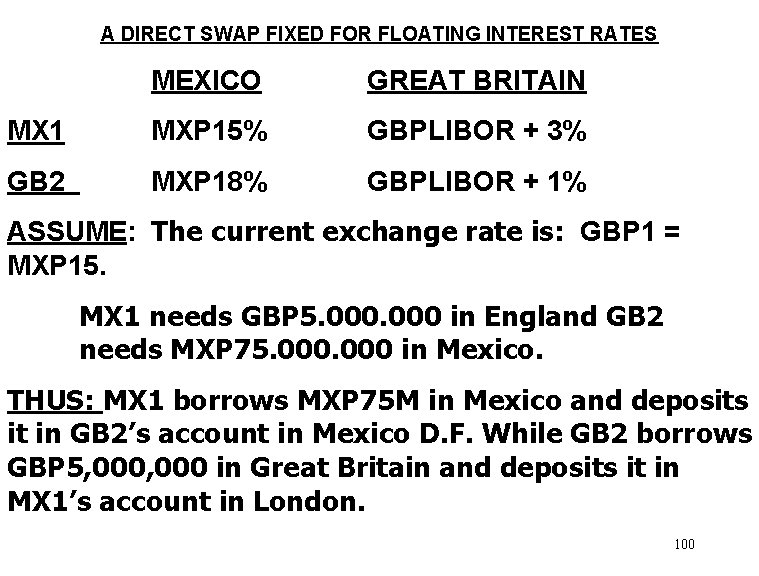
EXAMPLE: FIXED FOR FLOATING A Mexican firm needs capital for a project in Great Britain and a British firm needs capital for a project in Mexico. They enter a swap because they can exchange fixed interest rates into floating and borrow at rates that are below the rates they could obtain had they borrowed directly in the same markets. In this case, the swap is Fixed-for-Floating rates, i. e. , One firm borrows fixed, the other borrows floating and they swap the cash flows therby, changing the nature of the payments from fixed to floating and 99 vice – versa.
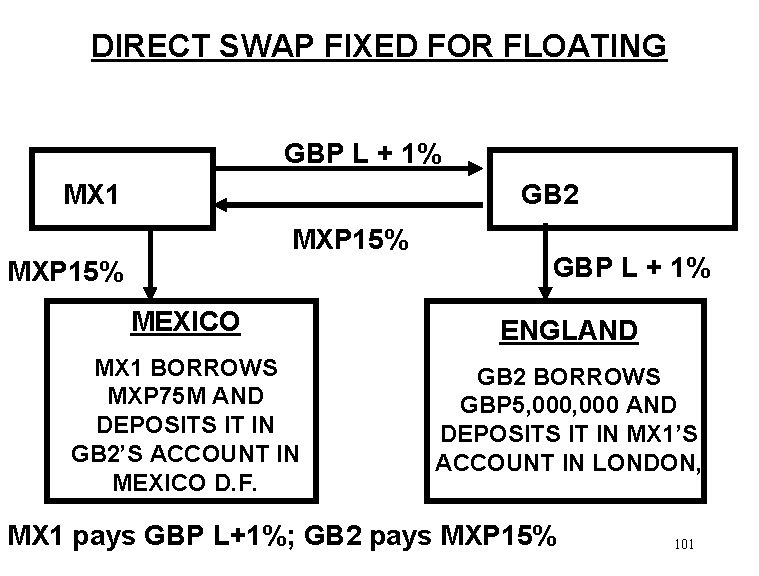
A DIRECT SWAP FIXED FOR FLOATING INTEREST RATES MEXICO GREAT BRITAIN MX 1 MXP 15% GBPLIBOR + 3% GB 2 MXP 18% GBPLIBOR + 1% ASSUME: The current exchange rate is: GBP 1 = MXP 15. MX 1 needs GBP 5. 000 in England GB 2 needs MXP 75. 000 in Mexico. THUS: MX 1 borrows MXP 75 M in Mexico and deposits it in GB 2’s account in Mexico D. F. While GB 2 borrows GBP 5, 000 in Great Britain and deposits it in MX 1’s account in London. 100
DIRECT SWAP FIXED FOR FLOATING GBP L + 1% MX 1 GB 2 MXP 15% GBP L + 1% MEXICO ENGLAND MX 1 BORROWS MXP 75 M AND DEPOSITS IT IN GB 2’S ACCOUNT IN MEXICO D. F. GB 2 BORROWS GBP 5, 000 AND DEPOSITS IT IN MX 1’S ACCOUNT IN LONDON, MX 1 pays GBP L+1%; GB 2 pays MXP 15% 101
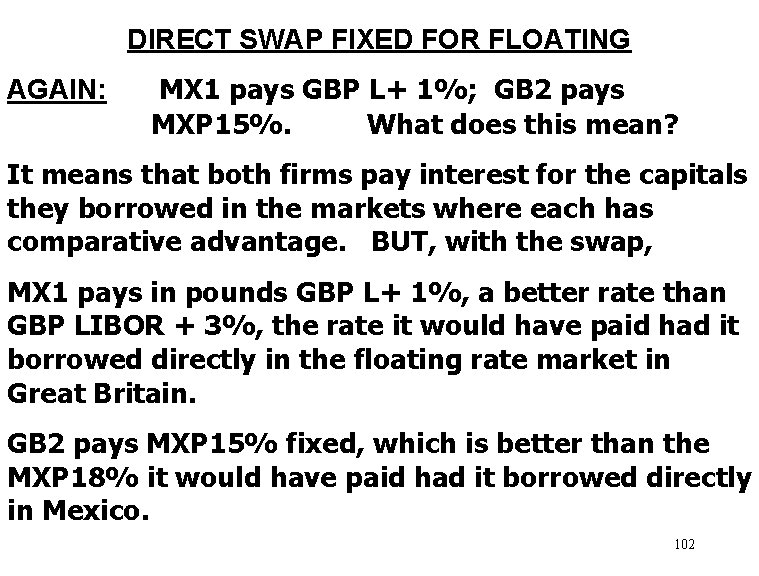
DIRECT SWAP FIXED FOR FLOATING AGAIN: MX 1 pays GBP L+ 1%; GB 2 pays MXP 15%. What does this mean? It means that both firms pay interest for the capitals they borrowed in the markets where each has comparative advantage. BUT, with the swap, MX 1 pays in pounds GBP L+ 1%, a better rate than GBP LIBOR + 3%, the rate it would have paid had it borrowed directly in the floating rate market in Great Britain. GB 2 pays MXP 15% fixed, which is better than the MXP 18% it would have paid had it borrowed directly in Mexico. 102
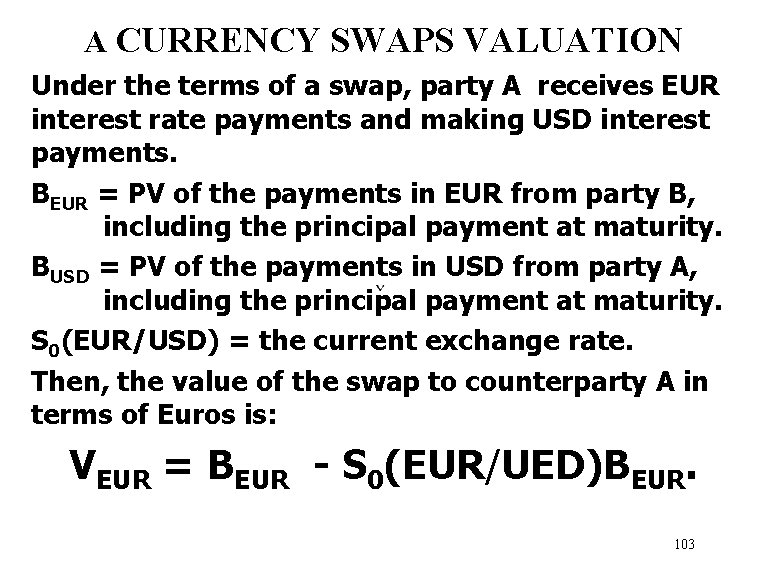
A CURRENCY SWAPS VALUATION Under the terms of a swap, party A receives EUR interest rate payments and making USD interest payments. BEUR = PV of the payments in EUR from party B, including the principal payment at maturity. BUSD = PV of the payments in USD from party A, including the principal payment at maturity. S 0(EUR/USD) = the current exchange rate. Then, the value of the swap to counterparty A in terms of Euros is: VEUR = BEUR - S 0(EUR/UED)BEUR. 103
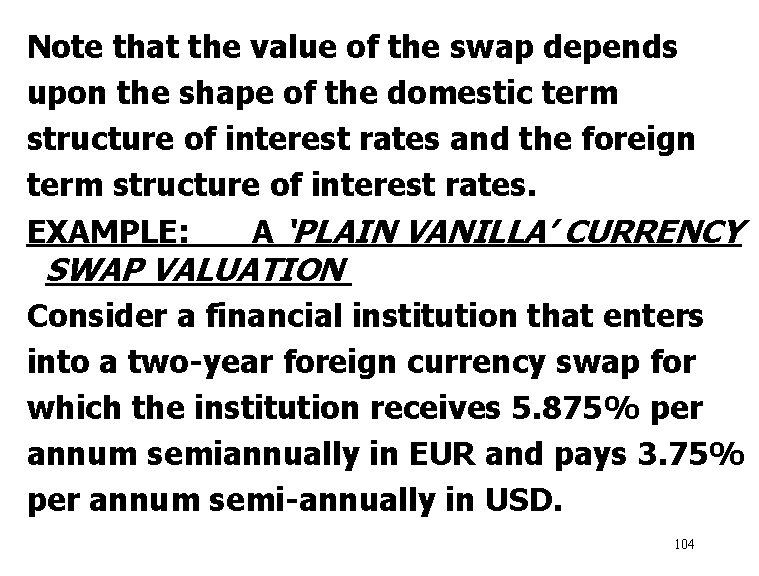
Note that the value of the swap depends upon the shape of the domestic term structure of interest rates and the foreign term structure of interest rates. EXAMPLE: A ‘PLAIN VANILLA’ CURRENCY SWAP VALUATION Consider a financial institution that enters into a two-year foreign currency swap for which the institution receives 5. 875% per annum semiannually in EUR and pays 3. 75% per annum semi-annually in USD. 104
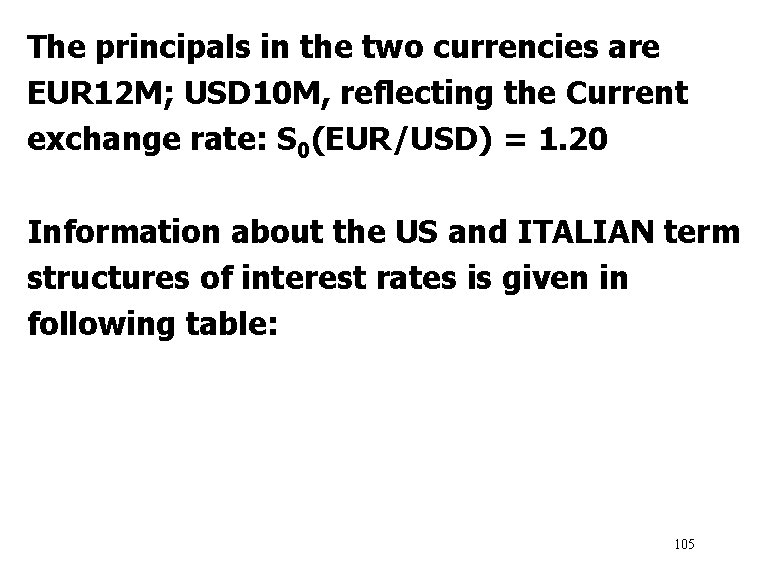
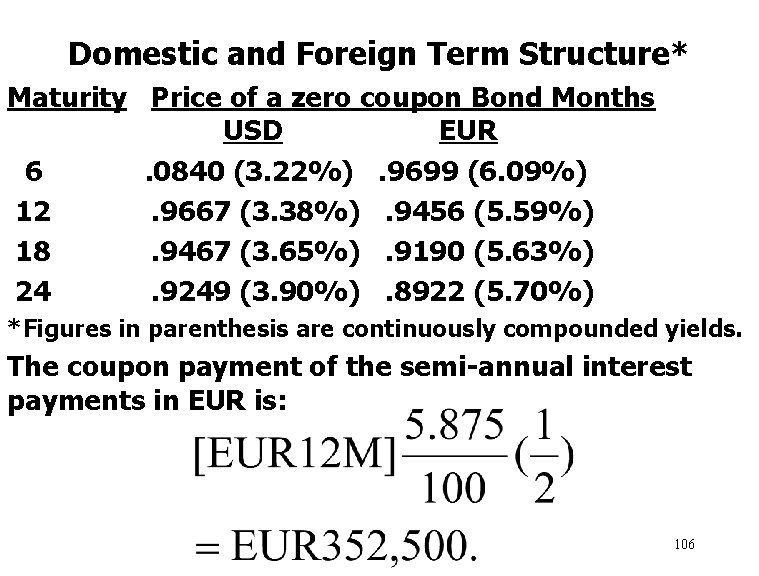
The principals in the two currencies are EUR 12 M; USD 10 M, reflecting the Current exchange rate: S 0(EUR/USD) = 1. 20 Information about the US and ITALIAN term structures of interest rates is given in following table: 105
Domestic and Foreign Term Structure* Maturity Price of a zero coupon Bond Months USD EUR 6 . 0840 (3. 22%) . 9699 (6. 09%) 12. 9667 (3. 38%) . 9456 (5. 59%) 18. 9467 (3. 65%) . 9190 (5. 63%) 24. 9249 (3. 90%) . 8922 (5. 70%) *Figures in parenthesis are continuously compounded yields. The coupon payment of the semi-annual interest payments in EUR is: 106
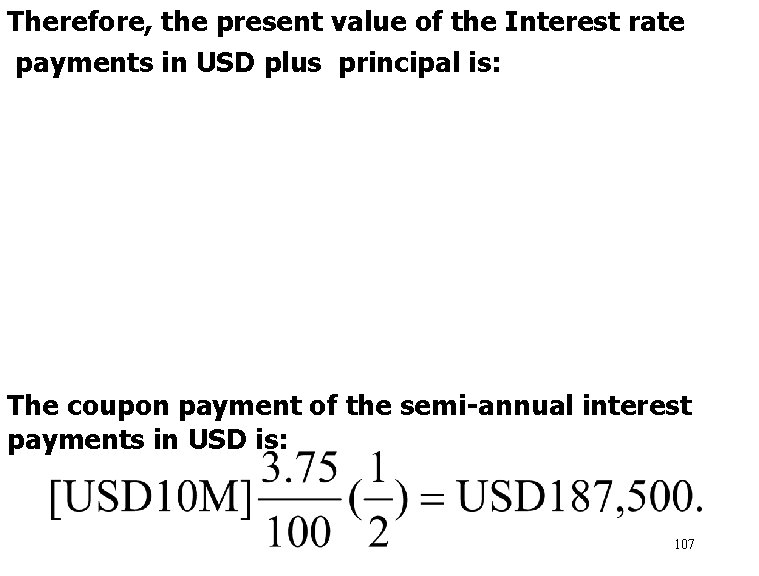
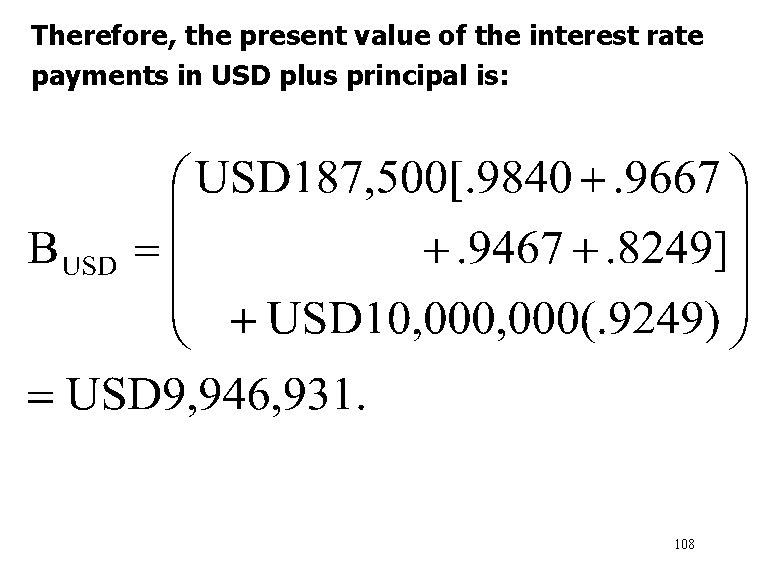
Therefore, the present value of the Interest rate payments in USD plus principal is: The coupon payment of the semi-annual interest payments in USD is: 107
Therefore, the present value of the interest rate payments in USD plus principal is: 108
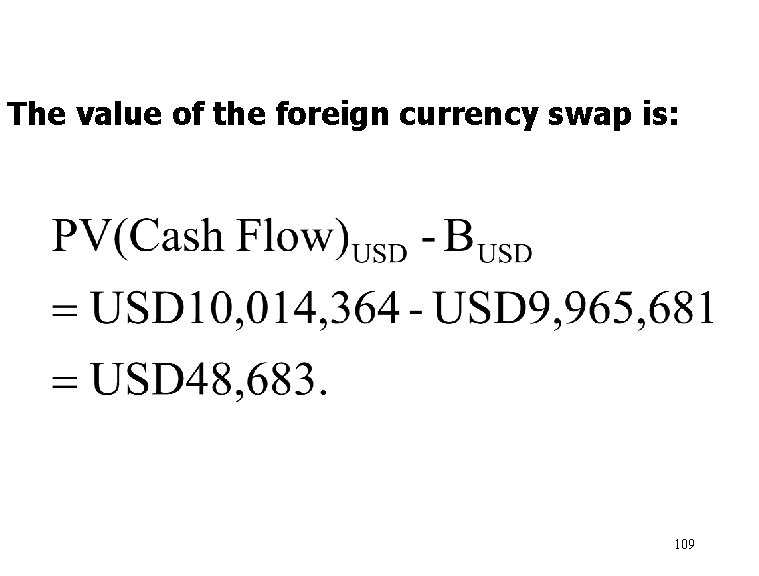
The value of the foreign currency swap is: 109
3. COMMODITY SWAPS The assets underlying the swaps in these markets are agreed upon quantities of the commodity. Here, we analyze commodity swaps using mainly energy commodities – natural gas and crude oil. For example, 100, 000 barrels of crude oil. 110
How does a commodity swap works: In a typical commodity swap: party A makes periodic payments to counterparty B at a fixed price per unit for a given notional quantity of some commodity. B pays A an agreed upon floating price for the same notional quantity of the commodity underlying the swap. The commodities are usually the same. The floating price is usually defined as the market price or an average market price, the average being calculated using spot commodity prices over some predefined period. 111
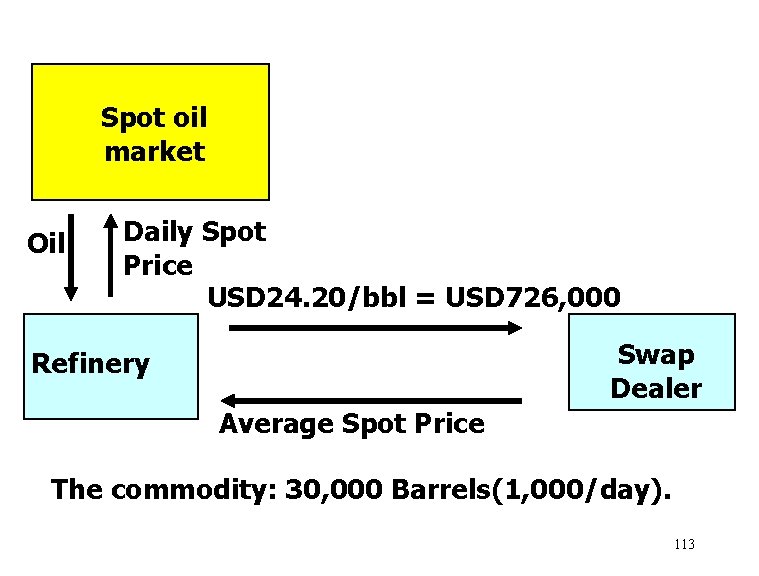
Example: A Commodity Swap Consider a refinery that has a constant demand for 30, 000 barrels of oil per month and is concerned about volatile oil prices. It enters into a three-year commodity swap with a swap dealer. The current spot oil price is USD 24. 20 per barrel. The refinery agrees to make monthly payments to the swap dealer at a fixed price of USD 24. 20 per barrel. The swap dealer agrees to pay the refinery the average daily price for oil during the CURRENT month. The notional principal is 30, 000 barrels. The swap is for 36 months. 112
Spot oil market Oil Daily Spot Price USD 24. 20/bbl = USD 726, 000 Swap Dealer Refinery Average Spot Price The commodity: 30, 000 Barrels(1, 000/day). 113
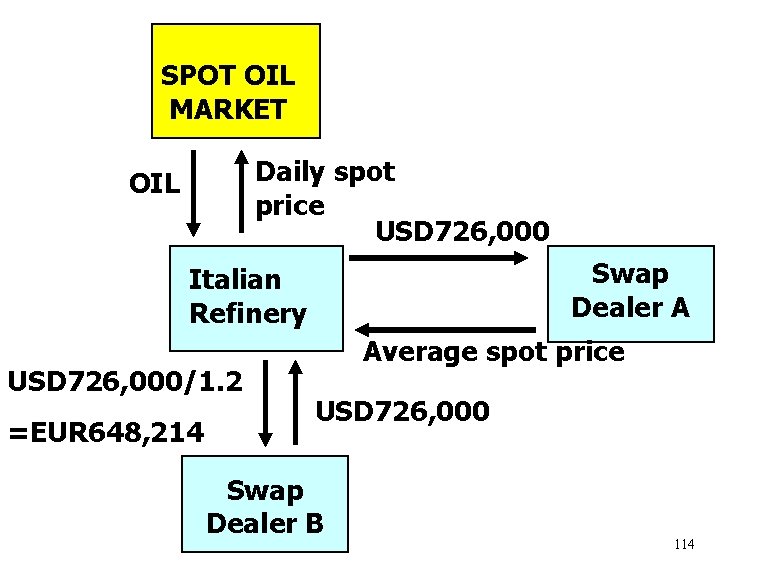
SPOT OIL MARKET Daily spot price USD 726, 000 OIL Swap Dealer A Italian Refinery USD 726, 000/1. 2 =EUR 648, 214 Average spot price USD 726, 000 Swap Dealer B 114
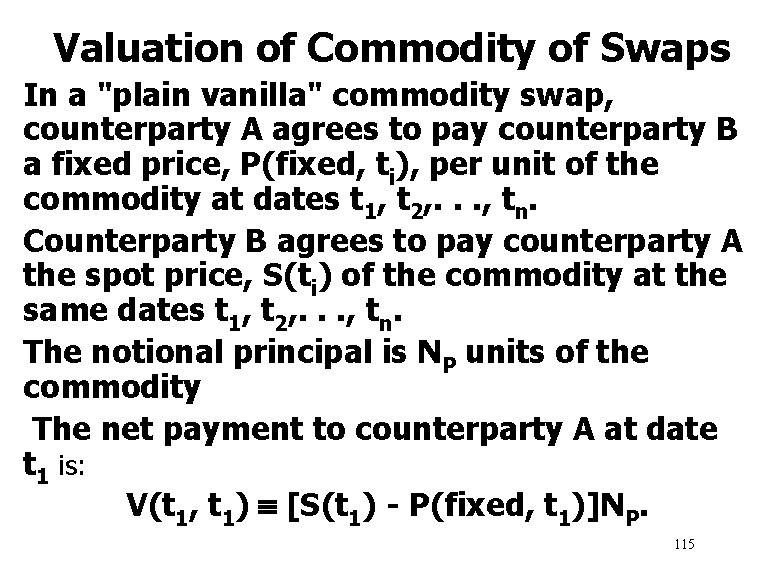
Valuation of Commodity of Swaps In a "plain vanilla" commodity swap, counterparty A agrees to pay counterparty B a fixed price, P(fixed, ti), per unit of the commodity at dates t 1, t 2, . . . , tn. Counterparty B agrees to pay counterparty A the spot price, S(ti) of the commodity at the same dates t 1, t 2, . . . , tn. The notional principal is NP units of the commodity The net payment to counterparty A at date t 1 is: V(t 1, t 1) [S(t 1) - P(fixed, t 1)]NP. 115
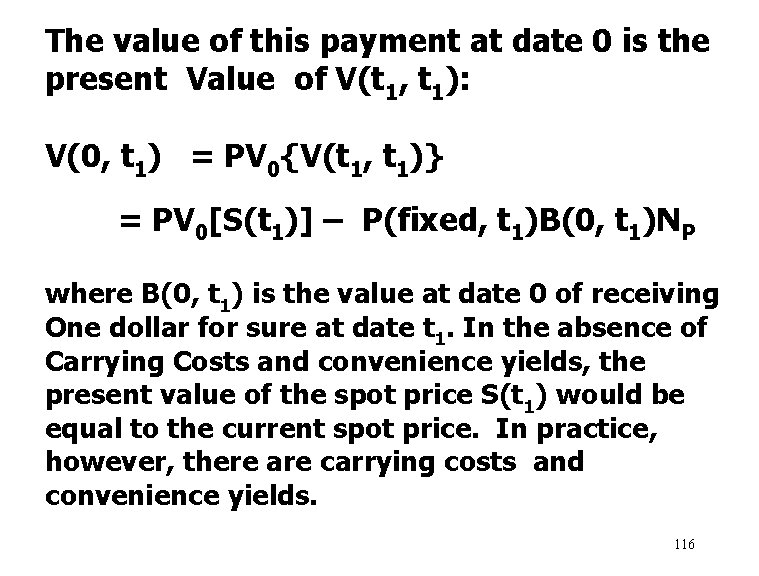
The value of this payment at date 0 is the present Value of V(t 1, t 1): V(0, t 1) = PV 0{V(t 1, t 1)} = PV 0[S(t 1)] – P(fixed, t 1)B(0, t 1)NP where B(0, t 1) is the value at date 0 of receiving One dollar for sure at date t 1. In the absence of Carrying Costs and convenience yields, the present value of the spot price S(t 1) would be equal to the current spot price. In practice, however, there are carrying costs and convenience yields. 116
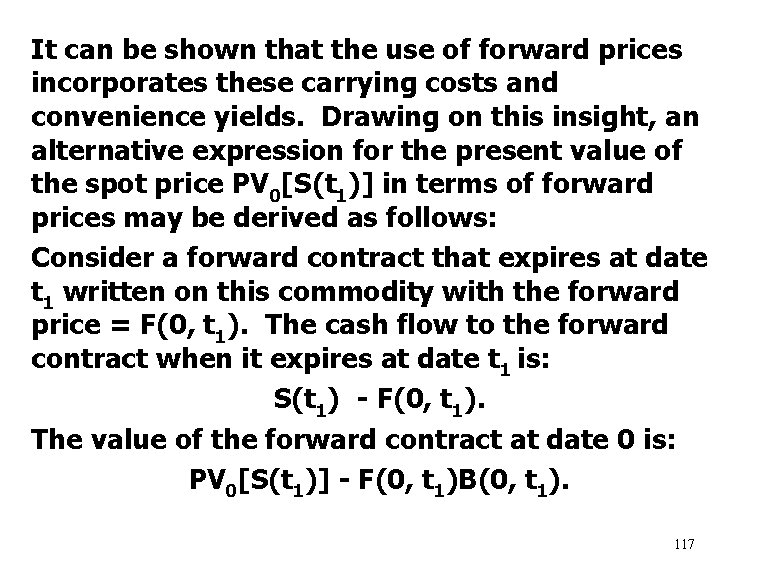
It can be shown that the use of forward prices incorporates these carrying costs and convenience yields. Drawing on this insight, an alternative expression for the present value of the spot price PV 0[S(t 1)] in terms of forward prices may be derived as follows: Consider a forward contract that expires at date t 1 written on this commodity with the forward price = F(0, t 1). The cash flow to the forward contract when it expires at date t 1 is: S(t 1) - F(0, t 1). The value of the forward contract at date 0 is: PV 0[S(t 1)] - F(0, t 1)B(0, t 1). 117
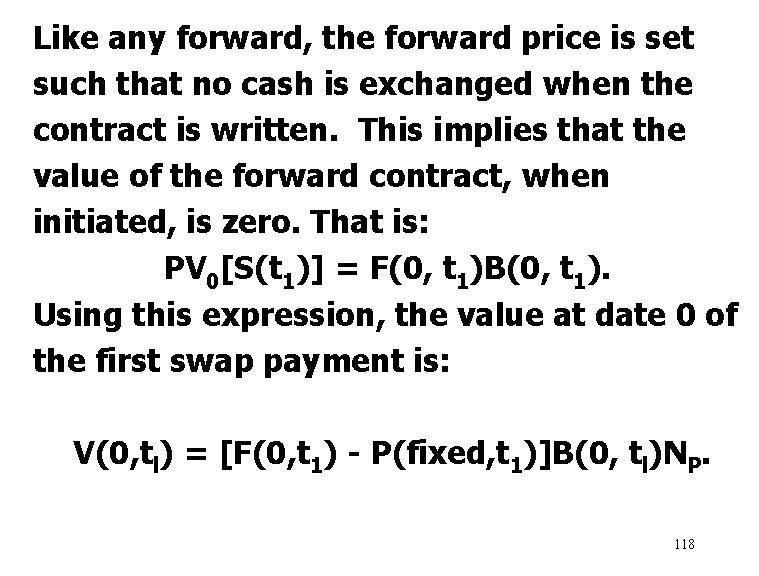
Like any forward, the forward price is set such that no cash is exchanged when the contract is written. This implies that the value of the forward contract, when initiated, is zero. That is: PV 0[S(t 1)] = F(0, t 1)B(0, t 1). Using this expression, the value at date 0 of the first swap payment is: V(0, tl) = [F(0, t 1) - P(fixed, t 1)]B(0, tl)NP. 118
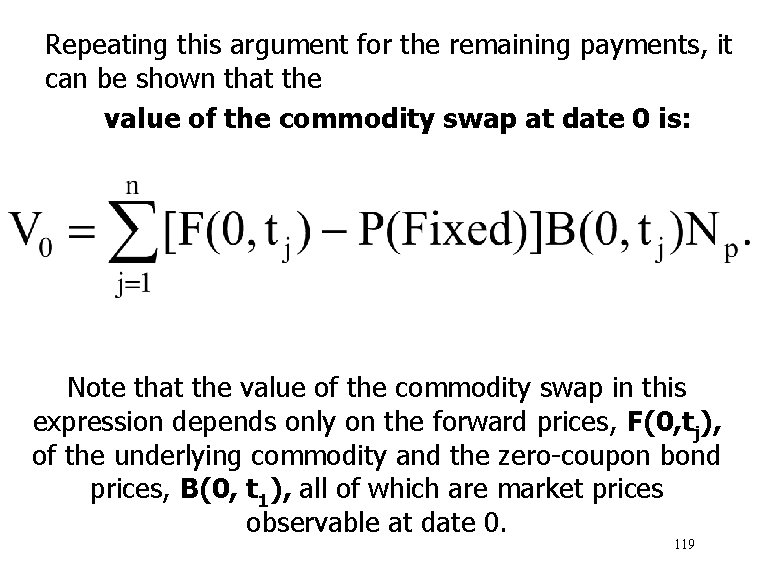
Repeating this argument for the remaining payments, it can be shown that the value of the commodity swap at date 0 is: Note that the value of the commodity swap in this expression depends only on the forward prices, F(0, tj), of the underlying commodity and the zero-coupon bond prices, B(0, t 1), all of which are market prices observable at date 0. 119
FINANCIAL ENGINEERING 1 From the derivatives trading room of BP: Hedging the sale and purchase of Natural Gas, using NYMEX Natural Gas futures and creating a sure profit margin Employing a swap of the remaining spread. 120
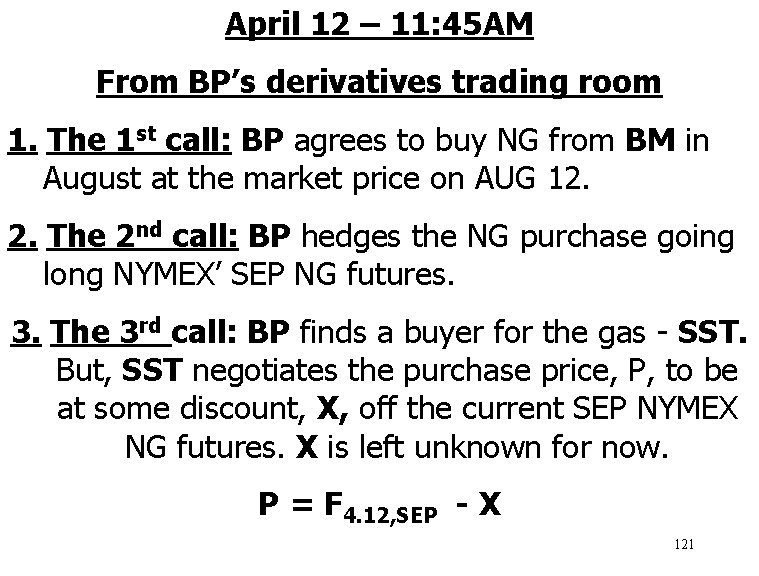
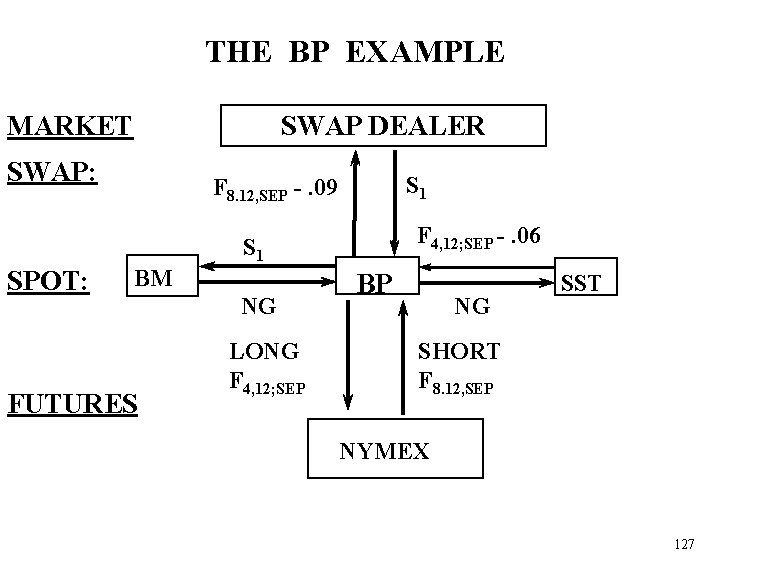
April 12 – 11: 45 AM From BP’s derivatives trading room 1. The 1 st call: BP agrees to buy NG from BM in August at the market price on AUG 12. 2. The 2 nd call: BP hedges the NG purchase going long NYMEX’ SEP NG futures. 3. The 3 rd call: BP finds a buyer for the gas - SST. But, SST negotiates the purchase price, P, to be at some discount, X, off the current SEP NYMEX NG futures. X is left unknown for now. P = F 4. 12, SEP - X 121
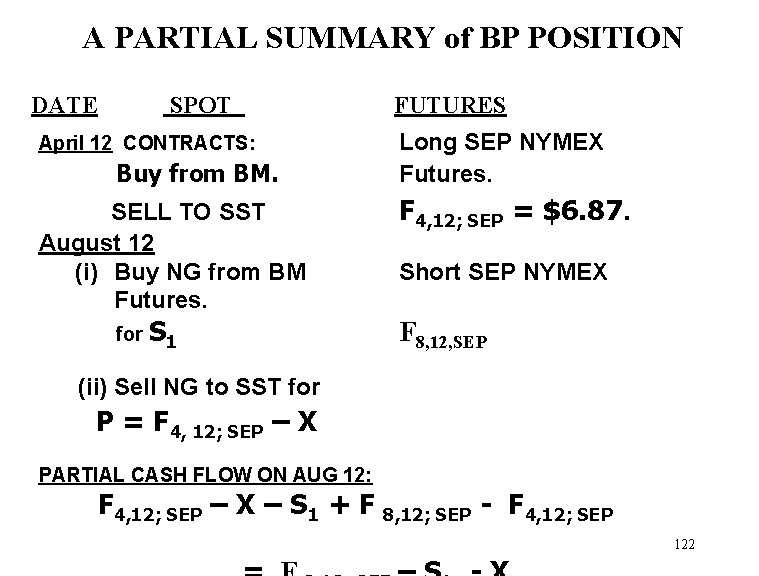
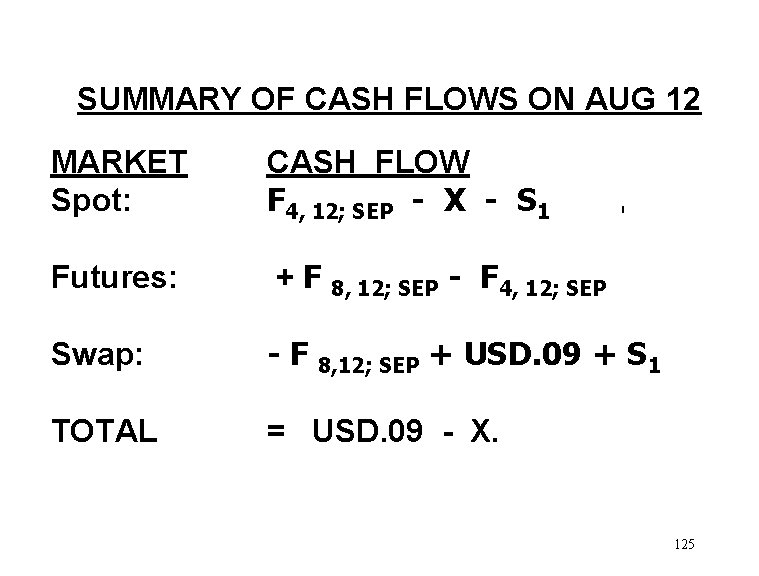
A PARTIAL SUMMARY of BP POSITION DATE SPOT April 12 CONTRACTS: Buy from BM. SELL TO SST August 12 (i) Buy NG from BM Futures. for S 1 FUTURES Long SEP NYMEX Futures. F 4, 12; SEP = $6. 87. Short SEP NYMEX F 8, 12, SEP (ii) Sell NG to SST for P = F 4, 12; SEP – X PARTIAL CASH FLOW ON AUG 12: F 4, 12; SEP – X – S 1 + F 8, 12; SEP - F 4, 12; SEP 122
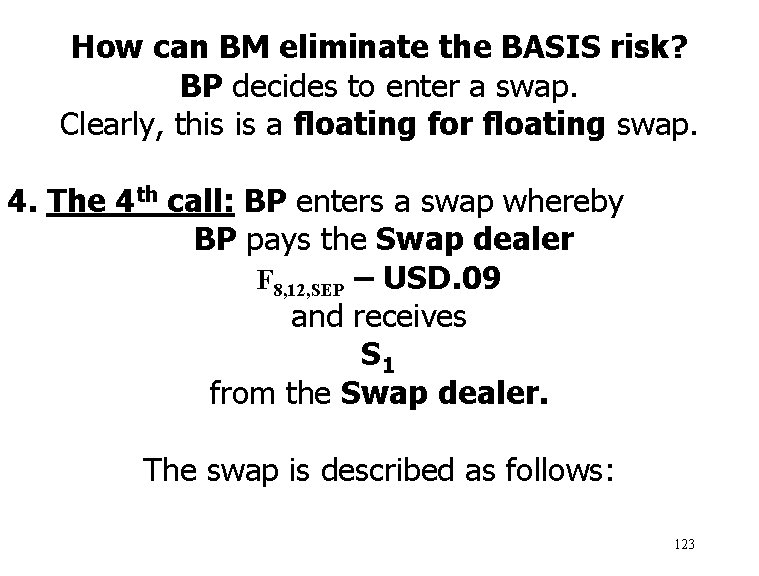
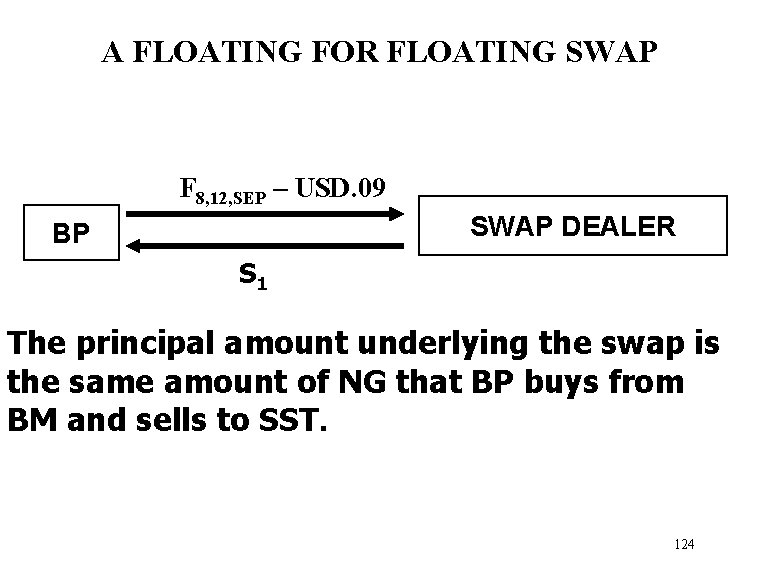
How can BM eliminate the BASIS risk? BP decides to enter a swap. Clearly, this is a floating for floating swap. 4. The 4 th call: BP enters a swap whereby BP pays the Swap dealer F 8, 12, SEP – USD. 09 and receives S 1 from the Swap dealer. The swap is described as follows: 123
A FLOATING FOR FLOATING SWAP F 8, 12, SEP – USD. 09 SWAP DEALER BP S 1 The principal amount underlying the swap is the same amount of NG that BP buys from BM and sells to SST. 124
SUMMARY OF CASH FLOWS ON AUG 12 MARKET Spot: CASH FLOW F 4, 12; SEP - X - S 1 Futures: + F 8, 12; SEP - F 4, 12; SEP Swap: - F 8, 12; SEP + USD. 09 + S 1 TOTAL = USD. 09 - X. 125
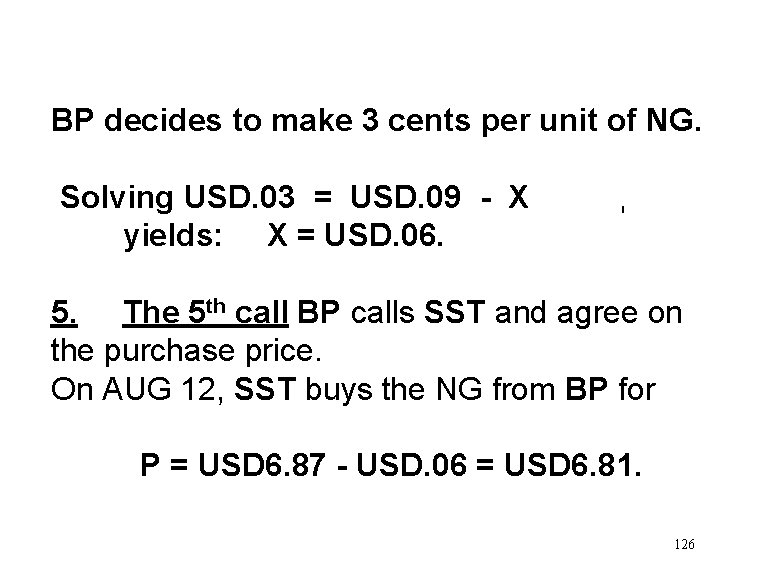
BP decides to make 3 cents per unit of NG. Solving USD. 03 = USD. 09 - X yields: X = USD. 06. 5. The 5 th call BP calls SST and agree on the purchase price. On AUG 12, SST buys the NG from BP for P = USD 6. 87 - USD. 06 = USD 6. 81. 126
THE BP EXAMPLE MARKET SWAP DEALER SWAP: S 1 F 8. 12, SEP -. 09 F 4, 12; SEP -. 06 S 1 SPOT: BM FUTURES NG LONG F 4, 12; SEP BP NG SST SHORT F 8. 12, SEP NYMEX 127
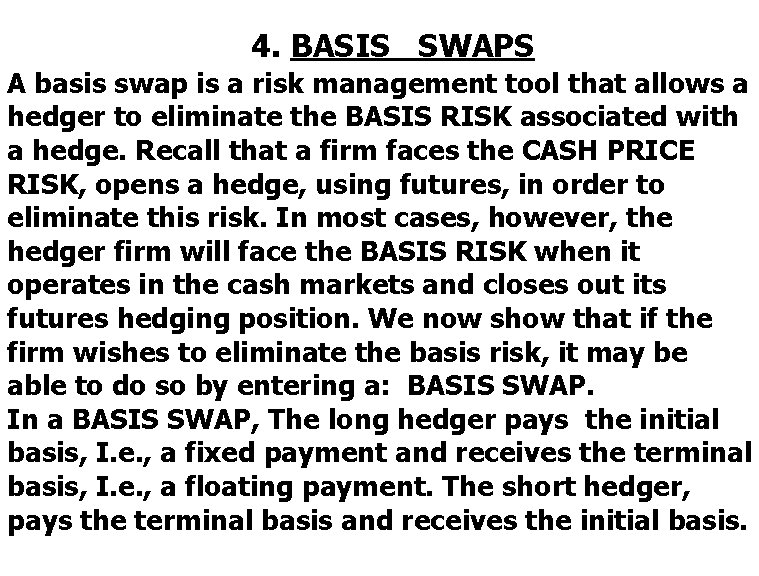
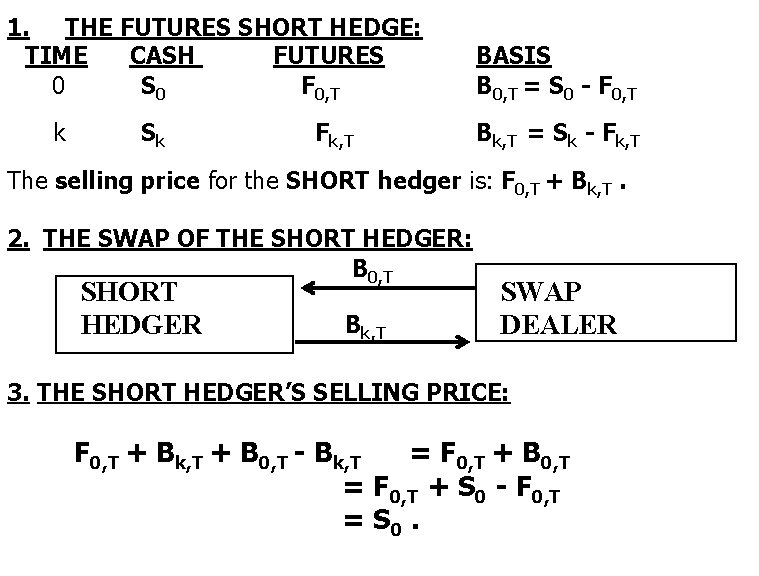
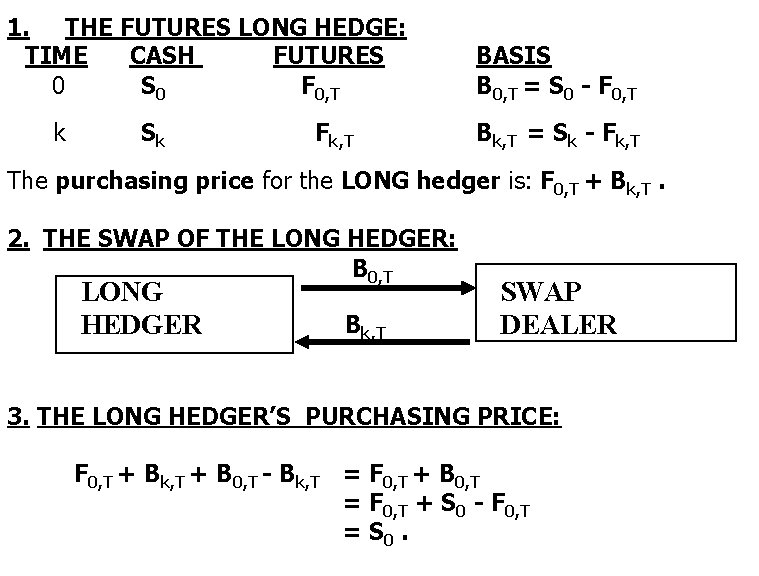
4. BASIS SWAPS A basis swap is a risk management tool that allows a hedger to eliminate the BASIS RISK associated with a hedge. Recall that a firm faces the CASH PRICE RISK, opens a hedge, using futures, in order to eliminate this risk. In most cases, however, the hedger firm will face the BASIS RISK when it operates in the cash markets and closes out its futures hedging position. We now show that if the firm wishes to eliminate the basis risk, it may be able to do so by entering a: BASIS SWAP. In a BASIS SWAP, The long hedger pays the initial basis, I. e. , a fixed payment and receives the terminal basis, I. e. , a floating payment. The short hedger, pays the terminal basis and receives the initial basis.
1. THE FUTURES SHORT HEDGE: TIME CASH FUTURES 0 S 0 F 0, T k Sk Fk, T BASIS B 0, T = S 0 - F 0, T Bk, T = Sk - Fk, T The selling price for the SHORT hedger is: F 0, T + Bk, T. 2. THE SWAP OF THE SHORT HEDGER: B 0, T SHORT HEDGER Bk, T SWAP DEALER 3. THE SHORT HEDGER’S SELLING PRICE: F 0, T + Bk, T + B 0, T - Bk, T = F 0, T + B 0, T = F 0, T + S 0 - F 0, T = S 0.
1. THE FUTURES LONG HEDGE: TIME CASH FUTURES 0 S 0 F 0, T k Sk Fk, T BASIS B 0, T = S 0 - F 0, T Bk, T = Sk - Fk, T The purchasing price for the LONG hedger is: F 0, T + Bk, T. 2. THE SWAP OF THE LONG HEDGER: B 0, T LONG HEDGER Bk, T SWAP DEALER 3. THE LONG HEDGER’S PURCHASING PRICE: F 0, T + Bk, T + B 0, T - Bk, T = F 0, T + B 0, T = F 0, T + S 0 - F 0, T = S 0.
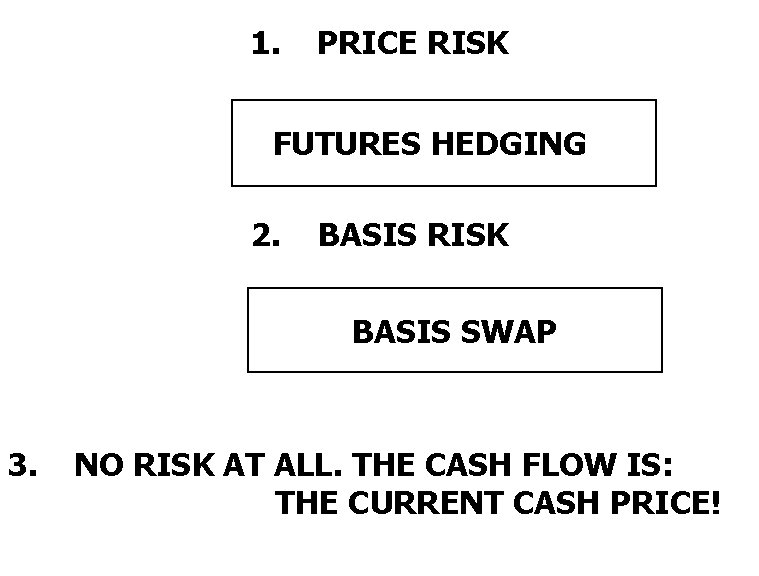
1. PRICE RISK FUTURES HEDGING 2. 3. BASIS RISK BASIS SWAP NO RISK AT ALL. THE CASH FLOW IS: THE CURRENT CASH PRICE!
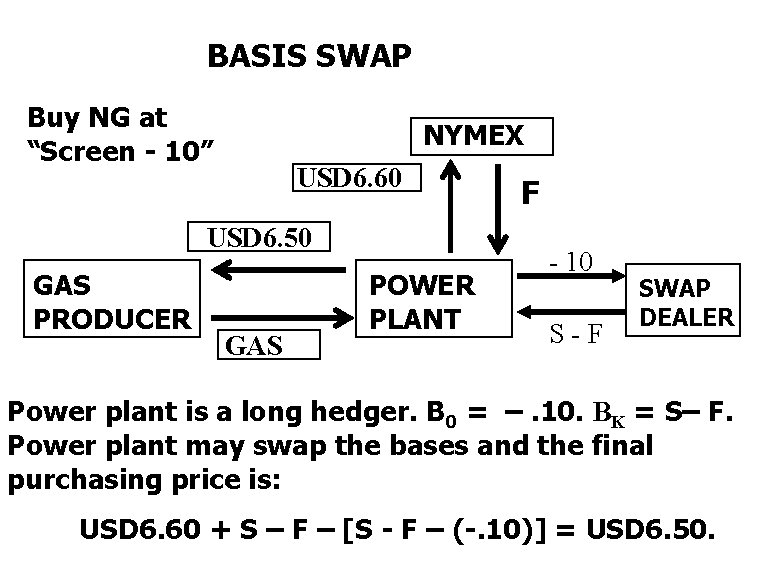
BASIS SWAP Buy NG at “Screen - 10” NYMEX USD 6. 60 USD 6. 50 GAS PRODUCER GAS POWER PLANT F - 10 S-F SWAP DEALER Power plant is a long hedger. B 0 = –. 10. BK = S– F. Power plant may swap the bases and the final purchasing price is: USD 6. 60 + S – F – [S - F – (-. 10)] = USD 6. 50.
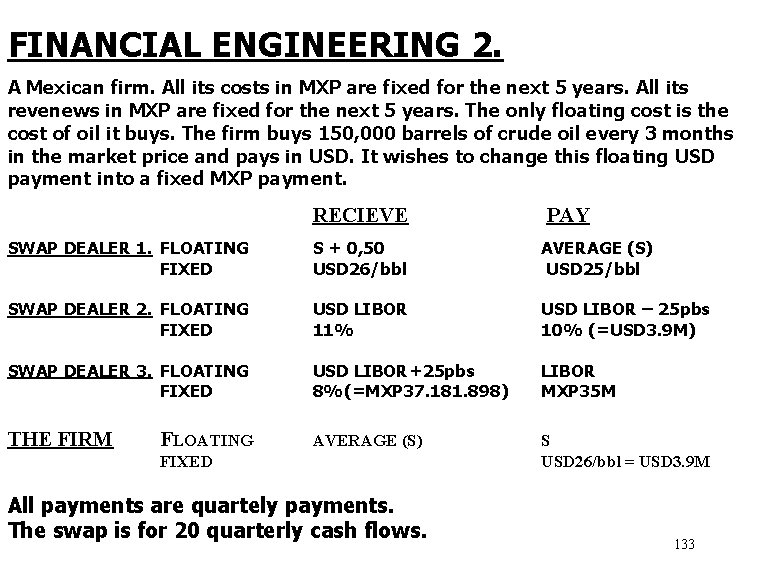
FINANCIAL ENGINEERING 2. A Mexican firm. All its costs in MXP are fixed for the next 5 years. All its revenews in MXP are fixed for the next 5 years. The only floating cost is the cost of oil it buys. The firm buys 150, 000 barrels of crude oil every 3 months in the market price and pays in USD. It wishes to change this floating USD payment into a fixed MXP payment. RECIEVE PAY SWAP DEALER 1. FLOATING FIXED S + 0, 50 USD 26/bbl SWAP DEALER 2. FLOATING FIXED USD LIBOR 11% USD LIBOR – 25 pbs 10% (=USD 3. 9 M) SWAP DEALER 3. FLOATING FIXED USD LIBOR+25 pbs 8%(=MXP 37. 181. 898) LIBOR MXP 35 M THE FIRM AVERAGE (S) S USD 26/bbl = USD 3. 9 M FLOATING FIXED All payments are quartely payments. The swap is for 20 quarterly cash flows. AVERAGE (S) USD 25/bbl 133
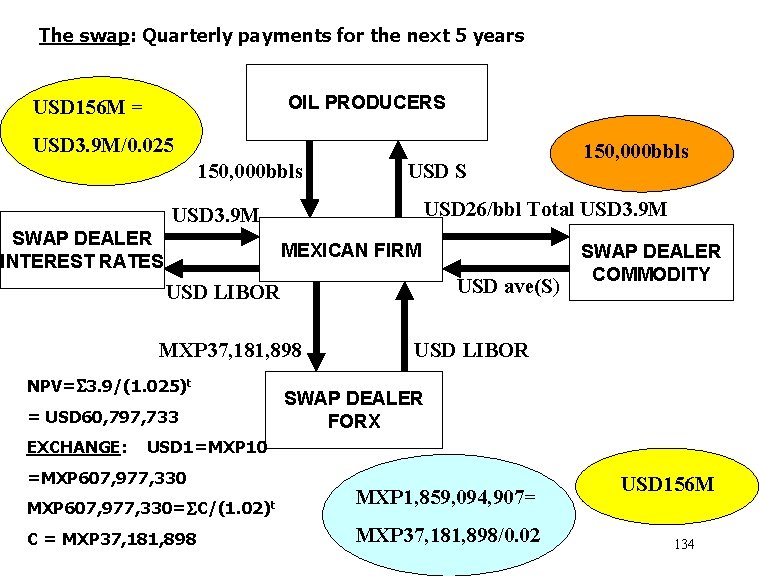
The swap: Quarterly payments for the next 5 years OIL PRODUCERS USD 156 M = USD 3. 9 M/0. 025 150, 000 bbls USD S USD 26/bbl Total USD 3. 9 M SWAP DEALER INTEREST RATES MEXICAN FIRM USD ave(S) USD LIBOR MXP 37, 181, 898 NPV= 3. 9/(1. 025)t = USD 60, 797, 733 150, 000 bbls SWAP DEALER COMMODITY USD LIBOR SWAP DEALER FORX EXCHANGE: USD 1=MXP 10 =MXP 607, 977, 330= C/(1. 02)t C = MXP 37, 181, 898 MXP 1, 859, 094, 907= MXP 37, 181, 898/0. 02 USD 156 M 134