
Tuesdays With Morrie CHAPTER QUESTIONS For each chapter






- Slides: 25
Tuesdays With Morrie CHAPTER QUESTIONS
For each chapter, you will have vocabulary and questions. You will complete the assignments in your notebook. I will check your questions and vocabulary every Tuesday On Friday nights, you will receive writing prompts. The writing prompts will also be due on Tuesdays.
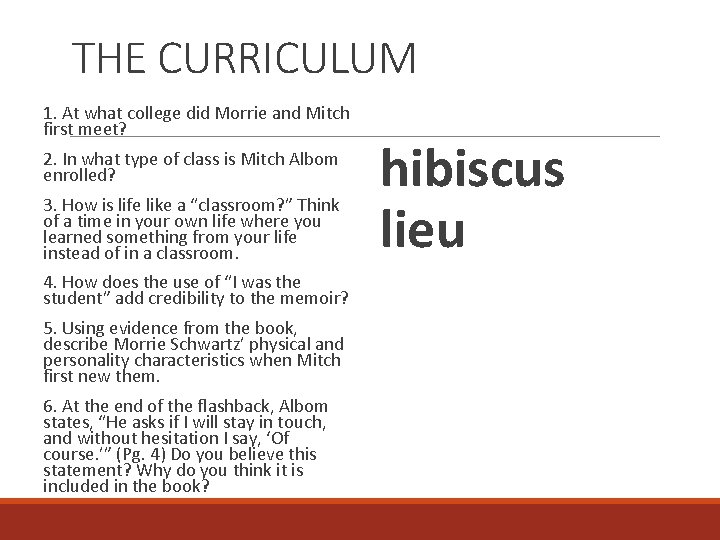
THE CURRICULUM 1. At what college did Morrie and Mitch first meet? 2. In what type of class is Mitch Albom enrolled? 3. How is life like a “classroom? ” Think of a time in your own life where you learned something from your life instead of in a classroom. 4. How does the use of “I was the student” add credibility to the memoir? 5. Using evidence from the book, describe Morrie Schwartz’ physical and personality characteristics when Mitch first new them. 6. At the end of the flashback, Albom states, “He asks if I will stay in touch, and without hesitation I say, ‘Of course. ’” (Pg. 4) Do you believe this statement? Why do you think it is included in the book? hibiscus lieu
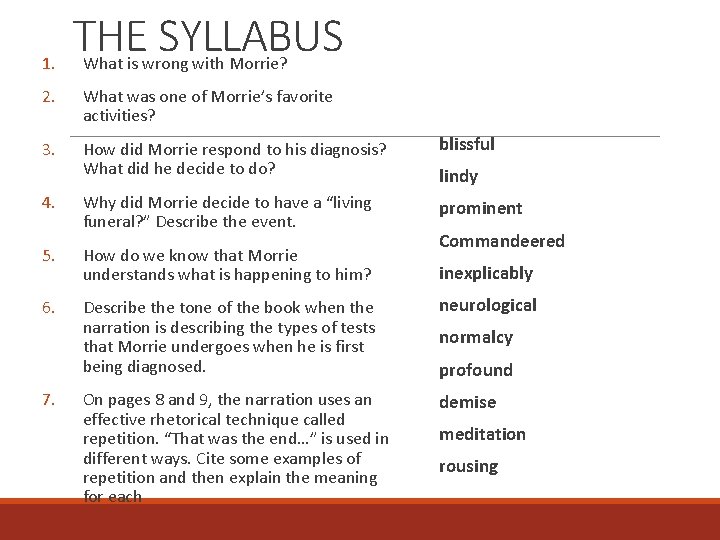
1. THE SYLLABUS What is wrong with Morrie? 2. What was one of Morrie’s favorite activities? 3. How did Morrie respond to his diagnosis? What did he decide to do? blissful Why did Morrie decide to have a “living funeral? ” Describe the event. prominent 5. How do we know that Morrie understands what is happening to him? inexplicably 6. Describe the tone of the book when the narration is describing the types of tests that Morrie undergoes when he is first being diagnosed. neurological On pages 8 and 9, the narration uses an effective rhetorical technique called repetition. “That was the end…” is used in different ways. Cite some examples of repetition and then explain the meaning for each demise 4. 7. lindy Commandeered normalcy profound meditation rousing
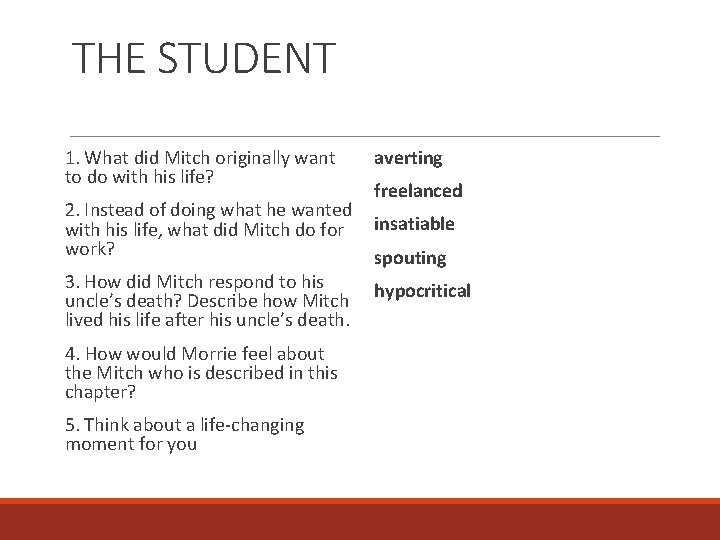
THE STUDENT 1. What did Mitch originally want to do with his life? averting freelanced 2. Instead of doing what he wanted with his life, what did Mitch do for insatiable work? spouting 3. How did Mitch respond to his hypocritical uncle’s death? Describe how Mitch lived his life after his uncle’s death. 4. How would Morrie feel about the Mitch who is described in this chapter? 5. Think about a life-changing moment for you
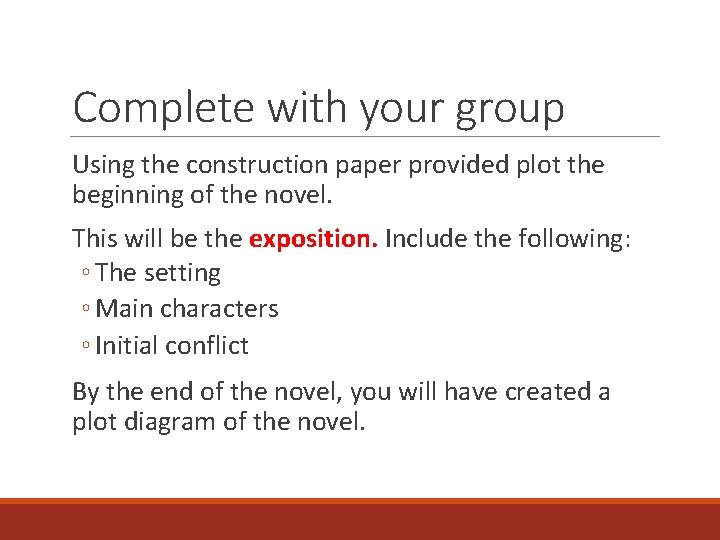
Complete with your group Using the construction paper provided plot the beginning of the novel. This will be the exposition. Include the following: ◦ The setting ◦ Main characters ◦ Initial conflict By the end of the novel, you will have created a plot diagram of the novel.
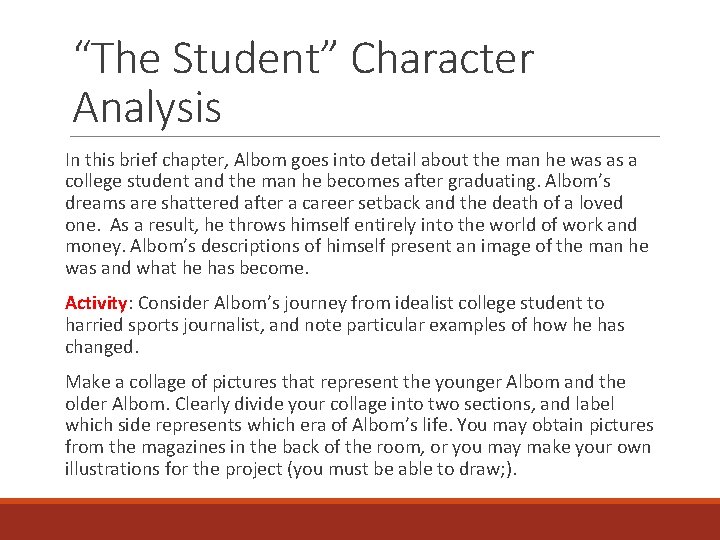
“The Student” Character Analysis In this brief chapter, Albom goes into detail about the man he was as a college student and the man he becomes after graduating. Albom’s dreams are shattered after a career setback and the death of a loved one. As a result, he throws himself entirely into the world of work and money. Albom’s descriptions of himself present an image of the man he was and what he has become. Activity: Consider Albom’s journey from idealist college student to harried sports journalist, and note particular examples of how he has changed. Make a collage of pictures that represent the younger Albom and the older Albom. Clearly divide your collage into two sections, and label which side represents which era of Albom’s life. You may obtain pictures from the magazines in the back of the room, or you may make your own illustrations for the project (you must be able to draw; ).
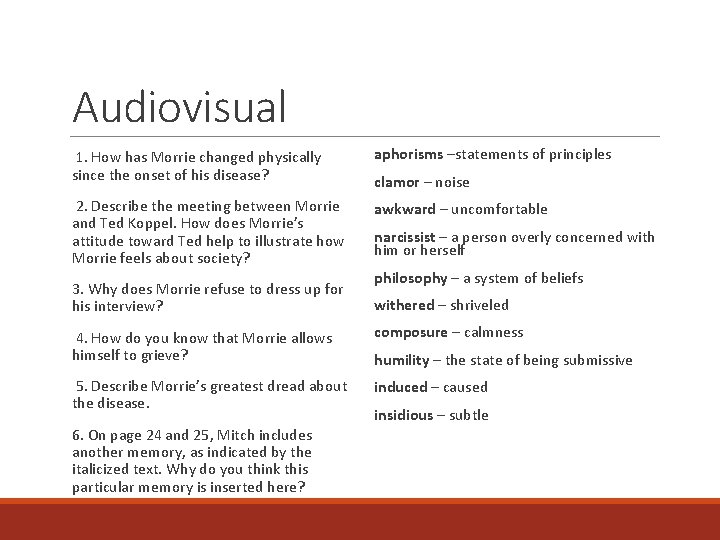
Audiovisual 1. How has Morrie changed physically since the onset of his disease? aphorisms –statements of principles 2. Describe the meeting between Morrie and Ted Koppel. How does Morrie’s attitude toward Ted help to illustrate how Morrie feels about society? awkward – uncomfortable 3. Why does Morrie refuse to dress up for his interview? 4. How do you know that Morrie allows himself to grieve? clamor – noise narcissist – a person overly concerned with him or herself philosophy – a system of beliefs withered – shriveled composure – calmness humility – the state of being submissive 5. Describe Morrie’s greatest dread about induced – caused the disease. insidious – subtle 6. On page 24 and 25, Mitch includes another memory, as indicated by the italicized text. Why do you think this particular memory is inserted here?
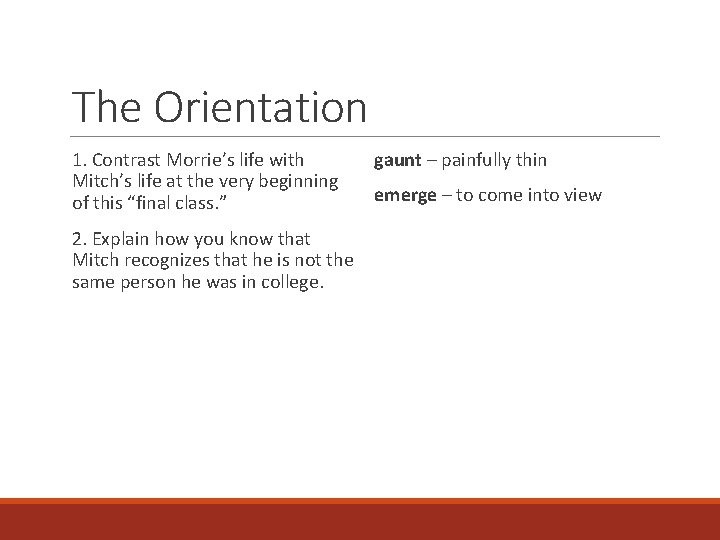
The Orientation 1. Contrast Morrie’s life with Mitch’s life at the very beginning of this “final class. ” 2. Explain how you know that Mitch recognizes that he is not the same person he was in college. gaunt – painfully thin emerge – to come into view
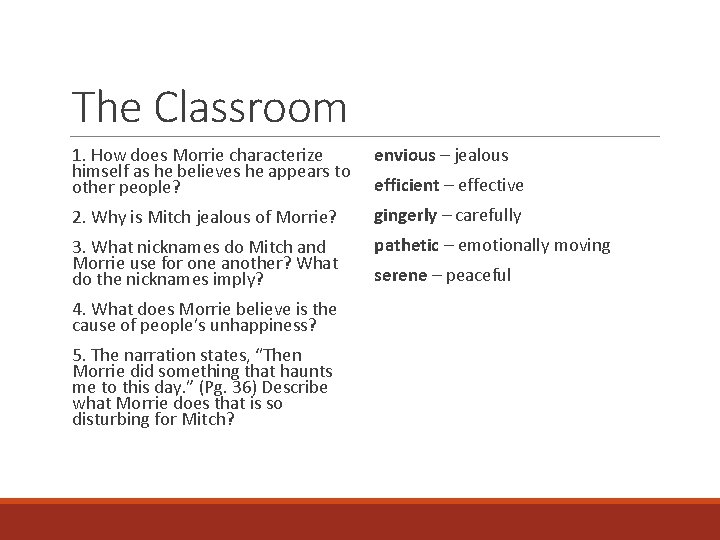
The Classroom 1. How does Morrie characterize envious – jealous himself as he believes he appears to efficient – effective other people? gingerly – carefully 2. Why is Mitch jealous of Morrie? 3. What nicknames do Mitch and Morrie use for one another? What do the nicknames imply? 4. What does Morrie believe is the cause of people’s unhappiness? 5. The narration states, “Then Morrie did something that haunts me to this day. ” (Pg. 36) Describe what Morrie does that is so disturbing for Mitch? pathetic – emotionally moving serene – peaceful
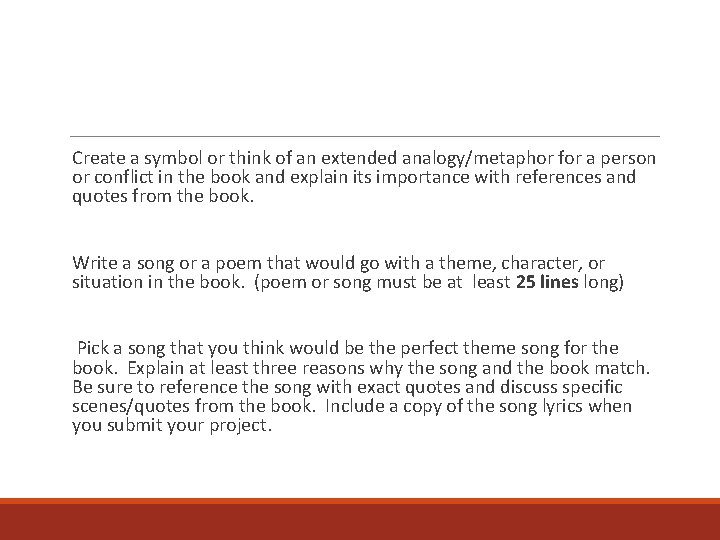
Create a symbol or think of an extended analogy/metaphor for a person or conflict in the book and explain its importance with references and quotes from the book. Write a song or a poem that would go with a theme, character, or situation in the book. (poem or song must be at least 25 lines long) Pick a song that you think would be the perfect theme song for the book. Explain at least three reasons why the song and the book match. Be sure to reference the song with exact quotes and discuss specific scenes/quotes from the book. Include a copy of the song lyrics when you submit your project.
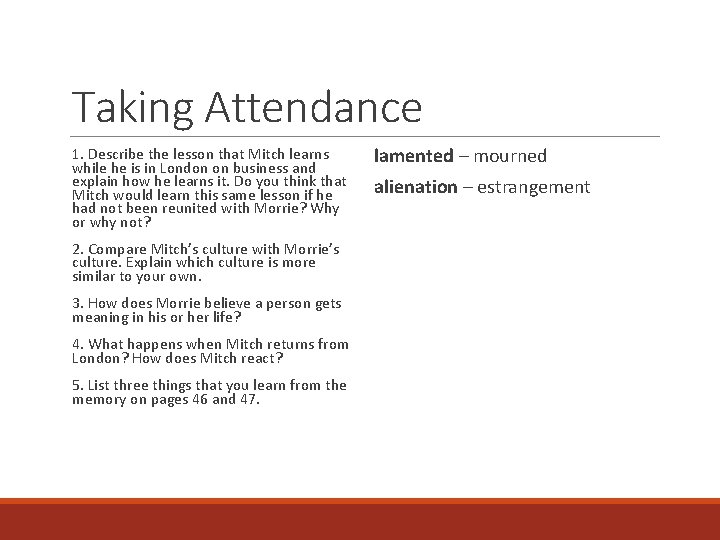
Taking Attendance 1. Describe the lesson that Mitch learns while he is in London on business and explain how he learns it. Do you think that Mitch would learn this same lesson if he had not been reunited with Morrie? Why or why not? 2. Compare Mitch’s culture with Morrie’s culture. Explain which culture is more similar to your own. 3. How does Morrie believe a person gets meaning in his or her life? 4. What happens when Mitch returns from London? How does Mitch react? 5. List three things that you learn from the memory on pages 46 and 47. lamented – mourned alienation – estrangement
The First Tuesday 1. How does Morrie view his dependency on other people? 2. Why does Morrie try to stay caught up on the news? To whom does Morrie feel the closest? is Morrie’s reaction to the world’s news different than Mitch’s reaction? 4. Explain the following quotation “Maybe death is the great equalizer, the one big thing that can finally make strangers shed a tear for one another. ” (Pg. 51) 5. Explain the connection between the title of the book and the story. 6. Morrie shares an aphorism with Mitch about love. What is the aphorism? What is your feeling about Morrie’s aphorism on love? atrophied – withered away cynical – distrustful anguish – pain and suffering agitated – bothered
The Second Tuesday 1. Describe how Mitch is changing through these Tuesday meetings. 2. How does food serve as a motif in the story? 3. How has the disease progressed? 4. Describe how Morrie perceives self-pity and mourning. 5. Would you consider Morrie a pessimist or an optimist? Explain your choice. 6. What is happening with the strike at Mitch’s newspaper? What does it illustrate in light of the conversations that Mitch and Morrie are having? 7. Describe the event that prompts Mitch to realize that time is running out with Morrie. mimicking – imitating hoisting – lifting
The Third Tuesday clamoring – insisting 1. What does Mitch decide to do in order to preserve his memories with Morrie? What is Mitch’s fear in asking Morrie for this intrusion? nostalgia – sentiment 2. How does Morrie feel about the tape recorded? ambivalence – uncertainty 3. Explain the irony in the following passage: 4. When Mitch fi rst sees Morrie on Nightline, what does Mitch wonder? 5. Does Mitch have any regrets about his life? Explain. 6. How does Morrie respond to Mitch’s question? 7. What conclusion does Mitch make about Morrie’s response? imminent – threatening egotistical – filled with selfimportance grapple – to struggle opiate – painkilling drug
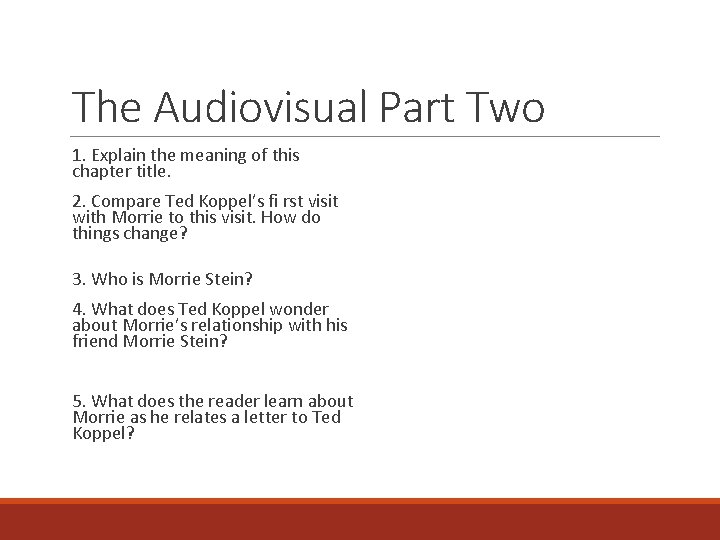
The Audiovisual Part Two 1. Explain the meaning of this chapter title. 2. Compare Ted Koppel’s fi rst visit with Morrie to this visit. How do things change? 3. Who is Morrie Stein? 4. What does Ted Koppel wonder about Morrie’s relationship with his friend Morrie Stein? 5. What does the reader learn about Morrie as he relates a letter to Ted Koppel?
The Professor 1. Explain the connection between this chapter and the previous chapter. How does the focus of this chapter change from the story so far? 2. How is the way Morrie confronted his mother’s death similar to the way Mitch confronted Morrie’s death? 3. Describe Morrie’s childhood. 4. Describe how does Morrie’s childhood influence his adulthood? 5. Does Mitch agree with Morrie’s career choice? How do you know? synagogue – a Jewish place of worship murky – dark boccie – a game like bowling antidote – a remedy and heavy
The Fourth Tuesday 1. Describe Morrie’s mood as the chapter begins. indecipherable – incapable of being understood 2. As Mitch and Morrie sit to talk about death, what is going on in the world? solidarity – unity 3. What imagery is used to describe Morrie’s plastic breathing tube? 4. What does Morrie believe are people’s attitudes about death? agnostic – a person who is not convinced that God exists transcend – to overcome exuberance – extreme joy 5. According to the book, what question should a quivered – shook person ask himself or herself everyday in order to live life to the fullest? ambitious – motivated 6. What does Morrie observe about Mitch’s life? deficient – lacking Do you think his observation is correct? Explain why or why not. materialistic – characterized by a belief that importance comes from only money 7. Describe Mitch’s attitude toward spiritualism? 8. Explain the significance of the line: “The disease owns him. ” (Pg. 88)
The Fifth Tuesday 1. How is this Tuesday different than the other Tuesdays? 2. “The fact is, there is no foundation, no secure ground, upon which people may stand today if it isn’t the family” (Pg. 91) How is this concept demonstrated in Morrie’s life? 3. Cite the imperative that Morrie makes Mitch write. Why is it so important to Morrie? 4. What causes Morrie to become so emotional? 5. What does Morrie imply when he says: “There is no experience like having children. That’s all. There’s no substitute for it. You cannot do it with a friend. You cannot do it with a lover. If you want the experience of having complete responsibility for another human being, and to learn how to love and bond in the deepest way, then you should have children. ” (Pg. 92) Would Morrie agree that everyone should have children? Why or why not? 6. Describe the differences between Mitch and his brother. 7. How does his brother deal with the illness? 8. How does the memory that Mitch inserts in the story connect with the previous chapter? lavaliere – to hang on the lapel responsive – capable of seeing a result
The Sixth Tuesday 1. What does the food that Mitch brings Morrie represent in this chapter? 2. What does Charlotte tell Mitch that he brings to Morrie? Why does she tell him this? 3. Explain the changes in Morrie’s physical condition. 4. What does Morrie want Mitch to learn how to do? Why does this confuse Mitch? 5. Explain Morrie’s “Theory of Detachment. ” 6. How does Morrie want to die? Why? laurels – small trees with red or white fl owers lilting – rhythmic impermanent – temporary vulnerability – openness instinctively – prompted by a natural tendency
The Professor, Part Two 1. Before Morrie is a professor, where does he work? Why? deceptively – misleadingly 2. What does Morrie learn through his observations of the female patient at the hospital? snarled – snapped exploiting – taking advantage of deferments – postponement of 3. How does what the reader learns military service about Morrie in this chapter reflect levitate – to raise above the ground what Morrie tries to teach Mitch? 4. As Mitch learns about life through Morrie’s experiences with death, he also learns about how different cultures view death. What is the purpose of including what he learns about the tribe in The Arctic?
The Seventh Tuesday 1. The chapter begins with the following lines: inclination – a tendency sultry – seductive-looking “Morrie lost his battle. Someone Inadequacy –insufficiency was now wiping his behind. ” (Pg. 115) How is this a turning point for Morrie? How does he deal with the manipulating – unfairly controlling situation? revel – to take pleasure in 2. Why has Mitch gone from being proud of saying his age to not wanting to bring it in to conversation? What is Morrie’s response? 3. What does Morrie envy about young people?
The Eighth Tuesday 1. How does Morrie feel about music? How does mogul – a great and important person this connect with what he is trying to teach Mitch about money? disillusioned – dissatisfied 2. Agree or disagree with the following passage from the book and explain your reasoning. comradeship – friendship colleagues – associates “These were people so hungry for love that they were accepting substitutes. They were embracing inconsequential – unimportant material things and expecting a sort of hug back. But it never works. You can’t substitute material things for love or for gentleness or for tenderness or for a sense of comradeship. ” (Pg. 125) 3. How does Morrie believe a person should find a meaningful life? Cite the passage directly from the book. 4. How does Mitch feel about his life as it reflects his attitude toward materialism? 5. According to the quote on page 129 by Mahatma Gandhi, does one have to die to be reborn? Explain.
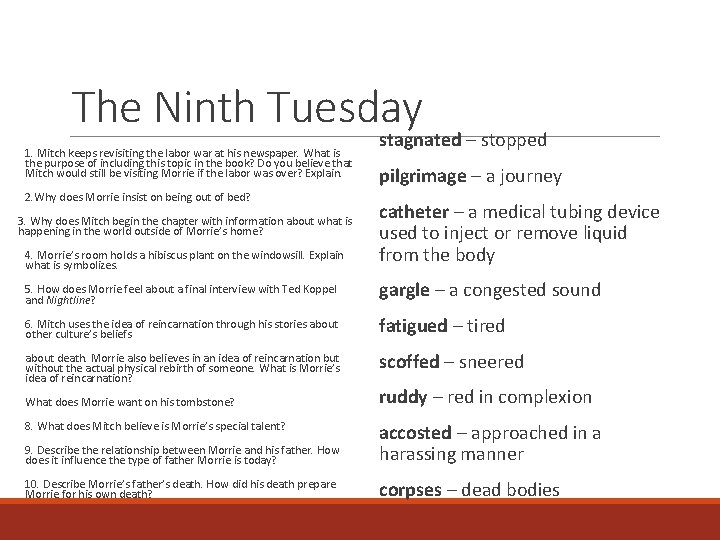
The Ninth Tuesday 1. Mitch keeps revisiting the labor war at his newspaper. What is the purpose of including this topic in the book? Do you believe that Mitch would still be visiting Morrie if the labor was over? Explain. 2. Why does Morrie insist on being out of bed? 3. Why does Mitch begin the chapter with information about what is happening in the world outside of Morrie’s home? 4. Morrie’s room holds a hibiscus plant on the windowsill. Explain what is symbolizes. stagnated – stopped pilgrimage – a journey catheter – a medical tubing device used to inject or remove liquid from the body 5. How does Morrie feel about a final interview with Ted Koppel and Nightline? gargle – a congested sound 6. Mitch uses the idea of reincarnation through his stories about other culture’s beliefs fatigued – tired about death. Morrie also believes in an idea of reincarnation but without the actual physical rebirth of someone. What is Morrie’s idea of reincarnation? scoffed – sneered What does Morrie want on his tombstone? 8. What does Mitch believe is Morrie’s special talent? ruddy – red in complexion 9. Describe the relationship between Morrie and his father. How does it influence the type of father Morrie is today? accosted – approached in a harassing manner 10. Describe Morrie’s father’s death. How did his death prepare Morrie for his own death? corpses – dead bodies
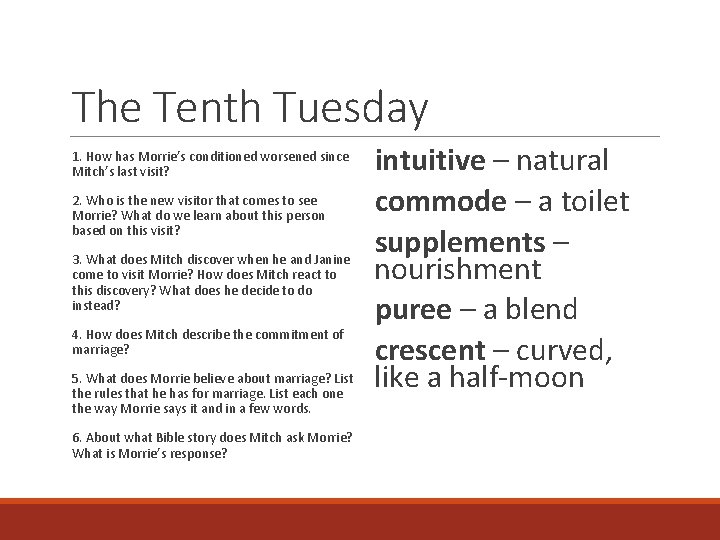
The Tenth Tuesday 1. How has Morrie’s conditioned worsened since Mitch’s last visit? 2. Who is the new visitor that comes to see Morrie? What do we learn about this person based on this visit? 3. What does Mitch discover when he and Janine come to visit Morrie? How does Mitch react to this discovery? What does he decide to do instead? 4. How does Mitch describe the commitment of marriage? 5. What does Morrie believe about marriage? List the rules that he has for marriage. List each one the way Morrie says it and in a few words. 6. About what Bible story does Mitch ask Morrie? What is Morrie’s response? intuitive – natural commode – a toilet supplements – nourishment puree – a blend crescent – curved, like a half-moon