Refactoring Erlang with Wrangler Huiqing Li Simon Thompson

- Slides: 60
Refactoring Erlang with Wrangler Huiqing Li Simon Thompson School of Computing University of Kent
Overview Refactoring. Tools and tool building. Clone detection. Improve module structure. Tool demo …
Introduction
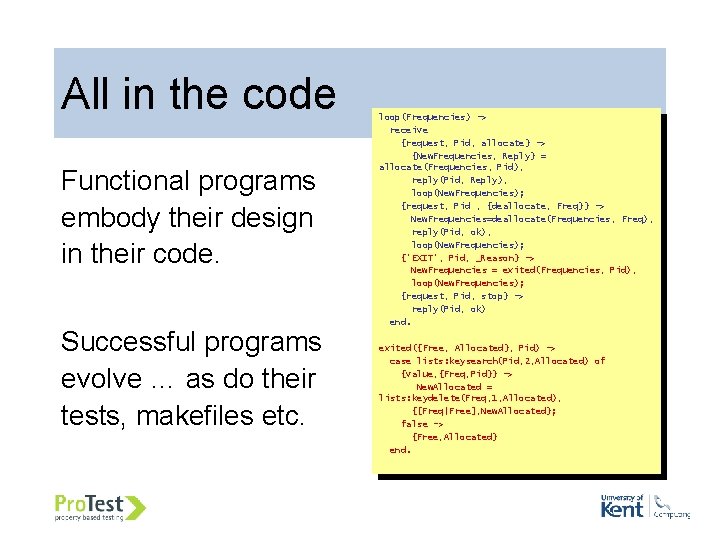
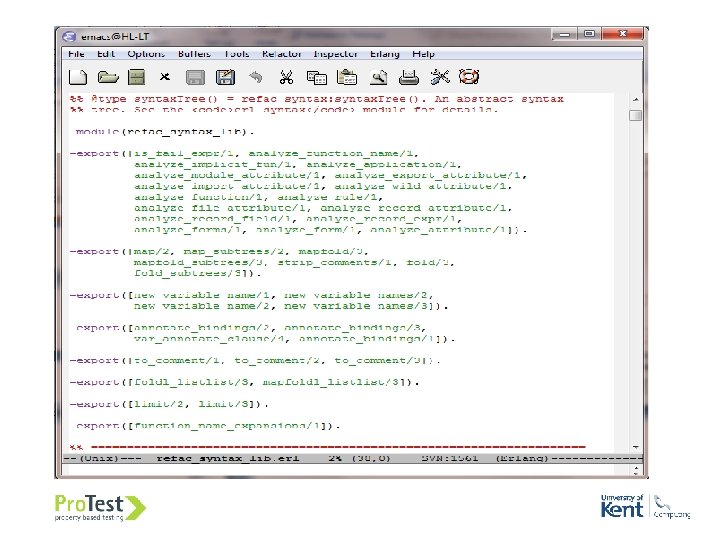
All in the code Functional programs embody their design in their code. Successful programs evolve … as do their tests, makefiles etc. loop(Frequencies) -> receive {request, Pid, allocate} -> {New. Frequencies, Reply} = allocate(Frequencies, Pid), reply(Pid, Reply), loop(New. Frequencies); {request, Pid , {deallocate, Freq}} -> New. Frequencies=deallocate(Frequencies, Freq), reply(Pid, ok), loop(New. Frequencies); {'EXIT', Pid, _Reason} -> New. Frequencies = exited(Frequencies, Pid), loop(New. Frequencies); {request, Pid, stop} -> reply(Pid, ok) end. exited({Free, Allocated}, Pid) -> case lists: keysearch(Pid, 2, Allocated) of {value, {Freq, Pid}} -> New. Allocated = lists: keydelete(Freq, 1, Allocated), {[Freq|Free], New. Allocated}; false -> {Free, Allocated} end.
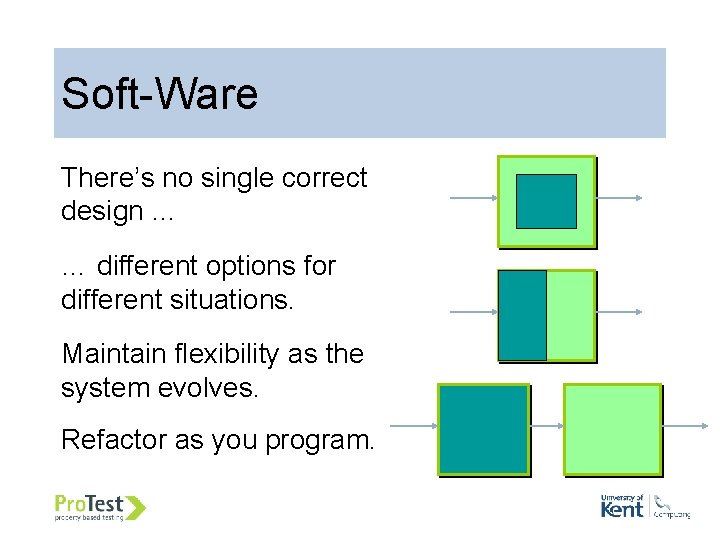
Soft-Ware There’s no single correct design … … different options for different situations. Maintain flexibility as the system evolves. Refactor as you program.
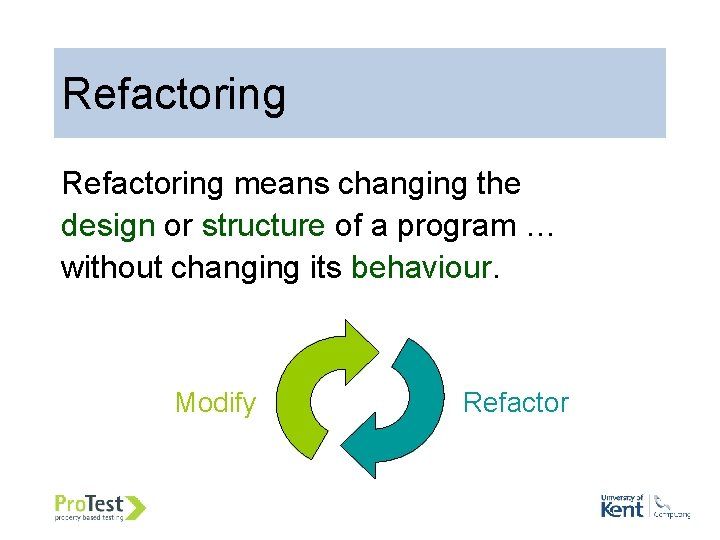
Refactoring means changing the design or structure of a program … without changing its behaviour. Modify Refactor
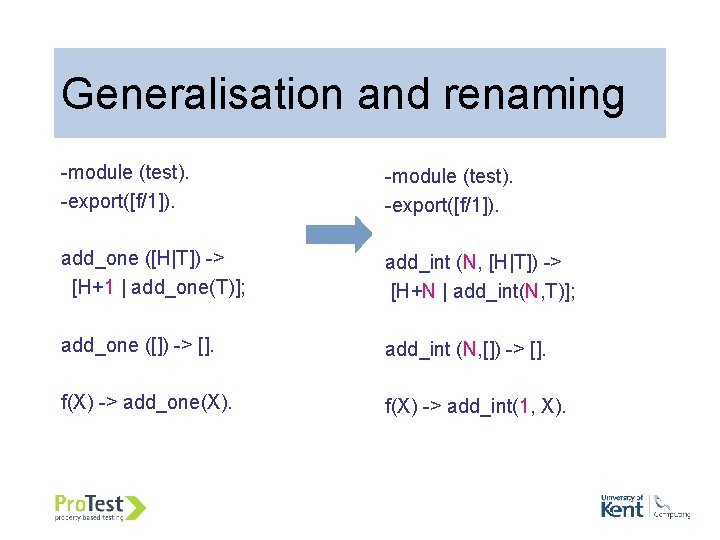
Generalisation and renaming -module (test). -export([f/1]). add_one ([H|T]) -> [H+1 | add_one(T)]; -module (test). -export([f/1]). add_one (N, [H|T]) -> add_int (N, [H|T]) -> [H+N | add_one(N, T)]; [H+N | add_int(N, T)]; add_one ([]) -> []. add_one (N, []) -> []. add_int (N, []) -> []. f(X) -> add_one(X). f(X) -> add_one(1, X). f(X) -> add_int(1, X).
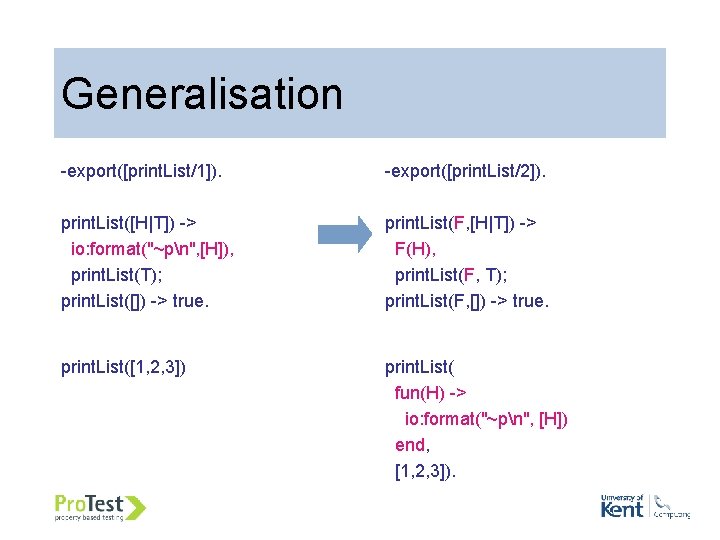
Generalisation -export([print. List/1]). -export([print. List/2]). print. List([H|T]) -> io: format("~pn", [H]), print. List(T); print. List([]) -> true. print. List(F, [H|T]) -> F(H), print. List(F, T); print. List(F, []) -> true. print. List([1, 2, 3]) print. List( fun(H) -> io: format("~pn", [H]) end, [1, 2, 3]).
The tool
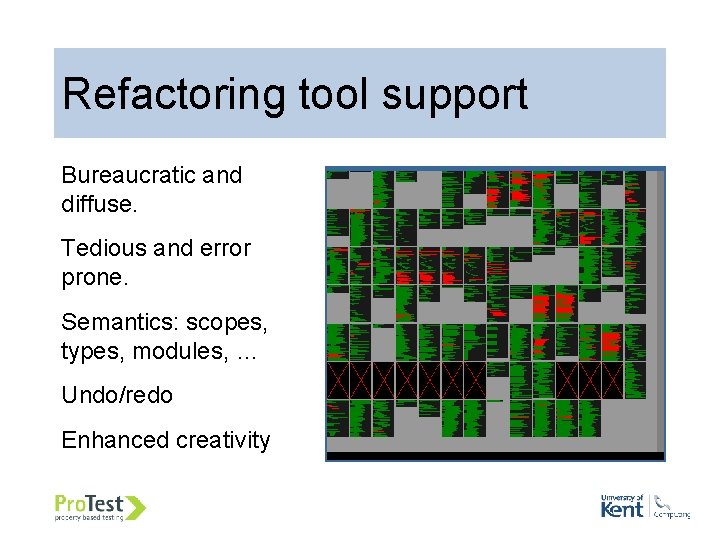
Refactoring tool support Bureaucratic and diffuse. Tedious and error prone. Semantics: scopes, types, modules, … Undo/redo Enhanced creativity
Wrangler Refactoring tool for Erlang Integrated into Emacs and Eclipse Multiple modules Structural, process, macro refactorings Duplicate code detection … … and elimination Testing / refactoring "Similar" code identification Code Inspection Property discovery
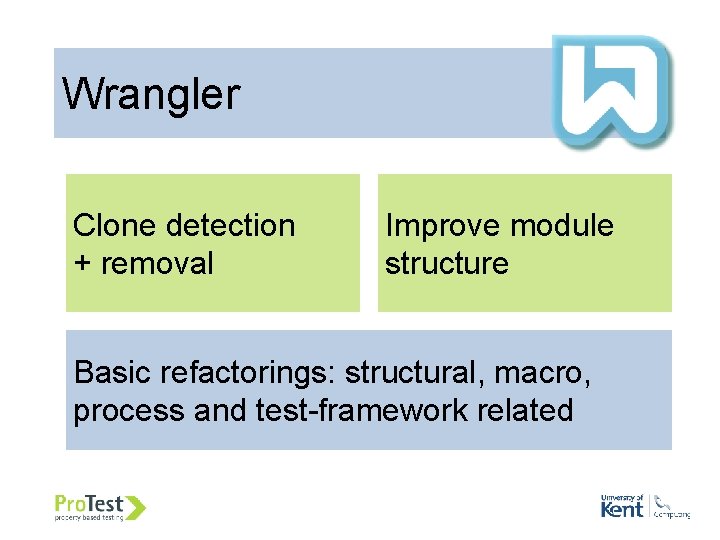
Wrangler Clone detection + removal Improve module structure Basic refactorings: structural, macro, process and test-framework related
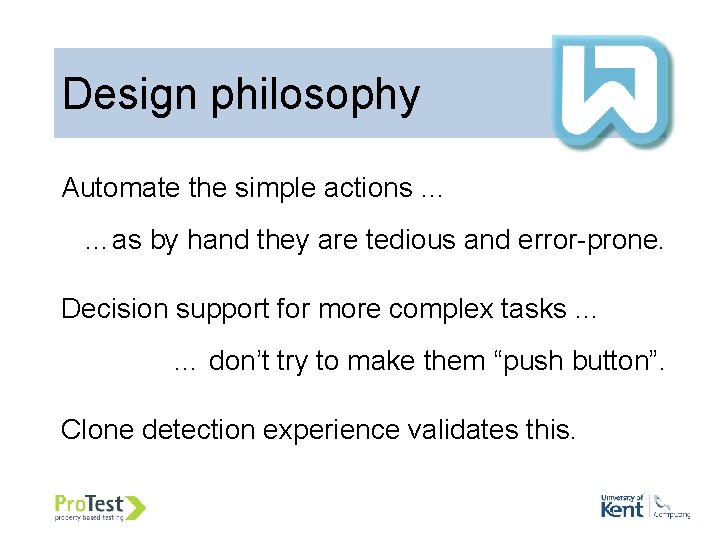
Design philosophy Automate the simple actions … …as by hand they are tedious and error-prone. Decision support for more complex tasks … … don’t try to make them “push button”. Clone detection experience validates this.
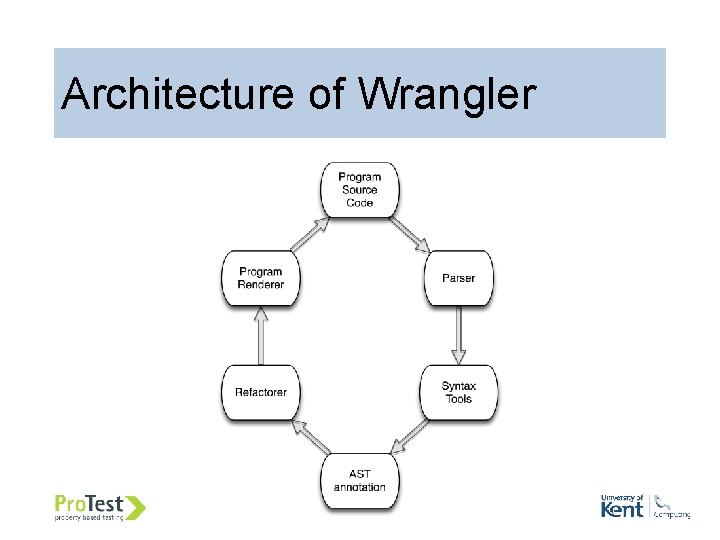
Architecture of Wrangler
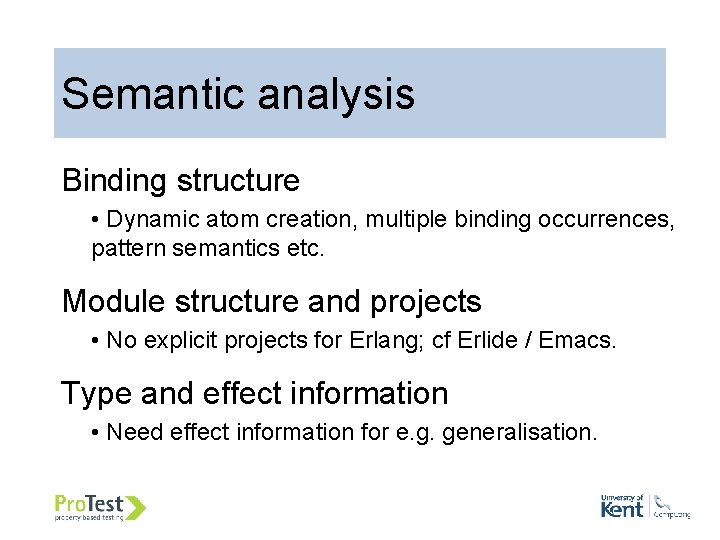
Semantic analysis Binding structure • Dynamic atom creation, multiple binding occurrences, pattern semantics etc. Module structure and projects • No explicit projects for Erlang; cf Erlide / Emacs. Type and effect information • Need effect information for e. g. generalisation.
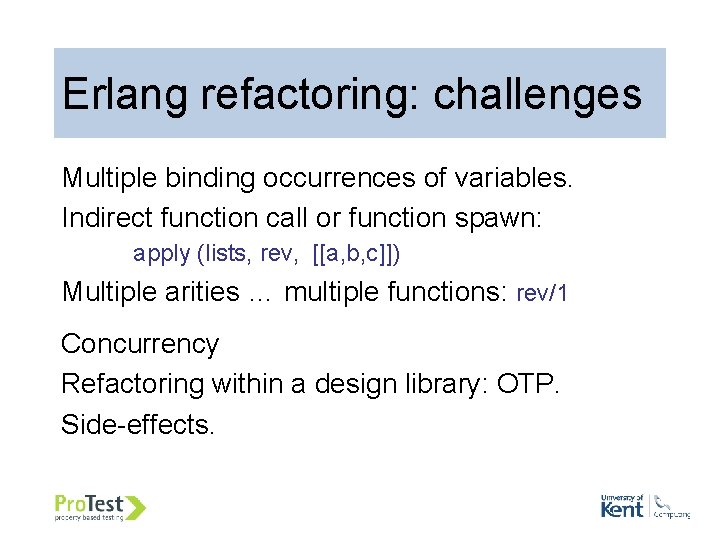
Erlang refactoring: challenges Multiple binding occurrences of variables. Indirect function call or function spawn: apply (lists, rev, [[a, b, c]]) Multiple arities … multiple functions: rev/1 Concurrency Refactoring within a design library: OTP. Side-effects.
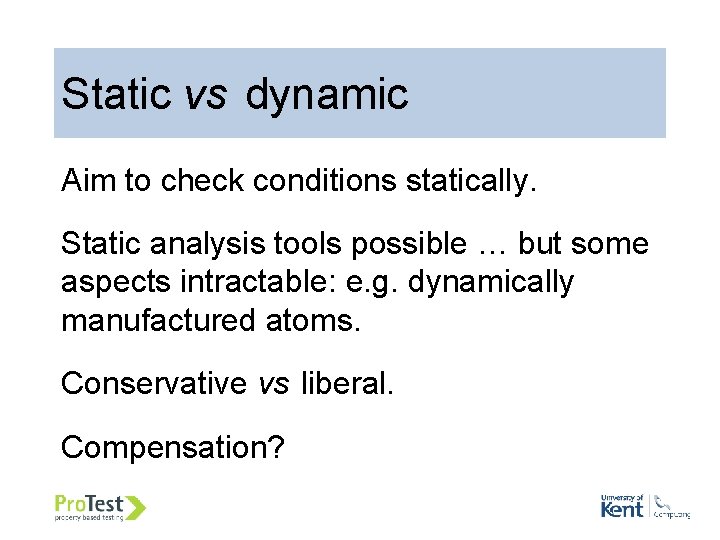
Static vs dynamic Aim to check conditions statically. Static analysis tools possible … but some aspects intractable: e. g. dynamically manufactured atoms. Conservative vs liberal. Compensation?
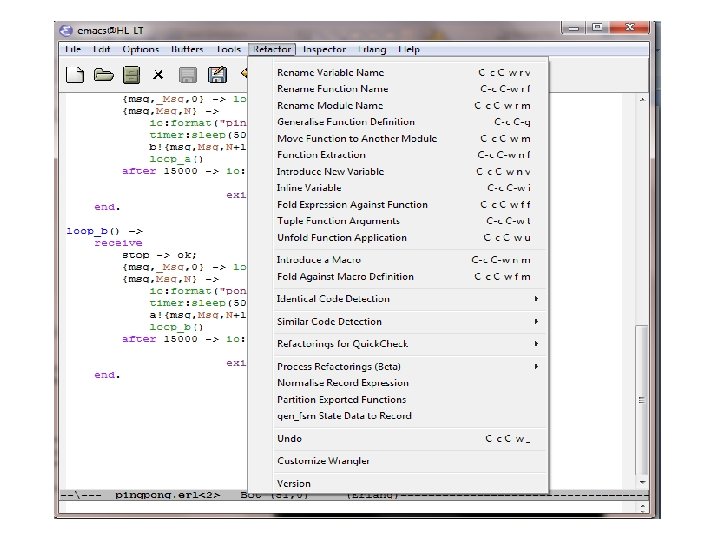
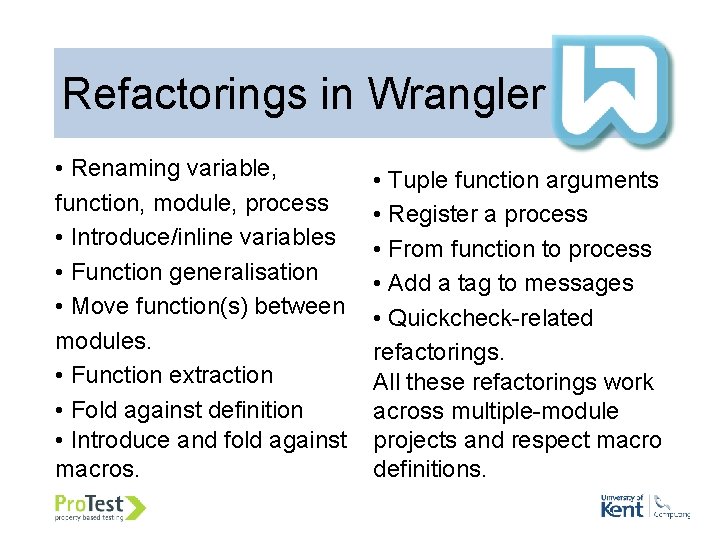
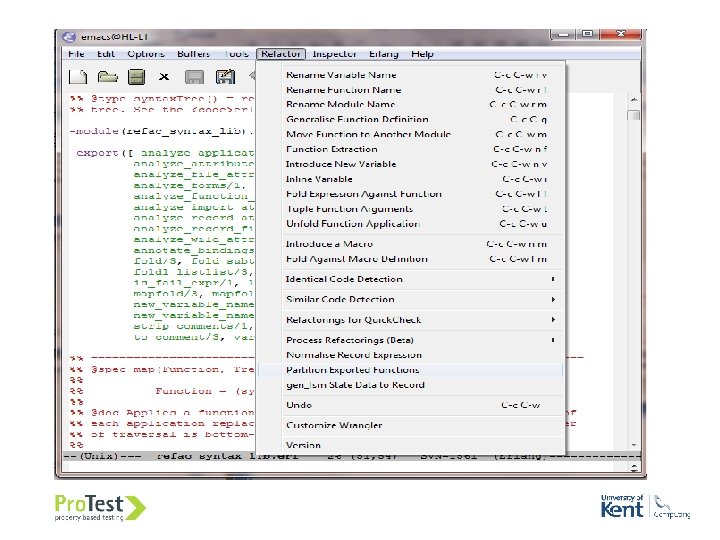
Refactorings in Wrangler • Renaming variable, • Tuple function arguments function, module, process • Register a process • Introduce/inline variables • From function to process • Function generalisation • Add a tag to messages • Move function(s) between • Quickcheck-related modules. refactorings. • Function extraction All these refactorings work • Fold against definition across multiple-module • Introduce and fold against projects and respect macro definitions. macros.
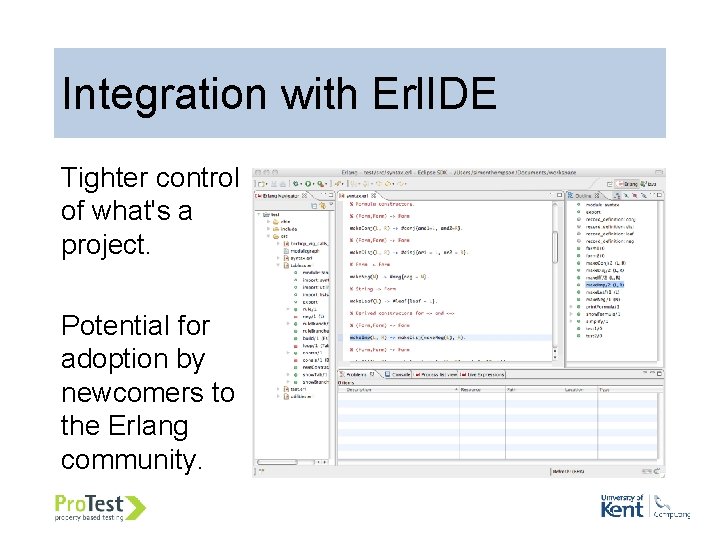
Integration with Erl. IDE Tighter control of what's a project. Potential for adoption by newcomers to the Erlang community.
Tool Demo
Clone detection
Duplicate code considered harmful It’s a bad smell … • increases chance of bug propagation, • increases size of the code, • increases compile time, and, • increases the cost of maintenance. But … it’s not always a problem.
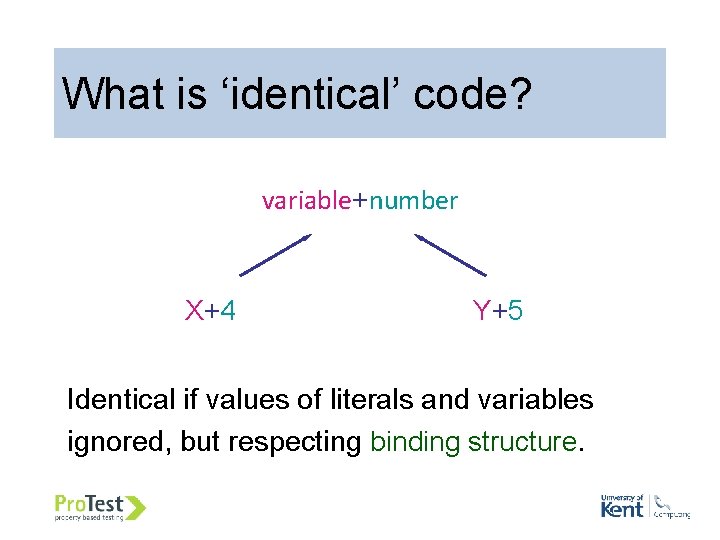
What is ‘identical’ code? variable+number X+4 Y+5 Identical if values of literals and variables ignored, but respecting binding structure.
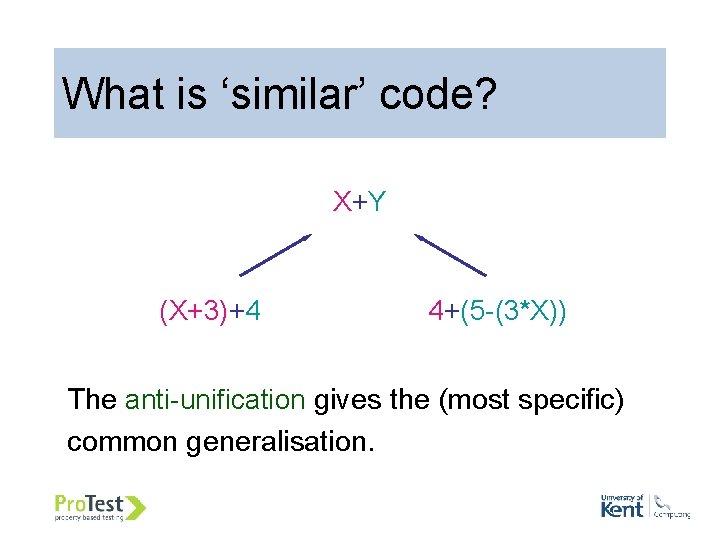
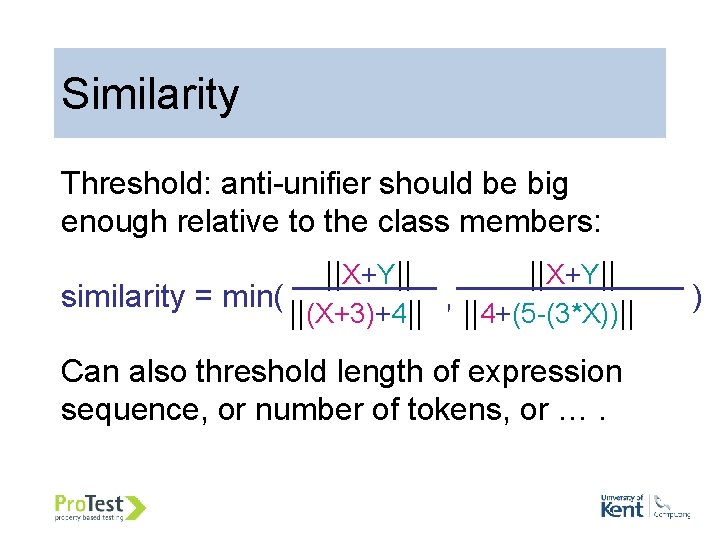
What is ‘similar’ code? X+Y (X+3)+4 4+(5 -(3*X)) The anti-unification gives the (most specific) common generalisation.
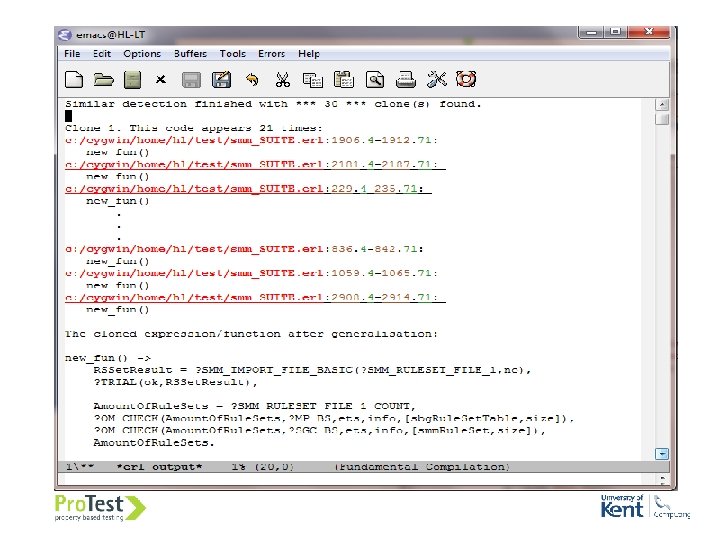
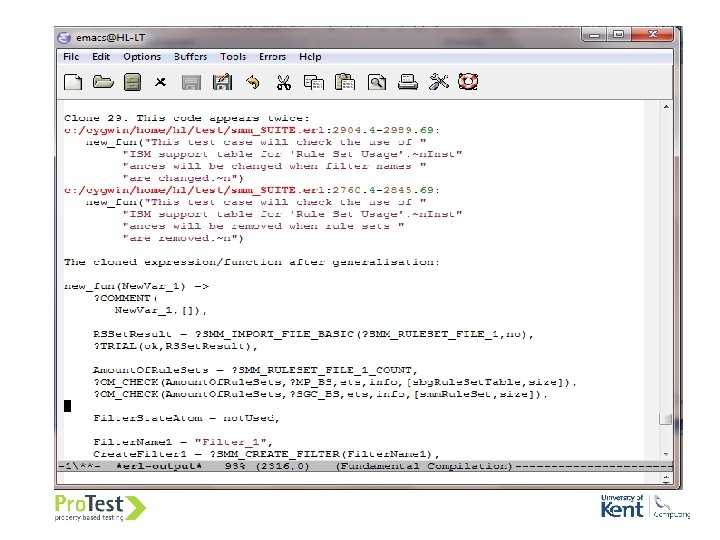
Clone detection • The Wrangler clone detector – relatively efficient – no false positives • User-guided interactive removal of clones. • Integrated into development environments, but can also be run from an Erlang shell.
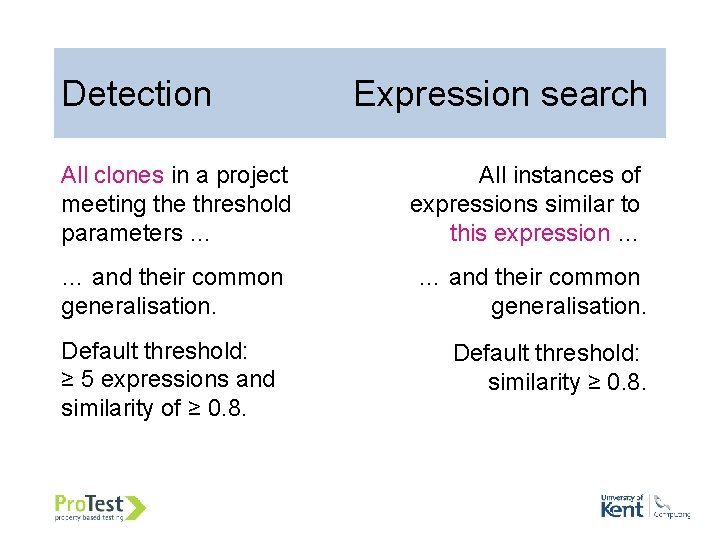
Detection Expression search All clones in a project meeting the threshold parameters … All instances of expressions similar to this expression … … and their common generalisation. Default threshold: ≥ 5 expressions and similarity of ≥ 0. 8. Default threshold: similarity ≥ 0. 8.
Similarity Threshold: anti-unifier should be big enough relative to the class members: ||X+Y|| similarity = min( , ) ||(X+3)+4|| ||4+(5 -(3*X))|| Can also threshold length of expression sequence, or number of tokens, or ….
Clone detection
Clone detection
Tool Demo
Improve Module Structure
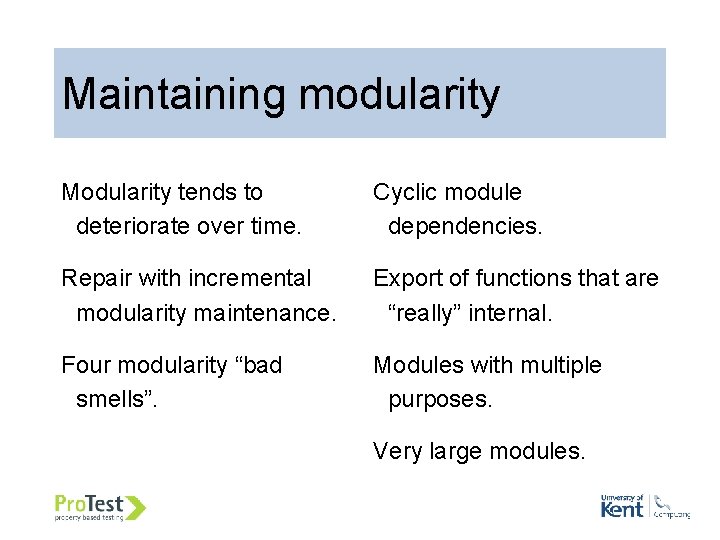
Maintaining modularity Modularity tends to deteriorate over time. Cyclic module dependencies. Repair with incremental modularity maintenance. Export of functions that are “really” internal. Four modularity “bad smells”. Modules with multiple purposes. Very large modules.
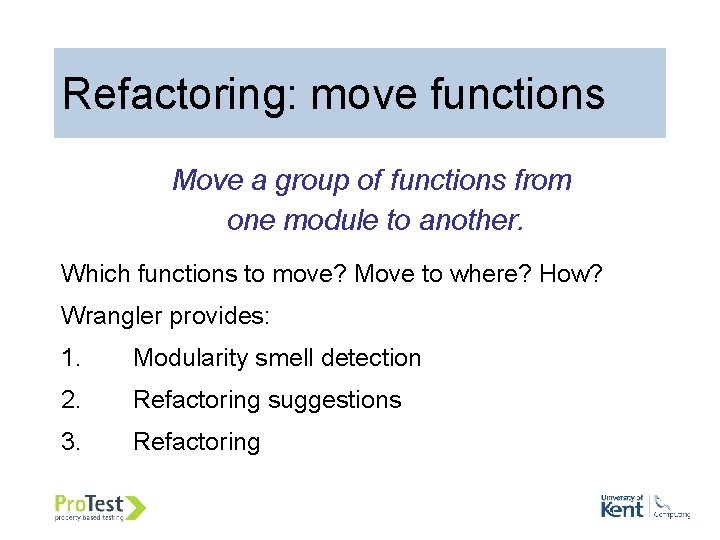
Refactoring: move functions Move a group of functions from one module to another. Which functions to move? Move to where? How? Wrangler provides: 1. Modularity smell detection 2. Refactoring suggestions 3. Refactoring
“Dogfooding” Wrangler Case study of Wrangler-0. 8. 7 56 Erlang modules, 40 kloc (inc. comments). • Improper dependencies: sharing implementation between refactorings. • Cyclic dependencies: need to split modules. • Multiple goals: refac_syntax_lib 7 clusters.
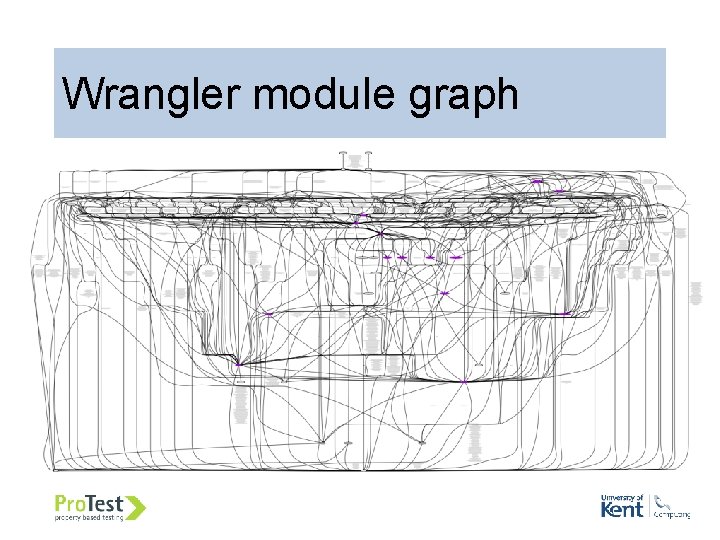
Wrangler module graph
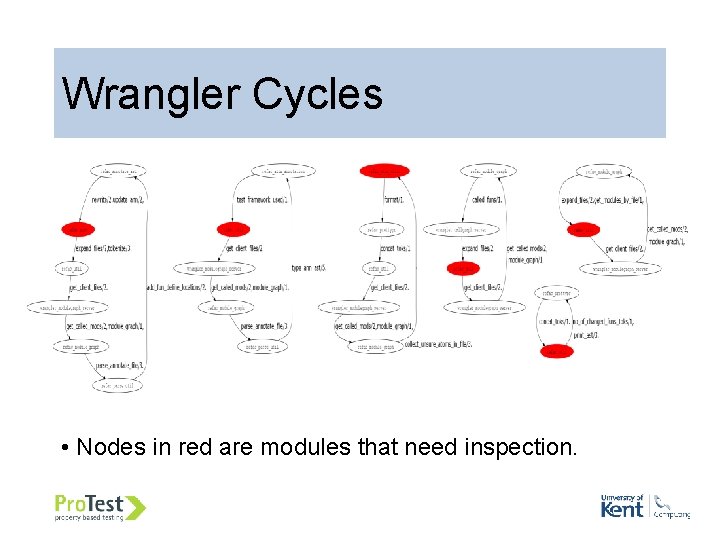
Wrangler Cycles • Nodes in red are modules that need inspection.
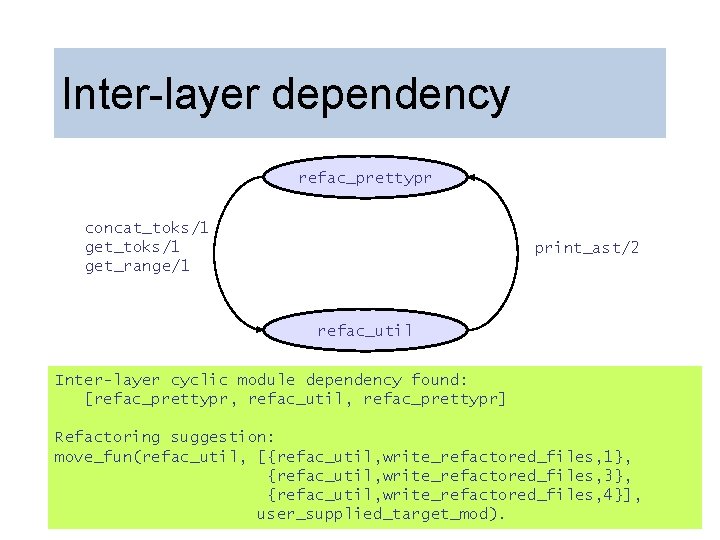
Inter-layer dependency refac_prettypr concat_toks/1 get_range/1 print_ast/2 refac_util Inter-layer cyclic module dependency found: [refac_prettypr, refac_util, refac_prettypr] Refactoring suggestion: move_fun(refac_util, [{refac_util, write_refactored_files, 1}, {refac_util, write_refactored_files, 3}, {refac_util, write_refactored_files, 4}], user_supplied_target_mod).
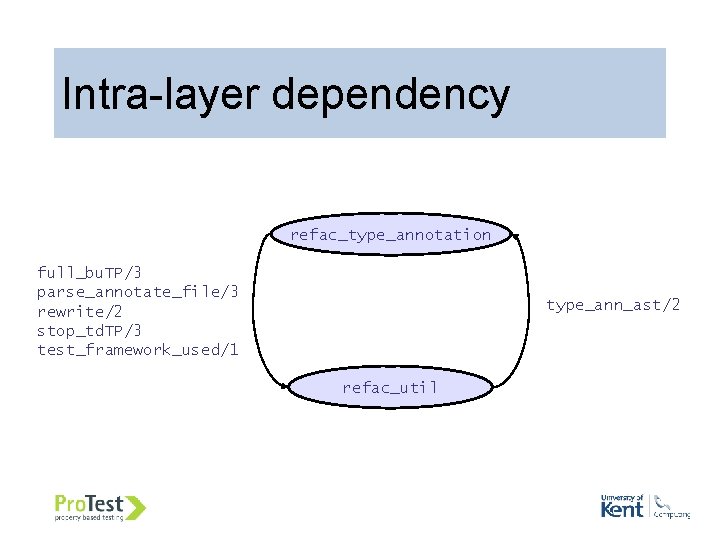
Intra-layer dependency refac_type_annotation full_bu. TP/3 parse_annotate_file/3 rewrite/2 stop_td. TP/3 test_framework_used/1 type_ann_ast/2 refac_util
Identifying "API" functions • Identify by examining call graph. • API functions are those … • … not used internally, • … "close to" other API functions. • Others are seen as internal, external calls to these are deemed improper.
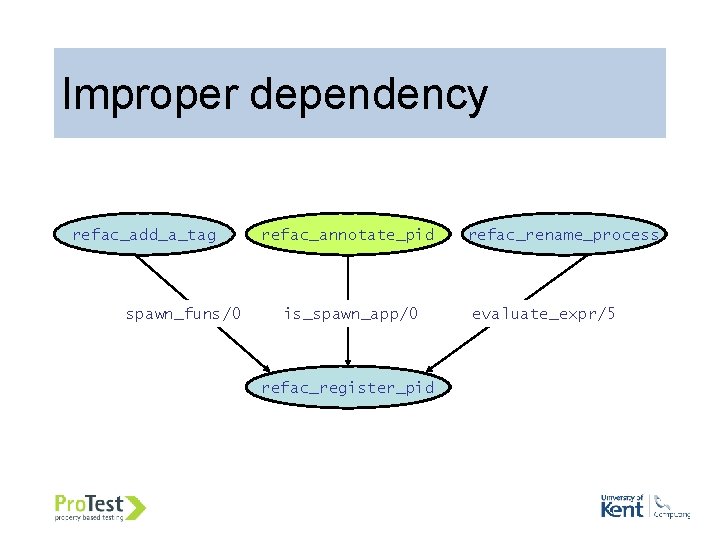
Improper dependency refac_add_a_tag spawn_funs/0 refac_annotate_pid is_spawn_app/0 refac_register_pid refac_rename_process evaluate_expr/5
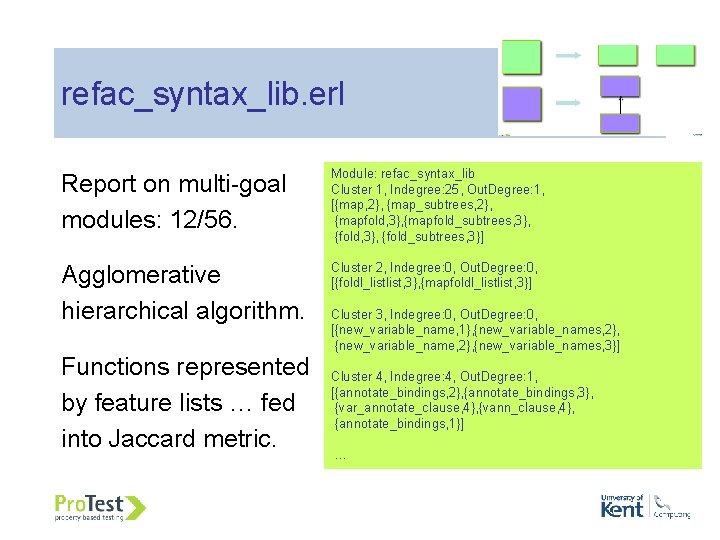
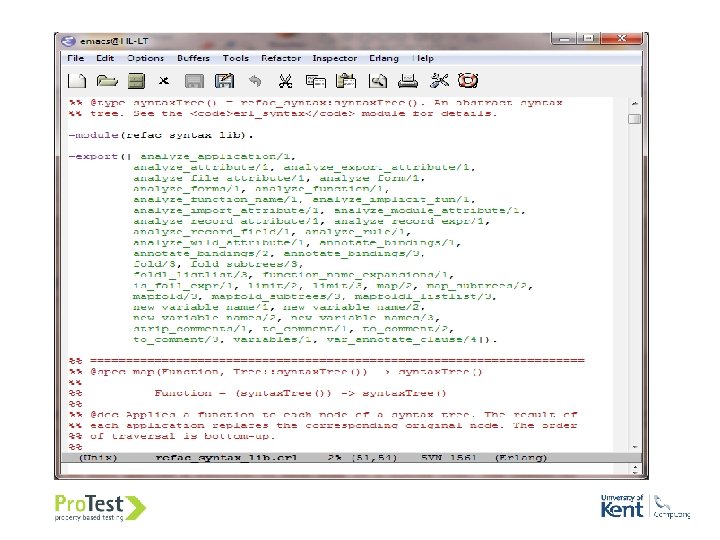
refac_syntax_lib. erl Report on multi-goal modules: 12/56. Module: refac_syntax_lib Cluster 1, Indegree: 25, Out. Degree: 1, [{map, 2}, {map_subtrees, 2}, {mapfold, 3}, {mapfold_subtrees, 3}, {fold, 3}, {fold_subtrees, 3}] Agglomerative hierarchical algorithm. Cluster 2, Indegree: 0, Out. Degree: 0, [{foldl_list, 3}, {mapfoldl_list, 3}] Functions represented by feature lists … fed into Jaccard metric. Cluster 3, Indegree: 0, Out. Degree: 0, [{new_variable_name, 1}, {new_variable_names, 2}, {new_variable_name, 2}, {new_variable_names, 3}] Cluster 4, Indegree: 4, Out. Degree: 1, [{annotate_bindings, 2}, {annotate_bindings, 3}, {var_annotate_clause, 4}, {vann_clause, 4}, {annotate_bindings, 1}] …
Future work Incremental detection of module bad smells, e. g. in overnight builds. Partition module exports according to client modules. Case studies.
Improve module structure • Refactoring – Move function(s) from one module to another. – select a function definition to move a single function, an export list to move a collect of functions. – Partition module exports.
Tool Demo
Hands-on
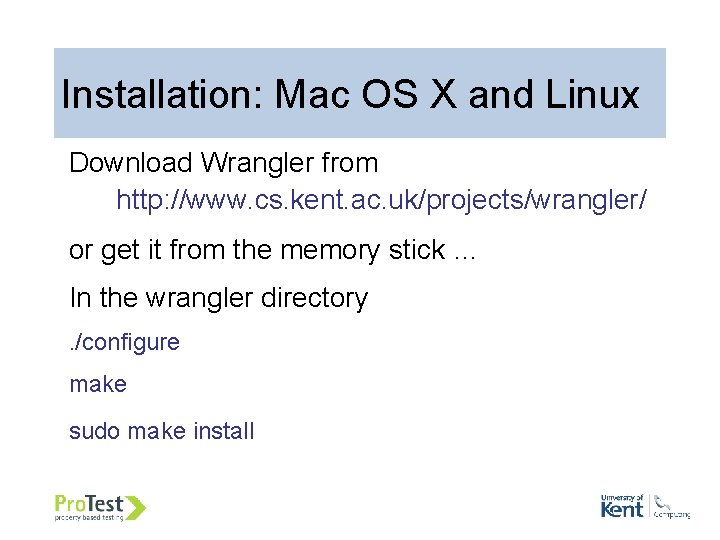
51 Installation: Mac OS X and Linux Requires: Erlang release R 11 B-5 or later
52 Installation: Mac OS X and Linux Download Wrangler from http: //www. cs. kent. ac. uk/projects/wrangler/ or get it from the memory stick … In the wrangler directory. /configure make sudo make install
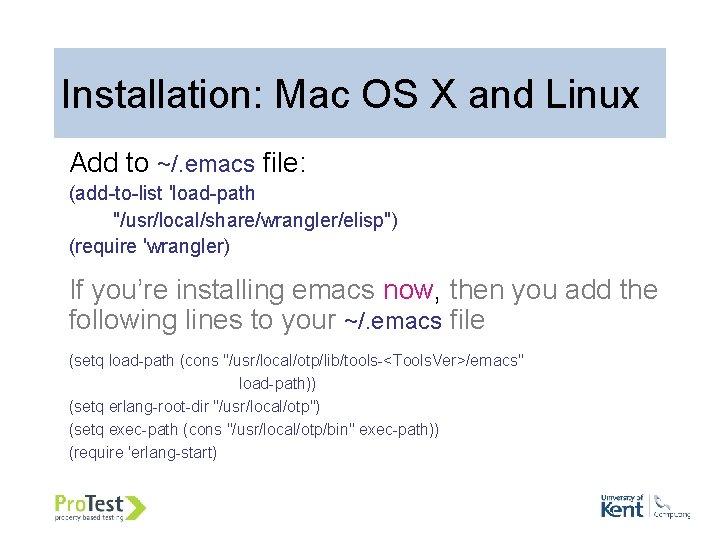
53 Installation: Mac OS X and Linux Add to ~/. emacs file: (add-to-list 'load-path "/usr/local/share/wrangler/elisp") (require 'wrangler) If you’re installing emacs now, then you add the following lines to your ~/. emacs file (setq load-path (cons "/usr/local/otp/lib/tools-<Tools. Ver>/emacs" load-path)) (setq erlang-root-dir "/usr/local/otp") (setq exec-path (cons "/usr/local/otp/bin" exec-path)) (require 'erlang-start)
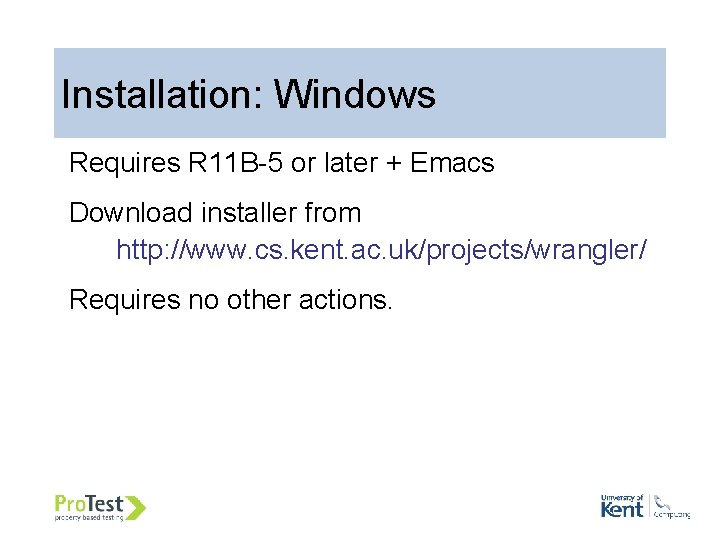
54 Installation: Windows Requires R 11 B-5 or later + Emacs Download installer from http: //www. cs. kent. ac. uk/projects/wrangler/ Requires no other actions.
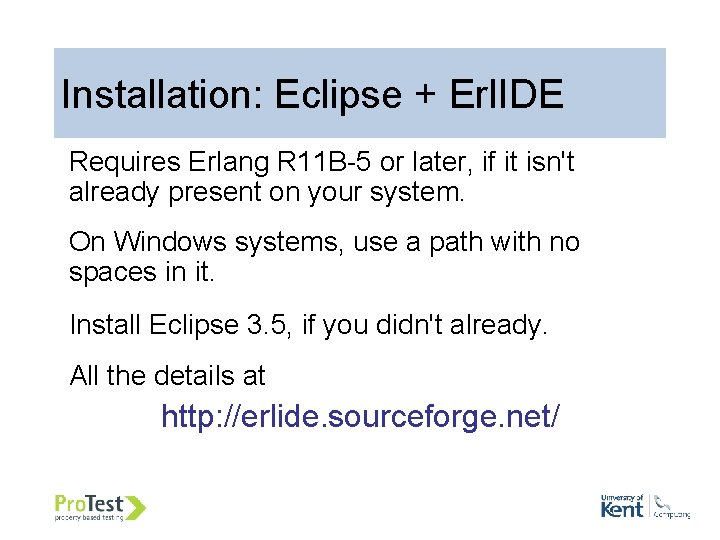
55 Installation: Eclipse + Erl. IDE Requires Erlang R 11 B-5 or later, if it isn't already present on your system. On Windows systems, use a path with no spaces in it. Install Eclipse 3. 5, if you didn't already. All the details at http: //erlide. sourceforge. net/
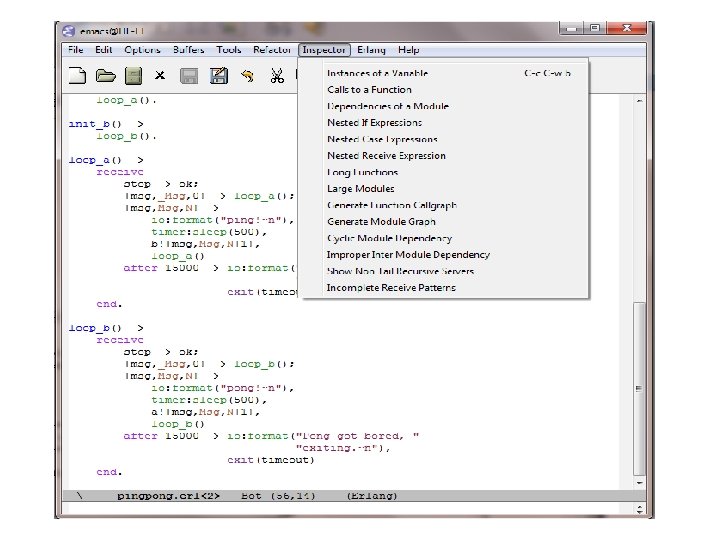
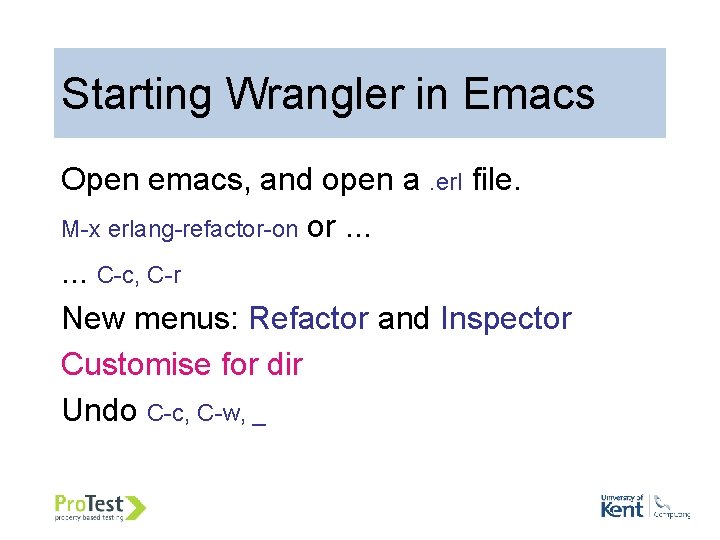
56 Starting Wrangler in Emacs Open emacs, and open a. erl file. M-x erlang-refactor-on or. . . C-c, C-r New menus: Refactor and Inspector Customise for dir Undo C-c, C-w, _
57 Preview Feature Preview changes before confirming the change Emacs ediff is used.
58 Stopping Wrangler in Emacs M-x erlang-refactor-off to stop Wrangler Shortcut C-c, C-r
59 Tutorial materials Exercises: http: //www. cs. kent. ac. uk/projects/wrangler /Misc/Wrangler. Exercise. {doc. pdf} Code: http: //www. cs. kent. ac. uk/projects/wrangler /Misc/wrangler_ex. tar. gz
60 Carrying on … Try on your own project code … Feedback: erlang-refactor@kent. ac. uk or H. Li@kent. ac. uk