MSIT Master of Science in Information Technology MSIT
- Slides: 101
MSIT | Master of Science in Information Technology MSIT 413: Wireless Technologies Week 2 Michael L. Honig Department of EECS Northwestern University September 2017 1
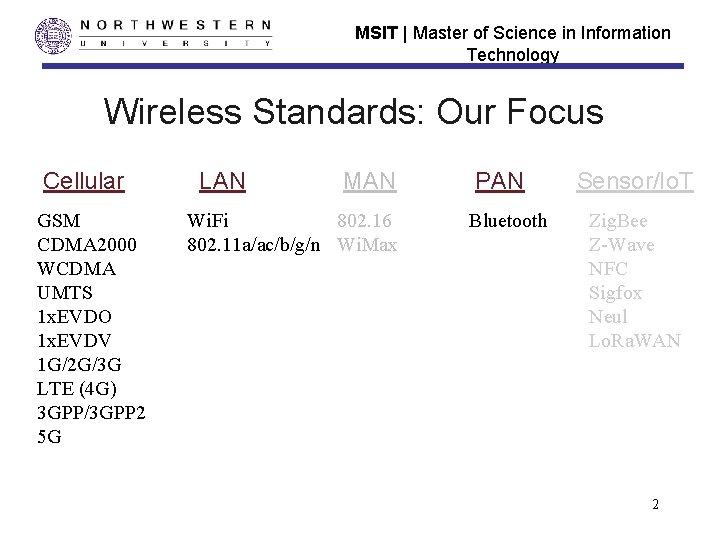
MSIT | Master of Science in Information Technology Wireless Standards: Our Focus Cellular GSM CDMA 2000 WCDMA UMTS 1 x. EVDO 1 x. EVDV 1 G/2 G/3 G LTE (4 G) 3 GPP/3 GPP 2 5 G LAN MAN Wi. Fi 802. 16 802. 11 a/ac/b/g/n Wi. Max PAN Bluetooth Sensor/Io. T Zig. Bee Z-Wave NFC Sigfox Neul Lo. Ra. WAN 2
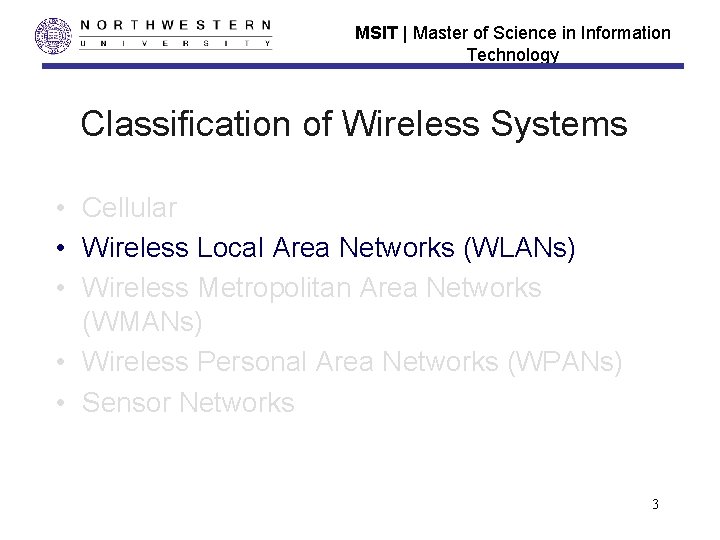
MSIT | Master of Science in Information Technology Classification of Wireless Systems • Cellular • Wireless Local Area Networks (WLANs) • Wireless Metropolitan Area Networks (WMANs) • Wireless Personal Area Networks (WPANs) • Sensor Networks 3
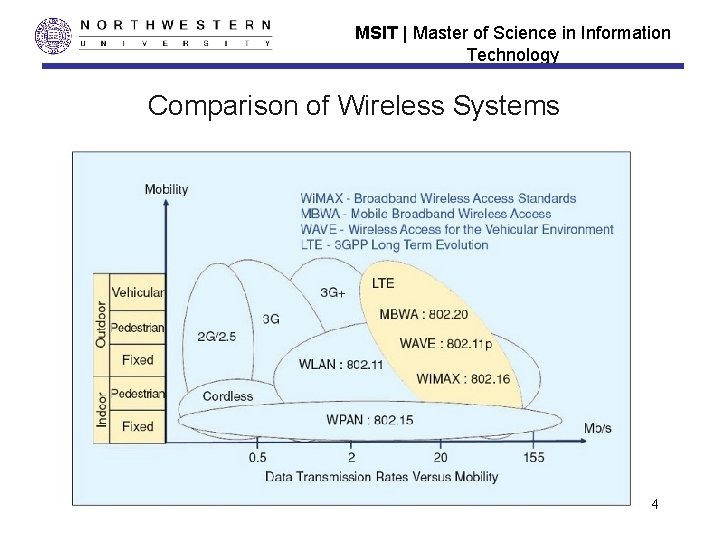
MSIT | Master of Science in Information Technology Comparison of Wireless Systems 4
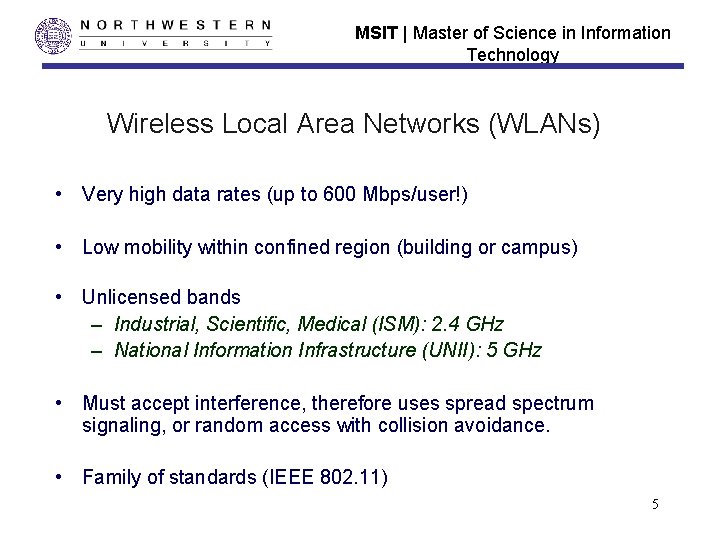
MSIT | Master of Science in Information Technology Wireless Local Area Networks (WLANs) • Very high data rates (up to 600 Mbps/user!) • Low mobility within confined region (building or campus) • Unlicensed bands – Industrial, Scientific, Medical (ISM): 2. 4 GHz – National Information Infrastructure (UNII): 5 GHz • Must accept interference, therefore uses spread spectrum signaling, or random access with collision avoidance. • Family of standards (IEEE 802. 11) 5
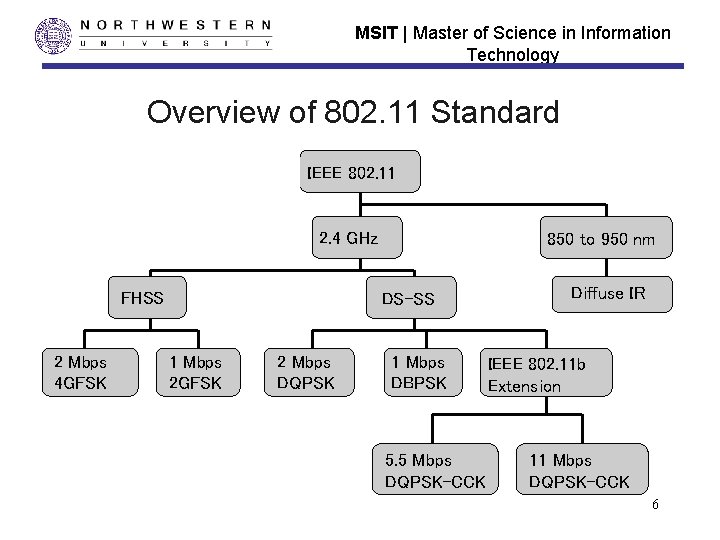
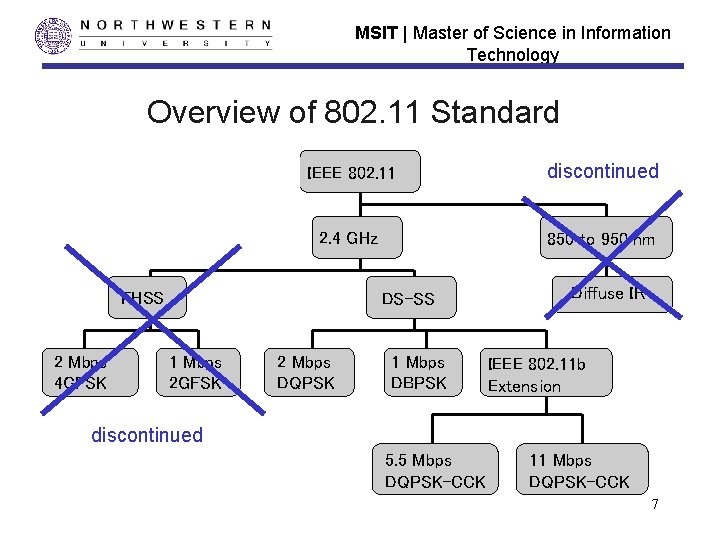
MSIT | Master of Science in Information Technology Overview of 802. 11 Standard IEEE 802. 11 2. 4 GHz FHSS 2 Mbps 4 GFSK 850 to 950 nm DS-SS 1 Mbps 2 GFSK 2 Mbps DQPSK 1 Mbps DBPSK 5. 5 Mbps DQPSK-CCK Diffuse IR IEEE 802. 11 b Extension 11 Mbps DQPSK-CCK 6
MSIT | Master of Science in Information Technology Overview of 802. 11 Standard IEEE 802. 11 discontinued 2. 4 GHz 850 to 950 nm FHSS 2 Mbps 4 GFSK DS-SS 1 Mbps 2 GFSK 2 Mbps DQPSK 1 Mbps DBPSK Diffuse IR IEEE 802. 11 b Extension discontinued 5. 5 Mbps DQPSK-CCK 11 Mbps DQPSK-CCK 7
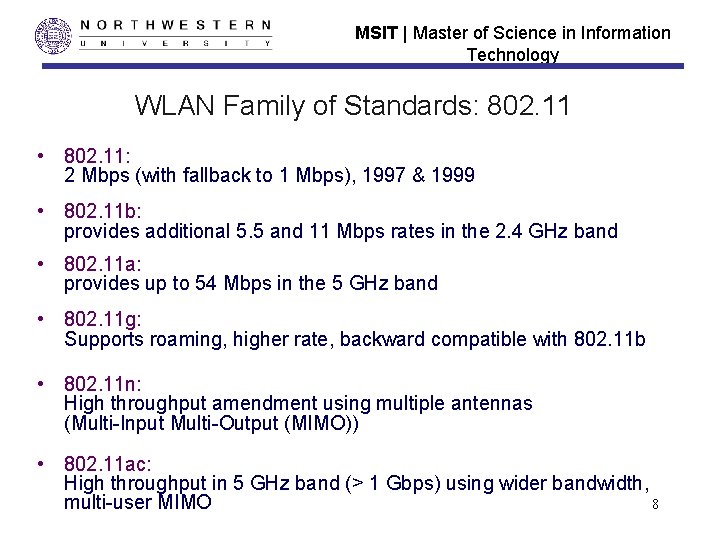
MSIT | Master of Science in Information Technology WLAN Family of Standards: 802. 11 • 802. 11: 2 Mbps (with fallback to 1 Mbps), 1997 & 1999 • 802. 11 b: provides additional 5. 5 and 11 Mbps rates in the 2. 4 GHz band • 802. 11 a: provides up to 54 Mbps in the 5 GHz band • 802. 11 g: Supports roaming, higher rate, backward compatible with 802. 11 b • 802. 11 n: High throughput amendment using multiple antennas (Multi-Input Multi-Output (MIMO)) • 802. 11 ac: High throughput in 5 GHz band (> 1 Gbps) using wider bandwidth, 8 multi-user MIMO
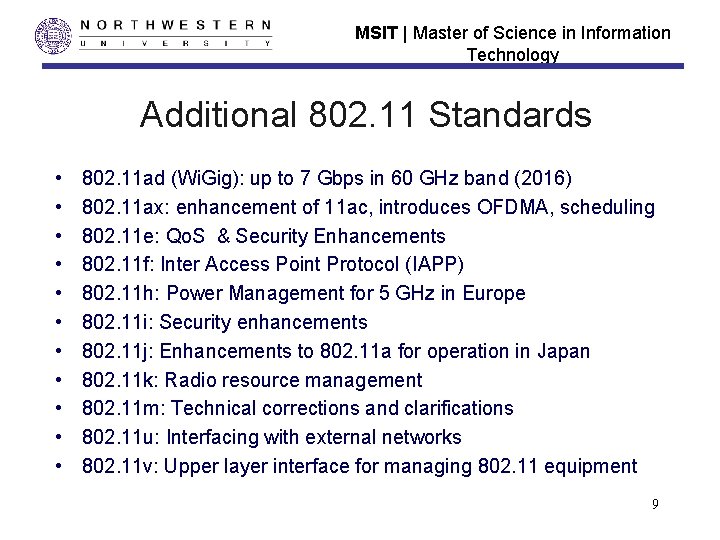
MSIT | Master of Science in Information Technology Additional 802. 11 Standards • • • 802. 11 ad (Wi. Gig): up to 7 Gbps in 60 GHz band (2016) 802. 11 ax: enhancement of 11 ac, introduces OFDMA, scheduling 802. 11 e: Qo. S & Security Enhancements 802. 11 f: Inter Access Point Protocol (IAPP) 802. 11 h: Power Management for 5 GHz in Europe 802. 11 i: Security enhancements 802. 11 j: Enhancements to 802. 11 a for operation in Japan 802. 11 k: Radio resource management 802. 11 m: Technical corrections and clarifications 802. 11 u: Interfacing with external networks 802. 11 v: Upper layer interface for managing 802. 11 equipment 9
MSIT | Master of Science in Information Technology 802. 11 a/b/g/n Comparison table 10
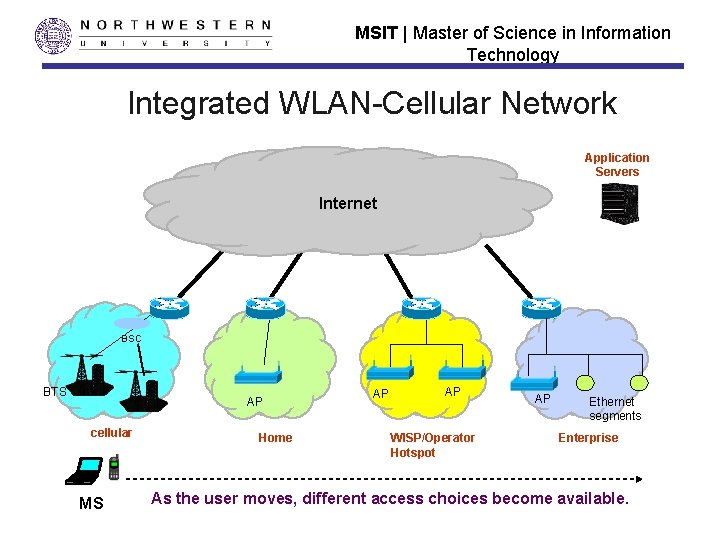
MSIT | Master of Science in Information Technology Integrated WLAN-Cellular Network Application Servers Internet BSC BTS AP cellular MS Home AP AP WISP/Operator Hotspot AP Ethernet segments Enterprise As the user moves, different access choices become available.
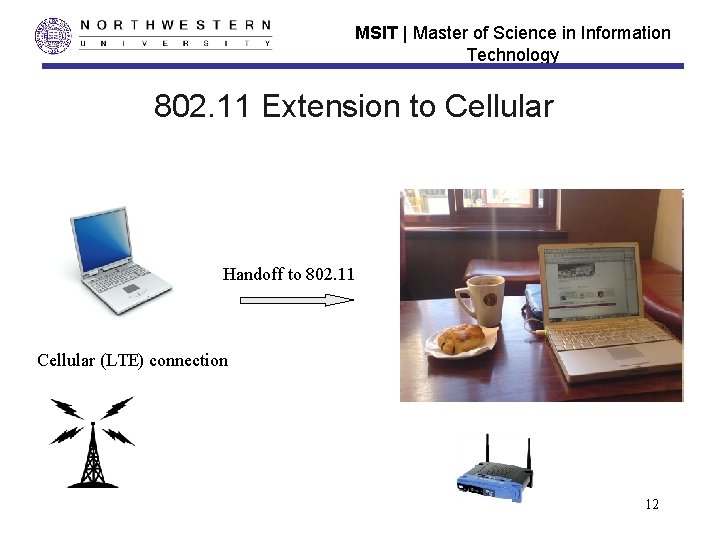
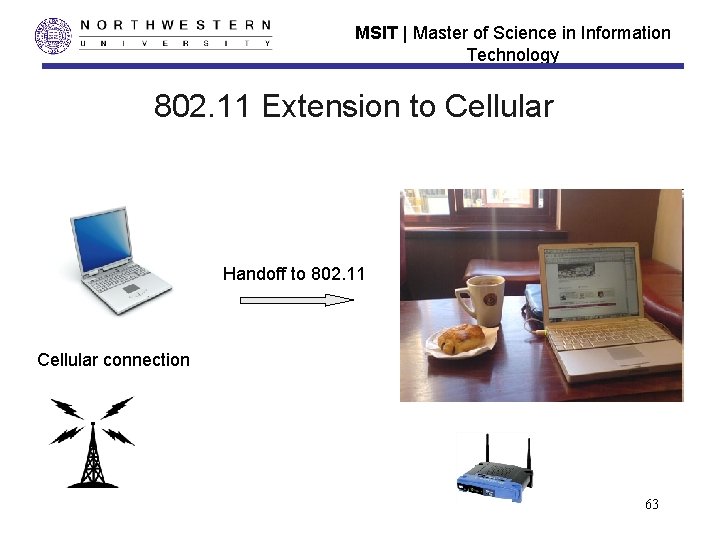
MSIT | Master of Science in Information Technology 802. 11 Extension to Cellular Handoff to 802. 11 Cellular (LTE) connection 12
MSIT | Master of Science in Information Technology Integrated WLAN/Cellular Network • • • High data rates at hot spots covered by WLANs. Lower data rates elsewhere provided by cellular. Single account; single bill Roaming, session mobility Common applications and services Cellular traffic Wi. Fi offload 13
MSIT | Master of Science in Information Technology Classification of Wireless Systems • Cellular • Wireless Local Area Networks (WLANs) • Wireless Metropolitan Area Networks (WMANs) • Wireless Personal Area Networks (WPANs) • Sensor Networks 14
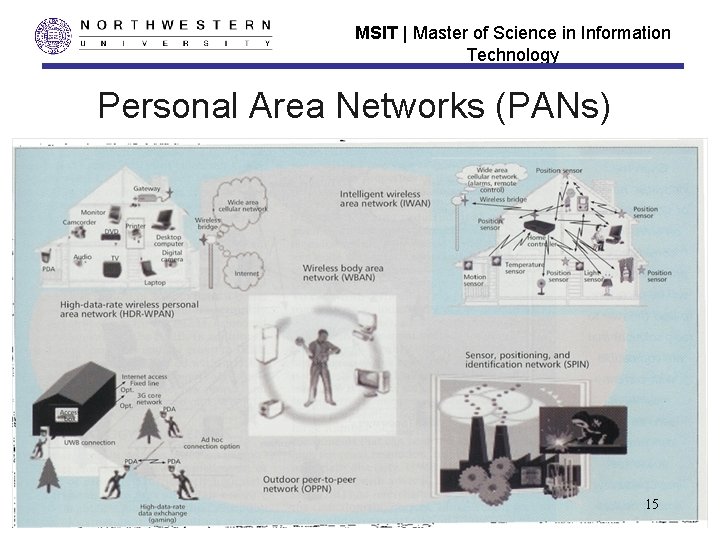
MSIT | Master of Science in Information Technology Personal Area Networks (PANs) 15
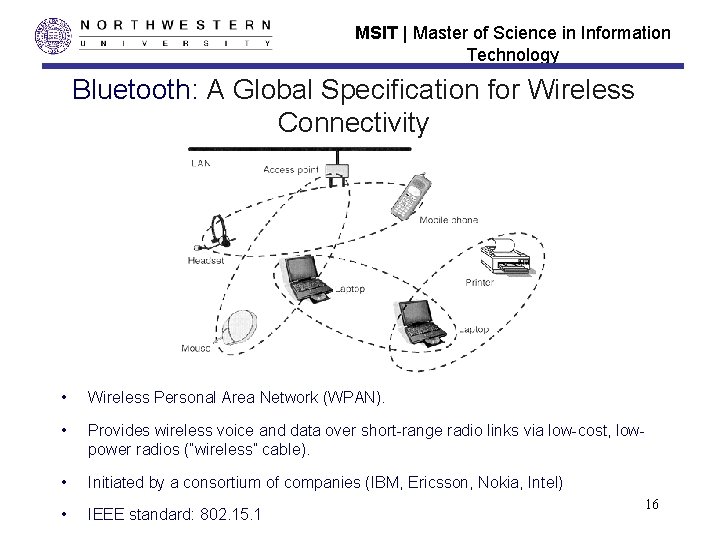
MSIT | Master of Science in Information Technology Bluetooth: A Global Specification for Wireless Connectivity • Wireless Personal Area Network (WPAN). • Provides wireless voice and data over short-range radio links via low-cost, lowpower radios (“wireless” cable). • Initiated by a consortium of companies (IBM, Ericsson, Nokia, Intel) • IEEE standard: 802. 15. 1 16
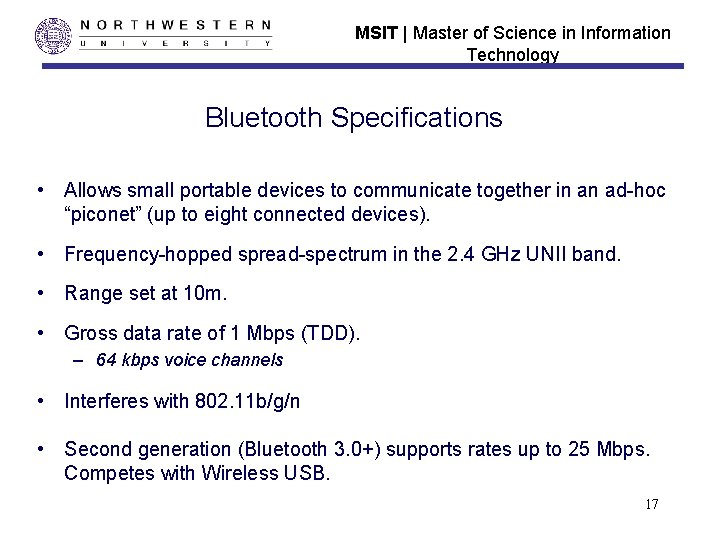
MSIT | Master of Science in Information Technology Bluetooth Specifications • Allows small portable devices to communicate together in an ad-hoc “piconet” (up to eight connected devices). • Frequency-hopped spread-spectrum in the 2. 4 GHz UNII band. • Range set at 10 m. • Gross data rate of 1 Mbps (TDD). – 64 kbps voice channels • Interferes with 802. 11 b/g/n • Second generation (Bluetooth 3. 0+) supports rates up to 25 Mbps. Competes with Wireless USB. 17
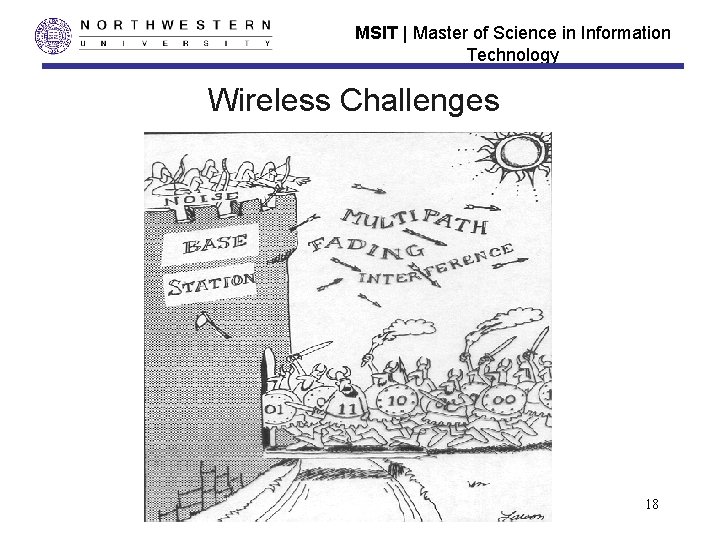
MSIT | Master of Science in Information Technology Wireless Challenges 18
MSIT | Master of Science in Information Technology Today • • • Cellular terminology Interference and capacity (voice) Performance measures (SINR, user capacity) Blocking and grade of service Channel assignments 19
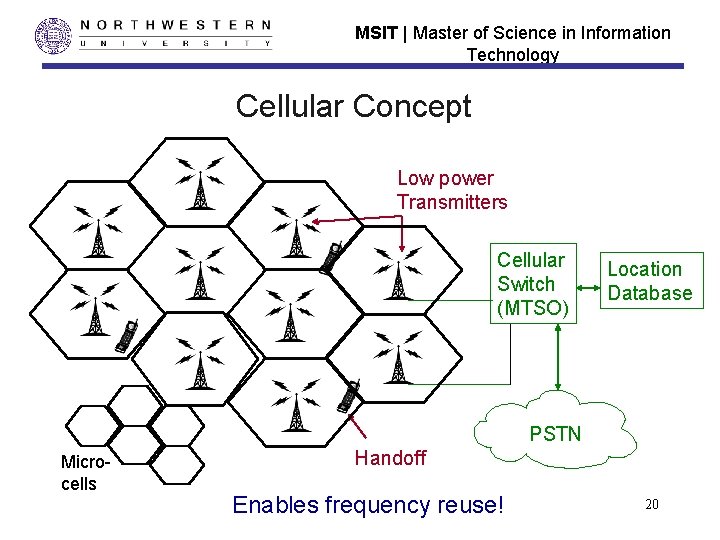
MSIT | Master of Science in Information Technology Cellular Concept Low power Transmitters Cellular Switch (MTSO) Location Database PSTN Microcells Handoff Enables frequency reuse! 20
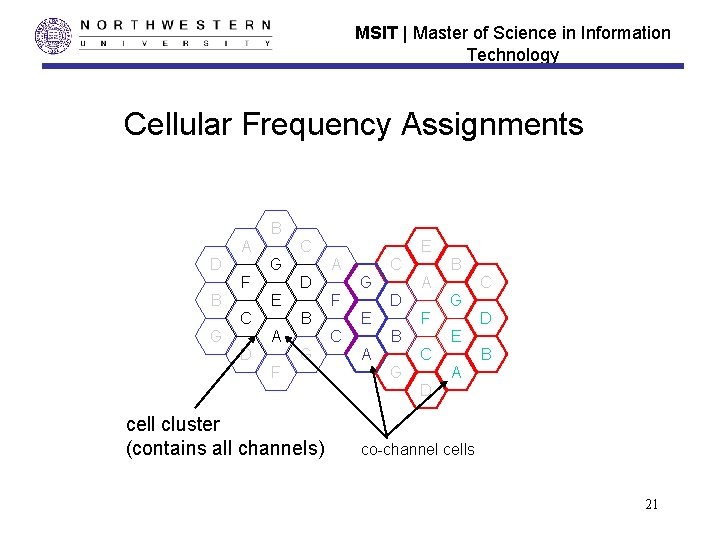
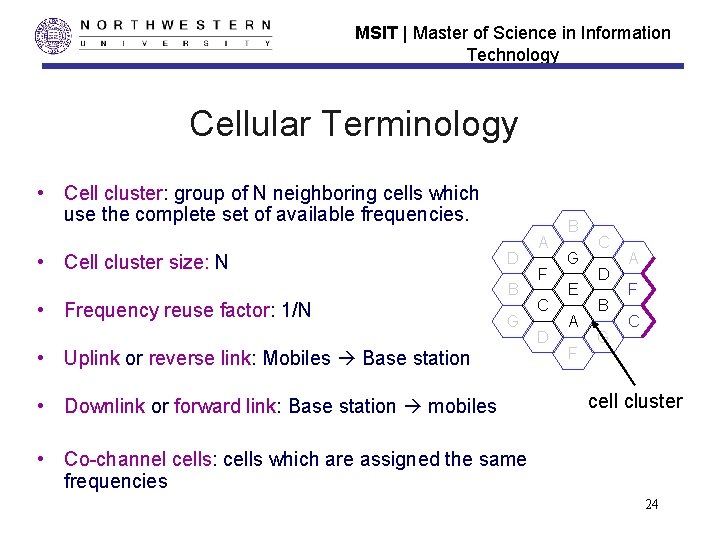
MSIT | Master of Science in Information Technology Cellular Frequency Assignments B A D C G F B A D E C G E G F B A D C F A D E C G B C G F B A D E C G B A D cell cluster (contains all channels) co-channel cells 21
MSIT | Master of Science in Information Technology Example of Cellular Layout drive test plots Opensignal. com 22
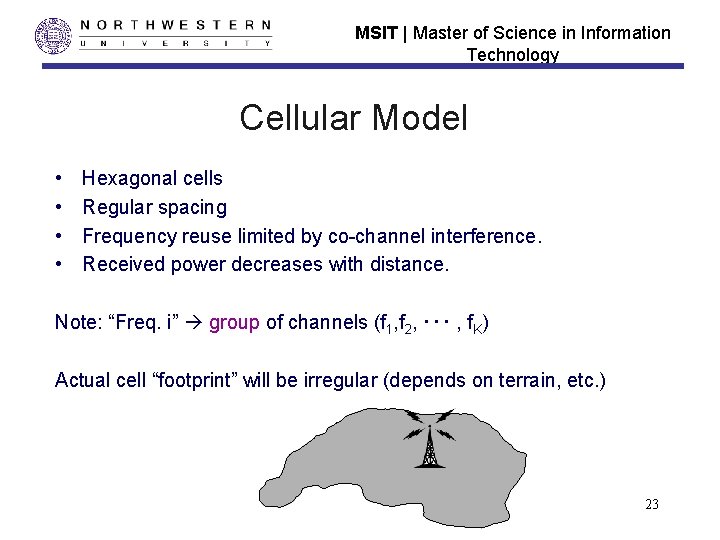
MSIT | Master of Science in Information Technology Cellular Model • • Hexagonal cells Regular spacing Frequency reuse limited by co-channel interference. Received power decreases with distance. Note: “Freq. i” group of channels (f 1, f 2, … , f. K) Actual cell “footprint” will be irregular (depends on terrain, etc. ) 23
MSIT | Master of Science in Information Technology Cellular Terminology • Cell cluster: group of N neighboring cells which use the complete set of available frequencies. • Cell cluster size: N D B • Frequency reuse factor: 1/N G • Uplink or reverse link: Mobiles Base station • Downlink or forward link: Base station mobiles A F C D B G E A F C D B G A F C cell cluster • Co-channel cells: cells which are assigned the same frequencies 24
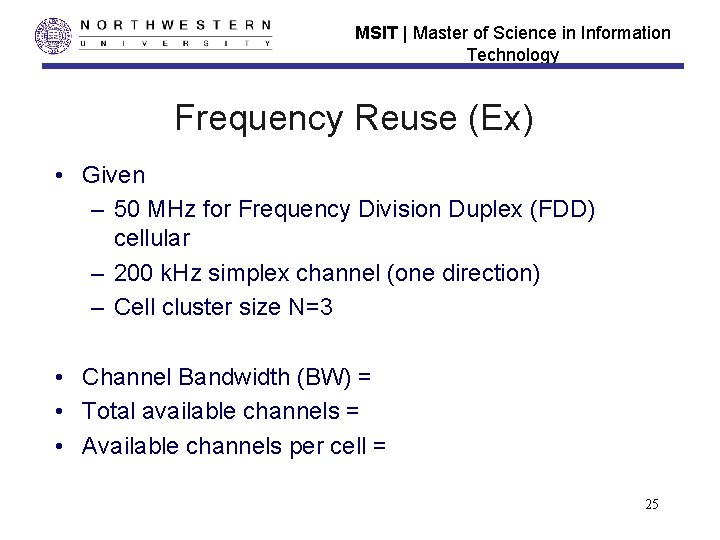
MSIT | Master of Science in Information Technology Frequency Reuse (Ex) • Given – 50 MHz for Frequency Division Duplex (FDD) cellular – 200 k. Hz simplex channel (one direction) – Cell cluster size N=3 • Channel Bandwidth (BW) = • Total available channels = • Available channels per cell = 25
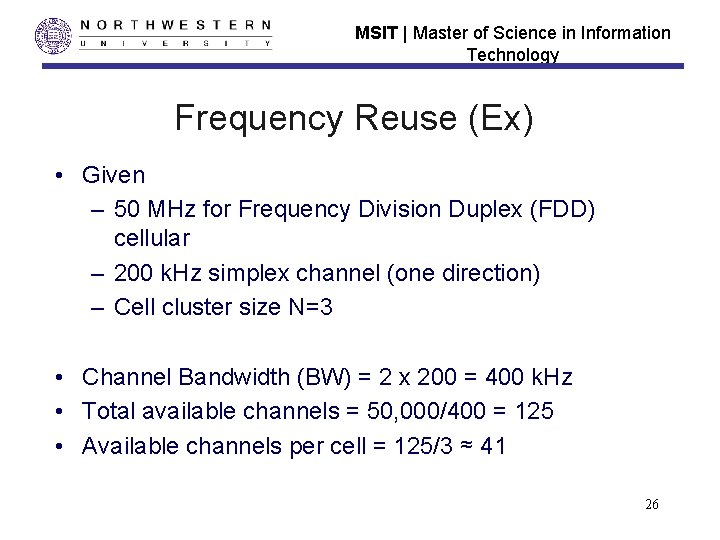
MSIT | Master of Science in Information Technology Frequency Reuse (Ex) • Given – 50 MHz for Frequency Division Duplex (FDD) cellular – 200 k. Hz simplex channel (one direction) – Cell cluster size N=3 • Channel Bandwidth (BW) = 2 x 200 = 400 k. Hz • Total available channels = 50, 000/400 = 125 • Available channels per cell = 125/3 ≈ 41 26
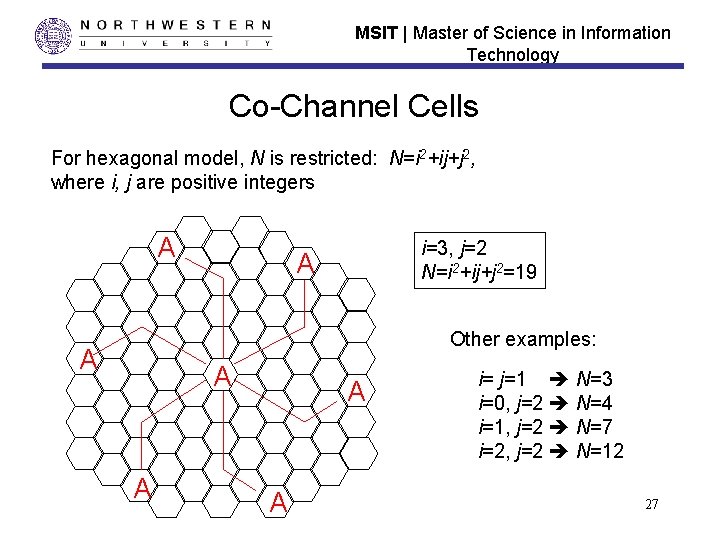
MSIT | Master of Science in Information Technology Co-Channel Cells For hexagonal model, N is restricted: N=i 2+ij+j 2, where i, j are positive integers A i=3, j=2 N=i 2+ij+j 2=19 A Other examples: A A A i= j=1 N=3 i=0, j=2 N=4 i=1, j=2 N=7 i=2, j=2 N=12 27
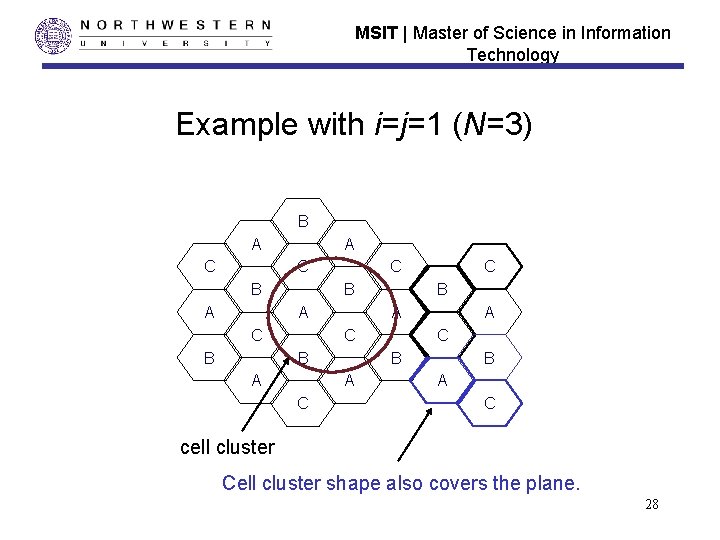
MSIT | Master of Science in Information Technology Example with i=j=1 (N=3) B A A C C B B A C A C B A C cell cluster Cell cluster shape also covers the plane. 28
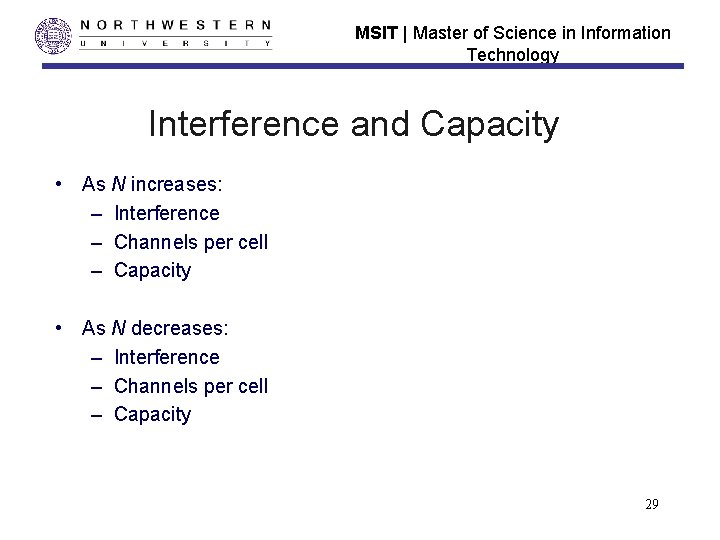
MSIT | Master of Science in Information Technology Interference and Capacity • As N increases: – Interference – Channels per cell – Capacity • As N decreases: – Interference – Channels per cell – Capacity 29
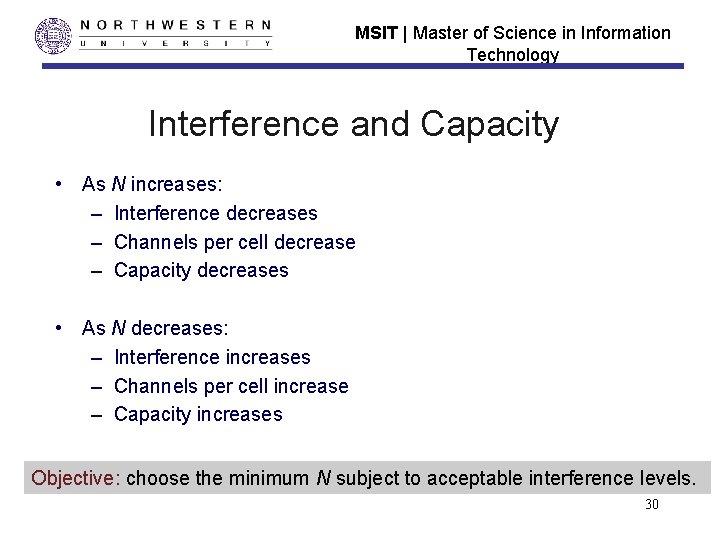
MSIT | Master of Science in Information Technology Interference and Capacity • As N increases: – Interference decreases – Channels per cell decrease – Capacity decreases • As N decreases: – Interference increases – Channels per cell increase – Capacity increases Objective: choose the minimum N subject to acceptable interference levels. 30
MSIT | Master of Science in Information Technology Sources of Interference 31
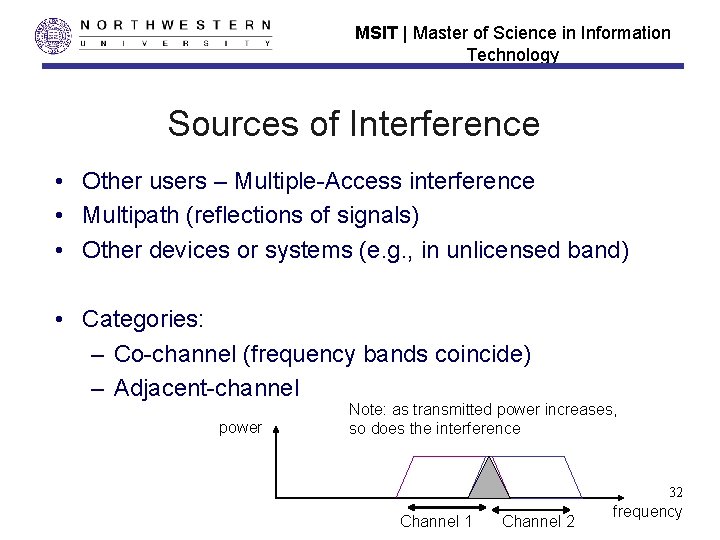
MSIT | Master of Science in Information Technology Sources of Interference • Other users – Multiple-Access interference • Multipath (reflections of signals) • Other devices or systems (e. g. , in unlicensed band) • Categories: – Co-channel (frequency bands coincide) – Adjacent-channel power Note: as transmitted power increases, so does the interference 32 Channel 1 Channel 2 frequency
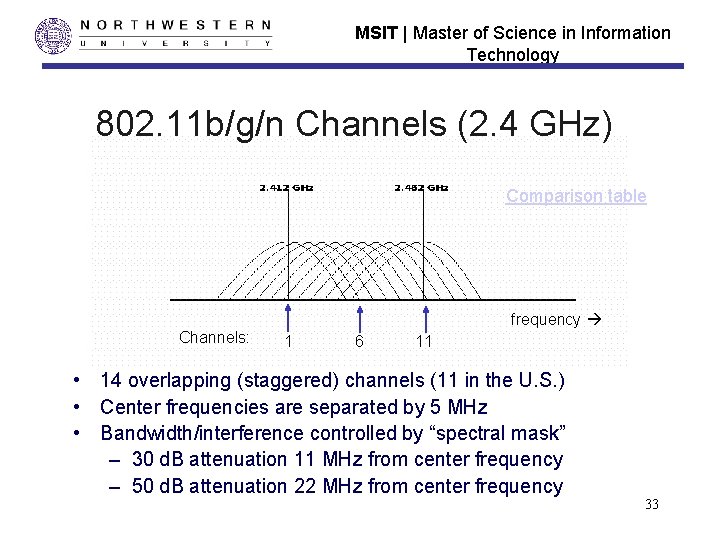
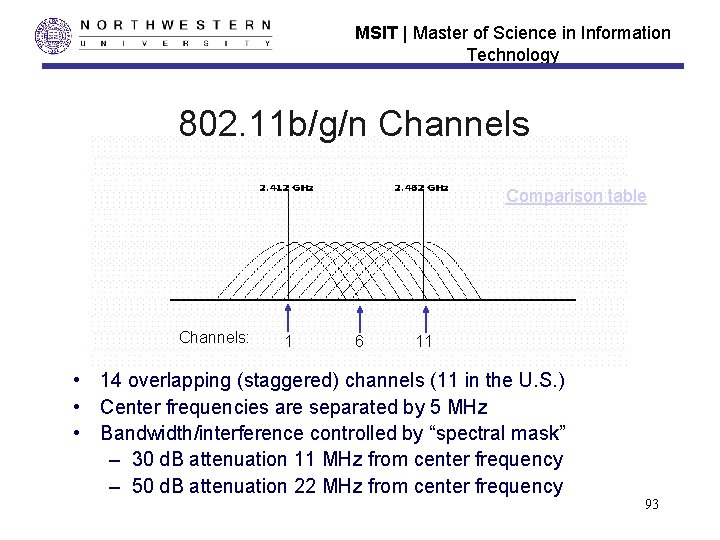
MSIT | Master of Science in Information Technology 802. 11 b/g/n Channels (2. 4 GHz) Comparison table frequency Channels: 1 6 11 • 14 overlapping (staggered) channels (11 in the U. S. ) • Center frequencies are separated by 5 MHz • Bandwidth/interference controlled by “spectral mask” – 30 d. B attenuation 11 MHz from center frequency – 50 d. B attenuation 22 MHz from center frequency 33
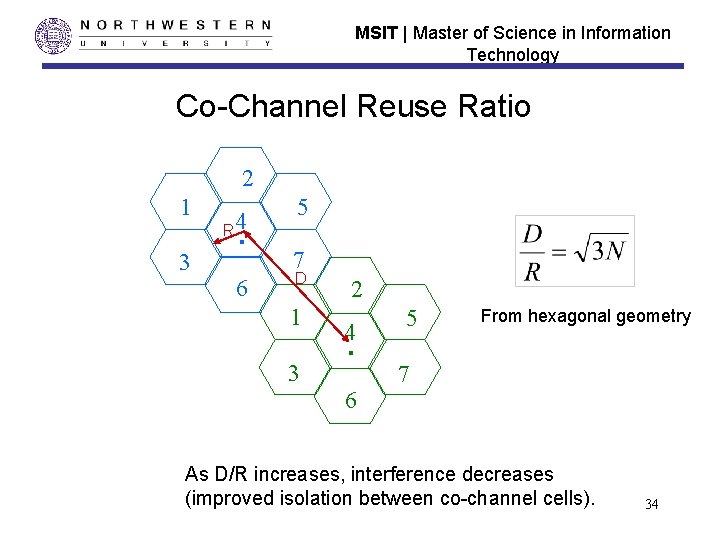
MSIT | Master of Science in Information Technology Co-Channel Reuse Ratio 2 1 3 . R 4 6 5 7 D 1 3 2 . 4 6 5 From hexagonal geometry 7 As D/R increases, interference decreases (improved isolation between co-channel cells). 34
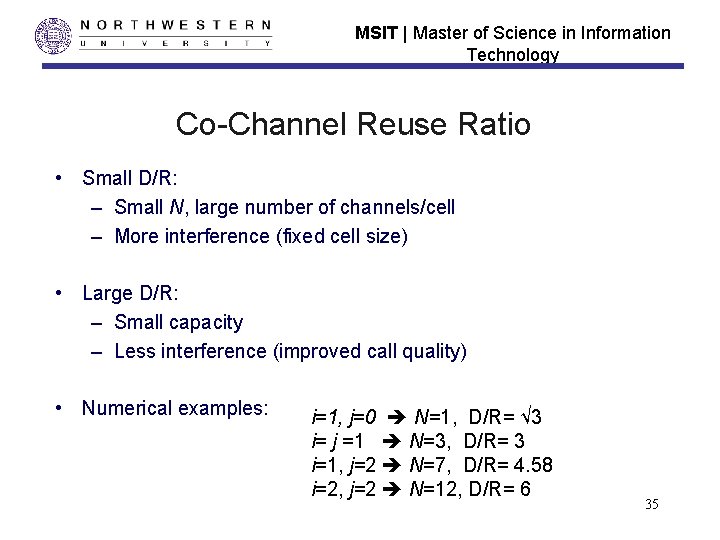
MSIT | Master of Science in Information Technology Co-Channel Reuse Ratio • Small D/R: – Small N, large number of channels/cell – More interference (fixed cell size) • Large D/R: – Small capacity – Less interference (improved call quality) • Numerical examples: i=1, j=0 N=1, D/R= √ 3 i= j =1 N=3, D/R= 3 i=1, j=2 N=7, D/R= 4. 58 i=2, j=2 N=12, D/R= 6 35
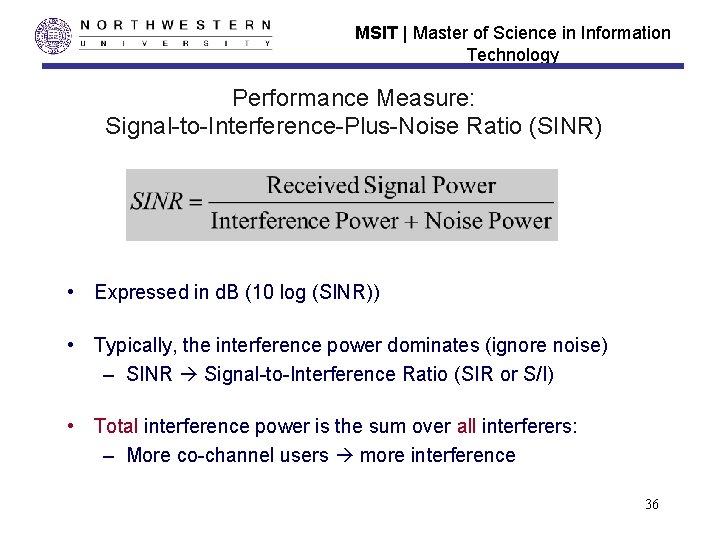
MSIT | Master of Science in Information Technology Performance Measure: Signal-to-Interference-Plus-Noise Ratio (SINR) • Expressed in d. B (10 log (SINR)) • Typically, the interference power dominates (ignore noise) – SINR Signal-to-Interference Ratio (SIR or S/I) • Total interference power is the sum over all interferers: – More co-channel users more interference 36
MSIT | Master of Science in Information Technology Why is SINR Important? 37
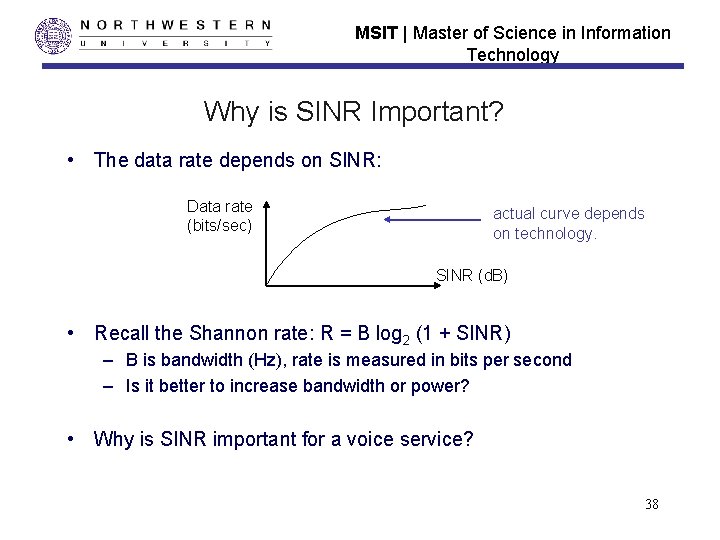
MSIT | Master of Science in Information Technology Why is SINR Important? • The data rate depends on SINR: Data rate (bits/sec) actual curve depends on technology. SINR (d. B) • Recall the Shannon rate: R = B log 2 (1 + SINR) – B is bandwidth (Hz), rate is measured in bits per second – Is it better to increase bandwidth or power? • Why is SINR important for a voice service? 38
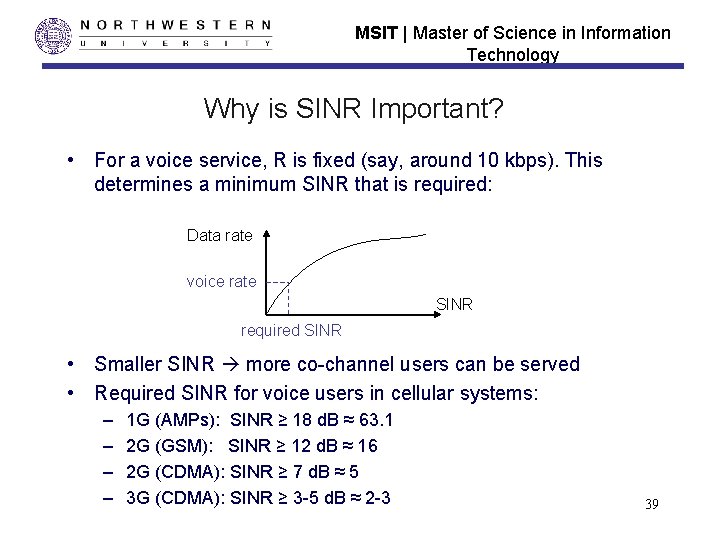
MSIT | Master of Science in Information Technology Why is SINR Important? • For a voice service, R is fixed (say, around 10 kbps). This determines a minimum SINR that is required: Data rate voice rate SINR required SINR • Smaller SINR more co-channel users can be served • Required SINR for voice users in cellular systems: – – 1 G (AMPs): SINR ≥ 18 d. B ≈ 63. 1 2 G (GSM): SINR ≥ 12 d. B ≈ 16 2 G (CDMA): SINR ≥ 7 d. B ≈ 5 3 G (CDMA): SINR ≥ 3 -5 d. B ≈ 2 -3 39
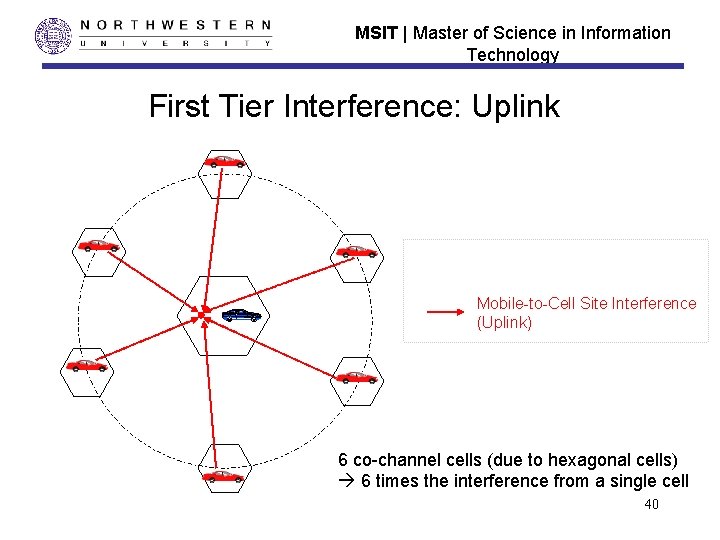
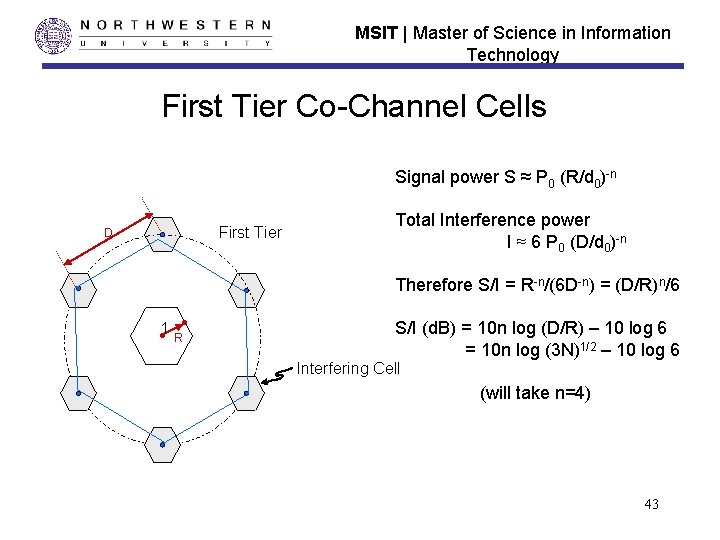
MSIT | Master of Science in Information Technology First Tier Interference: Uplink Mobile-to-Cell Site Interference (Uplink) 6 co-channel cells (due to hexagonal cells) 6 times the interference from a single cell 40
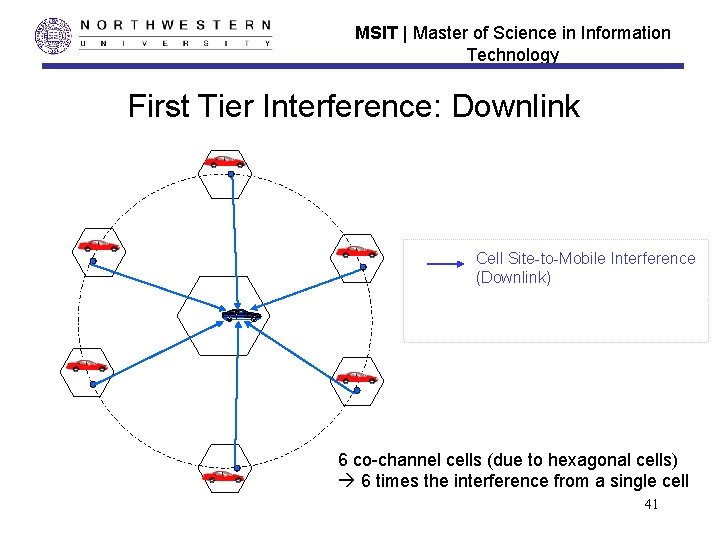
MSIT | Master of Science in Information Technology First Tier Interference: Downlink Cell Site-to-Mobile Interference (Downlink) 6 co-channel cells (due to hexagonal cells) 6 times the interference from a single cell 41
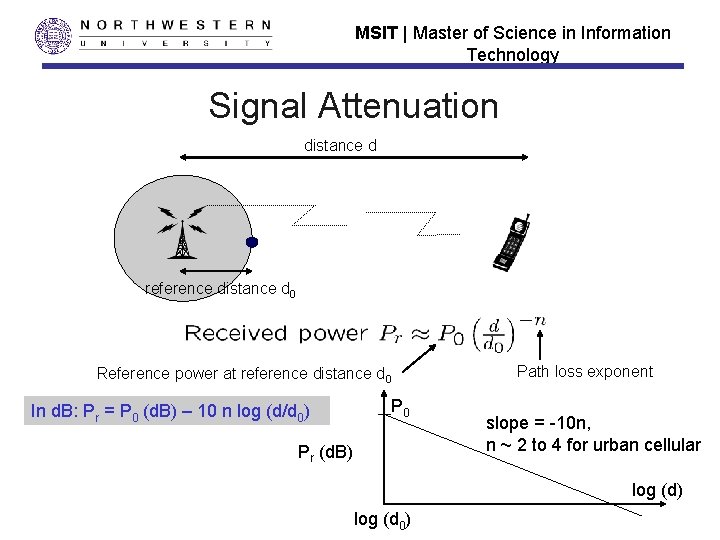
MSIT | Master of Science in Information Technology Signal Attenuation distance d reference distance d 0 Reference power at reference distance d 0 In d. B: Pr = P 0 (d. B) – 10 n log (d/d 0) P 0 Pr (d. B) Path loss exponent slope = -10 n, n ~ 2 to 4 for urban cellular log (d) log (d 0)
MSIT | Master of Science in Information Technology First Tier Co-Channel Cells Signal power S ≈ P 0 (R/d 0)-n First Tier D Total Interference power I ≈ 6 P 0 (D/d 0)-n Therefore S/I = R-n/(6 D-n) = (D/R)n/6 1 R S/I (d. B) = 10 n log (D/R) – 10 log 6 = 10 n log (3 N)1/2 – 10 log 6 Interfering Cell (will take n=4) 43
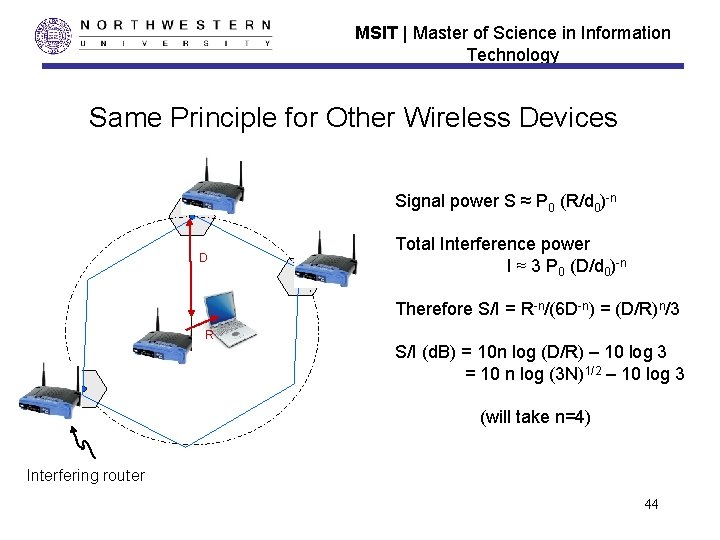
MSIT | Master of Science in Information Technology Same Principle for Other Wireless Devices Signal power S ≈ P 0 (R/d 0)-n D Total Interference power I ≈ 3 P 0 (D/d 0)-n Therefore S/I = R-n/(6 D-n) = (D/R)n/3 R S/I (d. B) = 10 n log (D/R) – 10 log 3 = 10 n log (3 N)1/2 – 10 log 3 (will take n=4) Interfering router 44
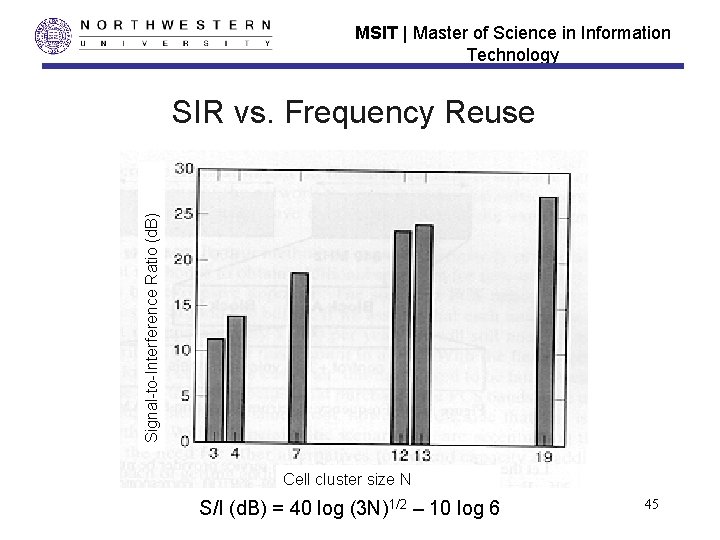
MSIT | Master of Science in Information Technology Signal-to-Interference Ratio (d. B) SIR vs. Frequency Reuse Cell cluster size N S/I (d. B) = 40 log (3 N)1/2 – 10 log 6 45
MSIT | Master of Science in Information Technology S/I Example • Suppose desired S/I = 10 d. B = 10 • From the graph, we can take N=3, that is, we need a 3 -cell reuse pattern. • But is this really adequate? 46
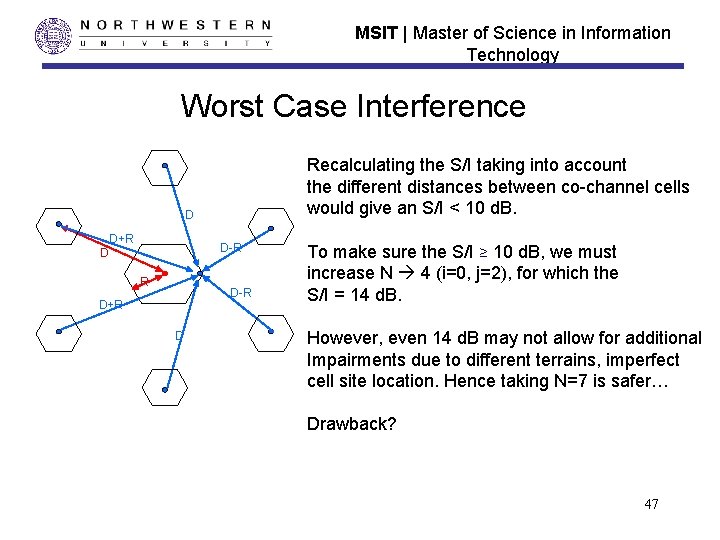
MSIT | Master of Science in Information Technology Worst Case Interference Recalculating the S/I taking into account the different distances between co-channel cells would give an S/I < 10 d. B. D D+R D-R D+R D To make sure the S/I ≥ 10 d. B, we must increase N 4 (i=0, j=2), for which the S/I = 14 d. B. However, even 14 d. B may not allow for additional Impairments due to different terrains, imperfect cell site location. Hence taking N=7 is safer… Drawback? 47
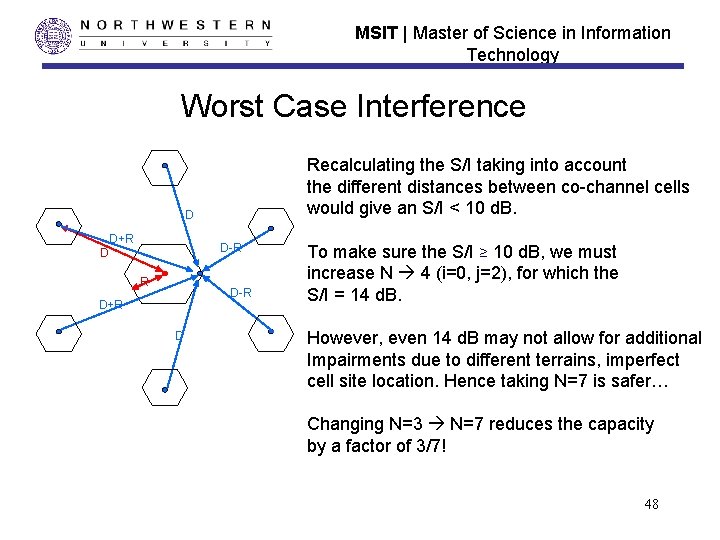
MSIT | Master of Science in Information Technology Worst Case Interference Recalculating the S/I taking into account the different distances between co-channel cells would give an S/I < 10 d. B. D D+R D-R D+R D To make sure the S/I ≥ 10 d. B, we must increase N 4 (i=0, j=2), for which the S/I = 14 d. B. However, even 14 d. B may not allow for additional Impairments due to different terrains, imperfect cell site location. Hence taking N=7 is safer… Changing N=3 N=7 reduces the capacity by a factor of 3/7! 48
MSIT | Master of Science in Information Technology To Increase Capacity in Cellular Systems: 49
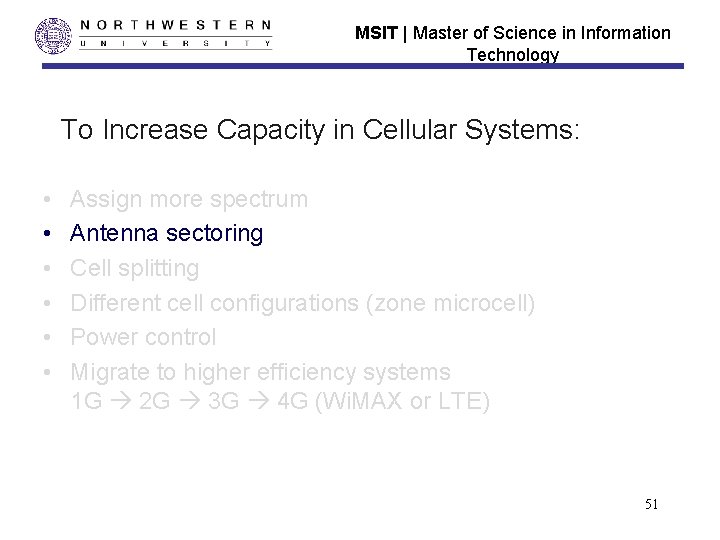
MSIT | Master of Science in Information Technology To Increase Capacity in Cellular Systems: • • • Buy more spectrum Antenna sectoring Cell splitting Different cell configurations (zone microcell) Power control Migrate to higher efficiency systems 1 G 2 G 3 G 4 G (LTE) 50
MSIT | Master of Science in Information Technology To Increase Capacity in Cellular Systems: • • • Assign more spectrum Antenna sectoring Cell splitting Different cell configurations (zone microcell) Power control Migrate to higher efficiency systems 1 G 2 G 3 G 4 G (Wi. MAX or LTE) 51
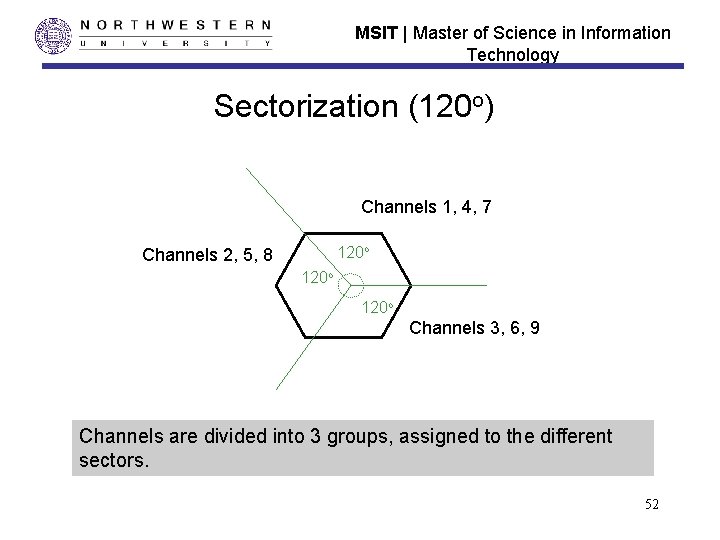
MSIT | Master of Science in Information Technology Sectorization (120 o) Channels 1, 4, 7 120 o Channels 2, 5, 8 120 o Channels 3, 6, 9 Channels are divided into 3 groups, assigned to the different sectors. 52
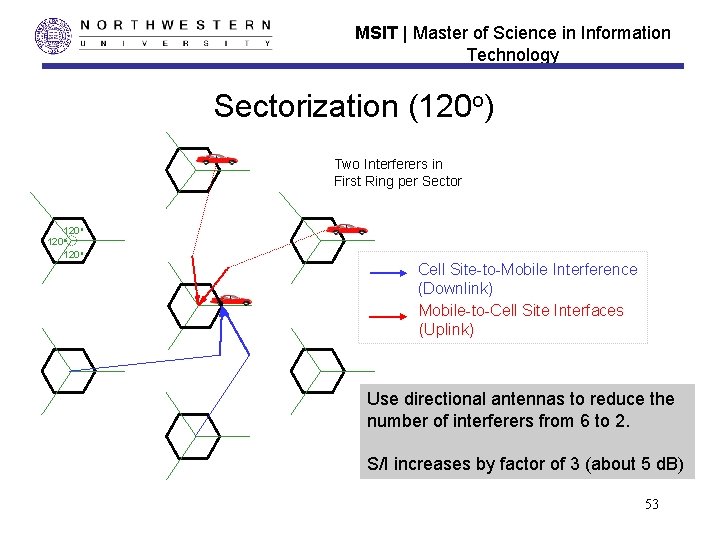
MSIT | Master of Science in Information Technology Sectorization (120 o) Two Interferers in First Ring per Sector 120 o Cell Site-to-Mobile Interference (Downlink) Mobile-to-Cell Site Interfaces (Uplink) Use directional antennas to reduce the number of interferers from 6 to 2. S/I increases by factor of 3 (about 5 d. B) 53
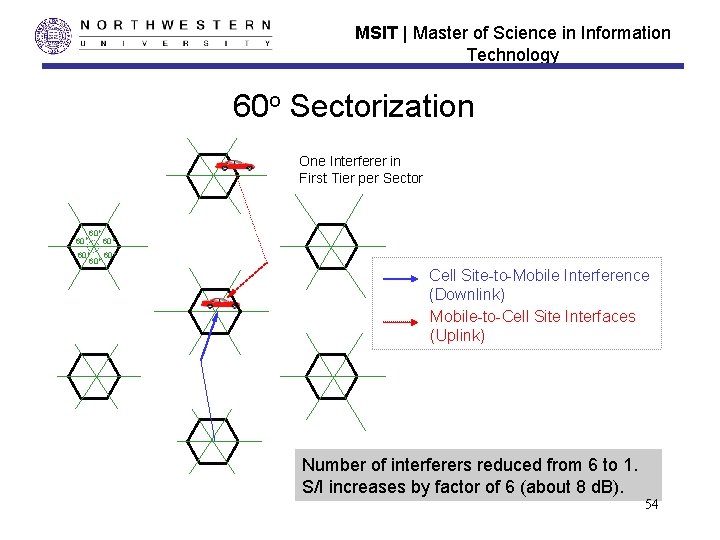
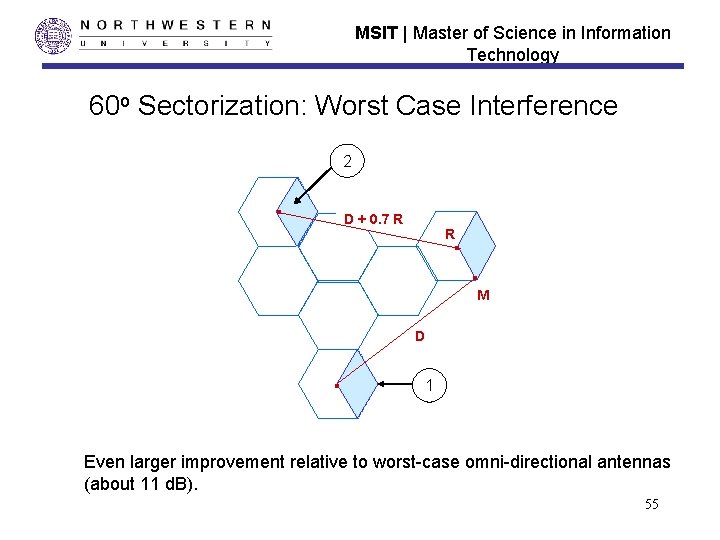
MSIT | Master of Science in Information Technology 60 o Sectorization One Interferer in First Tier per Sector 60 o 60 60 o o 60 o 60 o Cell Site-to-Mobile Interference (Downlink) Mobile-to-Cell Site Interfaces (Uplink) Number of interferers reduced from 6 to 1. S/I increases by factor of 6 (about 8 d. B). 54
MSIT | Master of Science in Information Technology 60 o Sectorization: Worst Case Interference 2 . . D + 0. 7 R R . M D . 1 Even larger improvement relative to worst-case omni-directional antennas (about 11 d. B). 55
MSIT | Master of Science in Information Technology Disadvantages of Sectoring 56
MSIT | Master of Science in Information Technology Disadvantages of Sectoring • Additional complexity • Increased handoffs (can be accommodated at base station instead of cellular switch (MTSO), so not a major concern) • Less effective in dense urban environments due to scattering of radio waves across sectors. • Reduced trunking efficiency 57
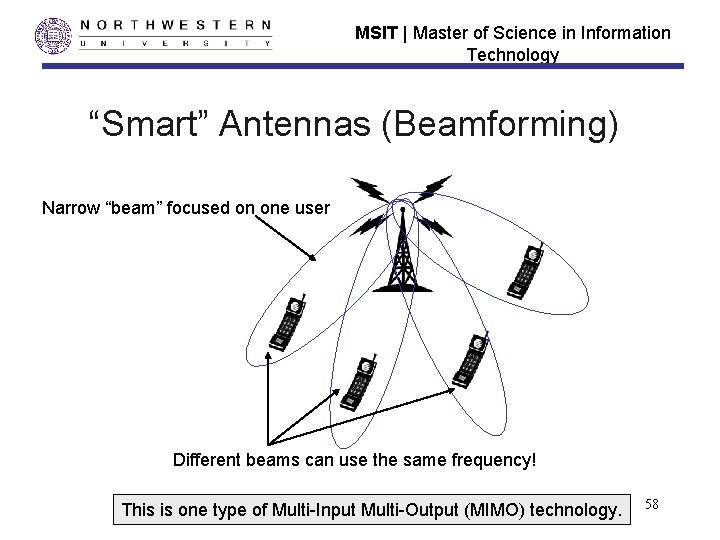
MSIT | Master of Science in Information Technology “Smart” Antennas (Beamforming) Narrow “beam” focused on one user Different beams can use the same frequency! This is one type of Multi-Input Multi-Output (MIMO) technology. 58
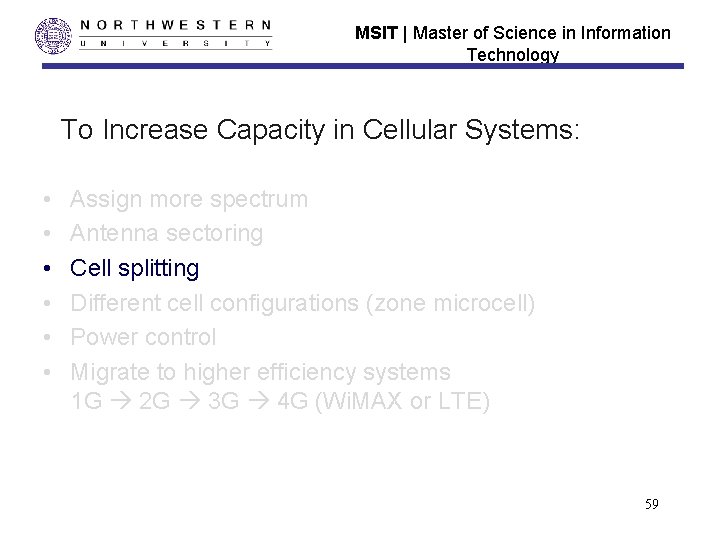
MSIT | Master of Science in Information Technology To Increase Capacity in Cellular Systems: • • • Assign more spectrum Antenna sectoring Cell splitting Different cell configurations (zone microcell) Power control Migrate to higher efficiency systems 1 G 2 G 3 G 4 G (Wi. MAX or LTE) 59
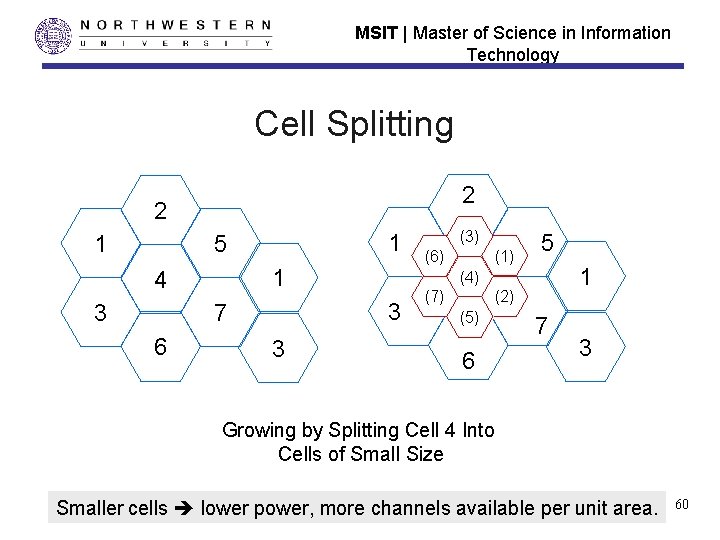
MSIT | Master of Science in Information Technology Cell Splitting 2 2 1 5 1 1 4 3 6 3 (1) (6) 5 1 (4) 3 7 (3) (7) (2) (5) 6 7 3 Growing by Splitting Cell 4 Into Cells of Small Size Smaller cells lower power, more channels available per unit area. 60
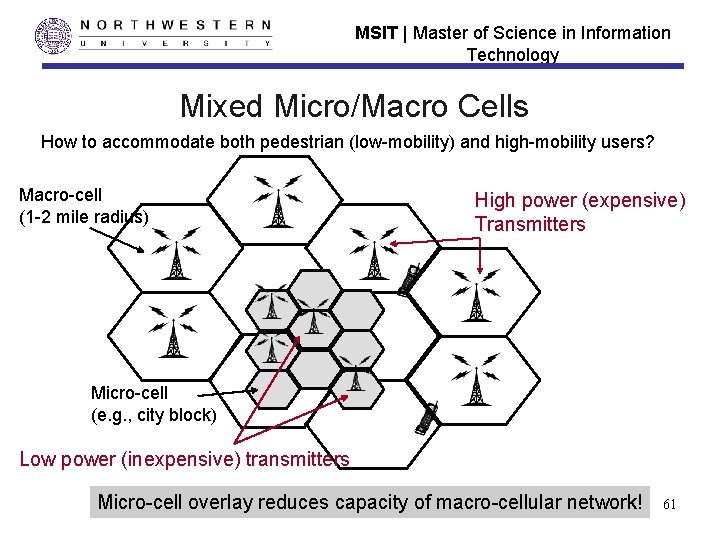
MSIT | Master of Science in Information Technology Mixed Micro/Macro Cells How to accommodate both pedestrian (low-mobility) and high-mobility users? Macro-cell (1 -2 mile radius) High power (expensive) Transmitters Micro-cell (e. g. , city block) Low power (inexpensive) transmitters Micro-cell overlay reduces capacity of macro-cellular network! 61
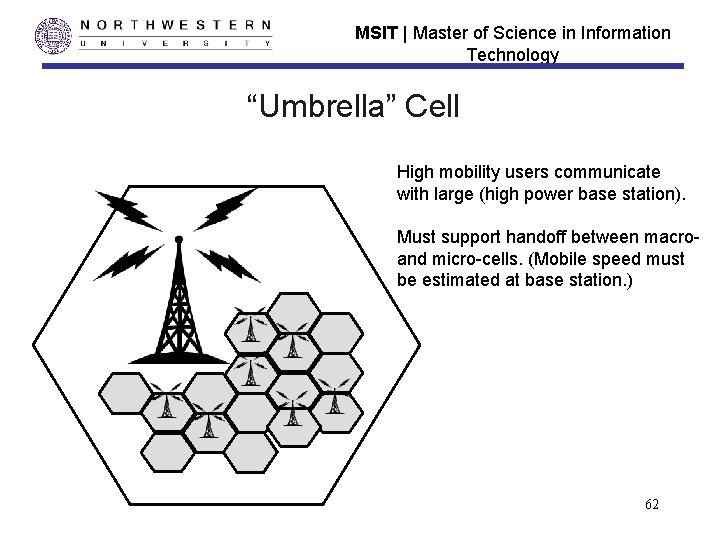
MSIT | Master of Science in Information Technology “Umbrella” Cell High mobility users communicate with large (high power base station). Must support handoff between macroand micro-cells. (Mobile speed must be estimated at base station. ) 62
MSIT | Master of Science in Information Technology 802. 11 Extension to Cellular Handoff to 802. 11 Cellular connection 63
MSIT | Master of Science in Information Technology To Increase Capacity in Cellular Systems: • • • Assign more spectrum Antenna sectoring Cell splitting Different cell configurations (zone microcell) Power control Migrate to higher efficiency systems 1 G 2 G 3 G 4 G (Wi. MAX or LTE) 64
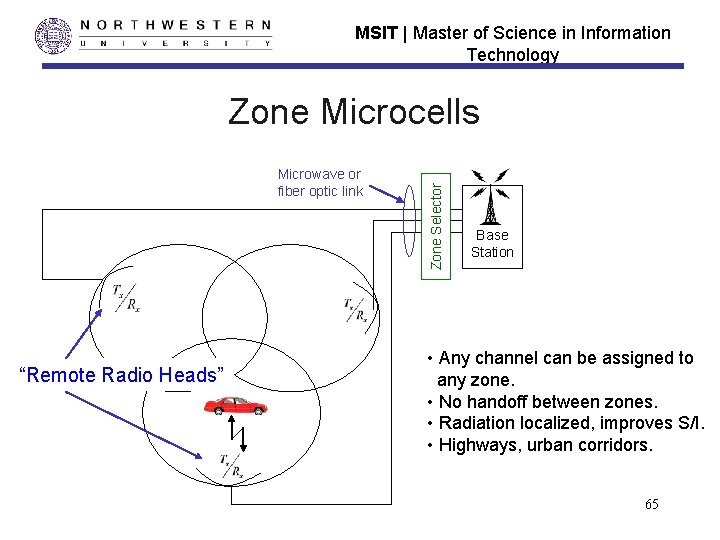
MSIT | Master of Science in Information Technology Microwave or fiber optic link “Remote Radio Heads” Zone Selector Zone Microcells Base Station • Any channel can be assigned to any zone. • No handoff between zones. • Radiation localized, improves S/I. • Highways, urban corridors. 65
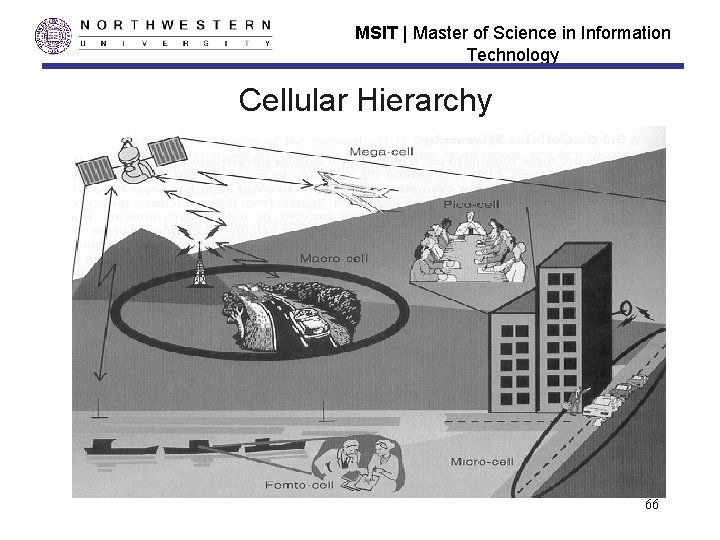
MSIT | Master of Science in Information Technology Cellular Hierarchy 66
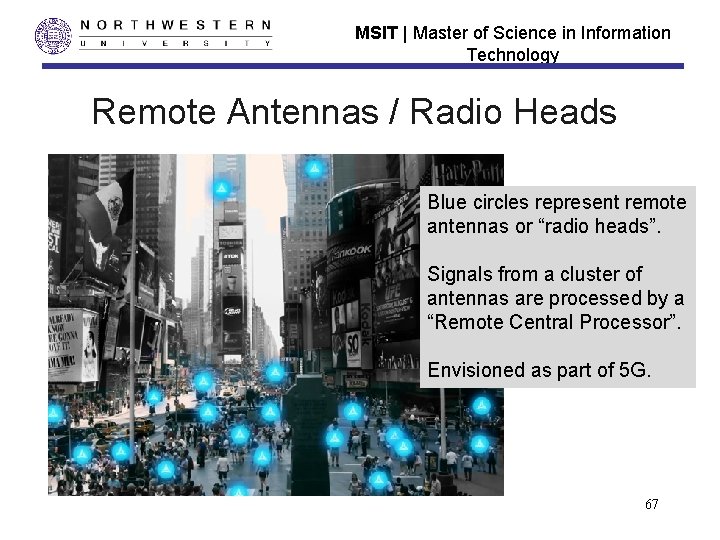
MSIT | Master of Science in Information Technology Remote Antennas / Radio Heads Blue circles represent remote antennas or “radio heads”. Signals from a cluster of antennas are processed by a “Remote Central Processor”. Envisioned as part of 5 G. 67
MSIT | Master of Science in Information Technology To Increase Capacity in Cellular Systems: • • • Assign more spectrum Antenna sectoring Cell splitting Different cell configurations (zone microcell) Power control Migrate to higher efficiency systems 2 G 3 G 4 G (LTE) 5 G? 68
MSIT | Master of Science in Information Technology Power Control and System Migration • Power control – Advantages? 69
MSIT | Master of Science in Information Technology Power Control and System Migration • Power control – Minimizes interference – Saves battery power – Solves “near-far” problem (crucial in CDMA) 70
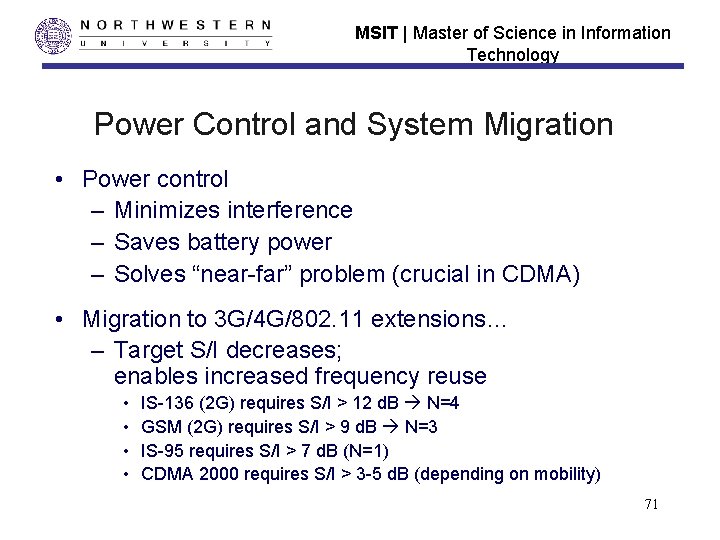
MSIT | Master of Science in Information Technology Power Control and System Migration • Power control – Minimizes interference – Saves battery power – Solves “near-far” problem (crucial in CDMA) • Migration to 3 G/4 G/802. 11 extensions… – Target S/I decreases; enables increased frequency reuse • • IS-136 (2 G) requires S/I > 12 d. B N=4 GSM (2 G) requires S/I > 9 d. B N=3 IS-95 requires S/I > 7 d. B (N=1) CDMA 2000 requires S/I > 3 -5 d. B (depending on mobility) 71
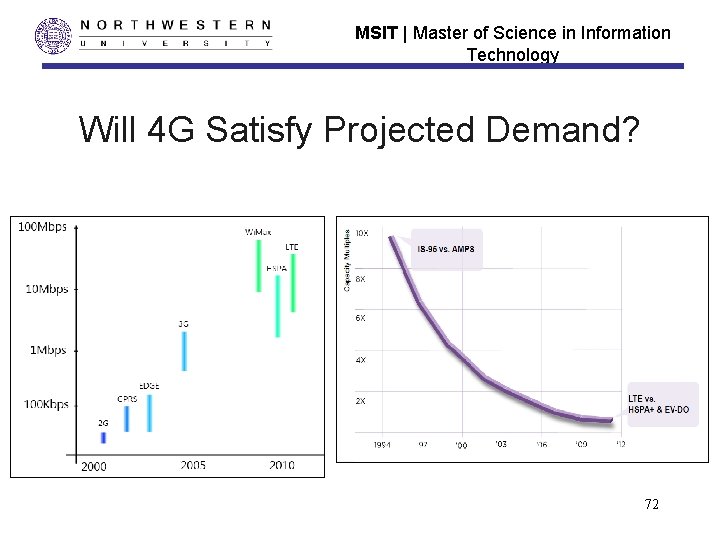
MSIT | Master of Science in Information Technology Will 4 G Satisfy Projected Demand? 72
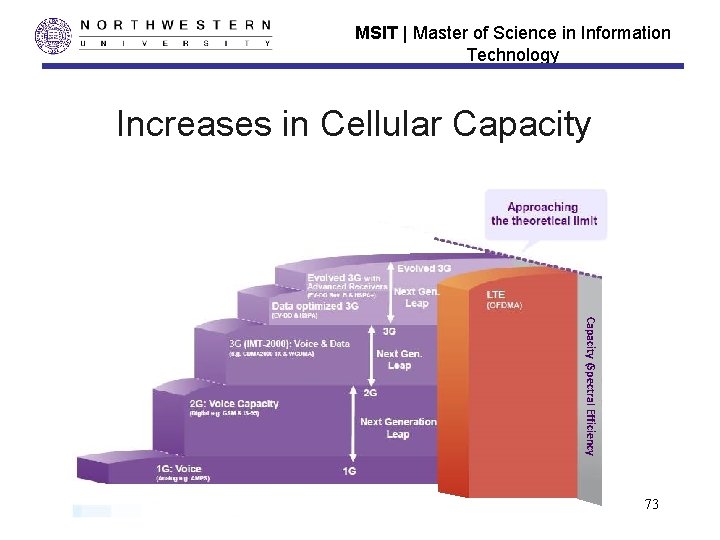
MSIT | Master of Science in Information Technology Increases in Cellular Capacity (Spectral Efficiency 73
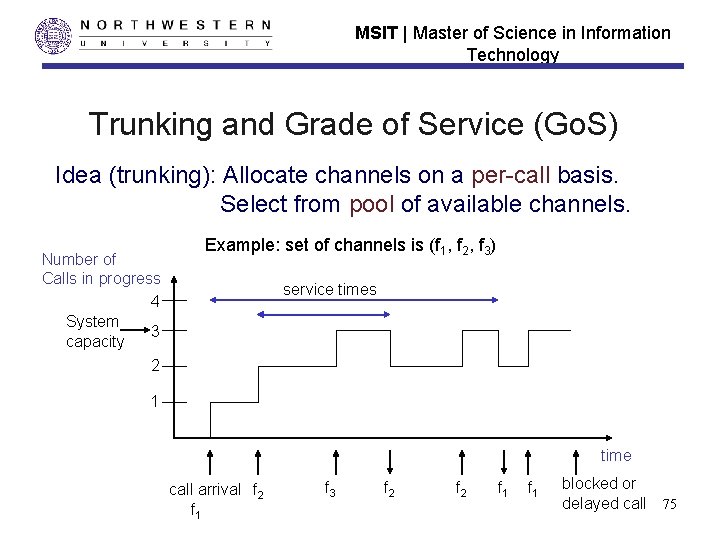
MSIT | Master of Science in Information Technology Trunking and Grade of Service (Go. S) Idea (trunking): Allocate channels on a per-call basis. Select from pool of available channels. 74
MSIT | Master of Science in Information Technology Trunking and Grade of Service (Go. S) Idea (trunking): Allocate channels on a per-call basis. Select from pool of available channels. Number of Calls in progress 4 System 3 capacity Example: set of channels is (f 1, f 2, f 3) service times 2 1 time call arrival f 2 f 1 f 3 f 2 f 1 blocked or delayed call 75
MSIT | Master of Science in Information Technology Grade of Service (Go. S) • Go. S measures: – Blocking probability – Probability that delay > time T (e. g. , maximum acceptable delay for voice call) • Go. S pertains to busiest hour (e. g. , rush hour) • Go. S depends on: – ? ? 76
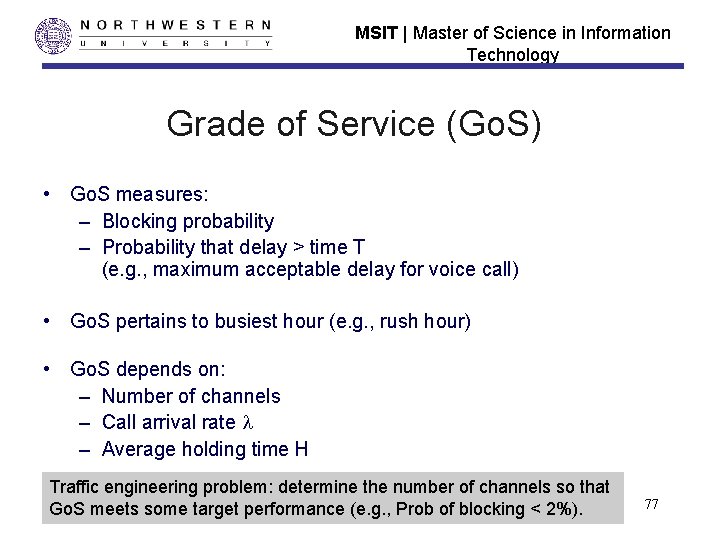
MSIT | Master of Science in Information Technology Grade of Service (Go. S) • Go. S measures: – Blocking probability – Probability that delay > time T (e. g. , maximum acceptable delay for voice call) • Go. S pertains to busiest hour (e. g. , rush hour) • Go. S depends on: – Number of channels – Call arrival rate – Average holding time H Traffic engineering problem: determine the number of channels so that Go. S meets some target performance (e. g. , Prob of blocking < 2%). 77
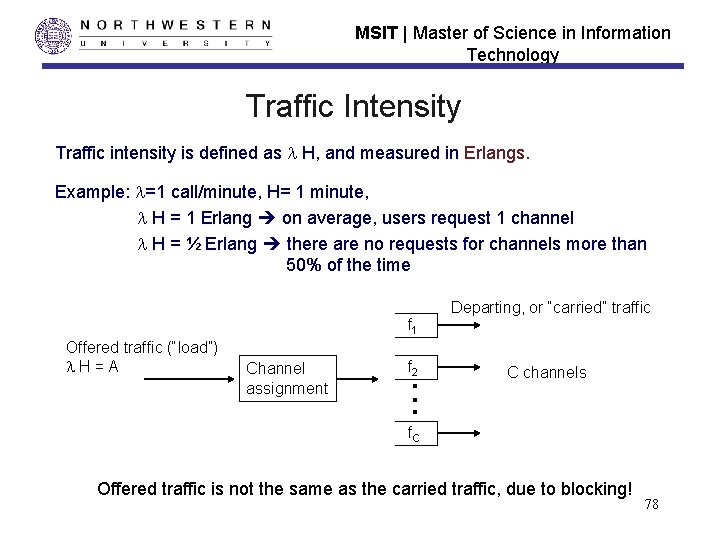
MSIT | Master of Science in Information Technology Traffic Intensity Traffic intensity is defined as H, and measured in Erlangs. Example: =1 call/minute, H= 1 minute, H = 1 Erlang on average, users request 1 channel H = ½ Erlang there are no requests for channels more than 50% of the time f 1 Offered traffic (“load”) H=A Channel assignment . . . f 2 Departing, or “carried” traffic C channels f. C Offered traffic is not the same as the carried traffic, due to blocking! 78
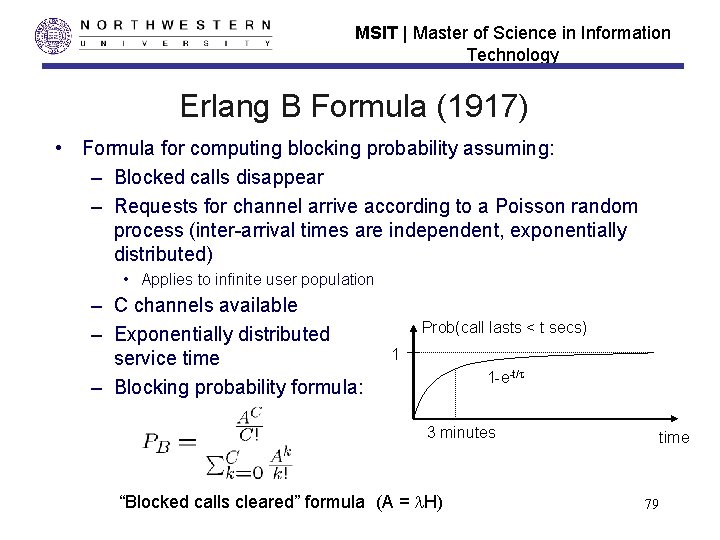
MSIT | Master of Science in Information Technology Erlang B Formula (1917) • Formula for computing blocking probability assuming: – Blocked calls disappear – Requests for channel arrive according to a Poisson random process (inter-arrival times are independent, exponentially distributed) • Applies to infinite user population – C channels available – Exponentially distributed service time – Blocking probability formula: Prob(call lasts < t secs) 1 1 -e-t/ 3 minutes “Blocked calls cleared” formula (A = H) time 79
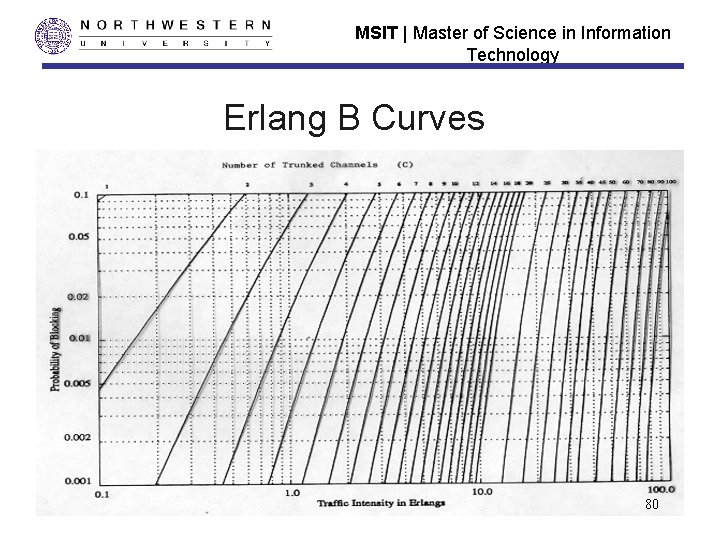
MSIT | Master of Science in Information Technology Erlang B Curves 80
MSIT | Master of Science in Information Technology Erlang C Formula • • Blocked calls enter a queue First come, first served Call is blocked if queuing delay D > T Formula for probability of blocking given in text. 81
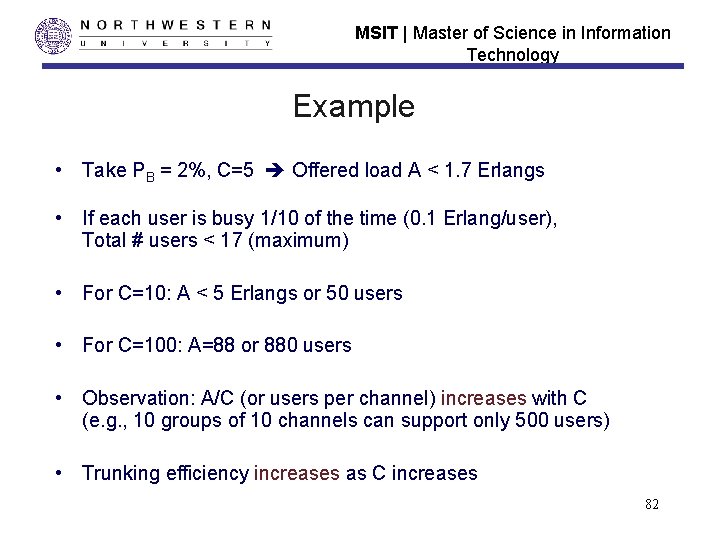
MSIT | Master of Science in Information Technology Example • Take PB = 2%, C=5 Offered load A < 1. 7 Erlangs • If each user is busy 1/10 of the time (0. 1 Erlang/user), Total # users < 17 (maximum) • For C=10: A < 5 Erlangs or 50 users • For C=100: A=88 or 880 users • Observation: A/C (or users per channel) increases with C (e. g. , 10 groups of 10 channels can support only 500 users) • Trunking efficiency increases as C increases 82
MSIT | Master of Science in Information Technology Trunking Efficiency • Refers to the traffic intensity (Erlangs) that can be supported given a fixed number of channels and a target blocking probability. • For a fixed blocking probability: – Trunking efficiency improves with the number of channels. Best to pool as many channels as possible. 83
MSIT | Master of Science in Information Technology Voice Capacity • Defined as – Example: SE = 2 Erlangs/MHz/km 2 1 MHz supports 2 Erlangs/km 2 (Note that 1 km 2 may correspond to a cell. ) – If on average, each user is active 1/10 of the time, then 1 Erlang corresponds to 10 users. • Traffic per cell depends on… 84
MSIT | Master of Science in Information Technology Voice Capacity • Defined as – Example: SE = 2 Erlangs/MHz/km 2 1 MHz supports 2 Erlangs/km 2 (Note that 1 km 2 may correspond to a cell. ) – If on average, each user is active 1/10 of the time, then 1 Erlang corresponds to 10 users. • Traffic per cell depends on: – Number of channels – Grade of Service (e. g. , typically 2%) – S/I requirement (determined by cluster size N) 85
MSIT | Master of Science in Information Technology Effect of Sectorization • Does sectorization increase user capacity (Erlangs) per cell? 86
MSIT | Master of Science in Information Technology Effect of Sectorization • For fixed N, sectorization – Increases the S/I – Reduces trunking efficiency • Example: 90 channels per cell, 120 o sectors gives 30 channels per sector, which reduces the number of Erlangs that can be supported for a given blocking probability. • Can we use sectorization to increase user capacity? – Yes, must also reduce N • Increases channels per cell increases user capacity • Increases interference, lowers S/I • Sectorization then increases S/I 87
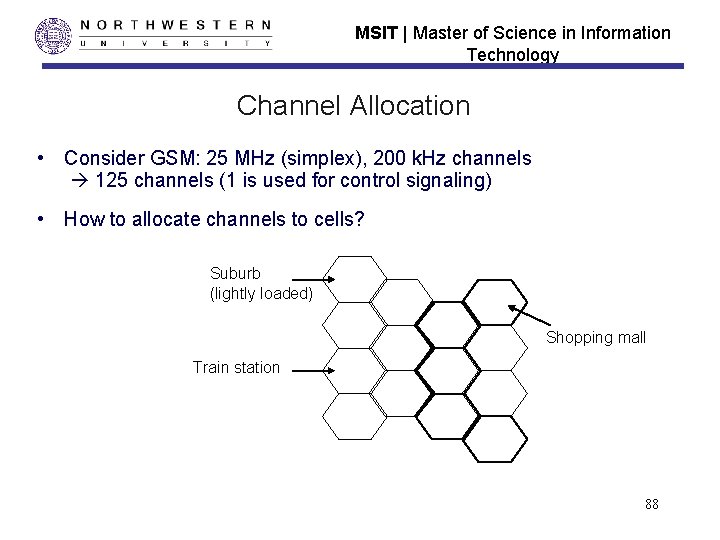
MSIT | Master of Science in Information Technology Channel Allocation • Consider GSM: 25 MHz (simplex), 200 k. Hz channels 125 channels (1 is used for control signaling) • How to allocate channels to cells? Suburb (lightly loaded) Shopping mall Train station 88
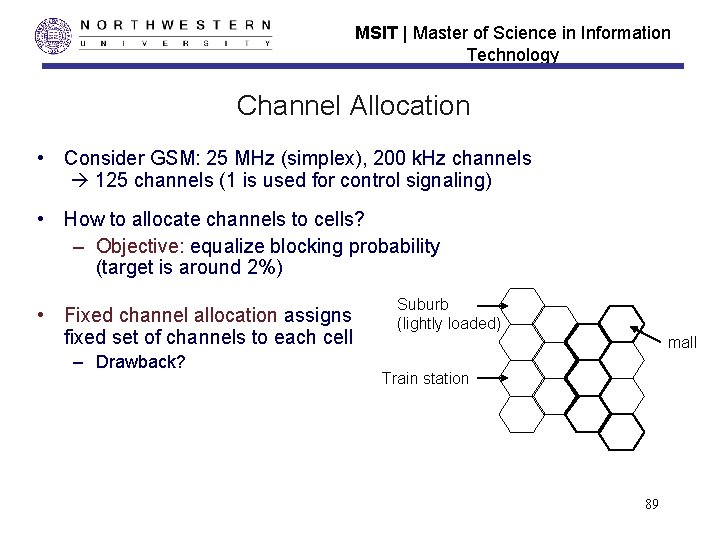
MSIT | Master of Science in Information Technology Channel Allocation • Consider GSM: 25 MHz (simplex), 200 k. Hz channels 125 channels (1 is used for control signaling) • How to allocate channels to cells? – Objective: equalize blocking probability (target is around 2%) • Fixed channel allocation assigns fixed set of channels to each cell – Drawback? Suburb (lightly loaded) mall Train station 89
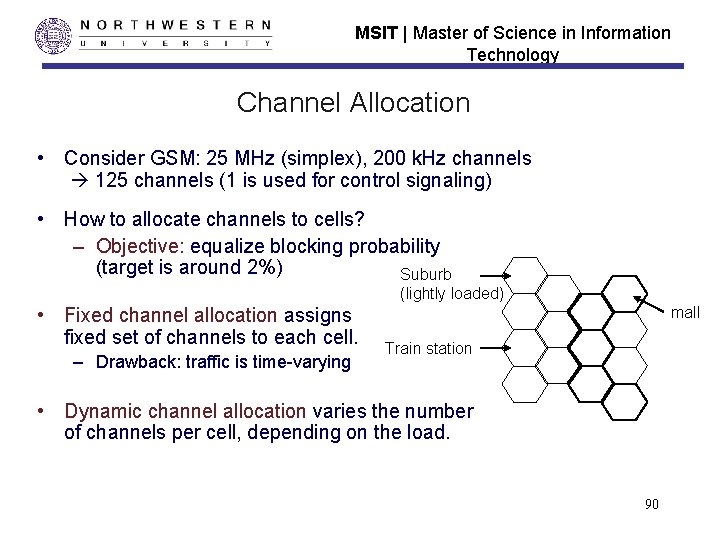
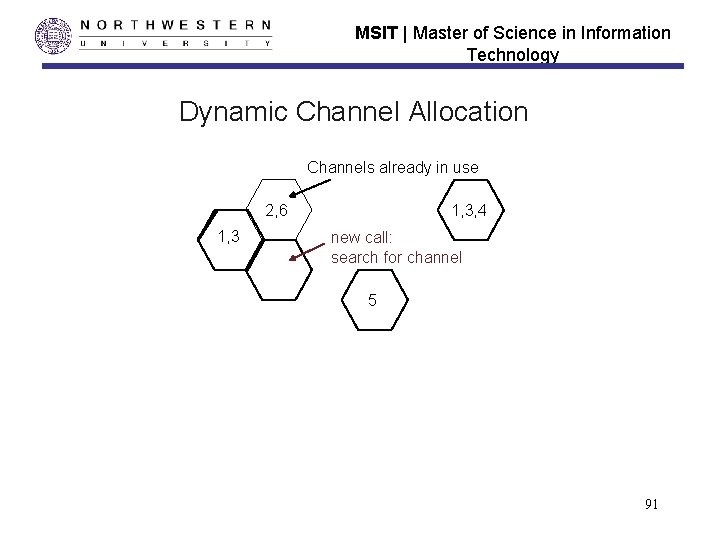
MSIT | Master of Science in Information Technology Channel Allocation • Consider GSM: 25 MHz (simplex), 200 k. Hz channels 125 channels (1 is used for control signaling) • How to allocate channels to cells? – Objective: equalize blocking probability (target is around 2%) Suburb (lightly loaded) • Fixed channel allocation assigns fixed set of channels to each cell. – Drawback: traffic is time-varying mall Train station • Dynamic channel allocation varies the number of channels per cell, depending on the load. 90
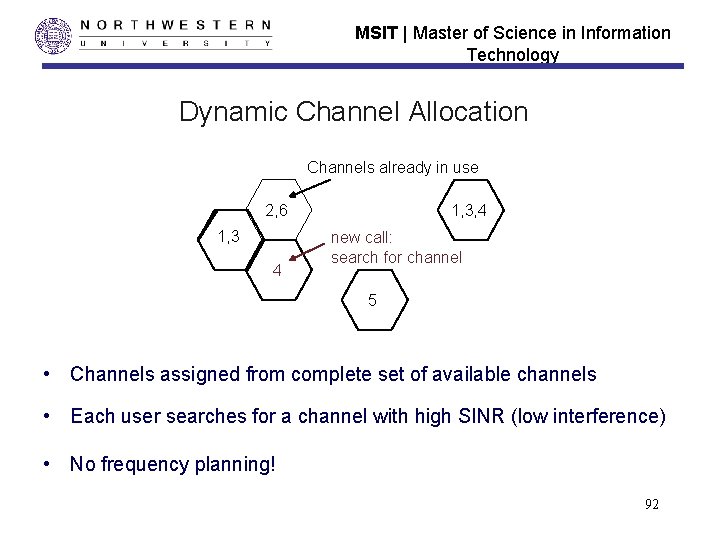
MSIT | Master of Science in Information Technology Dynamic Channel Allocation Channels already in use 2, 6 1, 3, 4 new call: search for channel 5 91
MSIT | Master of Science in Information Technology Dynamic Channel Allocation Channels already in use 2, 6 1, 3 4 1, 3, 4 new call: search for channel 5 • Channels assigned from complete set of available channels • Each user searches for a channel with high SINR (low interference) • No frequency planning! 92
MSIT | Master of Science in Information Technology 802. 11 b/g/n Channels Comparison table Channels: 1 6 11 • 14 overlapping (staggered) channels (11 in the U. S. ) • Center frequencies are separated by 5 MHz • Bandwidth/interference controlled by “spectral mask” – 30 d. B attenuation 11 MHz from center frequency – 50 d. B attenuation 22 MHz from center frequency 93
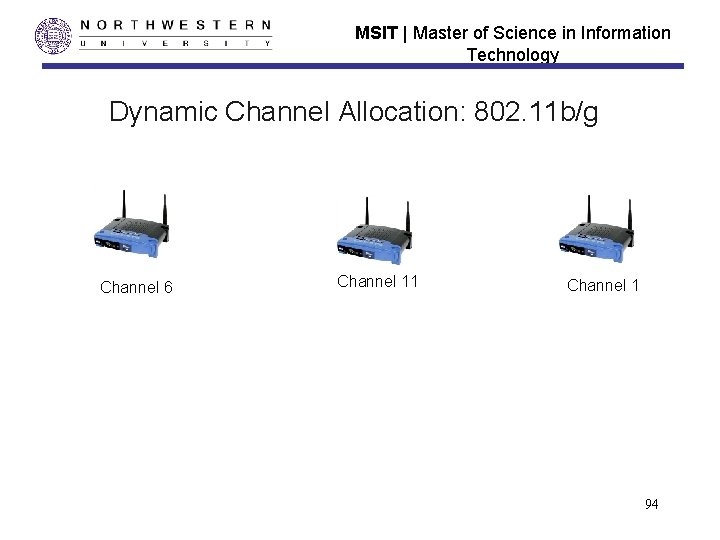
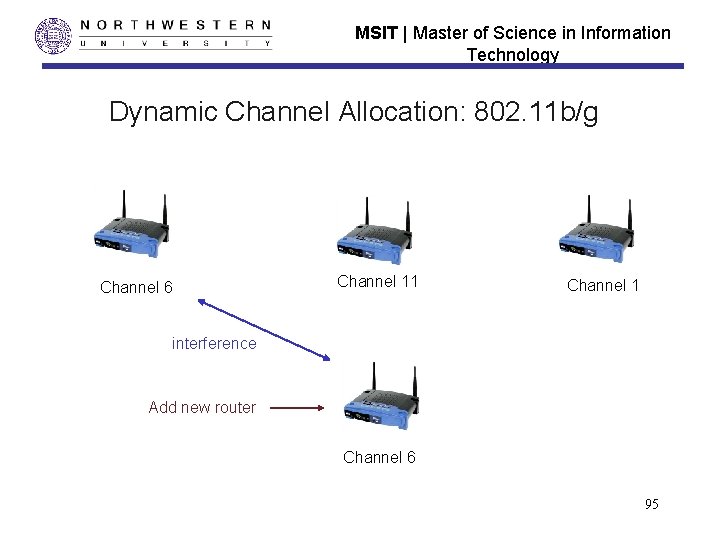
MSIT | Master of Science in Information Technology Dynamic Channel Allocation: 802. 11 b/g Channel 6 Channel 11 Channel 1 94
MSIT | Master of Science in Information Technology Dynamic Channel Allocation: 802. 11 b/g Channel 6 Channel 11 Channel 1 interference Add new router Channel 6 95
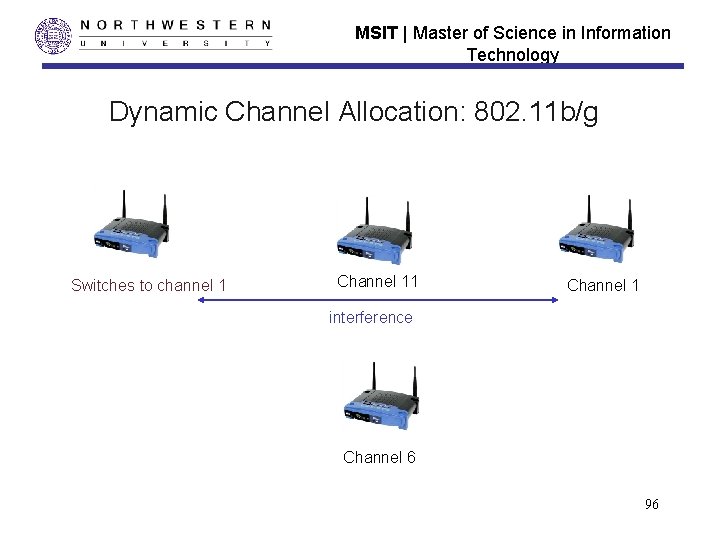
MSIT | Master of Science in Information Technology Dynamic Channel Allocation: 802. 11 b/g Switches to channel 1 Channel 1 interference Channel 6 96
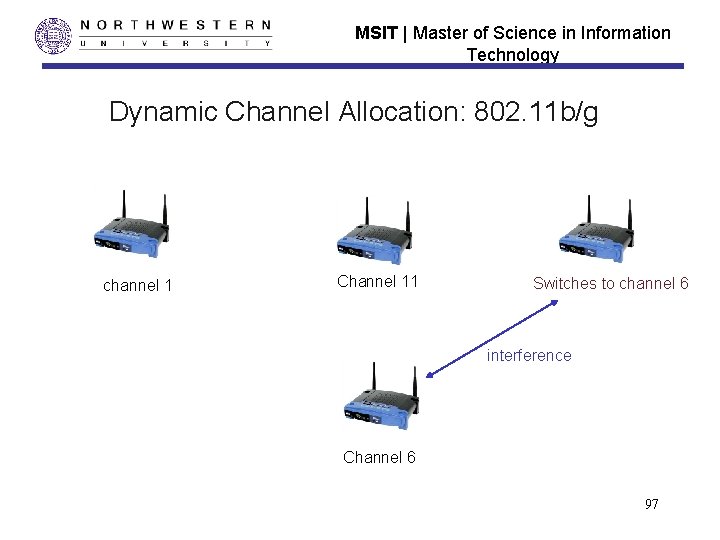
MSIT | Master of Science in Information Technology Dynamic Channel Allocation: 802. 11 b/g channel 1 Channel 11 Switches to channel 6 interference Channel 6 97
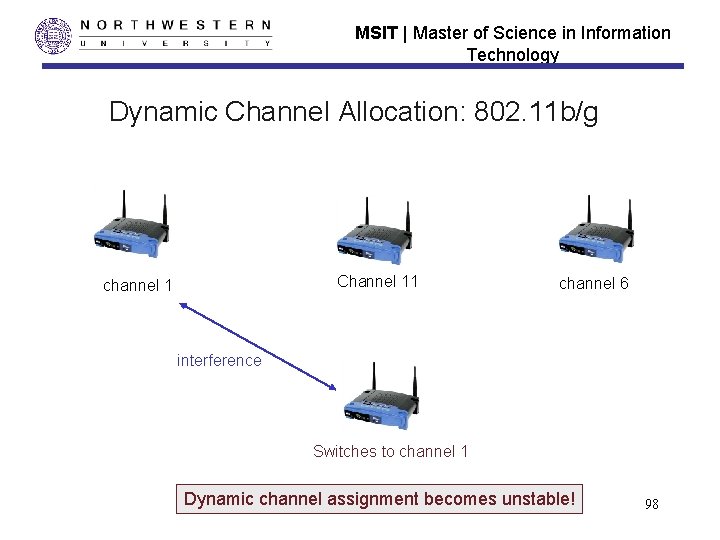
MSIT | Master of Science in Information Technology Dynamic Channel Allocation: 802. 11 b/g Channel 11 channel 6 interference Switches to channel 1 Dynamic channel assignment becomes unstable! 98
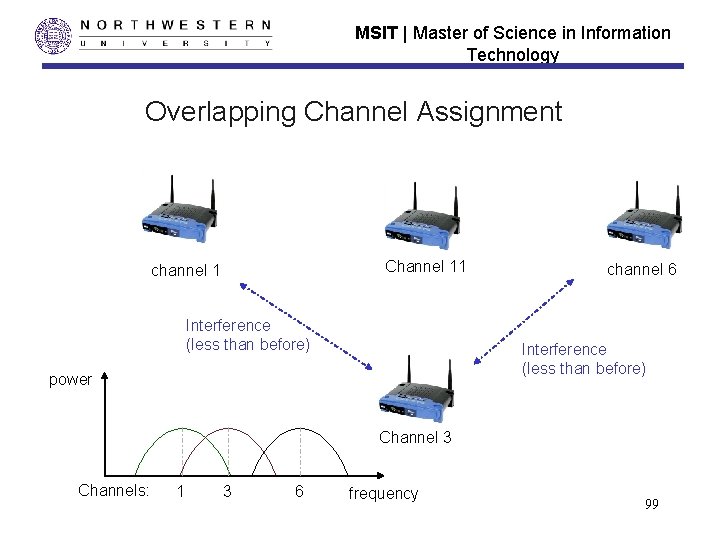
MSIT | Master of Science in Information Technology Overlapping Channel Assignment Channel 11 channel 1 Interference (less than before) channel 6 Interference (less than before) power Channel 3 Channels: 1 3 6 frequency 99
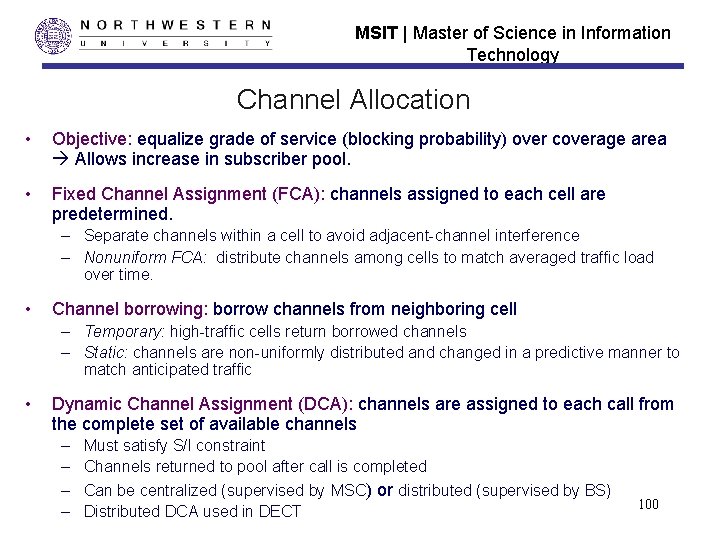
MSIT | Master of Science in Information Technology Channel Allocation • Objective: equalize grade of service (blocking probability) over coverage area Allows increase in subscriber pool. • Fixed Channel Assignment (FCA): channels assigned to each cell are predetermined. – Separate channels within a cell to avoid adjacent-channel interference – Nonuniform FCA: distribute channels among cells to match averaged traffic load over time. • Channel borrowing: borrow channels from neighboring cell – Temporary: high-traffic cells return borrowed channels – Static: channels are non-uniformly distributed and changed in a predictive manner to match anticipated traffic • Dynamic Channel Assignment (DCA): channels are assigned to each call from the complete set of available channels – – Must satisfy S/I constraint Channels returned to pool after call is completed Can be centralized (supervised by MSC) or distributed (supervised by BS) Distributed DCA used in DECT 100
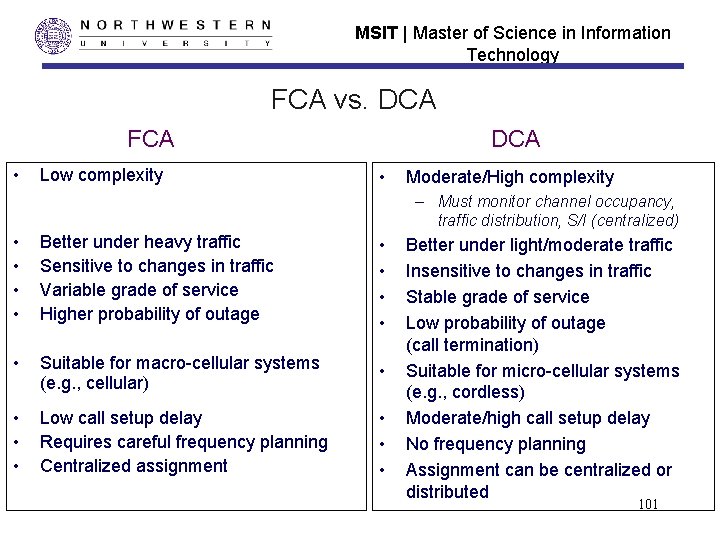
MSIT | Master of Science in Information Technology FCA vs. DCA FCA • Low complexity DCA • Moderate/High complexity – Must monitor channel occupancy, traffic distribution, S/I (centralized) • • Better under heavy traffic Sensitive to changes in traffic Variable grade of service Higher probability of outage • • • Suitable for macro-cellular systems (e. g. , cellular) • • Low call setup delay Requires careful frequency planning Centralized assignment • • • Better under light/moderate traffic Insensitive to changes in traffic Stable grade of service Low probability of outage (call termination) Suitable for micro-cellular systems (e. g. , cordless) Moderate/high call setup delay No frequency planning Assignment can be centralized or distributed 101