Madhav Institute of Technology Science Gwalior A Govt














- Slides: 40
Madhav Institute of Technology & Science, Gwalior (A Govt. Aided UGC Autonomous & NAAC Accredited Institute Affiliated to RGPV Bhopal) (Established in 1957) The MITS Family WELCOMES The Newly admitted students of First Year A Presentation BY Dr. Ma. NJAREE PANDIT, Professor, Department of Electrical Engineering & Dean, (Academics)
Presentation Overview Vision & Mission of the Institute History of MITS Introduction to Flexible Curriculum Rules for promotion to higher classes Courses Being Offerred at MITS Flexible Curriculum Guidelines for earning Additional Credits through MOOCs • Guidelines for Getting Honours or Minor Specialization with B. Tech Degree • Participation in feedbacks & surveys • • Induction programs for I year students: Address by Dean Academics: Dr. Manjaree Pandit 2
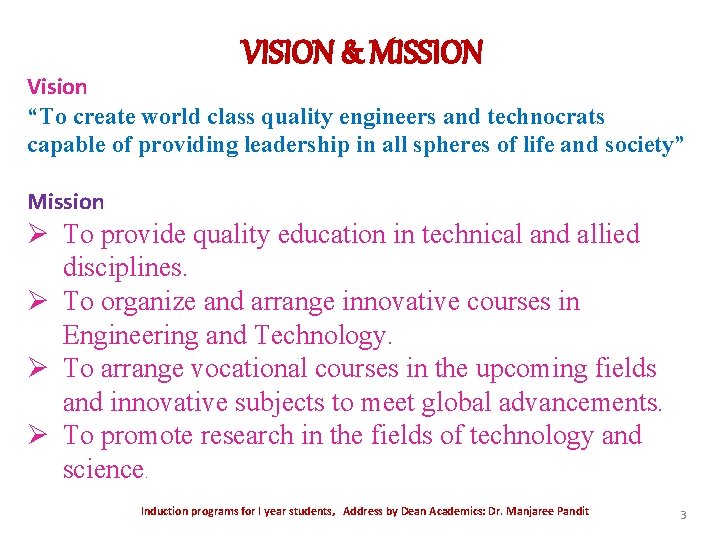
VISION & MISSION Vision “To create world class quality engineers and technocrats capable of providing leadership in all spheres of life and society” Mission Ø To provide quality education in technical and allied disciplines. Ø To organize and arrange innovative courses in Engineering and Technology. Ø To arrange vocational courses in the upcoming fields and innovative subjects to meet global advancements. Ø To promote research in the fields of technology and science. Induction programs for I year students, Address by Dean Academics: Dr. Manjaree Pandit 3
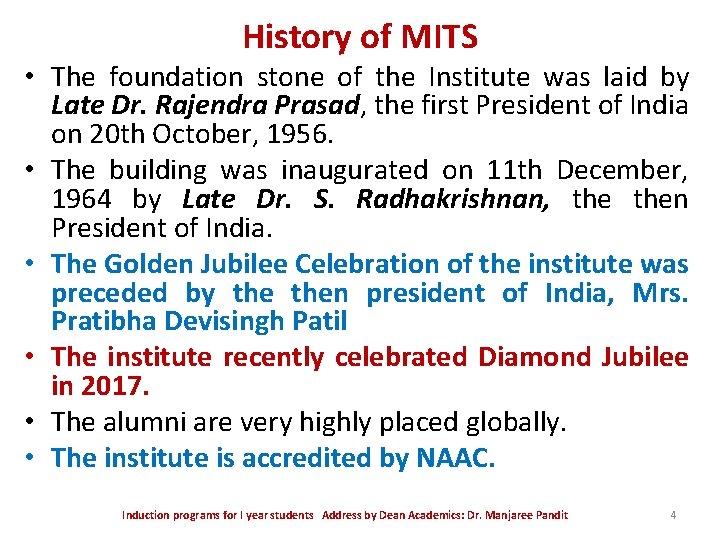
History of MITS • The foundation stone of the Institute was laid by Late Dr. Rajendra Prasad, the first President of India on 20 th October, 1956. • The building was inaugurated on 11 th December, 1964 by Late Dr. S. Radhakrishnan, then President of India. • The Golden Jubilee Celebration of the institute was preceded by then president of India, Mrs. Pratibha Devisingh Patil • The institute recently celebrated Diamond Jubilee in 2017. • The alumni are very highly placed globally. • The institute is accredited by NAAC. Induction programs for I year students Address by Dean Academics: Dr. Manjaree Pandit 4
History of MITS Autonomy • Till 2000 -01 MITS was affiliated to the Jiwaji University, Gwalior • For the last 19 years now MITS is an Autonomous Institute under the Rajiv Gandhi Proudyogiki Vishwavidyalaya (RGPV) Bhopal • The degree however is conferred by the university (RGPV) • With effect from July 2017, MITS was granted autonomy for 6 years by the University Grants Commission (UGC) which permits MITS to (i) Have its own courses and syllabi and (ii) Evolve methods of evaluation and conduction of examination Induction programs for I year students Address by Dean Academics: Dr. Manjaree Pandit 5
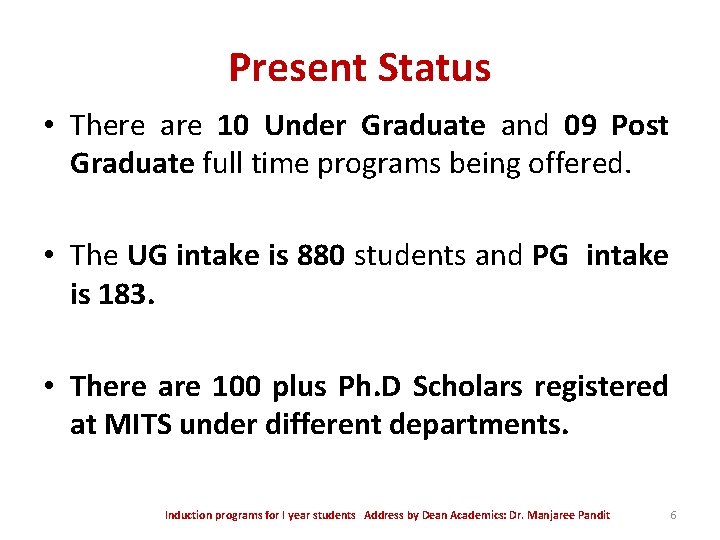
Present Status • There are 10 Under Graduate and 09 Post Graduate full time programs being offered. • The UG intake is 880 students and PG intake is 183. • There are 100 plus Ph. D Scholars registered at MITS under different departments. Induction programs for I year students Address by Dean Academics: Dr. Manjaree Pandit 6
Courses Being Offered at MITS UNDER GRADUATE(UG) PROGRAMMES POST GRADUATE (PG) PROGRAMMES Induction programs for I year students Address by Dean Academics: Dr. Manjaree Pandit 7
Flexible Curriculum (Drafted & Implemented in accordance with AICTE model curriculum guidelines) TERMINOLOGY L T P HSMC Lecture Tutorial Practical Humanities and Social Sciences including Management Courses BSC Basic Science Courses ESC Engineering Science Courses DC Departmental Core DE Departmental Elective OC DLC MC Open Category Departmental Laboratory Courses Mandatory Course Induction programs for I year students Address by Dean Academics: Dr. Manjaree Pandit 8
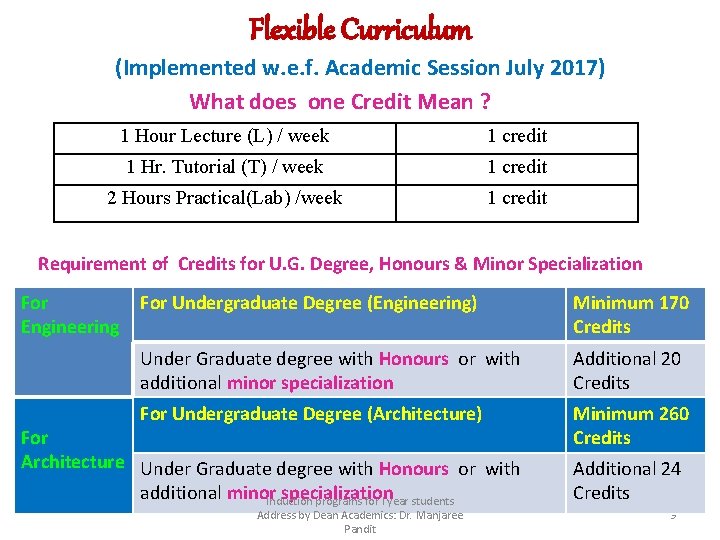
Flexible Curriculum (Implemented w. e. f. Academic Session July 2017) What does one Credit Mean ? 1 Hour Lecture (L) / week 1 credit 1 Hr. Tutorial (T) / week 1 credit 2 Hours Practical(Lab) /week 1 credit Requirement of Credits for U. G. Degree, Honours & Minor Specialization For Engineering For Undergraduate Degree (Engineering) Minimum 170 Credits Under Graduate degree with Honours or with additional minor specialization Additional 20 Credits For Undergraduate Degree (Architecture) Minimum 260 Credits For Architecture Under Graduate degree with Honours or with additional minor. Induction specialization programs for I year students Address by Dean Academics: Dr. Manjaree Pandit Additional 24 Credits 9
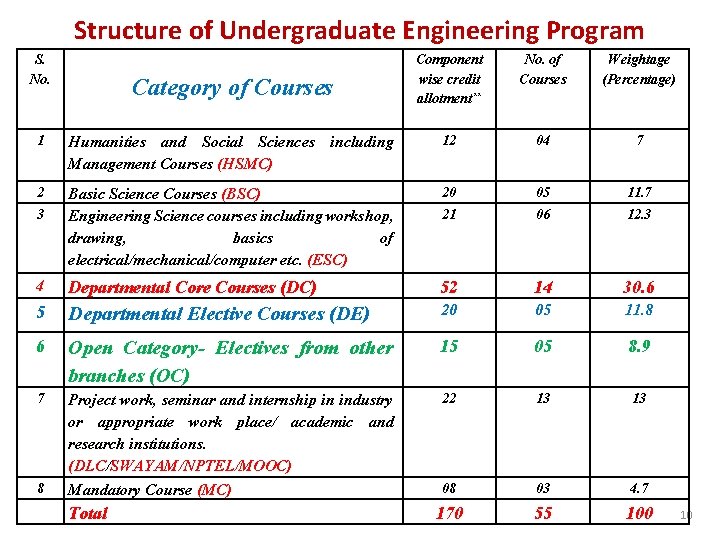
Structure of Undergraduate Engineering Program S. No. Category of Courses Component wise credit allotment** No. of Courses Weightage (Percentage) 1 Humanities and Social Sciences including Management Courses (HSMC) 12 04 7 2 Basic Science Courses (BSC) Engineering Science courses including workshop, drawing, basics of electrical/mechanical/computer etc. (ESC) 20 05 11. 7 21 06 12. 3 4 Departmental Core Courses (DC) 52 14 30. 6 5 Departmental Elective Courses (DE) 20 05 11. 8 6 Open Category- Electives from other branches (OC) 15 05 8. 9 7 Project work, seminar and internship in industry or appropriate work place/ academic and research institutions. (DLC/SWAYAM/NPTEL/MOOC) Mandatory Course (MC) 22 13 13 08 03 4. 7 170 55 100 3 8 Total 10
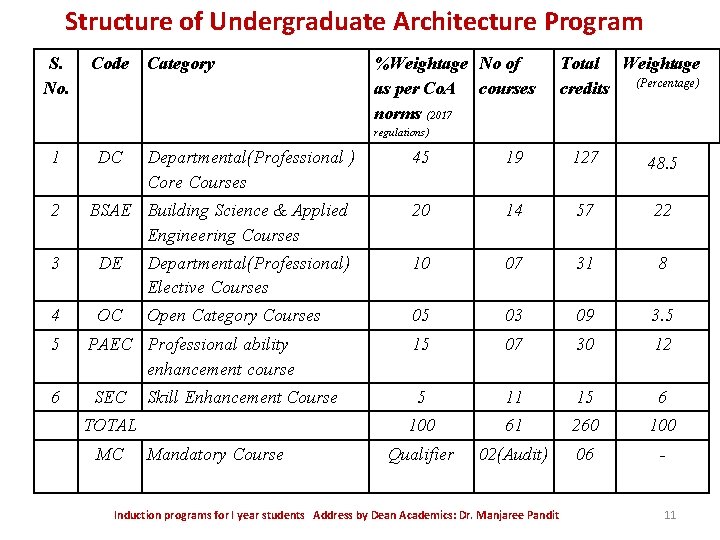
Structure of Undergraduate Architecture Program S. No. Code Category %Weightage No of as per Co. A courses norms (2017 Total Weightage (Percentage) credits regulations) 1 2 DC Departmental(Professional ) Core Courses BSAE Building Science & Applied Engineering Courses 45 19 127 48. 5 20 14 57 22 3 DE Departmental(Professional) Elective Courses 10 07 31 8 4 OC Open Category Courses 05 03 09 3. 5 15 07 30 12 5 11 15 6 100 61 260 100 Qualifier 02(Audit) 06 - 5 6 PAEC Professional ability enhancement course SEC Skill Enhancement Course TOTAL MC Mandatory Course Induction programs for I year students Address by Dean Academics: Dr. Manjaree Pandit 11
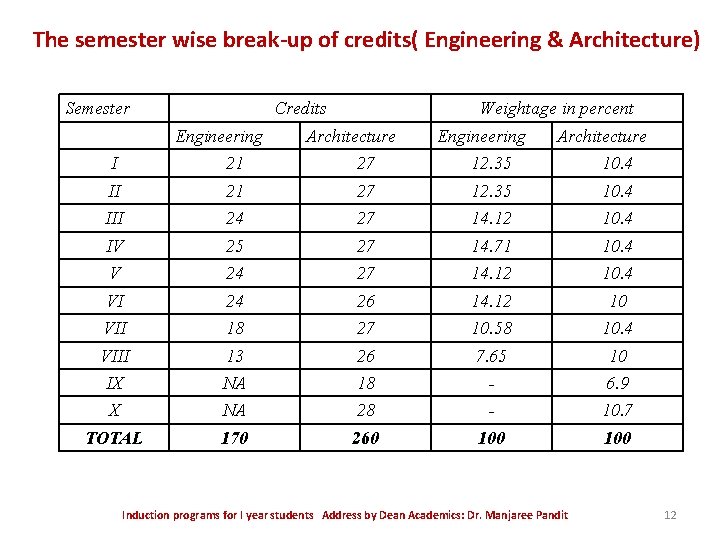
The semester wise break-up of credits( Engineering & Architecture) Semester Credits Engineering Weightage in percent Architecture Engineering Architecture I 21 27 12. 35 10. 4 III 24 27 14. 12 10. 4 IV 25 27 14. 71 10. 4 V 24 27 14. 12 10. 4 VI 24 26 14. 12 10 VII 18 27 10. 58 10. 4 VIII 13 26 7. 65 10 IX NA 18 - 6. 9 X NA 28 - 10. 7 TOTAL 170 260 100 Induction programs for I year students Address by Dean Academics: Dr. Manjaree Pandit 12
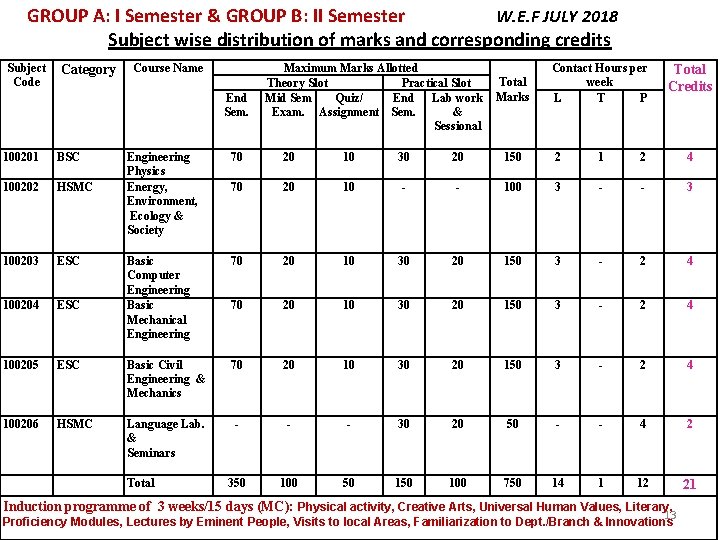
GROUP A: I Semester & GROUP B: II Semester W. E. F JULY 2018 Subject wise distribution of marks and corresponding credits Subject Code Category Course Name End Sem. 100201 BSC 100202 HSMC 100203 ESC 100204 ESC 100205 100206 Maximum Marks Allotted Theory Slot Practical Slot Mid Sem Quiz/ End Lab work Exam. Assignment Sem. & Sessional Total Marks Contact Hours per week L T P Total Credits Engineering Physics Energy, Environment, Ecology & Society 70 20 10 30 20 150 2 1 2 4 70 20 10 - - 100 3 - - 3 Basic Computer Engineering Basic Mechanical Engineering 70 20 10 30 20 150 3 - 2 4 ESC Basic Civil Engineering & Mechanics 70 20 10 30 20 150 3 - 2 4 HSMC Language Lab. & Seminars - - - 30 20 50 - - 4 2 350 100 750 14 1 12 21 Total Induction programme of 3 weeks/15 days (MC): Physical activity, Creative Arts, Universal Human Values, Literary, 13 Proficiency Modules, Lectures by Eminent People, Visits to local Areas, Familiarization to Dept. /Branch & Innovations
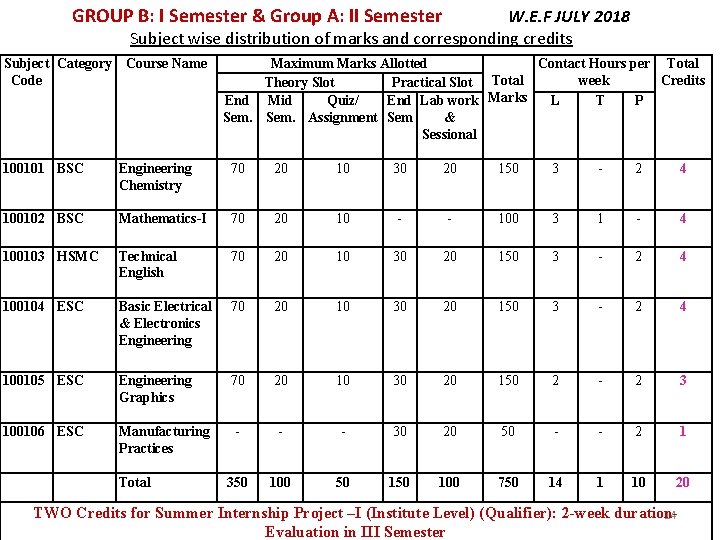
GROUP B: I Semester & Group A: II Semester W. E. F JULY 2018 Subject wise distribution of marks and corresponding credits Subject Category Course Name Code Maximum Marks Allotted Contact Hours per Total week Credits Theory Slot Practical Slot Total End Mid Quiz/ End Lab work Marks L T P Sem. Assignment Sem & Sessional 100101 BSC Engineering Chemistry 70 20 10 30 20 150 3 - 2 4 100102 BSC Mathematics-I 70 20 10 - - 100 3 1 - 4 100103 HSMC Technical English 70 20 10 30 20 150 3 - 2 4 100104 ESC Basic Electrical & Electronics Engineering 70 20 10 30 20 150 3 - 2 4 100105 ESC Engineering Graphics 70 20 10 30 20 150 2 - 2 3 100106 ESC Manufacturing Practices - - - 30 20 50 - - 2 1 350 100 750 14 1 10 20 Total TWO Credits for Summer Internship Project –I (Institute Level) (Qualifier): 2 -week duration 14 Evaluation in III Semester
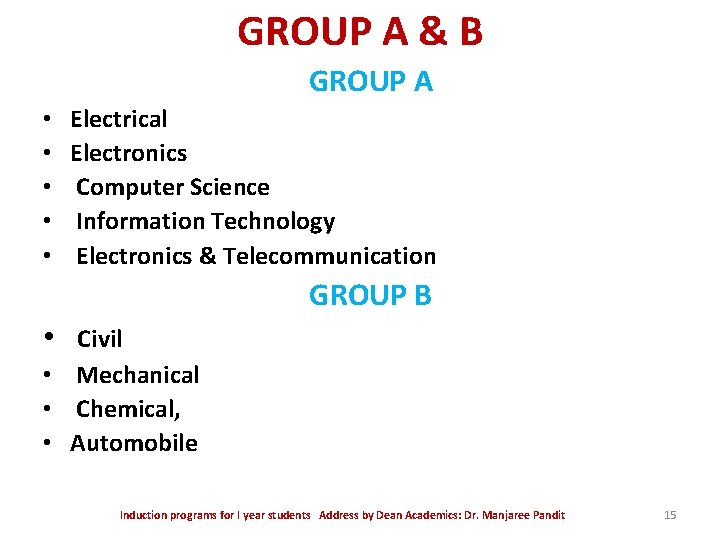
GROUP A & B GROUP A • • • Electrical Electronics Computer Science Information Technology Electronics & Telecommunication GROUP B • Civil • Mechanical • Chemical, • Automobile Induction programs for I year students Address by Dean Academics: Dr. Manjaree Pandit 15
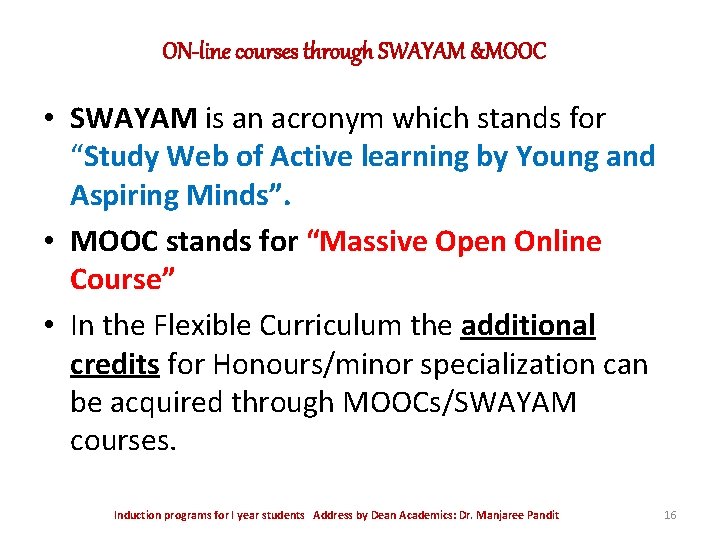
ON-line courses through SWAYAM &MOOC • SWAYAM is an acronym which stands for “Study Web of Active learning by Young and Aspiring Minds”. • MOOC stands for “Massive Open Online Course” • In the Flexible Curriculum the additional credits for Honours/minor specialization can be acquired through MOOCs/SWAYAM courses. Induction programs for I year students Address by Dean Academics: Dr. Manjaree Pandit 16
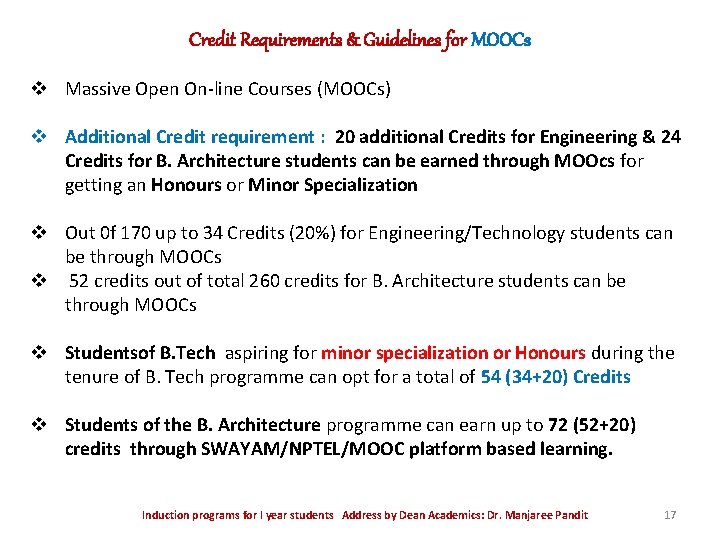
Credit Requirements & Guidelines for MOOCs v Massive Open On-line Courses (MOOCs) v Additional Credit requirement : 20 additional Credits for Engineering & 24 Credits for B. Architecture students can be earned through MOOcs for getting an Honours or Minor Specialization v Out 0 f 170 up to 34 Credits (20%) for Engineering/Technology students can be through MOOCs v 52 credits out of total 260 credits for B. Architecture students can be through MOOCs v Studentsof B. Tech aspiring for minor specialization or Honours during the tenure of B. Tech programme can opt for a total of 54 (34+20) Credits v Students of the B. Architecture programme can earn up to 72 (52+20) credits through SWAYAM/NPTEL/MOOC platform based learning. Induction programs for I year students Address by Dean Academics: Dr. Manjaree Pandit 17
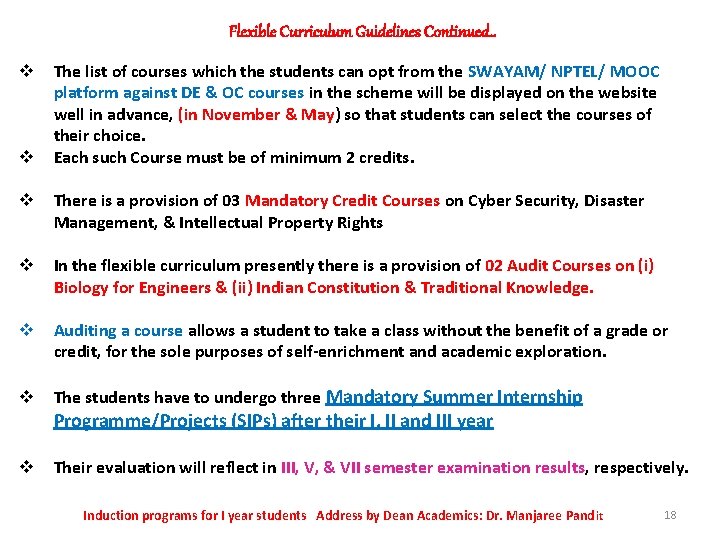
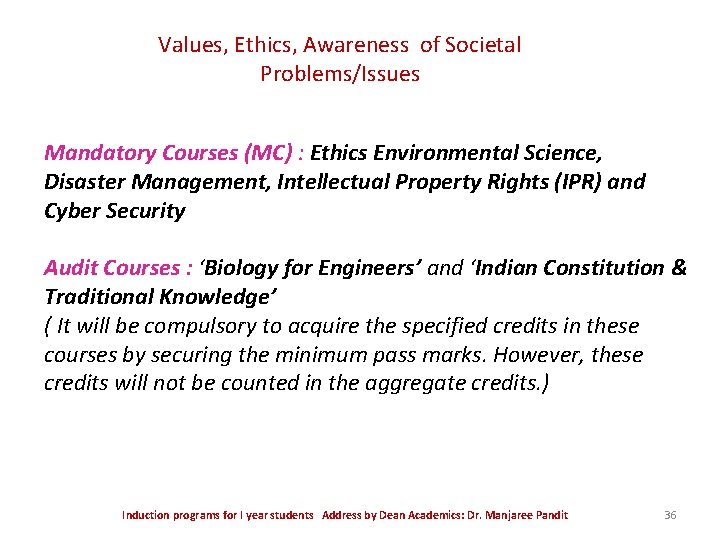
Flexible Curriculum Guidelines Continued. . v v The list of courses which the students can opt from the SWAYAM/ NPTEL/ MOOC platform against DE & OC courses in the scheme will be displayed on the website well in advance, (in November & May) so that students can select the courses of their choice. Each such Course must be of minimum 2 credits. v There is a provision of 03 Mandatory Credit Courses on Cyber Security, Disaster Management, & Intellectual Property Rights v In the flexible curriculum presently there is a provision of 02 Audit Courses on (i) Biology for Engineers & (ii) Indian Constitution & Traditional Knowledge. v Auditing a course allows a student to take a class without the benefit of a grade or credit, for the sole purposes of self-enrichment and academic exploration. v The students have to undergo three Mandatory Summer Internship Programme/Projects (SIPs) after their I, II and III year v Their evaluation will reflect in III, V, & VII semester examination results, respectively. Induction programs for I year students Address by Dean Academics: Dr. Manjaree Pand it 18
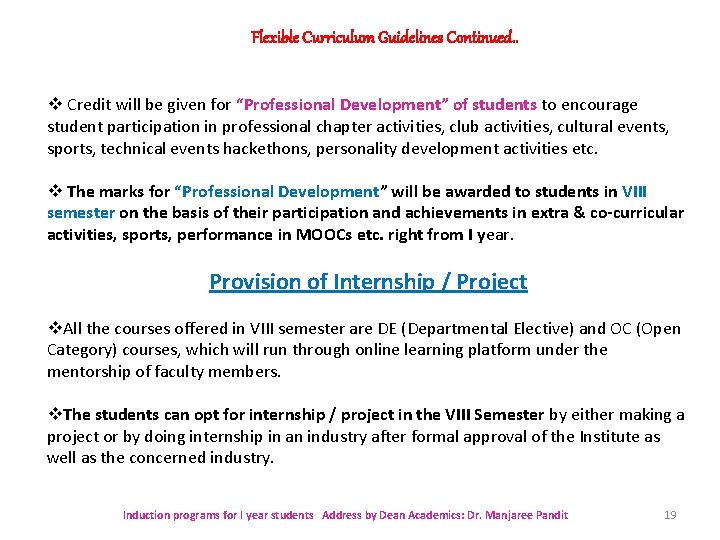
Flexible Curriculum Guidelines Continued. . v Credit will be given for “Professional Development” of students to encourage student participation in professional chapter activities, club activities, cultural events, sports, technical events hackethons, personality development activities etc. v The marks for “Professional Development” will be awarded to students in VIII semester on the basis of their participation and achievements in extra & co-curricular activities, sports, performance in MOOCs etc. right from I year. Provision of Internship / Project v. All the courses offered in VIII semester are DE (Departmental Elective) and OC (Open Category) courses, which will run through online learning platform under the mentorship of faculty members. v. The students can opt for internship / project in the VIII Semester by either making a project or by doing internship in an industry after formal approval of the Institute as well as the concerned industry. Induction programs for I year students Address by Dean Academics: Dr. Manjaree Pandit 19
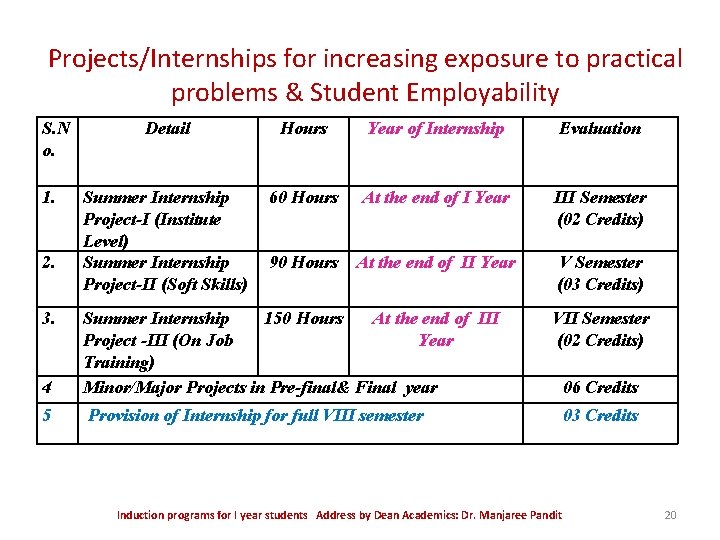
Projects/Internships for increasing exposure to practical problems & Student Employability S. N o. 1. 2. 3. Detail Hours Year of Internship Evaluation Summer Internship Project-I (Institute Level) Summer Internship Project-II (Soft Skills) 60 Hours At the end of I Year III Semester (02 Credits) 90 Hours At the end of II Year V Semester (03 Credits) 4 Summer Internship 150 Hours At the end of III Project -III (On Job Year Training) Minor/Major Projects in Pre-final& Final year 5 Provision of Internship for full VIII semester VII Semester (02 Credits) Induction programs for I year students Address by Dean Academics: Dr. Manjaree Pandit 06 Credits 03 Credits 20
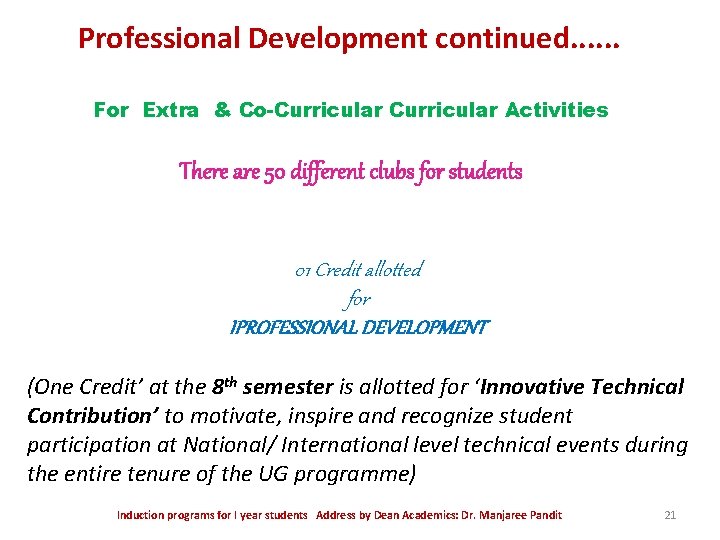
Professional Development continued. . . For Extra & Co-Curricular Activities There are 50 different clubs for students 01 Credit allotted for IPROFESSIONAL DEVELOPMENT (One Credit’ at the 8 th semester is allotted for ‘Innovative Technical Contribution’ to motivate, inspire and recognize student participation at National/ International level technical events during the entire tenure of the UG programme) Induction programs for I year students Address by Dean Academics: Dr. Manjaree Pandit 21
Guidelines for evaluating “Professional Development” PERFORMANCE METRICS Categories Suggestive Activities Marks Assigned Institute Level* (C 1) Participation in Institute level technical events such as quizzes, extemporary, debate, student volunteers, seminar, professional society local chapters (IET, IEEE, ISTE, IETE), NCC, etc. 02 Marks for each participation (maximum 06) Participation in State level technical events such as Robotics, State Level* 03 marks for each participation Coding challenge, Cultural cum technical fest, technical symposium, (C 2) (Maximum 09) volunteers, hackathon, sports etc. National level* (C 3) Participate in National level events such as hands on workshop, national level seminar, national conference, Entrepreneurship, 05 marks for each participation model making, techno culture fest, national youth festival, research (Maximum 15) conclave, project competition, volunteers, sports festival etc. MOOC’s** (C 4) Successfully completed technical certification course in any MOOC’s platform such as (NPTEL/SWAYAM/Ed. X/Coursera/Class Central etc) 10 marks for each course (Maximum 20) Evaluation Formula for evaluation in VIII Semester ( C 1 x 2 + C 2 x 3 + C 3 x 5 +C 4 x 10)= Marks Scored (Out of 50)
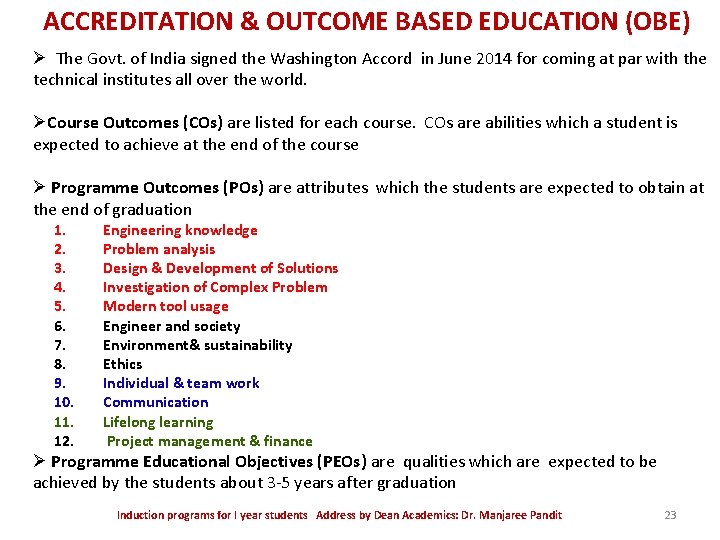
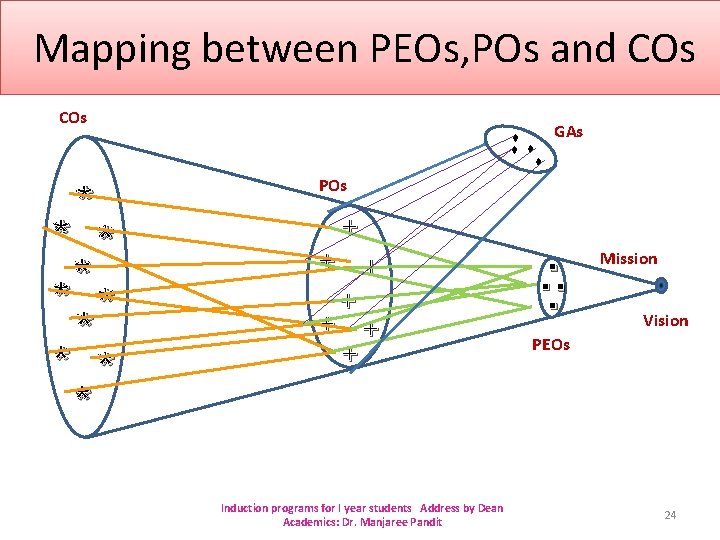
ACCREDITATION & OUTCOME BASED EDUCATION (OBE) Ø The Govt. of India signed the Washington Accord in June 2014 for coming at par with the technical institutes all over the world. ØCourse Outcomes (COs) are listed for each course. COs are abilities which a student is expected to achieve at the end of the course Ø Programme Outcomes (POs) are attributes which the students are expected to obtain at the end of graduation 1. 2. 3. 4. 5. 6. 7. 8. 9. 10. 11. 12. Engineering knowledge Problem analysis Design & Development of Solutions Investigation of Complex Problem Modern tool usage Engineer and society Environment& sustainability Ethics Individual & team work Communication Lifelong learning Project management & finance Ø Programme Educational Objectives (PEOs) are qualities which are expected to be achieved by the students about 3 -5 years after graduation Induction programs for I year students Address by Dean Academics: Dr. Manjaree Pandit 23
Mapping between PEOs, POs and COs ♦ ♦ ♦ * * * * * GAs ♦ POs + + + + Induction programs for I year students Address by Dean Academics: Dr. Manjaree Pandit . . Mission Vision PEOs 24
Academic feedbacks & surveys • • On-line feedback on teachers (during mid-sem exams) On-line feedback on courses being run (October & May) On-line feedback on course outcomes (end of course) Feedback by parents (during parent teacher meeting) (At the time of your graduation) • On-line feedback on Programme Outcomes (POs) • Exit survey (3 -5 years after Graduation) • Alumni satisfaction survey Induction programs for I year students Address by Dean Academics: Dr. Manjaree Pandit 25
Awareness about Ethics & Academic Integrity Criteria for accepting similarity index for the submission of UG project report/ PG dissertation/thesis The overall similarity index up to 15 -20% is acceptable (using turnitin plagiarism check software). The highest similarity percentage from any one source is not greater than 4 -6%. In case of self plagiarism, the permissible percentage may be slightly higher, say at 7 -10%. Induction programs for I year students Address by Dean Academics: Dr. Manjaree Pandit 26
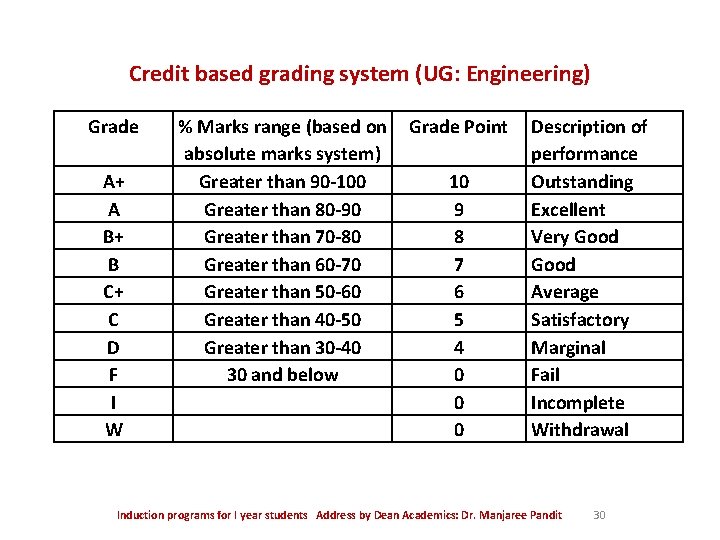
PROMOTION TO HIGHER SEMESTER AND YEAR • To pass a particular course the minimum required grade is D (at least 31% marks). • The candidate should also separately score minimum of grade D in end semester examinations of theory and practical parts of the course. • A candidate who has appeared in the examination of odd semester of a particular year, will automatically be promoted to even semester of that year irrespective of failing in any number of courses of previous semester. Induction programs for I year students Address by Dean Academics: Dr. Manjaree Pandit 27
PROMOTION Continued…. . • A candidate who fails to score minimum of grade D in more than five courses (Theory and Practical of the same course shall be treated as two courses) in a particular year, shall not be admitted to the next higher year. • For the award of degree minimum Cumulative Grade Point Average (CGPA) required is 5. 0. Induction programs for I year students Address by Dean Academics: Dr. Manjaree Pandit 28
PROMOTION Continued… • A candidate shall not be admitted in the fifth or higher semester classes unless he/she has fully passed the first year examination with minimum of CGPA of 5. 0. • Also a candidate shall not be admitted in seventh or higher semester classes unless he/she has fully passed first and second year examinations with minimum CGPA of 5. 0. Induction programs for I year students Address by Dean Academics: Dr. Manjaree Pandit 29
Credit based grading system (UG: Engineering) Grade A+ A B+ B C+ C D F I W % Marks range (based on absolute marks system) Greater than 90 -100 Greater than 80 -90 Greater than 70 -80 Greater than 60 -70 Greater than 50 -60 Greater than 40 -50 Greater than 30 -40 30 and below Grade Point 10 9 8 7 6 5 4 0 0 0 Description of performance Outstanding Excellent Very Good Average Satisfactory Marginal Fail Incomplete Withdrawal Induction programs for I year students Address by Dean Academics: Dr. Manjaree Pandit 30
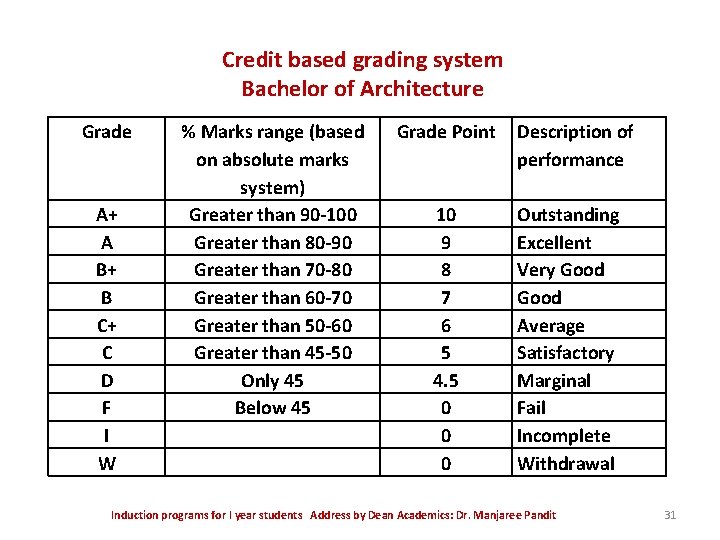
Credit based grading system Bachelor of Architecture Grade A+ A B+ B C+ C D F I W % Marks range (based on absolute marks system) Greater than 90 -100 Greater than 80 -90 Greater than 70 -80 Greater than 60 -70 Greater than 50 -60 Greater than 45 -50 Only 45 Below 45 Grade Point 10 9 8 7 6 5 4. 5 0 0 0 Description of performance Outstanding Excellent Very Good Average Satisfactory Marginal Fail Incomplete Withdrawal Induction programs for I year students Address by Dean Academics: Dr. Manjaree Pandit 31
Semester Grade Points Average(SGPA) & Cumulative Grade Points Average(CGPA) Induction programs for I year students Address by Dean Academics: Dr. Manjaree Pandit 32
Calculation of SGPA: an Example Course 1 Credits Grade point Allotted Received 4 A+ 10 Course 2 3 B+ 8 Course 3 Course 4 4 2 C+ A 6 9 SGPA= ((4 x 10)+(3 x 8)+(4 x 6)+(2 x 9)) /(4+3+4+2) = 8. 15 Induction programs for I year students Address by Dean Academics: Dr. Manjaree Pandit 33
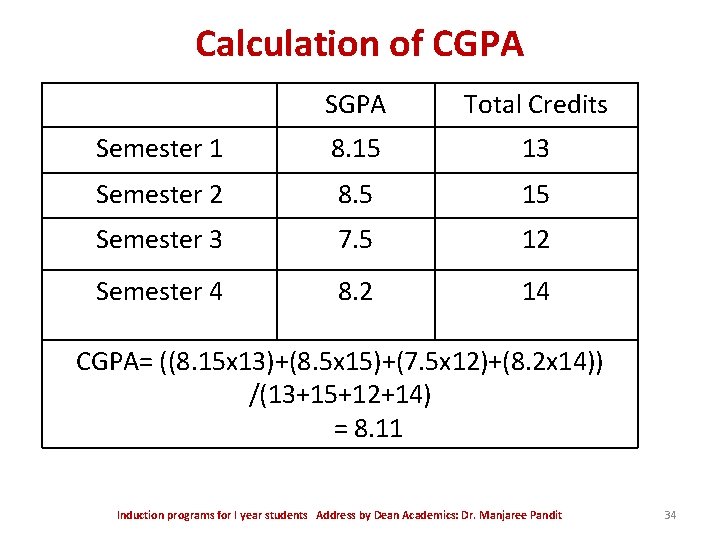
Calculation of CGPA SGPA Total Credits Semester 1 8. 15 13 Semester 2 8. 5 15 Semester 3 7. 5 12 Semester 4 8. 2 14 CGPA= ((8. 15 x 13)+(8. 5 x 15)+(7. 5 x 12)+(8. 2 x 14)) /(13+15+12+14) = 8. 11 Induction programs for I year students Address by Dean Academics: Dr. Manjaree Pandit 34
MID SEMESTER TESTS AND QUIZES • Each student will appear in two mid-semester tests compulsorily. The evaluation will be based on average performance. • There will be a third Mid-semester examination also for those who could not appear in one of the two mid-semester tests due to some valid reason. • On-line quiz will be conducted in each course on institute MOODLE Induction programs for I year students Address by Dean Academics: Dr. Manjaree Pandit 35
Values, Ethics, Awareness of Societal Problems/Issues Mandatory Courses (MC) : Ethics Environmental Science, Disaster Management, Intellectual Property Rights (IPR) and Cyber Security Audit Courses : ‘Biology for Engineers’ and ‘Indian Constitution & Traditional Knowledge’ ( It will be compulsory to acquire the specified credits in these courses by securing the minimum pass marks. However, these credits will not be counted in the aggregate credits. ) Induction programs for I year students Address by Dean Academics: Dr. Manjaree Pandit 36
Innovation & Personality Development Professional Society Chapters Available 1. 2. 3. 4. Indian Society for Technical Education (ISTE) Computer Society of India (CSI) Association for Computing Machinery (ACM) Institution of Electronics and Telecommunication Engineers(IETE) 5. Institution of Engineering and technology (IET) 6. The Institution of Electrical and Electronics Engineers (IEEE) 7. Society for Automobile Engineers of India (SAE INDIA) Induction programs for I year students Address by Dean Academics: Dr. Manjaree Pandit 37
Institute MOODLE is (Modular Object-Oriented Dynamic Learning Environment) The institute has its own MOODLE which is very well utilized. All the new students will be required to register and login to MOODLE Students are required to check their attendance regularly on MOODLE. If your attendance falls short, you will not be permitted to appear in exams. In case of any difficulty the students can contact the MOODLE server administrator Shri Atul Chauhan (moodle@mitsgwalior. in) Once they are registered, they can access Learning material such as Lecture plans, syllabi, Notes, PPTs, Unit Wise Question banks, previous year papers etc. on-line On-line quiz, technical as well as aptitude based are also conducted on this platform Induction programs for I year students Address by Dean Academics: Dr. Manjaree Pandit 38
Remedial/bridge classes for clearing doubts Doubt clearing sessions are conducted for all courses after the college hours and on working Saturdays The time-table for these classes is displayed on the departmental notice boards The students must contact their Class coordinator/ Head of the Department in case of any difficulty Induction programs for I year students Address by Dean Academics: Dr. Manjaree Pandit 39
Thank You And wish you all a very happy and successful time in MITS ensuring a bright future