
Dr BAIGS ADVANCE UNANI HERBAL CLINIC HIJAMA CENTRE
Dr. BAIG’S ADVANCE UNANI HERBAL CLINIC & HIJAMA CENTRE PRESENTS ANTIMICROBIAL ACTIVITY FROM THE SEEDS OF PSORALEA CORYLIFOLIA Dr. MOHAMED OBIEDULLAH BAIG BUMS. , DAC. , FCIP. , PGDHBT. , MD(AM) INTERNATIONAL UNANI PHYSICIAN, HERBAL BIOTECHNOLOGIST & HIJAMA SPECIALIST INTERNATIONAL ARCH OF EXCELLENCE AWARD WINNER 9 TH JANUARY 2015(MUMBAI) INTERNATIONAL GOLD STAR ACHIEVER AWARD WINNER 2013(CHENNAI INTERNATIONAL AWARD WINNER FOR THE BEST UNANI PHYSICIAN 2009(NEW DELHI) NATIONAL GEM OF INDIA AWARD WINNER 2011(BANGALORE )

I wish to express my sincere gratitude and indebtedness to Dr. Shyamala , Reader, Department of University of Madras for the help and expert guidance in completing this project. I am extremely grateful to Dr. P. ramasamy, Professor and Head-In-Charge, Department of Biotechnology, University of Madras for giving consent to carry out this work in the department. I express my sincere thanks to Ms. K. Uma Maheshwari, Lecturer, Department of Biotechnology, University of Madras for her valuable guidance and suggestion rendered during the course of my work. I express my sincere thanks to the Research Scholars of the Department of Biotechnology, University of Madras for their help during the project work. I thank all my family and friends for enabling me to complete this study successfully. (Md. Obiedullah Baig)
All over the world, plants have been one of the most important sources of medicine since the beginning of the human civilization. Tropical forests touch the daily lives of every one on earth through products and ecological services they provide. The active ingredients for 25% of the world's prescription drugs are substances derived from plants, most of which grow in tropical rain forests (the medicinal properties of plants are associated with their chemical constituents). About 80% of the world's population relies on plant extracts for medicines. Atleast 40% of all medicines, drugs and pharmaceuticals worth $100 billion per year owe their existence to the genetic resources of wild plants, mostly from tropical forest of less developed countries. About 70% of the 3, 000 plants from tropical forests were identified by the National Cancer Institute (NCI) as sources of cancer fighting chemicals (Tyler Miller, JR 1996). The herbal medicine represents probably the first and certainly the oldest system of human health care on the basis of knowledge obtained through Rigveda, Atharvanaveda, Charaka Sumheta (990 BC) and Susruta Samheta (500 BC) for over 500 years. Many ayurvedic pharmacopoeias have been compiled. The chinese system of medicine is also equally important, efficient and ancient. The unani (Graceo – Arabic) and Tibetan systems date back to about 3000 years also stressed the importance of herbal products for among sickness. Herbal medicine is still the mainstay of about 75 -80% of the world population, mainly in the developing countries for primary health care. The use of traditional medicine and medicinal plants in most developing countries, as a normative basis for the maintenance of good health has been widely observed (UNESCO, 1996). The practice of traditional medicine is wide spread in China, India, Japan, Pakistan, Sri lank and Thailand. In china 40% of the medicine is coming from traditional medicine (Lemma, 1991).
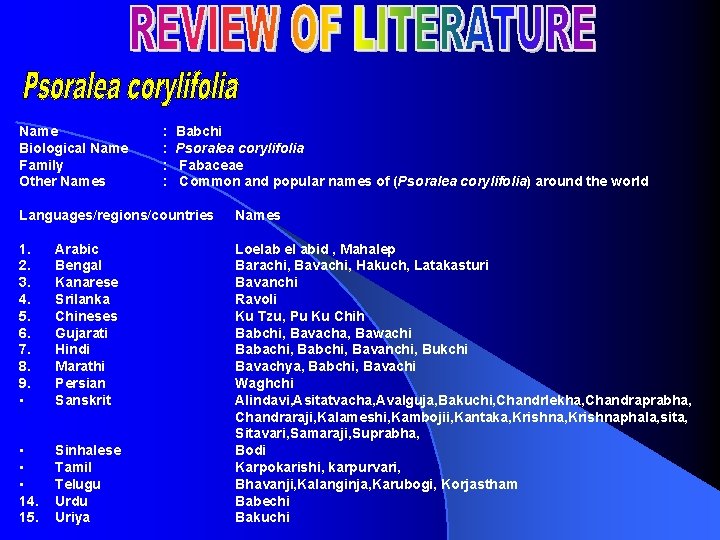
Name Biological Name Family Other Names : Babchi : Psoralea corylifolia : Fabaceae : Common and popular names of (Psoralea corylifolia) around the world Languages/regions/countries Names 1. 2. 3. 4. 5. 6. 7. 8. 9. • Arabic Bengal Kanarese Srilanka Chineses Gujarati Hindi Marathi Persian Sanskrit • • • 14. 15. Sinhalese Tamil Telugu Urdu Uriya Loelab el abid , Mahalep Barachi, Bavachi, Hakuch, Latakasturi Bavanchi Ravoli Ku Tzu, Pu Ku Chih Babchi, Bavacha, Bawachi Babachi, Babchi, Bavanchi, Bukchi Bavachya, Babchi, Bavachi Waghchi Alindavi, Asitatvacha, Avalguja, Bakuchi, Chandrlekha, Chandraprabha, Chandraraji, Kalameshi, Kambojii, Kantaka, Krishnaphala, sita, Sitavari, Samaraji, Suprabha, Bodi Karpokarishi, karpurvari, Bhavanji, Kalanginja, Karubogi, Korjastham Babechi Bakuchi
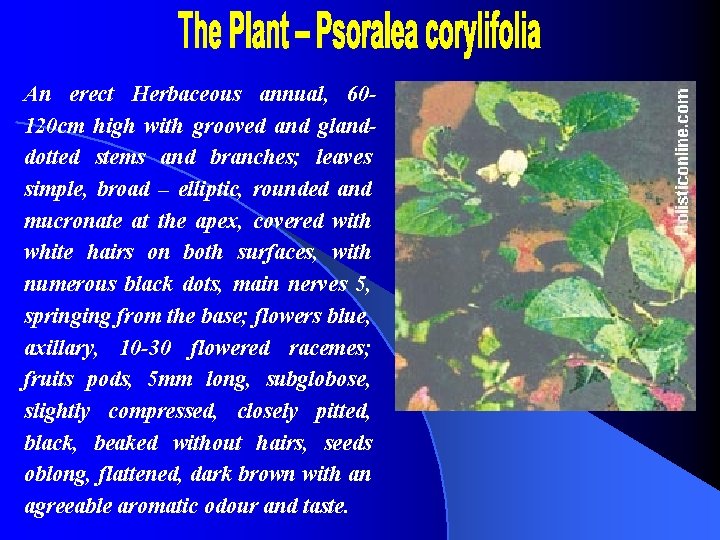
An erect Herbaceous annual, 60120 cm high with grooved and glanddotted stems and branches; leaves simple, broad – elliptic, rounded and mucronate at the apex, covered with white hairs on both surfaces, with numerous black dots, main nerves 5, springing from the base; flowers blue, axillary, 10 -30 flowered racemes; fruits pods, 5 mm long, subglobose, slightly compressed, closely pitted, black, beaked without hairs, seeds oblong, flattened, dark brown with an agreeable aromatic odour and taste.
Parts Used : Seeds Constituents : The chief active principle of the seeds is an essential oil; and a fixed oil, a resin, and traces of a substance of alkaloidal nature. Medicinal Uses : Anthelmintic; Antibacterial; Aphrodisiac; Astringent; Cardiac; Cytotoxic; Deobstruent; Diaphoretic; Diuretic; Infertility; Kidney; Odontalgic; Skin; Stimulant; Stomachic; Tonic. Psoralia corylifolia is valued in Chinese herbal medicine as a tonic remedy and is used to improve general vitality. Modern research has shown that it is also of value in the treatment of skin disorders, including vitiligo. Some caution should be employed when applying the herb externally, however, since it can sensitise the skin and cause an allergic reaction to sunlight. Pharmacological action: Antipleutritic (decreases itching contains natural antihistamine) antibacterial anthelmintic; laxative, diuretic; seeds, oil has strong effect against streptococci; Alcoholic and aqueous extracts of seeds antibacterial; petroleum ether extract anthelmentic against earth worms. In dogs it stimulates intestinal smooth muscle; isopsoralene is tranquillosedative, anticonvulsant, central muscle relaxant in rodent model tests. Bavachinine shows antiinflammatory action in rat studies; oleoresin extract of seeds effective on leukoderma Antimicrobial activity: Antimicrobial activities of Psoralea corylifolia seeds extracts were determined by the well diffusion technique of Bauer-Kirby (well-method) by measuring the zone of inhibition (mm) against the bacterial species namely Escherichia coli, Staphylococcus aureus, Proteus mirabilis, Pseudomonas aeruginosa, Enterococcus faecium. The extract showed no inhibition against Shigella dysenteriae, Bacillus cereus, Salmonella typhi, Actinomyces viscosus, Vibrio cholerae.
The aim of the study was to determine the antimicrobial activity of (babchi) Psoralea corylifolia seeds. The aqueous, chloroform & ethanolic extract of Psoralea corylifolia seeds were tested against 10 different bacterial species by Well diffusion Method.
Plant Material used : Psoralea corylifolia seeds were procured from the Agri-Horticulture society, Chennai, India. Preparation of the extract : The seeds of the plant material were dried at 31 o. C and were grounded into powder by using a electronic blendor. The Ethanolic, Chloroform and Aqueous extract of the seeds were prepared. 50 gm of seeds was extracted with 350 ml of corresponding solvents in a soxhlet apparatus at room temperature for about 8 hours. The extract was filtered through Whatman no-1 filter paper and the residue was dried and used for the study. Media used : • Nutrients agar was prepared and sterilized by autoclaving at 121 o. C for 15 minutes. • Sterile swabs, petridishes, microtips, pipettes, 0. 85% saline, textube, etc. Bacterial species tested : The extracts were tested against Escherichia coli, Staphylococcus aureus, Proteus mirabilis, Pseudomonas aeruginosa, Enterococcus faecium, Shigella dysenteriae, Bacillus cereus, Salmonella typhi, Actinomyces viscosus and Vibrio cholerae. Culture Media : The medium was prepared and sterilized by autoclaving.
Nutrient Agar Medium : Peptone Yeast Extract Beef Extract Sodium Chloride Agar Distilled Water p. H Methods : - 5 gm 2 gm 1 gm 5 gm 1000 ml 7 + 0. 2 The antibacterial activity of the ethanolic, chloroform and aqueous extract of the seeds were determined by well diffusion method. The sterile nutrient agar was poured on to the Petridishes and the media was allowed to solidify. The bacterial colonies were suspended in 0. 85% saline and turbidity was adjusted to match 0. 5 Mc Farland standard. The suspension of the bacteria were spread over the agar having a sterile cotton swab. A well of 5 mm diameter was cut on the agar with sterile bores. The extracts of concentration of 20 mg, 40 mg, 80 mg were added to the wells using micropipettes. The plates were incubated at 37 oc for 24 hrs and examined. The diameter of the zone of inhibition (mm) was measured for each of the extract against each bacterial species.
Methods : The antibacterial activity of the ethanolic, chloroform and aqueous extract of the seeds were determined by well diffusion method. The sterile nutrient agar was poured on to the Petridishes and the media was allowed to solidify. The bacterial colonies were suspended in 0. 85% saline and turbidity was adjusted to match 0. 5 Mc Farland standard. The suspension of the bacteria were spread over the agar having a sterile cotton swab. A well of 5 mm diameter was cut on the agar with sterile bores. The extracts of concentration of 20 mg, 40 mg, 80 mg were added to the wells using micropipettes. The plates were incubated at 37 oc for 24 hrs and examined. The diameter of the zone of inhibition (mm) was measured for each of the extract against each bacterial species.
The antibacterial activity of the aqueous, chloroform and ethanolic extract of Psoralea corylifolia seeds against 10 different bacterial species were tested. Among the 10 bacterial species tested Escherichia coli, Staphylococcus aureus, Proteus mirabilis, Pseudomonas aeruginosa and Enterococcus faecium were inhibited by all the extracts of Psoralea corylifolia seeds. The extracts did not show any activity against Shigella dysenteriae, Bacillus cereus, Salmonella typhi, Actinomyces viscosus and Vibrio cholerae. Of the three extracts tested for the antibacterial activity, the aqueous extract of the seeds showed more activity. The zone of inhibition of Escherichia coli were 10 mm, 14 mm and 15 mm in diameter for 20 mg, 40 mg & 80 mg / ml concentration respectively. Zone of inhibition of the aqueous extract of seeds against Escherichia coli, Staphylococcus aureus, Proteus mirabilis, Pseudomonas aeruginosa and Enterococcus faecium at 80 mg / ml concentration were 15 mm, 18 mm, 15 mm, 13 mm and 13 mm diameter respectively. The zone of inhibition of the chloroform and ethanolic extract against Escherichia coli were 14 mm and 10 mm at 40 mg / ml. The Staphylococcus aureus was inhibited at 20 mg, 40 mg and 80 mg and the zone of inhibition were measured as 12 mm, 15 mm and 18 mm respectively. The antibacterial effect of ethanolic extract was found to be less inhibitory against Staphylococcus aureus. All the three extracts tested against Proteus mirabilis were inhibitory at 80 mg with a zone of inhibition of 15 mm. The chloroform extract of seeds showed a zone of inhibition of 19 mm at 80 mg concentration and 15 mm for the ethanolic extract of seeds against Enterococcus faecium. The chloroform extract of seed showed more antibacterial activity against Pseudomonas aeruginosa at 80 mg / ml concentration and the zone of inhibition was measured as 19 mm. The ethanolic and aqueous extract of seeds were less inhibitory against Pseudomonas aeruginosa with a zone diameter of 13 mm at 80 mg / ml concentration. The antibacterial activity and zone of inhibition (mm) of the aqueous, chloroform and ethanolic extracts of seeds of Psoralea corylifolia against Escherichia coli, Staphylococcus aureus, Proteus mirabilis, Pseudomonas aeruginosa and Enterococcus faecium are shown in fig. 1, 2, 3.
Antibacterial activity of the seed extracts of Psoralea corylifolia
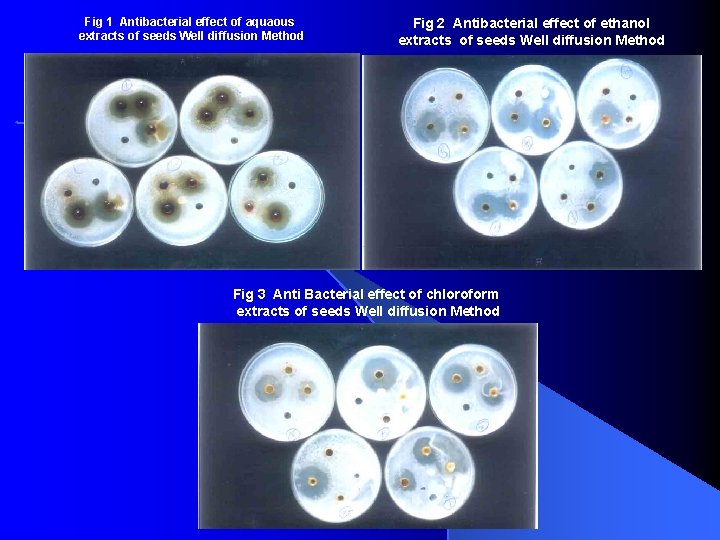
Fig 1 Antibacterial effect of aquaous extracts of seeds Well diffusion Method Fig 2 Antibacterial effect of ethanol extracts of seeds Well diffusion Method Fig 3 Anti Bacterial effect of chloroform extracts of seeds Well diffusion Method
Plants have been one of the most important sources of medicines. The screening and isolation of bioactive compounds from plants is increasing, as these compounds are much safer and less toxic than the chemically synthesized drugs. The increasing trends in emergence of resistance among infectious agents, treatment failures and recurrences of infection had led to the search of biologically active compounds or products from plants. The antibacterial activity of the seeds of Psoralea corylifolia has already been documented. The extract of seeds has shown antibacterial activity against some of the oral bacterial species tested. (Harumi Katsura et al ; 2001) Hence the study was done to evaluate the antibacterial effect of seeds of Psoralea corylifolia (babchi) against some of the bacterial pathogens. The aqueous, chloroform and ethanolic extract of seeds of Psoralea corylifolia were tested for their activity against 10 different species. The extract showed no activity against Shigella dysenteriae, Bacillus cereus, Salmonella typhi, Actinomyces viscosus and Vibrio cholerae where as Escherichia coli, Staphylococcus aureus, Proteus mirabilis, Pseudomonas aeruginosa and Enterococcus faecium were inhibited. The aqueous extract of seeds showed more inhibition than the chloroform and ethanolic extracts against all the species of bacteria that were inhibited. Antibacterial effect of aqueous & chloroform extract of seeds were higher than the ethanolic extract against Staphylococcus aureus. The chloroform extract showed more inhibition against Pseudomonas aeruginosa, when compared to the inhibitory action of the ethanolic and aqueous extract of seeds. The ethanolic extract of seed was more active against Enterococcus faecium. The antimicrobial effect of Psoralea corylifolia seeds may be due to the presence of secondary metabolites, one of the compound, Bakuchiol which is a alkaloid was found to possess antibacterial effect on oral bacterias. Hence further analysis of the compounds and their testing against microorganisms would help to develop a new antimicrobial agent that may be of great importance.
THANKS & REGARDS FROM DR. MOHAMED OBIEDULLAH BAIG BUMS. , DAC. , FCIP. , PG D(AM) INTERNATIONAL UNANI PHYSICIAN, HERBAL BIOTECHNOLOGIST & HIJAMA SPECIALIST FOUNDER & DIRECTOR OF DR. BAIG’S ADVANCE UNANI HERBALCLINIC & HIJAMA CENTRE OLD NO. 21, NEW NO. 24, KITABATH KHAN STREET, ELLIS ROAD, MOUNT ROAD, CHENNAI – 600 002. TAMILNADU, INDIA
- Slides: 15