MSIT Master of Science in Information Technology MSIT
- Slides: 100
MSIT | Master of Science in Information Technology MSIT 413: Wireless Technologies Week 1 Michael L. Honig Department of EECS Northwestern University January 2016 1
MSIT | Master of Science in Information Technology Outline • Background and history • Overview of current wireless services and standards 2
MSIT | Master of Science in Information Technology Outline • Background and history • Overview of current wireless services and standards 3
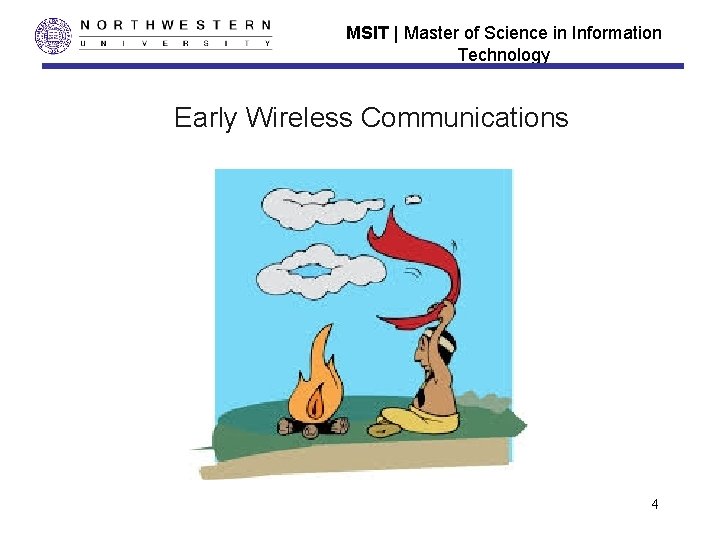
MSIT | Master of Science in Information Technology Early Wireless Communications 4
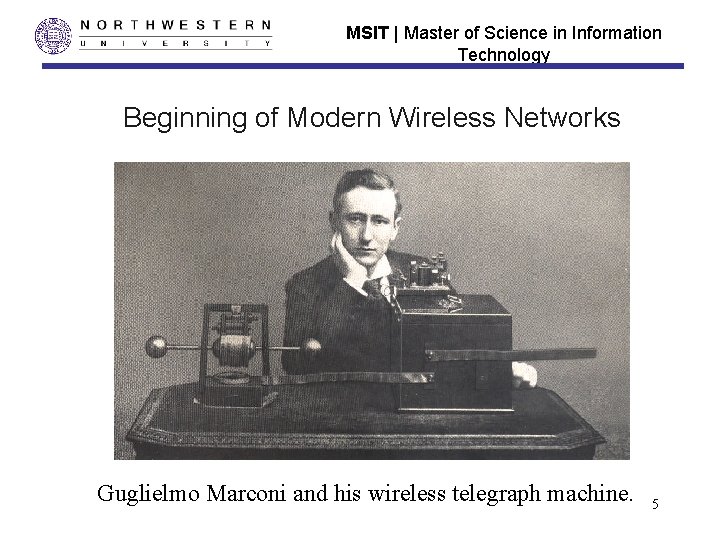
MSIT | Master of Science in Information Technology Beginning of Modern Wireless Networks Guglielmo Marconi and his wireless telegraph machine. 5
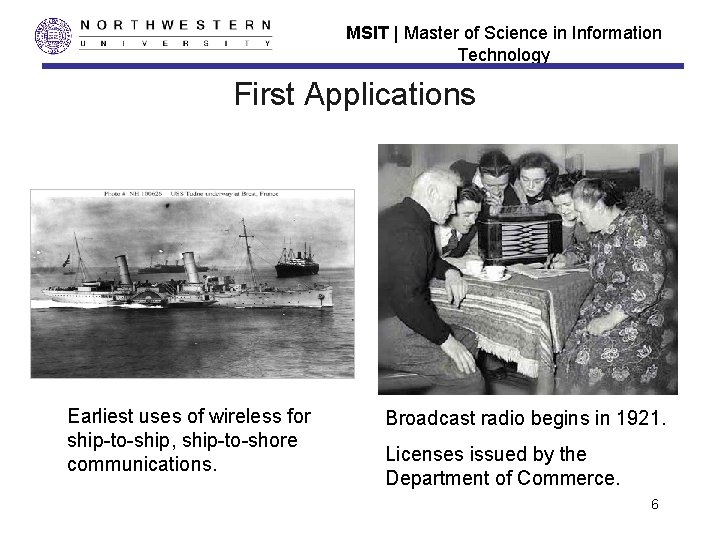
MSIT | Master of Science in Information Technology First Applications Earliest uses of wireless for ship-to-ship, ship-to-shore communications. Broadcast radio begins in 1921. Licenses issued by the Department of Commerce. 6
MSIT | Master of Science in Information Technology What is Wireless? Examples of wireless communications systems: 1. Garage door openers 2. Remote controllers (TV, VCR, etc. ) 3. Walkie-talkies 4. Broadcast TV, radio 5. Telemetry (RF tags) 6. Amateur radio, CB 7. Police radio, dispatch 8. Satellite systems 9. Cordless telephones 10. Cellular 11. Wireless Data (data entry, texts, email, internet) 12. Wireless Local Area Networks (LANs) 13. Wireless Personal Area Networks (PANs) 7
MSIT | Master of Science in Information Technology Wireless Information Networks (8 -14) Properties: • Mobility or portability (“tetherless” communications) • Access to network resources - Public Switched Telephone Network (PSTN) - Internet - Local Area Network 8
MSIT | Master of Science in Information Technology 9
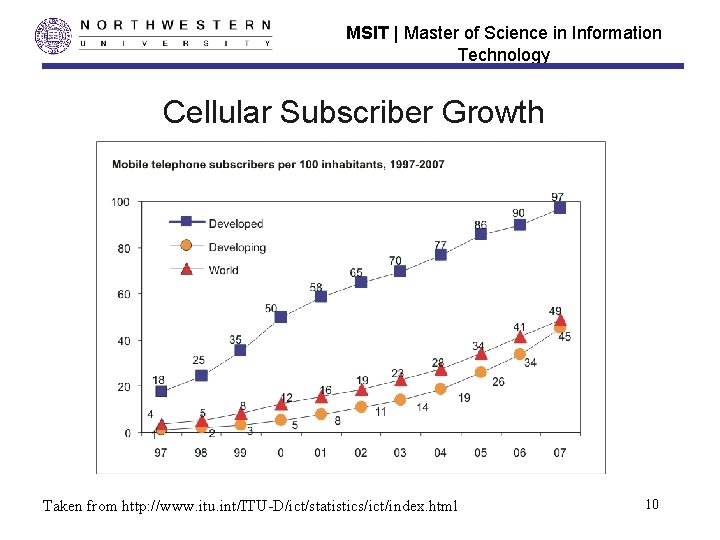
MSIT | Master of Science in Information Technology Cellular Subscriber Growth Taken from http: //www. itu. int/ITU-D/ict/statistics/ict/index. html 10
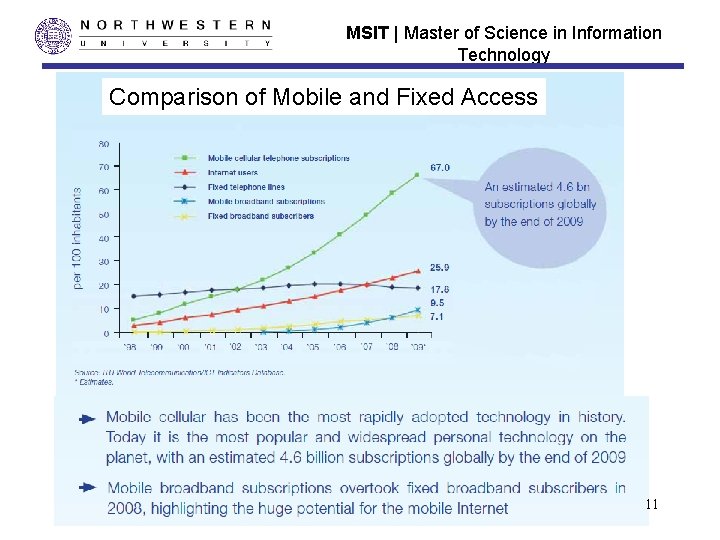
MSIT | Master of Science in Information Technology Comparison of Mobile and Fixed Access 11
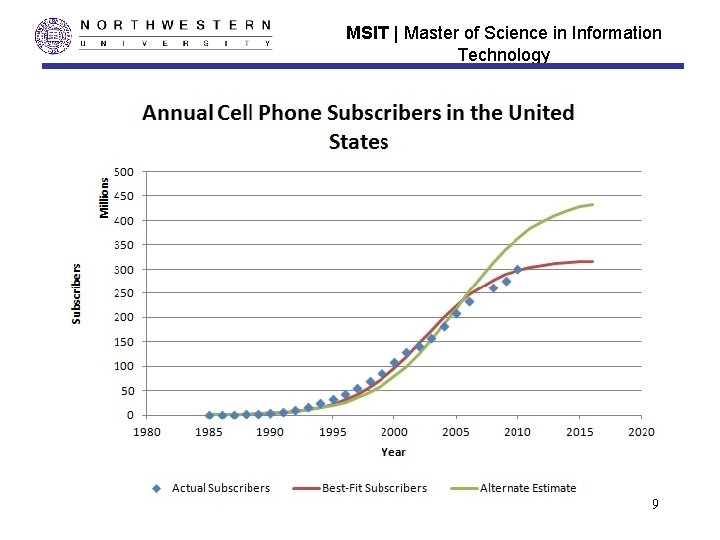
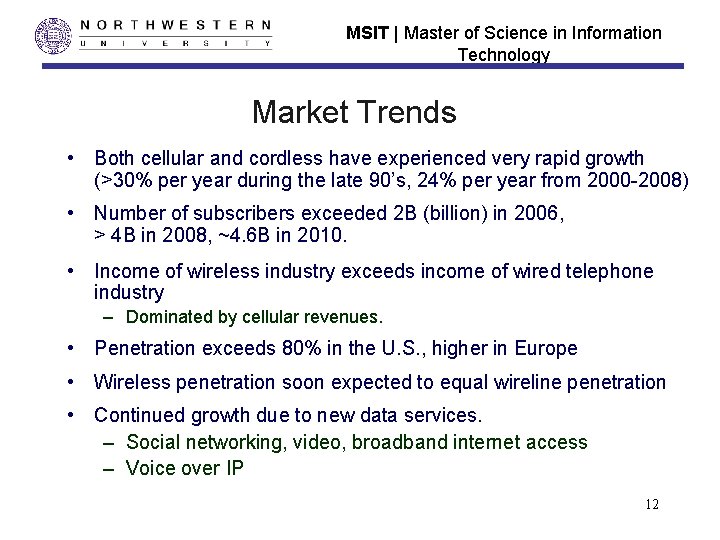
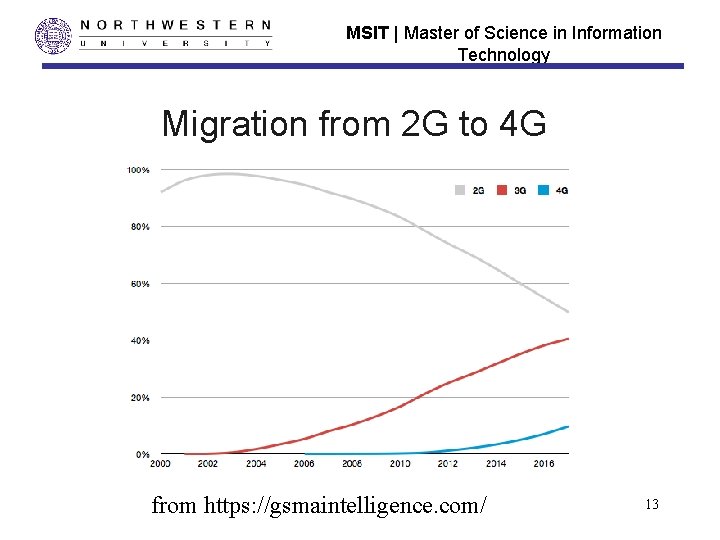
MSIT | Master of Science in Information Technology Market Trends • Both cellular and cordless have experienced very rapid growth (>30% per year during the late 90’s, 24% per year from 2000 -2008) • Number of subscribers exceeded 2 B (billion) in 2006, > 4 B in 2008, ~4. 6 B in 2010. • Income of wireless industry exceeds income of wired telephone industry – Dominated by cellular revenues. • Penetration exceeds 80% in the U. S. , higher in Europe • Wireless penetration soon expected to equal wireline penetration • Continued growth due to new data services. – Social networking, video, broadband internet access – Voice over IP 12
MSIT | Master of Science in Information Technology Migration from 2 G to 4 G from https: //gsmaintelligence. com/ 13
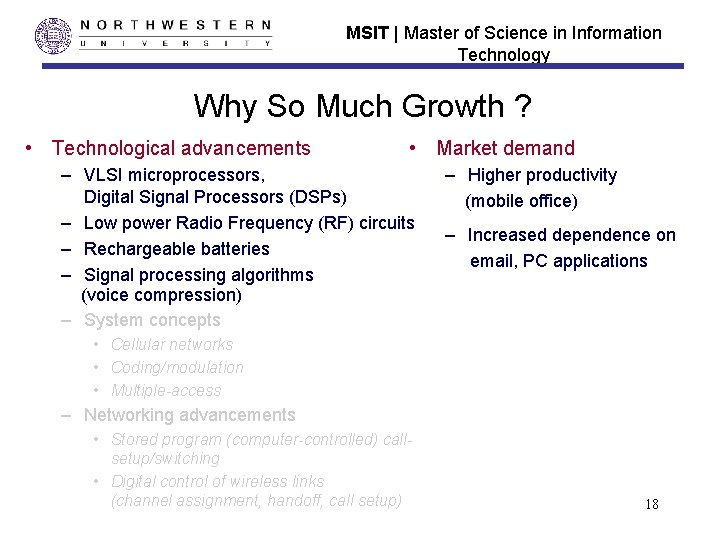
MSIT | Master of Science in Information Technology Why So Much Growth ? • Technological advancements • Market demand – VLSI microprocessors, Digital Signal Processors (DSPs) – Low power Radio Frequency (RF) circuits – Rechargeable batteries – Signal processing algorithms (voice compression) – System concepts – Higher productivity (mobile office) – Increased dependence on email, mobile applications • Cellular networks • Coding/modulation • Multiple-access – Networking advancements • Stored program (computer-controlled) callsetup/switching • Digital control of wireless links (channel assignment, handoff, call setup) 14
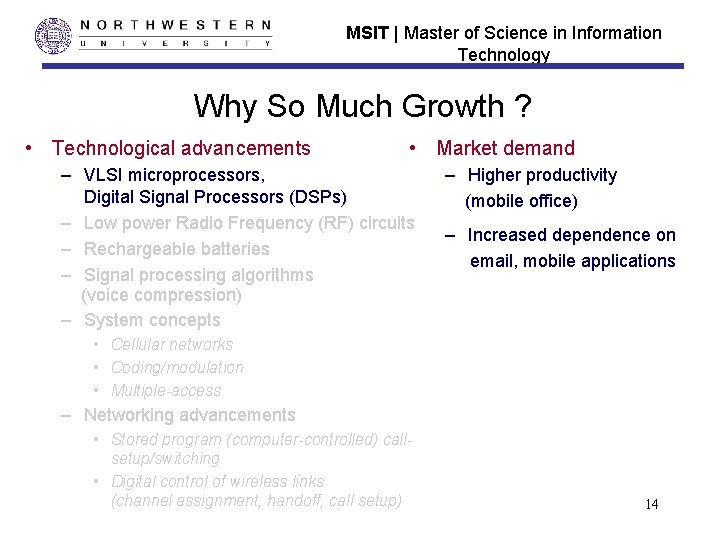
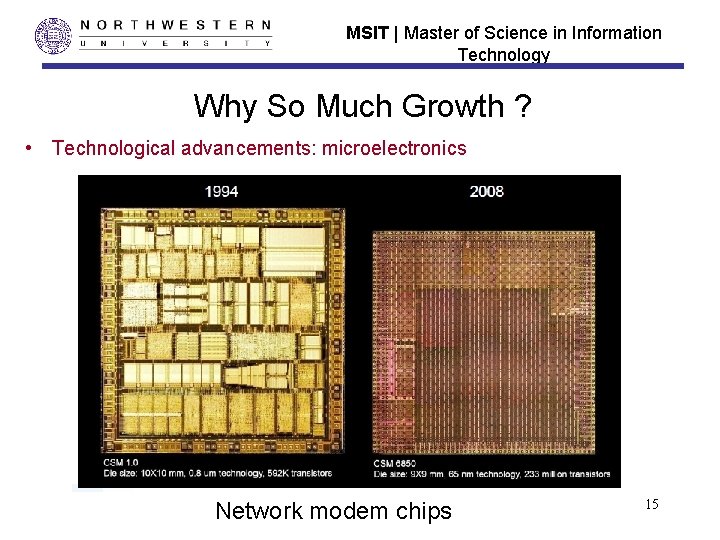
MSIT | Master of Science in Information Technology Why So Much Growth ? • Technological advancements: microelectronics Network modem chips 15
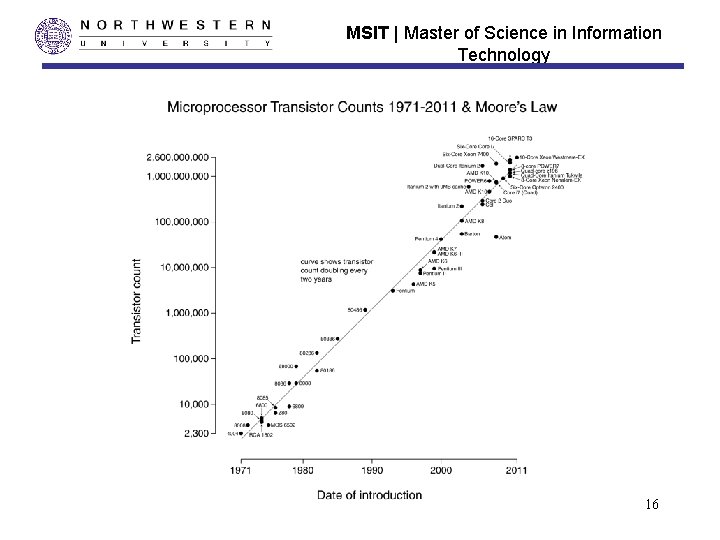
MSIT | Master of Science in Information Technology 16
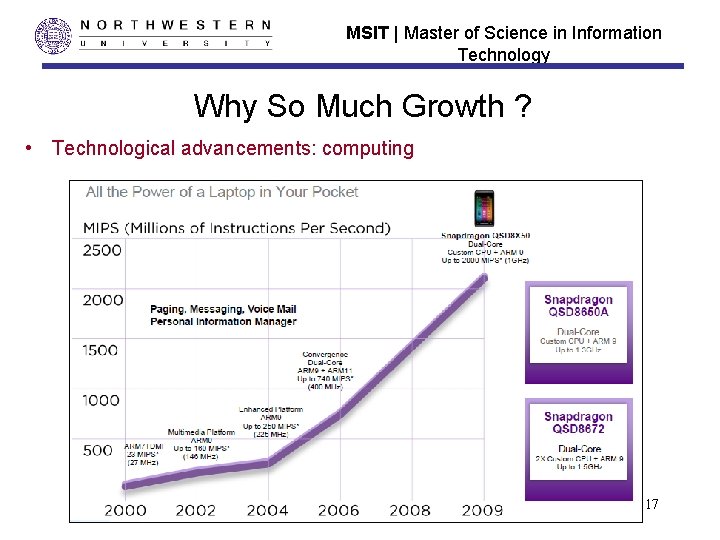
MSIT | Master of Science in Information Technology Why So Much Growth ? • Technological advancements: computing 17
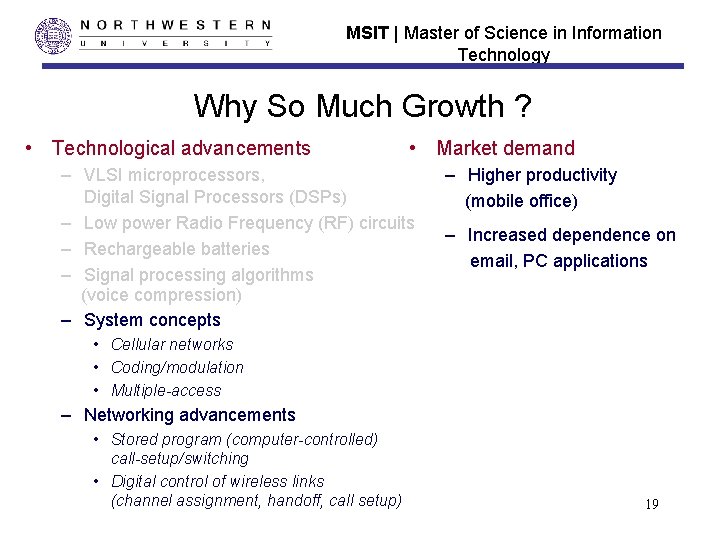
MSIT | Master of Science in Information Technology Why So Much Growth ? • Technological advancements • Market demand – VLSI microprocessors, Digital Signal Processors (DSPs) – Low power Radio Frequency (RF) circuits – Rechargeable batteries – Signal processing algorithms (voice compression) – System concepts – Higher productivity (mobile office) – Increased dependence on email, PC applications • Cellular networks • Coding/modulation • Multiple-access – Networking advancements • Stored program (computer-controlled) callsetup/switching • Digital control of wireless links (channel assignment, handoff, call setup) 18
MSIT | Master of Science in Information Technology Why So Much Growth ? • Technological advancements • Market demand – VLSI microprocessors, Digital Signal Processors (DSPs) – Low power Radio Frequency (RF) circuits – Rechargeable batteries – Signal processing algorithms (voice compression) – System concepts – Higher productivity (mobile office) – Increased dependence on email, PC applications • Cellular networks • Coding/modulation • Multiple-access – Networking advancements • Stored program (computer-controlled) call-setup/switching • Digital control of wireless links (channel assignment, handoff, call setup) 19
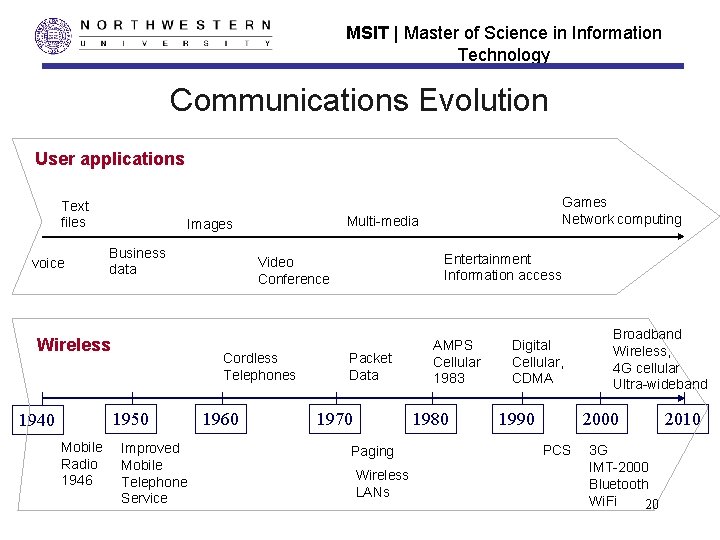
MSIT | Master of Science in Information Technology Communications Evolution User applications Text files voice Wireless Mobile Radio 1946 Improved Mobile Telephone Service Entertainment Information access Video Conference Cordless Telephones 1950 1940 Multi-media Images Business data 1960 Games Network computing Packet Data 1970 AMPS Cellular 1983 1980 Paging Wireless LANs Digital Cellular, CDMA 1990 Broadband Wireless, 4 G cellular Ultra-wideband 2000 PCS 3 G IMT-2000 Bluetooth Wi. Fi 20 2010
MSIT | Master of Science in Information Technology Historical Notes • Original mobile radio systems used a single, high-powered transmitter to cover a radius greater than 50 km • Early systems used FM with 120 k. Hz bandwidth for a 3 k. Hz voice signal. This was later reduced to 60 k. Hz, then to 30 k. Hz. • Improved Mobile Telephone Service (IMTS) -- introduced trunking (Many mobiles shared a single channel) • Demand for mobile telephony greatly exceeded system capacity: By 1976, Bell Mobile phone service for NYC market (approximately 10, 000 people) had only 12 channels, and could serve 543 paying customers over 1000 square miles. The waiting list was > 3, 700! • The FCC finally allocated additional spectrum for mobile telephony in the late 70 s by moving UHF TV channels 21
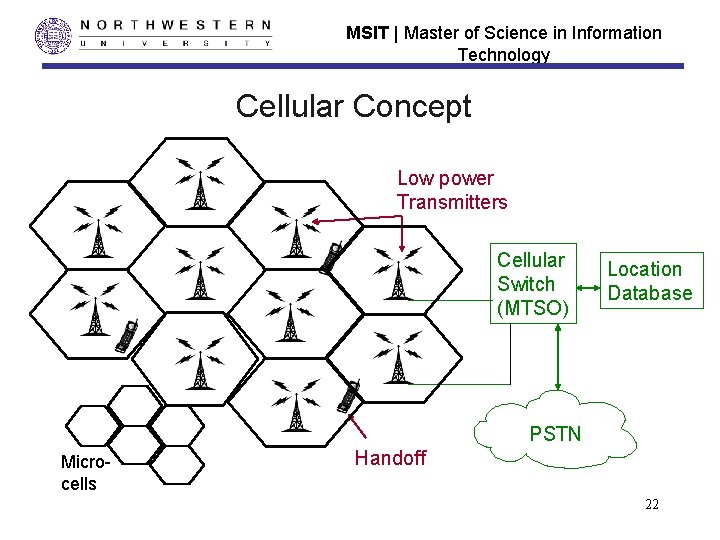
MSIT | Master of Science in Information Technology Cellular Concept Low power Transmitters Cellular Switch (MTSO) Location Database PSTN Microcells Handoff 22
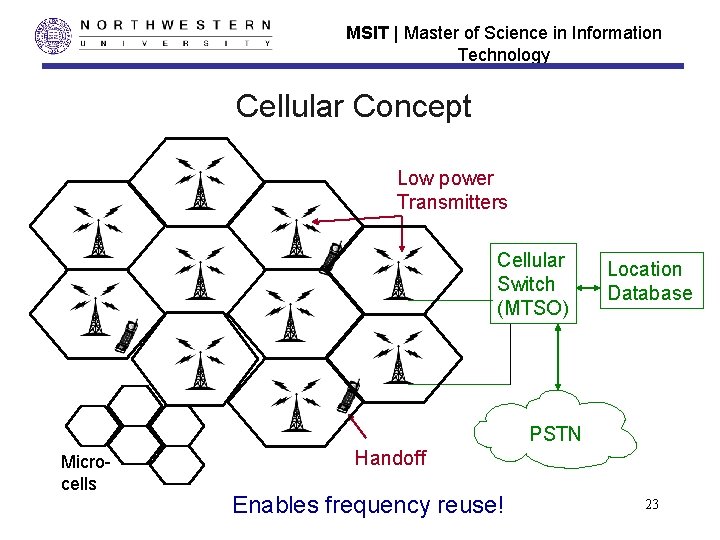
MSIT | Master of Science in Information Technology Cellular Concept Low power Transmitters Cellular Switch (MTSO) Location Database PSTN Microcells Handoff Enables frequency reuse! 23
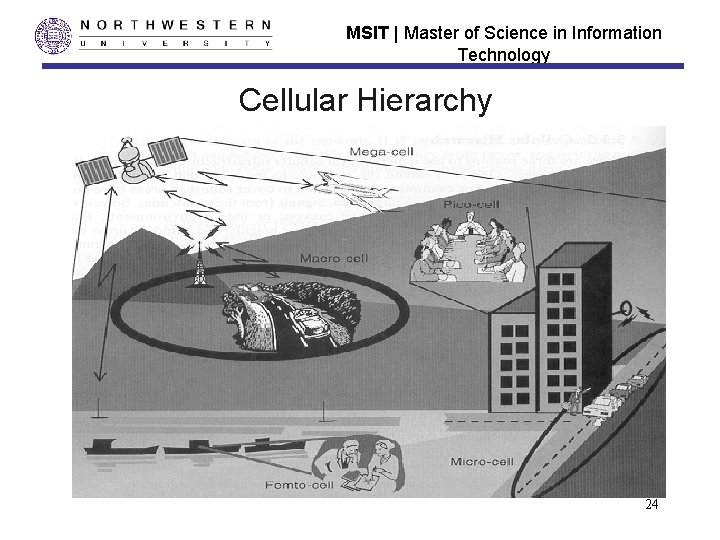
MSIT | Master of Science in Information Technology Cellular Hierarchy 24
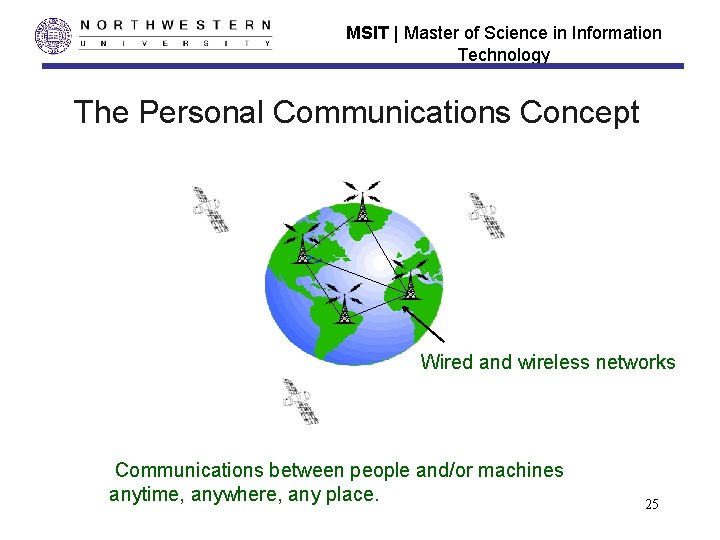
MSIT | Master of Science in Information Technology The Personal Communications Concept Wired and wireless networks Communications between people and/or machines anytime, anywhere, any place. 25
MSIT | Master of Science in Information Technology Personal Communications Services (PCS) • Originally a vision for the extension and integration of wired and wireless telecommunications network capabilities (1980 s). – Wireless: cellular, cordless, paging, PBX, satellite, air-to-ground – Wireline: PSTN, internet, LANs, private networks • More than wireless (service concept) – Service profile follows user. • Provides interoperability among wireline, wireless networks • Encompasses all cellular hierarchies (pico through macro) • Integrated services (voice, data, broadcast, multimedia) 26
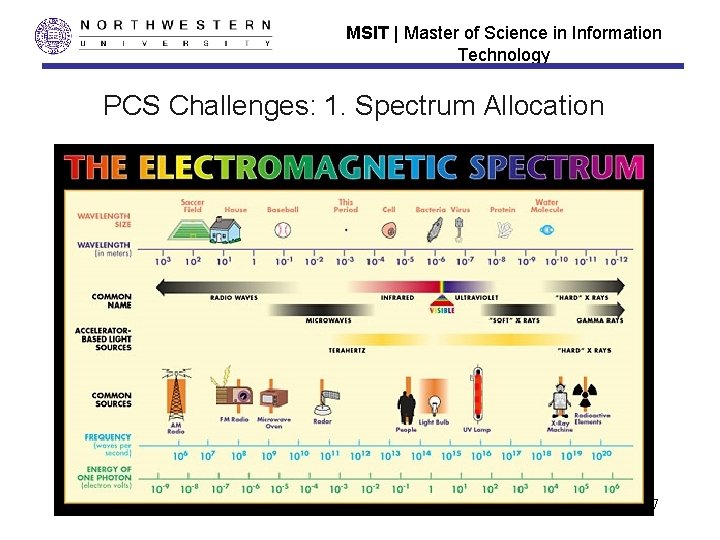
MSIT | Master of Science in Information Technology PCS Challenges: 1. Spectrum Allocation 27
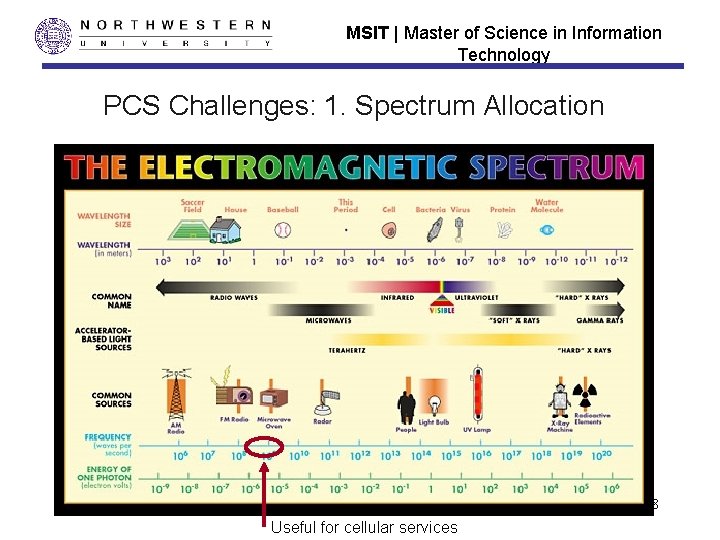
MSIT | Master of Science in Information Technology PCS Challenges: 1. Spectrum Allocation 28 Useful for cellular services
MSIT | Master of Science in Information Technology PCS Challenges: 1. Spectrum Allocation • Global, transparent service requires that the same spectrum be available everywhere. • Must have an international standards body to allocate spectrum for this purpose. 29
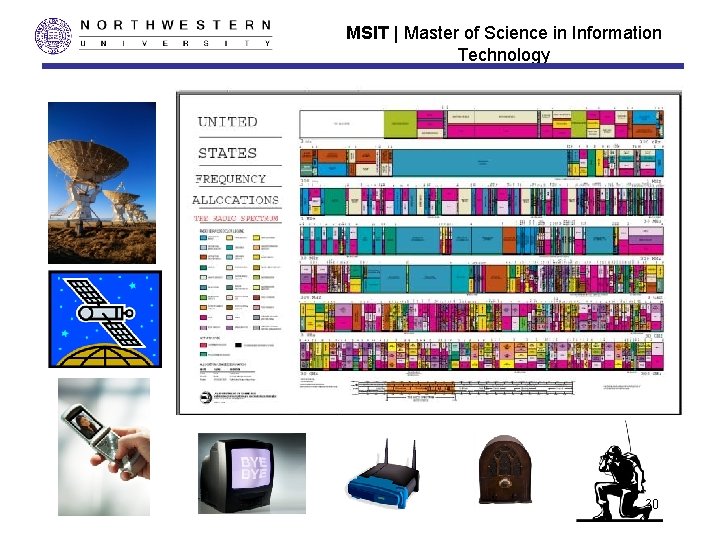
MSIT | Master of Science in Information Technology 30
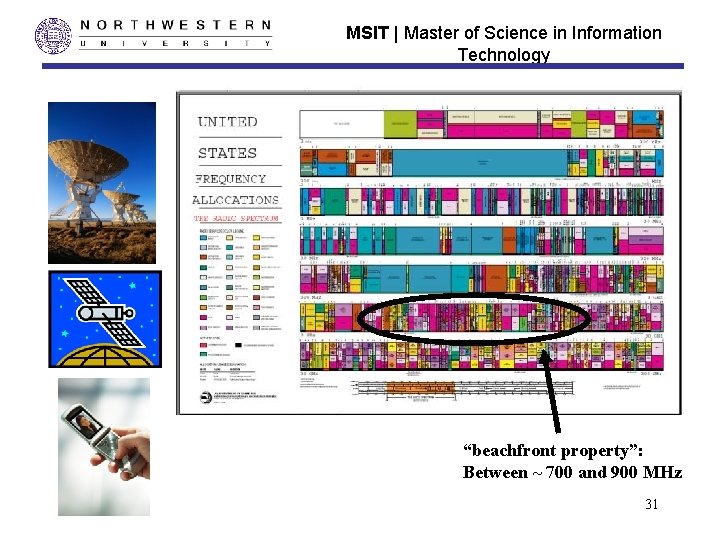
MSIT | Master of Science in Information Technology “beachfront property”: Between ~ 700 and 900 MHz 31
MSIT | Master of Science in Information Technology International PCS Spectrum Allocation • Task of the International Telecommunications Union (ITU) – Standards body for United Nations – Headquarters in Geneva, Switzerland • International Mobile Telecommunications (IMT) 2000 – Initiative for Third Generation mobile telephony within the ITU • World Radiocommunication Conferences (WRC) – Targeted 230 MHz for IMT 2000 in 1992 (1885 -2025 MHz, 2110 -2200 MHz) – Targeted additional 329 MHz for 3 G networks in 2000 (2500 -2690 MHz, 1710 -1885 MHz, 806 -960 MHz) – Targeted 255 MHz in 5 GHz band for unlicensed spectrum (WLAN) in 2003 – Will target more spectrum for cellular services in 2014 32
MSIT | Master of Science in Information Technology Licensed Spectrum: For “Exclusive Use” • Spectrum owned by government – Licensed to particular application, service provider (e. g. , Broadcast TV, Verizon, AT&T, etc. ) – Rigid use rules • Spectrum is private property – Applications, technical constraints decided by markets 33
MSIT | Master of Science in Information Technology Licensed Spectrum: For “Exclusive Use” • Spectrum owned by government – Licensed to particular application, service provider (e. g. , Broadcast TV, Verizon, AT&T, etc. ) – Rigid use rules • Spectrum is private property – Applications, technical constraints decided by markets • “Liberal” licenses (current cellular allocations) – Spectrum publicly owned, but licenses can be transferred, liberal use rules – Secondary markets (2003) 34
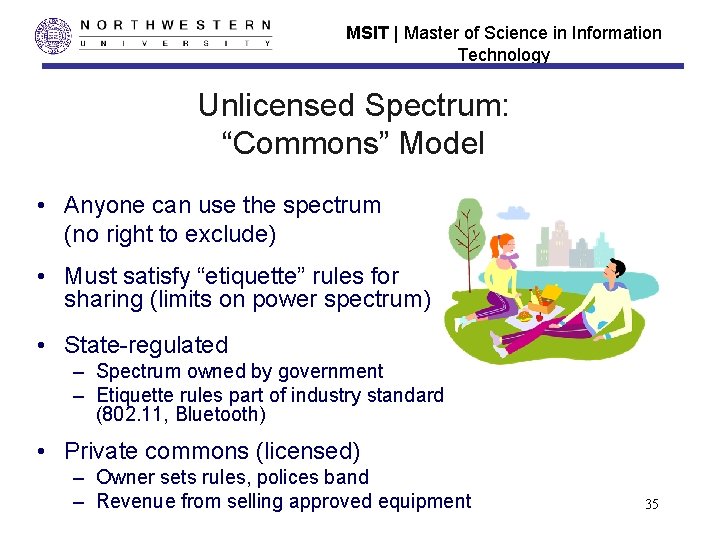
MSIT | Master of Science in Information Technology Unlicensed Spectrum: “Commons” Model • Anyone can use the spectrum (no right to exclude) • Must satisfy “etiquette” rules for sharing (limits on power spectrum) • State-regulated – Spectrum owned by government – Etiquette rules part of industry standard (802. 11, Bluetooth) • Private commons (licensed) – Owner sets rules, polices band – Revenue from selling approved equipment 35
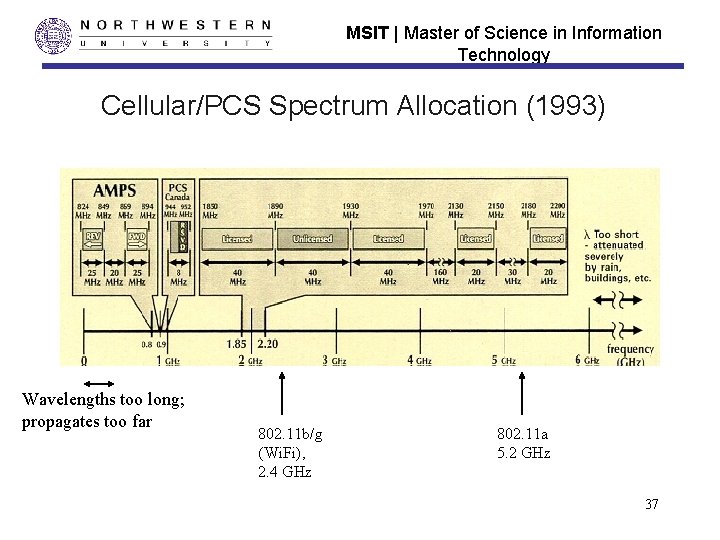
MSIT | Master of Science in Information Technology Licensed vs Unlicensed Spectrum • Licensed spectrum (cellular) – Licenses apply to separate geographic regions (e. g. , “basic/major” trading areas) – Allocated via auctions managed by FCC – Substantial source of revenue: • More than $30 B netted by U. S. government in mid-90 s • England netted $35. 5 B (5 licenses); Germany netted $46 B (4 licenses) • Nearly $20 B for 700 MHz auctions in 2008 • Unlicensed spectrum (Wi. Fi) – Industrial, Scientific, and Medical (ISM) bands (mid 80’s) • 902 -928 MHz, 2400 -2483. 5 MHz, 5150 -5350 MHz • Used by Wireless LANs (802. 11), Bluetooth, proprietary systems for wireless access – Unlicensed National Information Infrastructure (UNII) band (1997) • Additional 300 MHz in ISM bands 5150 -5350 MHz and 5725 -5825 MHz 36
MSIT | Master of Science in Information Technology Cellular/PCS Spectrum Allocation (1993) Wavelengths too long; propagates too far 802. 11 b/g (Wi. Fi), 2. 4 GHz 802. 11 a 5. 2 GHz 37
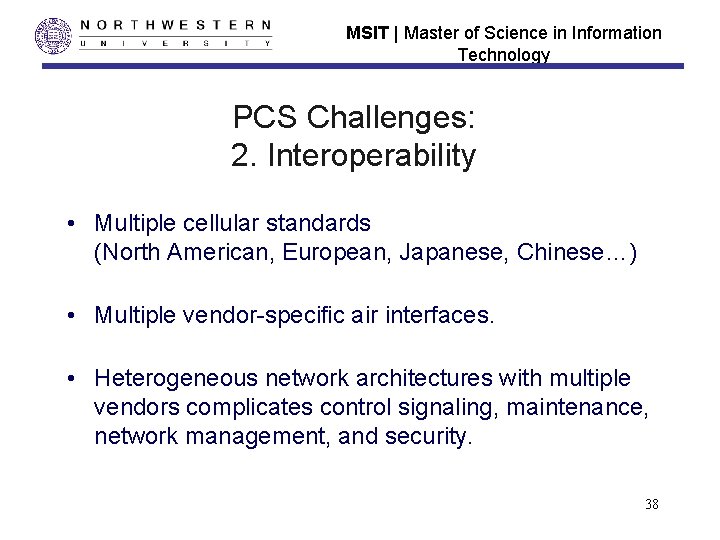
MSIT | Master of Science in Information Technology PCS Challenges: 2. Interoperability • Multiple cellular standards (North American, European, Japanese, Chinese…) • Multiple vendor-specific air interfaces. • Heterogeneous network architectures with multiple vendors complicates control signaling, maintenance, network management, and security. 38
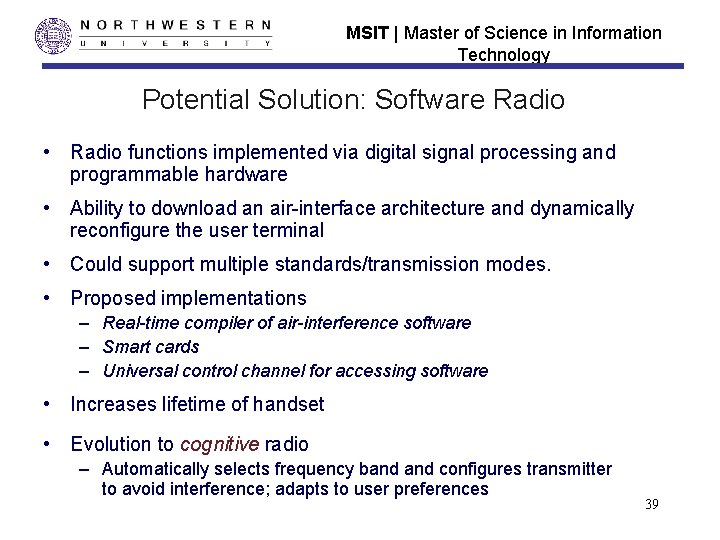
MSIT | Master of Science in Information Technology Potential Solution: Software Radio • Radio functions implemented via digital signal processing and programmable hardware • Ability to download an air-interface architecture and dynamically reconfigure the user terminal • Could support multiple standards/transmission modes. • Proposed implementations – Real-time compiler of air-interference software – Smart cards – Universal control channel for accessing software • Increases lifetime of handset • Evolution to cognitive radio – Automatically selects frequency band configures transmitter to avoid interference; adapts to user preferences 39
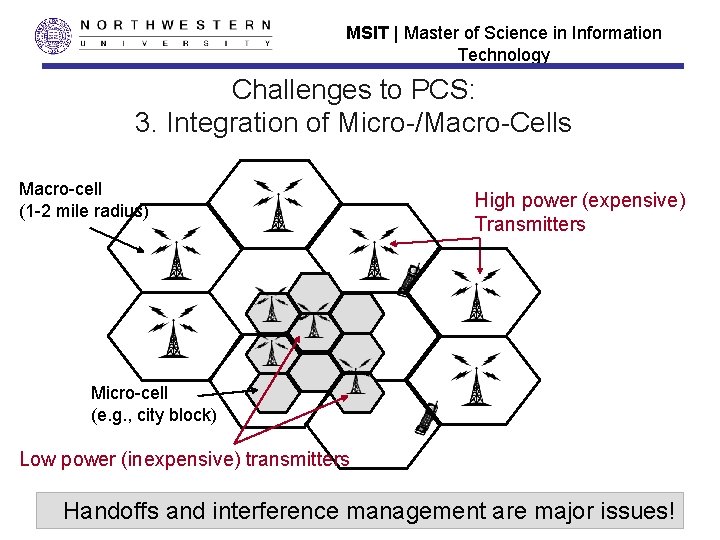
MSIT | Master of Science in Information Technology Challenges to PCS: 3. Integration of Micro-/Macro-Cells Macro-cell (1 -2 mile radius) High power (expensive) Transmitters Micro-cell (e. g. , city block) Low power (inexpensive) transmitters Handoffs and interference management are major issues!
MSIT | Master of Science in Information Technology PCS Challenges: 4. Economics • Providing a density of base stations is expensive! • Demand for services is uncertain… 41
MSIT | Master of Science in Information Technology Outline • Background and history • Overview of current wireless services and standards • What’s on the horizon? 42
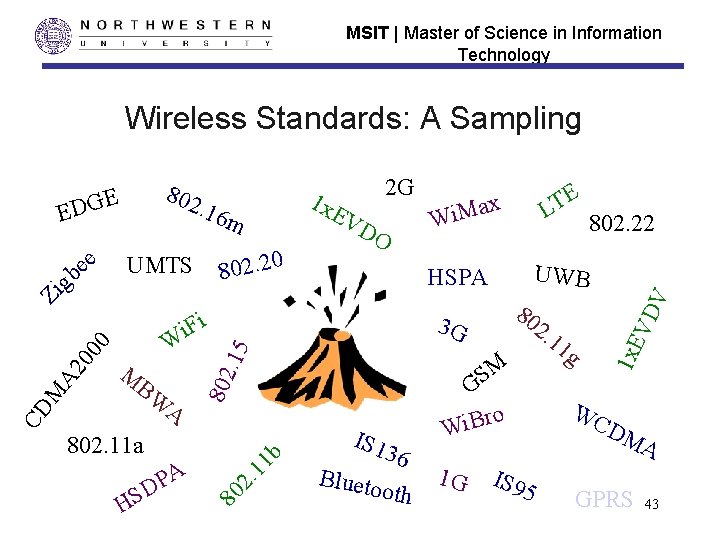
MSIT | Master of Science in Information Technology Wireless Standards: A Sampling 00 A 2 BW A 2. 1 HS A P D 1 b 802. 11 a 80 CD M M V 80 3 G 15 W 2. 1 1 g M S G IS 1 Blueto 36 oth WC o r B i W 1 G 802. 22 UWB HSPA i. Fi 0 g i Z 802. 20 UMTS 802. e e b DO E T L ax Wi. M VD 16 m E 2 G 1 x EV 1 x. E 802. DGE IS 9 DM 5 GPRS A 43
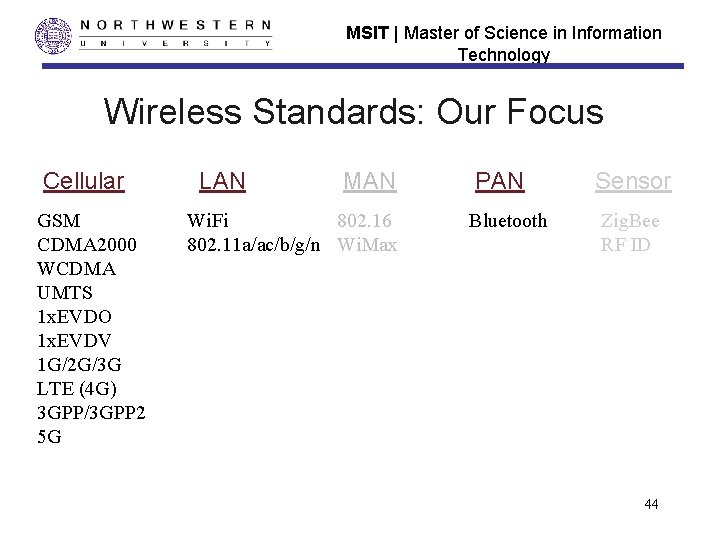
MSIT | Master of Science in Information Technology Wireless Standards: Our Focus Cellular GSM CDMA 2000 WCDMA UMTS 1 x. EVDO 1 x. EVDV 1 G/2 G/3 G LTE (4 G) 3 GPP/3 GPP 2 5 G LAN MAN Wi. Fi 802. 16 802. 11 a/ac/b/g/n Wi. Max PAN Sensor Bluetooth Zig. Bee RF ID 44
MSIT | Master of Science in Information Technology Why Have a Standard? 45
MSIT | Master of Science in Information Technology Why Have a Standard? • Allows equipment from different vendors to work together in a network. – Enables competition. – Provides more choices for service providers. • Helps small companies (e. g. , chip vendors, software houses) enter large markets. • Create mass markets for equipment, economies of scale. • Can potentially share intellectual property. 46
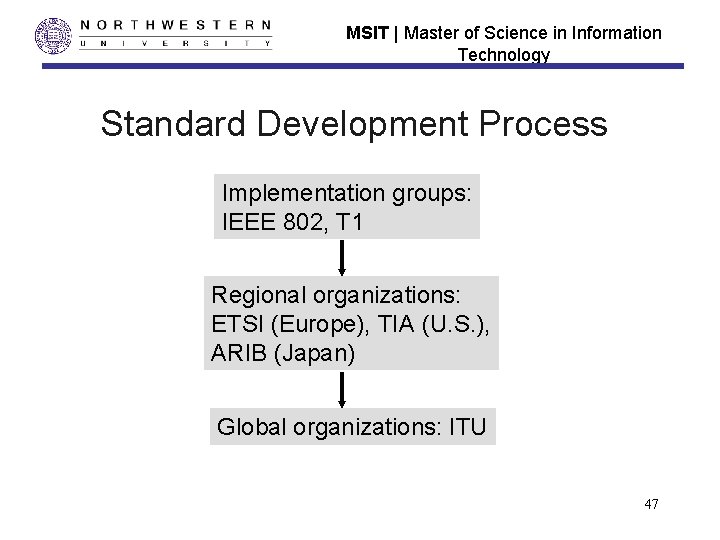
MSIT | Master of Science in Information Technology Standard Development Process Implementation groups: IEEE 802, T 1 Regional organizations: ETSI (Europe), TIA (U. S. ), ARIB (Japan) Global organizations: ITU 47
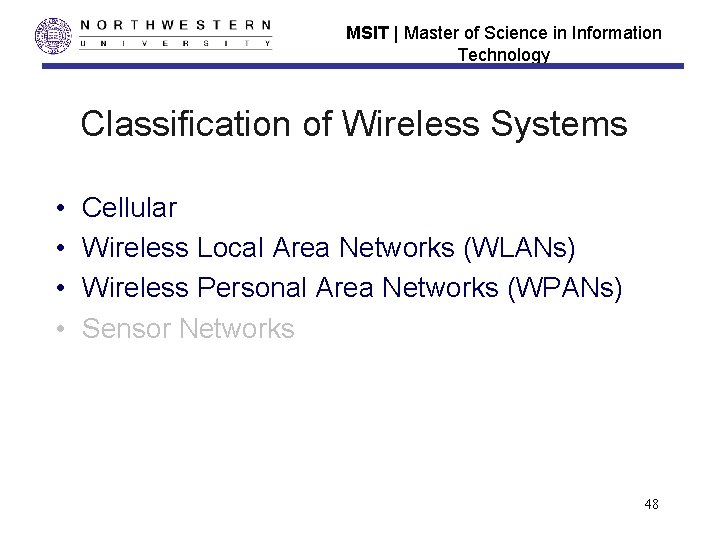
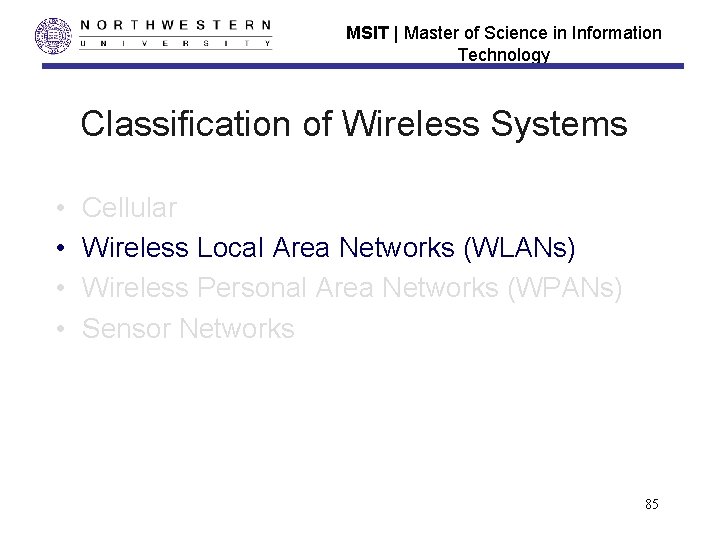
MSIT | Master of Science in Information Technology Classification of Wireless Systems • • Cellular Wireless Local Area Networks (WLANs) Wireless Personal Area Networks (WPANs) Sensor Networks 48
MSIT | Master of Science in Information Technology Classification of Wireless Systems • • Cellular Wireless Local Area Networks (WLANs) Wireless Personal Area Networks (WPANs) Sensor Networks 49
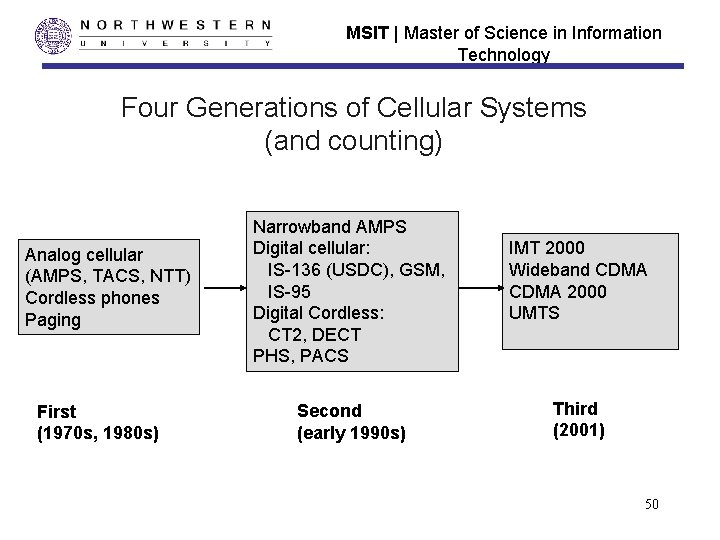
MSIT | Master of Science in Information Technology Four Generations of Cellular Systems (and counting) Analog cellular (AMPS, TACS, NTT) Cordless phones Paging First (1970 s, 1980 s) Narrowband AMPS Digital cellular: IS-136 (USDC), GSM, IS-95 Digital Cordless: CT 2, DECT PHS, PACS Second (early 1990 s) IMT 2000 Wideband CDMA 2000 UMTS Third (2001) 50
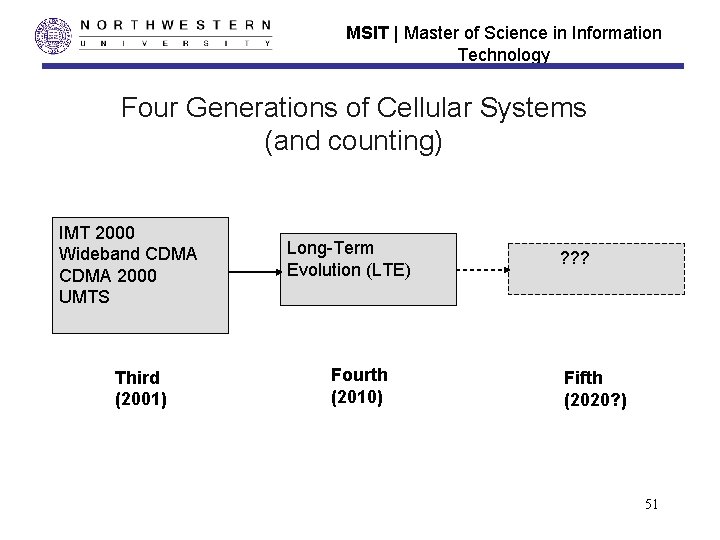
MSIT | Master of Science in Information Technology Four Generations of Cellular Systems (and counting) IMT 2000 Wideband CDMA 2000 UMTS Third (2001) Long-Term Evolution (LTE) Fourth (2010) ? ? ? Fifth (2020? ) 51
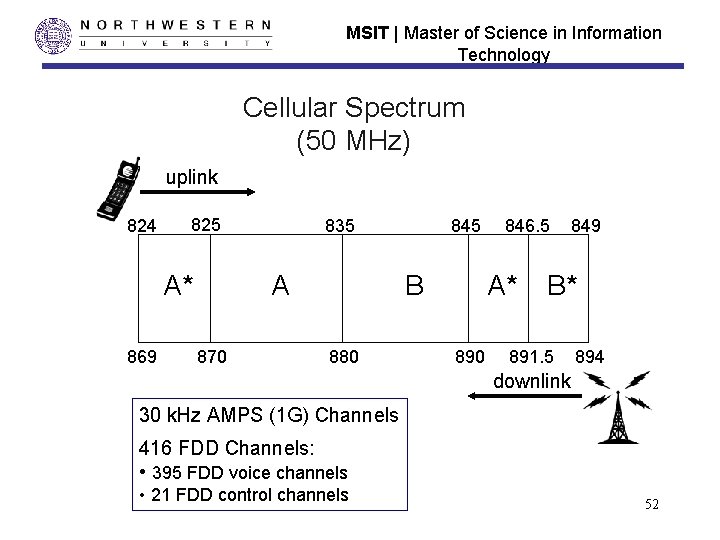
MSIT | Master of Science in Information Technology Cellular Spectrum (50 MHz) uplink 824 825 A* 869 835 A 870 845 B 880 846. 5 A* 890 849 B* 891. 5 894 downlink 30 k. Hz AMPS (1 G) Channels 416 FDD Channels: • 395 FDD voice channels • 21 FDD control channels 52
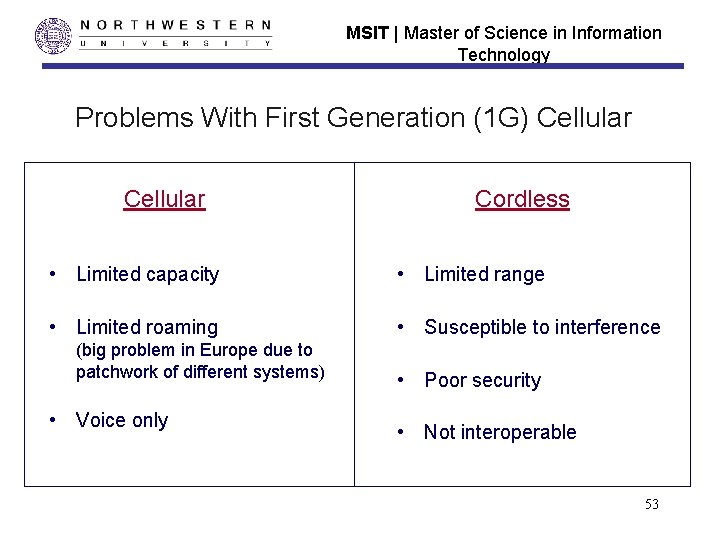
MSIT | Master of Science in Information Technology Problems With First Generation (1 G) Cellular Cordless • Limited capacity • Limited range • Limited roaming • Susceptible to interference (big problem in Europe due to patchwork of different systems) • Voice only • Poor security • Not interoperable 53
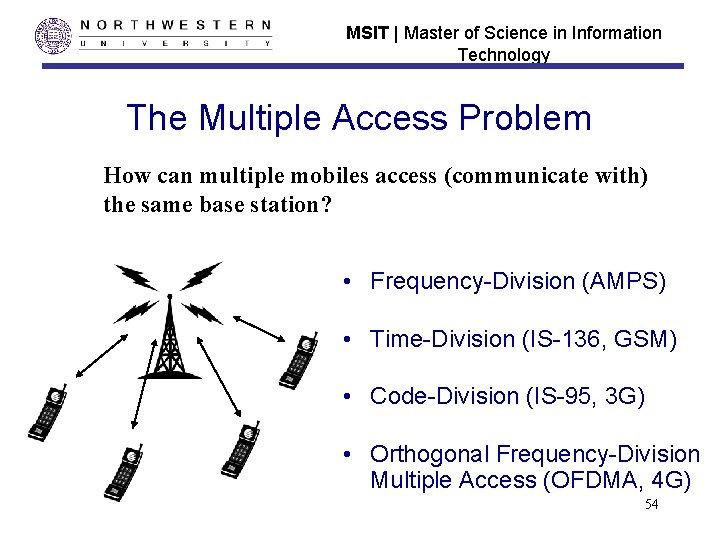
MSIT | Master of Science in Information Technology The Multiple Access Problem How can multiple mobiles access (communicate with) the same base station? • Frequency-Division (AMPS) • Time-Division (IS-136, GSM) • Code-Division (IS-95, 3 G) • Orthogonal Frequency-Division Multiple Access (OFDMA, 4 G) 54
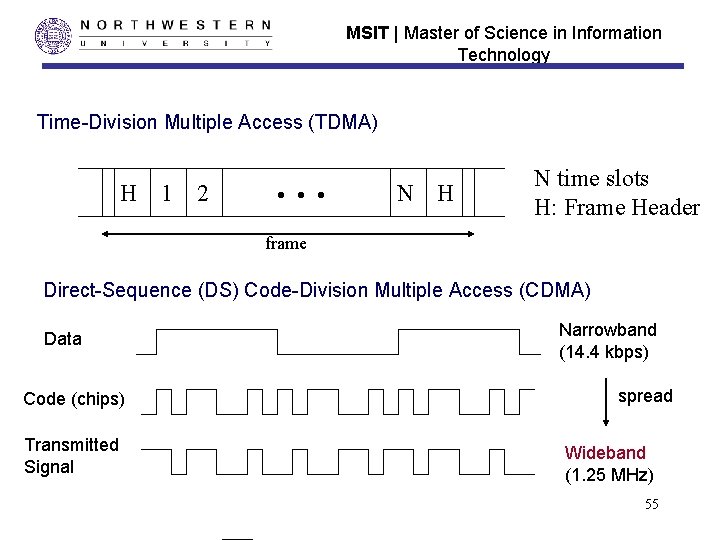
MSIT | Master of Science in Information Technology Time-Division Multiple Access (TDMA) H 1 2 . . . N H N time slots H: Frame Header frame Direct-Sequence (DS) Code-Division Multiple Access (CDMA) Data Code (chips) Transmitted Signal Narrowband (14. 4 kbps) spread Wideband (1. 25 MHz) 55
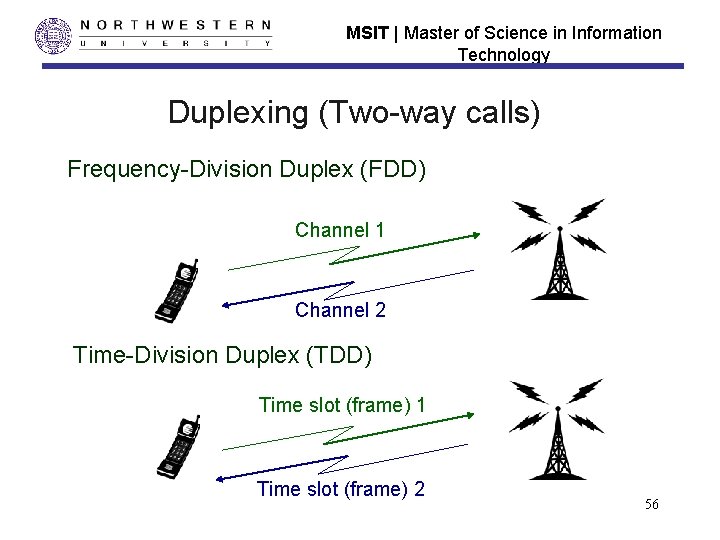
MSIT | Master of Science in Information Technology Duplexing (Two-way calls) Frequency-Division Duplex (FDD) Channel 1 Channel 2 Time-Division Duplex (TDD) Time slot (frame) 1 Time slot (frame) 2 56
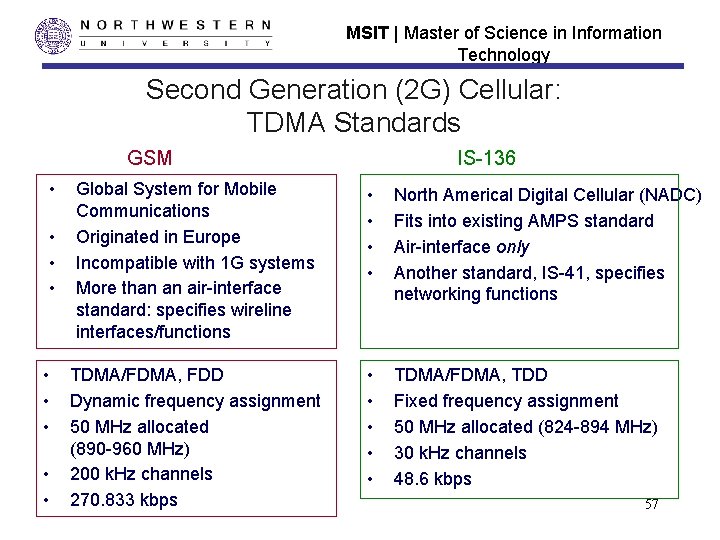
MSIT | Master of Science in Information Technology Second Generation (2 G) Cellular: TDMA Standards GSM • • • IS-136 Global System for Mobile Communications Originated in Europe Incompatible with 1 G systems More than an air-interface standard: specifies wireline interfaces/functions • • North Americal Digital Cellular (NADC) Fits into existing AMPS standard Air-interface only Another standard, IS-41, specifies networking functions TDMA/FDMA, FDD Dynamic frequency assignment 50 MHz allocated (890 -960 MHz) 200 k. Hz channels 270. 833 kbps • • • TDMA/FDMA, TDD Fixed frequency assignment 50 MHz allocated (824 -894 MHz) 30 k. Hz channels 48. 6 kbps 57
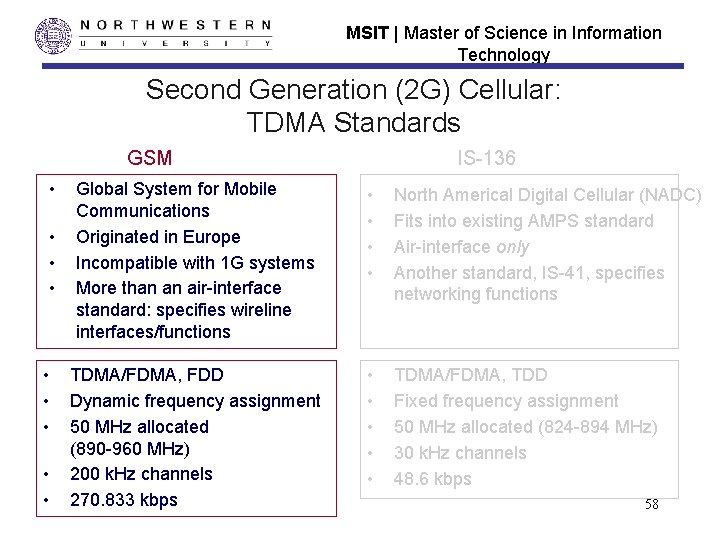
MSIT | Master of Science in Information Technology Second Generation (2 G) Cellular: TDMA Standards GSM • • • IS-136 Global System for Mobile Communications Originated in Europe Incompatible with 1 G systems More than an air-interface standard: specifies wireline interfaces/functions • • North Americal Digital Cellular (NADC) Fits into existing AMPS standard Air-interface only Another standard, IS-41, specifies networking functions TDMA/FDMA, FDD Dynamic frequency assignment 50 MHz allocated (890 -960 MHz) 200 k. Hz channels 270. 833 kbps • • • TDMA/FDMA, TDD Fixed frequency assignment 50 MHz allocated (824 -894 MHz) 30 k. Hz channels 48. 6 kbps 58
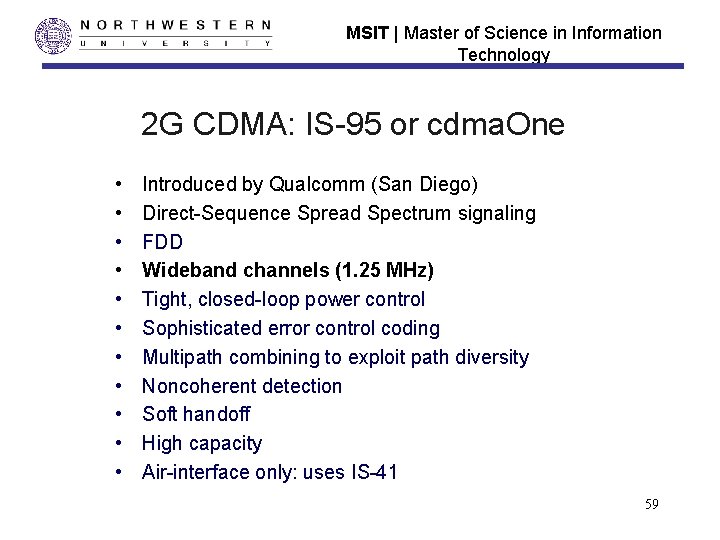
MSIT | Master of Science in Information Technology 2 G CDMA: IS-95 or cdma. One • • • Introduced by Qualcomm (San Diego) Direct-Sequence Spread Spectrum signaling FDD Wideband channels (1. 25 MHz) Tight, closed-loop power control Sophisticated error control coding Multipath combining to exploit path diversity Noncoherent detection Soft handoff High capacity Air-interface only: uses IS-41 59
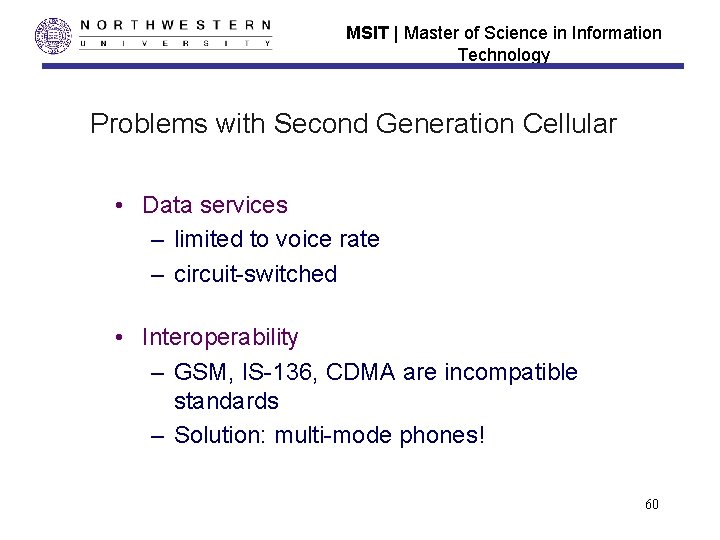
MSIT | Master of Science in Information Technology Problems with Second Generation Cellular • Data services – limited to voice rate – circuit-switched • Interoperability – GSM, IS-136, CDMA are incompatible standards – Solution: multi-mode phones! 60
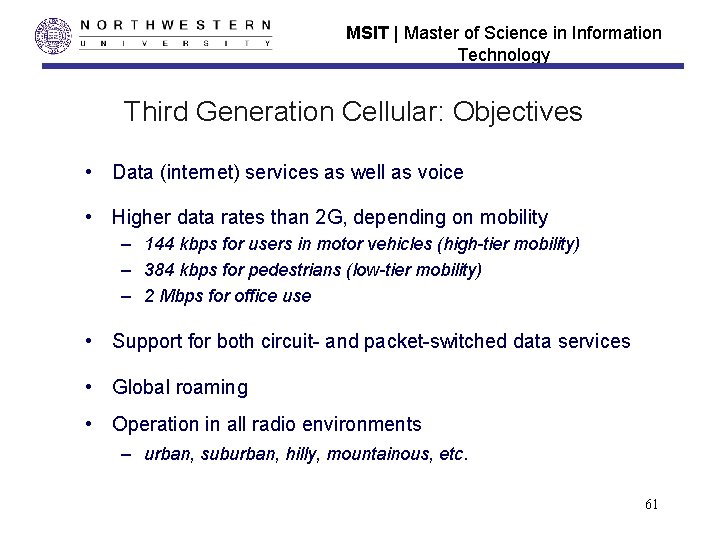
MSIT | Master of Science in Information Technology Third Generation Cellular: Objectives • Data (internet) services as well as voice • Higher data rates than 2 G, depending on mobility – 144 kbps for users in motor vehicles (high-tier mobility) – 384 kbps for pedestrians (low-tier mobility) – 2 Mbps for office use • Support for both circuit- and packet-switched data services • Global roaming • Operation in all radio environments – urban, suburban, hilly, mountainous, etc. 61
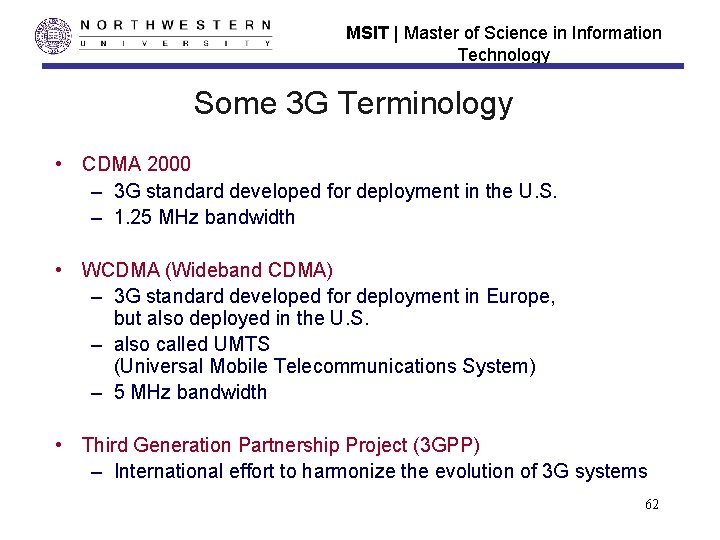
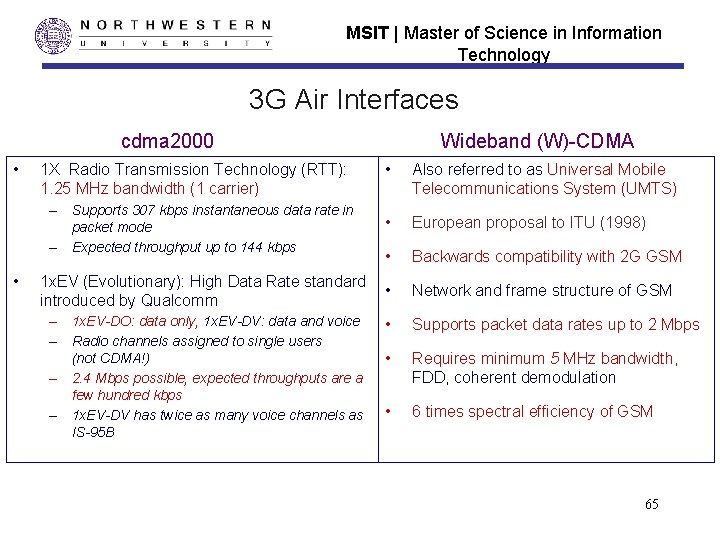
MSIT | Master of Science in Information Technology Some 3 G Terminology • CDMA 2000 – 3 G standard developed for deployment in the U. S. – 1. 25 MHz bandwidth • WCDMA (Wideband CDMA) – 3 G standard developed for deployment in Europe, but also deployed in the U. S. – also called UMTS (Universal Mobile Telecommunications System) – 5 MHz bandwidth • Third Generation Partnership Project (3 GPP) – International effort to harmonize the evolution of 3 G systems 62
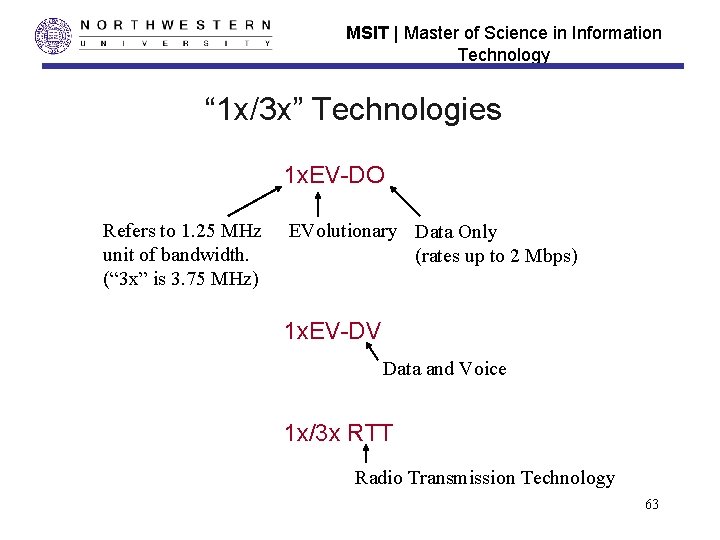
MSIT | Master of Science in Information Technology “ 1 x/3 x” Technologies 1 x. EV-DO Refers to 1. 25 MHz unit of bandwidth. (“ 3 x” is 3. 75 MHz) EVolutionary Data Only (rates up to 2 Mbps) 1 x. EV-DV Data and Voice 1 x/3 x RTT Radio Transmission Technology 63
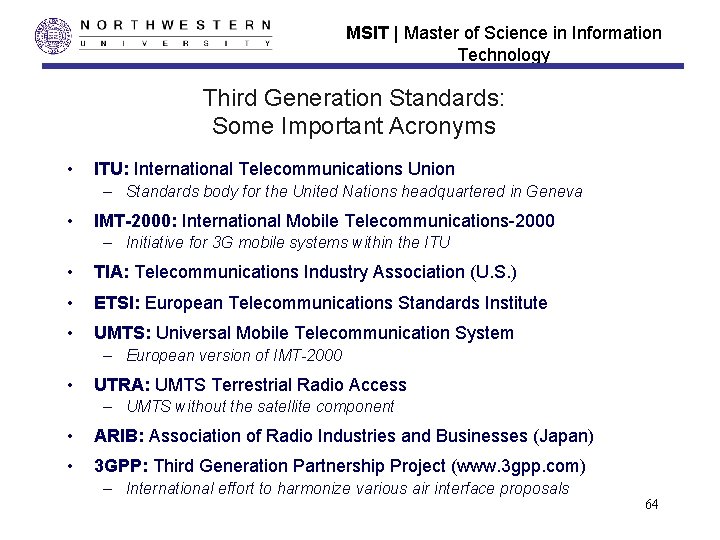
MSIT | Master of Science in Information Technology Third Generation Standards: Some Important Acronyms • ITU: International Telecommunications Union – Standards body for the United Nations headquartered in Geneva • IMT-2000: International Mobile Telecommunications-2000 – Initiative for 3 G mobile systems within the ITU • TIA: Telecommunications Industry Association (U. S. ) • ETSI: European Telecommunications Standards Institute • UMTS: Universal Mobile Telecommunication System – European version of IMT-2000 • UTRA: UMTS Terrestrial Radio Access – UMTS without the satellite component • ARIB: Association of Radio Industries and Businesses (Japan) • 3 GPP: Third Generation Partnership Project (www. 3 gpp. com) – International effort to harmonize various air interface proposals 64
MSIT | Master of Science in Information Technology 3 G Air Interfaces cdma 2000 • • Wideband (W)-CDMA • Also referred to as Universal Mobile Telecommunications System (UMTS) – Supports 307 kbps instantaneous data rate in packet mode – Expected throughput up to 144 kbps • European proposal to ITU (1998) • Backwards compatibility with 2 G GSM 1 x. EV (Evolutionary): High Data Rate standard introduced by Qualcomm • Network and frame structure of GSM • Supports packet data rates up to 2 Mbps • Requires minimum 5 MHz bandwidth, FDD, coherent demodulation • 6 times spectral efficiency of GSM 1 X Radio Transmission Technology (RTT): 1. 25 MHz bandwidth (1 carrier) – 1 x. EV-DO: data only, 1 x. EV-DV: data and voice – Radio channels assigned to single users (not CDMA!) – 2. 4 Mbps possible, expected throughputs are a few hundred kbps – 1 x. EV-DV has twice as many voice channels as IS-95 B 65
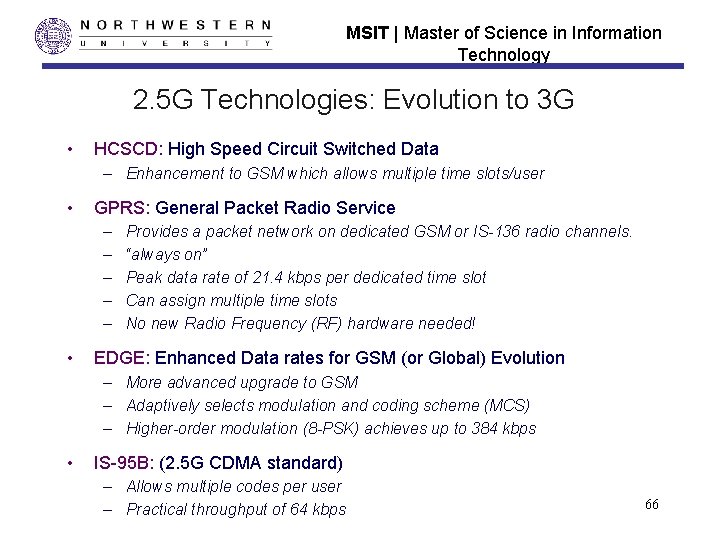
MSIT | Master of Science in Information Technology 2. 5 G Technologies: Evolution to 3 G • HCSCD: High Speed Circuit Switched Data – Enhancement to GSM which allows multiple time slots/user • GPRS: General Packet Radio Service – – – • Provides a packet network on dedicated GSM or IS-136 radio channels. “always on” Peak data rate of 21. 4 kbps per dedicated time slot Can assign multiple time slots No new Radio Frequency (RF) hardware needed! EDGE: Enhanced Data rates for GSM (or Global) Evolution – More advanced upgrade to GSM – Adaptively selects modulation and coding scheme (MCS) – Higher-order modulation (8 -PSK) achieves up to 384 kbps • IS-95 B: (2. 5 G CDMA standard) – Allows multiple codes per user – Practical throughput of 64 kbps 66
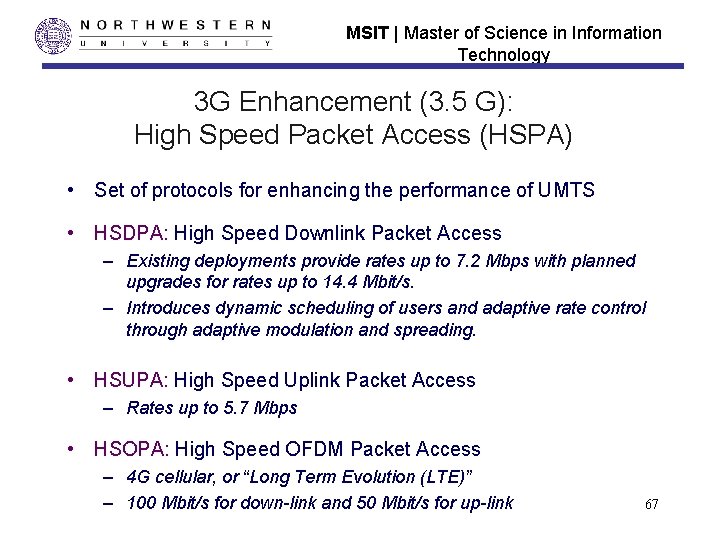
MSIT | Master of Science in Information Technology 3 G Enhancement (3. 5 G): High Speed Packet Access (HSPA) • Set of protocols for enhancing the performance of UMTS • HSDPA: High Speed Downlink Packet Access – Existing deployments provide rates up to 7. 2 Mbps with planned upgrades for rates up to 14. 4 Mbit/s. – Introduces dynamic scheduling of users and adaptive rate control through adaptive modulation and spreading. • HSUPA: High Speed Uplink Packet Access – Rates up to 5. 7 Mbps • HSOPA: High Speed OFDM Packet Access – 4 G cellular, or “Long Term Evolution (LTE)” – 100 Mbit/s for down-link and 50 Mbit/s for up-link 67
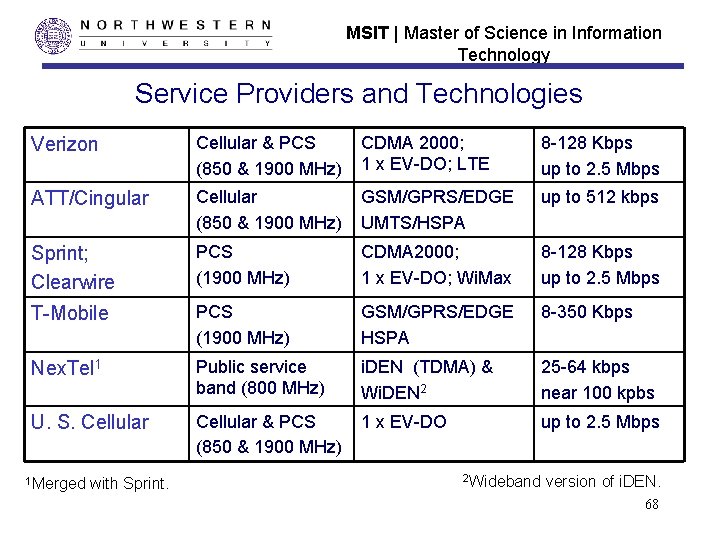
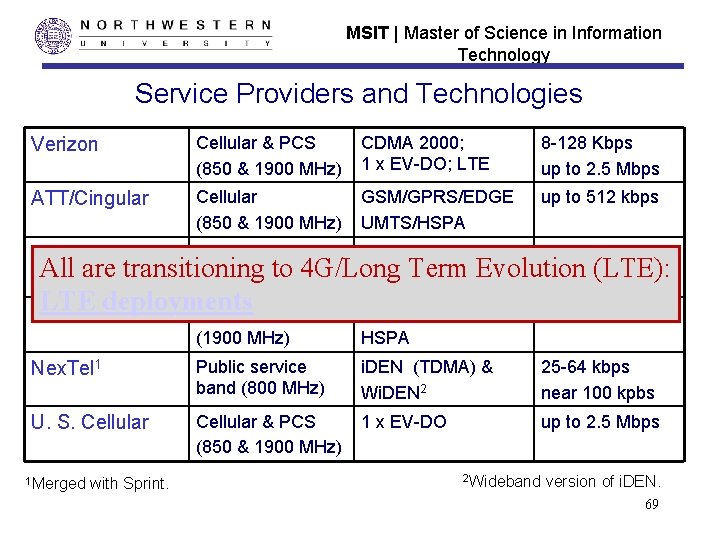
MSIT | Master of Science in Information Technology Service Providers and Technologies Verizon Cellular & PCS (850 & 1900 MHz) CDMA 2000; 1 x EV-DO; LTE 8 -128 Kbps up to 2. 5 Mbps ATT/Cingular Cellular (850 & 1900 MHz) GSM/GPRS/EDGE UMTS/HSPA up to 512 kbps Sprint; Clearwire PCS (1900 MHz) CDMA 2000; 1 x EV-DO; Wi. Max 8 -128 Kbps up to 2. 5 Mbps T-Mobile PCS (1900 MHz) GSM/GPRS/EDGE HSPA 8 -350 Kbps Nex. Tel 1 Public service band (800 MHz) i. DEN (TDMA) & Wi. DEN 2 25 -64 kbps near 100 kpbs U. S. Cellular & PCS (850 & 1900 MHz) 1 x EV-DO up to 2. 5 Mbps 1 Merged with Sprint. 2 Wideband version of i. DEN. 68
MSIT | Master of Science in Information Technology Service Providers and Technologies Verizon Cellular & PCS (850 & 1900 MHz) CDMA 2000; 1 x EV-DO; LTE 8 -128 Kbps up to 2. 5 Mbps ATT/Cingular Cellular (850 & 1900 MHz) GSM/GPRS/EDGE UMTS/HSPA up to 512 kbps Sprint; All are Clearwire PCS transitioning to (1900 MHz) LTE deployments PCS T-Mobile CDMA 2000; 8 -128 Kbps 4 G/Long Term. Wi. Max Evolution (LTE): 1 x EV-DO; up to 2. 5 Mbps 8 -350 Kbps (1900 MHz) GSM/GPRS/EDGE HSPA Nex. Tel 1 Public service band (800 MHz) i. DEN (TDMA) & Wi. DEN 2 25 -64 kbps near 100 kpbs U. S. Cellular & PCS (850 & 1900 MHz) 1 x EV-DO up to 2. 5 Mbps 1 Merged with Sprint. 2 Wideband version of i. DEN. 69
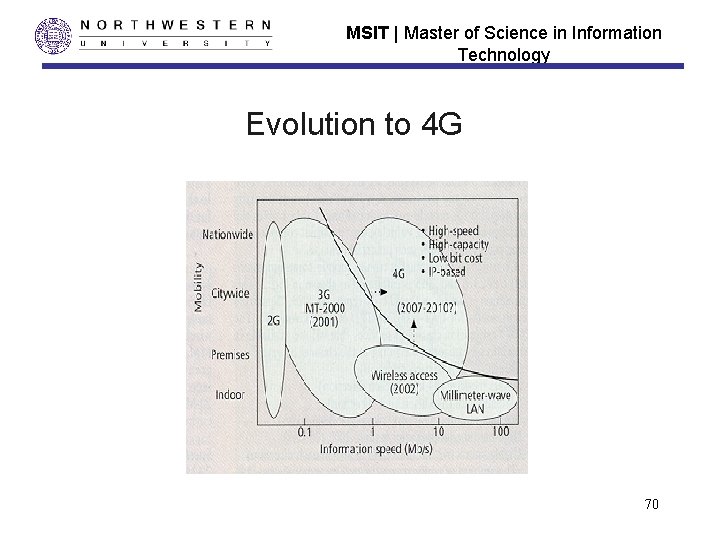
MSIT | Master of Science in Information Technology Evolution to 4 G 70
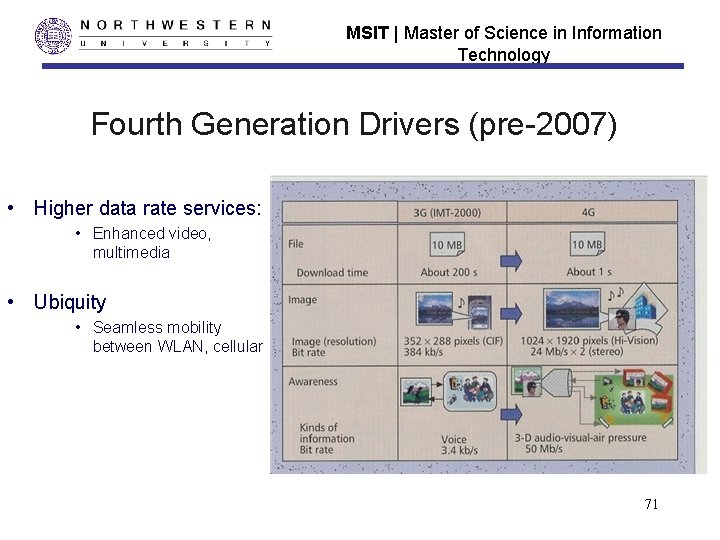
MSIT | Master of Science in Information Technology Fourth Generation Drivers (pre-2007) • Higher data rate services: • Enhanced video, multimedia • Ubiquity • Seamless mobility between WLAN, cellular 71
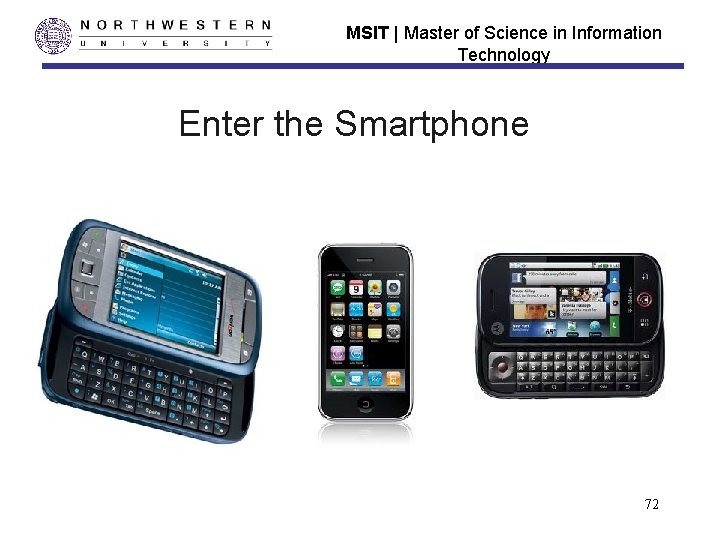
MSIT | Master of Science in Information Technology Enter the Smartphone 72
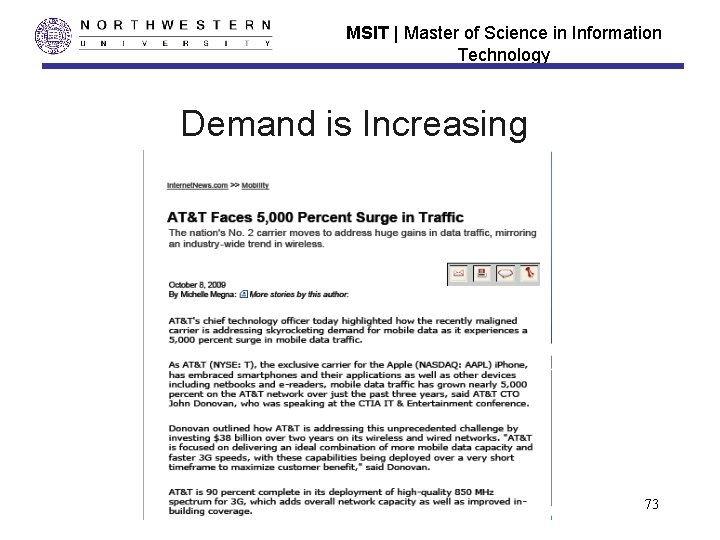
MSIT | Master of Science in Information Technology Demand is Increasing 73
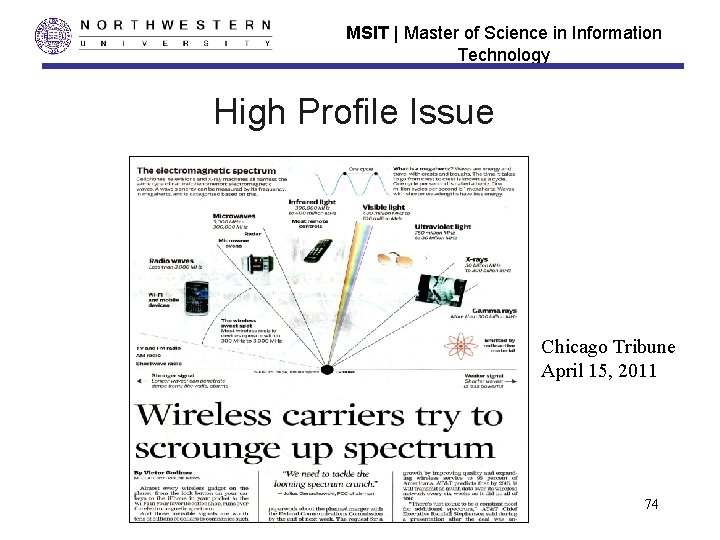
MSIT | Master of Science in Information Technology High Profile Issue Chicago Tribune April 15, 2011 74
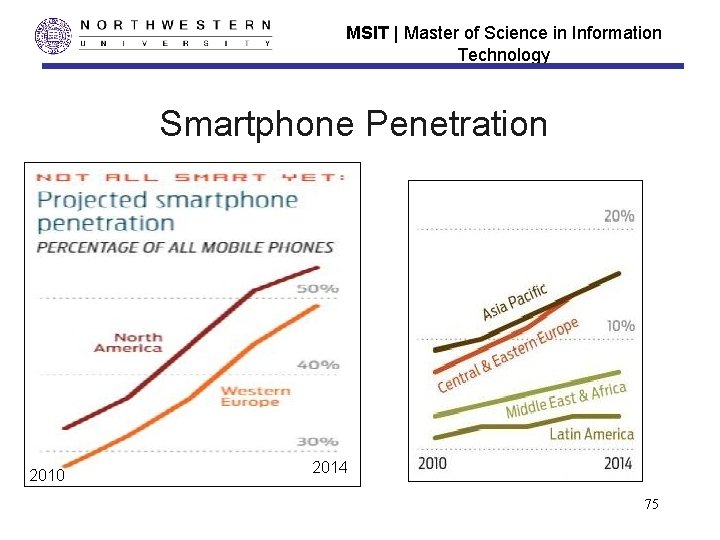
MSIT | Master of Science in Information Technology Smartphone Penetration 2010 2014 75
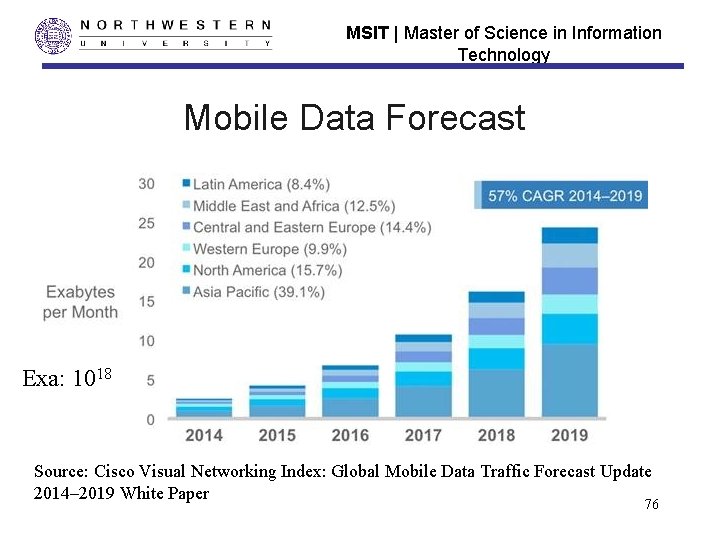
MSIT | Master of Science in Information Technology Mobile Data Forecast Exa: 1018 Source: Cisco Visual Networking Index: Global Mobile Data Traffic Forecast Update 2014– 2019 White Paper 76
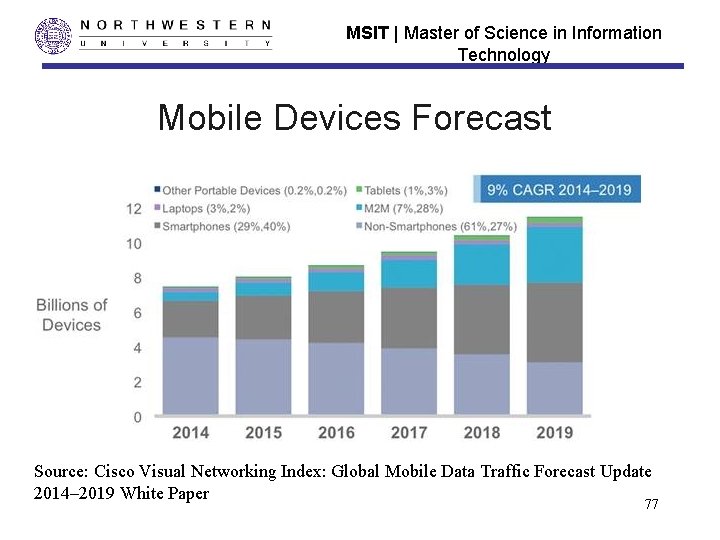
MSIT | Master of Science in Information Technology Mobile Devices Forecast Source: Cisco Visual Networking Index: Global Mobile Data Traffic Forecast Update 2014– 2019 White Paper 77
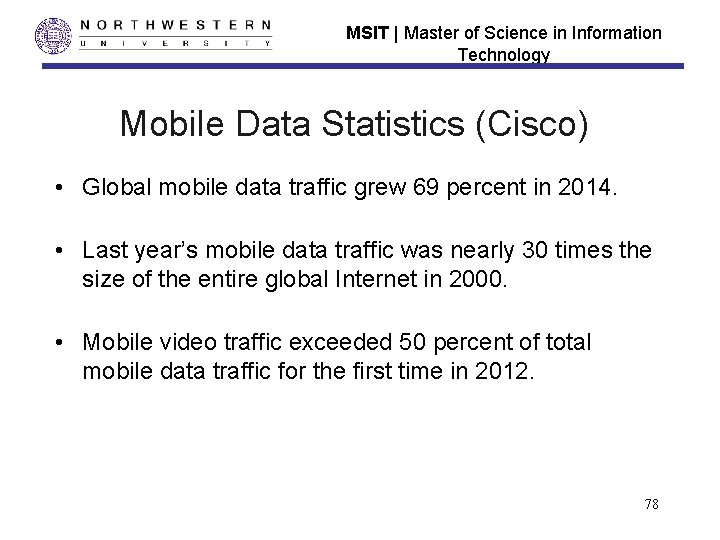
MSIT | Master of Science in Information Technology Mobile Data Statistics (Cisco) • Global mobile data traffic grew 69 percent in 2014. • Last year’s mobile data traffic was nearly 30 times the size of the entire global Internet in 2000. • Mobile video traffic exceeded 50 percent of total mobile data traffic for the first time in 2012. 78
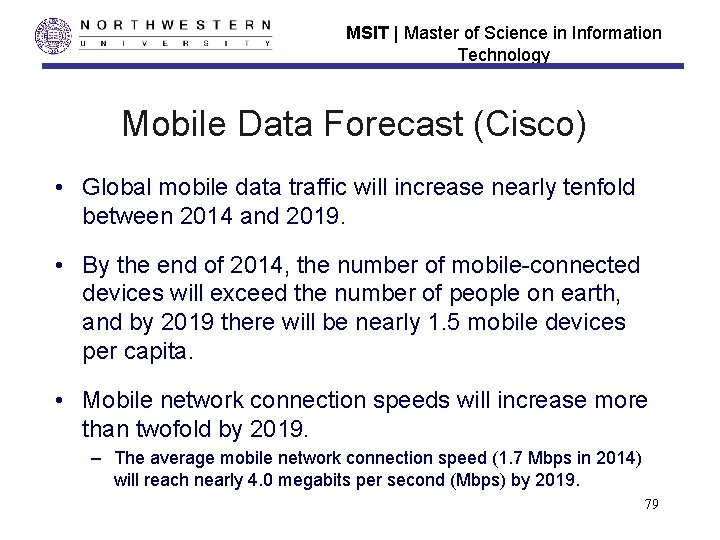
MSIT | Master of Science in Information Technology Mobile Data Forecast (Cisco) • Global mobile data traffic will increase nearly tenfold between 2014 and 2019. • By the end of 2014, the number of mobile-connected devices will exceed the number of people on earth, and by 2019 there will be nearly 1. 5 mobile devices per capita. • Mobile network connection speeds will increase more than twofold by 2019. – The average mobile network connection speed (1. 7 Mbps in 2014) will reach nearly 4. 0 megabits per second (Mbps) by 2019. 79
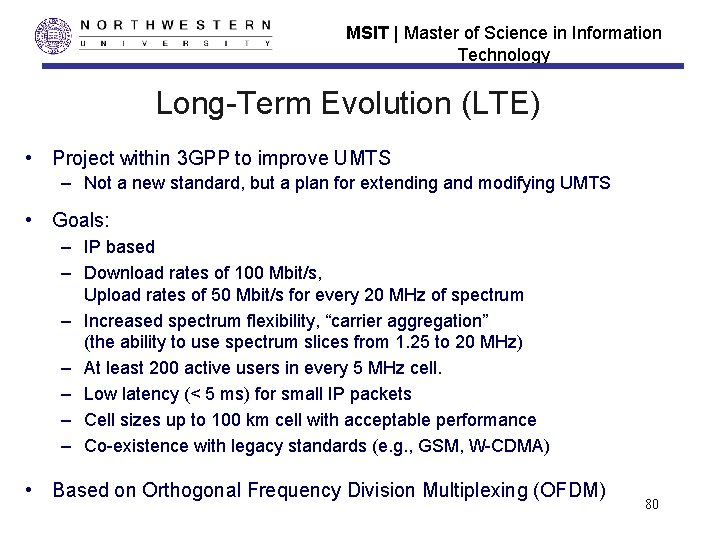
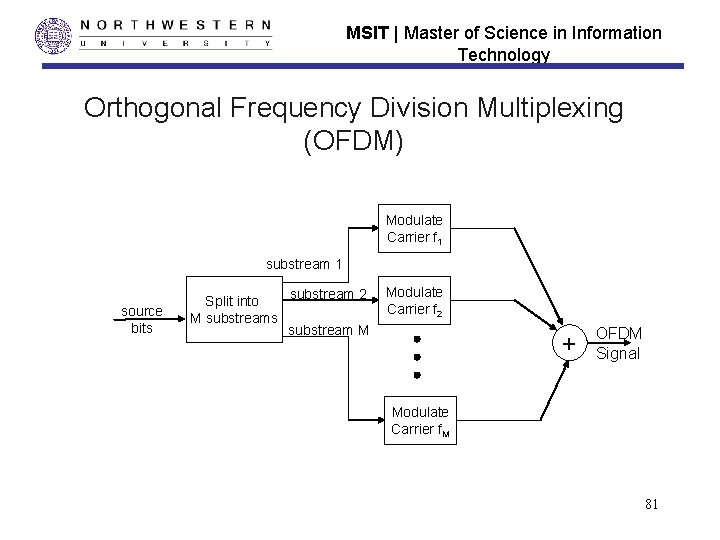
MSIT | Master of Science in Information Technology Long-Term Evolution (LTE) • Project within 3 GPP to improve UMTS – Not a new standard, but a plan for extending and modifying UMTS • Goals: – IP based – Download rates of 100 Mbit/s, Upload rates of 50 Mbit/s for every 20 MHz of spectrum – Increased spectrum flexibility, “carrier aggregation” (the ability to use spectrum slices from 1. 25 to 20 MHz) – At least 200 active users in every 5 MHz cell. – Low latency (< 5 ms) for small IP packets – Cell sizes up to 100 km cell with acceptable performance – Co-existence with legacy standards (e. g. , GSM, W-CDMA) • Based on Orthogonal Frequency Division Multiplexing (OFDM) 80
MSIT | Master of Science in Information Technology Orthogonal Frequency Division Multiplexing (OFDM) Modulate Carrier f 1 substream 1 source bits substream 2 Split into M substreams substream M Modulate Carrier f 2 + OFDM Signal Modulate Carrier f. M 81
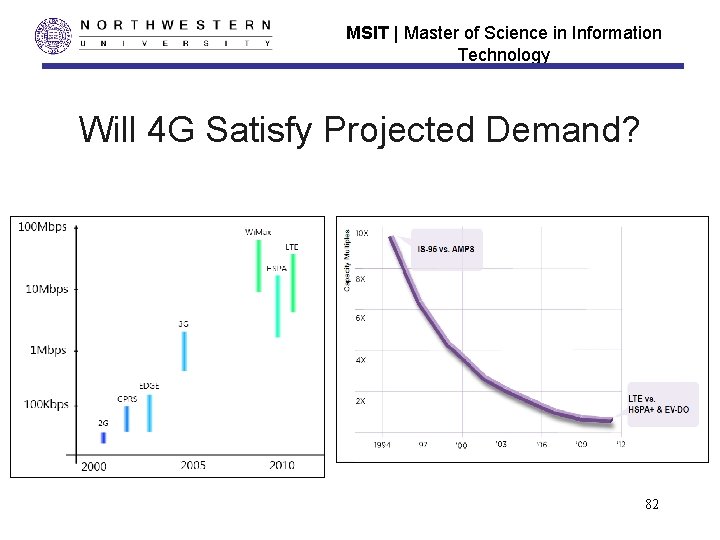
MSIT | Master of Science in Information Technology Will 4 G Satisfy Projected Demand? 82
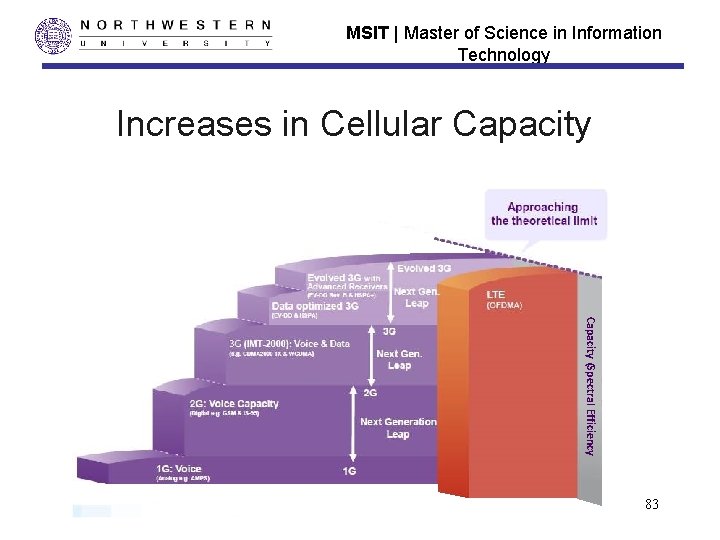
MSIT | Master of Science in Information Technology Increases in Cellular Capacity (Spectral Efficiency 83
MSIT | Master of Science in Information Technology What About 5 G? • No standard or specifications yet. Most likely will be a mix of technologies that integrate: – Small cells – Higher frequencies (including millimeter wave, meaning above 28 GHz) – Licensed and unlicensed spectrum • With 4 G rates eventually projected to be 1 Gbps what additional value can 5 G offer? • Wikipedia site 84
MSIT | Master of Science in Information Technology Classification of Wireless Systems • • Cellular Wireless Local Area Networks (WLANs) Wireless Personal Area Networks (WPANs) Sensor Networks 85
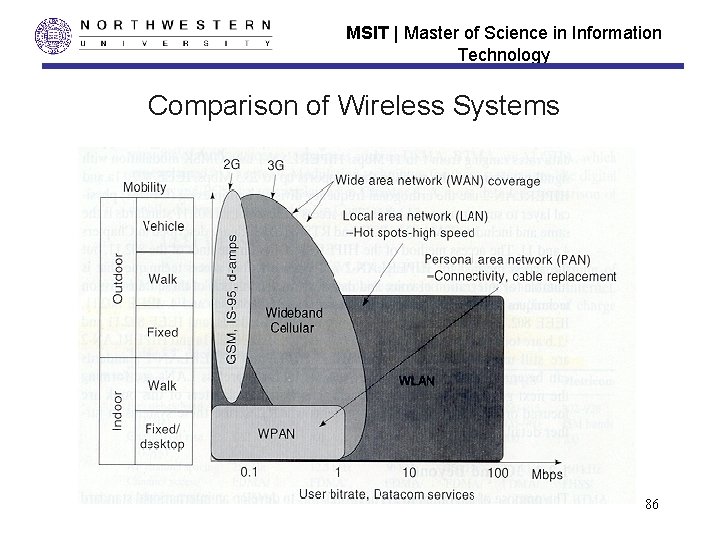
MSIT | Master of Science in Information Technology Comparison of Wireless Systems 86
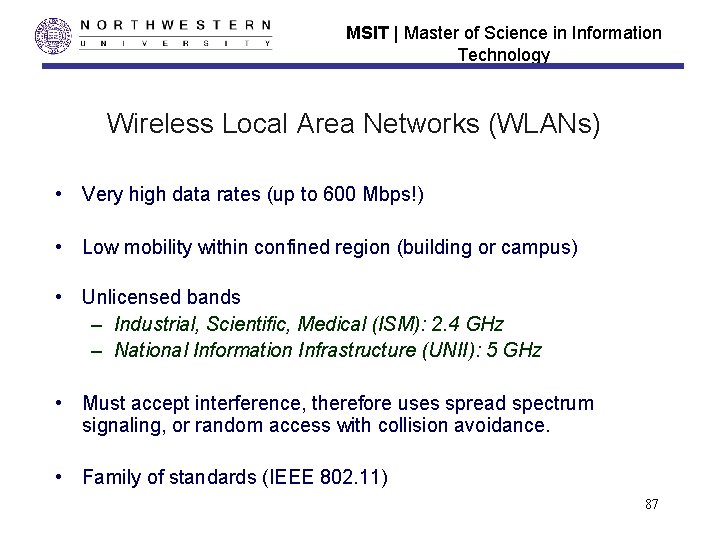
MSIT | Master of Science in Information Technology Wireless Local Area Networks (WLANs) • Very high data rates (up to 600 Mbps!) • Low mobility within confined region (building or campus) • Unlicensed bands – Industrial, Scientific, Medical (ISM): 2. 4 GHz – National Information Infrastructure (UNII): 5 GHz • Must accept interference, therefore uses spread spectrum signaling, or random access with collision avoidance. • Family of standards (IEEE 802. 11) 87
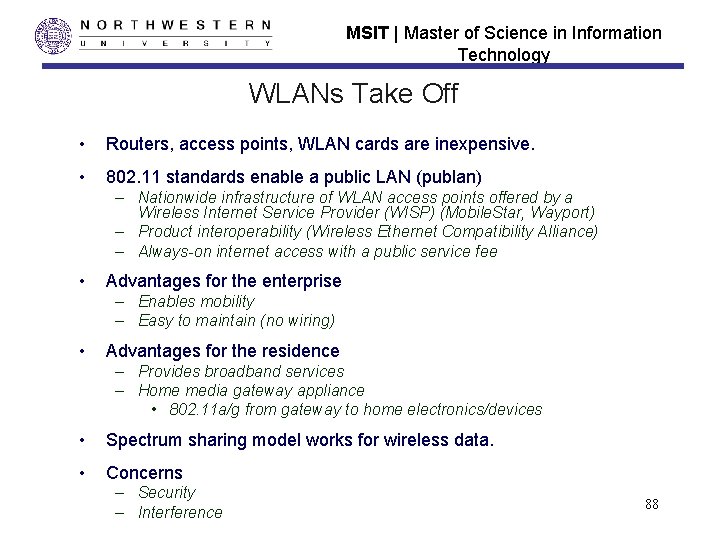
MSIT | Master of Science in Information Technology WLANs Take Off • Routers, access points, WLAN cards are inexpensive. • 802. 11 standards enable a public LAN (publan) – Nationwide infrastructure of WLAN access points offered by a Wireless Internet Service Provider (WISP) (Mobile. Star, Wayport) – Product interoperability (Wireless Ethernet Compatibility Alliance) – Always-on internet access with a public service fee • Advantages for the enterprise – Enables mobility – Easy to maintain (no wiring) • Advantages for the residence – Provides broadband services – Home media gateway appliance • 802. 11 a/g from gateway to home electronics/devices • Spectrum sharing model works for wireless data. • Concerns – Security – Interference 88
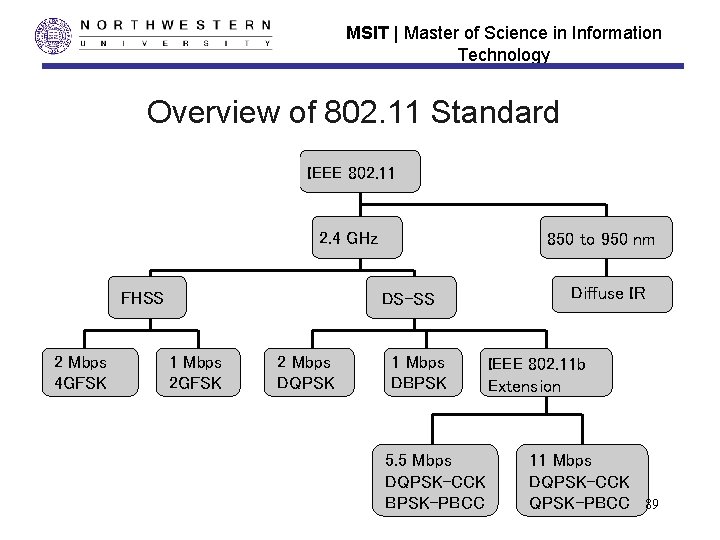
MSIT | Master of Science in Information Technology Overview of 802. 11 Standard IEEE 802. 11 2. 4 GHz FHSS 2 Mbps 4 GFSK 850 to 950 nm DS-SS 1 Mbps 2 GFSK 2 Mbps DQPSK 1 Mbps DBPSK 5. 5 Mbps DQPSK-CCK BPSK-PBCC Diffuse IR IEEE 802. 11 b Extension 11 Mbps DQPSK-CCK QPSK-PBCC 89
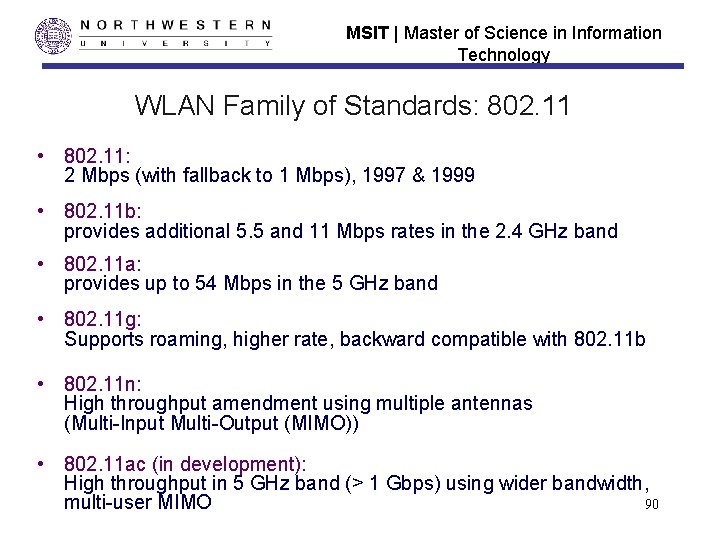
MSIT | Master of Science in Information Technology WLAN Family of Standards: 802. 11 • 802. 11: 2 Mbps (with fallback to 1 Mbps), 1997 & 1999 • 802. 11 b: provides additional 5. 5 and 11 Mbps rates in the 2. 4 GHz band • 802. 11 a: provides up to 54 Mbps in the 5 GHz band • 802. 11 g: Supports roaming, higher rate, backward compatible with 802. 11 b • 802. 11 n: High throughput amendment using multiple antennas (Multi-Input Multi-Output (MIMO)) • 802. 11 ac (in development): High throughput in 5 GHz band (> 1 Gbps) using wider bandwidth, 90 multi-user MIMO
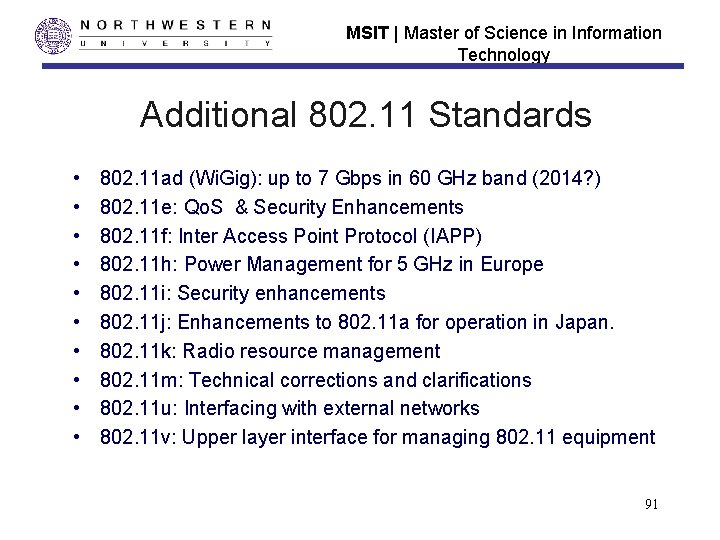
MSIT | Master of Science in Information Technology Additional 802. 11 Standards • • • 802. 11 ad (Wi. Gig): up to 7 Gbps in 60 GHz band (2014? ) 802. 11 e: Qo. S & Security Enhancements 802. 11 f: Inter Access Point Protocol (IAPP) 802. 11 h: Power Management for 5 GHz in Europe 802. 11 i: Security enhancements 802. 11 j: Enhancements to 802. 11 a for operation in Japan. 802. 11 k: Radio resource management 802. 11 m: Technical corrections and clarifications 802. 11 u: Interfacing with external networks 802. 11 v: Upper layer interface for managing 802. 11 equipment 91
MSIT | Master of Science in Information Technology 802. 11 a/b/g/n Comparison table 92
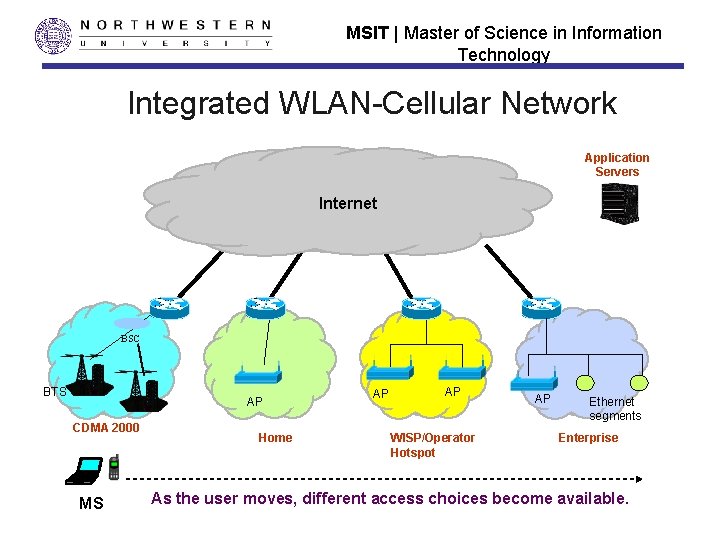
MSIT | Master of Science in Information Technology Integrated WLAN-Cellular Network Application Servers Internet BSC BTS AP CDMA 2000 MS Home AP AP WISP/Operator Hotspot AP Ethernet segments Enterprise As the user moves, different access choices become available.
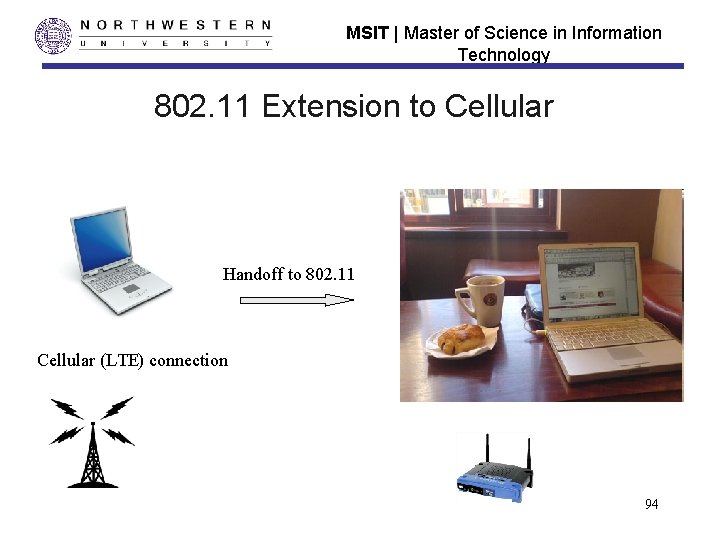
MSIT | Master of Science in Information Technology 802. 11 Extension to Cellular Handoff to 802. 11 Cellular (LTE) connection 94
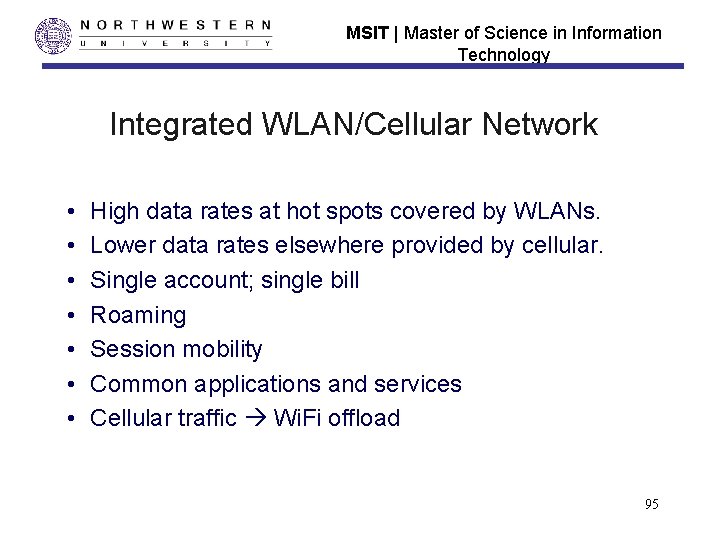
MSIT | Master of Science in Information Technology Integrated WLAN/Cellular Network • • High data rates at hot spots covered by WLANs. Lower data rates elsewhere provided by cellular. Single account; single bill Roaming Session mobility Common applications and services Cellular traffic Wi. Fi offload 95
MSIT | Master of Science in Information Technology Classification of Wireless Systems • • Cellular Wireless Local Area Networks (WLANs) Wireless Personal Area Networks (WPANs) Sensor Networks 96
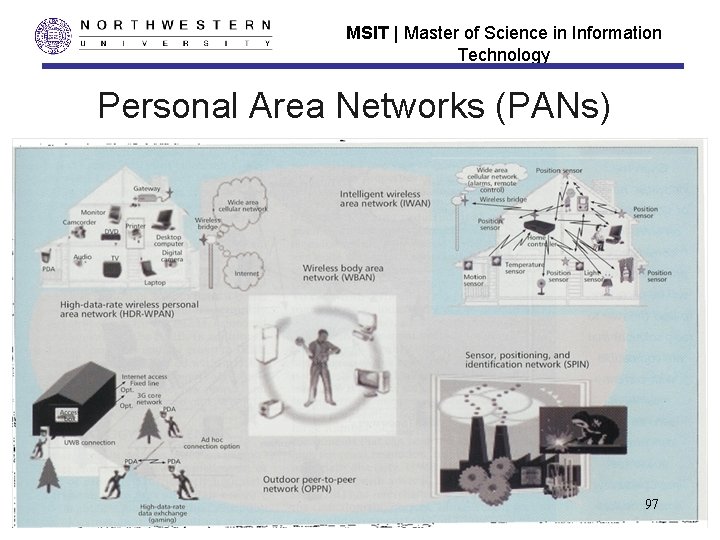
MSIT | Master of Science in Information Technology Personal Area Networks (PANs) 97
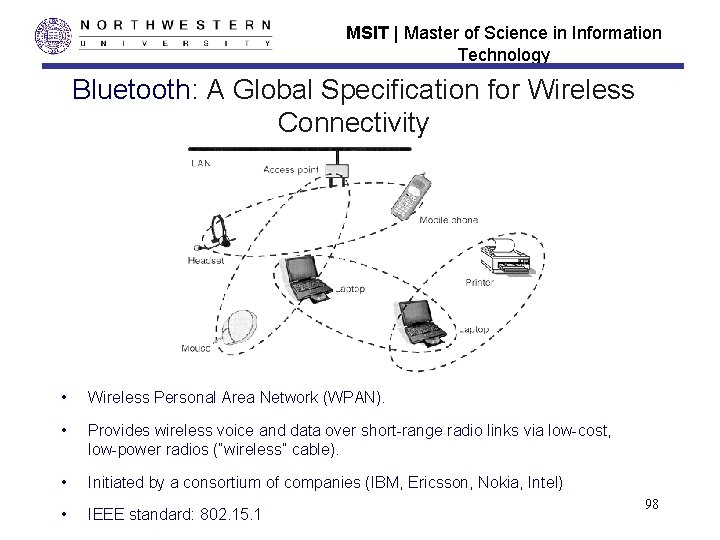
MSIT | Master of Science in Information Technology Bluetooth: A Global Specification for Wireless Connectivity • Wireless Personal Area Network (WPAN). • Provides wireless voice and data over short-range radio links via low-cost, low-power radios (“wireless” cable). • Initiated by a consortium of companies (IBM, Ericsson, Nokia, Intel) • IEEE standard: 802. 15. 1 98
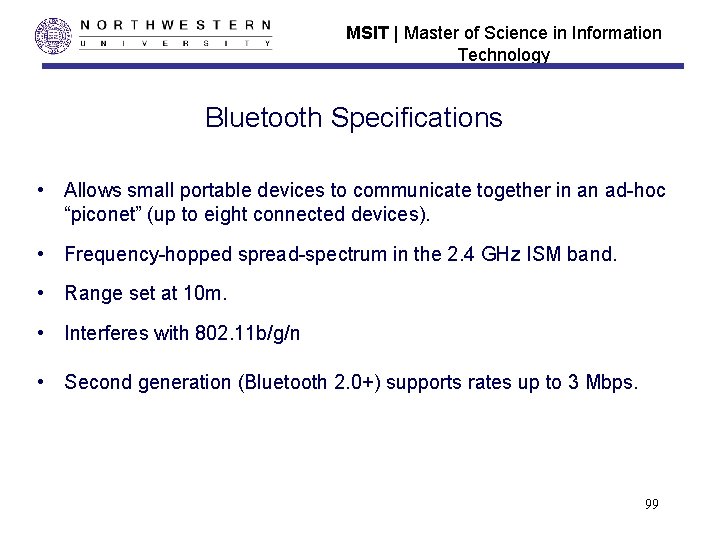
MSIT | Master of Science in Information Technology Bluetooth Specifications • Allows small portable devices to communicate together in an ad-hoc “piconet” (up to eight connected devices). • Frequency-hopped spread-spectrum in the 2. 4 GHz ISM band. • Range set at 10 m. • Interferes with 802. 11 b/g/n • Second generation (Bluetooth 2. 0+) supports rates up to 3 Mbps. 99
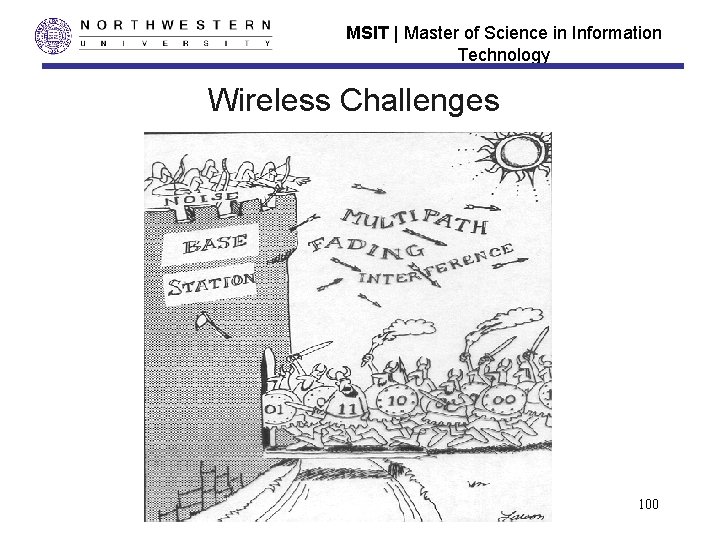
MSIT | Master of Science in Information Technology Wireless Challenges 100