
Cellular Phone Networks Some slides are based on

Cellular Phone Networks Some slides are based on: Computer Networking: A Top Down Approach Featuring the Internet, 3 rdedition. Jim Kurose, Keith Ross. Addison-Wesley, July 2004.
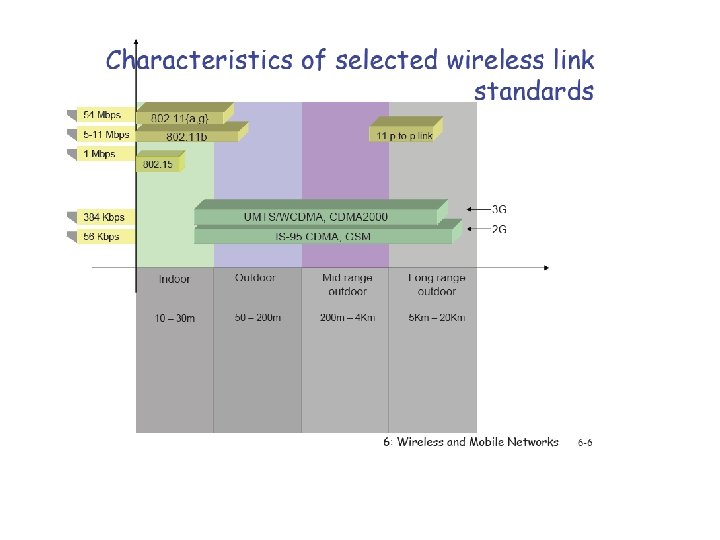
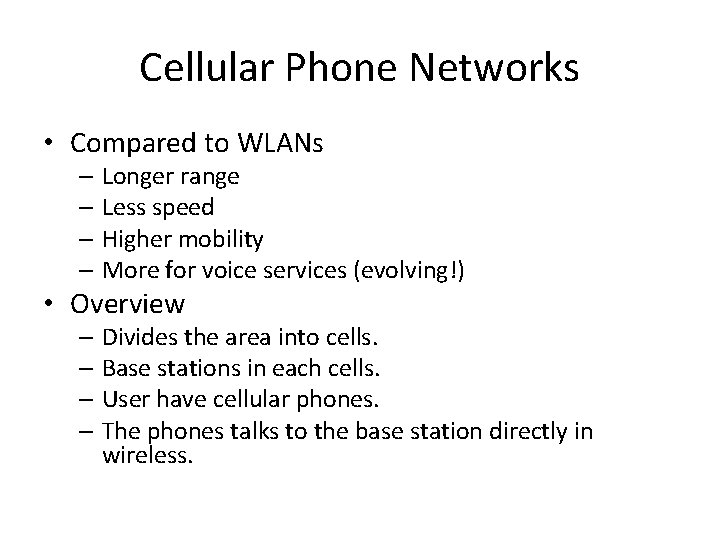
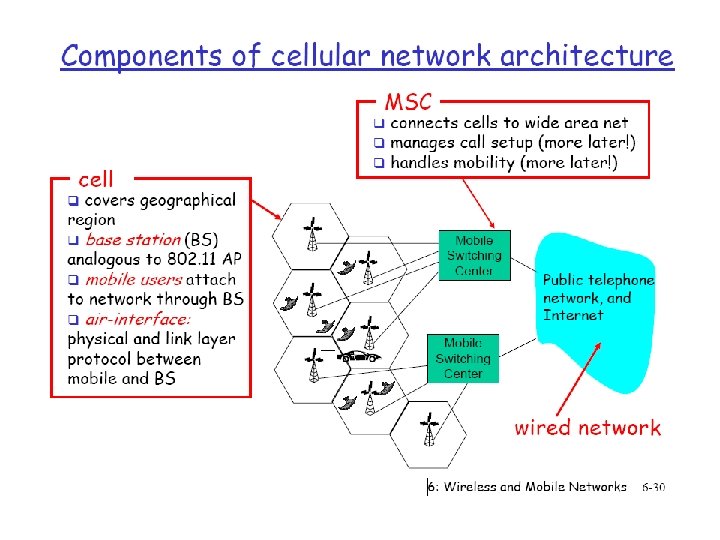
Cellular Phone Networks • Compared to WLANs – Longer range – Less speed – Higher mobility – More for voice services (evolving!) • Overview – Divides the area into cells. – Base stations in each cells. – User have cellular phones. – The phones talks to the base station directly in wireless.
GSM • Global System for Mobile (GSM) – Used by more than 3 billion people – 2 nd Generation (2 G), because everything is digital, compared to the analog mobile phones which is 1 G – Operates in 900 MHz and 1800 MHz band, or 850 M and 1900 M bands in the US – Uplink and down link both 25 MHz wide. In GSM 900, uplink band is 890 -915 M, downlink is 935 -960 M. – A band is divided into 124 channels with 200 KHz spacing. The data rate is about 270 Kbps for a channel.
GSM • GSM continued – The time in a channel is divided into 8 slots. Each slot is 577 us and is allocated to a user. – A mobile phone is allocated two channels, one for uplink and the other for downlink. Separated by 45 MHz. – The uplink and downlink slot numbers are separated by 3 – a phone never transmits and receives at the same time – FDMA/TDMA (Frequency Division Multiple Access / Time Division Multiple Access). – Different from In wireless LAN, in which a node is given the entire bandwidth for the time it needs to send a packet. Difference due to the nature of the application. – The peak transmission power of a GSM phone is 2 W in 900 M band 1 W in 1800 M band. In contrast, your wireless router transmits at 20 d. Bm, which is 0. 1 W. Difference due to the distance.
GMSK modulation • GSM uses Gaussian minimum-shift keying (GMSK). – MSK: basically replaces {1, -1} with a positive half sine wave or a negative half sine wave, and multiply it with the carrier. – GMSK: first pass the digital waveform through a Gaussian low pass filter. – Reduces interferences
Frequency Reuse • Adjacent cells should not use the same frequency, because it will cause interference. • However, non-adjacent cells may use the same frequency. • Due to frequency reuse, the actual number of channels used in an area is larger than 124. • Given an area, reducing the size of cells (reducing the transmit power) increases the frequency reuse, hence increasing the total capacity. • Cell planning is a major issue.
Frequency Reuse • Cell sizes in GSM: – Large microcell: 3 -30 km – Small microcell: 1 -3 km – Microcell: 0. 1 -1 km – Picocell: 0. 01 -0. 1 km – Nanocell: 0. 001 -0. 01 km • Typically, there are lots of small cells plus several large cells. The small cells carries the majority of the traffic. The large cells fills the holes.
Capacity • Given the number of channels in a cell, the maximum number of users supported is fixed. – With GSM, if there are C channels, we can support 8 C users at most • The number of users can be much larger than the maximum number of slots. That is why some time you see “emergency calls only. ” • The hope is that not all users want to make calls at the same time.
The Erlang-B Formula • The phone company wants to allocate enough channels such that the probability of dropping a call is below a threshold. • There is an old formula, the Erlang-B Formula, to calculate this. (It is probably 100 years old. ) • Check: http: //wireless. per. nl/reference/chaptr 04/erlangb. htm
The Erlang-B formula • Given N channels, where each channel supports a user. A new call can be served if and only if there is an available channel; otherwise it is dropped. • Assume the calls arrive following a Poisson process, that is, the inter-arrival time between two calls follows exponential distribution with parameter. Assume the duration of a phone call follows the exponential distribution with parameter. • What is the probability of call dropping?
Exponential Distribution • The p. d. f. of exponential distribution • A unique feature. Suppose you are waiting for a bus. The bus is following a random schedule, and the inter-arrival time follows the exponential distribution. If you just missed a bus, the probability you have to wait t seconds is given above. But, given that you have waited t 0 seconds, what is the probability you have to wait another t seconds?
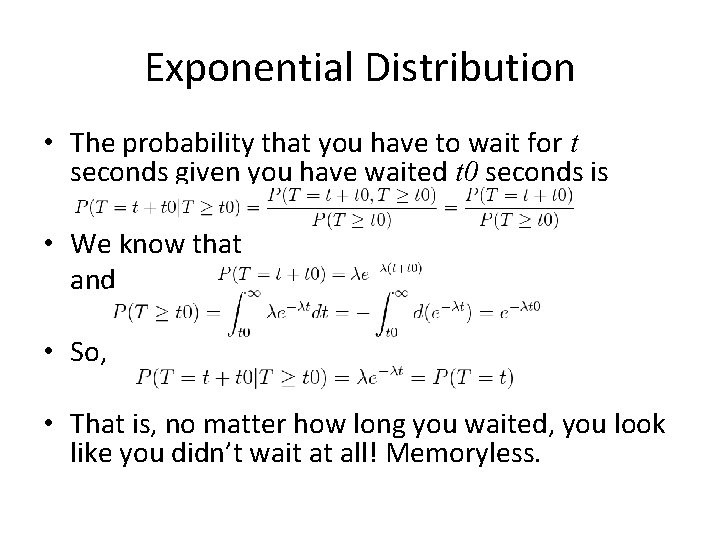
Exponential Distribution • The probability that you have to wait for t seconds given you have waited t 0 seconds is • We know that and • So, • That is, no matter how long you waited, you look like you didn’t wait at all! Memoryless.
The Erlang-B Formula • Consider the phone system. It can be fully described by the number of current users, if the inter-arrival time of calls and the call duration both follows the exponential distribution. – Because regardless of how long you have waited for the next arriving call or for a call to finish, it looks like you didn’t wait for any time at all – In other words, by assuming the exponential distribution, the system is memoryless.
Markov Chain • The number of current phone calls will change with time: – When a new call arrives – When a call finishes • Given that there are i ongoing calls, or, when the system is in state i, the next state is either i-1 or i+1. – Time is fine-grained and no two events happen at the same time. • The system is a Markov Chain if the probability to go from the current state to a next state is only determined by the current state, but not previous states. • Because the system is memoryless, it is a Markov chain.
The Erlang-B formula • Probability to go from state i to state i-1 – Event happens when a call finishes before a new call arrives • Probability to go from state i to state i+1 – Event happens when a new call arrives before an existing call finishes
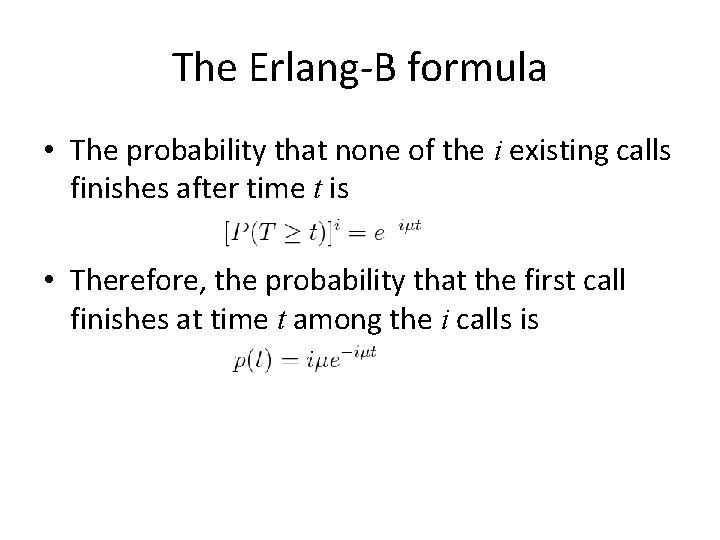
The Erlang-B formula • The probability that none of the i existing calls finishes after time t is • Therefore, the probability that the first call finishes at time t among the i calls is
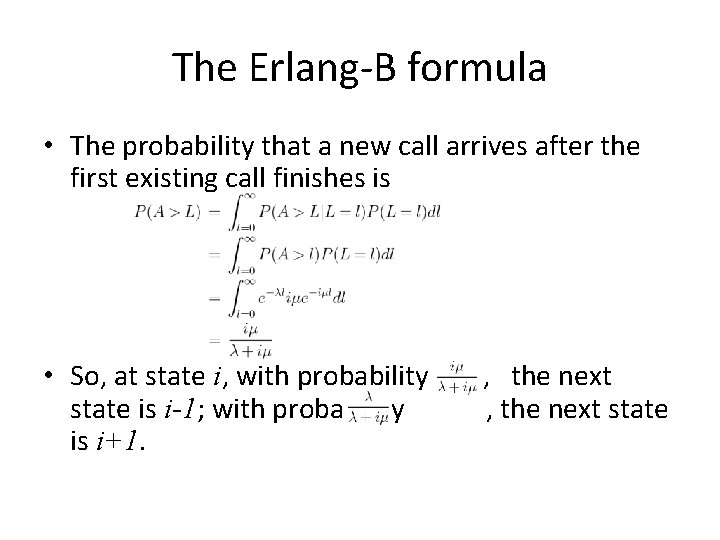
The Erlang-B formula • The probability that a new call arrives after the first existing call finishes is • So, at state i, with probability state is i-1; with probability is i+1. , the next state
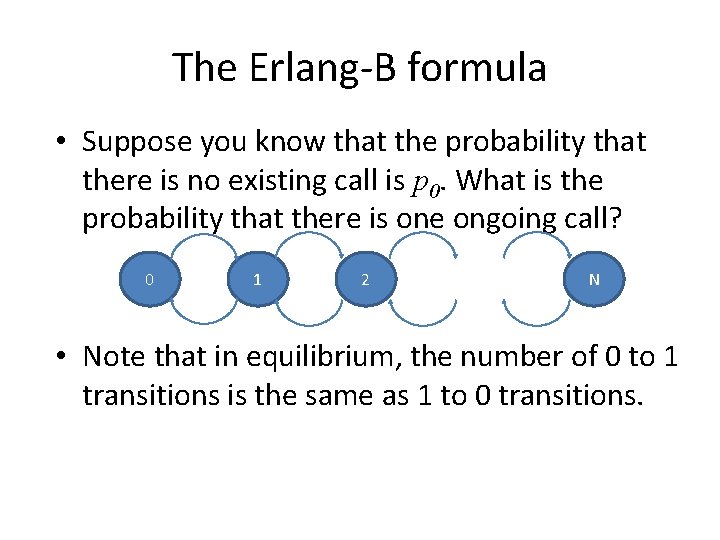
The Erlang-B formula • Suppose you know that the probability that there is no existing call is p 0. What is the probability that there is one ongoing call? 0 1 2 N • Note that in equilibrium, the number of 0 to 1 transitions is the same as 1 to 0 transitions.
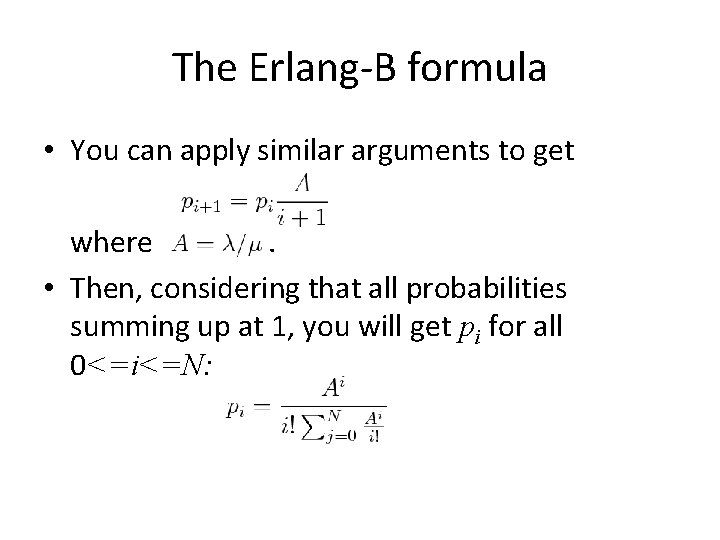
The Erlang-B formula • You can apply similar arguments to get where. • Then, considering that all probabilities summing up at 1, you will get pi for all 0<=i<=N:
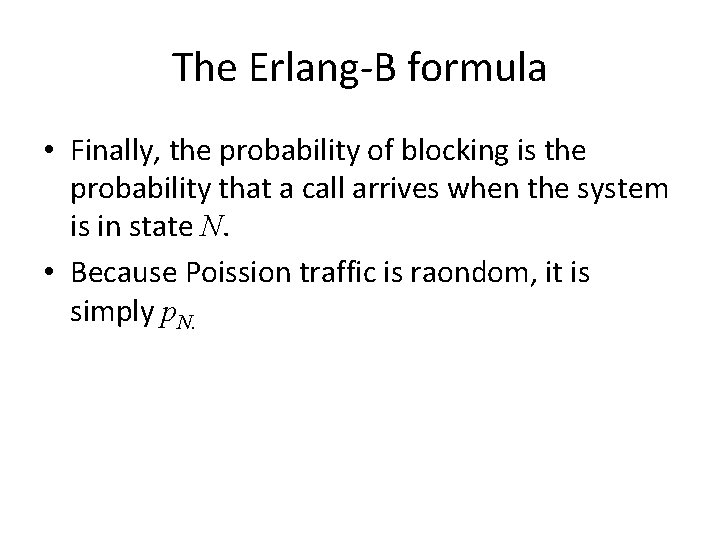
The Erlang-B formula • Finally, the probability of blocking is the probability that a call arrives when the system is in state N. • Because Poission traffic is raondom, it is simply p. N.
http: //elm. eeng. dcu. ie/~kaszubow/Biography/Lecture 5. pdf
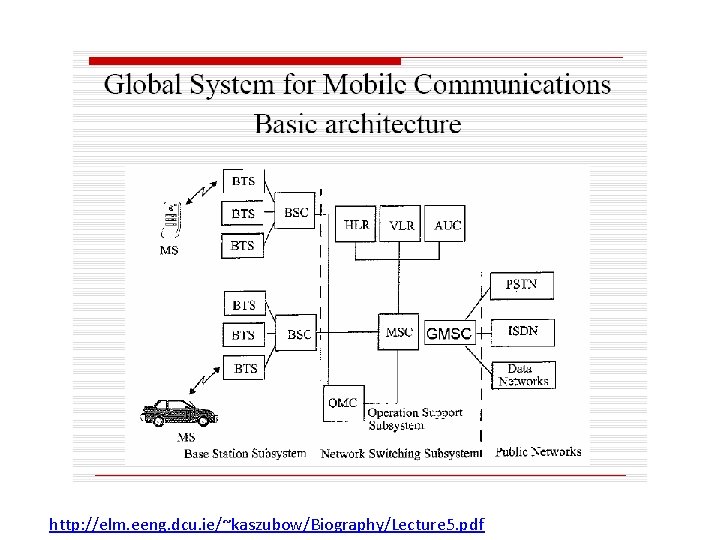
Management of GSM • Base Transceiver Station (BTS) – Has 1 to 16 transceivers • Base Station Controller (BSC) – Controls hundreds of BTS • Mobile Switching Center (MSC) – Typical MSC supports up to 100, 000 mobiles and 5000 simultaneous calls – MSC are connected with each other. – Gateway MSC connects the GSM system to external networks, e. g. PSTN. – Each MSC controls at least one Base Station System (BSS) • Authentication Center (AUC) • Operations and maintenance center (OMC) • …
GSM • Visitor’s Location Register (VLR): Each MSC connects to a VLR. The VLR is a data base with the information about cellphones temporarily located in the area served by particular MSC. • Home Location Register (HLR): database of all cellphones permanently registered in the system. Stores – Current location of the phone. – All parameters needed by the system to establish a connection with the user. – The address of the VLR currently associated with the phone – Encryption keys for data transmission and user authentication – …
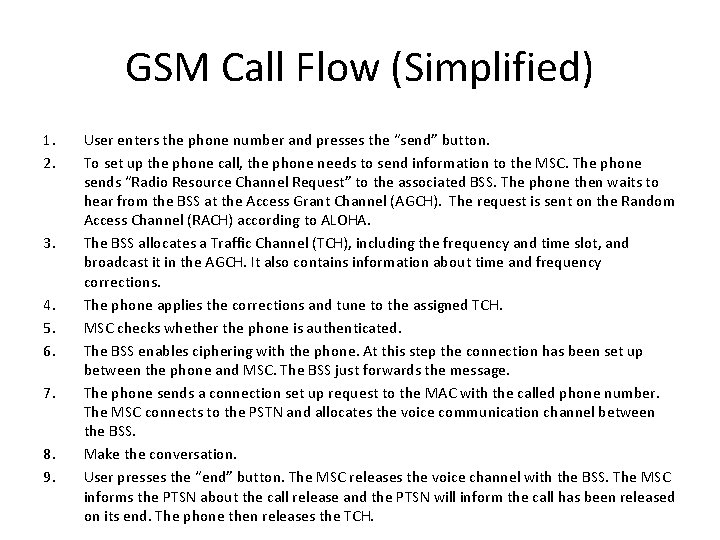
GSM Call Flow (Simplified) 1. 2. 3. 4. 5. 6. 7. 8. 9. User enters the phone number and presses the “send” button. To set up the phone call, the phone needs to send information to the MSC. The phone sends “Radio Resource Channel Request” to the associated BSS. The phone then waits to hear from the BSS at the Access Grant Channel (AGCH). The request is sent on the Random Access Channel (RACH) according to ALOHA. The BSS allocates a Traffic Channel (TCH), including the frequency and time slot, and broadcast it in the AGCH. It also contains information about time and frequency corrections. The phone applies the corrections and tune to the assigned TCH. MSC checks whether the phone is authenticated. The BSS enables ciphering with the phone. At this step the connection has been set up between the phone and MSC. The BSS just forwards the message. The phone sends a connection set up request to the MAC with the called phone number. The MSC connects to the PSTN and allocates the voice communication channel between the BSS. Make the conversation. User presses the “end” button. The MSC releases the voice channel with the BSS. The MSC informs the PTSN about the call release and the PTSN will inform the call has been released on its end. The phone then releases the TCH.
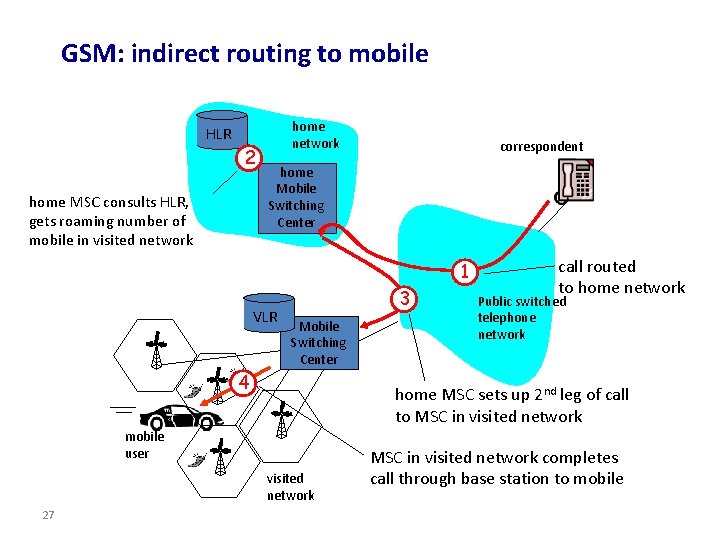
GSM: indirect routing to mobile home network HLR 2 home MSC consults HLR, gets roaming number of mobile in visited network correspondent home Mobile Switching Center 1 VLR 3 Mobile Switching Center 4 Public switched telephone network home MSC sets up 2 nd leg of call to MSC in visited network mobile user visited network 27 call routed to home network MSC in visited network completes call through base station to mobile
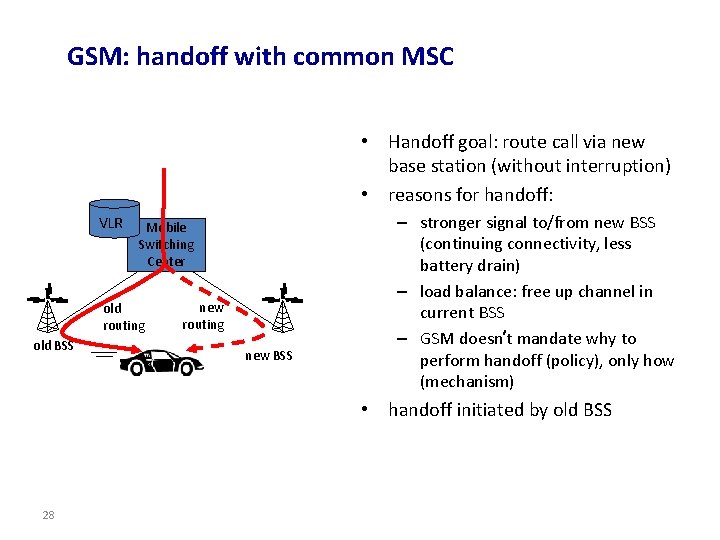
GSM: handoff with common MSC • Handoff goal: route call via new base station (without interruption) • reasons for handoff: VLR Mobile Switching Center old routing old BSS new routing new BSS – stronger signal to/from new BSS (continuing connectivity, less battery drain) – load balance: free up channel in current BSS – GSM doesn’t mandate why to perform handoff (policy), only how (mechanism) • handoff initiated by old BSS 28
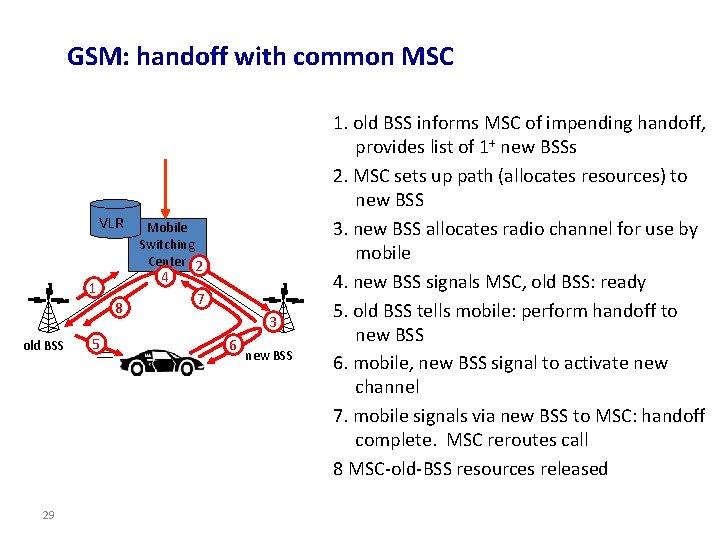
GSM: handoff with common MSC VLR 4 1 8 old BSS 29 5 Mobile Switching Center 2 7 3 6 new BSS 1. old BSS informs MSC of impending handoff, provides list of 1+ new BSSs 2. MSC sets up path (allocates resources) to new BSS 3. new BSS allocates radio channel for use by mobile 4. new BSS signals MSC, old BSS: ready 5. old BSS tells mobile: perform handoff to new BSS 6. mobile, new BSS signal to activate new channel 7. mobile signals via new BSS to MSC: handoff complete. MSC reroutes call 8 MSC-old-BSS resources released
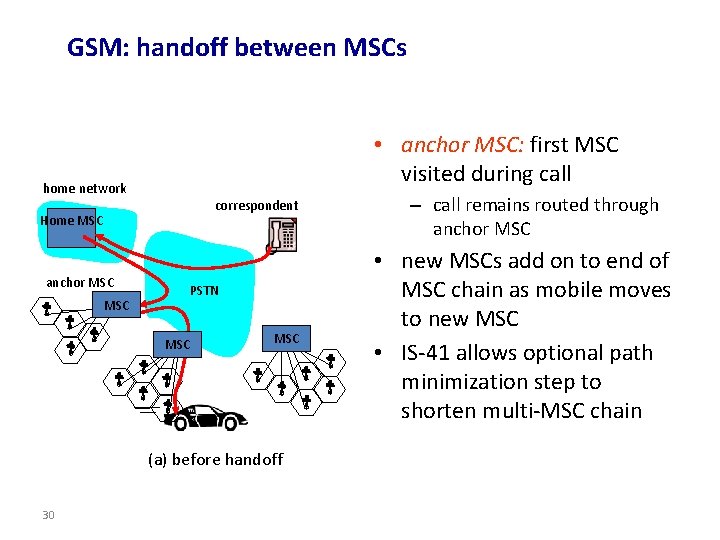
GSM: handoff between MSCs • anchor MSC: first MSC visited during call home network correspondent Home MSC anchor MSC PSTN MSC (a) before handoff 30 – call remains routed through anchor MSC • new MSCs add on to end of MSC chain as mobile moves to new MSC • IS-41 allows optional path minimization step to shorten multi-MSC chain
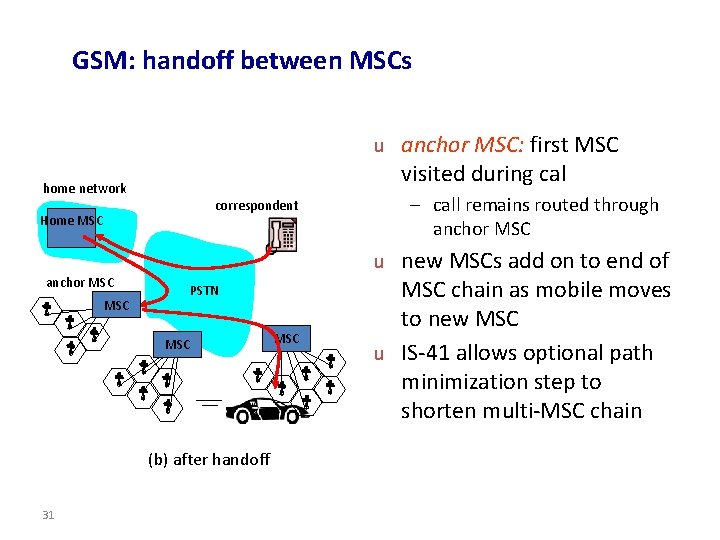
GSM: handoff between MSCs u home network – call remains routed through anchor MSC correspondent Home MSC u anchor MSC PSTN MSC (b) after handoff 31 MSC anchor MSC: first MSC visited during cal u new MSCs add on to end of MSC chain as mobile moves to new MSC IS-41 allows optional path minimization step to shorten multi-MSC chain
General Packet Radio Service (GPRS) • General Packet Radio Service – Supports data service. – GSM with GPRS is often called 2. 5 G, because it is providing a moderate level of data service – Supports IP, PPP (Point to point protocol). The mobile device can be used as a modem. – Different coding scheme can be used, CS-1 to CS 4, with different over head. Per time slot, the data rate is 8, 12, 14. 4, 20. 2 kbps.
GRPS • Multiple Access – Users are assigned frequency channels and time slots. – Packets are constant length, determined by the GSM slot. – Downlink: first come first served – Uplink: Slotted ALOHA for reserving, dynamic TDMA for data transmission
GSM SIM
GSM Security
Reading • http: //www. eventhelix. com/realtimemantra/Telecom/GSM_Originating_Call_Flow. pdf
- Slides: 36