
NSF Update Kevin Thompson NSF CISEANIR October 14
NSF Update Kevin Thompson NSF CISE/ANIR October 14, 2003
Outline • A few (more) words on Cyberinfrastructure • A few words on CISE/ANIR • Overview of ANIR Programs • New awards across 4 ANIR programs and ACIR’s ETF • CISE reorganization 2
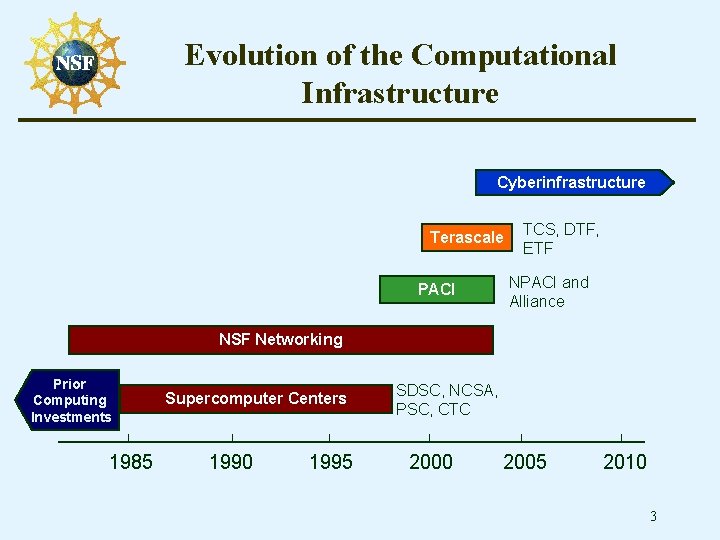
Evolution of the Computational Infrastructure Cyberinfrastructure TCS, DTF, ETF Terascale PACI NPACI and Alliance NSF Networking Prior Computing Investments Supercomputer Centers | 1985 SDSC, NCSA, PSC, CTC | | | 1990 1995 2000 | 2005 | 2010 3
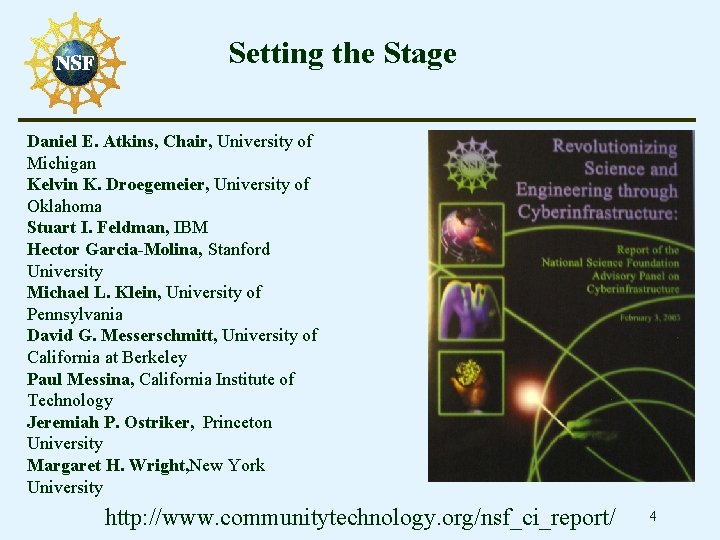
Setting the Stage Daniel E. Atkins, Chair, University of Michigan Kelvin K. Droegemeier, University of Oklahoma Stuart I. Feldman, IBM Hector Garcia-Molina, Stanford University Michael L. Klein, University of Pennsylvania David G. Messerschmitt, University of California at Berkeley Paul Messina, California Institute of Technology Jeremiah P. Ostriker, Princeton University Margaret H. Wright, New York University http: //www. communitytechnology. org/nsf_ci_report/ 4
Cyberinfrastructure Promise • Ubiquitous, digital knowledge environments that are both interactive and functionally complete………… (Atkins report) • revolutionize the processes of discovery, learning and innovation across the science and engineering frontier. 5
Cyberinfrastructure Characteristics • Community-Focused – virtual organizations – distributed, – collaborative • Scale and Scope – – – Multidisciplinary International Supporting data- and compute-intensive applications High-end to desktop Heterogenuous • Common Technology & Policy Platform(s) – Interoperability – Supports characteristics above 6
Cyberinfrastructure Early Adopters • Network for Earthquake Engineering Simulation (NEES) • National Ecological Observatory Network (NEON) • Biomedical Informatics Research Network (BIRN) • Extensible Terascale Facility (ETF) 7
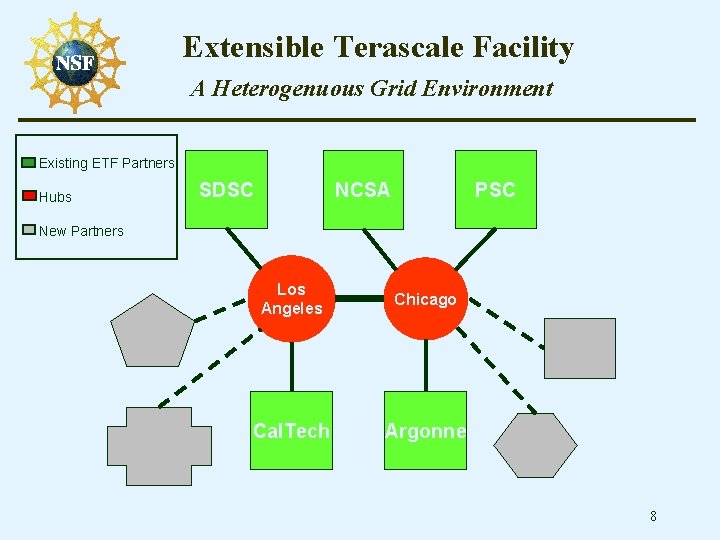
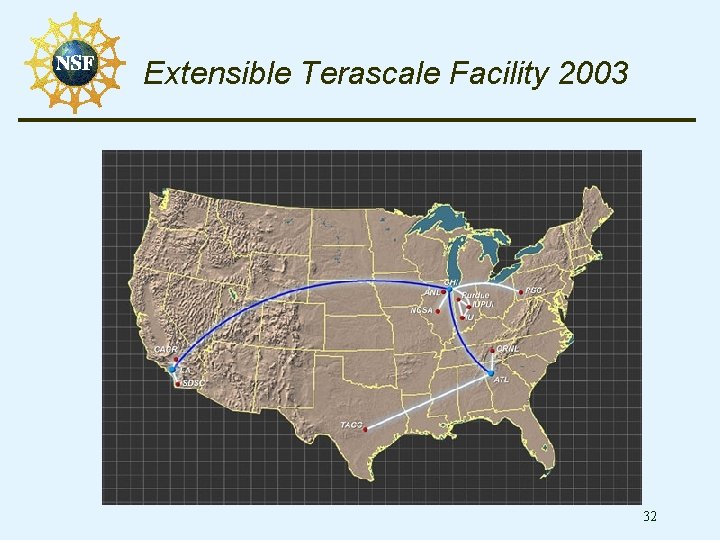
Extensible Terascale Facility A Heterogenuous Grid Environment Existing ETF Partners Hubs SDSC PSC NCSA New Partners Los Angeles Chicago Cal. Tech Argonne 8
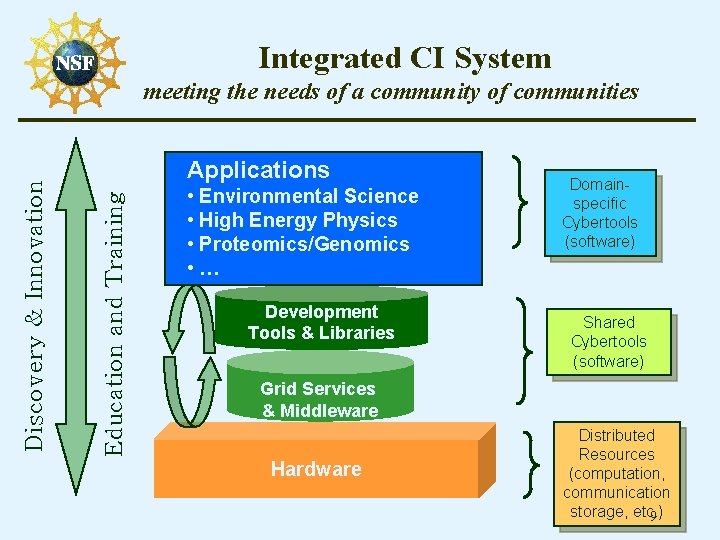
Integrated CI System Applications Education and Training Discovery & Innovation meeting the needs of a community of communities • Environmental Science • High Energy Physics • Proteomics/Genomics • … Development Tools & Libraries Domainspecific Cybertools (software) Shared Cybertools (software) Grid Services & Middleware Hardware Distributed Resources (computation, communication storage, etc. ) 9
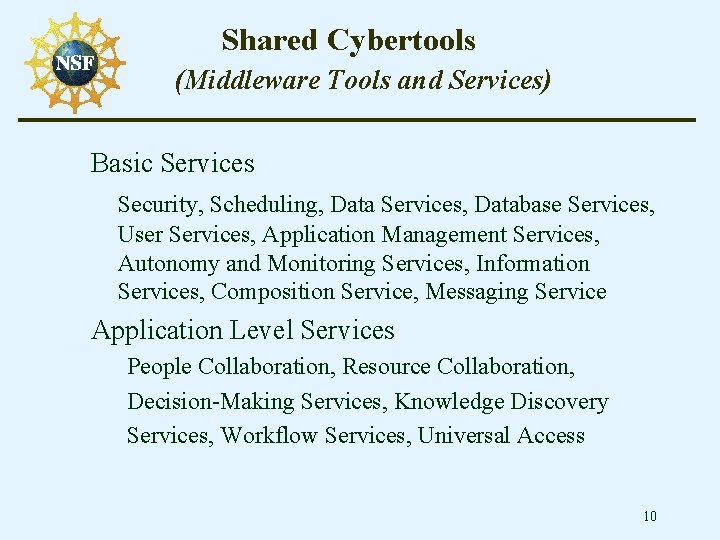
Shared Cybertools (Middleware Tools and Services) Basic Services Security, Scheduling, Data Services, Database Services, User Services, Application Management Services, Autonomy and Monitoring Services, Information Services, Composition Service, Messaging Service Application Level Services People Collaboration, Resource Collaboration, Decision-Making Services, Knowledge Discovery Services, Workflow Services, Universal Access 10
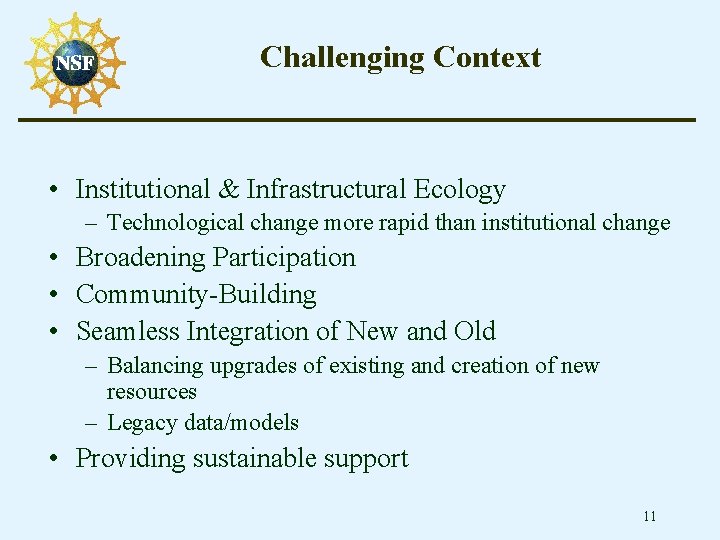
Challenging Context • Institutional & Infrastructural Ecology – Technological change more rapid than institutional change • Broadening Participation • Community-Building • Seamless Integration of New and Old – Balancing upgrades of existing and creation of new resources – Legacy data/models • Providing sustainable support 11
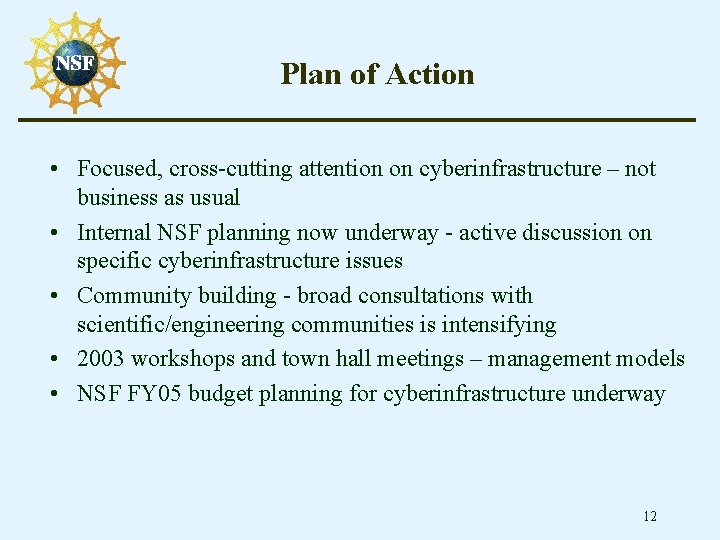
Plan of Action • Focused, cross-cutting attention on cyberinfrastructure – not business as usual • Internal NSF planning now underway - active discussion on specific cyberinfrastructure issues • Community building - broad consultations with scientific/engineering communities is intensifying • 2003 workshops and town hall meetings – management models • NSF FY 05 budget planning for cyberinfrastructure underway 12
CISE/ANIR • CISE - Computer and Information Science and Engineering Directorate • 3 Goals – to enable the U. S. to uphold a position of world leadership in computing, communications, and information science and engineering – To promote understanding of the principles and uses of advanced computing, communications and information systems in service to society – To contribute to universal, transparent and affordable participation in an information-based society. 13
CISE/ANIR • 5 Divisions – Advanced Computational Infrastructure & Research (ACIR) – Advanced Networking Infrastructure & Research (ANIR) – Computer-Communications Research (CCR) – Experimental & Integrative Activities (EIA) – Information & Intelligent Systems (IIS) 14
CISE/ANIR • ANIR - The programs focus on the fundamental science and technology needed to facilitate the efficient, high-speed transfer of information through networks and distributed systems. Projects funded span the entire spectrum, from network design and performance evaluation to middleware and software frameworks in support of applications running on top of networks and distributed systems. 15
ANIR Programs in 2003 • Network Research (NR) Program • Special Projects (SP) Program • High Performance Network Connections for Science and Engineering Research (HPNC) • Network Research Testbeds (NRT) • Experimental Infrastructure Networks (EIN) • NSF Middleware Initiative (NMI) • Strategic Technologies for the Internet (STI) • Other Cross Directorate – ITR (Information Technology Research) – REU (Research Experiences for Undergraduates) – Career 16
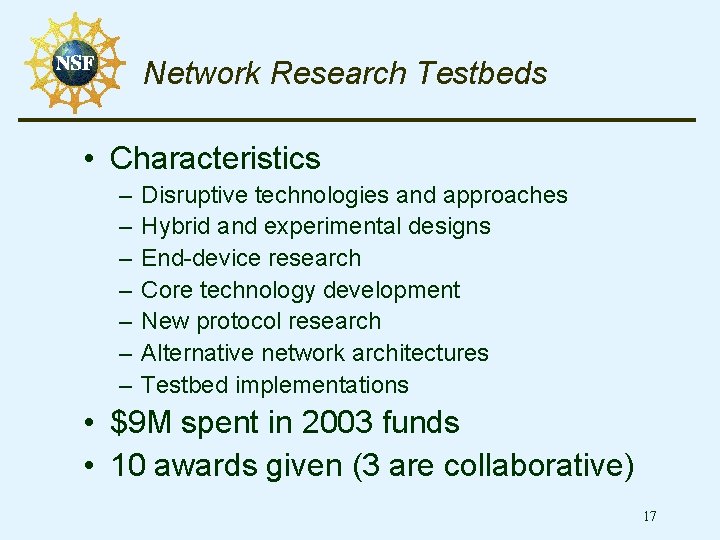
Network Research Testbeds • Characteristics – – – – Disruptive technologies and approaches Hybrid and experimental designs End-device research Core technology development New protocol research Alternative network architectures Testbed implementations • $9 M spent in 2003 funds • 10 awards given (3 are collaborative) 17
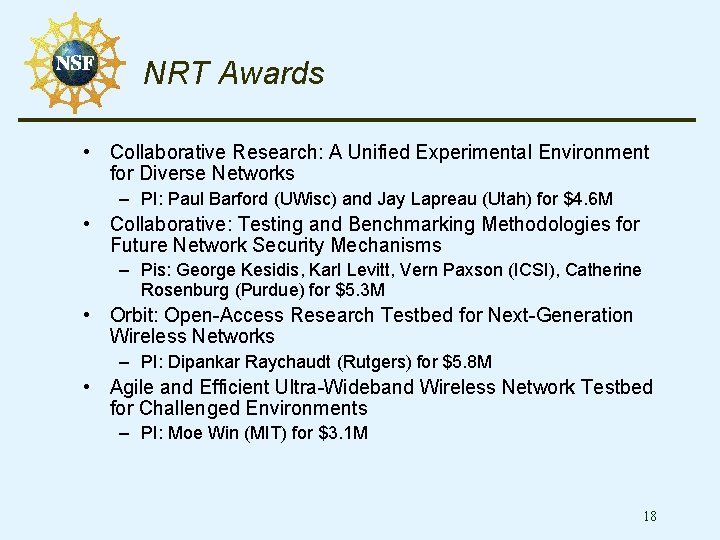
NRT Awards • Collaborative Research: A Unified Experimental Environment for Diverse Networks – PI: Paul Barford (UWisc) and Jay Lapreau (Utah) for $4. 6 M • Collaborative: Testing and Benchmarking Methodologies for Future Network Security Mechanisms – Pis: George Kesidis, Karl Levitt, Vern Paxson (ICSI), Catherine Rosenburg (Purdue) for $5. 3 M • Orbit: Open-Access Research Testbed for Next-Generation Wireless Networks – PI: Dipankar Raychaudt (Rutgers) for $5. 8 M • Agile and Efficient Ultra-Wideband Wireless Network Testbed for Challenged Environments – PI: Moe Win (MIT) for $3. 1 M 18
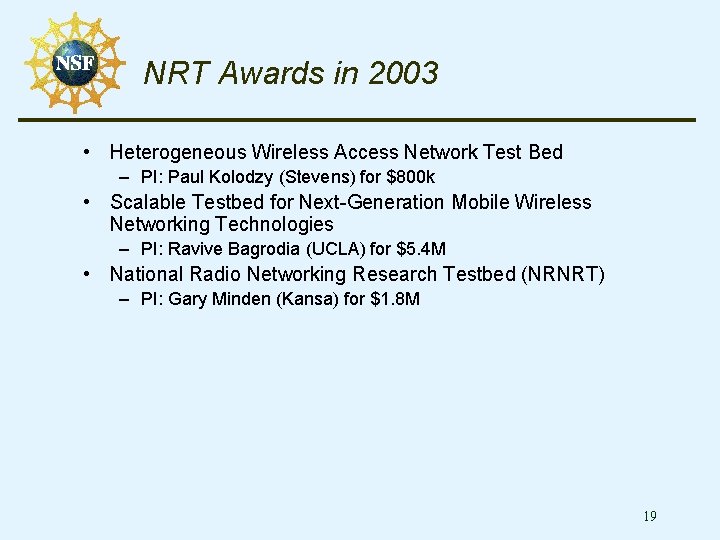
NRT Awards in 2003 • Heterogeneous Wireless Access Network Test Bed – PI: Paul Kolodzy (Stevens) for $800 k • Scalable Testbed for Next-Generation Mobile Wireless Networking Technologies – PI: Ravive Bagrodia (UCLA) for $5. 4 M • National Radio Networking Research Testbed (NRNRT) – PI: Gary Minden (Kansa) for $1. 8 M 19
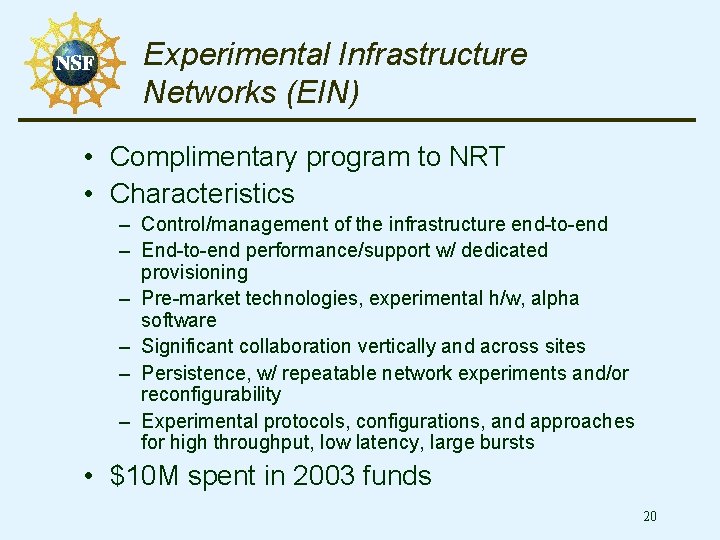
Experimental Infrastructure Networks (EIN) • Complimentary program to NRT • Characteristics – Control/management of the infrastructure end-to-end – End-to-end performance/support w/ dedicated provisioning – Pre-market technologies, experimental h/w, alpha software – Significant collaboration vertically and across sites – Persistence, w/ repeatable network experiments and/or reconfigurability – Experimental protocols, configurations, and approaches for high throughput, low latency, large bursts • $10 M spent in 2003 funds 20
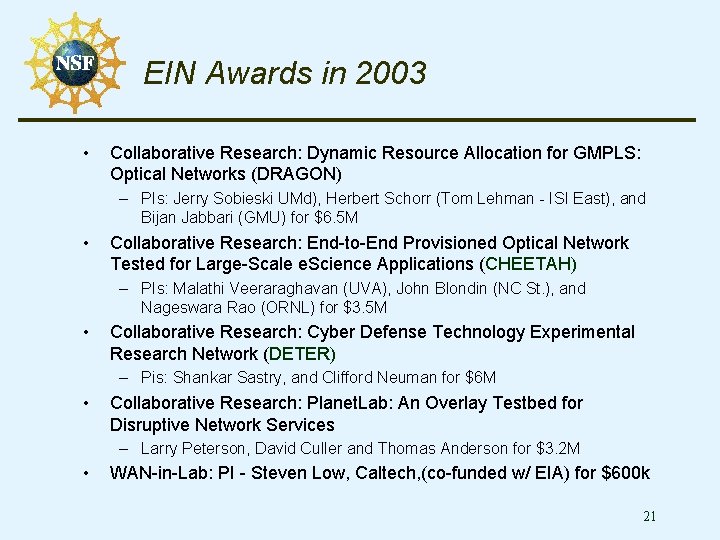
EIN Awards in 2003 • Collaborative Research: Dynamic Resource Allocation for GMPLS: Optical Networks (DRAGON) – PIs: Jerry Sobieski UMd), Herbert Schorr (Tom Lehman - ISI East), and Bijan Jabbari (GMU) for $6. 5 M • Collaborative Research: End-to-End Provisioned Optical Network Tested for Large-Scale e. Science Applications (CHEETAH) – PIs: Malathi Veeraraghavan (UVA), John Blondin (NC St. ), and Nageswara Rao (ORNL) for $3. 5 M • Collaborative Research: Cyber Defense Technology Experimental Research Network (DETER) – Pis: Shankar Sastry, and Clifford Neuman for $6 M • Collaborative Research: Planet. Lab: An Overlay Testbed for Disruptive Network Services – Larry Peterson, David Culler and Thomas Anderson for $3. 2 M • WAN-in-Lab: PI - Steven Low, Caltech, (co-funded w/ EIA) for $600 k 21
NSF Middleware Initiative • Purpose - To design, develop, deploy and support a set of reusable, expandable set of middleware functions and services that benefit applications in a networked environment • Program created by Alan Blatecky • 2003 marks the 3 rd set of awards 22
2003 NSF Middleware Initiative Program Awards • 20 awards totaling $9 M – 10 “System Integrator” awards • Focus – to further develop the integration and support infrastructure of middleware for the longer term • Themes - extending and deepening current activities, and expanding into new areas – 10 smaller awards focused on near-term capabilities and tool development • Focus – to encourage the development of additional new middleware components and capabilities for the NMI program 23
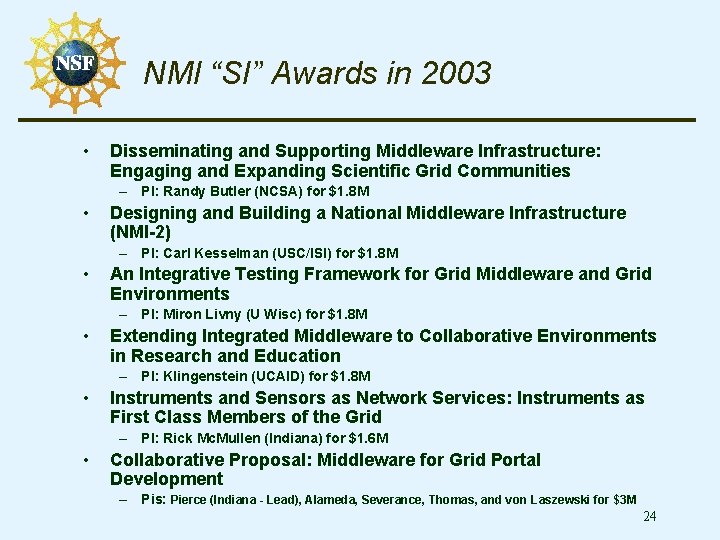
NMI “SI” Awards in 2003 • Disseminating and Supporting Middleware Infrastructure: Engaging and Expanding Scientific Grid Communities – PI: Randy Butler (NCSA) for $1. 8 M • Designing and Building a National Middleware Infrastructure (NMI-2) – PI: Carl Kesselman (USC/ISI) for $1. 8 M • An Integrative Testing Framework for Grid Middleware and Grid Environments – PI: Miron Livny (U Wisc) for $1. 8 M • Extending Integrated Middleware to Collaborative Environments in Research and Education – PI: Klingenstein (UCAID) for $1. 8 M • Instruments and Sensors as Network Services: Instruments as First Class Members of the Grid – PI: Rick Mc. Mullen (Indiana) for $1. 6 M • Collaborative Proposal: Middleware for Grid Portal Development – Pis: Pierce (Indiana - Lead), Alameda, Severance, Thomas, and von Laszewski for $3 M 24
NMI - Looking Ahead • There will be an NMI solicitation in 2004 • Exact funding level not set • NMI program is expected to be a primary focus area under CISE’s new division - Shared Cyberinfrastructure • October 23 Review at NSF for existing activities among the Grids Center and EDIT teams 25
Strategic Technologies for the Internet (STI) • Theme areas in 2003 – complex network monitoring, problem detection and resolution mechanisms – development of automated and advanced network tools – networked applications tools or network-based middleware – creation of usable and widely deployable networking applications that promote collaborative research and information sharing. – innovative access network technologies • $5. 2 M in FY 2003 funds • 14 awards 26
STI Awards in 2003 • A Security Architecture for IP Telephony • PI: Dipak Ghosal (UC Davis) for $160 k • Network Startup Resource Center (NSRC) • PI: Joanne Hugi (Oregon) for $385 k • Plethora: A Wide-Area Read-Write Object Repository for the Internet • PI: Suresh Jagganath (Purdue) for $550 k • Marist Grid Collaboration in Support of Advanced Internet and Research Applications • PI: Kamran Khan (Marist) for $500 k • Implementation of a Handle/DNS Server • PI: Robert Khan (CNRI) for $500 k 27
STI Awards in 2003 • Effective Diagnostic Strategies for Wide Area Networks • PI: Matt Mathis (CMU) for $900 k • Development of an Infrastructure for Real-Time Super Media over the Internet • PI: Mathew Mutka (Michigan St. ) for $750 k • Viable Network Defense for Scientific Research Institutions • PI: Vern Paxson (ICSI) for $900 k • The Strategic Technology Astronomy Research Team (START) Collaboratory: Broadening Participation in Authentic Astronomy Research • PI: Morteza Rahimi (NWU) for $600 k • Network Measurement, Monitoring and Analysis in Cluster Computing • PI: Tony Rimovsky (UIUC) for $800 k 28
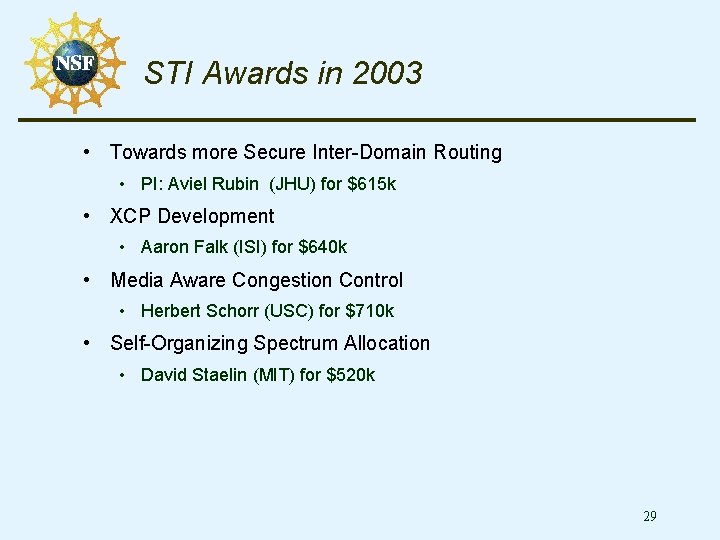
STI Awards in 2003 • Towards more Secure Inter-Domain Routing • PI: Aviel Rubin (JHU) for $615 k • XCP Development • Aaron Falk (ISI) for $640 k • Media Aware Congestion Control • Herbert Schorr (USC) for $710 k • Self-Organizing Spectrum Allocation • David Staelin (MIT) for $520 k 29
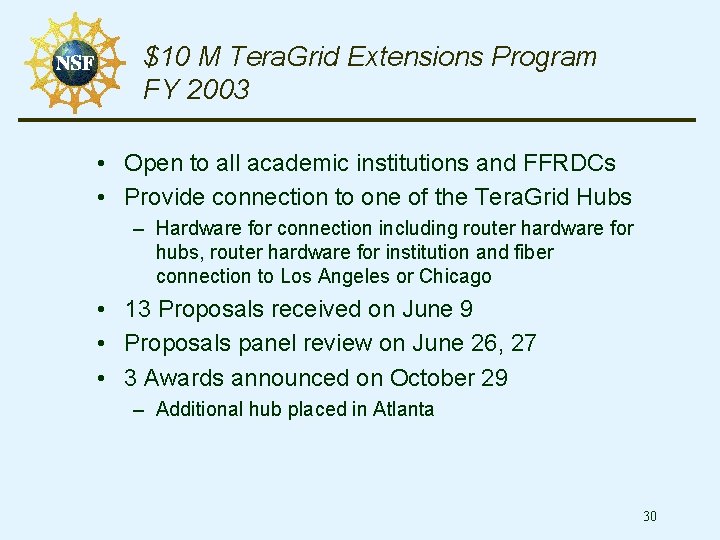
$10 M Tera. Grid Extensions Program FY 2003 • Open to all academic institutions and FFRDCs • Provide connection to one of the Tera. Grid Hubs – Hardware for connection including router hardware for hubs, router hardware for institution and fiber connection to Los Angeles or Chicago • 13 Proposals received on June 9 • Proposals panel review on June 26, 27 • 3 Awards announced on October 29 – Additional hub placed in Atlanta 30
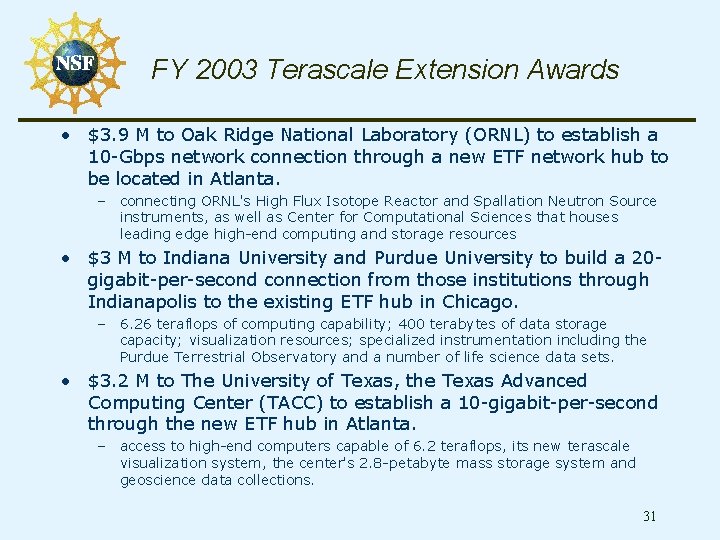
FY 2003 Terascale Extension Awards • $3. 9 M to Oak Ridge National Laboratory (ORNL) to establish a 10 -Gbps network connection through a new ETF network hub to be located in Atlanta. – connecting ORNL's High Flux Isotope Reactor and Spallation Neutron Source instruments, as well as Center for Computational Sciences that houses leading edge high-end computing and storage resources • $3 M to Indiana University and Purdue University to build a 20 gigabit-per-second connection from those institutions through Indianapolis to the existing ETF hub in Chicago. – 6. 26 teraflops of computing capability; 400 terabytes of data storage capacity; visualization resources; specialized instrumentation including the Purdue Terrestrial Observatory and a number of life science data sets. • $3. 2 M to The University of Texas, the Texas Advanced Computing Center (TACC) to establish a 10 -gigabit-per-second through the new ETF hub in Atlanta. – access to high-end computers capable of 6. 2 teraflops, its new terascale visualization system, the center's 2. 8 -petabyte mass storage system and geoscience data collections. 31
Extensible Terascale Facility 2003 32
Finally, a words on the CISE Reorganization • Drivers - CISE’s growing importance • Enormous impact of IT on all areas of NSF • National leader in computer, information science and engineering • Critical to success of cybertrust, cyberscience, national and homeland defense, and continued economic growth • Conceptual Drivers • Atkins report: “CISE must be deeply involved as a technology user and as a technology leader for the overall [CI] program”. • CISE Advisory Committee: “CISE organization structure should promote intellectual integrity and cohesiveness, should be flexible and fundamental enough to last 10 years”. 33
Reorg Objectives • Capitalize on emerging scientific opportunities • Build on CISE’s and NSF’s organizational successes • Ensure integration of education with research in all CISE activities • Sharpen programmatic focus and enhance budget flexibility • Enhance intellectual coherence in CISE cross-cutting, thematic areas • Increase research and education opportunities that will broaden participation in CISE activities 34
Additional Objectives • • Decrease the number of CISE programs thereby combating the tendency to reductionism in programmatic activity while promoting more integration Encourage the growth of cohesive scientific communities in important or emerging sub-disciplines Provide for more flexibility in defining and redefining cross-cutting priorities and emerging priorities of national and/or societal interest Empower CISE staff with the organizational, budget, and management support necessary to remain focused on key programmatic activities and goals Improve effectiveness and efficiency of CISE business practices by reducing program overlap and enhancing program synergy Position the Directorate for continued, strong budgetary growth and programmatic evolution. 35
Proposed Divisions and Areas of Responsibility • Division of Computing & Communication Foundations (CCF) – Formal and mathematical foundations – Foundations of computing processes and artifacts – Emerging models for technology and computation • Division of Computer and Network Systems (CNS) – Computer systems – Networks – Computing research infrastructure • Division of Information and Intelligent Systems (IIS) – Systems in context – Understanding, inference, & data – Data-driven science • Division of Shared Cyberinfrastructure (SCI) – Infrastructure planning, constructing, commissioning, & operations • Timeline - sometime between now and end-of-year 36
For more info on NSF awards Fastlane. nsf. gov 37

38
- Slides: 38