Choking HCA Education Continuing Care Alena Thompson RN


- Slides: 21
Choking: HCA Education Continuing Care Alena Thompson, RN, BSc. N Reviewed by Professional Practice Dept. Adaptations by Berni Baer RN GNC(c), Education Coordinator – St. Joseph’s Auxiliary Hospital Aug 9, 2016
Who do we help? WE HELP ANY ONE WHO IS CHOKING i. e. Resident Client Patient Visitor Co-worker
Signs of poor air exchange and difficulty breathing Mild Airway Obstruction – signs: § Good air exchange § Can cough forcefully § May wheeze between coughs
How can you help the Resident who has mild airway obstruction? Rescuer Actions: • Encourage the victim to continue spontaneous coughing and breathing efforts • Do not interfere with the residents efforts to cough up what they are choking on (ie. Do not slap them on the back, give a drink of water, etc. ) • Stay with the resident and monitor their condition. • If mild airway obstruction persists, call CODE BLUE.
Signs of poor air exchange and difficulty breathing Severe Airway Obstruction – signs: • Poor or no air exchange • High pitched noise while inhaling or no noise at all • Increased difficulty breathing • Weak ineffective cough or ‘silent’ cough • mouth opening and closing repeatedly as if they are trying to speak but no sound. Think “guppy”
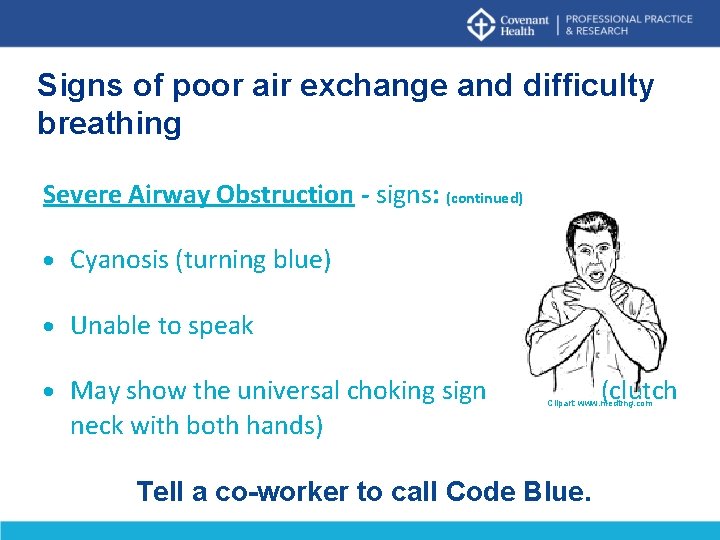
Signs of poor air exchange and difficulty breathing Severe Airway Obstruction - signs: (continued) Cyanosis (turning blue) Unable to speak May show the universal choking sign (clutch neck with both hands) Clipart: www. medtrng. com Tell a co-worker to call Code Blue.
Does the resident with Severe Airway Obstruction need your help? Rescuer Actions: Ask the resident if she/he is choking: If yes, begin abdominal thrusts. If no, stay close and allow them to try to get it out themselves. § If they are showing signs of severe airway obstruction but are unable to confirm or deny that they are choking, begin abdominal thrusts
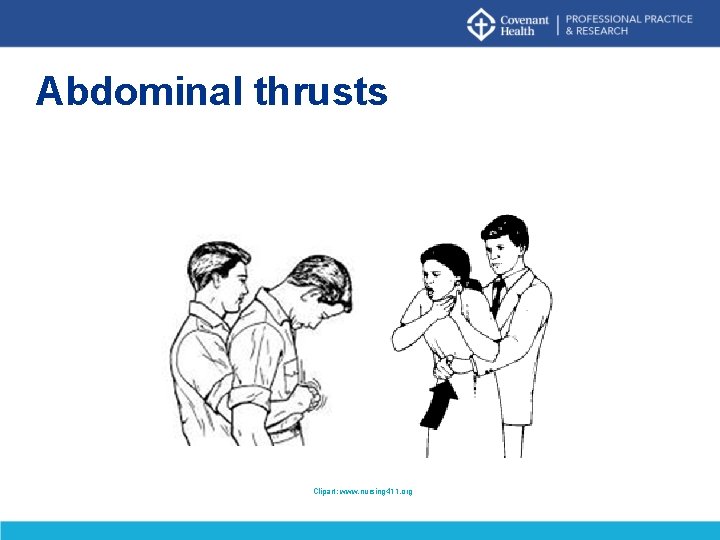
How to do abdominal thrusts Stand or kneel behind the resident Wrap your arms around their waist Locate their navel (belly button) Make a fist with one hand place it thumb side inward between the navel and breastbone Grasp fist with other hand press into abdomen with QUICK, FORCEFUL, UPWARD thrusts Demonstration of Abdominal Thrust: https: //www. youtube. com/watch? v=DE 45 ks 9 mi. Iw
Abdominal thrusts Clipart: www. nursing 411. org
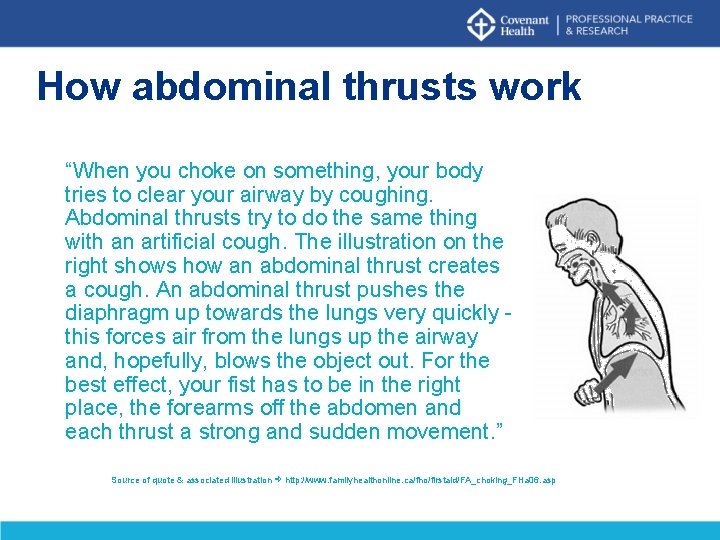
How abdominal thrusts work “When you choke on something, your body tries to clear your airway by coughing. Abdominal thrusts try to do the same thing with an artificial cough. The illustration on the right shows how an abdominal thrust creates a cough. An abdominal thrust pushes the diaphragm up towards the lungs very quickly - this forces air from the lungs up the airway and, hopefully, blows the object out. For the best effect, your fist has to be in the right place, the forearms off the abdomen and each thrust a strong and sudden movement. ” Source of quote & associated illustration http: //www. familyhealthonline. ca/fho/firstaid/FA_choking_FHa 06. asp
Abdominal thrusts for person in a wheelchair Push the wheelchair to a wall, lock the brakes, kneel in front of the victim and give abdominal thrusts from the front by pushing inward between the navel and breastbone. Note: Abdominal thrusts are not as effective for a person in a seated position. Chest Thrusts are the preferred method.
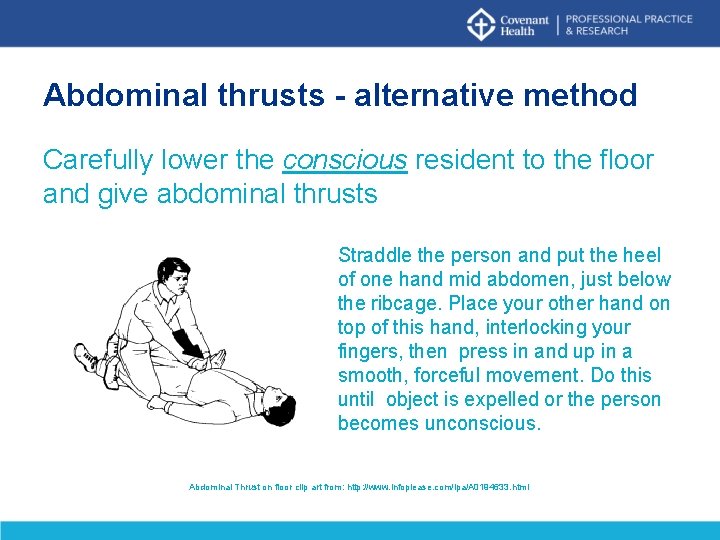
Abdominal thrusts - alternative method Carefully lower the conscious resident to the floor and give abdominal thrusts Straddle the person and put the heel of one hand mid abdomen, just below the ribcage. Place your other hand on top of this hand, interlocking your fingers, then press in and up in a smooth, forceful movement. Do this until object is expelled or the person becomes unconscious. Abdominal Thrust on floor clip art from: http: //www. infoplease. com/ipa/A 0194633. html
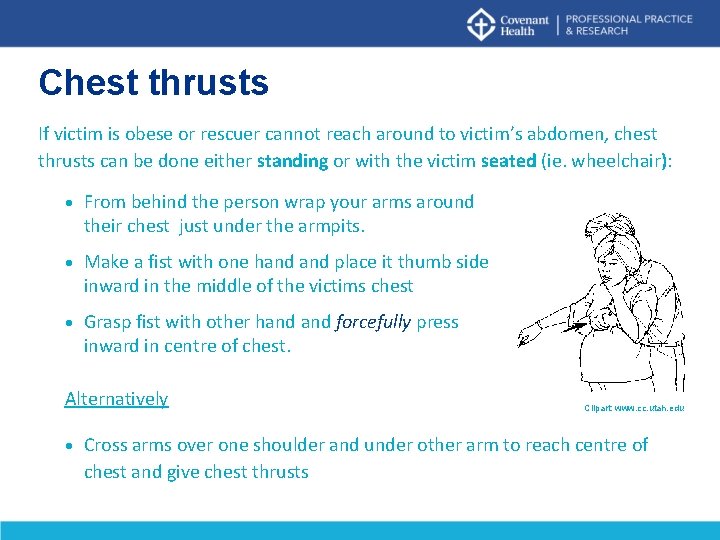
Chest thrusts If victim is obese or rescuer cannot reach around to victim’s abdomen, chest thrusts can be done either standing or with the victim seated (ie. wheelchair): From behind the person wrap your arms around their chest just under the armpits. Make a fist with one hand place it thumb side inward in the middle of the victims chest Grasp fist with other hand forcefully press inward in centre of chest. Alternatively Clipart: www. cc. utah. edu Cross arms over one shoulder and under other arm to reach centre of chest and give chest thrusts
Chest thrusts for person in a wheelchair Push the wheelchair against the wall, lock the brakes and kneel in front of the victim. Place the heel of one hand on the breast bone, at the nipple line, place the other hand on top of it and interlock the fingers. Forcefully press straight back.
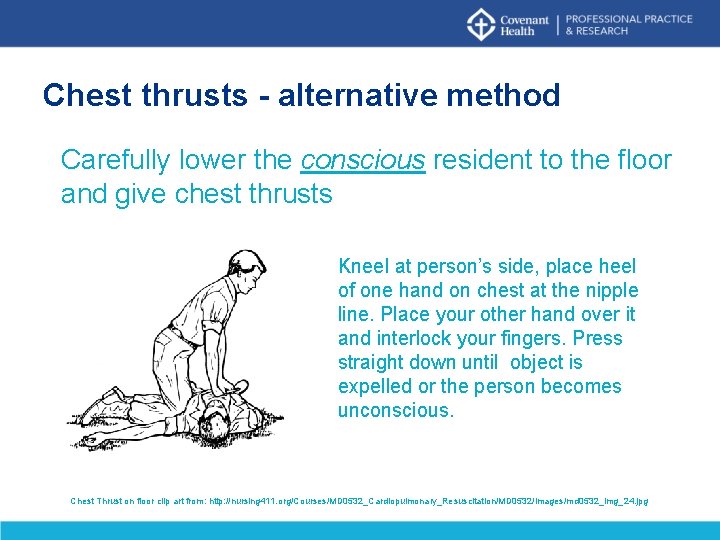
Chest thrusts - alternative method Carefully lower the conscious resident to the floor and give chest thrusts Kneel at person’s side, place heel of one hand on chest at the nipple line. Place your other hand over it and interlock your fingers. Press straight down until object is expelled or the person becomes unconscious. Chest Thrust on floor clip art from: http: //nursing 411. org/Courses/MD 0532_Cardiopulmonary_Resuscitation/MD 0532/images/md 0532_img_24. jpg
When to stop: Continue abdominal/chest thrusts until: Object is expelled (comes out) Resident collapses/becomes unresponsive
If resident collapses and becomes unresponsive Carefully get them to the floor (if not already there) Make sure a co-worker has called Code Blue & 911 Start CPR (if you’ve had the training)
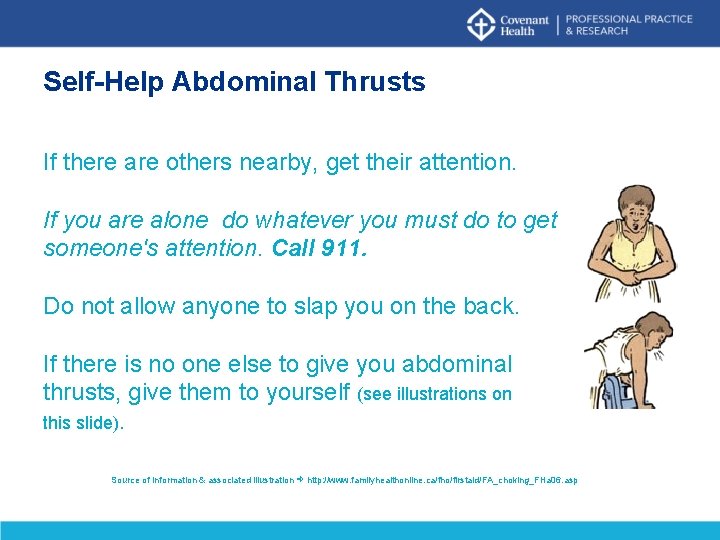
Self-Help Abdominal Thrusts If there are others nearby, get their attention. If you are alone do whatever you must do to get someone's attention. Call 911. Do not allow anyone to slap you on the back. If there is no one else to give you abdominal thrusts, give them to yourself (see illustrations on this slide). Source of information & associated illustration http: //www. familyhealthonline. ca/fho/firstaid/FA_choking_FHa 06. asp
Important note Seek medical attention after abdominal/chest thrusts are performed. There could be injuries from this maneuver i. e. bruised/broken ribs; punctured liver; etc.
References • American Heart Association (2011). BLS for Healthcare Providers Student Manual. First Heart and Stroke Foundation of Canada Printing May 2011. • Covenant Health Policy VII-C-30: Choking Prevention and Management • http: //www. familyhealthonline. ca/fho/firstaid/FA_choki ng_FHa 06. asp
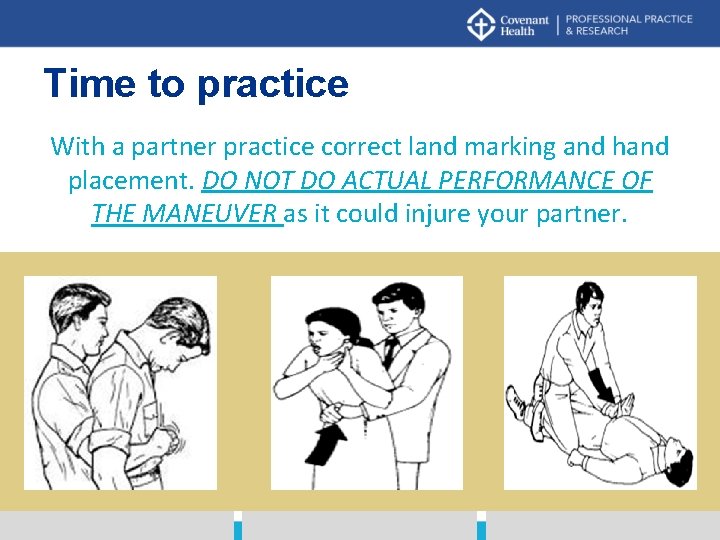
Time to practice With a partner practice correct land marking and hand placement. DO NOT DO ACTUAL PERFORMANCE OF THE MANEUVER as it could injure your partner.