Readytouse social skills resources to use effectively in


- Slides: 140
Ready-to-use social skills resources to use effectively in telehealth services for children with high functioning ASD Part 1 Joel Shaul, LCSW All original materials Copyright 2020 Joel Shaul. Recording of this presentation is not permitted.
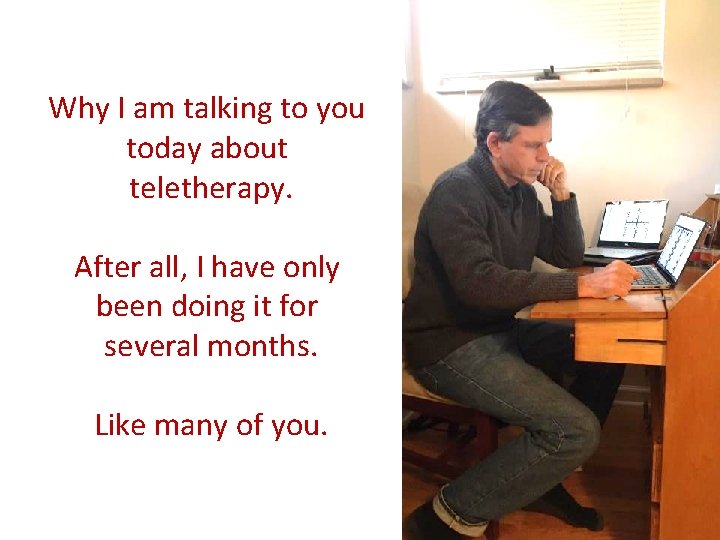
Why I am talking to you today about teletherapy. After all, I have only been doing it for several months. Like many of you.
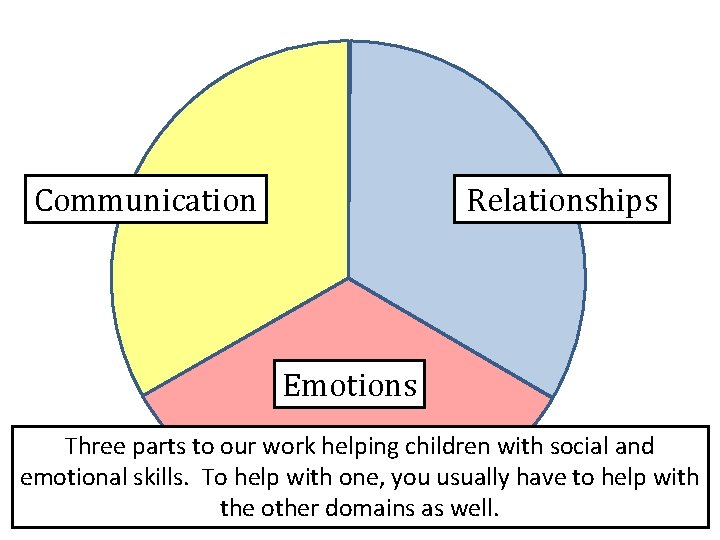
Communication Relationships Emotions Three parts to our work helping children with social and emotional skills. To help with one, you usually have to help with the other domains as well.
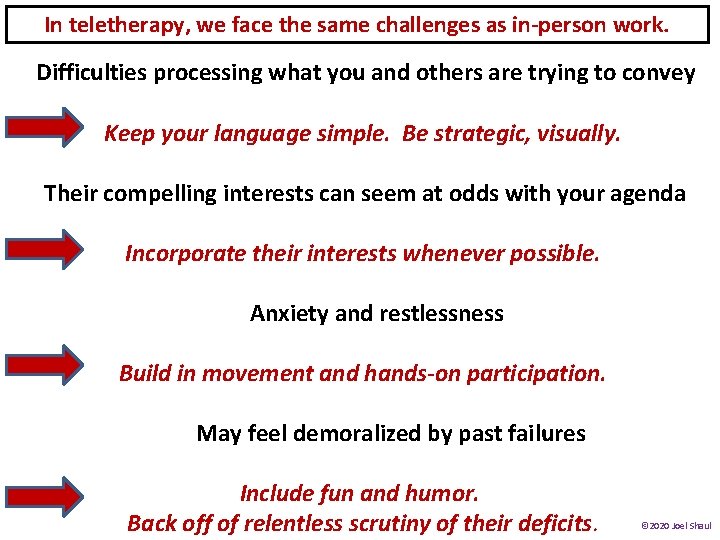
In teletherapy, we face the same challenges as in-person work. Difficulties processing what you and others are trying to convey Keep your language simple. Be strategic, visually. Their compelling interests can seem at odds with your agenda Incorporate their interests whenever possible. Anxiety and restlessness Build in movement and hands-on participation. May feel demoralized by past failures Include fun and humor. Back off of relentless scrutiny of their deficits. © 2020 Joel Shaul
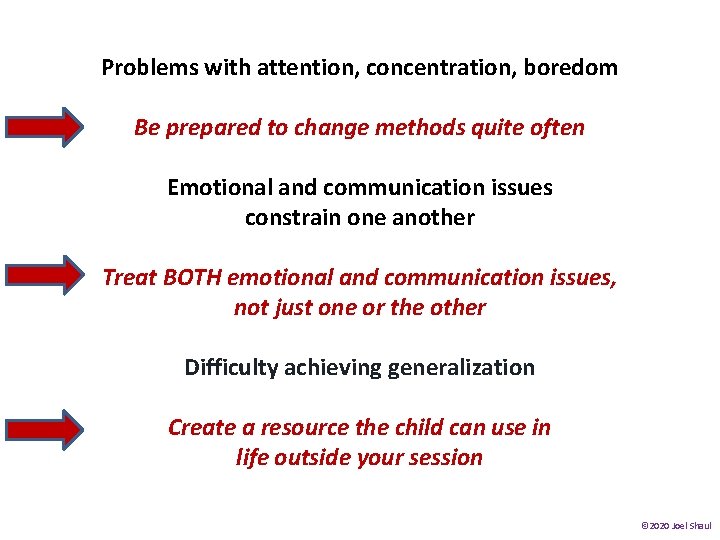
Problems with attention, concentration, boredom Be prepared to change methods quite often Emotional and communication issues constrain one another Treat BOTH emotional and communication issues, not just one or the other Difficulty achieving generalization Create a resource the child can use in life outside your session © 2020 Joel Shaul
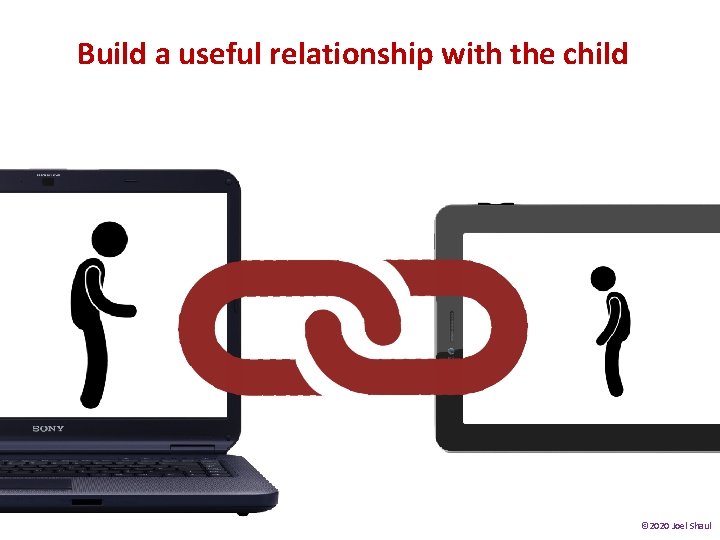
Build a useful relationship with the child © 2020 Joel Shaul
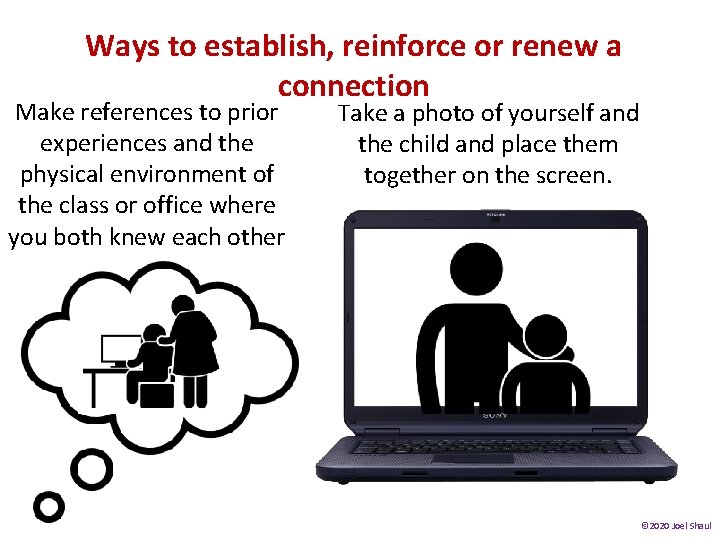
Ways to establish, reinforce or renew a connection Make references to prior experiences and the physical environment of the class or office where you both knew each other Take a photo of yourself and the child and place them together on the screen. © 2020 Joel Shaul
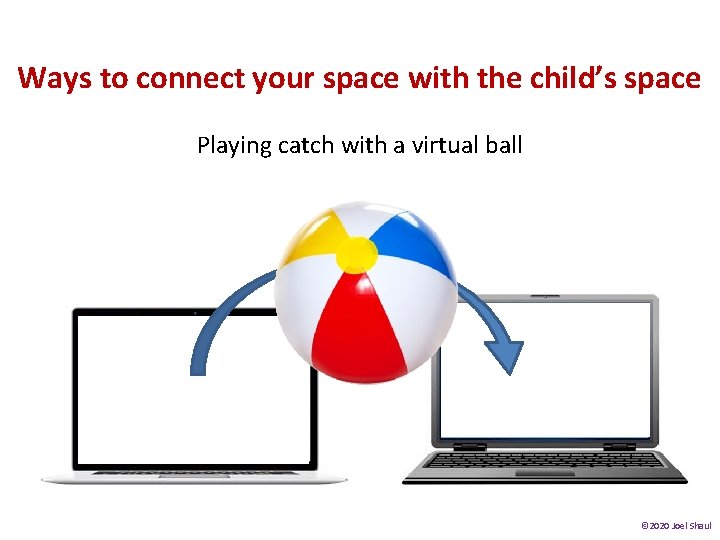
Ways to connect your space with the child’s space Playing catch with a virtual ball © 2020 Joel Shaul
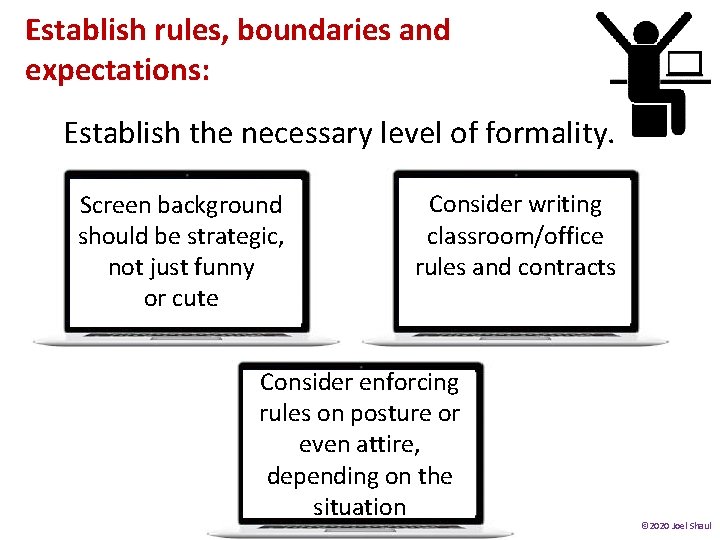
Establish rules, boundaries and expectations: Establish the necessary level of formality. Screen background should be strategic, not just funny or cute Consider writing classroom/office rules and contracts Consider enforcing rules on posture or even attire, depending on the situation © 2020 Joel Shaul
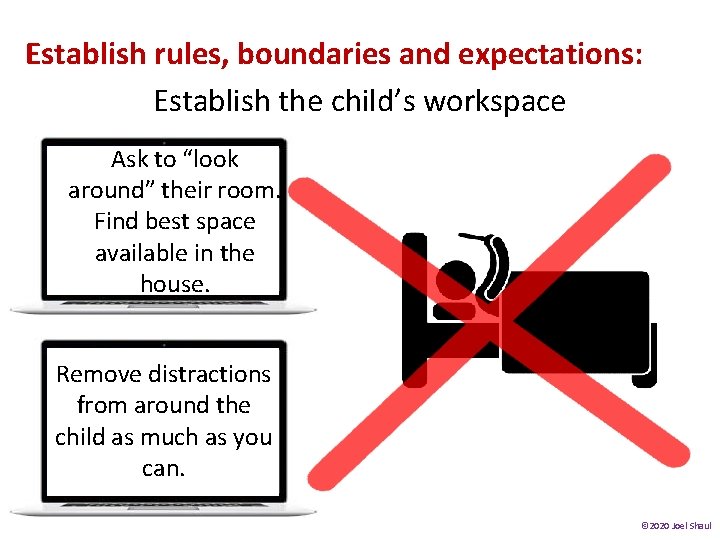
Establish rules, boundaries and expectations: Establish the child’s workspace Ask to “look around” their room. Find best space available in the house. Remove distractions from around the child as much as you can. © 2020 Joel Shaul
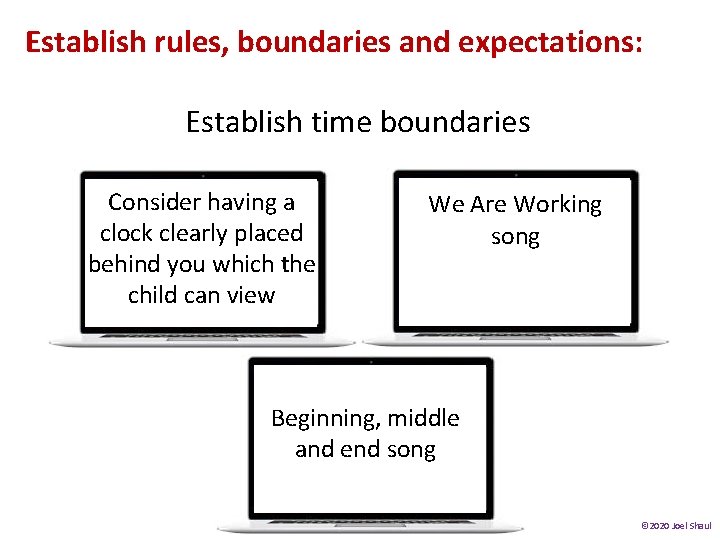
Establish rules, boundaries and expectations: Establish time boundaries Consider having a clock clearly placed behind you which the child can view We Are Working song Beginning, middle and end song © 2020 Joel Shaul
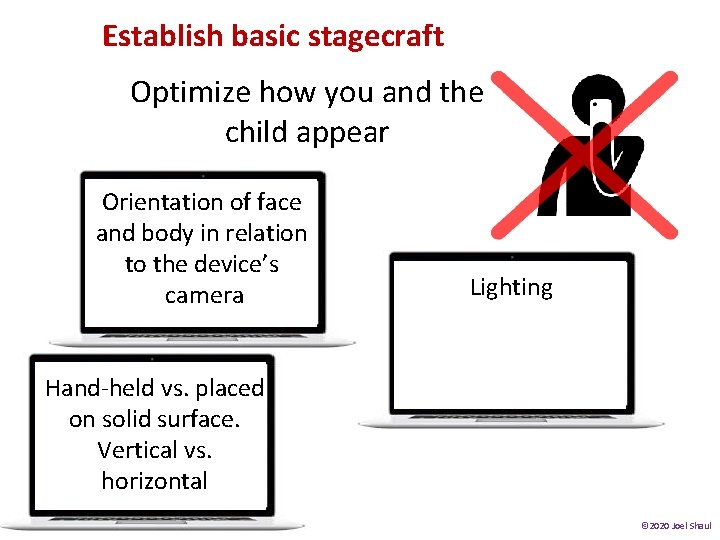
Establish basic stagecraft Optimize how you and the child appear Orientation of face and body in relation to the device’s camera Lighting Hand-held vs. placed on solid surface. Vertical vs. horizontal © 2020 Joel Shaul
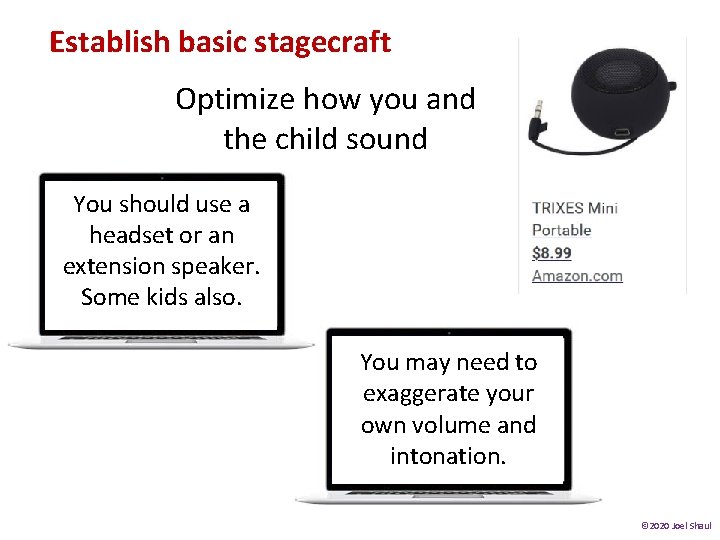
Establish basic stagecraft Optimize how you and the child sound You should use a headset or an extensionh speaker. Some kids also. You may need to exaggerate your own volume and intonation. © 2020 Joel Shaul
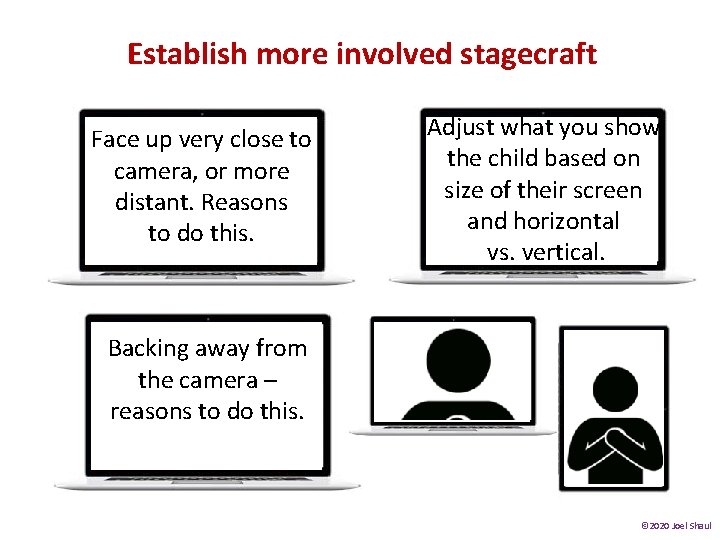
Establish more involved stagecraft Face up very close to camera, or more distant. h. Reasons to do this. Adjust what you show the child based on size of their screen and horizontal vs. vertical. Backing away from the camera – reasons to do this. © 2020 Joel Shaul
Establish more involved stagecraft by conforming to some established practices of online videos. Children probably compare us to these unconsciously. Online videos are quicker paced than h regular speech and have a more emphatic tone. Online videos have more frequent transitions of action and content. © 2020 Joel Shaul
Address potential obstacles affecting children with ASD in teletherapy The social encounter with you might not h seem “real” to them at first. They might have a rigid expectation of school = work & home = play. They may be slow to generalize: “Here is my therapist so this must be a therapy session. ” © 2020 Joel Shaul
Harness potential advantages of providing teletherapy for children with ASD They might really learn some things h better from you on a screen than in person. In group screen therapy sessions, some kids relate better to others than in person. They might learn better from you in their home than in an office or school. © 2020 Joel Shaul
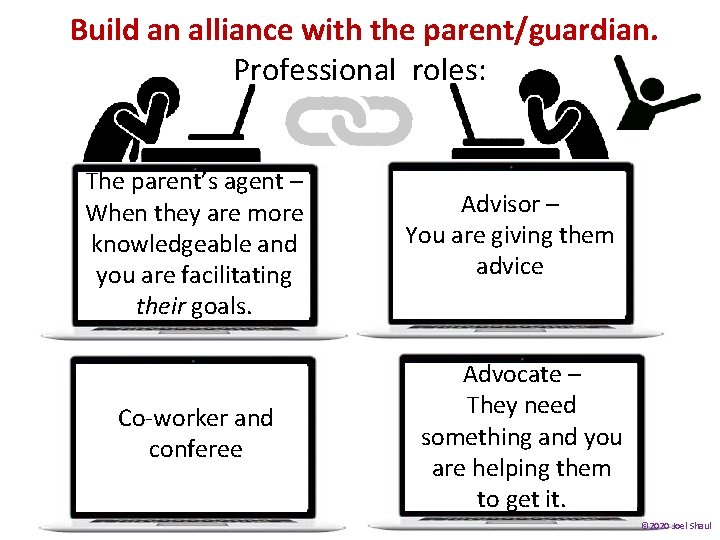
Build an alliance with the parent/guardian. Professional roles: The parent’s agent – When they are more knowledgeable and h you are facilitating their goals. Co-worker and conferee Advisor – You are giving them advice Advocate – They need something and you are helping them to get it. © 2020 Joel Shaul
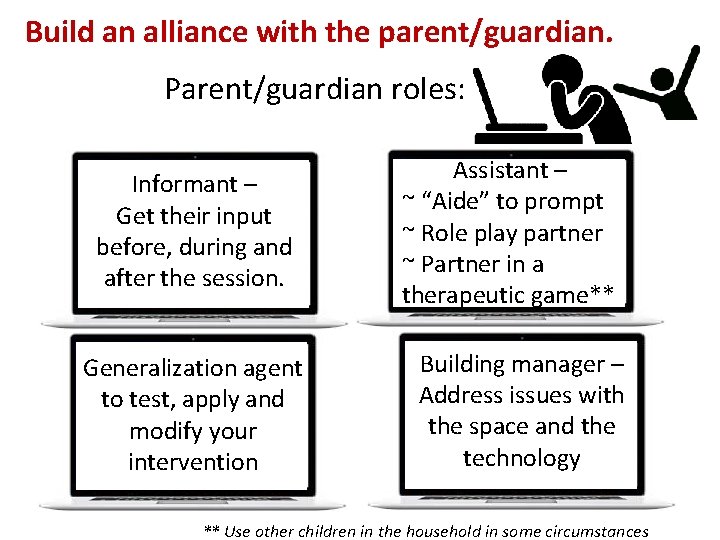
Build an alliance with the parent/guardian. Parent/guardian roles: Informant – Get their input h before, during and after the session. Generalization agent to test, apply and modify your intervention Assistant – ~ “Aide” to prompt ~ Role play partner ~ Partner in a therapeutic game** Building manager – Address issues with the space and the technology ** Use other children in the household in some circumstances
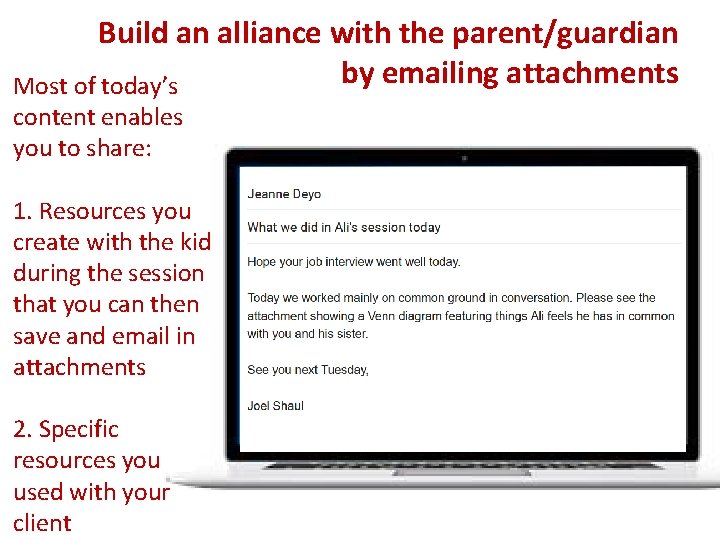
Build an alliance with the parent/guardian by emailing attachments Most of today’s content enables you to share: 1. Resources you create with the kid during the session that you can then save and email in attachments 2. Specific resources you used with your client h
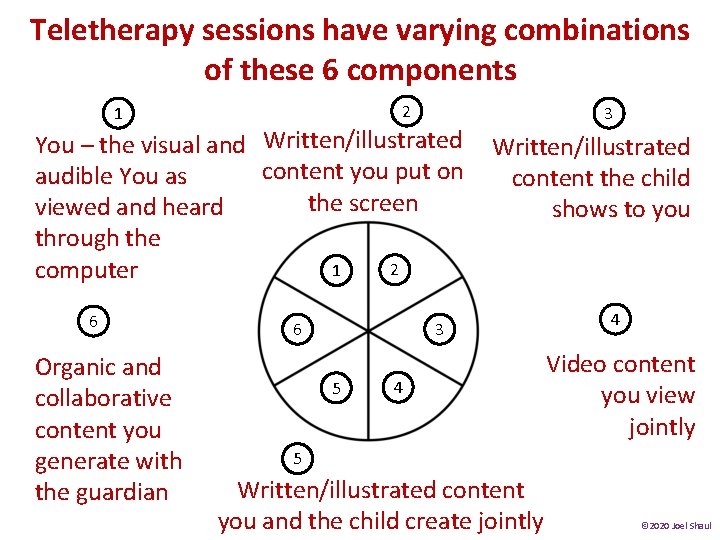
Teletherapy sessions have varying combinations of these 6 components 2 1 You – the visual and Written/illustrated content you put on audible You as the screen viewed and heard through the 2 1 computer 6 Organic and collaborative content you generate with the guardian 6 3 Written/illustrated content the child shows to you 3 5 4 4 Video content you view jointly 5 Written/illustrated content you and the child create jointly © 2020 Joel Shaul
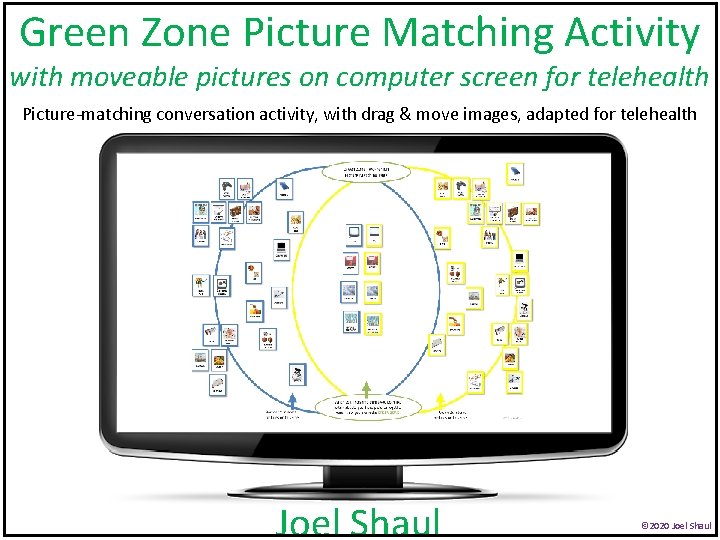
Green Zone Picture Matching Activity with moveable pictures on computer screen for telehealth Picture-matching conversation activity, with drag & move images, adapted for telehealth Joel Shaul © 2020 Joel Shaul
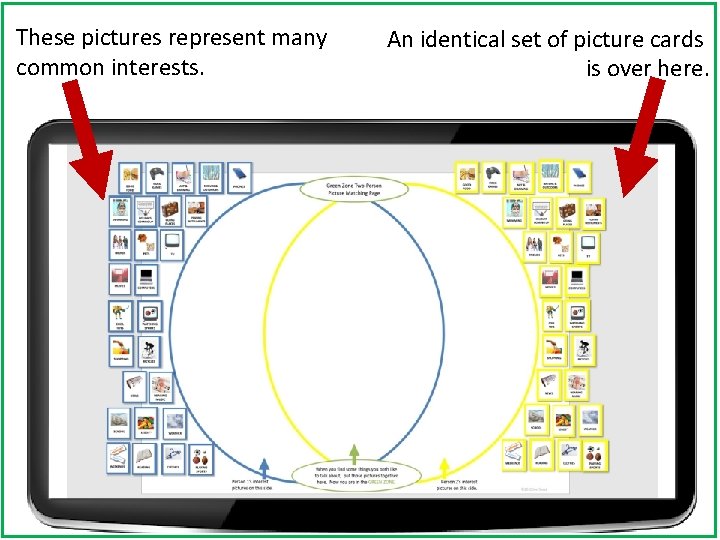
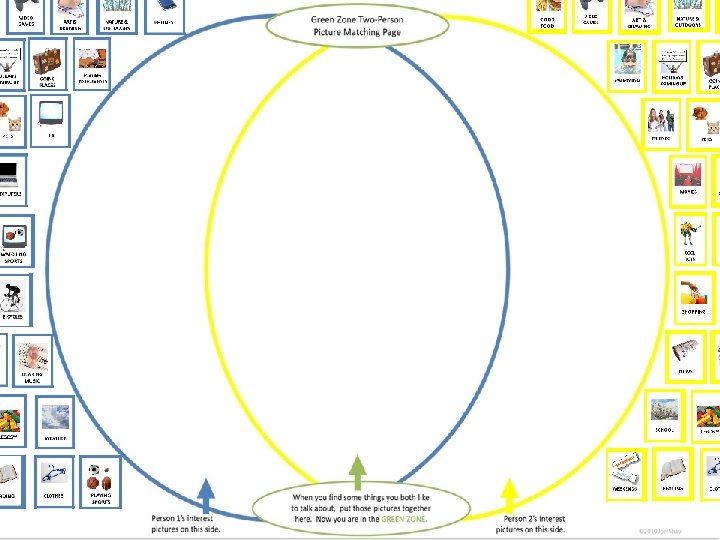
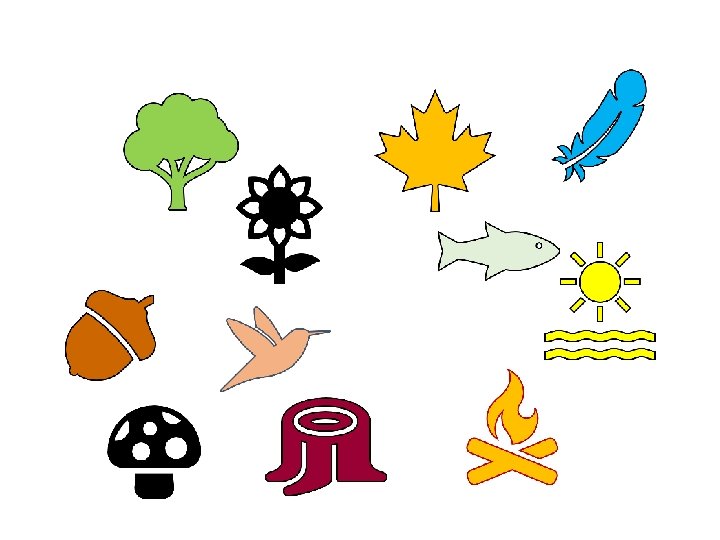
These pictures represent many common interests. An identical set of picture cards is over here.
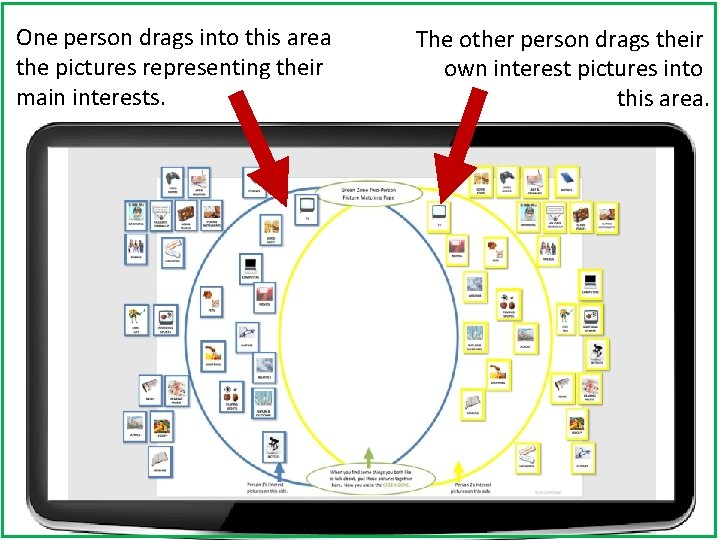
One person drags into this area the pictures representing their main interests. The other person drags their own interest pictures into this area.
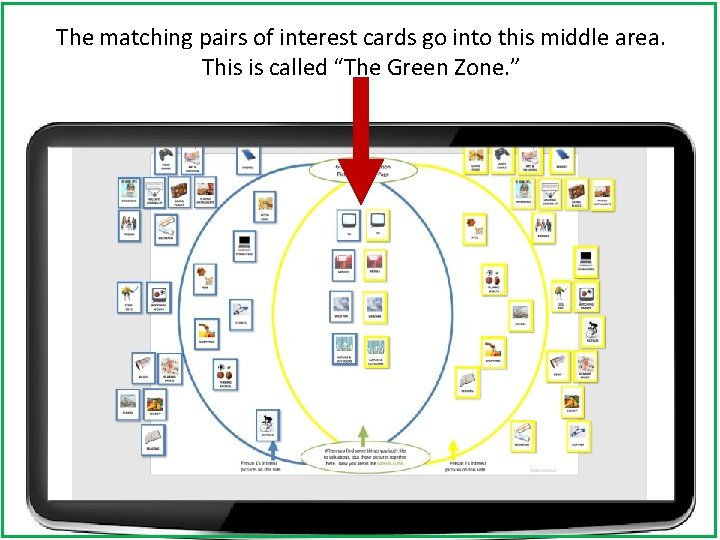
The matching pairs of interest cards go into this middle area. This is called “The Green Zone. ”
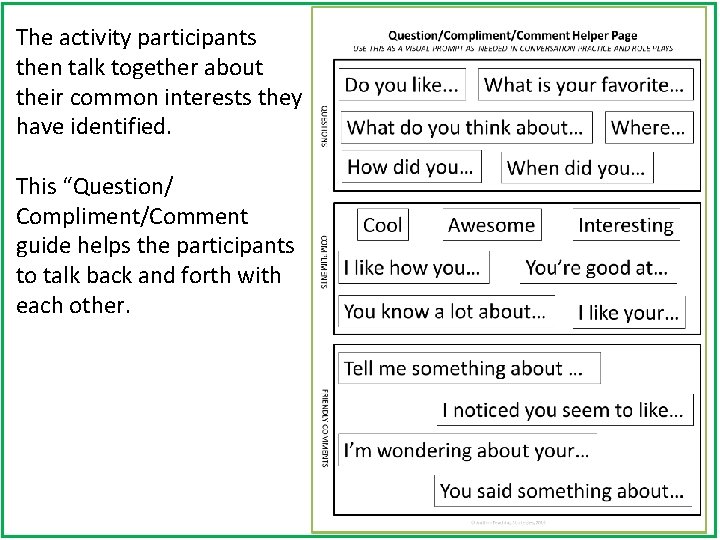
The activity participants then talk together about their common interests they have identified. This “Question/ Compliment/Comment guide helps the participants to talk back and forth with each other.
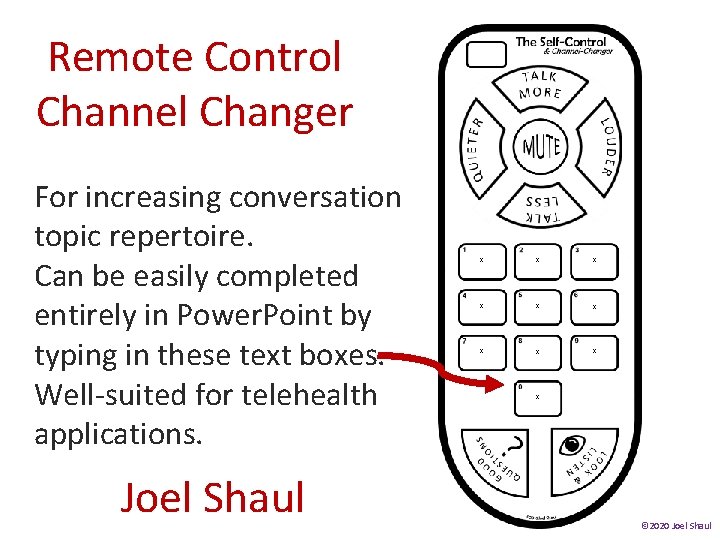
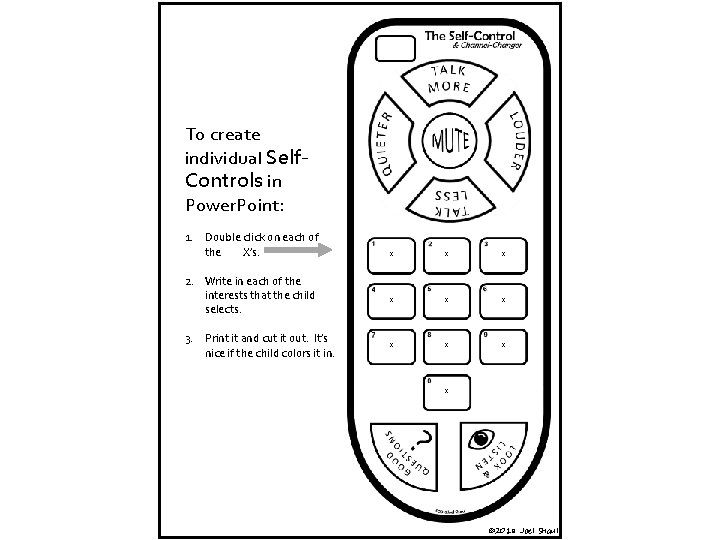
Remote Control Channel Changer For increasing conversation topic repertoire. Can be easily completed entirely in Power. Point by typing in these text boxes. Well-suited for telehealth applications. Joel Shaul x x x x x © 2020 Joel Shaul
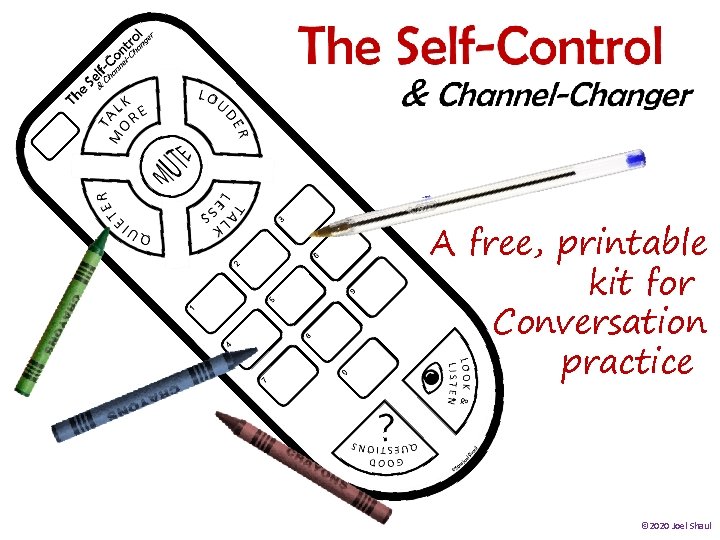
A free, printable kit for Conversation practice © 2020 Joel Shaul
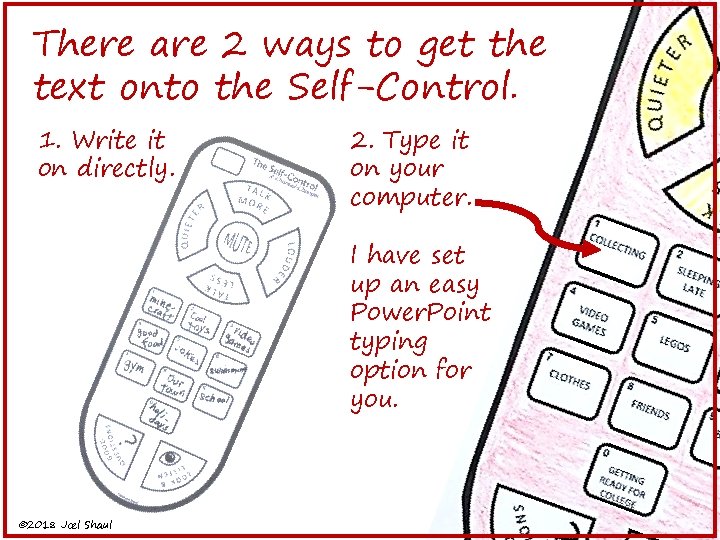
There are 2 ways to get the text onto the Self-Control. 1. Write it on directly. 2. Type it on your computer. I have set up an easy Power. Point typing option for you. © 2018 Joel Shaul
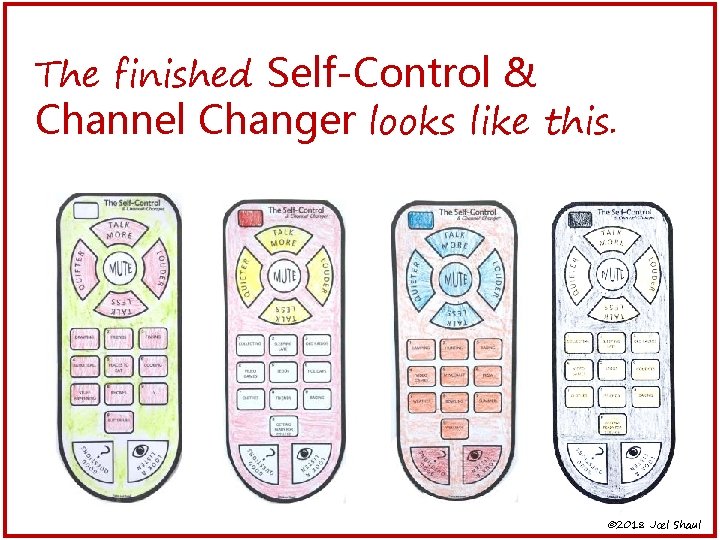
The finished Self-Control & Channel Changer looks like this. © 2018 Joel Shaul
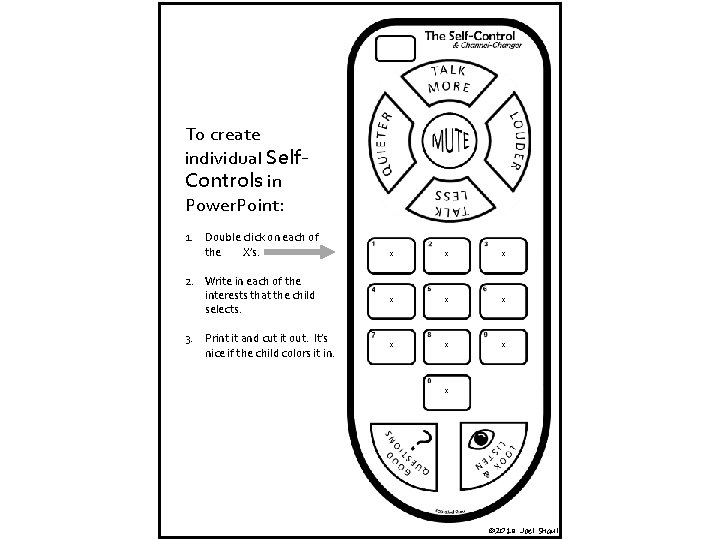
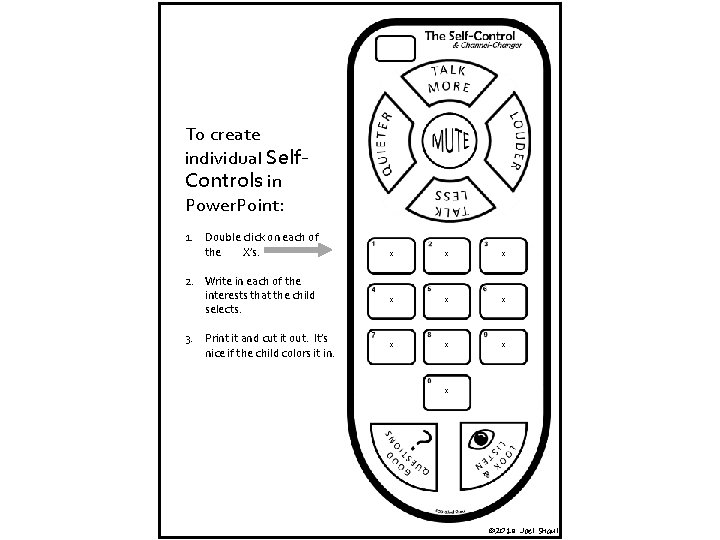
To create individual Self. Controls in Power. Point: 1. Double click on each of the X’s. 2. Write in each of the interests that the child selects. 3. Print it and cut it out. It’s nice if the child colors it in. x x x x x © 2018 Joel Shaul
To create individual Self. Controls in Power. Point: 1. Double click on each of the X’s. 2. Write in each of the interests that the child selects. 3. Print it and cut it out. It’s nice if the child colors it in. x x x x x © 2018 Joel Shaul
Using chain visuals to teach coherence in conversation (with moveable images for telehealth) Joel Shaul
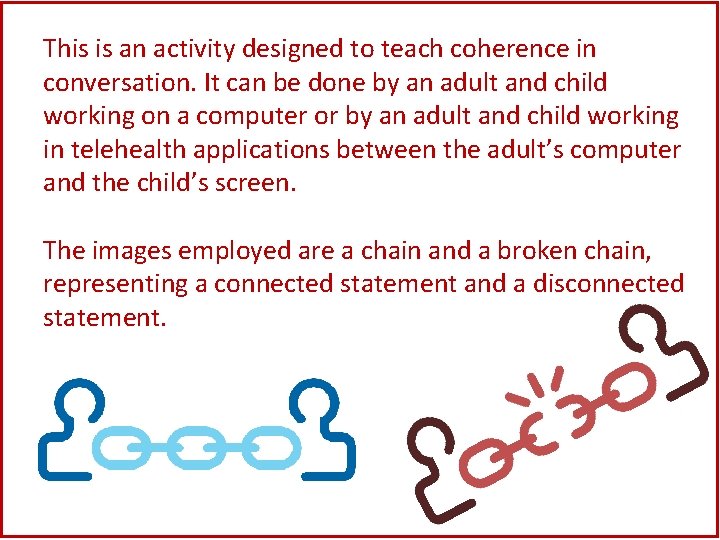
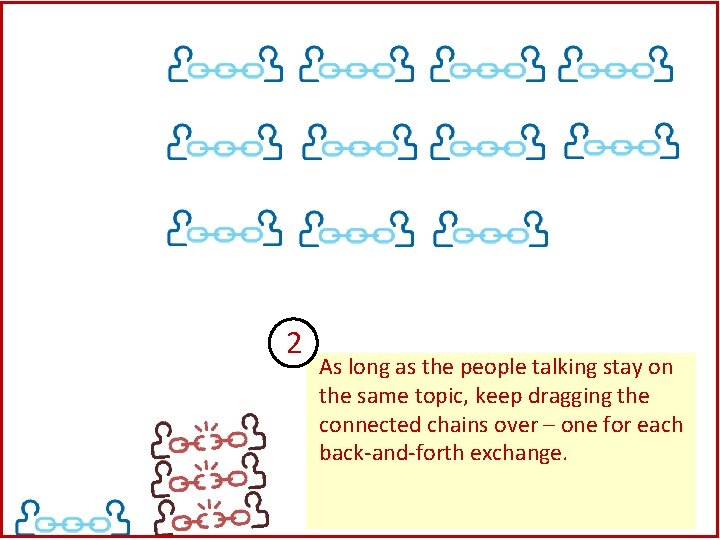
This is an activity designed to teach coherence in conversation. It can be done by an adult and child working on a computer or by an adult and child working in telehealth applications between the adult’s computer and the child’s screen. The images employed are a chain and a broken chain, representing a connected statement and a disconnected statement.
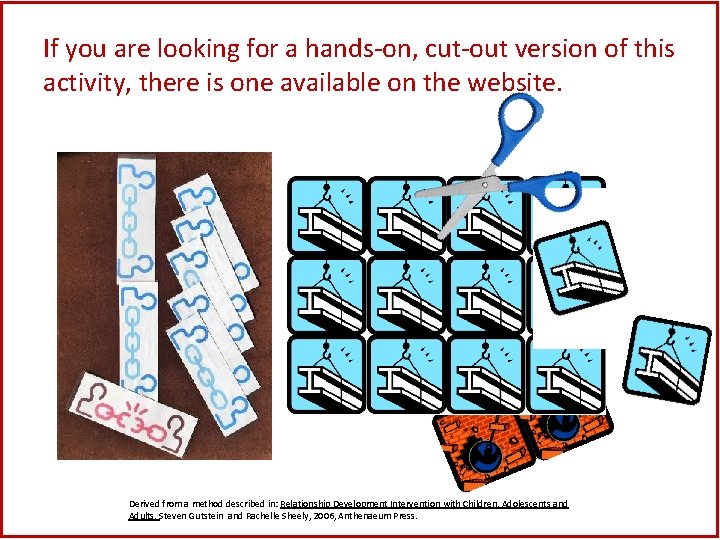
If you are looking for a hands-on, cut-out version of this activity, there is one available on the website. Derived from a method described in: Relationship Development Intervention with Children, Adolescents and Adults, Steven Gutstein and Rachelle Sheely, 2006, Anthenaeum Press.
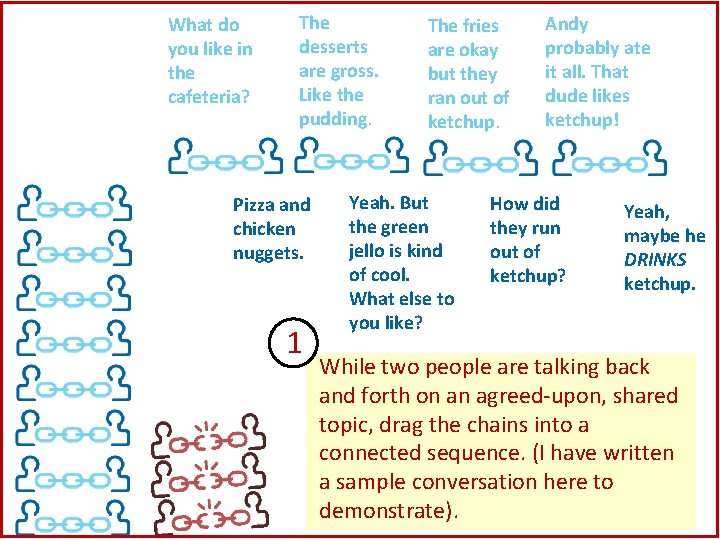
What do you like in the cafeteria? The desserts are gross. Like the pudding. Pizza and chicken nuggets. 1 The fries are okay but they ran out of ketchup. Yeah. But the green jello is kind of cool. What else to you like? Andy probably ate it all. That dude likes ketchup! How did they run out of ketchup? Yeah, maybe he DRINKS ketchup. While two people are talking back and forth on an agreed-upon, shared topic, drag the chains into a connected sequence. (I have written a sample conversation here to demonstrate).
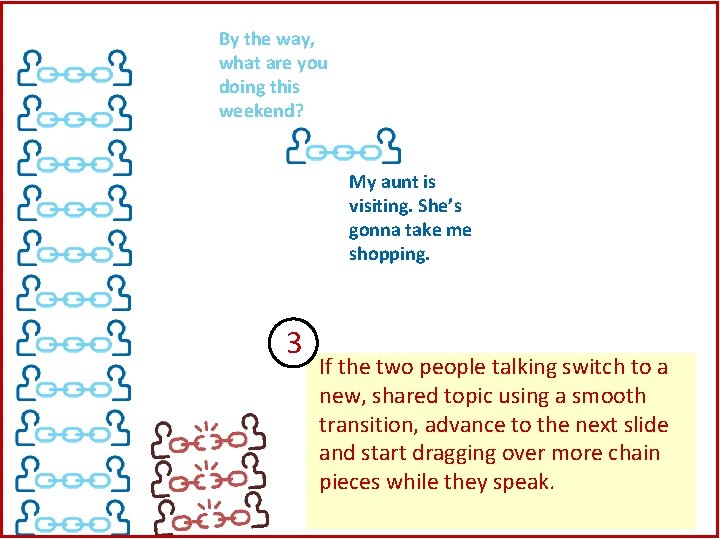
2 As long as the people talking stay on the same topic, keep dragging the connected chains over – one for each back-and-forth exchange.
By the way, what are you doing this weekend? My aunt is visiting. She’s gonna take me shopping. 3 If the two people talking switch to a new, shared topic using a smooth transition, advance to the next slide and start dragging over more chain pieces while they speak.
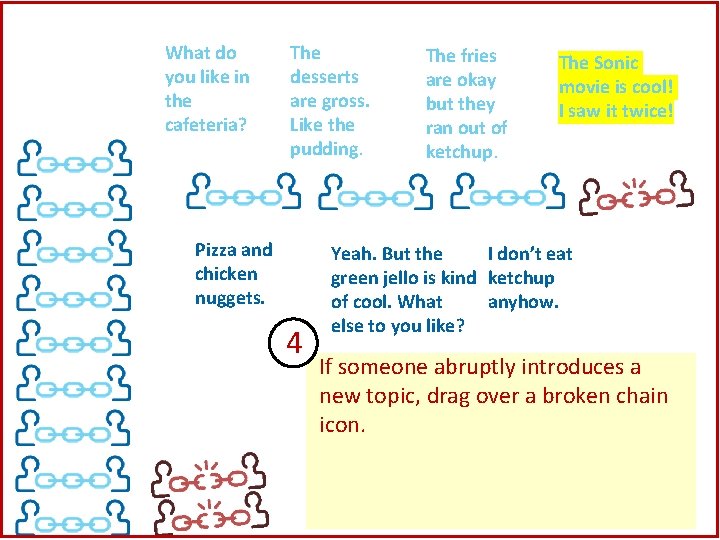
What do you like in the cafeteria? The desserts are gross. Like the pudding. Pizza and chicken nuggets. 4 The fries are okay but they ran out of ketchup. The Sonic movie is cool! I saw it twice! Yeah. But the I don’t eat green jello is kind ketchup of cool. What anyhow. else to you like? If someone abruptly introduces a new topic, drag over a broken chain icon.
© 2020 Joel Shaul
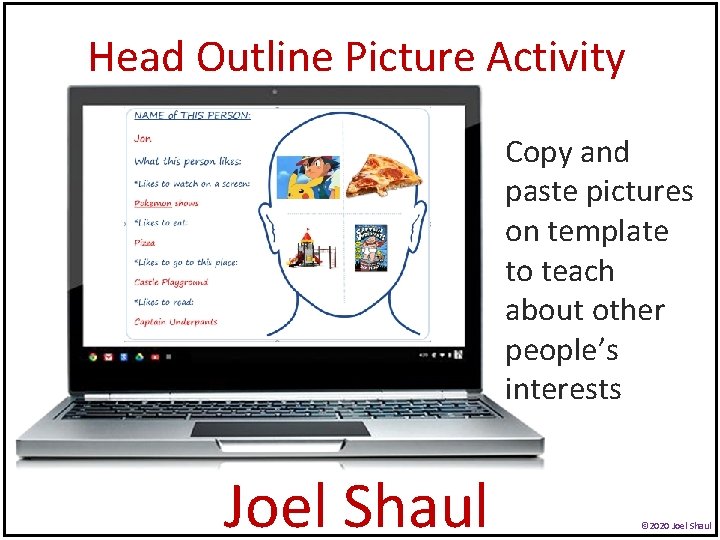
Head Outline Picture Activity Copy and paste pictures on template to teach about other people’s interests Joel Shaul © 2020 Joel Shaul
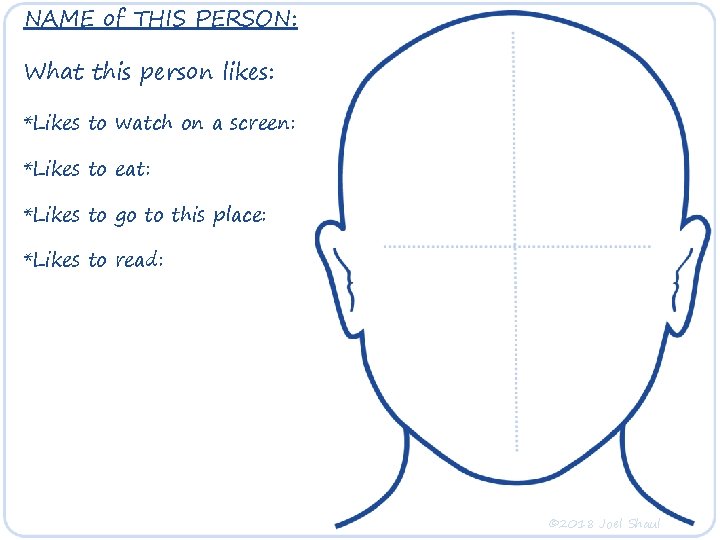
NAME of THIS PERSON: What this person likes: *Likes to watch on a screen: *Likes to eat: *Likes to go to this place: *Likes to read: © 2018 Joel Shaul
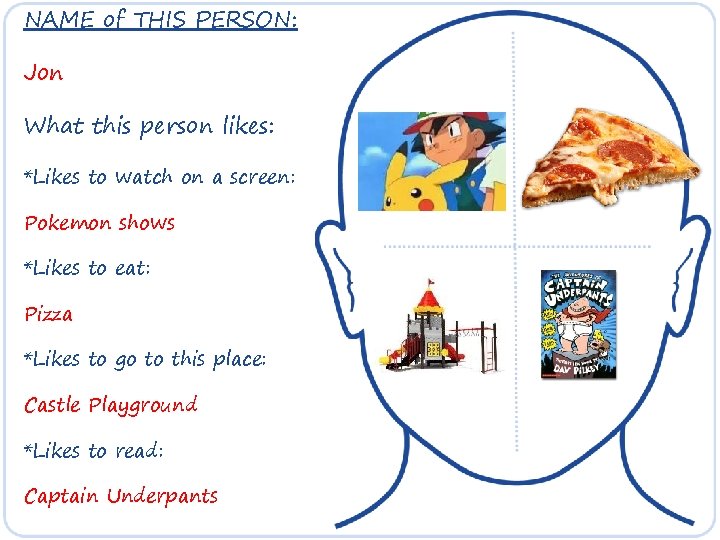
NAME of THIS PERSON: Jon What this person likes: *Likes to watch on a screen: Pokemon shows *Likes to eat: Pizza *Likes to go to this place: Castle Playground *Likes to read: Captain Underpants
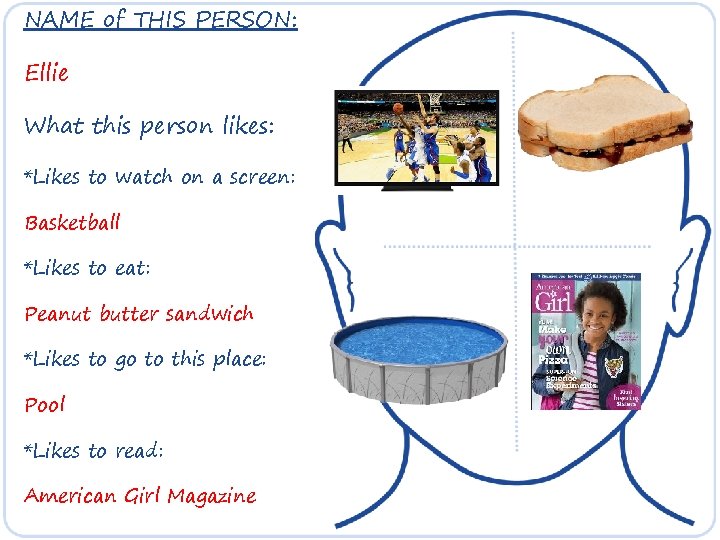
NAME of THIS PERSON: Ellie What this person likes: *Likes to watch on a screen: Basketball *Likes to eat: Peanut butter sandwich *Likes to go to this place: Pool *Likes to read: American Girl Magazine
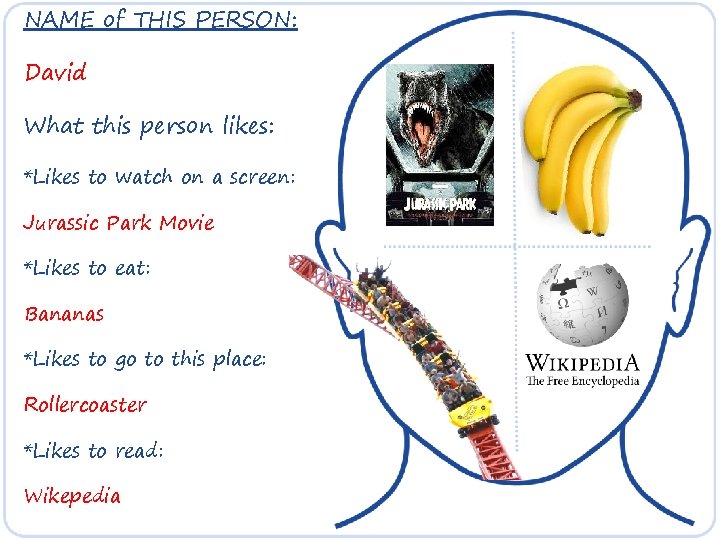
NAME of THIS PERSON: David What this person likes: *Likes to watch on a screen: Jurassic Park Movie *Likes to eat: Bananas *Likes to go to this place: Rollercoaster *Likes to read: Wikepedia
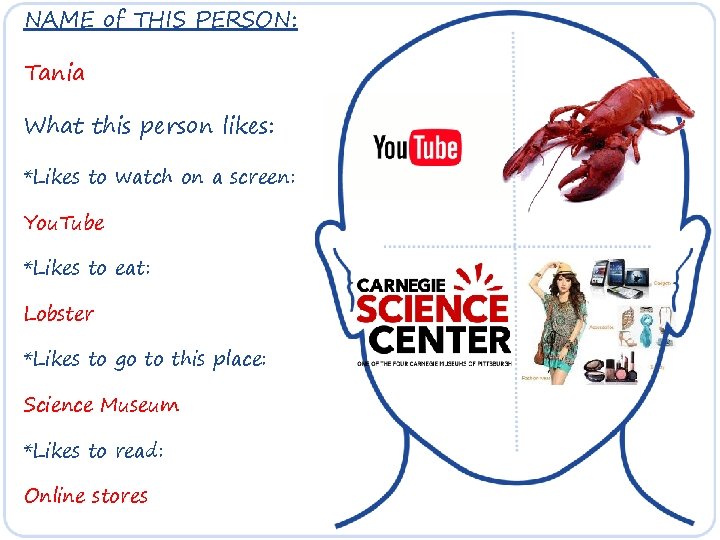
NAME of THIS PERSON: Tania What this person likes: *Likes to watch on a screen: You. Tube *Likes to eat: Lobster *Likes to go to this place: Science Museum *Likes to read: Online stores
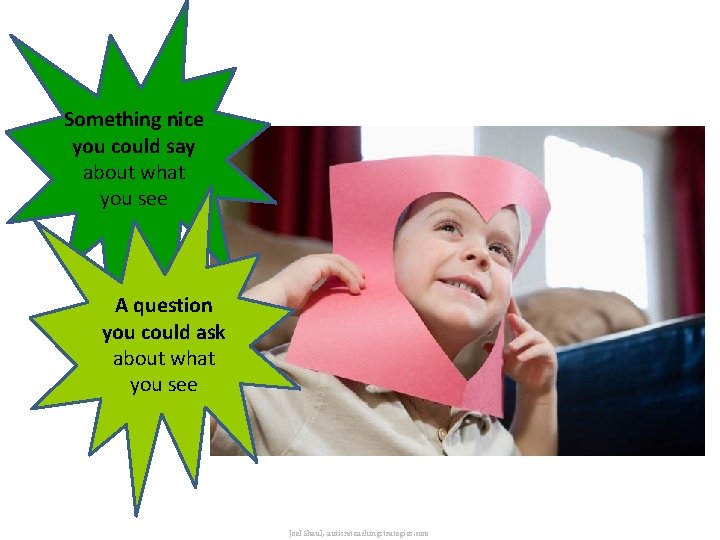
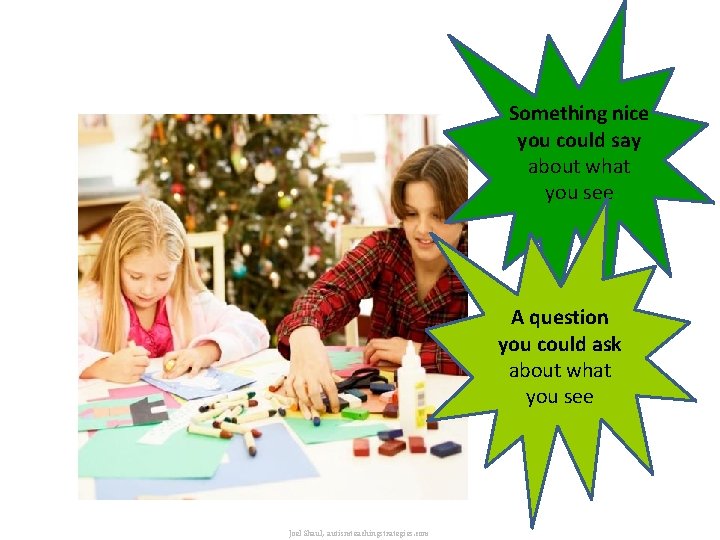
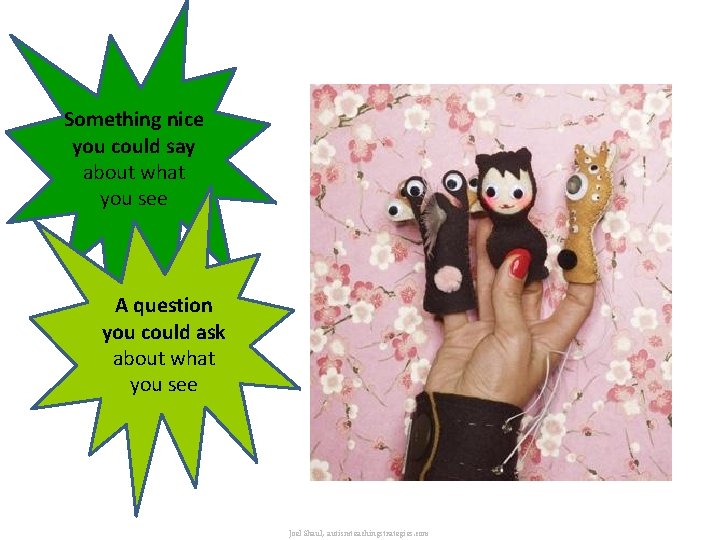
100 Conversation Picture Practice Slides Well–suited for telehealth conversation practice Joel Shaul © 2020 Joel Shaul
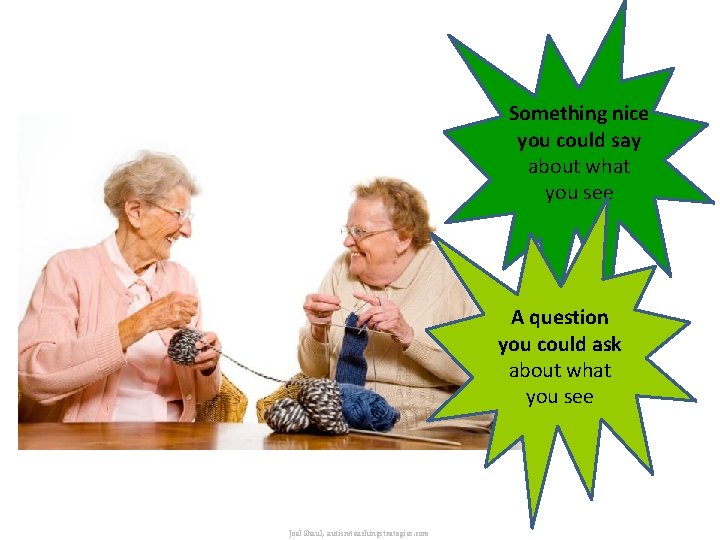
Something nice you could say about what you see A question you could ask about what you see Joel Shaul, autismteachingstrategies. com
Something nice you could say about what you see A question you could ask about what you see Joel Shaul, autismteachingstrategies. com
Something nice you could say about what you see A question you could ask about what you see Joel Shaul, autismteachingstrategies. com
Something nice you could say about what you see A question you could ask about what you see Joel Shaul, autismteachingstrategies. com
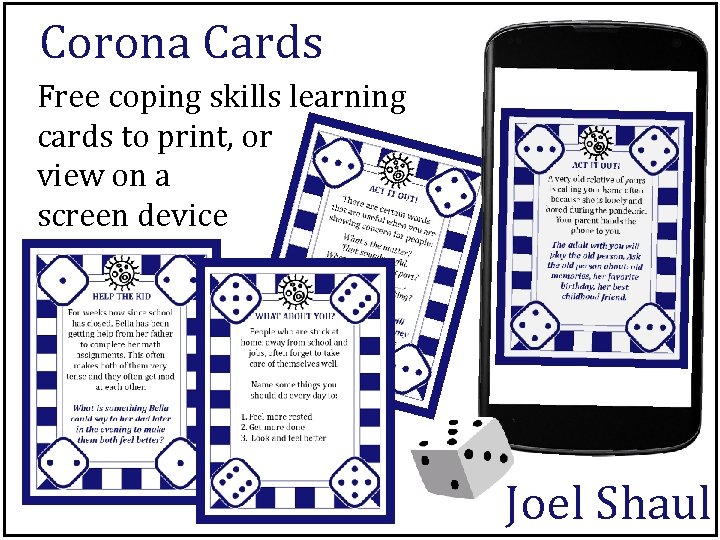
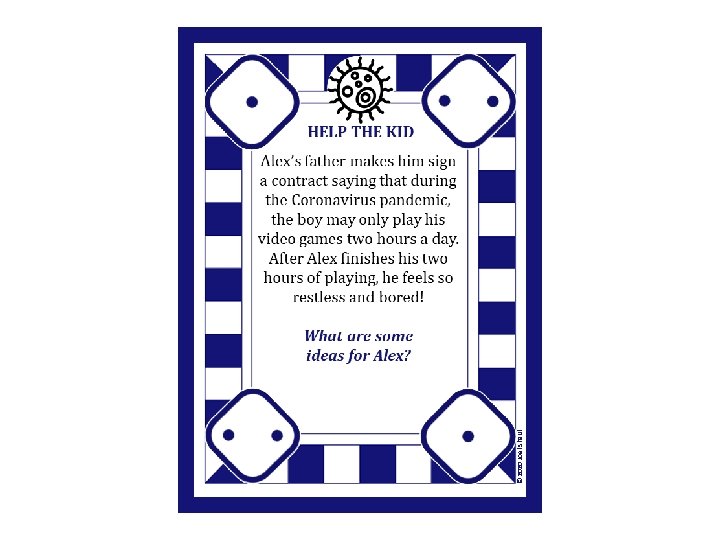
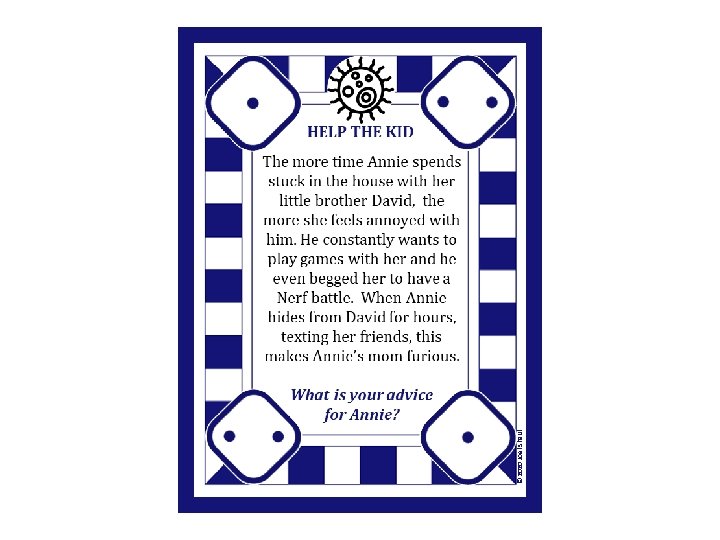
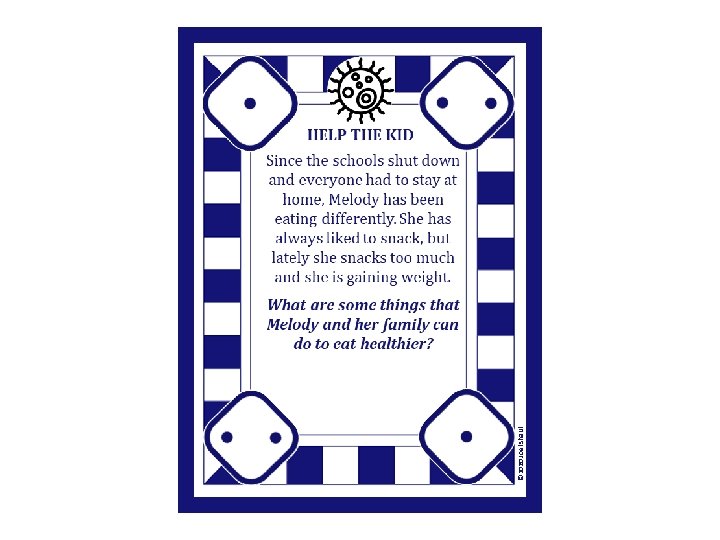
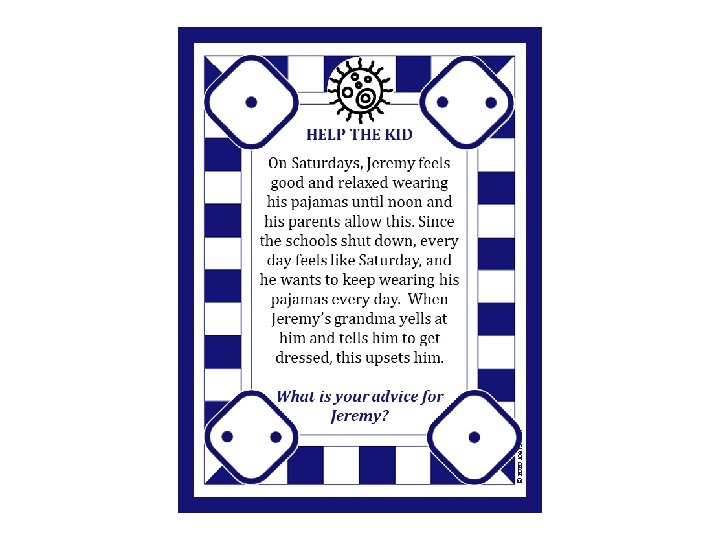
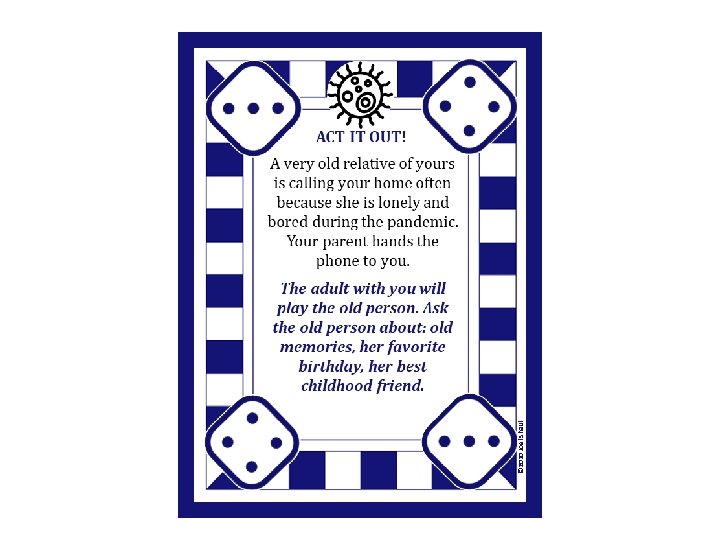
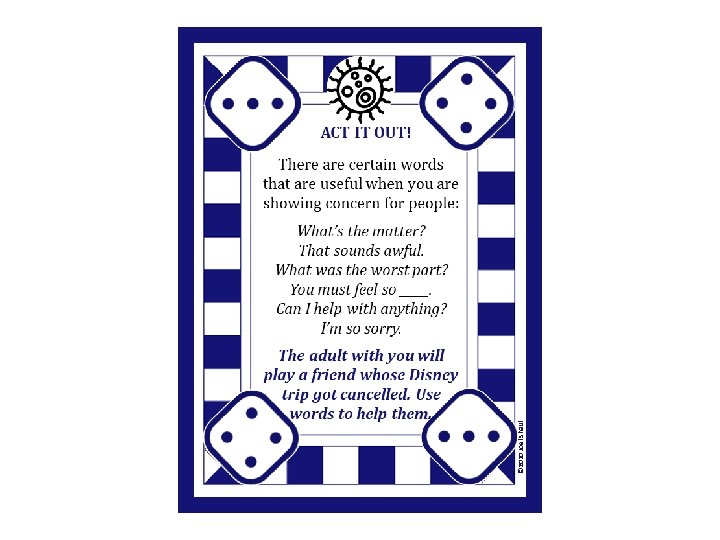
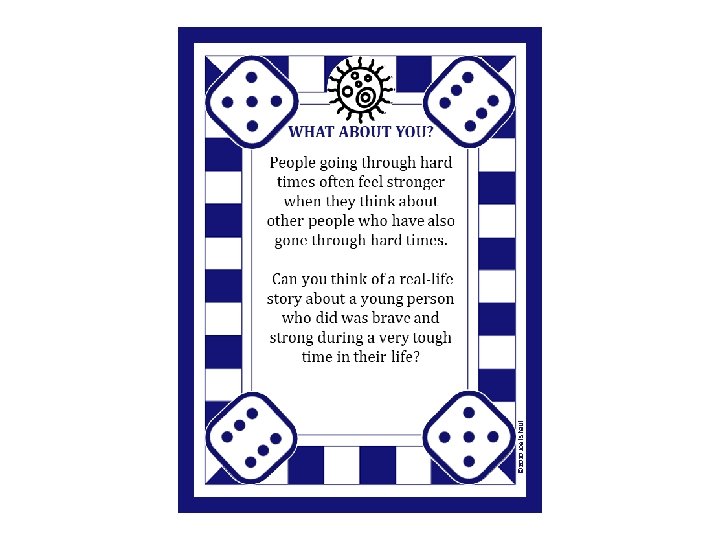
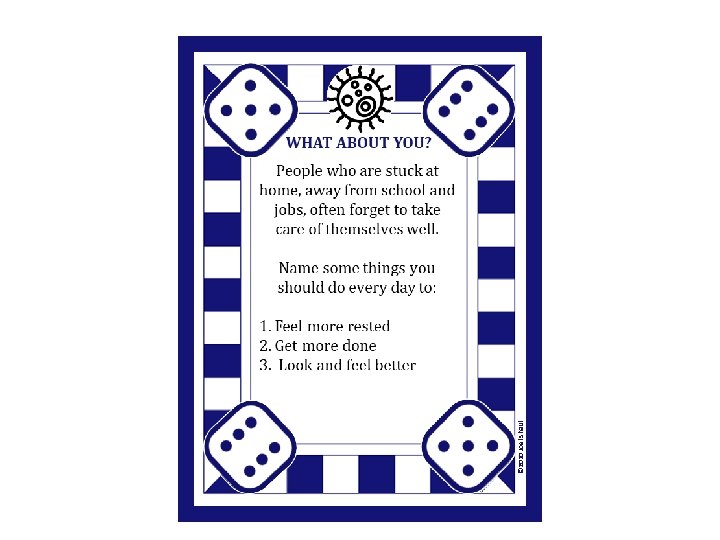
Corona Cards Free coping skills learning cards to print, or view on a screen device Joel Shaul
© 2020 Joel Shaul
© 2020 Joel Shaul
© 2020 Joel Shaul
© 2020 Joel Shaul
© 2020 Joel Shaul
© 2020 Joel Shaul
© 2020 Joel Shaul
© 2020 Joel Shaul
© 2020 Joel Shaul
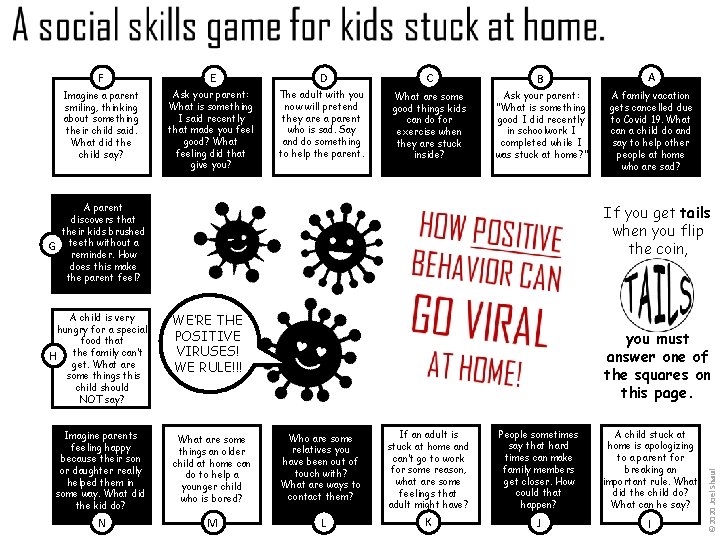
POSITIVE BEHAVIOR GOES VIRAL! A social skills game for ids stuck at home. a free download by Joel Shaul,
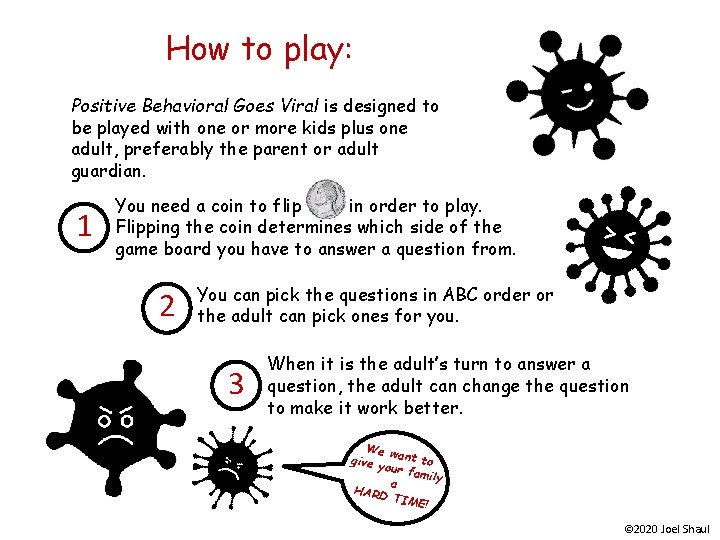
How to play: Positive Behavioral Goes Viral is designed to be played with one or more kids plus one adult, preferably the parent or adult guardian. 1 You need a coin to flip in order to play. Flipping the coin determines which side of the game board you have to answer a question from. 2 You can pick the questions in ABC order or the adult can pick ones for you. 3 When it is the adult’s turn to answer a question, the adult can change the question to make it work better. We w give y ant to our fa mily a HARD TIME ! © 2020 Joel Shaul
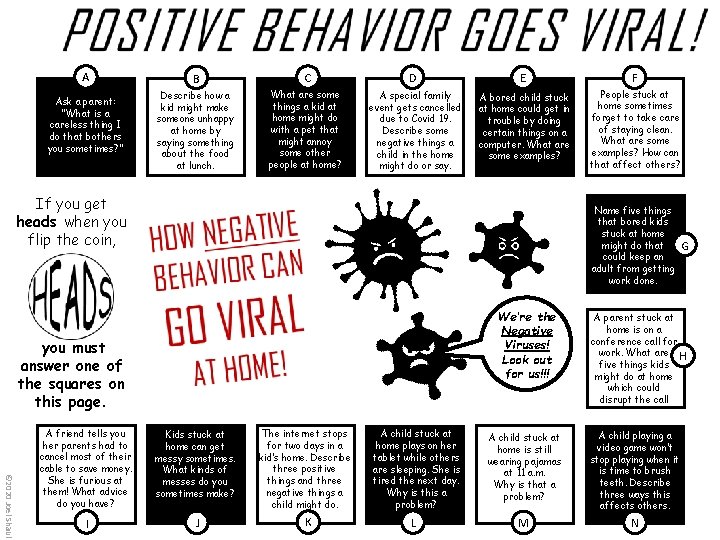
A Ask a parent: “What is a careless thing I do that bothers you sometimes? ” B C D E F Describe how a kid might make someone unhappy at home by saying something about the food at lunch. What are some things a kid at home might do with a pet that might annoy some other people at home? A special family event gets cancelled due to Covid 19. Describe some negative things a child in the home might do or say. A bored child stuck at home could get in trouble by doing certain things on a computer. What are some examples? People stuck at home sometimes forget to take care of staying clean. What are some examples? How can that affect others? If you get heads when you flip the coin, Name five things that bored kids stuck at home might do that could keep an adult from getting work done. We’re the Negative Viruses! Look out for us!!! you must answer one of the squares on this page. © 2020 Joel Shaul A friend tells you her parents had to cancel most of their cable to save money. She is furious at them! What advice do you have? Kids stuck at home can get messy sometimes. What kinds of messes do you sometimes make? I J The internet stops for two days in a kid’s home. Describe three positive things and three negative things a child might do. K A child stuck at home plays on her tablet while others are sleeping. She is tired the next day. Why is this a problem? L G A parent stuck at home is on a conference call for work. What are H five things kids might do at home which could disrupt the call A child stuck at home is still wearing pajamas at 11 a. m. Why is that a problem? A child playing a video game won’t stop playing when it is time to brush teeth. Describe three ways this affects others. M N
E D C B A Imagine a parent smiling, thinking about something their child said. What did the child say? Ask your parent: What is something I said recently that made you feel good? What feeling did that give you? The adult with you now will pretend they are a parent who is sad. Say and do something to help the parent. What are some good things kids can do for exercise when they are stuck inside? Ask your parent: “What is something good I did recently in schoolwork I completed while I was stuck at home? ” A family vacation gets cancelled due to Covid 19. What can a child do and say to help other people at home who are sad? A parent discovers that their kids brushed teeth without a reminder. How does this make the parent feel? A child is very hungry for a special food that H the family can’t get. What are some things this child should NOT say? If you get tails when you flip the coin, WE’RE THE POSITIVE VIRUSES! WE RULE!!! you must answer one of the squares on this page. Imagine parents feeling happy because their son or daughter really helped them in some way. What did the kid do? What are some things an older child at home can do to help a younger child who is bored? Who are some relatives you have been out of touch with? What are ways to contact them? If an adult is stuck at home and can’t go to work for some reason, what are some feelings that adult might have? People sometimes say that hard times can make family members get closer. How could that happen? A child stuck at home is apologizing to a parent for breaking an important rule. What did the child do? What can he say? N M L K J I © 2020 Joel Shaul G F
Ready-to-use social skills resources to use effectively in telehealth services for children with high functioning ASD Part 2 Joel Shaul, LCSW All original materials Copyright 2020 Joel Shaul. Recording of this presentation is not permitted.
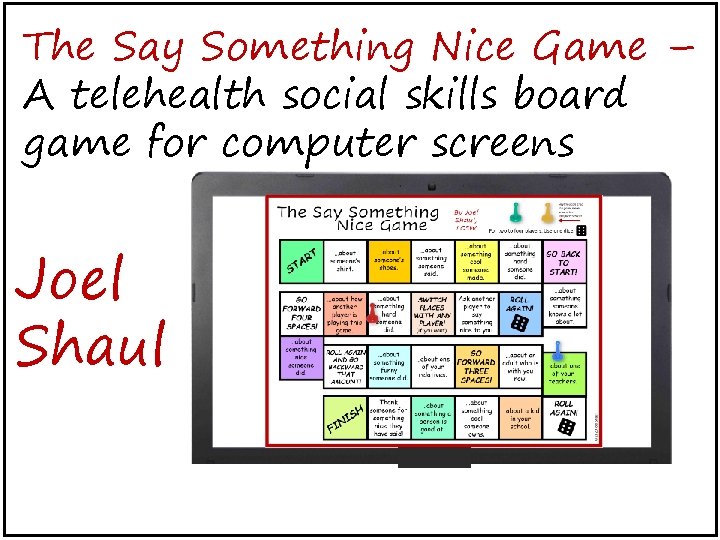
The Say Something Nice Game – A telehealth social skills board game for computer screens Joel Shaul
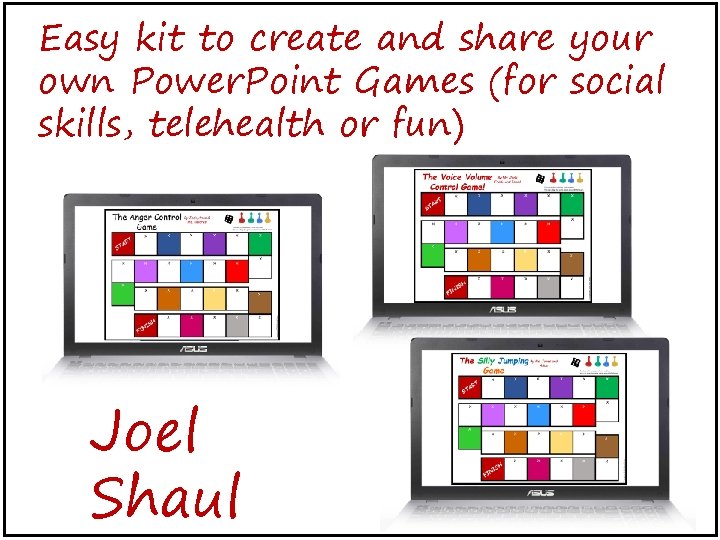
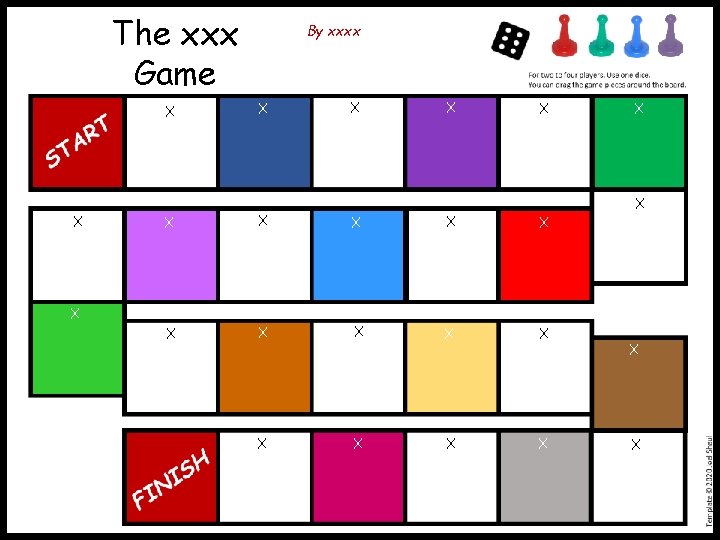
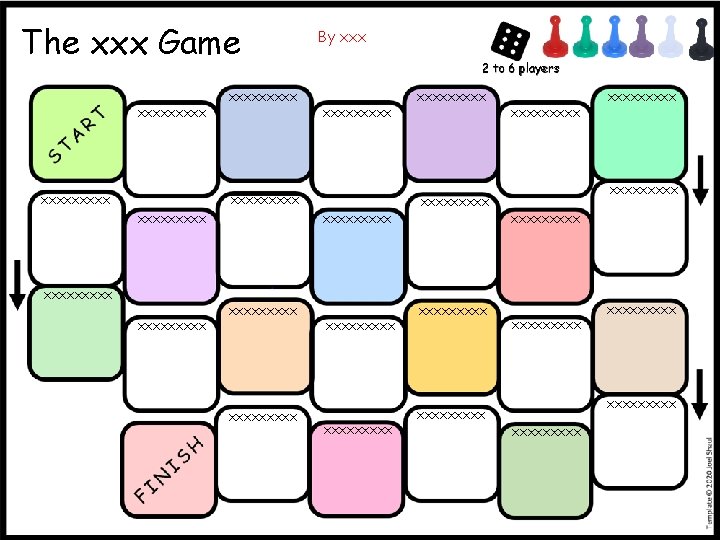
Easy kit to create and share your own Power. Point Games (for social skills, telehealth or fun) Joel Shaul
The xxx Game X X By xxxx X X X X X X
The xxx Game xxxxxxxxx By xxx 2 to 6 players xxxxxxxxx xxxxxxxxx xxxxxxxxx xxxxxxxxx xxxxxxxxx xxxxxxxxx
The _____ Game About the game: XXXXXXXXXXXXXXXXXXXXXXxxxxxxxx Directions for play: 1. X 2. X 3. x
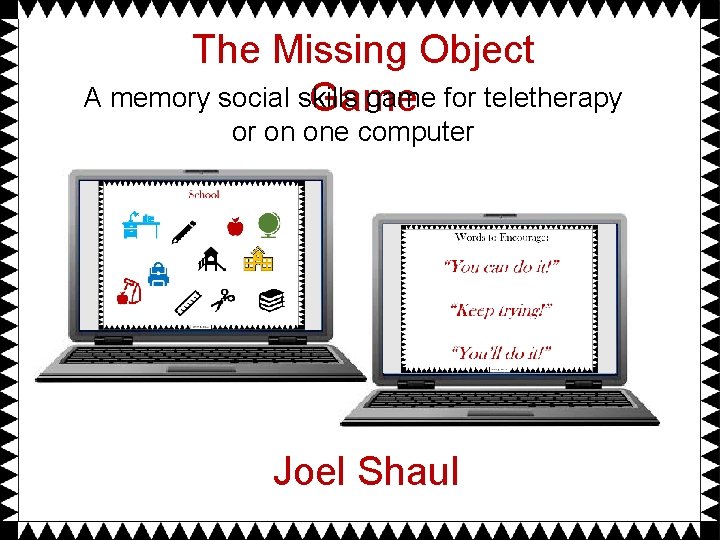
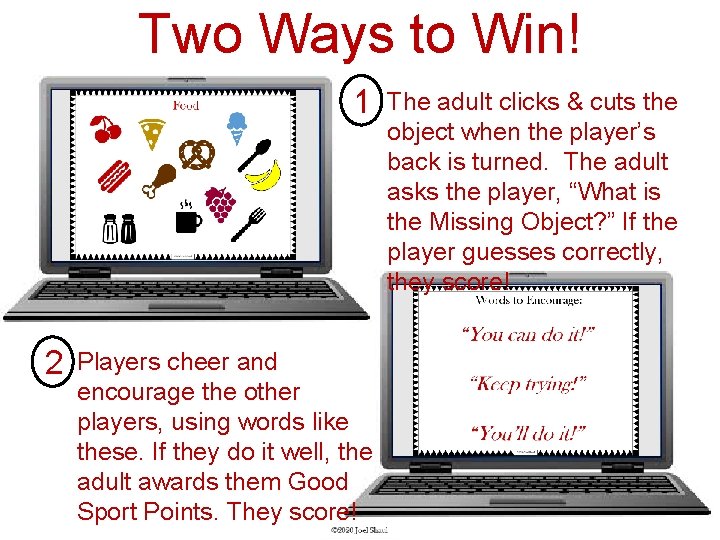
The Missing Object A memory social skills game for teletherapy Game or on one computer Joel Shaul
Two Ways to Win! 1 2 Players cheer and encourage the other players, using words like these. If they do it well, the adult awards them Good Sport Points. They score! The adult clicks & cuts the object when the player’s back is turned. The adult asks the player, “What is the Missing Object? ” If the player guesses correctly, they score!
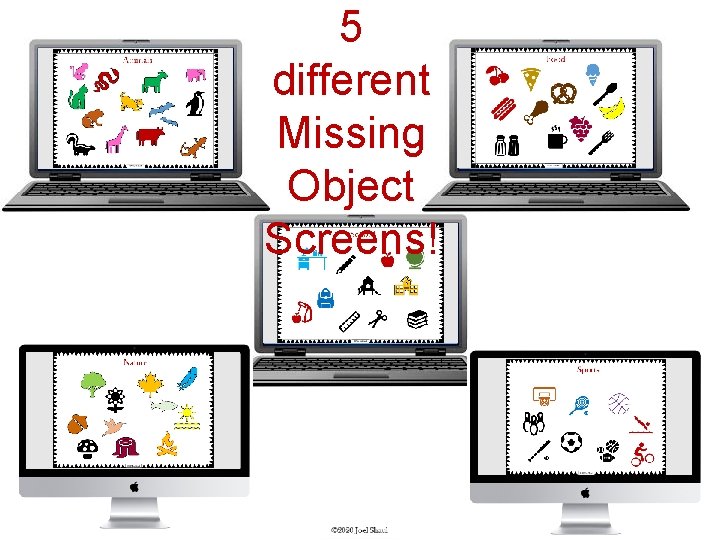
5 different Missing Object Screens!
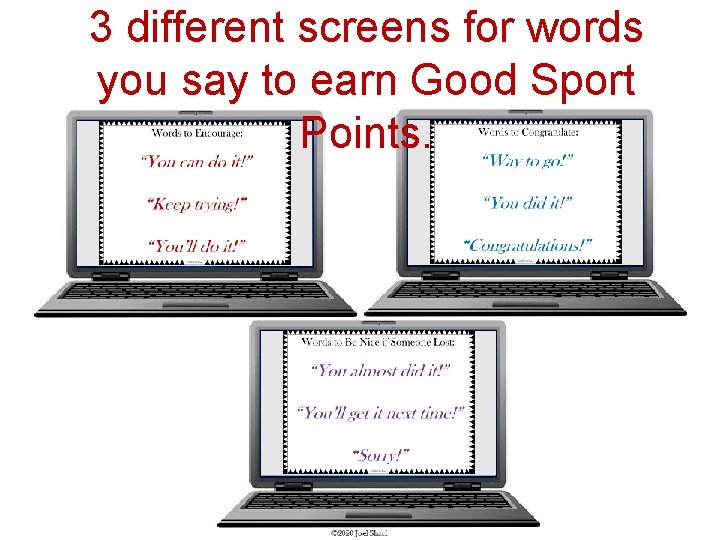
3 different screens for words you say to earn Good Sport Points.
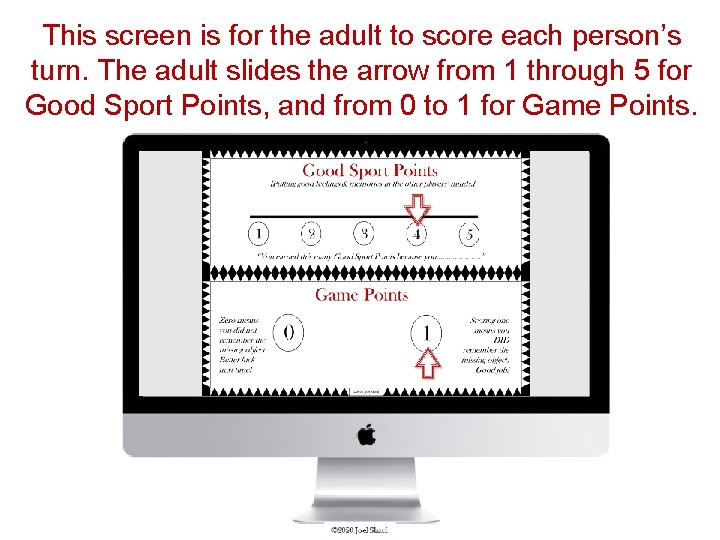
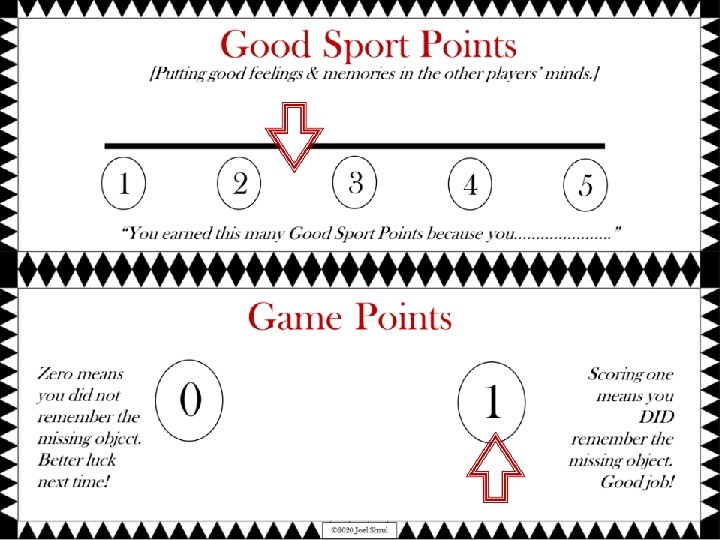
This screen is for the adult to score each person’s turn. The adult slides the arrow from 1 through 5 for Good Sport Points, and from 0 to 1 for Game Points.
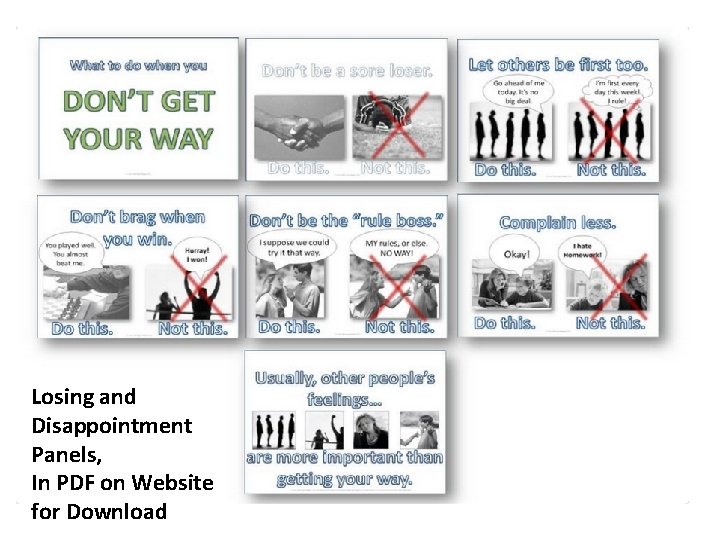
Losing and Disappointment Panels, In PDF on Website for Download
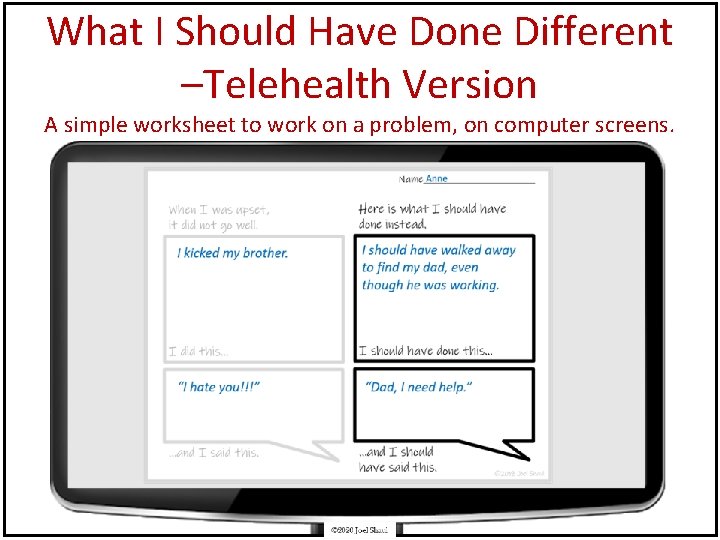
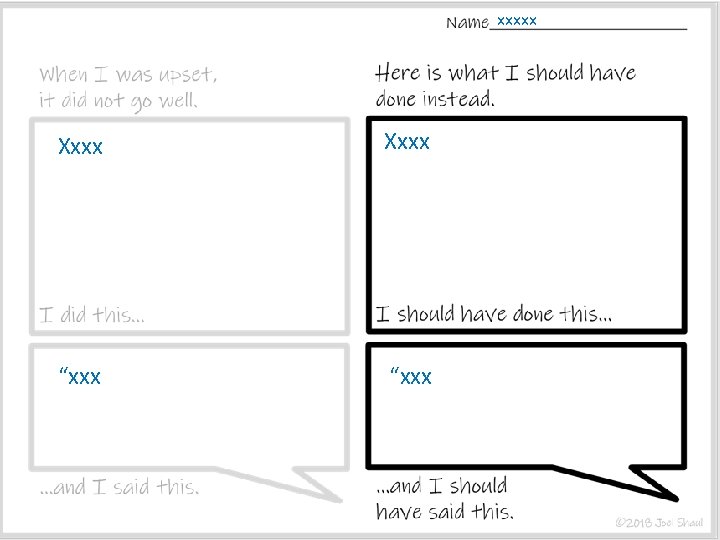
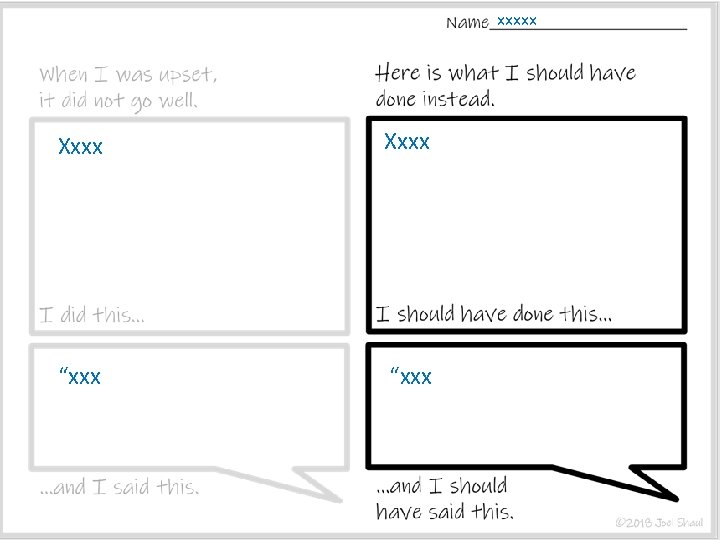
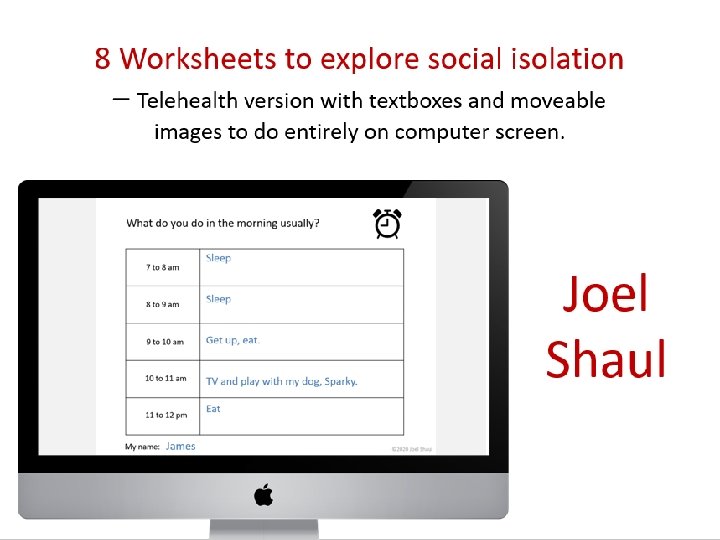
What I Should Have Done Different –Telehealth Version A simple worksheet to work on a problem, on computer screens.
xxxxx Xxxx “xxx
xxxxx Xxxx “xxx
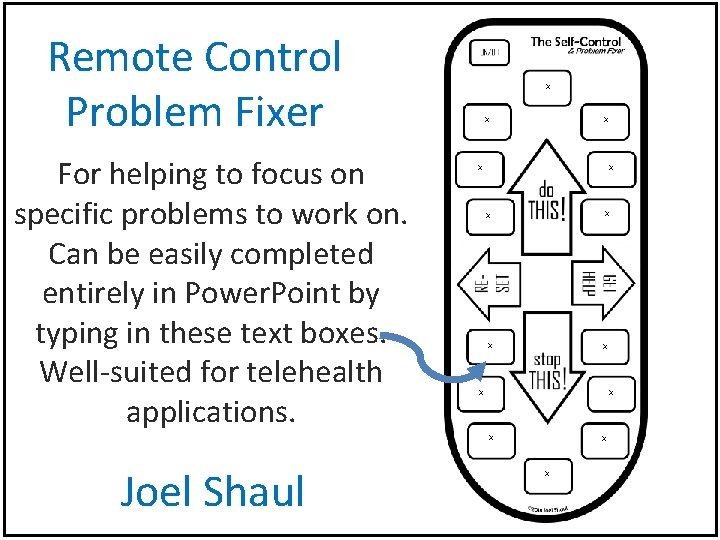
Remote Control Problem Fixer For helping to focus on specific problems to work on. Can be easily completed entirely in Power. Point by typing in these text boxes. Well-suited for telehealth applications. x x x Joel Shaul x x
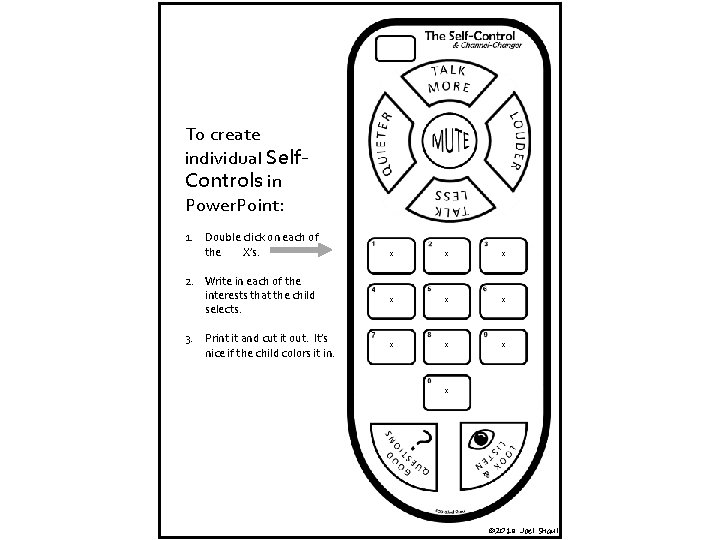
To create individual Self. Controls in Power. Point: 1. Double click on each of the X’s. 2. Write in each of the interests that the child selects. 3. Print it and cut it out. It’s nice if the child colors it in. x x x x x © 2018 Joel Shaul
To create individual Self. Controls in Power. Point: 1. Double click on each of the X’s. 2. Write in each of the interests that the child selects. 3. Print it and cut it out. It’s nice if the child colors it in. x x x x x © 2018 Joel Shaul
x
x
x
x x
x x
x x
x
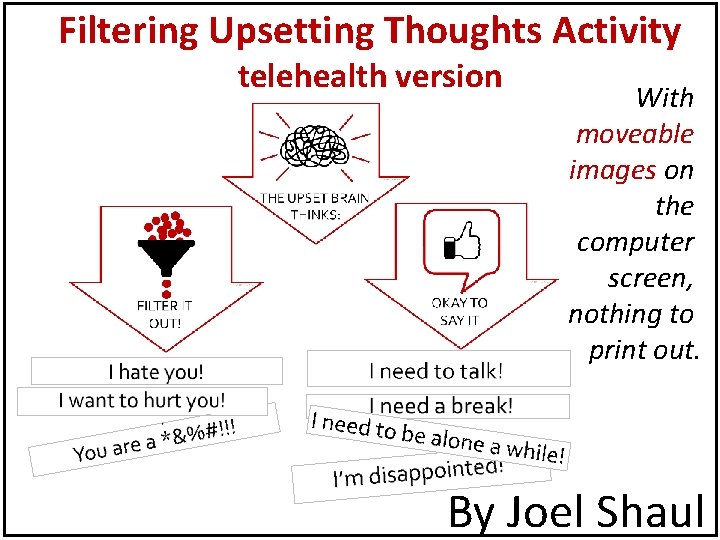
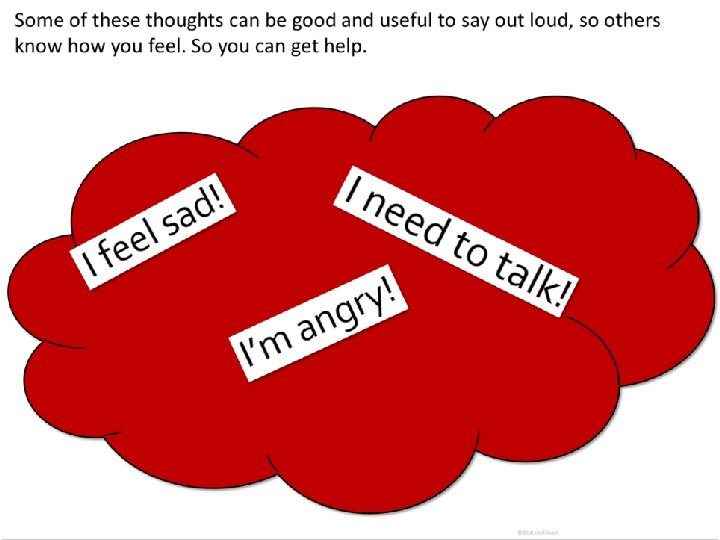
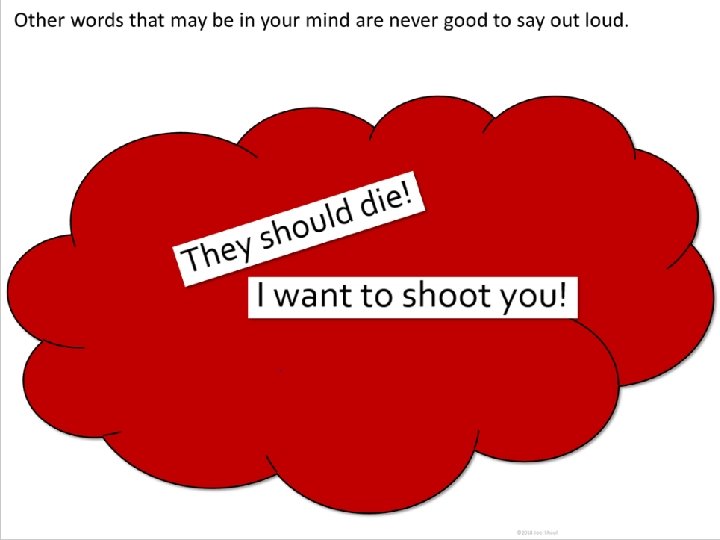
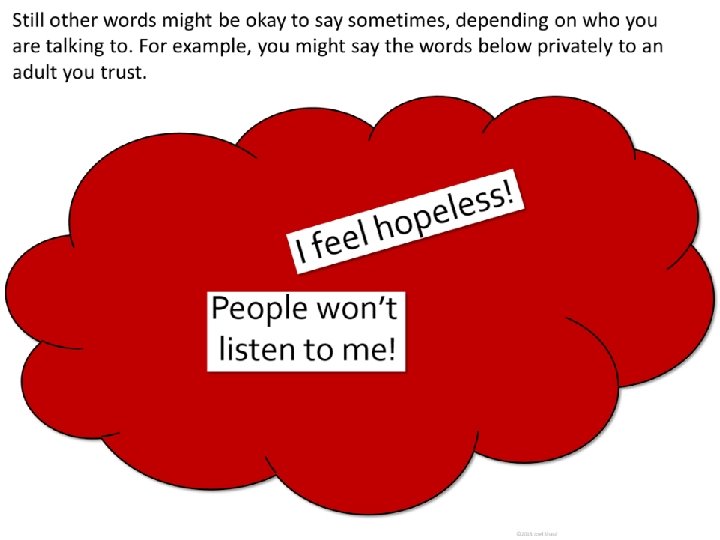
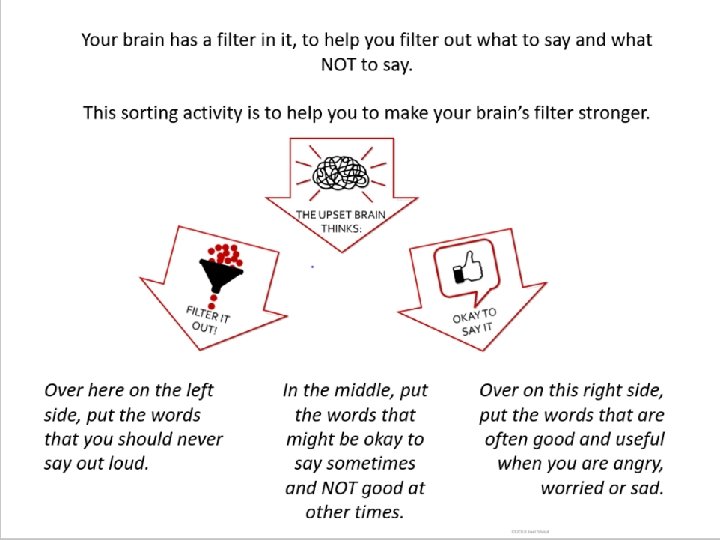
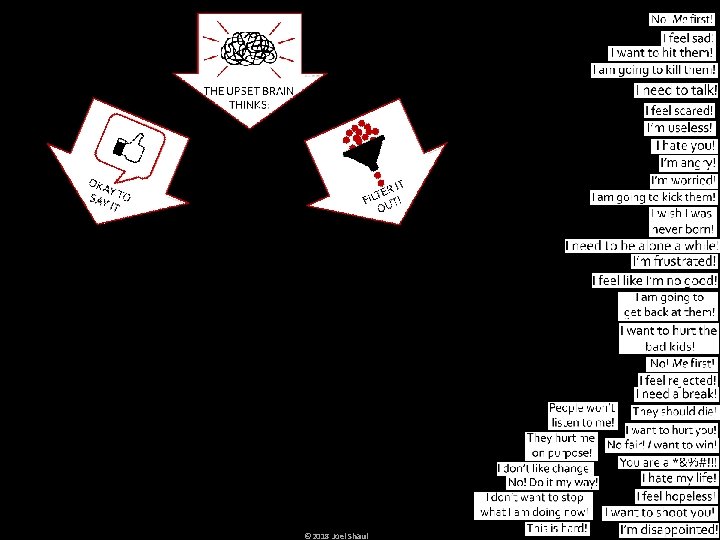
Filtering Upsetting Thoughts Activity telehealth version With moveable images on the computer screen, nothing to print out. By Joel Shaul
© 2018 Joel Shaul
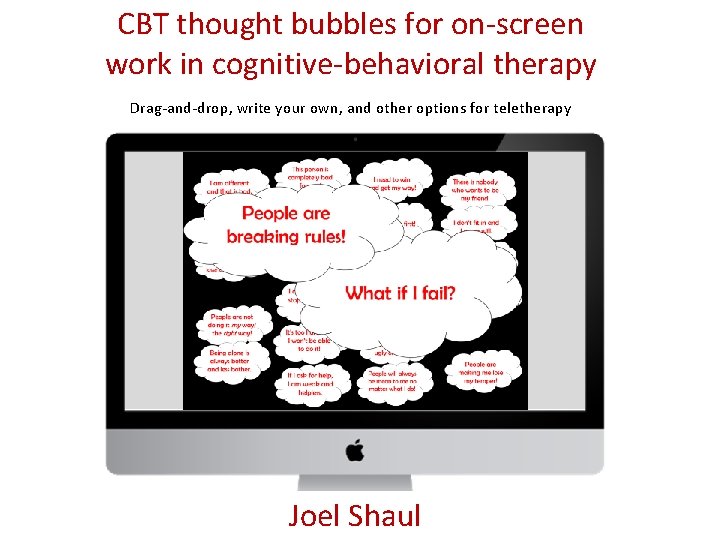
CBT thought bubbles for on-screen work in cognitive-behavioral therapy Drag-and-drop, write your own, and other options for teletherapy Joel Shaul
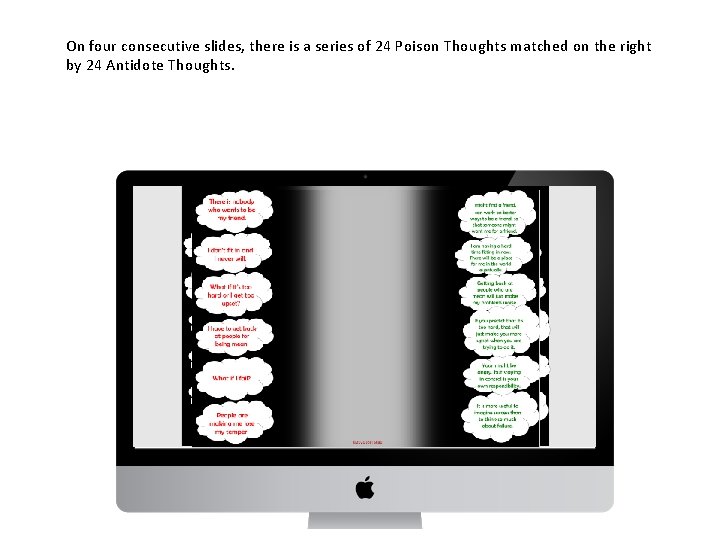
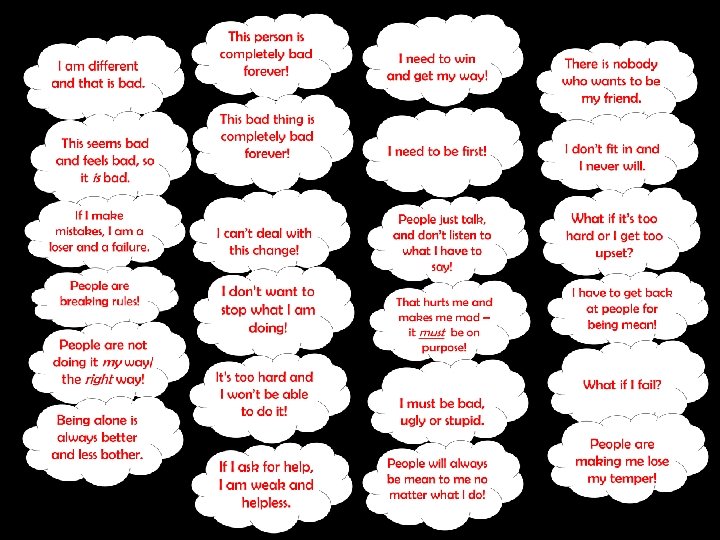
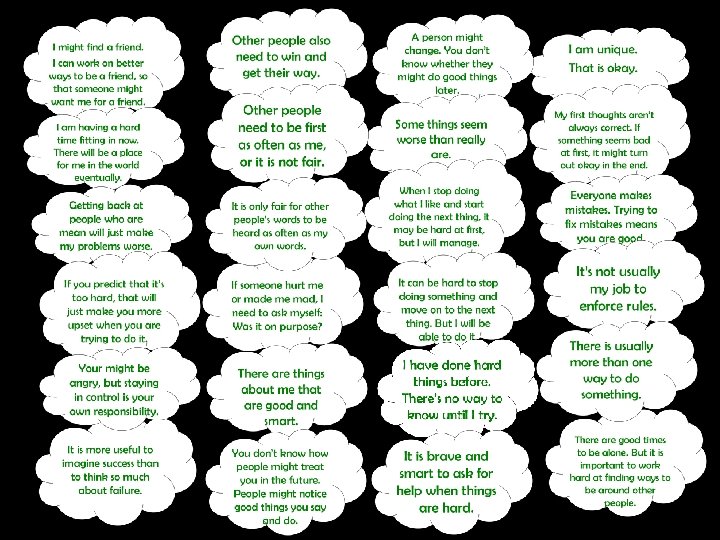
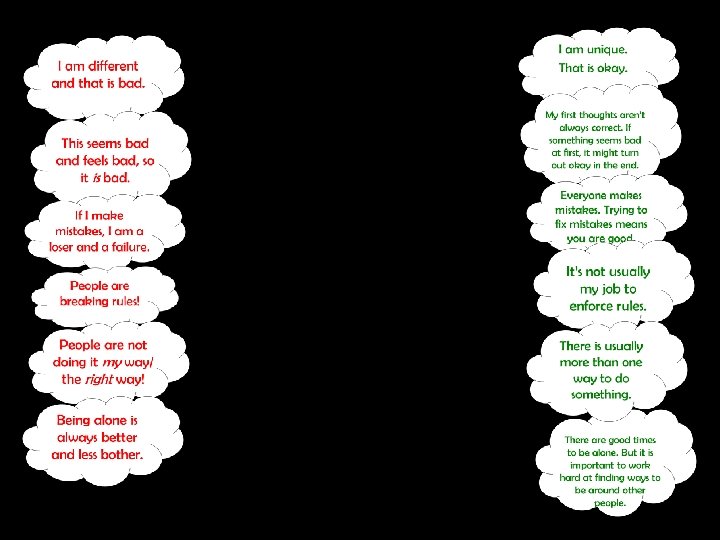
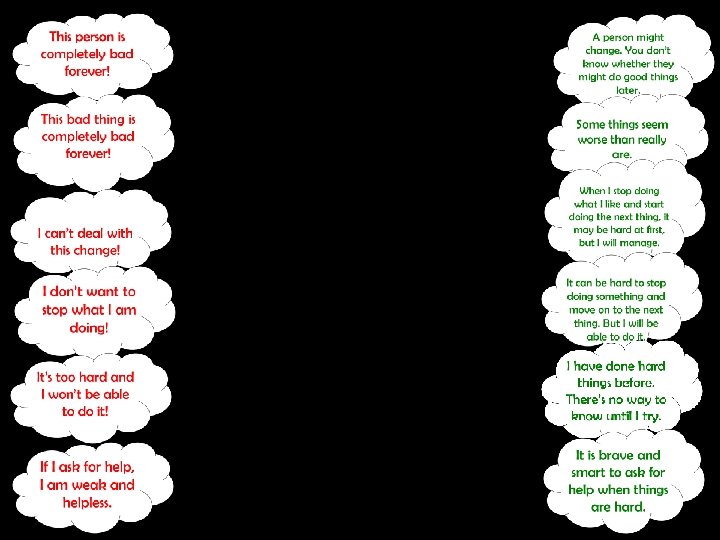
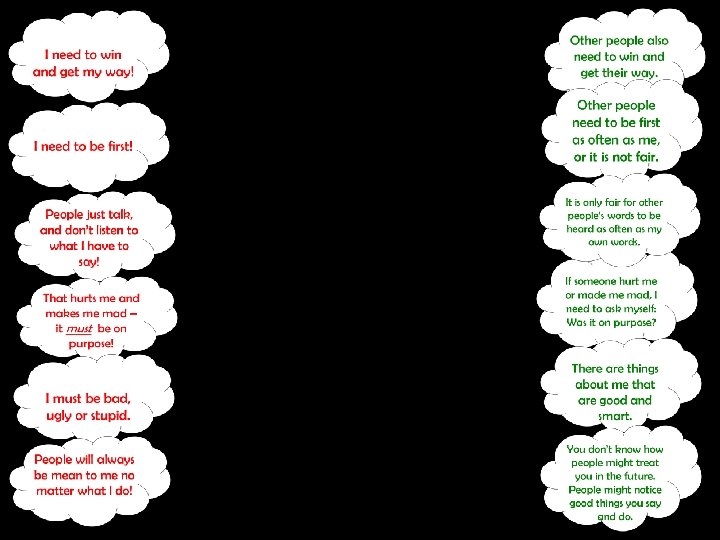
On four consecutive slides, there is a series of 24 Poison Thoughts matched on the right by 24 Antidote Thoughts.
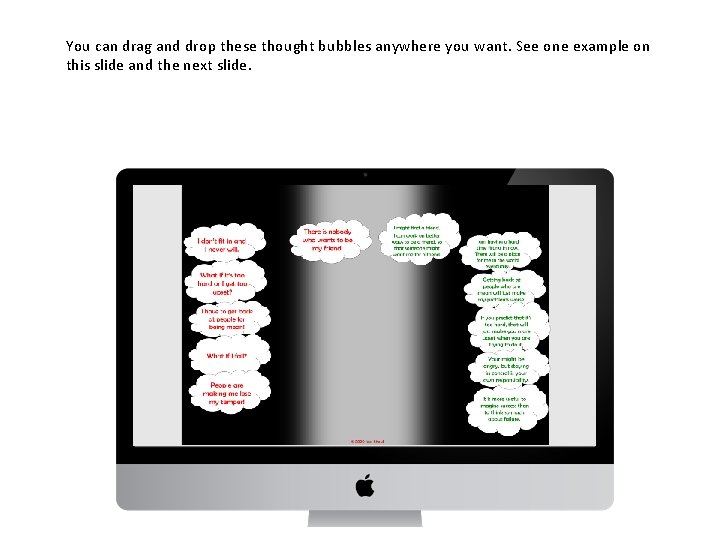
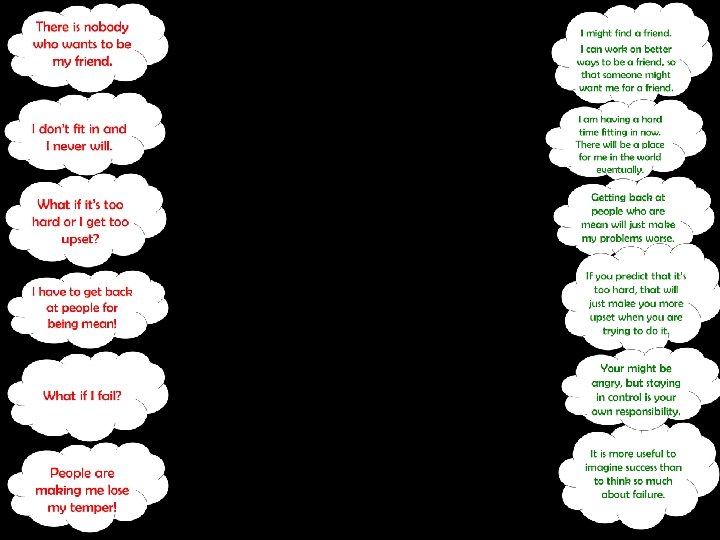
You can drag and drop these thought bubbles anywhere you want. See one example on this slide and the next slide.
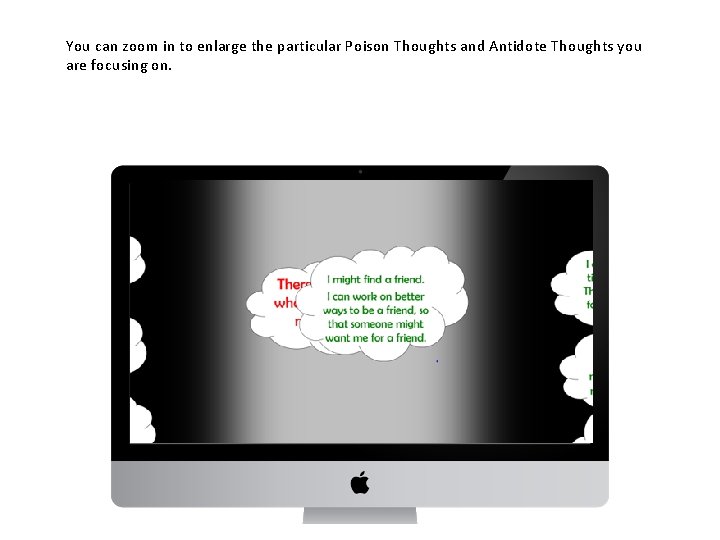
You can zoom in to enlarge the particular Poison Thoughts and Antidote Thoughts you are focusing on.
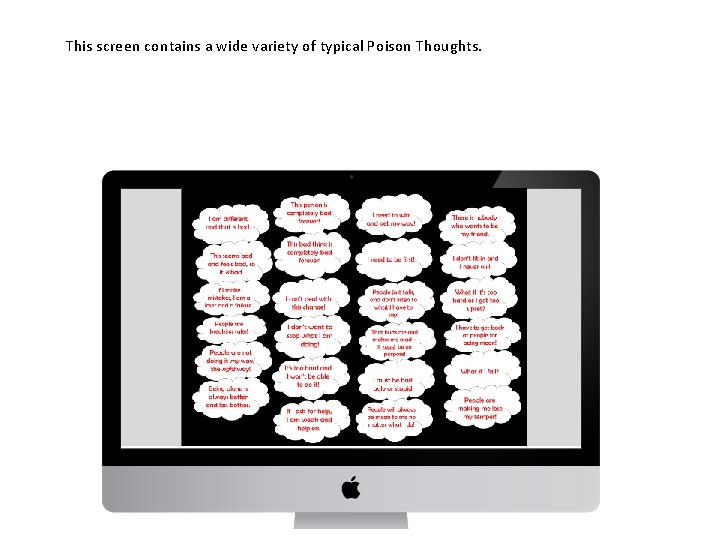
This screen contains a wide variety of typical Poison Thoughts.
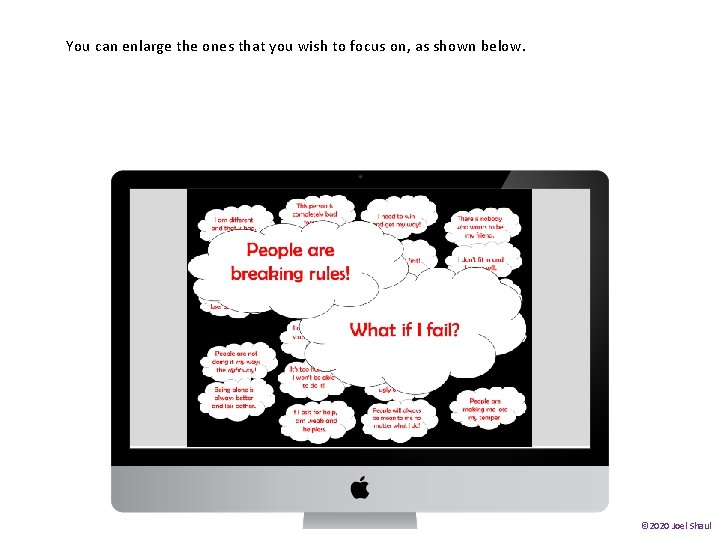
You can enlarge the ones that you wish to focus on, as shown below. © 2020 Joel Shaul
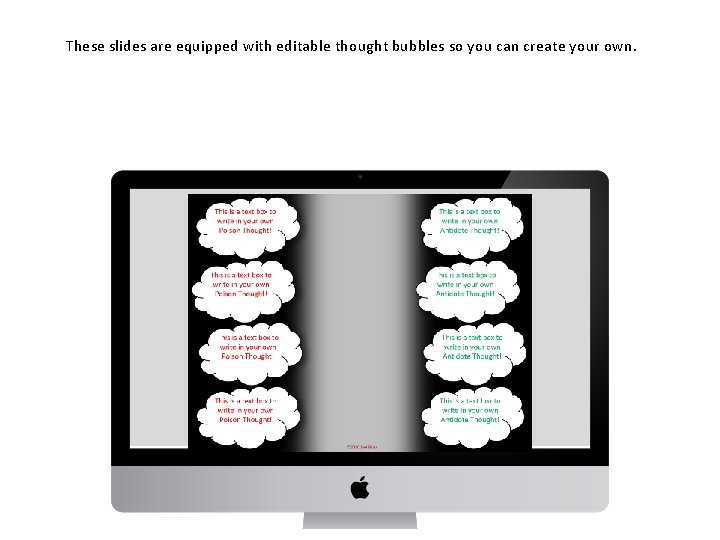
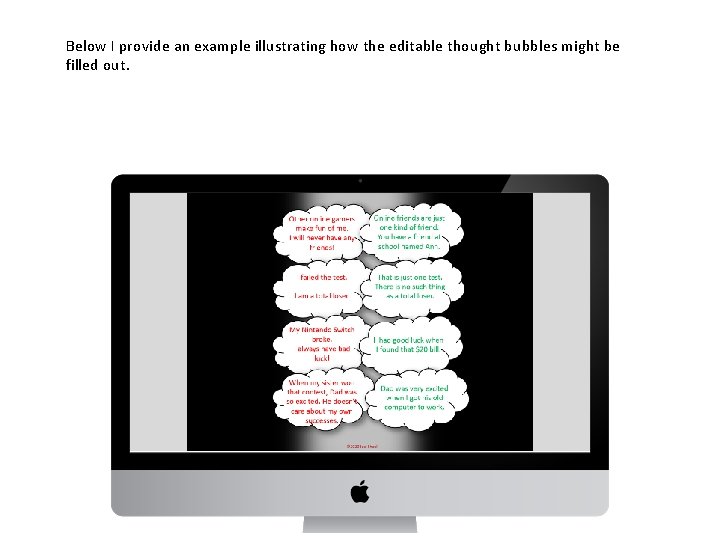
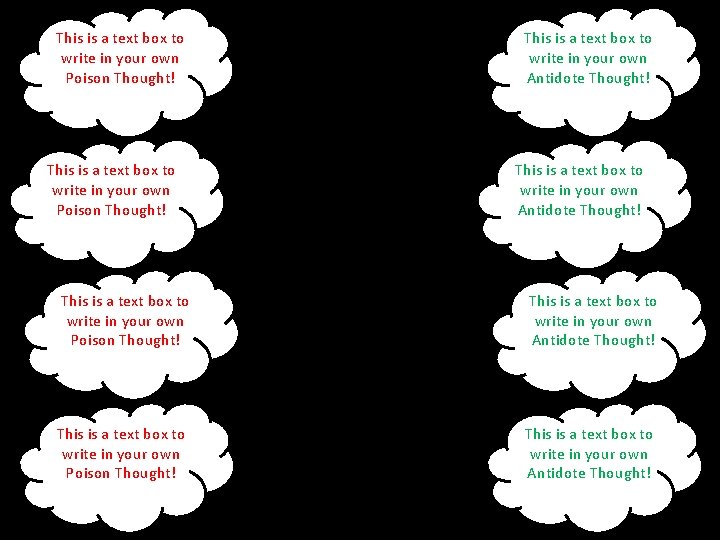
These slides are equipped with editable thought bubbles so you can create your own.
Below I provide an example illustrating how the editable thought bubbles might be filled out.
This is a text box to write in your own Poison Thought! This is a text box to write in your own Antidote Thought!
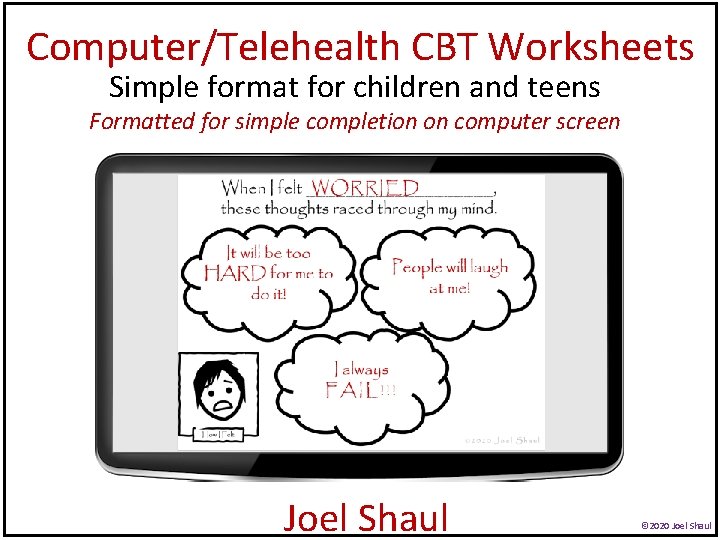
Computer/Telehealth CBT Worksheets Simple format for children and teens Formatted for simple completion on computer screen Joel Shaul © 2020 Joel Shaul
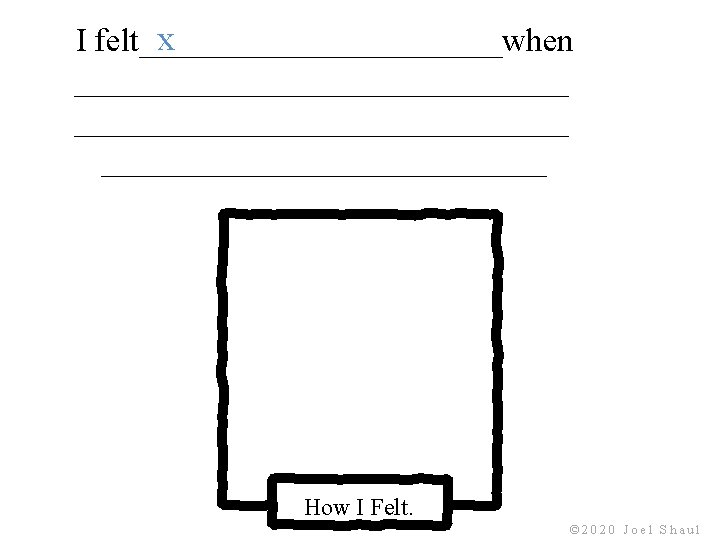
x I felt___________when ______________________________ How I Felt. © 2020 Joel Shaul
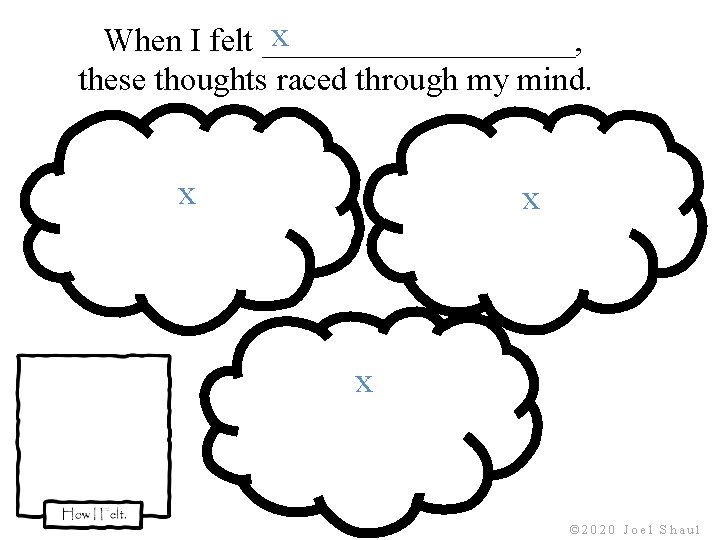
x When I felt __________, these thoughts raced through my mind. x x x © 2020 Joel Shaul
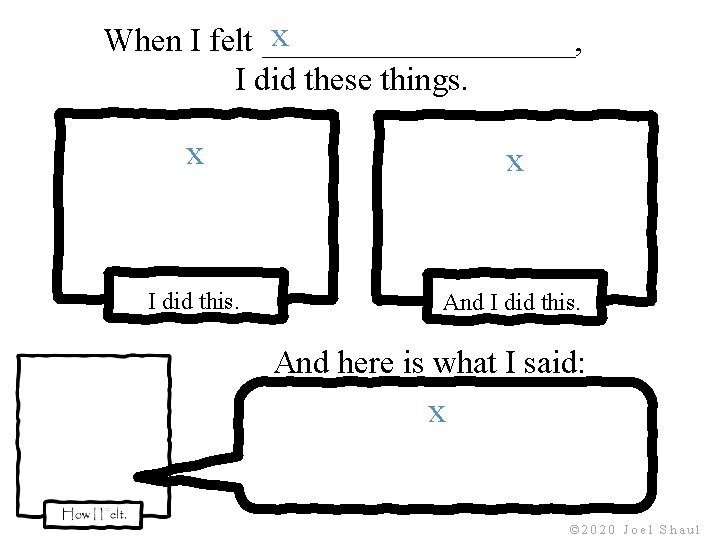
x When I felt __________, I did these things. x x I did this. And here is what I said: x © 2020 Joel Shaul
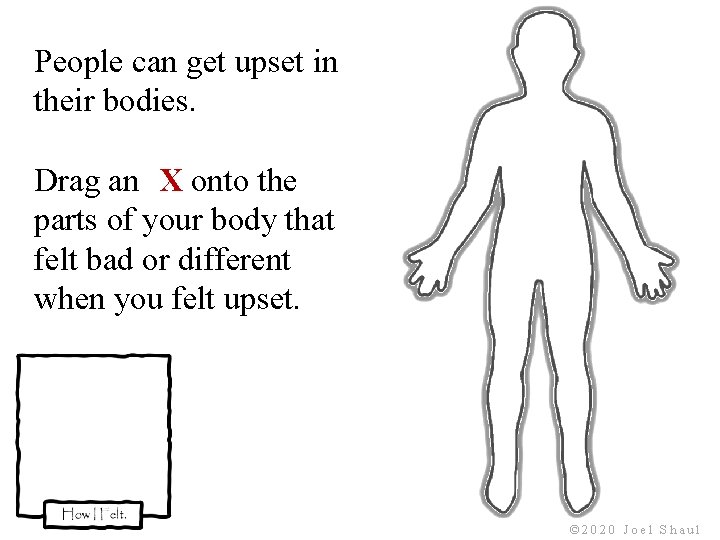
People can get upset in their bodies. Drag an X onto the parts of your body that felt bad or different when you felt upset. © 2020 Joel Shaul
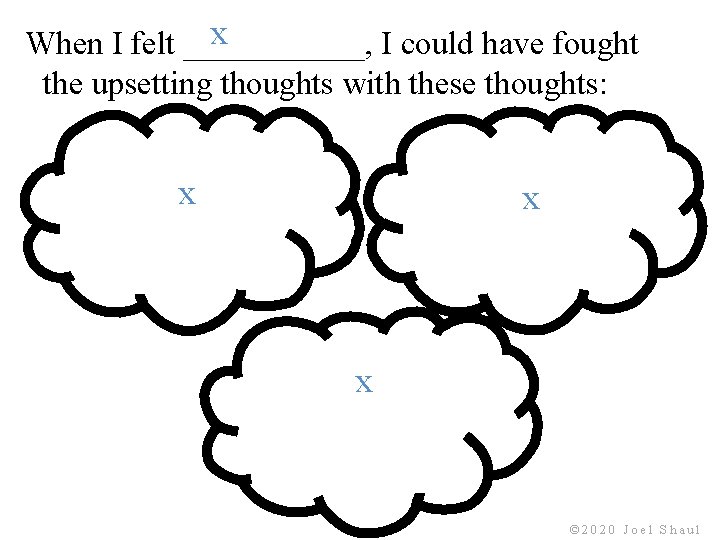
x When I felt ______, I could have fought the upsetting thoughts with these thoughts: x x x © 2020 Joel Shaul
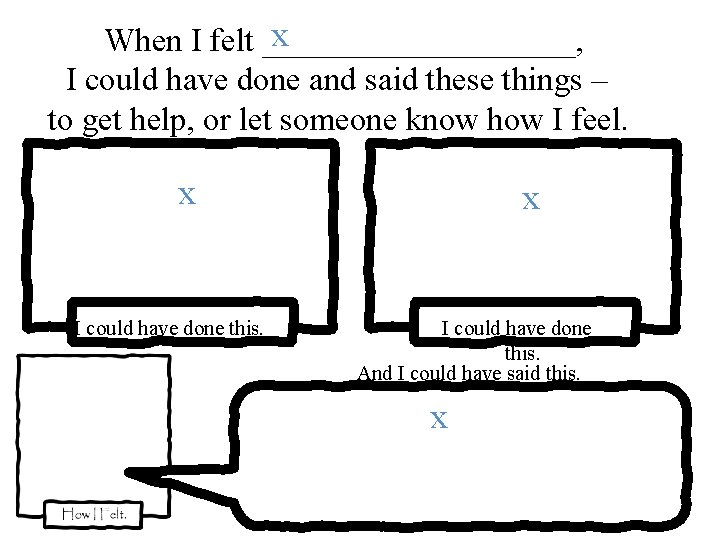
x When I felt __________, I could have done and said these things – to get help, or let someone know how I feel. x I could have done this. And I could have said this. x
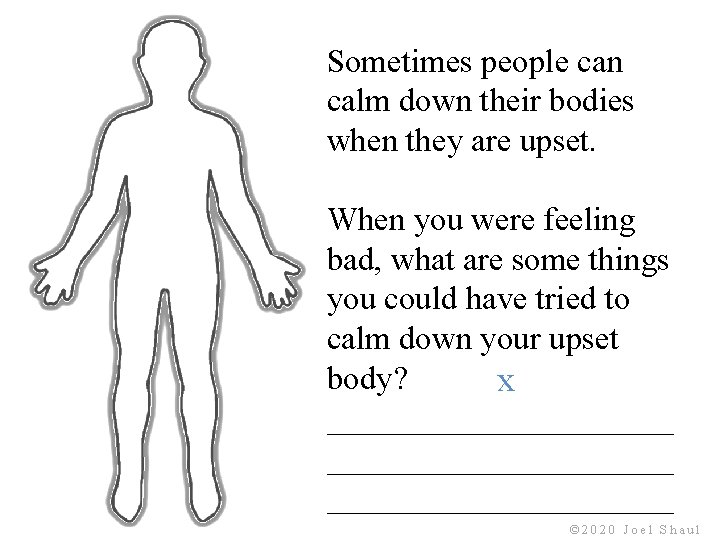
Sometimes people can calm down their bodies when they are upset. When you were feeling bad, what are some things you could have tried to calm down your upset body? x _____________________ © 2020 Joel Shaul
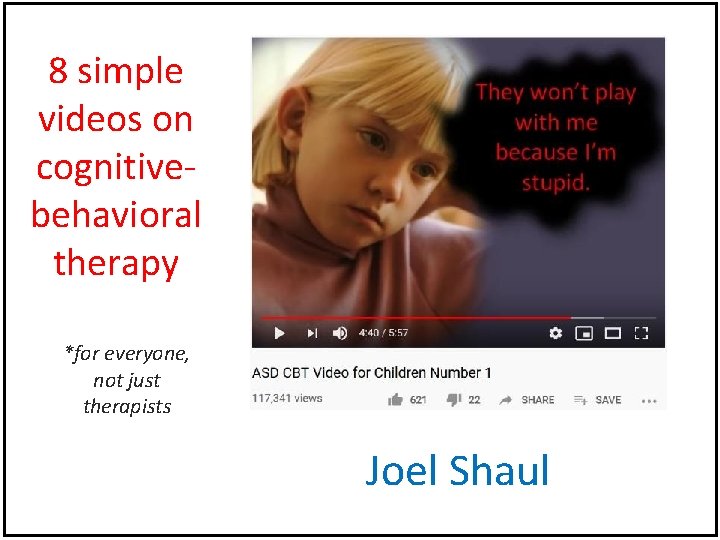
8 simple videos on cognitivebehavioral therapy *for everyone, not just therapists Joel Shaul
More free resources not originally designed for teletherapy but quite useful in that modality. http: //autismteachingstrategies. com/autism-strategies/correcting-others-and-tattling-toomuch-social-skills-activities-to-teach-kids-with-autism-who-have-these-problems/ http: //autismteachingstrategies. com/autism-strategies/helping-teen-boys-with-highfunctioning-autism-to-relate-to-girls-card-game-activity-and-social-skills-teachingmaterials/ http: //autismteachingstrategies. com/autism-strategies/teasing-and-bullying-social-skillskit-for-kids-with-asd-free-download-cards-and-illustrated-panels/ http: //autismteachingstrategies. com/autism-strategies/social-skills-card-teaching-activityfor-children-with-asd-who-are-isolated/ http: //autismteachingstrategies. com/autism-strategies/the-conversation-boxconversation-training-tool-for-children-with-high-functioning-autism-and-aspergers/
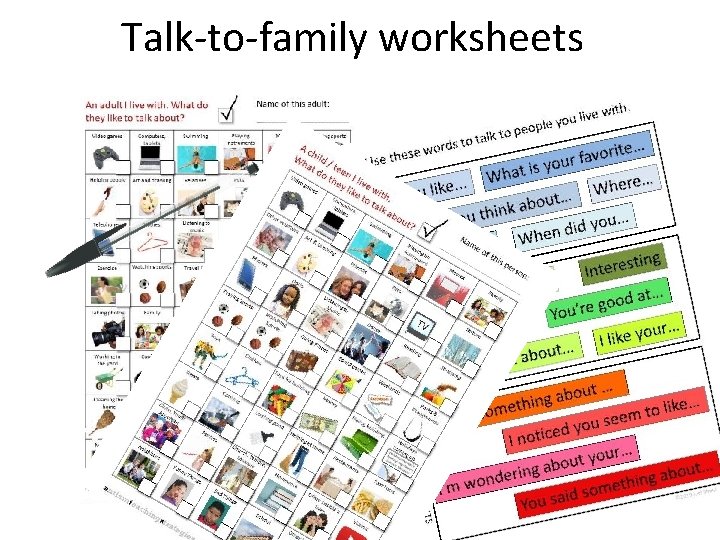
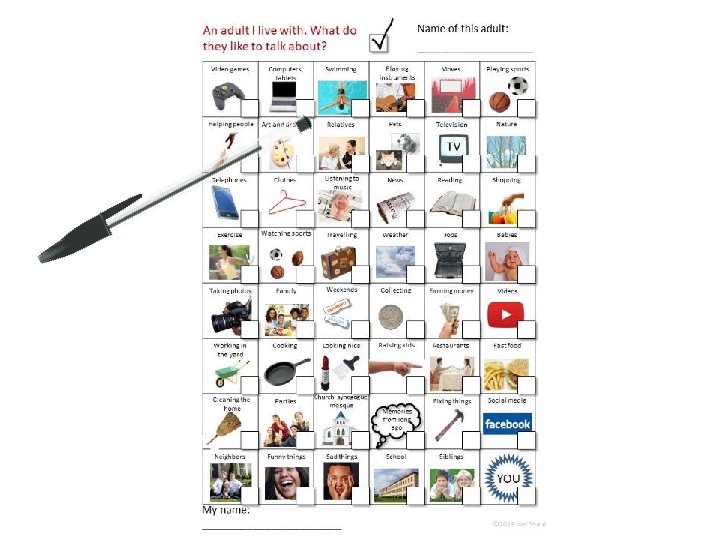
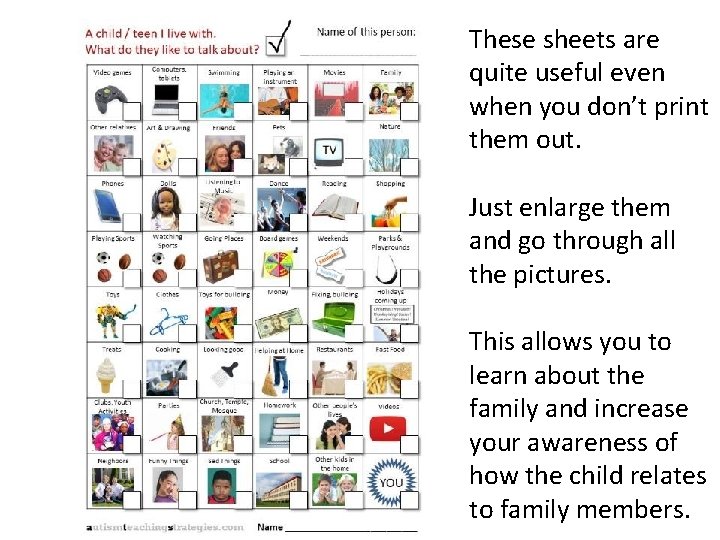
Talk-to-family worksheets
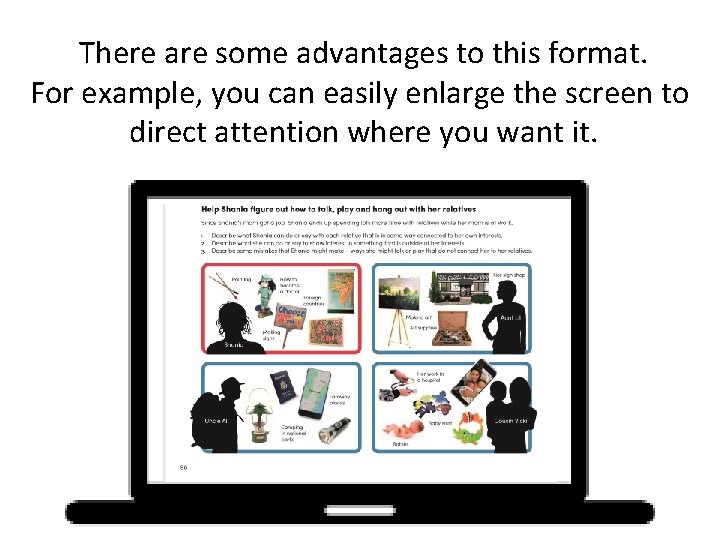
These sheets are quite useful even when you don’t print them out. Just enlarge them and go through all the pictures. This allows you to learn about the family and increase your awareness of how the child relates to family members.
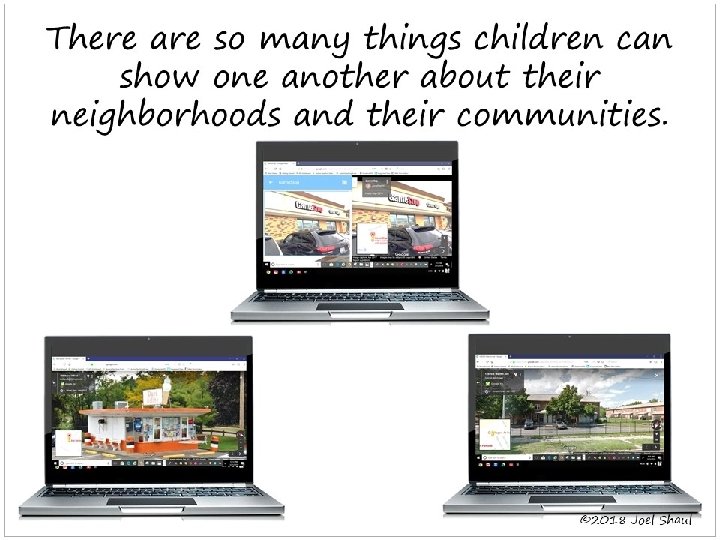
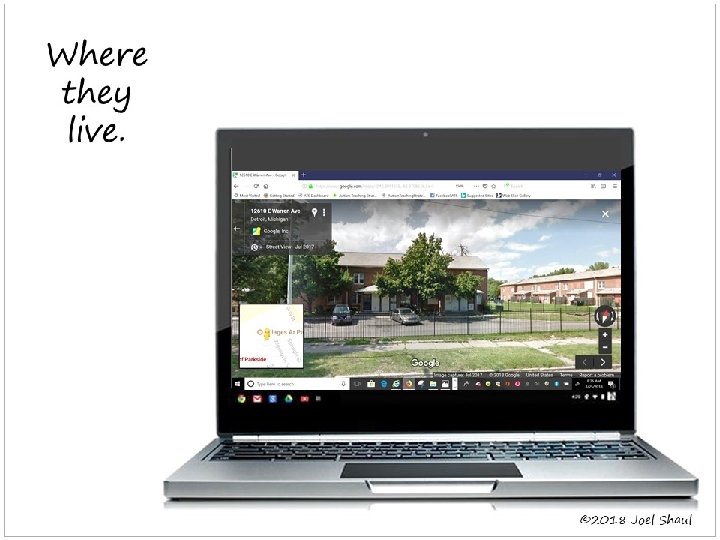
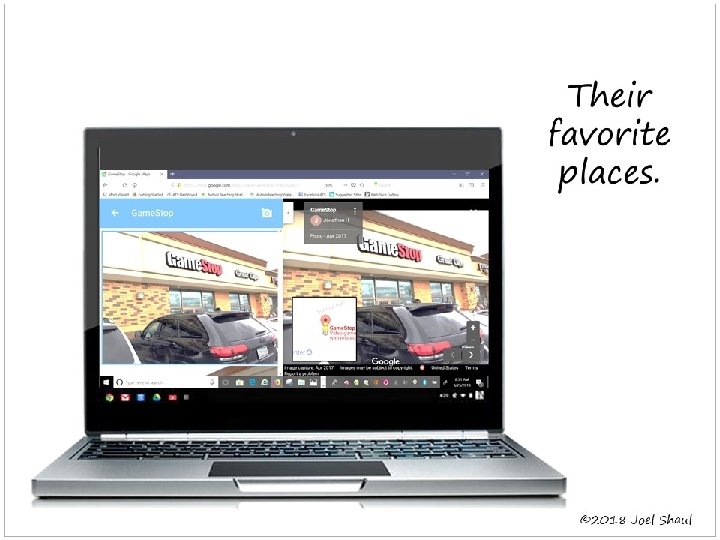
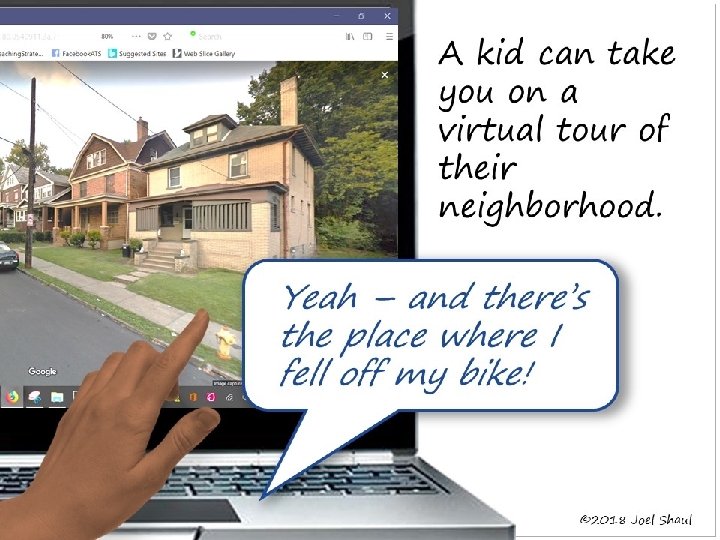
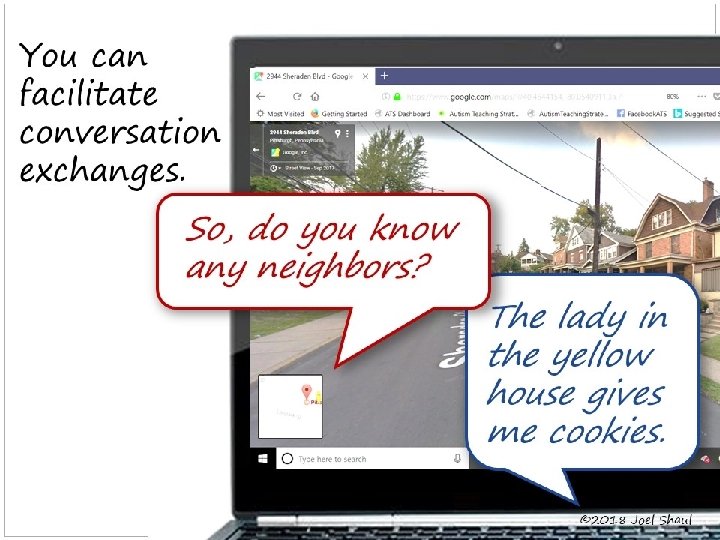
Visiting internet sites together in teletherapy
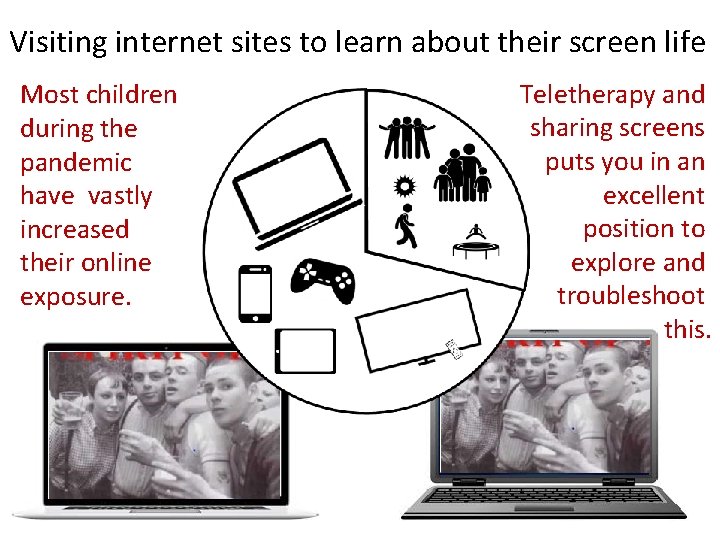
Visiting internet sites to learn about their screen life Most children during the pandemic have vastly increased their online exposure. Teletherapy and sharing screens puts you in an excellent position to explore and troubleshoot this.
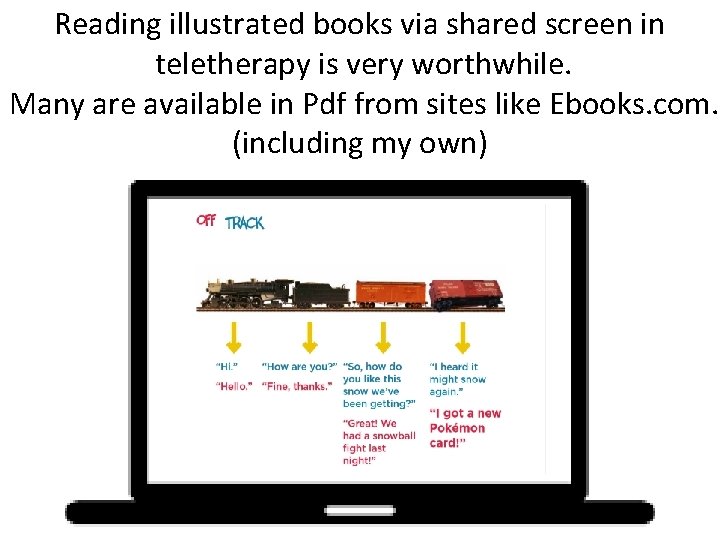
Reading illustrated books via shared screen in teletherapy is very worthwhile. Many are available in Pdf from sites like Ebooks. com. (including my own)
There are some advantages to this format. For example, you can easily enlarge the screen to direct attention where you want it.
Let me know how these resources worked for you, …or if you have any good ideas to share. joelshaul@gmail. com