
Water Resource Management in Norway Water Resources in

- Slides: 18
Water Resource Management in Norway
Water Resources in Norway • • • River systems and theri associated lakes and wetlands are complex system with folra adn faua characterised by the great diversity of species Ecological conditions diffrentriate heavily – from see to mountains Norway has many river and waterfalls, which are important for both commercial and private ( recreation) use There a number of colliding interest reg. water use – starting from water supply, whih obviously remains most important, to transport, timber floating, irrigation, sawmills and more important recently –hydropower generation Norway has a large number of dams. A dam break could have very serious consequences. The large dams in Norway have a high degree of structural safety and are followed up by owners and the NVE through supervision andcontingency planning.
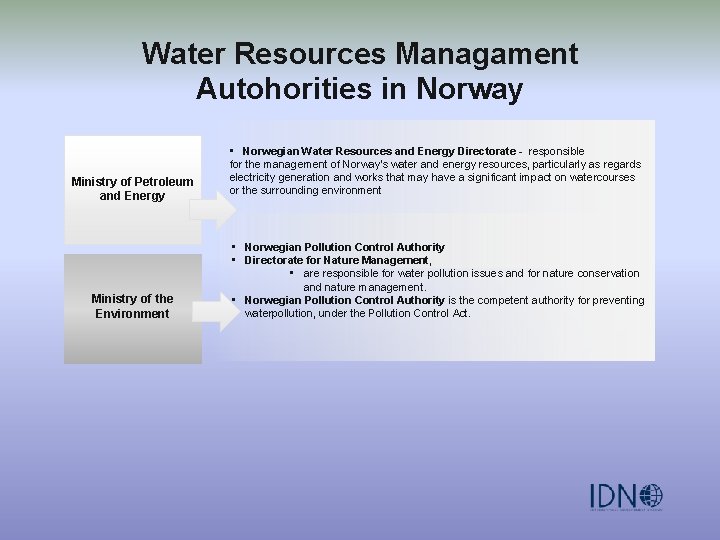
Water Resources Managament Autohorities in Norway Ministry of Petroleum and Energy Ministry of the Environment • Norwegian Water Resources and Energy Directorate - responsible for the management of Norway's water and energy resources, particularly as regards electricity generation and works that may have a significant impact on watercourses or the surrounding environment • Norwegian Pollution Control Authority • Directorate for Nature Management, • are responsible for water pollution issues and for nature conservation and nature management. • Norwegian Pollution Control Authority is the competent authority for preventing waterpollution, under the Pollution Control Act.
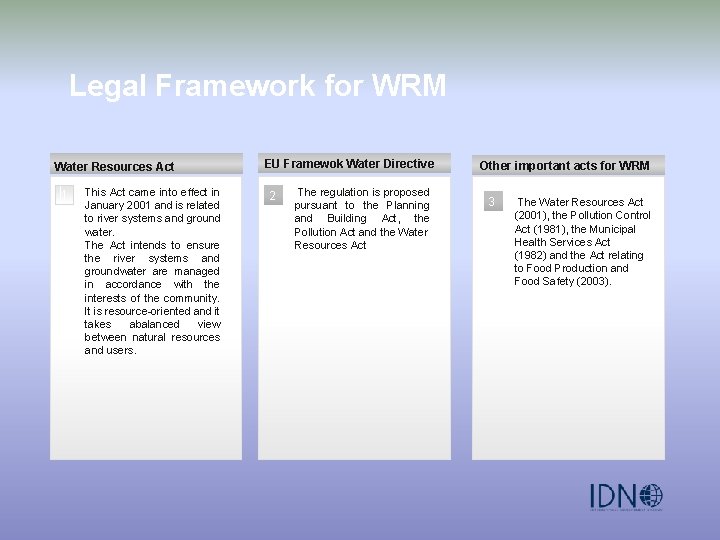
Legal Framework for WRM Water Resources Act 1 This Act came into effect in January 2001 and is related to river systems and ground water. The Act intends to ensure the river systems and groundwater are managed in accordance with the interests of the community. It is resource-oriented and it takes abalanced view between natural resources and users. EU Framewok Water Directive 2 t. The regulation is proposed pursuant to the Planning and Building Act, the Pollution Act and the Water Resources Act Other important acts for WRM 3 t. The Water Resources Act (2001), the Pollution Control Act (1981), the Municipal Health Services Act (1982) and the Act relating to Food Production and Food Safety (2003).
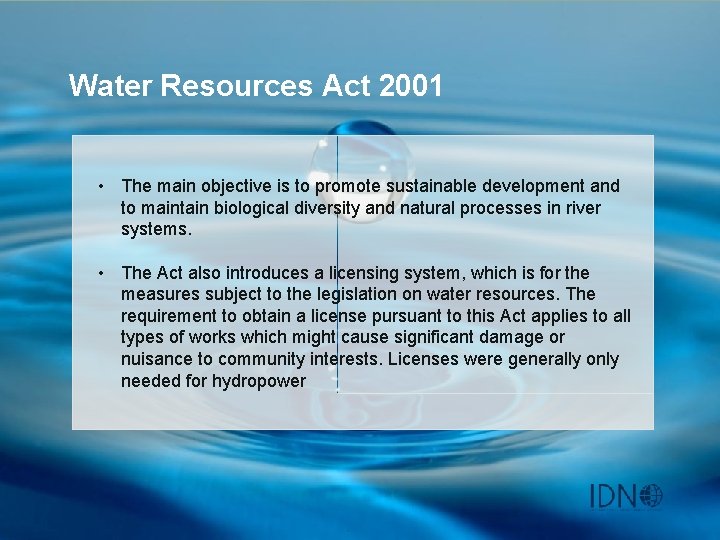
Water Resources Act 2001 • The main objective is to promote sustainable development and to maintain biological diversity and natural processes in river systems. • The Act also introduces a licensing system, which is for the measures subject to the legislation on water resources. The requirement to obtain a license pursuant to this Act applies to all types of works which might cause significant damage or nuisance to community interests. Licenses were generally only needed for hydropower
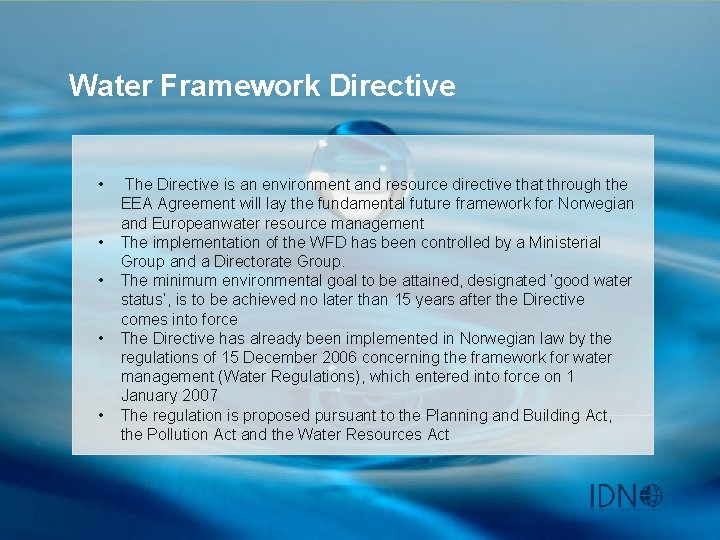
Water Framework Directive • • • The Directive is an environment and resource directive that through the EEA Agreement will lay the fundamental future framework for Norwegian and Europeanwater resource management The implementation of the WFD has been controlled by a Ministerial Group and a Directorate Group. The minimum environmental goal to be attained, designated ‘good water status’, is to be achieved no later than 15 years after the Directive comes into force The Directive has already been implemented in Norwegian law by the regulations of 15 December 2006 concerning the framework for water management (Water Regulations), which entered into force on 1 January 2007 The regulation is proposed pursuant to the Planning and Building Act, the Pollution Act and the Water Resources Act
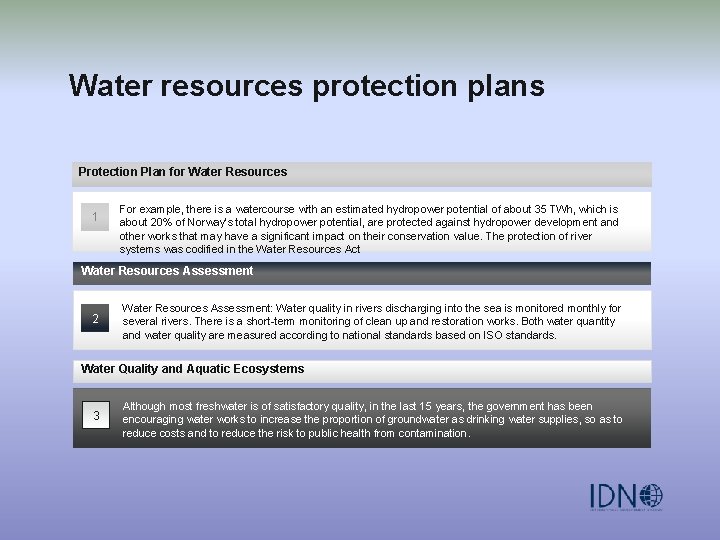
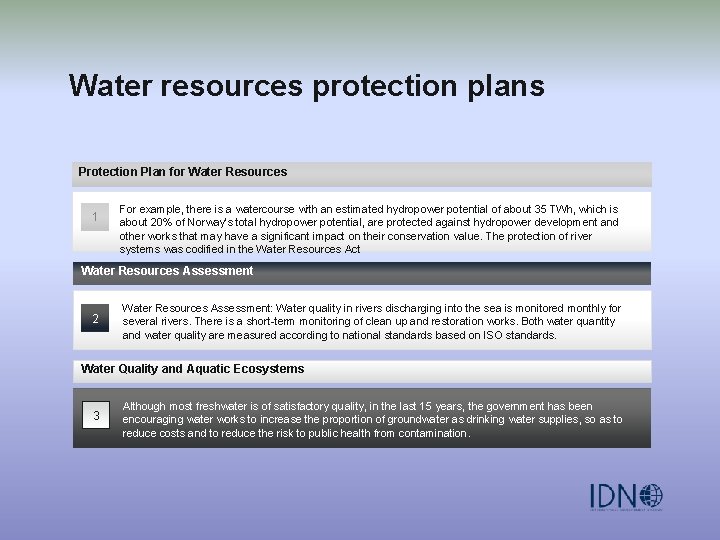
Water resources protection plans Protection Plan for Water Resources 1 For example, there is a watercourse with an estimated hydropower potential of about 35 TWh, which is about 20% of Norway’s total hydropower potential, are protected against hydropower development and other works that may have a significant impact on their conservation value. The protection of river systems was codified in the Water Resources Act Water Resources Assessment 2 Water Resources Assessment: Water quality in rivers discharging into the sea is monitored monthly for several rivers. There is a short-term monitoring of clean up and restoration works. Both water quantity and water quality are measured according to national standards based on ISO standards. Water Quality and Aquatic Ecosystems 3 Although most freshwater is of satisfactory quality, in the last 15 years, the government has been encouraging water works to increase the proportion of groundwater as drinking water supplies, so as to reduce costs and to reduce the risk to public health from contamination.
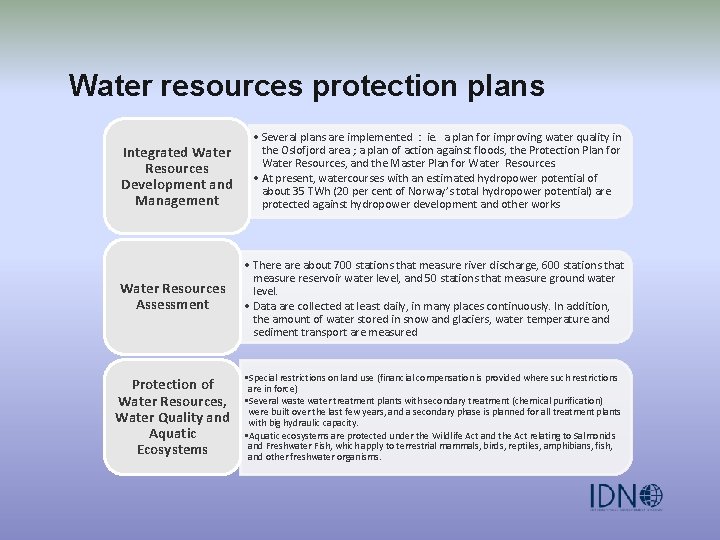
Water resources protection plans Integrated Water Resources Development and Management • Several plans are implemented : ie. a plan for improving water quality in the Oslofjord area ; a plan of action against floods, the Protection Plan for Water Resources, and the Master Plan for Water Resources. • At present, watercourses with an estimated hydropower potential of about 35 TWh (20 per cent of Norway’s total hydropower potential) are protected against hydropower development and other works Water Resources Assessment • There about 700 stations that measure river discharge, 600 stations that measure reservoir water level, and 50 stations that measure ground water level. • Data are collected at least daily, in many places continuously. In addition, the amount of water stored in snow and glaciers, water temperature and sediment transport are measured Protection of Water Resources, Water Quality and Aquatic Ecosystems • Special restrictions on land use (financial compensation is provided where such restrictions are in force) • Several waste water treatment plants with secondary treatment (chemical purification) were built over the last few years, and a secondary phase is planned for all treatment plants with big hydraulic capacity. • Aquatic ecosystems are protected under the Wildlife Act and the Act relating to Salmonids and Freshwater Fish, which apply to terrestrial mammals, birds, reptiles, amphibians, fish, and other freshwater organisms.
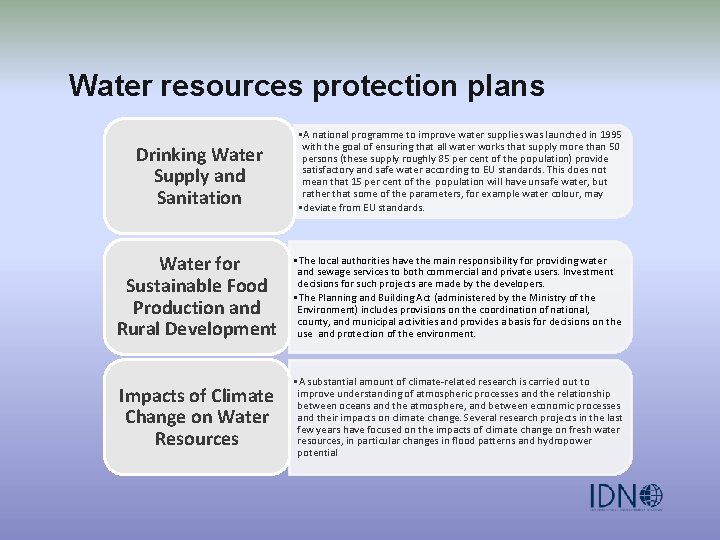
Water resources protection plans Drinking Water Supply and Sanitation • A national programme to improve water supplies was launched in 1995 with the goal of ensuring that all water works that supply more than 50 persons (these supply roughly 85 per cent of the population) provide satisfactory and safe water according to EU standards. This does not mean that 15 per cent of the population will have unsafe water, but rather that some of the parameters, for example water colour, may • deviate from EU standards. Water for Sustainable Food Production and Rural Development • The local authorities have the main responsibility for providing water and sewage services to both commercial and private users. Investment decisions for such projects are made by the developers. • The Planning and Building Act (administered by the Ministry of the Environment) includes provisions on the coordination of national, county, and municipal activities and provides a basis for decisions on the use and protection of the environment. Impacts of Climate Change on Water Resources • A substantial amount of climate-related research is carried out to improve understanding of atmospheric processes and the relationship between oceans and the atmosphere, and between economic processes and their impacts on climate change. Several research projects in the last few years have focused on the impacts of climate change on fresh water resources, in particular changes in flood patterns and hydropower potential
Water resources protection plans Protection Plan for Water Resources 1 For example, there is a watercourse with an estimated hydropower potential of about 35 TWh, which is about 20% of Norway’s total hydropower potential, are protected against hydropower development and other works that may have a significant impact on their conservation value. The protection of river systems was codified in the Water Resources Act Water Resources Assessment 2 Water Resources Assessment: Water quality in rivers discharging into the sea is monitored monthly for several rivers. There is a short-term monitoring of clean up and restoration works. Both water quantity and water quality are measured according to national standards based on ISO standards. Water Quality and Aquatic Ecosystems 3 Although most freshwater is of satisfactory quality, in the last 15 years, the government has been encouraging water works to increase the proportion of groundwater as drinking water supplies, so as to reduce costs and to reduce the risk to public health from contamination.
Research for sustainable water management • • • Research and Technologies: Several institutions carry out research and provide scientific advice on issues related to water management, such as the Norwegian Institute for Water Research, the Norwegian Institute for Nature Research, the Norwegian Institute of Public Health and the Norwegian Water Resources and Energy Directorate. Research is funded by the institutions themselves, the Research Council of Norway, the EU, or others. Drinking Water 2000 is a research programme designed to improve drinking water quality caused by specific Norwegian (or Nordic) problems , mostly due to the impact of climate on water quality and population distribution.
Study case : Integrated Water Management in Glooma • • • Glomma is the largest river in Norway with a catchment area of 41 200 km 2 covering 13 % of Norway’s land area. Mean annual flow is 700 m 3/s and 16 % of the water can be stored. 15 % of Norway’s population lives in the catchment. The population density, however, is low in a global comparison. The north-western parts of the Glomma basin consist of high mountain areas (Jotunheimen area with Norway’s highest peak: Galdhøpiggen (2468 m asl. ) with high precipitation and glaciated areas. The eastern part is covered by forest areas, whereas the central and southern parts comprise larger agricultural and urban areas Before the ongoing implementation of the EU Water Framework Directive, Glomma has a history of transparent and knowledge-based IWRM plans: Lake Mjøsa; Action Plan (Mjøsaksjonen). Action Plan Glomma (Handlingsplan Glomma), the Master Plan for Hydropower (Samlet Plan) and the comprehensive licensing procedure for hydropower development of Øvre Otta)
Integrated Water Management in Glooma • • An integrated interdisciplinary assessment in four twinning river basins is a three year EC funded project 2006 -2009 under the 6 th framework programme (FP 6) coordinated jointly by Bioforsk and NIVA. Project STRIVER activities have aimed at providing practical tools for ongoing water management activities in Glomma. The two scientific based practical tools applied in Glomma; 1) Modelling nutrients in Hunnselva and Lena river basins related to water pollution control issues in the River Basin Management Plan under the WDF 2) Multiple criteria analysis of environmental flows with pressure- impact curves in Øyeren and Høyegga, have both contributed to better knowledge in practical IWRM in these sub-basins of Glomma. It is recommended that these tools should be further developed through practical implementation, as well as through further research
Lesson learned in STRIVER • • Among the experiences and lessons learned from the work with the nutrient models; As an input to the models, various scenarios for agriculture development and pollution abatement strategies proved a valuable planning tool There is a lack of coordination between water quantity (hydrological) and quality monitoring in the region Knowledge building among stakeholders leads to better and more engaged participation and improved decision-making and that was a success factor of the project Finding an acceptable balance between environmental and user interests in an environmental flow regime is considered one of the key challenges in hydropower regulation of rivers.
Integrated Water Management in Glooma • • In the sub-basins of Øyeren and Høyegga, the approach with Pressure-Impact Multicriteria Environmental Flow Analyses proved a useful and very promising tool. The method uses a panel of experts representing different value elements, environmental issues and user interest. By illustrating their knowledge of impacts of the water regulation on each value element using pressure-impact curves, expert judgement becomes systematic and transparent. The panel uses multi-criteria analysis to illustrate trade-offs between different value elements under different environmental flow scenarios. Stakeholder panel(s) use the trade-off information, provided by the multi-criteria analysis, as a basis for identifying an acceptable regime, including mitigation and compensation measures. PIMCEFA method in the Glomma sub-basins Høyegga and Øyeren: - The method allows for systematic and documented participation and influence on environmental flow regimes
Conclusions • Norway has well developed water management system with the number of institutions regulating its performance. Hydropower is more ane more in use, however it is strictly licensed bt the state • The basis of the local management is an established cooperation between local shareholders ( research, authorities, private sector) • Sustainable water resource manegement is one the important directions of a Norwegian environmental policy
THANK YOU! Your Logo