
Unit 9 Corporate Social Responsibility Skills focus Listening
Unit 9 Corporate Social Responsibility
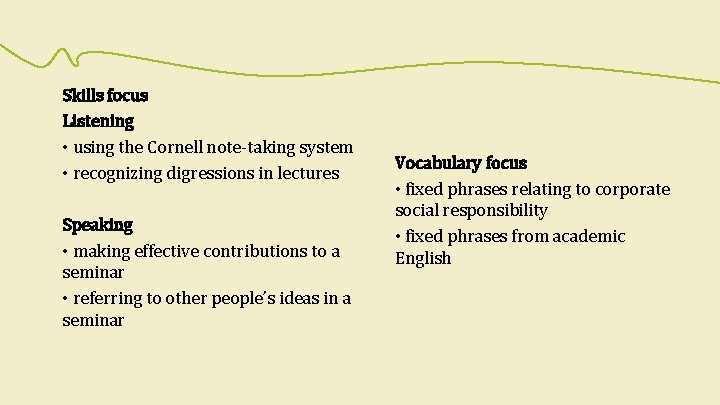
Skills focus Listening • using the Cornell note-taking system • recognizing digressions in lectures Speaking • making effective contributions to a seminar • referring to other people’s ideas in a seminar Vocabulary focus • fixed phrases relating to corporate social responsibility • fixed phrases from academic English
9. 1 Vocabulary 9. 2 Listening 9. 3 Extending Skills 9. 4 Extending Skills
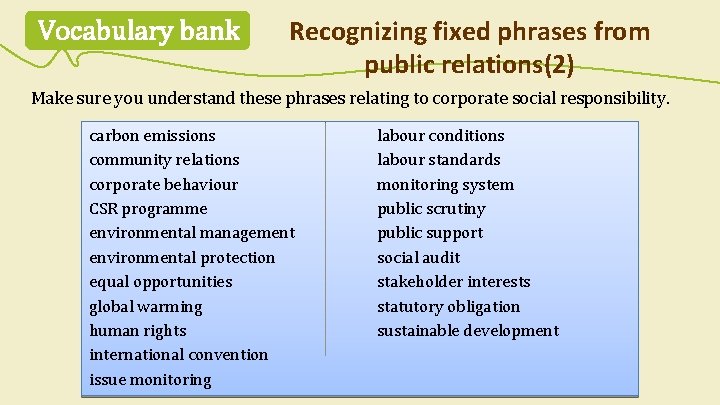
Vocabulary bank Recognizing fixed phrases from public relations(2) Make sure you understand these phrases relating to corporate social responsibility. carbon emissions community relations corporate behaviour CSR programme environmental management environmental protection equal opportunities global warming human rights international convention issue monitoring labour conditions labour standards monitoring system public scrutiny public support social audit stakeholder interests statutory obligation sustainable development
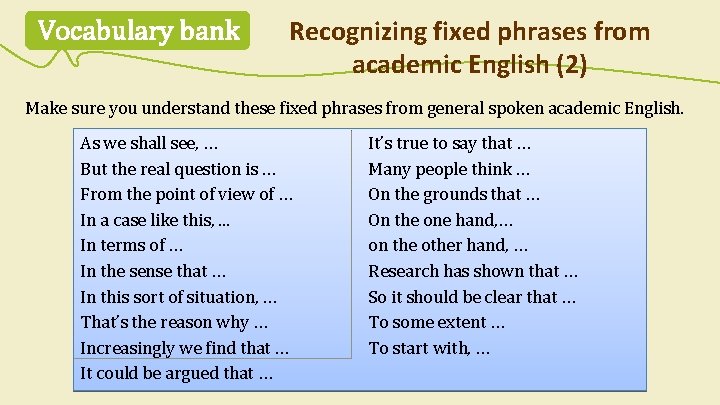
Vocabulary bank Recognizing fixed phrases from academic English (2) Make sure you understand these fixed phrases from general spoken academic English. As we shall see, … But the real question is … From the point of view of … In a case like this, . . . In terms of … In the sense that … In this sort of situation, … That’s the reason why … Increasingly we find that … It could be argued that … It’s true to say that … Many people think … On the grounds that … On the one hand, … on the other hand, … Research has shown that … So it should be clear that … To some extent … To start with, …
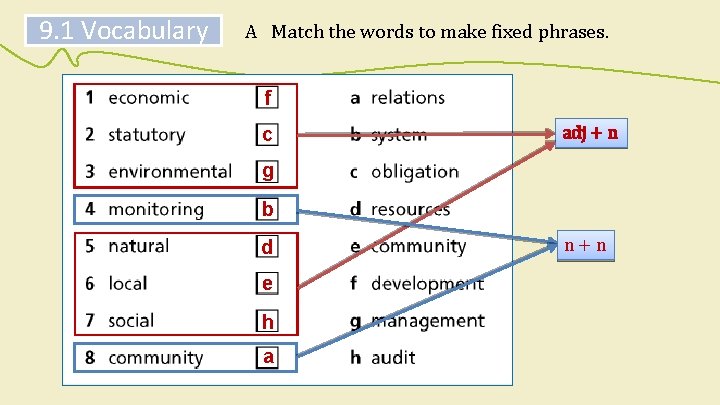
9. 1 Vocabulary A Match the words to make fixed phrases. f c adj + n g b d e h a n+n
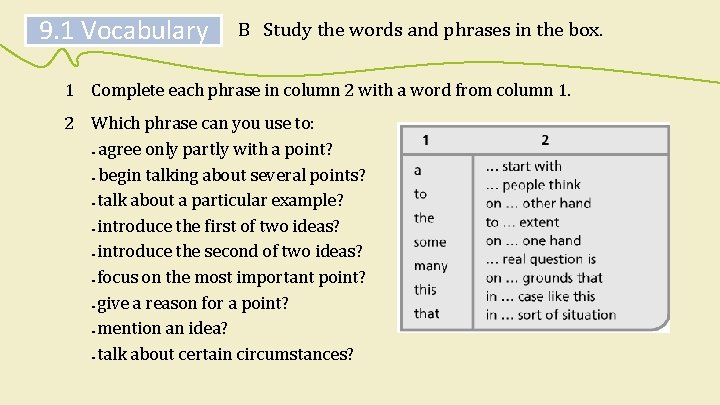
9. 1 Vocabulary B Study the words and phrases in the box. 1 Complete each phrase in column 2 with a word from column 1. 2 Which phrase can you use to: agree only partly with a point? begin talking about several points? talk about a particular example? introduce the first of two ideas? introduce the second of two ideas? focus on the most important point? give a reason for a point? mention an idea? talk about certain circumstances? ● ● ● ● ●
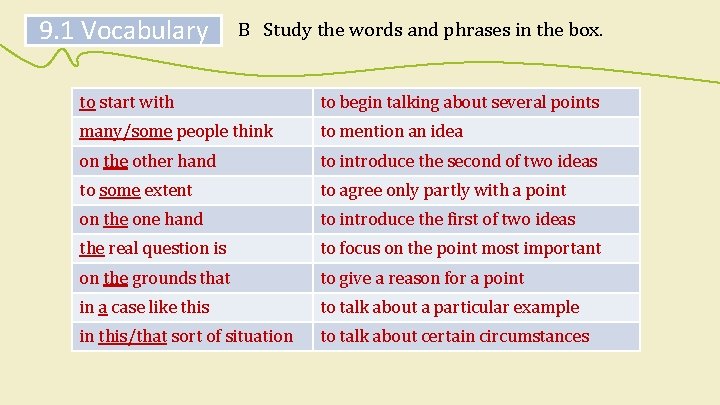
9. 1 Vocabulary B Study the words and phrases in the box. to start with to begin talking about several points many/some people think to mention an idea on the other hand to introduce the second of two ideas to some extent to agree only partly with a point on the one hand to introduce the first of two ideas the real question is to focus on the point most important on the grounds that to give a reason for a point in a case like this to talk about a particular example in this/that sort of situation to talk about certain circumstances
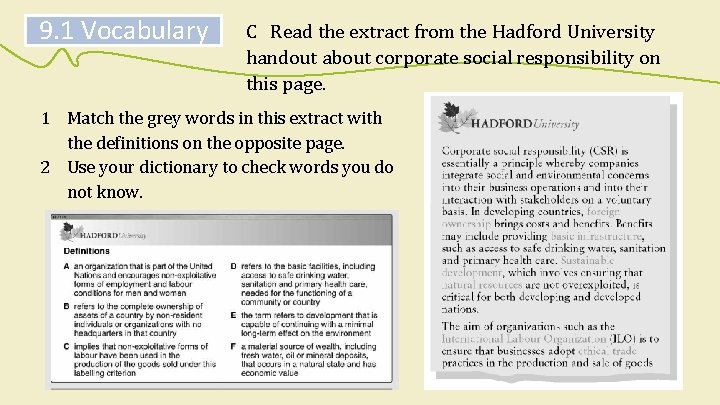
9. 1 Vocabulary C Read the extract from the Hadford University handout about corporate social responsibility on this page. 1 Match the grey words in this extract with the definitions on the opposite page. 2 Use your dictionary to check words you do not know.
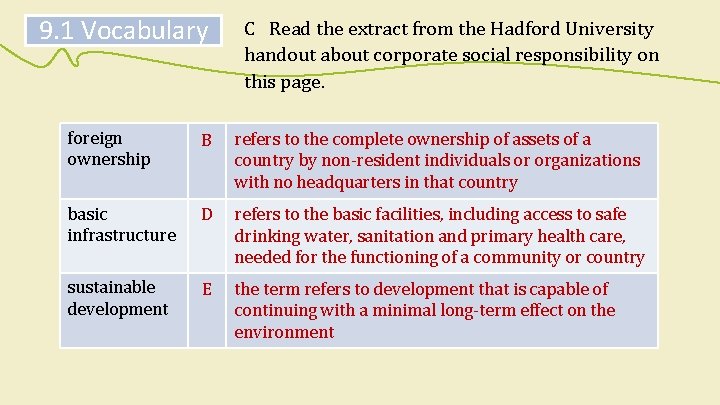
9. 1 Vocabulary C Read the extract from the Hadford University handout about corporate social responsibility on this page. foreign ownership B refers to the complete ownership of assets of a country by non-resident individuals or organizations with no headquarters in that country basic infrastructure D refers to the basic facilities, including access to safe drinking water, sanitation and primary health care, needed for the functioning of a community or country sustainable development E the term refers to development that is capable of continuing with a minimal long-term effect on the environment
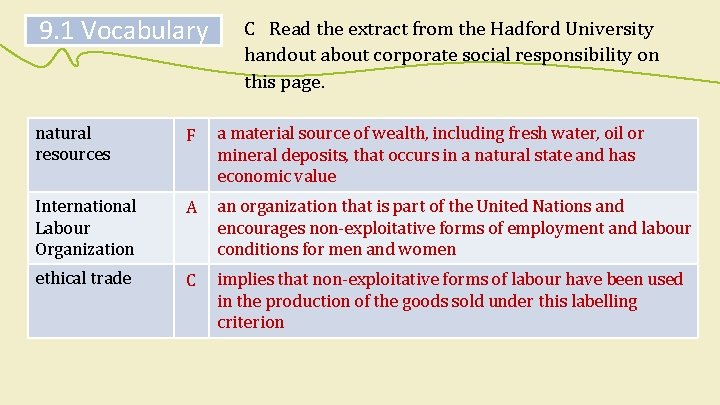
9. 1 Vocabulary C Read the extract from the Hadford University handout about corporate social responsibility on this page. natural resources F a material source of wealth, including fresh water, oil or mineral deposits, that occurs in a natural state and has economic value International Labour Organization A an organization that is part of the United Nations and encourages non-exploitative forms of employment and labour conditions for men and women ethical trade C implies that non-exploitative forms of labour have been used in the production of the goods sold under this labelling criterion
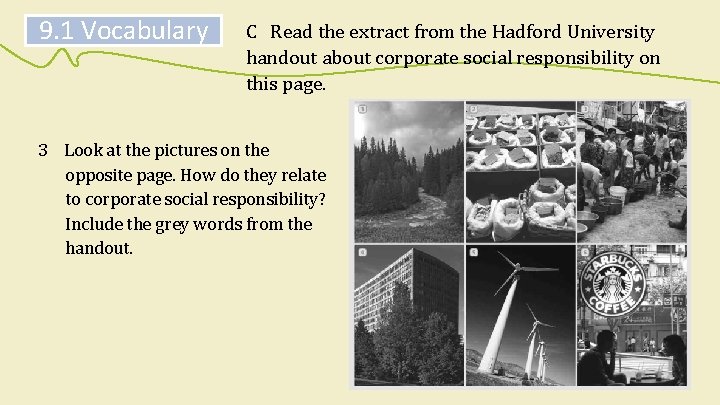
9. 1 Vocabulary C Read the extract from the Hadford University handout about corporate social responsibility on this page. 3 Look at the pictures on the opposite page. How do they relate to corporate social responsibility? Include the grey words from the handout.
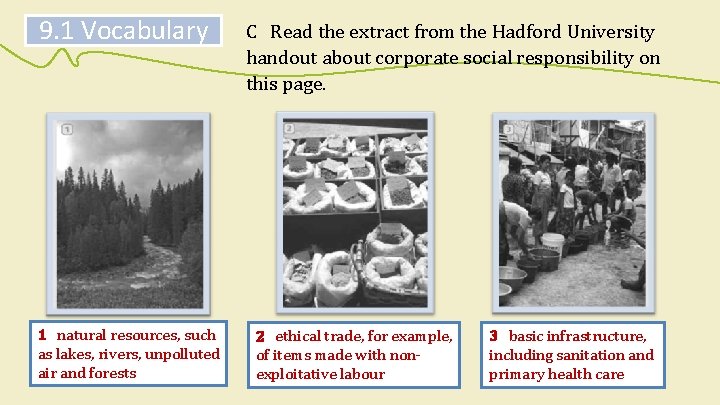
9. 1 Vocabulary 1 natural resources, such as lakes, rivers, unpolluted air and forests C Read the extract from the Hadford University handout about corporate social responsibility on this page. 2 ethical trade, for example, of items made with nonexploitative labour 3 basic infrastructure, including sanitation and primary health care
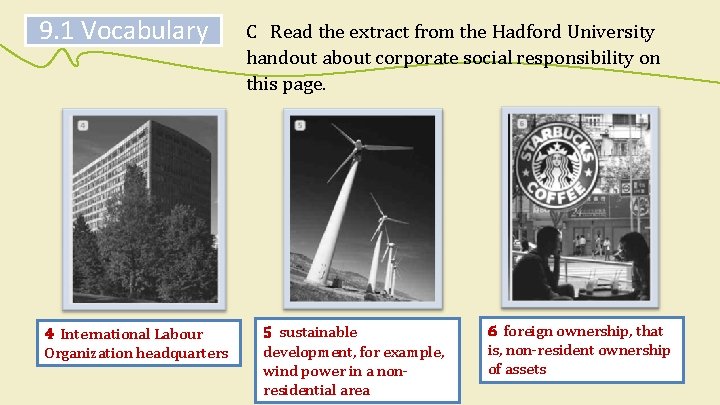
9. 1 Vocabulary 4 International Labour Organization headquarters C Read the extract from the Hadford University handout about corporate social responsibility on this page. 5 sustainable development, for example, wind power in a nonresidential area 6 foreign ownership, that is, non-resident ownership of assets
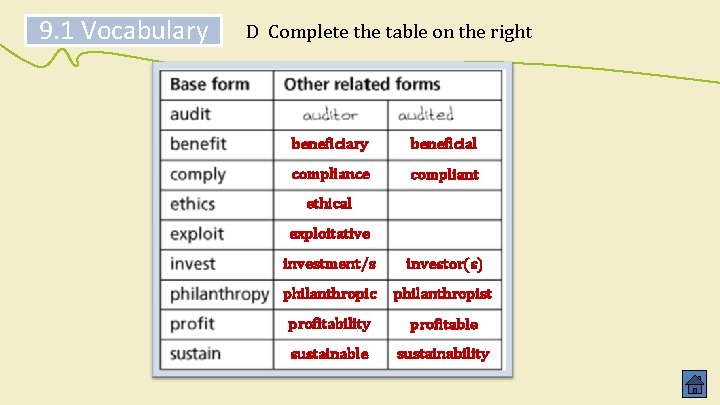
9. 1 Vocabulary D Complete the table on the right beneficiary beneficial compliance compliant ethical exploitative investment/s investor(s) philanthropic philanthropist profitability profitable sustainability
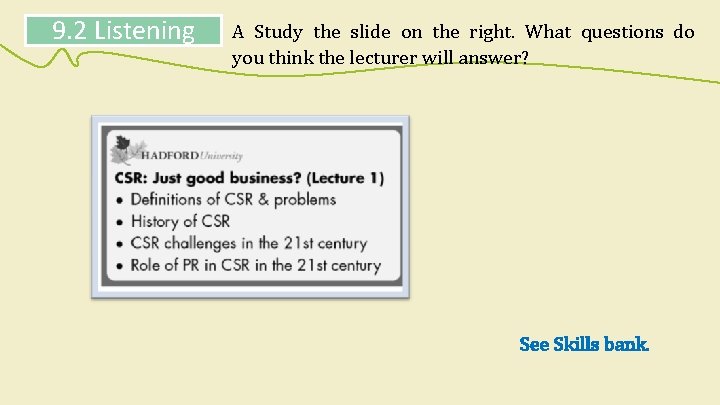
9. 2 Listening A Study the slide on the right. What questions do you think the lecturer will answer? See Skills bank.
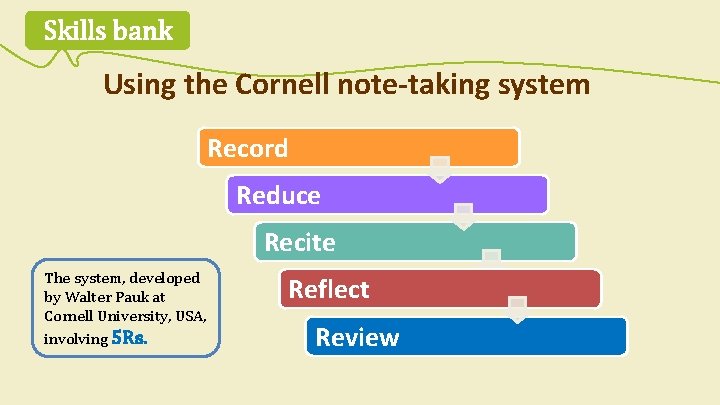
Skills bank Using the Cornell note-taking system Record Reduce Recite The system, developed by Walter Pauk at Cornell University, USA, involving 5 Rs. Reflect Review
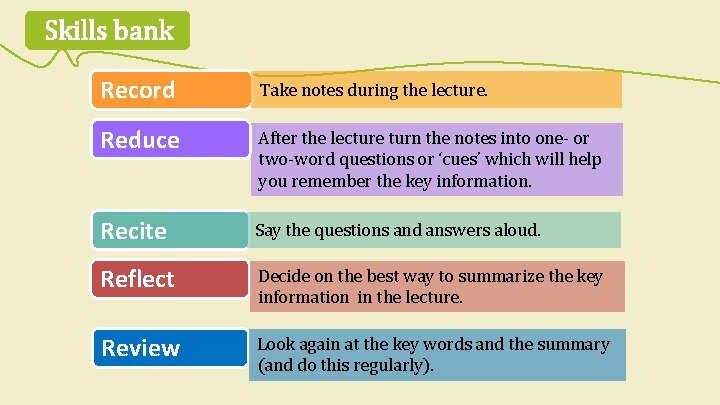
Skills bank Record Take notes during the lecture. Reduce After the lecture turn the notes into one- or two-word questions or ‘cues’ which will help you remember the key information. Recite Say the questions and answers aloud. Reflect Decide on the best way to summarize the key information in the lecture. Review Look again at the key words and the summary (and do this regularly).
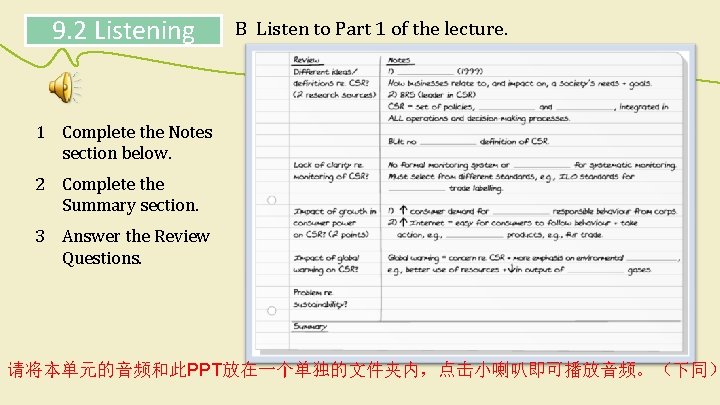
9. 2 Listening B Listen to Part 1 of the lecture. 1 Complete the Notes section below. 2 Complete the Summary section. 3 Answer the Review Questions. 请将本单元的音频和此PPT放在一个单独的文件夹内,点击小喇叭即可播放音频。(下同)
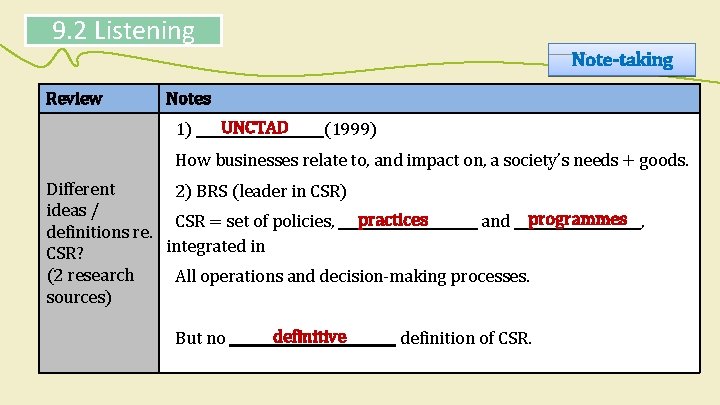
9. 2 Listening Note-taking Review Notes 1) UNCTAD (1999) How businesses relate to, and impact on, a society’s needs + goods. Different 2) BRS (leader in CSR) ideas / CSR = set of policies, practices and programmes , definitions re. integrated in CSR? (2 research All operations and decision-making processes. sources) But no definitive definition of CSR.
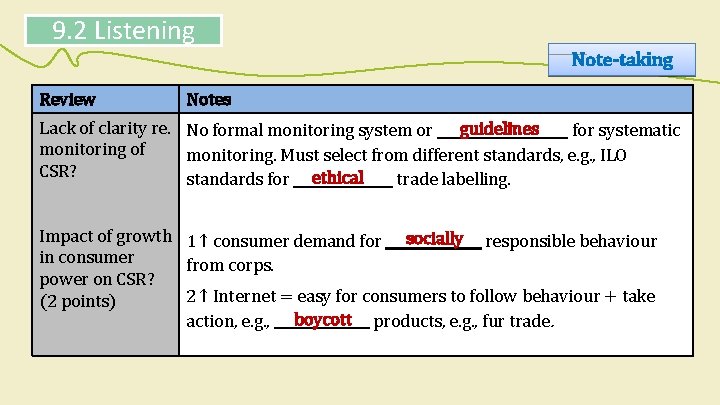
9. 2 Listening Note-taking Review Notes Lack of clarity re. No formal monitoring system or guidelines for systematic monitoring of monitoring. Must select from different standards, e. g. , ILO CSR? standards for ethical trade labelling. Impact of growth 1 ↑ consumer demand for socially responsible behaviour in consumer from corps. power on CSR? 2 ↑ Internet = easy for consumers to follow behaviour + take (2 points) action, e. g. , boycott products, e. g. , fur trade.
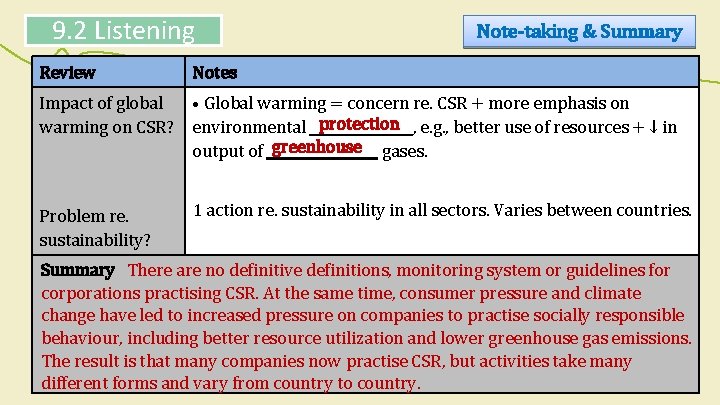
9. 2 Listening Note-taking & Summary Review Notes Impact of global warming on CSR? • Global warming = concern re. CSR + more emphasis on environmental protection , e. g. , better use of resources + ↓ in output of greenhouse gases. Problem re. sustainability? 1 action re. sustainability in all sectors. Varies between countries. Summary There are no definitive definitions, monitoring system or guidelines for corporations practising CSR. At the same time, consumer pressure and climate change have led to increased pressure on companies to practise socially responsible behaviour, including better resource utilization and lower greenhouse gas emissions. The result is that many companies now practise CSR, but activities take many different forms and vary from country to country.
9. 2 Listening C Create a blank Cornell diagram. Listen to Part 2 of the lecture. 1. Complete the Notes section. 2. Write some Review questions. 3. Complete the summary section. 4. Were your questions in Exercise A answered?
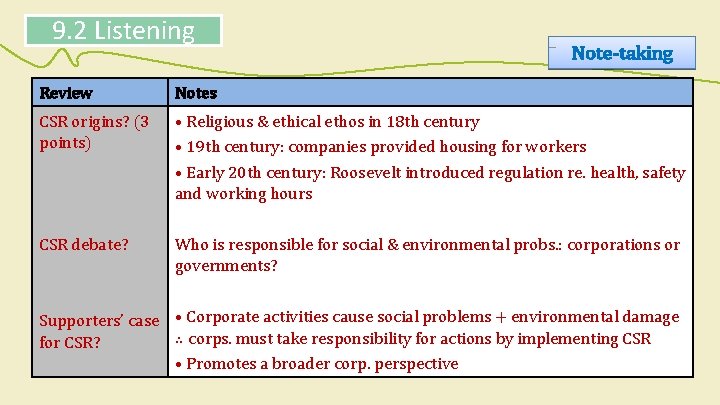
9. 2 Listening Note-taking Review Notes CSR origins? (3 points) • Religious & ethical ethos in 18 th century • 19 th century: companies provided housing for workers • Early 20 th century: Roosevelt introduced regulation re. health, safety and working hours CSR debate? Who is responsible for social & environmental probs. : corporations or governments? Supporters’ case • Corporate activities cause social problems + environmental damage ∴ corps. must take responsibility for actions by implementing CSR for CSR? • Promotes a broader corp. perspective
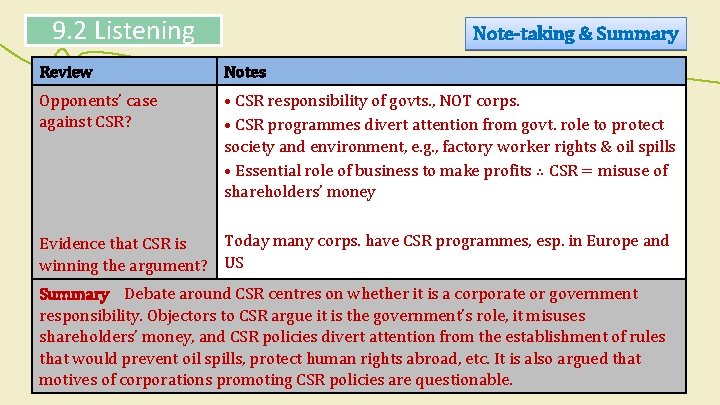
9. 2 Listening Note-taking & Summary Review Notes Opponents’ case against CSR? • CSR responsibility of govts. , NOT corps. • CSR programmes divert attention from govt. role to protect society and environment, e. g. , factory worker rights & oil spills • Essential role of business to make profits ∴ CSR = misuse of shareholders’ money Today many corps. have CSR programmes, esp. in Europe and Evidence that CSR is winning the argument? US Summary Debate around CSR centres on whether it is a corporate or government responsibility. Objectors to CSR argue it is the government’s role, it misuses shareholders’ money, and CSR policies divert attention from the establishment of rules that would prevent oil spills, protect human rights abroad, etc. It is also argued that motives of corporations promoting CSR policies are questionable.
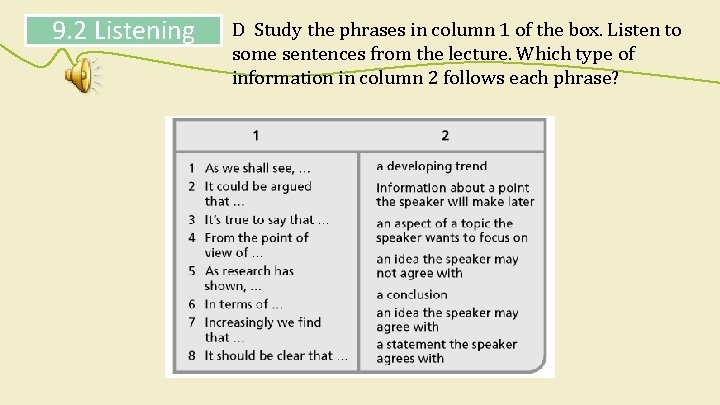
9. 2 Listening D Study the phrases in column 1 of the box. Listen to some sentences from the lecture. Which type of information in column 2 follows each phrase?
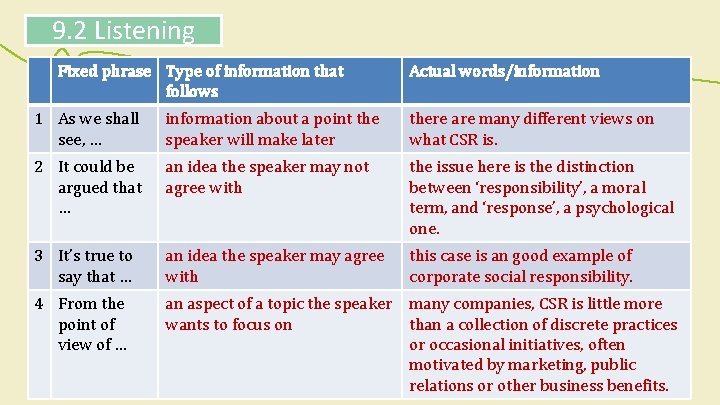
9. 2 Listening Fixed phrase Type of information that follows Actual words/information 1 As we shall see, … information about a point the speaker will make later there are many different views on what CSR is. 2 It could be argued that … an idea the speaker may not agree with the issue here is the distinction between ‘responsibility’, a moral term, and ‘response’, a psychological one. 3 It’s true to say that … an idea the speaker may agree with this case is an good example of corporate social responsibility. 4 From the point of view of … an aspect of a topic the speaker wants to focus on many companies, CSR is little more than a collection of discrete practices or occasional initiatives, often motivated by marketing, public relations or other business benefits.
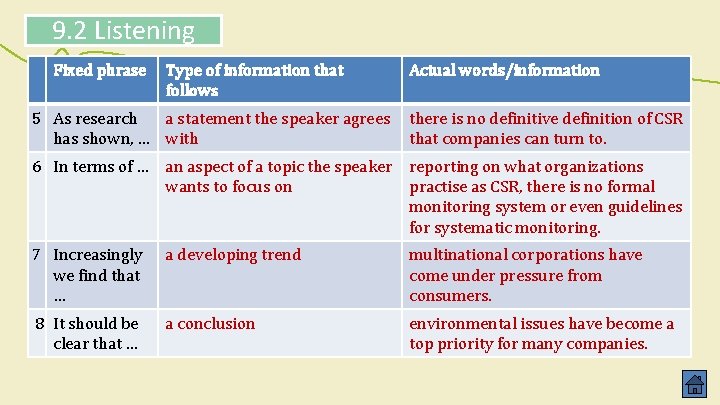
9. 2 Listening Fixed phrase Type of information that follows Actual words/information 5 As research a statement the speaker agrees has shown, … with there is no definitive definition of CSR that companies can turn to. 6 In terms of … an aspect of a topic the speaker wants to focus on reporting on what organizations practise as CSR, there is no formal monitoring system or even guidelines for systematic monitoring. 7 Increasingly we find that … a developing trend multinational corporations have come under pressure from consumers. 8 It should be clear that … a conclusion environmental issues have become a top priority for many companies.
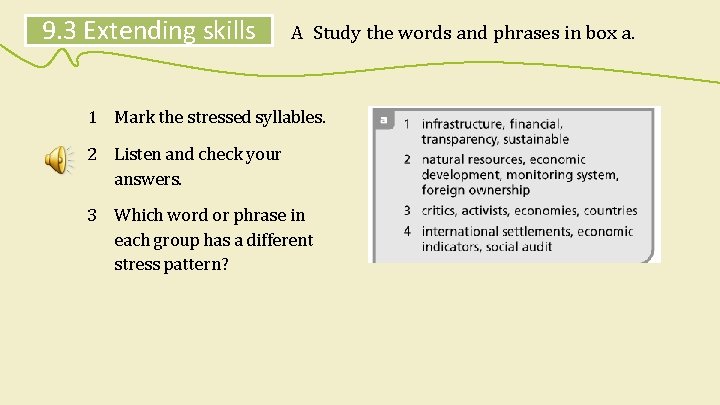
9. 3 Extending skills A Study the words and phrases in box a. 1 Mark the stressed syllables. 2 Listen and check your answers. 3 Which word or phrase in each group has a different stress pattern?
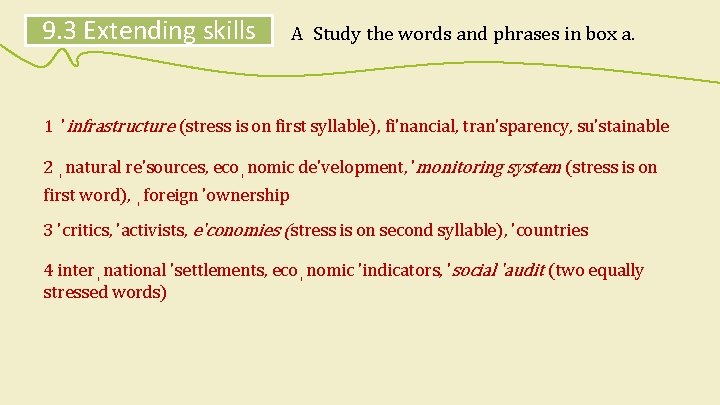
9. 3 Extending skills A Study the words and phrases in box a. 1 'infrastructure (stress is on first syllable), fi'nancial, tran'sparency, su'stainable 2 ˌnatural re'sources, ecoˌnomic de'velopment, 'monitoring system (stress is on first word), ˌforeign 'ownership 3 'critics, 'activists, e'conomies (stress is on second syllable), 'countries 4 interˌnational 'settlements, ecoˌnomic 'indicators, 'social 'audit (two equally stressed words)
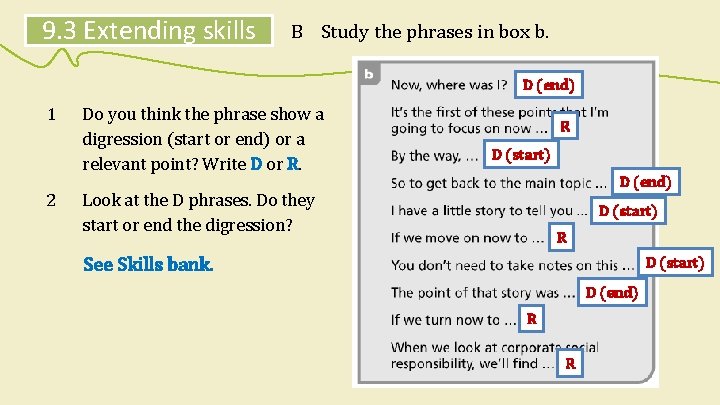
9. 3 Extending skills B Study the phrases in box b. D (end) 1 Do you think the phrase show a digression (start or end) or a relevant point? Write D or R. R D (start) D (end) 2 Look at the D phrases. Do they start or end the digression? D (start) R D (start) See Skills bank. D (end) R R
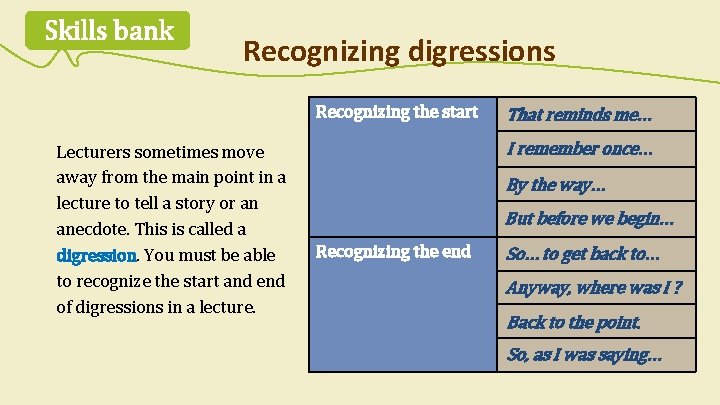
Skills bank Recognizing digressions Recognizing the start Lecturers sometimes move away from the main point in a lecture to tell a story or an anecdote. This is called a digression. You must be able to recognize the start and end of digressions in a lecture. That reminds me… I remember once… By the way… But before we begin… Recognizing the end So… to get back to… Anyway, where was I ? Back to the point. So, as I was saying…
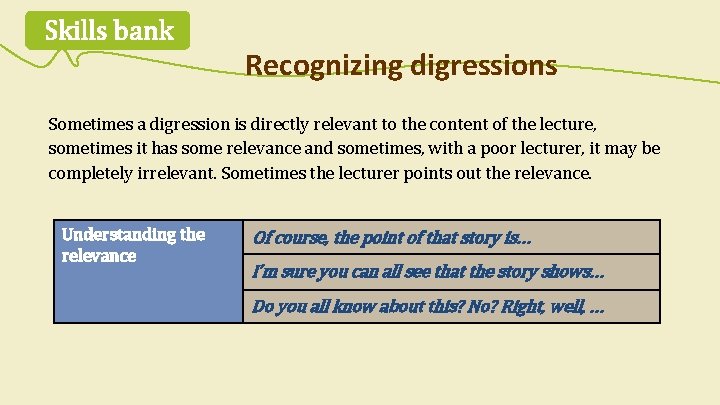
Skills bank Recognizing digressions Sometimes a digression is directly relevant to the content of the lecture, sometimes it has some relevance and sometimes, with a poor lecturer, it may be completely irrelevant. Sometimes the lecturer points out the relevance. Understanding the relevance Of course, the point of that story is… I’m sure you can all see that the story shows… Do you all know about this? No? Right, well, …
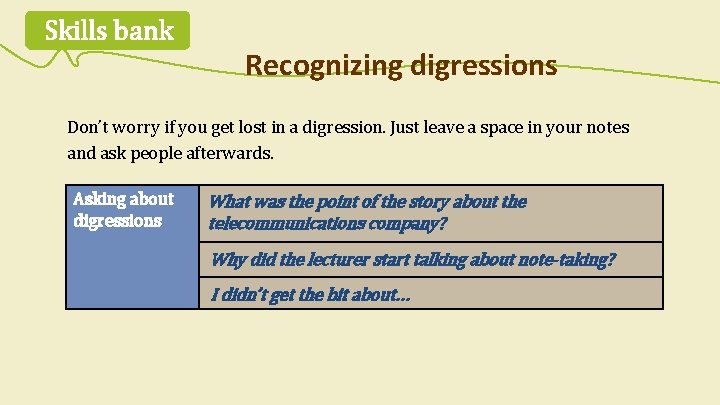
Skills bank Recognizing digressions Don’t worry if you get lost in a digression. Just leave a space in your notes and ask people afterwards. Asking about digressions What was the point of the story about the telecommunications company? Why did the lecturer start talking about note-taking? I didn’t get the bit about…
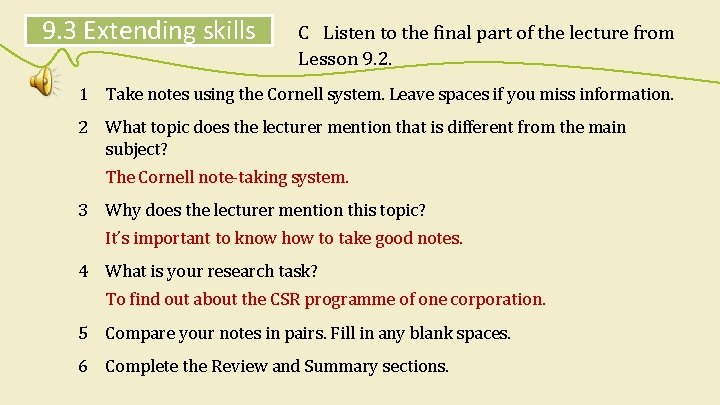
9. 3 Extending skills C Listen to the final part of the lecture from Lesson 9. 2. 1 Take notes using the Cornell system. Leave spaces if you miss information. 2 What topic does the lecturer mention that is different from the main subject? The Cornell note-taking system. 3 Why does the lecturer mention this topic? It’s important to know how to take good notes. 4 What is your research task? To find out about the CSR programme of one corporation. 5 Compare your notes in pairs. Fill in any blank spaces. 6 Complete the Review and Summary sections.
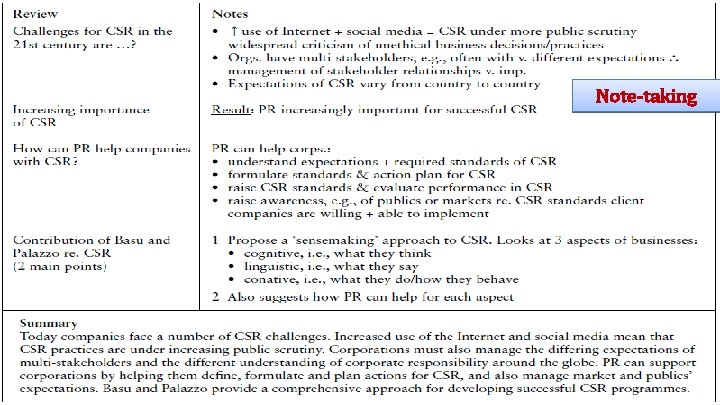
Note-taking
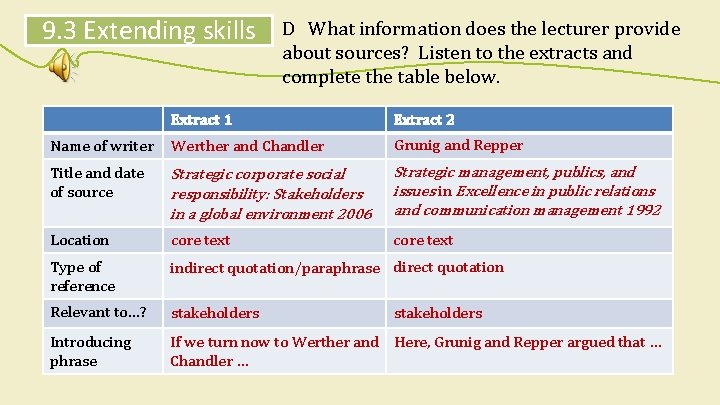
9. 3 Extending skills D What information does the lecturer provide about sources? Listen to the extracts and complete the table below. Extract 1 Extract 2 Name of writer Werther and Chandler Grunig and Repper Title and date of source Strategic corporate social responsibility: Stakeholders in a global environment 2006 Strategic management, publics, and issues in Excellence in public relations and communication management 1992 Location core text Type of reference indirect quotation/paraphrase direct quotation Relevant to…? stakeholders Introducing phrase If we turn now to Werther and Here, Grunig and Repper argued that … Chandler … stakeholders
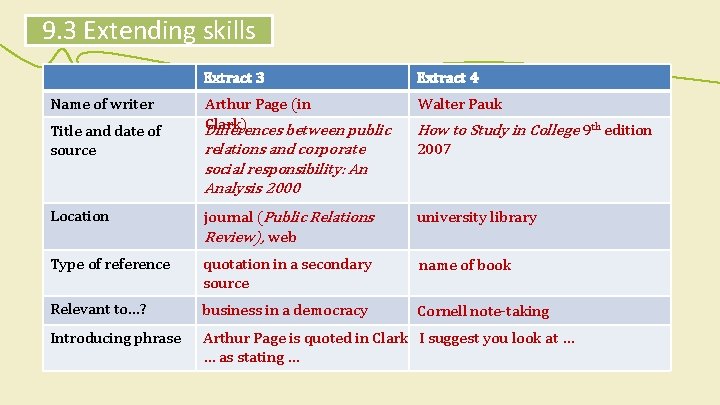
9. 3 Extending skills Name of writer Title and date of source Extract 3 Extract 4 Arthur Page (in Clark) Differences between public Walter Pauk How to Study in College 9 th edition relations and corporate social responsibility: An Analysis 2000 2007 Location journal (Public Relations Review), web university library Type of reference quotation in a secondary source name of book Relevant to…? business in a democracy Cornell note-taking Introducing phrase Arthur Page is quoted in Clark I suggest you look at … … as stating …
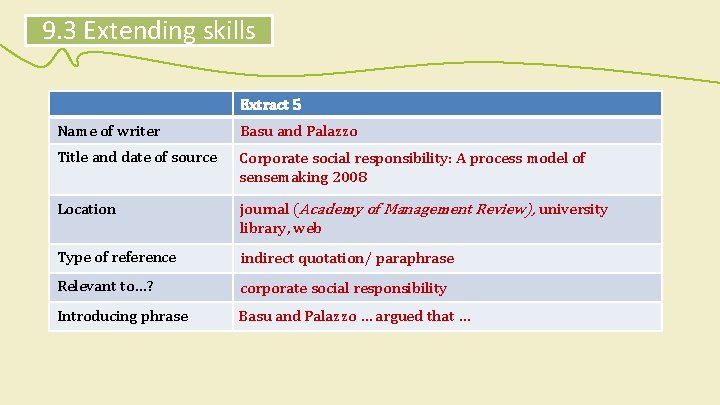
9. 3 Extending skills Extract 5 Name of writer Basu and Palazzo Title and date of source Corporate social responsibility: A process model of sensemaking 2008 Location journal (Academy of Management Review), university library, web Type of reference indirect quotation/ paraphrase Relevant to…? corporate social responsibility Introducing phrase Basu and Palazzo … argued that …
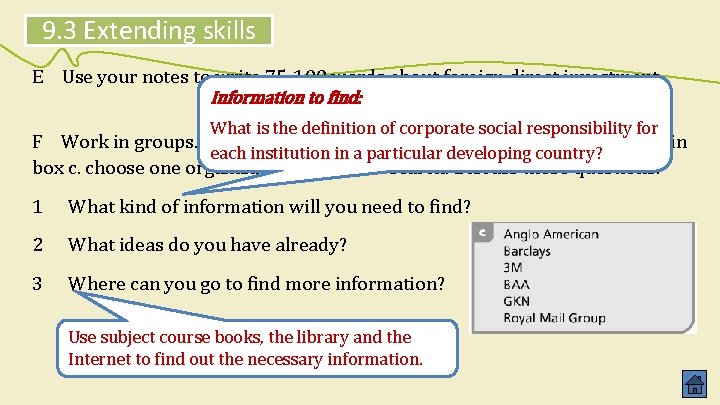
9. 3 Extending skills E Use your notes to write 75 -100 words about foreign direct investment. Information to find: What is the definition of corporate social responsibility for F Work in groups. Study the six corporations providing CSR programmes in each institution in a particular developing country? box c. choose one organization for your research. Discuss these questions: 1 What kind of information will you need to find? 2 What ideas do you have already? 3 Where can you go to find more information? Use subject course books, the library and the Internet to find out the necessary information.
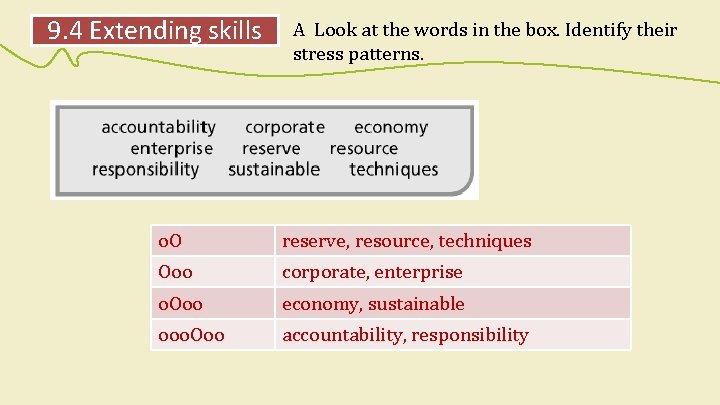
9. 4 Extending skills A Look at the words in the box. Identify their stress patterns. o. O reserve, resource, techniques Ooo corporate, enterprise o. Ooo economy, sustainable ooo. Ooo accountability, responsibility
9. 4 Extending skills B Work in pairs. Student A: Think of good ways to take part in a seminar. Student B: Think of bad ways to take part in a s seminar. Do’s Don’ts prepare the topic beforehand ask politely for information demand information from other students try to use correct language speak clearly mumble, whisper or shout say when you agree with someone get angry if someone disagrees with you link correctly with previous speakers build on points made by other speakers
9. 4 Extending skills B Work in pairs. Do’s Don’ts make a contribution, even if you are not sure if it is new or relevant stay silent, waiting for ‘the perfect moment’ be constructive be negative give specific examples to help explain be vague a point listen carefully to what others say start a side conversation allow others to speak dominate the discussion paraphrase to check understanding use clear visuals
9. 4 Extending skills C You are going to hear some students in a seminar. They have been asked to discuss the question: ‘What barriers are there to providing effective CSR/sustainability programmes? ’ 1. Listen to the seminar extracts. Decide whether each contribution is good or poor. 2. Give reasons for your opinion. 3. Think of some additional information to add to the good contributions.
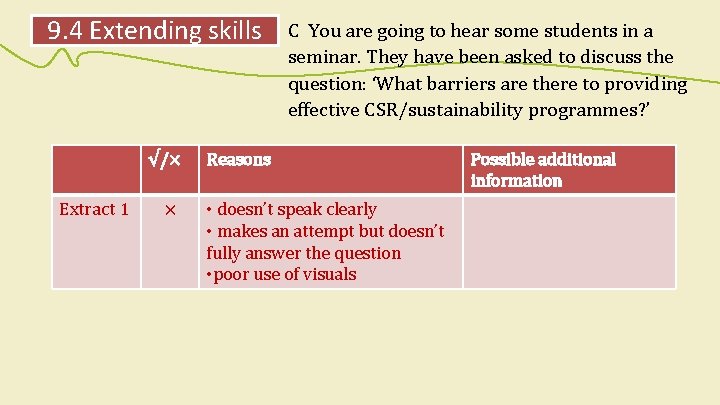
9. 4 Extending skills √/× Extract 1 × C You are going to hear some students in a seminar. They have been asked to discuss the question: ‘What barriers are there to providing effective CSR/sustainability programmes? ’ Reasons • doesn’t speak clearly • makes an attempt but doesn’t fully answer the question • poor use of visuals Possible additional information
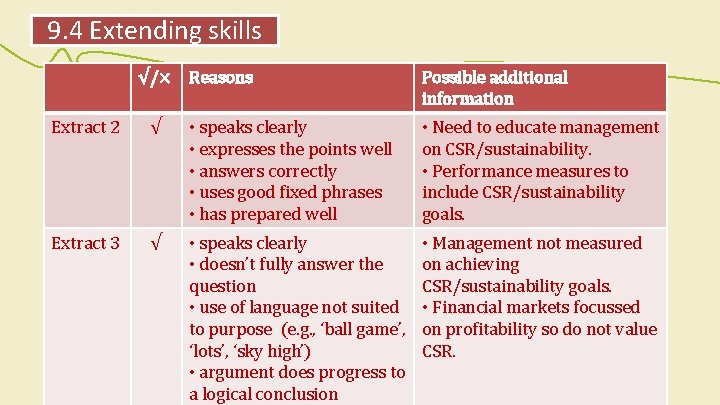
9. 4 Extending skills √/× Reasons Possible additional information Extract 2 √ • speaks clearly • expresses the points well • answers correctly • uses good fixed phrases • has prepared well • Need to educate management on CSR/sustainability. • Performance measures to include CSR/sustainability goals. Extract 3 √ • speaks clearly • doesn’t fully answer the question • use of language not suited to purpose (e. g. , ‘ball game’, ‘lots’, ‘sky high’) • argument does progress to a logical conclusion • Management not measured on achieving CSR/sustainability goals. • Financial markets focussed on profitability so do not value CSR.
9. 4 Extending skills D Work in a group of three or four. 1. Discuss the information you found on the corporations in Lesson 9. 3, Exercise F. Agree on the best examples of corporate social responsibility. 2. Discuss how bet to present this information. 3. Present your findings on your chosen corporation to the whole class.
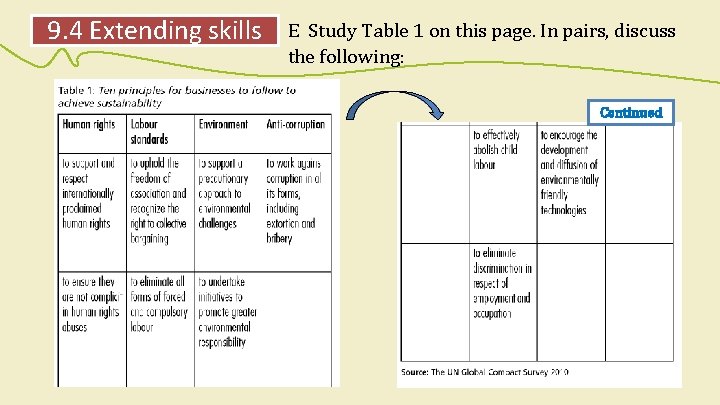
9. 4 Extending skills E Study Table 1 on this page. In pairs, discuss the following: Continued
9. 4 Extending skills E Study Table 1 on this page. In pairs, discuss the following: 1. What does the table show? Table 1 shows the ten principles of sustainability as defined by the UN Global Compact on Sustainability. The principles are grouped under the headings of Human rights, Labour standards, Environment, and Anti-corruption. 1. Select one principle in each column and give an example. 2. Present a brief explanation to your partner.
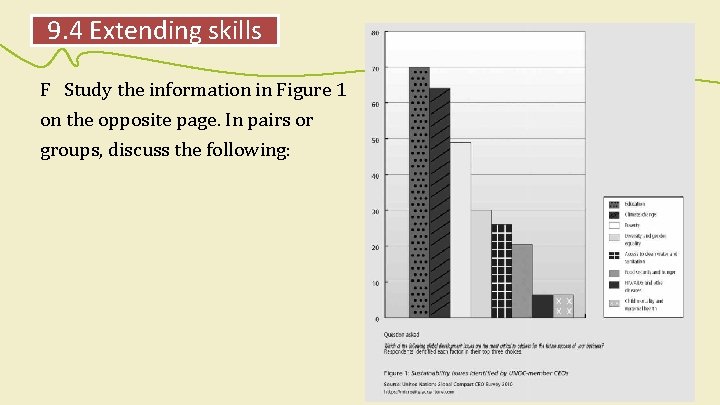
9. 4 Extending skills F Study the information in Figure 1 on the opposite page. In pairs or groups, discuss the following:
9. 4 Extending skills F Study the information in Figure 1 on the opposite page. In pairs or groups, discuss the following: 1. What does the information show about sustainability issues identified by UNGC-member CEOs? It shows that 70% of the respondents identified education as the most important issue, followed by climate change, identified by approximately 65% of the respondents. The issues that were identified as least critical were HIV/AIDS and other diseases, and child mortality and maternal health. Less than 10% of the respondents identified these as critical issues.
9. 4 Extending skills F Study the information in Figure 1 on the opposite page. In pairs or groups, discuss the following: 2. What other information not given here might be useful in explaining the data shown in the graph? 3. What areas of sustainability are missing from the survey? The most notable omission is a lack of focus on labour standards, apart from the issues of diversity and gender equality. Also human rights and anti-corruption were not mentioned as an issue.

- Slides: 54