
Seabrook Mc Kenzie Parenting Course Session Three Social
Seabrook Mc. Kenzie Parenting Course Session Three: Social Skills and Self Esteem
Self Esteem, Social Skills and SLD l All environments are social- cannot be avoided l Social-emotional learning is a complex process and cannot be understood in isolation l Social-emotional development is influenced by temperament, environment and learning process l All social interactions are complex: Children with SLD have to analyse the situation, organise their behaviour, control impulses, recall appropriate social rules, process instructions/language
Self Esteem, Social Skills and SLD continued… l Social cognitive and communication problems are considered inherent to SLD. This leads to social relationship difficulties, which in turn can result in low self -esteem and anxiety l Child with SLD often misinterpret social cues and has difficulty solving social problems- often seen as misbehaviour l Difficulty generalising skills (applying skills to different situations)
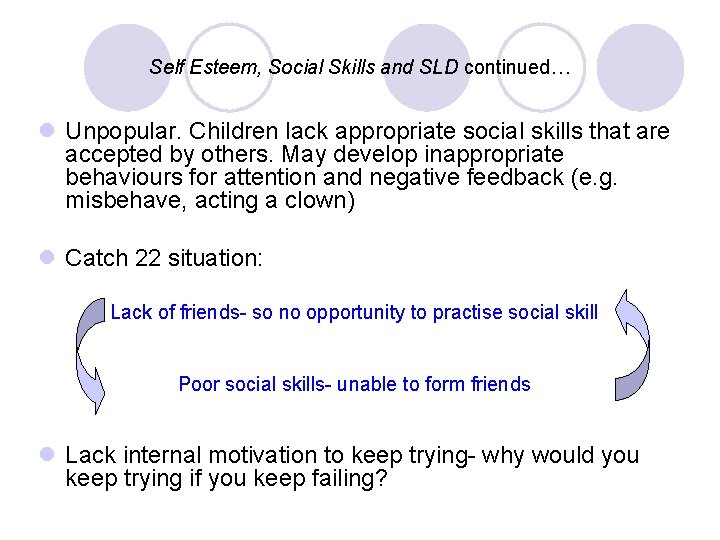
Self Esteem, Social Skills and SLD continued… l Unpopular. Children lack appropriate social skills that are accepted by others. May develop inappropriate behaviours for attention and negative feedback (e. g. misbehave, acting a clown) l Catch 22 situation: Lack of friends- so no opportunity to practise social skill Poor social skills- unable to form friends l Lack internal motivation to keep trying- why would you keep trying if you keep failing?
What are Social Skills? l l l Eye contact (maintain contact, listening and speaking) Facial expression (smiling, showing interest) Social distance (knowing where to stand, appropriate physical contact) Quality of voice (volume, pitch, rate of speech, content, clarity) Greeting others (initiating contact, response to a greeting, inviting a child to play) l Making conversations (age appropriate conversation skills, expressing feelings, asking questions, listening, responding) l Playing with others (keeping to rules, sharing, compromising, helping, taking turns, saying thank you) l Gaining attention (asking for help in appropriate ways) l Coping with conflict (control anger, accept criticism, dealing with anger in self/others) l Grooming and Hygiene
Types of Social Skills l Interpersonal Behaviours ¡ “friendship-making skills” e. g. introducing yourself, joining in, asking a favour, offering help, giving and accepting compliments, apologising l Peer-Related Behaviours ¡ Skills valued by classmates, associated with peer acceptance. E. g. working cooperatively, asking for and receiving information, correctly assessing another’s emotional state l Teacher Pleasing Social Skills ¡ Behaviours associated with school success e. g. following directions, doing your best work, listening to the teacher
Other social skills… l Self-Related Skills ¡ Social skills allow a child to assess a social situation, select an appropriate skill, and determine the skill’s effectiveness. Also include - following through, dealing with stress, understanding feelings, controlling anger l Assertiveness Skills ¡ Behaviours allow children to express their needs without resorting to aggression l Communication Skills ¡ Include listener responsiveness, turn-taking, maintaining conversational attention, and giving speaker feedback
Self Esteem l Because self-esteem is a feeling - not a skill, it can only be measured by observing the way which a person acts or behaves. Teachers and parents must develop good observation skills in order to assess self-esteem l Children with High Self Esteem will: ¡ Feel capable of influencing another’s opinions/behaviours in positive way ¡ Be able to communicate feelings and emotions in a variety of situations ¡ Approach new situations in a positive and confident manner ¡ Exhibit a high level of frustration tolerance ¡ Accept responsibility
Self-esteem continued… ¡ Keep situations (positive and negative) in proper perspective ¡ Communicate positive feelings about themselves ¡ Possess an internal locus of control (Believe that whatever happens to them is the result of their own behaviour and actions) l Children with Low Self-Esteem Will: ¡ ¡ ¡ Consistently communicate self-derogatory statements Exhibit learned helplessness Not volunteer Practise perfectionism Be overly dependent Demonstrate an excessive need for acceptance- a great desire to please authority figures ¡ Exhibit low frustration tolerance ¡ Become easily defensive
“Last One Picked…First One Picked on”: Learning Disabilities and Social Skills Video by Richard Lavoie l Many children with SLD experience social isolation and rejection l All environments are social, cannot avoid it l Cannot compensate for social skill deficit l Can compensate for other skills deficits e. g. can’t writeuse word processor l Hard to teach social skills as it is second nature to us we are too good at it
Teaching social skills… l Children with SLD have limited information on social skills/situations l Need to break down skills to most finite points and teach them l Children with SLD don’t learn by exposure/osmosis- have to be taught, as they are not learning by observation l Interrogation: Asking Questions ¡ Children with SLD find it hard to ask questions, often phrase as statement. This impacts on social ability ¡ 80% of the first 10 minutes of a conversation consists of questions, until you know enough about the person to have a conversation ¡ Children with SLD often make a statement rather than a question: e. g. “I can’t do this” rather than “can you help me”
Social skills and the distractible child: l ADHD- misconception ¡ Distractibility vs. no attention span ¡Shouldn’t use these terms interchangeably as mean different things ¡Distractible- pays attention to everything ¡No attention span- pays attention to nothing (often associated with cognitive delay/deficit) l Social implications for the distractible child
Social skills and the distractible child continued… l Inhibitory responses- we monitor what we think and determine if it’s appropriate to say (have many thoughts throughout the day we don’t express) l OTM- “On The Mind, Out the Mouth” l Children with SLD often have disinhibition l Not socially appropriate and say what’s on their mind- this impacts on social relationships
Social Skill Autopsies l The examination and inspection of a social error to discover the cause of error, determine the damage, and prevent it from occurring again l Use as opportunity to learn/teach l E. g. if you are teaching a child the times tables 3 x 3= and they answered it incorrectly, would you punish them and send them to their room? You teach them the answer l So why punish a child who makes a social skills error? Child will not learn from the error, and may not know what they did wrong- use it as teachable moment l DO social autopsies when child does something correct- not just for errors.
Exercise: Parenting Skill Autopsy l On your own or in pairs: l Identify a recent incident with your child you think you handled well, and why? l Identify a recent incident with your child and you feel you could have handled better and why?
The Hidden Curriculum l The unwritten, unspoken rules of school l Children with SLD often violate hidden curriculum and are often not socially aware enough to know when they have done that l Every school will have a different hidden curriculum- culture of the school l Child with SLD need to be taught
Examples of the hidden curriculum: ¡Don’t go through the side door in the morning because there are bullies there ¡Teacher A values students being on-time for class ¡Teacher B feels homework is very important ¡ Student ball- senior students wait by cars laugh at juniors, and turn up to the ball later
Top 7 skills Identified by mainstream teachers- What skills are important for students with SLD in the classroom? 1. Listening 2. Following directions 3. Stay on task 4. Know how to get help 5. Ability to get started on work 6. Finish on time 7. Word attack skills 1 st six items are hidden curriculum issues!
TEACH CHILDREN WITH SLD THE HIDDEN CURRICULUM l Some people may say it’s an unfair advantage l Only teaching them what most students pick up in the first few days of school l Children with SLD don’t pick up on patterns l Hidden curriculum is IMPORTANT in Adolescence
Adolescence l Quote from Dr. Lavine: Adolescence is a 365 day, 52 weeks in a year, battle not to be embarrassed l Embarrassment is what adolescents fear the most l Adolescents with SLD are constantly embarrassed by their lack of understanding of the hidden curriculum
Inconsistency in Performance l Inconsistency in performance is part of the SLD l Children with SLD need consistency and structure and consistent expectations around them, because their own performance/ability is inconsistent l Analogy of 3 clocks in the brain of the child with SLD- 3 clocks all running at different times and speed. Occasionally these clocks will be in sync, and child has period of growth l Need to celebrate the child’s achievement, rather than use it as ammunition against the child
New Situations: Prepare the child/ prepare the situation for the child l Prepare the child for new situations- e. g. show them the room they will be in, explain what they should and shouldn’t do in the room l Prepare the situation- e. g. sports coach- tell the coach my child good at… he/she has difficulty with reading, please don’t ask my child to read
Social Implications From parents in partnership l Children with SLD do not perceive the organisation in life. They experience disorganisation in one or more areas of functioning l Most people analyse a social situation in advance and decide on an acceptable mode of behaviour for that situation- children with SLD do not do this. l Because of this, others may not know how to relate to them. l Children with SLD often are poor at identifying feelings from pictures. E. g. they misread surprise as anger. l 5% of meaning in social interaction is thought to come from words, while 95% from body language. Children with SLD do not seem to learn these rules, and are largely unaware of how their behaviour affects others
Social implications continued… l Important for parents to teach appropriate behaviour including an understanding of body language, e. g. role play, discussion of moods, feelings, reactions, and careful preparation of the chid for any social situation, especially new experiences l Egocentricity lasts longer in the child with SLD. This is reflected in language that is more self-centred, and in a general lack of sensitivity to others l Hyperactivity has significant implications for family and school life - most people are not welcoming of hyperactive child visiting l MODIFYING home and daily living routines is important for the hyperactive child= you must screen out for them much of the stimuli they are unable to screen out for themselves.
Dependence vs. Disability Ways to discriminate (from Rimm, 1986) l It is important to foster your child’s learning and meet his/her emotional needs. Your child will need more support than other children in many areas of life. l How do you figure out whether you are meeting your child’s needs with regard to his/her disability, or whethere is over dependence? This can be often difficult to figure out
- Slides: 25