
Beyond Academics Hard Facts Soft Skills and PostSecondary
Beyond Academics: Hard Facts, Soft Skills and Post-Secondary Success Janet Price Assistant Vice President of Outreach and Admissions College Living Experience Live. Engage. Achieve. 800. 486. 5058 | Experience. CLE. com
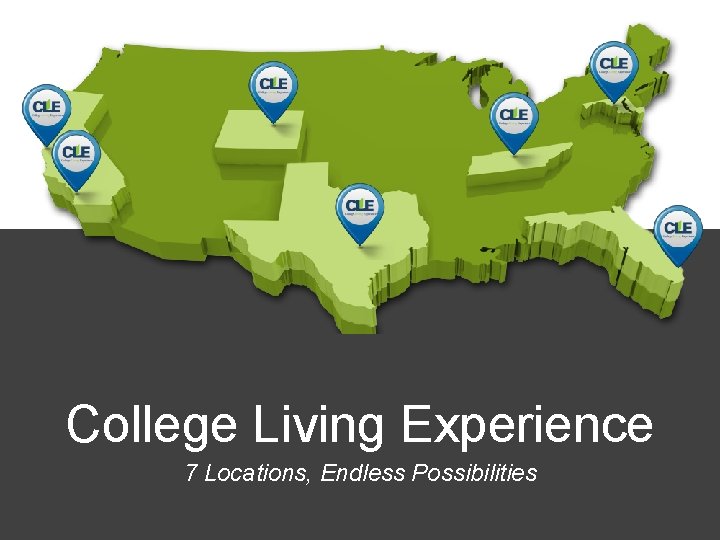
College Living Experience 7 Locations, Endless Possibilities
Participant Outcomes ü Differentiate between laws governing disability support at the secondary and post-secondary levels ü Describe the steps necessary to receive support in college ü Incorporate executive function, social skills and selfadvocacy skills into transition planning at home and at school Live. Engage. Achieve. 800. 486. 5058 | Experience. CLE. com
The Hard Facts: College Completion Rates About 33 percent of the students with disabilities who enroll in a four-year college or university graduate within 8 years. For those that enroll in two-year schools, the outcomes aren’t much better: 41 percent, according to federal data. (Hechinger Report, 11/15/2017) By contrast, about 60 percent of first-time, full-time undergraduate students completed a bachelor’s degree at the institution where they started within 6 years. (National Center for Education Statistics, 2019) Live. Engage. Achieve. 800. 486. 5058 | Experience. CLE. com
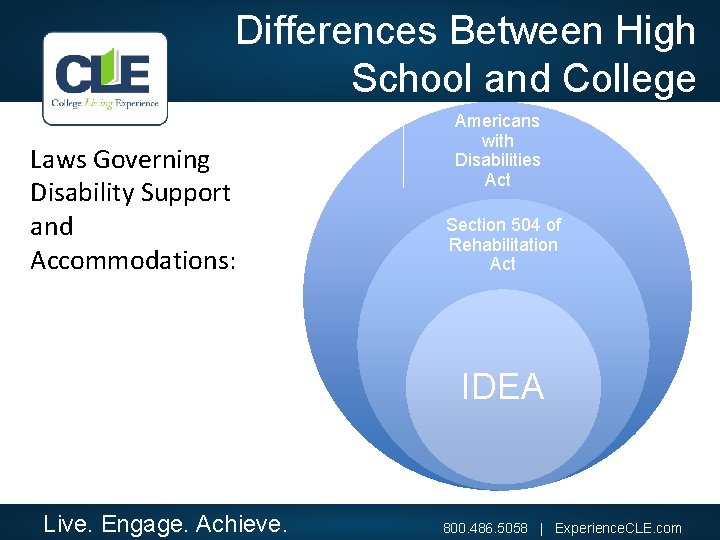
Differences Between High School and College Laws Governing Disability Support and Accommodations: Americans with Disabilities Act Section 504 of Rehabilitation Act IDEA Live. Engage. Achieve. 800. 486. 5058 | Experience. CLE. com
Differences Between High School and College Moving from Entitlement (FAPE) to Equal Access Section 504 of the Rehabilitation Act of 1973 Federal law that protects students from discrimination based on disability and applies to entities that receive federal funds. ADA Comprehensive civil rights law. Prohibits discrimination on the basis of disability in employment, state and local government programs, public accommodations, commercial facilities, transportation, and telecommunications. Live. Engage. Achieve. 800. 486. 5058 | Experience. CLE. com
Differences Between High School and College Student with a Disability vs. Qualified Student with a Disability Live. Engage. Achieve. 800. 486. 5058 | Experience. CLE. com
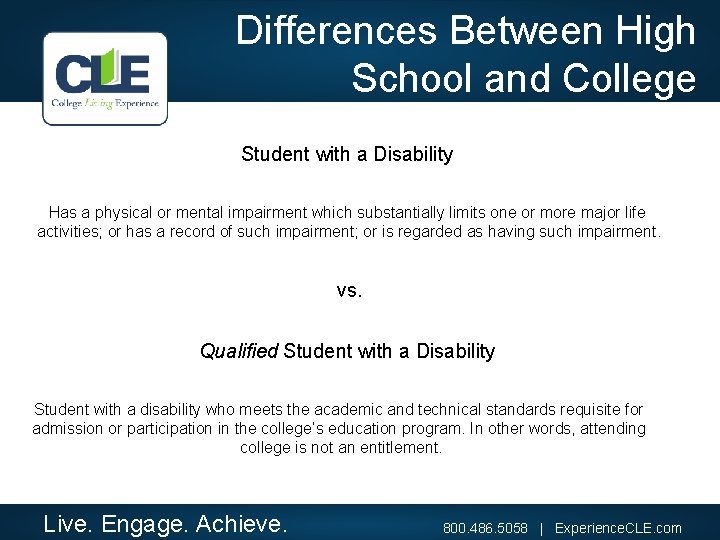
Differences Between High School and College Student with a Disability Has a physical or mental impairment which substantially limits one or more major life activities; or has a record of such impairment; or is regarded as having such impairment. vs. Qualified Student with a Disability Student with a disability who meets the academic and technical standards requisite for admission or participation in the college’s education program. In other words, attending college is not an entitlement. Live. Engage. Achieve. 800. 486. 5058 | Experience. CLE. com
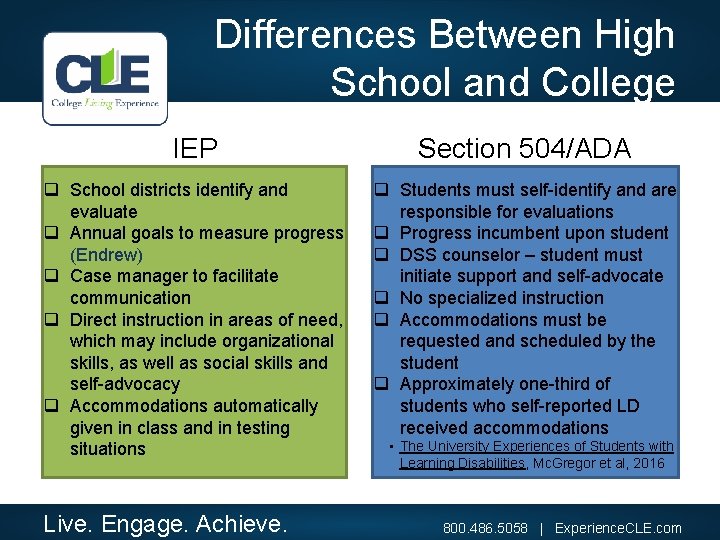
Differences Between High School and College IEP Section 504/ADA q School districts identify and evaluate q Annual goals to measure progress (Endrew) q Case manager to facilitate communication q Direct instruction in areas of need, which may include organizational skills, as well as social skills and self-advocacy q Accommodations automatically given in class and in testing situations q Students must self-identify and are responsible for evaluations q Progress incumbent upon student q DSS counselor – student must initiate support and self-advocate q No specialized instruction q Accommodations must be requested and scheduled by the student q Approximately one-third of students who self-reported LD received accommodations Live. Engage. Achieve. • The University Experiences of Students with Learning Disabilities, Mc. Gregor et al, 2016 800. 486. 5058 | Experience. CLE. com
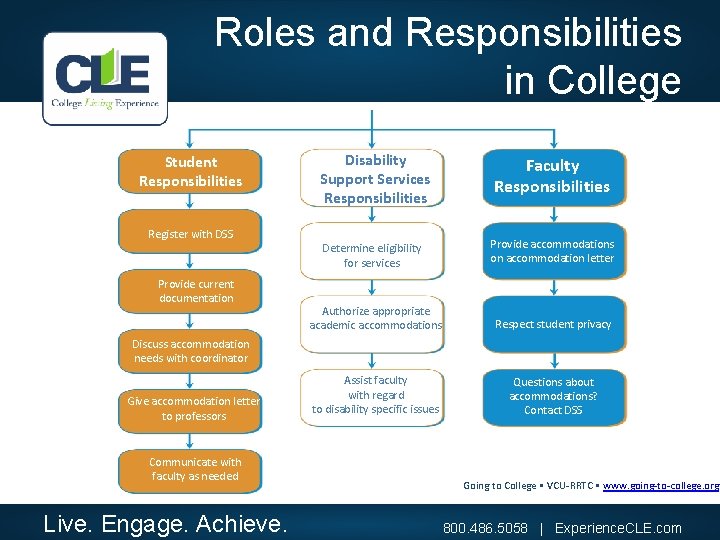
Roles and Responsibilities in College Student Responsibilities Register with DSS Provide current documentation Disability Support Services Responsibilities Faculty Responsibilities Determine eligibility for services Provide accommodations on accommodation letter Authorize appropriate academic accommodations Respect student privacy Assist faculty with regard to disability specific issues Questions about accommodations? Contact DSS Discuss accommodation needs with coordinator Give accommodation letter to professors Communicate with faculty as needed Live. Engage. Achieve. Questions about accommodations? Contact DSS Going to College • VCU-RRTC • www. going-to-college. org 800. 486. 5058 | Experience. CLE. com
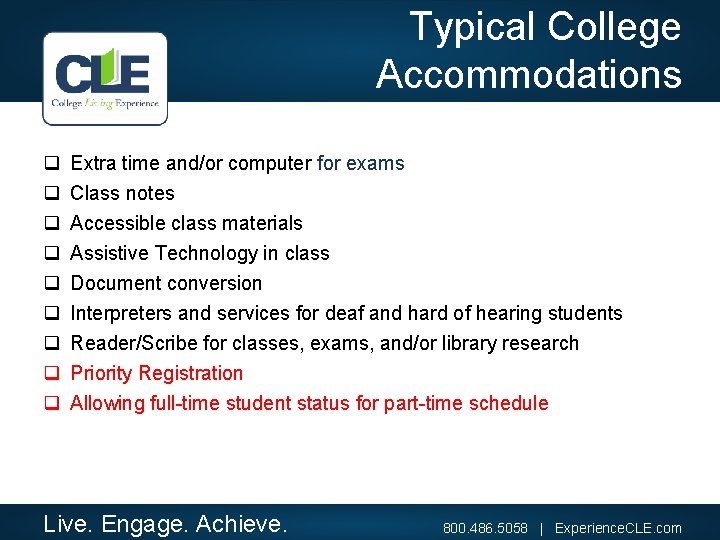
Typical College Accommodations q q q q q Extra time and/or computer for exams Class notes Accessible class materials Assistive Technology in class Document conversion Interpreters and services for deaf and hard of hearing students Reader/Scribe for classes, exams, and/or library research Priority Registration Allowing full-time student status for part-time schedule Live. Engage. Achieve. 800. 486. 5058 | Experience. CLE. com
What is NOT Required by Colleges? Colleges do not have to change any academic requirements that: q q q Are essential to instruction Are necessary for licensing requirements Alter the fundamental nature of a program Present undue financial or administrative burdens Are not considered reasonable* Accommodations are not required to produce identical result or level of achievement; but must afford equal opportunity to obtain the same result, gain the same benefit, or reach the same level of achievement. *OCR gives appropriate deference to the academic discretion of a college Live. Engage. Achieve. 800. 486. 5058 | Experience. CLE. com
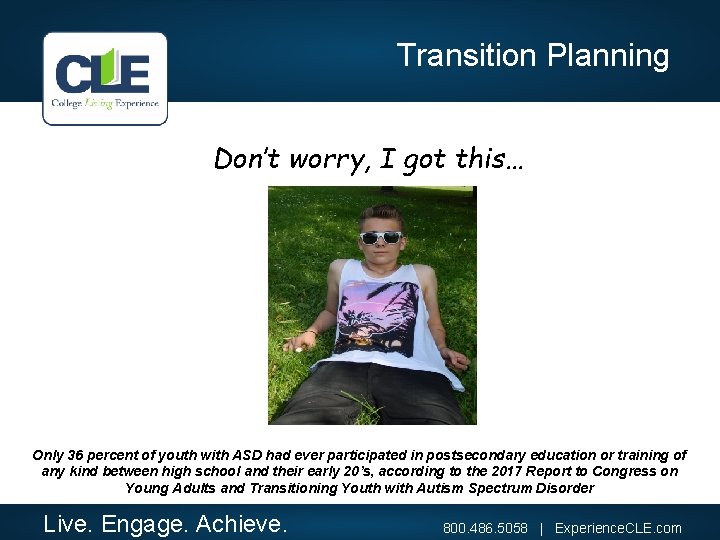
Transition Planning Don’t worry, I got this… Only 36 percent of youth with ASD had ever participated in postsecondary education or training of any kind between high school and their early 20’s, according to the 2017 Report to Congress on Young Adults and Transitioning Youth with Autism Spectrum Disorder Live. Engage. Achieve. 800. 486. 5058 | Experience. CLE. com
Backwards Planning for Future Goals Backwards Planning/Backwards Design Concept in curriculum development by Mc. Tighe and Wiggins. Thinking Backwards: 1. What is the end goal? 2. What assessment will show the goal has been met? 3. What are the steps that the student will need to get there? Live. Engage. Achieve. 800. 486. 5058 | Experience. CLE. com
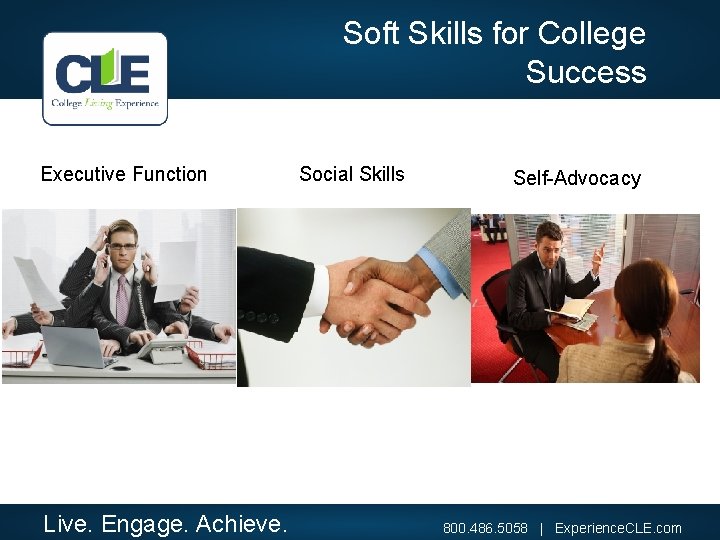
Soft Skills for College Success Executive Function Social Skills Live. Engage. Achieve. Self-Advocacy 800. 486. 5058 | Experience. CLE. com
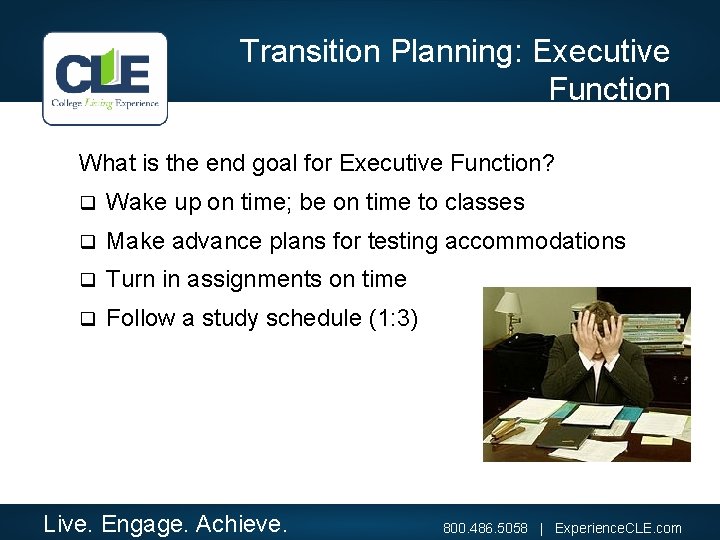
Transition Planning: Executive Function What is the end goal for Executive Function? q Wake up on time; be on time to classes q Make advance plans for testing accommodations q Turn in assignments on time q Follow a study schedule (1: 3) Live. Engage. Achieve. 800. 486. 5058 | Experience. CLE. com
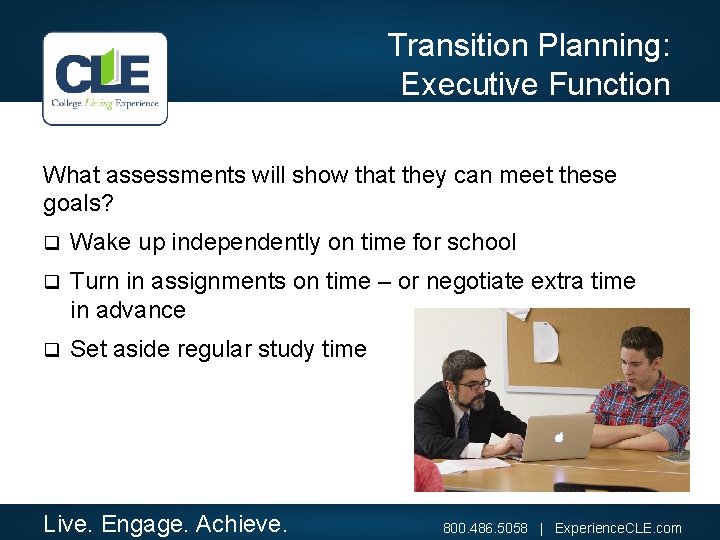
Transition Planning: Executive Function What assessments will show that they can meet these goals? q Wake up independently on time for school q Turn in assignments on time – or negotiate extra time in advance q Set aside regular study time Live. Engage. Achieve. 800. 486. 5058 | Experience. CLE. com
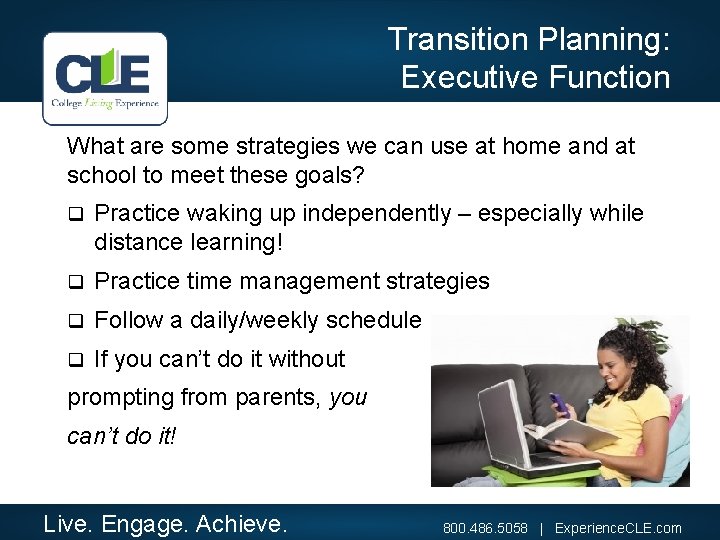
Transition Planning: Executive Function What are some strategies we can use at home and at school to meet these goals? q Practice waking up independently – especially while distance learning! q Practice time management strategies q Follow a daily/weekly schedule q If you can’t do it without prompting from parents, you can’t do it! Live. Engage. Achieve. 800. 486. 5058 | Experience. CLE. com
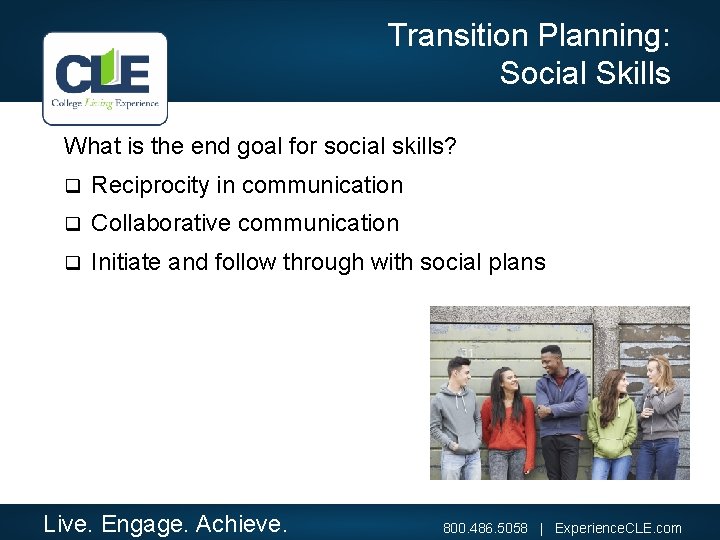
Transition Planning: Social Skills What is the end goal for social skills? q Reciprocity in communication q Collaborative communication q Initiate and follow through with social plans Live. Engage. Achieve. 800. 486. 5058 | Experience. CLE. com
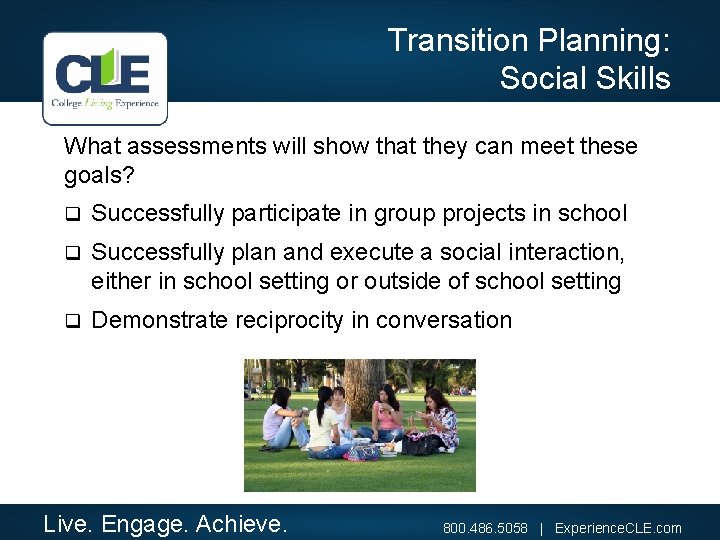
Transition Planning: Social Skills What assessments will show that they can meet these goals? q Successfully participate in group projects in school q Successfully plan and execute a social interaction, either in school setting or outside of school setting q Demonstrate reciprocity in conversation Live. Engage. Achieve. 800. 486. 5058 | Experience. CLE. com
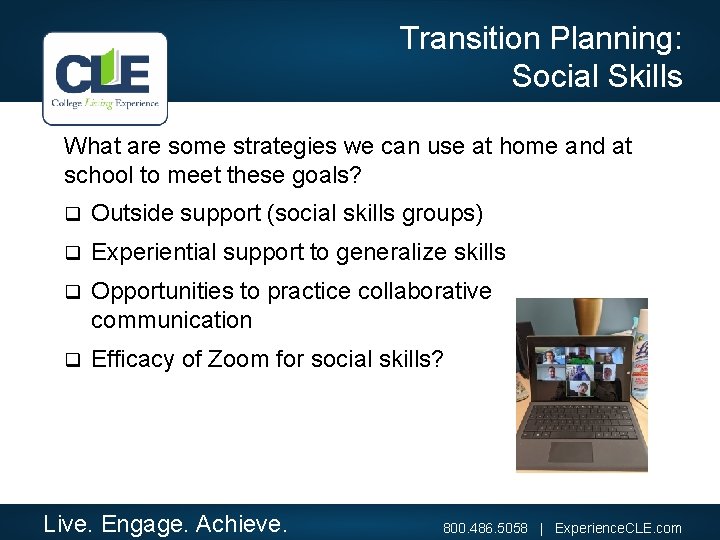
Transition Planning: Social Skills What are some strategies we can use at home and at school to meet these goals? q Outside support (social skills groups) q Experiential support to generalize skills q Opportunities to practice collaborative communication q Efficacy of Zoom for social skills? Live. Engage. Achieve. 800. 486. 5058 | Experience. CLE. com
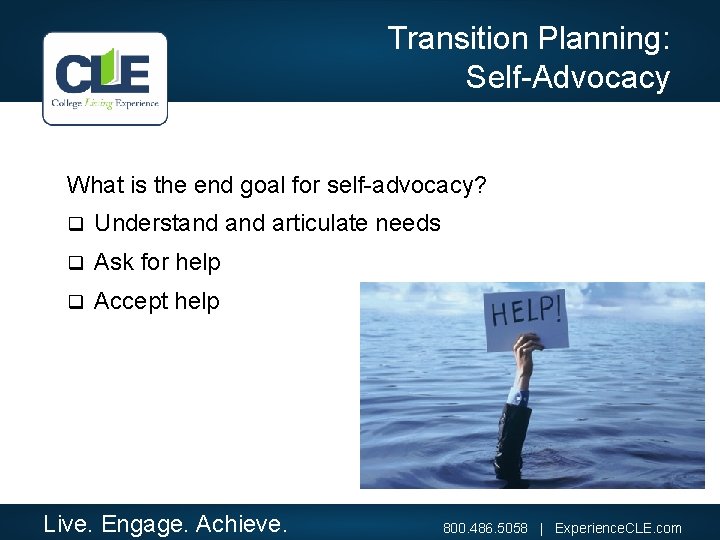
Transition Planning: Self-Advocacy What is the end goal for self-advocacy? q Understand articulate needs q Ask for help q Accept help Live. Engage. Achieve. 800. 486. 5058 | Experience. CLE. com
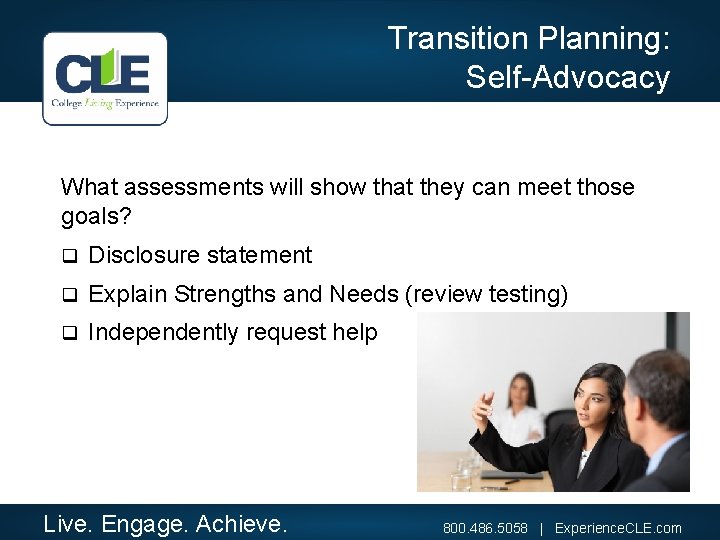
Transition Planning: Self-Advocacy What assessments will show that they can meet those goals? q Disclosure statement q Explain Strengths and Needs (review testing) q Independently request help Live. Engage. Achieve. 800. 486. 5058 | Experience. CLE. com
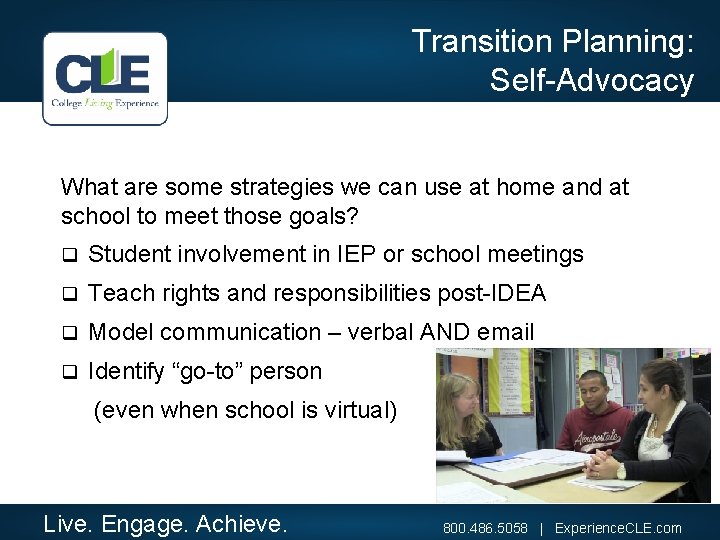
Transition Planning: Self-Advocacy What are some strategies we can use at home and at school to meet those goals? q Student involvement in IEP or school meetings q Teach rights and responsibilities post-IDEA q Model communication – verbal AND email q Identify “go-to” person (even when school is virtual) Live. Engage. Achieve. 800. 486. 5058 | Experience. CLE. com
Transition Planning: Self-Advocacy Sample Disclosure Statement: My disability can sometimes make me feel frustrated. When this happens, I need to take a few minutes to calm myself down. I may need to take a short break. Most of the time, I am fine soon after. Live. Engage. Achieve. 800. 486. 5058 | Experience. CLE. com
Other Aspects of Transition Planning Other steps to consider: q. Maintaining a clean living space (or at least, “college clean”), doing laundry q. Managing medications independently q. Health protocol q. Managing money q Planning for meals Live. Engage. Achieve. 800. 486. 5058 | Experience. CLE. com
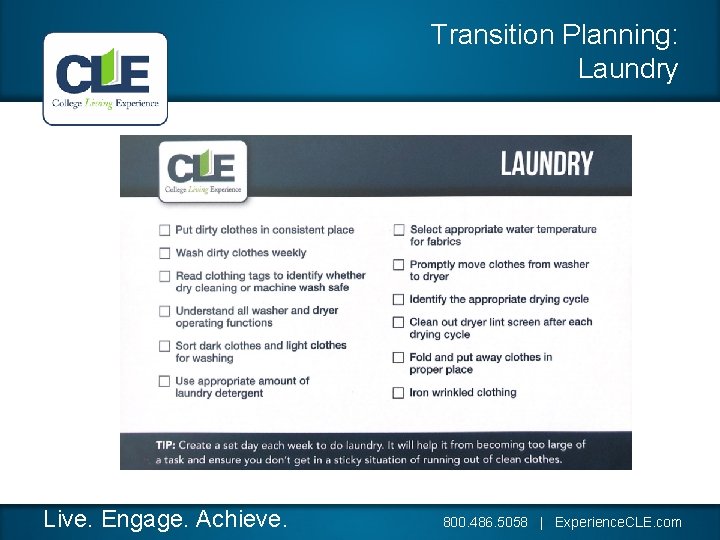
Transition Planning: Laundry Live. Engage. Achieve. 800. 486. 5058 | Experience. CLE. com
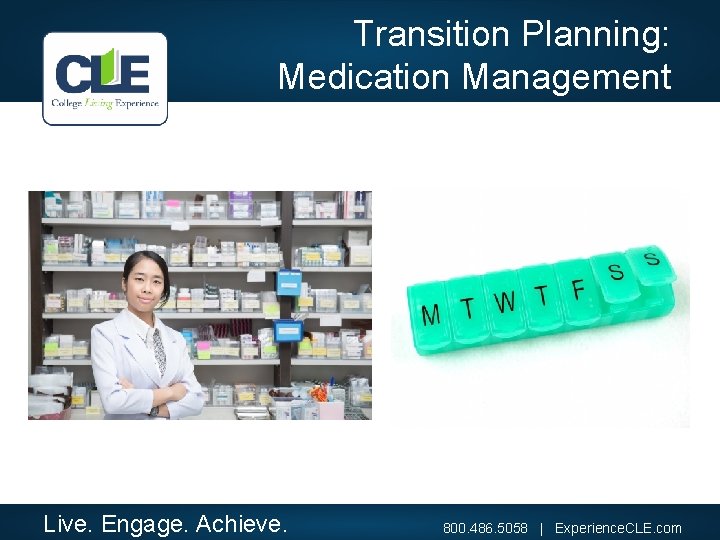
Transition Planning: Medication Management Live. Engage. Achieve. 800. 486. 5058 | Experience. CLE. com
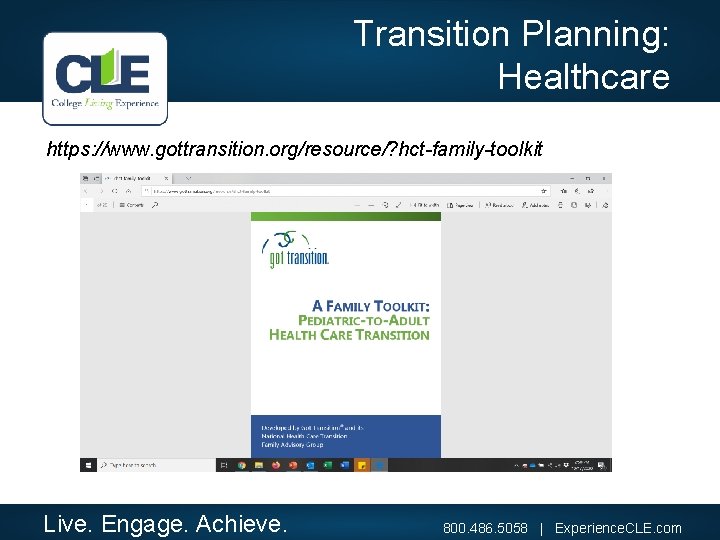
Transition Planning: Healthcare https: //www. gottransition. org/resource/? hct-family-toolkit Live. Engage. Achieve. 800. 486. 5058 | Experience. CLE. com
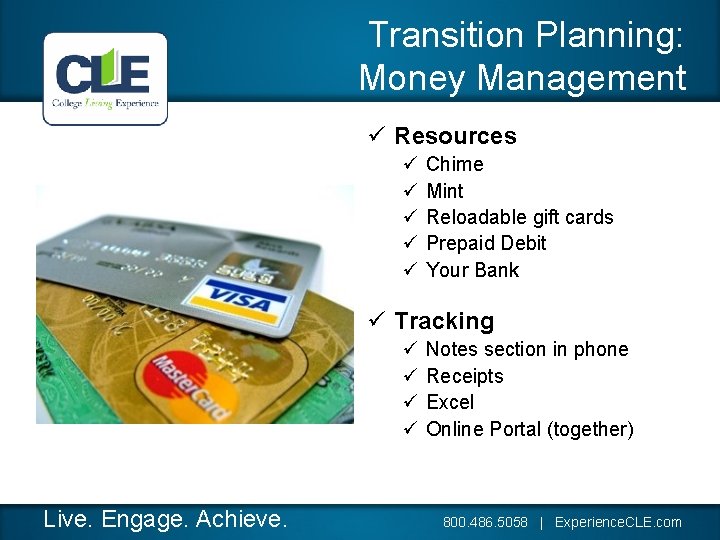
Transition Planning: Money Management ü Resources ü ü ü Chime Mint Reloadable gift cards Prepaid Debit Your Bank ü Tracking ü ü Live. Engage. Achieve. Notes section in phone Receipts Excel Online Portal (together) 800. 486. 5058 | Experience. CLE. com
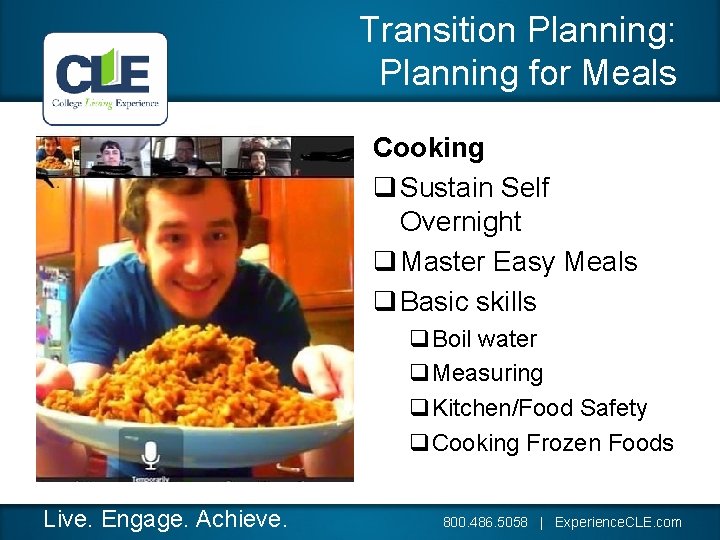
Transition Planning: Planning for Meals Cooking q Sustain Self Overnight q Master Easy Meals q Basic skills q. Boil water q. Measuring q. Kitchen/Food Safety q. Cooking Frozen Foods Live. Engage. Achieve. 800. 486. 5058 | Experience. CLE. com
Questions? Live. Engage. Achieve. 800. 486. 5058 | Experience. CLE. com
For More Information: www. Experience. CLE. com japrice@experiencecle. com 240 -425 -8784 800 -486 -5058 Live. Engage. Achieve. 800. 486. 5058 | Experience. CLE. com
- Slides: 34