Social Skil For most people the skills needed
- Slides: 17
Social Skil
For most people, the skills needed for social interaction come 'naturally' during the process of growth and development. However, for many individuals this process may not be so effortless and direct social skills instruction may be necessary, the ability to navigate everyday social interactions can frequently present significant challenges for these students. (Canney and Byrne, 2006; De. George, 1998).
Because of these inappropriate interactions, students with LD may find themselves socially isolated or ostracized by their peers. For example, students with learning disabilities may have difficulties controlling physical or verbal impulses; they may shout answers without being called on or inadvertently say something thoughtless or rude to a classmate (Hayes, 1994; Lavoie, 2005). Students with learning disabilities may also have trouble recognizing personal space and appropriate levels of physical contact (Hayes, 1994). These types of difficulties or other social skills deficits can serve to isolate students with learning disabilities, resulting in missed social opportunities.
Why are social skills important? Having social skills is essential for success in life, some students need to learn how to act appropriately with peers so that they can be included in the regular education classroom and learn how to act appropriately in the community.
According to PBIS World. com, teaching social skills will… • Improve basic social skills • Increase instructional time (inclusion in the regular education classroom) • Improve student interactions • Increase student productivity • Help students improve daily social functioning • Help students make friends (engage in conversions) • • • Help students to fit in Help students to function better in classes Teach students to follow rules, expectations, procedures, etc Increase self confidence, self concept, and self esteem Give students a common “language” Teach students safety (stranger danger, how to ride a bus, etc. )
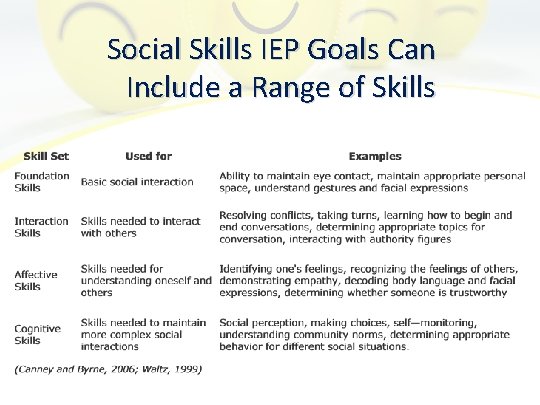
Social Skills IEP Goals Can Include a Range of Skills
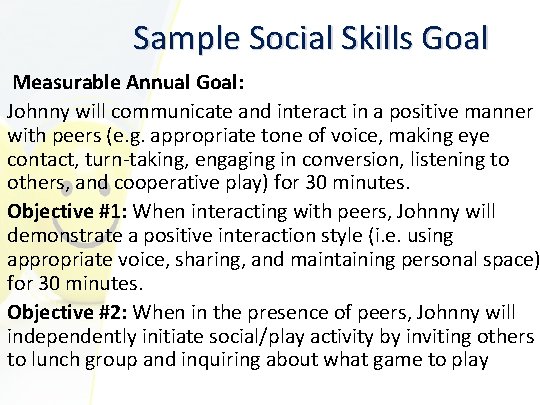
Sample Social Skills Goal Measurable Annual Goal: Johnny will communicate and interact in a positive manner with peers (e. g. appropriate tone of voice, making eye contact, turn-taking, engaging in conversion, listening to others, and cooperative play) for 30 minutes. Objective #1: When interacting with peers, Johnny will demonstrate a positive interaction style (i. e. using appropriate voice, sharing, and maintaining personal space) for 30 minutes. Objective #2: When in the presence of peers, Johnny will independently initiate social/play activity by inviting others to lunch group and inquiring about what game to play
Social Skills Strategies
Social Stories • Can provide students with a narrative or script about a variety of situations and appropriate behavior. • These can be ready made stories, stories written specifically for the student, like preparing them for a trip or new school, or as children get older they can write their own social story. • Another option could be creating social story videos
Social Story Video Example Keep Hands to Yourself (2 min 26 seconds) https: //www. youtube. com/watch? v=8 i. TPPh 1 d 2 j 8
Lunch Group Provides students the opportunity to practice social skills in a small group setting under direct supervision in order to address appropriate and inappropriate social skills. Typically this is done during lunch in a secluded area 2 -3 times a week. The child may ask his peers to join or the teacher may ask peers to join. During lunch group games are played to facilitate the following: • Initiate conversation with peers in informal situations • Cooperation with peers in group activities • Listening while others are speaking • Gaining peers’ attention in an appropriate manner • Inviting peers to play or share activities • Asking questions and expanding conversions with peers • Extending conversions to 2 -3 turns
Social Skills Field Trips Social skills field trips can teach students new skills in the setting where they are most likely to be used. - How do we act in the restaurant/order food - How do we act at the store - Teaches them community safety - Teaches students patience
Social Skill Autopsies After a social interaction discuss what the child did, what happened, whether the outcome was positive or negative and what the child can do in the same situation in the future (Elksnin and Elksnin, 2000; Lavoie, 2005).
Big Buddies: Learning to interact with peers is a very important social skill. It is just as important to learn how to interact with others who may be younger or older. Usually an older class pairs up with a younger class, but sometimes the individual with disabilities can be the peer mentor.
Scripting is the practice of using focused scripts of typical situations and encounters to help teach students appropriate social skills, appropriate behaviors, and how to manage anxiety and fear. Using scripts to role-play provides an organized plan for teaching particular social skills that include: • Thinking about one’s behavior before, during, and after speaking. • Using appropriate eye contact, voice, tone, expression, and posture. • Respecting someone’s personal space. • Learning to participate appropriately in groups. • Dealing with peer pressure. • Taking charge of one’s feelings. • Giving and responding to criticism. • Dealing appropriately with conflict
Social Skills in Middle and High School Small group instruction, that provides skills in the following areas: Communication, Cooperation, Assertion, Responsibility, Empathy, Engagement, Acceptance, and Self-Control. Can have boys only social groups, girls only social, LGBT social groups.
References Used: • http: //www. ldonline. org/article/21025/ • https: //www. pbisworld. com/tier-1/teach-social-skills/ • http: //images. pcmac. org/Uploads/White. County. SD/Sub. Depart ments/Documents. Categories/Documents/Lunch%20 Bunch. pdf • https: //www. superduperinc. com/handouts/pdf/366%20 Scripting. pdf