Planner Please have your planner open on todays

- Slides: 57
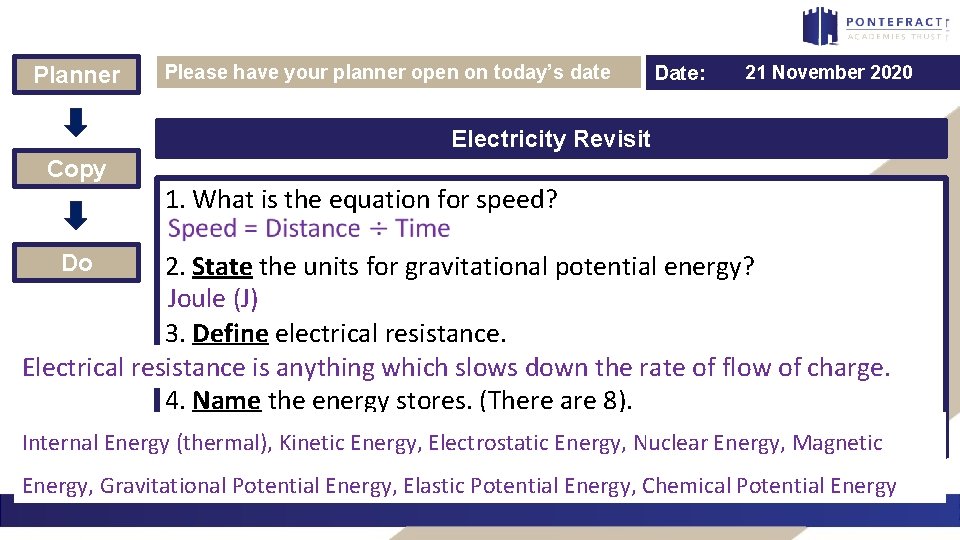
Planner Please have your planner open on today’s date Date: 21 November 2020 Electricity Revisit Copy 1. What is the equation for speed? 2. State the units for gravitational potential energy? Joule (J) 3. Define electrical resistance. Electrical resistance is anything which slows down the rate of flow of charge. 4. Name the energy stores. (There are 8). Do Internal Energy (thermal), Kinetic Energy, Electrostatic Energy, Nuclear Energy, Magnetic Energy, Gravitational Potential Energy, Elastic Potential Energy, Chemical Potential Energy
Learning Focus: Can I recall information about energy? Key Terms: Joule, energy, work done, power efficiency, series, parallel, resistance, current, charge, potential difference. Learning Outcomes: I can state the types of energy, formula and the law of conservation of energy. I can define waste energy I can calculate efficiency and describe ways to improve efficiency.
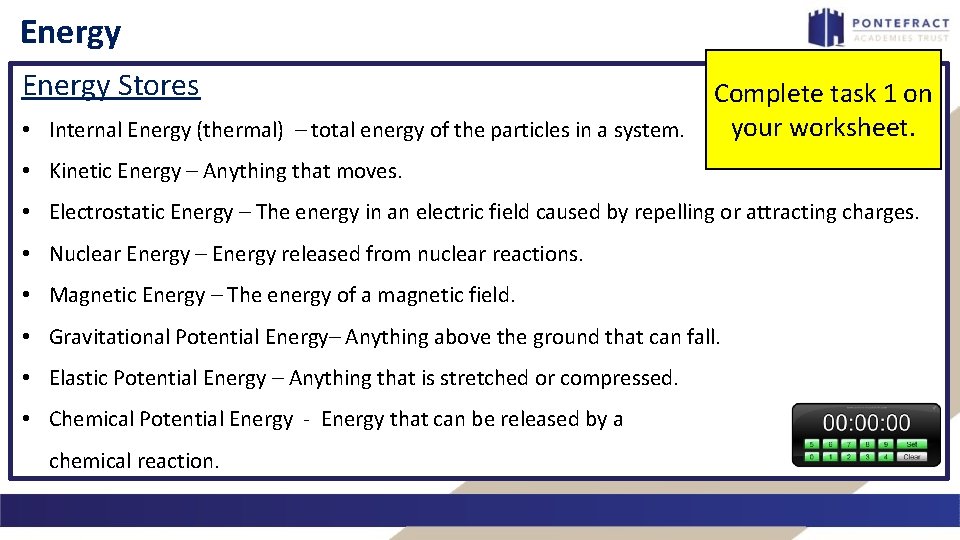
Energy Stores • Internal Energy (thermal) – total energy of the particles in a system. Complete task 1 on your worksheet. • Kinetic Energy – Anything that moves. • Electrostatic Energy – The energy in an electric field caused by repelling or attracting charges. • Nuclear Energy – Energy released from nuclear reactions. • Magnetic Energy – The energy of a magnetic field. • Gravitational Potential Energy– Anything above the ground that can fall. • Elastic Potential Energy – Anything that is stretched or compressed. • Chemical Potential Energy - Energy that can be released by a chemical reaction.
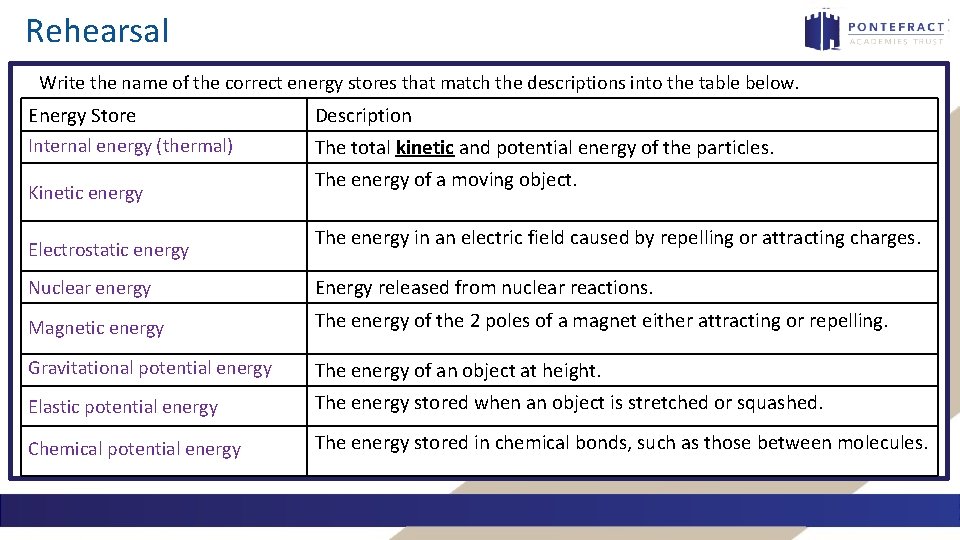
Rehearsal Write the name of the correct energy stores that match the descriptions into the table below. Energy Store Internal energy (thermal) Kinetic energy Electrostatic energy Description The total kinetic and potential energy of the particles. The energy of a moving object. The energy in an electric field caused by repelling or attracting charges. Nuclear energy Energy released from nuclear reactions. Magnetic energy The energy of the 2 poles of a magnet either attracting or repelling. Gravitational potential energy The energy of an object at height. Elastic potential energy The energy stored when an object is stretched or squashed. Chemical potential energy The energy stored in chemical bonds, such as those between molecules.
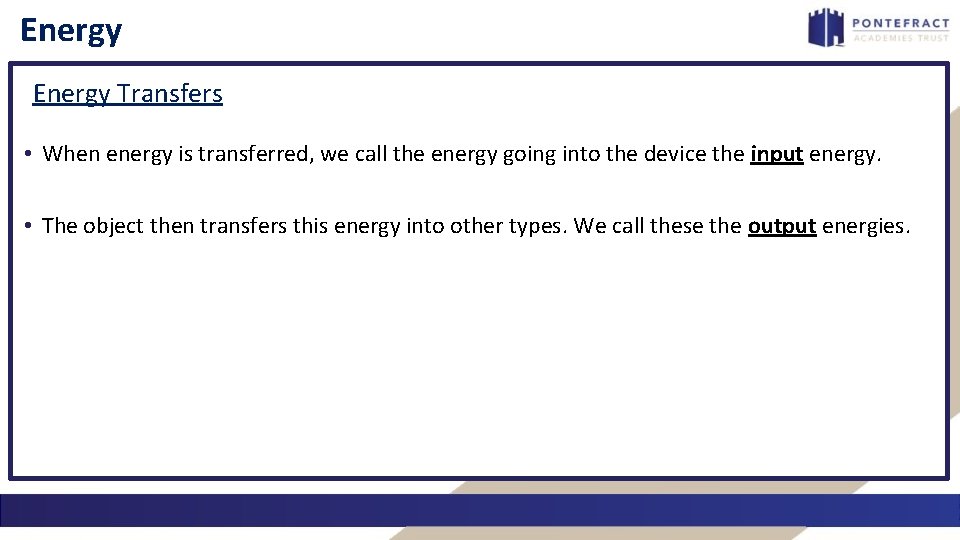
Energy Transfers • When energy is transferred, we call the energy going into the device the input energy. • The object then transfers this energy into other types. We call these the output energies.
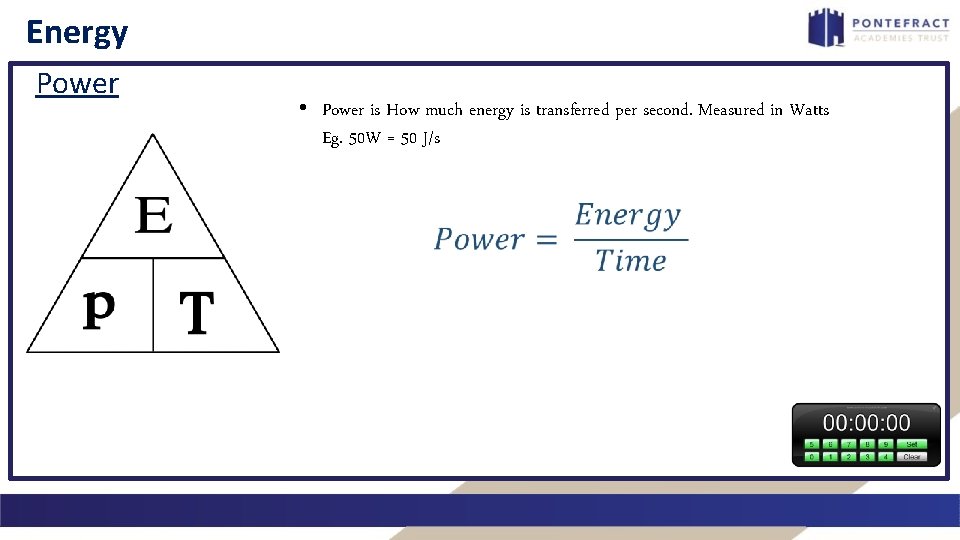
Energy Power • Power is How much energy is transferred per second. Measured in Watts Eg. 50 W = 50 J/s
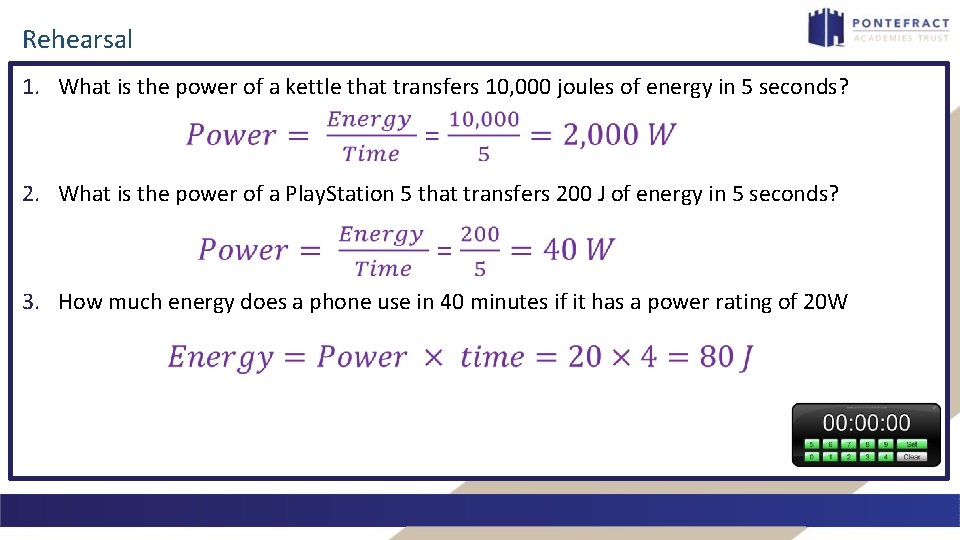
Rehearsal 1. What is the power of a kettle that transfers 10, 000 joules of energy in 5 seconds? 2. What is the power of a Play. Station 5 that transfers 200 J of energy in 5 seconds? 3. How much energy does a phone use in 40 minutes if it has a power rating of 20 W
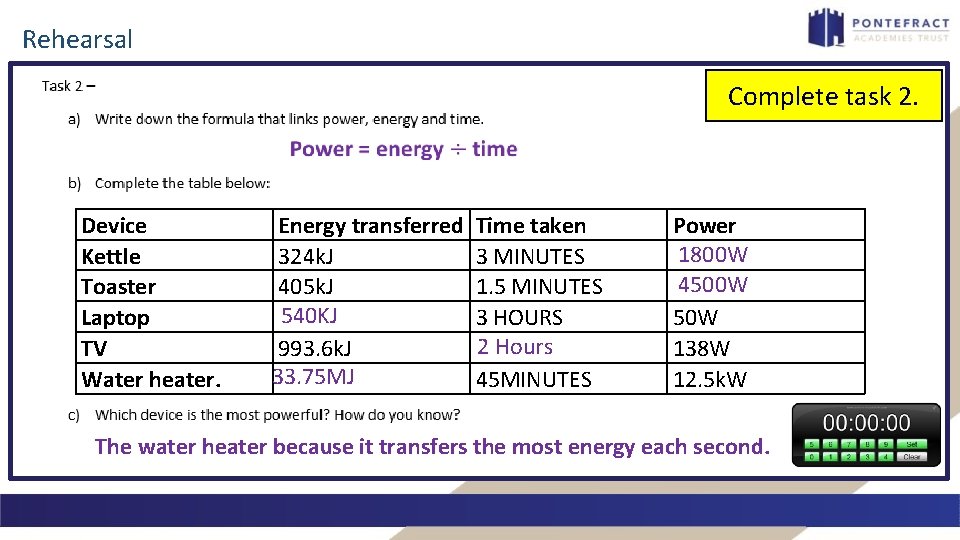
Rehearsal Complete task 2. Device Kettle Toaster Laptop TV Water heater. Energy transferred 324 k. J 405 k. J 540 KJ 993. 6 k. J 33. 75 MJ Time taken 3 MINUTES 1. 5 MINUTES 3 HOURS 2 Hours 45 MINUTES Power 1800 W 4500 W 50 W 138 W 12. 5 k. W The water heater because it transfers the most energy each second.
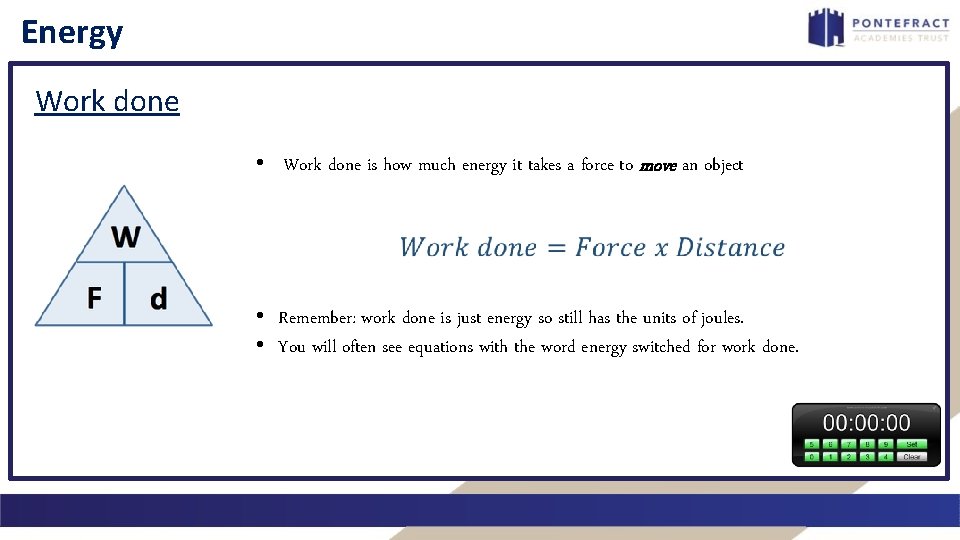
Energy Work done • Work done is how much energy it takes a force to move an object • Remember: work done is just energy so still has the units of joules. • You will often see equations with the word energy switched for work done.
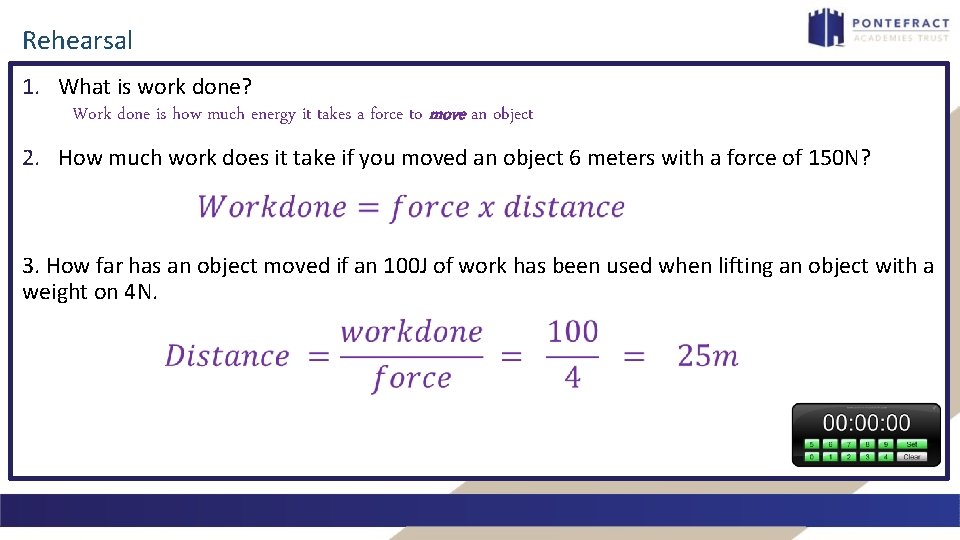
Rehearsal 1. What is work done? Work done is how much energy it takes a force to move an object 2. How much work does it take if you moved an object 6 meters with a force of 150 N? 3. How far has an object moved if an 100 J of work has been used when lifting an object with a weight on 4 N.
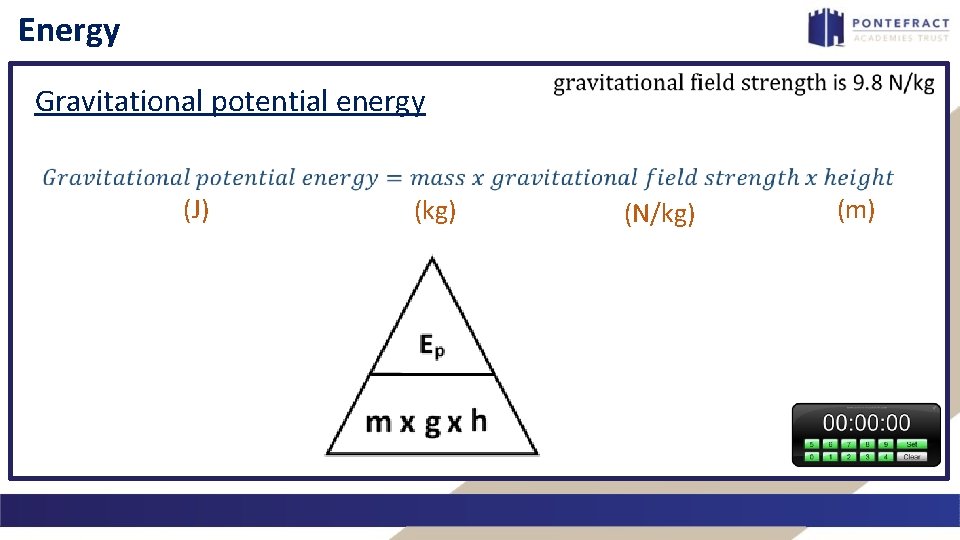
Energy Gravitational potential energy (J) (kg) (N/kg) (m)
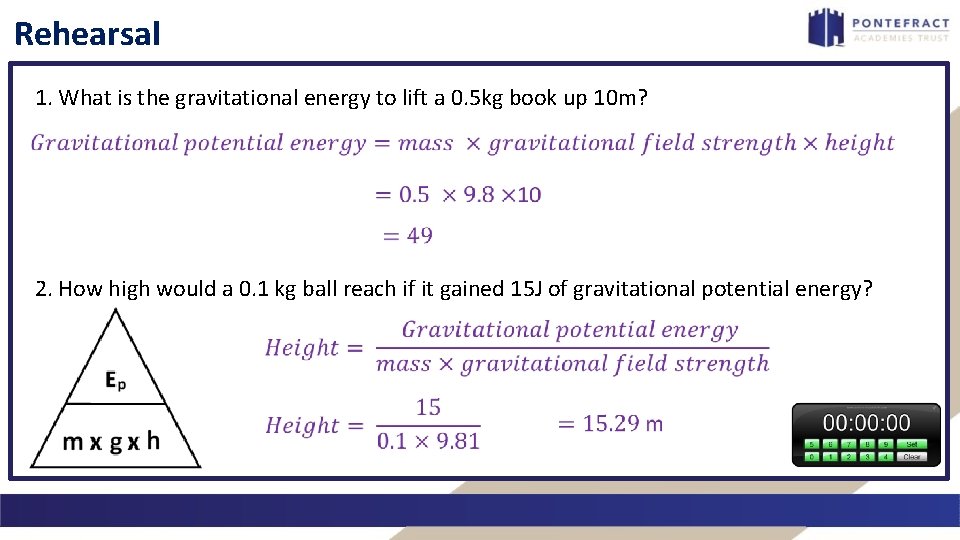
Rehearsal 1. What is the gravitational energy to lift a 0. 5 kg book up 10 m? 2. How high would a 0. 1 kg ball reach if it gained 15 J of gravitational potential energy?
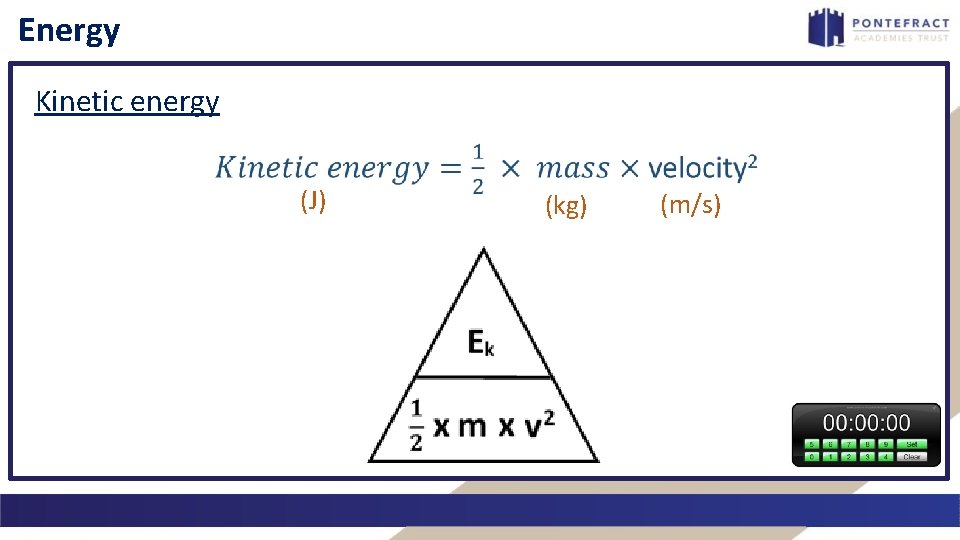
Energy Kinetic energy (J) (kg) (m/s)
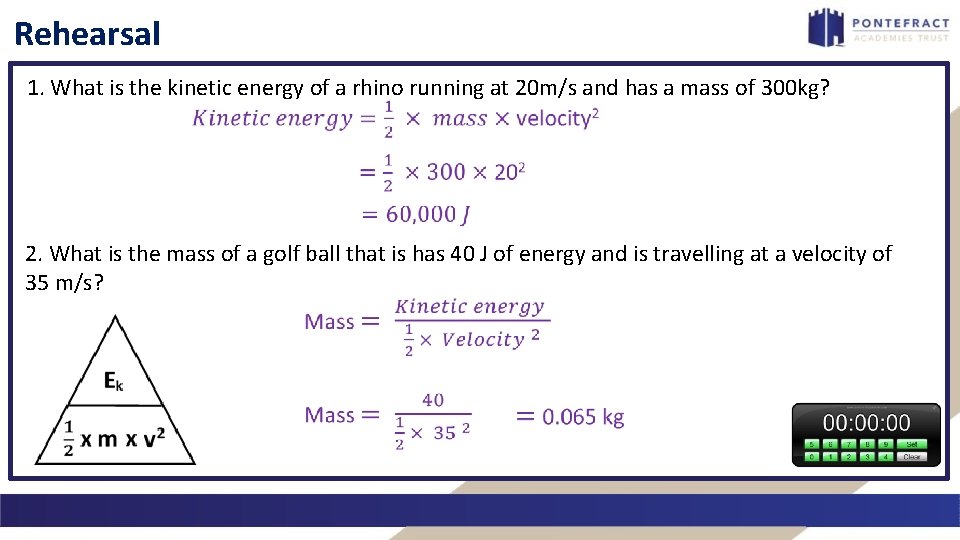
Rehearsal 1. What is the kinetic energy of a rhino running at 20 m/s and has a mass of 300 kg? 2. What is the mass of a golf ball that is has 40 J of energy and is travelling at a velocity of 35 m/s?
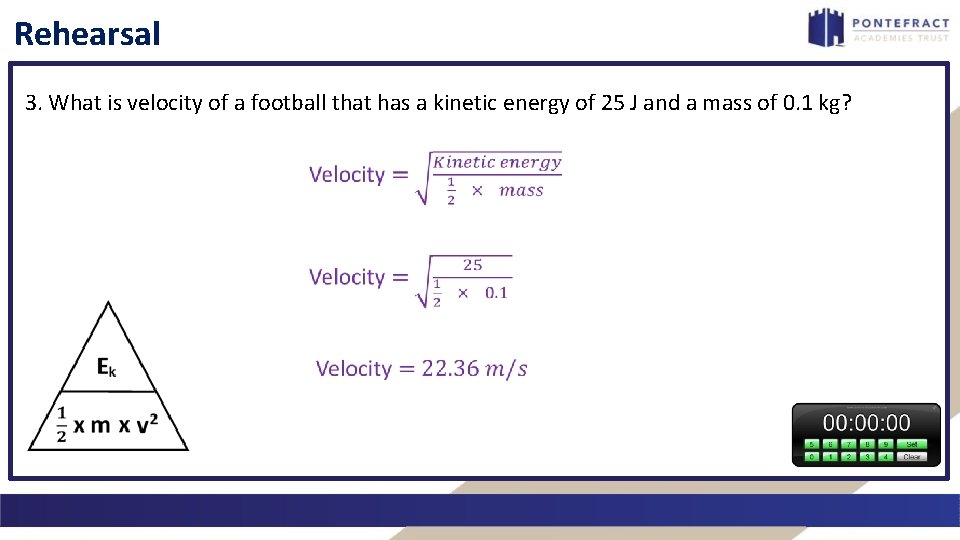
Rehearsal 3. What is velocity of a football that has a kinetic energy of 25 J and a mass of 0. 1 kg?
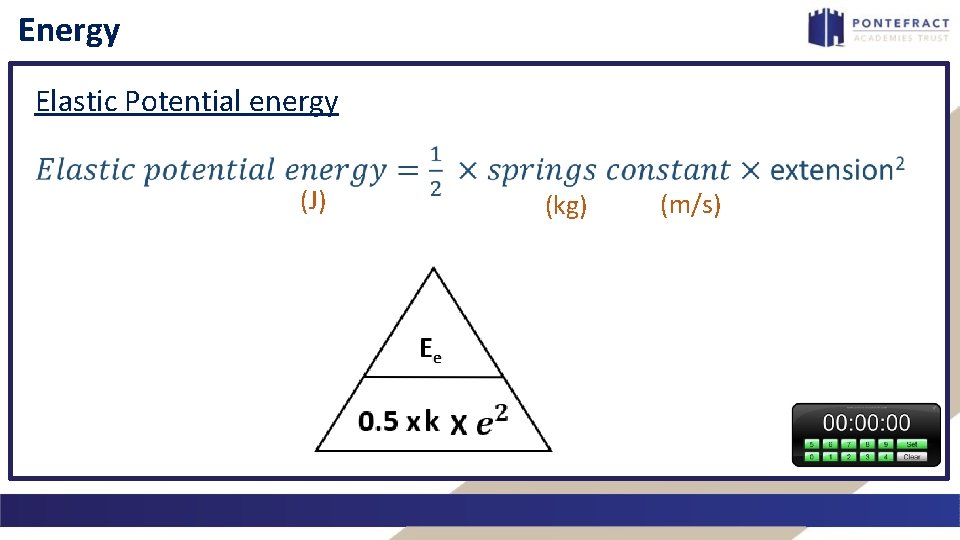
Energy Elastic Potential energy (J) (kg) (m/s)
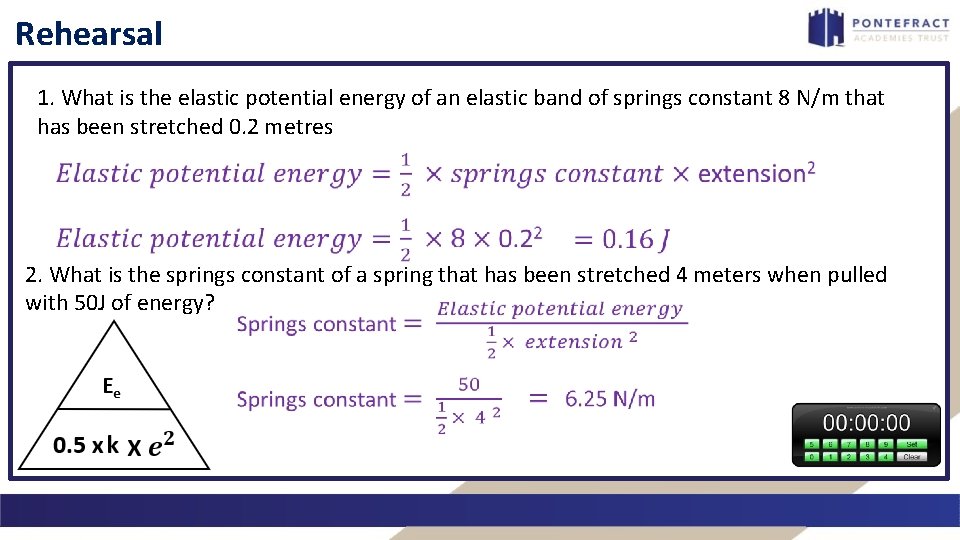
Rehearsal 1. What is the elastic potential energy of an elastic band of springs constant 8 N/m that has been stretched 0. 2 metres 2. What is the springs constant of a spring that has been stretched 4 meters when pulled with 50 J of energy?
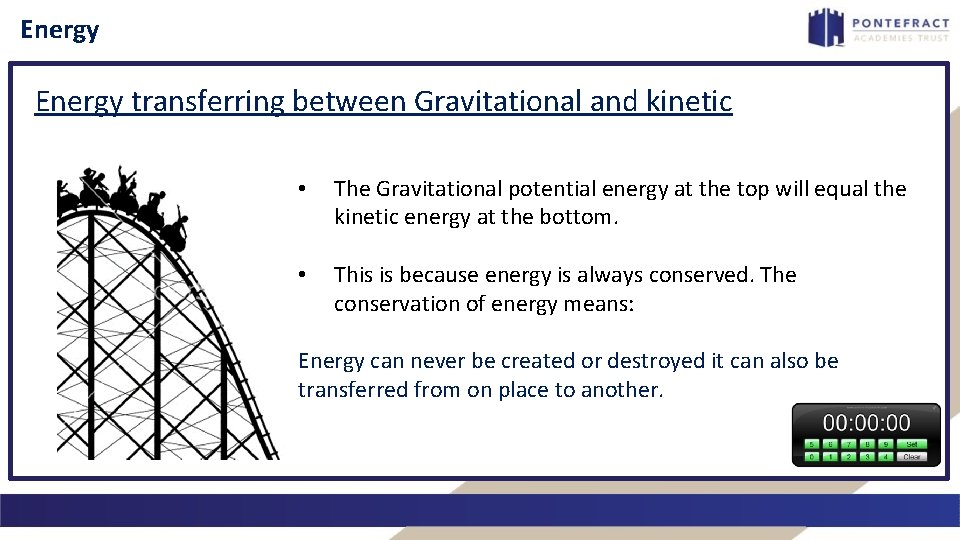
Energy transferring between Gravitational and kinetic • The Gravitational potential energy at the top will equal the kinetic energy at the bottom. • This is because energy is always conserved. The conservation of energy means: Energy can never be created or destroyed it can also be transferred from on place to another.
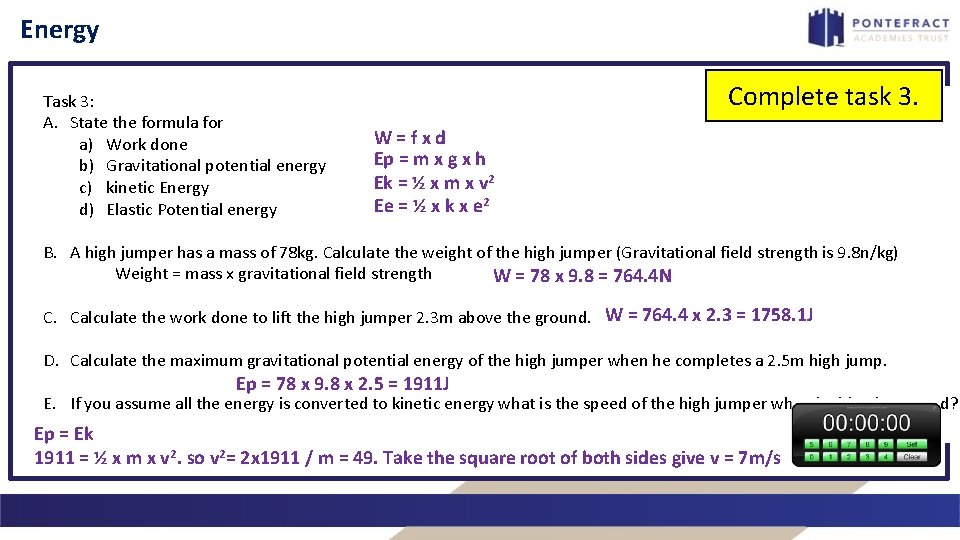
Energy Task 3: A. State the formula for a) Work done b) Gravitational potential energy c) kinetic Energy d) Elastic Potential energy Complete task 3. W = f x d Ep = m x g x h Ek = ½ x m x v 2 Ee = ½ x k x e 2 B. A high jumper has a mass of 78 kg. Calculate the weight of the high jumper (Gravitational field strength is 9. 8 n/kg) Weight = mass x gravitational field strength W = 78 x 9. 8 = 764. 4 N C. Calculate the work done to lift the high jumper 2. 3 m above the ground. W = 764. 4 x 2. 3 = 1758. 1 J D. Calculate the maximum gravitational potential energy of the high jumper when he completes a 2. 5 m high jump. Ep = 78 x 9. 8 x 2. 5 = 1911 J E. If you assume all the energy is converted to kinetic energy what is the speed of the high jumper when he hits the ground? Ep = Ek 1911 = ½ x m x v 2. so v 2= 2 x 1911 / m = 49. Take the square root of both sides give v = 7 m/s
Learning Focus: Can I recall information about electricity? Key Terms: Series, parallel, resistance, current, charge, potential difference. Learning Outcomes: I can define current, potential difference, resistance and charge. I can describe the rules of potential difference, current and resistance in series and parallel. I apply ohms law and give exceptions to it.
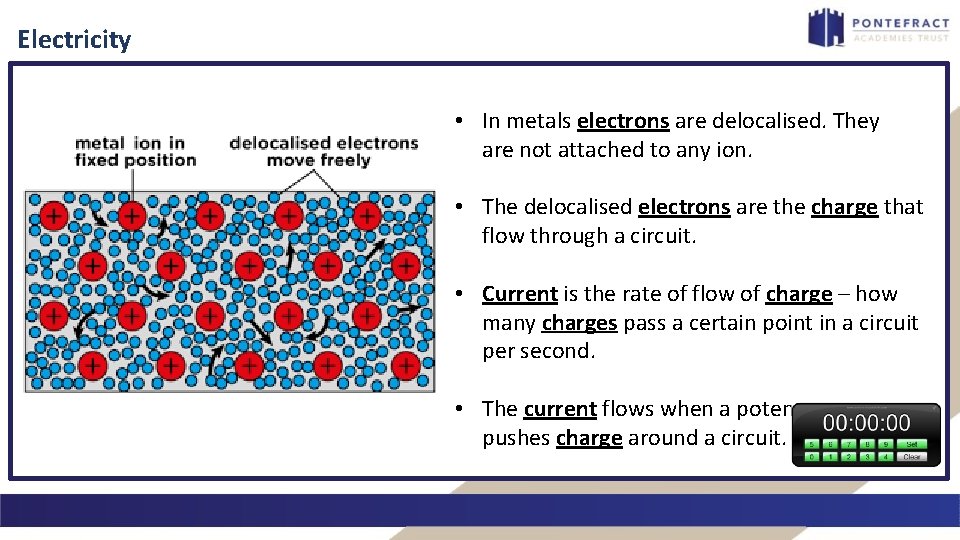
Electricity • In metals electrons are delocalised. They are not attached to any ion. • The delocalised electrons are the charge that flow through a circuit. • Current is the rate of flow of charge – how many charges pass a certain point in a circuit per second. • The current flows when a potential difference pushes charge around a circuit.
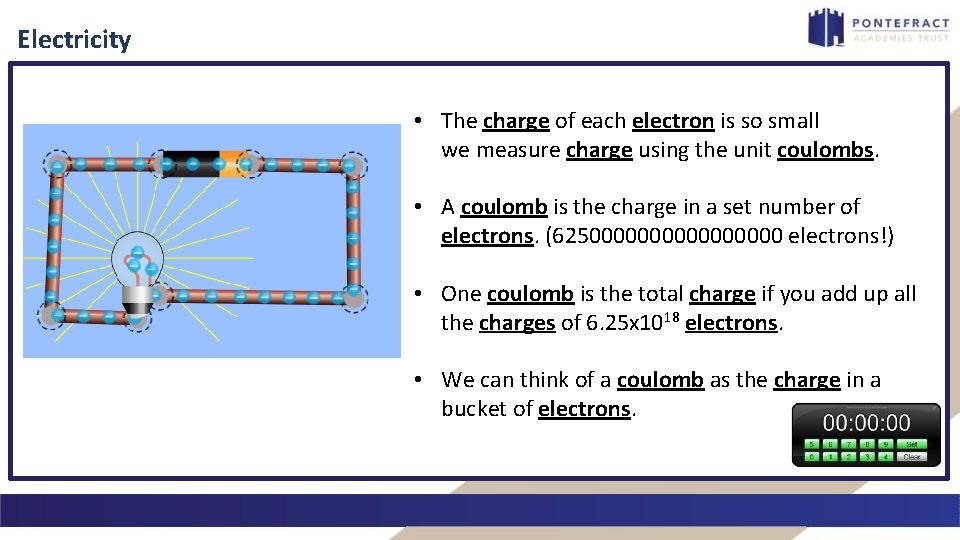
Electricity • The charge of each electron is so small we measure charge using the unit coulombs. • A coulomb is the charge in a set number of electrons. (62500000000 electrons!) • One coulomb is the total charge if you add up all the charges of 6. 25 x 1018 electrons. • We can think of a coulomb as the charge in a bucket of electrons.
Rehearsal 1. Which subatomic particles carry charge in a wire? Electrons 2. Why can charges move in wires? Charges can move because electrons are delocalised (not attached to any ion). 3. What are the units we measure charge in? Charge is measured in coulombs. 4. Why do we use this unit for charge? We use the unit of coulombs because the charge in each electron is so small. 5. What is a coulomb of charge? A coulomb of charge is the charge in a set number of electrons.
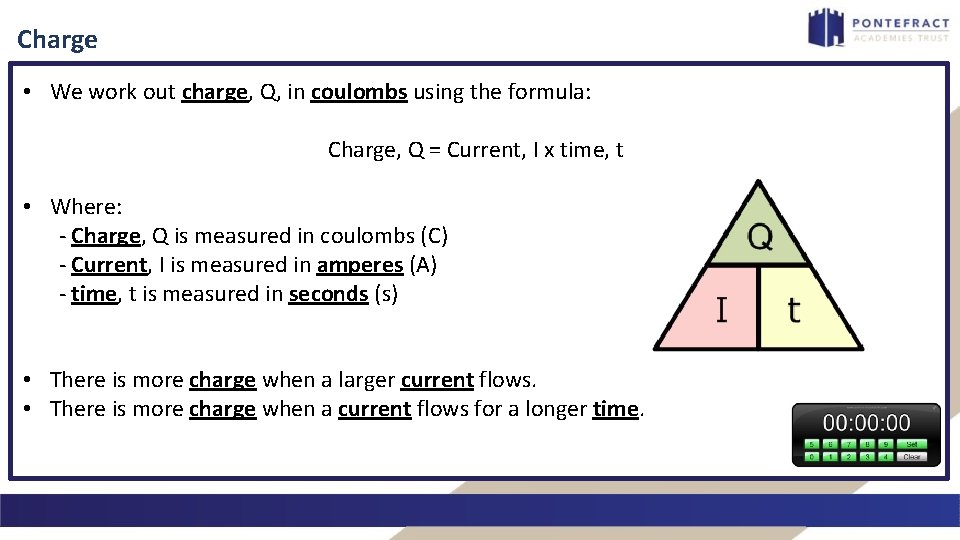
Charge • We work out charge, Q, in coulombs using the formula: Charge, Q = Current, I x time, t • Where: - Charge, Q is measured in coulombs (C) - Current, I is measured in amperes (A) - time, t is measured in seconds (s) • There is more charge when a larger current flows. • There is more charge when a current flows for a longer time.
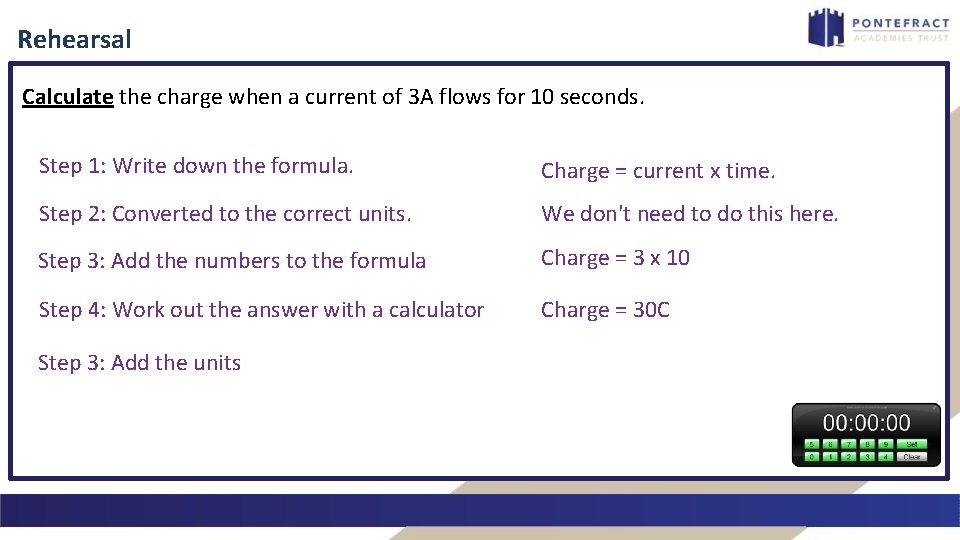
Rehearsal Calculate the charge when a current of 3 A flows for 10 seconds. Step 1: Write down the formula. Charge = current x time. Step 2: Converted to the correct units. We don't need to do this here. Step 3: Add the numbers to the formula Charge = 3 x 10 Step 4: Work out the answer with a calculator Charge = 30 C Step 3: Add the units
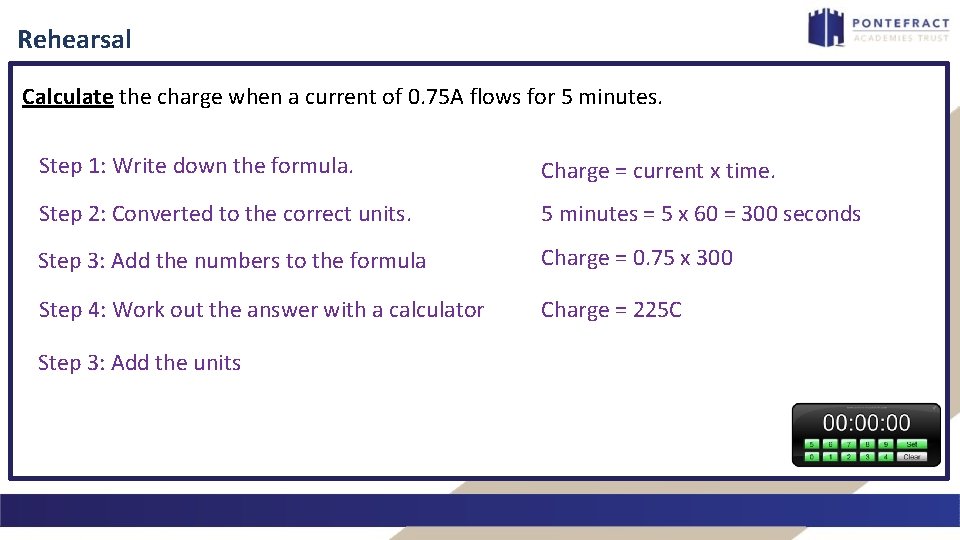
Rehearsal Calculate the charge when a current of 0. 75 A flows for 5 minutes. Step 1: Write down the formula. Charge = current x time. Step 2: Converted to the correct units. 5 minutes = 5 x 60 = 300 seconds Step 3: Add the numbers to the formula Charge = 0. 75 x 300 Step 4: Work out the answer with a calculator Charge = 225 C Step 3: Add the units
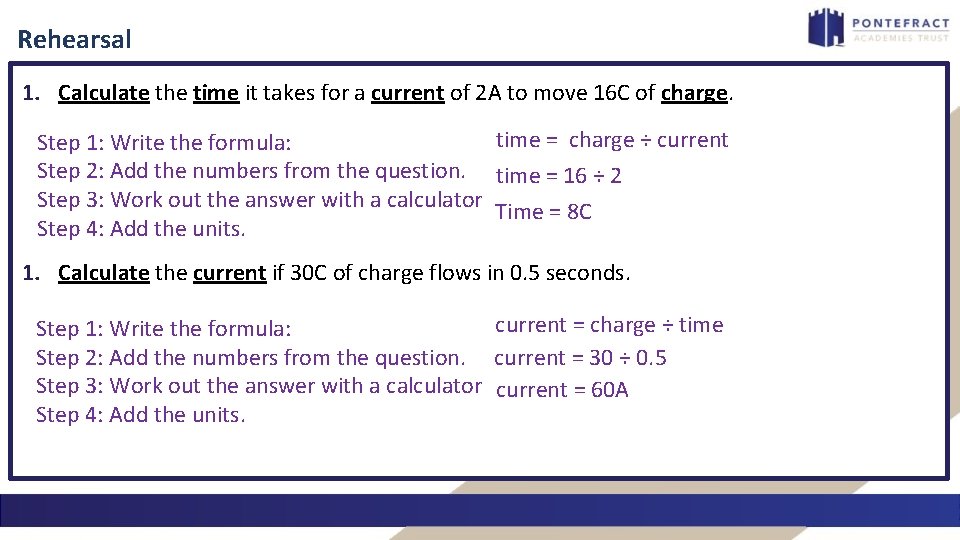
Rehearsal 1. Calculate the time it takes for a current of 2 A to move 16 C of charge. time = charge ÷ current Step 1: Write the formula: Step 2: Add the numbers from the question. time = 16 ÷ 2 Step 3: Work out the answer with a calculator Time = 8 C Step 4: Add the units. 1. Calculate the current if 30 C of charge flows in 0. 5 seconds. current = charge ÷ time Step 1: Write the formula: Step 2: Add the numbers from the question. current = 30 ÷ 0. 5 Step 3: Work out the answer with a calculator current = 60 A Step 4: Add the units.
Electricity • Potential difference is the amount of energy each coulomb of charge has. • Each charge is given energy from a cell or battery. • Charges transfer energy to electrical components through the electrical pathway.
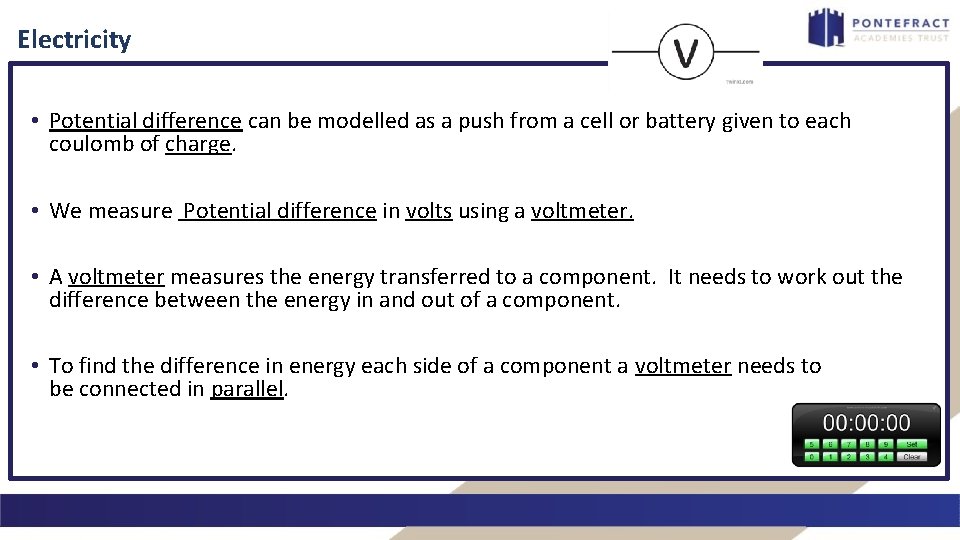
Electricity • Potential difference can be modelled as a push from a cell or battery given to each coulomb of charge. • We measure Potential difference in volts using a voltmeter. • A voltmeter measures the energy transferred to a component. It needs to work out the difference between the energy in and out of a component. • To find the difference in energy each side of a component a voltmeter needs to be connected in parallel.
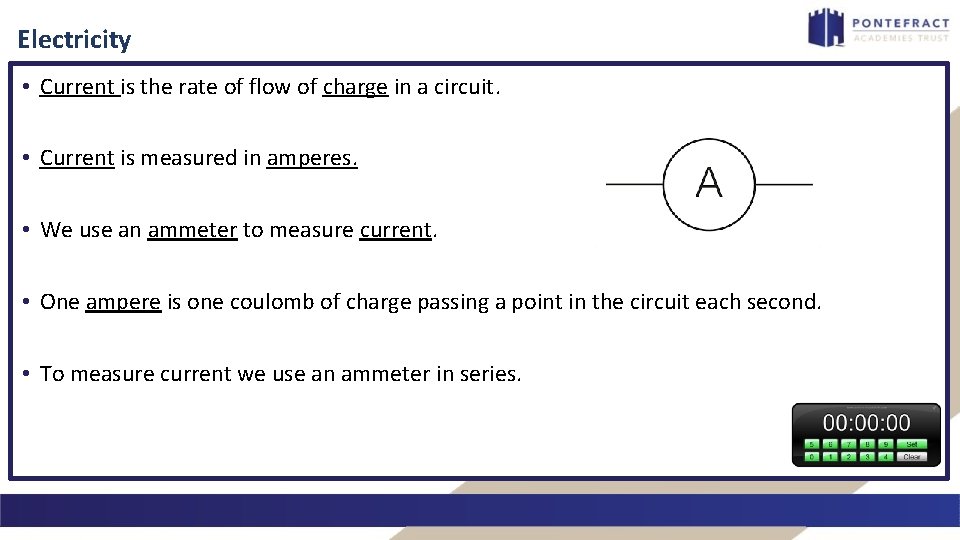
Electricity • Current is the rate of flow of charge in a circuit. • Current is measured in amperes. • We use an ammeter to measure current. • One ampere is one coulomb of charge passing a point in the circuit each second. • To measure current we use an ammeter in series.
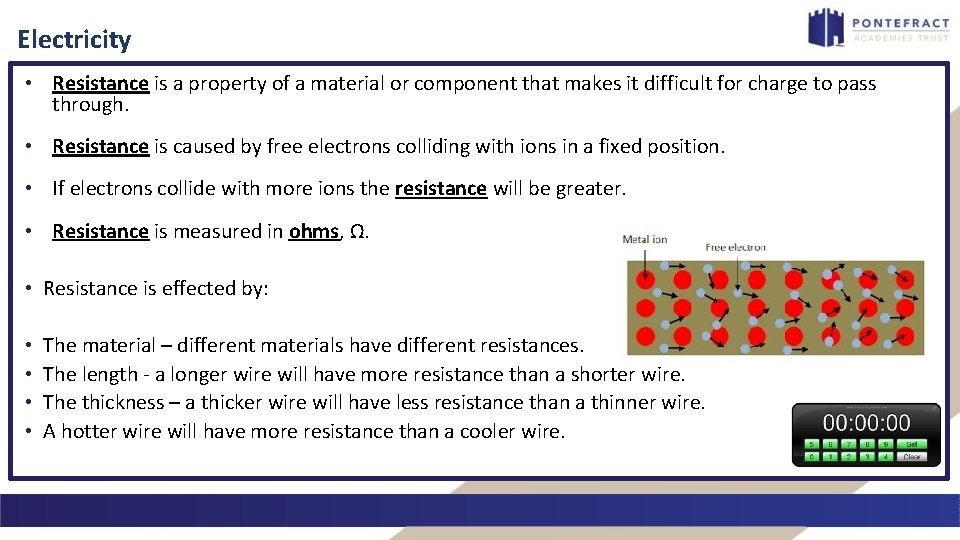
Electricity • Resistance is a property of a material or component that makes it difficult for charge to pass through. • Resistance is caused by free electrons colliding with ions in a fixed position. • If electrons collide with more ions the resistance will be greater. • Resistance is measured in ohms, Ω. • Resistance is effected by: • • The material – different materials have different resistances. The length - a longer wire will have more resistance than a shorter wire. The thickness – a thicker wire will have less resistance than a thinner wire. A hotter wire will have more resistance than a cooler wire.
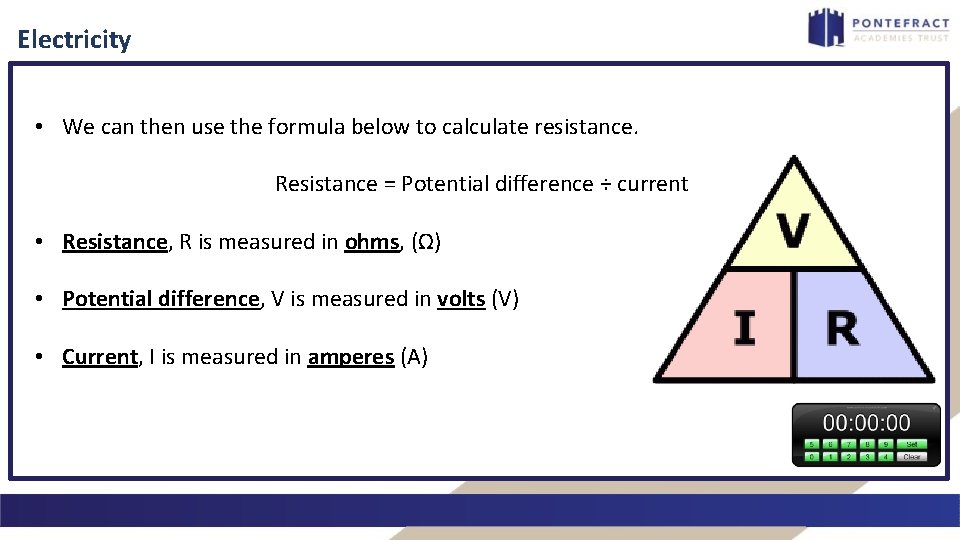
Electricity • We can then use the formula below to calculate resistance. Resistance = Potential difference ÷ current • Resistance, R is measured in ohms, (Ω) • Potential difference, V is measured in volts (V) • Current, I is measured in amperes (A)
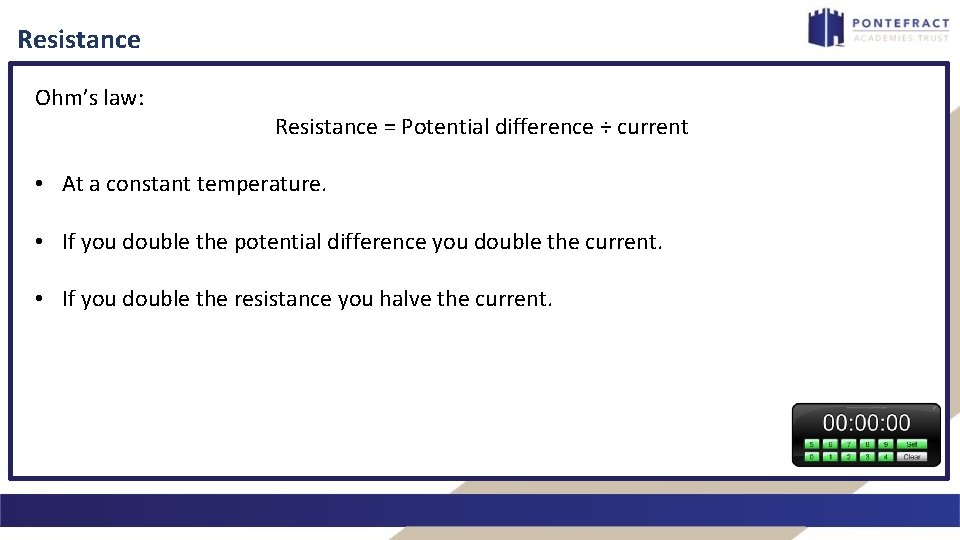
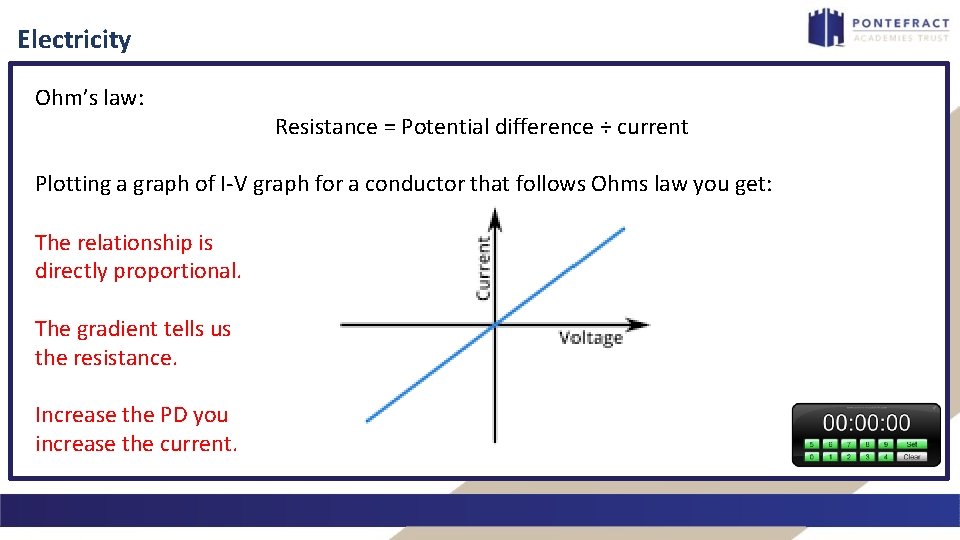
Resistance Ohm’s law: Resistance = Potential difference ÷ current • At a constant temperature. • If you double the potential difference you double the current. • If you double the resistance you halve the current.
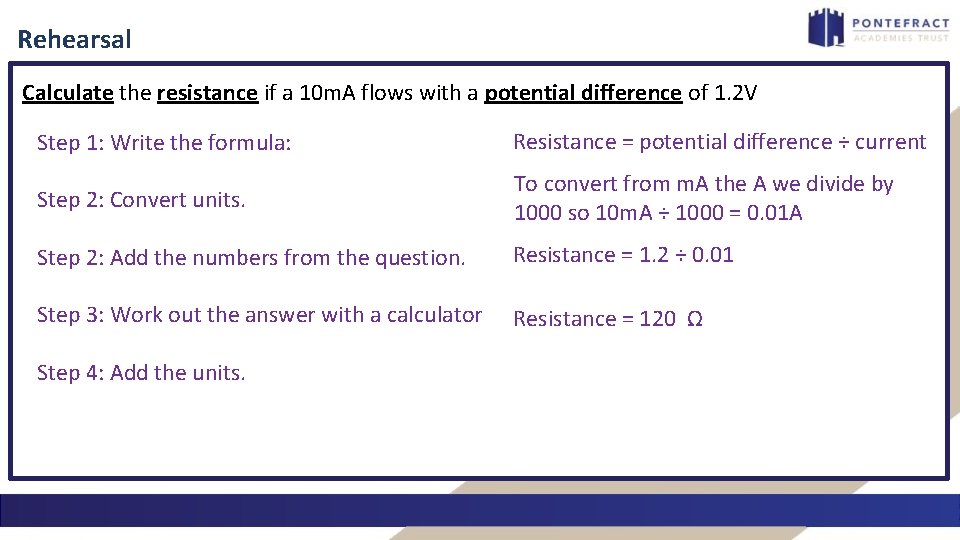
Rehearsal Calculate the resistance if a 10 m. A flows with a potential difference of 1. 2 V Step 1: Write the formula: Resistance = potential difference ÷ current Step 2: Convert units. To convert from m. A the A we divide by 1000 so 10 m. A ÷ 1000 = 0. 01 A Step 2: Add the numbers from the question. Resistance = 1. 2 ÷ 0. 01 Step 3: Work out the answer with a calculator Resistance = 120 Ω Step 4: Add the units.
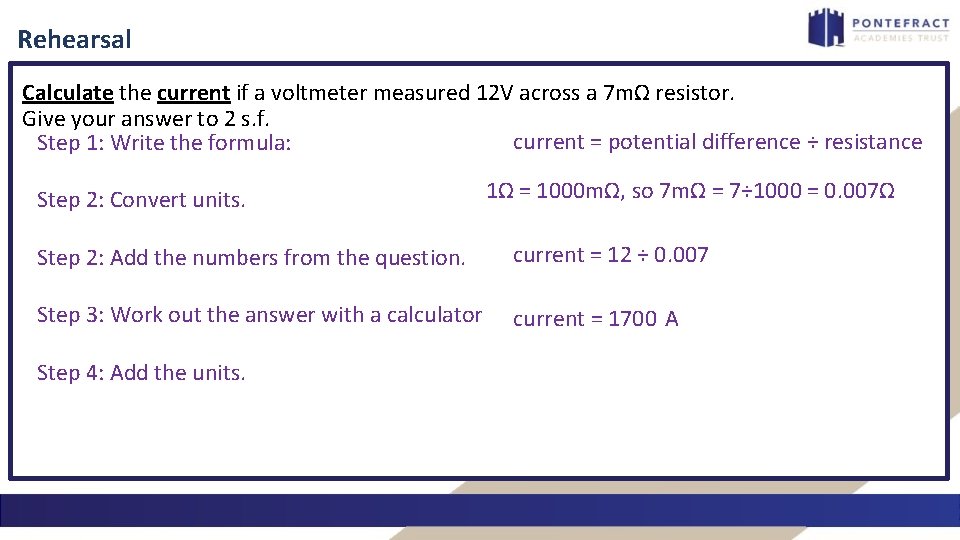
Rehearsal Calculate the current if a voltmeter measured 12 V across a 7 mΩ resistor. Give your answer to 2 s. f. current = potential difference ÷ resistance Step 1: Write the formula: Step 2: Convert units. 1Ω = 1000 mΩ, so 7 mΩ = 7÷ 1000 = 0. 007Ω Step 2: Add the numbers from the question. current = 12 ÷ 0. 007 Step 3: Work out the answer with a calculator current = 1700 A Step 4: Add the units.
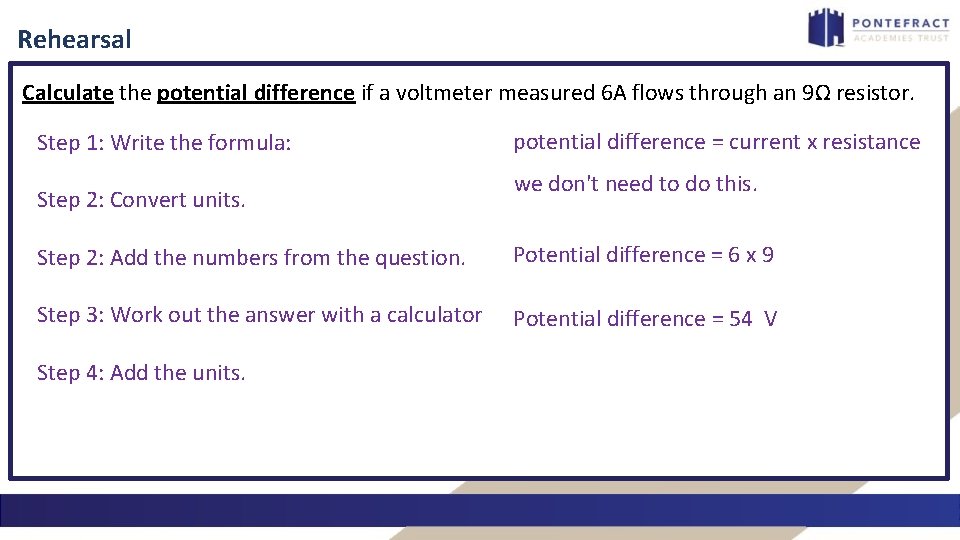
Rehearsal Calculate the potential difference if a voltmeter measured 6 A flows through an 9Ω resistor. Step 1: Write the formula: Step 2: Convert units. potential difference = current x resistance we don't need to do this. Step 2: Add the numbers from the question. Potential difference = 6 x 9 Step 3: Work out the answer with a calculator Potential difference = 54 V Step 4: Add the units.
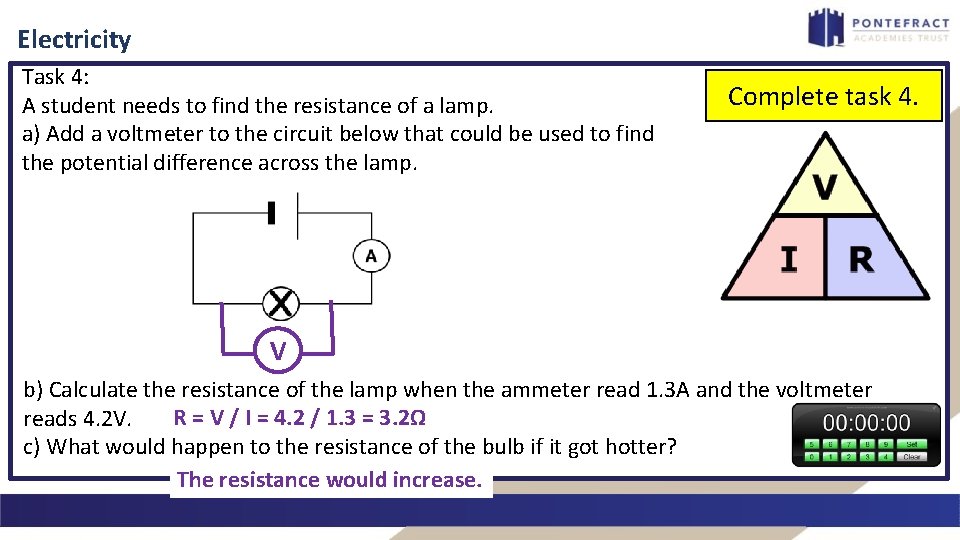
Electricity Task 4: A student needs to find the resistance of a lamp. a) Add a voltmeter to the circuit below that could be used to find the potential difference across the lamp. Complete task 4. V b) Calculate the resistance of the lamp when the ammeter read 1. 3 A and the voltmeter R = V / I = 4. 2 / 1. 3 = 3. 2Ω reads 4. 2 V. c) What would happen to the resistance of the bulb if it got hotter? The resistance would increase.
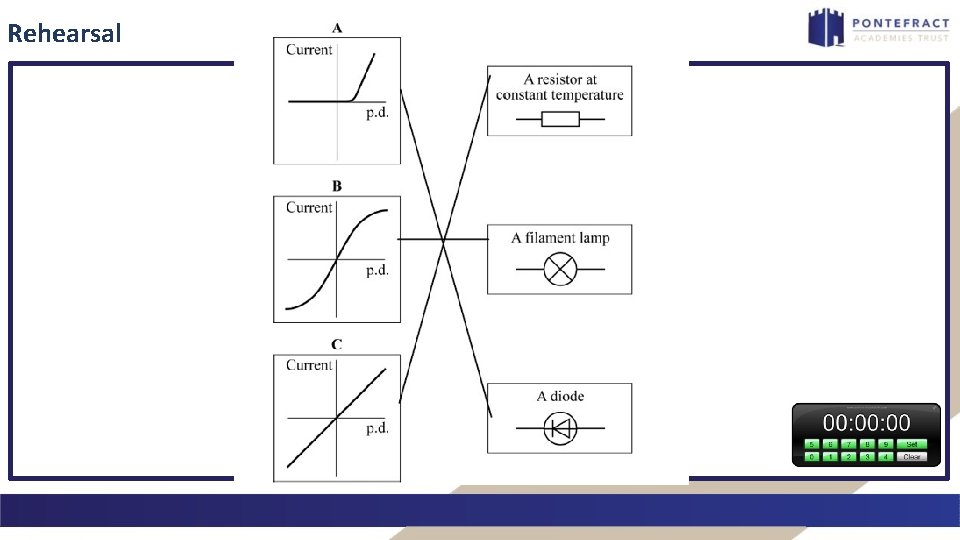
Electricity Ohm’s law: Resistance = Potential difference ÷ current Plotting a graph of I-V graph for a conductor that follows Ohms law you get: The relationship is directly proportional. The gradient tells us the resistance. Increase the PD you increase the current.
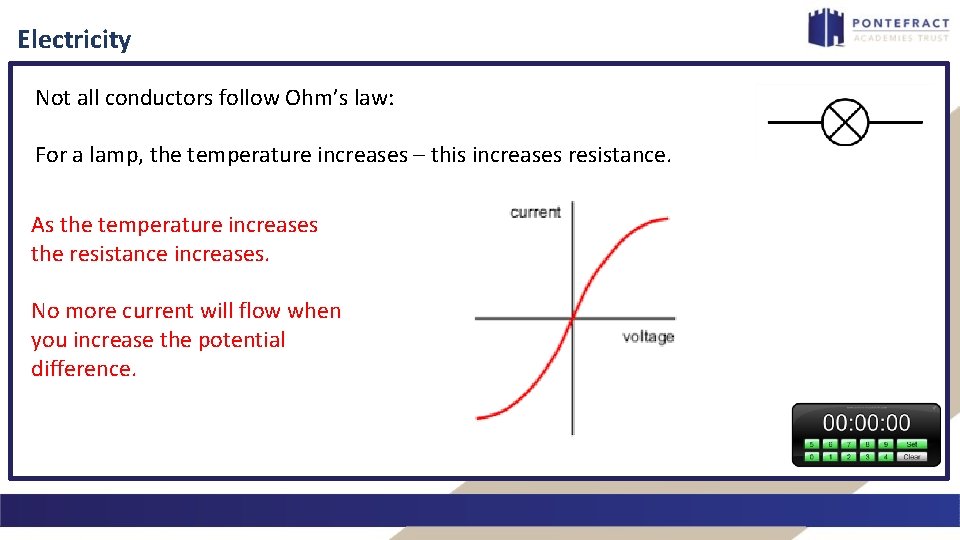
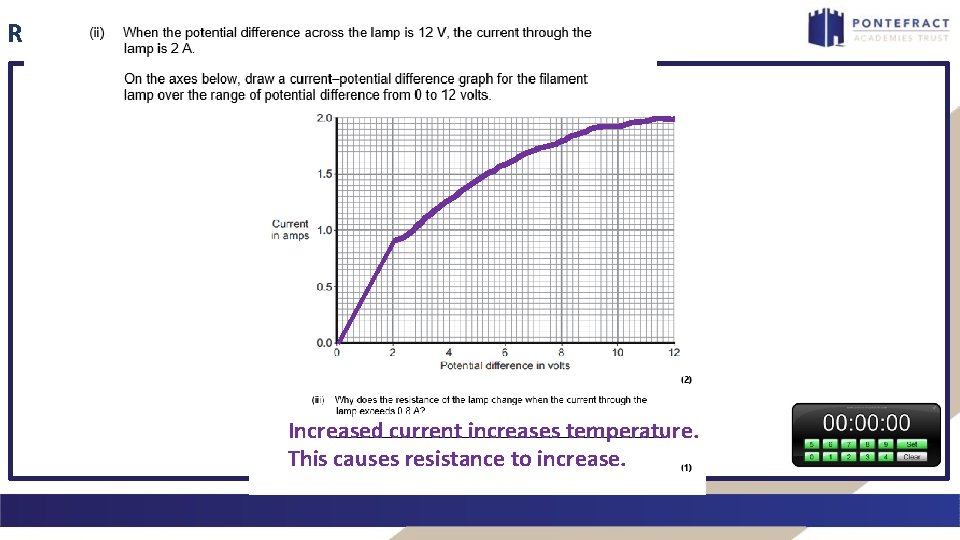
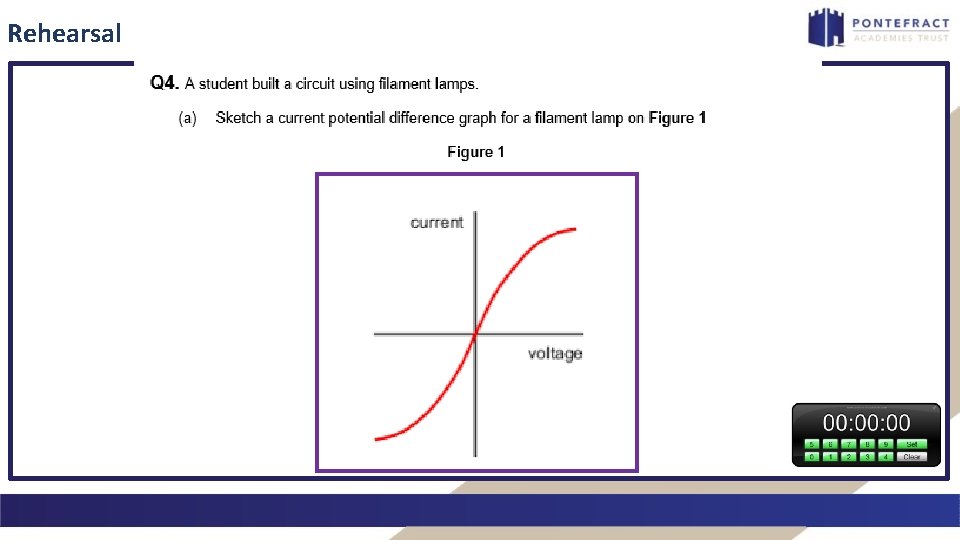
Electricity Not all conductors follow Ohm’s law: For a lamp, the temperature increases – this increases resistance. As the temperature increases the resistance increases. No more current will flow when you increase the potential difference.
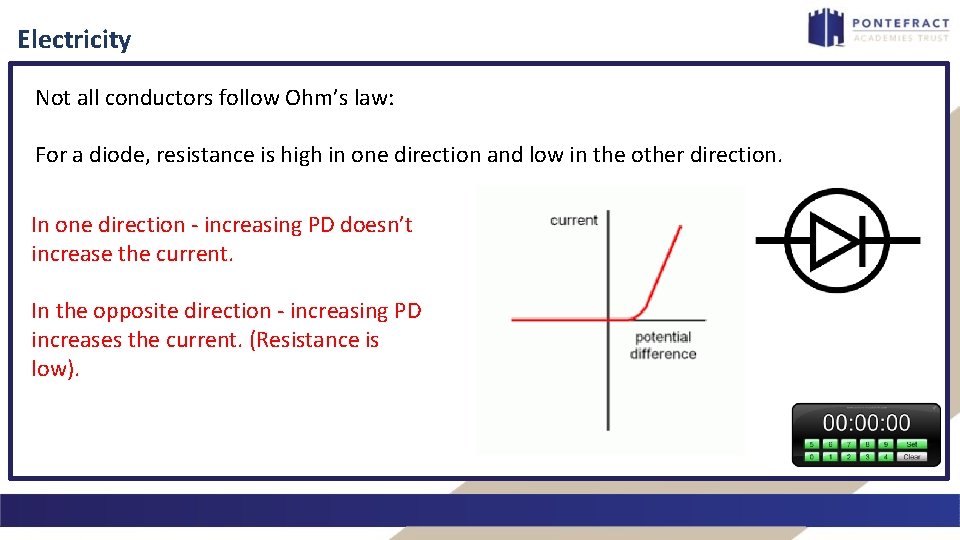
Electricity Not all conductors follow Ohm’s law: For a diode, resistance is high in one direction and low in the other direction. In one direction - increasing PD doesn’t increase the current. In the opposite direction - increasing PD increases the current. (Resistance is low).
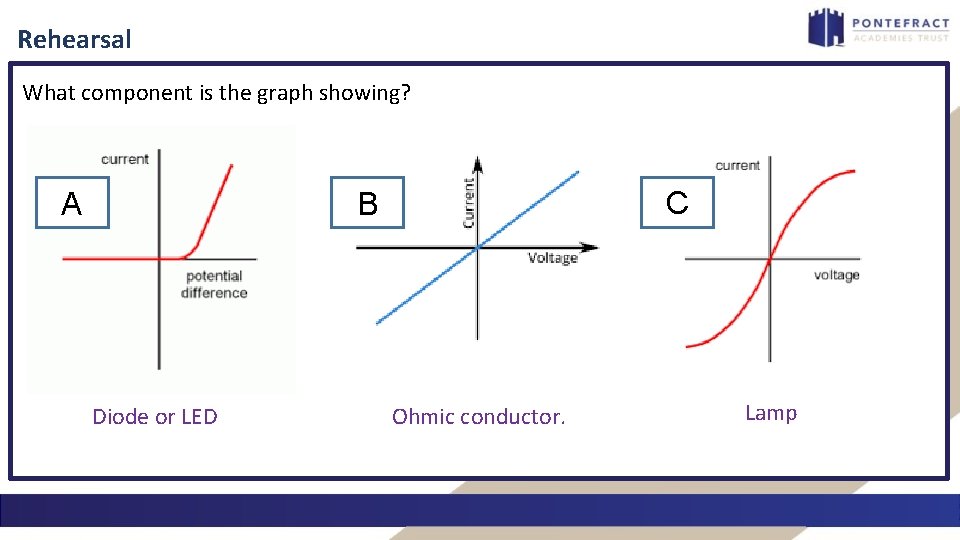
Rehearsal What component is the graph showing? C B A Diode or LED Ohmic conductor. Lamp
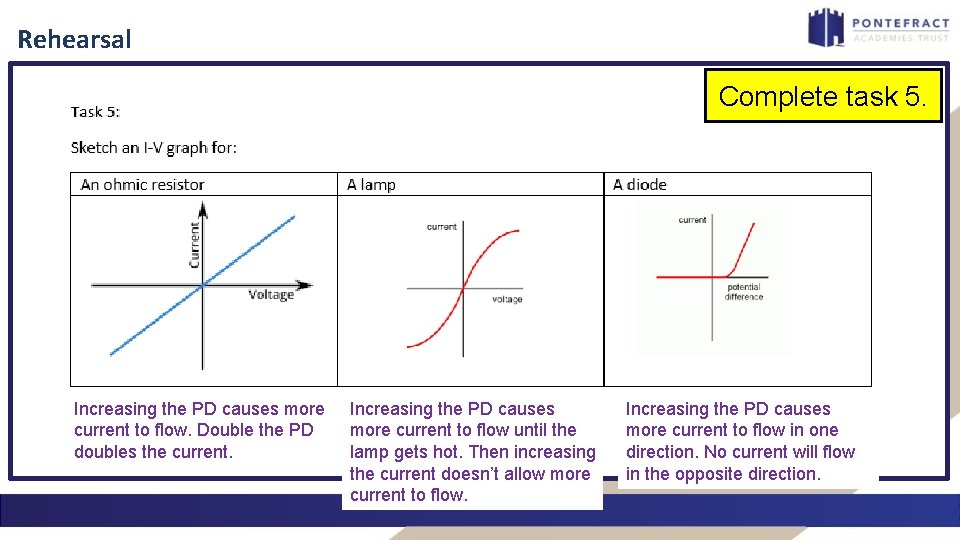
Rehearsal Complete task 5. Increasing the PD causes more current to flow. Double the PD doubles the current. Increasing the PD causes more current to flow until the lamp gets hot. Then increasing the current doesn’t allow more current to flow. Increasing the PD causes more current to flow in one direction. No current will flow in the opposite direction.
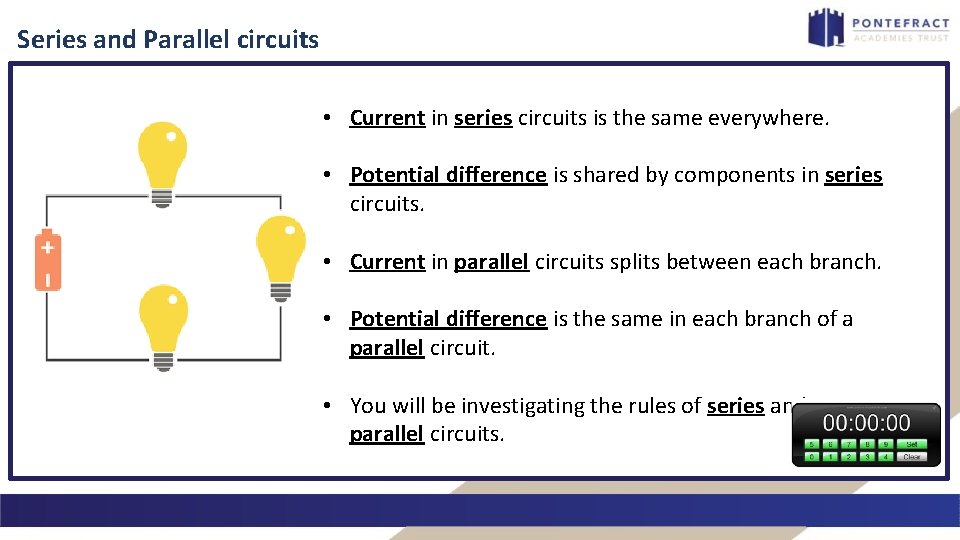
Series and Parallel circuits • Current in series circuits is the same everywhere. • Potential difference is shared by components in series circuits. • Current in parallel circuits splits between each branch. • Potential difference is the same in each branch of a parallel circuit. • You will be investigating the rules of series and parallel circuits.
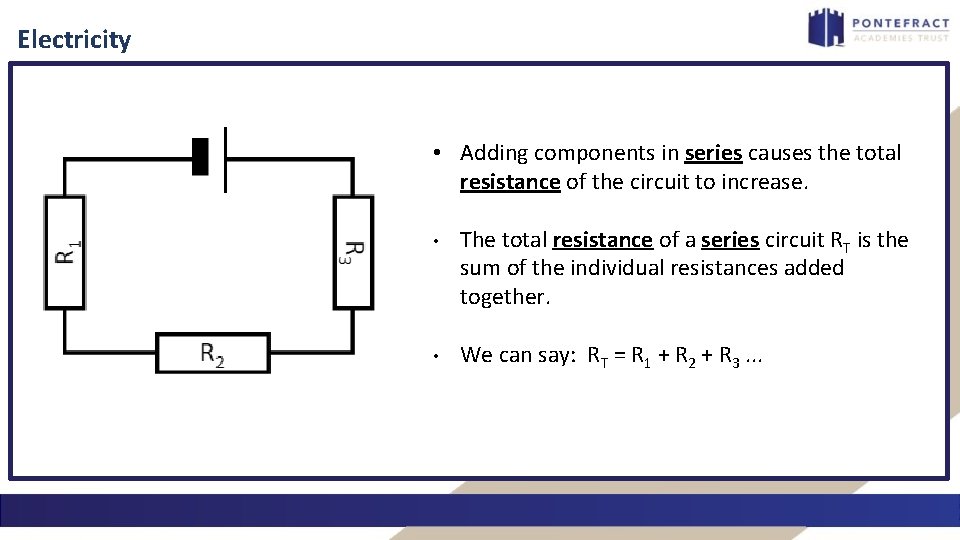
Electricity • Adding components in series causes the total resistance of the circuit to increase. • The total resistance of a series circuit RT is the sum of the individual resistances added together. • We can say: RT = R 1 + R 2 + R 3. . .
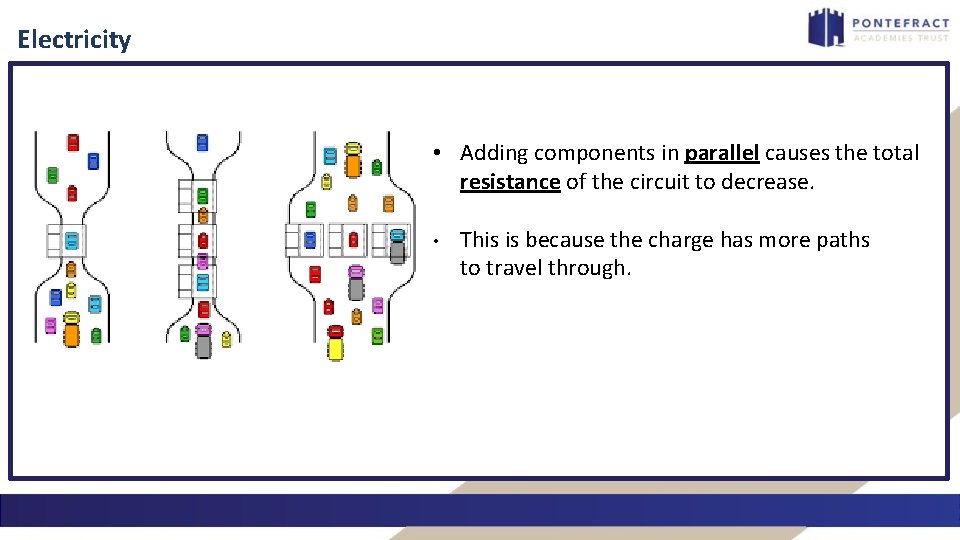
Electricity • Adding components in parallel causes the total resistance of the circuit to decrease. • This is because the charge has more paths to travel through.
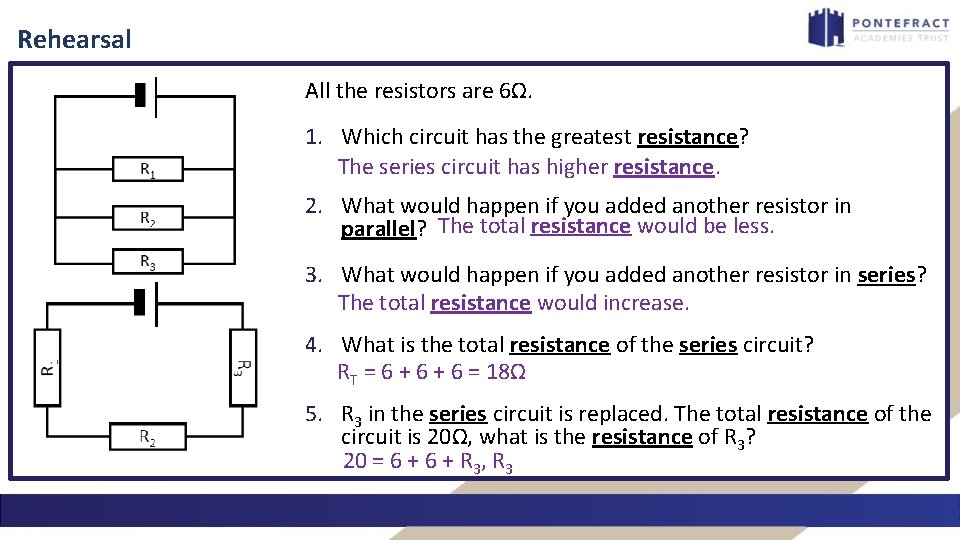
Rehearsal All the resistors are 6Ω. 1. Which circuit has the greatest resistance? The series circuit has higher resistance. 2. What would happen if you added another resistor in parallel? The total resistance would be less. 3. What would happen if you added another resistor in series? The total resistance would increase. 4. What is the total resistance of the series circuit? RT = 6 + 6 = 18Ω 5. R 3 in the series circuit is replaced. The total resistance of the circuit is 20Ω, what is the resistance of R 3? 20 = 6 + R 3, R 3
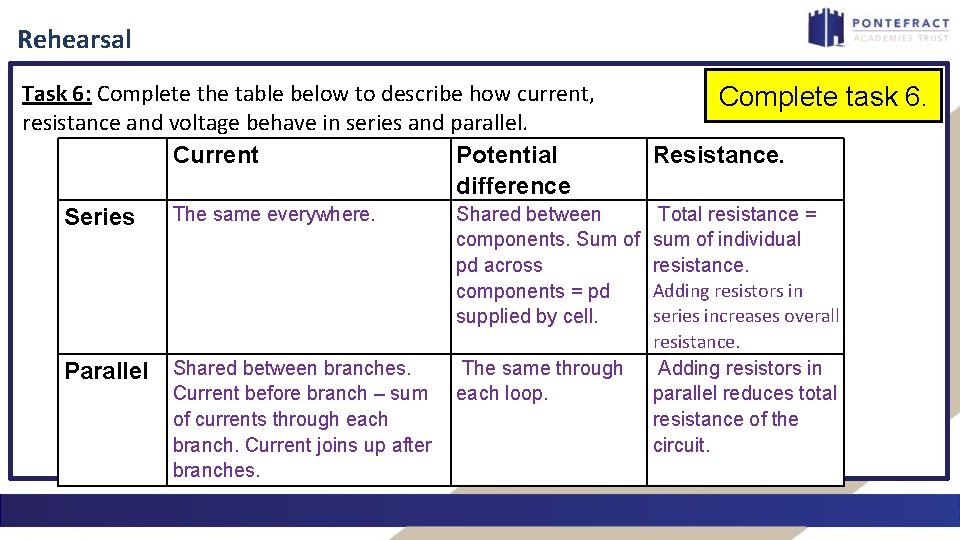
Rehearsal Task 6: Complete the table below to describe how current, resistance and voltage behave in series and parallel. Current Potential difference Shared between Series The same everywhere. Parallel Complete task 6. Resistance. Total resistance = components. Sum of sum of individual pd across resistance. Adding resistors in components = pd series increases overall supplied by cell. resistance. Shared between branches. The same through Adding resistors in Current before branch – sum each loop. parallel reduces total of currents through each resistance of the branch. Current joins up after circuit. branches.
Rehearsal • Complete the exam questions.
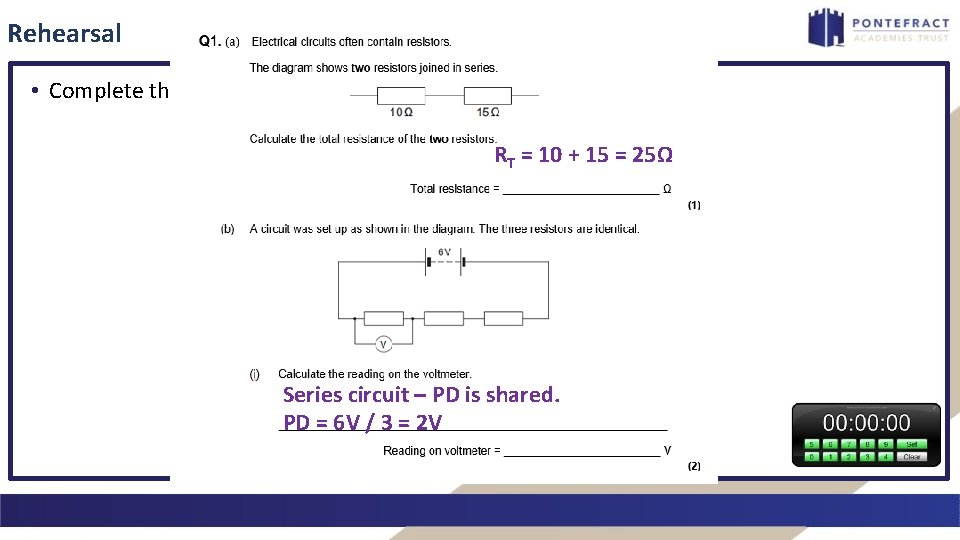
Rehearsal • Complete the exam questions. RT = 10 + 15 = 25Ω Series circuit – PD is shared. PD = 6 V / 3 = 2 V
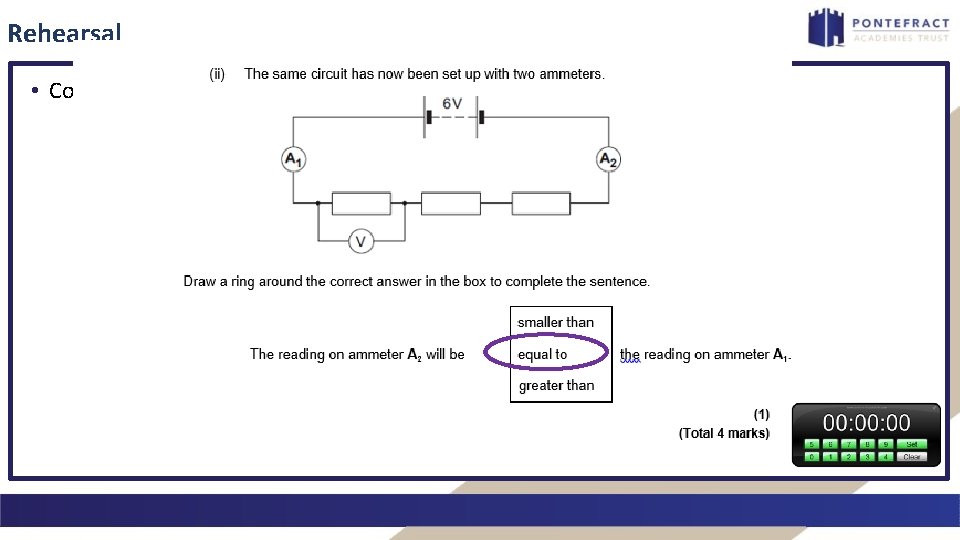
Rehearsal • Complete the exam questions.
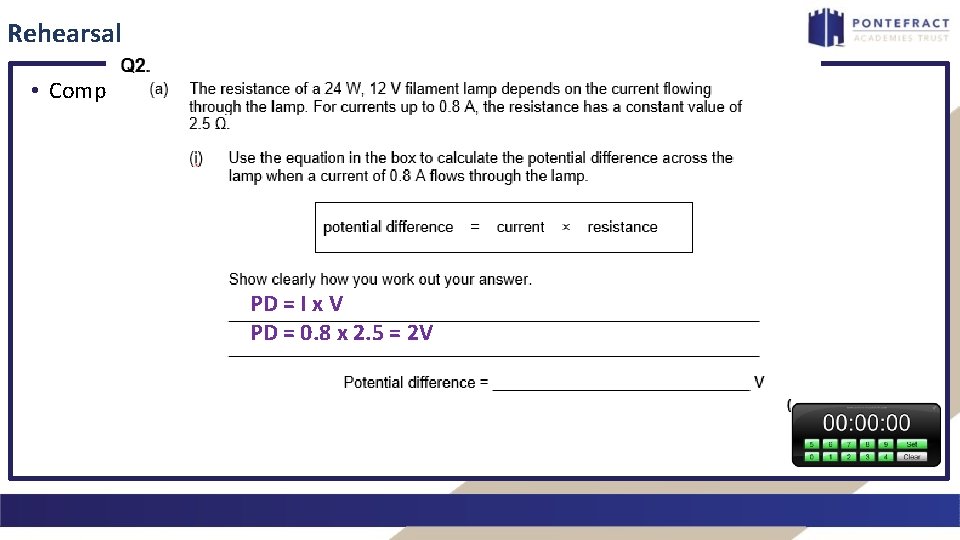
Rehearsal • Complete the exam questions. PD = I x V PD = 0. 8 x 2. 5 = 2 V
Rehearsal • Complete the exam questions. Increased current increases temperature. This causes resistance to increase.
Rehearsal
Rehearsal
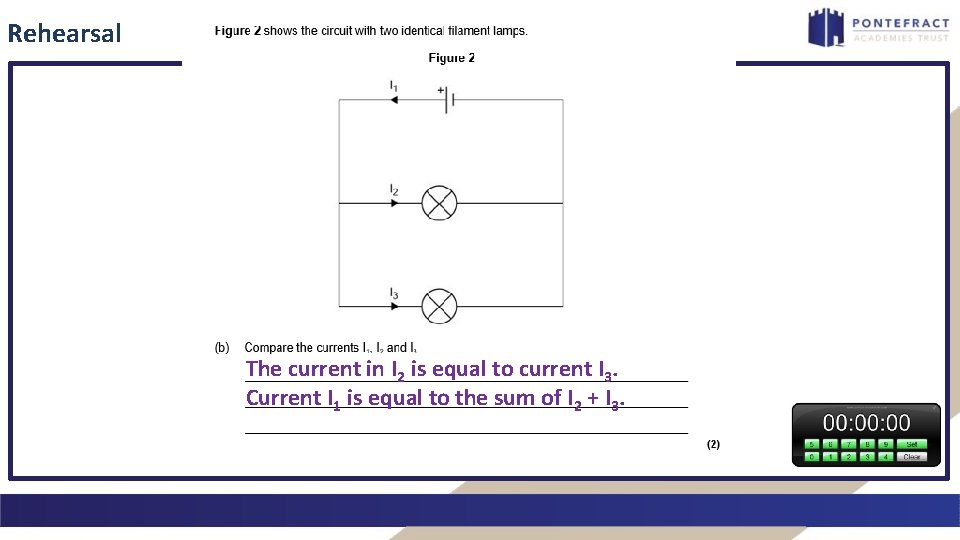
Rehearsal The current in I 2 is equal to current I 3. Current I 1 is equal to the sum of I 2 + I 3.
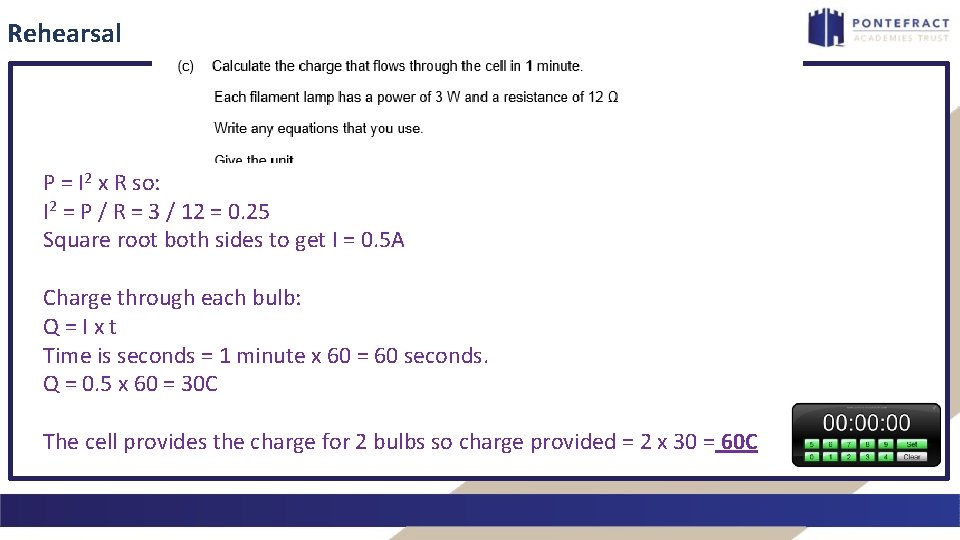
Rehearsal P = I 2 x R so: I 2 = P / R = 3 / 12 = 0. 25 Square root both sides to get I = 0. 5 A Charge through each bulb: Q = I x t Time is seconds = 1 minute x 60 = 60 seconds. Q = 0. 5 x 60 = 30 C The cell provides the charge for 2 bulbs so charge provided = 2 x 30 = 60 C
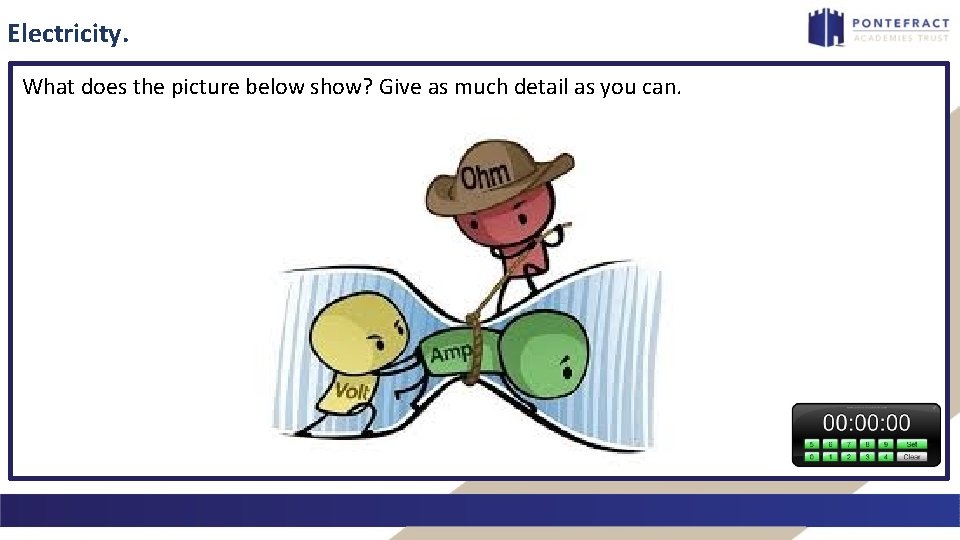
Electricity. What does the picture below show? Give as much detail as you can.