Particle Physics II CP violation also known as






- Slides: 86
Particle Physics II – CP violation (also known as “Physics of Anti-matter”) Lecture 1 N. Tuning Niels Tuning (1)
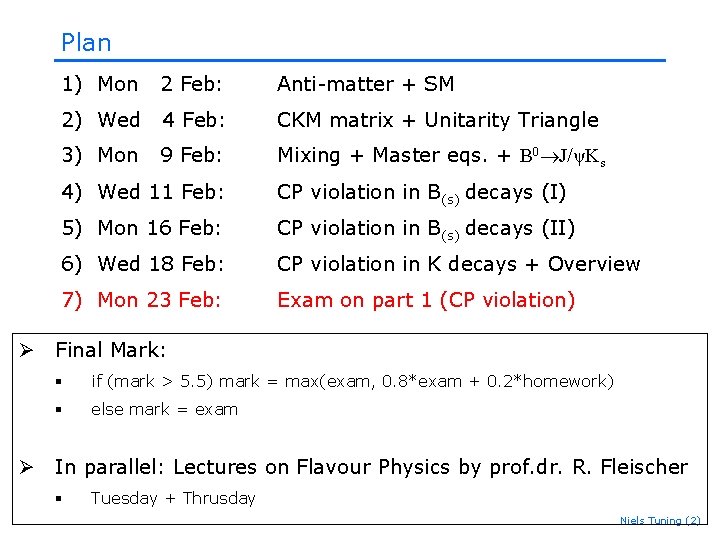
Plan 1) Mon 2 Feb: Anti-matter + SM 2) Wed 4 Feb: CKM matrix + Unitarity Triangle 3) Mon 9 Feb: Mixing + Master eqs. + B 0 J/ψKs 4) Wed 11 Feb: CP violation in B(s) decays (I) 5) Mon 16 Feb: CP violation in B(s) decays (II) 6) Wed 18 Feb: CP violation in K decays + Overview 7) Mon 23 Feb: Exam on part 1 (CP violation) Ø Final Mark: § if (mark > 5. 5) mark = max(exam, 0. 8*exam + 0. 2*homework) § else mark = exam Ø In parallel: Lectures on Flavour Physics by prof. dr. R. Fleischer § Tuesday + Thrusday Niels Tuning (2)
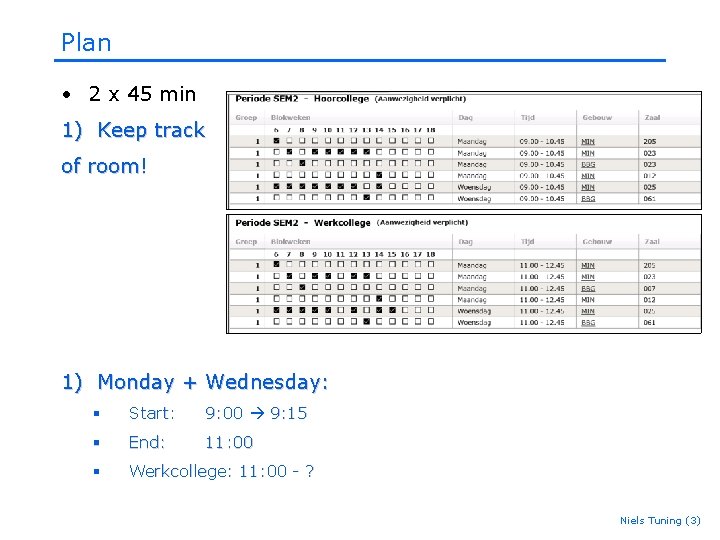
Plan • 2 x 45 min 1) Keep track of room! 1) Monday + Wednesday: § Start: 9: 00 9: 15 § End: 11: 00 § Werkcollege: 11: 00 - ? Niels Tuning (3)
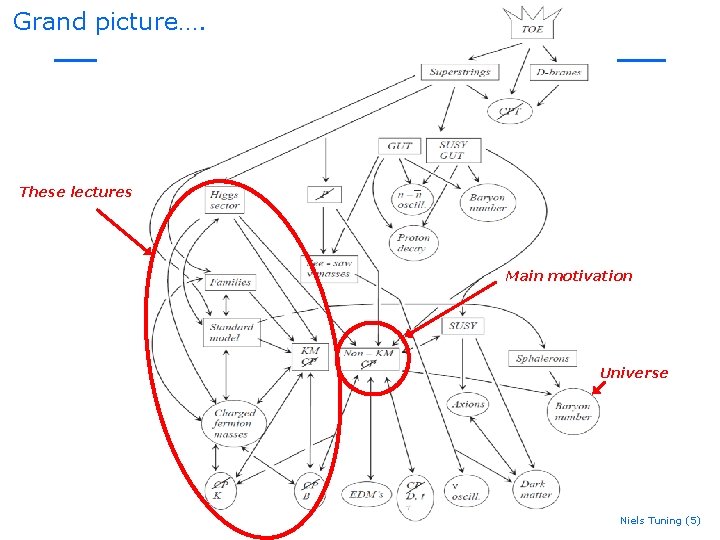
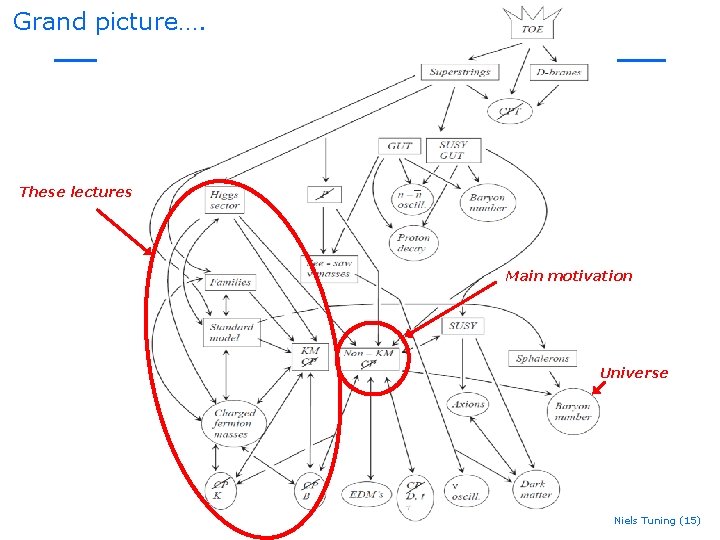
Grand picture…. These lectures Main motivation Universe Niels Tuning (5)
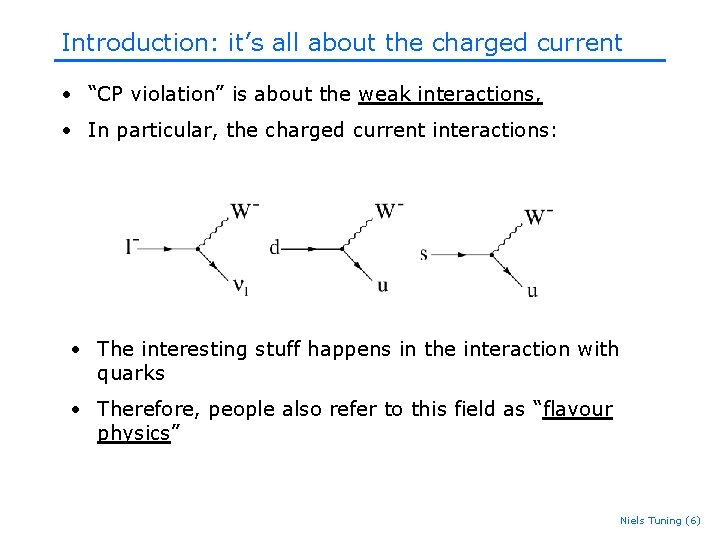
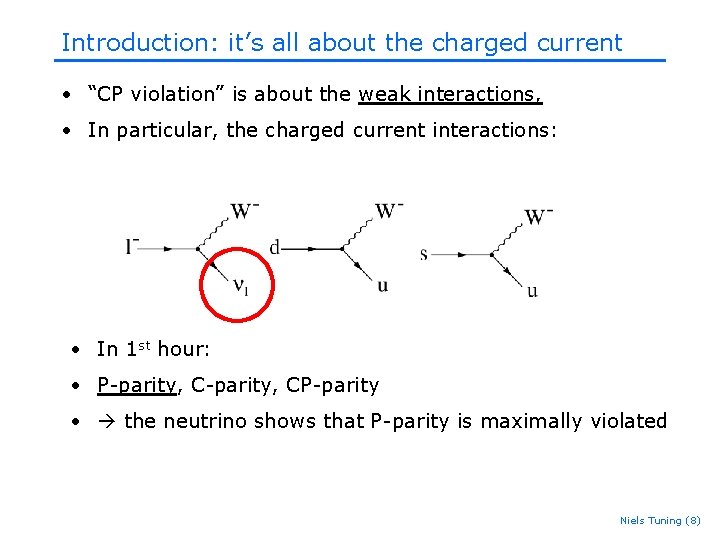
Introduction: it’s all about the charged current • “CP violation” is about the weak interactions, • In particular, the charged current interactions: • The interesting stuff happens in the interaction with quarks • Therefore, people also refer to this field as “flavour physics” Niels Tuning (6)
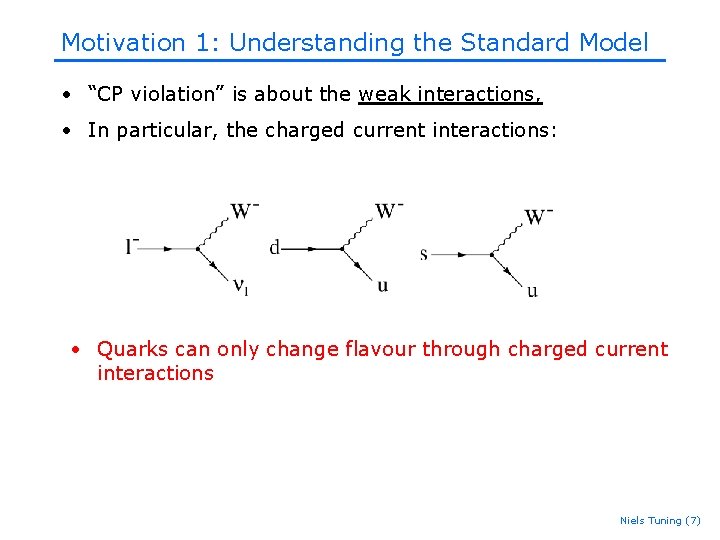
Motivation 1: Understanding the Standard Model • “CP violation” is about the weak interactions, • In particular, the charged current interactions: • Quarks can only change flavour through charged current interactions Niels Tuning (7)
Introduction: it’s all about the charged current • “CP violation” is about the weak interactions, • In particular, the charged current interactions: • In 1 st hour: • P-parity, CP-parity • the neutrino shows that P-parity is maximally violated Niels Tuning (8)
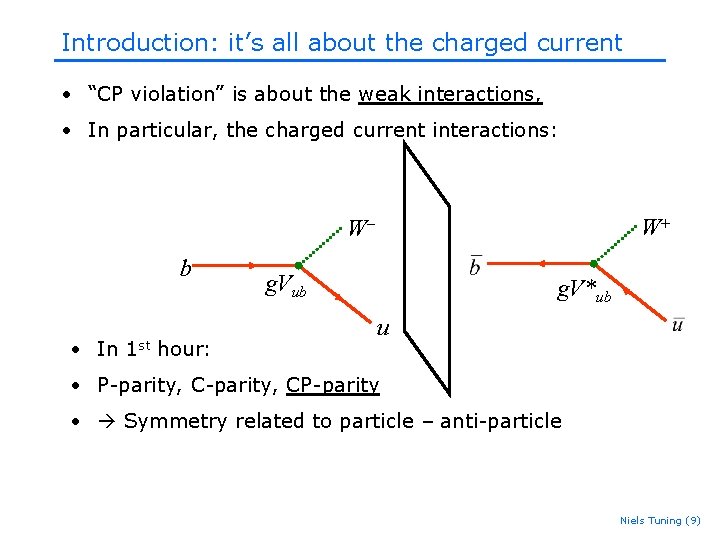
Introduction: it’s all about the charged current • “CP violation” is about the weak interactions, • In particular, the charged current interactions: W+ W b • In 1 st hour: g. Vub g. V*ub u • P-parity, CP-parity • Symmetry related to particle – anti-particle Niels Tuning (9)
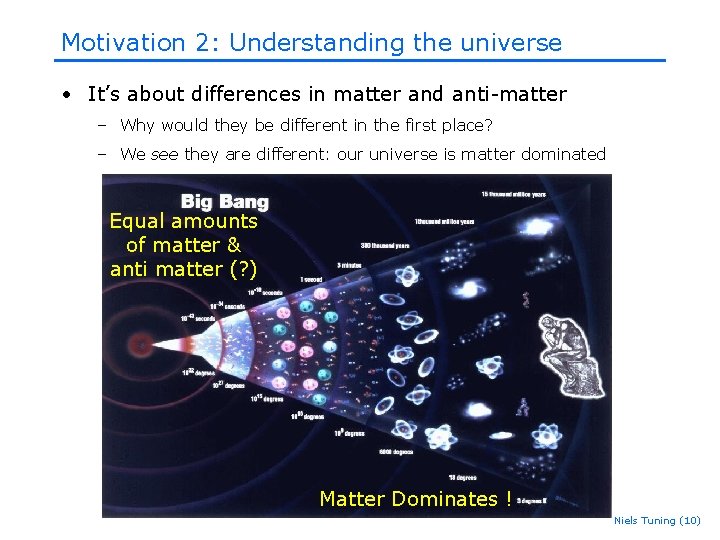
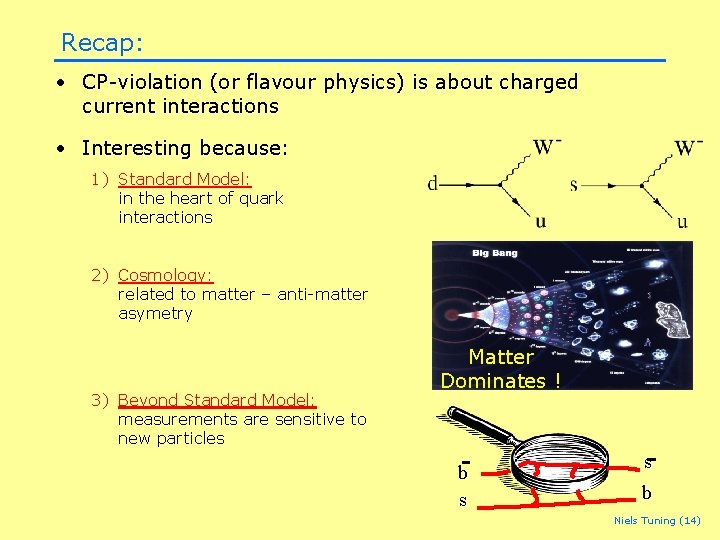
Motivation 2: Understanding the universe • It’s about differences in matter and anti-matter – Why would they be different in the first place? – We see they are different: our universe is matter dominated Equal amounts of matter & anti matter (? ) Matter Dominates ! Niels Tuning (10)
Where and how do we generate the Baryon asymmetry? • No definitive answer to this question yet! • In 1967 A. Sacharov formulated a set of general conditions that any such mechanism has to meet 1) You need a process that violates the baryon number B: (Baryon number of matter=1, of anti-matter = -1) 2) Both C and CP symmetries should be violated 3) Conditions 1) and 2) should occur during a phase in which there is no thermal equilibrium • In these lectures we will focus on 2): CP violation • Apart from cosmological considerations, I will convince you that there are more interesting aspects in CP violation Niels Tuning (11)
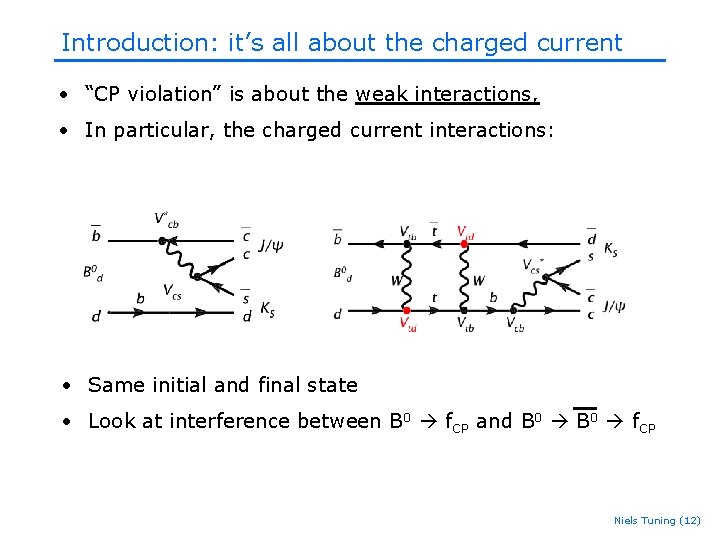
Introduction: it’s all about the charged current • “CP violation” is about the weak interactions, • In particular, the charged current interactions: • Same initial and final state • Look at interference between B 0 f. CP and B 0 f. CP Niels Tuning (12)
Motivation 3: Sensitive to find new physics • “CP violation” is about the weak interactions, • In particular, the charged current interactions: “Box” diagram: ΔB=2 “Penguin” diagram: ΔB=1 b s s b μ μ Bs b s b g s x x s g b s b Bs B 0 b d g b x s K* Bs μ s s b g s x b μ μ μ • Are heavy particles running around in loops? Niels Tuning (13)
Recap: • CP-violation (or flavour physics) is about charged current interactions • Interesting because: 1) Standard Model: in the heart of quark interactions 2) Cosmology: related to matter – anti-matter asymetry 3) Beyond Standard Model: measurements are sensitive to new particles Matter Dominates ! b s s b Niels Tuning (14)
Grand picture…. These lectures Main motivation Universe Niels Tuning (15)
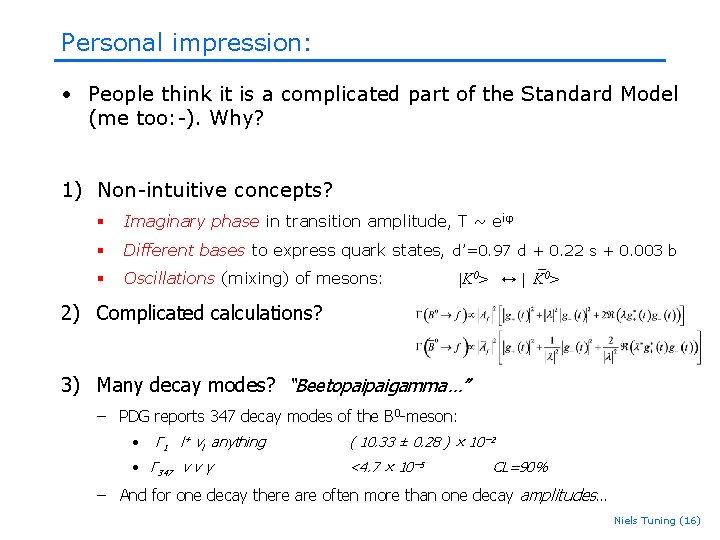
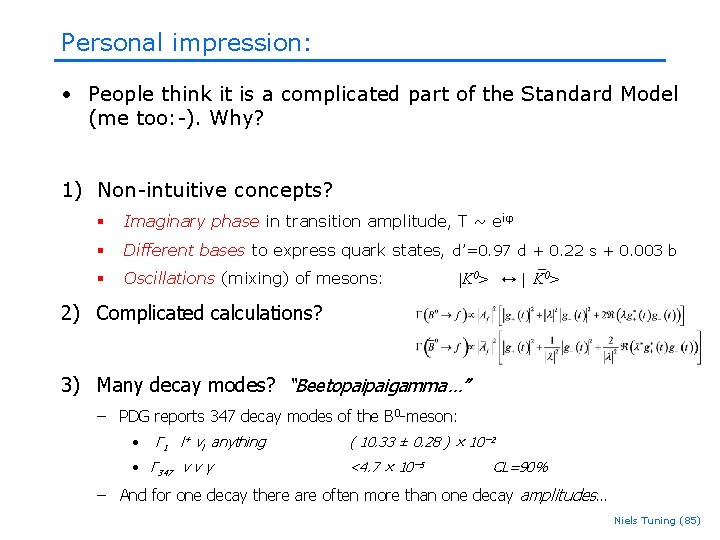
Personal impression: • People think it is a complicated part of the Standard Model (me too: -). Why? 1) Non-intuitive concepts? § Imaginary phase in transition amplitude, T ~ eiφ § Different bases to express quark states, d’=0. 97 d + 0. 22 s + 0. 003 b § Oscillations (mixing) of mesons: |K 0> ↔ | K 0> 2) Complicated calculations? 3) Many decay modes? “Beetopaipaigamma…” – PDG reports 347 decay modes of the B 0 -meson: • Γ 1 l+ νl anything • Γ 347 ν ν γ ( 10. 33 ± 0. 28 ) × 10− 2 <4. 7 × 10− 5 CL=90% – And for one decay there are often more than one decay amplitudes… Niels Tuning (16)
Anti-matter • Dirac (1928): Prediction • Anderson (1932): Discovery • Present-day experiments Niels Tuning (17)
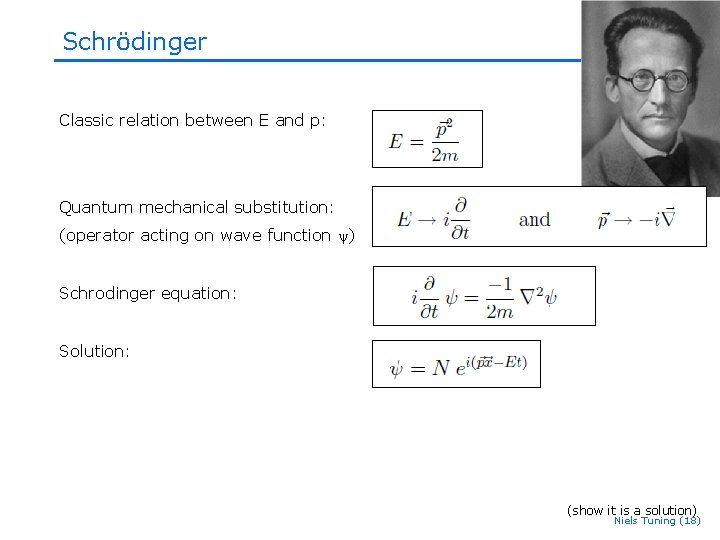
Schrödinger Classic relation between E and p: Quantum mechanical substitution: (operator acting on wave function ψ) Schrodinger equation: Solution: (show it is a solution) Niels Tuning (18)
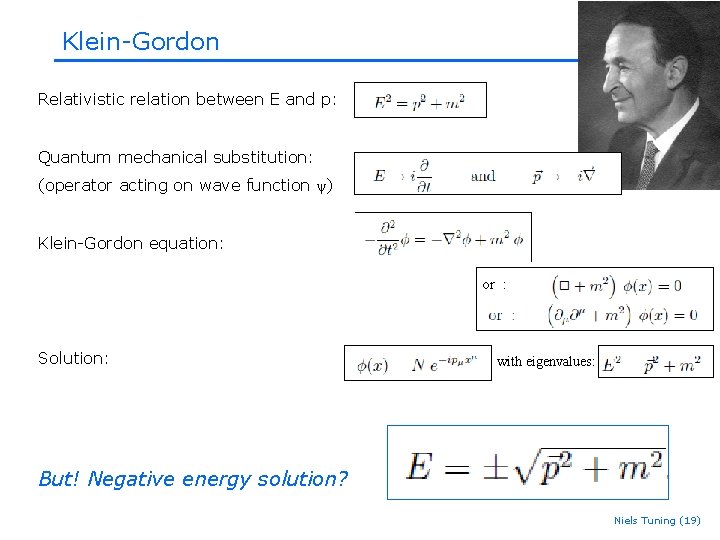
Klein-Gordon Relativistic relation between E and p: Quantum mechanical substitution: (operator acting on wave function ψ) Klein-Gordon equation: or : Solution: with eigenvalues: But! Negative energy solution? Niels Tuning (19)
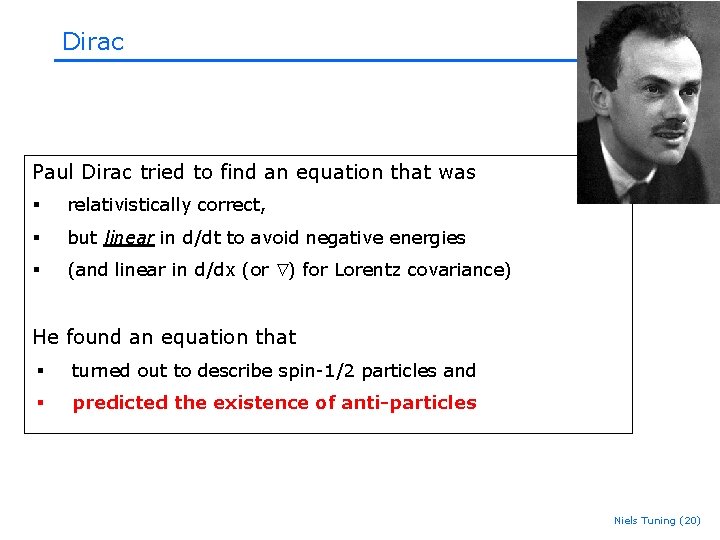
Dirac Paul Dirac tried to find an equation that was § relativistically correct, § but linear in d/dt to avoid negative energies § (and linear in d/dx (or ) for Lorentz covariance) He found an equation that § turned out to describe spin-1/2 particles and § predicted the existence of anti-particles Niels Tuning (20)
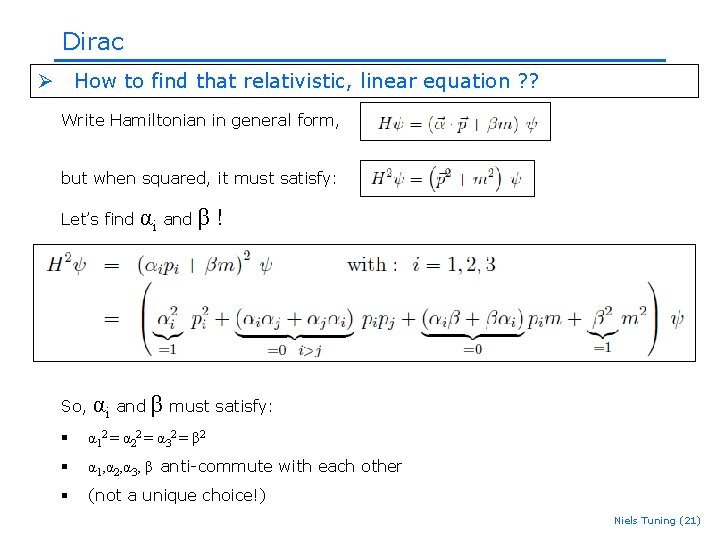
Dirac Ø How to find that relativistic, linear equation ? ? Write Hamiltonian in general form, but when squared, it must satisfy: Let’s find So, αi and β ! αi and β must satisfy: § α 12 = α 22 = α 32 = β 2 § α 1, α 2, α 3, β anti-commute with each other § (not a unique choice!) Niels Tuning (21)
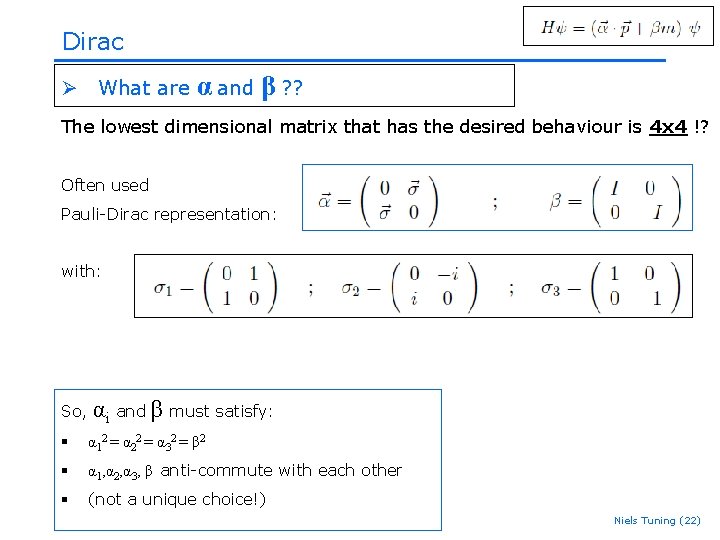
Dirac Ø What are α and β ? ? The lowest dimensional matrix that has the desired behaviour is 4 x 4 !? Often used Pauli-Dirac representation: with: So, αi and β must satisfy: § α 12 = α 22 = α 32 = β 2 § α 1, α 2, α 3, β anti-commute with each other § (not a unique choice!) Niels Tuning (22)
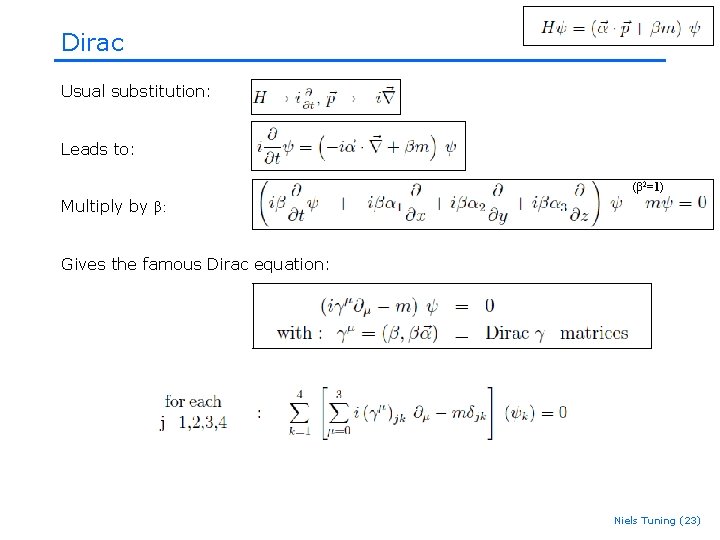
Dirac Usual substitution: Leads to: (β 2=1) Multiply by β: Gives the famous Dirac equation: Niels Tuning (23)
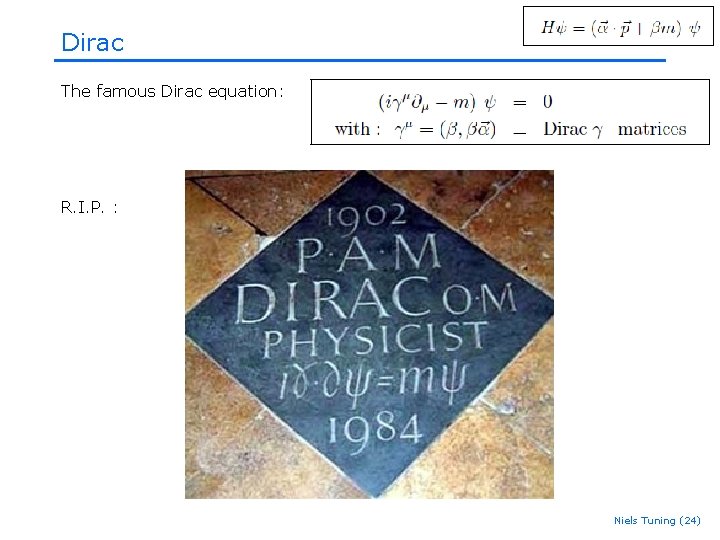
Dirac The famous Dirac equation: R. I. P. : Niels Tuning (24)
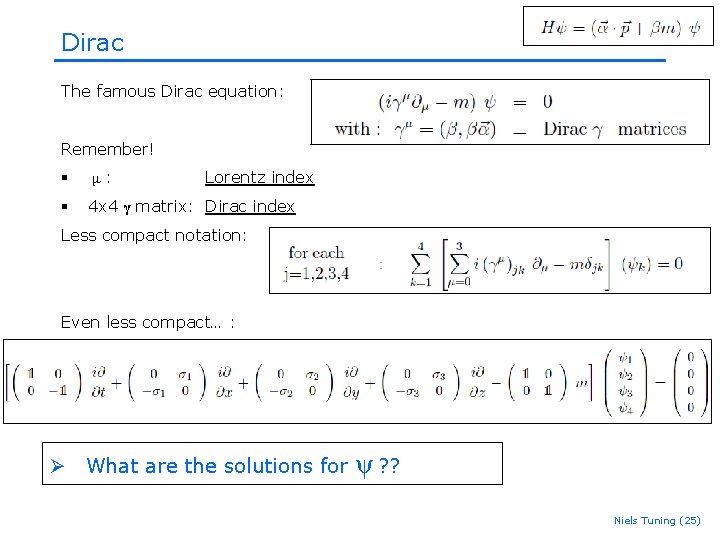
Dirac The famous Dirac equation: Remember! Lorentz index § μ : § 4 x 4 γ matrix: Dirac index Less compact notation: Even less compact… : Ø What are the solutions for ψ ? ? Niels Tuning (25)
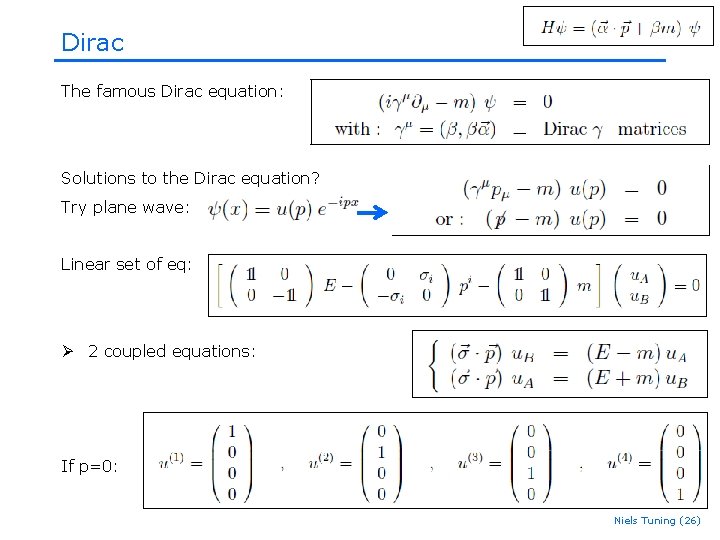
Dirac The famous Dirac equation: Solutions to the Dirac equation? Try plane wave: Linear set of eq: Ø 2 coupled equations: If p=0: Niels Tuning (26)
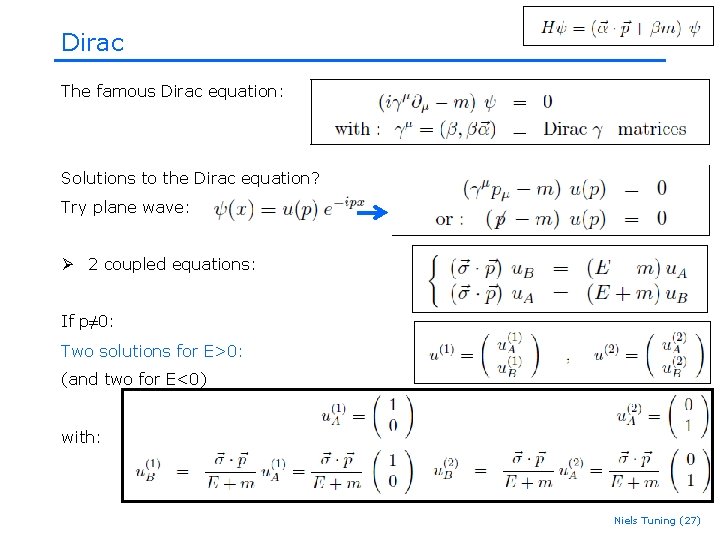
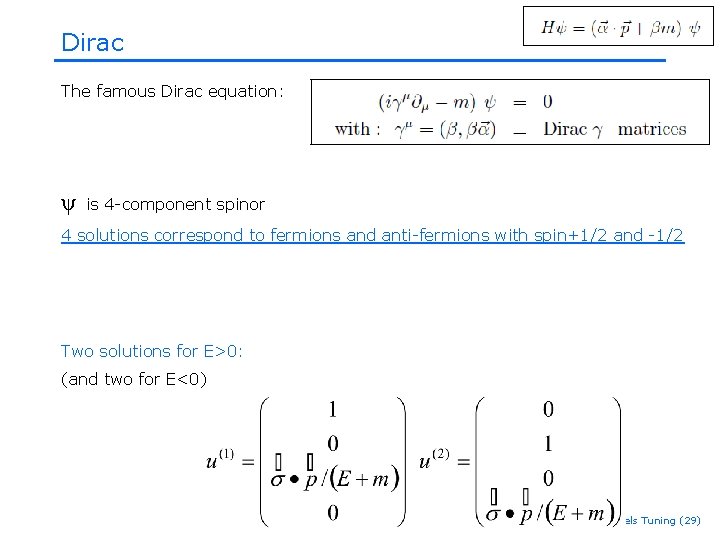
Dirac The famous Dirac equation: Solutions to the Dirac equation? Try plane wave: Ø 2 coupled equations: If p≠ 0: Two solutions for E>0: (and two for E<0) with: Niels Tuning (27)
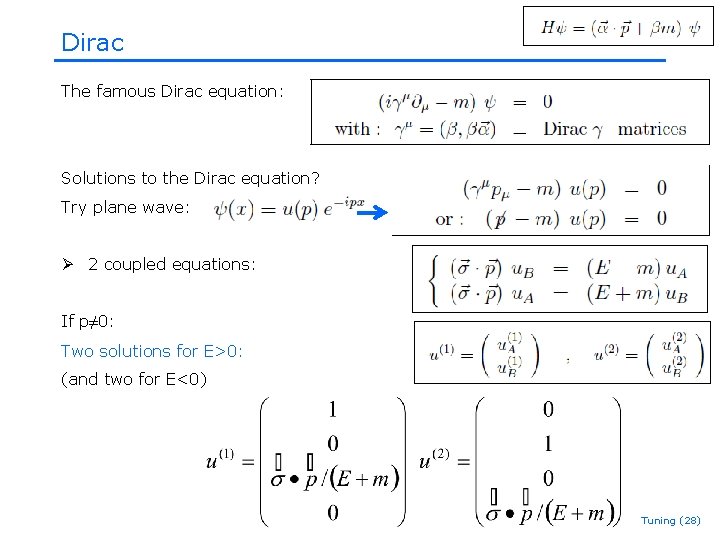
Dirac The famous Dirac equation: Solutions to the Dirac equation? Try plane wave: Ø 2 coupled equations: If p≠ 0: Two solutions for E>0: (and two for E<0) Tuning (28)
Dirac The famous Dirac equation: ψ is 4 -component spinor 4 solutions correspond to fermions and anti-fermions with spin+1/2 and -1/2 Two solutions for E>0: (and two for E<0) Niels Tuning (29)
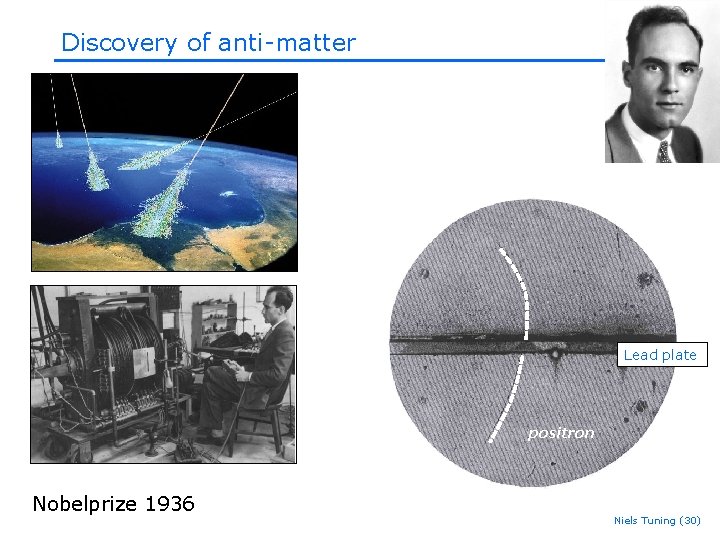
Discovery of anti-matter Lead plate positron Nobelprize 1936 Niels Tuning (30)
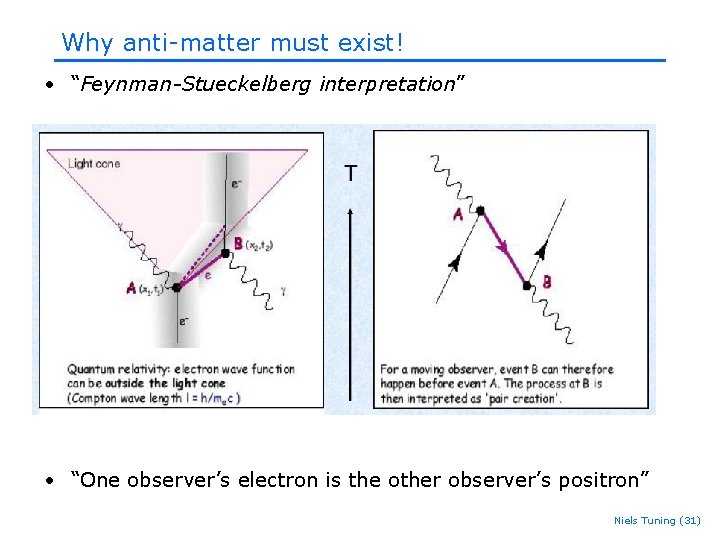
Why anti-matter must exist! • “Feynman-Stueckelberg interpretation” • “One observer’s electron is the other observer’s positron” Niels Tuning (31)
CPT theorem • CPT transformation: – C: interchange particles and anti-particles – P: reverse space-coordinates – T: Reverse time-coordinate • CPT transformation closely related to Lorentz-boost Ø CPT invariance implies – Particles and anti-particles have same mass and lifetime – Lorentz invariance Niels Tuning (32)
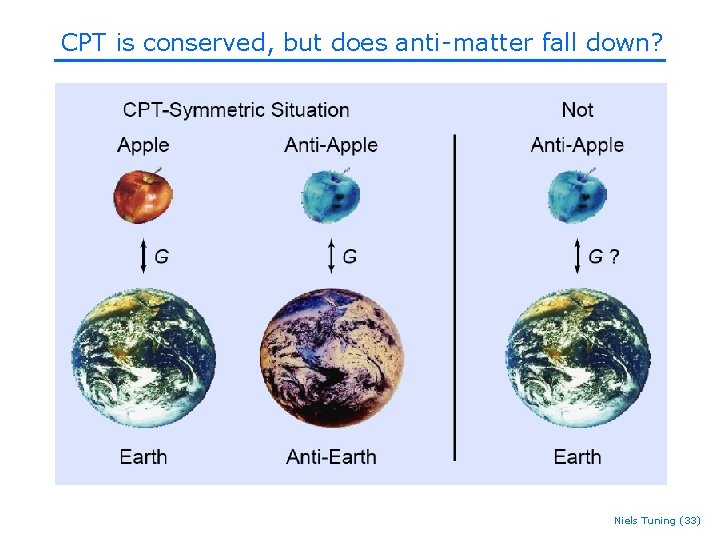
CPT is conserved, but does anti-matter fall down? Niels Tuning (33)
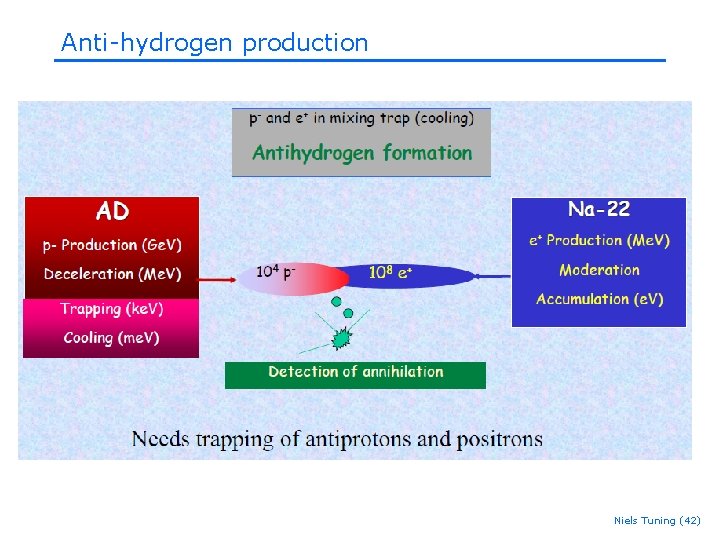
Experiments • Need to have neutral anti-matter – Otherwise electrostatic forces spoil the weak gravitational force • Make anti-protons – Accelerator – Anti-proton factory – Decelerator – Storage • Produce anti-hydrogen for study – Trap – Observe (spectroscopy, …) Thanks to Rolf Landua (CERN) Niels Tuning (34)
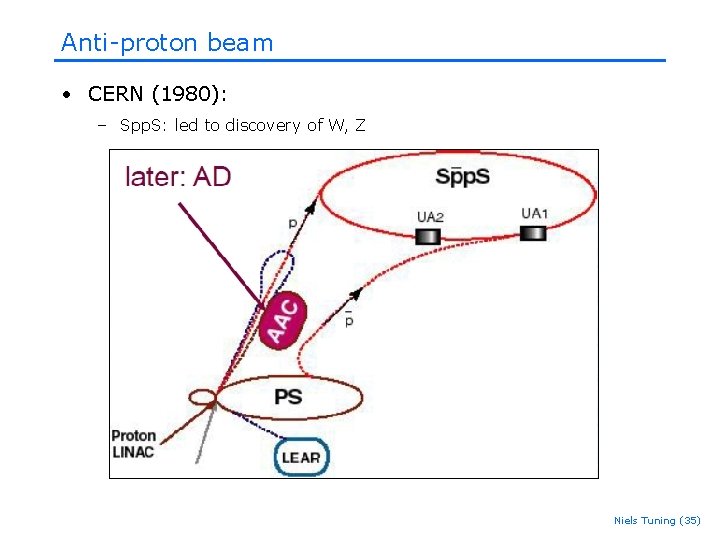
Anti-proton beam • CERN (1980): – Spp. S: led to discovery of W, Z Niels Tuning (35)
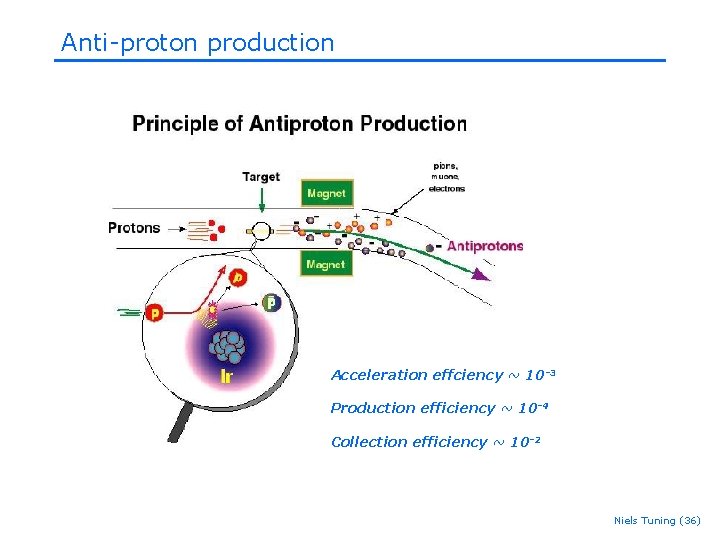
Anti-proton production Acceleration effciency ~ 10 -3 Production efficiency ~ 10 -4 Collection efficiency ~ 10 -2 Niels Tuning (36)
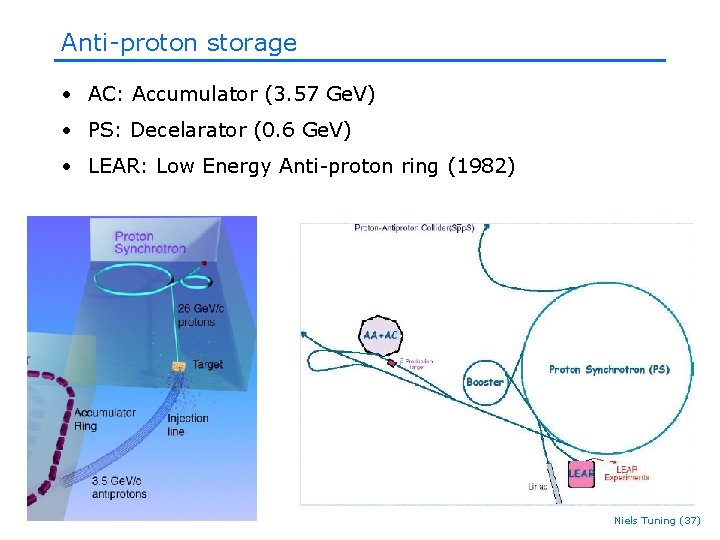
Anti-proton storage • AC: Accumulator (3. 57 Ge. V) • PS: Decelarator (0. 6 Ge. V) • LEAR: Low Energy Anti-proton ring (1982) Niels Tuning (37)
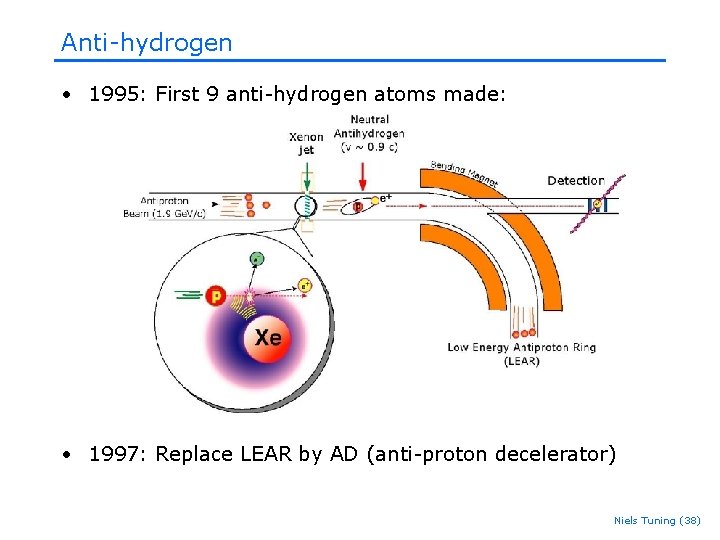
Anti-hydrogen • 1995: First 9 anti-hydrogen atoms made: • 1997: Replace LEAR by AD (anti-proton decelerator) Niels Tuning (38)
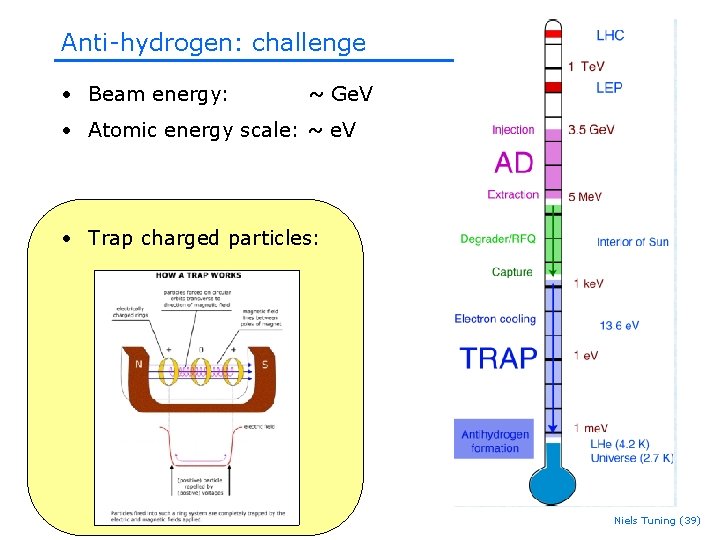
Anti-hydrogen: challenge • Beam energy: ~ Ge. V • Atomic energy scale: ~ e. V • Trap charged particles: Niels Tuning (39)
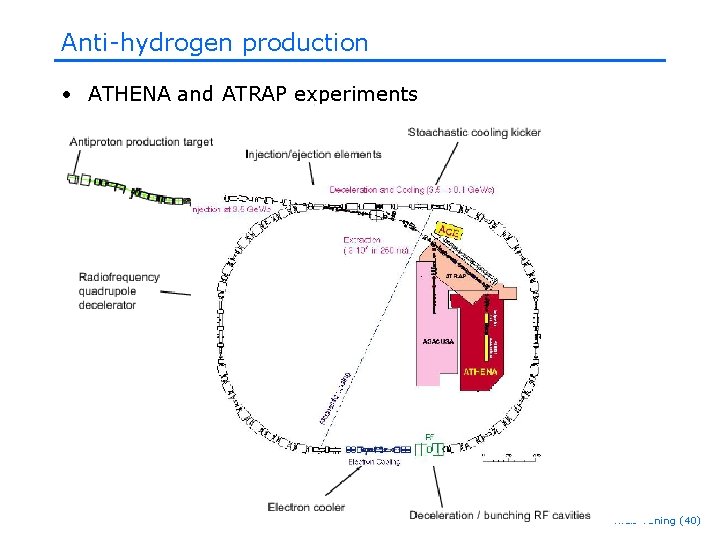
Anti-hydrogen production • ATHENA and ATRAP experiments Niels Tuning (40)
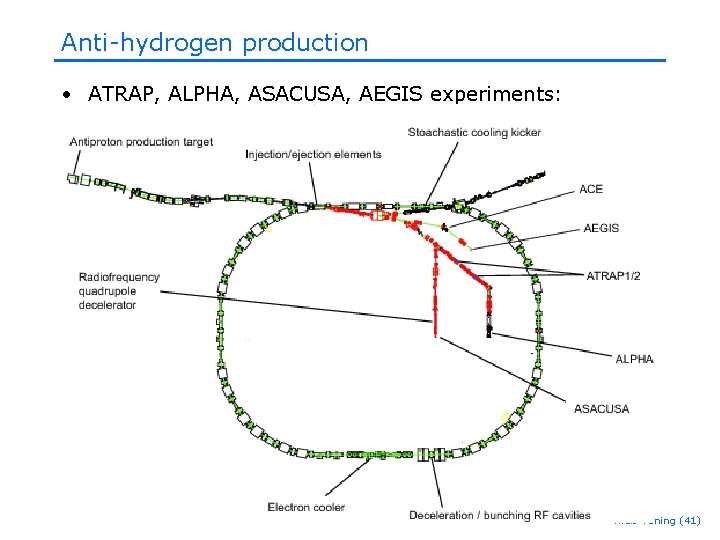
Anti-hydrogen production • ATRAP, ALPHA, ASACUSA, AEGIS experiments: Niels Tuning (41)
Anti-hydrogen production Niels Tuning (42)
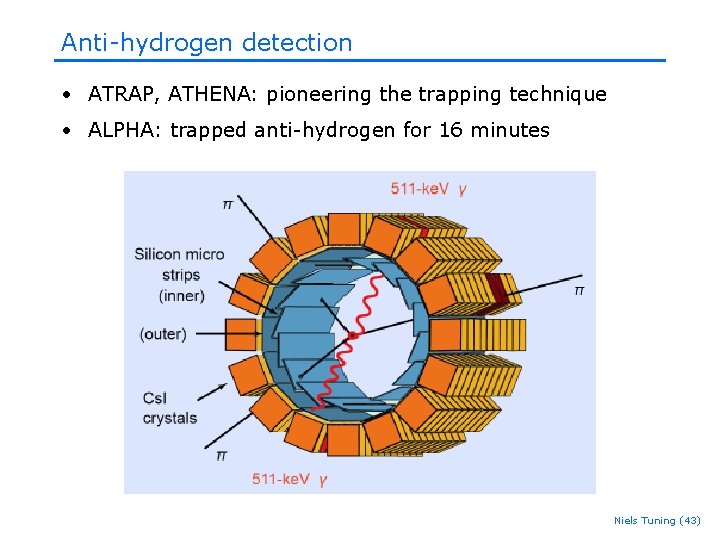
Anti-hydrogen detection • ATRAP, ATHENA: pioneering the trapping technique • ALPHA: trapped anti-hydrogen for 16 minutes Niels Tuning (43)
Anti-hydrogen detection • ASACUSA: • 2011: trapped anti-proton in He (replacing an electron), measuring mass to 10 -9 21 Jan 2014: • The ASACUSA experiment at CERN has succeeded for the first time in producing a beam of anti-hydrogen atoms. In a paper published today in Nature Communications, the ASACUSA collaboration reports the unambiguous detection of 80 anti-hydrogen atoms 2. 7 metres downstream of their production, where the perturbing influence of the magnetic fields used initially to produce the anti-atoms is small. This result is a significant step towards precise hyperfine spectroscopy of anti-hydrogen atoms. Niels Tuning (44)
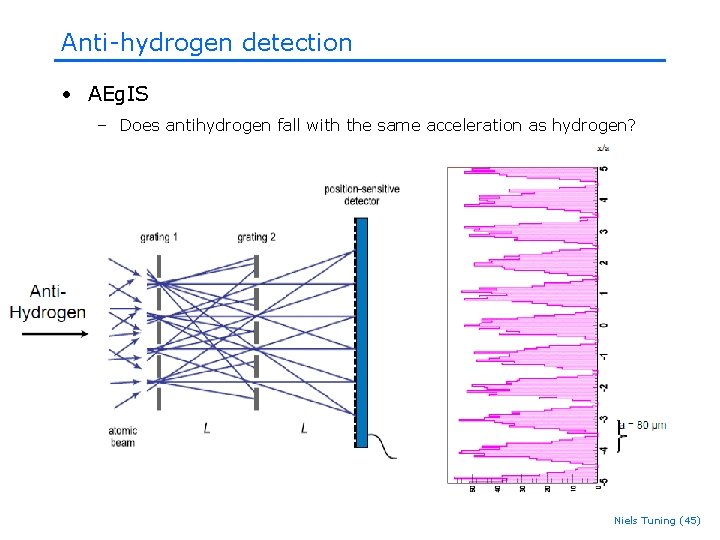
Anti-hydrogen detection • AEg. IS – Does antihydrogen fall with the same acceleration as hydrogen? Niels Tuning (45)
C, P, T • C, P, T transformation: – C: interchange particles and anti-particles – P: reverse space-coordinates – T: Reverse time-coordinate • CPT we discussed briefly … • After the break we deal with P and CP… … violation! Niels Tuning (46)
Break Niels Tuning (47)
P and C violation • What is the link between anti-matter and discrete symmetries? Ø C operator changes matter into anti-matter • 2 more discrete symmetries: P and T Niels Tuning (48)
Continuous vs discrete symmetries • Space, time translation & orientation symmetries are all continuous symmetries – Each symmetry operation associated with one ore more continuous parameter • There also discrete symmetries – Charge sign flip (Q -Q) : C parity – Spatial sign flip ( x, y, z -x, -y, -z) : P parity – Time sign flip (t -t) : T parity • Are these discrete symmetries exact symmetries that are observed by all physics in nature? – Key issue of this course Niels Tuning (49)
Three Discrete Symmetries • Parity, P – Parity reflects a system through the origin. Converts right-handed coordinate systems to left-handed ones. – Vectors change sign but axial vectors remain unchanged • x -x , p -p, but L = x p L • Charge Conjugation, C – Charge conjugation turns a particle into its anti-particle • e + e- , K - K + + • Time Reversal, T – Changes, for example, the direction of motion of particles • t -t Niels Tuning (50)
Example: People believe in symmetry… Instruction for Abel Tasman, explorer of Australia (1642): • “Since many rich mines and other treasures have been found in countries north of the equator between 15 o and 40 o latitude, there is no doubt that countries alike exist south of the equator. The provinces in Peru and Chili rich of gold and silver, all positioned south of the equator, are revealing proofs hereof. ” Niels Tuning (51)
Example: People believe in symmetry… Award Ceremony Speech Nobel Prize (1957): • “it was assumed almost tacitly, that elementary particle reactions are symmetric with respect to right and left. ” • “In fact, most of us were inclined to regard the symmetry of elementary particles with respect to right and left as a necessary consequence of the general principle of right-left symmetry of Nature. ” • “… only Lee and Yang … asked themselves what kind of experimental support there was for the assumption that all elementary particle processes are symmetric with respect to right and left. “ Niels Tuning (52)
A realistic experiment: the Wu experiment (1956) • Observe radioactive decay of Cobalt-60 nuclei – The process involved: – is spin-5 and ne are spin-½ 60 27 Co 28 Ni is spin-4, both e- and 60 60 60 28 Ni + e - + e S=1/2 – If you start with fully polarized Co (SZ=5) the experiment is essentially the same (i. e. there is only one spin solution for the decay) |5, +5> |4, +4> + |½ , +½> + |½, +½> S=4 S=1/2 Niels Tuning (53)
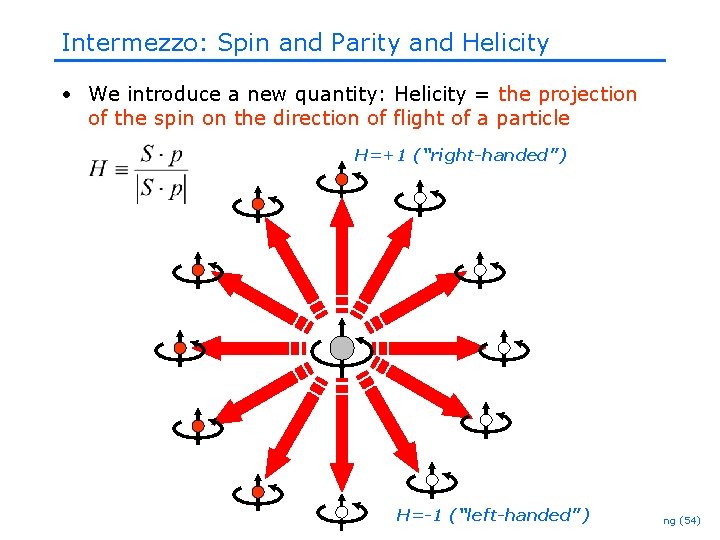
Intermezzo: Spin and Parity and Helicity • We introduce a new quantity: Helicity = the projection of the spin on the direction of flight of a particle H=+1 (“right-handed”) H=-1 (“left-handed”) Niels Tuning (54)
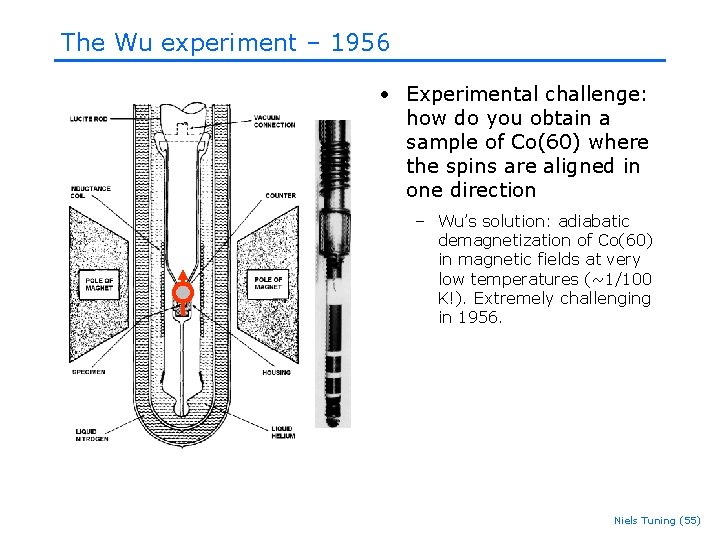
The Wu experiment – 1956 • Experimental challenge: how do you obtain a sample of Co(60) where the spins are aligned in one direction – Wu’s solution: adiabatic demagnetization of Co(60) in magnetic fields at very low temperatures (~1/100 K!). Extremely challenging in 1956. Niels Tuning (55)
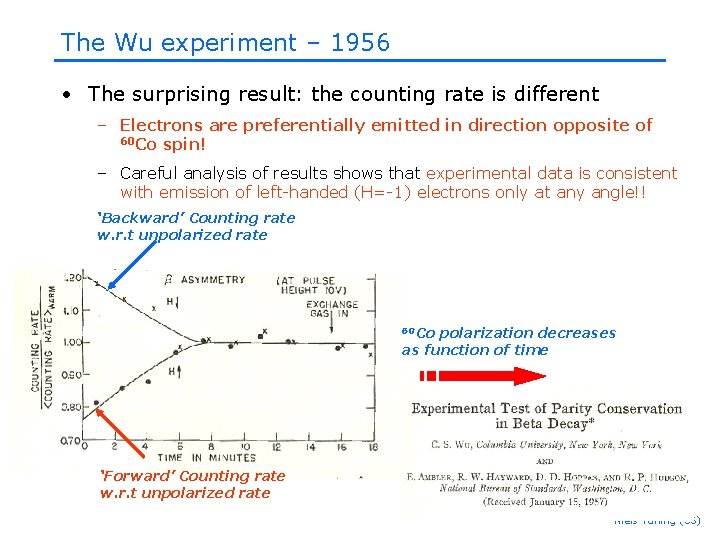
The Wu experiment – 1956 • The surprising result: the counting rate is different – Electrons are preferentially emitted in direction opposite of 60 Co spin! – Careful analysis of results shows that experimental data is consistent with emission of left-handed (H=-1) electrons only at any angle!! ‘Backward’ Counting rate w. r. t unpolarized rate 60 Co polarization decreases as function of time ‘Forward’ Counting rate w. r. t unpolarized rate Niels Tuning (56)
The Wu experiment – 1956 • Physics conclusion: – Angular distribution of electrons shows that only pairs of lefthanded electrons / right-handed anti-neutrinos are emitted regardless of the emission angle – Since right-handed electrons are known to exist (for electrons H is not Lorentz-invariant anyway), this means no left-handed anti-neutrinos are produced in weak decay • Parity is violated in weak processes – Not just a little bit but 100% • How can you see that 60 Co violates parity symmetry? – If there is parity symmetry there should exist no measurement that can distinguish our universe from a parity-flipped universe, but we can! Niels Tuning (57)
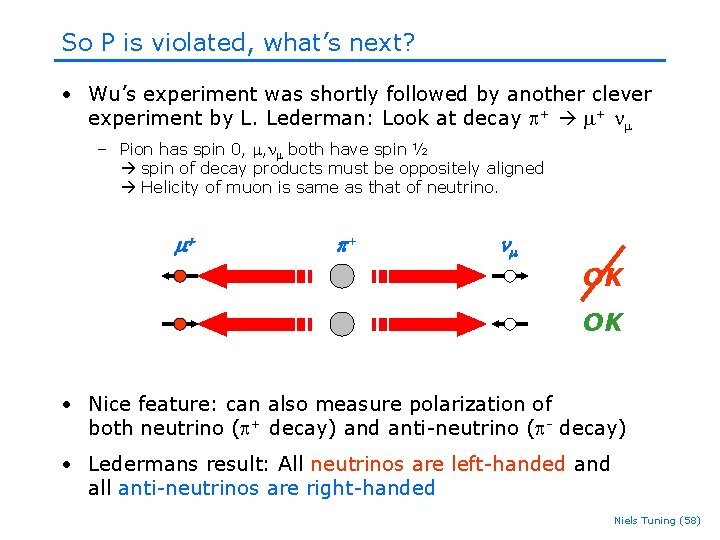
So P is violated, what’s next? • Wu’s experiment was shortly followed by another clever experiment by L. Lederman: Look at decay + + – Pion has spin 0, , both have spin ½ spin of decay products must be oppositely aligned Helicity of muon is same as that of neutrino. m+ p+ nm OK OK • Nice feature: can also measure polarization of both neutrino ( + decay) and anti-neutrino ( - decay) • Ledermans result: All neutrinos are left-handed and all anti-neutrinos are right-handed Niels Tuning (58)
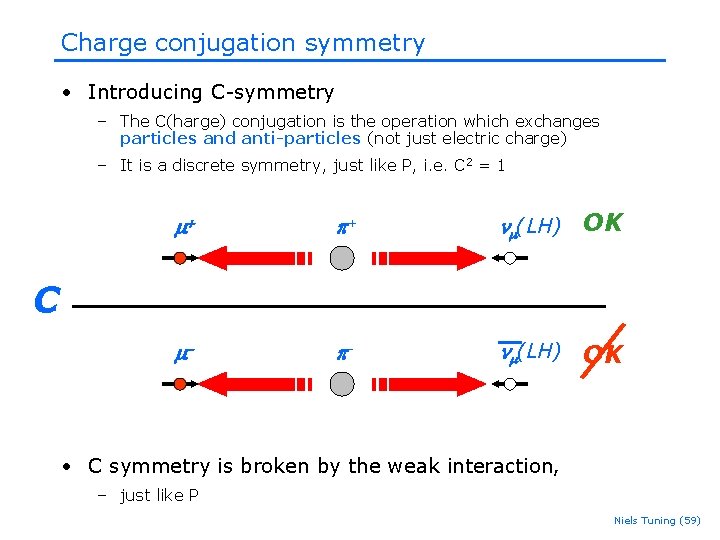
Charge conjugation symmetry • Introducing C-symmetry – The C(harge) conjugation is the operation which exchanges particles and anti-particles (not just electric charge) – It is a discrete symmetry, just like P, i. e. C 2 = 1 m+ p+ nm(LH) OK m- p- nm(LH) OK C • C symmetry is broken by the weak interaction, – just like P Niels Tuning (59)
The Weak force and C, P parity violation • What about C+P CP symmetry? – CP symmetry is parity conjugation (x, y, z -x, -y, z) followed by charge conjugation (X X) + Intrinsic spin P + + + CP C CP appears to be preserved in weak interaction! Niels Tuning (60)
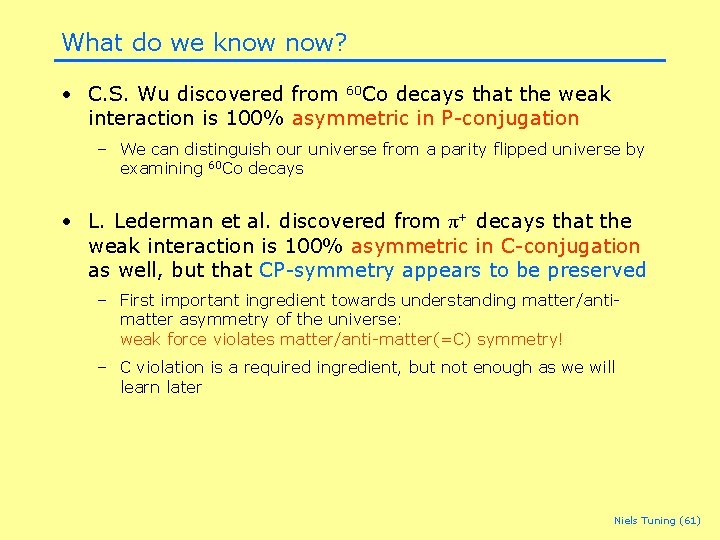
What do we know now? • C. S. Wu discovered from 60 Co decays that the weak interaction is 100% asymmetric in P-conjugation – We can distinguish our universe from a parity flipped universe by examining 60 Co decays • L. Lederman et al. discovered from π+ decays that the weak interaction is 100% asymmetric in C-conjugation as well, but that CP-symmetry appears to be preserved – First important ingredient towards understanding matter/antimatter asymmetry of the universe: weak force violates matter/anti-matter(=C) symmetry! – C violation is a required ingredient, but not enough as we will learn later Niels Tuning (61)
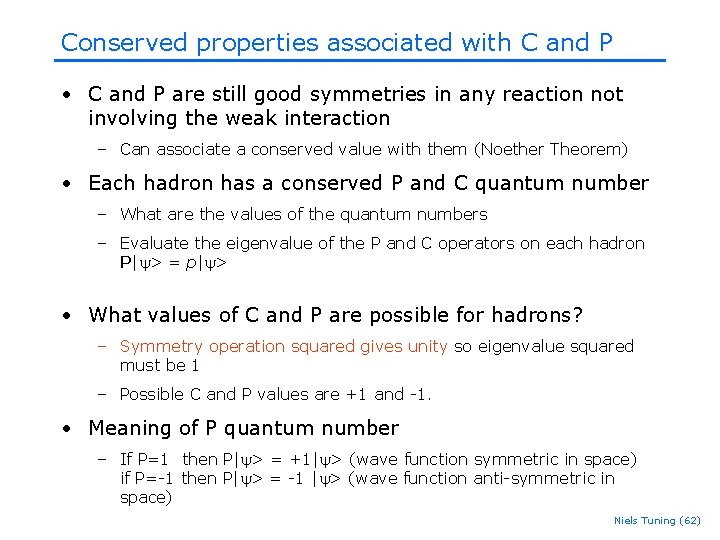
Conserved properties associated with C and P • C and P are still good symmetries in any reaction not involving the weak interaction – Can associate a conserved value with them (Noether Theorem) • Each hadron has a conserved P and C quantum number – What are the values of the quantum numbers – Evaluate the eigenvalue of the P and C operators on each hadron P|y> = p|y> • What values of C and P are possible for hadrons? – Symmetry operation squared gives unity so eigenvalue squared must be 1 – Possible C and P values are +1 and -1. • Meaning of P quantum number – If P=1 then P|y> = +1|y> (wave function symmetric in space) if P=-1 then P|y> = -1 |y> (wave function anti-symmetric in space) Niels Tuning (62)
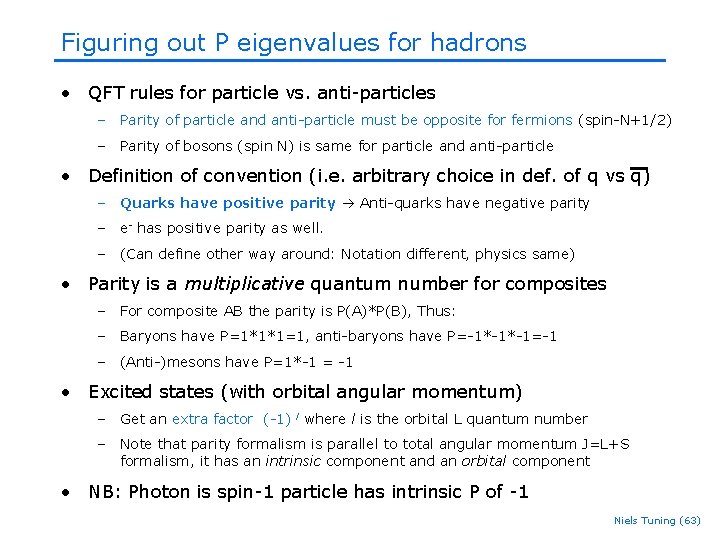
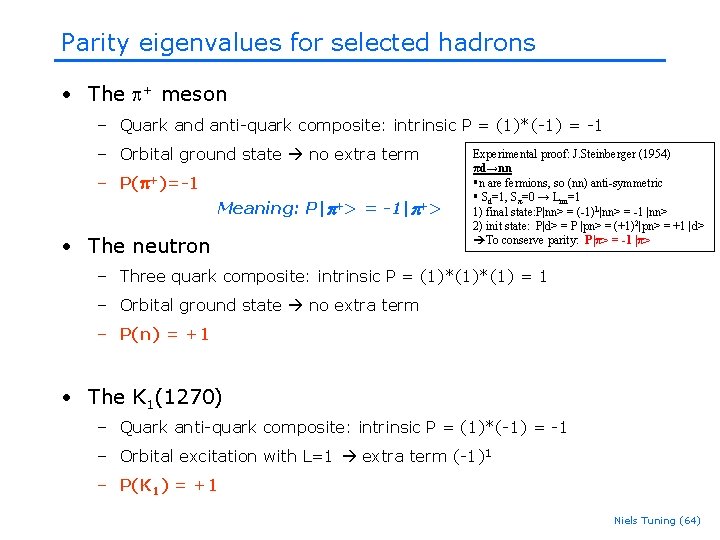
Figuring out P eigenvalues for hadrons • QFT rules for particle vs. anti-particles – Parity of particle and anti-particle must be opposite for fermions (spin-N+1/2) – Parity of bosons (spin N) is same for particle and anti-particle • Definition of convention (i. e. arbitrary choice in def. of q vs q) – Quarks have positive parity Anti-quarks have negative parity – e- has positive parity as well. – (Can define other way around: Notation different, physics same) • Parity is a multiplicative quantum number for composites – For composite AB the parity is P(A)*P(B), Thus: – Baryons have P=1*1*1=1, anti-baryons have P=-1*-1*-1=-1 – (Anti-)mesons have P=1*-1 = -1 • Excited states (with orbital angular momentum) – Get an extra factor (-1) l where l is the orbital L quantum number – Note that parity formalism is parallel to total angular momentum J=L+S formalism, it has an intrinsic component and an orbital component • NB: Photon is spin-1 particle has intrinsic P of -1 Niels Tuning (63)
Parity eigenvalues for selected hadrons • The + meson – Quark and anti-quark composite: intrinsic P = (1)*(-1) = -1 – Orbital ground state no extra term – P(p+)=-1 Meaning: P|p+> = -1|p+> • The neutron Experimental proof: J. Steinberger (1954) πd→nn §n are fermions, so (nn) anti-symmetric § Sd=1, Sπ=0 → Lnn=1 1) final state: P|nn> = (-1)L|nn> = -1 |nn> 2) init state: P|d> = P |pn> = (+1)2|pn> = +1 |d> To conserve parity: P|π> = -1 |π> – Three quark composite: intrinsic P = (1)*(1) = 1 – Orbital ground state no extra term – P(n) = +1 • The K 1(1270) – Quark anti-quark composite: intrinsic P = (1)*(-1) = -1 – Orbital excitation with L=1 extra term (-1)1 – P(K 1) = +1 Niels Tuning (64)
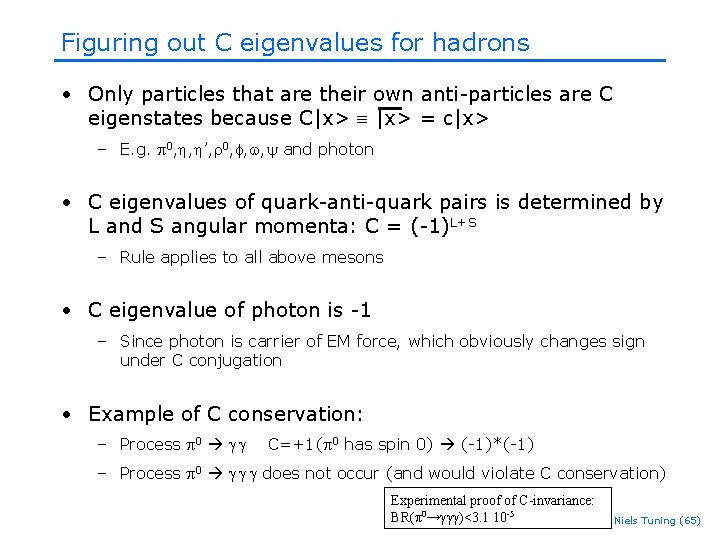
Figuring out C eigenvalues for hadrons • Only particles that are their own anti-particles are C eigenstates because C|x> = c|x> – E. g. 0, h, h’, r 0, f, w, y and photon • C eigenvalues of quark-anti-quark pairs is determined by L and S angular momenta: C = (-1)L+S – Rule applies to all above mesons • C eigenvalue of photon is -1 – Since photon is carrier of EM force, which obviously changes sign under C conjugation • Example of C conservation: – Process 0 g g C=+1( 0 has spin 0) (-1)*(-1) – Process 0 g g g does not occur (and would violate C conservation) Experimental proof of C-invariance: BR(π0→γγγ)<3. 1 10 -5 Niels Tuning (65)
• This was an introduction to P and C • Let’s change gear… Niels Tuning (66)
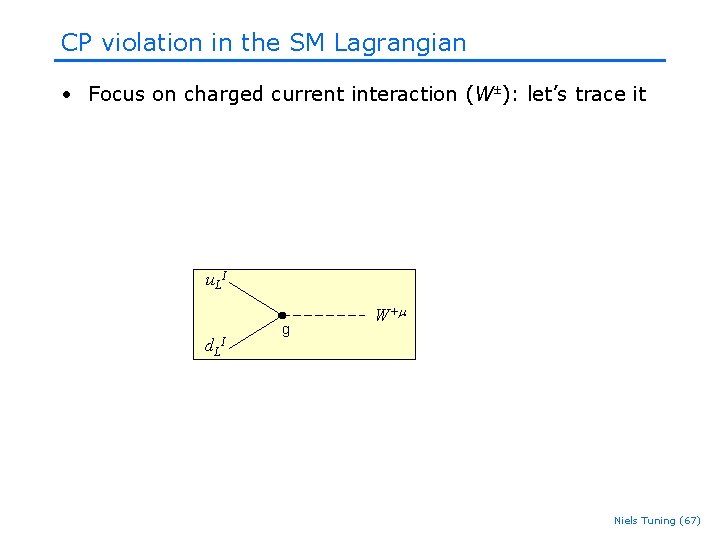
CP violation in the SM Lagrangian • Focus on charged current interaction (W±): let’s trace it u. LI d. L I g W+m Niels Tuning (67)
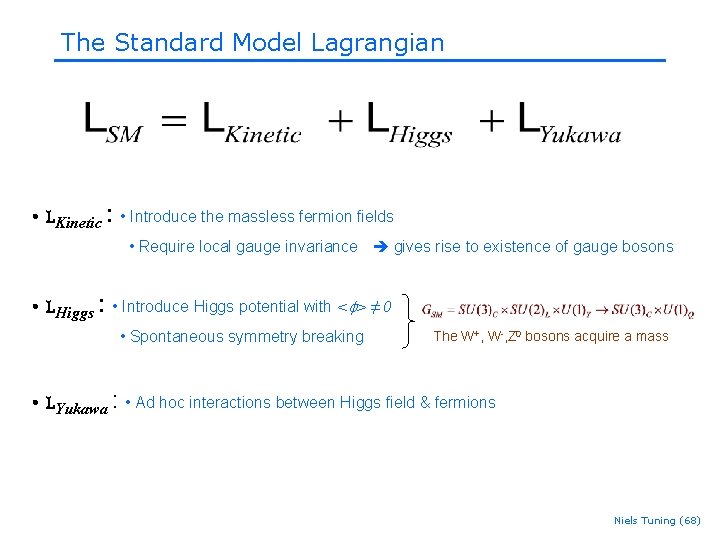
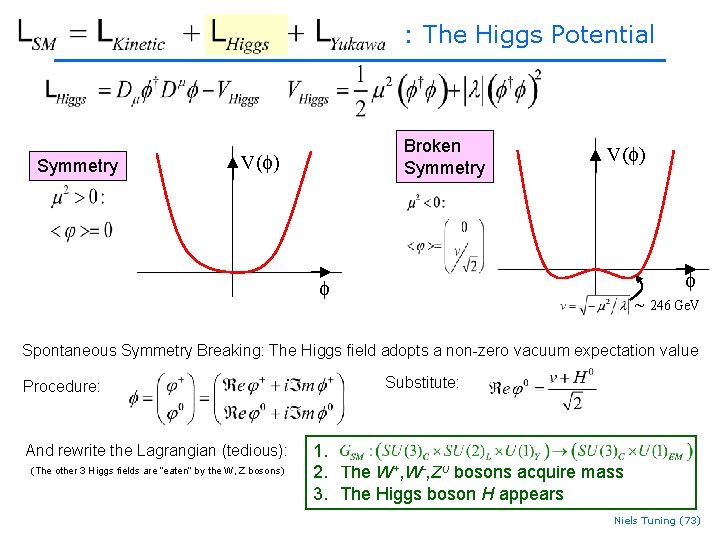
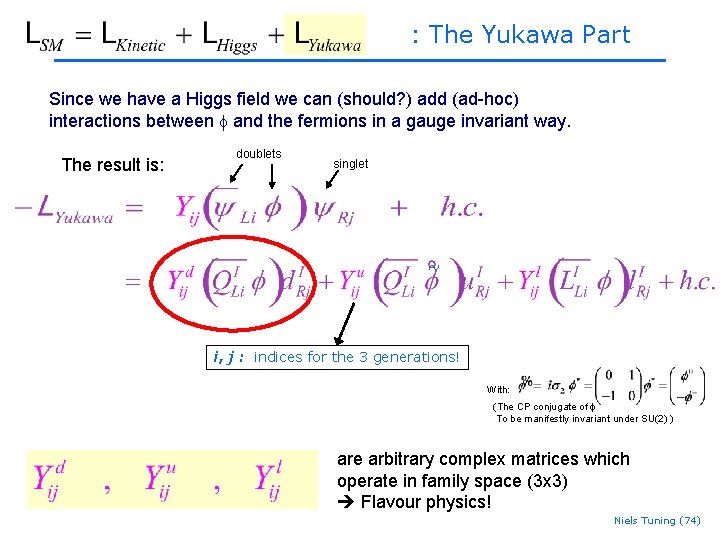
The Standard Model Lagrangian • LKinetic : • Introduce the massless fermion fields • Require local gauge invariance gives rise to existence of gauge bosons • LHiggs : • Introduce Higgs potential with <f> ≠ 0 • Spontaneous symmetry breaking The W+, W-, Z 0 bosons acquire a mass • LYukawa : • Ad hoc interactions between Higgs field & fermions Niels Tuning (68)
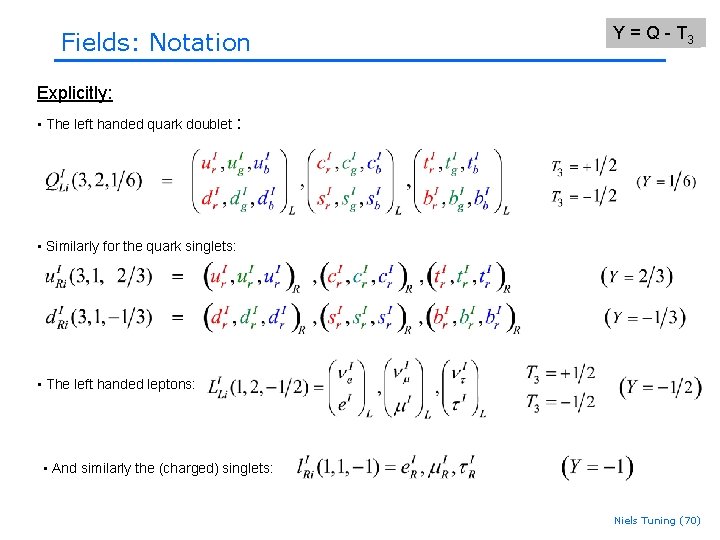
Y = Q - T 3 Fields: Notation with y = QL, u. R, d. R, LL, l. R, n. R Fermions: Interaction rep. Quarks: Under SU 2: Left handed doublets Right hander singlets • SU(3)C SU(2)L Hypercharge Y (=avg el. charge in multiplet) Leftgeneration handed index • Leptons: • • Scalar field: • • • Note: Interaction representation: standard model interaction is independent of generation Niels Tuning (69) number
Fields: Notation Q == Q Y T 3 -+TY 3 Explicitly: • The left handed quark doublet : • Similarly for the quark singlets: • The left handed leptons: • And similarly the (charged) singlets: Niels Tuning (70)
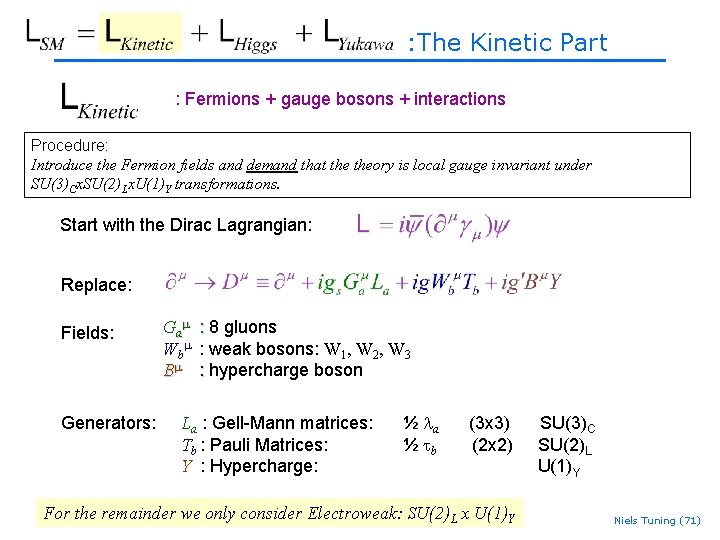
: The Kinetic Part : Fermions + gauge bosons + interactions Procedure: Introduce the Fermion fields and demand that theory is local gauge invariant under SU(3)Cx. SU(2)Lx. U(1)Y transformations. Start with the Dirac Lagrangian: Replace: Fields: Generators: Ga : 8 gluons Wb : weak bosons: W 1, W 2, W 3 B : hypercharge boson La : Gell-Mann matrices: Tb : Pauli Matrices: Y : Hypercharge: ½ la (3 x 3) ½ tb (2 x 2) For the remainder we only consider Electroweak: SU(2)L x U(1)Y SU(3)C SU(2)L U(1) Y Niels Tuning (71)
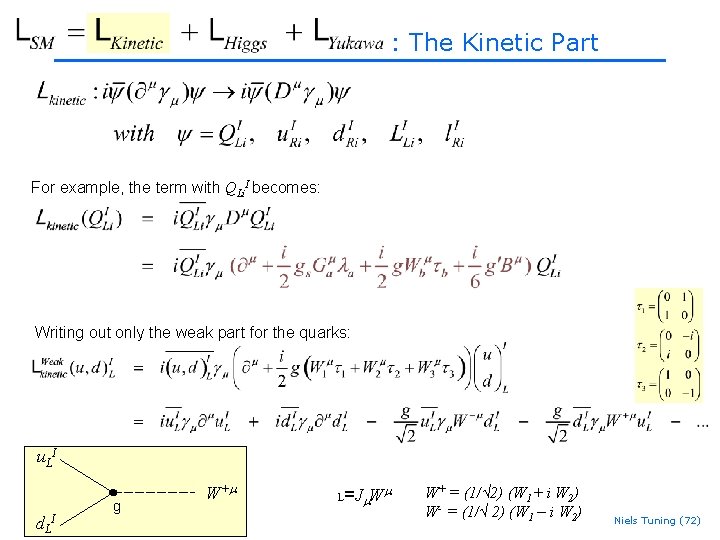
: The Kinetic Part For example, the term with QLi. I becomes: Writing out only the weak part for the quarks: u. LI d. L I g W+m L=Jm. Wm W+ = (1/√ 2) (W 1+ i W 2) W- = (1/√ 2) (W 1 – i W 2) Niels Tuning (72)
: The Higgs Potential Symmetry Broken Symmetry V(f) f f ~ 246 Ge. V Spontaneous Symmetry Breaking: The Higgs field adopts a non-zero vacuum expectation value Procedure: And rewrite the Lagrangian (tedious): (The other 3 Higgs fields are “eaten” by the W, Z bosons) Substitute: 1. . 2. The W+, W-, Z 0 bosons acquire mass 3. The Higgs boson H appears Niels Tuning (73)
: The Yukawa Part Since we have a Higgs field we can (should? ) add (ad-hoc) interactions between f and the fermions in a gauge invariant way. The result is: doublets singlet ~ i, j : indices for the 3 generations! With: (The CP conjugate of f To be manifestly invariant under SU(2) ) are arbitrary complex matrices which operate in family space (3 x 3) Flavour physics! Niels Tuning (74)
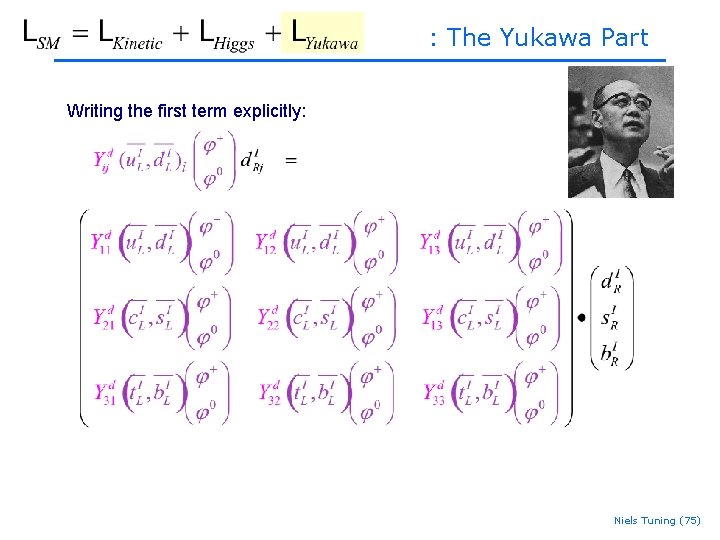
: The Yukawa Part Writing the first term explicitly: Niels Tuning (75)
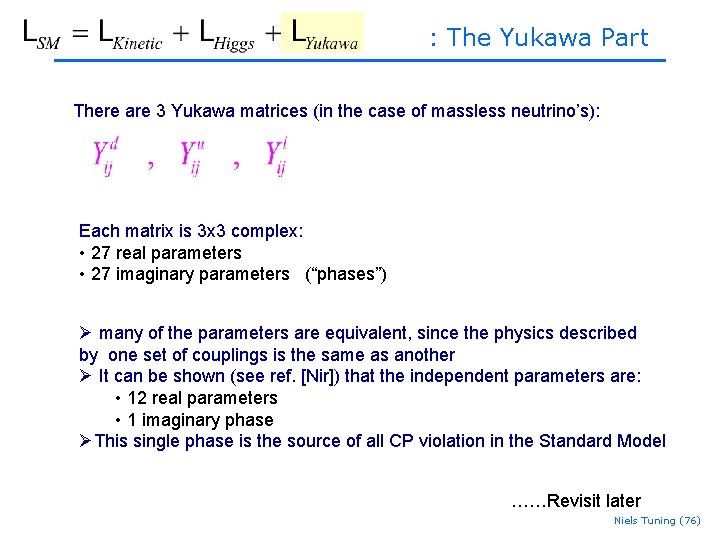
: The Yukawa Part There are 3 Yukawa matrices (in the case of massless neutrino’s): Each matrix is 3 x 3 complex: • 27 real parameters • 27 imaginary parameters (“phases”) Ø many of the parameters are equivalent, since the physics described by one set of couplings is the same as another Ø It can be shown (see ref. [Nir]) that the independent parameters are: • 12 real parameters • 1 imaginary phase ØThis single phase is the source of all CP violation in the Standard Model ……Revisit later Niels Tuning (76)
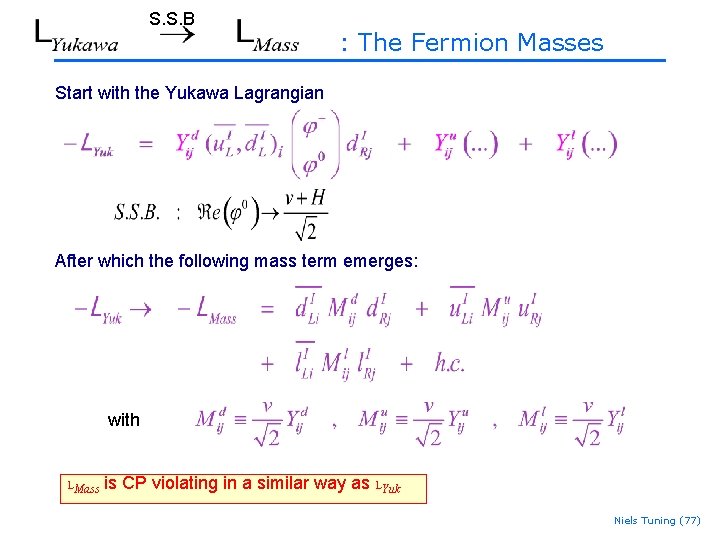
S. S. B : The Fermion Masses Start with the Yukawa Lagrangian After which the following mass term emerges: with LMass is CP violating in a similar way as LYuk Niels Tuning (77)
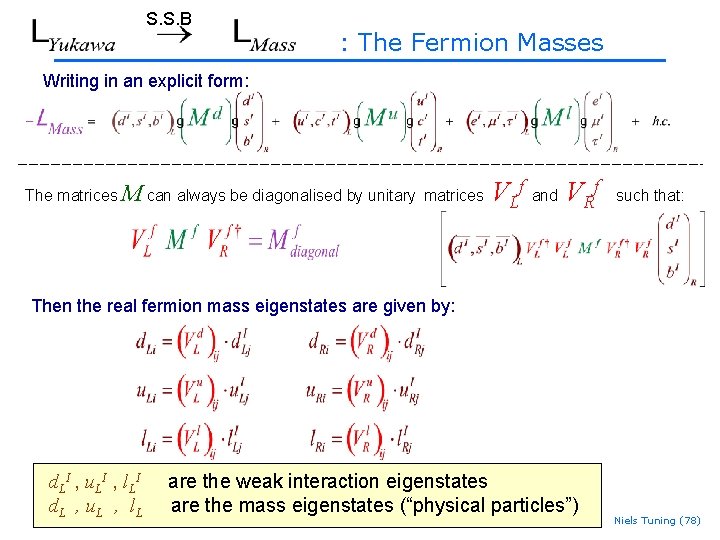
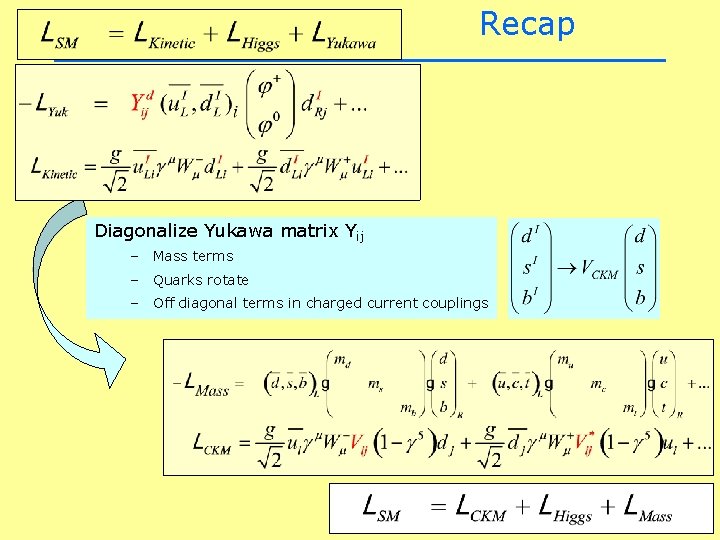
S. S. B : The Fermion Masses Writing in an explicit form: The matrices M can always be diagonalised by unitary matrices VLf and VRf such that: Then the real fermion mass eigenstates are given by: d. LI , u. LI , l. LI d. L , u. L , l. L are the weak interaction eigenstates are the mass eigenstates (“physical particles”) Niels Tuning (78)
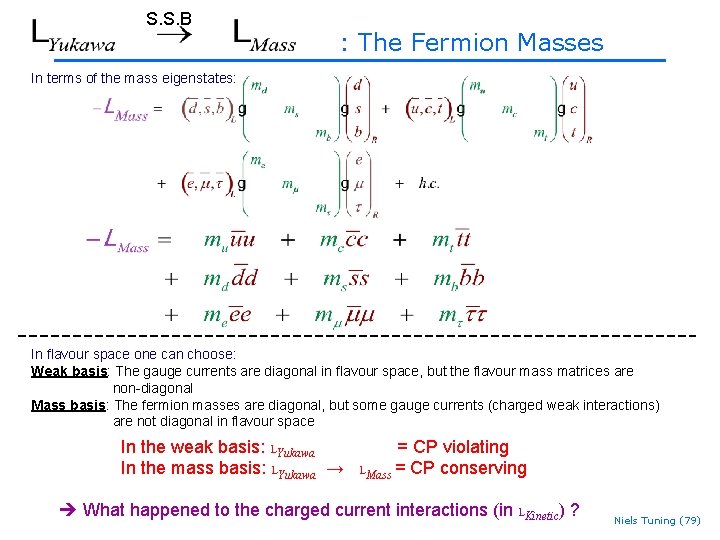
S. S. B : The Fermion Masses In terms of the mass eigenstates: In flavour space one can choose: Weak basis: The gauge currents are diagonal in flavour space, but the flavour mass matrices are non-diagonal Mass basis: The fermion masses are diagonal, but some gauge currents (charged weak interactions) are not diagonal in flavour space In the weak basis: LYukawa = CP violating In the mass basis: LYukawa → LMass = CP conserving What happened to the charged current interactions (in LKinetic) ? Niels Tuning (79)
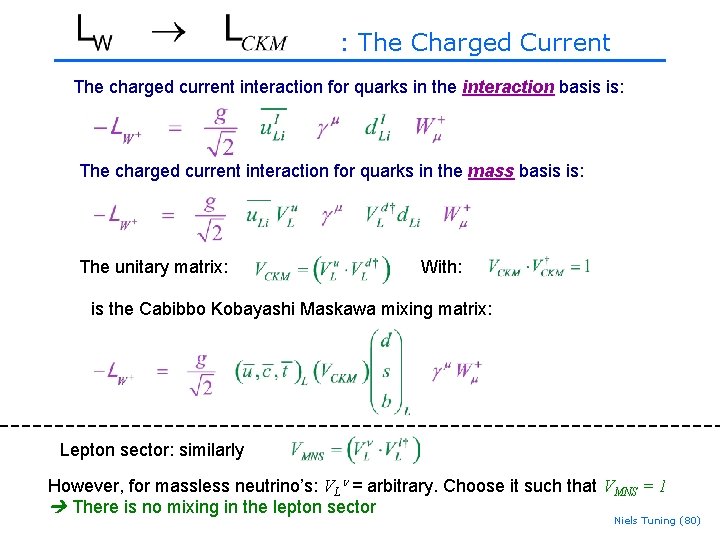
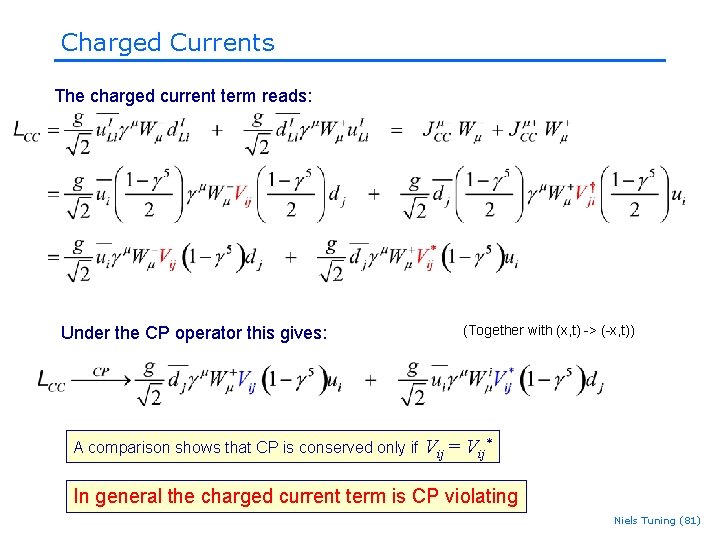
: The Charged Current The charged current interaction for quarks in the interaction basis is: The charged current interaction for quarks in the mass basis is: The unitary matrix: With: is the Cabibbo Kobayashi Maskawa mixing matrix: Lepton sector: similarly However, for massless neutrino’s: VLn = arbitrary. Choose it such that VMNS = 1 There is no mixing in the lepton sector Niels Tuning (80)
Charged Currents The charged current term reads: Under the CP operator this gives: A comparison shows that CP is conserved only if (Together with (x, t) -> (-x, t)) Vij = Vij* In general the charged current term is CP violating Niels Tuning (81)
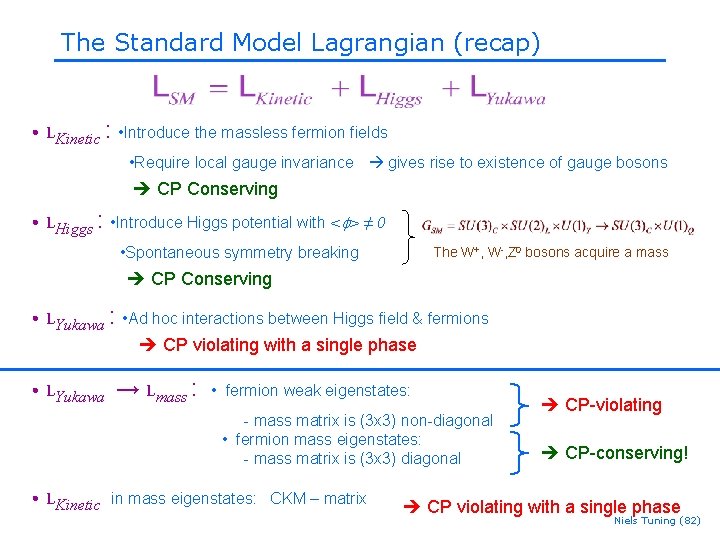
The Standard Model Lagrangian (recap) • LKinetic : • Introduce the massless fermion fields • Require local gauge invariance gives rise to existence of gauge bosons CP Conserving • LHiggs : • Introduce Higgs potential with <f> ≠ 0 • Spontaneous symmetry breaking The W+, W-, Z 0 bosons acquire a mass CP Conserving • LYukawa : • Ad hoc interactions between Higgs field & fermions CP violating with a single phase • LYukawa → Lmass : • LKinetic • fermion weak eigenstates: - mass matrix is (3 x 3) non-diagonal • fermion mass eigenstates: - mass matrix is (3 x 3) diagonal in mass eigenstates: CKM – matrix CP-violating CP-conserving! CP violating with a single phase Niels Tuning (82)
Recap Diagonalize Yukawa matrix Yij – Mass terms – Quarks rotate – Off diagonal terms in charged current couplings Niels Tuning (83)
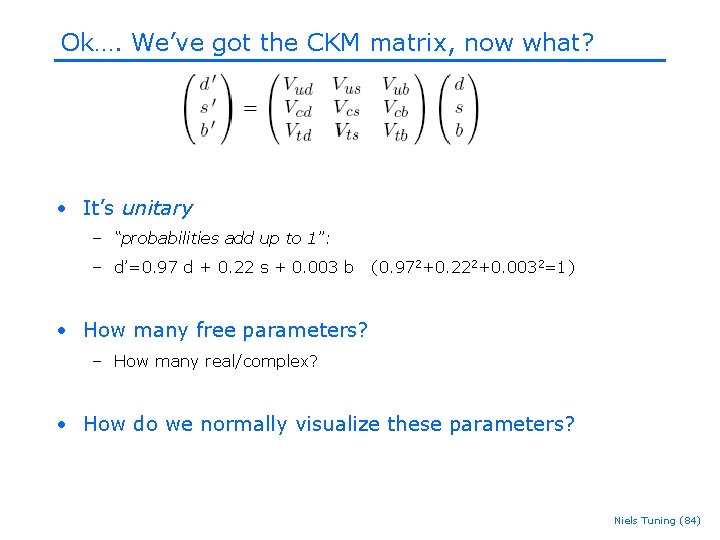
Ok…. We’ve got the CKM matrix, now what? • It’s unitary – “probabilities add up to 1”: – d’=0. 97 d + 0. 22 s + 0. 003 b (0. 972+0. 222+0. 0032=1) • How many free parameters? – How many real/complex? • How do we normally visualize these parameters? Niels Tuning (84)
Personal impression: • People think it is a complicated part of the Standard Model (me too: -). Why? 1) Non-intuitive concepts? § Imaginary phase in transition amplitude, T ~ eiφ § Different bases to express quark states, d’=0. 97 d + 0. 22 s + 0. 003 b § Oscillations (mixing) of mesons: |K 0> ↔ | K 0> 2) Complicated calculations? 3) Many decay modes? “Beetopaipaigamma…” – PDG reports 347 decay modes of the B 0 -meson: • Γ 1 l+ νl anything • Γ 347 ν ν γ ( 10. 33 ± 0. 28 ) × 10− 2 <4. 7 × 10− 5 CL=90% – And for one decay there are often more than one decay amplitudes… Niels Tuning (85)