
CHAPTER5 THE CONSISTENT DEFORMATION METHOD Method of Virtual



- Slides: 17
CHAPTER-5 THE CONSISTENT DEFORMATION METHOD
Method of Virtual Work [REVISION]
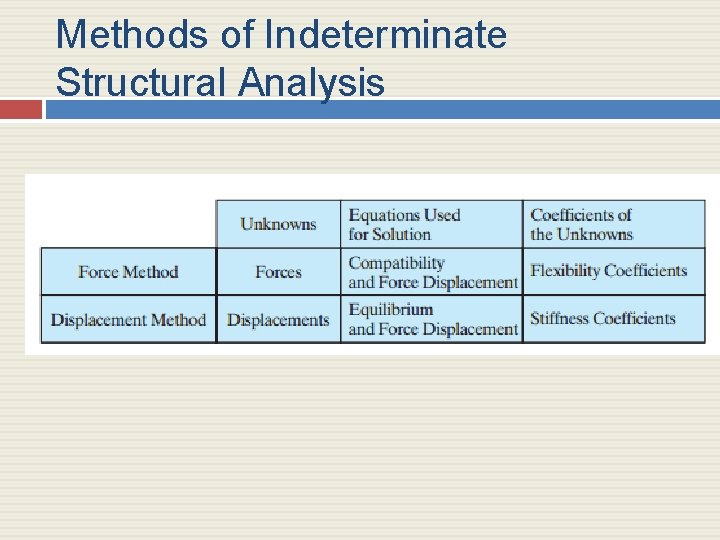
Methods of Indeterminate Structural Analysis FORCE Method: - consists of writing equations that satisfy the compatibility and forcedisplacement requirements for the structure to determine the redundant forces. UNKNOWNS --- FORCES DISPLACEMENT Method: - is based on writing force-displacement relationships for each member and then satisfying equilibrium requirements for the structure. UNKNOWNS --- DISPLACEMENTS
Methods of Indeterminate Structural Analysis
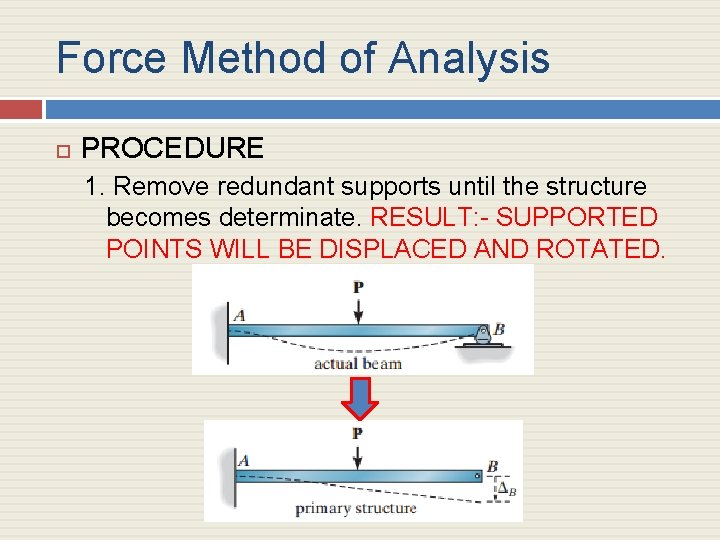
Force Method of Analysis PROCEDURE 1. Remove redundant supports until the structure becomes determinate. RESULT: - SUPPORTED POINTS WILL BE DISPLACED AND ROTATED.
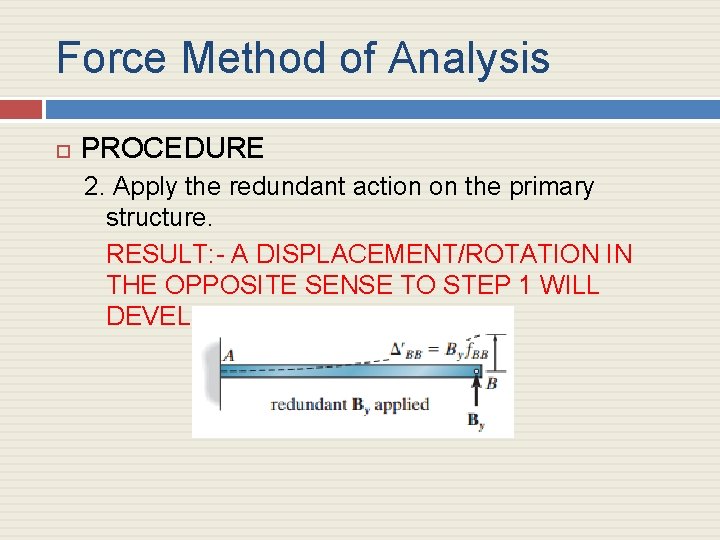
Force Method of Analysis PROCEDURE 2. Apply the redundant action on the primary structure. RESULT: - A DISPLACEMENT/ROTATION IN THE OPPOSITE SENSE TO STEP 1 WILL DEVELOP AT APPLIED POINT.
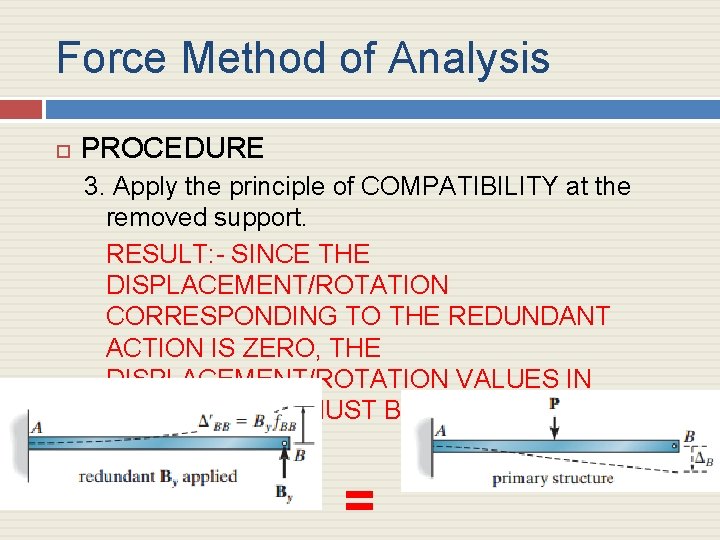
Force Method of Analysis PROCEDURE 3. Apply the principle of COMPATIBILITY at the removed support. RESULT: - SINCE THE DISPLACEMENT/ROTATION CORRESPONDING TO THE REDUNDANT ACTION IS ZERO, THE DISPLACEMENT/ROTATION VALUES IN STEPS 1 AND 2 MUST BE EQUAL. =
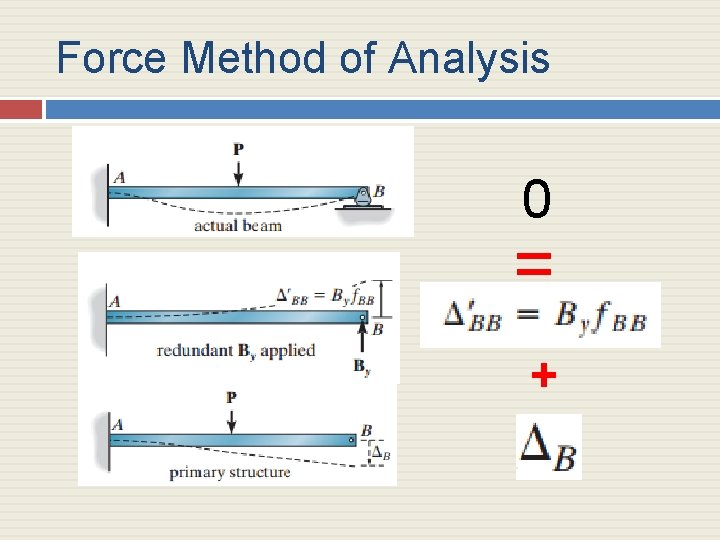
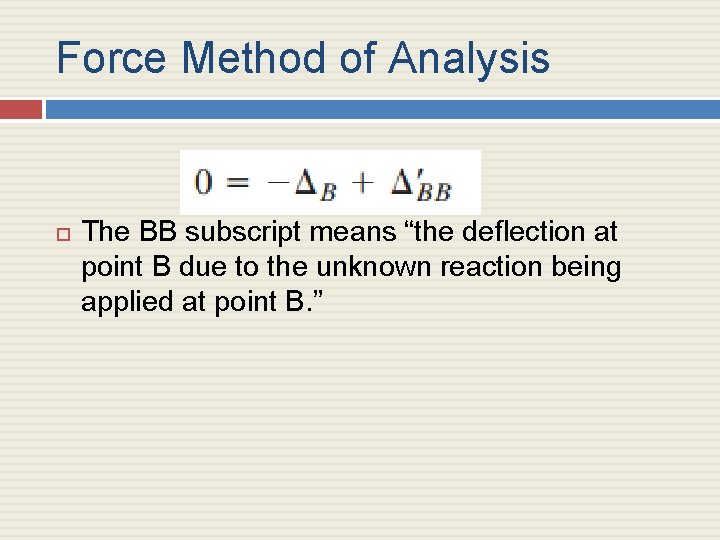
Force Method of Analysis 0 = +
Force Method of Analysis The BB subscript means “the deflection at point B due to the unknown reaction being applied at point B. ”
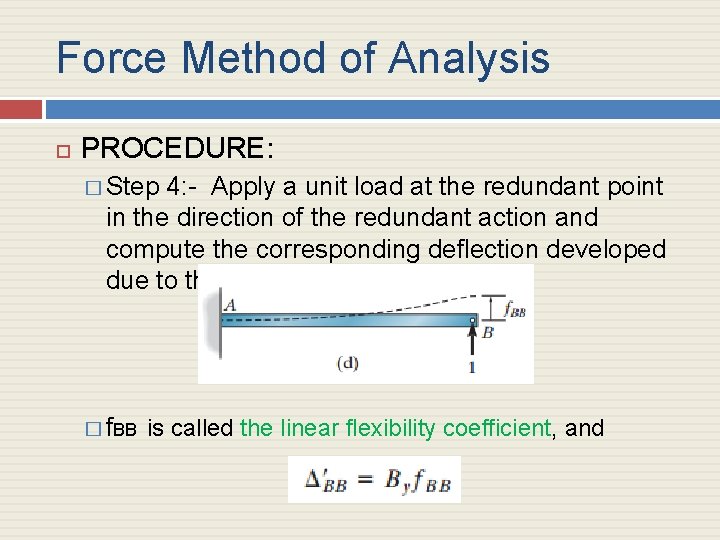
Force Method of Analysis PROCEDURE: � Step 4: - Apply a unit load at the redundant point in the direction of the redundant action and compute the corresponding deflection developed due to this unit action. � f. BB is called the linear flexibility coefficient, and
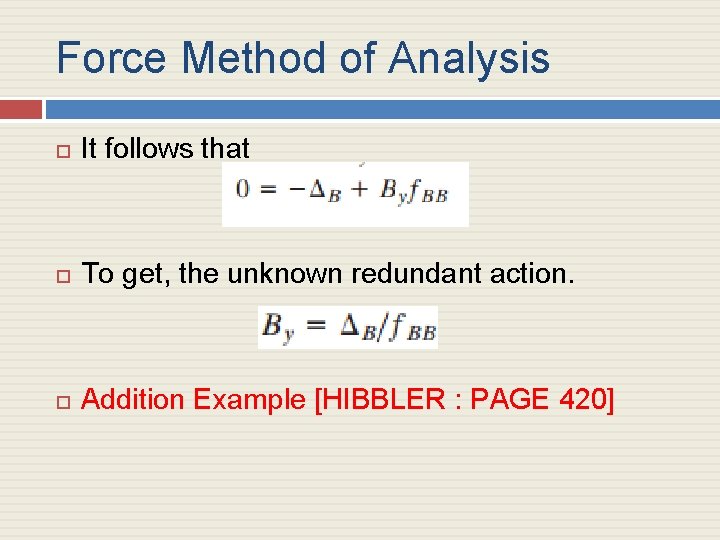
Force Method of Analysis It follows that To get, the unknown redundant action. Addition Example [HIBBLER : PAGE 420]
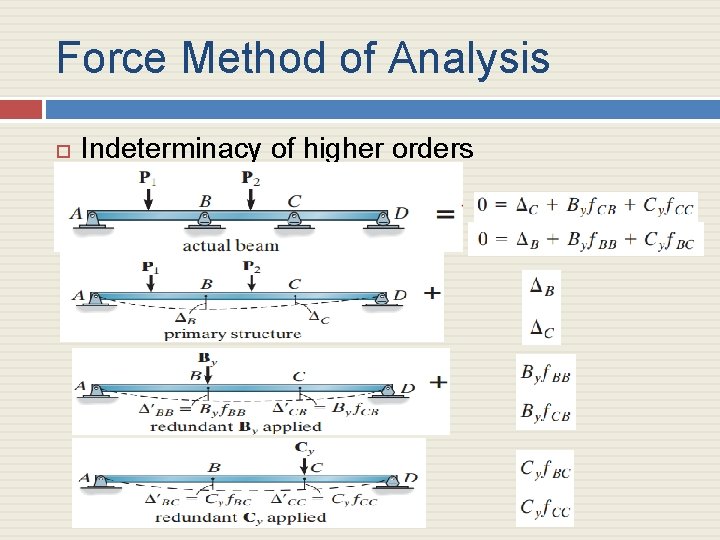
Force Method of Analysis Indeterminacy of higher orders
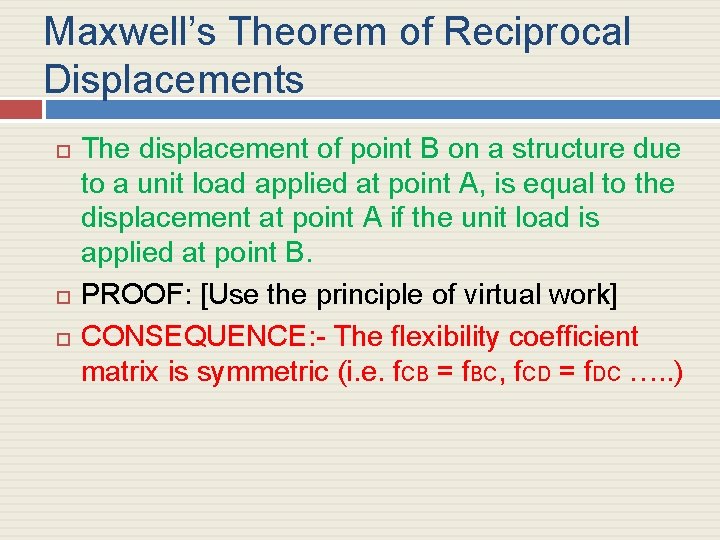
Maxwell’s Theorem of Reciprocal Displacements The displacement of point B on a structure due to a unit load applied at point A, is equal to the displacement at point A if the unit load is applied at point B. PROOF: [Use the principle of virtual work] CONSEQUENCE: - The flexibility coefficient matrix is symmetric (i. e. f. CB = f. BC, f. CD = f. DC …. . )
BEAMS
TRUSSES
FRAMES
FIN