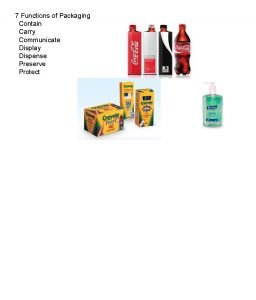
Packaging Mr Vilayphone KEOSILAPHET Faculty of Agriculture FOA









- Slides: 88
Packaging ການຫມຫ Mr. Vilayphone KEOSILAPHET Faculty of Agriculture (FOA) Department of Rural Economy and Food Thecnology National University of Laos (NUOL) (Lao PDR) Mobile: 856 20 22024356
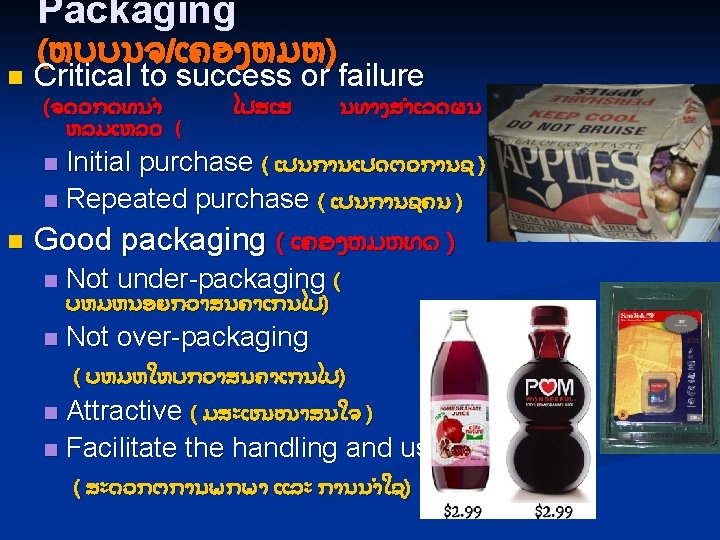
Terminology (ຄຳສບ) n Packaging (ຫບບນຈ/ເຄອງຫມຫ) A coordinated system of preparing goods for safe, secure, efficient, and effective handling, transport, distribution, storage, retailing, consumption and recovery, re-use or disposal combined with maximizing consumer value, sales and hence profit. ( ແມນສງທຕຽມໃສສນຄາເພອໃຫມຄວາມປອດໄພ, ປະກນໄພ, ມປະສດທພາບແລະສະດວກຕການຂນຍາຍ, ຂນສງ, ການແຈກຈາຍ, ການເກບຮກສາ, ເກບຂາຍຍອຍ, ສະດວກຕການຊມໃຊ, ນຳໃຊຄນໄດ,
Function of packaging ໜາທຂອງການຫມຫ n Protection ເປນການປອງກນແລະຮກສາ Mechanical injury ��������� n Undesirable gas ����������� n Climatic factors �������� n Utility ����� n Containment ������������ n Others: extend shelf life, convenience use, environmental friendly ���: �������� n ��������, ��������. n Communication �������� : n n Required information ���������� Optional information ����������
Package design ���������� n Structural design �������� n Protect product from mechanical damage ��������������� Delay quality loss ���������� n Facilitate utility of the package n ��������������� n Graphic design ����� Text ������ n Picture ������� n Texture �������� n Material ���� n Color ����� n
Factors for designing packaging ������������ n Product characteristics ����������� Distribution ��������� n Regulatory requirement �������� n Customer/marketing requirement n ������������/�����
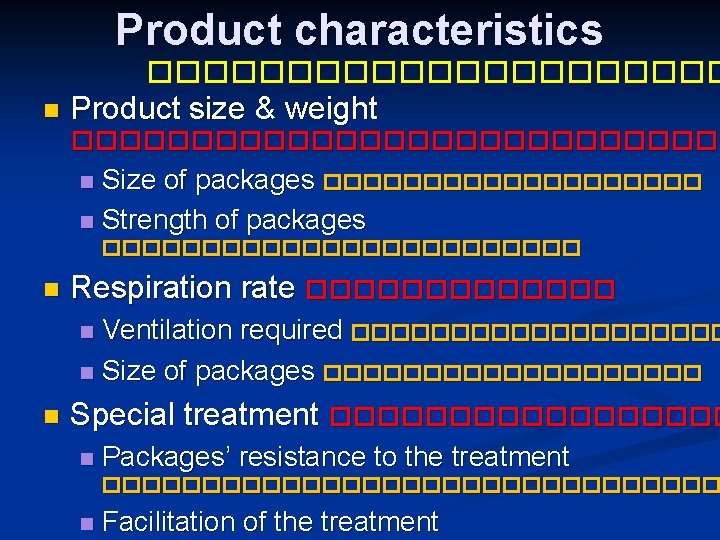
Product characteristics ����������� n Product size & weight �������������� Size of packages ���������� n Strength of packages n ������������ n Respiration rate ������� Ventilation required ���������� n Size of packages ���������� n n Special treatment ��������� n Packages’ resistance to the treatment ���������������� n Facilitation of the treatment
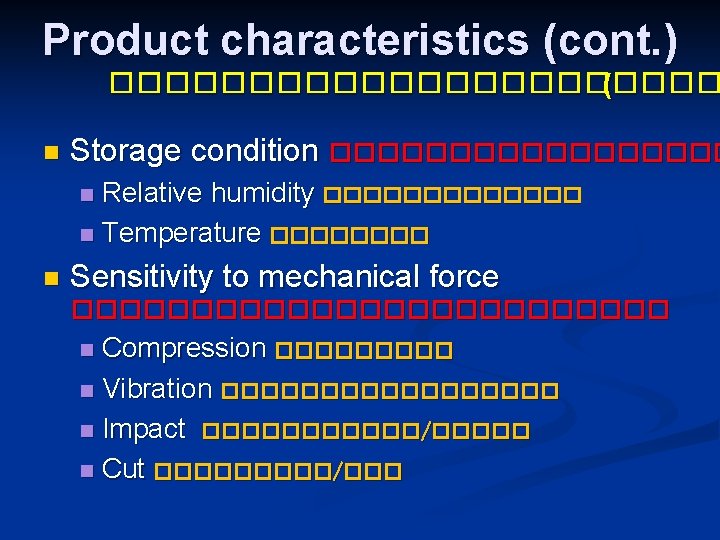
Product characteristics (cont. ) ����������� ( n Storage condition ��������� Relative humidity ������� n Temperature ���� n n Sensitivity to mechanical force ������������� Compression ����� n Vibration ��������� n Impact ������/����� n Cut �����/��� n
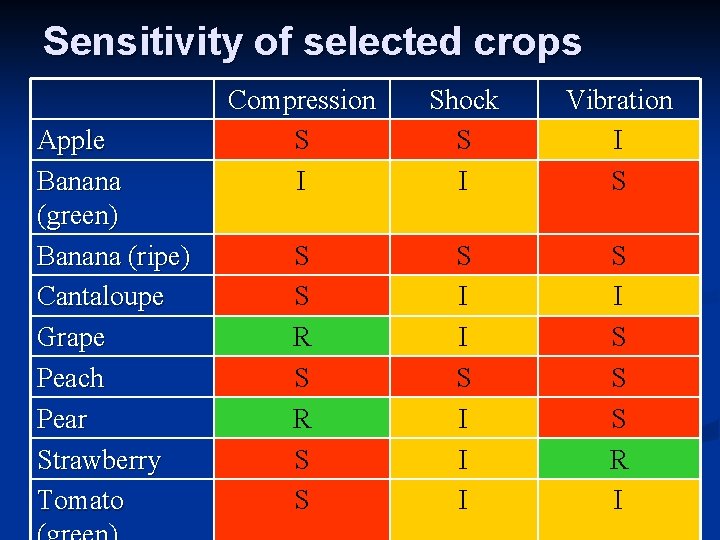
Sensitivity of selected crops Apple Banana (green) Banana (ripe) Cantaloupe Grape Peach Pear Strawberry Tomato Compression S I Shock S I Vibration I S S S R S S S I I I S S S R I
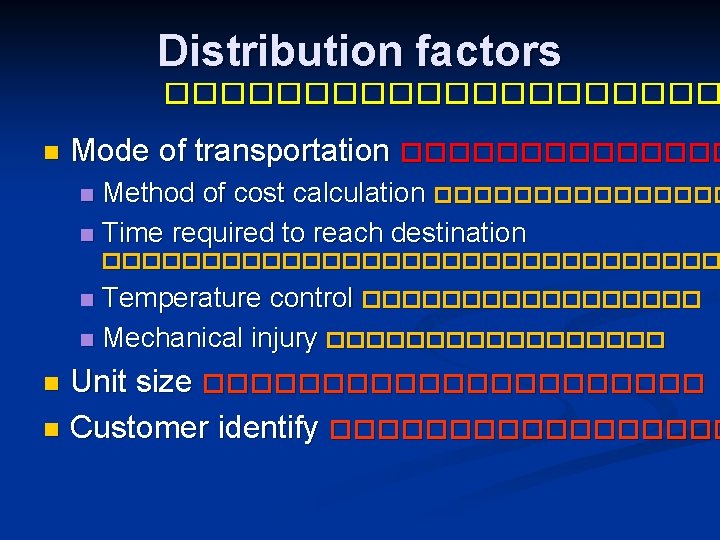
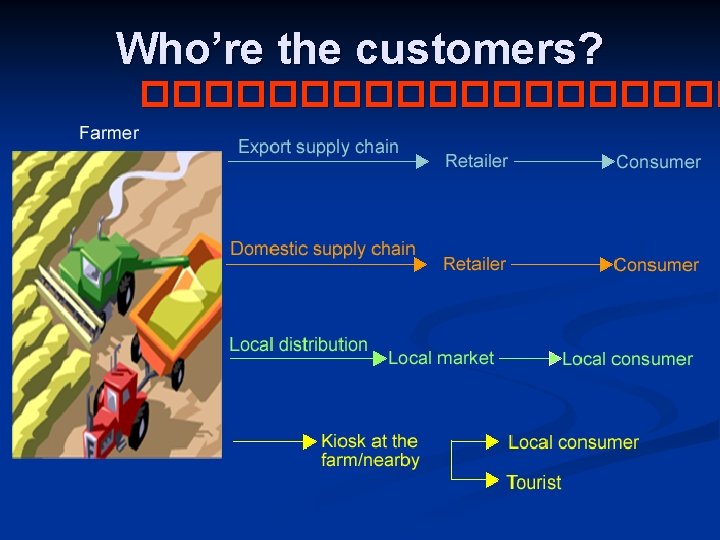
Distribution factors ���������� n Mode of transportation ������� Method of cost calculation �������� n Time required to reach destination n ���������������� Temperature control ��������� n Mechanical injury ��������� n Unit size ����������� n Customer identify ��������� n
Regulatory requirement ��������� n Which regulation ����� Producing country ������� n Target market country ��������� n n Information provided on the package �������������� n Regulation of packages allowed to use �������������� n Treatment regulation ���������� n Waste regulation ���������
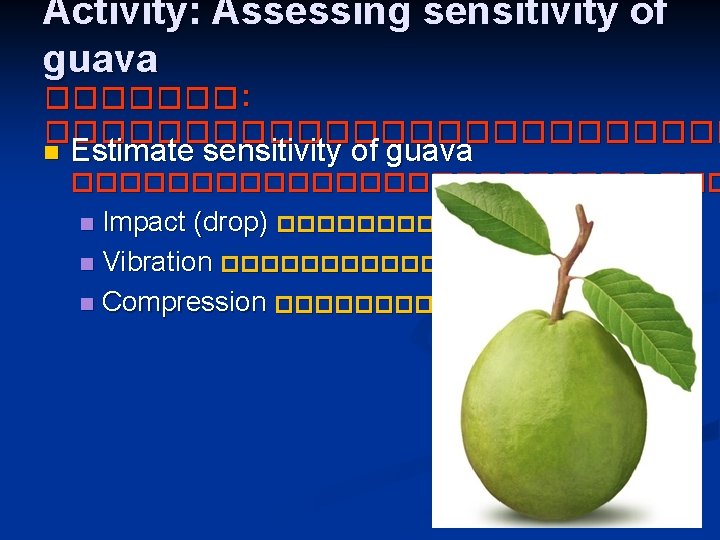
Activity: Assessing sensitivity of guava �������: ������������� n Estimate sensitivity of guava ������������ ��� Impact (drop) ����(��� ( n Vibration ������� n Compression ������� n
Activity: What do customers want? �������: �������� ? n Identify characteristics of packages that the following customers want: �������������� : Collector/Distributor �����/���� n Retail ����� n Consumer ����� n n Local market ����� n Export market ������� n Tourist ������
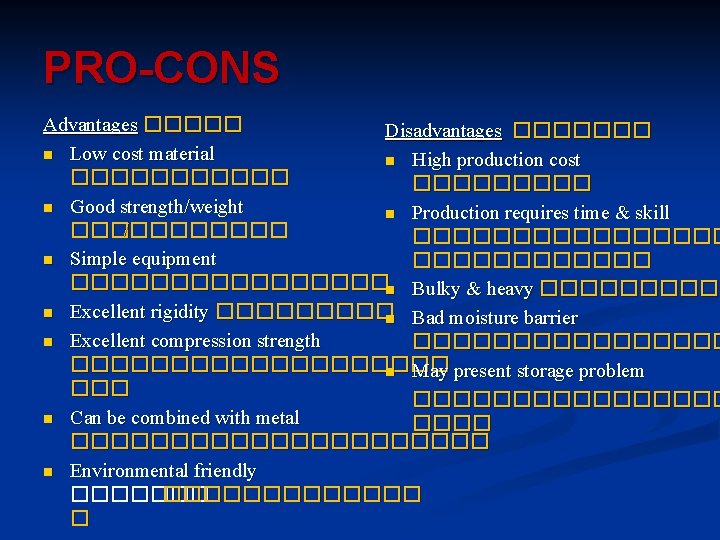
PRO-CONS Advantages ����� Disadvantages ������� n Low cost material n High production cost ������ n Good strength/weight n Production requires time & skill ���/�������� n Simple equipment ����������������n Bulky & heavy ����� n Excellent rigidity ����� n Bad moisture barrier n Excellent compression strength ������������������� n May present storage problem ���������� n Can be combined with metal ������������� n Environmental friendly ������������� �
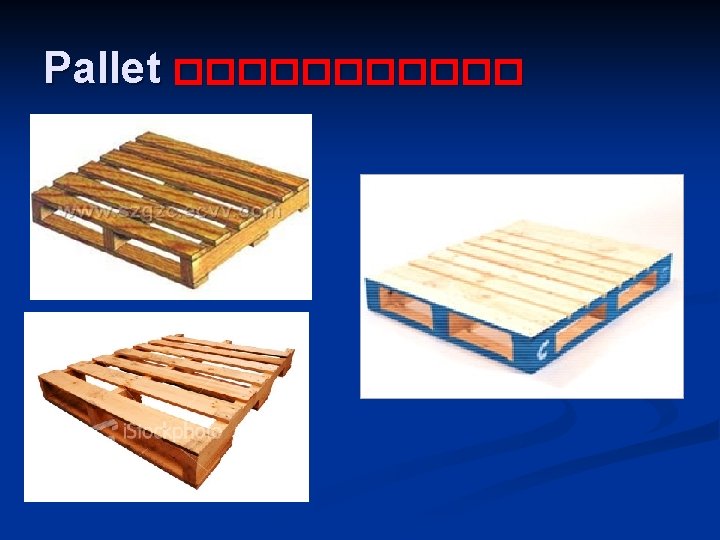
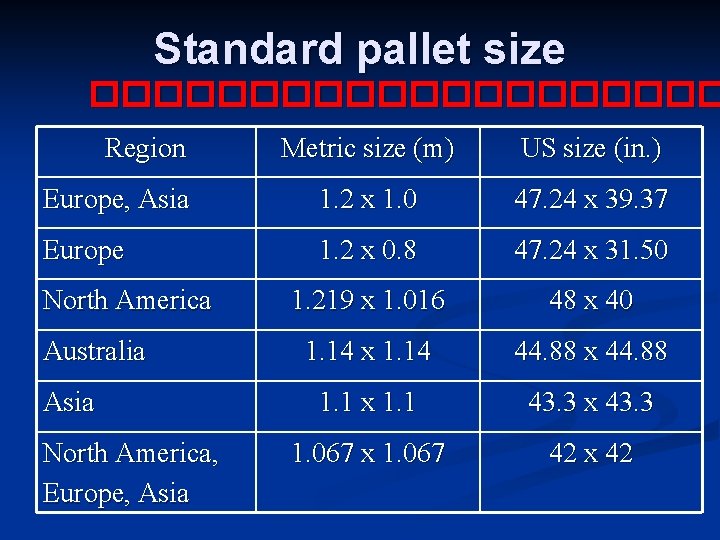
Standard pallet size ���������� Region Metric size (m) US size (in. ) Europe, Asia 1. 2 x 1. 0 47. 24 x 39. 37 Europe 1. 2 x 0. 8 47. 24 x 31. 50 1. 219 x 1. 016 48 x 40 1. 14 x 1. 14 44. 88 x 44. 88 1. 1 x 1. 1 43. 3 x 43. 3 1. 067 x 1. 067 42 x 42 North America Australia Asia North America, Europe, Asia
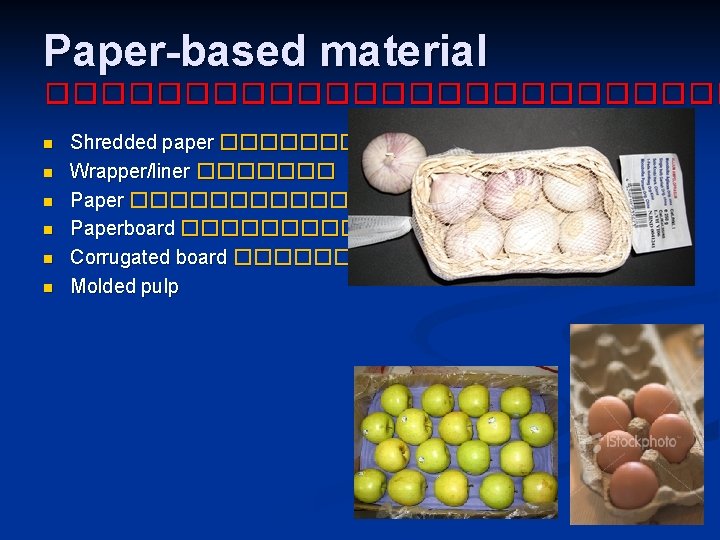
Paper-based material ������������� n n n Shredded paper ������� Wrapper/liner ������� Paperboard ������ Corrugated board ���� Molded pulp
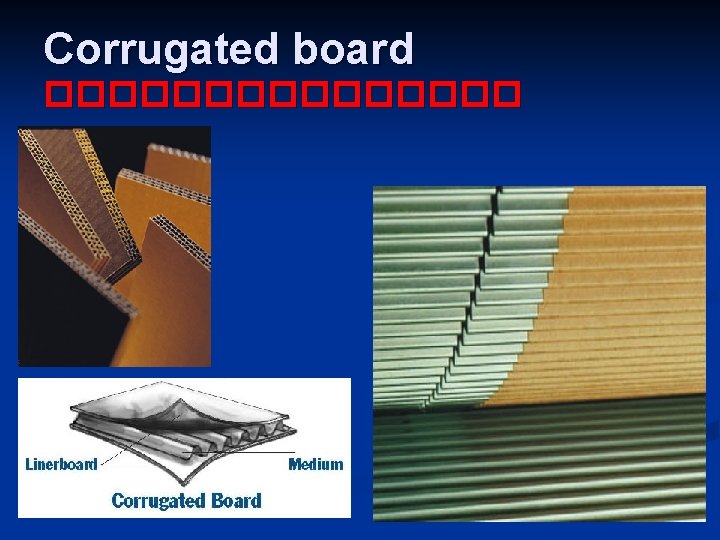
Corrugated board ��������
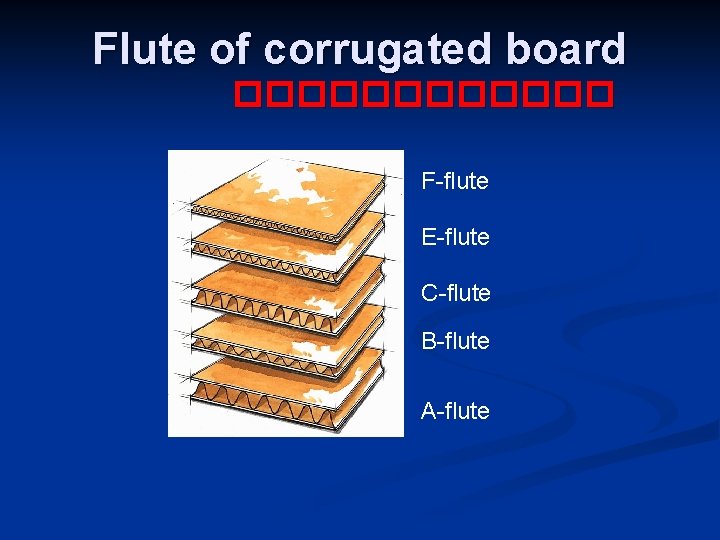
Flute of corrugated board ������ F-flute E-flute C-flute B-flute A-flute
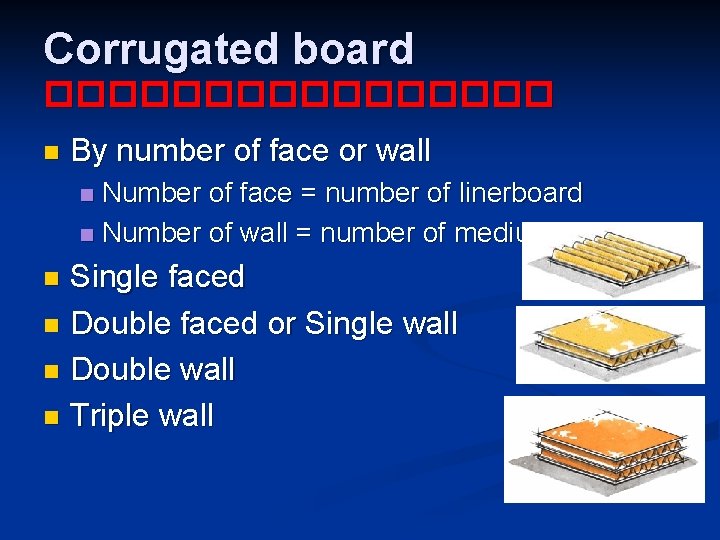
Corrugated board �������� n By number of face or wall Number of face = number of linerboard n Number of wall = number of medium n Single faced n Double faced or Single wall n Double wall n Triple wall n
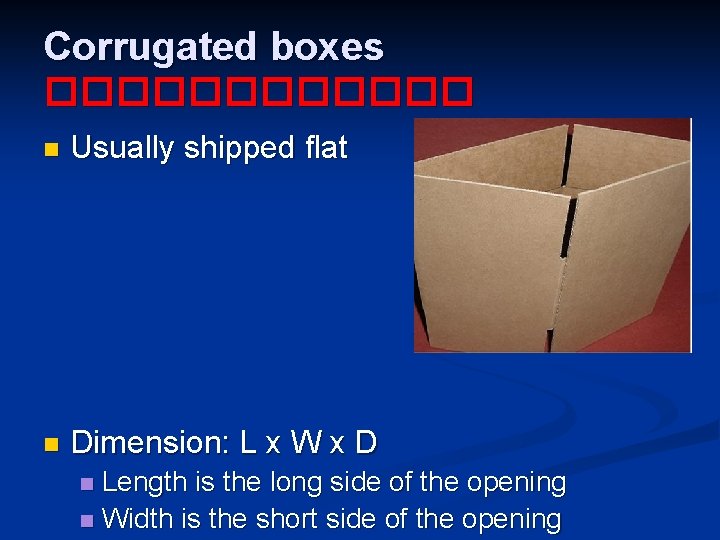
Corrugated boxes ������ n Usually shipped flat n Dimension: L x W x D Length is the long side of the opening n Width is the short side of the opening n
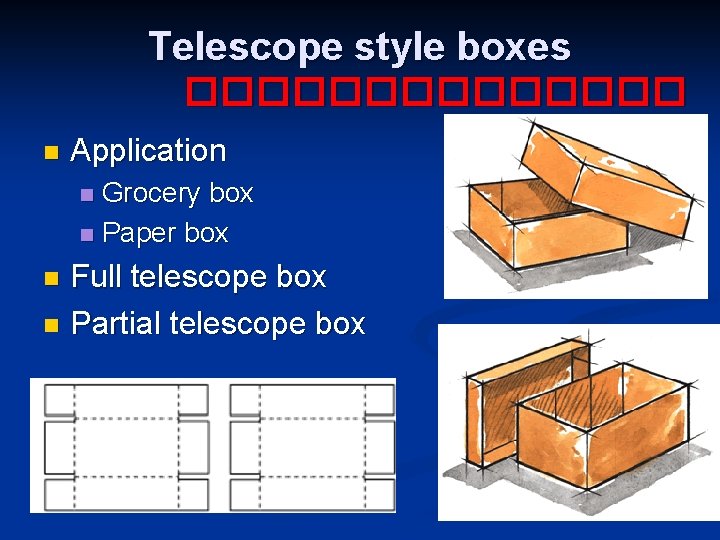
Telescope style boxes ������� n Application Grocery box n Paper box n Full telescope box n Partial telescope box n
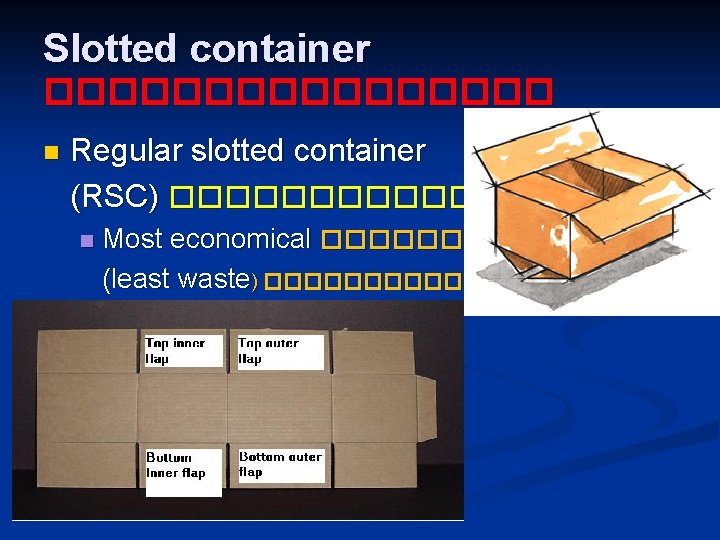
Slotted container �������� n Regular slotted container (RSC) �������� n Most economical ������� (least waste) �����������
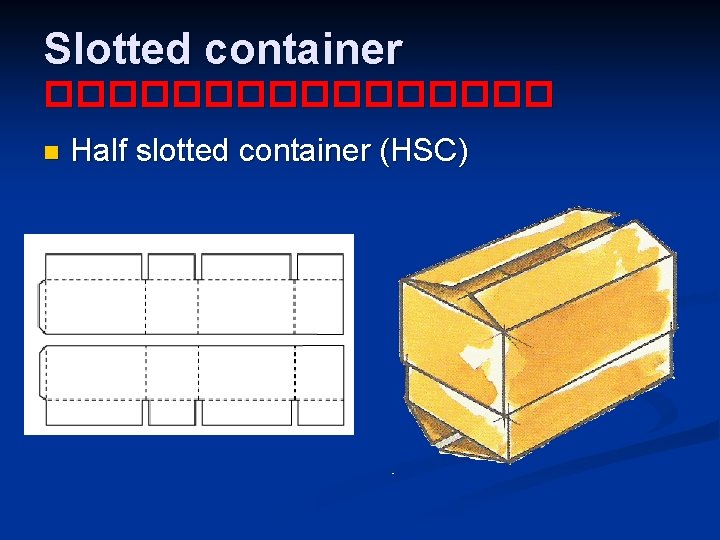
Slotted container �������� n Half slotted container (HSC)
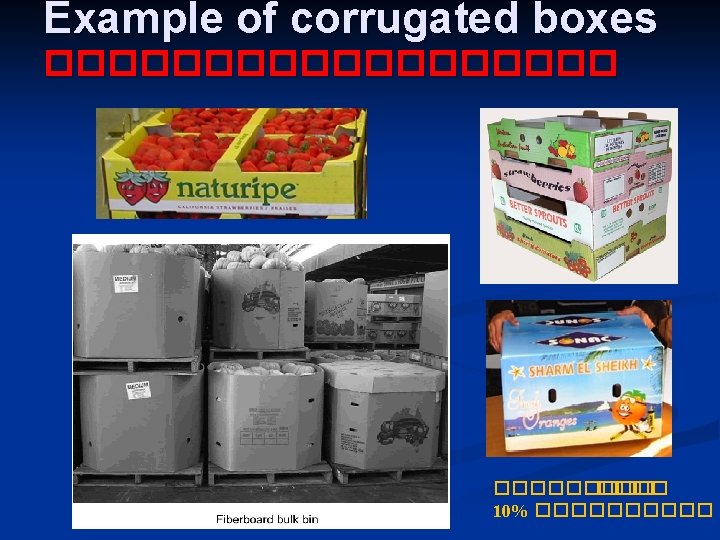
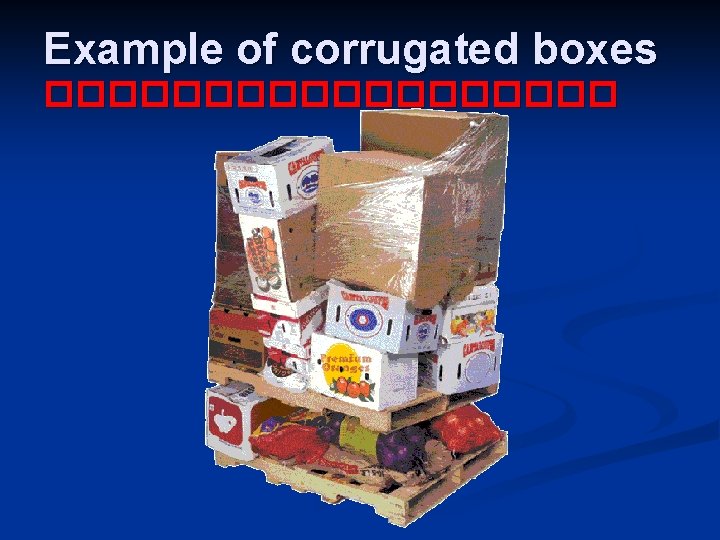
Example of corrugated boxes ���������
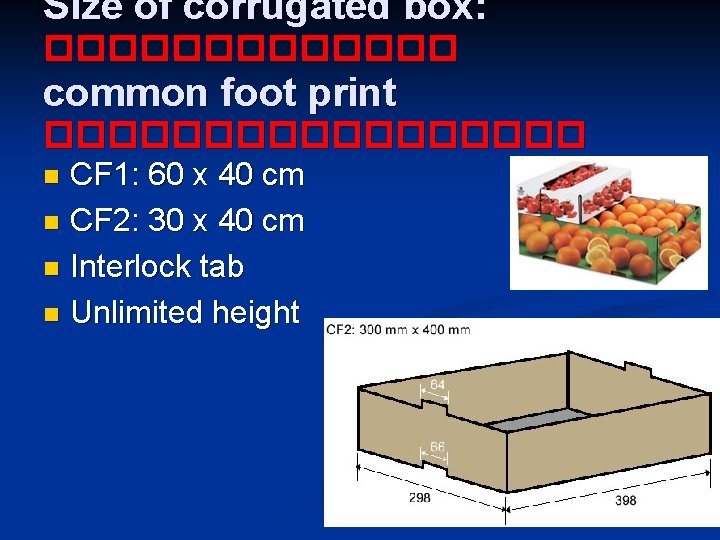
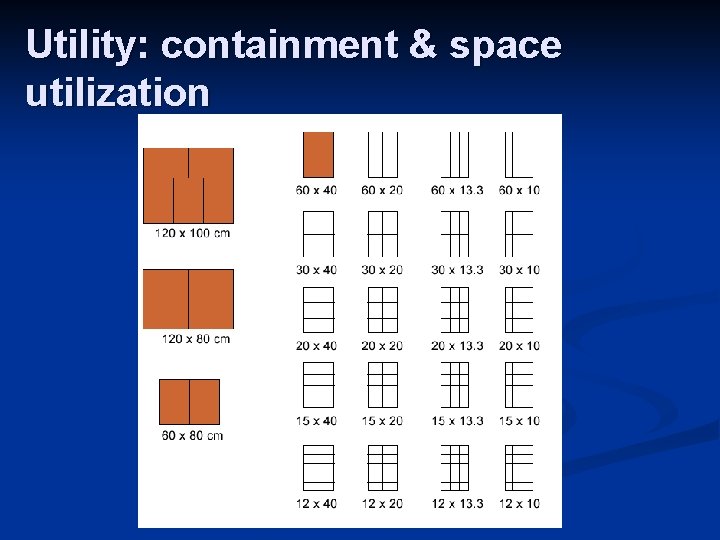
Size of corrugated box: ������� common foot print ��������� n CF 1: 60 x 40 cm n CF 2: 30 x 40 cm n Interlock tab n Unlimited height
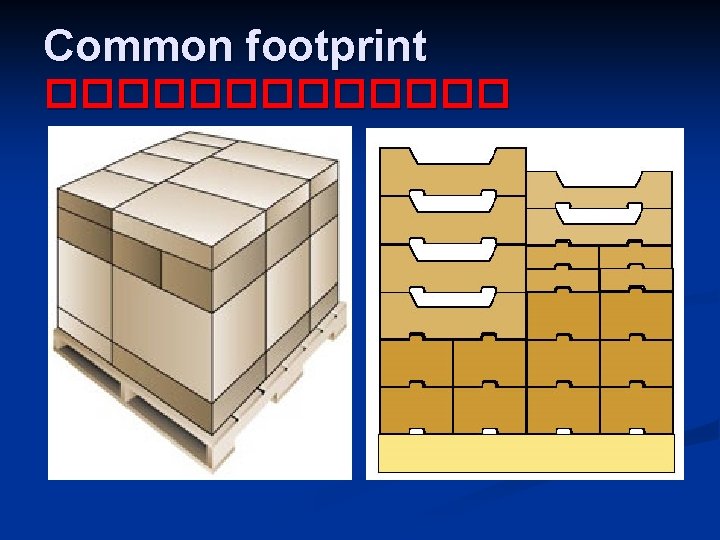
Common footprint �������
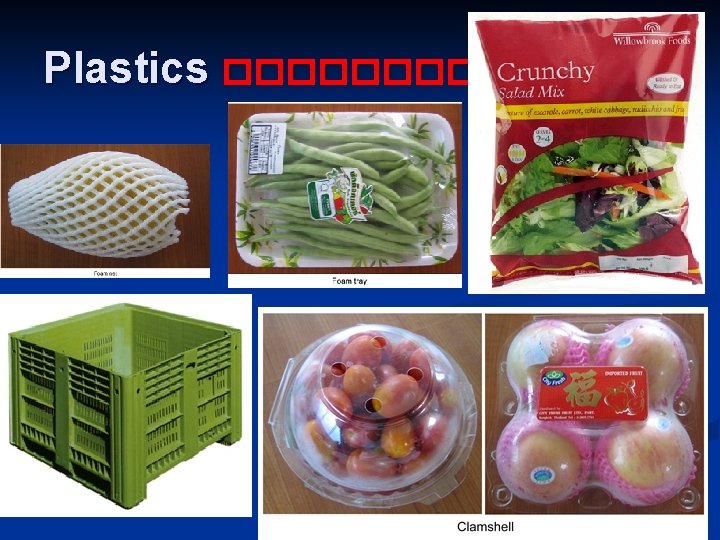
Plastics �����
Plastic’s advantages ��������� Low density: reduce transportation cost n Thinner: space reduction n Lower Tm than glass & metal: reduce processing cost n Can be custom-made easily n Transparent n Unbreakable n
Permeability of plastic ����������� n Critical factors for Product shelf life n Modified atmosphere packaging n Active packaging n n Depends on Polymer chemical & physical structure n Temperature n (Relative humidity) n
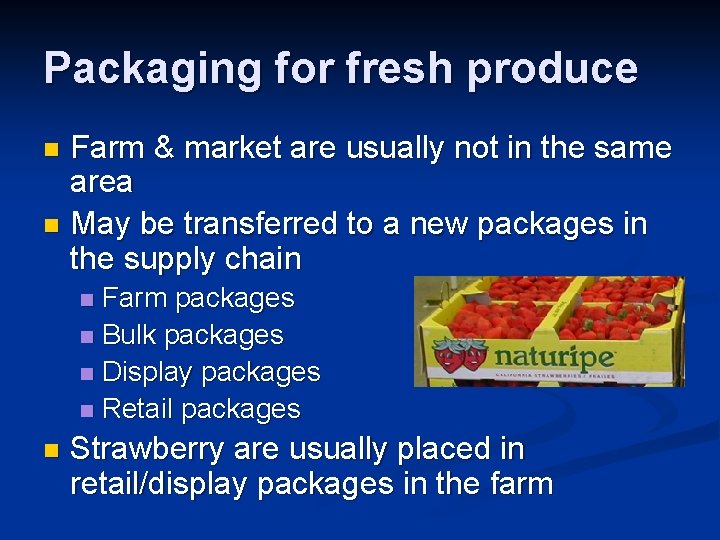
Packaging for fresh produce Farm & market are usually not in the same area n May be transferred to a new packages in the supply chain n Farm packages n Bulk packages n Display packages n Retail packages n n Strawberry are usually placed in retail/display packages in the farm
Method of packing is critical to produce damage n Type of packing method n Jumble pack n Pattern pack n Tray pack n Retail pack n
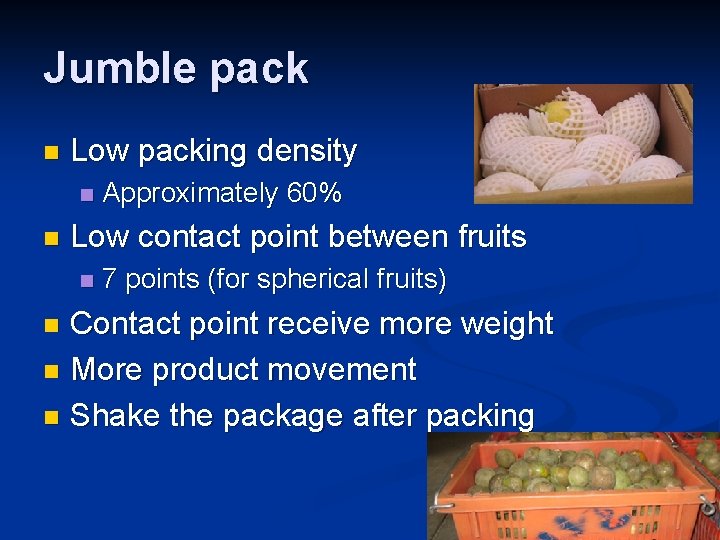
Jumble pack n Low packing density n n Approximately 60% Low contact point between fruits n 7 points (for spherical fruits) Contact point receive more weight n More product movement n Shake the package after packing n
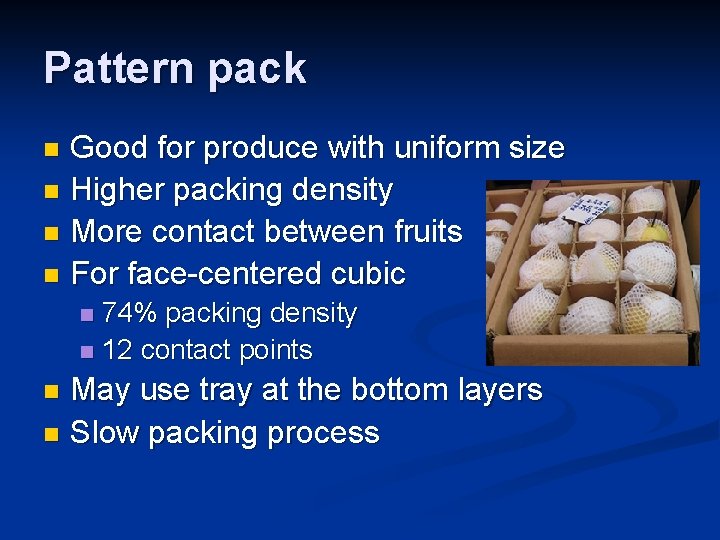
Pattern pack Good for produce with uniform size n Higher packing density n More contact between fruits n For face-centered cubic n 74% packing density n 12 contact points n May use tray at the bottom layers n Slow packing process n
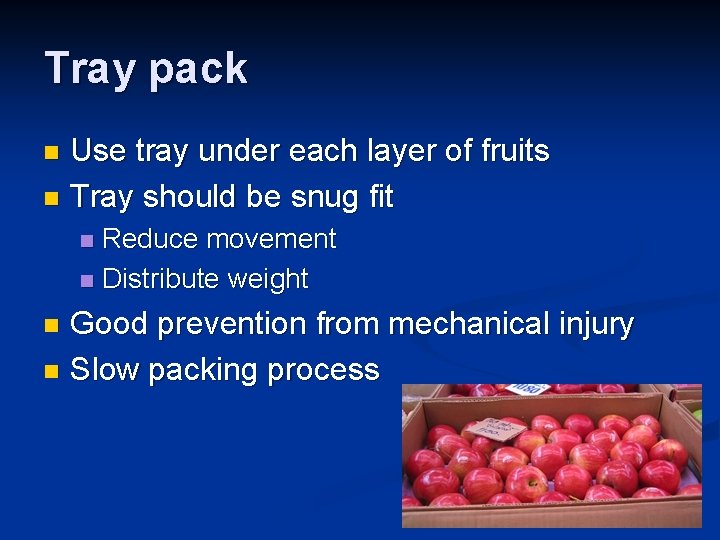
Tray pack Use tray under each layer of fruits n Tray should be snug fit n Reduce movement n Distribute weight n Good prevention from mechanical injury n Slow packing process n
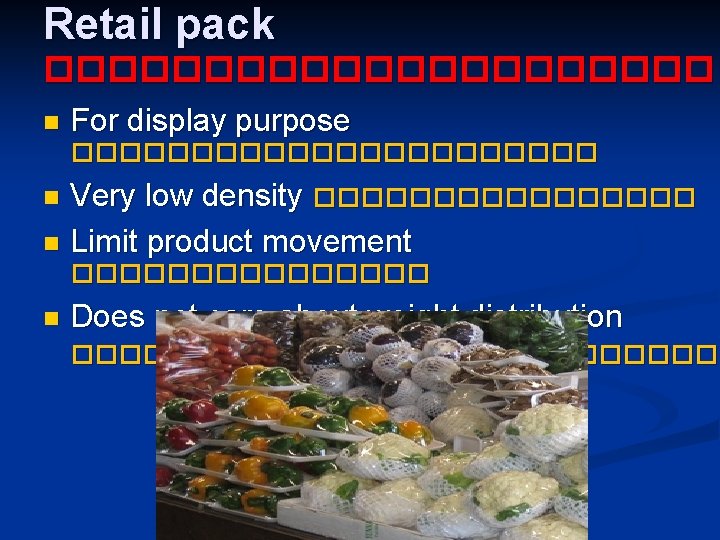
Retail pack ����������� n For display purpose ����������� Very low density �������� n Limit product movement n �������� n Does not care about weight distribution ��������������
Designing packages for fresh produce according to functions
Protection
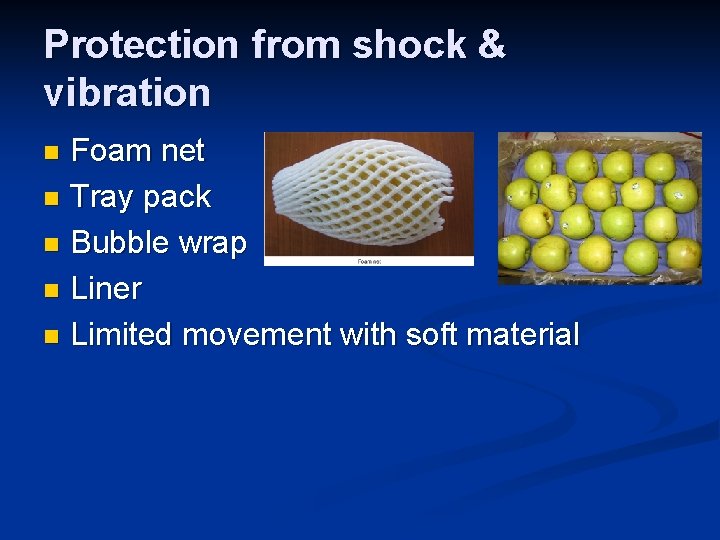
Protection from shock & vibration Foam net n Tray pack n Bubble wrap n Liner n Limited movement with soft material n
Protection against compression n For produce sensitive to compression, packages should bear the compression load not the product Provide sufficient headspace n Use containers with suitable compression strength n n Compression strength (CS) Determined by compression tester n Report as: Maximum force @ deflection n
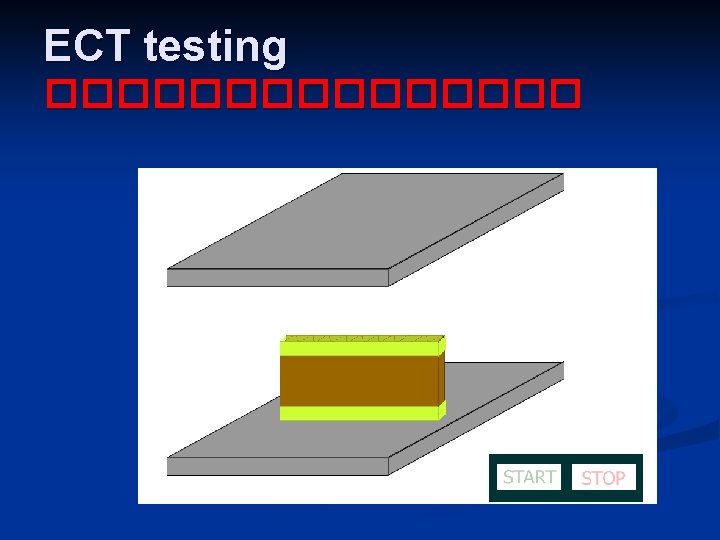
Determination of CS
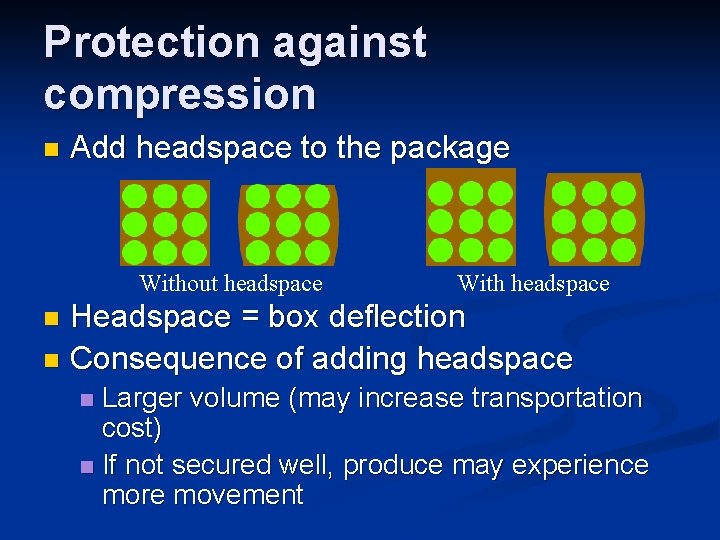
Protection against compression n Add headspace to the package Without headspace With headspace Headspace = box deflection n Consequence of adding headspace n Larger volume (may increase transportation cost) n If not secured well, produce may experience more movement n
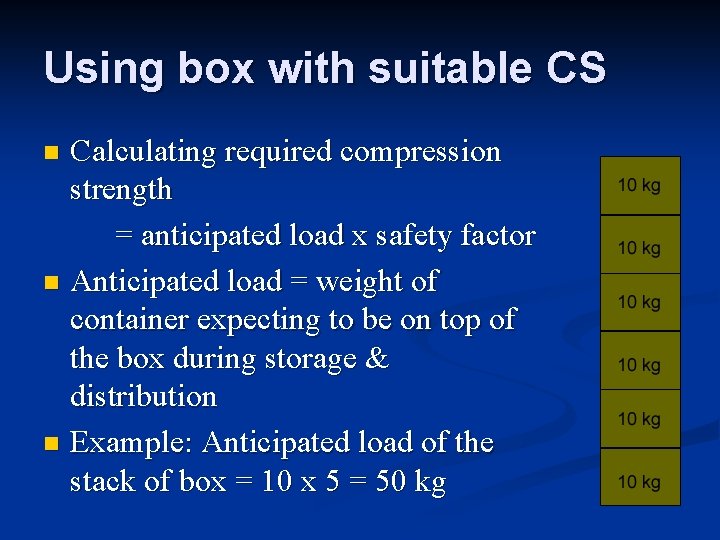
Using box with suitable CS Calculating required compression strength = anticipated load x safety factor n Anticipated load = weight of container expecting to be on top of the box during storage & distribution n Example: Anticipated load of the stack of box = 10 x 5 = 50 kg n
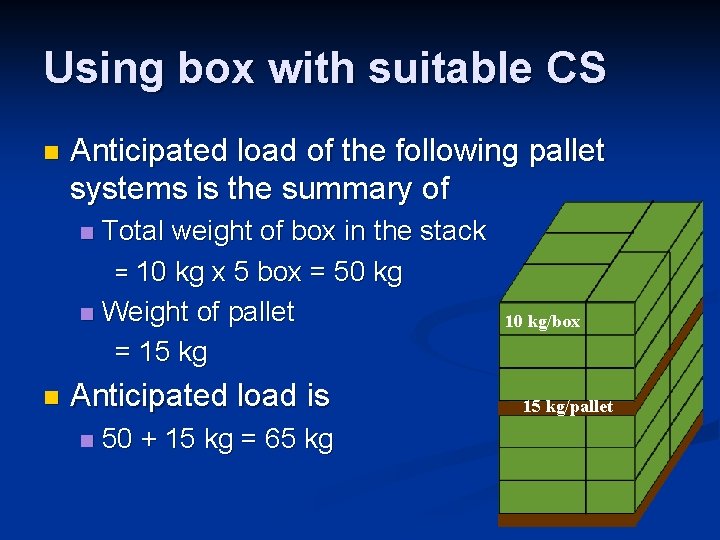
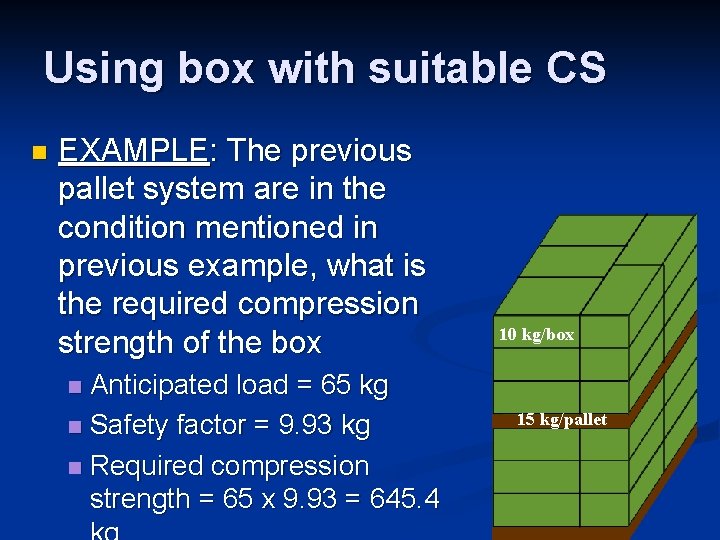
Using box with suitable CS n Anticipated load of the following pallet systems is the summary of Total weight of box in the stack = 10 kg x 5 box = 50 kg n Weight of pallet = 15 kg n n Anticipated load is n 50 + 15 kg = 65 kg 10 kg/box 15 kg/pallet
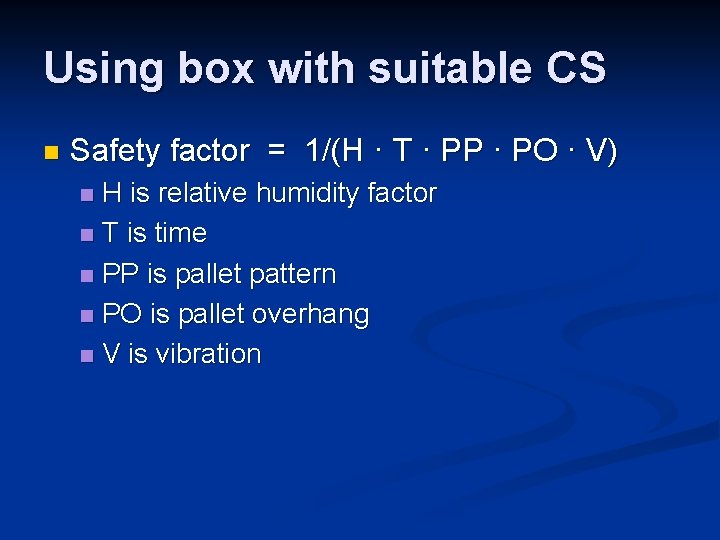
Using box with suitable CS n Safety factor = 1/(H · T · PP · PO · V) H is relative humidity factor n T is time n PP is pallet pattern n PO is pallet overhang n V is vibration n
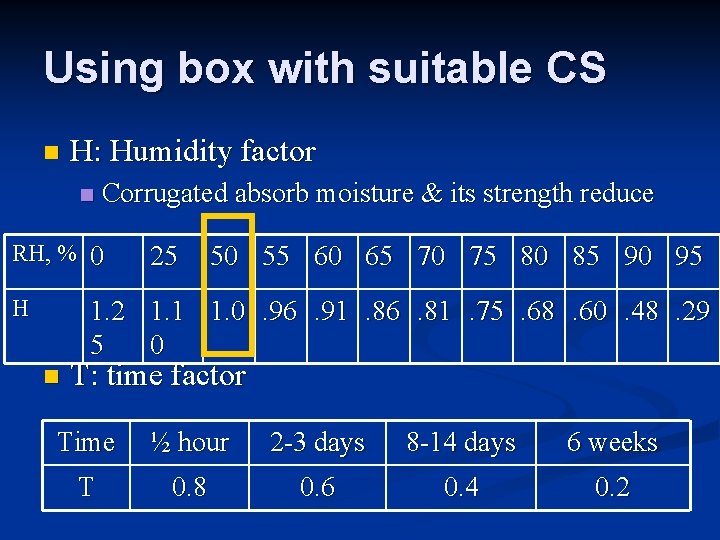
Using box with suitable CS n H: Humidity factor n Corrugated absorb moisture & its strength reduce RH, % 0 H 25 50 55 60 65 70 75 80 85 90 95 1. 2 1. 1 1. 0. 96. 91. 86. 81. 75. 68. 60. 48. 29 5 0 n T: time factor Time ½ hour 2 -3 days 8 -14 days 6 weeks T 0. 8 0. 6 0. 4 0. 2
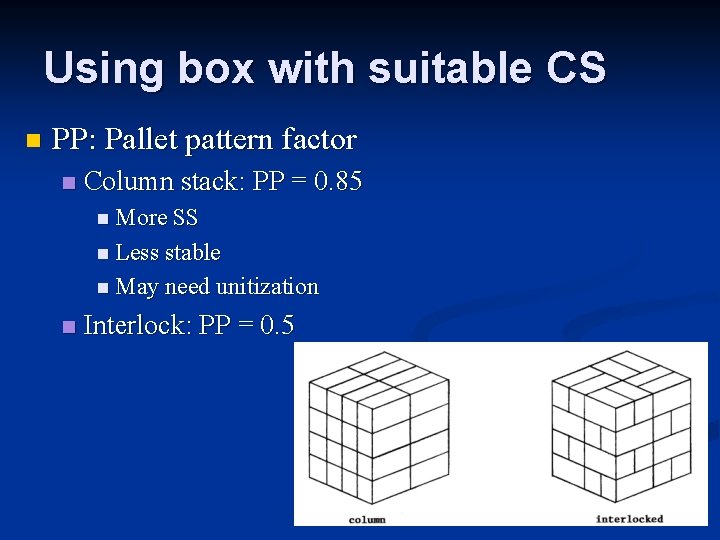
Using box with suitable CS n PP: Pallet pattern factor n Column stack: PP = 0. 85 n More SS n Less stable n May need unitization n Interlock: PP = 0. 5
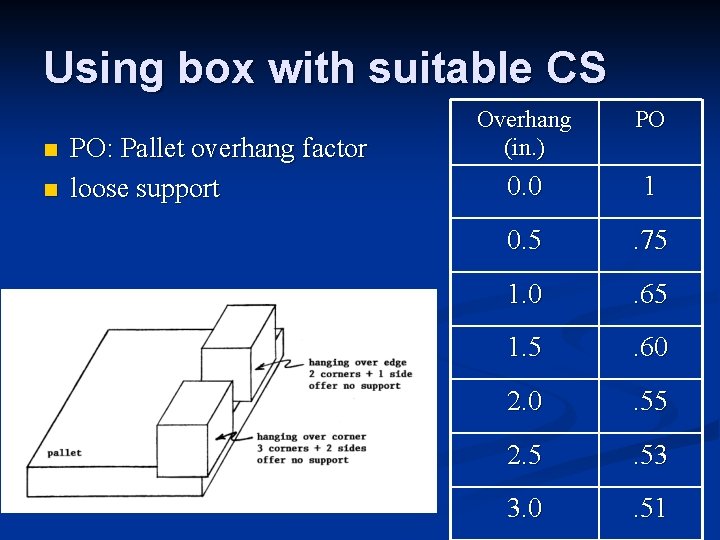
Using box with suitable CS n n PO: Pallet overhang factor loose support Overhang (in. ) PO 0. 0 1 0. 5 . 75 1. 0 . 65 1. 5 . 60 2. 0 . 55 2. 5 . 53 3. 0 . 51
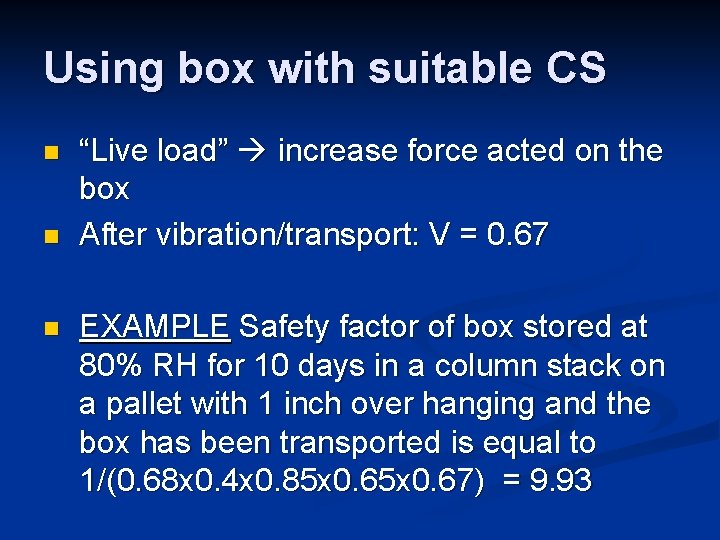
Using box with suitable CS n n n “Live load” increase force acted on the box After vibration/transport: V = 0. 67 EXAMPLE Safety factor of box stored at 80% RH for 10 days in a column stack on a pallet with 1 inch over hanging and the box has been transported is equal to 1/(0. 68 x 0. 4 x 0. 85 x 0. 67) = 9. 93
Using box with suitable CS n EXAMPLE: The previous pallet system are in the condition mentioned in previous example, what is the required compression strength of the box Anticipated load = 65 kg n Safety factor = 9. 93 kg n Required compression strength = 65 x 9. 93 = 645. 4 10 kg/box n 15 kg/pallet
Utility
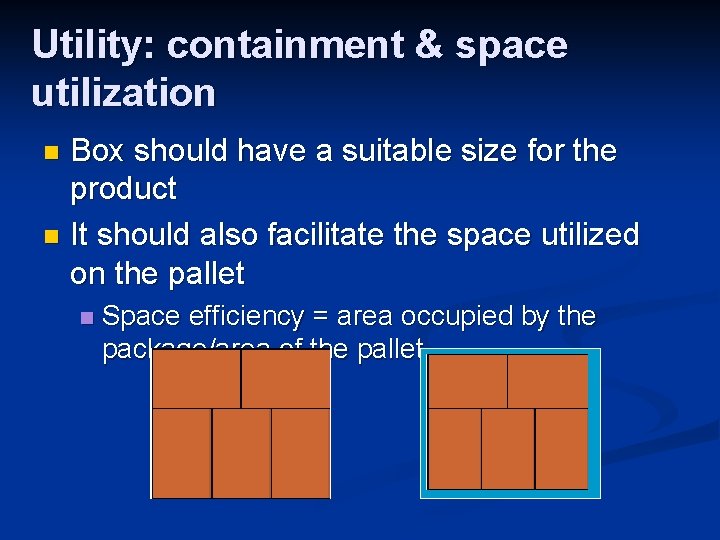
Utility: containment & space utilization Box should have a suitable size for the product n It should also facilitate the space utilized on the pallet n n Space efficiency = area occupied by the package/area of the pallet
Utility: containment & space utilization
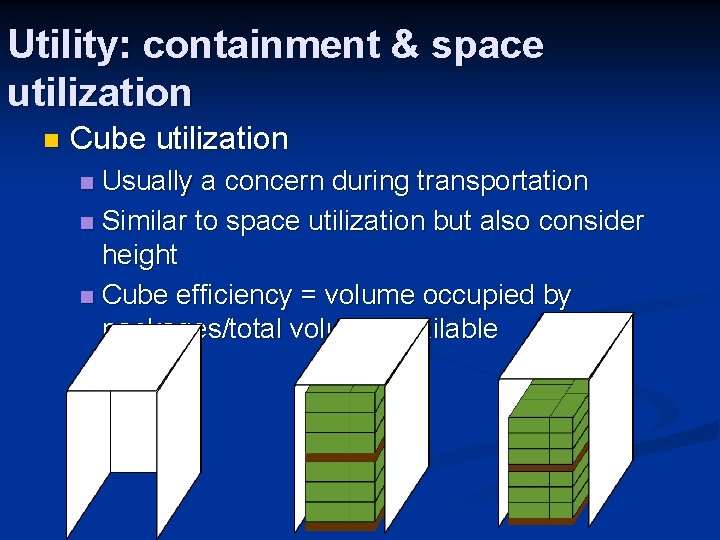
Utility: containment & space utilization n Cube utilization Usually a concern during transportation n Similar to space utilization but also consider height n Cube efficiency = volume occupied by packages/total volume available n
Utility: Extend shelf life n Technology available to extend shelf life/storage life of product Modified atmosphere packaging (MAP) n Active packaging n n Modified atmosphere packaging Alter atmospheric condition within the package to reduce physiological changes & quality loss n Atmosphere condition n n Low oxygen n High carbon dioxide
Utility: Extend shelf life Same principle of controlled atmosphere (CA) n Need to perform CA experiment to answer the following question n Can CA storage extend the life of this product? n If yes, what is the optimum headspace concentration? ([O 2] and [CO 2] that most benefit the storage life of product) n
Utility: Extend shelf life n CA vs. MAP n n n Extend shelf life by the same principle Different in practical CA n n n More precise control of the concentration of gas Force known concentration of gas mixture into storage MAP n n n Internal atmosphere changes continually until it reaches steady-state (constant gas concentration in headspace) Setup cost: much cheaper than CA Need careful design of MAP system n Pack-and-pray approach
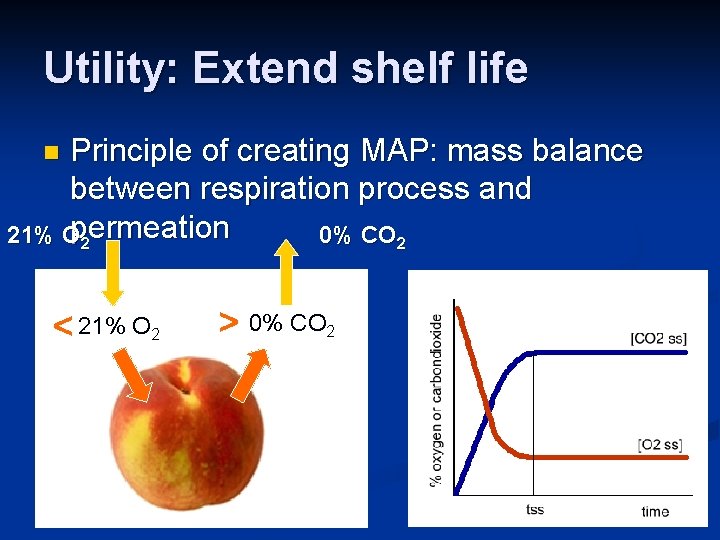
Utility: Extend shelf life Principle of creating MAP: mass balance between respiration process and 21% Opermeation 0% CO 2 2 n < 21% O 2 > 0% CO 2
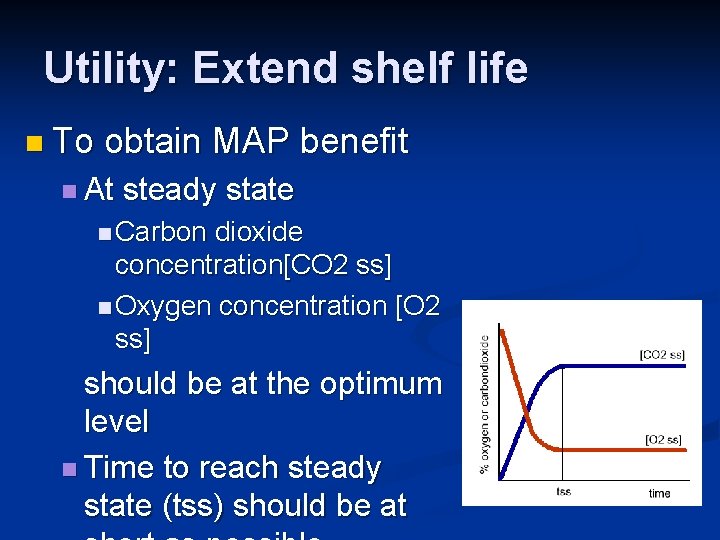
Utility: Extend shelf life n To obtain MAP benefit n At steady state n Carbon dioxide concentration[CO 2 ss] n Oxygen concentration [O 2 ss] should be at the optimum level n Time to reach steady state (tss) should be at
Utility: Extend shelf life n To reduce time required to reach steady state (tss) Decrease free volume (headspace) n Increase the amount of produce* n n To increase [O 2] & reduce [CO 2] Reduce thickness n Increase surface area n Reduce the amount of produce* n
Utility: Extend shelf life Temperature maintenance is critical for MAP n Increase temperature n Increase respiration n Increase permeation n The rate of increase is different n n If cold chain is not maintained, it is more risky to use MAP
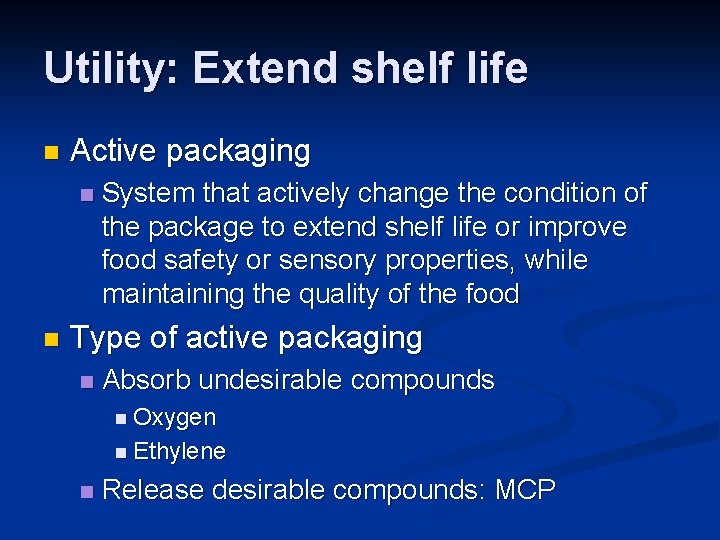
Utility: Extend shelf life n Active packaging n n System that actively change the condition of the package to extend shelf life or improve food safety or sensory properties, while maintaining the quality of the food Type of active packaging n Absorb undesirable compounds n Oxygen n Ethylene n Release desirable compounds: MCP
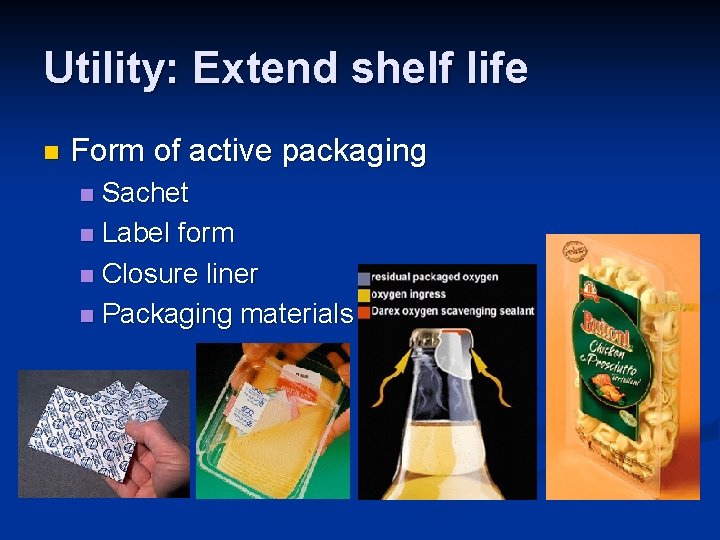
Utility: Extend shelf life n Form of active packaging Sachet n Label form n Closure liner n Packaging materials n
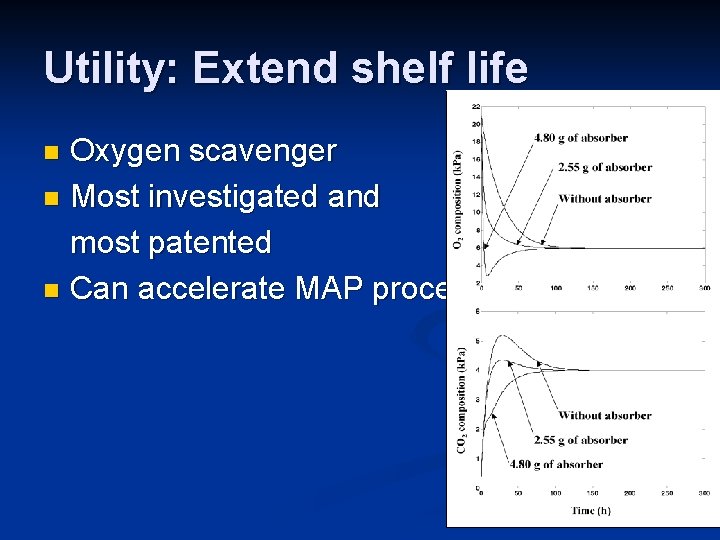
Utility: Extend shelf life Oxygen scavenger n Most investigated and most patented n Can accelerate MAP process n
Utility: Extend shelf life n Principle of oxygen scavenger: Incorporating some highly oxygen sensitive material into packaging system Iron powder n Ascorbic acid n Photosensitive dye n Enzyme (e. g. glucose oxidase/catalase, alcohol oxidase)) n Ferrous salts n Unsaturated fatty acids n
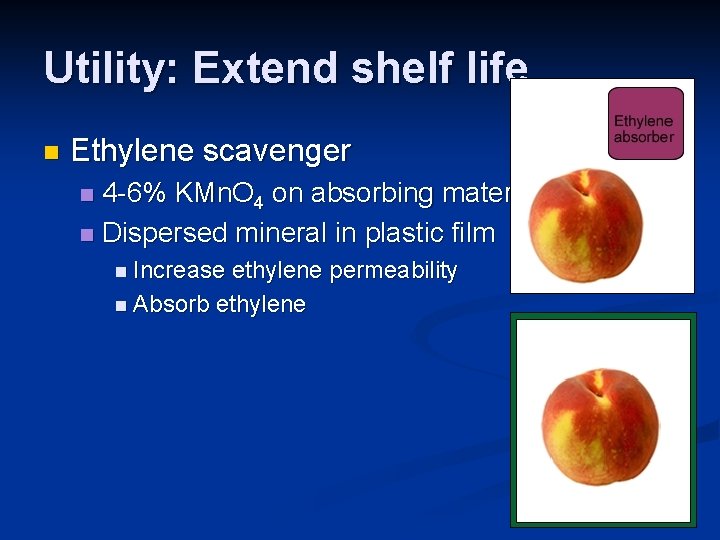
Utility: Extend shelf life n Ethylene scavenger 4 -6% KMn. O 4 on absorbing material n Dispersed mineral in plastic film n n Increase ethylene permeability n Absorb ethylene
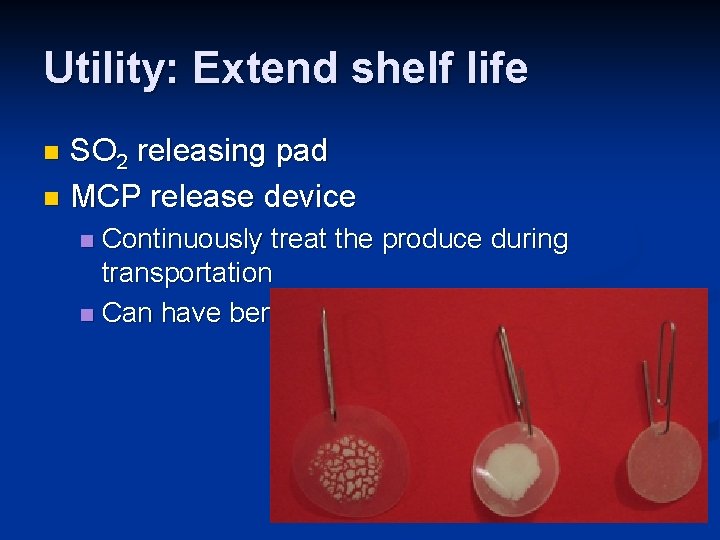
Utility: Extend shelf life SO 2 releasing pad n MCP release device n Continuously treat the produce during transportation n Can have benefit of both MAP and MCP n
Utility: Environmental aspect Some countries put tax on packaging for waste disposal cost n Reusable Produce Container (RPC) n Reduce waste n Additional cost n n Containers are more expensive n Cost for returning the container n Cost for cleaning the container n Biodegradable material: is being developed
Communication
Communication: Required information n n Depends on producing & target market country General information that should be included n n n n n Cultivar Class type or size Weight or count Producers code Pack house code Name & address of the exporter Country of origin Special treatment: SO 2, wax type, pesticides Recommended storage & handling
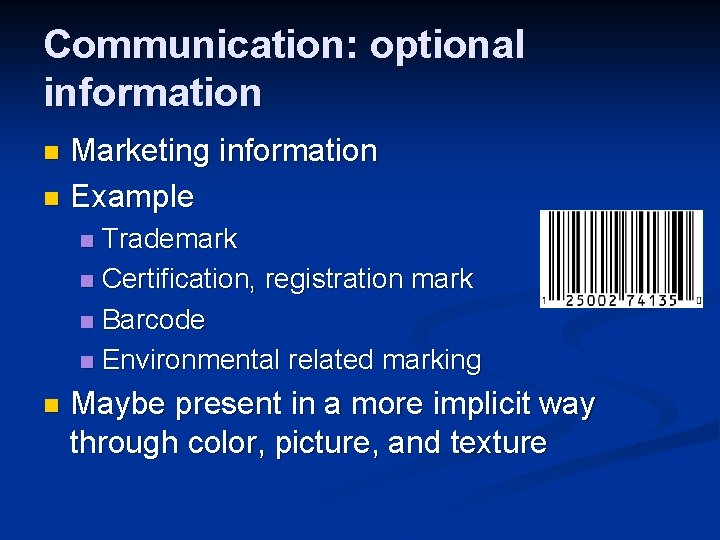
Communication: optional information Marketing information n Example n Trademark n Certification, registration mark n Barcode n Environmental related marking n n Maybe present in a more implicit way through color, picture, and texture
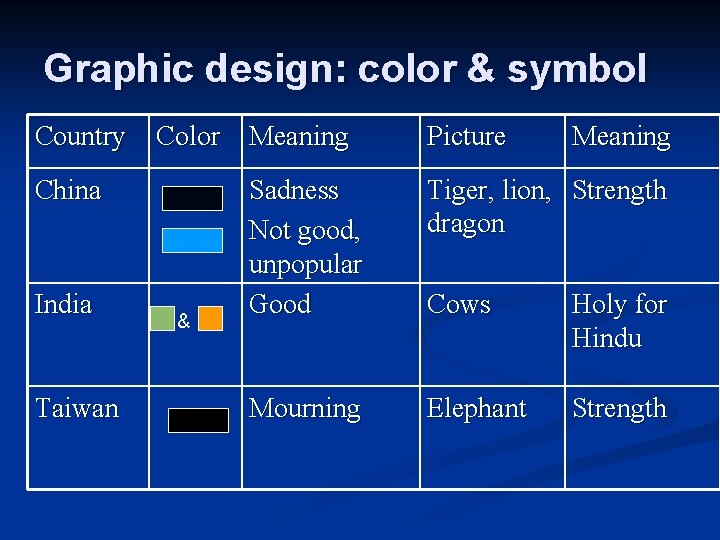
Graphic design: color & symbol Country Color China India Taiwan & Meaning Picture Meaning Sadness Not good, unpopular Good Tiger, lion, Strength dragon Cows Holy for Hindu Mourning Elephant Strength
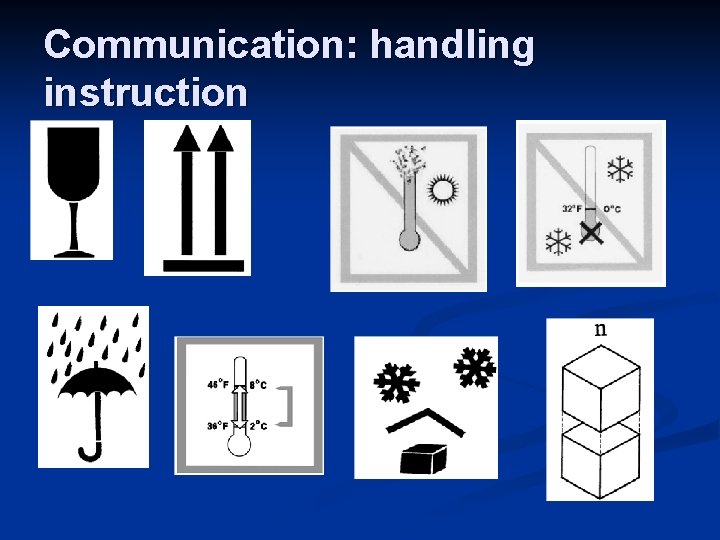
Communication: handling instruction
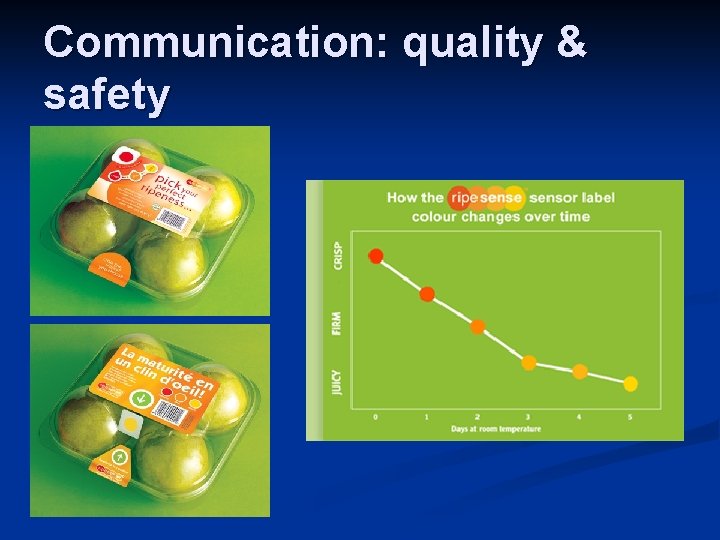
Communication: quality & safety
Packaging decision tool
Conclusion Packaging has many aspects n Designing packaging is a team effort n All factors must be weighed in when designing a package n n Do not seek for “the best packaging” but search for the “most proper packaging”
Practical: Packaging system for Guava n Determine the box size for 3 kg guava. Be sure to take into consideration the height limit and the space utilization. n Determine orientation of box on a pallet. Calculate how many box you can place on a pallet n Calculate the required compression strength of the box. n Assume that we use half slotted container for both bottom and the lid. The bottom and the lid are of identical size.
Practical: Packaging system for Guava n Cut out the one part (either bottom or lid) of the box using the provide paperboard (assume it is a corrugated board) n Mark the location of ventilation hole. n (Design the graphic & text on the package)
Thank you for your attention �����������