
Paper and Board Subject Fish Packaging Technology Date
Paper and Board Subject: Fish Packaging Technology Date of Lecture: 29. 04. 2020 By Dr. Abhishek Thakur (Assistant Professor) College of Fisheries, Kishanganj BASU, Patna
History of paper • The discovery of paper : https: //goo. gl/maps/JSNWw. XJ 7 d. UBqas. GB 7 (Tsai Lun in 105 AD). • But it took some 500 years for this secret to travel from china to Korea in 600 AD. • 10 years later, the art of paper making was brought to Japan and 10 th century it reached Cairo and Damascus. • First known installation in Europe was brought by Moors to Latvia, Spain in 1151 AD. • Subsequently it spread to other countries like France, Italy, Germany and England in 16 th Century. In 1690, first paper will was built at Pennsylvania in the U. S.
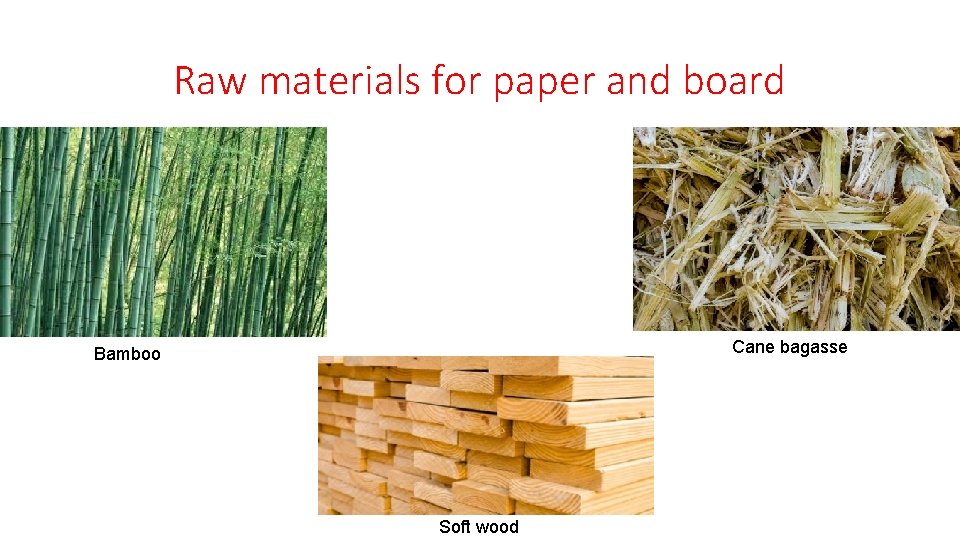
Raw materials for paper and board Cane bagasse Bamboo Soft wood
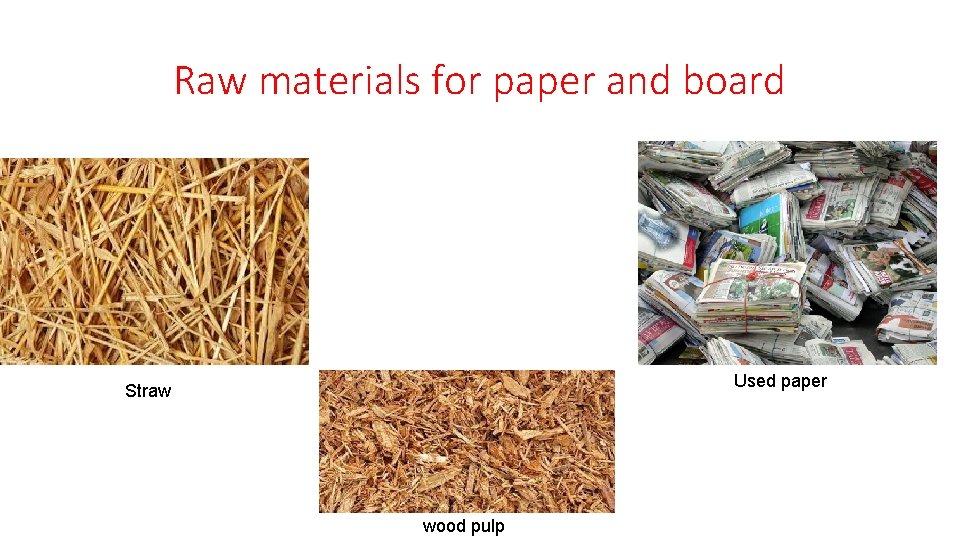
Raw materials for paper and board Used paper Straw wood pulp
Raw materials for paper and board • Wood pulp is prepared directly using from timber from the forest and is of better quality and higher cost than waste paper pulp (Chip board pulp). • Wood pulp may be prepared from soft wood which have long slender fibre or from hard wood which have stout short fibres. • Paper and board from soft wood pulp have better mechanical properties and better suited for packaging applications.
• Pulp is the raw material for the production of paper, paperboard, corrugated board and similar manufactured products. • It is obtained from plant fiber and is therefore a renewable resource. • Today about 97 percent of the world's paper and board is made from wood pulp.
Main constituents of wood • Cellulose • This is a long chain, linear polymer built-up of a large numbers of glucose molecules. • Most abundant, naturally occurring organic compound. • Cellulose is moderately resistant to the action of chlorine and dilute sodium hydroxide under mild conditions, but is modified or dissolved under more severe conditions. • It is relatively resistant to oxidation and therefore bleaching operations can be used to remove small amounts of impurities such as lignin without appreciable damage to the strength of the pulp.
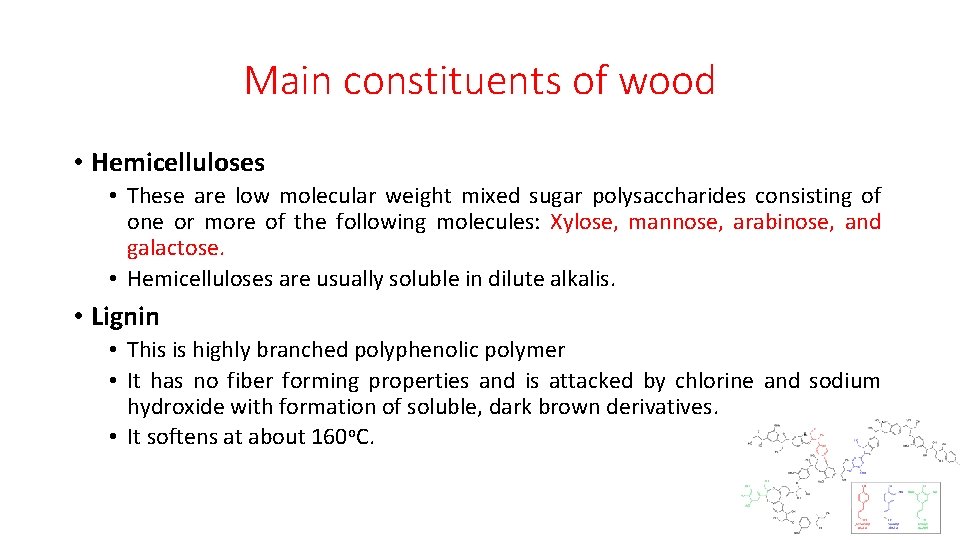
Main constituents of wood • Hemicelluloses • These are low molecular weight mixed sugar polysaccharides consisting of one or more of the following molecules: Xylose, mannose, arabinose, and galactose. • Hemicelluloses are usually soluble in dilute alkalis. • Lignin • This is highly branched polyphenolic polymer • It has no fiber forming properties and is attacked by chlorine and sodium hydroxide with formation of soluble, dark brown derivatives. • It softens at about 160 o. C.
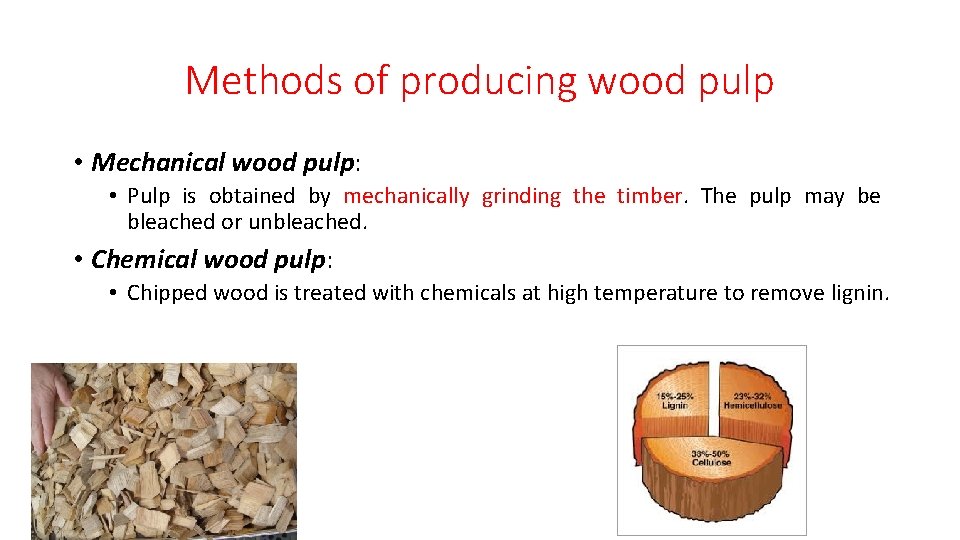
Methods of producing wood pulp • Mechanical wood pulp: • Pulp is obtained by mechanically grinding the timber. The pulp may be bleached or unbleached. • Chemical wood pulp: • Chipped wood is treated with chemicals at high temperature to remove lignin.
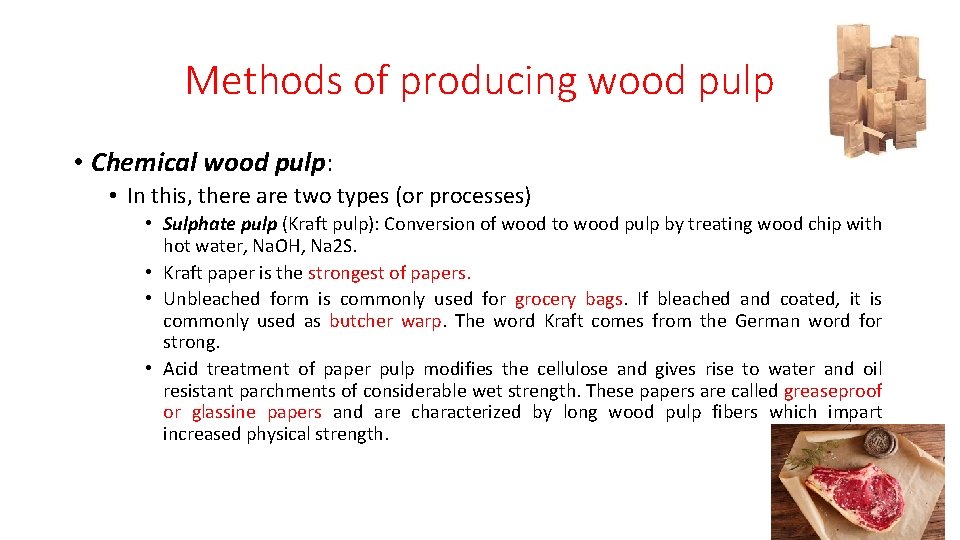
Methods of producing wood pulp • Chemical wood pulp: • In this, there are two types (or processes) • Sulphate pulp (Kraft pulp): Conversion of wood to wood pulp by treating wood chip with hot water, Na. OH, Na 2 S. • Kraft paper is the strongest of papers. • Unbleached form is commonly used for grocery bags. If bleached and coated, it is commonly used as butcher warp. The word Kraft comes from the German word for strong. • Acid treatment of paper pulp modifies the cellulose and gives rise to water and oil resistant parchments of considerable wet strength. These papers are called greaseproof or glassine papers and are characterized by long wood pulp fibers which impart increased physical strength.
Methods of producing wood pulp • Chemical wood pulp: • In this, there are two types (or processes) • Sulphate pulp (Kraft pulp): Conversion of wood to wood pulp by treating wood chip with hot water, Na. OH, Na 2 S. • Sulphite pulp: Conversion of wood to wood pulp by treating wood chips with solutions of sulfite and bisulfite ions (sulfite/bisulfite salts + 2+ of sodium (Na ), calcium (Ca ), potassium (K ), magnesium (Mg ), and ammonium (NH 4+) • Both the above pulps may be bleached white or unbleached. • Semi chemical pulp: Milder chemical processing combined with mechanical treatment.
Coatings used in paper and carton boards • Clay, Calcium carbonate and binder to enhance appearance and printability. • Fluorocarbon to enhance grease resistance for contact with fat containing foods. • Silicone: To obtain release characteristics for ovenable boards. • Polyethylene (PE): To obtain water resistant and water vapour barrier properties and a degree of grease resistance and heat seal-ability. • Polypropylene (PP): To get improved grease resistance and heat resistance.
Coatings used in paper and carton boards • Polyethylene Terephthalate (PET): PET coated boards are more heat resistant than PP. Therefore used for dual purpose i. e. microwave or domestic ovenable board packaging. • Varnish applied after printing. To give high gloss or matte finish or to provide protection e. g. Resistance to deep freeze, resistance to water and minimize scuff. • Wax: to impart water resistant quality.

Paper and Board • paper bags, wrapping, packaging papers and infusible tissues, e. g. tea and coffee bags, sachets, pouches, overwrapping paper, sugar and flour bags, carrier bags • multiwall paper sacks • folding cartons and rigid boxes • corrugated and solid fiberboard boxes (shipping cases) • paper based tubes, tubs and composite containers • fire drums • liquid packaging • moulded pulp containers • labels • sealing tapes • cushioning materials • cap liners (sealing wads) and diaphragms (membranes).
Types of paper • Fine papers: • Generally made of bleached pulp, and typically used for writing paper, bond, book and cover papers. • Coarse papers: • generally made of unbleached Kraft softwood pulps and used for packaging.
Main types of packaging papers • Kraft paper • This is typically a coarse paper with exceptional strength, glazed on a Yankee dryer or machine. • Bleached paper • They are generally more expensive and weaker than unbleached papers. Their aesthetic appeal is frequently augmented by coating on one or both sides. • Greaseproof paper • This is a translucent, machine finished paper which has been hydrated to give oil and grease resistance. • Prolonged beating or mechanical refining is used to break the cellulose fibers which absorb so much water that they become superficially gelatinized and sticky.
Main types of packaging papers • Glassine paper derives its name from its glassy, smooth surface, high density and transparency. It is produced by further treating grease proof paper in a super calendar. • Vegetable parchment takes its name from its physical similarity to animal parchment, which is made from animal skins. Because of its grease resistance and wet strength, it strips away easily from food material without defibering, thus finding use as an interleaver between slices of food such as meat or pastry. It was first used for wrapping fatty foods such as butter.
Main types of packaging papers • Glassine paper derives its name from its glassy, smooth surface, high density and transparency. It is produced by further treating grease proof paper in a super calendar. • Vegetable parchment takes its name from its physical similarity to animal parchment, which is made from animal skins. Because of its grease resistance and wet strength, it strips away easily from food material without defibering, thus finding use as an interleaver between slices of food such as meat or pastry. It was first used for wrapping fatty foods such as butter. • 6. 3. 6. Tissue paper • Tissue papers range from semitransparent to totally opaque, and can be waxed. They are generally either machine – Finished (MF) or machine – Glazed (MG). MG papers may also be machine finished to improve the smoothness on both sides. • 6. 3. 7. Waxed paper • Waxed papers provide a barrier against penetration of liquids and vapors. Wet waxed papers have a continuous surface film on one or both sides achieved by shock-chilling the waxed web immediately after application of the wax. This also imparts a high degree of gloss on the coated surface. Dry waxed papers are produced using heated rolls and do not have a continuous film on the surfaces. Wax-laminated papers are bonded with a continuous film of wax which acts as an adhesive. The primary purpose of the wax is to provide a moisture barrier and a heat sealable laminate.

• Thank you
- Slides: 19