
GDS Mj R 3 Data Migration Packaging Material



- Slides: 14
GDS Mj. R 3 – Data Migration Packaging. Material. Typecode Session: GDS UG Time: 14: 30 – 17: 30 Who May Attend: IP Speaker: Mark Van Eeghem
What? Packaging. Material. Code (codelist) 2. 8 now maps to Packaging. Material. Type. Code (codelist) Mj. R © 2014 GS 1 2
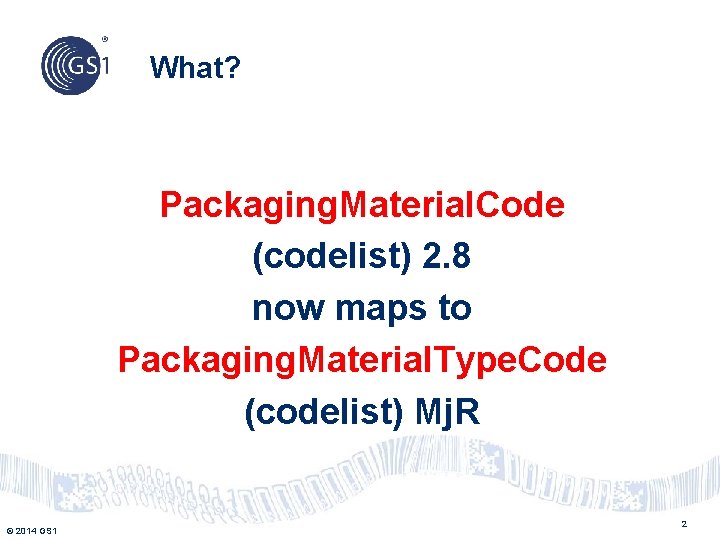
Where is packaging. Material. Type. Code in Mj. R? It’s here. And here. © 2014 GS 1 3
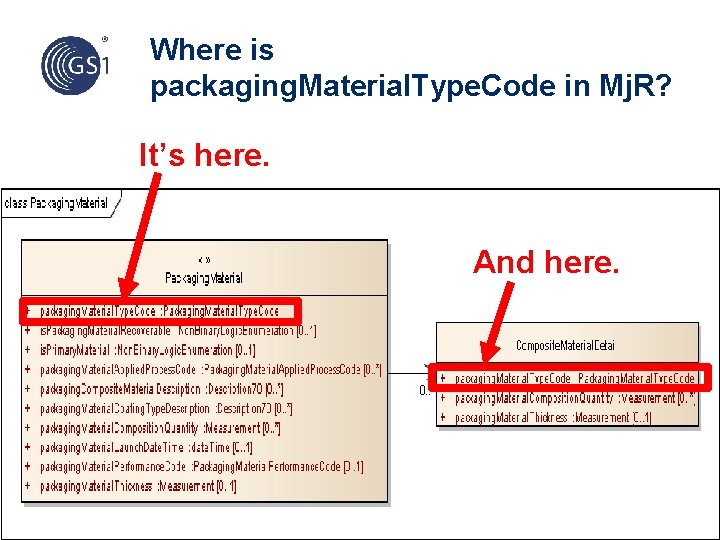
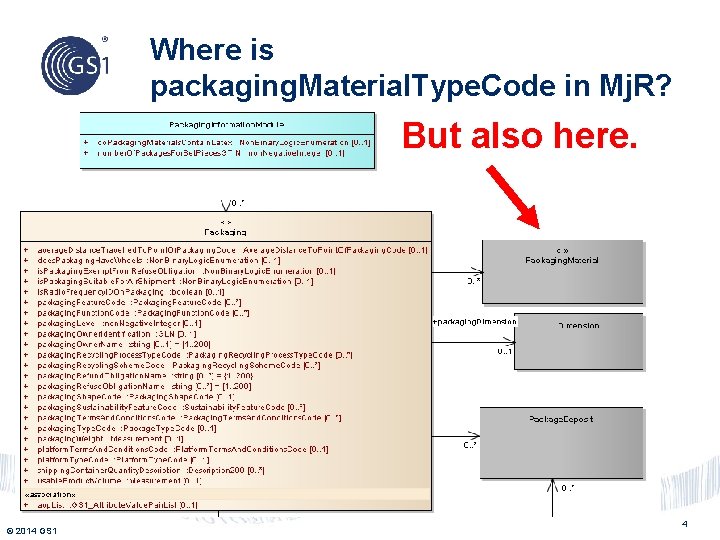
Where is packaging. Material. Type. Code in Mj. R? But also here. © 2014 GS 1 4
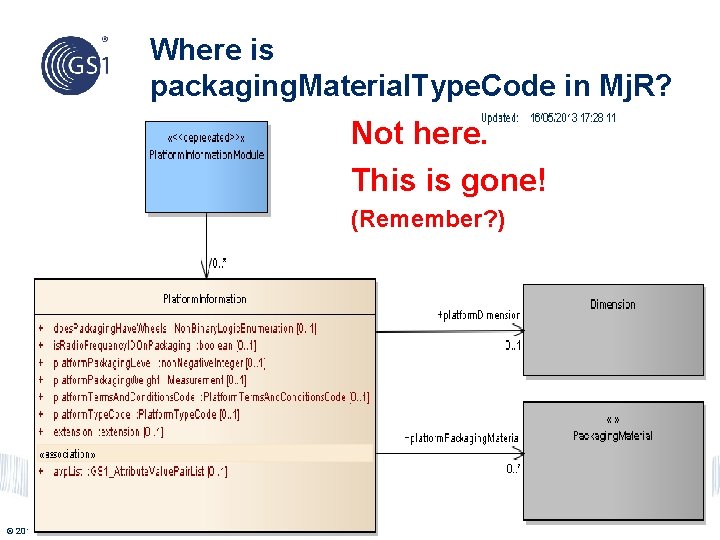
Where is packaging. Material. Type. Code in Mj. R? Not here. This is gone! (Remember? ) © 2014 GS 1 5
Migration Issue 1: They’re gone… These are not packaging material types… but other type codes So: no direct mapping to Mj. R is possible. © 2014 GS 1 6
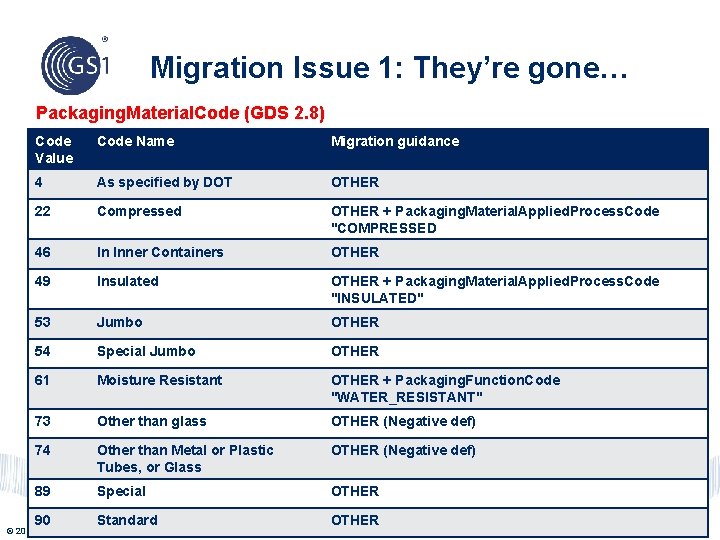
Migration Issue 1: They’re gone… Packaging. Material. Code (GDS 2. 8) Code Value Code Name Migration guidance 4 As specified by DOT OTHER 22 Compressed OTHER + Packaging. Material. Applied. Process. Code "COMPRESSED 46 In Inner Containers OTHER 49 Insulated OTHER + Packaging. Material. Applied. Process. Code "INSULATED" 53 Jumbo OTHER 54 Special Jumbo OTHER 61 Moisture Resistant OTHER + Packaging. Function. Code "WATER_RESISTANT" 73 Other than glass OTHER (Negative def) 74 Other than Metal or Plastic Tubes, or Glass OTHER (Negative def) 89 Special OTHER 90 Standard OTHER © 2014 GS 1 7
The Real Migration Issue 1. User intervention is required User, Datapool and MO should discuss: • Is there a real packaging. Material. Type. Code the user wants to pass on, other than “OTHER”? • Is so, which one? © 2014 GS 1 8
Action Items 1 Datapools must check whether the codes are being used, and if so, check with their userbase to see whether another existing platform. Type is required. 2 Datapools should report back to UG if these Codes are being used at all. © 2014 GS 1 9
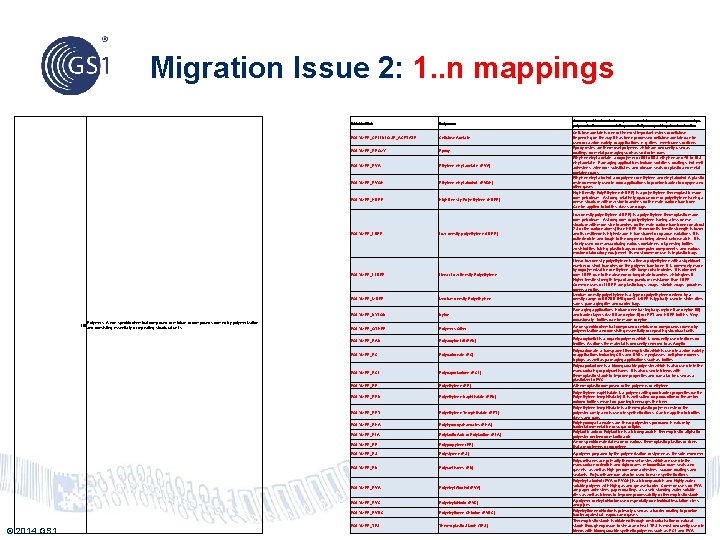
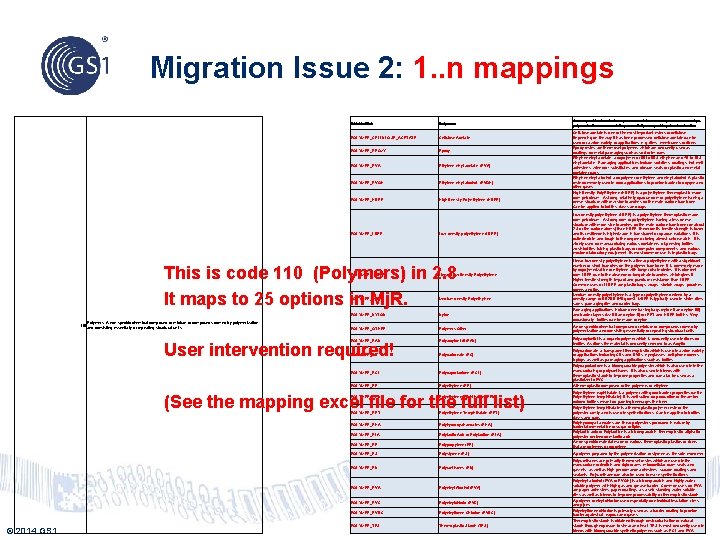
Migration Issue 2: 1. . n mappings POLYMERS Polymers POLYMER_CELLULOSE_ACETATE Cellulose Acetate POLYMER_EPOXY Epoxy POLYMER_EVA Ethylene vinyl acetate, (EVA) POLYMER_EVOH Ethylene vinyl alcohol, (EVOH) POLYMER_HDPE High Density Polyethylene (HDPE) POLYMER_LDPE 110 © 2014 GS 1 Polymers: A non-specific chemical compound or mixture of compounds formed by polymerization and consisting essentially of repeating structural units. Low-density polyethylene (LDPE) A non-specific chemical compound or mixture of compounds formed by polymerization and consisting essentially of repeating structural units Cellulose acetate is one of the most important esters of cellulose. Depending on the way it has been processed cellulose acetate can be used for a wide variety of applications, e. g. films, membranes or fibers. Epoxy resins are thermoset polymers which are frequently used as coatings for metal packaging such as soft-drink cans. Ethylene vinyl acetate, a copolymer of 60 to 90% ethylene and 40 to 10% vinyl acetate. Packaging applications include soft films, coatings, hot melt adhesives, wine cork substitutes, and closure seals for plastic and metal container caps. Ethylene vinyl alcohol, a copolymer of ethylene and vinyl alcohol. A plastic resin commonly used in food applications to provide barrier to oxygen and other gases. High-Density Poly. Ethylene (HDPE) is a polyethylene thermoplastic made from petroleum. A strong, relatively opaque form of polyethylene having a dense structure with few side branches off the main carbon backbone. Can be applied to bottles, flasks and caps. Low-density polyethylene (LDPE) is a polyethylene thermoplastic made from petroleum. A strong form of polyethylene having a less dense structure with more side branches off the main carbon backbone (on about 2% of the carbon atoms) than HDPE; therefore its tensile strength is lower, and its resilience is higher. Made in translucent or opaque variations, it is quite flexible, and tough to the degree of being almost unbreakable. It is widely used for manufacturing various containers, dispensing bottles, wash bottles, tubing, plastic bags for computer components, and various moulded laboratory equipment. Its most common use is in plastic bags. Linear low density polyethylene is a linear polyethylene with a significant number of short branches on the polymer backbone. It is commonly made by copolymerization of ethylene with longer-chain olefins. It is different from LDPE due to the absence of long chain branches which gives it higher tensile strength, impact and puncture resistance than LDPE. Common uses of LLDPE are plastic bags, wraps, stretch wraps, pouches, covers and lids. Medium-density polyethylene is a type of polyethylene defined by a density range of 0. 926 -0. 940 g/cm 3. MDPE is typically used in shrink films, sacks, packaging film and carrier bags. Packaging applications include oven-baking bags (nylon 6 and nylon 66) and barrier layers (MXD 6 and nylon 6) for PET and HDPE bottles. Very occasionally, bottles can be made of nylon. POLYMER_LLDPE Linear Low Density Polyethylene POLYMER_MDPE Medium-density Polyethylene POLYMER_NYLON Nylon POLYMER_OTHER Polymers Other A non-specific chemical compound or mixture of compounds formed by polymerization and consisting essentially of repeating structural units POLYMER_PAN Polyacrylonitril (PAN) Polyacrylonitril is a organic polymer which is frequently used in fibres for textiles. As fibres the material is frequently referred to as Acrylic. POLYMER_PC Polycarbonate (PC) POLYMER_PCL Polycaprolactone (PCL) POLYMER_PE Polyethylene (PE) POLYMER_PEN Polyethylene Naphthalate (PEN) POLYMER_PET Polyethylene Terephthalate (PET) POLYMER_PHA Polyhydroxyalkanoates (PHA) POLYMER_PLA Polylactic Acid or Polylactide (PLA) POLYMER_PP Polypropylene (PP) POLYMER_PS Polystyrene (PS) POLYMER_PU Polyurethanes (PU) POLYMER_PVA Polyvinyl Alcohol (PVA) POLYMER_PVC Polyvinylchlorid (PVC) POLYMER_PVDC Polyvinylidene Chloride (PVDC) POLYMER_TPS Thermoplastic Starch (TPS) Polycarbonate, a transparent thermoplastic which is used in a wide variety of applications including CDs and DVDs, eyeglasses, cell phone covers, laptops as well as packaging applications such as bottles. Polycaprolactone is a biodegradable polyester which is also used in in the manufacturing of polyurethanes. It is also used in blends with thermoplastic starch to improve properties and can also be used as a plasticizer to PVC. A thermoplastic composed of the polymers of ethylene. Polyethylene naphthalate is a polymer with good barrier properties (unlike Polyethylene terephthalate). It is well-suited for production of the ambercolored bottles meant for packing beverages like beer. Polyethylene terephthalate is a thermoplastic polymer resin of the polyester family and is used in synthetic fibers. Can be applied to bottles, flasks and caps. Polyhydroxyalkanoates are linear polyesters produced in nature by bacterial fermentation of sugar or lipids. Polylactic acid or Polylactide is a biodegradable, thermoplastic, aliphatic polyester derived from lactic acid. A non-specific material made of various thermoplastics or fibers that are polymers of propylene. A polymer prepared by the polymerization of styrene as the sole monomer Polyurethanes are primarily thermoset resins which are used in the manufacture of flexible and rigid foams, microcellular foam seals and gaskets, as well as high performance adhesives, surface coatings and sealants. Polyurethane can also be used to make synthetic fibers. Polyvinyl alcohol (PVA or PVOH) is a biodegradable and highly water soluble polymer with high gas and grease barrier. Common uses for PVA are paper adhesives, paper coatings, as a self-standing water soluble films as well as blends to improve processability of thermoplastic starch. A polymer of vinyl chloride used especially for electrical insulation, films, and pipes Polyvinylidene chloride is primarily used as a barrier coating to provide barrier against fat, vapour and gases. Thermoplastic starch is obtained through destructurization of natural starch through exposure to shear and heat. TPS is most frequently used in blends with biodegradable synthetic polymers such as PCL and PVA. 10
Migration Issue 2: 1. . n mappings POLYMERS Polymers POLYMER_CELLULOSE_ACETATE Cellulose Acetate POLYMER_EPOXY Epoxy POLYMER_EVA Ethylene vinyl acetate, (EVA) POLYMER_EVOH Ethylene vinyl alcohol, (EVOH) POLYMER_HDPE High Density Polyethylene (HDPE) POLYMER_LDPE Low-density polyethylene (LDPE) This is code 110 (Polymers) in 2. 8 It maps to 25 options in Mj. R. 110 Polymers: A non-specific chemical compound or mixture of compounds formed by polymerization and consisting essentially of repeating structural units. Cellulose acetate is one of the most important esters of cellulose. Depending on the way it has been processed cellulose acetate can be used for a wide variety of applications, e. g. films, membranes or fibers. Epoxy resins are thermoset polymers which are frequently used as coatings for metal packaging such as soft-drink cans. Ethylene vinyl acetate, a copolymer of 60 to 90% ethylene and 40 to 10% vinyl acetate. Packaging applications include soft films, coatings, hot melt adhesives, wine cork substitutes, and closure seals for plastic and metal container caps. Ethylene vinyl alcohol, a copolymer of ethylene and vinyl alcohol. A plastic resin commonly used in food applications to provide barrier to oxygen and other gases. High-Density Poly. Ethylene (HDPE) is a polyethylene thermoplastic made from petroleum. A strong, relatively opaque form of polyethylene having a dense structure with few side branches off the main carbon backbone. Can be applied to bottles, flasks and caps. Low-density polyethylene (LDPE) is a polyethylene thermoplastic made from petroleum. A strong form of polyethylene having a less dense structure with more side branches off the main carbon backbone (on about 2% of the carbon atoms) than HDPE; therefore its tensile strength is lower, and its resilience is higher. Made in translucent or opaque variations, it is quite flexible, and tough to the degree of being almost unbreakable. It is widely used for manufacturing various containers, dispensing bottles, wash bottles, tubing, plastic bags for computer components, and various moulded laboratory equipment. Its most common use is in plastic bags. Linear low density polyethylene is a linear polyethylene with a significant number of short branches on the polymer backbone. It is commonly made by copolymerization of ethylene with longer-chain olefins. It is different from LDPE due to the absence of long chain branches which gives it higher tensile strength, impact and puncture resistance than LDPE. Common uses of LLDPE are plastic bags, wraps, stretch wraps, pouches, covers and lids. Medium-density polyethylene is a type of polyethylene defined by a density range of 0. 926 -0. 940 g/cm 3. MDPE is typically used in shrink films, sacks, packaging film and carrier bags. Packaging applications include oven-baking bags (nylon 6 and nylon 66) and barrier layers (MXD 6 and nylon 6) for PET and HDPE bottles. Very occasionally, bottles can be made of nylon. POLYMER_LLDPE Linear Low Density Polyethylene POLYMER_MDPE Medium-density Polyethylene POLYMER_NYLON Nylon POLYMER_OTHER Polymers Other A non-specific chemical compound or mixture of compounds formed by polymerization and consisting essentially of repeating structural units POLYMER_PAN Polyacrylonitril (PAN) Polyacrylonitril is a organic polymer which is frequently used in fibres for textiles. As fibres the material is frequently referred to as Acrylic. POLYMER_PC Polycarbonate (PC) POLYMER_PCL Polycaprolactone (PCL) POLYMER_PE Polyethylene (PE) User intervention required! (See the mapping excel file for the full list) © 2014 GS 1 A non-specific chemical compound or mixture of compounds formed by polymerization and consisting essentially of repeating structural units POLYMER_PEN Polyethylene Naphthalate (PEN) POLYMER_PET Polyethylene Terephthalate (PET) POLYMER_PHA Polyhydroxyalkanoates (PHA) POLYMER_PLA Polylactic Acid or Polylactide (PLA) POLYMER_PP Polypropylene (PP) POLYMER_PS Polystyrene (PS) POLYMER_PU Polyurethanes (PU) POLYMER_PVA Polyvinyl Alcohol (PVA) POLYMER_PVC Polyvinylchlorid (PVC) POLYMER_PVDC Polyvinylidene Chloride (PVDC) POLYMER_TPS Thermoplastic Starch (TPS) Polycarbonate, a transparent thermoplastic which is used in a wide variety of applications including CDs and DVDs, eyeglasses, cell phone covers, laptops as well as packaging applications such as bottles. Polycaprolactone is a biodegradable polyester which is also used in in the manufacturing of polyurethanes. It is also used in blends with thermoplastic starch to improve properties and can also be used as a plasticizer to PVC. A thermoplastic composed of the polymers of ethylene. Polyethylene naphthalate is a polymer with good barrier properties (unlike Polyethylene terephthalate). It is well-suited for production of the ambercolored bottles meant for packing beverages like beer. Polyethylene terephthalate is a thermoplastic polymer resin of the polyester family and is used in synthetic fibers. Can be applied to bottles, flasks and caps. Polyhydroxyalkanoates are linear polyesters produced in nature by bacterial fermentation of sugar or lipids. Polylactic acid or Polylactide is a biodegradable, thermoplastic, aliphatic polyester derived from lactic acid. A non-specific material made of various thermoplastics or fibers that are polymers of propylene. A polymer prepared by the polymerization of styrene as the sole monomer Polyurethanes are primarily thermoset resins which are used in the manufacture of flexible and rigid foams, microcellular foam seals and gaskets, as well as high performance adhesives, surface coatings and sealants. Polyurethane can also be used to make synthetic fibers. Polyvinyl alcohol (PVA or PVOH) is a biodegradable and highly water soluble polymer with high gas and grease barrier. Common uses for PVA are paper adhesives, paper coatings, as a self-standing water soluble films as well as blends to improve processability of thermoplastic starch. A polymer of vinyl chloride used especially for electrical insulation, films, and pipes Polyvinylidene chloride is primarily used as a barrier coating to provide barrier against fat, vapour and gases. Thermoplastic starch is obtained through destructurization of natural starch through exposure to shear and heat. TPS is most frequently used in blends with biodegradable synthetic polymers such as PCL and PVA. 11
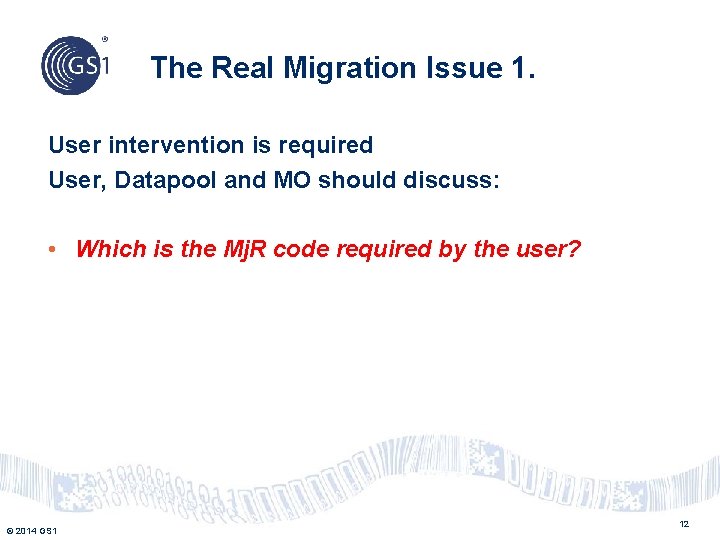
The Real Migration Issue 1. User intervention is required User, Datapool and MO should discuss: • Which is the Mj. R code required by the user? © 2014 GS 1 12
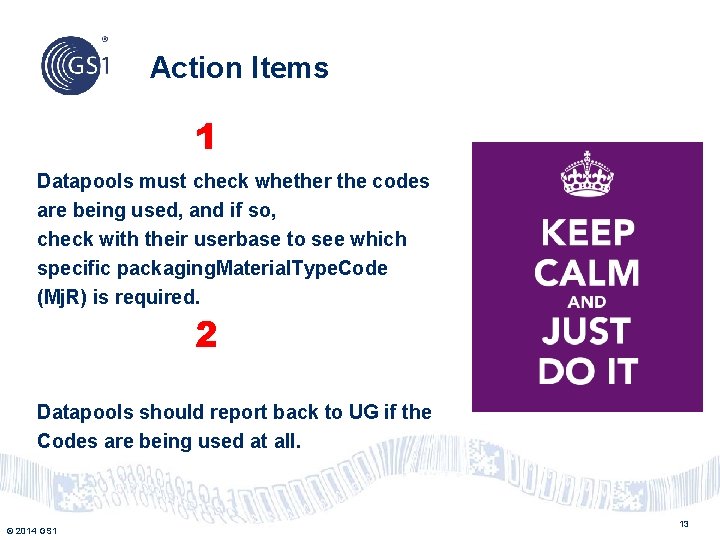
Action Items 1 Datapools must check whether the codes are being used, and if so, check with their userbase to see which specific packaging. Material. Type. Code (Mj. R) is required. 2 Datapools should report back to UG if the Codes are being used at all. © 2014 GS 1 13
Contact Details Mark Van Eeghem Sr Manager Tech Req And Dev GS 1 Global Office E: mark. vaneeghem@gs 1. org W: www. gs 1. org