MULTIPLE EFFECTIVE ASSESSMENT STRATEGIES FOR ADULTS WITH LEARNING


- Slides: 44
MULTIPLE & EFFECTIVE ASSESSMENT STRATEGIES FOR ADULTS WITH LEARNING DISABILITIES CASAS National Summer Institute Wednesday, June 16, 2004 Nancie Payne, M. S. Payne & Associates, Inc. 1
Goals & Objectives n In depth look at tools used to assess Learning Disabilities – Learning Disabilities assessment tools – Usefulness of tools – Diagnostic-prescriptive assessment – Effective assessment strategies – Getting better “special needs” data from CASAS assessment tools 2
MEETING YOUR NEEDS n In choosing this session – what one thing would meet your needs today? 3
CLARIFYING ASSESSMENTS n What does the term “Learning Disability Assessment” mean? n What purpose does a “Learning Disability Assessment” serve? n What does the term “Competency-based Assessment” mean? n What purposes does a “Competencybased Assessment” serve? n How are these assessments useful? 4
Learning Disabilities & Related Disorders Evaluation Process n Adult Standards n Youth Standards 5
TYPES OF COGNITIVE & EDUCATION ASSESSMENT… n Formal – Standardized – Specific & required – Needed for diagnosis, placement & reporting progress/gains n Informal – Diagnostician or teacher developed – Condition or instruction based – Learner centered & driven 6
TYPES OF COGNITIVE & EDUCATION ASSESSMENT… n Brief Tests, Locators & Appraisals – Quick sort – Frequently used in initial stages n Comprehensive Testing – Specific cognitive & content areas – Frames development of next steps – Guides instruction & lesson planning 7
DIAGNOSTICPRESCRIPTIVE APPROACH n Describe a diagnostic-prescriptive approach when teaching a learner who has a Learning Disability? Here’s how we get there… 8
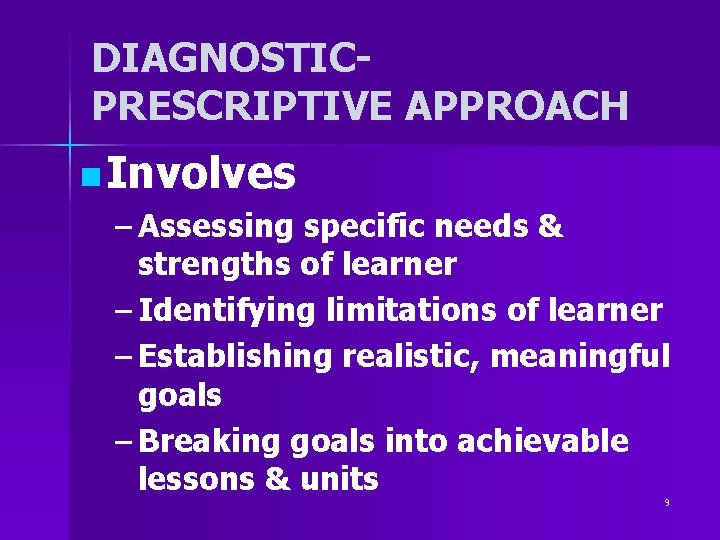
DIAGNOSTICPRESCRIPTIVE APPROACH n Involves – Assessing specific needs & strengths of learner – Identifying limitations of learner – Establishing realistic, meaningful goals – Breaking goals into achievable lessons & units 9
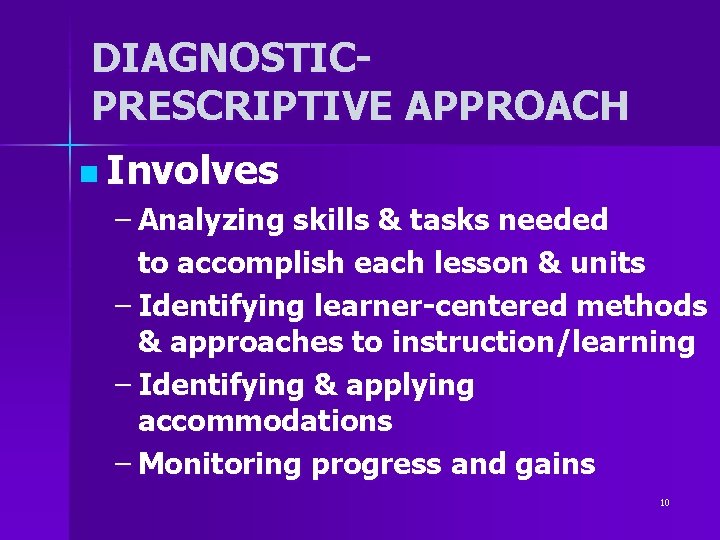
DIAGNOSTICPRESCRIPTIVE APPROACH n Involves – Analyzing skills & tasks needed to accomplish each lesson & units – Identifying learner-centered methods & approaches to instruction/learning – Identifying & applying accommodations – Monitoring progress and gains 10
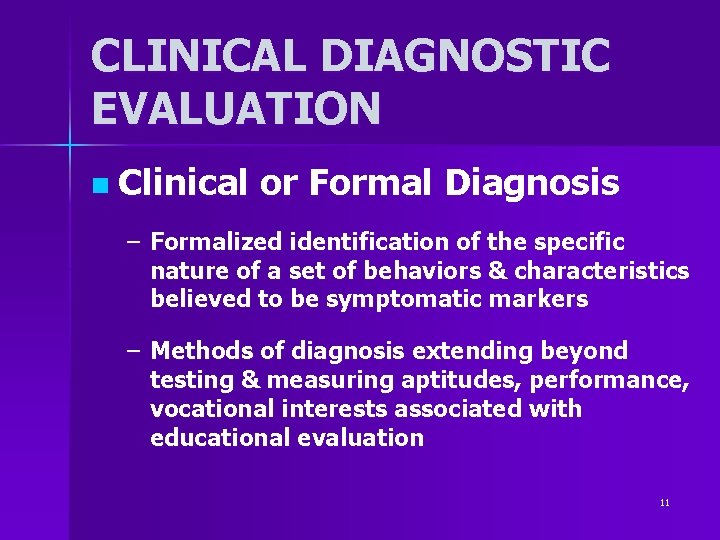
CLINICAL DIAGNOSTIC EVALUATION n Clinical or Formal Diagnosis – Formalized identification of the specific nature of a set of behaviors & characteristics believed to be symptomatic markers – Methods of diagnosis extending beyond testing & measuring aptitudes, performance, vocational interests associated with educational evaluation 11
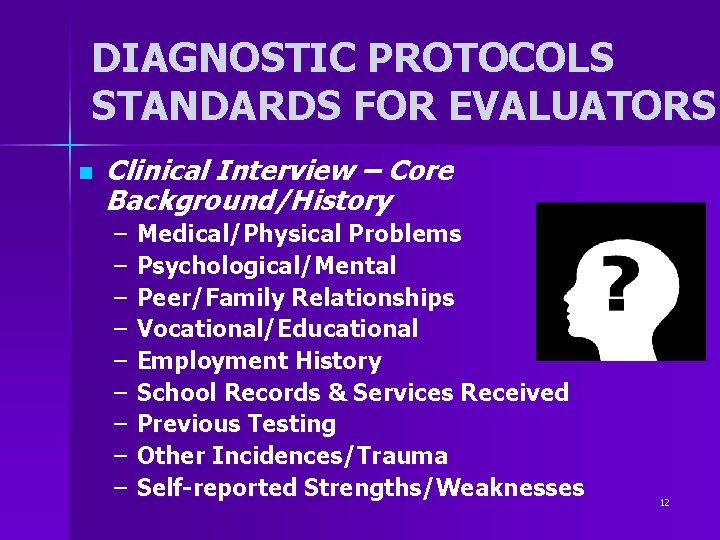
DIAGNOSTIC PROTOCOLS STANDARDS FOR EVALUATORS n Clinical Interview – Core Background/History – – – – – Medical/Physical Problems Psychological/Mental Peer/Family Relationships Vocational/Educational Employment History School Records & Services Received Previous Testing Other Incidences/Trauma Self-reported Strengths/Weaknesses 12
DIAGNOSTIC PROTOCOLS STANDARDS FOR EVALUATORS n Medical Evaluation (if needed) – Medical History – Referral for Examination 13
DIAGNOSTIC PROTOCOLS STANDARDS FOR EVALUATORS n Behavioral Observations – Communication – Interpersonal – Attention – Emotional – Problem Solving 14
DIAGNOSTIC PROTOCOLS STANDARDS FOR EVALUATORS n Psychological Assessment n Intelligence n Achievement n Information processing n Personality n Aptitude 15
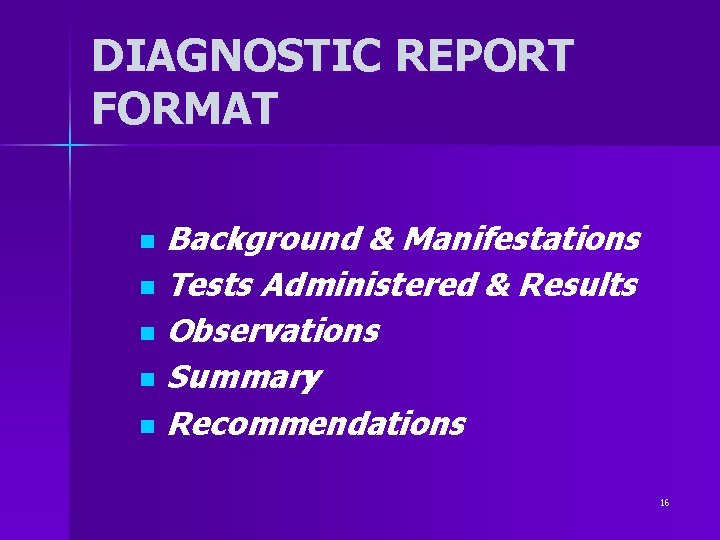
DIAGNOSTIC REPORT FORMAT Background & Manifestations n Tests Administered & Results n Observations n Summary n Recommendations n 16
DIAGNOSTIC PROTOCOLS STANDARDS FOR EVALUATORS n Evaluation & Report – Conclusions – – – – Aptitude/Cognitive Level Medical – Physical Issues Psychological Issues Strengths & Limitations Severity of Disability Areas of Potential Impact Rationale For Diagnosis Employment Goals 17
DIAGNOSTIC PROTOCOLS STANDARDS FOR EVALUATORS n Report – Recommendations – Medical – Vocational/Educational – Employment – Additional Services – Local Resources 18
DIAGNOSTIC PROTOCOLS STANDARDS FOR EVALUATORS n Report – Accommodations for Plan – Assistive Technology – Documentation for other Purposes n GED n Pre-employment Testing 19
DIAGNOSTIC PROTOCOLS STANDARDS FOR EVALUATORS n Feedback Session – Face-to-Face Verbal Review with Written Report – Tape Record n Findings n Specific Accommodations n Goal-oriented Recommendations n Questions & Answers n Listen to Tape – Read Report n Follow-up 20
FEEDBACK IS PERSONAL! 21
QUESTIONS & CONCERNS Consult with the Diagnostician n Engage a LD Specialist n Maintain Highest Level of Confidentiality n Maintain Medical Records & Disability Information/Evaluations Securely n 22
EVALUATION TOOLS n Intelligence – – – n n Achievement Wechsler Children Wechsler Adult Stanford Binet – – – Woodcock-Johnson Wechsler Peabody Information Processing – Woodcock-Johnson – Detroit Learning Aptitude 23
LD Assessment Components n Sensory & Perceptual – Auditory – Visual – Tactile – Kinesthetic 24
LD Assessment Components n Motor – Motor Functions – Visual Motor – Auditory Motor – Tactile Motor 25
LD Assessment Components n Executive Functions – Higher Order Cognition – Reasoning & Processing n Communication & Language Skills n Orientation & Relationships – Visual-spatial Relations – Time Orientation 26
LD Assessment Components n Achievement Areas – – – Dyslexia – Reading/Language Disorders Dyscalculia – Mathematics Disorders Dysgraphia – Writing Disorders Dysphasia – Receptive/Expressive Dysnomia – Word Finding Deficits 27
GATHERING INFORMATION n Customer Input n Provider Input – Informal Assessment Observation – Brief Interviewing n Other Input – Spouse/Family – Friend – Co-Worker 28
EFFECTIVE USE OF THE INFORMATION… n CONFIDENTIAL n DETERMINE ACCOMMODATIONS n MAKE PROGRAM RECOMMENDATIONS n LABELING 29
USING ASSESSMENT INFORMATION TO SHAPE DIAGNOSTICPRESCRIPTIVE APPROACHES n Information Gathering is Crucial – Observation – Informal assessment – Formal assessment 30
PART OF A WHOLE PROCESS n Observation – Focus on non-verbal – Watch how learner approaches tasks – Scrutinize & analyze learner efforts – Listen to the tone of voice & words learner uses – Note strengths & areas of need 31
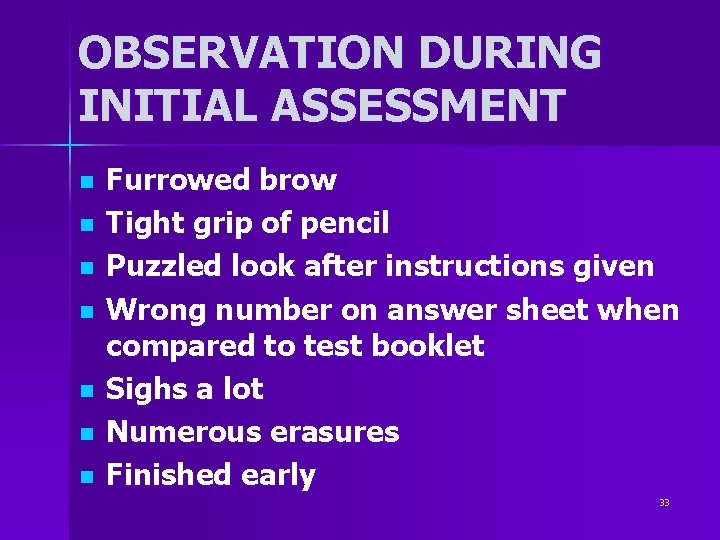
OBSERVATION What are some observations you might see when someone is taking a CASAS test? 32
OBSERVATION DURING INITIAL ASSESSMENT n n n n Furrowed brow Tight grip of pencil Puzzled look after instructions given Wrong number on answer sheet when compared to test booklet Sighs a lot Numerous erasures Finished early 33
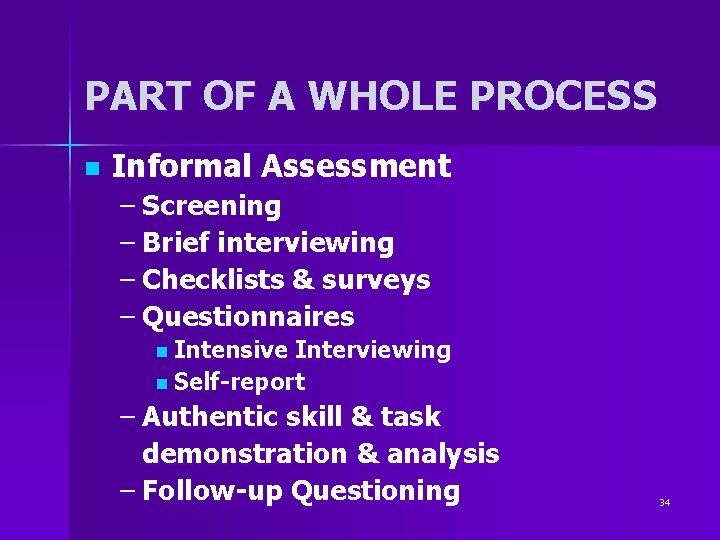
PART OF A WHOLE PROCESS n Informal Assessment – Screening – Brief interviewing – Checklists & surveys – Questionnaires n Intensive Interviewing n Self-report – Authentic skill & task demonstration & analysis – Follow-up Questioning 34
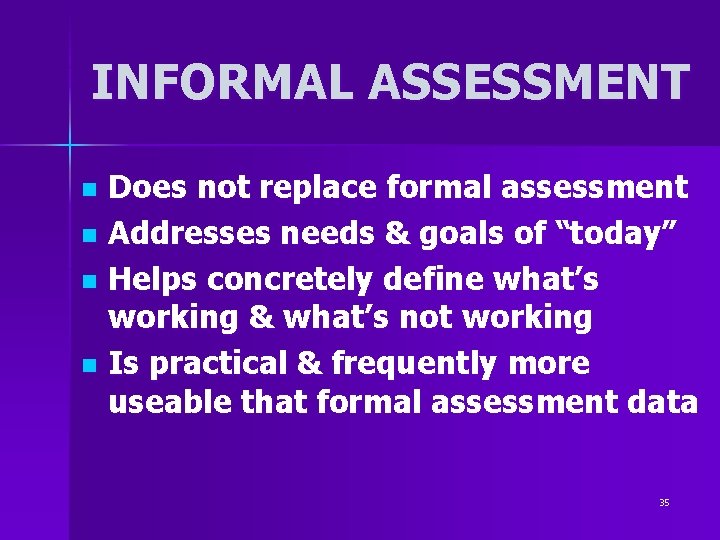
INFORMAL ASSESSMENT Does not replace formal assessment n Addresses needs & goals of “today” n Helps concretely define what’s working & what’s not working n Is practical & frequently more useable that formal assessment data n 35
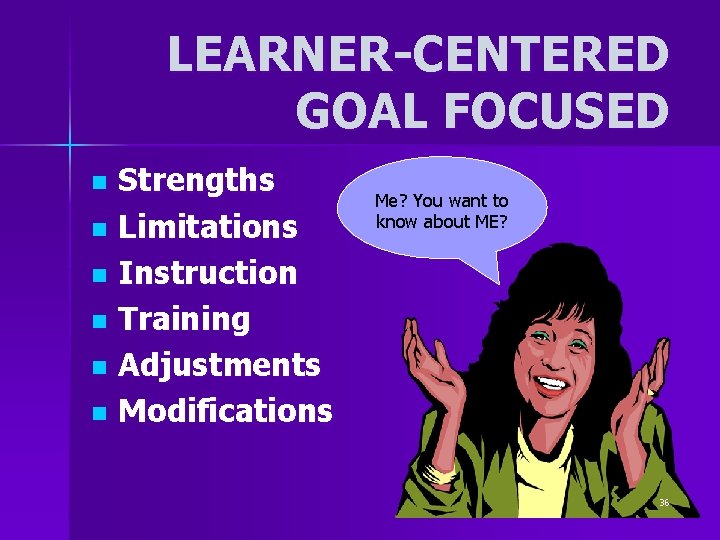
LEARNER-CENTERED GOAL FOCUSED Strengths n Limitations n Instruction n Training n Adjustments n Modifications n Me? You want to know about ME? 36
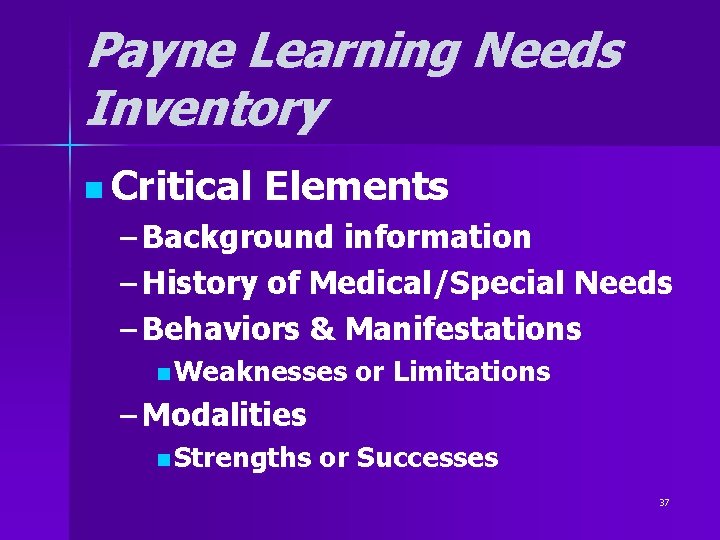
Payne Learning Needs Inventory n Critical Elements – Background information – History of Medical/Special Needs – Behaviors & Manifestations n Weaknesses or Limitations – Modalities n Strengths or Successes 37
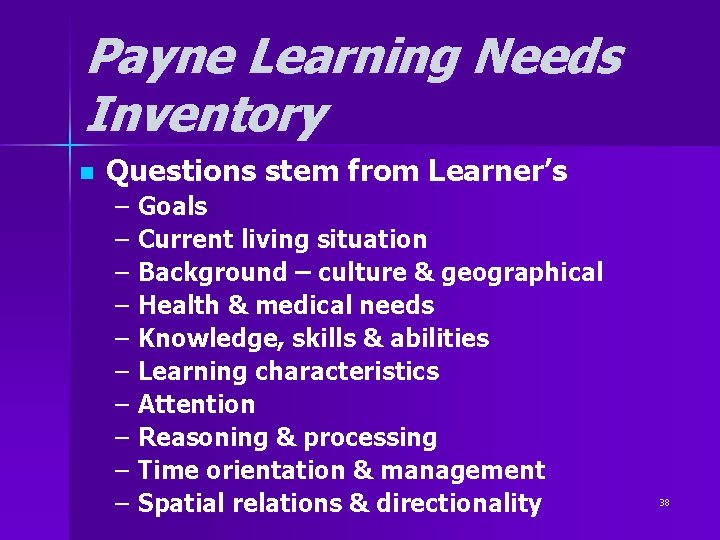
Payne Learning Needs Inventory n Questions stem from Learner’s – Goals – Current living situation – Background – culture & geographical – Health & medical needs – Knowledge, skills & abilities – Learning characteristics – Attention – Reasoning & processing – Time orientation & management – Spatial relations & directionality 38
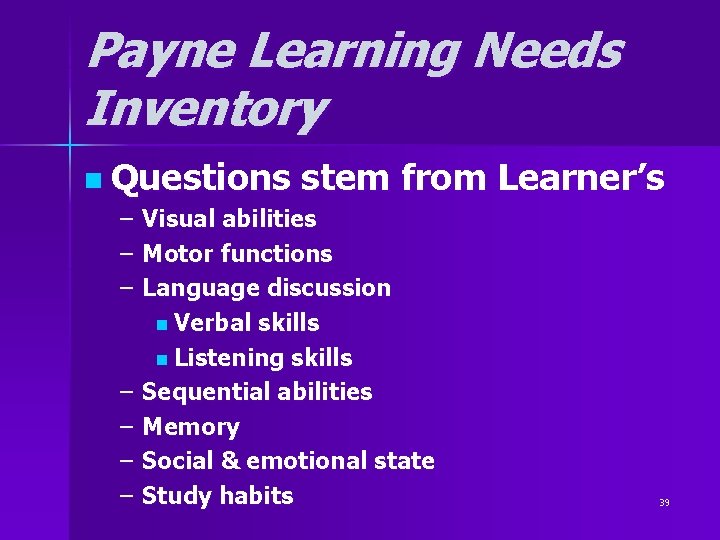
Payne Learning Needs Inventory n Questions stem – Visual abilities – Motor functions – Language discussion from Learner’s n Verbal – – skills n Listening skills Sequential abilities Memory Social & emotional state Study habits 39
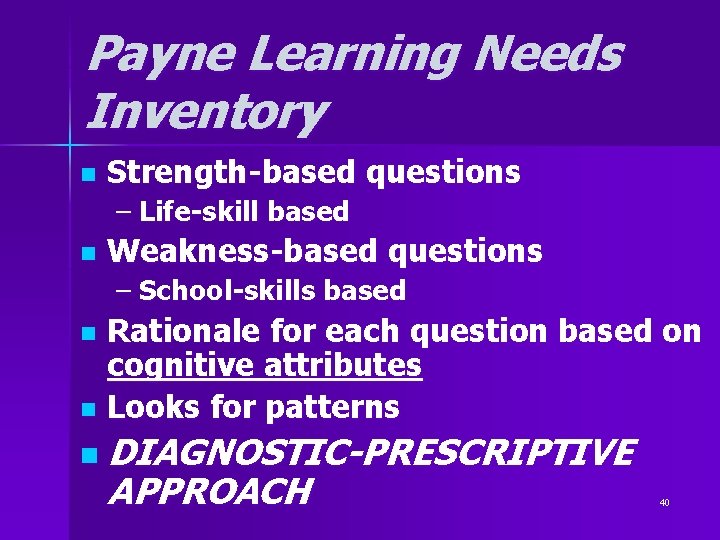
Payne Learning Needs Inventory n Strength-based questions – Life-skill based n Weakness-based questions – School-skills based Rationale for each question based on cognitive attributes n Looks for patterns n n DIAGNOSTIC-PRESCRIPTIVE APPROACH 40
CASAS ASSESSMENTS Not just about scores n Evaluation of responses n – Correct answers – Incorrect answers – Sections left blank n Time limitations – Within specific timeframes – With additional time 41
CASAS ASSESSMENTS n Individual diagnostic profiles – Divided into competency areas n Strengths n Weaknesses n Checks & balances – Have learner work some of the missed items or similar items to see where the mistakes occurred – Allow an adaptive device n Calculator 42 n Audio cassette
LEARNER-CENTERED PLAN DEVELOPMENT n Set goals – Individualized – Realistic – Basis of instructional lessons & units n Observe & monitor – Learner needs & difficulties – Consistencies & inconsistencies 43
DOING THE RIGHT THING Remember… Diagnosis is not a Means to an End It is the Start of the Beginning 44