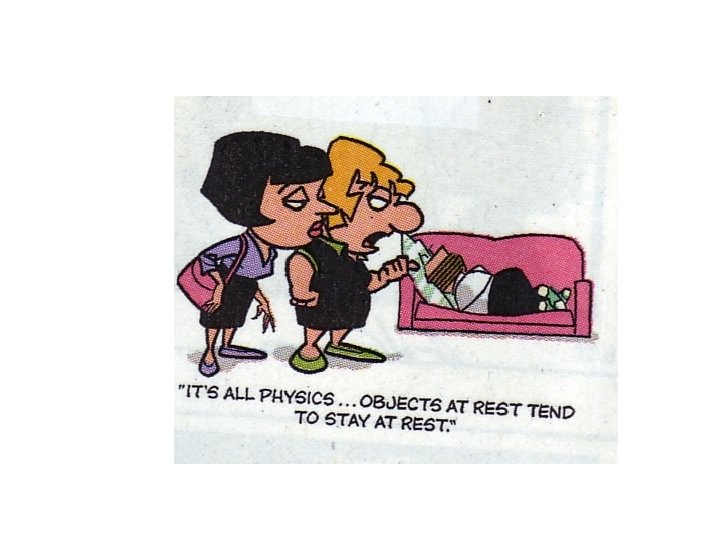
Linear Momentum Momentum Momentum is inertia in motion

- Slides: 79
Linear Momentum
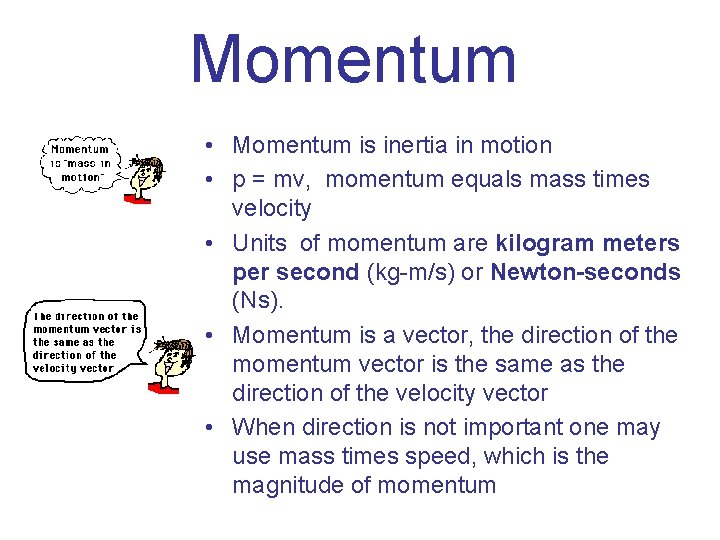
Momentum • Momentum is inertia in motion • p = mv, momentum equals mass times velocity • Units of momentum are kilogram meters per second (kg-m/s) or Newton-seconds (Ns). • Momentum is a vector, the direction of the momentum vector is the same as the direction of the velocity vector • When direction is not important one may use mass times speed, which is the magnitude of momentum
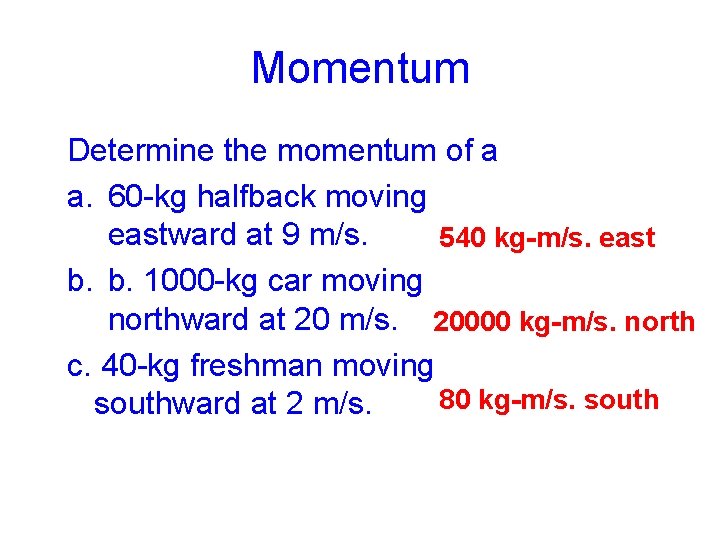
Momentum Determine the momentum of a a. 60 -kg halfback moving eastward at 9 m/s. 540 kg-m/s. east b. b. 1000 -kg car moving northward at 20 m/s. 20000 kg-m/s. north c. 40 -kg freshman moving 80 kg-m/s. southward at 2 m/s.
Momentum • High momentum can be achieved with a large mass, or with high speed, or both high speed and large mass. • Note, it is possible for light objects to have more momentum than more massive objects
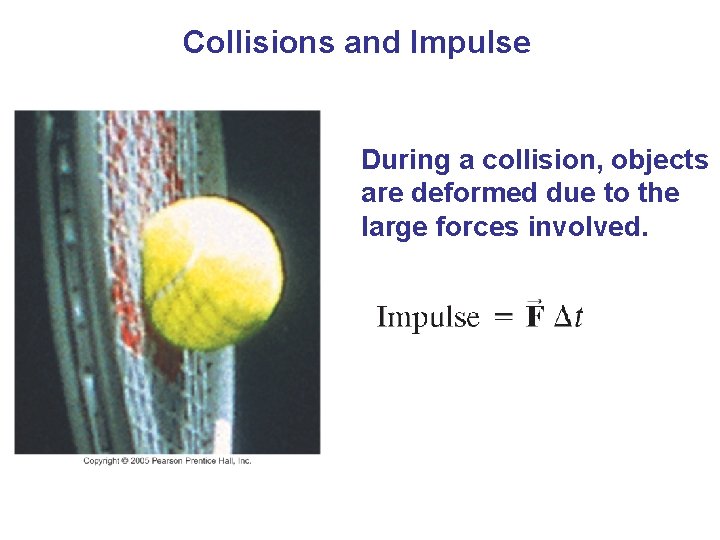
Collisions and Impulse During a collision, objects are deformed due to the large forces involved.
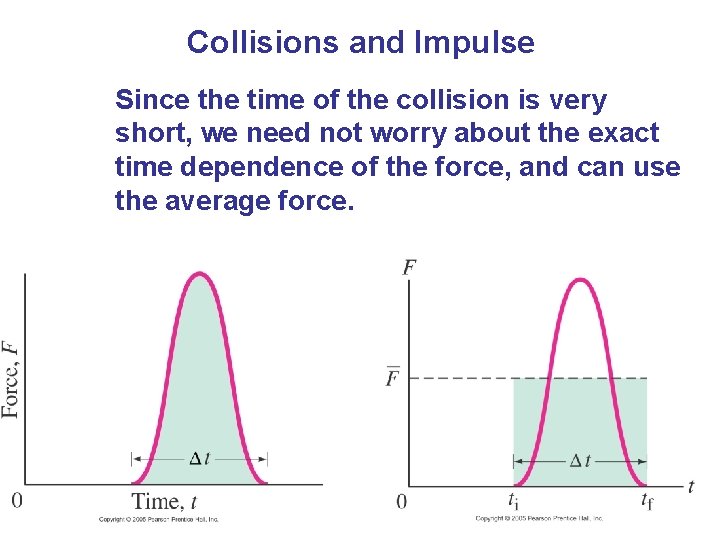
Collisions and Impulse Since the time of the collision is very short, we need not worry about the exact time dependence of the force, and can use the average force.
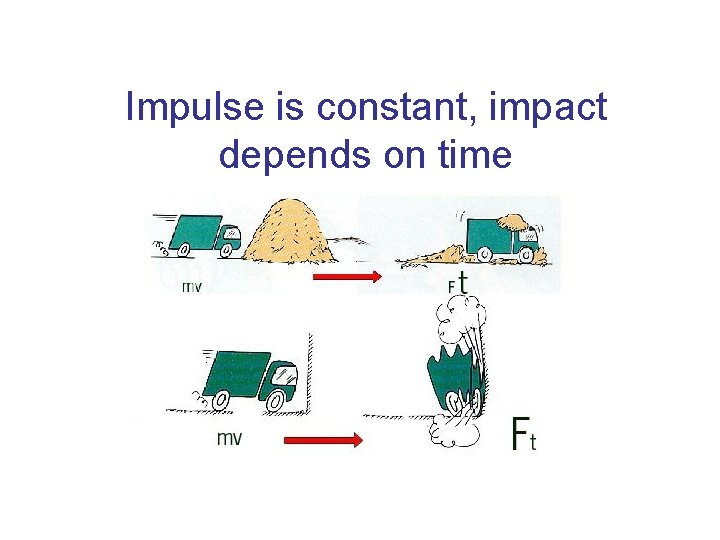
Impulse is constant, impact depends on time
• In racket and bat sports, hitters are often encouraged to follow-through when striking a ball. High speed films of the collisions between bats/rackets and balls have shown that the act of following through serves to increase the time over which a collision occurs. This increase in time must result in a change the time of the collision not the force. The force in hitting is dependent upon how hard the hitter swings the bat or racket, not the time of impact. By following through, a hitter can hit the ball in such a way that it leaves the bat or racket with more velocity. In tennis, baseball, racket ball, etc. , giving the ball a high velocity often leads to greater success.
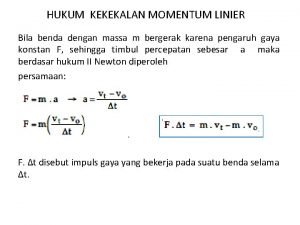
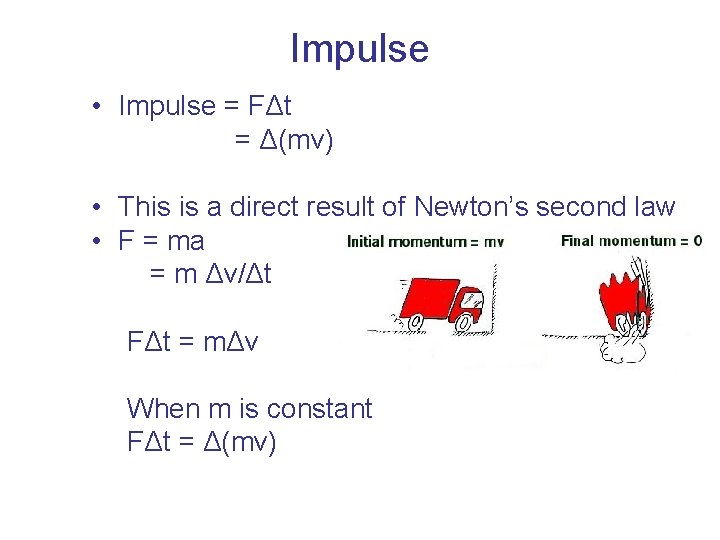
Impulse • Impulse = FΔt = Δ(mv) • This is a direct result of Newton’s second law • F = ma = m Δv/Δt FΔt = mΔv When m is constant FΔt = Δ(mv)
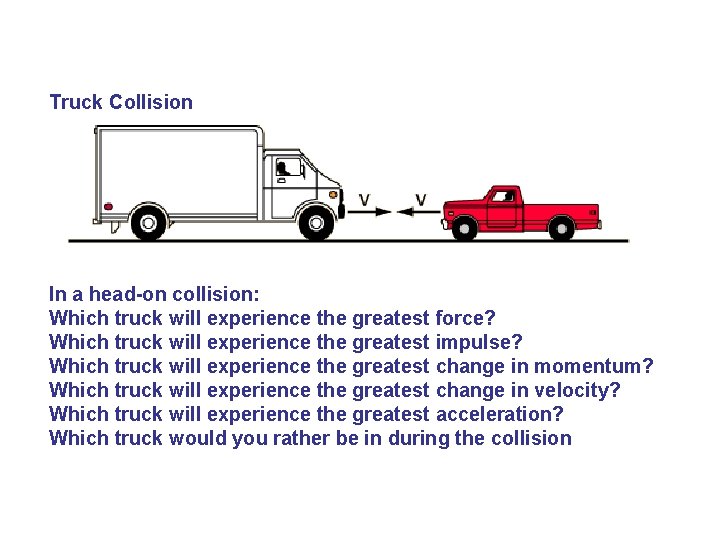
Truck Collision In a head-on collision: Which truck will experience the greatest force? Which truck will experience the greatest impulse? Which truck will experience the greatest change in momentum? Which truck will experience the greatest change in velocity? Which truck will experience the greatest acceleration? Which truck would you rather be in during the collision
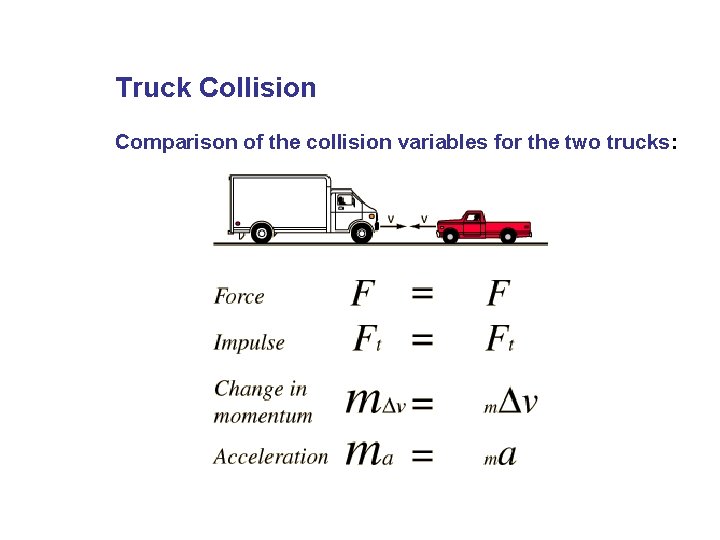
Truck Collision Comparison of the collision variables for the two trucks:
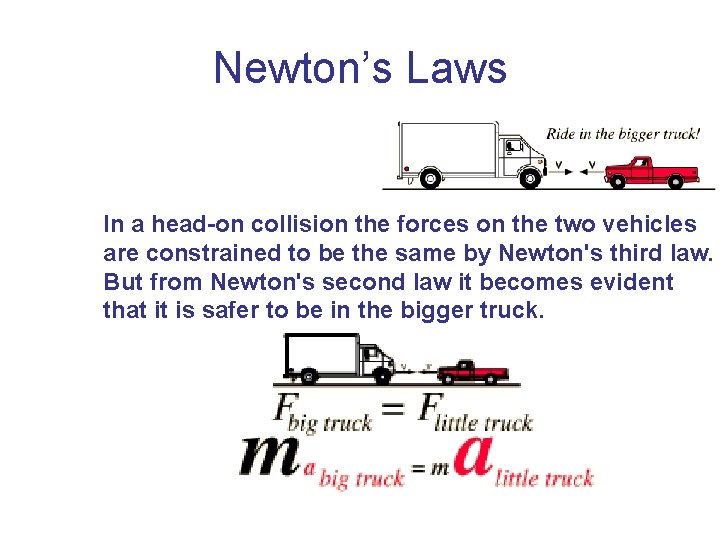
Newton’s Laws In a head-on collision the forces on the two vehicles are constrained to be the same by Newton's third law. But from Newton's second law it becomes evident that it is safer to be in the bigger truck.
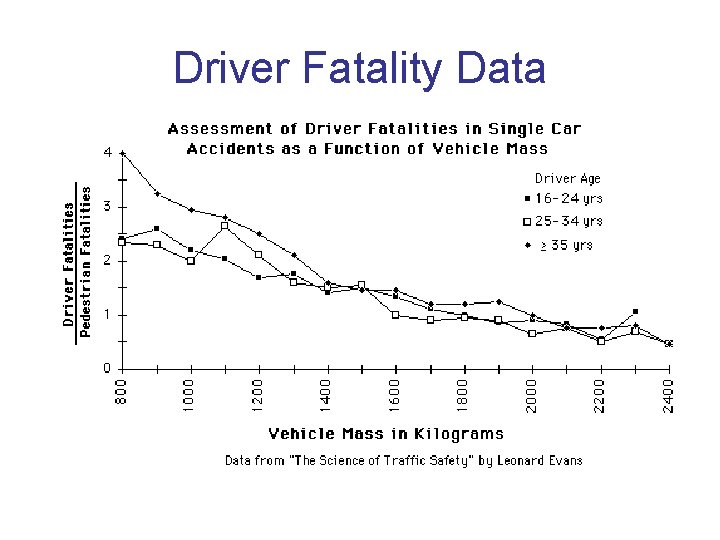
Driver Fatality Data
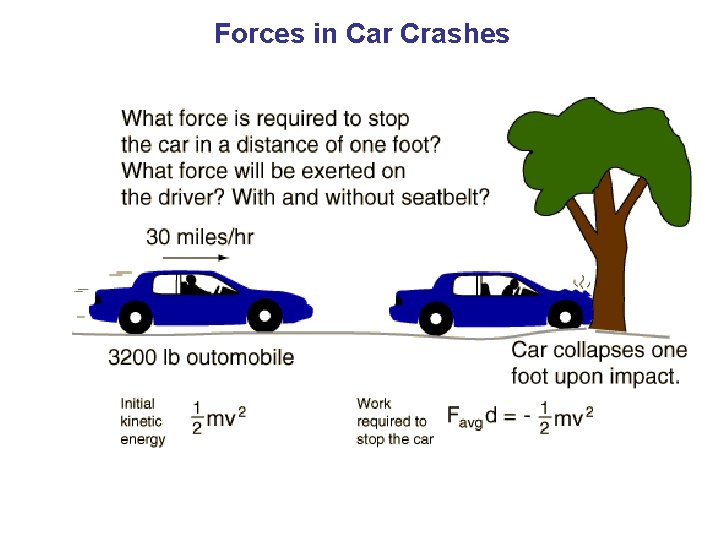
Forces in Car Crashes
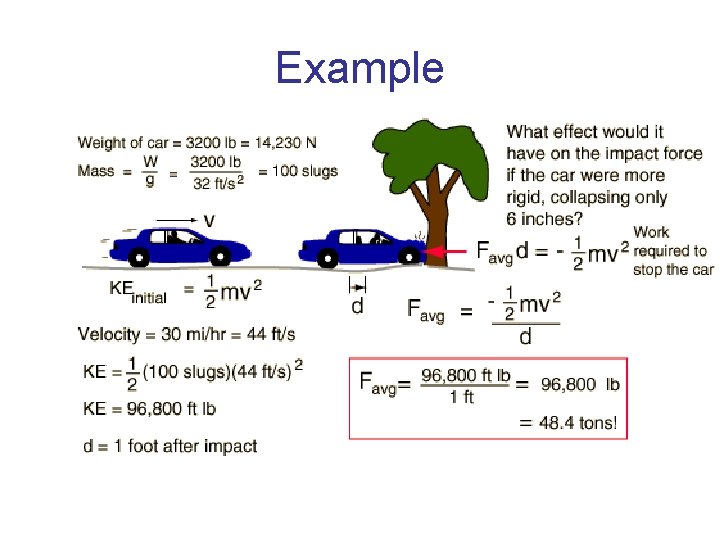
Example
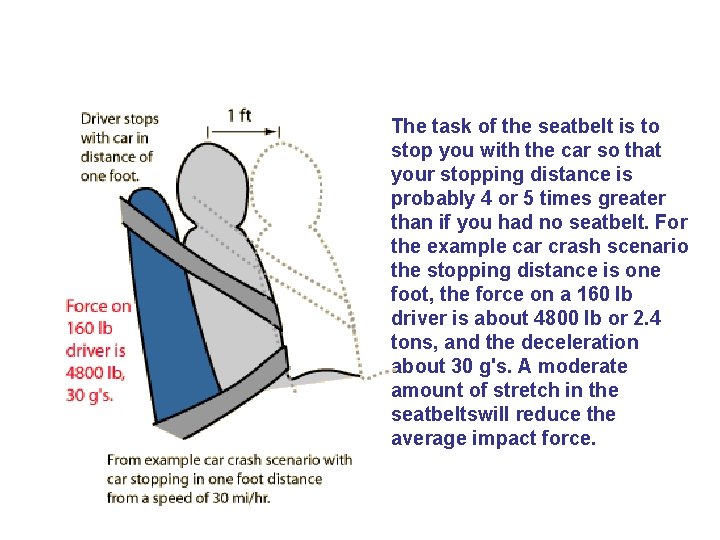
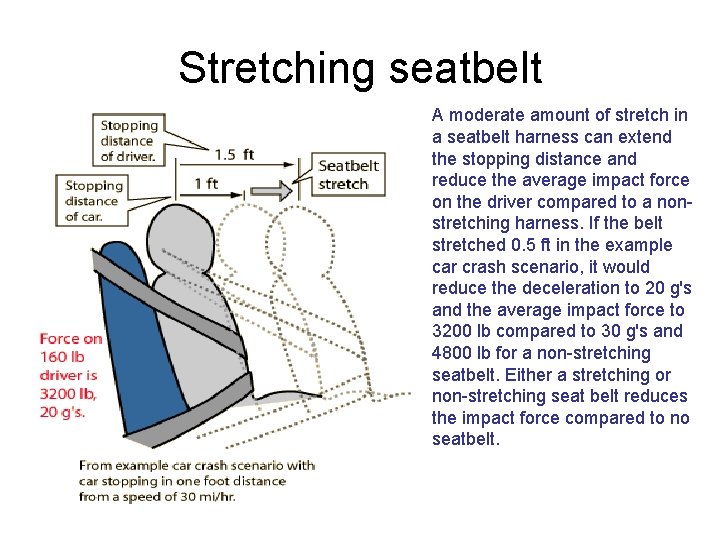
The task of the seatbelt is to stop you with the car so that your stopping distance is probably 4 or 5 times greater than if you had no seatbelt. For the example car crash scenario the stopping distance is one foot, the force on a 160 lb driver is about 4800 lb or 2. 4 tons, and the deceleration about 30 g's. A moderate amount of stretch in the seatbeltswill reduce the average impact force.
Stretching seatbelt A moderate amount of stretch in a seatbelt harness can extend the stopping distance and reduce the average impact force on the driver compared to a nonstretching harness. If the belt stretched 0. 5 ft in the example car crash scenario, it would reduce the deceleration to 20 g's and the average impact force to 3200 lb compared to 30 g's and 4800 lb for a non-stretching seatbelt. Either a stretching or non-stretching seat belt reduces the impact force compared to no seatbelt.
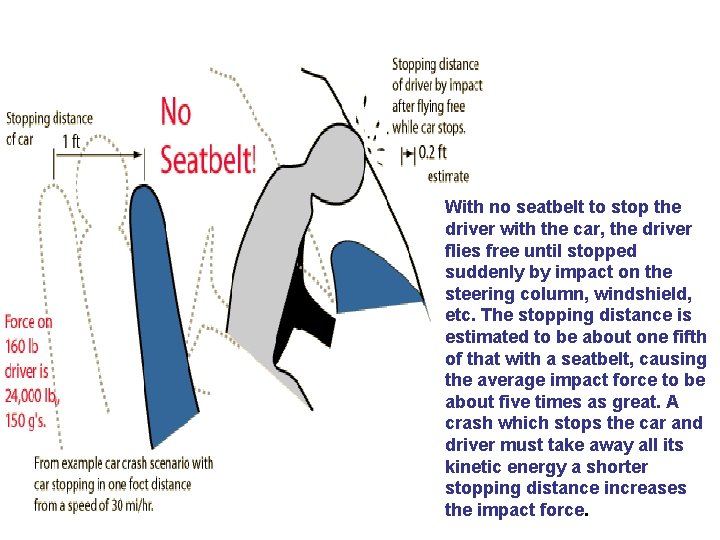
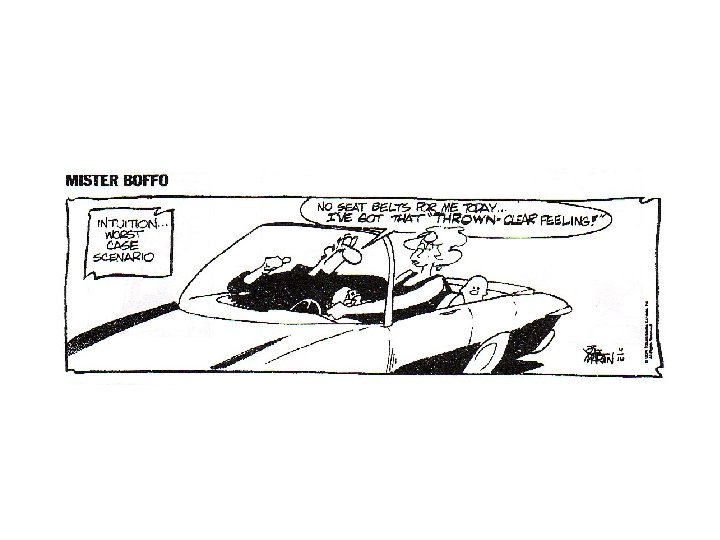
With no seatbelt to stop the driver with the car, the driver flies free until stopped suddenly by impact on the steering column, windshield, etc. The stopping distance is estimated to be about one fifth of that with a seatbelt, causing the average impact force to be about five times as great. A crash which stops the car and driver must take away all its kinetic energy a shorter stopping distance increases the impact force.
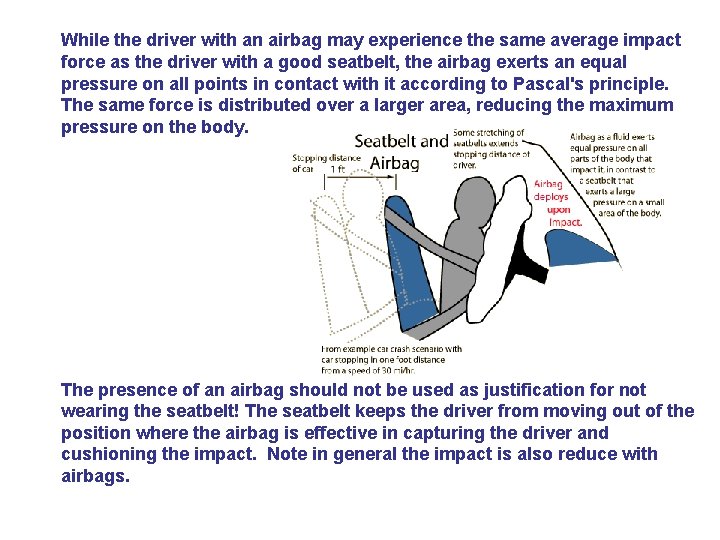
While the driver with an airbag may experience the same average impact force as the driver with a good seatbelt, the airbag exerts an equal pressure on all points in contact with it according to Pascal's principle. The same force is distributed over a larger area, reducing the maximum pressure on the body. The presence of an airbag should not be used as justification for not wearing the seatbelt! The seatbelt keeps the driver from moving out of the position where the airbag is effective in capturing the driver and cushioning the impact. Note in general the impact is also reduce with airbags.
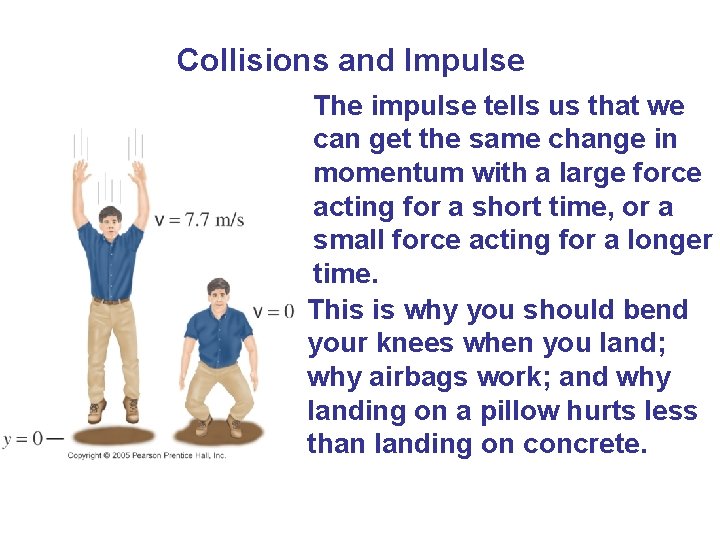
Collisions and Impulse The impulse tells us that we can get the same change in momentum with a large force acting for a short time, or a small force acting for a longer time. This is why you should bend your knees when you land; why airbags work; and why landing on a pillow hurts less than landing on concrete.
Rebounding and Impulse
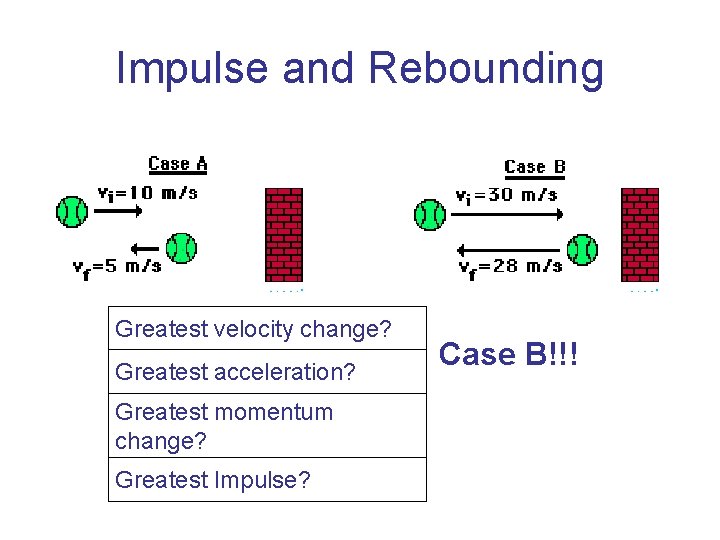
Impulse and Rebounding Greatest velocity change? Greatest acceleration? Greatest momentum change? Greatest Impulse? Case B!!!
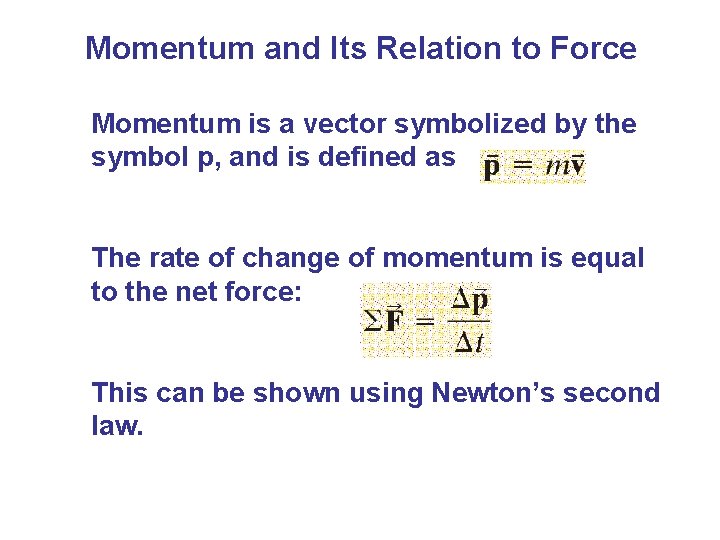
Momentum and Its Relation to Force Momentum is a vector symbolized by the symbol p, and is defined as The rate of change of momentum is equal to the net force: This can be shown using Newton’s second law.
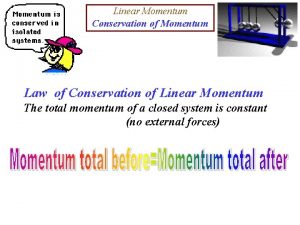
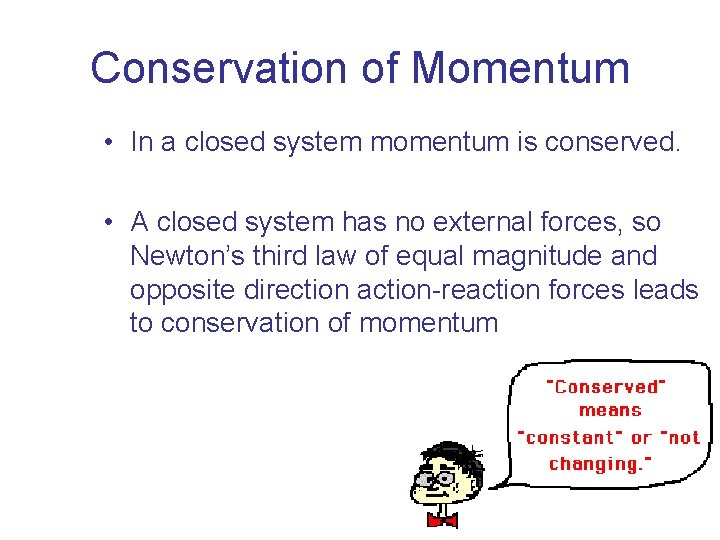
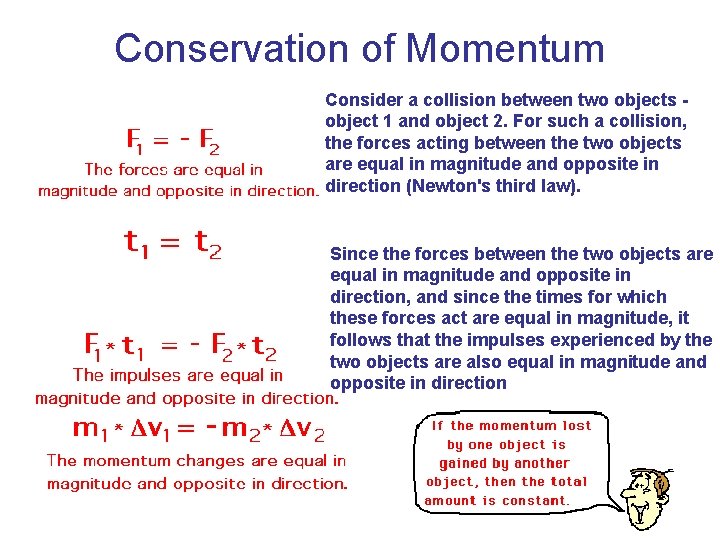
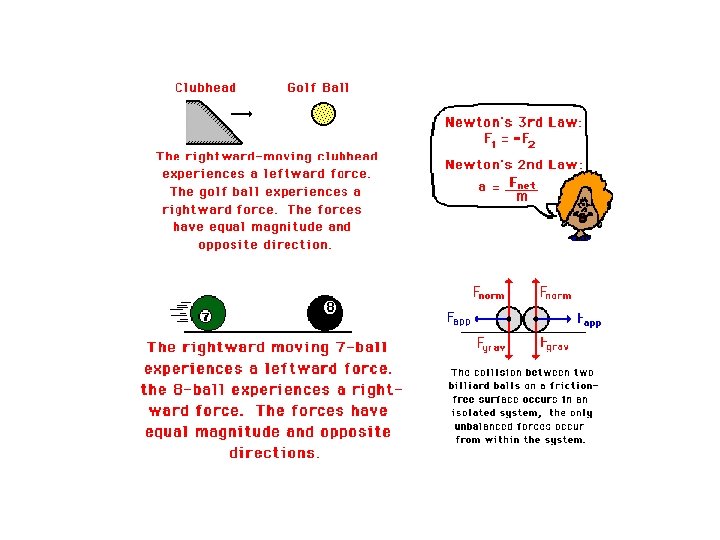
Conservation of Momentum • In a closed system momentum is conserved. • A closed system has no external forces, so Newton’s third law of equal magnitude and opposite direction action-reaction forces leads to conservation of momentum
Conservation of Momentum Consider a collision between two objects object 1 and object 2. For such a collision, the forces acting between the two objects are equal in magnitude and opposite in direction (Newton's third law). Since the forces between the two objects are equal in magnitude and opposite in direction, and since the times for which these forces act are equal in magnitude, it follows that the impulses experienced by the two objects are also equal in magnitude and opposite in direction
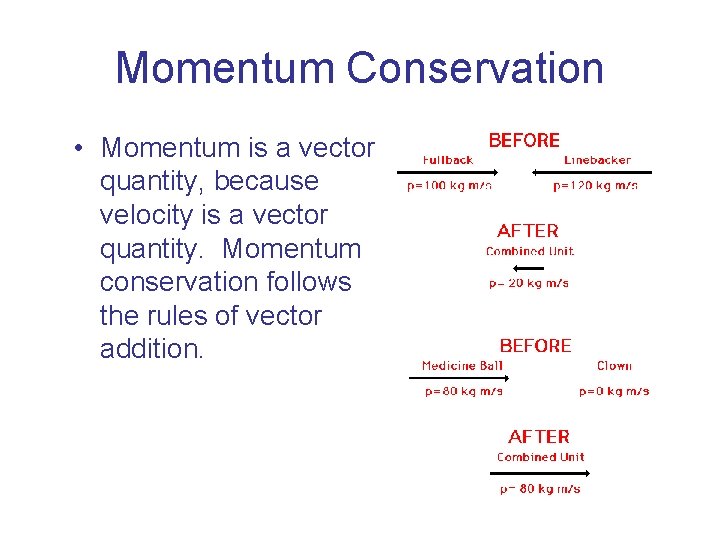
Momentum Conservation • Momentum is a vector quantity, because velocity is a vector quantity. Momentum conservation follows the rules of vector addition.
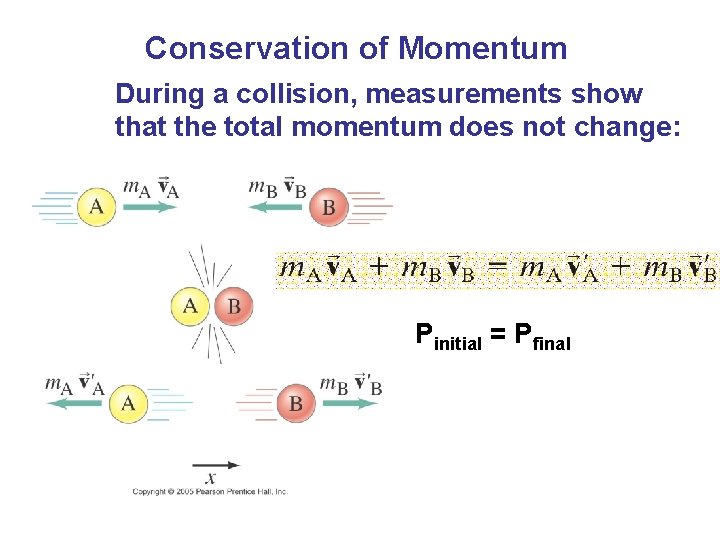
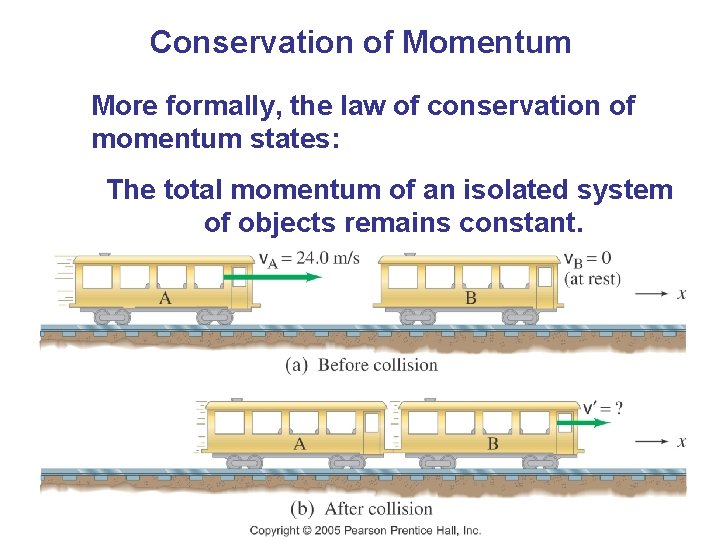
Conservation of Momentum During a collision, measurements show that the total momentum does not change: Pinitial = Pfinal
Conservation of Momentum More formally, the law of conservation of momentum states: The total momentum of an isolated system of objects remains constant.
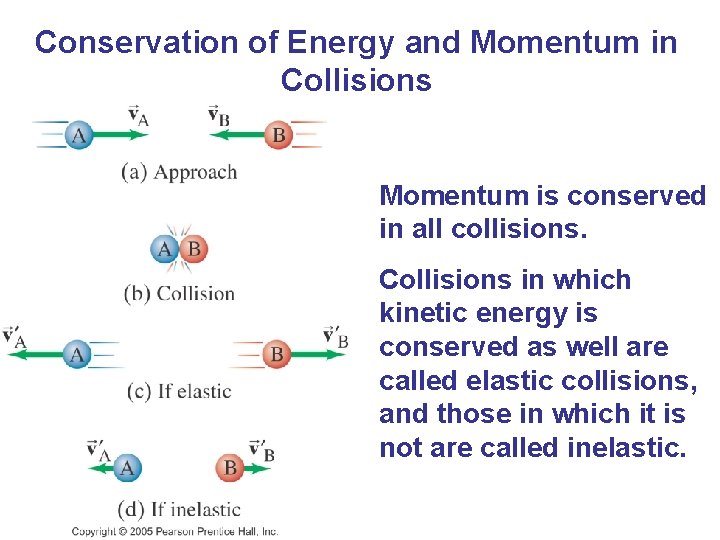
Conservation of Energy and Momentum in Collisions Momentum is conserved in all collisions. Collisions in which kinetic energy is conserved as well are called elastic collisions, and those in which it is not are called inelastic.
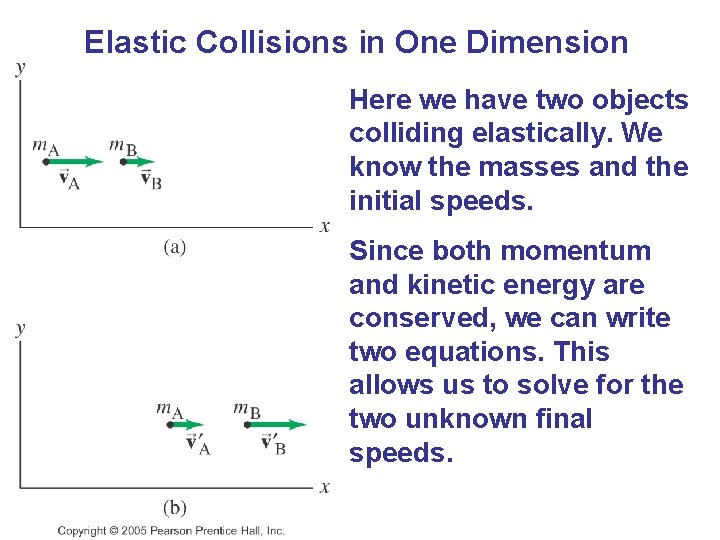
Elastic Collisions in One Dimension Here we have two objects colliding elastically. We know the masses and the initial speeds. Since both momentum and kinetic energy are conserved, we can write two equations. This allows us to solve for the two unknown final speeds.
Collisions • In the macroscopic world perfectly elastic collisions are not evident. There is always some heat or sound generation. • In the microscopic world they are commonplace, e. g. electrically charged particles do not even touch when they “collide”
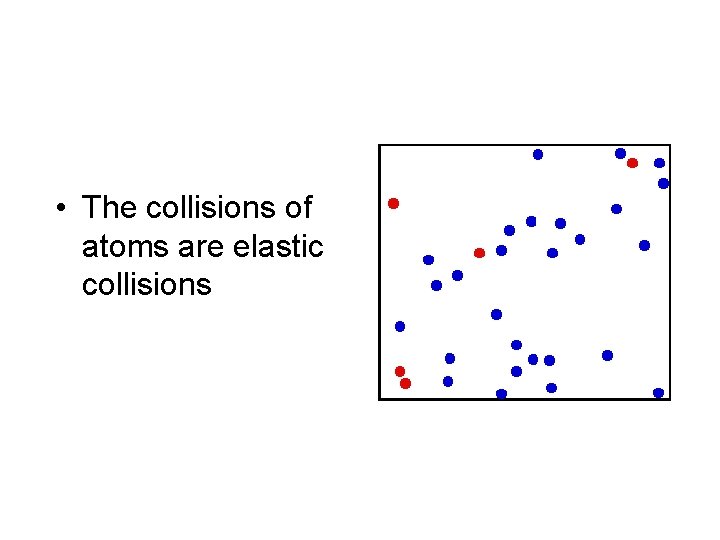
• The collisions of atoms are elastic collisions
Collisions • Elastic collisions: when objects collide without generating heat or being permanently deformed the collision is said to be elastic. • Inelastic collisions: if the objects become coupled together so they become one even more massive object. • Momentum conservation holds in both elastic and inelastic collisions
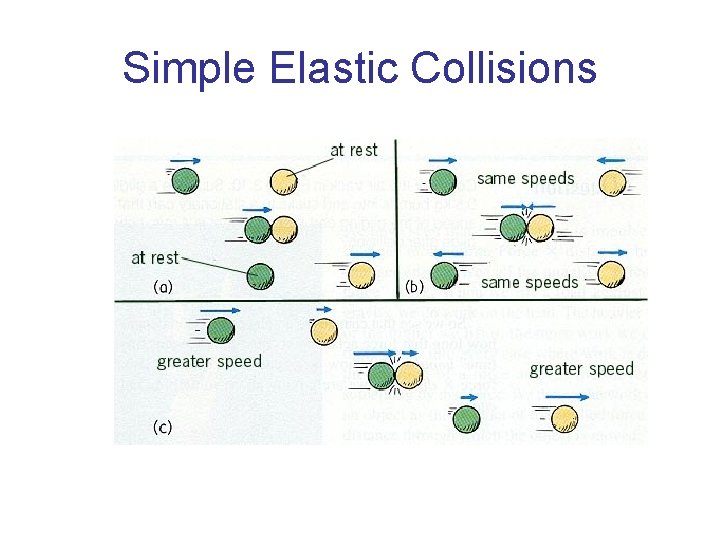
Simple Elastic Collisions
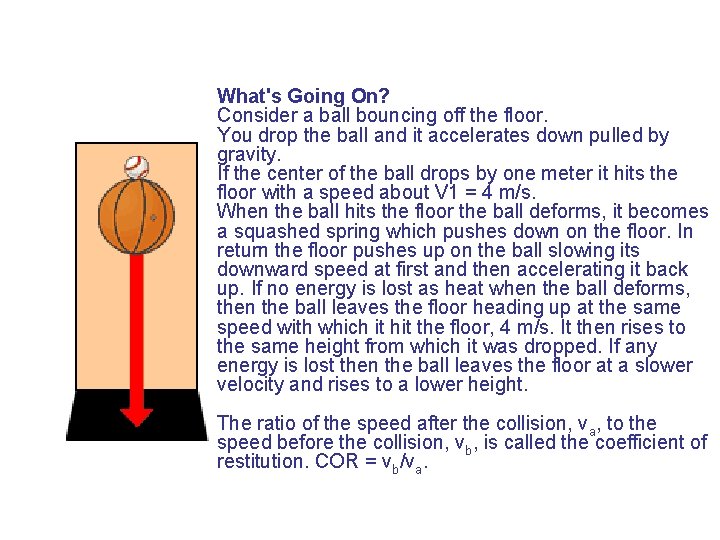
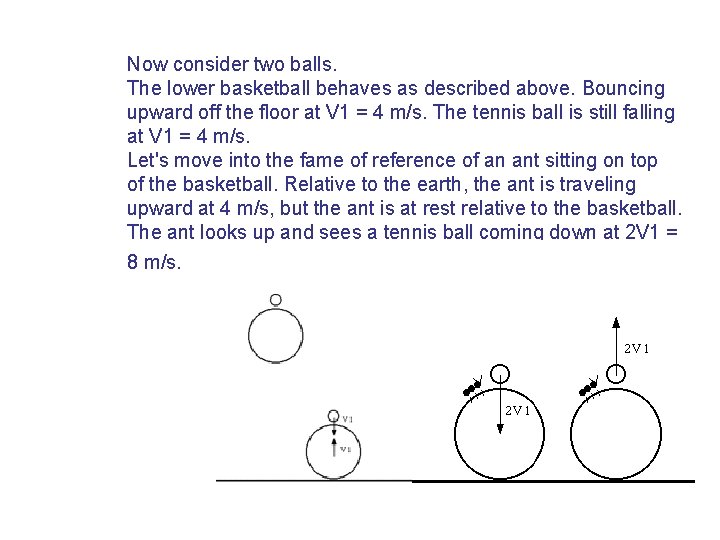
What's Going On? Consider a ball bouncing off the floor. You drop the ball and it accelerates down pulled by gravity. If the center of the ball drops by one meter it hits the floor with a speed about V 1 = 4 m/s. When the ball hits the floor the ball deforms, it becomes a squashed spring which pushes down on the floor. In return the floor pushes up on the ball slowing its downward speed at first and then accelerating it back up. If no energy is lost as heat when the ball deforms, then the ball leaves the floor heading up at the same speed with which it hit the floor, 4 m/s. It then rises to the same height from which it was dropped. If any energy is lost then the ball leaves the floor at a slower velocity and rises to a lower height. The ratio of the speed after the collision, va, to the speed before the collision, vb, is called the coefficient of restitution. COR = vb/va.
Now consider two balls. The lower basketball behaves as described above. Bouncing upward off the floor at V 1 = 4 m/s. The tennis ball is still falling at V 1 = 4 m/s. Let's move into the fame of reference of an ant sitting on top of the basketball. Relative to the earth, the ant is traveling upward at 4 m/s, but the ant is at rest relative to the basketball. The ant looks up and sees a tennis ball coming down at 2 V 1 = 8 m/s.
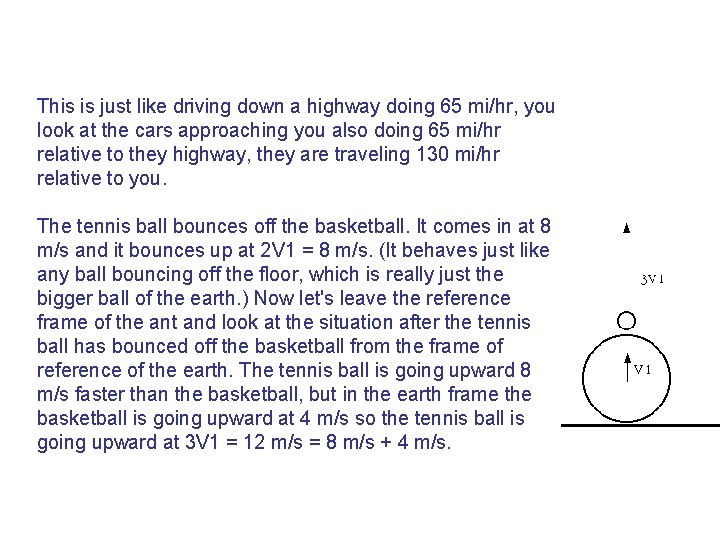
This is just like driving down a highway doing 65 mi/hr, you look at the cars approaching you also doing 65 mi/hr relative to they highway, they are traveling 130 mi/hr relative to you. The tennis ball bounces off the basketball. It comes in at 8 m/s and it bounces up at 2 V 1 = 8 m/s. (It behaves just like any ball bouncing off the floor, which is really just the bigger ball of the earth. ) Now let's leave the reference frame of the ant and look at the situation after the tennis ball has bounced off the basketball from the frame of reference of the earth. The tennis ball is going upward 8 m/s faster than the basketball, but in the earth frame the basketball is going upward at 4 m/s so the tennis ball is going upward at 3 V 1 = 12 m/s = 8 m/s + 4 m/s.
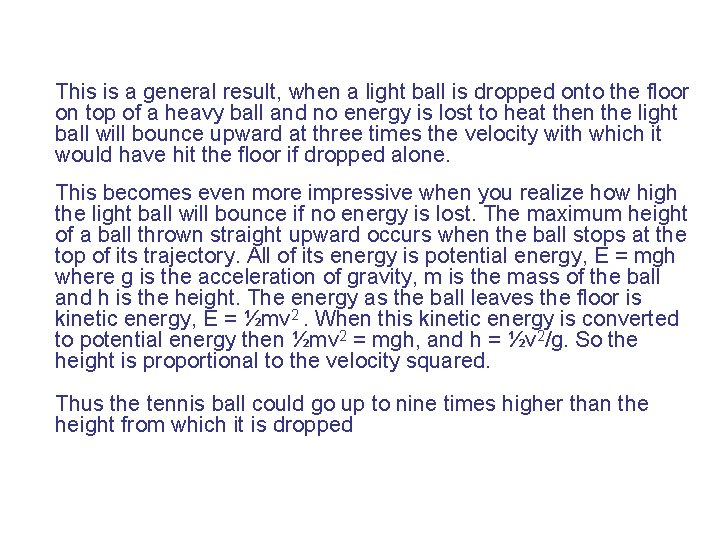
This is a general result, when a light ball is dropped onto the floor on top of a heavy ball and no energy is lost to heat then the light ball will bounce upward at three times the velocity with which it would have hit the floor if dropped alone. This becomes even more impressive when you realize how high the light ball will bounce if no energy is lost. The maximum height of a ball thrown straight upward occurs when the ball stops at the top of its trajectory. All of its energy is potential energy, E = mgh where g is the acceleration of gravity, m is the mass of the ball and h is the height. The energy as the ball leaves the floor is kinetic energy, E = ½mv 2. When this kinetic energy is converted to potential energy then ½mv 2 = mgh, and h = ½v 2/g. So the height is proportional to the velocity squared. Thus the tennis ball could go up to nine times higher than the height from which it is dropped
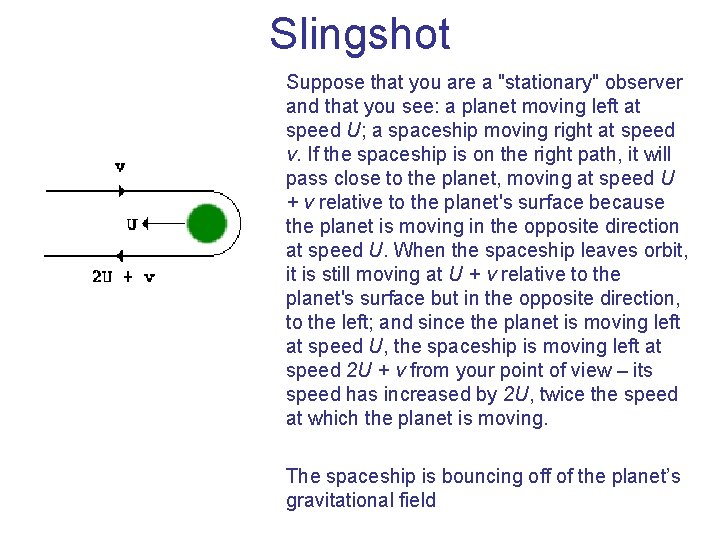
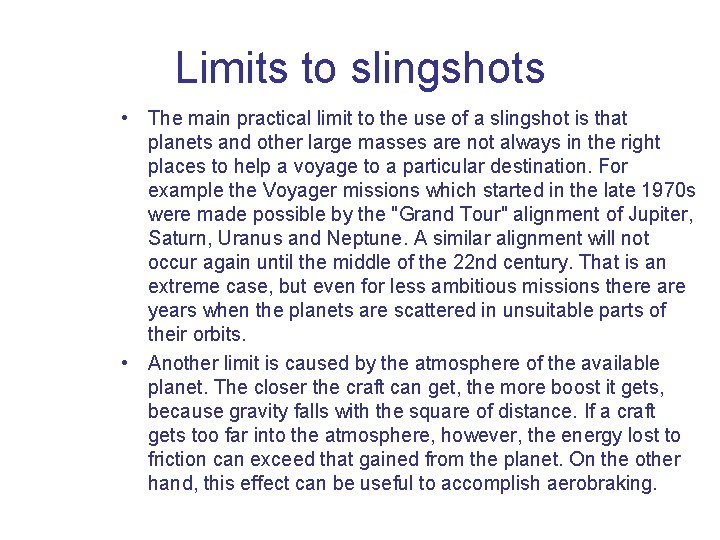
Slingshot Suppose that you are a "stationary" observer and that you see: a planet moving left at speed U; a spaceship moving right at speed v. If the spaceship is on the right path, it will pass close to the planet, moving at speed U + v relative to the planet's surface because the planet is moving in the opposite direction at speed U. When the spaceship leaves orbit, it is still moving at U + v relative to the planet's surface but in the opposite direction, to the left; and since the planet is moving left at speed U, the spaceship is moving left at speed 2 U + v from your point of view – its speed has increased by 2 U, twice the speed at which the planet is moving. The spaceship is bouncing off of the planet’s gravitational field
Limits to slingshots • The main practical limit to the use of a slingshot is that planets and other large masses are not always in the right places to help a voyage to a particular destination. For example the Voyager missions which started in the late 1970 s were made possible by the "Grand Tour" alignment of Jupiter, Saturn, Uranus and Neptune. A similar alignment will not occur again until the middle of the 22 nd century. That is an extreme case, but even for less ambitious missions there are years when the planets are scattered in unsuitable parts of their orbits. • Another limit is caused by the atmosphere of the available planet. The closer the craft can get, the more boost it gets, because gravity falls with the square of distance. If a craft gets too far into the atmosphere, however, the energy lost to friction can exceed that gained from the planet. On the other hand, this effect can be useful to accomplish aerobraking.
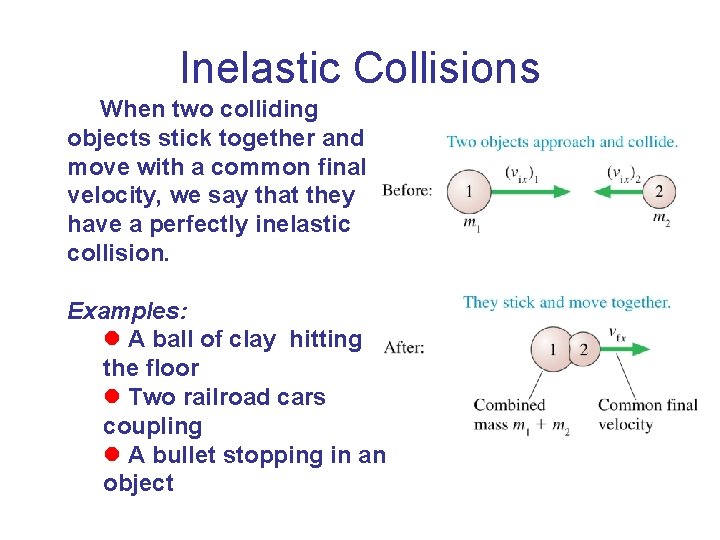
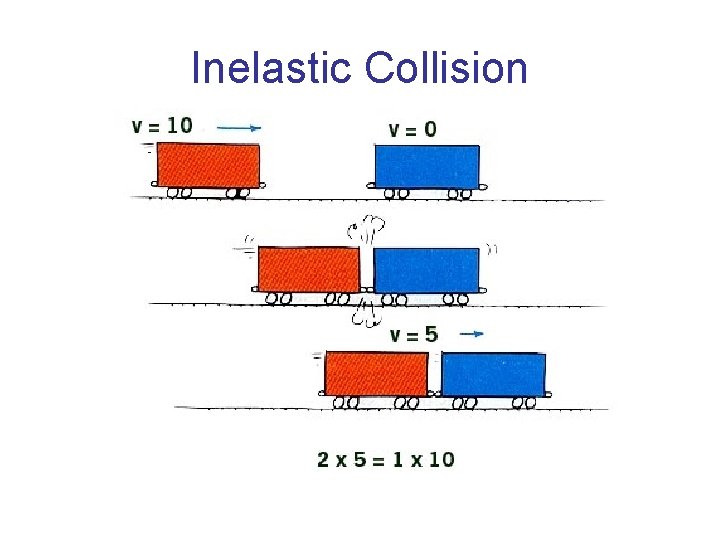
Inelastic Collisions When two colliding objects stick together and move with a common final velocity, we say that they have a perfectly inelastic collision. Examples: l A ball of clay hitting the floor l Two railroad cars coupling l A bullet stopping in an object
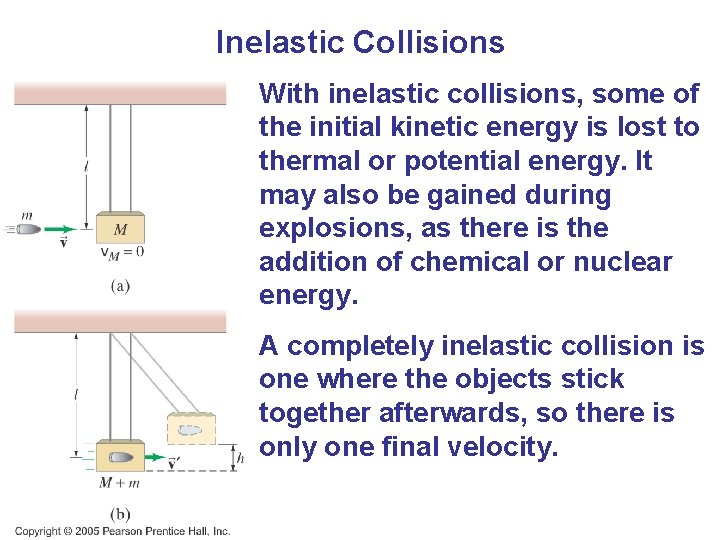
Inelastic Collisions With inelastic collisions, some of the initial kinetic energy is lost to thermal or potential energy. It may also be gained during explosions, as there is the addition of chemical or nuclear energy. A completely inelastic collision is one where the objects stick together afterwards, so there is only one final velocity.
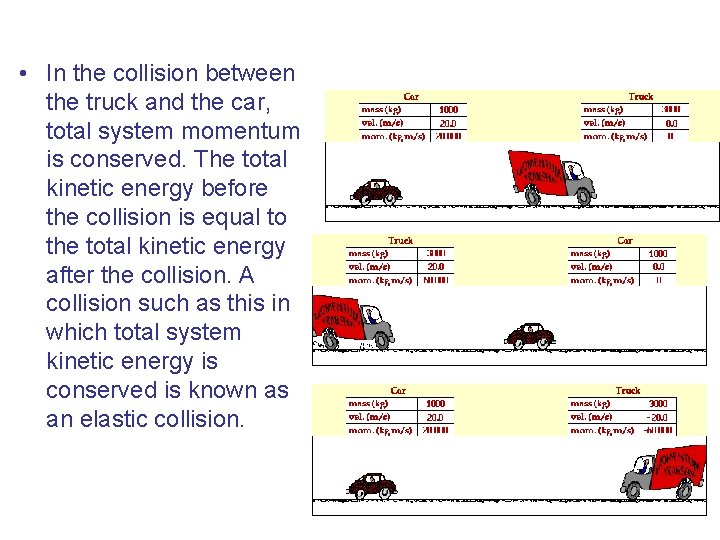
• In the collision between the truck and the car, total system momentum is conserved. The total kinetic energy before the collision is equal to the total kinetic energy after the collision. A collision such as this in which total system kinetic energy is conserved is known as an elastic collision.
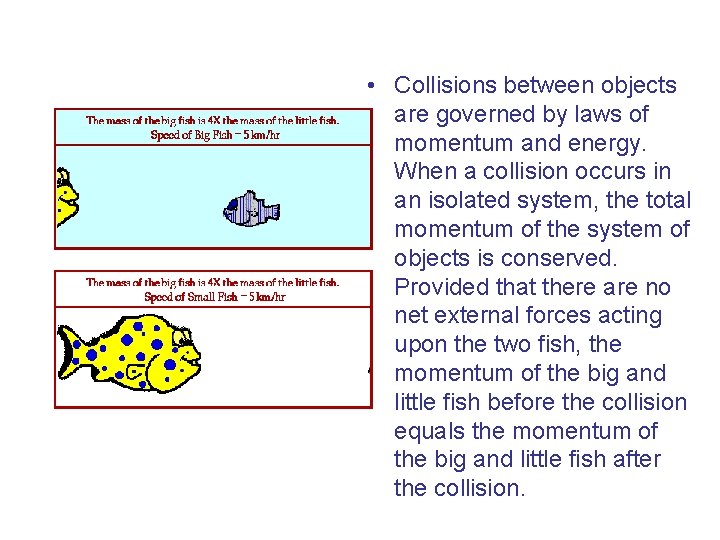
• Collisions between objects are governed by laws of momentum and energy. When a collision occurs in an isolated system, the total momentum of the system of objects is conserved. Provided that there are no net external forces acting upon the two fish, the momentum of the big and little fish before the collision equals the momentum of the big and little fish after the collision.
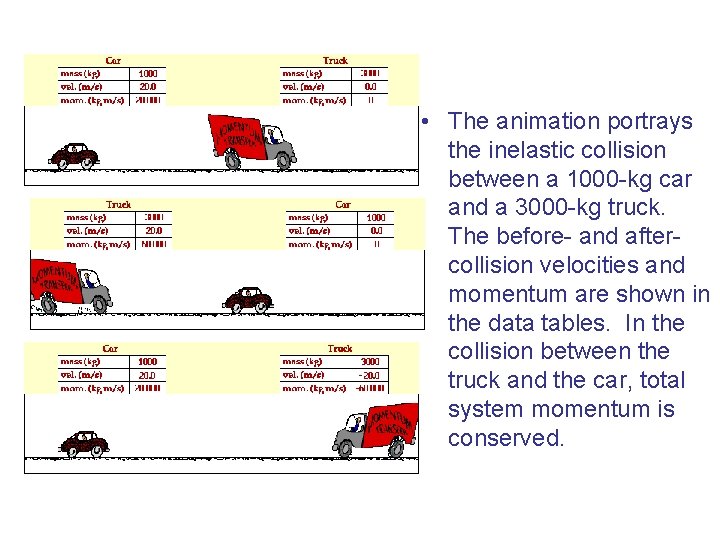
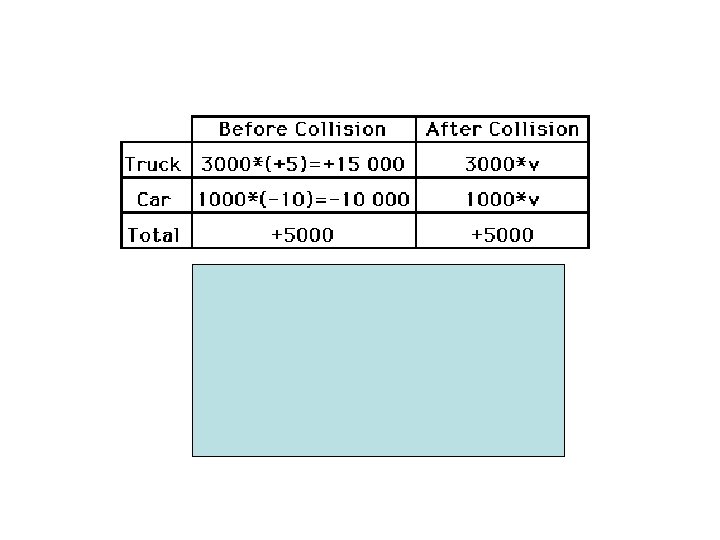
• The animation portrays the inelastic collision between a 1000 -kg car and a 3000 -kg truck. The before- and aftercollision velocities and momentum are shown in the data tables. In the collision between the truck and the car, total system momentum is conserved.
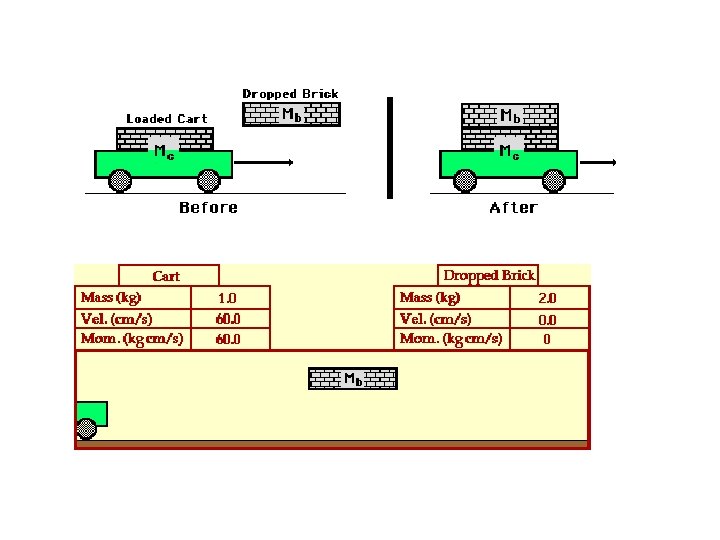
Inelastic Collision
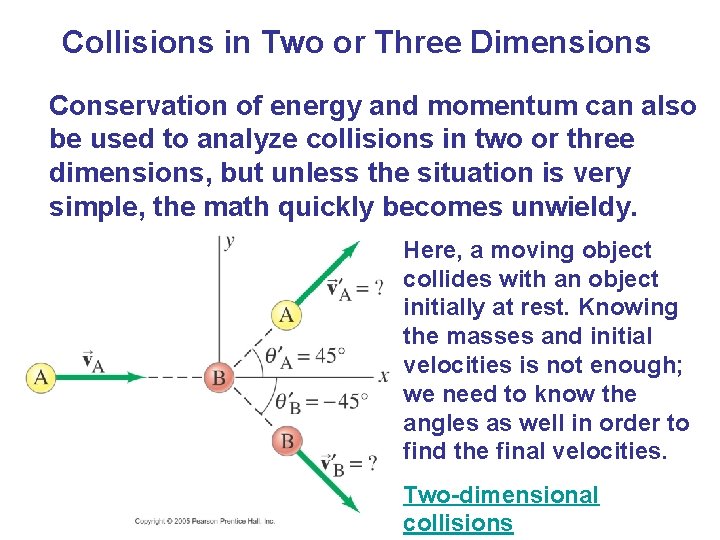
Collisions in Two or Three Dimensions Conservation of energy and momentum can also be used to analyze collisions in two or three dimensions, but unless the situation is very simple, the math quickly becomes unwieldy. Here, a moving object collides with an object initially at rest. Knowing the masses and initial velocities is not enough; we need to know the angles as well in order to find the final velocities. Two-dimensional collisions
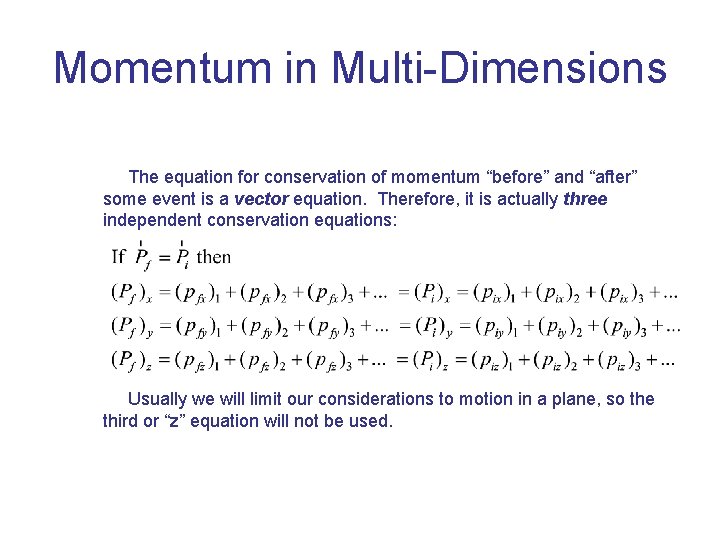
Momentum in Multi-Dimensions The equation for conservation of momentum “before” and “after” some event is a vector equation. Therefore, it is actually three independent conservation equations: Usually we will limit our considerations to motion in a plane, so the third or “z” equation will not be used.
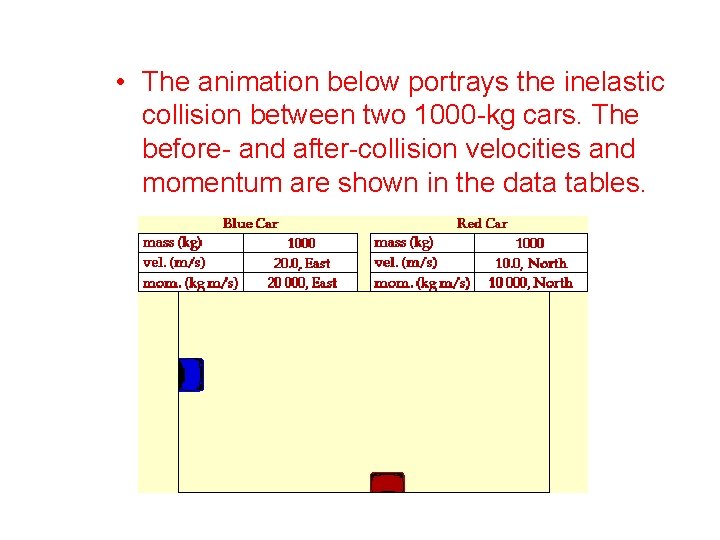
• The animation below portrays the inelastic collision between two 1000 -kg cars. The before- and after-collision velocities and momentum are shown in the data tables.
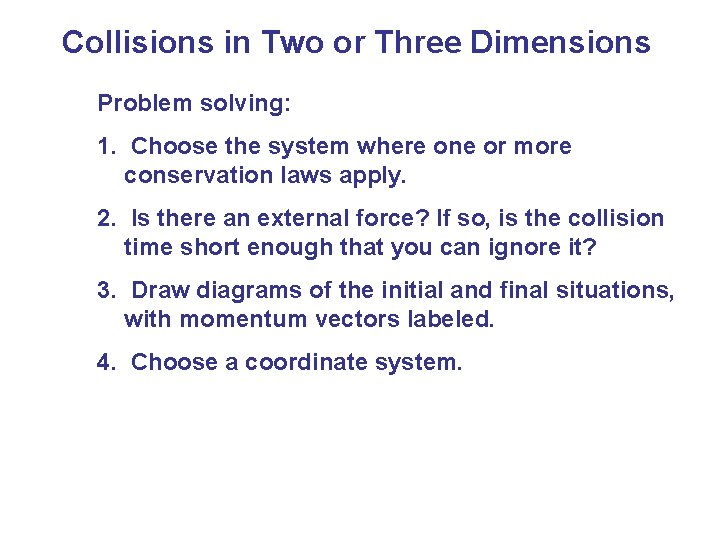
Collisions in Two or Three Dimensions Problem solving: 1. Choose the system where one or more conservation laws apply. 2. Is there an external force? If so, is the collision time short enough that you can ignore it? 3. Draw diagrams of the initial and final situations, with momentum vectors labeled. 4. Choose a coordinate system.
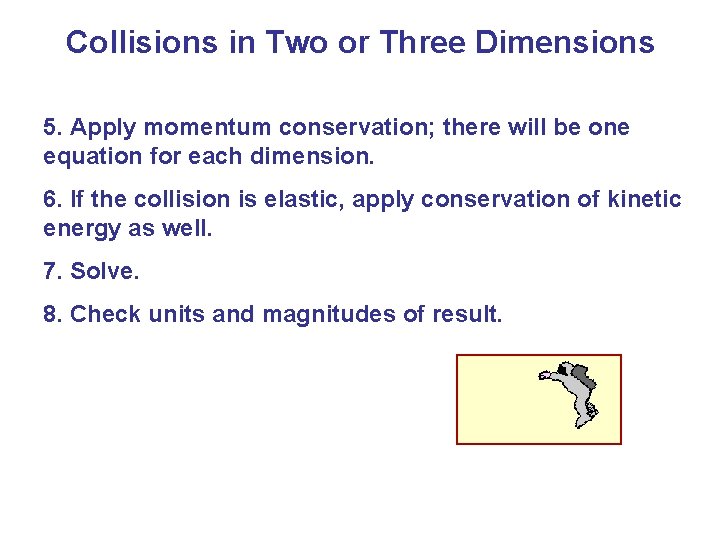
Collisions in Two or Three Dimensions 5. Apply momentum conservation; there will be one equation for each dimension. 6. If the collision is elastic, apply conservation of kinetic energy as well. 7. Solve. 8. Check units and magnitudes of result.
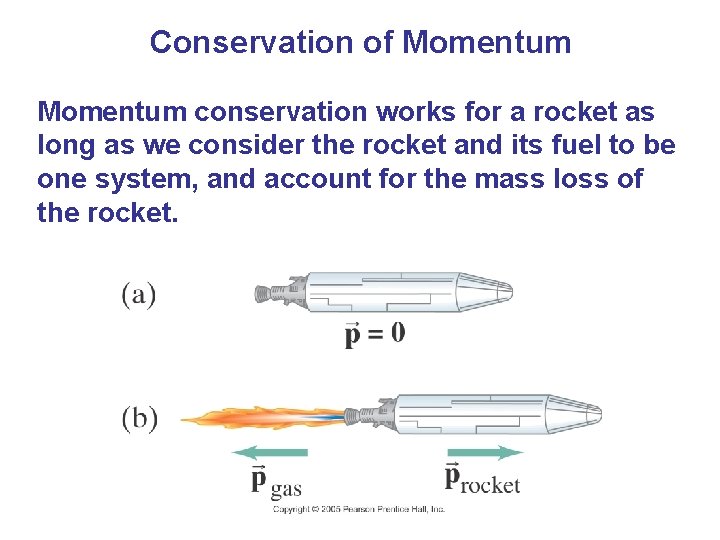
Conservation of Momentum conservation works for a rocket as long as we consider the rocket and its fuel to be one system, and account for the mass loss of the rocket.
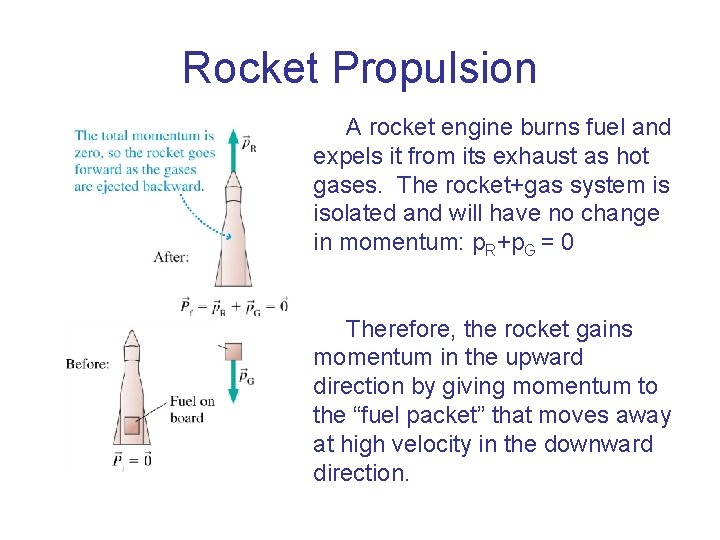
Rocket Propulsion A rocket engine burns fuel and expels it from its exhaust as hot gases. The rocket+gas system is isolated and will have no change in momentum: p. R+p. G = 0 Therefore, the rocket gains momentum in the upward direction by giving momentum to the “fuel packet” that moves away at high velocity in the downward direction.
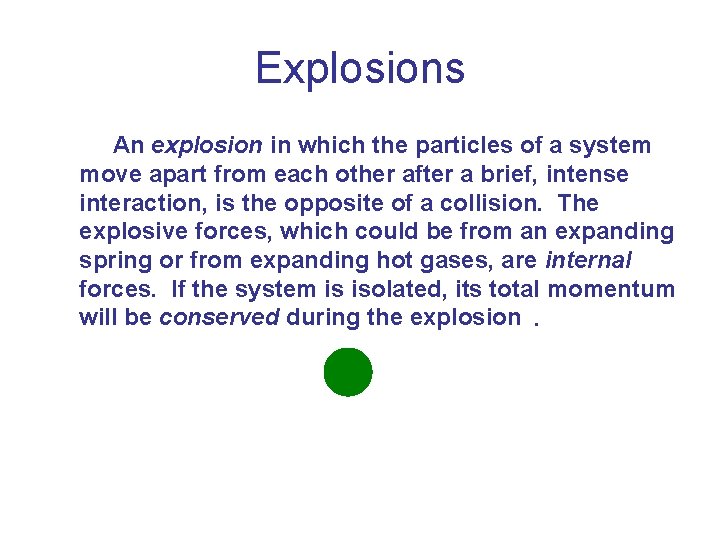
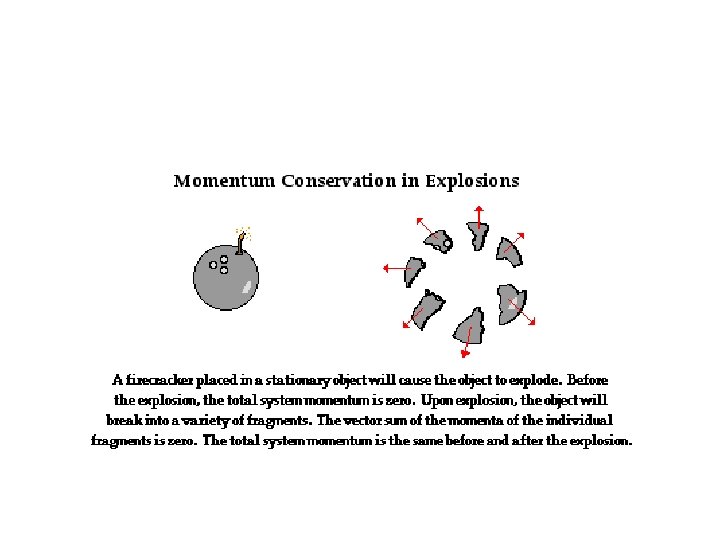
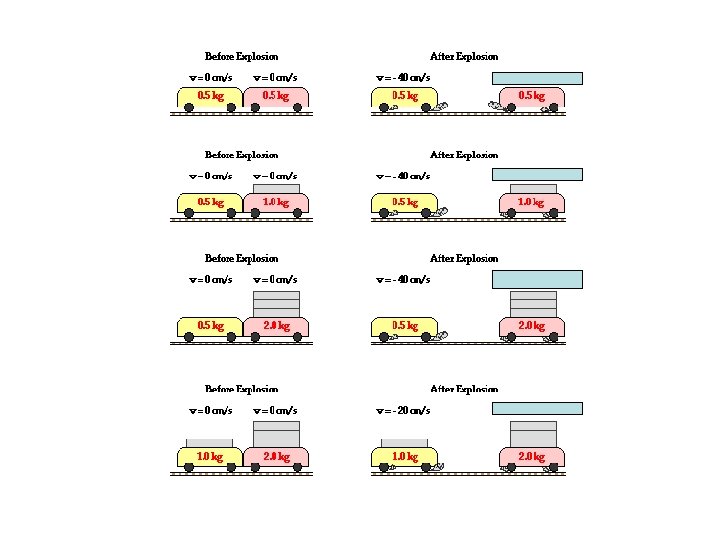
Explosions An explosion in which the particles of a system move apart from each other after a brief, intense interaction, is the opposite of a collision. The explosive forces, which could be from an expanding spring or from expanding hot gases, are internal forces. If the system is isolated, its total momentum will be conserved during the explosion.
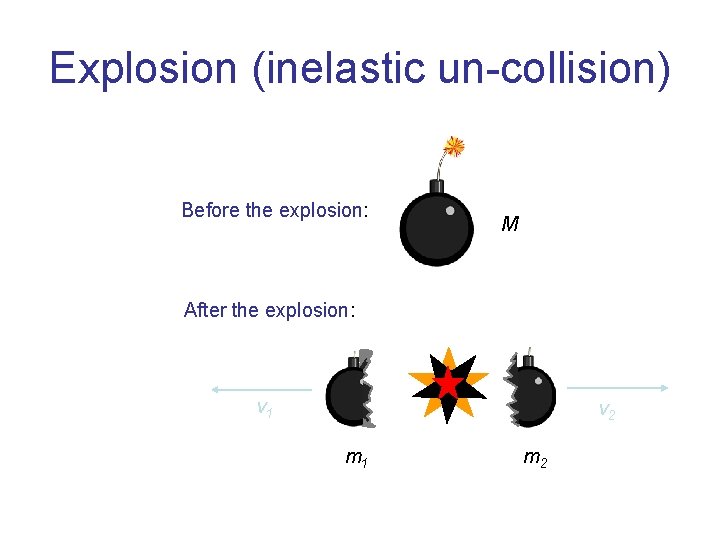
Explosion (inelastic un-collision) Before the explosion: M After the explosion: v 1 v 2 m 1 m 2
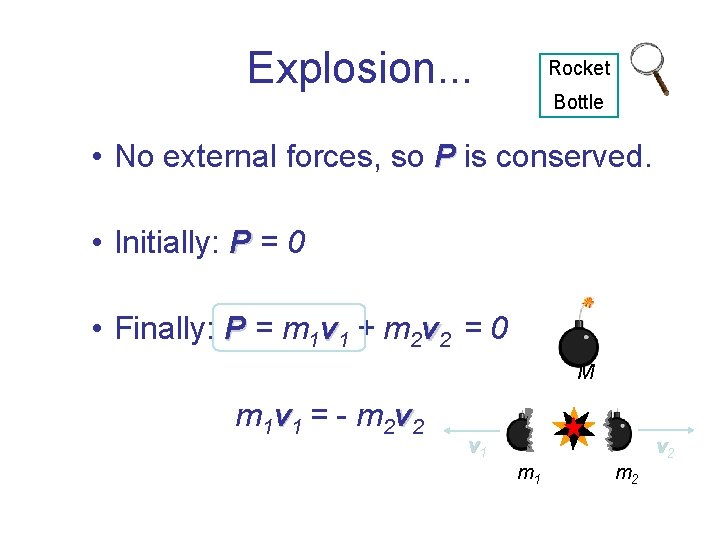
Explosion. . . Rocket Bottle • No external forces, so P is conserved. • Initially: P = 0 • Finally: P = m 1 v 1 + m 2 v 2 = 0 M m 1 v 1 = - m 2 v 1 v 2 m 1 m 2
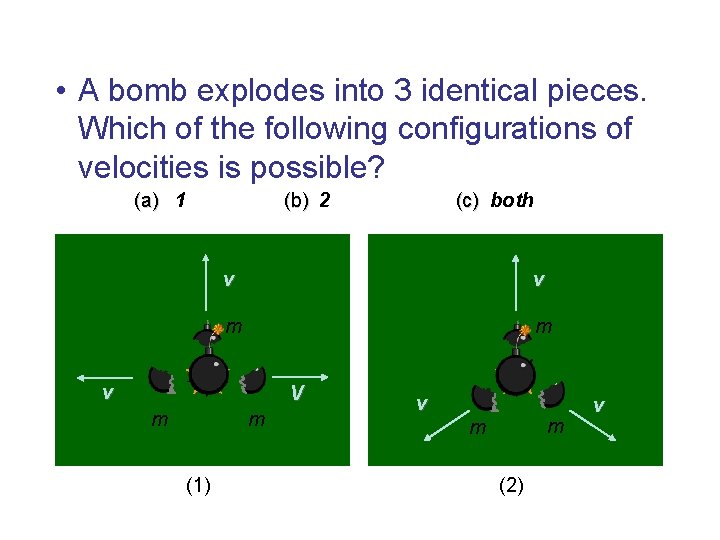
• A bomb explodes into 3 identical pieces. Which of the following configurations of velocities is possible? (a) 1 (b) 2 v v m m v V m m (1) (c) both v m m (2) v
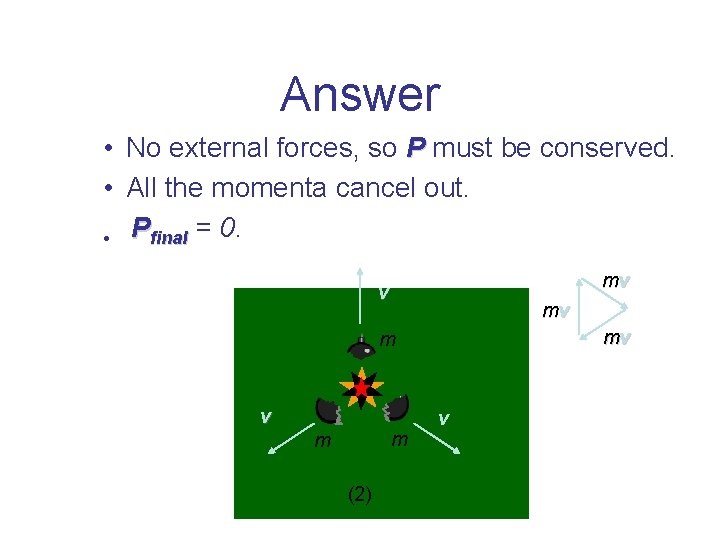
Answer • No external forces, so P must be conserved. • All the momenta cancel out. • Pfinal = 0. mv v mv mv m m (2) v
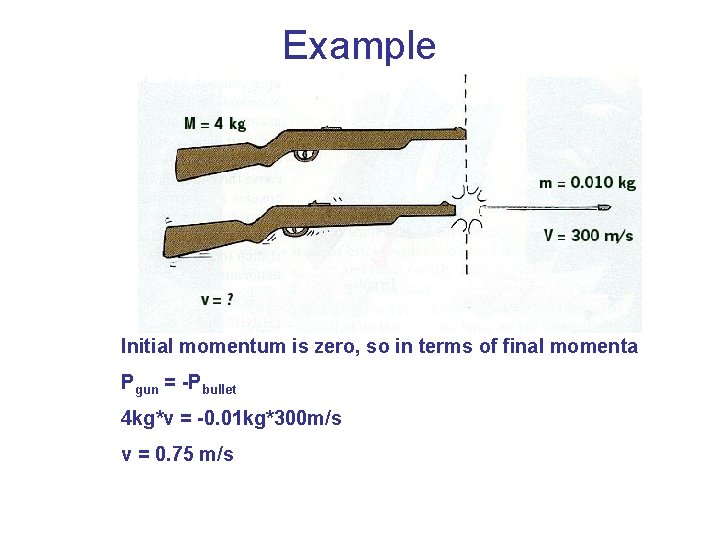
Example Initial momentum is zero, so in terms of final momenta Pgun = -Pbullet 4 kg*v = -0. 01 kg*300 m/s v = 0. 75 m/s
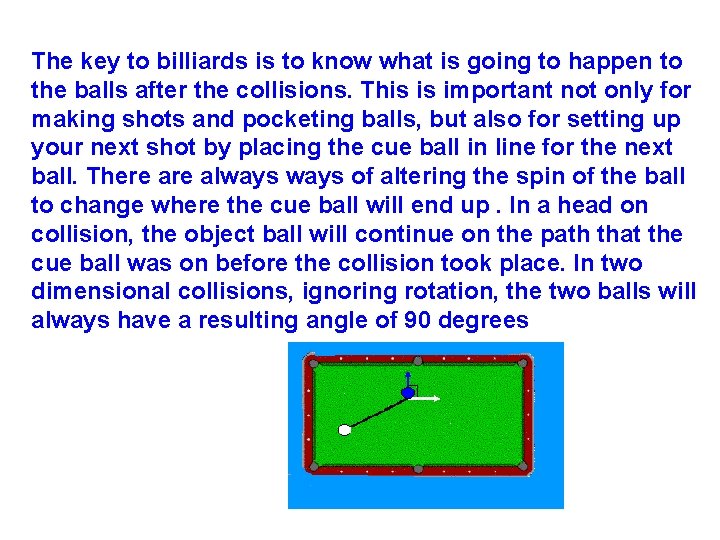
The key to billiards is to know what is going to happen to the balls after the collisions. This is important not only for making shots and pocketing balls, but also for setting up your next shot by placing the cue ball in line for the next ball. There always of altering the spin of the ball to change where the cue ball will end up. In a head on collision, the object ball will continue on the path that the cue ball was on before the collision took place. In two dimensional collisions, ignoring rotation, the two balls will always have a resulting angle of 90 degrees
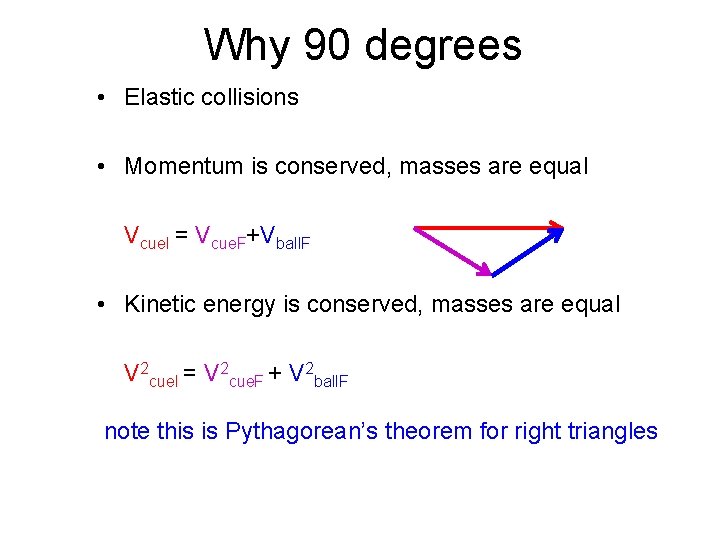
Why 90 degrees • Elastic collisions • Momentum is conserved, masses are equal Vcue. I = Vcue. F+Vball. F • Kinetic energy is conserved, masses are equal V 2 cue. I = V 2 cue. F + V 2 ball. F note this is Pythagorean’s theorem for right triangles
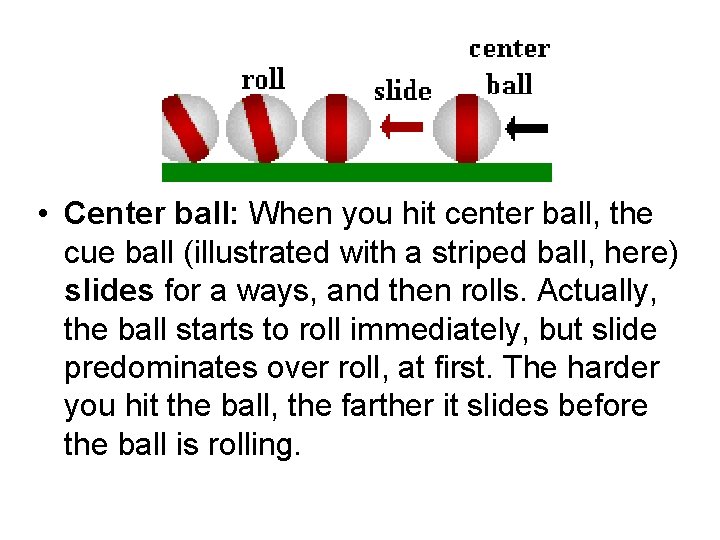
• Center ball: When you hit center ball, the cue ball (illustrated with a striped ball, here) slides for a ways, and then rolls. Actually, the ball starts to roll immediately, but slide predominates over roll, at first. The harder you hit the ball, the farther it slides before the ball is rolling.
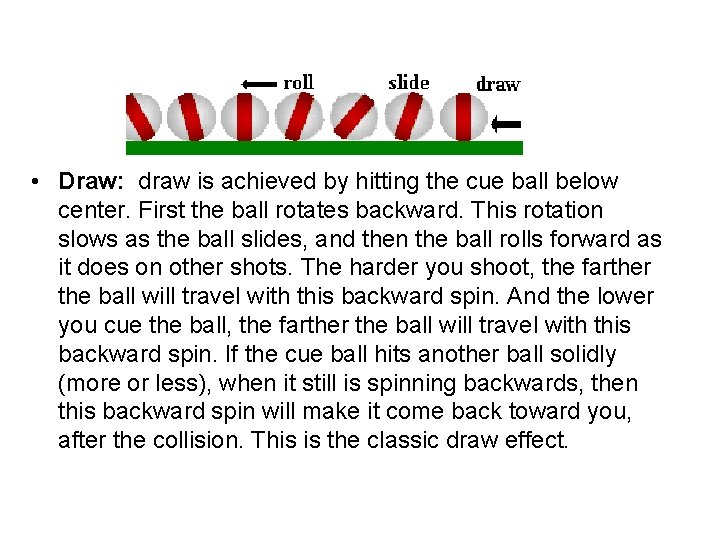
• Draw: draw is achieved by hitting the cue ball below center. First the ball rotates backward. This rotation slows as the ball slides, and then the ball rolls forward as it does on other shots. The harder you shoot, the farther the ball will travel with this backward spin. And the lower you cue the ball, the farther the ball will travel with this backward spin. If the cue ball hits another ball solidly (more or less), when it still is spinning backwards, then this backward spin will make it come back toward you, after the collision. This is the classic draw effect.
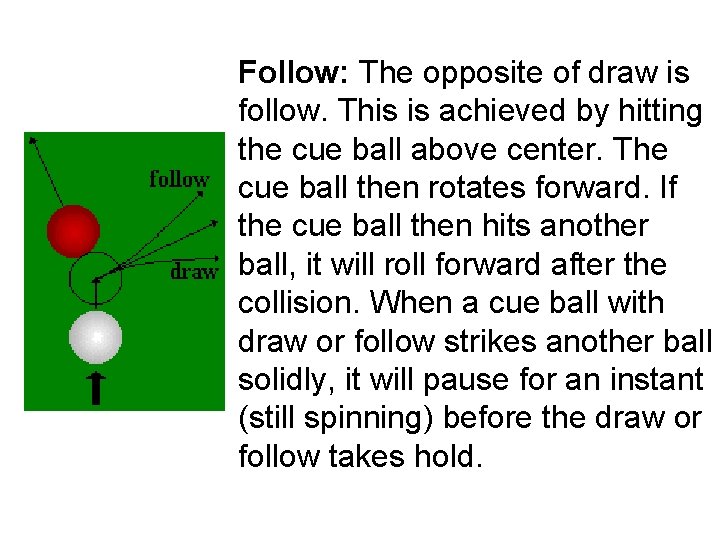
Follow: The opposite of draw is follow. This is achieved by hitting the cue ball above center. The cue ball then rotates forward. If the cue ball then hits another ball, it will roll forward after the collision. When a cue ball with draw or follow strikes another ball solidly, it will pause for an instant (still spinning) before the draw or follow takes hold.
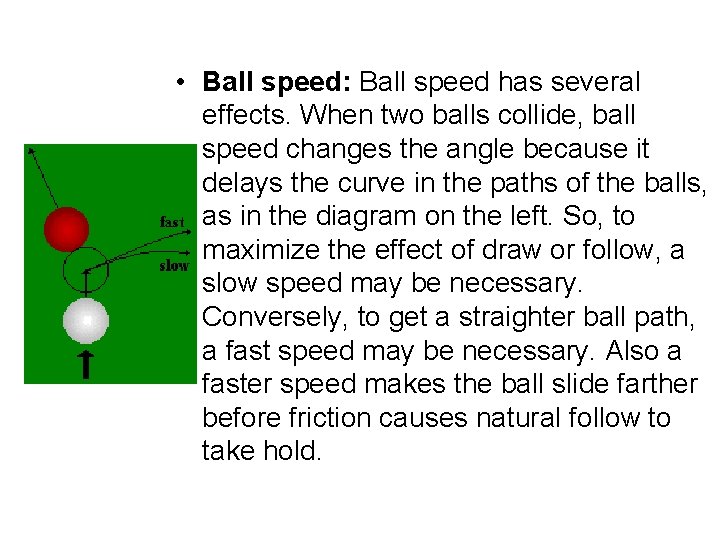
• Ball speed: Ball speed has several effects. When two balls collide, ball speed changes the angle because it delays the curve in the paths of the balls, as in the diagram on the left. So, to maximize the effect of draw or follow, a slow speed may be necessary. Conversely, to get a straighter ball path, a fast speed may be necessary. Also a faster speed makes the ball slide farther before friction causes natural follow to take hold.
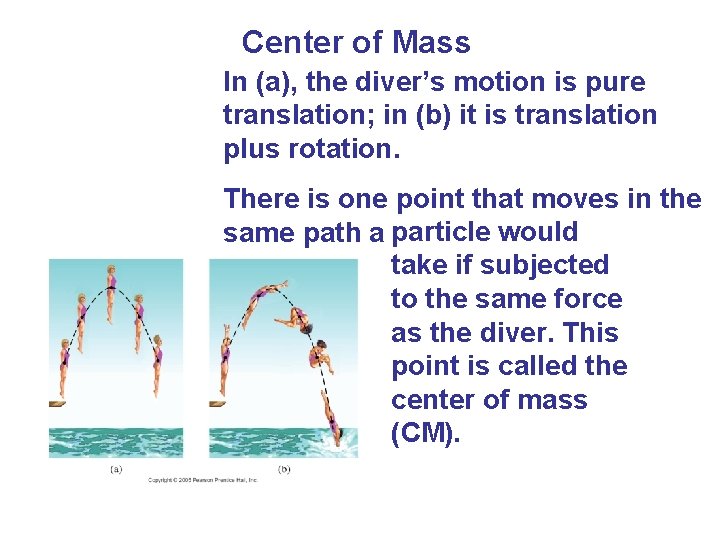
Center of Mass In (a), the diver’s motion is pure translation; in (b) it is translation plus rotation. There is one point that moves in the same path a particle would take if subjected to the same force as the diver. This point is called the center of mass (CM).
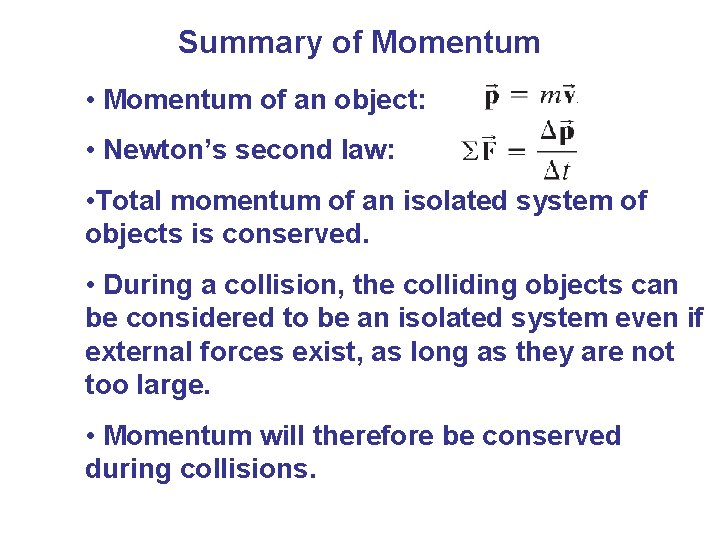
Summary of Momentum • Momentum of an object: • Newton’s second law: • Total momentum of an isolated system of objects is conserved. • During a collision, the colliding objects can be considered to be an isolated system even if external forces exist, as long as they are not too large. • Momentum will therefore be conserved during collisions.
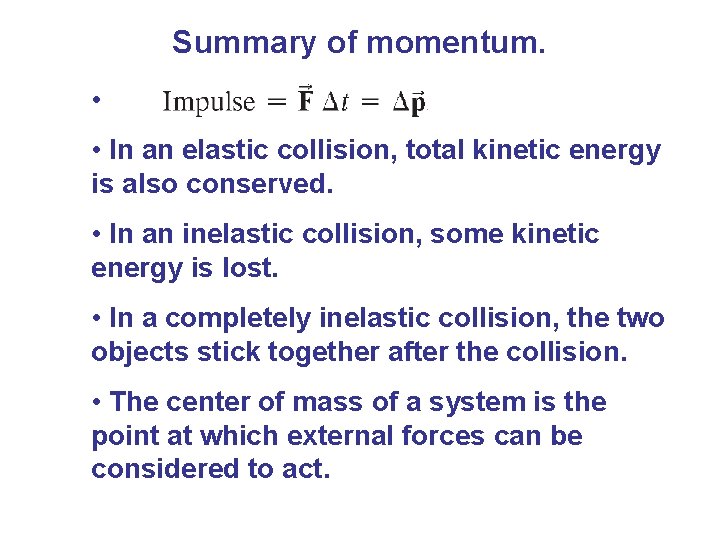
Summary of momentum. • • In an elastic collision, total kinetic energy is also conserved. • In an inelastic collision, some kinetic energy is lost. • In a completely inelastic collision, the two objects stick together after the collision. • The center of mass of a system is the point at which external forces can be considered to act.
• http: //physics. weber. edu/amiri/director/dcrf iles/momentum/astronaut. S. dcr • http: //physics. weber. edu/amiri/director/dcrf iles/momentum/car. Jump. S. dcr
• Lesson 11: Center of Mass • Lesson 12: Impulse and Momentum • Lesson 13: Conservation of Linear Momentum, Collisions