
Test Review Chapter 4 Linear Motion Question Youre








- Slides: 69
Test Review Chapter 4 – Linear Motion
Question • You’re solving a problem and you see a unit of km/hr. What variable is this giving you?
Answer • speed
Question • The acceleration vector of a moving object points at an angle to the velocity vector. What does this tell us about the motion of the object?
Answer • It’s changing direction
Question 15 • You get pulled over for going 50 mph in a 35 mph zone. Is this based on your average or instantaneous speed?
Answer • instantaneous
Question 16 • What is the equation used to calculate the average speed of an object?
Answer • Speed = change in distance/change in time
Question 17 • A description of how fast something moves is _____.
Answer • Speed
Question • You are solving a problem and you see the units of m/s². What variable is this giving you?
Answer • acceleration
Question 18 • A description of how fast and in what direction something moves is _____.
Answer • Velocity
Question • A ball is thrown upward with a speed of 50 m/s. If it is caught at the same height where it was released, how fast is it traveling?
Answer • 50 m/s
Question 19 • What are 3 ways an object can undergo an acceleration?
Answer • Speed up, slow down, change direction
Question • On the turnpike, they are trying to pass a law that based on what time you pass through each toll booth, you may get a speeding ticket in the mail. Is this based off average speed or instantaneous speed?
Answer • Average
Question 21 • What are the standard SI units of acceleration?
Answer • m/s²
Question • What physical quantity does “g” represent?
Answer • Acceleration due to gravity
Question 22 • True or False: the acceleration of an object undergoing free fall motion is constant.
Answer • True
Question 23 • In each passing second, how does the speed of an falling object change?
Answer • It increases by 10 m/s
Question 25 • Why can you not use d=vt to solve for distance in cases involving free fall motion?
Answer • In order to use d=vt, there must be NO acceleration (in other words the speed must be constant). Clearly in free fall motion, the object is accelerating towards Earth.
Question • A ball is allowed to rise and fall under free fall motion. What is its acceleration at the highest point?
Answer • 10 m/s²
Question 26 • For each second of free fall motion, how does the distance fallen compare with that of the previous time interval?
Answer • It is greater. This is because the object is accelerating and therefore its speed is increasing constantly and therefore covering more and more distance.
Question 27 • A linear, nonhorizontal graph of distance vs time shows that the object’s ______ is constant.
Answer • Speed, the slope of a distance vs. time graph gives speed. If the slope is constant ( in other words linear) then the speed is constant.
Question • Sketch what the distance vs time graph of a freely falling object would look like?
Answer • parabolic
Question • A ball is allowed to rise and fall under free fall motion. What is its speed at its highest point?
Answer • O m/s
Question 28 • A linear, nonhorizontal graph of speed vs. time shows that the object’s _____ is constant.
Answer • Acceleration. The slope of a speed vs. time graph gives acceleration. If the slope is constant ( in other words linear) then the acceleration must be constant.
Question 29 • In a distance vs. time graph, the steepness of the slope continues to increase as time passes. What does this mean?
Answer • Speed increases and object is accelerating. Speed is given by the slope of a distance vs. time graph so steeper slopes correspond to greater speeds. If speed is increasing then object is accelerating.
Question 30 • What is the difference between average speed and instantaneous speed?
Answer • Average speed is how fast you have to constantly travel in order to cover a given distance in a given time. Instantaneous speed is the speed of an object at a particular moment in time.
Question 31 • Calculate the speed of a bowling ball that moves 8 meters in 4 seconds.
Answer • 2 m/s
Question • Sketch what the speed vs. time graph of an object undergoing free fall motion would look like.
Answer • linear
Question • For a moving object, the acceleration vector points in the opposite direction of the velocity vector. What does this tell us about the motion of the object?
Answer • It’s slowing down
Question 32 • Calculate the distance Charlie runs if he maintains an average speed of 10 m/s for 40 seconds.
Answer • 400 m
Question 33 • Calculate the acceleration of a ball that starts from rest and rolls down a ramp and gains a speed of 25 m/s in 5 seconds.
Answer • 5 m/s²
Question 34 • Calculate the speed (in m/s) of a skateboarder who accelerates from rest for 3 seconds down a ramp at an acceleration of 5 m/s²
Answer • 15 m/s
Question 35 • A sky diver steps from a high-flying helicopter. If there were no air resistance, how fast would she be falling at the end of a 12 second jump?
Answer • 120 m/s
Question 36 • An apple drops from a tree and hits the ground in 1. 5 s. Calculate how far it falls.
Answer • 11. 3 m
Question 37 • On a distant planet a freely falling object has an acceleration of 20 m/s². Calculate the speed an object dropped from rest on this distant planet acquires in 1. 5 s.
Answer • 30 m/s
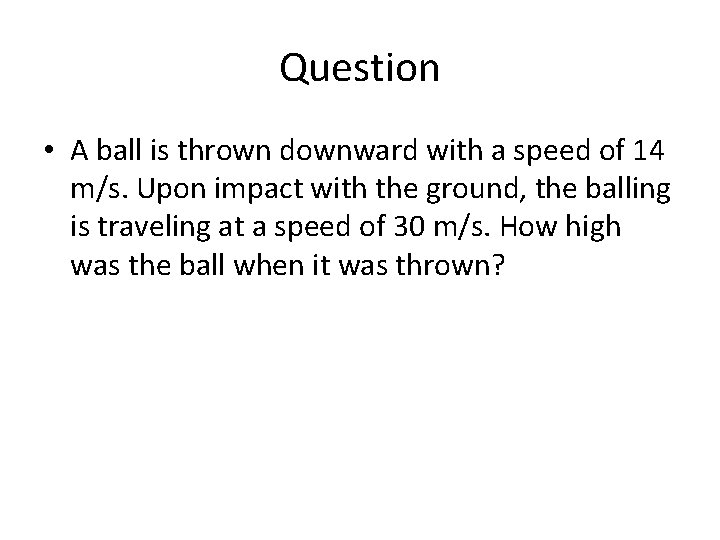
Question • A ball is thrown downward with a speed of 14 m/s. Upon impact with the ground, the balling is traveling at a speed of 30 m/s. How high was the ball when it was thrown?
Answer • 35. 2 m
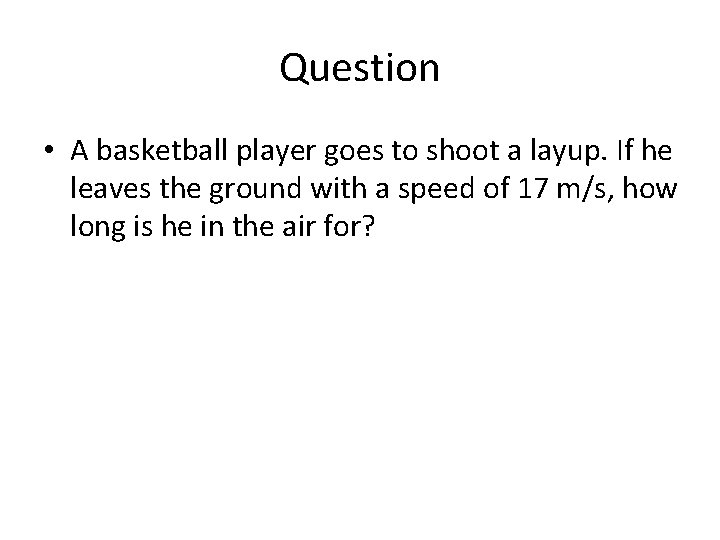
Question • A basketball player goes to shoot a layup. If he leaves the ground with a speed of 17 m/s, how long is he in the air for?
Answer • 3. 4 s