Chapter 7 Linear Momentum MFMc GrawPHY 1401 Chap
- Slides: 73
Chapter 7 Linear Momentum MFMc. Graw-PHY 1401 Chap 07 b- Linear Momentum: Revised 6/28/2010
Linear Momentum • Definition of Momentum • Impulse • Conservation of Momentum • Center of Mass • Motion of the Center of Mass • Collisions (1 d, 2 d; elastic, inelastic) MFMc. Graw-PHY 1401 Chap 07 b- Linear Momentum: Revised 6/28/2010 2
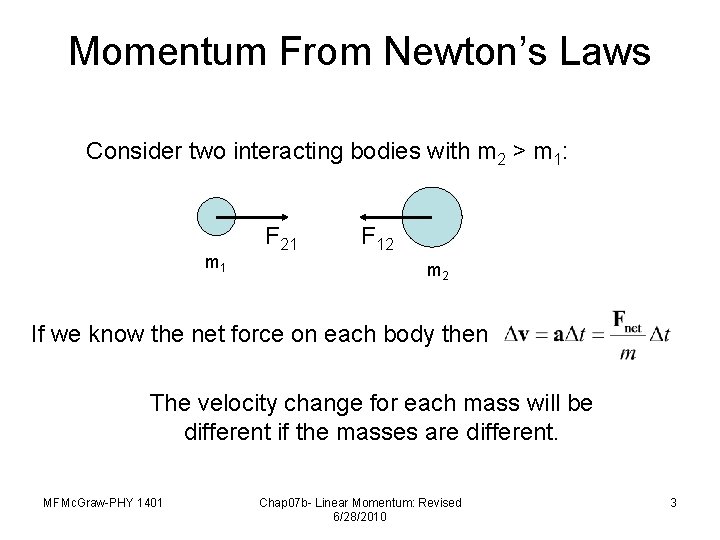
Momentum From Newton’s Laws Consider two interacting bodies with m 2 > m 1: m 1 F 21 F 12 m 2 If we know the net force on each body then The velocity change for each mass will be different if the masses are different. MFMc. Graw-PHY 1401 Chap 07 b- Linear Momentum: Revised 6/28/2010 3
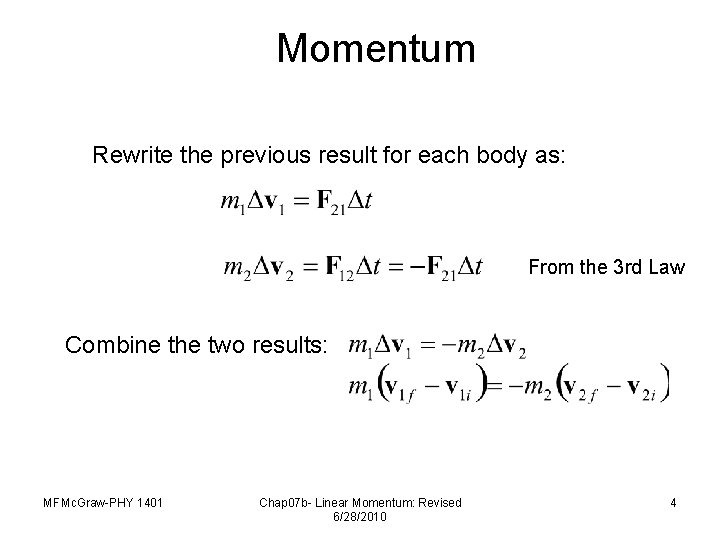
Momentum Rewrite the previous result for each body as: From the 3 rd Law Combine the two results: MFMc. Graw-PHY 1401 Chap 07 b- Linear Momentum: Revised 6/28/2010 4
Define Momentum The quantity (mv) is called momentum (p). p = mv and is a vector. The unit of momentum is kg m/s; there is no derived unit for momentum. MFMc. Graw-PHY 1401 Chap 07 b- Linear Momentum: Revised 6/28/2010 5
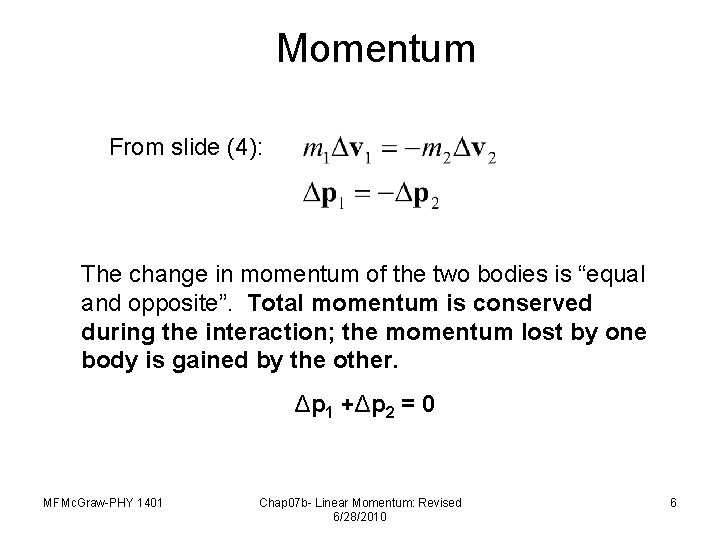
Momentum From slide (4): The change in momentum of the two bodies is “equal and opposite”. Total momentum is conserved during the interaction; the momentum lost by one body is gained by the other. Δp 1 +Δp 2 = 0 MFMc. Graw-PHY 1401 Chap 07 b- Linear Momentum: Revised 6/28/2010 6
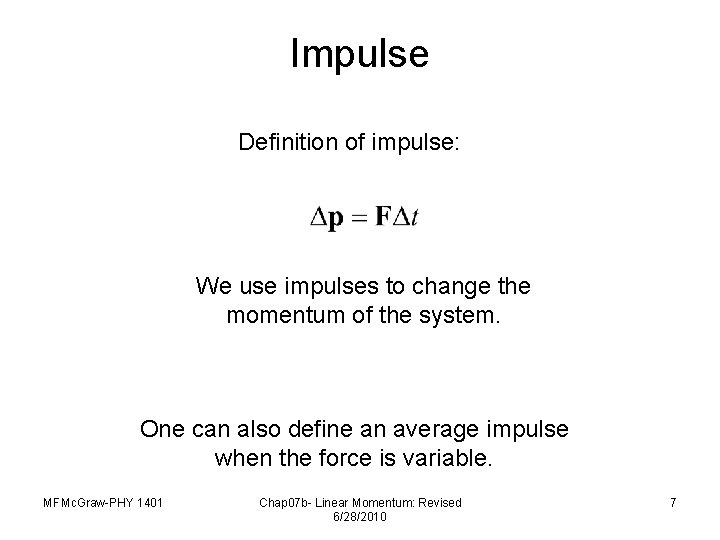
Impulse Definition of impulse: We use impulses to change the momentum of the system. One can also define an average impulse when the force is variable. MFMc. Graw-PHY 1401 Chap 07 b- Linear Momentum: Revised 6/28/2010 7
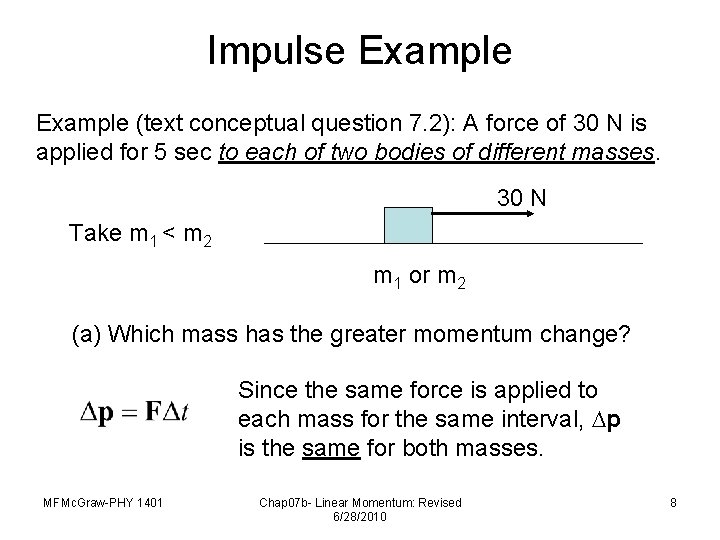
Impulse Example (text conceptual question 7. 2): A force of 30 N is applied for 5 sec to each of two bodies of different masses. 30 N Take m 1 < m 2 m 1 or m 2 (a) Which mass has the greater momentum change? Since the same force is applied to each mass for the same interval, p is the same for both masses. MFMc. Graw-PHY 1401 Chap 07 b- Linear Momentum: Revised 6/28/2010 8
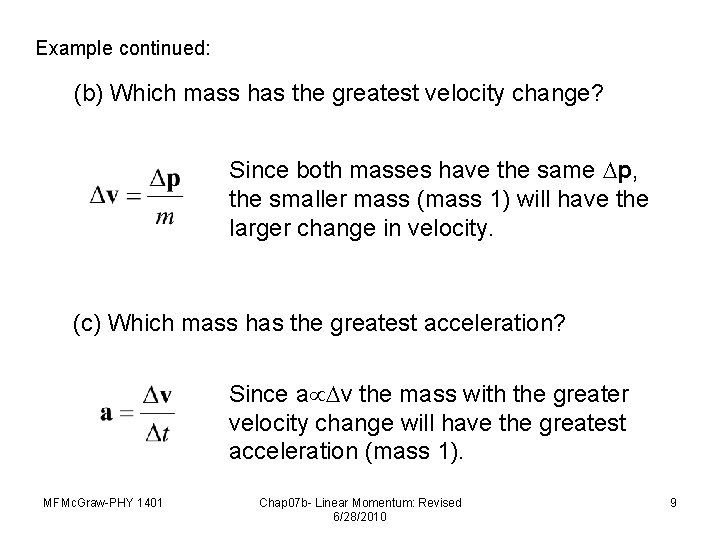
Example continued: (b) Which mass has the greatest velocity change? Since both masses have the same p, the smaller mass (mass 1) will have the larger change in velocity. (c) Which mass has the greatest acceleration? Since a v the mass with the greater velocity change will have the greatest acceleration (mass 1). MFMc. Graw-PHY 1401 Chap 07 b- Linear Momentum: Revised 6/28/2010 9
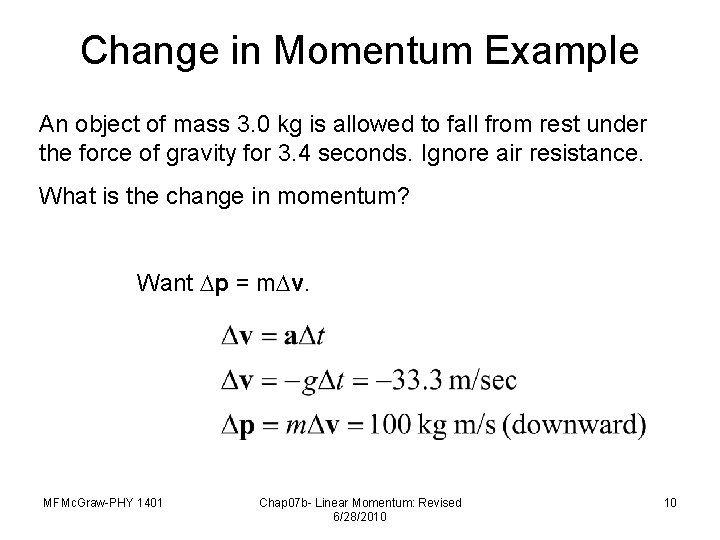
Change in Momentum Example An object of mass 3. 0 kg is allowed to fall from rest under the force of gravity for 3. 4 seconds. Ignore air resistance. What is the change in momentum? Want p = m v. MFMc. Graw-PHY 1401 Chap 07 b- Linear Momentum: Revised 6/28/2010 10
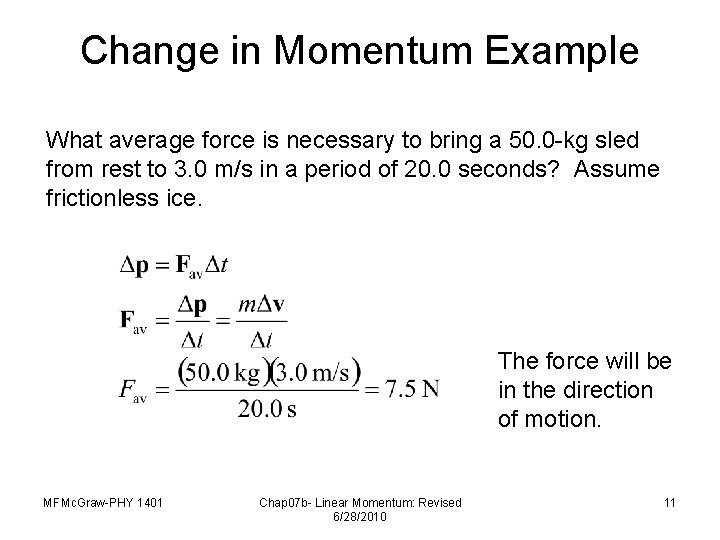
Change in Momentum Example What average force is necessary to bring a 50. 0 -kg sled from rest to 3. 0 m/s in a period of 20. 0 seconds? Assume frictionless ice. The force will be in the direction of motion. MFMc. Graw-PHY 1401 Chap 07 b- Linear Momentum: Revised 6/28/2010 11
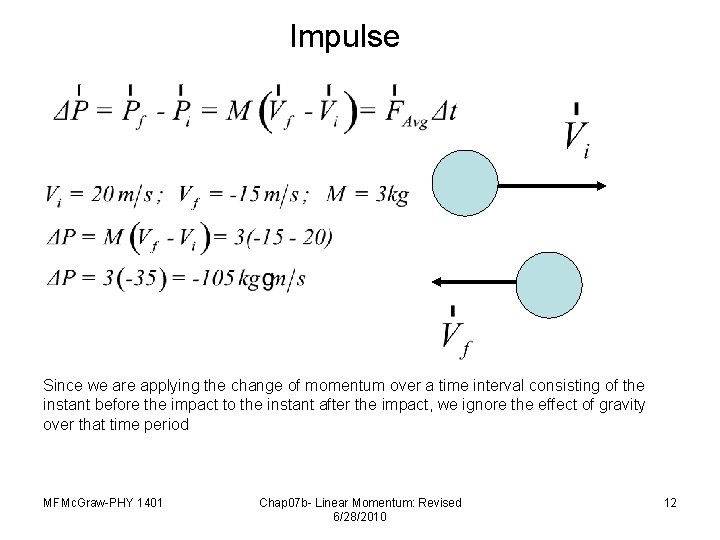
Impulse Since we are applying the change of momentum over a time interval consisting of the instant before the impact to the instant after the impact, we ignore the effect of gravity over that time period MFMc. Graw-PHY 1401 Chap 07 b- Linear Momentum: Revised 6/28/2010 12
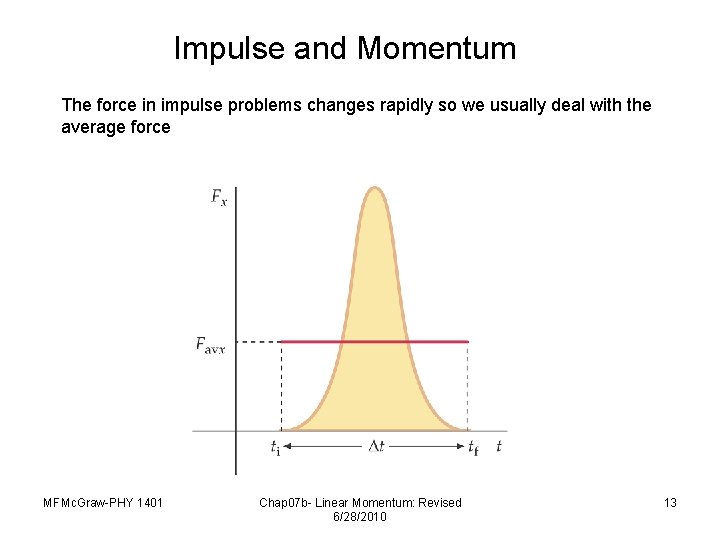
Impulse and Momentum The force in impulse problems changes rapidly so we usually deal with the average force MFMc. Graw-PHY 1401 Chap 07 b- Linear Momentum: Revised 6/28/2010 13
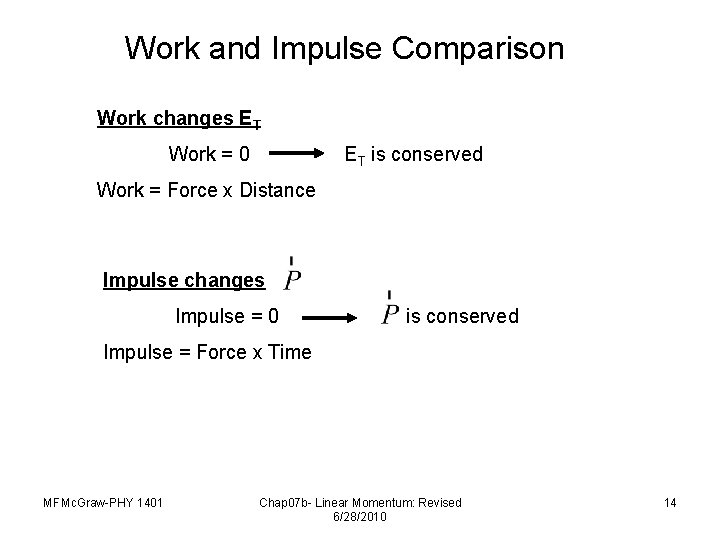
Work and Impulse Comparison Work changes ET Work = 0 ET is conserved Work = Force x Distance Impulse changes Impulse = 0 is conserved Impulse = Force x Time MFMc. Graw-PHY 1401 Chap 07 b- Linear Momentum: Revised 6/28/2010 14
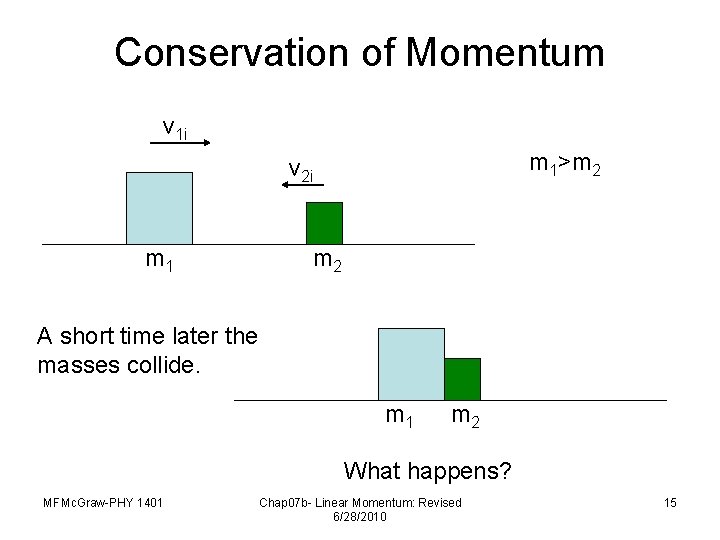
Conservation of Momentum v 1 i m 1>m 2 v 2 i m 1 m 2 A short time later the masses collide. m 1 m 2 What happens? MFMc. Graw-PHY 1401 Chap 07 b- Linear Momentum: Revised 6/28/2010 15
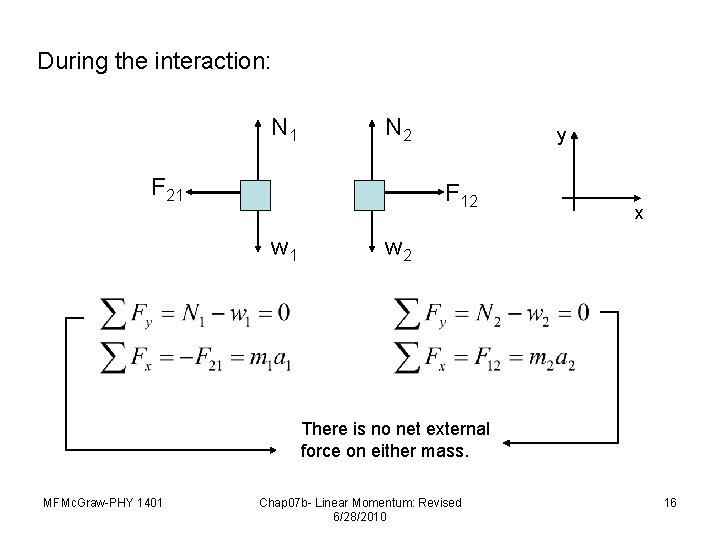
During the interaction: N 1 N 2 F 21 y F 12 w 1 x w 2 There is no net external force on either mass. MFMc. Graw-PHY 1401 Chap 07 b- Linear Momentum: Revised 6/28/2010 16
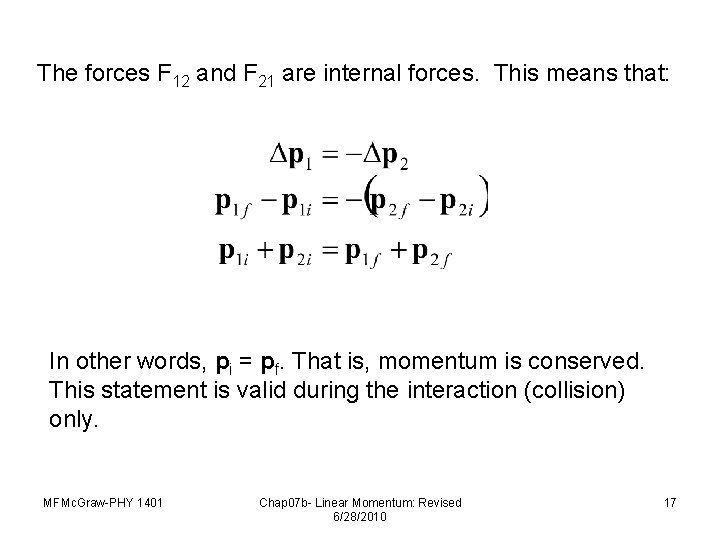
The forces F 12 and F 21 are internal forces. This means that: In other words, pi = pf. That is, momentum is conserved. This statement is valid during the interaction (collision) only. MFMc. Graw-PHY 1401 Chap 07 b- Linear Momentum: Revised 6/28/2010 17
Momentum Examples MFMc. Graw-PHY 1401 Chap 07 b- Linear Momentum: Revised 6/28/2010 18
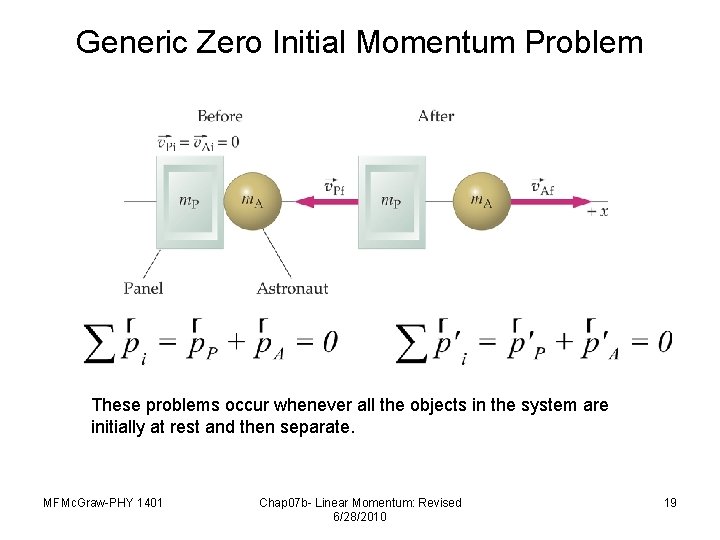
Generic Zero Initial Momentum Problem These problems occur whenever all the objects in the system are initially at rest and then separate. MFMc. Graw-PHY 1401 Chap 07 b- Linear Momentum: Revised 6/28/2010 19
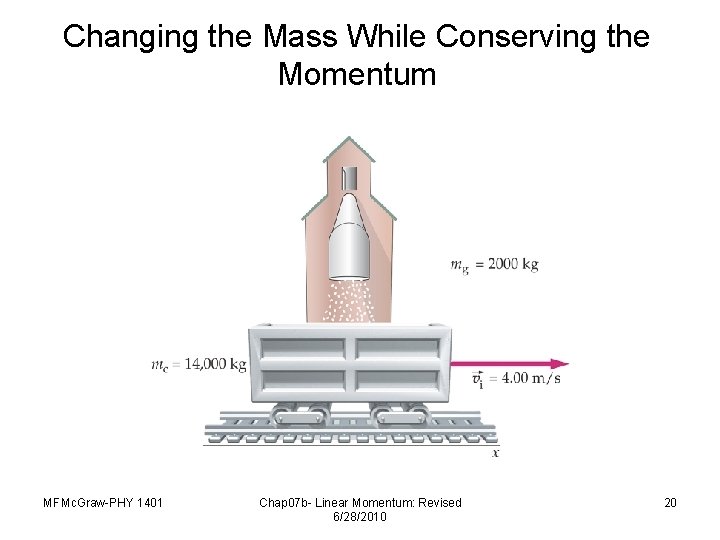
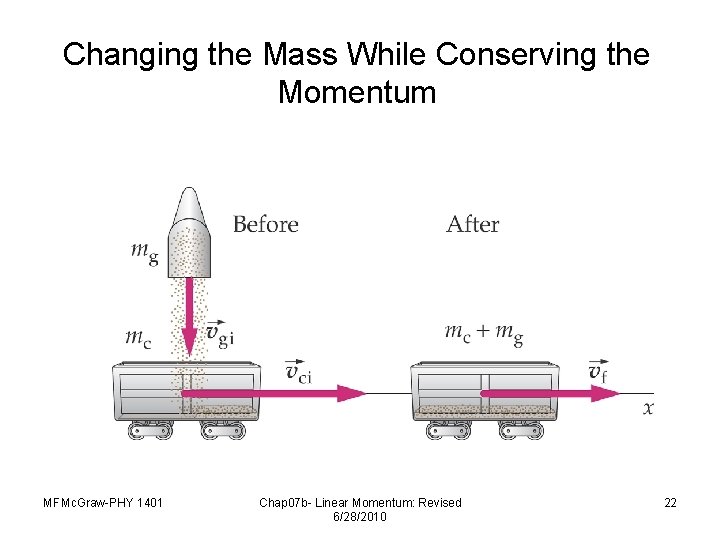
Changing the Mass While Conserving the Momentum MFMc. Graw-PHY 1401 Chap 07 b- Linear Momentum: Revised 6/28/2010 20
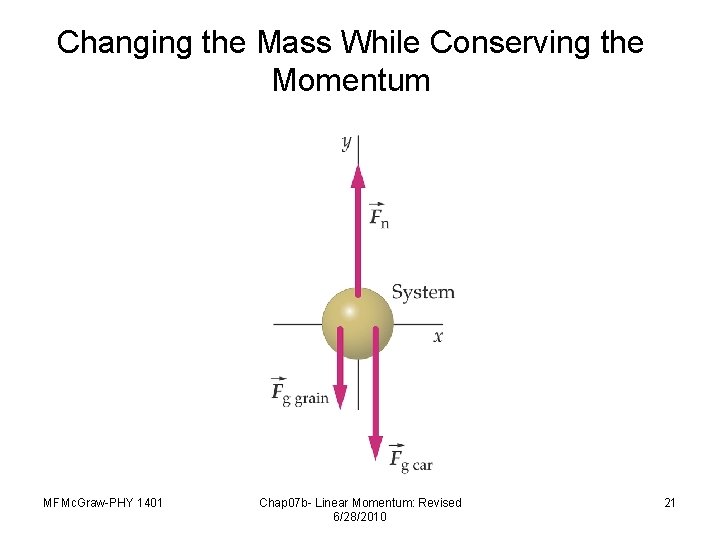
Changing the Mass While Conserving the Momentum MFMc. Graw-PHY 1401 Chap 07 b- Linear Momentum: Revised 6/28/2010 21
Changing the Mass While Conserving the Momentum MFMc. Graw-PHY 1401 Chap 07 b- Linear Momentum: Revised 6/28/2010 22
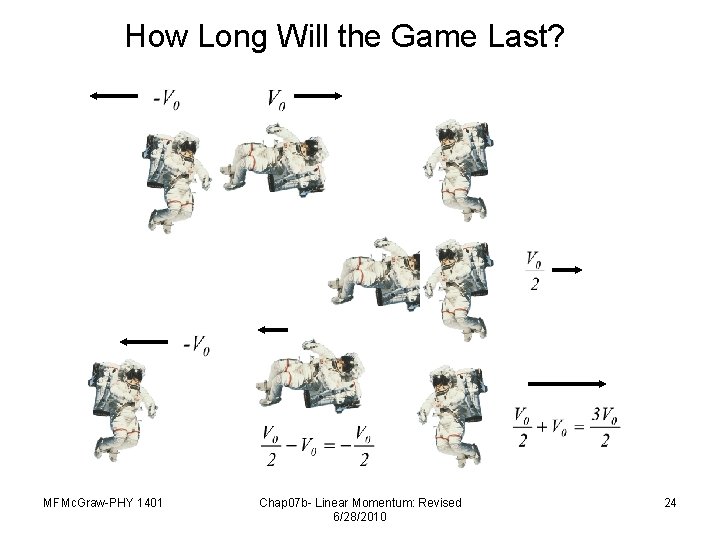
Astronaut Tossing How Long Will the Game Last? MFMc. Graw-PHY 1401 Chap 07 b- Linear Momentum: Revised 6/28/2010 23
How Long Will the Game Last? MFMc. Graw-PHY 1401 Chap 07 b- Linear Momentum: Revised 6/28/2010 24
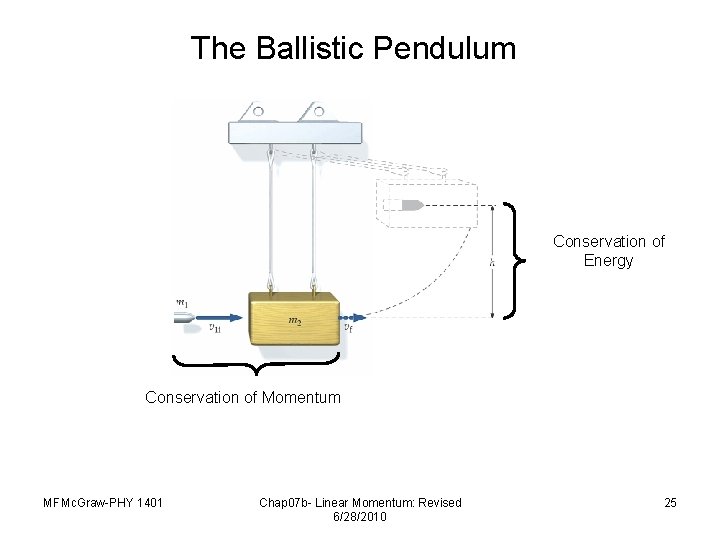
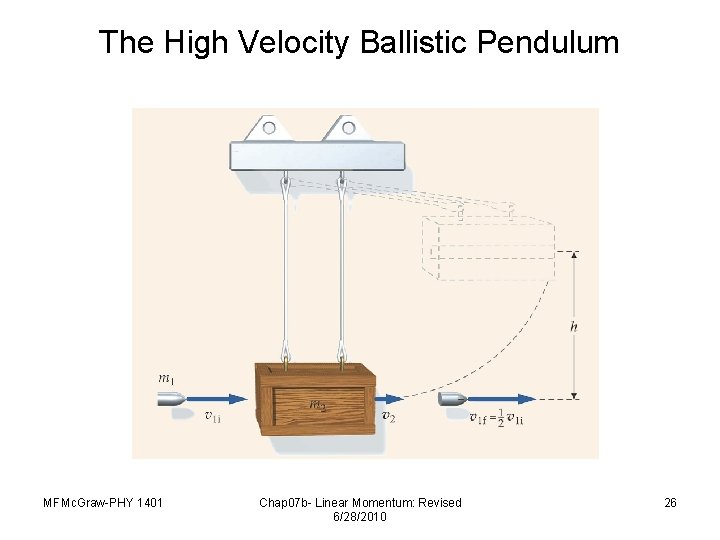
The Ballistic Pendulum Conservation of Energy Conservation of Momentum MFMc. Graw-PHY 1401 Chap 07 b- Linear Momentum: Revised 6/28/2010 25
The High Velocity Ballistic Pendulum MFMc. Graw-PHY 1401 Chap 07 b- Linear Momentum: Revised 6/28/2010 26
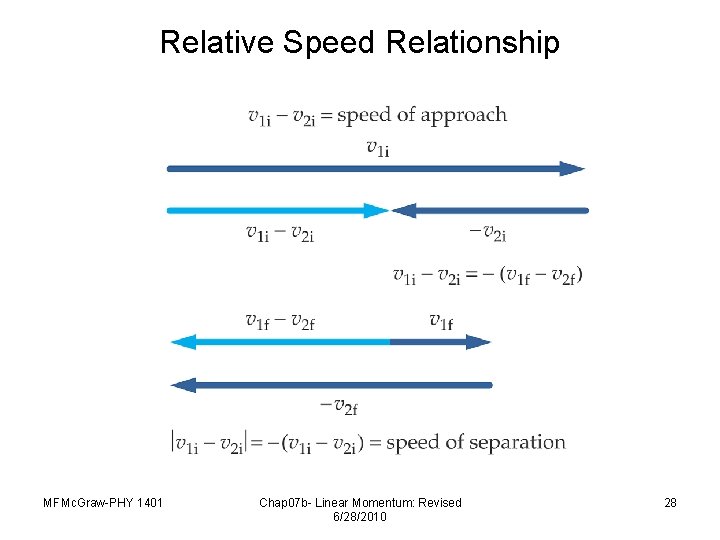
Relative Speed Relationship • The relative speed relationship applies to elastic collisions. • In an elastic collision the total kinetic energy is also conserved. • If a second equation is needed to solve a momentum problem, the relative speed relationship is easier to deal with than the KE equation. MFMc. Graw-PHY 1401 Chap 07 b- Linear Momentum: Revised 6/28/2010 27
Relative Speed Relationship MFMc. Graw-PHY 1401 Chap 07 b- Linear Momentum: Revised 6/28/2010 28
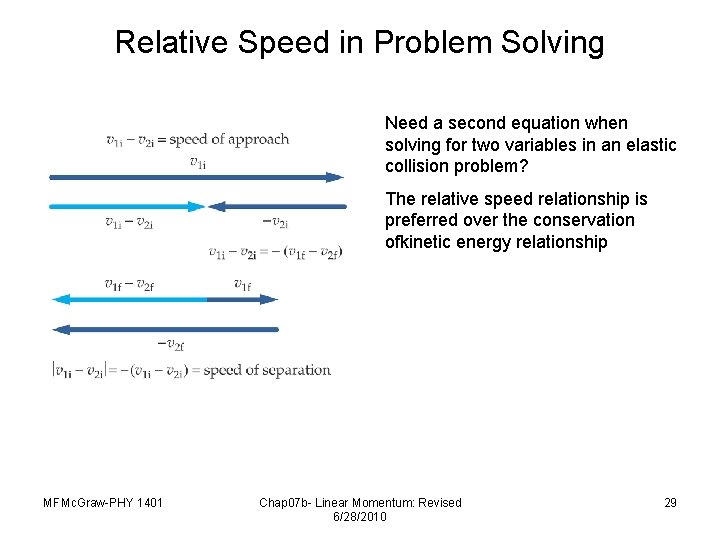
Relative Speed in Problem Solving Need a second equation when solving for two variables in an elastic collision problem? The relative speed relationship is preferred over the conservation ofkinetic energy relationship MFMc. Graw-PHY 1401 Chap 07 b- Linear Momentum: Revised 6/28/2010 29
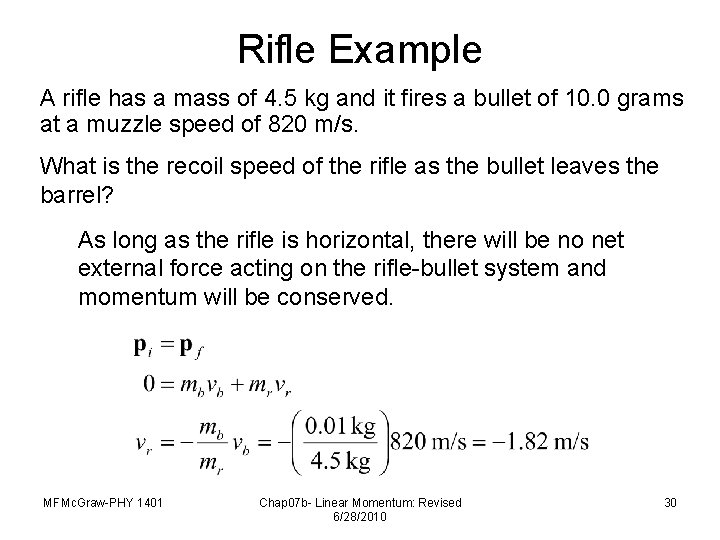
Rifle Example A rifle has a mass of 4. 5 kg and it fires a bullet of 10. 0 grams at a muzzle speed of 820 m/s. What is the recoil speed of the rifle as the bullet leaves the barrel? As long as the rifle is horizontal, there will be no net external force acting on the rifle-bullet system and momentum will be conserved. MFMc. Graw-PHY 1401 Chap 07 b- Linear Momentum: Revised 6/28/2010 30
Center of Mass MFMc. Graw-PHY 1401 Chap 07 b- Linear Momentum: Revised 6/28/2010 31
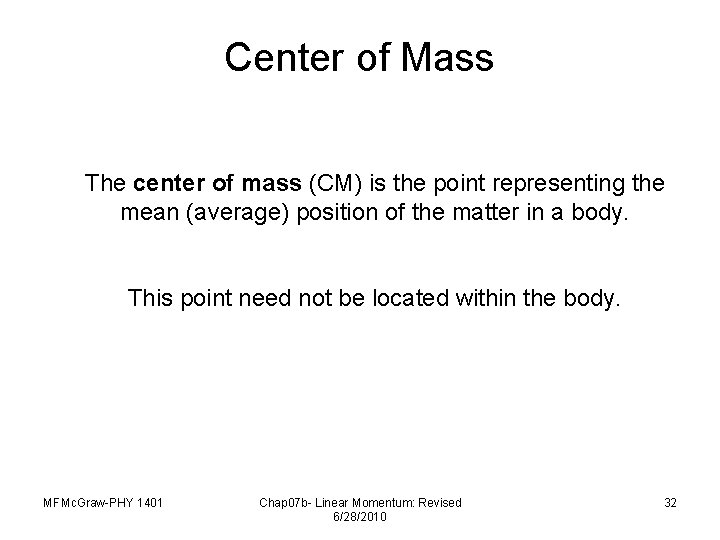
Center of Mass The center of mass (CM) is the point representing the mean (average) position of the matter in a body. This point need not be located within the body. MFMc. Graw-PHY 1401 Chap 07 b- Linear Momentum: Revised 6/28/2010 32
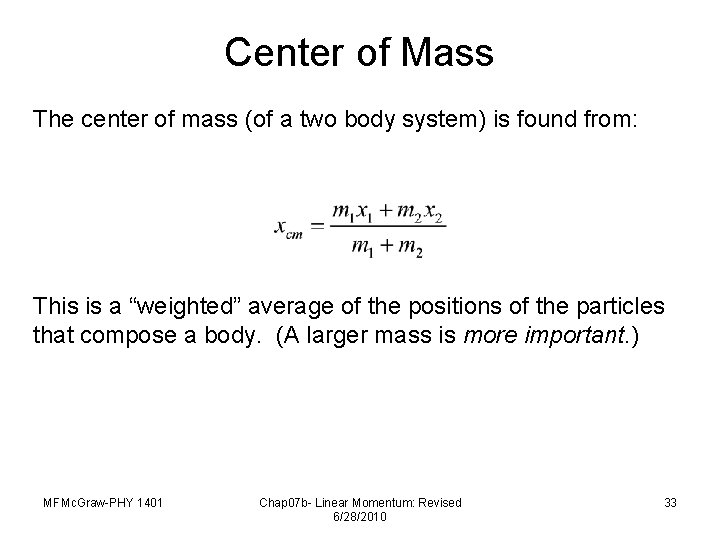
Center of Mass The center of mass (of a two body system) is found from: This is a “weighted” average of the positions of the particles that compose a body. (A larger mass is more important. ) MFMc. Graw-PHY 1401 Chap 07 b- Linear Momentum: Revised 6/28/2010 33
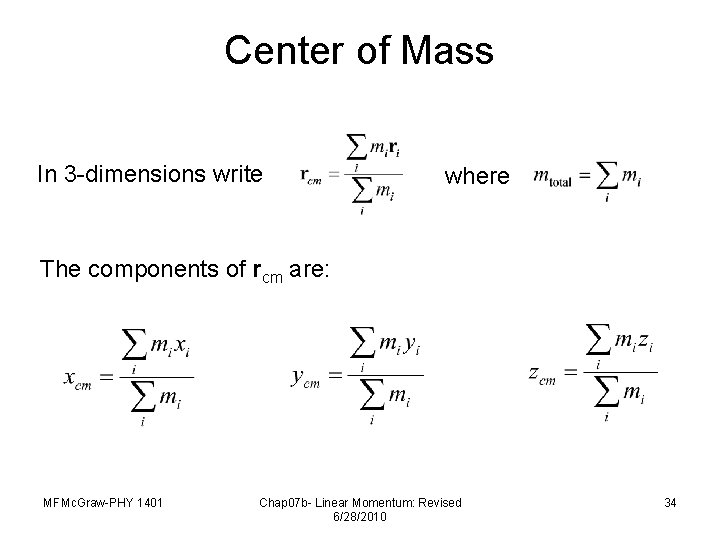
Center of Mass In 3 -dimensions write where The components of rcm are: MFMc. Graw-PHY 1401 Chap 07 b- Linear Momentum: Revised 6/28/2010 34
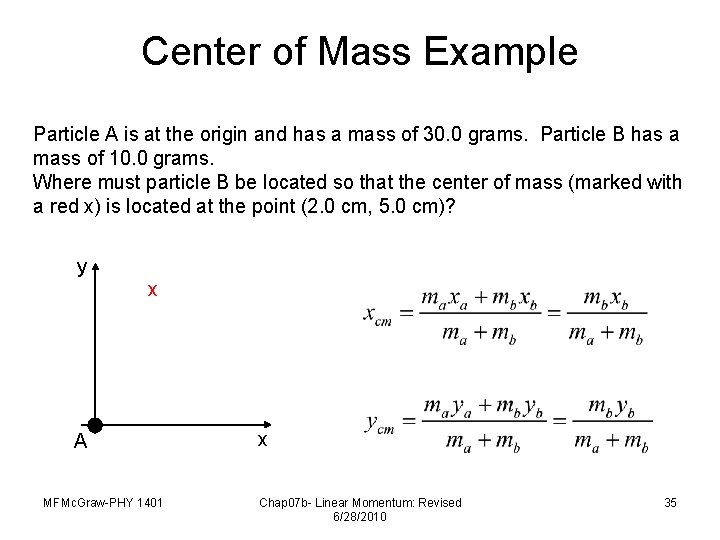
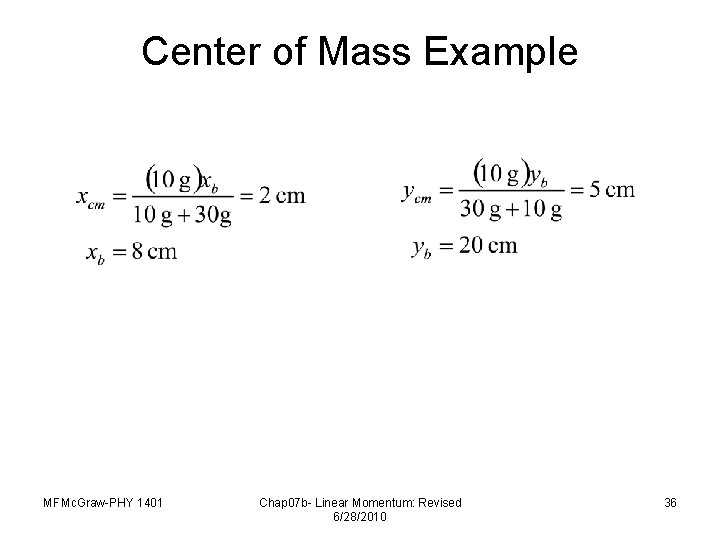
Center of Mass Example Particle A is at the origin and has a mass of 30. 0 grams. Particle B has a mass of 10. 0 grams. Where must particle B be located so that the center of mass (marked with a red x) is located at the point (2. 0 cm, 5. 0 cm)? y x A MFMc. Graw-PHY 1401 x Chap 07 b- Linear Momentum: Revised 6/28/2010 35
Center of Mass Example MFMc. Graw-PHY 1401 Chap 07 b- Linear Momentum: Revised 6/28/2010 36
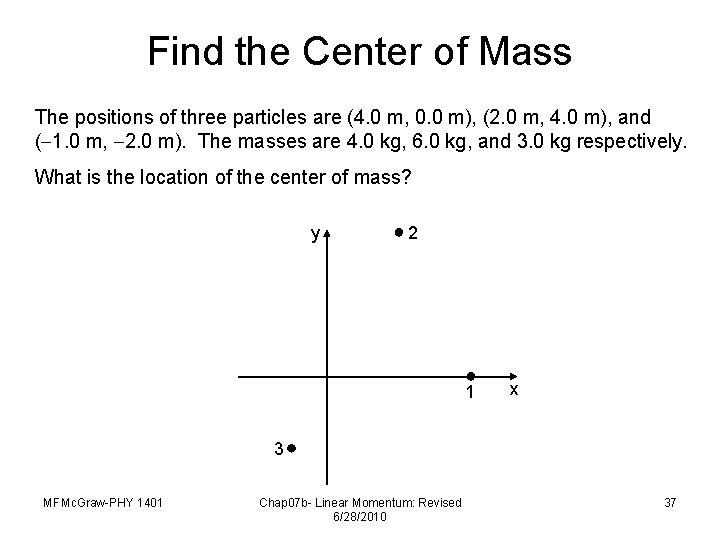
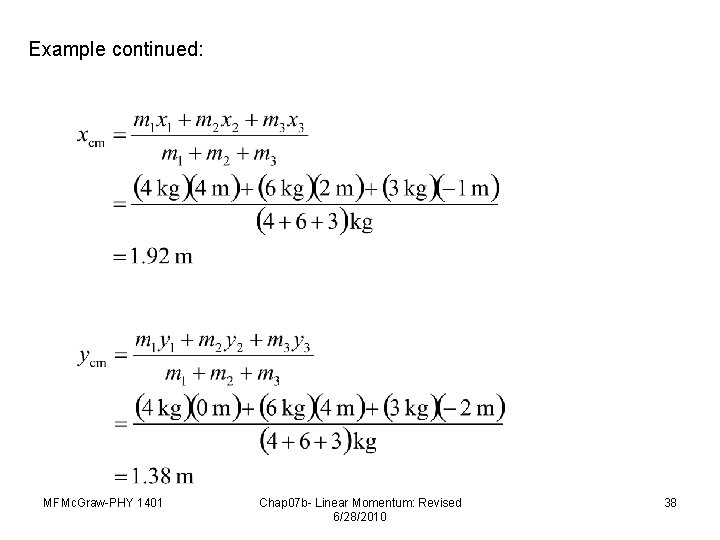
Find the Center of Mass The positions of three particles are (4. 0 m, 0. 0 m), (2. 0 m, 4. 0 m), and ( 1. 0 m, 2. 0 m). The masses are 4. 0 kg, 6. 0 kg, and 3. 0 kg respectively. What is the location of the center of mass? y 2 1 x 3 MFMc. Graw-PHY 1401 Chap 07 b- Linear Momentum: Revised 6/28/2010 37
Example continued: MFMc. Graw-PHY 1401 Chap 07 b- Linear Momentum: Revised 6/28/2010 38
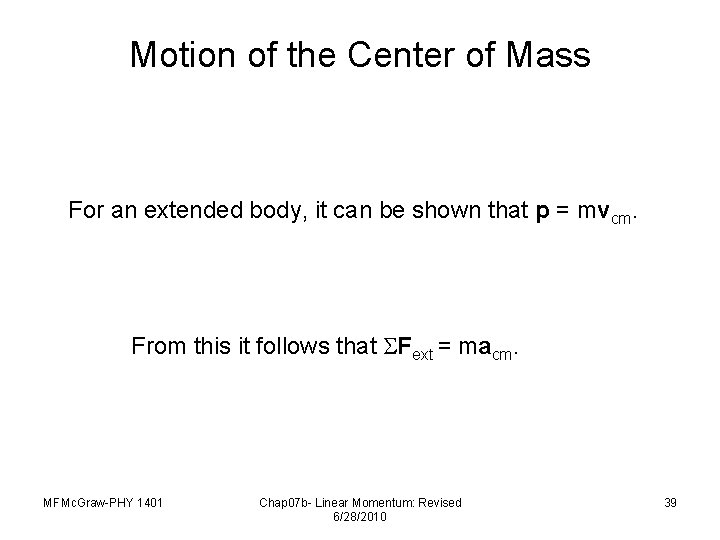
Motion of the Center of Mass For an extended body, it can be shown that p = mvcm. From this it follows that Fext = macm. MFMc. Graw-PHY 1401 Chap 07 b- Linear Momentum: Revised 6/28/2010 39
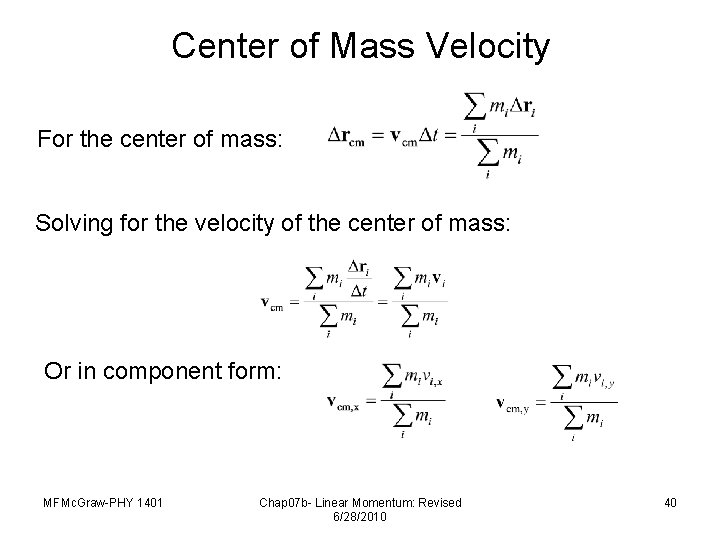
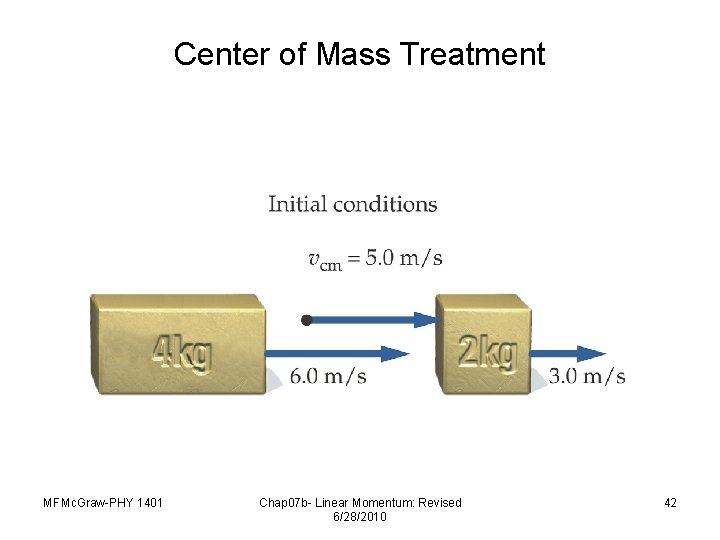
Center of Mass Velocity For the center of mass: Solving for the velocity of the center of mass: Or in component form: MFMc. Graw-PHY 1401 Chap 07 b- Linear Momentum: Revised 6/28/2010 40
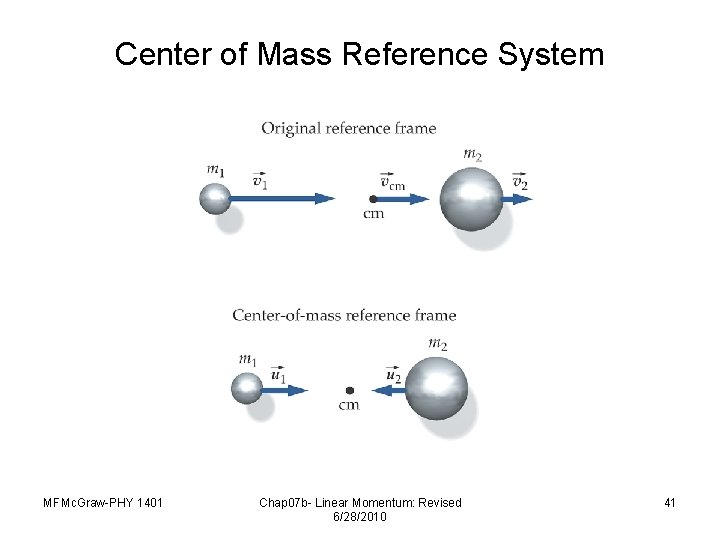
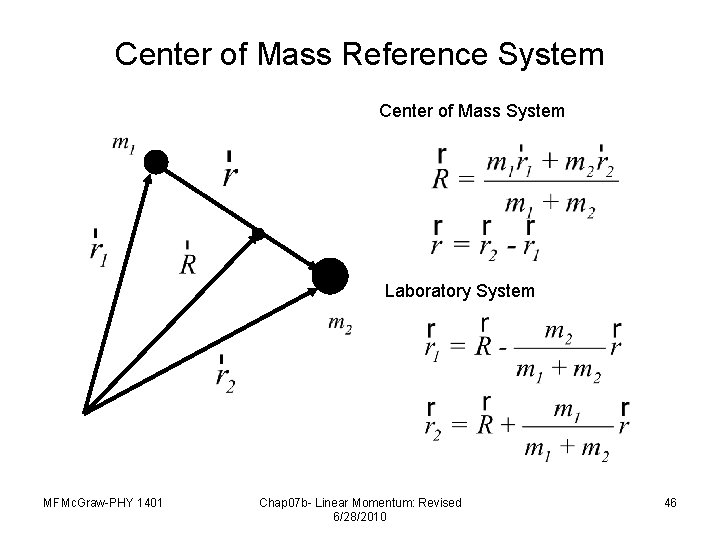
Center of Mass Reference System MFMc. Graw-PHY 1401 Chap 07 b- Linear Momentum: Revised 6/28/2010 41
Center of Mass Treatment MFMc. Graw-PHY 1401 Chap 07 b- Linear Momentum: Revised 6/28/2010 42
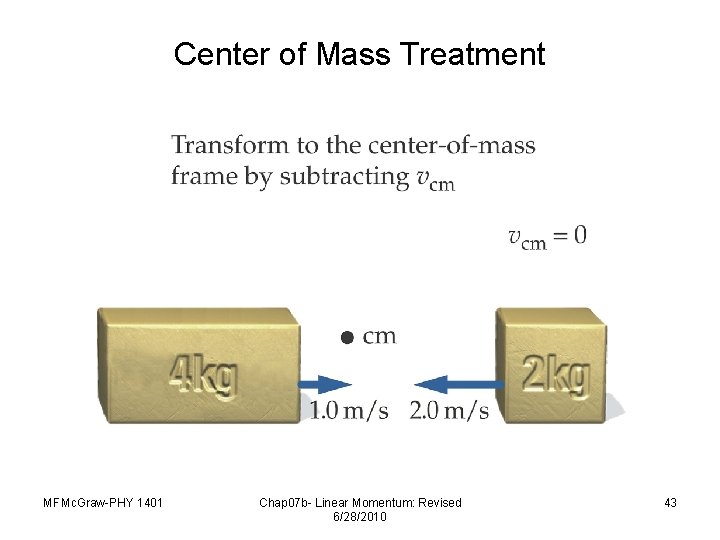
Center of Mass Treatment MFMc. Graw-PHY 1401 Chap 07 b- Linear Momentum: Revised 6/28/2010 43
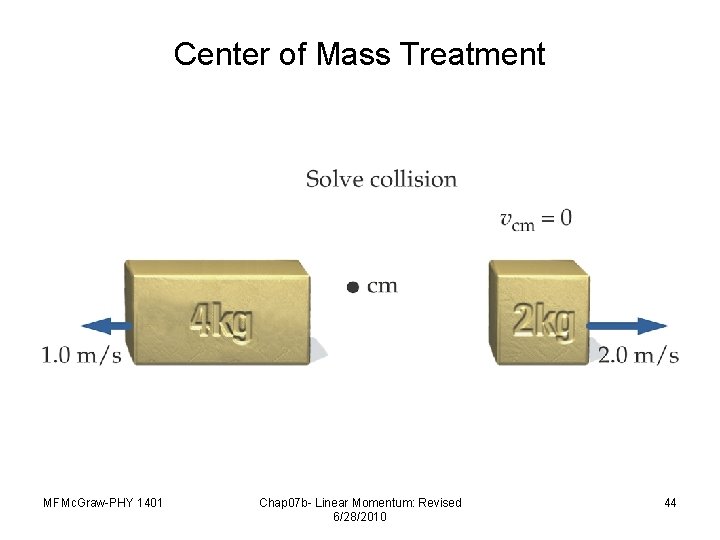
Center of Mass Treatment MFMc. Graw-PHY 1401 Chap 07 b- Linear Momentum: Revised 6/28/2010 44
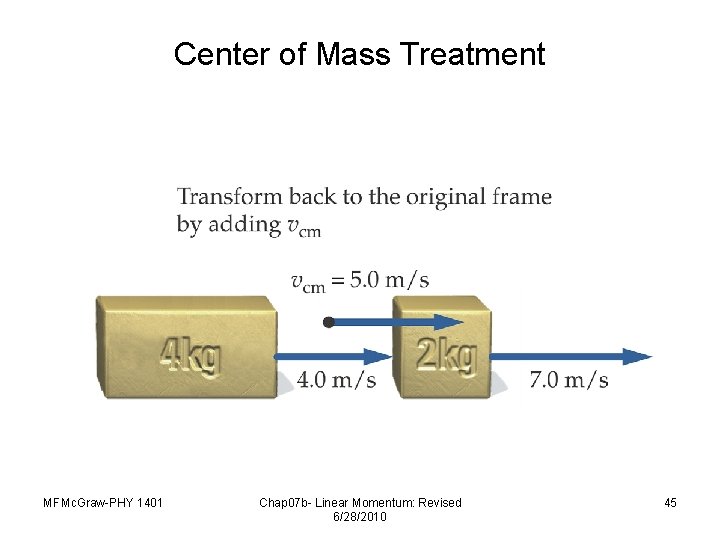
Center of Mass Treatment MFMc. Graw-PHY 1401 Chap 07 b- Linear Momentum: Revised 6/28/2010 45
Center of Mass Reference System Center of Mass System Laboratory System MFMc. Graw-PHY 1401 Chap 07 b- Linear Momentum: Revised 6/28/2010 46
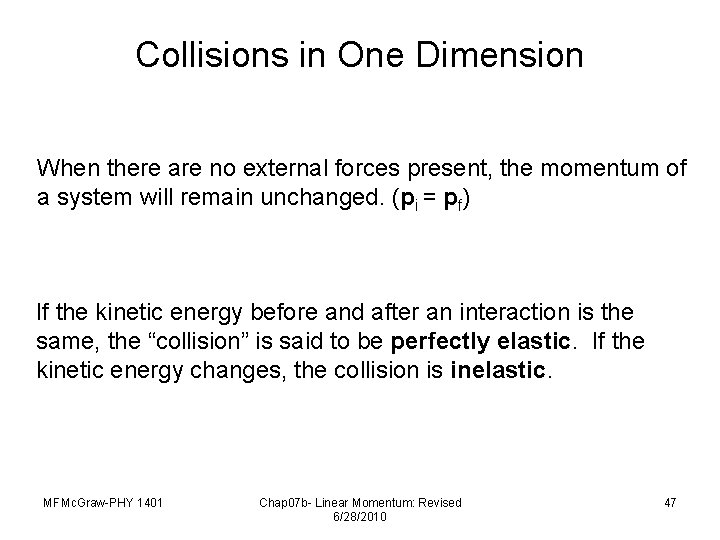
Collisions in One Dimension When there are no external forces present, the momentum of a system will remain unchanged. (pi = pf) If the kinetic energy before and after an interaction is the same, the “collision” is said to be perfectly elastic. If the kinetic energy changes, the collision is inelastic. MFMc. Graw-PHY 1401 Chap 07 b- Linear Momentum: Revised 6/28/2010 47
Collisions in One Dimension If, after a collision, the bodies remain stuck together, the loss of kinetic energy is a maximum, but not necessarily a 100% loss of kinetic energy. This type of collision is called perfectly inelastic. MFMc. Graw-PHY 1401 Chap 07 b- Linear Momentum: Revised 6/28/2010 48
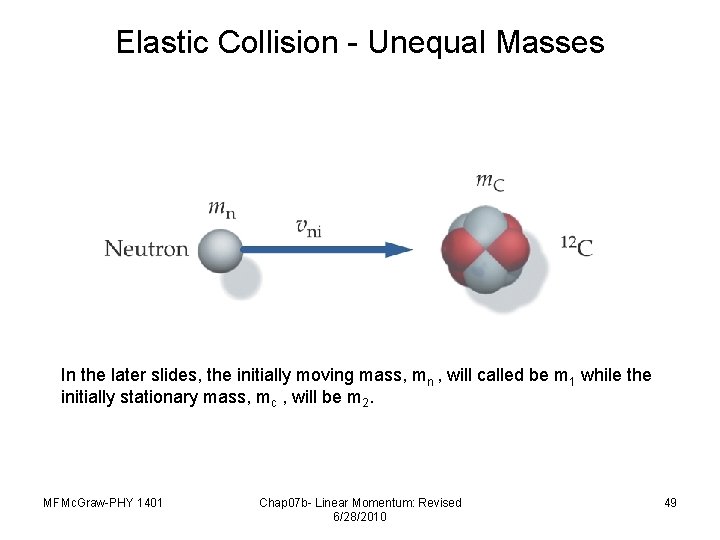
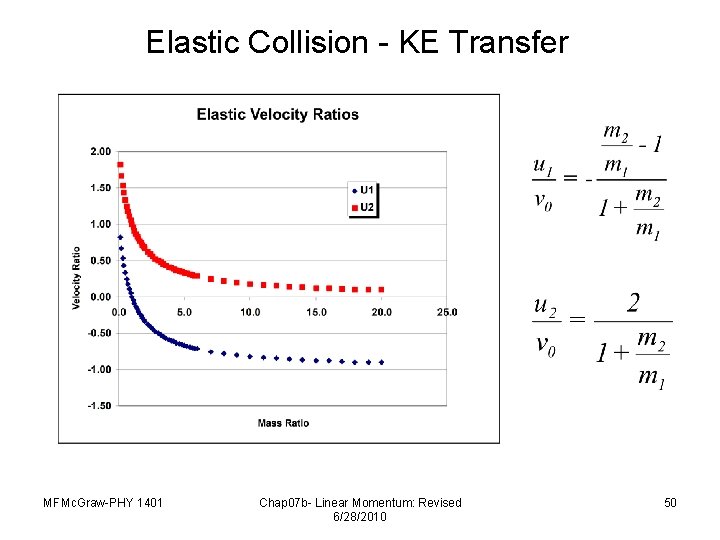
Elastic Collision - Unequal Masses In the later slides, the initially moving mass, mn , will called be m 1 while the initially stationary mass, mc , will be m 2. MFMc. Graw-PHY 1401 Chap 07 b- Linear Momentum: Revised 6/28/2010 49
Elastic Collision - KE Transfer MFMc. Graw-PHY 1401 Chap 07 b- Linear Momentum: Revised 6/28/2010 50
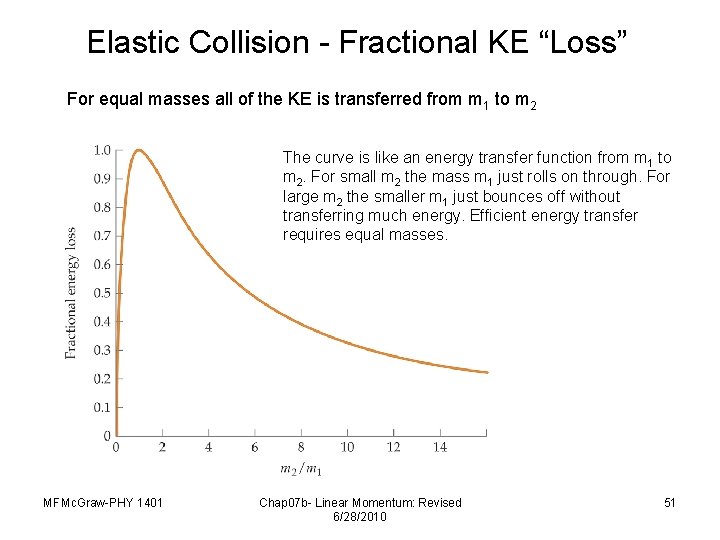
Elastic Collision - Fractional KE “Loss” For equal masses all of the KE is transferred from m 1 to m 2 The curve is like an energy transfer function from m 1 to m 2. For small m 2 the mass m 1 just rolls on through. For large m 2 the smaller m 1 just bounces off without transferring much energy. Efficient energy transfer requires equal masses. MFMc. Graw-PHY 1401 Chap 07 b- Linear Momentum: Revised 6/28/2010 51
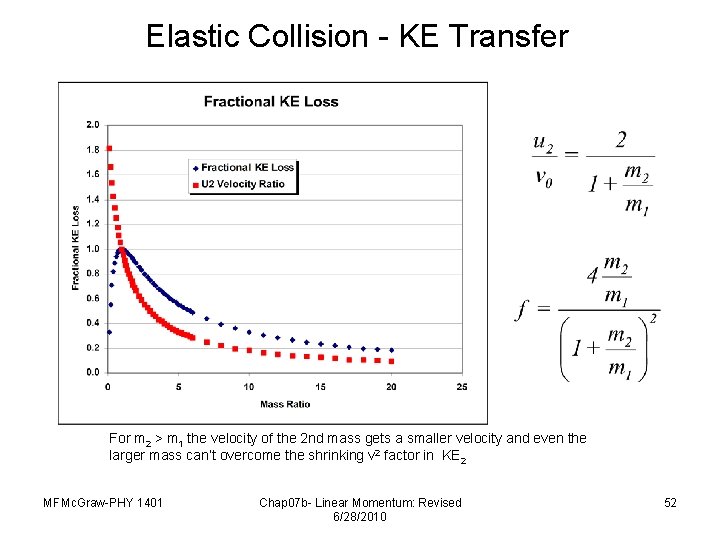
Elastic Collision - KE Transfer For m 2 > m 1 the velocity of the 2 nd mass gets a smaller velocity and even the larger mass can’t overcome the shrinking v 2 factor in KE 2 MFMc. Graw-PHY 1401 Chap 07 b- Linear Momentum: Revised 6/28/2010 52
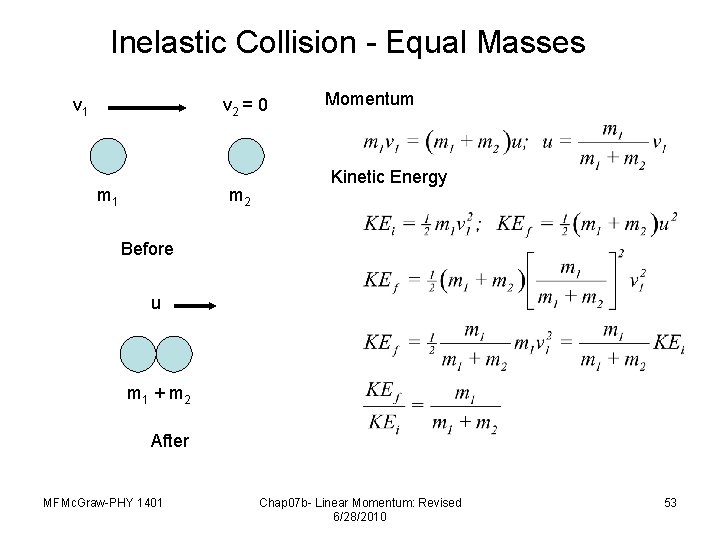
Inelastic Collision - Equal Masses v 1 v 2 = 0 m 1 m 2 Momentum Kinetic Energy Before u m 1 + m 2 After MFMc. Graw-PHY 1401 Chap 07 b- Linear Momentum: Revised 6/28/2010 53
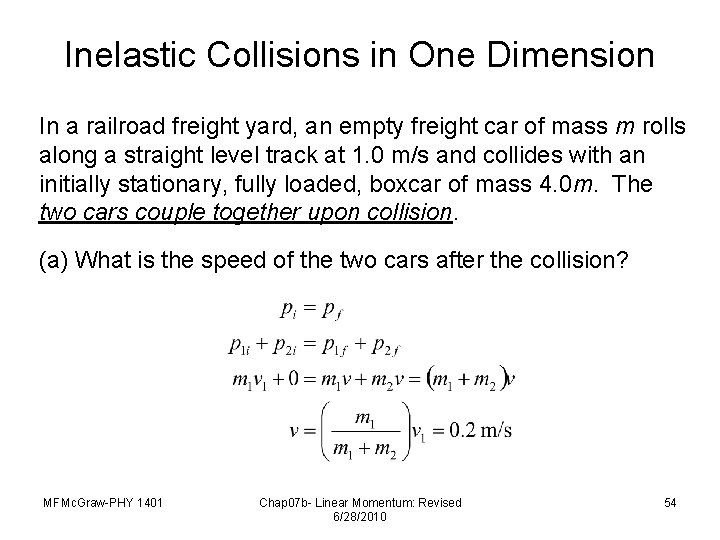
Inelastic Collisions in One Dimension In a railroad freight yard, an empty freight car of mass m rolls along a straight level track at 1. 0 m/s and collides with an initially stationary, fully loaded, boxcar of mass 4. 0 m. The two cars couple together upon collision. (a) What is the speed of the two cars after the collision? MFMc. Graw-PHY 1401 Chap 07 b- Linear Momentum: Revised 6/28/2010 54
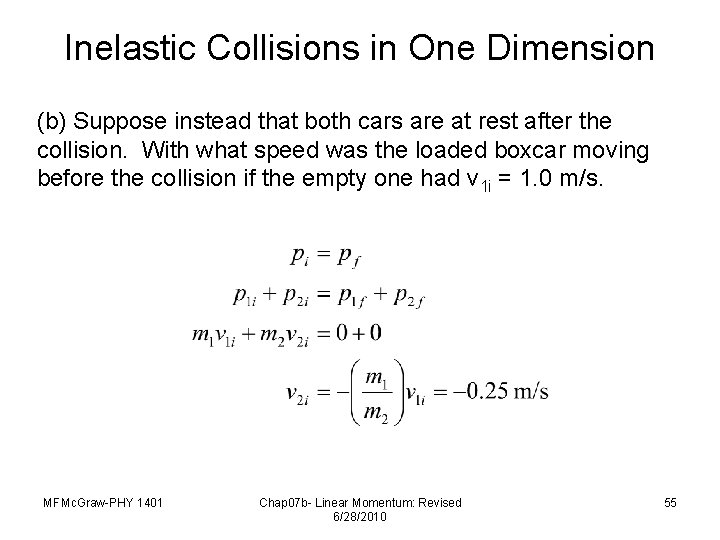
Inelastic Collisions in One Dimension (b) Suppose instead that both cars are at rest after the collision. With what speed was the loaded boxcar moving before the collision if the empty one had v 1 i = 1. 0 m/s. MFMc. Graw-PHY 1401 Chap 07 b- Linear Momentum: Revised 6/28/2010 55
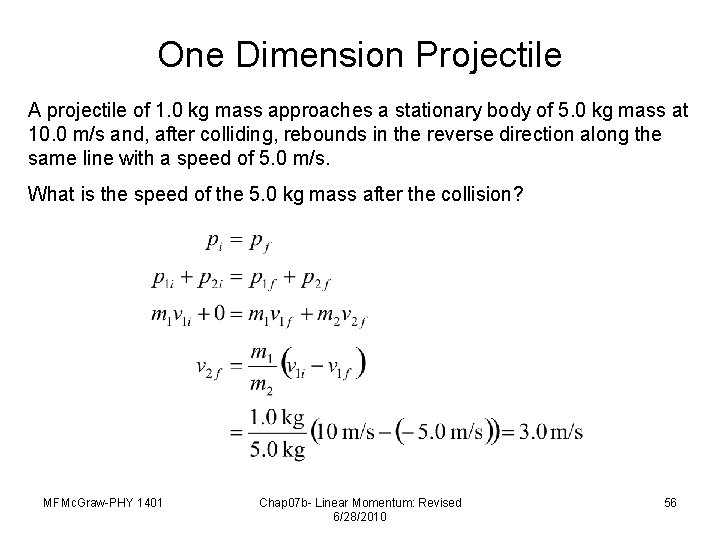
One Dimension Projectile A projectile of 1. 0 kg mass approaches a stationary body of 5. 0 kg mass at 10. 0 m/s and, after colliding, rebounds in the reverse direction along the same line with a speed of 5. 0 m/s. What is the speed of the 5. 0 kg mass after the collision? MFMc. Graw-PHY 1401 Chap 07 b- Linear Momentum: Revised 6/28/2010 56
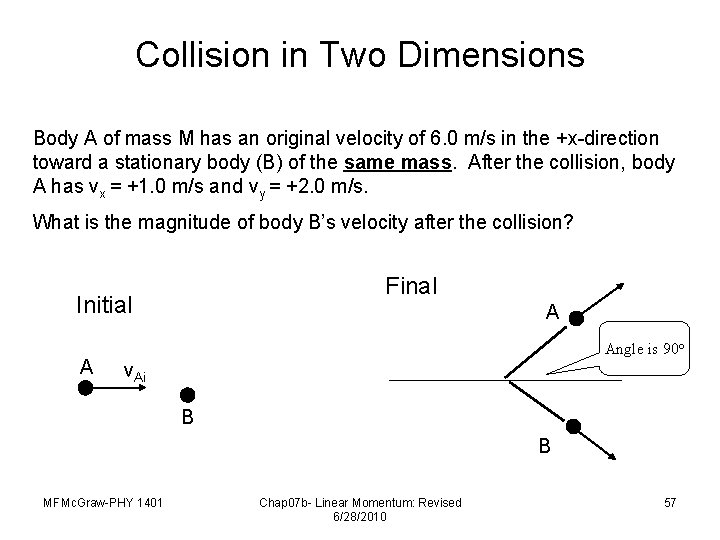
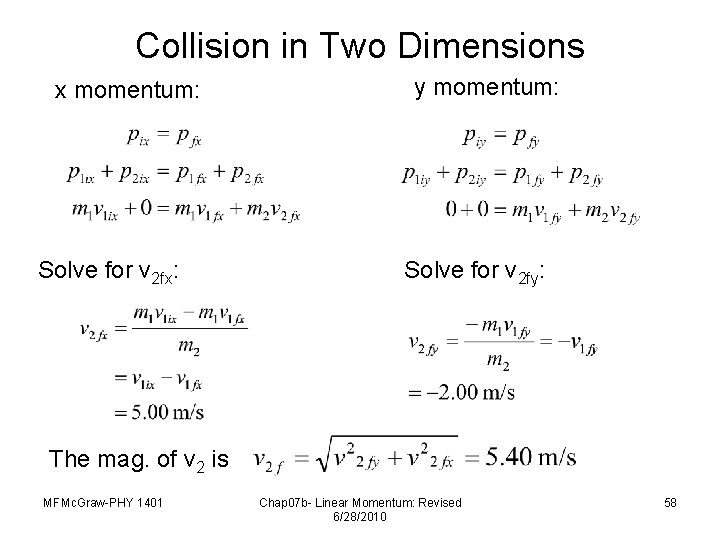
Collision in Two Dimensions Body A of mass M has an original velocity of 6. 0 m/s in the +x-direction toward a stationary body (B) of the same mass. After the collision, body A has vx = +1. 0 m/s and vy = +2. 0 m/s. What is the magnitude of body B’s velocity after the collision? Final Initial A A Angle is 90 o v. Ai B B MFMc. Graw-PHY 1401 Chap 07 b- Linear Momentum: Revised 6/28/2010 57
Collision in Two Dimensions x momentum: Solve for v 2 fx: y momentum: Solve for v 2 fy: The mag. of v 2 is MFMc. Graw-PHY 1401 Chap 07 b- Linear Momentum: Revised 6/28/2010 58
Collisions in Two and Three Dimensions MFMc. Graw-PHY 1401 Chap 07 b- Linear Momentum: Revised 6/28/2010 59
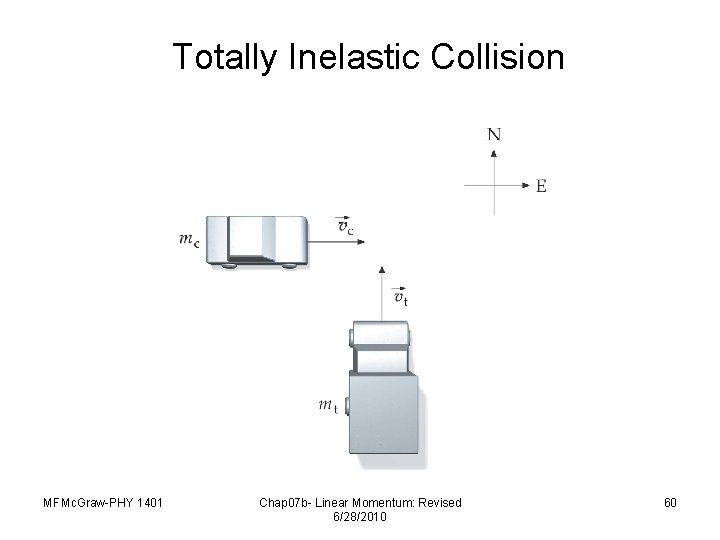
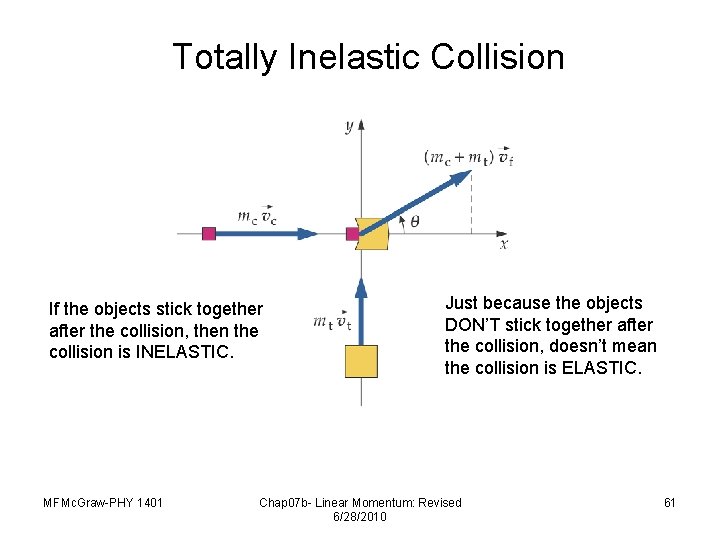
Totally Inelastic Collision MFMc. Graw-PHY 1401 Chap 07 b- Linear Momentum: Revised 6/28/2010 60
Totally Inelastic Collision If the objects stick together after the collision, then the collision is INELASTIC. MFMc. Graw-PHY 1401 Just because the objects DON’T stick together after the collision, doesn’t mean the collision is ELASTIC. Chap 07 b- Linear Momentum: Revised 6/28/2010 61
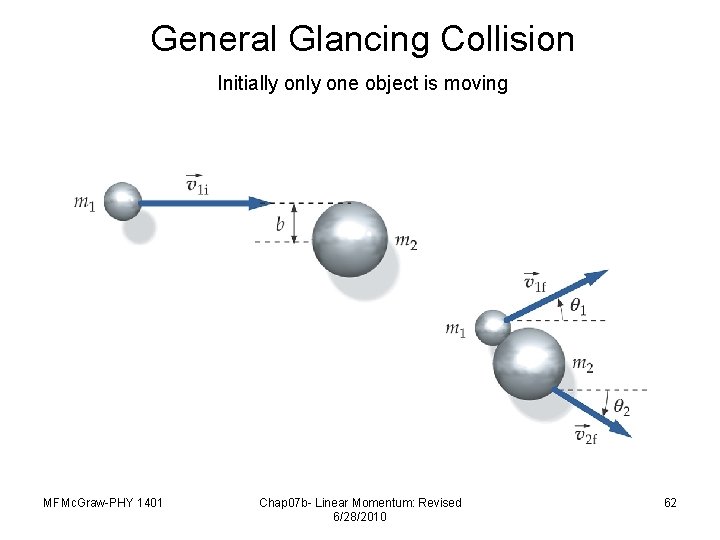
General Glancing Collision Initially one object is moving MFMc. Graw-PHY 1401 Chap 07 b- Linear Momentum: Revised 6/28/2010 62
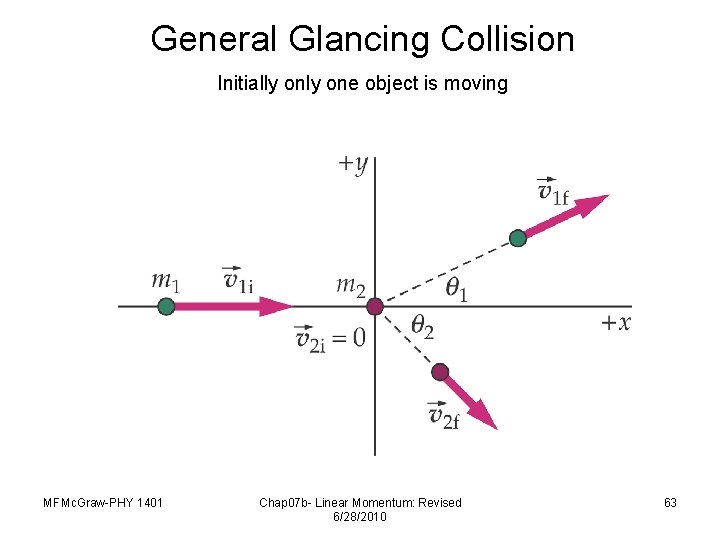
General Glancing Collision Initially one object is moving MFMc. Graw-PHY 1401 Chap 07 b- Linear Momentum: Revised 6/28/2010 63
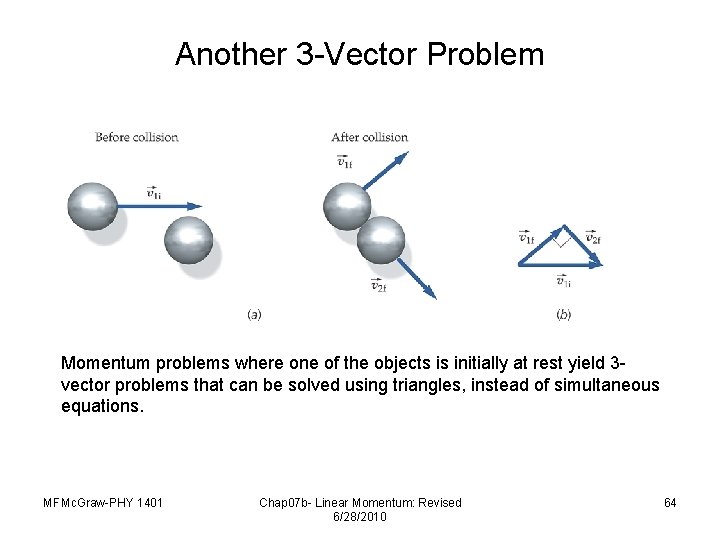
Another 3 -Vector Problem Momentum problems where one of the objects is initially at rest yield 3 vector problems that can be solved using triangles, instead of simultaneous equations. MFMc. Graw-PHY 1401 Chap 07 b- Linear Momentum: Revised 6/28/2010 64
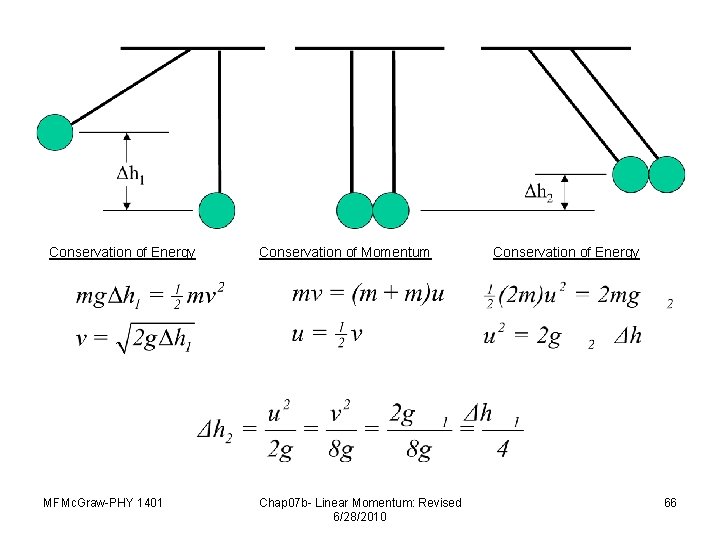
Combining Conservation of Energy, Momentum, and KE Transfer in Equal Mass Inelastic Collisions MFMc. Graw-PHY 1401 Chap 07 b- Linear Momentum: Revised 6/28/2010 65
Conservation of Energy MFMc. Graw-PHY 1401 Conservation of Momentum Chap 07 b- Linear Momentum: Revised 6/28/2010 Conservation of Energy 66
Summary • Definition of Momentum • Impulse • Center of Mass • Conservation of Momentum MFMc. Graw-PHY 1401 Chap 07 b- Linear Momentum: Revised 6/28/2010 67
Extra Slides MFMc. Graw-PHY 1401 Chap 07 b- Linear Momentum: Revised 6/28/2010 68
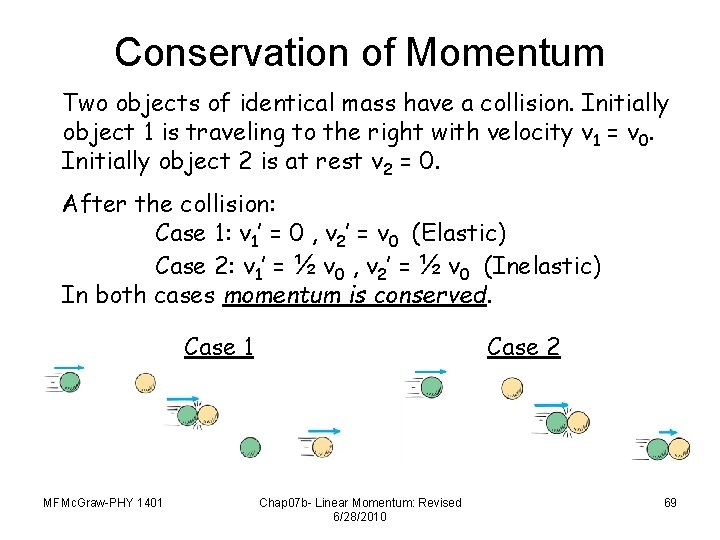
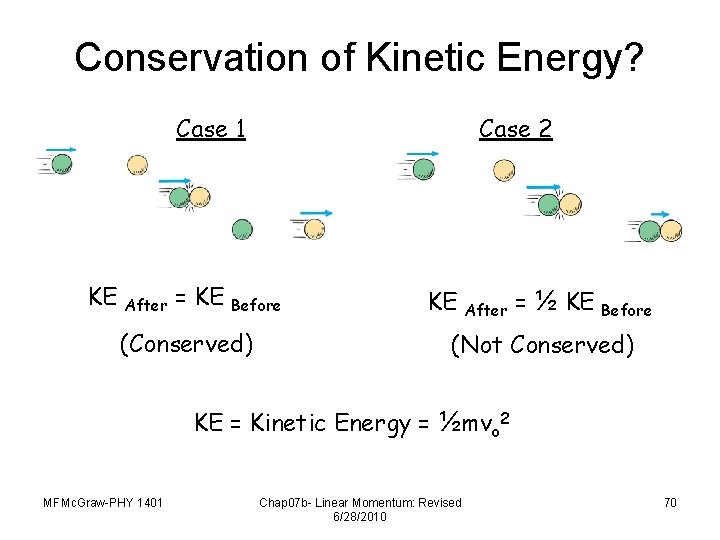
Conservation of Momentum Two objects of identical mass have a collision. Initially object 1 is traveling to the right with velocity v 1 = v 0. Initially object 2 is at rest v 2 = 0. After the collision: Case 1: v 1’ = 0 , v 2’ = v 0 (Elastic) Case 2: v 1’ = ½ v 0 , v 2’ = ½ v 0 (Inelastic) In both cases momentum is conserved. Case 1 MFMc. Graw-PHY 1401 Case 2 Chap 07 b- Linear Momentum: Revised 6/28/2010 69
Conservation of Kinetic Energy? Case 1 KE After = KE Case 2 Before (Conserved) KE After = ½ KE Before (Not Conserved) KE = Kinetic Energy = ½mvo 2 MFMc. Graw-PHY 1401 Chap 07 b- Linear Momentum: Revised 6/28/2010 70
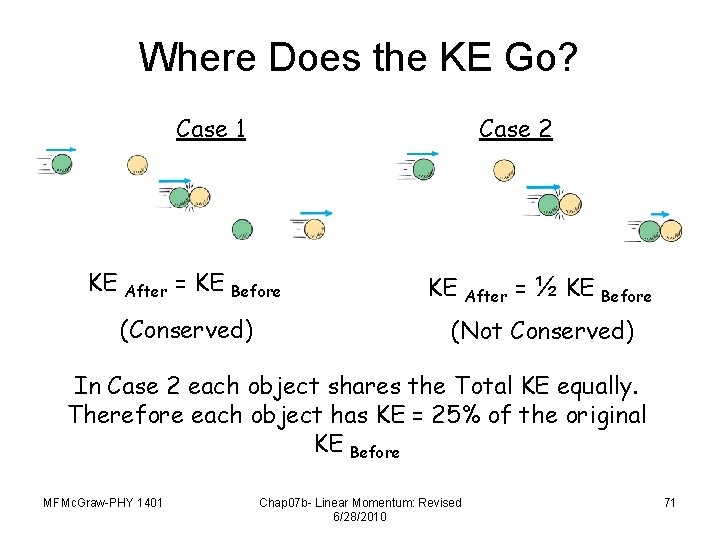
Where Does the KE Go? Case 1 KE After = KE Case 2 Before (Conserved) KE After = ½ KE Before (Not Conserved) In Case 2 each object shares the Total KE equally. Therefore each object has KE = 25% of the original KE Before MFMc. Graw-PHY 1401 Chap 07 b- Linear Momentum: Revised 6/28/2010 71
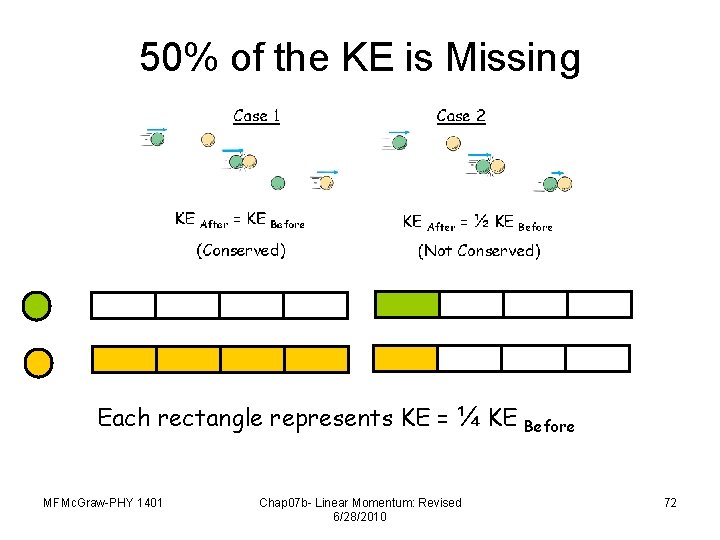
50% of the KE is Missing Each rectangle represents KE = ¼ KE MFMc. Graw-PHY 1401 Chap 07 b- Linear Momentum: Revised 6/28/2010 Before 72
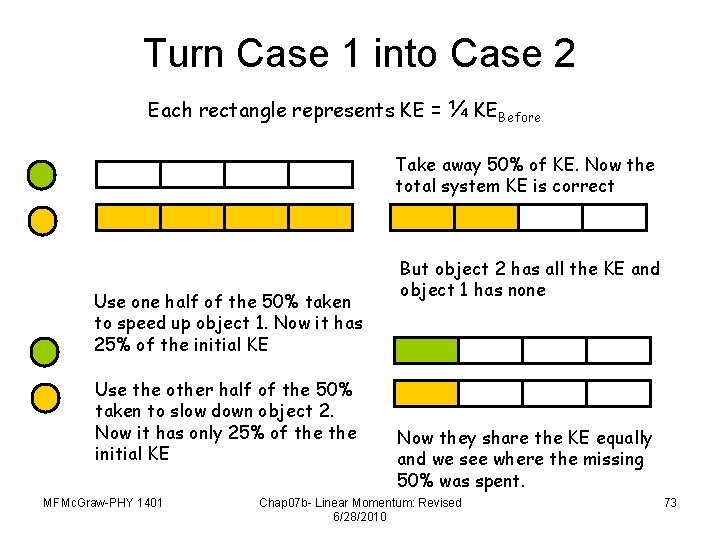
Turn Case 1 into Case 2 Each rectangle represents KE = ¼ KEBefore Take away 50% of KE. Now the total system KE is correct Use one half of the 50% taken to speed up object 1. Now it has 25% of the initial KE Use the other half of the 50% taken to slow down object 2. Now it has only 25% of the initial KE MFMc. Graw-PHY 1401 But object 2 has all the KE and object 1 has none Now they share the KE equally and we see where the missing 50% was spent. Chap 07 b- Linear Momentum: Revised 6/28/2010 73