Section 9 4 Conservation of Energy Momentum in
- Slides: 22
Section 9 -4: Conservation of Energy & Momentum in Collisions
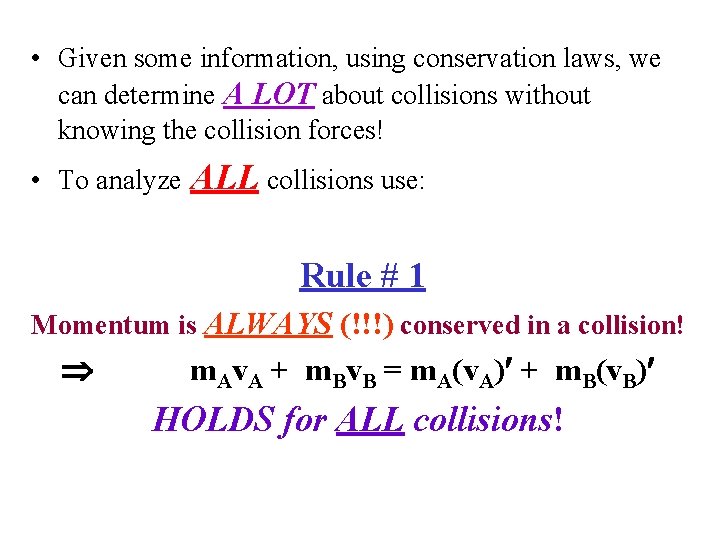
• Given some information, using conservation laws, we can determine A LOT about collisions without knowing the collision forces! • To analyze ALL collisions use: Rule # 1 Momentum is ALWAYS (!!!) conserved in a collision! m. Av. A + m. Bv. B = m. A(v. A) + m. B(v. B) HOLDS for ALL collisions!
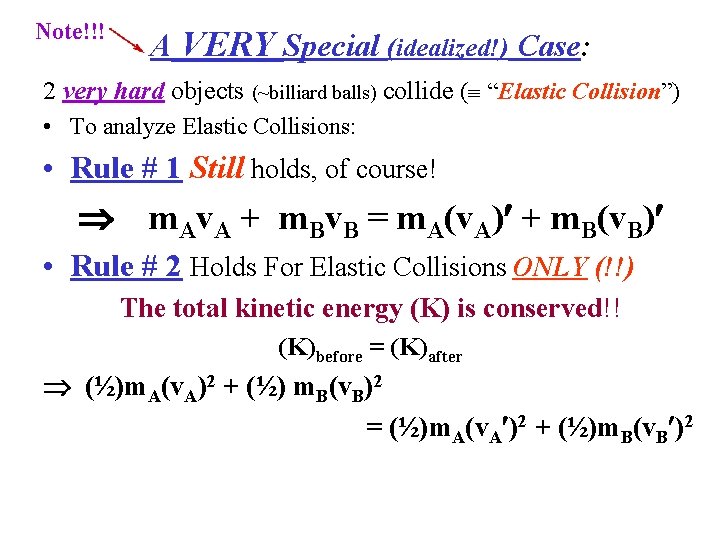
Note!!! A VERY Special (idealized!) Case: 2 very hard objects (~billiard balls) collide ( “Elastic Collision”) • To analyze Elastic Collisions: • Rule # 1 Still holds, of course! m. Av. A + m. Bv. B = m. A(v. A) + m. B(v. B) • Rule # 2 Holds For Elastic Collisions ONLY (!!) The total kinetic energy (K) is conserved!! (K)before = (K)after (½)m. A(v. A)2 + (½) m. B(v. B)2 = (½)m. A(v. A )2 + (½)m. B(v. B )2
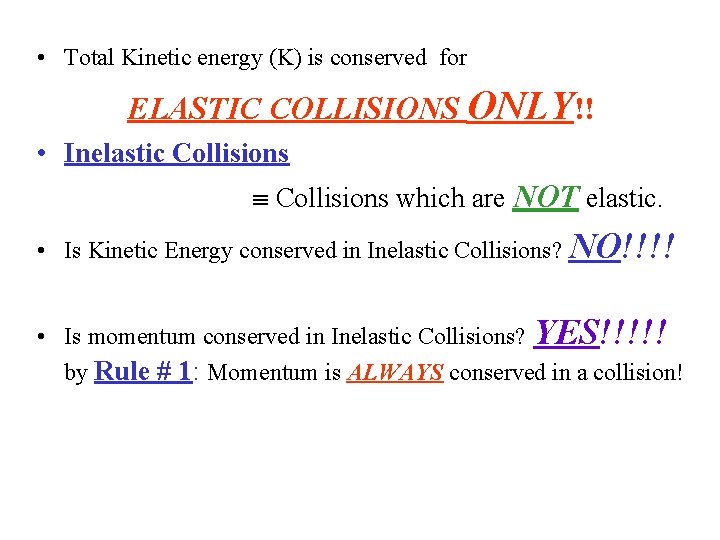
• Total Kinetic energy (K) is conserved for ELASTIC COLLISIONS ONLY!! • Inelastic Collisions which are NOT elastic. • Is Kinetic Energy conserved in Inelastic Collisions? NO!!!! • Is momentum conserved in Inelastic Collisions? YES!!!!! by Rule # 1: Momentum is ALWAYS conserved in a collision!
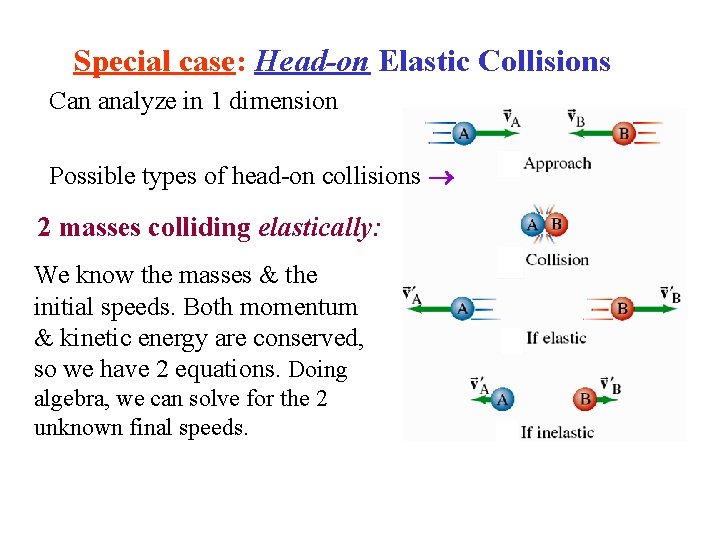
Special case: Head-on Elastic Collisions Can analyze in 1 dimension Possible types of head-on collisions 2 masses colliding elastically: We know the masses & the initial speeds. Both momentum & kinetic energy are conserved, so we have 2 equations. Doing algebra, we can solve for the 2 unknown final speeds.
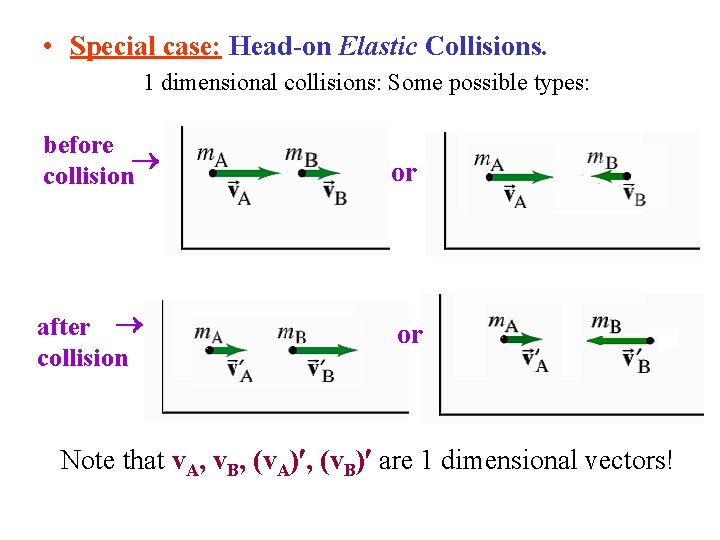
• Special case: Head-on Elastic Collisions. 1 dimensional collisions: Some possible types: before collision or after collision or Note that v. A, v. B, (v. A) , (v. B) are 1 dimensional vectors!
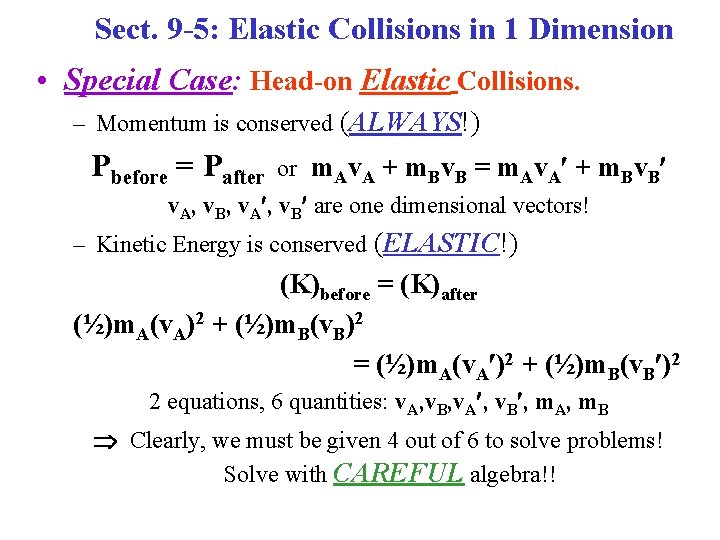
Sect. 9 -5: Elastic Collisions in 1 Dimension • Special Case: Head-on Elastic Collisions. – Momentum is conserved (ALWAYS!) Pbefore = Pafter or m. Av. A + m. Bv. B = m. Av. A + m. Bv. B v. A, v. B, v. A , v. B are one dimensional vectors! – Kinetic Energy is conserved (ELASTIC!) (K)before = (K)after (½)m. A(v. A)2 + (½)m. B(v. B)2 = (½)m. A(v. A )2 + (½)m. B(v. B )2 2 equations, 6 quantities: v. A, v. B, v. A , v. B , m. A, m. B Clearly, we must be given 4 out of 6 to solve problems! Solve with CAREFUL algebra!!
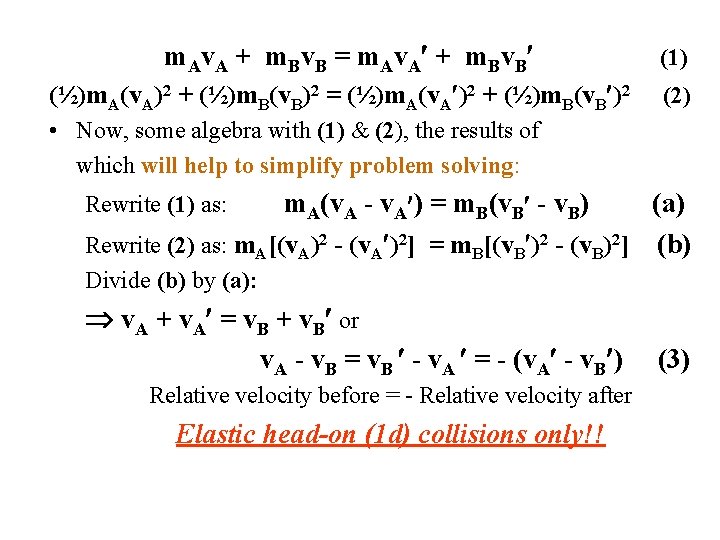
m. Av. A + m. Bv. B = m. Av. A + m. Bv. B (½)m. A(v. A)2 + (½)m. B(v. B)2 = (½)m. A(v. A )2 + (½)m. B(v. B )2 (1) (2) • Now, some algebra with (1) & (2), the results of which will help to simplify problem solving: (a) Rewrite (2) as: m. A[(v. A)2 - (v. A )2] = m. B[(v. B )2 - (v. B)2] (b) Rewrite (1) as: m. A(v. A - v. A ) = m. B(v. B - v. B) Divide (b) by (a): v. A + v. A = v. B + v. B or v. A - v. B = v. B - v. A = - (v. A - v. B ) Relative velocity before = - Relative velocity after Elastic head-on (1 d) collisions only!! (3)
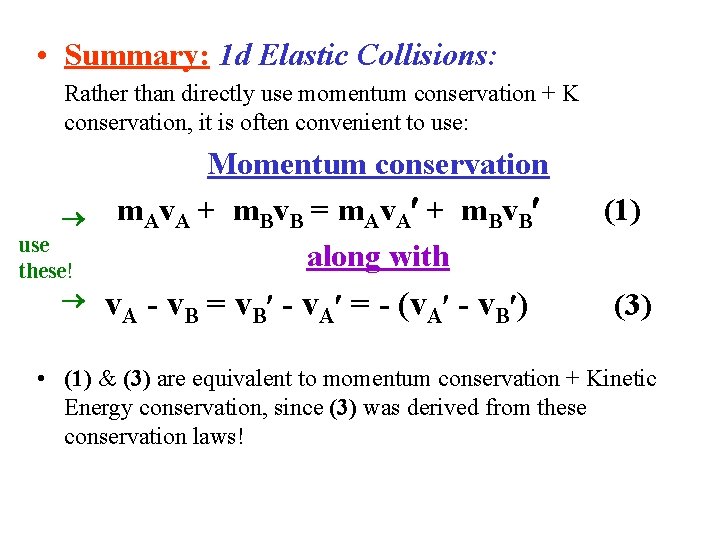
• Summary: 1 d Elastic Collisions: Rather than directly use momentum conservation + K conservation, it is often convenient to use: use these! Momentum conservation m. Av. A + m. Bv. B = m. Av. A + m. Bv. B along with v. A - v. B = v. B - v. A = - (v. A - v. B ) (1) (3) • (1) & (3) are equivalent to momentum conservation + Kinetic Energy conservation, since (3) was derived from these conservation laws!
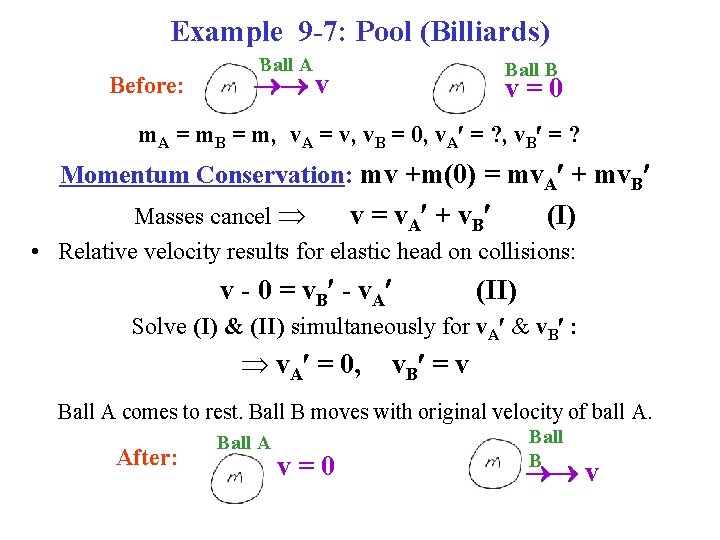
Example 9 -7: Pool (Billiards) Before: Ball A Ball B v v=0 m. A = m. B = m, v. A = v, v. B = 0, v. A = ? , v. B = ? Momentum Conservation: mv +m(0) = mv. A + mv. B Masses cancel v = v. A + v. B (I) • Relative velocity results for elastic head on collisions: v - 0 = v. B - v. A (II) Solve (I) & (II) simultaneously for v. A & v. B : v. A = 0, v. B = v Ball A comes to rest. Ball B moves with original velocity of ball A. After: Ball A v=0 Ball B v
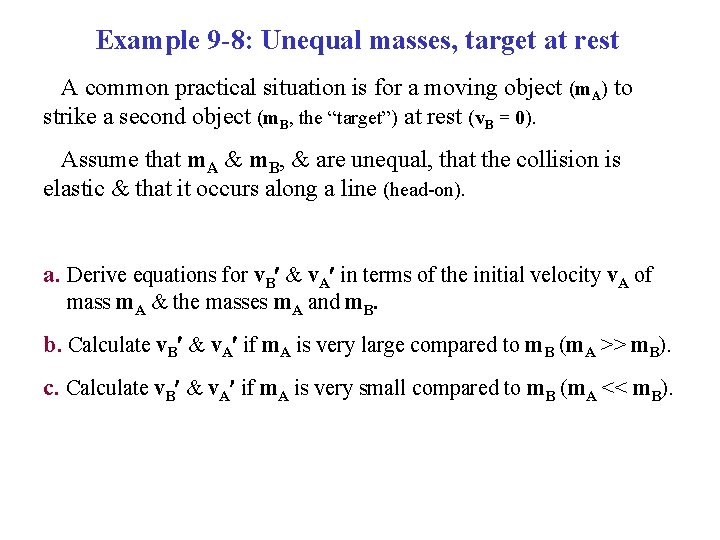
Example 9 -8: Unequal masses, target at rest A common practical situation is for a moving object (m. A) to strike a second object (m. B, the “target”) at rest (v. B = 0). Assume that m. A & m. B, & are unequal, that the collision is elastic & that it occurs along a line (head-on). a. Derive equations for v. B & v. A in terms of the initial velocity v. A of mass m. A & the masses m. A and m. B. b. Calculate v. B & v. A if m. A is very large compared to m. B (m. A >> m. B). c. Calculate v. B & v. A if m. A is very small compared to m. B (m. A << m. B).
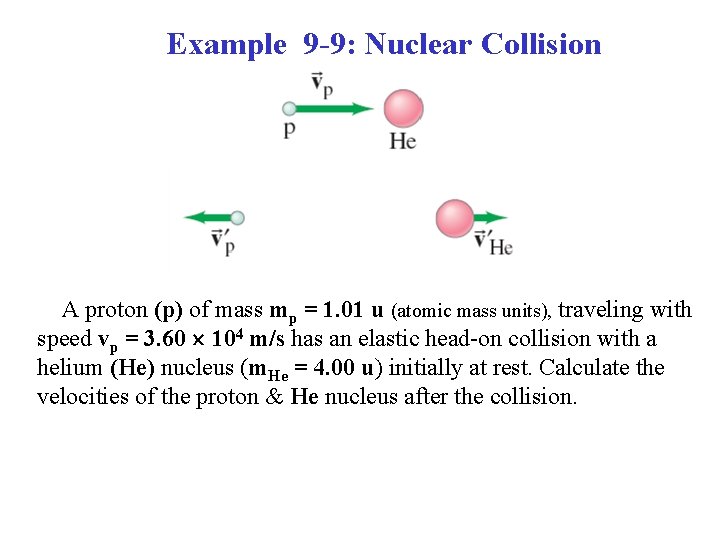
Example 9 -9: Nuclear Collision A proton (p) of mass mp = 1. 01 u (atomic mass units), traveling with speed vp = 3. 60 104 m/s has an elastic head-on collision with a helium (He) nucleus (m. He = 4. 00 u) initially at rest. Calculate the velocities of the proton & He nucleus after the collision.
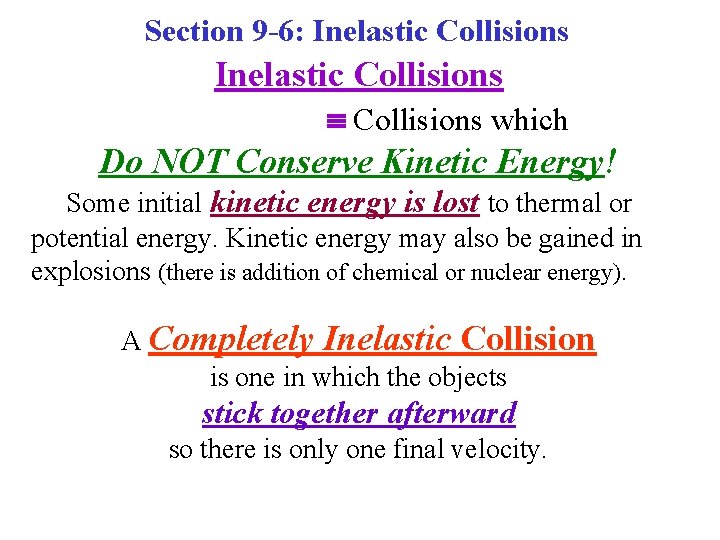
Section 9 -6: Inelastic Collisions which Do NOT Conserve Kinetic Energy! Some initial kinetic energy is lost to thermal or potential energy. Kinetic energy may also be gained in explosions (there is addition of chemical or nuclear energy). A Completely Inelastic Collision is one in which the objects stick together afterward so there is only one final velocity.
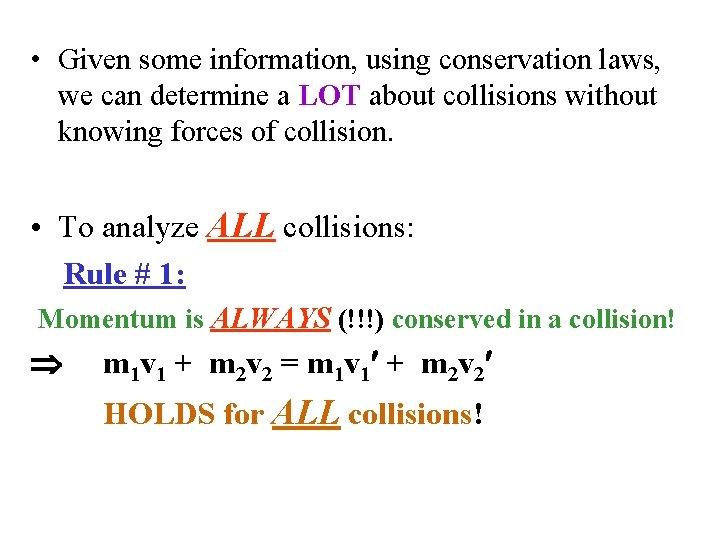
• Given some information, using conservation laws, we can determine a LOT about collisions without knowing forces of collision. • To analyze ALL collisions: Rule # 1: Momentum is ALWAYS (!!!) conserved in a collision! m 1 v 1 + m 2 v 2 = m 1 v 1 + m 2 v 2 HOLDS for ALL collisions!
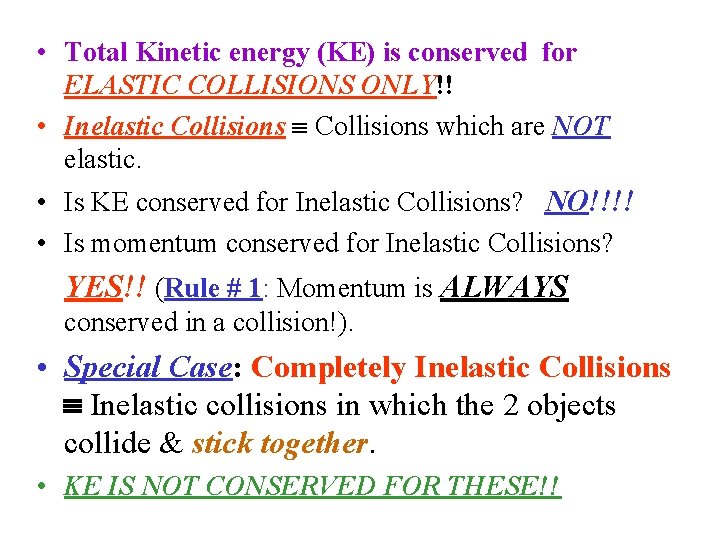
• Total Kinetic energy (KE) is conserved for ELASTIC COLLISIONS ONLY!! • Inelastic Collisions which are NOT elastic. • Is KE conserved for Inelastic Collisions? NO!!!! • Is momentum conserved for Inelastic Collisions? YES!! (Rule # 1: Momentum is ALWAYS conserved in a collision!). • Special Case: Completely Inelastic Collisions Inelastic collisions in which the 2 objects collide & stick together. • KE IS NOT CONSERVED FOR THESE!!
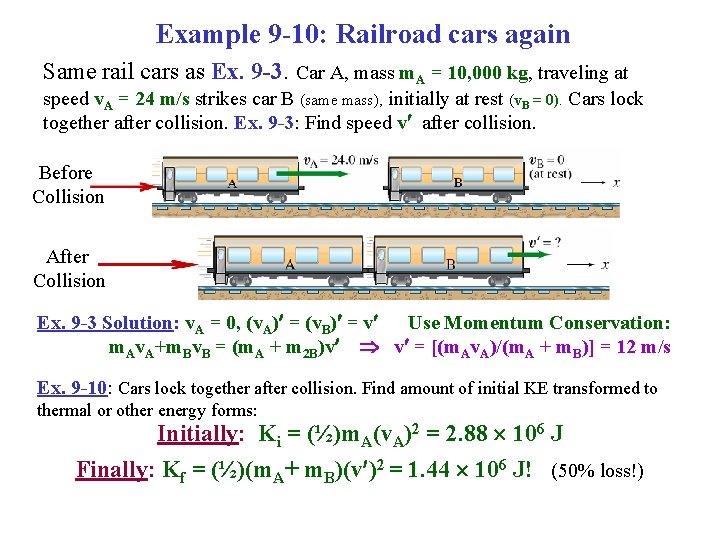
Example 9 -10: Railroad cars again Same rail cars as Ex. 9 -3. Car A, mass m. A = 10, 000 kg, traveling at speed v. A = 24 m/s strikes car B (same mass), initially at rest (v. B = 0). Cars lock together after collision. Ex. 9 -3: Find speed v after collision. Before Collision After Collision Ex. 9 -3 Solution: v. A = 0, (v. A) = (v. B) = v Use Momentum Conservation: m. Av. A+m. Bv. B = (m. A + m 2 B)v v = [(m. Av. A)/(m. A + m. B)] = 12 m/s Ex. 9 -10: Cars lock together after collision. Find amount of initial KE transformed to thermal or other energy forms: Initially: Ki = (½)m. A(v. A)2 = 2. 88 106 J Finally: Kf = (½)(m. A+ m. B)(v )2 = 1. 44 106 J! (50% loss!)
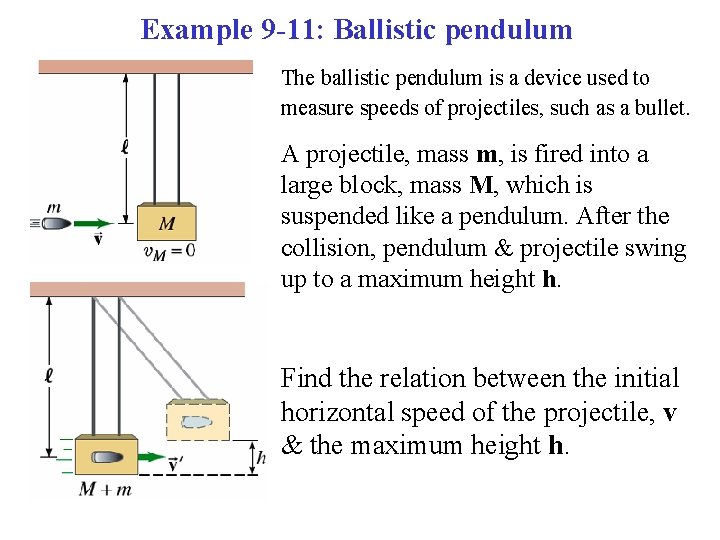
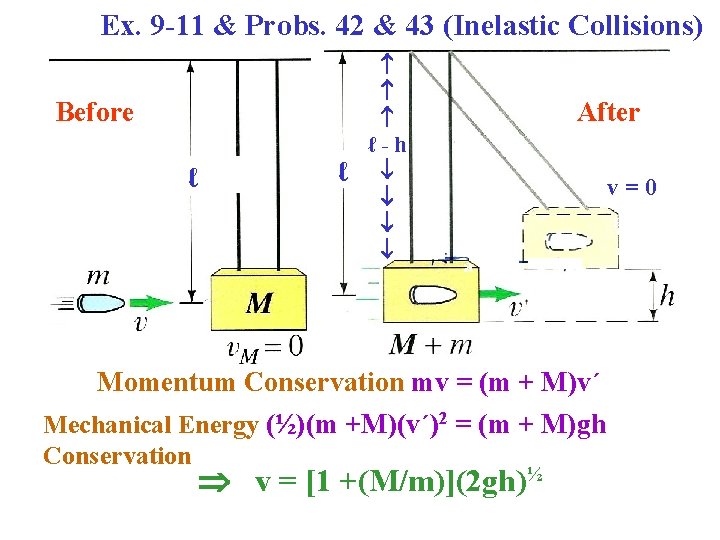
Example 9 -11: Ballistic pendulum The ballistic pendulum is a device used to measure speeds of projectiles, such as a bullet. A projectile, mass m, is fired into a large block, mass M, which is suspended like a pendulum. After the collision, pendulum & projectile swing up to a maximum height h. Find the relation between the initial horizontal speed of the projectile, v & the maximum height h.
Ex. 9 -11 & Probs. 42 & 43 (Inelastic Collisions) Before ℓ ℓ ℓ-h a After a v=0 a a a Momentum Conservation mv = (m + M)v´ Mechanical Energy (½)(m +M)(v´)2 = (m + M)gh Conservation v = [1 +(M/m)](2 gh)½
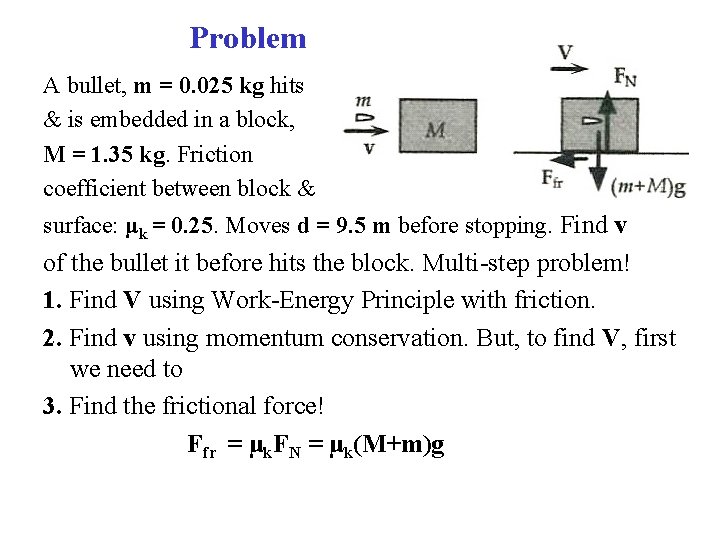
Problem A bullet, m = 0. 025 kg hits & is embedded in a block, M = 1. 35 kg. Friction coefficient between block & surface: μk = 0. 25. Moves d = 9. 5 m before stopping. Find v of the bullet it before hits the block. Multi-step problem! 1. Find V using Work-Energy Principle with friction. 2. Find v using momentum conservation. But, to find V, first we need to 3. Find the frictional force! Ffr = μk. FN = μk(M+m)g
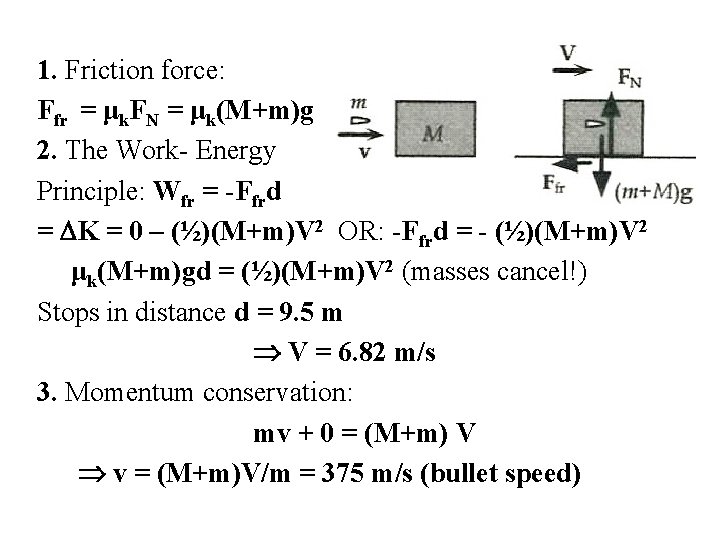
1. Friction force: Ffr = μk. FN = μk(M+m)g 2. The Work- Energy Principle: Wfr = -Ffrd = K = 0 – (½)(M+m)V 2 OR: -Ffrd = - (½)(M+m)V 2 μk(M+m)gd = (½)(M+m)V 2 (masses cancel!) Stops in distance d = 9. 5 m V = 6. 82 m/s 3. Momentum conservation: mv + 0 = (M+m) V v = (M+m)V/m = 375 m/s (bullet speed)
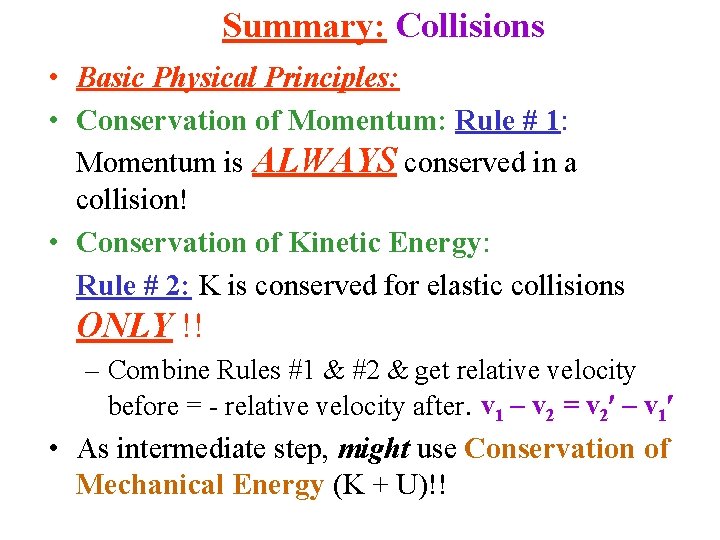
Summary: Collisions • Basic Physical Principles: • Conservation of Momentum: Rule # 1: Momentum is ALWAYS conserved in a collision! • Conservation of Kinetic Energy: Rule # 2: K is conserved for elastic collisions ONLY !! – Combine Rules #1 & #2 & get relative velocity before = - relative velocity after. v 1 – v 2 = v 2 – v 1 • As intermediate step, might use Conservation of Mechanical Energy (K + U)!!
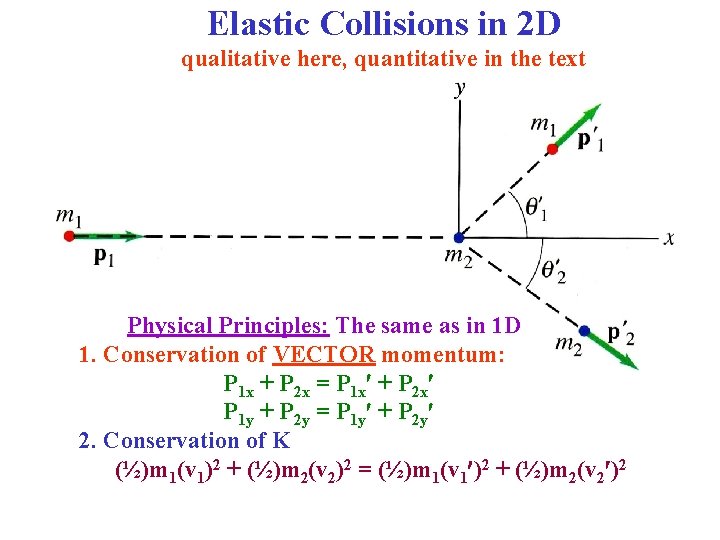
Elastic Collisions in 2 D qualitative here, quantitative in the text Physical Principles: The same as in 1 D 1. Conservation of VECTOR momentum: P 1 x + P 2 x = P 1 x + P 2 x P 1 y + P 2 y = P 1 y + P 2 y 2. Conservation of K (½)m 1(v 1)2 + (½)m 2(v 2)2 = (½)m 1(v 1 )2 + (½)m 2(v 2 )2