
Impulse and Conservation of momentum REVIEW What causes

- Slides: 23
Impulse and Conservation of momentum REVIEW
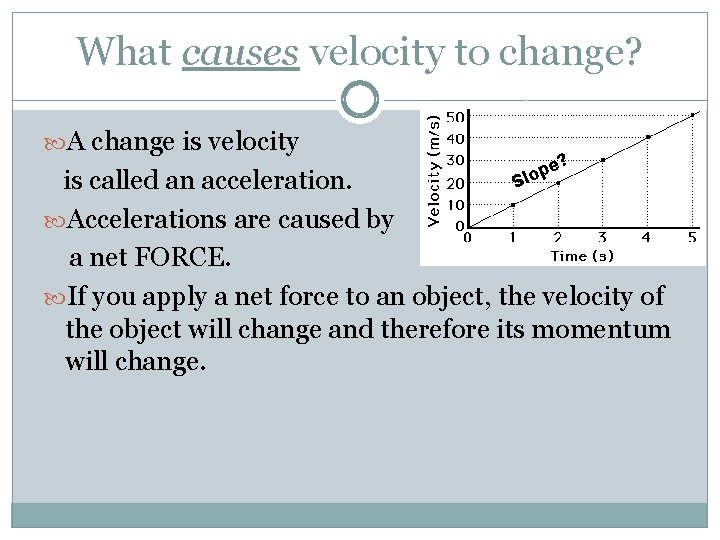
What causes velocity to change? A change is velocity pe? o l S is called an acceleration. Accelerations are caused by a net FORCE. If you apply a net force to an object, the velocity of the object will change and therefore its momentum will change.
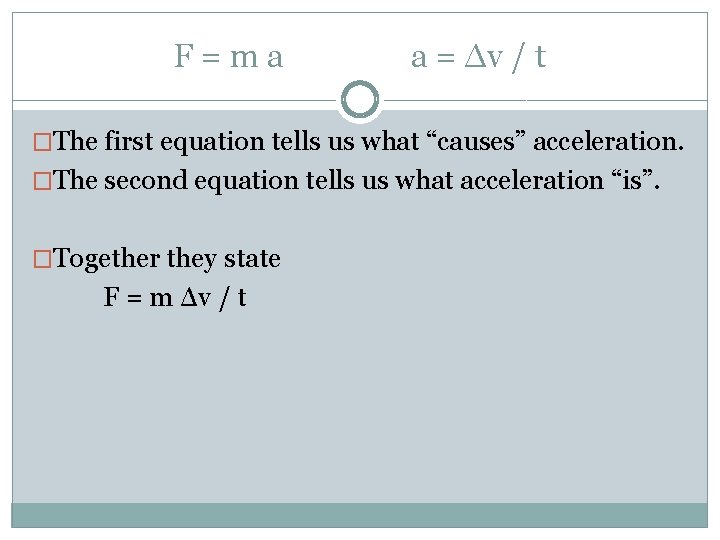
F=ma a = Δv / t �The first equation tells us what “causes” acceleration. �The second equation tells us what acceleration “is”. �Together they state F = m Δv / t
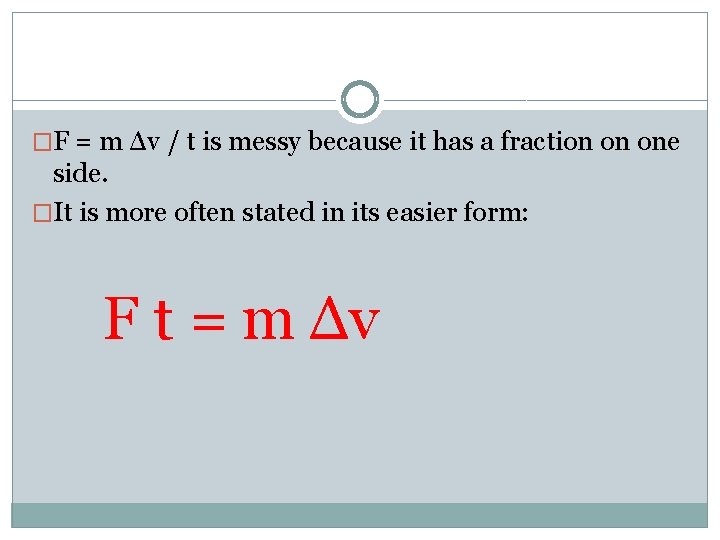
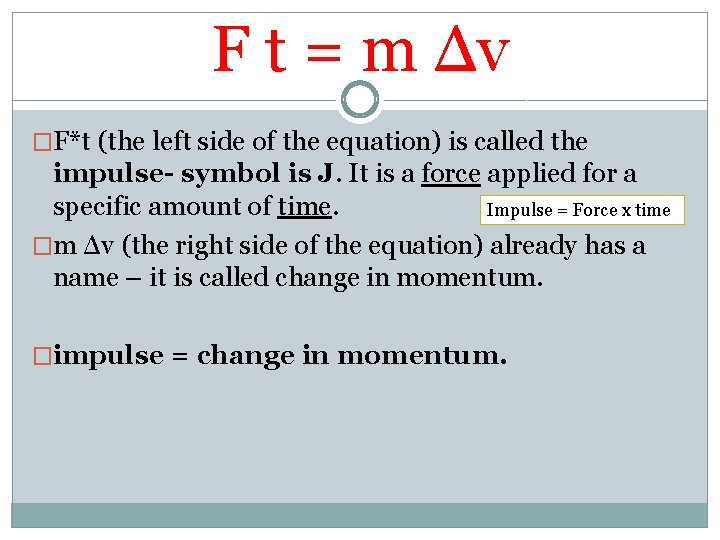
�F = m Δv / t is messy because it has a fraction on one side. �It is more often stated in its easier form: F t = m Δv
F t = m Δv �F*t (the left side of the equation) is called the impulse- symbol is J. It is a force applied for a specific amount of time. Impulse = Force x time �m Δv (the right side of the equation) already has a name – it is called change in momentum. �impulse = change in momentum.
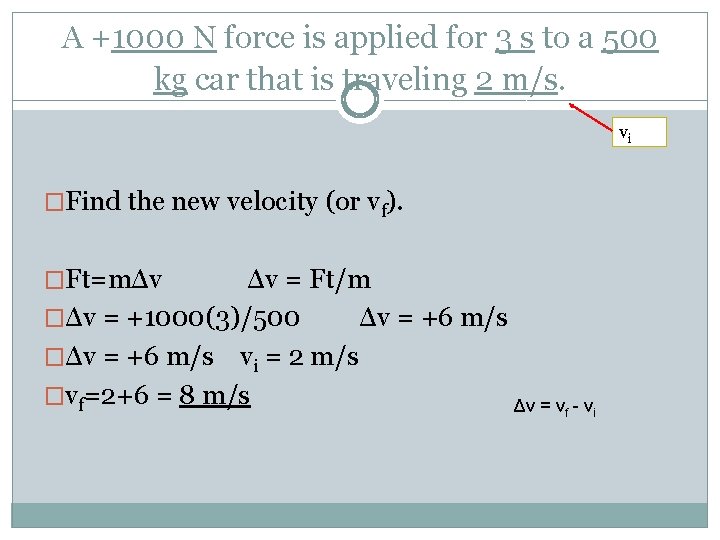
A +1000 N force is applied for 3 s to a 500 kg car that is traveling 2 m/s. vi �Find the new velocity (or vf). �Ft=mΔv Δv = Ft/m �Δv = +1000(3)/500 Δv = +6 m/s �Δv = +6 m/s vi = 2 m/s �vf=2+6 = 8 m/s Δv = vf - vi
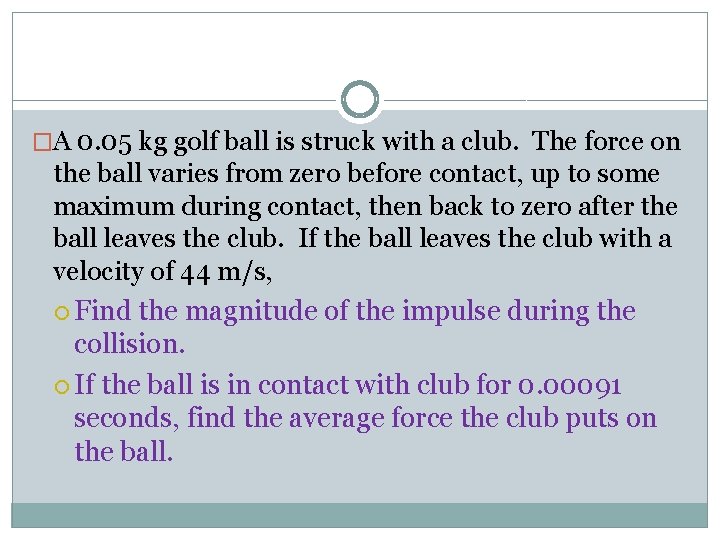
�A 0. 05 kg golf ball is struck with a club. The force on the ball varies from zero before contact, up to some maximum during contact, then back to zero after the ball leaves the club. If the ball leaves the club with a velocity of 44 m/s, Find the magnitude of the impulse during the collision. If the ball is in contact with club for 0. 00091 seconds, find the average force the club puts on the ball.
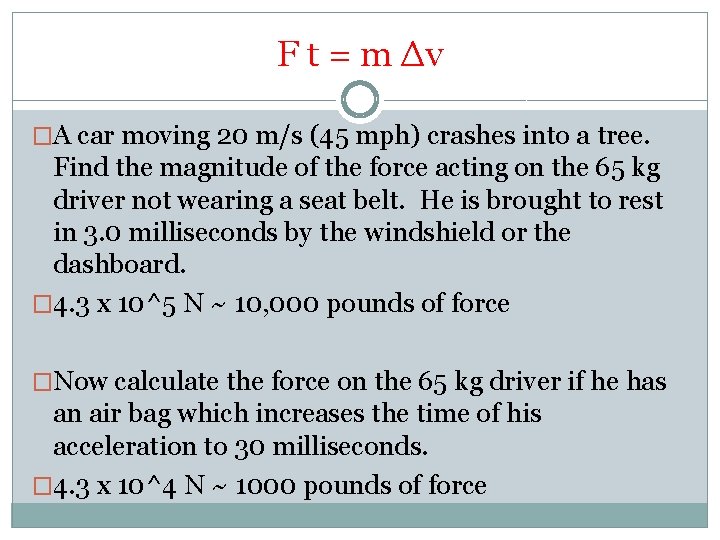
F t = m Δv �A car moving 20 m/s (45 mph) crashes into a tree. Find the magnitude of the force acting on the 65 kg driver not wearing a seat belt. He is brought to rest in 3. 0 milliseconds by the windshield or the dashboard. � 4. 3 x 10^5 N ~ 10, 000 pounds of force �Now calculate the force on the 65 kg driver if he has an air bag which increases the time of his acceleration to 30 milliseconds. � 4. 3 x 10^4 N ~ 1000 pounds of force
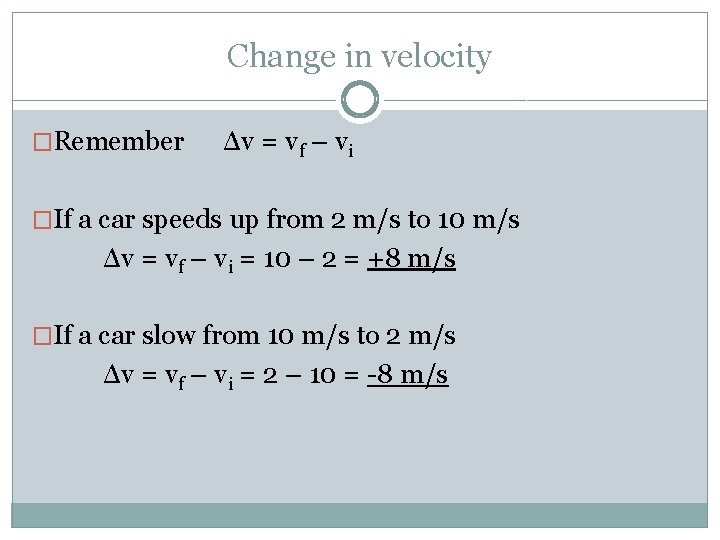
Change in velocity �Remember Δv = vf – vi �If a car speeds up from 2 m/s to 10 m/s Δv = vf – vi = 10 – 2 = +8 m/s �If a car slow from 10 m/s to 2 m/s Δv = vf – vi = 2 – 10 = -8 m/s
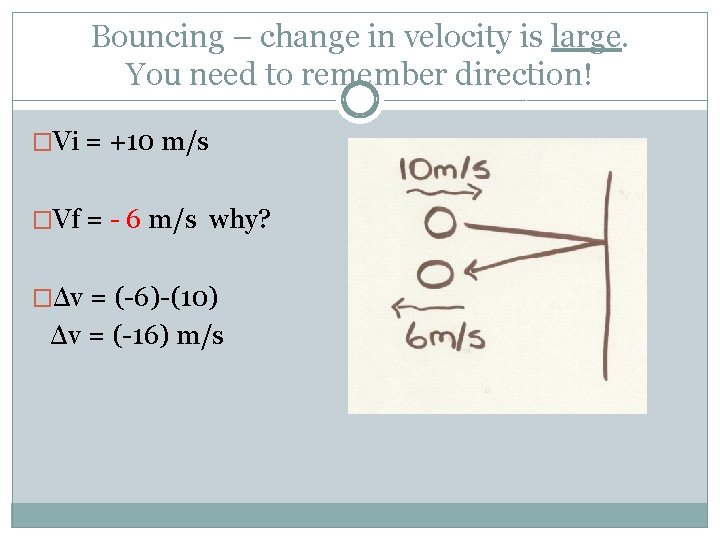
Bouncing – change in velocity is large. You need to remember direction! �Vi = +10 m/s �Vf = - 6 m/s why? �Δv = (-6)-(10) Δv = (-16) m/s
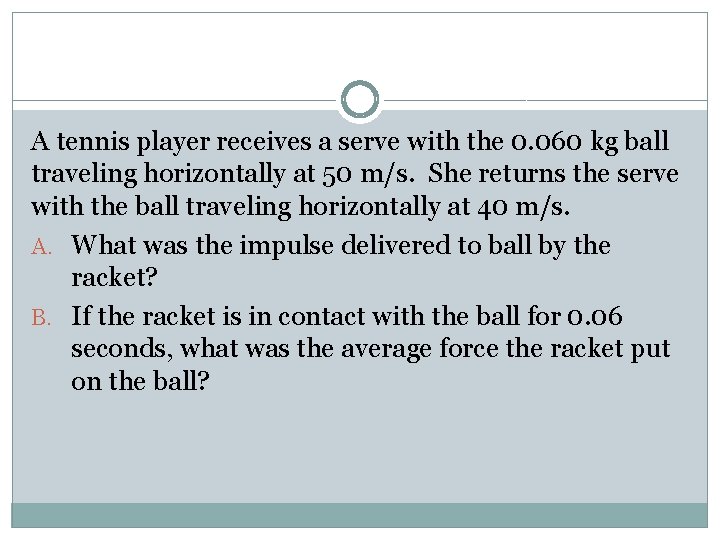
A tennis player receives a serve with the 0. 060 kg ball traveling horizontally at 50 m/s. She returns the serve with the ball traveling horizontally at 40 m/s. A. What was the impulse delivered to ball by the racket? B. If the racket is in contact with the ball for 0. 06 seconds, what was the average force the racket put on the ball?
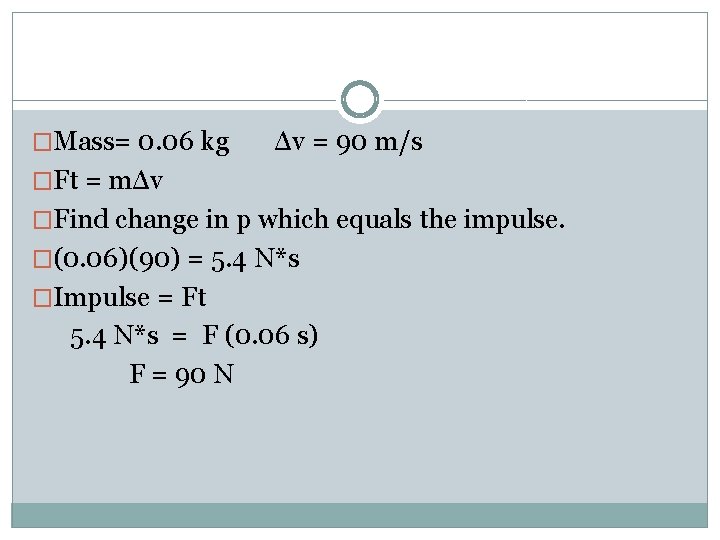
�Mass= 0. 06 kg Δv = 90 m/s �Ft = mΔv �Find change in p which equals the impulse. �(0. 06)(90) = 5. 4 N*s �Impulse = Ft 5. 4 N*s = F (0. 06 s) F = 90 N
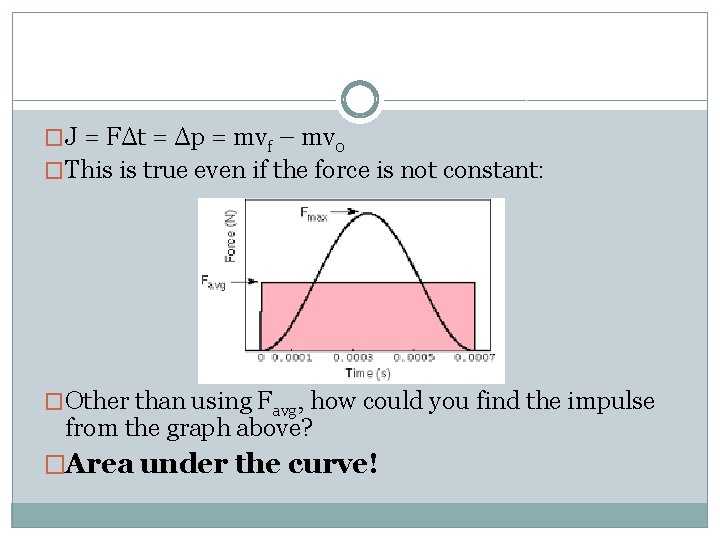
�J = FΔt = Δp = mvf – mv 0 �This is true even if the force is not constant: �Other than using Favg, how could you find the impulse from the graph above? �Area under the curve!
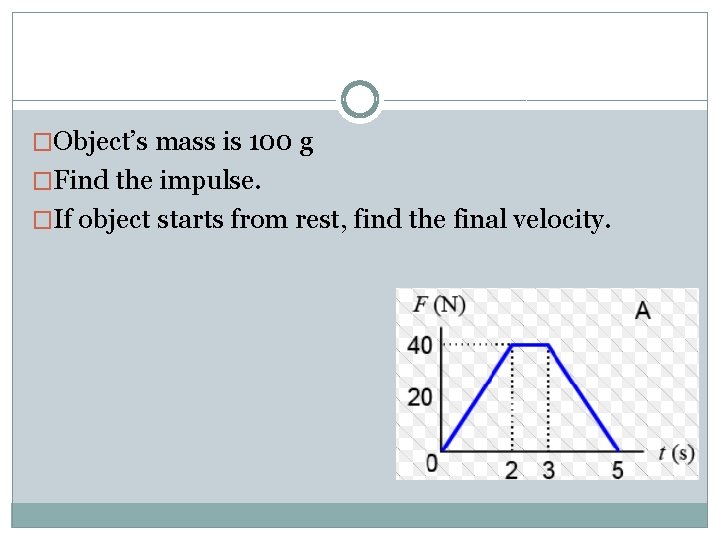
�Object’s mass is 100 g �Find the impulse. �If object starts from rest, find the final velocity.
�Impulse is the area under the curve (2 triangles and a rectangle) You should get a total area of 120 N*s �Impulse = Δmomentum p = mΔv 120 N*s = 0. 1 kg Δv Δv = 1200 m/s Since the object starts from rest and it’s velocity changes 1200 m/s, the final velocity is 1200 m/s
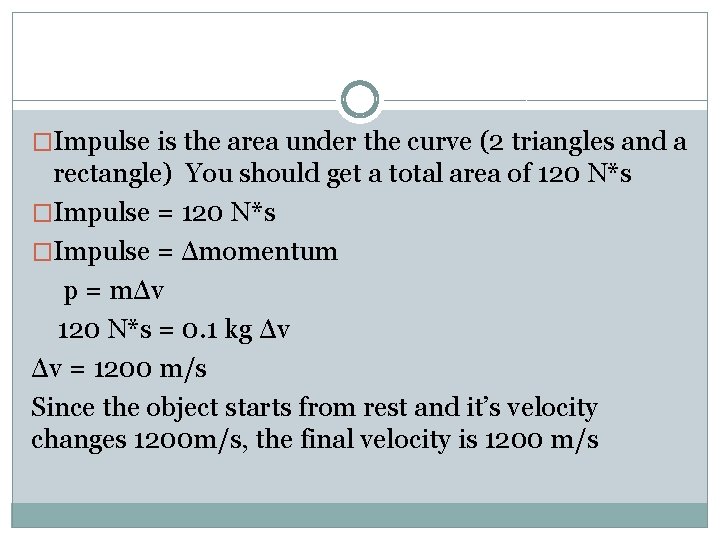
�Object’s mass is 15 kg and Is traveling at 30 m/s in forward direction. Find the impulse. Find the object’s final velocity.
�Impulse = area under the curve �J = 100 N*s this also = Δp �Δp = mΔv 100 = (15)(Δv) Δv = 6. 67 m/s The initial velocity was 30 m/s and the impulse caused a Δv of 6. 67 m/s. The final velocity is 36. 67 m/s
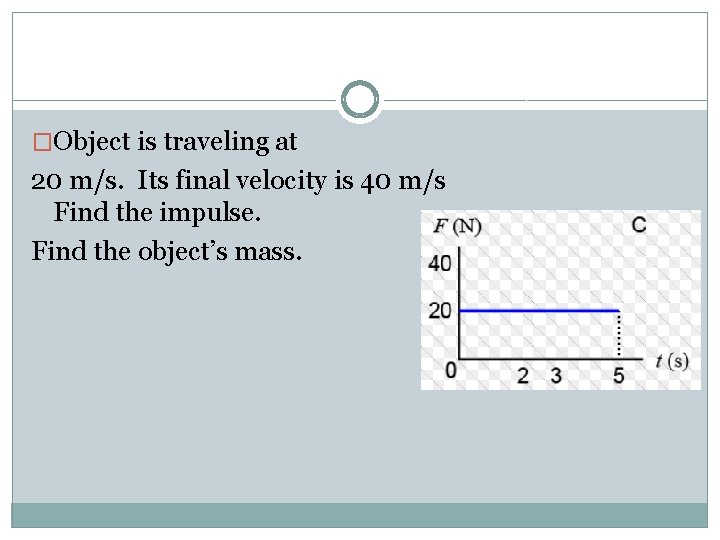
�Object is traveling at 20 m/s. Its final velocity is 40 m/s Find the impulse. Find the object’s mass.
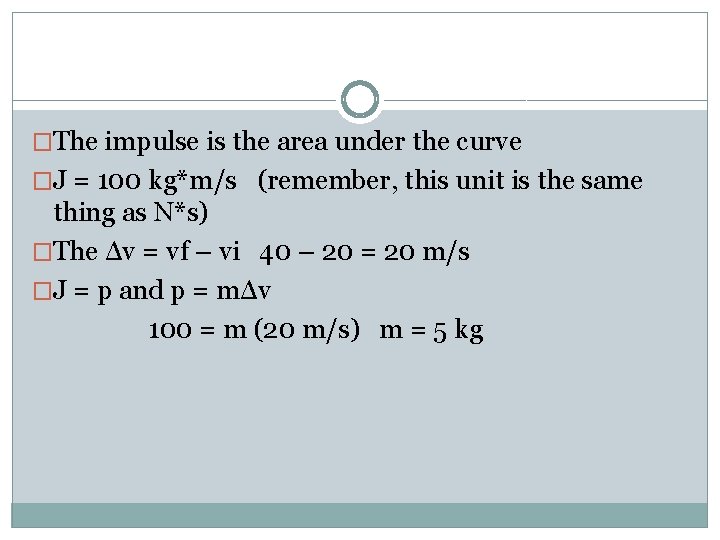
�The impulse is the area under the curve �J = 100 kg*m/s (remember, this unit is the same thing as N*s) �The Δv = vf – vi 40 – 20 = 20 m/s �J = p and p = mΔv 100 = m (20 m/s) m = 5 kg
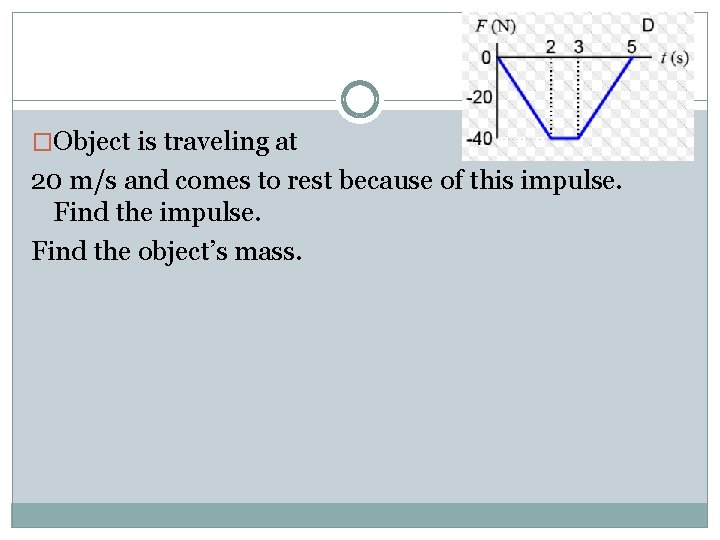
�Object is traveling at 20 m/s and comes to rest because of this impulse. Find the object’s mass.
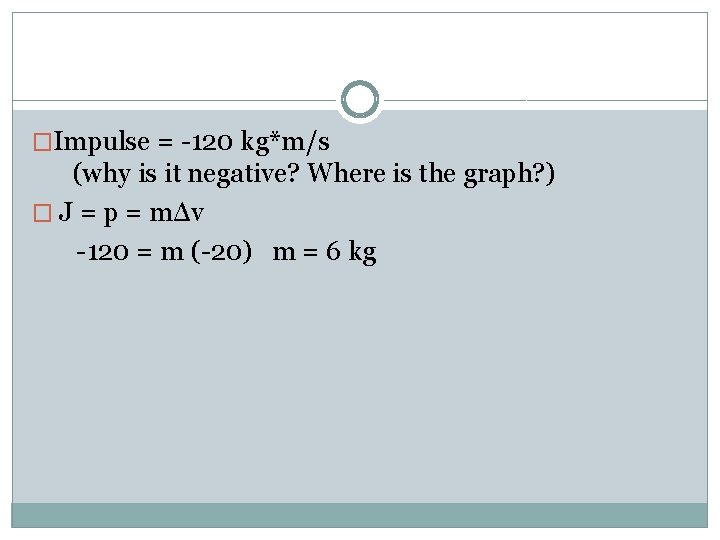
�Impulse = -120 kg*m/s (why is it negative? Where is the graph? ) � J = p = mΔv -120 = m (-20) m = 6 kg
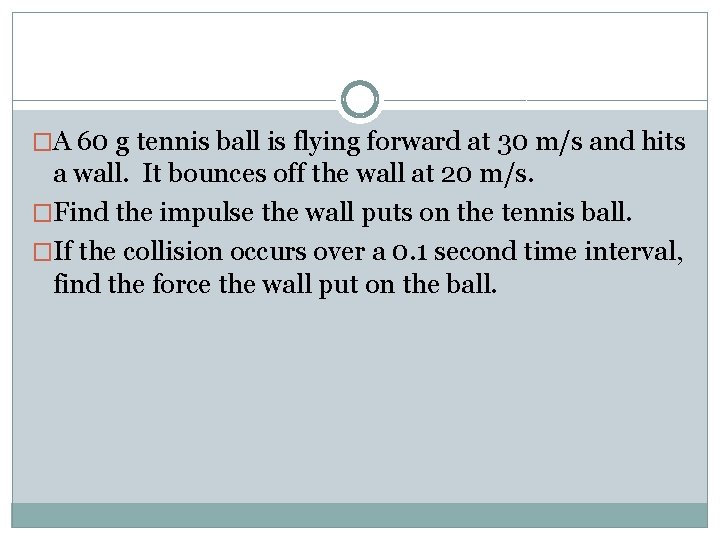
�A 60 g tennis ball is flying forward at 30 m/s and hits a wall. It bounces off the wall at 20 m/s. �Find the impulse the wall puts on the tennis ball. �If the collision occurs over a 0. 1 second time interval, find the force the wall put on the ball.
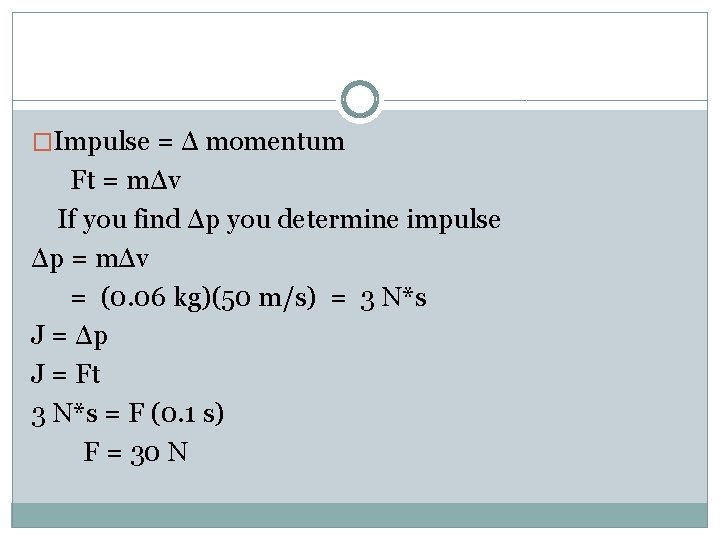
�Impulse = Δ momentum Ft = mΔv If you find Δp you determine impulse Δp = mΔv = (0. 06 kg)(50 m/s) = 3 N*s J = Δp J = Ft 3 N*s = F (0. 1 s) F = 30 N